

Most people learn how to make a travel itinerary the hard way: a spreadsheet with forty rows, a color code nobody remembers, and a day-three afternoon spent standing on a train platform wondering why a “quick” cross-town stop took ninety minutes. The itinerary was detailed. It just wasn’t built around how a body, a transit map and an opening-hours sign actually behave.
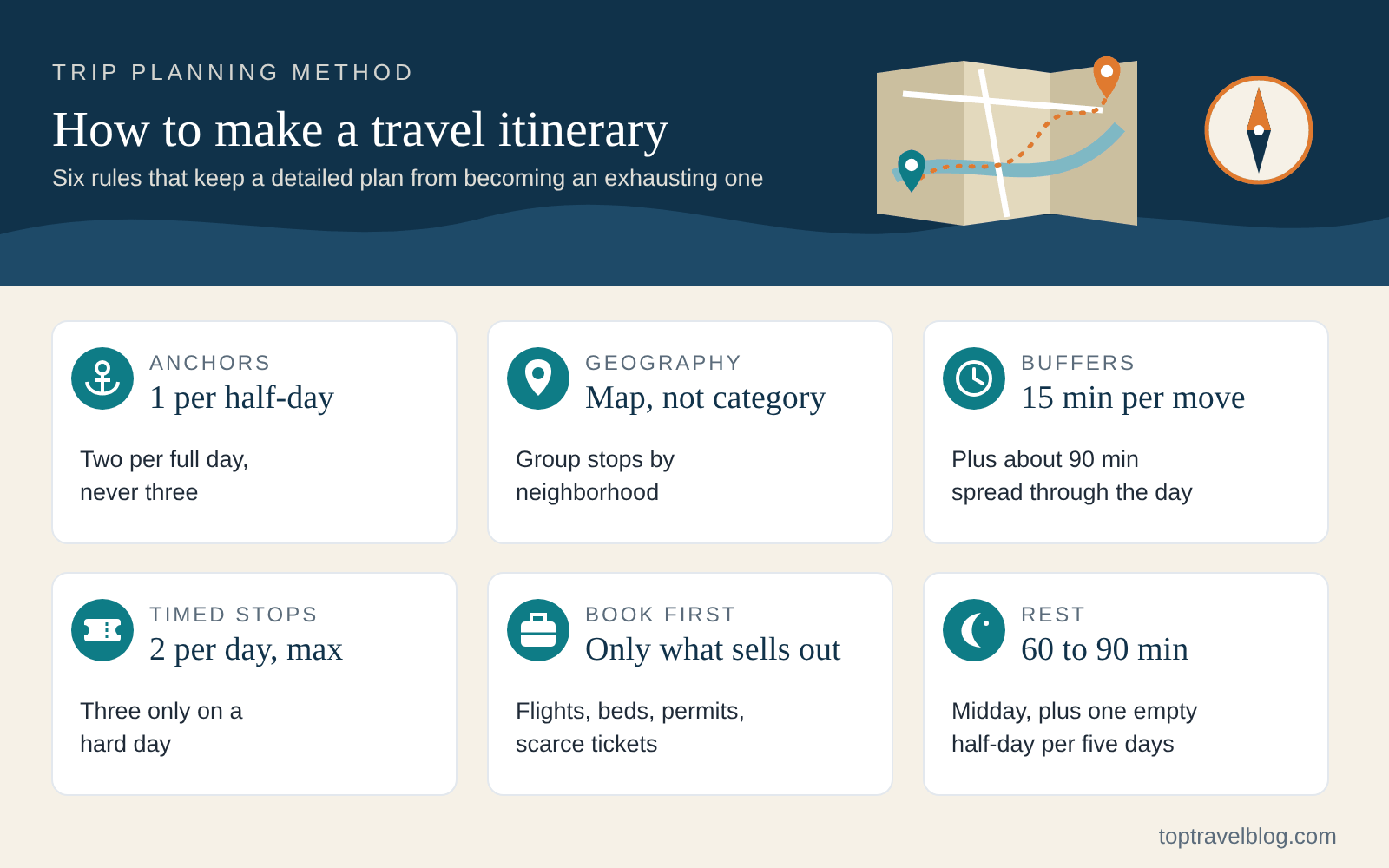
Here is the short answer. A good itinerary has one anchor per half-day, stops grouped by geography rather than by category, a buffer after every transfer, and a short list of tickets booked early. Everything else stays loose on purpose. Plan the three or four things that can fail, and leave the rest to the afternoon you are actually in.
That sounds almost too simple, so this guide breaks how to make a travel itinerary into six steps you can follow with any destination, any group and any length of trip. I have used this method for long weekends in cities I know well, for ten days across three countries, and for a road trip with a toddler who napped on a strict schedule.
It works because it plans around constraints, not ambition, which is the real secret of how to make a travel itinerary that survives contact with the trip.
You will get the exact order I work in, the numbers I use for walking and transit time, a way to decide what to book first, three worked examples with real distances, and the mistakes I see most often when friends send me their drafts. If you are still at the stage of choosing a destination and dates, start with how to plan a trip and come back here when you have a place and a window.
Quick facts: how to make a travel itinerary at a glance
- Best for: first-time planners, over-planners, couples and families who want a trip with structure but not a schedule that runs their day.
- Time it takes: two to three focused hours for a 4-day city trip, a weekend of evenings for a multi-city trip.
- The core rule: one anchor per half-day, with a flexible block and a buffer around it. Three to four timed activities per day is the ceiling, not the goal.
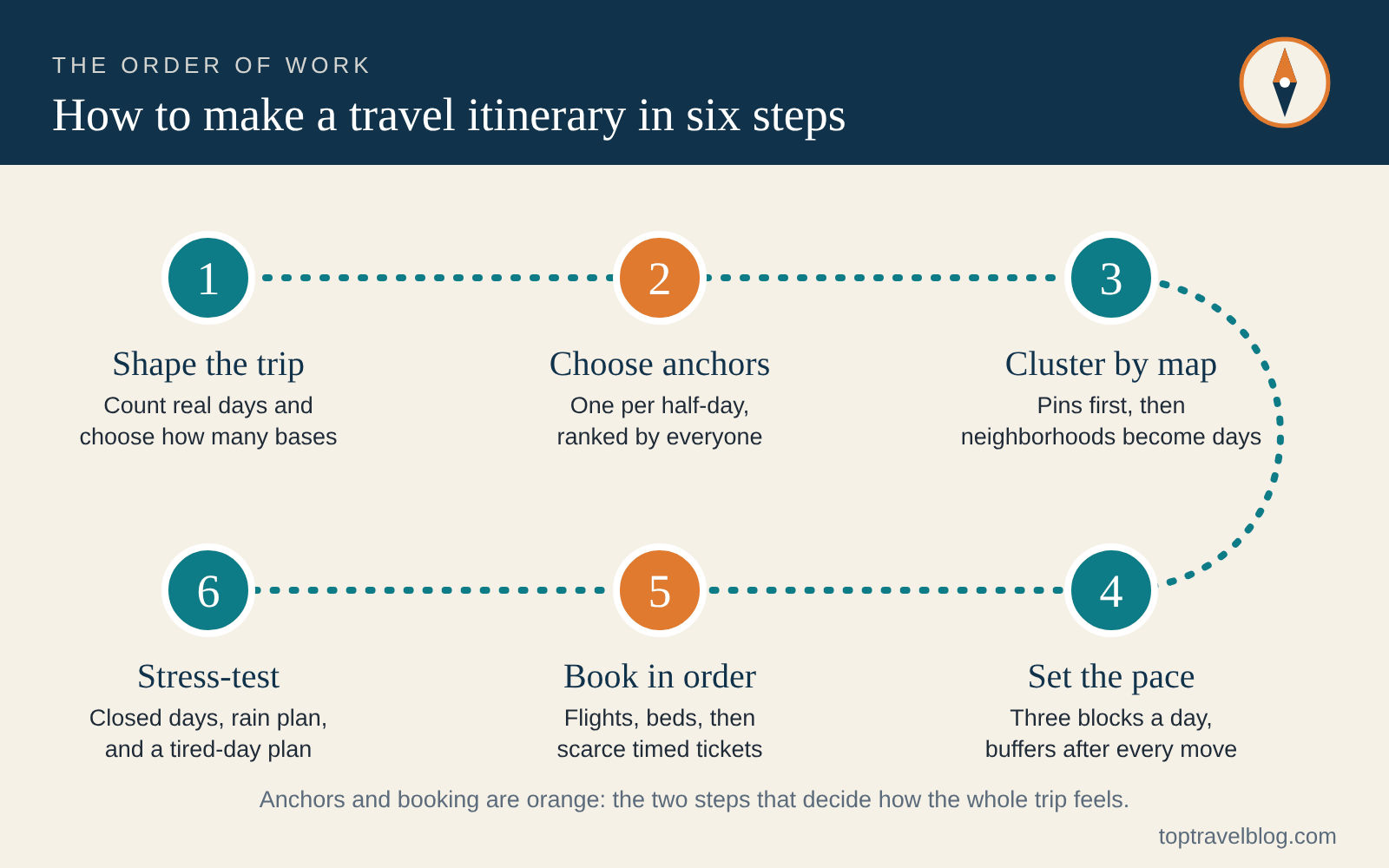
- Order of work: shape the trip, pick anchors, cluster by map, set the pace, book the scarce things, stress-test the plan.
- Tools you need: a map app with saved lists, one shared document, and a calendar for the handful of fixed times.
- Biggest traps: counting transit as zero minutes, ignoring closed days, stacking two big sights in one morning, and planning the arrival day as a full day.
What a good itinerary is, and what it is not
Before the steps, a definition, because most failures in how to make a travel itinerary come from the wrong idea of the product. An itinerary is not a schedule. A schedule assigns a time to everything and punishes you for being fifteen minutes late. An itinerary is a decision made in advance about order, geography and priority, so that when you are tired at 3 p.m. you do not have to decide anything.
I think of it as three layers. The first is the fixed layer: flights, hotel nights, timed tickets, a dinner reservation you cared enough to make. These have clock times and they are the skeleton. The second is the anchor layer:
the one thing per half-day that is the reason you are in that neighborhood. The third is the flex layer: a short list of nearby options you will take or skip depending on energy, weather and what you walk past.
Once you see it this way, how to make a travel itinerary becomes a question of sizing each layer correctly. People who burn out have a bloated fixed layer, with six timed entries in a day. People who feel lost have no anchor layer, so every morning begins with a search for “things to do near me” and a forty-minute argument.
The test I use on any draft
Read the day aloud as if you were describing it to a friend. If you cannot say it in two sentences (“Morning at the Alhambra, then lunch and a wander through the Albaicín; dinner somewhere on the hill”), the day has too many moving parts. If your description needs the words “then quickly” more than once, the day is overloaded.
A second test is the tired-Tuesday test. Imagine day four, you slept badly, it is raining, and one of your two people has a blister. Which items do you cut, and does the day still feel like a good day? If the answer is “I cut the anchor and nothing is left”, the plan is brittle. A sturdy plan loses its flex layer first and still holds together.
Detailed versus exhausting
The title of this guide promises detail without exhaustion, so here is how I separate the two when thinking about how to make a travel itinerary. Detail means knowing: opening days, walking distances, which station exit to use, where lunch is, what time the last train leaves. Exhaustion comes from commitment: pre-paying, pre-timing and pre-deciding things that do not need to be fixed. You can know a great deal about a day and commit to very little of it.
That distinction is the whole design principle of how to make a travel itinerary without wearing yourself out. Research as much as you enjoy. Commit only where waiting costs you money or access. A detailed itinerary written this way is a map of options with a few fixed pins, which is a very different object from a minute-by-minute timetable, even if both are ten pages long.
Step 1: Shape the trip before you open a map
The most expensive mistakes in how to make a travel itinerary happen before any sightseeing is chosen. They are decisions about dates, length and number of bases, and they quietly cap what any later plan can do. Spend your first hour here, not on restaurant lists.
Count real days, not calendar days
A “seven-day trip” rarely contains seven days. If you fly out on Friday evening and land Saturday at 2 p.m., that Saturday is a half-day at best, because customs, transit into the city, hotel check-in (usually mid-afternoon) and jet lag eat the rest of it. The last day is similar: a noon flight means you leave the hotel at 8 or 9 a.m.
My arithmetic for how to make a travel itinerary that fits the calendar is simple. Subtract one half-day for arrival and one half-day for departure, and subtract another half-day for every long transfer between bases. A week with two cities usually has five and a half usable days, not seven. If you want a deeper way of choosing length, how many days you need for a vacation trip walks through the trade-offs destination by destination.
Decide how many bases you are willing to have
Every time you change hotels you pay in packing, checking out, getting to a station and settling in. I budget roughly half a day per move, even on a fast train, and more when it involves an airport. So the most useful early question is not “what do I want to see” but “how many beds do I want to sleep in”.
For trips under a week, one base is almost always right, with day trips if you must. For ten days, two or three bases is comfortable. For two weeks, I would still stop at four. If you are heading down the multi-stop road, how to plan a multi-city trip covers the transit math, and open-jaw flights can save you a day of backtracking by letting you land in one city and fly home from another.
Fix the non-negotiables
Write down, in one place, what is already decided: dates, the airport, who is traveling and what each person needs. That last part matters more than it sounds. A parent who needs a midday break, a traveler who cannot walk more than three miles, a teenager who will only get out of bed for one specific museum: those are constraints, and constraints are free design information.
I also set a rough daily budget for activities at this stage, because it decides which anchors are realistic. If you plan to spend about $60 per person per day on tickets and tours, a three-museum day or a pricey harbor cruise will not fit every day. Knowing that on day zero saves you from cutting things in the middle of the trip.
Pick the season with the itinerary in mind
Daylight, heat and closures change how to make a travel itinerary for any given month, because they change what a day can hold. In northern Europe in December, the sun is down by 4 p.m., so outdoor anchors belong in the morning.
In the desert Southwest in July, the reverse is true: you walk at sunrise and sit indoors by 11 a.m. A plan built for April that gets used in August will fail even though nothing in it is wrong.
Tip: Write the sunrise and sunset times for your first and last day at the top of your plan. They tell you how many usable outdoor hours you really have, and they often change which day you put a viewpoint or a hike.
Step 2: Choose your anchors, the part of how to make a travel itinerary that matters most
Anchors are the first thing I ask about when someone wants to know how to make a travel itinerary. An anchor is the single activity that justifies being in a particular place at a particular time of day. A morning in the Vatican Museums is an anchor. “Walk around Trastevere” is a flex item. The anchor decides where you start, how long you spend and where lunch will be.
Brainstorm wide, then rank hard
When people ask me how to make a travel itinerary, I tell them to start by dumping every idea into a list without judging it. Use a notes app, a shared document or a map app with saved places. Pull from official tourism sites, guidebooks, friends, and the places that keep appearing in your own searches. Do not worry about order yet.
Then rank. For each person traveling, mark three must-do items and three would-be-nice items. Compare the lists. Whatever appears twice becomes an anchor candidate. What appears once goes into the flex pile, and it may still make it in, but it does not get a reservation or a time slot. This single exercise settles most disagreements, because it makes the trade-offs visible and fair.
How many anchors you can afford
The rule of thumb I rely on when working out how to make a travel itinerary, tested across dozens of trips: one anchor per half-day, two per full day, never three. A big museum or a hike counts as a full anchor. A smaller sight, a market visit or a viewpoint counts as half an anchor. Two full anchors in a day is already a strong day.
So a four-day city trip supports about eight anchors, and in practice six or seven because arrival and departure days are light. If your ranked list has twenty must-dos, that is not a scheduling problem. It is a signal that you need more days, a different destination, or the honesty to cut. Pushing twenty into four days gets you twenty rushed photographs.
Look for anchors with natural boundaries
Some activities have built-in limits, which makes them easy to plan: a timed museum entry, a ferry crossing, a guided tour of fixed length, a show at 8 p.m. Others sprawl: shopping, “exploring a neighborhood”, a big park. Mix both kinds in each day. A bounded morning followed by a sprawling afternoon gives you a clear start and an easy way to run long or cut short.
I also match anchors to energy. Anything that needs focus (a large art museum, a complicated historic site, a hike with a view at the top) goes before lunch. Anything social, relaxed or low effort (a market, an evening stroll, a long dinner) goes at the end. Putting a three-hour guided tour at 3 p.m. on day five is how groups end up silent and cranky.
Test every anchor against the calendar
Before an anchor is final, check four things: which days it is open, whether it needs a timed ticket, how long people realistically spend there, and whether anything on that date closes the area (a holiday, a marathon, a festival, a strike). Many museums close one day a week, often Monday or Tuesday. The Louvre, for example, closes on Tuesdays and sells its tickets for set time slots through its official ticketing page.
Write the open days next to each anchor and drop them into the calendar. In my experience about one itinerary in three has at least one anchor that lands on its closed day until you do this pass, and fixing it costs nothing at this stage.
Step 3: Cluster stops by geography, then draw the route
This is where most DIY attempts at how to make a travel itinerary fall apart, and where a map does more work than any list. People group activities by type (all museums on one day, all food on another), which looks tidy on paper and sends you across the city six times. Group by place instead.
Put every anchor and flex item on one map
Open a map app and save each candidate as a pin in a single list, using one color for anchors and another for flex items. Zoom out. You will see clusters almost immediately. Four of your ten pins sit within a mile of each other in the old center. Three more line up along one river. One lonely pin is across the water and an hour away.
Each cluster becomes a day, or half a day. The lonely pin becomes a decision: is it worth a dedicated half-day, or does it go? I almost always find that the one pin that feels essential is the one that costs a full day of travel, and seeing that cost on a map makes the call easy.
Use realistic travel times, not map-app optimism
Map apps give you a door-to-door number that quietly assumes you leave at the instant you plan to and never wait. In real life, and in any honest answer to how to make a travel itinerary, add time for each transfer: walking to the station, waiting for the next train, finding the right exit, and the walk from the exit to the entrance. I add these allowances to every leg.
- Walking: plan on about 20 minutes per mile with stops. A 2-mile walk is 40 to 45 minutes once you pause for photos and traffic lights.
- Metro or subway: the posted ride time plus 10 minutes for walking to the platform, waiting and walking out. Add 5 more in big stations with long transfers.
- Bus or tram: posted time plus 15 minutes, because frequencies drop outside rush hours and on Sundays.
- Taxi or rideshare: posted time plus 10 minutes for the pickup and a margin of 30 percent in city traffic at rush hour.
- Intercity train: the ride plus 45 minutes at each end for getting to the station, security or ticket checks, and getting out of the destination station.
- Airport legs: plan the transfer by the worst case, not the average. Two hours before a domestic flight and three before an international one is the standard allowance, and the TSA lists how PreCheck can shorten the security leg.
Order stops along a line, not a loop
A small trick in how to make a travel itinerary that saves legs: inside a cluster, arrange stops so you move in one direction and finish near where you will eat or sleep. A common wasteful pattern is to start at the hotel, go out to the farthest sight, and double back through the rest. Instead, take transport to the far end first and walk back toward home with the day winding down.
Also look at hills and elevation. Climbing from the river to a hilltop castle at 4 p.m. after six hours on your feet is a different trip from taking the funicular at 9 a.m. If a route is mostly uphill, flip the direction so that the steep part comes when people are fresh.
Match each cluster to a day
Now assign clusters to days. This is the part of how to make a travel itinerary that feels like solving a puzzle, and the constraints go in this order:
Closed days, timed tickets you can only get on certain dates, weather windows, then energy. Put your biggest, most demanding cluster on day two or three, after you have adjusted to the time zone and before you are worn out. Day one is an easing-in day. The last full day is for the one thing you will regret skipping, plus packing.
If you are working out how to make a travel itinerary across more than one city, apply the same logic at a larger scale: cluster cities by rail line or flight corridor, then count each move as a half-day. A good test is whether the route could be drawn as a single line without crossing itself. Our guide to planning a multi-city trip without losing days to transit shows how to do exactly that.
Step 4: Set the pace, which is where how to make a travel itinerary stops being exhausting
You now have clusters assigned to days. Before you add a single time, set the shape of each day. This is the step in how to make a travel itinerary that separates a detailed plan from an exhausting one, and it takes about ten minutes per day.
The three-block day
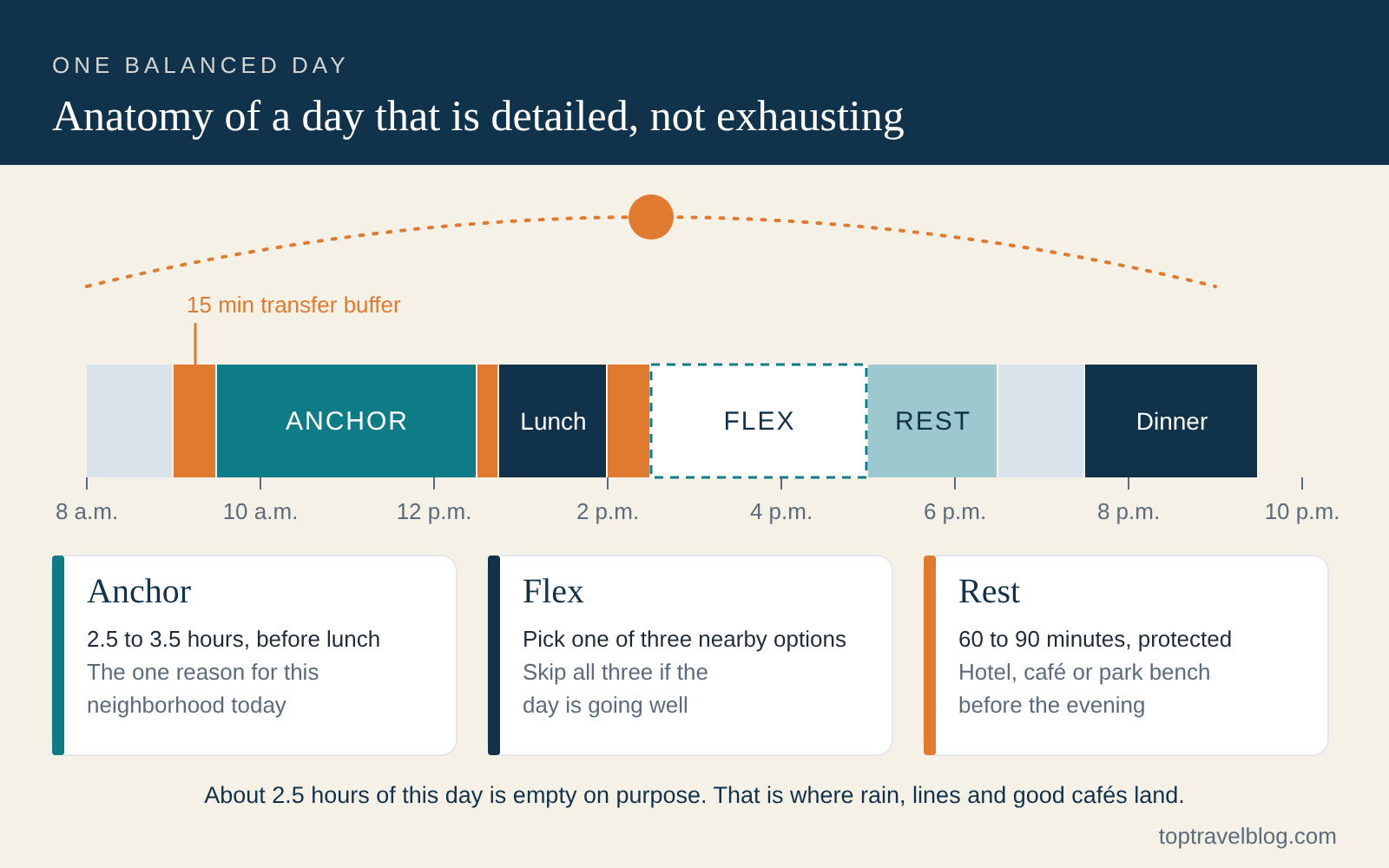
For how to make a travel itinerary that feels light, I divide every day into three blocks: a morning, an afternoon and an evening. The morning holds the anchor. The afternoon holds a flex block and the break. The evening holds dinner and, optionally, one low-effort thing. That is the whole template.
The numbers I work with: the morning anchor gets about 2.5 to 3.5 hours, a sit-down lunch gets 60 to 90 minutes, the afternoon gets 2 to 3 hours of flexible activity, and I protect at least 60 to 90 minutes of rest in the middle of the day for anyone over about eight or nine years old or under about fifty. Evenings stay open after dinner unless there is a show.
The buffer rules
Buffers are the least glamorous part of how to make a travel itinerary, and the most useful. A buffer is empty time that exists only to absorb reality. I use three kinds. A transfer buffer of 15 minutes goes after every change of location.
A meal buffer adds 20 minutes to the time you think lunch will take, since seating, ordering and paying take longer than eating. A daily buffer of about 90 minutes is spread through the day and not assigned to anything.
If you add those up, a typical day has about two and a half hours of apparent slack, and that is correct. The slack is where sudden rain, a long line, a good café, a wrong turn and a tired kid all land. Every time I have trimmed it for one more attraction, I have regretted it by 4 p.m.
Cap the timed stops
When I work out how to make a travel itinerary for a busy city, my cap is two timed entries on a normal day and three on a hard day, with the first timed entry no earlier than 9:30 a.m. unless the destination demands it. Timed tickets are useful because they remove lines, but each one is a small tax on spontaneity. Three in a day means you are watching the clock from breakfast onward.
Also look at the gap between timed entries. A 10 a.m. museum slot and a 1 p.m. lunch booking sound loose, but a large museum takes 2 to 3 hours and the lunch is 20 minutes away by transit. That is already a squeeze. Leave at least 90 minutes between the end of one fixed commitment and the start of the next.
Plan the arrival and departure days as light
Arrival days are underrated. After a red-eye or a long-haul flight, most people have maybe two good hours of energy. I plan a short walk, an early dinner and bed. For a flight from the U.S. to Europe, the first full day is usually when jet lag hits hardest, so I put a gentle anchor there, not the expensive one.
For the final day, plan backwards from the departure time. Work out when you must leave for the airport, when you must check out, when you need breakfast, and what is realistic in the hours left. If you are new to long-distance travel, our guide to a first international trip and the international travel checklist cover what has to happen around those days.
Worth knowing: The most common pace error is to treat arrival day and departure day as full days. A 4 p.m. landing is not a sightseeing day, and neither is a 1 p.m. departure. Count them as zero or half, and the rest of the plan becomes much more honest.
Build in one empty half-day for every five days
On trips of five days or more, my rule for how to make a travel itinerary with slack is to leave one half-day entirely unplanned. Not “optional museum” or “free time to shop” but a block with nothing in it. It acts as insurance against delays and weather, and it is often where the best unplanned moments happen, because you have time to follow a recommendation from the owner of the café you wandered into.
If you do not need it for repairs, use it. If a storm or a canceled train blows up a day, you have somewhere to put the displaced anchor. Either way it earns its place, and I have never met a traveler who regretted having it.
Step 5: Book in the right order, and only what needs booking
Booking is the point in how to make a travel itinerary where a flexible plan can turn rigid. The principle behind how to make a travel itinerary that stays flexible is to book in order of scarcity and cost of change, and to leave everything else open. Some things can sell out months ahead. Others you can walk into. Treat them differently.
The booking order I follow
- Flights or main transport. They set your dates and are the hardest to change. If you have flexibility, a search strategy can save real money, and how to find cheap flights explains how to compare dates and airports without falling into the usual traps.
- Lodging, in the cluster that fits your route. Pick the hotel after you have drawn the map, not before. A base that is 25 minutes from every anchor undoes the whole plan. How to choose a hotel covers location, fees and cancellation terms, which matter more than the star rating.
- Scarce, timed tickets. Anything that sells out or requires a date: a famous painting in a small room, a hike with a permit, a rooftop at sunset, a popular tour.
- Dinner reservations you care about. Usually one or two per trip, not one per night.
- Everything else, nothing. Museums with ample capacity, markets, parks and most neighborhood restaurants do not need a reservation.
Find out what is genuinely scarce
Scarcity varies enormously, and knowing which items to book is half of how to make a travel itinerary that is not rigid, so test each anchor instead of assuming. Search the official site and look for the earliest available date. If the next open slot is more than two weeks away, treat it as scarce and book now.
If tickets are available the same week, let it float. Official sites are the right place for this, since third-party resellers add markups and do not always show real availability.
Some examples of the pattern: the Last Supper in Milan is visited in small timed groups through the official booking site, and slots go quickly in the high season. In New York, the ferry to the Statue of Liberty’s crown or pedestal books far ahead, while the Staten Island Ferry needs nothing.
National parks and other federal sites increasingly run permits and timed entry through Recreation.gov, and where they do, that is a reservation to make before almost anything else.
Choose refundable options for the rest
Where you do have to commit, prefer the free-cancellation version, even if it costs a little more, until your plan has been through the stress test in step six. Free cancellation on a hotel for the first and last nights is especially useful, because those are the dates most likely to shift. You can lock the cheaper nonrefundable rate once the plan is stable.
I also hold back one ticket-heavy decision until I land: the weather-dependent ones. An observation deck, a boat trip and a hike are all better booked two or three days out when you can see the forecast. If they are on a scarce list, book the refundable slot early and move it later.
Tip: Put every reservation into one calendar with a note of the cancellation deadline in the title, for example “Hotel Lisbon, free cancel until Sep 3”. A deadline in the calendar gets acted on. A deadline buried in an email gets missed.
Keep the paperwork in one place
The unglamorous side of how to make a travel itinerary is storage, so create one folder, digital and printed, with confirmations, tickets, addresses in local script if relevant, and your own written plan. Share it with your travel partner. Download offline copies of anything you will need without a signal, including ticket QR codes and maps.
This sounds trivial until you are at a gate in a train station with no data and a screenshot is all that stands between you and a fine.
Step 6: Stress-test the plan and write it down
You have a first draft, and the last part of how to make a travel itinerary is trying to break it. This step takes about thirty minutes and catches most of the problems that would otherwise appear on the trip.
Run the five checks
Walk through the plan day by day and ask five questions each time.
- Is anything closed? Check each stop against its weekly closing day and public holidays on your dates.
- Is the geography honest? Reopen the map and trace each day in order. Does it double back? Does any transfer take more than 45 minutes?
- Is there a meal in every gap? Look for the 2 p.m. stretch with nothing nearby, and the evening when the kitchen you chose is closed on Sundays.
- What if it rains? Each outdoor anchor needs a nearby indoor swap you have already looked up.
- What happens if one person is unwell? The plan should still work if you drop one day’s second half.
Add a rain plan and a tired plan
For every day, I add two lines at the bottom: “If it rains” and “If we’re tired”. The rain line names one indoor option within 15 minutes of the anchor. The tired line names the single thing I would cut and the easiest way to spend the time instead (a café, a park bench, a movie in the hotel room).
These are not backup plans in the usual sense, since you rarely need an elaborate one. They are decisions you have already made, and they give you permission to relax.
Write it in a form you will actually use
In how to make a travel itinerary document that people read, one page per day that can be scanned at a glance on a phone is the right size. My format is simple: the day’s anchor and its open hours at the top, then the flex list with a one-line note each, then addresses and transfer times, then the two fallback lines. Fixed reservations are in bold with times.
Put maps in your map app, not in the document. Link each stop in your plan to its pin so one tap launches directions. Keep a copy offline. Share the document with everyone traveling, and give each person a small piece of ownership: one picks a dinner, another handles the morning transit, so the plan belongs to the group and not just its author.
What a finished day looks like
To see how to make a travel itinerary in practice, here is a typical Day 3 in my own format, for a European city of roughly 500,000 people, with a mid-sized museum as the anchor:
- Anchor (9:30 to 12:30): the main museum, timed entry at 9:30, 25 minutes by metro from the hotel. Leave at 8:45.
- Lunch (12:45 to 14:00): a place near the museum I picked from the map list, plus a fallback two streets away.
- Flex (14:30 to 17:00): pick one of three options in the same district: a market, a river walk, or a small gallery. Skip all three if needed.
- Rest (17:00 to 18:30): back at the hotel, or a café for anyone who prefers to stay out.
- Evening (19:30): dinner reservation near the hotel, no activity after.
- If it rains: swap the river walk for the covered market. If we’re tired: cut the flex block and go straight to rest.
That is a full, satisfying day, and the entire fixed part fits in three lines. The rest is a menu.
Worked examples: how to make a travel itinerary for three very different trips
Methods are easier to trust when you see them run. Here is how to make a travel itinerary for three trips, each built with the six steps, with the real distances that shaped the decisions.
Example 1
A long weekend in Rome, four nights, one base
Shape: arrival Thursday at 1 p.m. at Fiumicino, departure Monday at 11 a.m. That is two full days and two half-days, not four. One base near Termini or in the center, since the airport train to Termini takes about 30 minutes.
Anchors: the Colosseum and Roman Forum on Friday morning, the Vatican Museums on Saturday morning, a day of wandering and one big meal on Sunday. The Colosseum and the Vatican sit about three miles apart, so they cannot share a morning. That one map check kills the common plan of “Colosseum then Vatican on the same day”.
Clusters: the ancient core (Colosseum, Forum, Palatine, Capitoline Hill) is one walkable day. The Vatican, the Castel Sant’Angelo and the streets around Via Cola di Rienzo make a second. Trastevere, Campo de’ Fiori and the Pantheon area form a third, and they join up on foot. Thursday afternoon is a two-mile walk from the hotel to the Pantheon and an early dinner. That is all.
The booking list is short: timed Colosseum entry and the Vatican Museums tickets, both on official sites, plus one dinner. The Pantheon, the Trevi Fountain, the Spanish Steps and every church on the list stay unreserved. That is how to make a travel itinerary where a four-night trip contains about six major sights and still has afternoons free.
Example 2
Ten days across London, Paris and Amsterdam
Shape: ten nights is nine usable days after arrival and departure. Three bases means two moves, each costing a half-day. That leaves about eight days: three in London, three in Paris, two in Amsterdam, which is tight but workable if you accept that Amsterdam is a taste.
Flights: an open-jaw ticket, landing in London and flying home from Amsterdam, saves a full day of backtracking compared with returning to London. See open-jaw flights explained for how to price that against a round trip. The trains do the middle: London to Paris on Eurostar takes roughly two hours twenty minutes, and Paris to Amsterdam on a direct train is a little over three hours.
Pacing: on each move day, I plan only the morning at the old place and dinner at the new one, with no anchors in between. Each city gets one big anchor per day and a light second half. In Paris I put the Louvre on a morning that is not a Tuesday, and I leave the Eiffel Tower to the flex pile, because the view of it from a bridge costs nothing.
The lesson from this example is how it answers the question of how to make a travel itinerary for several cities: let the transit legs be the plan, and treat each city as a short sequence of clusters. If the transit is more than about three hours, sleep in the destination first and sightsee second.
Example 3
A one-week national parks road trip with a young child
Shape: seven days, starting and ending in Las Vegas. The drive from Las Vegas to Zion is roughly two and a half hours, Zion to Bryce Canyon about two hours, and Bryce back toward Vegas about four. Those drives are the skeleton, and a child’s nap and snack schedule is the real timetable.
Anchors: one short walk or ride per half-day, nothing over an hour of hiking each way with a small child, and a picnic lunch by the car. The driving happens during naps, which means leaving right after lunch and arriving at 3:30 p.m. rather than driving all morning and arriving at noon with a cranky kid.
Booking: lodging first, since in-park lodges and nearby motels fill many months ahead in the high season, then any permit or timed-entry systems on Recreation.gov. Everything else stays open. I plan two nights in each park instead of three one-night stops, because packing a car with a toddler is its own anchor.
Rain plan: the National Park Service posts flash flood warnings for the narrow canyons at Zion and closes some trails in storms, so the rain line says “visitor center, scenic drive with stops, early dinner”. The tired line is simpler: stay at the lodge pool. A road trip is the clearest case where how to make a travel itinerary is more about driving time and rest than about sights.
Tip: Whatever the trip, compare your draft with how many anchors, buffers and moves the examples above carry. If yours has twice as many, you have a to-do list, not an itinerary.
Adjusting how to make a travel itinerary for who is traveling
How to make a travel itinerary changes with the people, even though the method stays the same. The rules do not change. The numbers do.
Families with young children
Daily cap: one anchor, two for older kids
Build the day around nap or quiet time, not around the museum hours. Plan the anchor for the morning, the break for the early afternoon, and a playground or ice cream in the late afternoon. Keep walks under a mile and a half without a stroller. Choose a base with a kitchen if meals are a battle. Expect everything to take about 40 percent longer than adult estimates.
Couples
Daily cap: two anchors
You have the most flexibility. The risk is pace mismatch: one person wants to pack the day, the other wants to linger. Use the ranking exercise from step two and alternate who owns each day’s anchor. Leave at least one evening each trip with no plan after dinner, and book one special reservation that you both care about.
Groups of friends
Daily cap: two anchors, one shared meal
Splitting is allowed. Name one fixed shared moment per day (usually dinner) and let people do their own thing in the flex block. Agree early on budget so that nobody feels pressured into a tour they cannot afford. Use a shared document and a group chat for logistics, and nominate one person to hold reservations.
Older travelers or limited mobility
Daily cap: one anchor, longer buffers
Count steps and stairs, not just miles. Check lifts at stations, seating at sights and the distance from drop-off points to entrances. Choose hotels with a short walk to the most-used transit. Put the physically demanding anchor on the first full day or a rest-rich day, and double the transfer buffer.
Solo travelers
Daily cap: two anchors, more flexibility
You can change plans at will, so keep the fixed layer smaller. Book one social activity early in the trip, such as a walking tour or a cooking class, then follow the energy. Share your plan with someone at home and note your accommodation addresses in an offline copy.
First-time international travelers
Daily cap: one anchor on days one and two
Build in extra time for jet lag, currency, SIM or eSIM setup and getting used to transit. Keep the first two days nearby and easy. Our first international trip guide covers the paperwork, money and phone basics that make the early days smoother.
Common mistakes when you make a travel itinerary
These are the errors I see most often when friends ask me how to make a travel itinerary and send me a draft, in roughly the order they cost people time.
- Treating transit as zero. A two-mile hop on a map is a 25-minute trip with waiting, and a 45-minute one with a transfer. Add it every time, or the day will quietly lose two hours.
- Planning by category. “All museums on Tuesday” sends you across town repeatedly. Plan by neighborhood, and put the category second.
- Stacking two heavy anchors in a morning. The second one is always worse because you are tired, and the memory of it is mostly a bench. Put one anchor in each half-day.
- Ignoring closed days. Check weekly closures and public holidays for every anchor before you commit to a date, since one closed door can cascade through the day.
- Over-booking early. Pre-paying every activity makes you cling to the schedule when it is wrong. Book only the scarce things, and keep the rest as options.
- Under-booking the scarce things. The opposite error is as common: not reserving the timed ticket, the permit or the one dinner that mattered, then discovering it is gone.
- Treating arrival day as a full day. After a long flight the first afternoon is a nap and a walk. Plan it that way and it will feel like a gift.
- No rest block. People over-plan for the version of themselves who feels great at 3 p.m. on day five. That person does not show up.
- Choosing the hotel before the route. If the base is 30 minutes from the clusters, that is an hour a day lost for the whole trip. Draw the map first.
- Not telling anyone the plan. A plan only one person understands fails when that person is sick, tired or annoyed. Share it and assign small pieces.
The mistake behind all the mistakes
Each of these comes from planning for the best version of the trip. The best version has no queues, no rain, no missed trains and no blisters. A better method for how to make a travel itinerary is to plan for the median version, leave margins for the bad one, and let the good one arrive on its own. That mindset change is worth more than any template.
Frequently asked questions about how to make a travel itinerary
How far ahead should I make an itinerary?
For how to make a travel itinerary on a sensible schedule, start the outline as soon as you have dates, usually two to four months out for an international trip, and finish the details in the last two to three weeks. Book scarce items such as timed tickets and permits the moment their slots open. The rest of the plan can stay loose until about two weeks before departure, when the forecast becomes meaningful.
How many activities should I plan per day?
For most travelers learning how to make a travel itinerary, one main anchor per half-day and two per full day is the ceiling, with a flexible list of two to four lighter options. Families with small children should aim for one anchor a day. If you find yourself writing five timed items for a single day, move half of them to another day or turn them into optional items.
What is the best app or tool for planning an itinerary?
For how to make a travel itinerary with free tools, a map app with saved lists, a shared document and a calendar cover nearly every need. Use the map list to cluster places, the document to hold the day-by-day notes and fallback options, and the calendar for fixed times and cancellation deadlines. Dedicated itinerary apps can work, but they add a new place to keep updated, so I rarely use more than these three.
Should I book everything before I leave?
No. When you think through how to make a travel itinerary, book the things that sell out, require dates or cost a lot to change, such as flights, lodging, timed tickets and one or two dinners. Leave the rest. Over-booking reduces your options when weather or energy changes. A useful rule is that you should be able to cancel or move any single day without ruining the next one.
How do I plan an itinerary for a city I have never visited?
To see how to make a travel itinerary for a new city, start with the official tourism site and a guidebook to find the anchors, then put everything on a map to see the clusters. Choose a hotel in or beside the densest cluster. Plan a light first day and keep the second and third days for the biggest sights. A related example is our New York City itinerary, which shows these principles applied to a four-day trip.
How much time should I allow between activities?
The usual numbers in how to make a travel itinerary: at least 15 minutes after any change of location, 60 to 90 minutes for lunch, and 90 minutes or more between two timed commitments. For airports and intercity trains, allow the standard check-in buffer plus the transfer to the station or terminal. When in doubt, add time. Early arrival costs you a coffee. Late arrival can cost you a ticket or a flight.
How do I include rest days without wasting the trip?
The honest answer on how to make a travel itinerary with rest in it: make the rest day a feature. Choose one neighborhood or park and a long lunch, and leave out any ticketed item. On a trip of five days or more, an unscheduled half-day does more for the other days than another attraction would. If you cannot bear an empty slot, fill it with one flex item you can skip without regret.
What if my group wants different things?
The best answer on how to make a travel itinerary for a group is to run the ranking exercise from step two: each person marks three must-dos and three nice-to-haves. Anchors are the items that overlap or the top picks of each person, assigned alternately. During the flex block, it is fine for people to split up for a couple of hours and reconvene for dinner. Clear ownership of different days reduces arguments more than compromise does.
Should I build the itinerary around flights or hotels first?
In how to make a travel itinerary, flights set your dates, so they usually come first, though I draft the route before I buy anything. Once you know the dates, pick the hotel in the cluster that fits your anchors. Our guides on how to find cheap flights and how to choose a hotel cover each decision in detail.
How long should a multi-city trip stay in each place?
My rule for how to make a travel itinerary across cities: give each base at least two full nights, and three if the destination has more than one cluster. One-night stops cost almost half a day each in packing and transit, so the sightseeing time shrinks to almost nothing. If you only have a week, two bases is generally the limit. See the multi-city guide for more detailed rules by trip length.
Is it worth paying for a tour operator or a planner?
It can be, for complex trips with many moving parts, or when you want local access you cannot get alone. For a typical city break or road trip, knowing how to make a travel itinerary yourself with the method above gets you most of the benefit for free. If you use a planner, share your anchors and pace rules first so they build to your constraints, not their template.
One last thing before you go
The best compliment I have received on an itinerary came from a friend who said, “I didn’t feel planned at.” That is the standard I aim for. The plan is there, the details are right, the tickets are booked, and you never feel like you are following orders. You are just having a good day that someone thought about in advance.
If you take only one idea about how to make a travel itinerary from this guide, take the anchor rule: one reason per half-day, everything else optional. And if you have a free evening, use it on the thing you will not find in a guidebook, the place the hotel clerk mentions, or a bench near the water with nothing to do.
When you are ready to practice how to make a travel itinerary on a real trip, start with the dates and a map, and follow the steps in order. Over time you will develop your own rules of thumb, and the template will shrink to a handful of numbers in your head. That is how it should be.
Related planning guides
- How to plan a trip step by step — the bigger picture, from choosing a destination to a booked itinerary.
- How many days you need for a vacation — the trip-length question this guide assumes you have settled.
- How to plan a multi-city trip — the transit math for trips with more than one base.
- How to choose a hotel — location, fees and cancellation terms once your route is drawn.
- International travel checklist — everything to do before leaving the U.S.
- New York City itinerary: the best 4 days — this method applied to a real four-day city trip.