
Start with the answer. How to find cheap flights comes down to five moves made in a fixed order: search wide on a tool that shows the whole calendar, compare the total trip cost instead of the headline fare, widen your dates and airports until the price stops falling, buy inside the window where fares for your route are usually lowest, and then keep watching after you book.
Nothing in that list is a trick, and that is the honest truth about how to find cheap flights. The people who consistently pay less are not smarter than you; they are just flexible in two or three places and patient in one.
I have booked a lot of tickets over the years, for myself, for my parents and for friends who text me a screenshot at midnight asking if the fare is any good. Most of what I know comes from overpaying first.
This guide is the long version of how to find cheap flights, written the way I would explain it to a friend who has never done it carefully: where to look, when to buy, which fares are traps, what the rules say about canceling, and how to spot a deal that is really a bag-fee machine.
One honest note before we start. In 2026 the cheap end of U.S. flying got more expensive. Spirit Airlines stopped operating in May 2026, jet fuel costs jumped earlier in the year, and several large airlines raised bag fees. A genuinely good fare still exists on almost every route, but it takes more care to find than it did two years ago, which is a reason to do this properly.
Quick facts: how to find cheap flights at a glance
- Best for: U.S. leisure travelers booking domestic or international trips for 2027, families coordinating dates, and anyone who has watched a fare rise $80 while deciding.
- The core method: search wide, compare total trip cost, widen dates and airports, buy in the right window, track after booking.
- Booking window: roughly 1 to 3 months ahead for most domestic routes and roughly 2 to 8 months ahead for most international routes, earlier for holidays and summer.
- Free safety net: for tickets bought directly from an airline at least 7 days before departure, the U.S. Department of Transportation requires either a 24-hour full-refund cancellation or a 24-hour hold. Airlines can choose which.
- Biggest hidden cost: bags and seat fees. A $120 basic fare with two checked bags can cost more than a $190 main cabin fare that includes them.
- Tools that do most of the work: Google Flights for the calendar view and price tracking, then the airline’s own website for the final price.
- What to avoid: hidden-city tickets, tight self-made connections, buying through an unfamiliar agency, and paying extra for fare “protection” you did not ask about.

The method behind how to find cheap flights: five moves in order
I think of airfare, and of how to find cheap flights in general, the way I think of buying a used car. There is no single right price, only a range, and the way you get to the low end of the range is by knowing what is normal, comparing more than one option, and being willing to walk away.
The five moves are the structure for everything below, so here they are in plain language before we go deeper.
- Search wide first. Start on a tool that shows prices across a whole month, not on a single date. You are learning the shape of prices for your route before you decide anything.
- Judge the total, not the fare. Add bags, seat selection and the cost of getting to a farther airport. The cheapest-looking ticket often is not.
- Move the variables that matter. Dates by a day or two, airports by an hour’s drive, stops by one. Each move is worth more on some routes than others.
- Buy in the window. Fares for most routes follow a pattern, and buying inside it beats both booking too early and waiting for a drop that never arrives.
- Keep watching. Set an alert before you book and a reminder after. A fare that falls by a meaningful amount can sometimes be rebooked for a credit.
Those five moves cover most of what is possible. The remaining 10 percent is mistake fares, targeted promotions and points redemptions, which I cover later and which are worth knowing about but not worth building your plan around.
The order matters more than people expect in how to find cheap flights. If you start by hunting for a promo code or a secret site, you spend an hour before you know whether $280 is a low fare or a typical one for that route. If you start wide, you know within five minutes.
Why “cheapest” is a moving target
The basic mechanism behind how to find cheap flights is that airlines price each seat on a flight in buckets, and the bucket you see depends on how many seats in lower buckets are already sold, how far away the flight is, and what competing airlines charge on the same route. That is why the same flight can cost $212 on Tuesday and $247 on Wednesday without anything about the flight changing.
It is also why routes with more competition, like New York to Orlando or Los Angeles to Las Vegas, have lower and more stable fares than routes served by one airline. Competition is the biggest single force acting on a fare, and it shapes how to find cheap flights on every route, and you cannot change it, but you can choose routes and airports that benefit from more of it. That idea comes up again in the airports section.
Tip: Before you start on how to find cheap flights, write down your route, rough dates and a number you would be happy paying before you open a single search tab. The number can be a guess. Having it stops you from anchoring on the first price you see, which is how people end up calling a mediocre fare a bargain.
Judge the total trip cost, not the ticket price
The most common mistake I see in how to find cheap flights is comparing the number on the results page and nothing else. That number is the start of the cost, not the end of it, which is why how to find cheap flights is partly an arithmetic problem.
Here is what belongs in the total, in the order people usually forget it.
Bags are the biggest swing
Most large U.S. airlines now charge roughly $40 to $50 each way for a first checked bag when you pay online, and a bit more at the airport. Frontier and other ultra-low-cost carriers can charge far more than that for a bag, and often charge for a full-size carry-on too. Southwest, which used to be the exception, ended free checked bags in 2025, so no major U.S. airline can be assumed to include one on its cheapest fare any more.
For a couple traveling with one checked bag each, round trip, bags alone can add $150 to $200. A fare that looks $70 cheaper per person can lose to a fare that includes the bags once you do the arithmetic. The honest approach to how to find cheap flights is to price the fare you would actually buy: the one that includes the bag you actually plan to pack.
Seats, boarding and the carry-on rule
Basic economy fares usually assign your seat at check-in and put you in the last boarding group. If you are traveling with a child or want to sit with your partner, you may pay $15 to $60 each way for seats together, depending on route. On some airlines, a basic fare does not include a full-size carry-on bag for the overhead bin at all; United’s basic economy is the example most travelers run into.
I cover that trade-off in detail in our guide to basic economy vs main cabin, but the short version is this: price the whole bundle for your party before you decide that the lowest fare is the lowest cost.
Getting to the airport
A fare out of an airport 70 miles away is only cheaper if the drive, parking or train does not eat the savings. Parking for a week at a major airport can run $80 to $150, and a one-way rideshare from a city center to a distant airport can be $60 to $120. Add your time: an extra hour each way is two hours you do not spend on the trip.
The time cost of a connection
A nonstop that costs $60 more than a one-stop is often a good trade. You save roughly three hours and the risk of a missed connection, and you are less exposed to weather delays in a hub city. I would pay that $60 on a flight before a morning meeting or a cruise departure. I would not pay it on a flexible leisure trip where I have a day to spare.
A worked comparison
Say you are flying a family of three from Chicago to Orlando for a week. The lowest fare is a basic economy ticket at $138 each. The main cabin fare on the same flights is $176 each and includes advance seat selection. Both versions need two checked bags, at about $45 each way per bag.
On the basic fare, add roughly $25 per seat each way to sit together, which is $150 for the family, plus $180 for the bags. That makes $414 plus $330, or $744. The main cabin tickets cost $528 plus the same $180 for bags, or $708.
The fare that looked $114 more expensive ends up $36 cheaper, and you also board earlier and have an easier time making changes. These numbers are illustrative, not quotes, and they swing by airline, but the arithmetic is the point: add up what your party really needs, then compare.
Watch out: “Cheapest” on a results page is almost never the price you will pay. Open the final checkout screen on the airline’s own website with bags and seats added, and read the total. That is the only number worth comparing.
When to book: the window where fares are usually lowest
Timing is the part of how to find cheap flights that gets the most bad advice, so I will be specific about what is solid and what is folklore.
What is solid in how to find cheap flights: fares follow a rough curve. Far out, airlines price high because nothing is selling yet and they have no pressure to discount. In the middle of the curve, fares settle into their lowest range. Inside the last few weeks, they climb, because the people still buying are business travelers and emergencies who will pay almost anything.
Domestic trips
For most domestic routes, the lowest fares tend to show up roughly one to three months before departure. Google Flights’ own fare history, which you can see on any route by looking at the price graph, shows that shape again and again on routes with several competing airlines.
For peak travel, shift the window earlier. If you want to be in Orlando at spring break, in Hawaii in July, or anywhere the week of Thanksgiving, think three to five months out. Seats on holiday dates sell down quickly, and the low fare buckets disappear well before the airline raises the sticker price.
International trips
For how to find cheap flights abroad, international fares usually reward earlier planning, with a typical sweet spot of roughly two to eight months out for most routes. Summer in Europe, Christmas in Asia and the cherry-blossom season in Japan push that window to four to ten months. Long-haul flights have fewer daily departures, so fewer seats go on sale at low prices and they do not come back.
What the data cannot tell you
Windows describe the middle of the range, not your route. A route with a flash sale, a new competitor or a schedule change can break the pattern. That is why, when people ask me how to find cheap flights, I never say “book exactly 47 days out.” I say: start looking early, learn what the normal range is for your route, and buy when the price is inside it.
The day-of-week myths
You will see advice to buy tickets on Tuesday at 3 p.m. That advice comes from an era when airlines loaded fare changes once a day, and it is mostly dead. Airfare today updates continuously, with software adjusting prices based on demand all day long.
What does still matter is the day you fly. Departing and returning on Tuesdays, Wednesdays and Saturdays is often cheaper than Fridays and Sundays on leisure routes, because those are the days fewer people want to travel. That is a flying-day effect, not a booking-day effect, and it is the single most reliable calendar pattern I have found.
Tip: If a fare is inside your target range and the trip is more than a few weeks away, buy it; that is the single most useful habit in how to find cheap flights. Waiting for an extra $20 drop is a gamble where the downside is $100 and the upside is $20. The 24-hour cancellation rule below exists partly so you can take that decision without fear.
The 24-hour rule is part of your timing strategy
Under U.S. Department of Transportation rules, if you book directly with an airline at least seven days before departure, the airline must let you either cancel within 24 hours for a full refund or hold the reservation at the quoted fare for 24 hours without paying. Airlines choose which of the two they offer, and the rule does not cover tickets bought through online travel agencies, which have their own policies.
In practice, for how to find cheap flights, that means a fare you like is a fare you can lock, sleep on and cancel the next morning if a better one appears. I use it on most trips. Our full guide to the 24-hour flight cancellation rule covers the edge cases, including what counts as the seven-day cutoff.
Flexibility is where the savings come from
If you remember one thing from this guide on how to find cheap flights, make it this: price is a function of how flexible you are, and you can usually decide how much to give.
I treat flexibility, the heart of how to find cheap flights, as four dials. Each can be turned a little, and each has a different cost to you.
Dial one: the days you fly
Moving a trip by one day often moves the price by $30 to $150 per person. The calendar or date grid view on Google Flights shows you every combination of departure and return in a month at once, so you stop guessing. Our detailed walkthrough of how to use Google Flights goes through the date grid, price graph and tracking screens click by click.
A rule of thumb I use: if a trip is flexible by one day on either side, look at all nine combinations, which is three departure days times three return days. Spending five minutes on that is the best-paid five minutes in travel planning.
Dial two: the airports
Large metro areas have two or three airports, and fares can differ a lot among them. Washington has Reagan, Dulles and BWI. New York has JFK, LaGuardia and Newark. Los Angeles has LAX, Burbank, Long Beach, Ontario and John Wayne. Chicago has O’Hare and Midway.
The cheaper airport is not always the farther one. Sometimes a smaller airport has a budget carrier that forces other airlines to match. Add ground costs honestly. If Newark saves you $70 but the train adds $20 and 40 minutes each way, the savings shrink, and you should decide whether 80 minutes is worth $30.
Dial three: the number of stops
A nonstop is a convenience you pay for, and it is cheaper on competitive routes than you would guess. On less-served routes, a one-stop itinerary can save $100 to $300 round trip. I will take a one-stop if the layover is between 60 minutes and 3 hours and the connection is in an airport I know. I will skip it if the layover is under 50 minutes or if I would be arriving the night before an event.
If you do book a connection, read our guides to minimum connection time and what happens if you miss a connecting flight. Both are short and will change how you read an itinerary.
Dial four: the destination
If you have no fixed destination, that is the most powerful dial of all in how to find cheap flights. Google Flights has an Explore view that shows a map of prices from your home airport to dozens of cities. For a long weekend, I sometimes start there, pick the three cheapest places I would actually want to go, and then plan the rest around them.
That is a different way to approach how to plan a trip: letting the fare nudge the destination instead of the other way around. It works best for flexible travelers, couples and friends without a fixed itinerary, and it fails for anyone tied to a wedding date or a school break.
What flexibility is worth
I cannot give you a universal percentage, because it depends entirely on the route. On competitive routes, such as New York to Orlando, the gap between a fixed search and a flexible one is often small. On thin routes, or in peak weeks, a two-day shift and a second airport can save real money. The first time you try it on a trip you care about, the result usually surprises you.
The step-by-step search routine for how to find cheap flights
This is the routine I actually follow for how to find cheap flights, written as steps so you can copy it. It takes about 25 to 40 minutes the first time, and 10 to 15 once you have done it for a route. Each step assumes you have already settled on the rough trip, the way we describe it in our guide to how to plan a trip.

Step 1
Set your range before you search
Write down the earliest and latest dates you would consider, the airports you would use, and the most you would pay. Add your party size and the bags you will bring. This stops the search from drifting.
If you are traveling with others, agree on how flexible each person is. A search that works for you and not your travel partner is a wasted search, and discovering that at checkout is annoying.
Step 2
Search wide on a calendar tool
Open Google Flights and begin the real work of how to find cheap flights: enter your origin and destination, and switch to the date grid or price graph. Look at the whole month. Note the cheapest day pair, the cheapest weekday pair and what a normal price looks like. Spend about five minutes here.
Include nearby airports by adding them to the origin and destination fields. Google Flights lets you enter several airports in one search, which saves a lot of repeated work.
Step 3
Narrow to two or three date pairs
Pick the cheapest pair, the cheapest pair that fits your schedule comfortably, and a middle option. Do not agonize. If the cheapest pair requires a Tuesday-to-Tuesday trip and you can only take a week off, take the middle option.
Step 4
Read the itineraries, not only the price
Click through to the details. Look at connection airports and layover lengths, the arrival time, the aircraft, and whether the return flight leaves at 6 a.m. Very cheap fares often have either a long overnight layover or an awful departure time. Cheap is only useful if you can live with it.
Step 5
Price the full bundle on the airline’s site
Go to the airline’s own website for your two or three finalists and add your bags and seats. Use the same number of passengers. Compare the totals. This is where basic economy fares often stop being the winner.
If an online travel agency is the only seller for the fare, note it and read the rules under “Traps” below before buying.
Step 6
Set an alert, then decide
If the price is already in your target range, buy it; that is the plainest rule in how to find cheap flights. If not, turn on price tracking in Google Flights for your dates, or for “any dates” if you are flexible, and give yourself a deadline. For a domestic trip, that is usually two to three weeks of watching. For an international trip, a few weeks to a couple of months.
Google’s price tracking sends an email when the price of a tracked route changes, and for tracked routes it also sends an alert when prices are likely to rise soon. Those alerts are estimates, not promises, but they are useful nudges.
Step 7
Buy, then use the 24-hour window
Book directly with the airline when the price matches your range. If you booked at least seven days before departure, you have a day to change your mind under the DOT rule. Use that day to run one last search for the same dates. If something cheaper has appeared, cancel and rebook.
Step 8
Keep a tracker after you book
Save the confirmation, set a reminder, and watch the price for your flight for a few weeks. Many airlines now let you change a main cabin fare without a fee, and some give a credit if the fare drops. I explain how that works in the section on what to do after you book.
The tools I use, and what each is good for
You do not need ten apps to learn how to find cheap flights. You need one to see the whole market, one to see the real price, and one place to keep your alerts.
Google Flights for the whole picture
Google Flights is where I start almost every search. It shows prices from most major airlines across a calendar, lets you filter by stops and airline alliance, and tracks prices for you. Southwest fares now appear in its results, though you complete the booking on Southwest’s own site.
Its limits matter. It does not show every fare class on every carrier, some small airlines do not appear, and the “typically” price labels are estimates built from past fares. Treat it as a map, not a verdict. Our guide to how to use Google Flights covers the less obvious screens.
Airline websites for the real price
The airline’s own site is where you see the full bundle price, the exact fare conditions and any promotion that did not make it into an aggregator. I almost always book here. If something goes wrong, the airline is the party that can rebook you, and you avoid the confusion of an agency standing between you and the carrier.
Online travel agencies: use carefully
Expedia, Priceline, Kayak and similar sites can show fares the airlines do not, especially on international itineraries combining separate airlines. They can also make changes and refunds harder, because you may need to go through the agency instead of the airline, and the DOT 24-hour rule does not cover tickets bought through them.
My rule for how to find cheap flights through agencies: if an agency fare is more than about $40 to $50 cheaper than booking direct, I will consider it, and I read the cancellation terms first. If the saving is smaller, I book direct.
Alerts and deal services
Paid and free deal newsletters send out mistake fares and sales. They are good for travelers who can leave on short notice, and not very useful for someone tied to a specific week. I treat them as a source of ideas rather than the core of a plan.
A short list of what not to bother with
For how to find cheap flights I skip browser extensions that promise to “unlock” lower fares, VPN tricks to change your country and apps that charge a subscription to show you what Google Flights shows for free. The idea that airlines raise your price because you searched twice has not held up in anything I have tested; the more common cause of a rising fare is that a seat in a lower bucket actually sold.
A simple price log that keeps you honest
When a trip is a few weeks or months away, memory is a poor tool. You will remember the lowest price you saw and forget the three days it was out of your budget. A tiny log solves that, and it is the habit that improved my results in how to find cheap flights more than any website.
Open a note on your phone. Write the route, the dates, the airline and the price each time you look. Add one line saying what the Google Flights label said: low, typical or high. After four or five entries, you have a picture of your own route that no generic article can give you.
What the log tells you
If the price has moved within a $30 band for three weeks, the fare is stable, and waiting is unlikely to help. If it has moved by $100 or more in either direction, you are watching a route that reprices often, and a fare in your range deserves a quick purchase.
If you see it move down and then back up, that is a sign the airline is testing prices. Buy on the dip. I have watched the same fare drop $45 on a Sunday and be gone by Tuesday, and the log is the reason I recognized it.
A short script for the decision
Before I buy, I ask myself three things, in this order. Is the total, with the bags I will actually bring, inside my number? Is the schedule one I would be happy with if the trip went slightly wrong? Can I cancel for free for the next 24 hours? If the answer to all three is yes, I book without another tab.
The ten-minute version when you are in a hurry
Some weeks you have ten minutes, not an hour. This is the shortest version of how to find cheap flights that still catches most of the savings.
- Open Google Flights, enter your airports and view the date grid or price graph for the month.
- Pick the two cheapest date pairs that actually fit your calendar.
- Add one nearby airport at each end and see whether the price drops by more than $50.
- Open the airline’s own site for the best option and add your bags to see the total.
- If the total is inside your number, buy it directly and use the 24-hour window if you qualify. If not, turn on price tracking and move on.
That sequence takes the main ideas in this guide and cuts away everything that needs a second look. It will not find every deal. It will keep you from the worst mistakes, which are buying blind and paying for things you did not need.
When to spend the full hour
If the trip costs more than about $1,500 in total airfare, involves a family, or has dates you cannot move, take the hour. The difference between a careful search and a quick one is bigger on expensive trips, and mistakes cost more.
Basic economy, budget airlines and the fares that cost more than they look
There are three kinds of low fare in the U.S. market, and they behave differently. Knowing which one you are looking at is a big part of how to find cheap flights without getting burned.
Basic economy on large airlines
American, Delta, United, Alaska and others sell a stripped-down fare on most routes. It is usually the lowest price on a results page. In return you give up some or all of the following: advance seat selection, a full-size carry-on, changes or refunds, upgrades and sometimes mileage earning.
It is a good fare for a solo traveler with only a backpack and a fixed date. It is a poor fare for a family, a traveler with a bag or anyone whose plans might move. Our comparison of basic economy vs main cabin lists what each airline removes, so you do not have to read fare rules to find out.
Ultra-low-cost carriers
Frontier and Allegiant sell a base fare that includes little more than a seat and a personal item, then charge for bags, seat selection, printing and sometimes water. Spirit Airlines, which pioneered the model, stopped operating in May 2026 after its second bankruptcy, which removed a source of price pressure on routes it served.
Budget airlines can be the best answer to how to find cheap flights when you travel light. I have flown them for a one-night trip with a backpack and paid less than half what the major airlines charged. I have also seen the same airlines produce a total higher than a main cabin ticket once a family paid for bags and seats. The only way to know is to price the whole bundle, as in the earlier worked example.
Main cabin and its variants
Main cabin, or “standard economy,” is the ordinary fare. It includes a carry-on, usually lets you choose a seat for free or for a modest fee, and allows changes without a fee on most large U.S. airlines. Premium economy and business class sit above it. If you are considering the step up on a long flight, our guide to premium economy vs economy explains when it pays off.
Southwest’s changes
Southwest used to be the clearest example of a low fare that stayed low, with two free checked bags and open seating. In 2025 it ended free checked bags, and in early 2026 it moved from open seating to assigned seats. It is now closer to other airlines than it used to be, which means its fares need the same total-cost comparison.
What changed in 2026
Cheap fares got scarcer this year, and how to find cheap flights for 2027 will take more care. Spirit left the market, jet fuel costs rose sharply early in the year, and several airlines trimmed capacity and raised bag fees.
I would not predict where fares go next, but I would plan trips for 2027 on the assumption that the very lowest fares will be harder to find and will not last as long. That is a reason to buy when a price is good, instead of waiting for a better one.
Tip: When two fares are within $20 of each other, I pick the one with the better schedule and the airline I trust to rebook me if something goes wrong. A cheap ticket on an airline with one daily flight on your route leaves you stranded in a delay. A slightly pricier ticket on an airline with five a day does not.
Airports, connections and routing that save money
The route you choose can move a fare as much as the date. Here is how I think about routing when I want to keep a price down.
Compare airports like a local
The airport step of how to find cheap flights starts here: go through the airports within about 90 minutes of home. For each, note which airlines fly there and how many nonstops they offer to your destination. Budget carriers often serve secondary airports, and the major airlines respond with lower fares to compete.
Ask what it really costs to get there. A reasonable test: if a farther airport saves less than about $50 per person on a round trip, I usually stay with the closer one, because time, parking and stress eat the difference. If it saves $100 or more, I will drive.
Hub airports and one-stop fares
For many routes the cheapest itinerary connects through a hub such as Atlanta, Dallas, Charlotte, Chicago, Denver or Houston. A one-stop through the carrier’s main hub is usually the best-value option because the airline has several onward flights, so a missed connection has a fix.
A tight connection is a risk, not a saving. For domestic trips, I look for at least 60 to 75 minutes at a big hub. For international arrivals that include immigration and baggage claim, I want much more. Our international layover time guide explains how long you really need.
Self-made connections
Some booking sites combine two separate tickets on different airlines into one trip. It can be much cheaper, and it can also leave you stranded if the first flight is late, because the second airline has no obligation to rebook you. If you do it, leave a long buffer, travel with carry-on bags only and never book the second ticket on the same day as the first when the connection is the only thing between you and a ship, a wedding or a tour.
Open-jaw and multi-city
A classic move in how to find cheap flights for a two-city trip is to fly into one and out of another. Flying into Rome and home from Paris often costs about the same as a round trip to either, and it saves a day backtracking. The same trick works domestically: into Las Vegas and out of Los Angeles for a western road trip, for example. Our Las Vegas itinerary and Los Angeles itinerary pair neatly in that way.
When a delay or cancellation strikes
Cheap tickets are not worse in a disruption, but cheap routing can be. Fewer flights a day on your route means fewer ways to be rebooked. If you pick a route with a single daily flight, know that a cancellation can cost you a day. Our guide on what to do when a flight is canceled or delayed covers the first ten minutes, which are the ones that matter.
How to find cheap flights for international trips
International airfare has different rules from domestic fares, and most of the extra savings come from planning rather than flexibility. The method for how to find cheap flights is the same, but the weights shift.
Start earlier
Long-haul flights have fewer daily departures and larger gaps in the schedule. Once the cheaper fare buckets sell on a route, there may be no equivalent seat on a later flight. For summer in Europe, I start looking in the fall and plan to book between January and March. For a Christmas trip to Asia or Europe, I look in the spring.
Shoulder season is the lever
Fares to Europe in April, May, late September and October are routinely much lower than July and August, and the weather is better for walking cities. The same pattern holds for Japan outside of cherry blossom and fall color weeks, and for the Caribbean in June and again in November. If your dates are flexible by a month, that is a bigger lever in how to find cheap flights than any website.
Use the carrier mix to your advantage
On transatlantic routes you will see U.S. airlines, European legacy carriers and a few low-cost options. A one-stop itinerary through a European hub on a non-U.S. carrier can beat a U.S. airline’s nonstop by hundreds of dollars. The trade is time. If you do a one-stop, aim for a connection of two to four hours and read our guide on international layover time.
Think about stopovers
Some airlines let you break a long trip in their home city for a few days at little or no added fare. Icelandair, TAP Air Portugal and Turkish Airlines are examples. It is a way to see a second place for the price of a night or two of lodging, and I use it when the routing makes sense. Read the rules on each airline’s own page.
Flying into Europe or Asia and out of somewhere else
The open-jaw approach is more useful on long trips. Landing in Lisbon and flying home from Madrid, or arriving in Tokyo and leaving from Osaka, can turn a two-week trip from a back-and-forth journey into a single line. Fares for open-jaw tickets are sometimes only slightly higher than round trips, and sometimes the same.
Know the rest of the cost
Check passport validity and entry rules early, because a rushed passport renewal costs more than most fare savings. Add travel insurance if the trip is expensive and nonrefundable. Plan how you will get from the airport into the city, since some cheap flights land at airports that are far from the center.
Points, miles and credit cards: where they help
I am not a points hobbyist, but even a casual traveler can use points as part of how to find cheap flights.
If you already have a travel credit card, it is worth looking at its points balance before paying cash on an expensive trip. Redemption values vary widely, and a flight that costs $600 in cash may cost 30,000 points, or may cost 80,000. The first is a good use, the second is poor.
My simple test: if the points price is more than about 1.5 cents per point against the cash price, I redeem. If it is less, I keep the points. You do not need to chase every promotion. Do not open a new card just for a trip unless the bonus clearly beats the annual fee and the credit effects.
Points also help in a shortage. When cash fares are high on a holiday week, award seats are priced differently and can be available at a sensible number. They are also a hedge against price spikes. If you are flexible, search both.
One more point that saves money: some credit cards carry trip delay, trip cancellation or baggage delay coverage when you pay for the ticket with the card. The terms vary a lot, so read the guide to benefits from your own card issuer. It is free coverage if you already carry the card.
The traps that make a cheap fare expensive
Most of the money lost in how to find cheap flights is not lost on the fare. It is lost on the traps around it. These are the ones I see most.
Hidden-city ticketing
Hidden-city tickets work like this: you book a flight from A to C with a stop in B, and get off at B. Sites that advertise it can show a fare lower than the direct A-to-B fare. It is against most airlines’ contracts of carriage. United and Orbitz sued one of the best-known sites in 2014, and American has pursued the site since.
The practical risks are real: if you check a bag, it goes to C; if the airline changes your flight, your trick fails; if you do it repeatedly, you can lose frequent-flyer status or mileage. I do not recommend it. It only works one-way and carry-on only, and even then the potential downside is bigger than the savings.
Fake urgency
“Only 2 seats left at this price” is sometimes true and sometimes just a sales line. Airlines show the number of seats left in a fare bucket, not on the plane, and the next bucket is often only a few dollars higher. A price that is inside your range is a reason to buy. A banner that says “hurry” is not.
Sponsored and unfamiliar sellers
Some search results are paid placements, and some sellers are agencies you have never heard of with cheap fares and weak customer service. If you can’t find the seller’s phone number, address and cancellation terms within a minute, close the tab. Cheap tickets sold through poor agencies are the source of most horror stories I hear.
Add-ons you did not ask for
Watch for pre-checked boxes for insurance, seat upgrades, priority boarding and “price lock” features at checkout. Some are useful. Most are expensive for what they cover. Decide in advance which you want and uncheck the rest.
Currency and card traps
When booking an international fare, you may be offered a choice between paying in U.S. dollars or the local currency. Pay in the currency of the card’s country unless you have a reason not to, and use a card with no foreign transaction fee. The offer to “convert to dollars” at the checkout usually builds in a poor exchange rate.
Names that do not match
The name on your ticket must match your passport or ID exactly. A one-letter error can mean a correction fee or, with some airlines, a new ticket. Copy the name from the document itself, not from memory.
Booking the wrong dates
It sounds silly, and I have done it. A flight that leaves after midnight departs on the next calendar day. If your ticket says “December 1” and you want to fly on the evening of November 30, you may have booked a flight that leaves just after midnight. Read the date on every segment.
Watch out: A fare that looks too good, with a long layover in a country you need a visa to enter or a tight self-made connection, is usually exactly that. If the saving is under 15 percent of the cost of an ordinary alternative, the risk is rarely worth it.
Mistake fares, flash sales and deal alerts
Every few weeks an airline or a booking system publishes a fare far below the normal price: a transatlantic round trip for a fraction of the usual cost, or a domestic route at a price that looks like a typo. Some are mistake fares, some are short flash sales, and some are real promotions timed to fill a weak season.
I do not plan trips around them, but they are the reason I keep deal alerts on. If you can leave on short notice, they are the one place where how to find cheap flights turns into a lottery that pays out often enough to matter.
How to act on one
Move quickly, but do not skip the basics. Make sure the dates work for you, read the fare conditions, and book directly with the airline if the fare is on its site. Many people book first and sort out details later, which is reasonable only if the ticket is inside the 24-hour window.
Do not book hotels or non-refundable tours until the airline has honored the fare. Airlines usually honor mistake fares in the U.S., because the DOT has pushed carriers to do so, but it is not guaranteed in every case, and a few have canceled and refunded. Wait a day or two for the confirmation to settle.
Flash sales and seasonal promotions
Airlines run sales when demand is soft: late January, early fall, and the weeks after a holiday. The best of them are for specific routes and travel windows, and the fine print matters because blackout dates can remove the dates you wanted. A sale is only a good deal if the fare is lower than your target range and the travel windows fit.
A calm approach to deal alerts
I subscribe to a small number of alert services and mute the rest. A good alert tells you the route, the dates and the price, and gives a sense of how rare the fare is. If three alerts a week arrive for places you do not want to go, unsubscribe. Alerts are an idea engine, not a plan.
How to avoid bag fees without turning the trip into a chore
Bags are the biggest hidden cost in how to find cheap flights, so a short section on dodging them is worth it. I am not a minimalist by nature, so none of this requires giving up clothes.
Learn the actual limits
Personal items are small by design, and the size limits differ by airline. Measure your bag against the airline’s posted dimensions, not what you assume. A soft backpack that squeezes under the seat is usually fine. A rigid case is not.
Pack for a week in one bag
Choose a color palette so everything mixes, wear the bulkiest shoes on the plane, and plan to do laundry or use a hotel sink once. I have done two weeks in Europe in one carry-on, and the only thing I missed was a second pair of shoes.
Ship or buy there
For a long beach trip or a ski vacation, shipping gear ahead can cost less than two checked bags each way. Buying sunscreen, toiletries and basic clothes at the destination often costs less than the bag fee that carrying them would incur.
Use cards and status
Some airline credit cards include a free checked bag for the cardholder and companions on the same reservation, which can offset the annual fee quickly if you fly a few times a year. Elite status does the same. If you fly often with one airline, this is worth a look.
When a bag is the right call
If you carry a stroller, car seat, ski gear or a week of cold-weather clothes, pay for the bag and stop trying to avoid it. The goal is the lowest total, not the lowest fare, and sometimes the lowest total includes a checked bag.
How to find cheap flights for different kinds of trips
The same method for how to find cheap flights applies to every trip, but the weights shift.
Weekend getaways
Fares for short trips are often priced for business travelers, which means Friday and Sunday are expensive. Try Thursday evening or Saturday morning outbound and Monday morning or Sunday night return. A one-hour longer trip on the ground can cost less than an hour saved on the plane.
Families
For a family, seats together and bags dominate the total. Main cabin fares, or a carrier that lets you pick seats free, often win. Book earlier than a couple would, since four seats together on the same flight are scarce close to departure.
Couples and friends
Price per person matters, but so does timing. A group can hold a booking for 24 hours when it was made directly with an airline, which gives everyone a day to say yes. Do not let a group chat drag for a week while the fare rises.
Solo travelers
You have the most flexibility, and you can take the oddest cheap itinerary. You also carry all the risk, so favor an airline with multiple daily flights, avoid tight self-made connections, and keep a buffer in case the trip falls apart.
Business and work trips
If your employer pays, the cheap fare may not be your goal. If you pay and get reimbursed, check the policy on fare class and flexibility. A refundable fare can be cheaper in the long run than a nonrefundable one that you lose when a meeting moves.
Book now, track it or wait: a simple decision flow
Most of the stress in how to find cheap flights comes from one question: is this the moment to buy? You can answer it with four checks, and the infographic below lays them out in order.
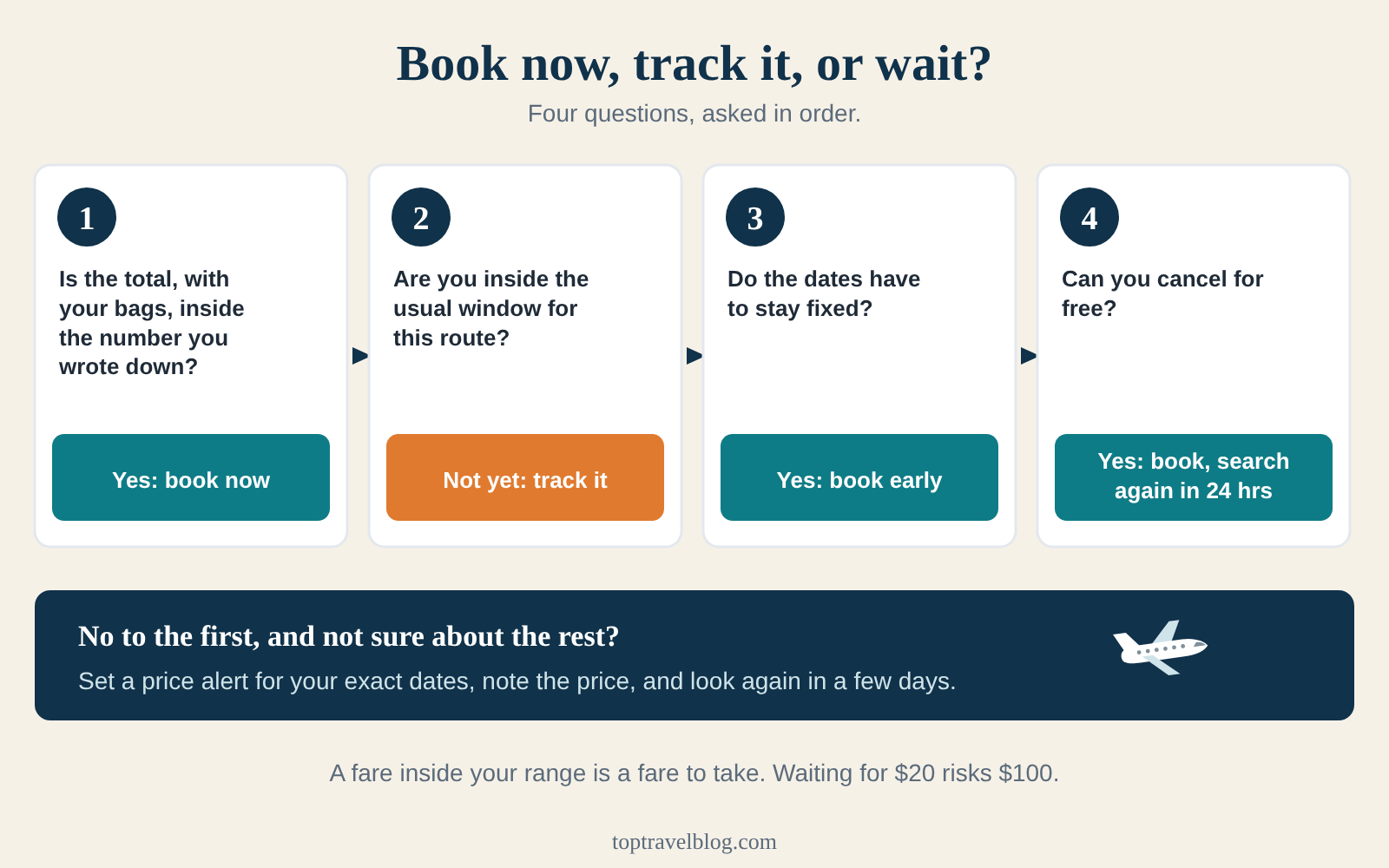
First, is the price inside the range you wrote down at the start? If yes, the answer is almost always to buy, particularly for dates inside the next three months. A fare you are happy with is a fare you take.
Second, is the trip inside the typical booking window for your route? If you are well inside the window and the price is still high, waiting rarely helps, because fares tend to rise from here. If you are well outside it, set an alert and wait.
Third, how much do the dates matter? A wedding, a graduation or a cruise departure is not a trip to gamble on. A flexible week at the beach is. The less flexible you are, the earlier you should buy.
Fourth, can you cancel? If you can, because the fare is refundable or you are inside the 24-hour window, buying early costs you almost nothing. If you can’t, the stakes of buying too early or too late go up.
What a “good” price looks like
On Google Flights, a route page shows a label for whether the current price is low, typical or high, based on past fares for the same route. That label is not perfect, but it is a useful sanity check when you do not know the route. I treat “low” as a green light, “typical” as fine if the dates matter, and “high” as a reason to track instead of buy.
Three worked examples of how to find cheap flights
Abstract advice is easier to follow with a concrete case, so here are three trips that show how to find cheap flights, with the reasoning I would use. The prices are illustrative, not quotes.
Example one: a family week in Orlando
A family of four wants a week in Orlando during the school break, about four months out. Orlando is a leisure route with many airlines, including budget carriers, so fares are competitive and tickets are usually not scarce except in holiday weeks.
I would search wide on Google Flights for the month, then look at all the airports within an hour or two of home, including a secondary one if it has a budget carrier. I would price main cabin vs basic economy with four seats together and two checked bags, because four people paying for seats separately turns a basic fare into a bad deal. Our Orlando vacation guide explains how many days the parks actually need, which in turn decides how many nights to fly for.
Example two: a long weekend in New York
A couple wants three nights in New York in six weeks. New York is served by three airports and many airlines, and last-minute fares can be sharp, but six weeks is inside the domestic window.
I would search all three airports on both ends, compare Friday-evening departures with Thursday ones, and look at Sunday evening against Monday morning returns. A Thursday-to-Sunday trip often undercuts Friday-to-Monday by enough to pay for a nice dinner. Before settling, I would read the New York City itinerary to decide whether a day less on the ground still fits what we want to do.
Example three: Europe in shoulder season
A solo traveler wants ten days in southern Europe in May, six months out. That is the front of the international window, and May is a shoulder month, so fares should be moderate.
I would use the date grid to find the cheapest Tuesday or Wednesday departure, try open-jaw routings such as into Lisbon and out of Madrid, and compare a nonstop on a U.S. carrier with a one-stop on a European one. I would set an alert and look every few days. If the fare fell into a range I wrote down, I would buy and use the 24-hour window to check once more.
A fourth case: last-minute and emergency trips
If you need a seat in the next week, every rule changes. The cheap buckets are usually gone, and the airline knows the buyer has no choice. A few things still help: check nearby airports, look at one-stop itineraries, price a nonstop on a different day, and compare the airline’s own site against Google Flights. Some airlines have bereavement or compassionate fares, but they are rarely cheap anymore, so ask rather than assume.
Tip: Many of these examples assume you can search for an hour. If you cannot, a good compromise is to buy a refundable or flexible fare at a moderate price and track the price for the 24 hours that follow.
After you book: price drops, changes and refunds
Booking is not the end of how to find cheap flights. This is where a good decision can save you another $50 to $150, or protect you from losing the entire fare.
Price drops
A quiet part of how to find cheap flights is the price drop. On many main cabin fares, you can change a ticket without a fee. If the fare for your flight falls, some airlines will let you rebook at the lower price and issue the difference as a credit. The rules differ by airline and fare class, and basic economy often excludes this. I keep a tracker on my own flights for a few weeks after buying, and it has paid off more than once.
Cancellations and refunds
If an airline cancels your flight, or changes it significantly, and you decline the alternative, the Department of Transportation requires a refund. The DOT rule defines a significant change as a delay of three hours or more on a domestic itinerary or six hours or more on an international itinerary, and it also covers a change of airport or an added connection. Refunds for credit card purchases are due within seven business days.
That refund is automatic for tickets bought from an airline, which means you do not have to ask for it. The details, including what fees come back with it, are in our guide to airline refund rules. If you simply change your mind on a nonrefundable fare, the airline is usually not required to refund it, though you often keep a credit.
Bags that go wrong
A delayed or lost bag is the other cost of a cheap trip that people forget. Keep receipts for essentials you buy while waiting, and file a report before you leave the airport. Our guides to delayed baggage and lost luggage walk through the reporting steps and what you can claim.
Seats
If you booked basic economy and your seat has not been assigned, do not pay for a seat at checkout until check-in opens, because the airline may assign a seat for free. If you did pay and want a better one, our short guide to the best airplane seat explains how to choose between space, sleep and a fast exit.
Hotels and the rest of the trip
Airfare is one piece. Once the flights are booked, the lodging decision should follow the same total-cost logic. Our guide to how to choose a hotel covers location, fees and cancellation terms, which are the same kind of hidden costs.
Seasons, holidays and the dates that cost the most
Some dates are expensive no matter how well you apply how to find cheap flights. Knowing them lets you plan around them or accept them.
The peak weeks
On domestic routes the highest fares cluster around the days before and after Thanksgiving, the two weeks around Christmas and New Year’s, spring break weeks, July 4 and Memorial Day. Prices on those days reflect demand, not timing, and the best you can do is book early and fly on the less popular day, such as Thanksgiving Day itself or the Tuesday before.
The quiet weeks
January after the first week, early February, late April, parts of May, September after Labor Day and the first half of November are routinely cheaper on leisure routes. Mid-week flying in any of those windows is where I find the best fares. If your schedule is open, shifting a trip by two weeks into one of these windows is a stronger move than any search trick.
Events you do not see coming
Conventions, big sporting events and festivals can push a fare up on dates that look ordinary. If a price is oddly high for a quiet week, search the destination for events. A city-wide convention can double hotel and flight prices for three days. Moving the trip by two days solves it.
Weather and cheap months
Cheap months are cheap for a reason. Summer in Florida and the Gulf is hot and stormy, winter in the Northeast is cold, and hurricane season runs from June through November. A low fare is only a deal if you still want the trip in that weather. Check how the weather affects your plans, and consider flexible fares in storm-prone seasons.
Common mistakes when you try to find cheap flights
These are the errors I see most often in how to find cheap flights, including some I made myself.
1. Comparing fares without bags
The lowest price on the page is rarely the lowest total. Price the bundle you will actually buy.
2. Waiting for a drop on a fare that is already low
If a fare is in your target range, take it. Waiting for an extra $15 is a bad bet when the downside is $100 or more.
3. Booking too early for domestic trips
Buying a domestic ticket nine months out usually means paying a high opening price. Unless it is a peak holiday, start tracking and buy in the window.
4. Ignoring the airport next door
A second airport can change the price by more than a day change can. Always include nearby airports in the search.
5. Choosing basic economy for a family
Seats together, a carry-on each and the ability to change are all missing. The saving disappears as soon as one of them matters.
6. Booking tight self-made connections
Two separate tickets with less than a few hours between them put all the risk on you. Leave a long buffer or buy one itinerary.
7. Trusting an unknown seller
If you cannot easily find how to reach the seller, do not buy from them. A saving of $30 is not worth a refund fight.
8. Skipping the 24-hour window
For tickets bought at least seven days before departure from the airline, a day of free cancellation is available on most bookings. Use it for one last search.
9. Forgetting passport and entry rules
Fares do not matter if you cannot board. Check passport validity and entry requirements before paying for a nonrefundable ticket.
10. Chasing a secret trick
There is no single secret site or day. The savings come from flexibility, timing and total-cost thinking, and they compound.
Frequently asked questions about how to find cheap flights
What is the best way to find cheap flights?
Start with a calendar tool such as Google Flights to see the whole month, compare the total cost including bags and seats, widen your dates and airports, buy within the usual window for your route and set alerts. This is the core of how to find cheap flights, and it works because it is built on flexibility, not tricks.
How far in advance should I book a flight?
For most domestic routes, roughly one to three months ahead; for peak holidays and summer, three to five months. For most international routes, roughly two to eight months ahead, and four to ten for peak seasons. These are ranges drawn from fare patterns, not guarantees, so use your own route’s price history to adjust.
Is Tuesday really the cheapest day to buy flights?
No. Prices update all day, and the idea of a cheap booking day is mostly outdated. The day you fly matters more: Tuesday, Wednesday and Saturday departures are often cheaper than Friday and Sunday on leisure routes. Spend your time finding the cheap days to fly, not the cheap day to click.
Do budget airlines make how to find cheap flights easier?
Sometimes. If you travel with only a personal item and need no changes, a low-cost carrier can be much cheaper. If you need a bag, seats together or flexibility, the total often matches or exceeds a main cabin fare. Frontier and Allegiant are the main U.S. ultra-low-cost carriers now that Spirit has stopped flying.
Does incognito mode help with how to find cheap flights?
I have not found evidence that it does. A rising price is far more often a seat in a cheaper fare bucket having sold. If a price changes between searches, it is likely real inventory. Use an alert for the route and ignore the folklore.
What is the 24-hour rule for flights?
For tickets bought directly from an airline at least seven days before departure, the airline must let you cancel for a full refund within 24 hours or hold the fare for 24 hours without payment. It does not apply to most tickets bought through travel agencies. Read our guide to the 24-hour flight cancellation rule for the details.
Is hidden-city ticketing legal?
It is not illegal in the criminal sense, but it violates most airlines’ contracts of carriage, and airlines have sued sites that promote it. They can cancel the remaining ticket, cancel your frequent-flyer account or refuse a bag. I do not recommend it, and I never use it for anything I cannot afford to lose.
Should I book a one-way or round-trip ticket?
Compare both; it is a small part of how to find cheap flights that people skip. On many U.S. routes a round trip and two one-ways cost about the same, and mixing airlines (one each way) can sometimes be cheaper. Internationally, round trips are often cheaper than one-ways, and some countries want proof of onward travel, so a one-way can cause problems at check-in.
Are points worth using for cheap flights?
Sometimes, and they are a useful side road in how to find cheap flights. If your points are worth more than about 1.5 cents each against the cash price, redeem them. Otherwise keep them. They are most useful when cash fares are high, such as holiday weeks. Do not open a new card only for one trip unless the bonus clearly outweighs the annual fee.
What should I do if a fare drops after I book?
If your airline allows changes without a fee, you may be able to rebook at the lower fare and receive the difference as a credit. Basic economy usually excludes this. Also check whether you are still inside the 24-hour window, when you can cancel and rebuy at the new price.
What is the cheapest month to fly?
It depends on the route, but in how to find cheap flights the pattern on leisure routes is that January after the first week, early February, September and early November are often cheaper than summer and holiday months. Shoulder seasons, such as April to May and September to October in Europe, give a mix of better weather and lower fares.
One last thing before you search
If I had to boil how to find cheap flights down to one habit, it would be this: look at the whole month before you look at a single day. Everything else in this guide, the bags, the airports, the 24-hour window, is a refinement of that.
The best fare I ever found was on a trip I almost did not take. I had a date in mind, searched the month for fun, and noticed that shifting two days saved enough for a proper dinner on both ends. It took nothing but patience, and it is the reason I still open the calendar before anything else.
Knowing how to find cheap flights is a skill you build one trip at a time. Write down your target, search wide, price the real total, buy inside the window, and keep watching. Do that three or four times and you will stop needing a guide like this one.
Related planning guides
- How to use Google Flights: date grids, price tracking and flexible airports — the click-by-click companion to the search routine above.
- How to plan a trip step by step — where flights fit among the other ten decisions.
- Basic economy vs main cabin — what you give up for the lower fare, airline by airline.
- Airline refund rules in the U.S. — cancellations, significant delays and bag fees.
- The 24-hour flight cancellation rule — when it applies and when it does not.
- Flight canceled or delayed? What to do first — the first ten minutes matter most.


