

Three days is the right length for a first Las Vegas itinerary, and the best version of it spends only one of those days on the Strip. That is the verdict I keep arriving at after a dozen visits, and it surprises people who assume Vegas is a casino crawl and nothing else.
The honest shape of a great Las Vegas itinerary is one day walking the Strip with a plan, one day Downtown around Fremont Street and the Arts District, and one day in the desert at Red Rock Canyon or out at Hoover Dam.
You will gamble as much or as little as you like, and you will come home with more than a hangover and a parking receipt.
This Las Vegas itinerary suits first-timers, couples, friend groups and anyone traveling with a non-gambler who still wants a real vacation. It works for families too, with a few swaps I spell out below. It does not suit someone who wants to sit at a blackjack table for 72 hours; you do not need an itinerary for that, you need a bankroll.
Every part of this Las Vegas itinerary is priced and timed for trips in 2027, with the numbers I verified in late 2026: resort fees that now run $45 to $55 a night at most big Strip properties, $20 to $25 a day to park a car, a $20 vehicle fee at Red Rock Canyon plus a timed-entry reservation from October through May, and a Deuce bus day pass that still costs $8.
Let’s plan the Las Vegas itinerary.
Quick facts
- Best for: first-time visitors, couples, friend groups, and mixed parties where one person doesn’t gamble; works for families with the swaps noted in each day.
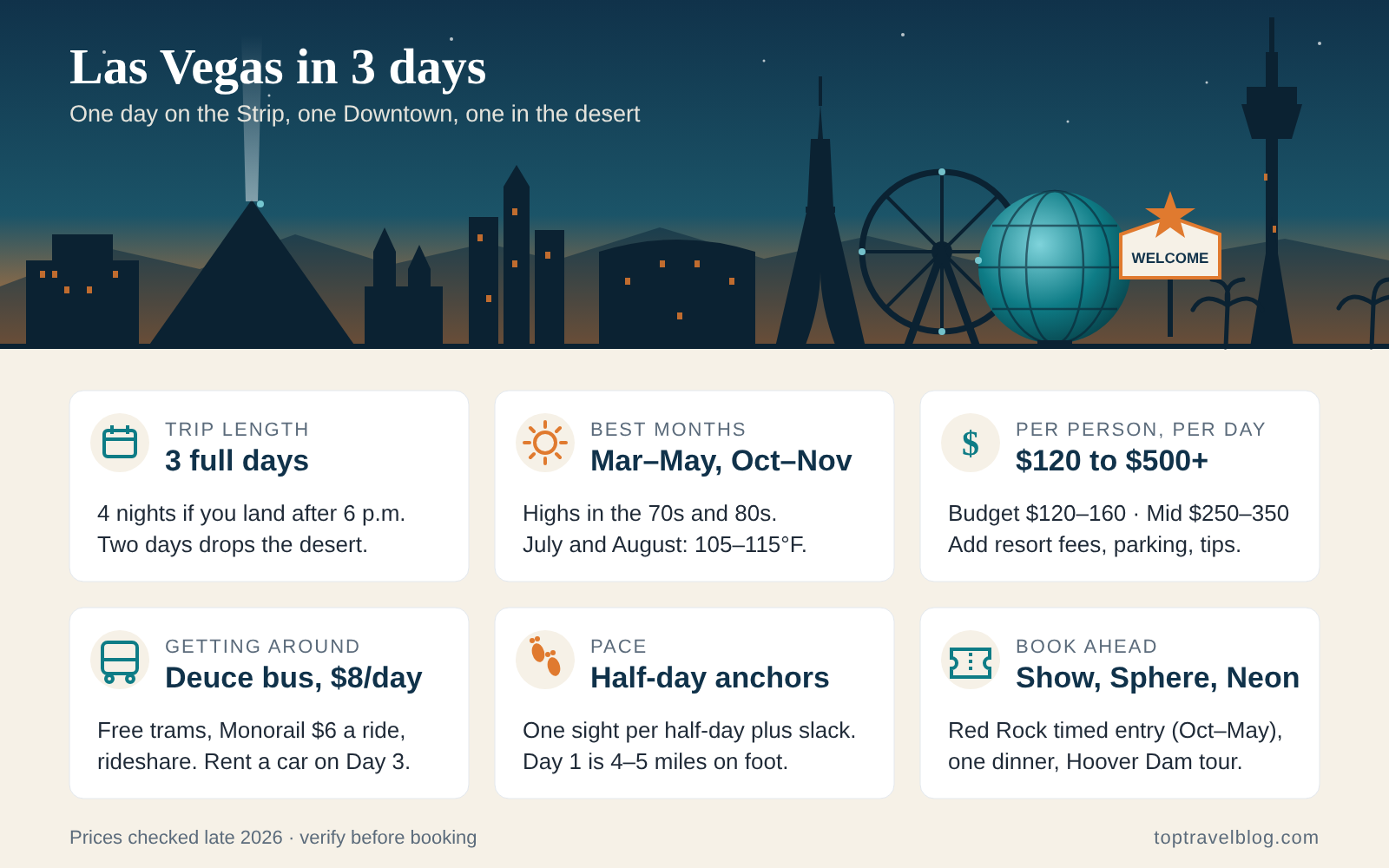
- Ideal Las Vegas itinerary length: 3 full days (4 nights if you fly in late). Two days feels rushed; five starts to repeat itself unless you add a Grand Canyon or Zion day.
- Best months: March to mid-May and late September to early November. Avoid July and August unless you plan around 110°F afternoons.
- How to get around: walk short stretches of the Strip, ride the Deuce bus ($8 for 24 hours) or the Monorail ($15 day pass), use rideshare for Downtown and the airport, rent a car only for Day 3.
- Booking priorities: a Cirque or headliner show, the Sphere Experience, the Neon Museum evening slot, a Red Rock Canyon timed-entry reservation (Oct–May), and a dinner reservation for one proper night out.
- Pacing: this Las Vegas itinerary uses one anchor per half-day plus a free-roam window; Vegas distances are longer than they look and the heat drains you faster than you expect.
- Key caveats: resort fees ($45–$55 plus tax per night), paid parking ($20–$25 a day), $20 cocktails, and a tipping culture that expects cash at every turn. Budget for those first, then book.
Best time to go for this Las Vegas itinerary
Las Vegas has two good seasons, one brutal one and one that is better than its reputation. The good ones are spring, from early March through the middle of May, and fall, from the last week of September through early November.
Daytime highs sit in the 70s and 80s, evenings are warm enough for a patio, and the Day 3 desert outing is a pleasure instead of an endurance test. If you can only pick one window for a Las Vegas itinerary, pick the second half of October.
Summer is the brutal one. From mid-June through early September, afternoon highs of 105°F to 115°F are normal, not exceptional, and the pavement on Las Vegas Boulevard radiates heat well after dark.
Hotels get cheaper, sometimes dramatically so on weeknights, which is why people go anyway. This Las Vegas itinerary still works in July, but only if you flip the schedule: desert and outdoor walking before 9 a.m., indoor everything from noon to 6 p.m., and the Strip after sunset. I give you those swaps in the heat variant below.
Winter is the underrated Las Vegas itinerary season. December through February brings highs in the 50s and low 60s, cold nights, and the occasional day of rain or wind that cancels the Bellagio fountains. It is also the best time to hike Red Rock Canyon and the cheapest time to sleep on the Strip, apart from two spikes: the week around New Year’s Eve and the CES convention in early January, when a $120 room becomes a $500 room and restaurant reservations evaporate.
Crowds and prices by week, not just by month
Vegas pricing is driven by the calendar more than the season. A Tuesday in late October might cost $110 at a mid-Strip MGM property; the Friday of the same week can be $350 for the same room because a fight, a festival or a convention is in town.
Before you lock dates for a Las Vegas itinerary, look at the convention calendar on the Las Vegas Convention and Visitors Authority site, and check for big events like the Formula 1 race in November, EDC in May, and March Madness weekends.
The quietest, cheapest stretches I have found are the first two weeks of December, mid-January after CES, and the dead week after Labor Day. Sunday through Thursday nights are consistently 30 to 50 percent cheaper than Friday and Saturday, which is why my ideal 3 days in Las Vegas run Sunday night to Thursday morning. You get the same shows, shorter lines at the buffets, and a Red Rock reservation that is actually available.
Worth knowing: Spring is windy. March and April bring afternoon gusts strong enough to cancel the Bellagio fountains, close the High Roller wheel temporarily, and turn the Red Rock Scenic Drive into a sandblasting. Build the fountain viewing on your Las Vegas itinerary into the evening, when the wind usually drops.
How many days you really need in Las Vegas
Three full days, with four nights if your flight lands after 6 p.m. That is the answer for a first visit, and it is the shape this Las Vegas itinerary follows. Here is how a Las Vegas itinerary changes at each length, so you can adjust if your dates are fixed.
With 2 days
Run Day 1 (the Strip) of this Las Vegas itinerary and a compressed Day 2 (Downtown in the afternoon and evening, skipping the Arts District). You lose the desert entirely, which is a real loss, but you still get the two faces of the city. If you only have two days and you have never seen the Grand Canyon, I would still not try to cram it in; the West Rim day trips burn ten hours for ninety minutes of canyon.
With 3 days (this plan)
The Strip, Downtown plus the Arts District, and one desert day. You see the fountains, the Sphere, a show, Fremont Street’s canopy, the Neon Museum and either Red Rock Canyon or Hoover Dam, with enough slack for a long lunch and a pool afternoon. This is the Las Vegas itinerary I recommend to friends, and it is the version that works for the widest range of travelers.
With 4 days
Add the desert day you did not pick to the three-day Las Vegas itinerary. If Day 3 was Red Rock, Day 4 becomes Hoover Dam in the morning and Valley of Fire in the afternoon, or the reverse.
Alternatively, spend Day 4 doing what you would have done had you flown straight to Los Angeles: a pool day with a reserved daybed, a long dinner, and a second show.
Four days is also where a rental car for the whole trip starts to make financial sense, resort parking fees included.
With 5 or more days
Leave town. Zion National Park is two and a half hours northeast, the Grand Canyon’s South Rim is four and a half hours east, and Death Valley is two hours west. A five-day Las Vegas itinerary in the city itself gets repetitive unless you are there for a conference or a pool party residency. Many people pair Vegas with a California road trip, and if that is you, our Los Angeles itinerary picks up where this one leaves off, four hours down I-15.
One more framing that helps with any Las Vegas itinerary: Vegas is a destination where more days do not mean more value. The unit economics of a Strip hotel (resort fee, parking, $9 coffee) punish long stays.
If you are deciding between 3 days in Las Vegas plus 4 in another city or 7 days in Vegas, take the split every time. Readers planning a bigger US trip often pair this with our New York City itinerary; the two cities make a strange and excellent contrast in one trip.
Where to stay: on the Strip or off it
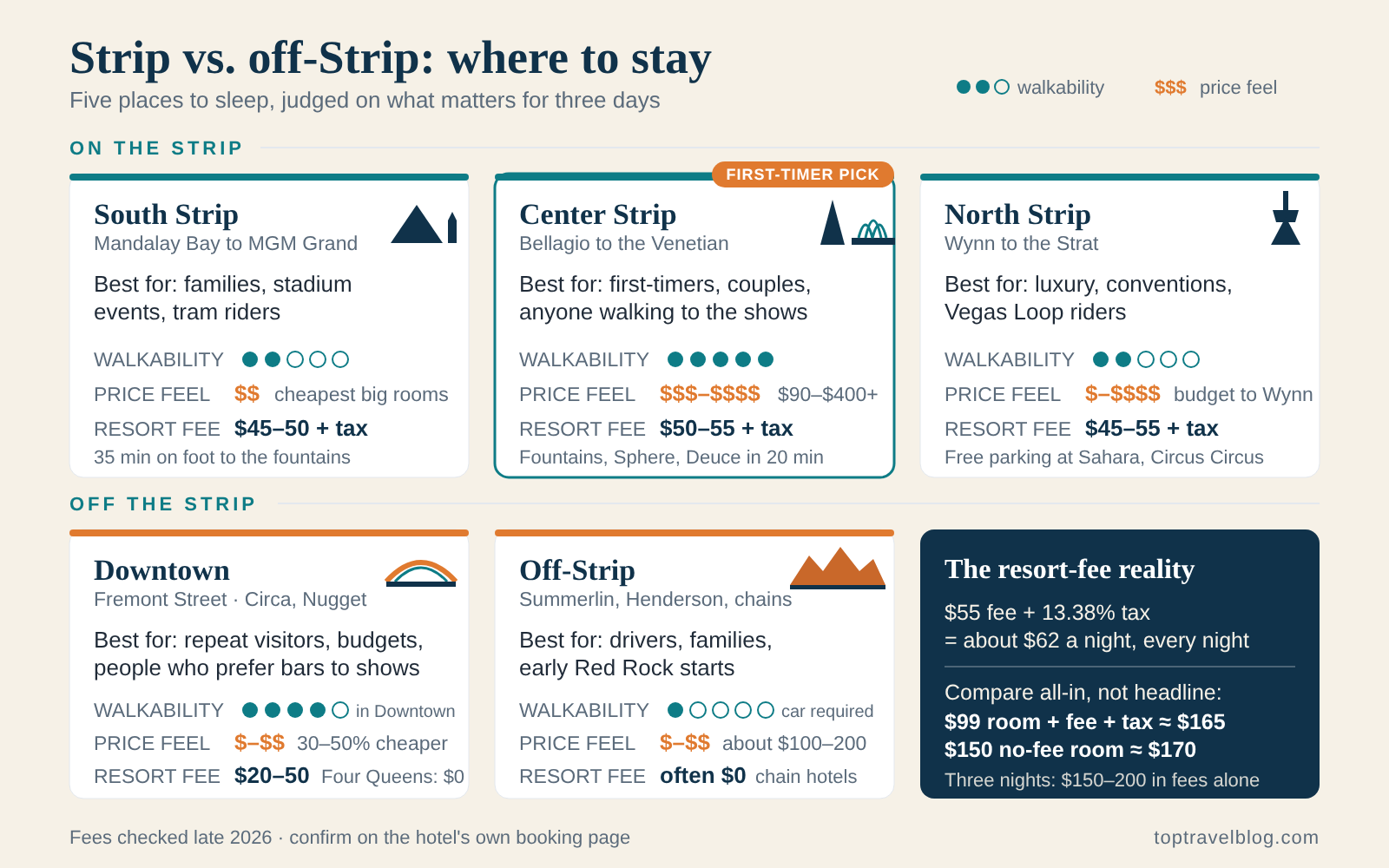
Where you sleep shapes this Las Vegas itinerary more than any other decision, because the Strip is four miles long and the hotels are enormous. Walking from your room to the sidewalk can take ten minutes at a place like Caesars Palace or MGM Grand, and that is before you walk anywhere. For a first trip of three days, I would stay on the Center Strip for two or three nights and accept the resort fee as the cost of location.
For a repeat visit, Downtown or an off-Strip locals’ casino is often the smarter buy. Here is how the areas compare for a Las Vegas itinerary.
Center Strip (Bellagio to the Venetian)
Best for: first-timers, couples, anyone who wants to walk to the fountains and the Sphere
Bellagio, Caesars Palace, the Cosmopolitan, Paris, Planet Hollywood, the LINQ, Flamingo, Harrah’s and the Venetian all sit within a 20-minute walk of each other. Rooms run from roughly $90 (Flamingo, Harrah’s on a weeknight) to $400 and up (Cosmopolitan, Bellagio on a weekend), plus a $50 to $55 resort fee almost everywhere. If you want one base for 3 days in Las Vegas, this is it.
South Strip (Mandalay Bay to MGM Grand)
Best for: families, Allegiant Stadium and T-Mobile Arena events, people who want a tram
Mandalay Bay, Luxor, Excalibur, New York-New York, Park MGM and MGM Grand. The free tram links the first three, and Luxor and Excalibur have the cheapest big-resort rooms on the Boulevard, often under $80 midweek with a $45 resort fee. The trade-off for a Las Vegas itinerary is distance: it is a 35-minute walk from Excalibur to the Bellagio fountains, and the Sphere is a bus ride, not a stroll.
North Strip (Wynn to the Strat)
Best for: luxury seekers, convention-goers, Vegas Loop users
Wynn and Encore are the best-run big hotels in the city and charge accordingly; Resorts World and Fontainebleau are newer, quieter and sometimes discounted because they are a long walk from everything. Sahara, Circus Circus and the Strat are budget options with free self-parking. The gap between Encore and Fontainebleau is a half-mile of sidewalk with almost nothing on it; after dark, take the Deuce.
Downtown / Fremont Street
Best for: repeat visitors, budget travelers, people who prefer bars to shows
Circa, Golden Nugget, the Plaza, the D, Golden Gate, Downtown Grand and El Cortez. Rooms are 30 to 50 percent cheaper than the Center Strip, resort fees run $20 to $50 (Four Queens charges none), parking is cheaper or free for guests, and the table minimums are lower. The catch: you are a $20 to $30 rideshare from the Strip each way, and the Fremont Street canopy is loud until 2 a.m.
Off-Strip locals’ casinos and non-casino hotels
Best for: drivers, families, anyone building the trip around Red Rock or Hoover Dam
Red Rock Resort in Summerlin (20 minutes from the Scenic Drive), Green Valley Ranch in Henderson, South Point on the far south end, and the cluster of Marriott and Hilton properties near the convention center. Rooms are often $100 to $200 with free parking and, at the non-casino brands, no resort fee. You will need a car or a rideshare budget for every Strip visit; without one this Las Vegas itinerary falls apart.
Where to stay on the Strip: the version nobody puts in the brochure
Picking where to stay on the Strip comes down to one question: what do you want to be able to walk to at 11 p.m. without thinking about it? If the answer is the Bellagio fountains and a cocktail bar, stay between Bellagio and the Venetian. If the answer is a pool and a quick exit to the airport, stay South Strip. If the answer is a quiet, well-run hotel and you are happy to ride the bus, stay at Wynn, Encore or Fontainebleau.
My own pattern for a first-timer’s Las Vegas itinerary is two nights at a Center Strip property in the $150 to $250 range before fees (the Cosmopolitan on a weeknight, Paris, or the Venetian if there is a deal), then one night Downtown at Circa or the Golden Nugget to break up the trip and sleep near the Day 2 action.
The hotel change costs you an hour on Day 2 morning and saves you two long rideshares at night. If moving hotels sounds like misery, stay Center Strip all three nights; it is the least wrong answer.
A few specific calls on where to stay for this Las Vegas itinerary. Flamingo and Harrah’s are the cheapest Center Strip rooms and they feel like it; ask for a renovated tower. Paris has one of the better locations on the Boulevard, directly across from the fountains, and its rooms are often underpriced relative to Bellagio next door.
Planet Hollywood connects to the Miracle Mile Shops, which matters in August. The LINQ is loud and young. The Venetian’s standard suites are the biggest base rooms on the Strip and a genuine value when they drop below $200.
Las Vegas off the Strip: when it is the better call
Las Vegas off the Strip means different things to different people. For most readers it will mean one of three choices: Downtown, a Summerlin or Henderson locals’ casino, or a chain hotel near the convention center. All three can be smart, and all three can wreck a Las Vegas itinerary if you choose them for the wrong reasons.
Downtown works for a Las Vegas itinerary when you are a repeat visitor, when nightlife matters more than shows, or when your budget is tight and you would rather spend on dinner than on a resort fee. Circa is the standout: adults-only, a rooftop pool amphitheater, and a sportsbook you will want to visit even if you never place a bet.
The Golden Nugget is the classic choice with the pool and the shark tank. The Plaza and the D are cheaper and fine. El Cortez is the oldest and the most charming if you like a 1941 casino with an updated room.
Summerlin and Henderson work when you have a car and you are leaning into Day 3. Red Rock Resort is a legitimately nice hotel with a good pool, free parking and the Scenic Drive 20 minutes away, which makes the 6 a.m. desert start painless. The problem is the Strip: it is 25 minutes by car with no traffic and 45 with it, so your Day 1 and Day 2 evenings become drive-and-park exercises, and nobody wants to be the designated driver on Fremont Street.
The convention-center chains work when the whole point is cost. A Residence Inn or Hyatt Place near the LVCC can be $120 with free breakfast, free parking and no resort fee, which is a $120 to $180 nightly swing against a Strip hotel once you add everything up. You will be a Monorail or a Deuce ride from the Strip and a rideshare from everything else.
That is a fine trade for a group of friends; it is a poor trade for a couple on a first Las Vegas itinerary who wants to feel like they are in Vegas.
The resort fee reality (and how to think about it)
Las Vegas resort fees are mandatory daily charges that hotels add on top of the room rate, and they are the single most resented line item in this city. As of late 2026, nearly every major Strip hotel charges $45 to $55 per night before tax; with Clark County’s 13.38 percent lodging tax, a $55 fee becomes about $62.
Downtown they run $20 to $50. MGM Resorts, Caesars and the Venetian all raised theirs in the past two years, and the pattern is upward. Third-party sites sometimes bury the fee, so look for it on the hotel’s own booking page.
What you get for it is usually Wi-Fi, fitness center access, and sometimes a couple of bottled waters or a pool-towel service, which is to say nothing you would pay $55 for voluntarily. The practical response is to compare hotels on the all-in nightly number, not the headline rate. A $99 room at Flamingo with a $50 fee and tax is roughly $165. A $150 room at a no-fee Marriott near the convention center is $170. Suddenly the decision is about location, not price.
A handful of properties still charge no resort fee: Four Queens downtown, the Casino Royale on the Strip (a Best Western), and the non-casino chains near the convention center. Some loyalty tiers waive the fee, and a few booking packages roll it into the rate.
None of these loopholes are worth building a trip around, but they are worth knowing when two options are otherwise close. Over a three-night Las Vegas itinerary, resort fees alone add $150 to $200; budget it as a fixed cost from the start and it stops being a surprise.
Tip: If you are driving, factor in parking the same way. MGM and Caesars properties charge $20 Monday to Thursday and $25 on weekends for self-parking; Wynn gives non-guests three hours free, then $25; Treasure Island, Sahara and Circus Circus still park for free. A rental car parked at a Center Strip hotel for three nights costs $60 to $75 before you drive it anywhere.
The 3-day Las Vegas itinerary, day by day
This Las Vegas itinerary assumes you arrive the evening before Day 1 and that you are staying somewhere on the Center Strip. If you are staying Downtown or off the Strip, the days still work; just add 20 to 30 minutes of transit at each end.
Each day has one anchor per half-day, a meal I would actually eat, the walking and transit times between stops, and a swap for heat, rain, kids or a non-gambler. Times are deliberately loose. Vegas punishes rigid schedules because everything takes longer than the map suggests.
Day 1
The Strip done right: south to north, fountains at dusk, a show at night
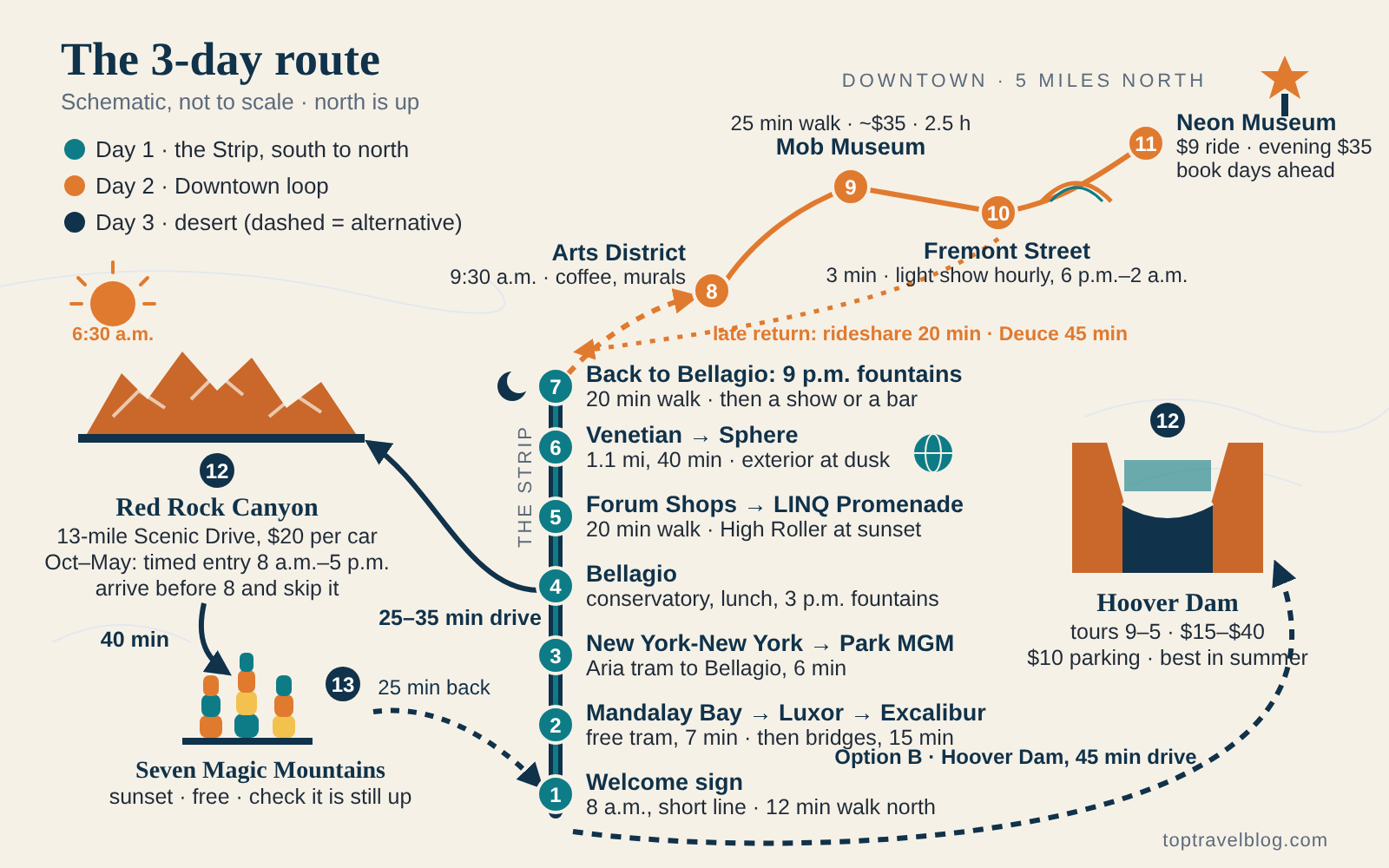
The Strip is best walked from south to north, and the reason is timing, not geography. Starting at the south end in the morning puts you at the Bellagio and the Sphere in the late afternoon, which is exactly when both are at their best, and it leaves you on the Center Strip at night, where the shows, the fountains and the bars are.
People who start at the Venetian and drift south end up at the Luxor at 7 p.m. with nothing to do and a long bus ride back. Do not be those people.
Morning: the sign, the pyramid and the free trams
Start early, by 8 a.m. if you can, at the Welcome to Fabulous Las Vegas sign on the median south of Mandalay Bay. The Deuce bus stops right there (it is the southern end of the route), there is a free parking lot, and at 8 a.m. the line for a photo is three people instead of thirty. Before 9 a.m. the light is soft and the sign faces you; by midday it is backlit and surrounded by a wedding party.
Walk or ride one Deuce stop north to Mandalay Bay (12 minutes on foot along a sidewalk with no shade), then take the free tram to Luxor and on to Excalibur. The tram runs from about 10 a.m., so if you are early, the walk through Mandalay Bay’s convention corridor to Luxor is covered and air-conditioned.
Luxor’s atrium is still one of the strangest interiors in the city; walk up the inclinator if nobody stops you. Shark Reef at Mandalay Bay is the first-choice kids’ swap here, about an hour and roughly $30 to $40 per person.
From Excalibur, the pedestrian bridges carry you over Tropicana Avenue to New York-New York, where the Big Apple Coaster runs from 11 a.m. and the fake Brooklyn Bridge makes a decent coffee stop. Continue through Park MGM (quiet, good casino, the only Strip resort that is fully non-smoking) to the Aria Express tram, which is free and drops you at Bellagio in six minutes.
Budget two and a half hours of the Las Vegas itinerary for the sign-to-Bellagio stretch, coffee included. On foot without trams it is about two miles, which sounds easy and is not, because every resort routes you through its casino.
Afternoon: Bellagio’s conservatory, a long lunch and the walk to the Sphere
Bellagio’s Conservatory and Botanical Garden is free, changes its installation five times a year, and sits right off the lobby under the Chihuly glass ceiling. Give it 20 minutes. Then lunch.
My default is the Bellagio Patio or Sadelle’s inside the hotel, both overlooking the fountains, or a cheaper walk across the bridge to Paris for Mon Ami Gabi’s terrace, which has the best fountain view of any restaurant and takes same-day reservations more often than you would expect. Figure $35 to $60 per person for lunch with a drink at any of these.
Watch one fountain show while you are there. On weekdays the Fountains of Bellagio start at 3 p.m. and run every 30 minutes until 6:30 p.m., then every 15 minutes from 7 p.m. to midnight; on weekends and holidays the first show is at noon.
The daytime shows are good; the night shows are better. See one now from the Paris side and plan to see another after dark. Wind cancels them, and the hotel does not announce it, so if nothing happens at the top of the half hour, move on.
From Bellagio, walk north on the east side of the Boulevard: past Caesars Palace (duck into the Forum Shops to see the fake sky and cool off), through the LINQ Promenade (the High Roller wheel is here, $25 to $40 a ride; worth it at sunset, not at 2 p.m.), and on to the Venetian.
That is about 1.1 miles and takes 35 to 45 minutes with casino detours. Walk through the Venetian’s Grand Canal Shoppes to the back exit toward Sands Avenue, and there it is: the Sphere, 366 feet tall, looking like a planet that landed in a parking lot.
Evening: the Sphere, the fountains again, and a show
The Sphere exterior is best seen from the pedestrian bridge between the Venetian and the Wynn side of Sands Avenue around dusk, when the Exosphere’s LED skin switches on and the sky still has color.
You do not need a ticket for that. If you want to go inside, the Sphere Experience (the film program, which has rotated between Postcard from Earth and The Wizard of Oz at Sphere) runs most afternoons and evenings and costs roughly $95 to $250 depending on seat level and showtime, with weekday matinees cheapest.
Book on the Sphere’s own site. I would do a 5 p.m. or 5:30 p.m. showing, which leaves the rest of the night open.
From the Sphere it is a 20-minute walk back to Bellagio for the night fountains, or two Deuce stops. Plan to be on the sidewalk in front of Bellagio by 8:45 p.m. for the 9 p.m. show, then stay for the 9:15; the music changes and the crowd thins between them. On this Las Vegas itinerary, dinner is either before a show or late after one.
If you booked a Cirque show (O at Bellagio, Mystère at Treasure Island, and KÀ at MGM Grand are the three I would consider; O is the one worth paying up for), the 7 p.m. or 7:30 p.m. curtain means an early dinner at 5:30 p.m. and fountains at 9:30 p.m. after the show. Either order works.
End at a bar with a view. The Chandelier at the Cosmopolitan is the obvious choice and still a good one; the Cosmopolitan’s lobby bar and the Bellagio’s Petrossian are quieter. Expect $18 to $24 for a cocktail at any of them, plus the tip. If your feet are done, the Deuce or a rideshare gets you home. If they are not, the stretch from Cosmopolitan south to Park MGM is the pleasantest late-night walk on the Strip.
Logistics: Welcome sign to Mandalay Bay, 12 minutes on foot or 1 Deuce stop; trams Mandalay Bay–Excalibur (free, 7 minutes) and Park MGM–Bellagio (free, 6 minutes); Bellagio to Sphere, 1.3 miles, 40 to 50 minutes with detours; Sphere back to Bellagio, 20 minutes on foot. Total walking on Day 1 of this Las Vegas itinerary with trams: 4 to 5 miles. Without trams, closer to 7. Buy the $8 Deuce 24-hour pass in the rideRTC app before you start.
If it rains or hits 110°F: Run the same Las Vegas itinerary backwards in time, not in space. Start at Bellagio at 10 a.m. (conservatory, lunch, a 3 p.m. fountain), spend 2 p.m. to 5 p.m. indoors at the Forum Shops and the Venetian, see the Sphere at dusk, and skip the south end entirely. Save the Welcome sign for the drive to the airport.
With kids: Shark Reef at Mandalay Bay in the morning, the Big Apple Coaster at New York-New York, the Bellagio conservatory, and the High Roller at sunset make a full day of the Las Vegas itinerary on their own. Replace the show with the 8 p.m. fountains and an early night; the Strip after 10 p.m. is not a place for children, and I say that as someone who likes it.
Day 2
Downtown: the Arts District, the Mob Museum, Fremont Street and neon after dark
Downtown Las Vegas is five miles north of the Center Strip and it is a different city: lower buildings, older casinos, real streets with real crosswalks, and a bar scene that locals actually use.
Day 2 of this Las Vegas itinerary runs from a late breakfast in the Arts District through the Mob Museum, an afternoon under the Fremont Street canopy, and an evening at the Neon Museum, before a late-night return to the Strip. You will spend less money today than on Day 1, and you may like the city more.
Morning: the Arts District, slowly
Take a rideshare ($18 to $28 from the Center Strip, 15 to 20 minutes) or the Deuce (35 to 50 minutes, same $8 pass) to the Arts District, the 18-block area around Main Street and Charleston Boulevard that locals call 18b.
Aim for 9:30 a.m. Breakfast at Esther’s Kitchen on Main Street if you can get in (they open at 11 a.m. for lunch, so plan this as an early lunch instead), or coffee and a pastry at Vesta Coffee Roasters on Casino Center Boulevard, which is where I start.
Then wander: antique stores on Main, murals in every alley, the Arts Factory, and a half dozen breweries that open at noon.
This is the one part of the Las Vegas itinerary where I would not over-plan. Two hours of unstructured walking between Main Street, Casino Center and Commerce Street is the point. If you want structure, the Arts District’s First Friday festival (the first Friday of each month, from 5 p.m.) is the biggest street event in the city; if your dates line up, flip this day so you are Downtown in the evening and do the Neon Museum another night.
Midday: the Mob Museum
From the Arts District, the Mob Museum is a 1.4-mile walk north on Main Street (25 minutes, flat, shaded in patches) or a $10 rideshare. It occupies the 1933 federal courthouse at 300 Stewart Avenue where the Kefauver hearings were held, and it is the best museum in Las Vegas by a wide margin. Adult admission starts around $35 online and includes access to the Underground speakeasy and distillery in the basement; the Crime Lab and firearm simulator experiences cost extra.
Nevada residents get $10 off. Buy online for a timed slot and give it two and a half hours, three if you do the distillery tour.
The Mob Museum’s site lists current prices and hours (daily 9 a.m. to 9 p.m., last entry 7 p.m.).
Lunch after the museum is a short walk. Carson Kitchen on Carson Avenue (two blocks south) is the reliable choice, with a rooftop patio and a $20 to $30 lunch. Pizza Rock on North 3rd Street is the cheap and fast one. Either way you are now three minutes’ walk from the Fremont Street canopy, and it is time to see it in daylight before the crowds arrive.
Afternoon: Fremont Street in the light, Fremont East, and a break
The Fremont Street Experience is the five-block pedestrian mall under a 1,500-foot LED canopy between Main Street and Las Vegas Boulevard. In the afternoon it is manageable: the casinos (Golden Nugget, Four Queens, Binion’s, the D, Golden Gate, Circa at the west end) are open, the street performers are setting up, and the SlotZilla zipline is running with a shorter line than it will have at 9 p.m.
Walk it end to end (15 minutes), step into the Golden Nugget to see the gold nugget and the shark tank at the pool, and step into Circa to see the sportsbook, which is three stories tall and worth it even for a non-gambler.
East of Las Vegas Boulevard, the canopy ends and Fremont East begins: a few blocks of bars (Commonwealth, Atomic Liquors, which has been pouring since 1952, and the Downtown Cocktail Room) and the Downtown Container Park, a shopping and food complex built from shipping containers with a kid-friendly playground in the middle.
This is a good place to stop for an hour. If you are hoteling it Downtown tonight, check in now and lie down; if you are returning to the Strip, this is where you decide how late you are staying out.
Evening: the Neon Museum, the canopy after dark, and the late ride home
The Neon Museum at 770 Las Vegas Boulevard North is a 20-minute walk or a $9 rideshare from Fremont Street. It is an outdoor boneyard of about 250 rescued signs from demolished casinos, and it is best seen at night when the restored ones are lit.
Evening general admission runs $35 for adults ($30 for seniors, students and Nevada residents; children 6 and under free), guided tours add $15, and the Brilliant! Jackpot projection show is an add-on from $17. Evening slots sell out days ahead in high season.
Book on the Neon Museum site. Hours shift seasonally (3 p.m. to 11 p.m. most of the year, later in summer), so a 7 p.m. slot is not always dusk. Give it 75 to 90 minutes.
Back under the canopy, the Viva Vision light show runs every hour on the hour from 6 p.m. to 2 a.m., six to eight minutes each. The 9 p.m. and 10 p.m. shows are the loudest and the most crowded. Watch one from the middle block near the Four Queens, then move on; two shows in a row is one too many.
Dinner options nearby that I would book: the Golden Steer Steakhouse on West Sahara Avenue (halfway back to the Strip, open since 1958, reserve weeks ahead), or Esther’s Kitchen in the Arts District if you missed it at lunch. Either is a $70 to $120 per person dinner with wine.
Getting back to the Strip late is the last logistics question of Day 2 on this Las Vegas itinerary, and the choice is between money and time. A rideshare from Fremont Street to the Center Strip runs $20 to $35 depending on surge (and it surges after 11 p.m. on weekends), takes 15 to 20 minutes, and picks up from the designated zones at the Fremont Street garages, not from the pedestrian mall.
The Deuce runs 24 hours a day, costs nothing more on your pass, and takes 40 to 55 minutes at night, which is longer than the ride but shorter than the wait for a surge to drop. If three or more of you are traveling, a rideshare wins.
Logistics: Center Strip to Arts District, 15 to 20 minutes by rideshare or 40 by Deuce; Arts District to Mob Museum, 1.4 miles, 25 minutes on foot; Mob Museum to Fremont Street canopy, 3 minutes; Fremont Street to Neon Museum, 1 mile, 20 minutes on foot (not a walk I would do alone after 10 p.m.; take a $9 rideshare); Fremont Street to Center Strip, 15 to 20 minutes by car, 40 to 55 by bus. Total walking on Day 2 of the Las Vegas itinerary: 3 to 4 miles.
Be aware: Fremont Street after dark is the rowdiest public space in the city. Expect aggressive costumed performers who demand tips for photos, open containers, and pickpocket-friendly crowds during the light shows. Keep your phone in a front pocket, do not accept a “free” anything from anyone, and know that the police substation is at the west end near the Plaza.
With kids or in extreme heat: Do the Mob Museum at opening (9 a.m., coolest and emptiest), lunch at the Container Park, skip Fremont East, and book the Neon Museum’s first evening slot so you are done by 8 p.m. In July, the Neon Museum’s late-summer hours (8 p.m. to midnight) exist precisely because the boneyard is unbearable before sunset.
Day 3
Off the Strip: Red Rock Canyon (or Hoover Dam and Valley of Fire), then Seven Magic Mountains at sunset
Day 3 is the day that turns a Las Vegas itinerary from a weekend of casinos into a trip you remember. You have two realistic options with a rental car or a day-long rideshare budget: Red Rock Canyon, 25 minutes west of the Strip, or Hoover Dam, 45 minutes southeast, with Valley of Fire State Park an hour northeast as an add-on.
I have done all three in a day exactly once and do not recommend it. Here is how they compare, which one I would pick, and how to do each properly.
Red Rock Canyon vs. Hoover Dam: pick one
Red Rock Canyon National Conservation Area is a 13-mile one-way Scenic Drive through sandstone cliffs that glow at sunrise, with a dozen pullouts and trailheads along the way. It is managed by the Bureau of Land Management, costs $20 per car (America the Beautiful passes accepted), and from October 1 through May 31 it requires a timed-entry reservation for arrivals between 8 a.m. and 5 p.m.
You get mountains, short hikes, wild burros if you are lucky, and a half-day that feels nothing like Las Vegas. It is my pick for anyone who likes being outside.
Hoover Dam is a 726-foot concrete arch dam on the Colorado River, completed in 1936, with a visitor center, two tour tiers and a pedestrian walkway on the Mike O’Callaghan–Pat Tillman Memorial Bridge that gives you the postcard view. It is managed by the Bureau of Reclamation, the visitor center costs $15, the Power Plant tour $25 and the full Guided Dam Tour $40, and parking in the Nevada-side garage is $10.
You get engineering, history, a very photogenic bridge, and a reason to be indoors for 90 minutes, which matters in July. It is my pick for engineering people, for families with school-age kids, and for anyone visiting between June and September.
Valley of Fire is the wild card of a Las Vegas itinerary: Nevada’s oldest state park, 50 miles northeast, with redder rock than Red Rock, a 10-mile scenic byway to the White Domes trailhead, petroglyphs, and the Fire Wave.
Entry is $15 per out-of-state vehicle. It is better than Red Rock in photographs and worse in logistics: twice the drive, no shade, and a west entrance that has been closed on weekdays through the end of 2026 for construction, which routes you through the east entrance and adds 20 minutes.
Pair it with Hoover Dam only if you are willing to drive 160 miles in a day.
My pick for this Las Vegas itinerary: Red Rock Canyon from October through May, Hoover Dam from June through September. If you have a fourth day, do both and add Valley of Fire to the Hoover Dam day only if you leave by 8 a.m.
Morning, Option A: Red Rock Canyon, and how the timed-entry rules actually work
The reservation system trips up more Las Vegas itinerary planners than anything else, so here it is plainly. From October 1 to May 31, every vehicle entering the Scenic Drive between 8 a.m. and 5 p.m. needs a timed-entry reservation from Recreation.gov. Reservations are released 30 days in advance, cost a $2 booking fee on top of the $20 entry fee (or on top of your pass, which you must show physically at the gate), and are tied to a one-hour arrival window.
You can arrive up to 30 minutes early. Once inside you can stay until the drive closes, but if you leave and come back you need a new reservation. From June 1 to September 30, no reservation is needed at any hour.
The loophole that is not a loophole: arrivals before 8 a.m. do not need a reservation in any month. The drive opens at 6 a.m. year-round, and 6:30 a.m. in October or April is the single best hour to be there: the Calico Hills are lit from the side, the temperature is 20 degrees lower than it will be at noon, and the parking lots at Calico I and Sandstone Quarry have spaces.
Set an alarm. If you cannot do early, book the 8 a.m. or 9 a.m. window the morning it opens (30 days out, 8 a.m. Pacific); weekend slots in March and April go within hours.
The drive itself is one-way, 13 miles, 35 mph, and takes an hour with no stops and three hours with the ones you should make. In order: Calico I and Calico II (the red sandstone you came for; scramble ten minutes up from the Calico I lot), Sandstone Quarry (trailhead for Calico Tanks, a 2.5-mile round trip to a hidden pool and a view back toward the Strip, the one hike I would do), High Point Overlook (the whole valley at 4,771 feet), Ice Box Canyon (shaded, cooler, 2.6 miles round trip), and Pine Creek Canyon at the end.
The visitor center at the entrance has water, restrooms and a good exhibit; there is nothing inside the loop but trailheads and vault toilets. Bring more water than you think.
Lunch afterward is 15 minutes east in Summerlin. Downtown Summerlin is an outdoor mall with a dozen decent restaurants; Red Rock Resort next door has a food hall and a sportsbook. Or drive 20 minutes back toward the Strip and eat at Lotus of Siam on East Flamingo Road, which is the best Thai restaurant in Nevada and a reasonable reward for a 6 a.m. start. By 2 p.m. the Las Vegas itinerary has you back at the hotel for the pool.
Morning, Option B: Hoover Dam (and the Valley of Fire add-on)
Leave the Strip by 8 a.m. on I-215 east to US-93 and you are at the dam by 8:45 a.m., ahead of the tour buses that arrive around 10 a.m. Park in the Nevada-side garage ($10, cash or card) next to the visitor center, which opens at 9 a.m. Tours run 9 a.m. to 5 p.m. daily except Thanksgiving and Christmas, with the last tour at 4:10 p.m.
Book the Power Plant tour ($25 adults, $15 ages 4 to 16) online in advance on the Bureau of Reclamation’s Hoover Dam page; the full Guided Dam Tour ($40, includes the power plant plus the inspection tunnels and the original elevator) is sold only in person, first come, first served, with your whole group present, and it sells out most days by late morning.
Be in line when the doors open if you want it. The visitor center is small, the exhibits are quick, and the real reason to come is the tour, so plan the morning around whichever one you can get.
After the tour, walk out onto the dam itself (free), cross into Arizona on foot, and then drive back up to the Memorial Bridge parking area for the ten-minute walk out to the pedestrian walkway, 900 feet above the river.
That is the view. The whole dam visit, tour included, takes two and a half to three hours. Boulder City, ten minutes back toward Las Vegas, is a pleasant, casino-free town for lunch; the Boulder Dam Hotel’s café and the Southwest Diner are the usual stops.
If you are adding Valley of Fire, skip Boulder City lunch, take Lake Mead Parkway and Northshore Road north along the lake (a gorgeous, empty 60-mile drive, roughly 80 minutes), enter through the east entrance, drive Mouse’s Tank Road to the White Domes trailhead, do the 1.1-mile White Domes loop or the 1.5-mile Fire Wave trail, and leave by 4 p.m.
You will be back on the Strip by 5:30 p.m. via I-15, tired and sunburned and glad you did it. Do not attempt this in July.
Late afternoon and evening: Seven Magic Mountains, a pool, and a last dinner
Seven Magic Mountains is Ugo Rondinone’s installation of seven 30-foot stacks of fluorescent boulders in the desert off I-15 near Jean, 25 minutes south of the Strip. It is free, it is open all the time, and the colors are best in the hour before sunset with the light from the west. From Red Rock it is a 40-minute drive south on I-215 and I-15; from Hoover Dam it is a 45-minute drive via I-11.
One caution: the installation’s land lease with the BLM ran through December 2026, and while the artist has chosen not to relocate it, its status beyond that date is open. Look at the installation’s official page before you drive out; if it is gone, swap in the Welcome sign at dusk instead.
Back at the hotel by 5 p.m. on either option, this Las Vegas itinerary leaves time for a pool hour if it is warm enough and a shower before dinner.
Make the last dinner the one you booked ahead. My short list for a final night on the Strip: Bazaar Meat at Sahara for the theater of it, Carbone at Aria for the room, Mon Ami Gabi at Paris if you want the fountains one more time, or a $30 ramen at Monta on Spring Mountain Road in Chinatown if you are tired of Strip pricing. After dinner, walk the Center Strip one last time. The Bellagio fountains run until midnight.
Logistics: Center Strip to Red Rock Canyon visitor center, 17 miles via Charleston Boulevard or Summerlin Parkway, 25 to 35 minutes; Scenic Drive, 13 miles one-way, 1 to 3 hours; Red Rock to Seven Magic Mountains, 40 minutes; Center Strip to Hoover Dam, 35 miles, 45 minutes; Hoover Dam to Valley of Fire via Northshore Road, 65 miles, 80 minutes; Valley of Fire to the Strip via I-15, 55 miles, 60 minutes.
Rental car for the day: $45 to $90 plus $20 to $25 to park it at your hotel overnight.
No car? A rideshare to Red Rock runs $35 to $50 each way, but drivers will not wait inside the loop and pickups from the trailheads are unreliable; you would also still need your own timed-entry reservation.
The better car-free options are a small-group tour (Pink Jeep and several others run half-day Red Rock and Hoover Dam trips for roughly $120 to $200 per person) or the Hoover Dam shuttle tours that leave from Strip hotels. Renting a car for one day is almost always cheaper for two or more people.
Three versions of this Las Vegas itinerary: 110°F, with a non-gambler, and on a budget
The Las Vegas itinerary above is the default. Most trips need one of three adjustments, and the adjustments are big enough to spell out rather than bury in callouts.
If it’s 110°F in July: the heat-flipped Las Vegas itinerary
Summer in Las Vegas is not uncomfortable the way a humid East Coast August is uncomfortable; it is dangerous for anyone who treats the sidewalk like a normal sidewalk. Pavement temperatures hit 150°F, shade is rare on the Strip, and the walk from Bellagio to the Venetian that takes 40 pleasant minutes in October becomes a 40-minute dehydration exercise in July. The whole Las Vegas itinerary still works. You just invert it.
Day 1 becomes: pool from 8 a.m. to 11 a.m. while it is only 95°F, indoors from noon to 6 p.m. (the Forum Shops, the Venetian’s canals, the Bellagio conservatory, a 2 p.m. Sphere Experience, the Shark Reef), then the Strip on foot after 7 p.m. when it drops to 100°F and the fountains start their 15-minute cycle.
Skip the Welcome sign entirely or do it from the car. Day 2 becomes: Mob Museum at 9 a.m. opening, lunch indoors Downtown, a long afternoon break at the hotel, and the Neon Museum’s summer hours (8 p.m. to midnight), followed by the 10 p.m. and 11 p.m. Viva Vision shows.
Day 3 of the heat-flipped Las Vegas itinerary is where you switch Red Rock for Hoover Dam. The Scenic Drive needs no reservation in summer, which is tempting, but the Calico Tanks hike at 9 a.m. in July is already 100°F with no shade and people get airlifted off it every year. If you insist on Red Rock, be at the gate at 6 a.m., drive the loop, do a 20-minute scramble at Calico I, and be out by 8:30 a.m.
Otherwise, Hoover Dam’s tour is indoors and air-conditioned for most of its length, the bridge walk takes ten minutes, and Boulder City has lunch. Seven Magic Mountains at 7:30 p.m. is fine; at 3 p.m. it is a mistake.
Practical summer rules: a liter of water per person per hour outside, a hat, sunscreen reapplied at noon, and rideshares for anything over half a mile between 11 a.m. and 6 p.m. Expect hotel rates 30 to 50 percent lower than spring, which is the compensation. Also expect pool clubs to charge $50 to $100 just to walk in on weekends; the regular hotel pool is free for guests and nearly as good on a Tuesday.
With a non-gambler: a Las Vegas itinerary that never needs a casino floor
Here is the thing nobody tells first-timers: the plan above already contains almost no gambling. The fountains, the conservatory, the Sphere, the Cirque show, the Mob Museum, Fremont Street, the Neon Museum, Red Rock, Hoover Dam and Seven Magic Mountains are all things you do standing up and sober if you like. A non-gambler on this Las Vegas itinerary is not making sacrifices; they are the person it was designed for.
What changes is the evening slack. Where a gambler fills 10 p.m. to 1 a.m. at a blackjack table, the non-gambler needs a plan.
Good ones: a second show (Absinthe at Caesars Palace is the funniest thing on the Strip and genuinely not for kids; the Beatles LOVE closed with the Mirage in 2024, and the site reopens as the Hard Rock in 2027), the Cosmopolitan’s rooftop or the Chandelier bar, a late-night ramen run to Spring Mountain Road, the Area15 complex on Desert Inn Road (Omega Mart, roughly $50 to $60 a ticket, open until midnight on weekends), or an 11 p.m. walk down the Strip, which costs nothing and is better than most of what costs money.
If one person in your party gambles and one does not, the trick is to pick hotels and bars where the non-gambler can see and hear the gambler without sitting at the table. Circa’s sportsbook and the Cosmopolitan’s casino bar both work. Set a time and a place to meet rather than a vague “I’ll find you,” because the casino floor is designed to make sure nobody finds anybody.
On a budget: the same 3 days in Las Vegas for a lot less
This Las Vegas itinerary can be done for roughly $120 to $160 a day per person, all in, and still include most of this plan. The cuts come in a specific order. First, sleep Downtown or at a no-fee chain hotel near the convention center midweek: that alone saves $100 or more a night against the Center Strip.
Second, ride the Deuce ($8 a day) instead of rideshares ($60 to $100 a day). Third, replace the Cirque show with the free stuff that is actually good: the fountains, the conservatory, the Sphere exterior, Viva Vision, the Wynn’s Lake of Dreams show, the Treasure Island and Venetian fronts, and the people-watching.
Fourth, eat one real meal a day and make the others cheap. The Strip’s food courts are expensive for what they are; Chinatown on Spring Mountain Road, 10 minutes west by rideshare, has $12 to $18 meals that beat $40 Strip plates. Downtown, Pizza Rock and the Container Park hold prices down. Buy water and snacks at the CVS or Walgreens on the Strip (there are several) instead of at the hotel, where a bottle of water is $6.
Fifth, keep the paid tickets to the ones that are worth it: the Mob Museum ($35), the Neon Museum’s daytime admission ($25 instead of $35 at night), and Red Rock ($20 per car, split among everyone in it). Skip the Sphere interior if money is tight; the exterior is the famous part.
Where I would not cut: the Red Rock reservation, a tip for the housekeeper, and a single dinner you will remember. A budget 3 days in Las Vegas that is all compromise is worse than not going; one with two cheap days and one splurge night is a good trip. If you are stretching a US trip over several cities, the same logic that applies here applies to Orlando, where our Orlando vacation guide walks through the park-ticket math in the same spirit.
Getting around on a Las Vegas itinerary (and the walking-distance illusion)
The Strip lies to you about distance. Every hotel looks close because every hotel is huge, and the result is that first-timers set out to “walk over to the Venetian” from the MGM Grand and discover, 50 minutes later, that they have covered 2.3 miles, crossed four pedestrian bridges and walked through three casinos to do it.
The Strip from Mandalay Bay to the Strat is 4.2 miles of sidewalk; from the Welcome sign to the Sahara is closer to five. Plan every Las Vegas itinerary around this fact and you avoid the single most common complaint I hear.
The rule of thumb I use on every Las Vegas itinerary: on the Strip, anything more than two casinos away is a ride, not a walk, unless you are deliberately strolling at night. Between adjacent resorts (Bellagio to Caesars, Paris to Planet Hollywood), walking is faster than anything else. Between resort clusters (South Strip to Center Strip, Center to North), take the bus, the Monorail or a car. Here is how each option works and what it costs.
The Deuce bus: the best $8 you will spend
The Deuce is the RTC’s double-decker bus that runs the length of Las Vegas Boulevard from the South Strip transfer terminal, past the Welcome sign, up the Strip, and on to Downtown and the Fremont Street area, 24 hours a day, every 15 to 20 minutes.
A 2-hour pass is $6, a 24-hour pass is $8, and a 3-day pass is $20, all bought in the rideRTC app or at the ticket machines at stops; reduced fares are half those for riders under 18 or over 60.
The 3-day pass covers this entire Las Vegas itinerary apart from the airport and the Day 3 drive. Fares and schedules are on the RTC of Southern Nevada site.
The honest downside is speed. The Deuce stops roughly every quarter mile and sits in the same traffic as everyone else, so Strip to Downtown is 35 to 55 minutes depending on the hour, and Mandalay Bay to the Wynn can be 30 minutes on a Saturday night.
Sit on the upper deck at the front and it becomes a cheap sightseeing tour. Stand on the lower deck at midnight on Friday and it becomes a different experience. The stops are on the Boulevard itself, usually in front of the resort entrances.
The Monorail: fast, limited, east side only
The Las Vegas Monorail runs along the back of the east-side resorts from MGM Grand to the Sahara, with stops at Horseshoe/Paris, Flamingo/Caesars, Harrah’s/LINQ, the Convention Center and Westgate. A single ride is $6 at the station ($5.50 online), a 24-hour pass is $15 ($13.45 online), a 2-day pass $26 and a 3-day pass $32.
It runs from 7 a.m. to midnight on Mondays, 2 a.m. Tuesday through Thursday and 3 a.m. Friday through Sunday. End to end takes 15 minutes, which is a third of the Deuce’s time for the same stretch; current fares are on the Monorail’s site.
The limitations are real. The stations sit at the back of the resorts, so “MGM Grand station” means a ten-minute walk through the casino from the Boulevard. It does not reach Bellagio, the Cosmopolitan, Aria, the Venetian, Wynn, the Sphere, Downtown or the airport. For Day 1 of this Las Vegas itinerary, it is useful only for the return from the north end to a South Strip hotel.
If you are staying at the Flamingo, Harrah’s, Paris or the MGM Grand and going to a convention, it is excellent. Otherwise, buy single rides, not a pass.
Free trams and the Vegas Loop
Three free trams move you between resorts and they are the best-kept open secret on the Strip: Mandalay Bay–Luxor–Excalibur (about 10 a.m. to midnight), the Aria Express linking Park MGM, Aria and Bellagio (about 8 a.m. to 2 a.m.), and nothing between Treasure Island and the Mirage site since that tram closed in 2024. Both running trams are built into Day 1 of this Las Vegas itinerary and both save you 15 to 20 minutes of casino-floor slog each time.
The Vegas Loop is the Boring Company’s network of tunnels under which Teslas drive you between stations. As of late 2026 the public stations are the Convention Center complex, Resorts World, Westgate, Encore, Fontainebleau and the Sahara, with limited service to and from Harry Reid Airport’s two terminals. Rides between non-convention stations are priced per person, roughly $5 to $14 by distance, and airport rides are about $12 to $14 per person; tickets are sold on the Loop’s own site and app.
The network is expanding quickly, with new Strip stations announced for 2027. For now it is useful on a Las Vegas itinerary based on the North Strip, and a curiosity otherwise.
Rideshare and taxis
Uber and Lyft work everywhere, with one catch: every resort has a designated pickup zone, usually at a side entrance or in the parking garage, and it is often a five- to ten-minute walk from where you are standing. The app will tell you where; follow it, because drivers cannot stop on the Boulevard. Typical fares: Center Strip to Downtown $18 to $35, Center Strip to South Strip $10 to $15, anywhere to the airport $15 to $30.
Surge pricing hits hard when shows let out (10 p.m. to 11 p.m.) and on weekend nights; a 20-minute wait inside a bar often beats a 2.5x multiplier.
Taxis are metered ($3.50 drop, about $2.76 a mile, $3 credit card fee) except from the airport, where flat zone fares apply: roughly $21 to the South Strip, $25 to the Center Strip and $29 to the North Strip, before tip; Downtown is metered and usually runs higher. Taxi stands are at the front of every resort, which makes them faster than rideshare late at night when the pickup zone is a hike.
Watch for “long-hauling” from the airport, where a driver takes the freeway tunnel to run up the meter; the flat zones were introduced to stop it, so ask for the flat rate before you leave the curb.
Airport transfers: Harry Reid to your hotel
Harry Reid International Airport is three miles from the Strip and five from Downtown, which is the shortest airport-to-hotel distance of any major US destination. Rideshare pickup at Terminal 1 is on Level 2 of the parking garage (elevator near Door 2 in baggage claim, cross the bridge, pickup on the right); at Terminal 3 it is on the Valet level of the garage (elevators near Doors 52, 54 and 56, up to Level 1, across the bridge, then down).
Expect $15 to $30 by rideshare, more during conventions and after midnight; directions and current rules are on the airport’s site.
Taxi stands are outside baggage claim at both terminals with the flat zone fares above; add a $3 card fee and a tip. Shared shuttles cost $12 to $18 per person and can take an hour if you are the last stop. The RTC’s route 109 and the Centennial Express serve the airport for $4 to $6 but are slow and awkward with luggage.
For a party of three or four, a taxi or rideshare is the obvious choice. The Vegas Loop’s airport service only serves North Strip stations, and only at certain hours, so treat it as a bonus rather than a plan.
Renting a car and the parking math
For this three-day Las Vegas itinerary, rent a car for Day 3 only and pick it up from a Strip hotel location (Hertz, Avis and Enterprise all have counters inside major resorts) rather than from the airport, which saves the airport concession fees and the Rent-A-Car Center shuttle. A one-day economy rental runs $45 to $90 in 2026 pricing.
Parking that car overnight at an MGM or Caesars property costs $20 to $25; at Wynn, Treasure Island, Sahara and Circus Circus it is free for guests; Downtown garages run $10 to $20 for non-guests and are often free with a hotel key or a casino play card.
Renting for the whole Las Vegas itinerary makes sense only if you are staying off the Strip, visiting both desert options, or traveling with a mobility-limited companion for whom the walking is a problem. Even then, understand that you will be parking in a garage a ten-minute walk from the casino floor, every time, and paying for the privilege. Las Vegas resort fees get the headlines; parking fees are the quieter drain on a driver’s budget.
What a 3-day Las Vegas itinerary costs
Las Vegas is not a cheap city anymore, and it pays to see the real numbers before you book. The figures below are per person, per day, assuming two people sharing a room, in a normal week in spring or fall. They exclude flights and gambling, which is yours to decide. Multiply by three and add the airport transfers and the Day 3 car, and you have a realistic Las Vegas itinerary budget.
Budget: roughly $120 to $160 a day
You are sleeping Downtown or at a no-fee hotel near the convention center midweek ($50 to $70 per person after fees), riding the Deuce ($8), eating one real meal and two cheap ones ($40 to $55), paying for one attraction a day (Mob Museum, Neon Museum daytime, Red Rock split four ways), and drinking at casino bars during happy hour or not at all.
This Las Vegas itinerary works at this level, with the Sphere interior and the Cirque show dropped. The things you cannot avoid: the $45 to $55 resort fee if you stay on the Strip, the tip culture, and the $6 hotel water.
Mid-range: roughly $250 to $350 a day
A Center Strip room on a weeknight ($90 to $140 per person including the resort fee), a mix of Deuce and rideshares ($20 to $30), lunch at a sit-down place and one good dinner ($90 to $130), the Mob Museum and the Neon Museum at night, a Sphere Experience ($95 to $130 in the upper seats), a Cirque show once ($100 to $180), and cocktails at $18 to $24 apiece.
This is the Las Vegas itinerary described in this guide, and most couples land here. Weekends push every line item up by a third.
Comfortable: $500 a day and up
Wynn, Encore, the Cosmopolitan or Bellagio ($200 to $400 per person after fees), rideshares everywhere, a reserved pool daybed ($100 to $300 on weekends), dinners at Carbone or Bazaar Meat ($150 to $250 a head with wine), premium Sphere seats, good Cirque seats, and a cabana. The ceiling in Las Vegas does not exist; the number above is where you stop noticing the resort fee.
The line items that catch people out
Las Vegas resort fees first: $45 to $55 a night plus 13.38 percent tax on the Strip, $20 to $50 Downtown, charged at checkout even if you prepaid the room.
Parking: $20 to $25 a day at most Strip resorts, free at a few. Drinks: $16 to $24 for a cocktail at a Strip bar, $12 to $16 for a beer at a pool, and the “free” drinks on the casino floor arrive only if you are gambling and you tip the server $1 to $2 each.
Coffee: $7 to $9 at the hotel Starbucks. Bottled water: $5 to $7 in the room, $1.50 at the CVS across the street.
Tipping in Las Vegas runs on cash and runs everywhere. Standard practice: $2 to $5 per bag for the bellhop, $5 a night for housekeeping (left daily, not at the end), $1 to $2 per drink at a bar or from a cocktail server, 18 to 22 percent at restaurants, $2 to $5 for a valet retrieval, a few dollars to a taxi or rideshare driver, and a chip or two to the dealer if you win.
Bring $100 in small bills for the trip. People who skip the cash find themselves tipping $5 on a card for a $6 coffee because the screen offered no smaller option.
And the gambling budget, if there is one, should be set before you land and kept separate from everything else, physically if possible. Table minimums on the Center Strip are $15 to $25 at most hours and $50 or more on weekend nights; Downtown, $5 and $10 tables still exist, which is one more reason Day 2 is the better day to play.
Slots at a penny denomination are rarely a penny a spin. None of this is advice to gamble; it is advice to decide in advance how much you are prepared to lose, because the building is designed to help you forget.
What to book ahead for this Las Vegas itinerary
Vegas sells out less often than New York or Orlando, but when it does it is sudden and tied to the calendar. Here is the booking order I use, from the thing that must be done first to the things that can wait until the week of travel.
Six to eight weeks out: the hotel (compare the all-in nightly rate including resort fee and parking, not the headline), flights, and any headliner show or residency, because those sell by the date and the good seats go first. If you want a specific restaurant for the final night (Carbone, Bazaar Meat, the Golden Steer), reservations open 30 to 60 days out and the 7 p.m. to 8:30 p.m. slots go within days.
Thirty days out: the Red Rock Canyon timed-entry reservation, which opens exactly 30 days ahead on Recreation.gov at 8 a.m. Pacific if you are traveling between October and May. Also the Cirque show (O sells out weekends; weeknights are easier and cheaper), the Sphere Experience (prices rise as the date approaches), and the Hoover Dam Power Plant tour if you want a set time.
Rental car for Day 3; Strip hotel locations have limited fleets and the one-day economy rate climbs in the last two weeks.
One to two weeks out: the Neon Museum evening slot and any Brilliant! Jackpot add-on, the Mob Museum timed ticket, a pool daybed or cabana if that matters to you, and any brunch or lunch reservation at a fountain-view restaurant. Download the rideRTC app and buy the Deuce 3-day pass now so you are not fumbling with a machine at the Welcome sign on the morning of Day 1.
On arrival: nothing, if you did the above. The Hoover Dam Guided Dam Tour is the one thing you cannot book ahead; it is sold in person on the day, first come, first served, so if you want it, be at the visitor center doors at 9 a.m.
Same-day discount ticket booths come and go (the Tix4Tonight chain closed in 2020; smaller operators and the resorts’ own box offices still discount unsold mid-tier seats by 30 to 50 percent), but never for O, the Sphere or the headliners.
Prices move: Las Vegas prices shift more than in any other US city I write about.
Food and experiences worth planning a Las Vegas itinerary around
You could eat well in Las Vegas for a month without repeating a restaurant, which is exactly why a list of 30 names is useless. Here are the handful of meals and experiences I would move a schedule to accommodate, and the cheap counterparts that make the expensive ones affordable.
The one steakhouse dinner
Vegas is a steakhouse town and every Las Vegas itinerary should have one steakhouse night. The Golden Steer on West Sahara Avenue has been open since 1958, still has the Rat Pack booths, and books out weeks ahead; it is a 10-minute drive from the Strip and a 10-minute drive from Downtown, which makes it the natural Day 2 dinner.
Bazaar Meat at the Sahara is the modern alternative, with a tasting-menu energy and a $150-plus bill. Both are better than the celebrity-branded steakhouses inside the big resorts, which are fine and forgettable.
Chinatown, ten minutes west
Spring Mountain Road, from the Strip west past Valley View Boulevard, is three miles of strip malls holding the best cheap food in Nevada: Monta and Ramen Sora for ramen, Raku for Japanese small plates (book it; it is tiny), Chubby Cattle for hot pot, Lotus of Siam a little east on Flamingo Road for Thai.
Most meals are $15 to $35 and the kitchens run past midnight. A rideshare from the Center Strip is $10 to $14 each way. Build one lunch or one late dinner here into any Las Vegas itinerary and the Strip’s prices stop feeling inevitable.
The fountain-view meal
One meal across from the Bellagio fountains belongs in every Las Vegas itinerary. Mon Ami Gabi at Paris has the terrace everyone photographs, a steak frites that costs about $45, and a willingness to seat walk-ins at lunch. The Bellagio’s own Lago and Spago both look at the water from the other side. Time it so the fountains run during your meal: on weekdays that means 3 p.m. or later, on weekends noon or later, and after 7 p.m. for the every-15-minute schedule.
Buffets, honestly
The Vegas buffet is not what it was; several closed during 2020 and never reopened, and the survivors cost $50 to $90 a head. The Bacchanal at Caesars Palace and the Wicked Spoon at the Cosmopolitan are the two still worth that money.
Go once, go hungry, go at an off hour (2 p.m. on a weekday), and do not go on a day when you also have a steakhouse booked. The weekend brunch lines at Bacchanal can reach an hour; the buffet apps and Caesars Rewards line-skip are worth looking into.
The experiences I would not skip
Cirque du Soleil’s O at Bellagio is the one show I recommend to everyone, every time; 25 years in and it still earns the $150-plus ticket. The Sphere Experience is a 50-minute film that is worth seeing once for the building, not for the plot. Absinthe at Caesars Palace is the adults-only alternative, cheaper and funnier.
The High Roller at sunset, the Mob Museum, and the Neon Museum after dark are the three paid attractions on this Las Vegas itinerary that justify their tickets. Area15, the Omega Mart complex off I-15, is the one for anyone under 30 or anyone traveling with teenagers.
And the free ones: the Bellagio fountains and conservatory, the Sphere exterior, Fremont Street’s Viva Vision, the Wynn’s Lake of Dreams show behind the Parasol bars (nightly on the half hour after dark), the Venetian’s gondoliers from the bridge, the Flamingo’s wildlife habitat, and simply walking the Strip after 10 p.m. when the lights are on and the heat is off. A good Las Vegas itinerary alternates paid and free; an expensive one forgets the second column exists.
Common mistakes on a first Las Vegas itinerary
1. Booking the room on the headline rate. A $79 room with a $55 resort fee and $25 parking is a $170 room. Compare all-in, every time, and you will often find the “expensive” hotel is cheaper.
2. Trusting the map’s walking times. Google says 18 minutes from the Cosmopolitan to the Venetian; through the casinos and over the bridges it is 35. Double every Strip walking estimate in your Las Vegas itinerary and treat anything beyond two resorts as a ride.
3. Starting Day 1 at the north end. You end up at the Luxor at 7 p.m. with the fountains, the Sphere and your show all three miles behind you. South to north, always.
4. Skipping Downtown. People whose Las Vegas itinerary is only the Strip leave thinking Vegas is one thing. Fremont Street, the Mob Museum, the Arts District and the Neon Museum are half the city and a third of the price.
5. Showing up at Red Rock at 10 a.m. in March without a reservation. The gate will turn you around. Book 30 days out or be there before 8 a.m.
6. Trying to do Red Rock, Hoover Dam and Valley of Fire in one day. That is 200 miles and three different directions. Pick one, two with a fourth day, never three.
7. Hiking at noon in summer. People are rescued from the Calico Tanks trail every July. In summer, outdoor anything happens before 9 a.m. or after 7 p.m.
8. Forgetting cash for tips. Housekeeping, bellhops, cocktail servers and valets all run on small bills. Bring $100 in fives and ones.
9. Buying the Monorail 3-day pass when you are staying on the west side of the Strip. It does not go to Bellagio, Aria, the Venetian or Wynn. Buy single rides if you use it at all.
10. Letting a show dictate dinner. A 7 p.m. curtain and a 6 p.m. reservation at a resort across the street means a stressful, overpriced meal. Eat at 5:30 p.m. or at 10 p.m., never at 6.
11. Gambling the trip money. Set the number before you fly. Keep it separate. When it is gone, the rest of this Las Vegas itinerary is still waiting, and it is better than the table.
12. Packing for the daytime only. Casinos run cold, desert nights in spring and fall drop into the 40s and 50s, and the Neon Museum is outdoors. Bring a layer even in May.
Frequently asked questions about a Las Vegas itinerary
How many days do you need for a Las Vegas itinerary?
Three full days is the sweet spot for a first visit: one on the Strip, one Downtown, one in the desert at Red Rock Canyon or Hoover Dam. Two days covers the Strip and Fremont Street but drops the desert. Four days adds the second desert option or a pool day. Beyond five, the city repeats itself and you are better off driving to Zion, Death Valley or the Grand Canyon’s South Rim and coming back.
Is 3 days in Las Vegas enough for a first-time visitor?
Yes, and it is the Las Vegas itinerary length I recommend. In three days you can see the Bellagio fountains, the Sphere, a Cirque show, the Mob Museum, the Fremont Street canopy, the Neon Museum, and a morning at Red Rock Canyon, with time left for a long lunch and a pool afternoon. Four nights is ideal if your flight arrives in the evening, so Day 1 starts rested at 8 a.m. rather than at 1 p.m.
Where should a Las Vegas first-time visitor stay?
On the Center Strip, between Bellagio and the Venetian, for at least two of three nights. It puts the fountains, the Sphere, the best shows and the Deuce bus within a 20-minute walk and avoids the long gaps at the north and south ends. Paris, the Cosmopolitan and the Venetian are my three picks at different price points. Repeat visitors and budget travelers should look Downtown at Circa or the Golden Nugget.
What are Las Vegas resort fees and can you avoid them?
Resort fees are mandatory nightly charges, $45 to $55 plus 13.38 percent tax at most Strip hotels and $20 to $50 Downtown as of late 2026, added at checkout regardless of how you booked. You cannot negotiate them away at the desk. You can avoid them by staying at the few no-fee properties (Four Queens, the Casino Royale, non-casino chains near the convention center) or offset them with loyalty status. Compare hotels on the all-in nightly cost.
Do you need a car for this Las Vegas itinerary?
Only on Day 3. The Strip and Downtown are covered by the Deuce bus, the Monorail, free trams and rideshares, and parking a car at a Strip hotel costs $20 to $25 a night. Rent for one day from a Strip hotel counter for the Red Rock or Hoover Dam trip, then return it. If you are staying off the Strip in Summerlin or Henderson, you will need a car for the whole trip and a plan for who is not drinking.
Do you need a reservation for Red Rock Canyon?
From October 1 through May 31, yes, for any arrival between 8 a.m. and 5 p.m. Book on Recreation.gov up to 30 days ahead; it costs a $2 booking fee plus the $20 per-vehicle entry fee (or a valid pass), and you must enter within your one-hour window. Arrivals before 8 a.m. need no reservation in any month, and from June through September the requirement is lifted entirely.
Is Hoover Dam or Red Rock Canyon better for a day trip?
Red Rock Canyon in the cooler months, for anyone who wants to be outdoors: it is closer (25 minutes), cheaper ($20 per car), and the Scenic Drive with one short hike fills a perfect half-day. Hoover Dam in summer, or for engineering fans and families: the Power Plant tour ($25) is mostly indoors, the Memorial Bridge walkway is the best view in southern Nevada, and Boulder City makes a pleasant lunch. Do both only with a fourth day on your Las Vegas itinerary.
How much does a 3-day Las Vegas itinerary cost?
Per person, sharing a room, excluding flights and gambling: roughly $120 to $160 a day on a budget (Downtown hotel, Deuce bus, one attraction a day), $250 to $350 mid-range (Center Strip weeknight, one show, the Sphere, good dinners), and $500 and up for the comfortable version with Wynn-level rooms and a cabana. Add resort fees, parking and tips to every tier; they are the costs first-timers forget.
What is the best way to get from Harry Reid Airport to the Strip?
A rideshare or taxi, 10 to 20 minutes and $15 to $30. Rideshare pickup at Terminal 1 is on Level 2 of the parking garage via the bridge from baggage claim; at Terminal 3 it is on the garage’s Valet level.
Taxis use flat zone fares, roughly $21 to the South Strip, $25 to the Center Strip and $29 to the North Strip, plus a $3 card fee. Shuttles are cheaper per person but slow. The Vegas Loop serves only a few North Strip hotels from the airport so far.
Can you do this Las Vegas itinerary in July?
Yes, with the schedule flipped. Pools and desert before 9 a.m., indoor attractions (Sphere, Forum Shops, Mob Museum, Shark Reef) from noon to 6 p.m., and the Strip on foot only after dark.
Swap Red Rock for Hoover Dam, whose tour is largely indoors, or drive the Scenic Drive at 6 a.m. and skip the hike. Hotel rates fall 30 to 50 percent, which is the reward.
Carry a liter of water per hour outdoors and use rideshares for anything over half a mile at midday.
Is the Deuce bus worth it in Las Vegas?
For $8 a day or $20 for the three days of this Las Vegas itinerary, yes, especially for the Strip-to-Downtown run and for anyone staying at the far ends of the Strip.
It runs 24 hours, every 15 to 20 minutes, and the upper deck is a free sightseeing tour. It is slow, 35 to 55 minutes between the Center Strip and Fremont Street, and crowded late on weekends. For groups of three or more, a rideshare costs about the same and saves half an hour.
Related planning guides
- Los Angeles itinerary: 4 days of beaches, neighborhoods and iconic sights — the natural next stop four hours down I-15, with the same honest take on distances and costs.
- New York City itinerary: the best 4 days for first-time visitors — the other American city that never closes, planned neighborhood by neighborhood.
- Orlando vacation guide: theme parks, where to stay and how many days you need — if the family vote goes to roller coasters instead of roulette.
- Miami itinerary: 3 days in South Beach, Little Havana and beyond — the other three-day city built for warm nights, pools and late dinners.
One last thing before you book this Las Vegas itinerary
The first time I went to Las Vegas I stayed four nights on the Strip, never left it, and came home convinced the city was a loud mall with slot machines. The trip that changed my mind was the one where I got up at 5:30 a.m., drove out to Red Rock with a gas-station coffee, scrambled up the Calico Hills as the sun hit them, and was back at the Bellagio in time for the 3 p.m. fountain show.
That contrast, the desert in the morning and the neon at night, is the whole argument for this Las Vegas itinerary. The Strip is better when it is one day out of three.
If I were running this Las Vegas itinerary again next spring, the one thing I would change is the first night. I would skip the Center Strip for that night, check into Circa Downtown, eat at the Golden Steer, and watch the Viva Vision canopy with the night-one energy that usually gets wasted on an overpriced Strip dinner and jet lag.
Then I would move to the Strip for nights two and three and walk it south to north on the day I was most rested. Small change, better trip.
Book the Red Rock reservation first, the show second, the hotel on the all-in rate third, and let everything else in the Las Vegas itinerary fall into the slack. Bring small bills, bring a layer, drink the water, and when you find yourself on the Bellagio sidewalk at 9:15 p.m. with the second fountain show starting and no plan for the rest of the night, consider that the plan worked.
See our Miami itinerary if you want the same three-day shape with an ocean instead of a desert.