

Four days. That is my honest answer to the question I get asked most about this city, and it is the number this new york city itinerary is built around.
Four days gives you one full day in Midtown with Central Park and a skyline view, one day at the harbor and the 9/11 Memorial with a walk over the Brooklyn Bridge, one day of museums and the Village, and one day for the High Line, Chelsea Market and Brooklyn before a Broadway show.
Three days works if you cut the museums short. Five days is better if you want a slow morning anywhere at all.
The verdict in one sentence: New York rewards people who book the three or four things that sell out, then walk everywhere else with a loaded OMNY tap card and no fixed schedule. This plan suits first-time visitors who like to be on their feet six to eight hours a day, couples, friends traveling together, and families with kids who are old enough to handle the subway stairs.
It is less suited to anyone who needs a car (don’t bring one) or who wants a beach vacation with a city attached (that is Miami, not here).
I have done this trip in every season, with my parents, with a toddler, and alone with a notebook. What follows is the new york city itinerary I would hand a friend: the exact order of days that keeps you from criss-crossing Manhattan, the current fares and ticket prices as of late 2026, where to sleep so you are not spending an hour a day on trains, and the mistakes I watch visitors make every single week on the steps of the Met.
Quick facts: this New York City itinerary at a glance
- Best for: first-time visitors, couples, friends, families with kids 6 and up, anyone who likes to walk.
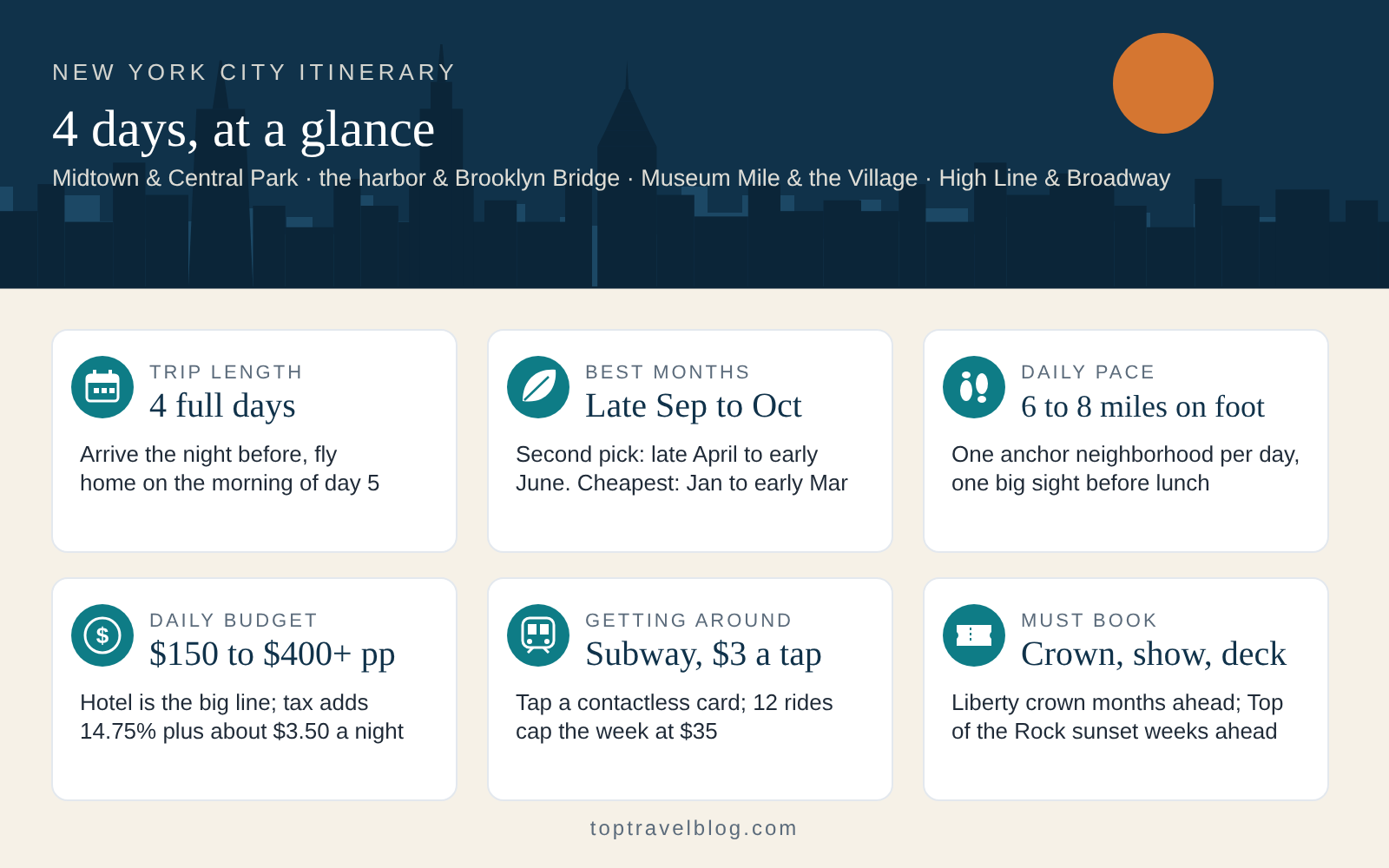
- Ideal trip length: 4 full days (arrive the evening before, fly home on the morning of day 5).
- How to get around: subway with a contactless card or phone ($3.00 a ride, capped at $35 a week), plus 8 to 10 miles of walking a day. No rental car.
- Booking priorities: Statue of Liberty crown or pedestal tickets (months ahead), a Broadway show (weeks ahead or lottery day-of), Top of the Rock sunset slot, 9/11 Museum timed entry, a Friday or Saturday dinner reservation anywhere you actually care about.
- Pacing: one anchor neighborhood per day, one big sight before lunch, one after, and an evening you can drop if your feet give out.
- Key caveats: hotel taxes add roughly 15 percent plus about $3.50 a night; the subway is the fastest way across town but stations rarely have elevators; July and August are humid enough to change your plans; December is wonderful and absurdly crowded.
Best time to go: when this New York City itinerary works best
If I could only choose one window, it would be the last week of September through the end of October. Daytime highs sit in the 60s and low 70s, the humidity that makes July miserable is gone, Central Park turns color in the second half of October, and the hotel rates, while never cheap, have not yet hit the December madness.
The second-best window is late April through early June, when the park is green and the outdoor cafés reopen, though spring rain is more frequent than fall rain and you should carry a packable jacket.
Here is how I think about each stretch of the year, because the right new york city itinerary changes with the thermometer.
January to mid-March: cheapest rooms, coldest days
This is the only time of year when a Midtown hotel can feel like a bargain. After New Year’s week ends, rates drop 30 to 40 percent from their December peak and stay low until spring break. The trade: highs in the 30s and 40s, wind that funnels down the avenues, and the occasional snowstorm that shuts down the ferry to Liberty Island for a day.
Museums are quiet, Broadway Week and Restaurant Week discounts land in late January and February, and you can walk into most restaurants without a reservation on a Tuesday. If you don’t mind the cold, go; January rooms run about two-thirds of the December price. Pack real gloves.
Late March to May: the city wakes up
April is unpredictable. I have had 75-degree days in Washington Square and sleet on the Brooklyn Bridge in the same week. The cherry trees in Central Park and the Brooklyn Botanic Garden peak in late April, and the Botanic Garden’s weekends during bloom are among the most crowded places in the city, so go on a weekday morning.
Hotel prices start climbing in April and are firmly high by Memorial Day. Rain comes in short, hard bursts rather than all-day drizzle, which is why the “if it rains” swaps in the day plans below are museum-based rather than full rewrites.
June to August: long days, heavy air
June is lovely until the last week, when the first heat wave usually arrives. July and August run hot (highs regularly 85 to 95) with humidity that makes the subway platforms feel like a sauna. The platforms are the real problem: trains are air-conditioned, stations are not, and a 10-minute wait at 34th Street–Herald Square in August is genuinely unpleasant.
Free outdoor programming compensates: Shakespeare in the Park, Bryant Park movie nights, SummerStage concerts and the Governors Island ferry all run through the summer. If you come in summer, flip this new york city itinerary so the walking happens before 11 a.m. and after 5 p.m., with museums in between.
September and October: the sweet spot
Labor Day empties the city for a week and then the best season begins. Fashion Week, the UN General Assembly (third week of September, which closes streets on the East Side between 42nd and 50th) and the New York City Marathon (first Sunday of November) bring crowds and price spikes on specific dates. Try to plan around them.
Otherwise this is the season when every day of the New York City itinerary below works exactly as written, including the Brooklyn Bridge at golden hour and a picnic on the Great Lawn.
November and December: the holiday squeeze
Early November is still fall and still reasonably priced. The switch flips the week before Thanksgiving. From the Macy’s parade through New Year’s Day, Midtown between 34th and 59th Streets is effectively a slow-moving crowd from noon until 10 p.m. The Rockefeller Center tree lighting is in early December and the tree stays up into mid-January.
Hotel rates in the second and third weeks of December can be double what you would pay in late January. It is magical, and I would still tell most first-time visitors to come in October and see the tree on a return trip. If December is non-negotiable, stay below 23rd Street or in Brooklyn and treat Midtown as a one-evening excursion rather than your base.
Tip: Whatever month you pick for your New York City itinerary, check the sunset time before you book your skyline view. In late October the sun sets around 6 p.m.; in late June it is after 8:30 p.m. The observation decks price their sunset slots higher and sell them out first, so your Day 1 evening depends on that one number.
Days of the week matter as much as the month
The Met is closed on Wednesdays. MoMA stays open late on Fridays. The 9/11 Museum has free admission on Monday evenings from 5:30 to 7 p.m., with tickets released online the same morning at 7 a.m. and gone within minutes. Most Broadway shows go dark on Mondays, and TKTS booth hours are shorter on Mondays, Tuesdays and Fridays.
Weekend subway service runs on altered schedules with lines rerouted for track work, which is the single most common reason visitors end up standing on the wrong platform in Brooklyn. I build this New York City itinerary around a Thursday-to-Sunday or Friday-to-Monday stay and mention the swaps where a closure matters.
How many days you really need in New York City
Four days is the point where the trip stops feeling like a checklist. Here is what changes at each length, based on the version of this new york city itinerary I would actually hand to someone with that many days.
2 days in New York: pick a side of the island
With two days you cannot do both the harbor and the museums without feeling rushed, so choose. My pick from this New York City itinerary is Day 1 (Midtown, Central Park, Top of the Rock) followed by Day 2 (Statue of Liberty, 9/11 Memorial, Brooklyn Bridge). You skip the Met entirely, see Broadway on the first night, and eat dinner in the West Village on the second.
Expect to be on your feet from 8 a.m. to 10 p.m. both days. It works as a long weekend tacked onto a work trip, and it is the version many people end up doing on a layover-style first visit. Do not try to squeeze a Yankees game or a day in Brooklyn into two days.
3 days in New York: the itinerary most people actually take
Three days adds the museum day (Day 3 of the New York City itinerary below), which means you get the Met in the morning and Greenwich Village in the evening. You still lose the High Line and Chelsea Market unless you push them into the Day 2 evening, which is doable in summer when sunset is late.
Three days is also enough to fit one proper sit-down dinner that you booked three weeks ago and one food-hall lunch. The feeling at the end of three days is “I saw it.” The feeling at the end of four is “I’d come back.”
4 days in New York: the plan in this guide
A 4-day New York City itinerary gives every big sight its own half-day, leaves room for a two-hour wander with no destination, and lets you pick between Brooklyn and the High Line on the last day instead of doing both badly. It also absorbs one bad-weather day without wrecking the trip; the rain swaps in each day plan assume you will lose roughly three hours to a downpour somewhere.
If you are flying in from the West Coast or Europe, four days also covers the morning when jet lag puts you on a bench in Bryant Park at 6 a.m. wondering why you’re awake.
5 or more days: now you can slow down
With five days I would add a half-day on Governors Island (ferry from the Battery, a few dollars round trip with free early-morning weekend sailings in season), an afternoon in Harlem including the Studio Museum and a soul-food lunch, or a full day in Queens for Flushing’s food and the Museum of the Moving Image in Astoria.
Six days means you can do both Williamsburg and Prospect Park instead of choosing, and seven lets you take the Metro-North train an hour north to the Hudson Valley for a day at Dia Beacon or Storm King.
Pairing New York with another city
Plenty of readers pair this New York City itinerary with a second city. New York pairs naturally with a flight down to Florida: our Miami itinerary for 3 days is the sensible second half if you want the beach you won’t get here, and the Orlando vacation guide covers the theme-park week that families often stack onto a few days in the city.
Going coast to coast, four days here plus four days from our Los Angeles itinerary is a classic two-week America trip with a six-hour flight in the middle. Give yourself a full travel day between stops; a 6 a.m. flight out of JFK after four days of walking is a mistake I have made exactly once.
Worth knowing: Count your days honestly. A 3 p.m. arrival at JFK and a 7 a.m. departure four days later is three days, not four. Arrival day in New York is good for a walk to Times Square after dark and a slice of pizza, and nothing more ambitious. Build the New York City itinerary below around full days only.
Where to stay in New York City for a first visit
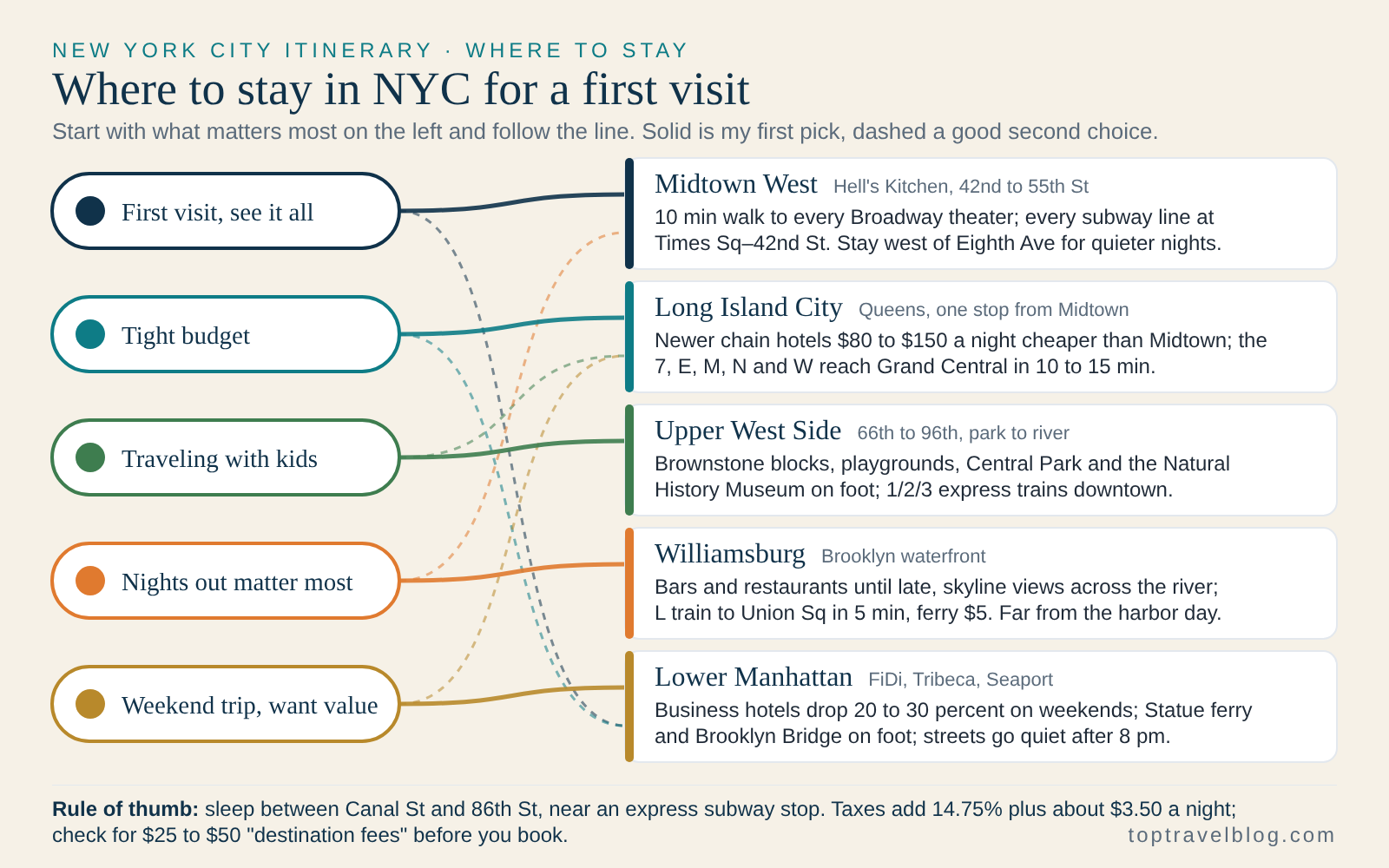
The question of where to stay in new york city decides more about your trip than any ticket you buy. The wrong neighborhood costs you 45 minutes each way on the subway and turns every “let’s go back to the room for an hour” into a non-starter. The right one puts you within a 15-minute walk or a single train ride of most of this New York City itinerary.
My general rule for a first visit: sleep in Manhattan between Canal Street and 86th Street, as close to an express subway stop as your budget allows, and accept that the room will be smaller than any hotel room you have stayed in outside Tokyo.
On price: a plain, clean, well-reviewed Midtown hotel room runs roughly $220 to $350 a night before tax in the shoulder seasons and $350 to $550 in December, and that is for 220 square feet with a view of an air shaft.
Add 14.75 percent in combined state, city and occupancy taxes plus about $3.50 a night in flat fees, and then check for a “destination” or “facility” fee of $25 to $50 a night, which many large Midtown hotels now tack on and which booking sites often hide until checkout.
Budget travelers can find hostel beds from about $60 to $90 and small-room hotels from about $150, mostly in Hell’s Kitchen, the Lower East Side and Long Island City. I never promise a specific rate in print because they move weekly; compare the hotel’s own site against two booking engines and look at the total with taxes and fees.
The five areas I recommend for a New York City itinerary, and who each one suits
Midtown West (Hell’s Kitchen, Times Square edge, 42nd to 57th)
Best for: first-timers, Broadway nights, maximum subway lines
This is where I put most people on their first New York City itinerary, specifically on the blocks between Eighth and Tenth Avenues from 42nd to 55th Streets. You are a 10-minute walk from any Broadway theater, Times Square–42nd Street gives you nearly every subway line, and Ninth Avenue is lined with inexpensive restaurants that are open late. The trade-off is noise and the Times Square crowds spilling west; stay west of Eighth Avenue and above 44th Street and it calms down fast.
Lower Manhattan (Financial District, Tribeca, Seaport)
Best for: weekend value, Day 2 convenience, quieter nights
FiDi hotels are built for weekday business travel, so Friday and Saturday nights are often 20 to 30 percent cheaper than the same room in Midtown. You start Day 2 of the New York City itinerary on foot, the Brooklyn Bridge is at your door, and the Fulton Street station complex connects to almost everything.
Downsides: streets empty out after 8 p.m. on weekdays, the restaurant scene is thinner than it looks, and you will ride the subway 20 to 25 minutes to reach Central Park and the Met.
Upper West Side (66th to 96th, between the park and Riverside)
Best for: families, museum lovers, a residential feel
Brownstone blocks, two supermarkets on every avenue, Central Park and the Natural History Museum within a 10-minute walk, and the 1/2/3 express trains to get downtown in 15 to 20 minutes. Hotel supply is small (a handful of older hotels plus apartment-style rentals), so book earlier here than anywhere else. It is the neighborhood I choose when I bring my parents or travel with a kid who needs a playground and an early bedtime.
Williamsburg, Brooklyn
Best for: nightlife, second-time visitors, skyline views from your room
The waterfront hotels along Kent and Wythe Avenues look straight across the East River at the Midtown skyline, and the bars and restaurants on Bedford, Grand and Wythe keep going past midnight.
The L train reaches Union Square in one stop (about 5 minutes) and the NYC Ferry runs to Wall Street and 34th Street for $5. It is a poor base for the Statue of Liberty morning and the Upper East Side museums, which both need 40-plus minutes each way, so I only suggest it for people who prioritize evenings over sightseeing efficiency.
Long Island City, Queens
Best for: budget, new hotels, one stop from Midtown
LIC has a cluster of newer chain hotels that undercut Midtown by $80 to $150 a night for a bigger, cleaner room, and the 7, E, M, N, W and G lines put you at Grand Central or Times Square in 10 to 15 minutes. Gantry Plaza State Park has the best free view of the UN and the Chrysler Building in the city.
The neighborhood itself is high-rise and a little sterile at street level, and the walk from some hotels to the subway is longer than the listing suggests, so look at the map before booking.
Areas I’d skip on a first visit
Times Square itself: you will walk through it, you don’t need to sleep in it, and the hotels on the bowtie charge a premium for the privilege of hearing the crowd at 1 a.m. The Upper East Side above 86th Street: lovely, but far from the Day 2 and Day 4 anchors of this New York City itinerary and served mainly by the slow 6 train (the Second Avenue Q line helps, but only between 72nd and 96th).
Anywhere in New Jersey or outer Queens that advertises “20 minutes to Manhattan”: that number assumes a perfect connection at 2 p.m., not a Saturday night with weekend track work. Airport hotels near JFK or LGA are only worth it for the final night before a 6 a.m. flight.
Hotel vs. apartment rental
New York’s short-term rental law (Local Law 18, enforced since September 2023) removed most entire-apartment listings under 30 nights. What remains on the rental platforms is largely either registered hosts renting a room while they stay in the apartment, or 30-night-plus stays.
For a four-day trip, assume you are booking a hotel or a licensed aparthotel. If you see an entire-apartment listing for three nights in Manhattan at a price that looks reasonable, read the fine print very carefully; some are legitimate hotel-licensed buildings, and some are not.
What to check before you click “book”
Three things. First, the nearest subway station and which lines stop there; an express stop (the 1/2/3 at 72nd, the A/C/E at 42nd, the 4/5 at Fulton) saves you 10 minutes on every trip compared with a local-only station. Second, the total price with taxes and any resort or destination fee; a $249 room with a $35 fee and 15 percent tax is a $327 room.
Third, the room size in square feet if the listing gives it; under 180 square feet is tight for two people with roller bags, and plenty of older Midtown hotels are exactly that. Read the most recent reviews for words like “construction” and “elevator,” because both are chronic.
The 4-day New York City itinerary, day by day
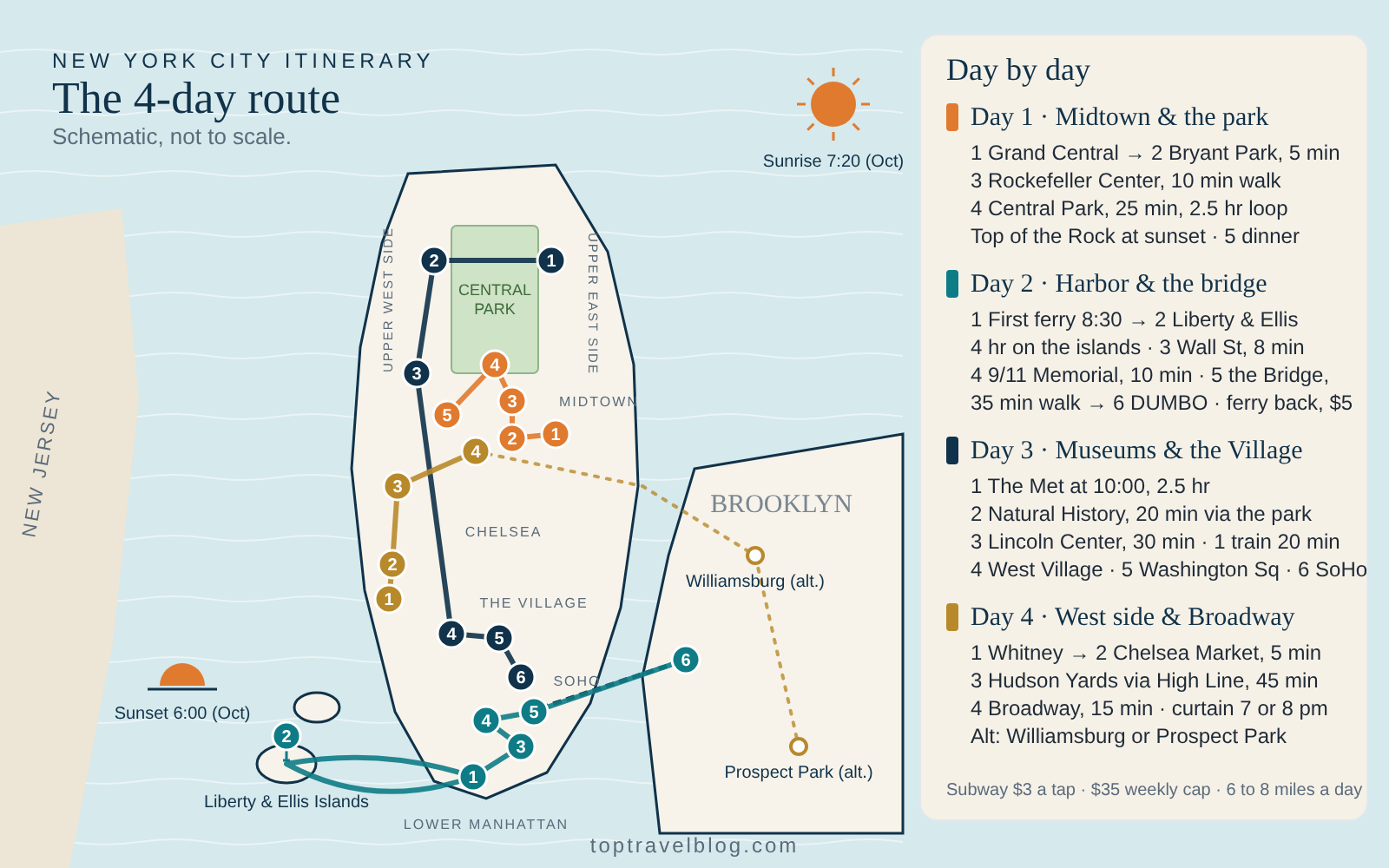
Each day of this New York City itinerary has one anchor neighborhood so you are never riding the subway back and forth across the island. Mornings start early because the city’s big sights are measurably better at 9 a.m. than at 11, and evenings are built to be dropped if your feet are done. Walking times are real-world times at a visitor’s pace with photo stops, not Google’s. Transit times include the walk to the platform and a reasonable wait.
Day 1
Midtown, Central Park and a first skyline
Morning: Grand Central, Bryant Park and the Library
Start your New York City itinerary at Grand Central Terminal at 8:30 a.m., when commuters are streaming through and the main concourse looks the way it does in the movies. Look up at the ceiling (the constellations are famously painted backwards), find the whispering gallery outside the Oyster Bar on the lower level, and get a coffee from one of the stands in the Grand Central Market on the Lexington Avenue side.
Walk out onto 42nd Street and look east at the Chrysler Building; you cannot go up it, but the lobby is open on weekdays and worth two minutes.
Walk west on 42nd Street. In five minutes you reach the New York Public Library’s main building, with the lions out front and the Rose Main Reading Room upstairs (free, open to the public, go up to the third floor and be quiet).
Behind the library is Bryant Park, which from November to early March becomes the Winter Village with a free ice rink (skate rental costs extra) and from April onward has free lawn chairs, ping-pong tables and a carousel. Give this whole stretch about 75 minutes.
Late morning: Fifth Avenue to Rockefeller Center
From Bryant Park, the New York City itinerary heads north on Fifth Avenue. You pass the flagship stores between 47th and 57th Streets, St. Patrick’s Cathedral at 50th (free, open daily, quieter before noon), and Rockefeller Center on your left between 48th and 51st. The Channel Gardens lead you down to the famous sunken plaza, which is an ice rink from October through April and a café the rest of the year.
If you are here in December, this is where the tree is and this is where the crowd is; come back after 10 p.m. for a saner look.
Continue north to 59th Street and Grand Army Plaza (the one in Manhattan, not Brooklyn), where the Plaza Hotel faces the southeast corner of Central Park. The walk from Bryant Park to the park entrance takes 20 to 25 minutes without shopping stops.
Grab lunch before entering the park: the food hall under the Plaza, a sandwich from one of the delis on 57th Street, or, if you planned ahead, a reservation at one of the sit-down places on the side streets off Madison in the 50s.
A street-cart hot dog or halal platter from the carts along 59th is the budget option and is a legitimate New York lunch.
Afternoon: the southern half of Central Park
Enter the park at Grand Army Plaza and follow the path northwest past the Pond and Gapstow Bridge (the one in every photo), then up to the Mall, the elm-lined promenade that leads to Bethesda Terrace and its fountain. That is the core 30-minute walk and it is the right one for a first New York City itinerary.
From Bethesda, go left along the Lake to Bow Bridge, then up to Strawberry Fields at West 72nd Street, where the Imagine mosaic sits across from the Dakota. If you still have energy, continue north to Belvedere Castle and the Great Lawn, another 15 minutes.
Budget two to two and a half hours for the park at an easy pace. Rowboats at the Loeb Boathouse run roughly $25 an hour plus a cash deposit in season; the carousel near 64th Street costs a few dollars and is beloved by small children; the Central Park Zoo at 64th and Fifth is small, about $20 for adults, and best for kids under eight.
Exit the park on the west side at 72nd Street and take the B or C train from 72nd Street back down to 47th–50th Streets/Rockefeller Center (about 10 minutes), or walk back down Central Park West and Seventh Avenue in 30 minutes.
Evening: Top of the Rock at sunset, then dinner in Hell’s Kitchen
This is the one timed ticket on Day 1 of the New York City itinerary and the view I recommend for a first visit. Top of the Rock, Summit One Vanderbilt and the Empire State Building all cost between roughly $40 and $50 for a standard adult ticket before fees (more for sunset slots, express passes and add-ons; the Rockefeller Center site lists the add-ons).
I pick Top of the Rock because it is the only one of the three that gives you the Empire State Building in your photo, with Central Park spread out behind you in the other direction. The 70th-floor deck is open-air, there is no glass between you and the view on the top level, and timed entry means you are rarely in line more than 15 minutes.
Summit One Vanderbilt is a different thing: a mirrored, art-installation experience where the view competes with the room itself. It is spectacular and I would do it on a second visit, but it has footwear rules (no heels on the mirror floor), the photos are mostly of you reflected a hundred times, and weekend prices climb.
The Empire State Building has the history and the 86th-floor open deck, but the obvious problem is that you cannot see the Empire State Building from the Empire State Building. Book the Top of the Rock slot 45 to 60 minutes before the official sunset time so you get daylight, the sunset, and the lights coming on, all on one ticket.
Afterward, walk west on 50th or 51st Street to Ninth Avenue (12 to 15 minutes) and pick a restaurant in Hell’s Kitchen. The strip from 44th to 56th on Ninth has Thai, Ethiopian, Peruvian, ramen, Italian and a dozen other options at $18 to $35 a main, most without reservations on a weeknight. It is also five minutes from the theater district, which matters if you decide to move your Broadway night to Day 1.
Logistics: Day 1 of the New York City itinerary covers about 7 miles on foot. Grand Central to Bryant Park, 5 minutes. Bryant Park to Central Park at 59th, 20 to 25 minutes. Park loop, 2 to 2.5 hours. West 72nd to Rockefeller Center, 10 minutes by B/C train or 30 on foot. Rockefeller Center to Ninth Avenue, 12 to 15 minutes.
If it rains: Swap the park for the Morgan Library on Madison at 36th (about $25, the 1906 library room alone is worth it) or spend the early afternoon at MoMA on 53rd Street ($30 adults, free for 16 and under), then do the park on Day 3 morning before the Met. Keep the Top of the Rock slot; the deck has indoor levels and the view after a storm clears is the best of the trip.
With kids: On a New York City itinerary with kids, cut the Fifth Avenue walk, enter the park at 59th and go straight to the zoo and the carousel, then let them loose on the Heckscher Playground near 62nd Street. The Lego and Nintendo stores at Rockefeller Center are a reliable bribe. Top of the Rock is fine for children of any age; strollers are allowed.
In winter: On a winter New York City itinerary, do the park walk at noon when it is warmest, book skating at Wollman Rink (reservations required, roughly $20 to $40 depending on the day, plus skate rental) instead of the longer loop, and move the Top of the Rock slot to about 4 p.m., since the sun sets before 5 in December.
Day 2
The harbor, the 9/11 Memorial and the Brooklyn Bridge
Morning: the first ferry to Liberty and Ellis Islands
Day 2 is the longest day of this New York City itinerary, so be at Castle Clinton in the Battery by 8:15 a.m. for a ferry in the 8:30 to 9:00 range (first departures vary by season; the schedule is on the National Park Service page for the monument and at Statue City Cruises, the only authorized operator).
Tickets bought in advance are about $26 for adults, $23 for seniors and $17 for children 4 to 12, and that includes the round-trip ferry, both islands, both museums and the audio tour.
Pedestal access and crown access each add a token amount (around 30 cents) but are capacity-limited: pedestal tickets usually need two to four weeks of lead time in high season, and crown tickets, which require climbing 162 narrow steps and come with a strict no-bags rule, sell out three to four months ahead for spring, summer and fall dates.
The first ferry matters more than any other timing in this New York City itinerary. By 10:30 a.m. on a Saturday in October, the security line at the Battery wraps around Castle Clinton and takes 45 to 60 minutes, and the sellers in the park waving laminated “official tickets” are not official; the NPS warns about them on its own site.
With the first boat, you walk through security in 10 minutes, get Liberty Island with a hundred people instead of two thousand, and still have time for Ellis Island’s Registry Room and the Hall of Records before the midday crush. Plan on three and a half to four hours for both islands including the ferry rides, and do not skip Ellis Island; it is the better museum.
Early afternoon: Wall Street and lunch
Back at the Battery around 12:30 p.m., walk up Broadway past the Charging Bull (expect a line for photos; the bronze is on the median at Bowling Green), then east into the Financial District.
Wall Street is a six-minute walk, the New York Stock Exchange facade is at Broad Street, and Federal Hall across from it, where Washington took the oath, is free and quiet.
Trinity Church at the head of Wall Street has Alexander Hamilton’s grave in the churchyard. Fifteen minutes covers this unless you want to go inside.
For lunch, Stone Street is the obvious choice: a cobbled pedestrian block of pubs and taverns with outdoor tables from spring through fall, $20 to $30 for a sandwich or a burger and a drink.
The Tin Building at the Seaport, 10 minutes further northeast, is a glossy food hall with more range and higher prices. If you want fast and cheap, the chain lunch spots along Broadway and Nassau Street do $12 to $16 bowls and are busy with office workers, which is a decent sign.
Afternoon: the 9/11 Memorial and Museum
From Wall Street, walk northwest on Broadway or Church Street to the World Trade Center site in about 10 minutes. The Memorial plaza, with the two reflecting pools set in the footprints of the towers and the names cut into the bronze parapets, is free and open daily from 8 a.m. to 8 p.m.
Walk the full perimeter of both pools; find the Survivor Tree, the callery pear that was pulled from the rubble and replanted. Give it 30 minutes and expect to feel it more than you anticipated.
The 9/11 Memorial Museum is underground, between and beneath the pools, and it is not a quick stop. Tickets are timed, must be bought in advance, and currently run from roughly $24 to $36 depending on the type, with children 6 and under free (a ticket is still required) and free entry for U.S. military with ID.
Book a 2:30 or 3 p.m. slot and allow two full hours. Free admission on Monday evenings from 5:30 to 7 p.m. exists, but the tickets go online at 7 a.m. that Monday and are gone within minutes.
The museum is heavy; the historical exhibition under the North Tower footprint includes recordings and photographs that many parents choose to skip with children under 12. The Oculus, Santiago Calatrava’s white-ribbed transit hall next door, is free and makes a good decompression stop, with restrooms and a coffee shop.
Late afternoon: across the Brooklyn Bridge to DUMBO
The Manhattan-side entrance to the bridge’s pedestrian walkway is across from City Hall Park, at Centre Street and Park Row, a 10-minute walk from the Oculus. Since 2021 the walkway is for pedestrians only, with bikes moved to a protected lane on the roadway below, so the crush is less than it was, though on a sunny Saturday afternoon you are still shoulder to shoulder near the towers.
The walk takes 30 to 40 minutes with photo stops, and it is the one Manhattan walking route I would never cut from a New York City itinerary. Start about 90 minutes before sunset: you cross with the light on the skyline behind you and arrive in Brooklyn as the lights come on.
At the Brooklyn end, take the stairs down at Washington Street and walk north toward the water. The photo of the Manhattan Bridge framed by brick warehouses with the Empire State Building in the arch is taken from the middle of Washington Street at Water Street; there will be a line of people taking it, and it takes 10 seconds.
Then walk into Brooklyn Bridge Park at Pier 1 and along the waterfront to Jane’s Carousel, the restored 1922 carousel in its glass box. This is the best skyline view in the city and it costs nothing.
Evening: dinner in DUMBO or Brooklyn Heights, then the ferry back
DUMBO has pizza (the famous coal-oven place under the bridge usually has a 45-minute wait by 6 p.m.; the other famous one a block away is often shorter and just as good), Time Out Market’s rooftop food hall with a view, and a dozen sit-down restaurants at $25 to $45 a main. For something quieter, walk 15 minutes up into Brooklyn Heights, along the Promenade, and eat on Montague or Henry Street.
Get back to Manhattan on the NYC Ferry from the DUMBO/Fulton Ferry landing ($5, pay in the app or at the kiosk) to Wall Street/Pier 11 in 10 minutes, or take the A/C from High Street or the 2/3 from Clark Street.
Logistics: Day 2 of the New York City itinerary runs from the hotel to Castle Clinton by 8:15 a.m. (take the 1 to South Ferry, the 4/5 to Bowling Green or the R/W to Whitehall). Islands, 3.5 to 4 hours. Battery to Wall Street, 8 minutes on foot. Wall Street to the 9/11 Memorial, 10 minutes. Memorial to the bridge entrance, 10 minutes. Bridge, 30 to 40 minutes. DUMBO to Manhattan by ferry, 10 minutes. Total walking: about 6 miles plus a lot of standing.
If it rains: The ferries run in rain but not in high wind, and Liberty Island with no shelter in a downpour is miserable. If the forecast is bad, move the islands to the morning of Day 4 of the New York City itinerary and spend today’s morning at the 9/11 Museum (indoors, two hours), then the Oculus and Brookfield Place, with the bridge walk saved for a dry evening.
The free Staten Island Ferry passes the statue at a distance and is a reasonable rain-day consolation with a 25-minute ride each way.
With kids: Skip the crown (minimum height 42 inches, and the climb is hard on small legs and on the adults carrying them). Ellis Island has a short family-friendly audio tour. Replace the museum with the Memorial plaza only, then let them run in Brooklyn Bridge Park, which has excellent playgrounds at Pier 6 and the carousel (a couple of dollars a ride). The bridge walk is fine with a stroller; the Brooklyn-side stairs are not, so use the ramp exit further along.
In winter: The harbor wind is the coldest part of any winter New York City itinerary; wear everything you own on the ferry deck. Move the bridge walk to midday for warmth and light, and do the 9/11 Museum last, from about 3:30 p.m., since it is open until 7 p.m. most days.
Day 3
Museum Mile, the Upper West Side and a Village evening
Morning: the Met, with a plan
Day 3 of the New York City itinerary starts at the Metropolitan Museum of Art, which opens at 10 a.m. (closed Wednesdays), and the difference between arriving at 9:50 and 11:30 is the difference between having the Temple of Dendur nearly to yourself and sharing it with four school groups.
Admission is $30 for adults, $22 for seniors, $17 for students and free for children 12 and under; New York State residents and students from New York, New Jersey and Connecticut pay what they wish, which is why you will see locals paying a dollar at the desk.
Buy timed tickets online at metmuseum.org to skip the ticket line; the ticket also covers same-day entry to the Met Cloisters uptown.
Do not try to see the Met; no New York City itinerary has room for it. Pick three things and give them two and a half hours. My standard first-visit route: the Egyptian wing and the Temple of Dendur (ground floor, right from the Great Hall), then up the main staircase to the European paintings for the Vermeers and the Impressionists, then the American Wing’s Tiffany windows and the period rooms.
In warm months, finish on the Cantor Roof Garden (seasonal, usually late April to October) for the view over the park with a drink in your hand. The Costume Institute show in spring and the big temporary exhibitions draw the longest lines; if one of those is your reason for coming, go there first.
Midday: Museum Mile or the Natural History Museum
Fifth Avenue between 82nd and 105th is Museum Mile, and after the Met you have a choice. Walk north 10 minutes to the Guggenheim at 89th (about $30, the Frank Lloyd Wright rotunda is the exhibit) or the Neue Galerie at 86th (Klimt’s “Woman in Gold” and a Viennese café that serves the best strudel in Manhattan).
Or cross the park on the 79th or 86th Street transverse, a 20-minute walk through the Ramble or along the Reservoir path, to the American Museum of Natural History on Central Park West at 79th. The Natural History Museum is the better pick for a New York City itinerary with kids.
Its 2023 Gilder Center with the insectarium and the butterfly vivarium is the best new museum space in the city. Admission is pay-what-you-wish for New York, New Jersey and Connecticut residents and roughly $30 for adults from everywhere else, with the special exhibitions and the planetarium costing extra; book a timed slot online.
Lunch on the Upper West Side is easy: the appetizing counter at the famous smoked-fish shop on Amsterdam at 86th for a bagel with lox (about $20, eaten standing or in Central Park), the diners along Broadway in the 70s and 80s, or the food market in the basement of the big grocery at Broadway and 80th.
Then walk south down Columbus Avenue past the brownstone side streets to Lincoln Center at 65th, where the plaza and fountain are free and the Metropolitan Opera’s Chagall murals are visible through the glass. This is a 30-minute stroll and it is the Upper West Side at its most Nora-Ephron.
Afternoon: downtown to Greenwich Village
Take the 1 train from 66th Street–Lincoln Center down to Christopher Street–Sheridan Square (about 20 minutes). You come up in the heart of the West Village, where the grid gives up and West 4th Street somehow crosses West 10th. Walk east along Christopher past the Stonewall Inn and the national monument park across from it, then zigzag through the brick-townhouse blocks of Grove, Bedford, Barrow and Commerce Streets.
Bedford at Grove is the “Friends” building (the exterior only; the café in the show was a studio set), and the narrowest house in the city is at 75½ Bedford. Give this wander 60 to 90 minutes with no destination.
End at Washington Square Park, 10 minutes east. The arch, the fountain, the chess players in the southwest corner, the NYU students, the jazz trio under the arch most warm afternoons: this is the Village’s living room.
From here you can walk south on Thompson or MacDougal into SoHo in 10 minutes for the cast-iron facades between Houston and Canal (Greene and Mercer Streets are the prettiest) and the shopping along Broadway and Prince. SoHo on a Saturday afternoon is a crowd; on a weekday at 4 p.m. it is pleasant.
Evening: dinner and live music below 14th Street
The Village and its neighbors are where I would spend any dinner budget I had. On the West Village side, the Italian places on Carmine and Bleecker, the little French bistros near Perry and Charles, and the famous no-reservations restaurants where the wait is part of the experience. On the East Village side of Broadway, the Japanese restaurants on St.
Marks and 9th Street, Ukrainian comfort food that has been there for fifty years, and the ramen counters with lines at 7 p.m. Dinner for two with wine at a mid-range place runs $120 to $180 with tax and tip; a slice and a beer at the counter on MacDougal runs $12.
After dinner, see jazz. The Village Vanguard on Seventh Avenue South has two sets most nights (reserve online; around $40 plus a one-drink minimum, cash or card), Smalls on West 10th is cheaper and looser, and the Blue Note on West 3rd is bigger and pricier.
If jazz is not your thing, the Comedy Cellar on MacDougal runs multiple shows nightly with a two-item minimum and sells out days ahead for weekend sets. Either one puts you in bed by midnight, which you will need after a seven-mile day.
Logistics: Day 3 of the New York City itinerary runs from the hotel to the Met by 9:50 a.m. (4/5/6 to 86th Street, then a 10-minute walk west; or the Q to 86th Street and 2nd Avenue). Met, 2.5 hours. Cross-park walk to the Natural History Museum, 20 minutes. Columbus Avenue to Lincoln Center, 30 minutes. 1 train to Christopher Street, 20 minutes. Village wander plus Washington Square, 90 minutes to 2 hours. Total walking: about 7 miles.
If it rains: This is already the indoor day of the New York City itinerary. Extend the Met to four hours, add the Natural History Museum’s planetarium show, and take the subway instead of the cross-park walk. In the Village, swap the street wander for a long lunch and an early show. If it is a Wednesday and the Met is closed, use the Frick on Fifth at 70th (reopened in 2025 after its renovation, about $30, no children under 10) and MoMA.
With kids: Reverse the morning of this New York City itinerary: Natural History Museum first at 10 a.m. (the dinosaur halls on the fourth floor, then the blue whale, then the butterflies), lunch on Columbus, and then the Met’s arms and armor hall and the Egyptian wing only, which together hold a nine-year-old for about 75 minutes. Washington Square’s playgrounds and the dog run are a good late-afternoon stop.
In winter: Museums are the correct winter day in any New York City itinerary. Add the Met’s Christmas tree and Neapolitan crèche in the Medieval Sculpture Hall (late November to early January) and finish the Village evening with a cocktail bar instead of a sidewalk table.
Day 4
The High Line, Chelsea Market and Hudson Yards, or a Brooklyn day, then Broadway
Day 4 of the New York City itinerary is a choice, and I will make the case for both. The west-side version is the one I give to most first-timers because it stays in Manhattan, needs almost no transit, and ends five minutes from the theaters. The Brooklyn version is better if you have already fallen for DUMBO on Day 2 and want more, or if the weather is perfect and you would rather be in a park than in a shopping development.
Option A, morning: the High Line from the south
Start at the Whitney Museum of American Art on Gansevoort Street at 9:30 a.m. if you want one more museum (about $30, closed Tuesdays, the terraces alone are worth the ticket for the river view), or skip it and climb the stairs to the High Line right beside it at 10 a.m.
The High Line is a 1.45-mile park built on top of a disused freight viaduct, running north from Gansevoort to 34th Street, free, and the easiest Manhattan walking route on this New York City itinerary.
Walk it slowly: the amphitheater window over Tenth Avenue at 17th Street, the sundeck with the lounge chairs near 14th, the art installations that change every year, the glimpses into expensive apartments. The full walk takes 45 to 60 minutes; the crowds build after 11, especially on weekends.
Detour down at 16th Street into Chelsea Market, the former Nabisco factory where the Oreo was invented, now a block-long food hall. Lobster rolls, tacos, ramen, doughnuts, a good bookshop, and the best people-watching in Chelsea. It is a better lunch than dinner (the market closes by 10 p.m. and many stalls earlier), so plan to eat here at about 11:45 before the noon rush turns the main corridor into a slow river.
Expect $18 to $30 per person. Little Island, the floating park on concrete tulips at Pier 55, is a five-minute walk west on 13th Street and is free; in summer it hosts ticketed evening performances in its amphitheater.
Option A, afternoon: Hudson Yards and the west side
Back up on the High Line, continue north through the Chelsea gallery district (the galleries themselves, on 20th to 26th Streets between Tenth and Eleventh, are free and open Tuesday to Saturday) to the spur at 30th Street, where the path curves around the rail yards and delivers you into Hudson Yards. The Vessel, the honeycomb staircase sculpture, reopened to climbers in 2024 with new safety barriers and a ticket requirement; whether you climb it or not, it is the photo.
Edge, the observation deck jutting out of 30 Hudson Yards at 1,100 feet, is a fourth skyline option at roughly $40 to $50 and up; I would not do two decks on one New York City itinerary, so skip it unless you missed Top of the Rock.
The Shops at Hudson Yards is a mall, and a good one if you need a mall; the Shed next door hosts art and performance. From here you are a 10-minute walk from the Javits Center and the 7 train, or you can walk back east along 34th Street to Macy’s and the Empire State Building in 15 minutes.
Mid-afternoon is the right time to go back to your hotel, put your feet up for 90 minutes, and change for the theater; a Broadway night is better when you are not running on fumes.
Option B: a Brooklyn day in Williamsburg or Prospect Park
Williamsburg version: take the L train to Bedford Avenue (one stop from Union Square). Coffee on Bedford, then a loop through the side streets to the waterfront at Domino Park, where the old sugar refinery has been turned into a park with the best Midtown skyline view from the Brooklyn side. Walk north along Kent Avenue to the Wythe Hotel block, browse the vintage stores on North 6th and Grand, and if it is a Saturday, go to Smorgasburg in Marsha P.
Johnson State Park (April through October, 11 a.m. to 6 p.m., 80-plus food vendors, bring cash and patience). Take the NYC Ferry from North Williamsburg back to Midtown’s 34th Street landing in 20 minutes, straight into the theater district by 5 p.m.
Prospect Park version: take the 2/3 to Grand Army Plaza (the Brooklyn one), see the arch and the Saturday greenmarket, then walk into Prospect Park, which Olmsted and Vaux designed after Central Park and considered the better work. Long Meadow, the Boathouse, the Ravine. Pair it with the Brooklyn Museum (about $20 suggested, Egyptian collection and the Judy Chicago “Dinner Party” installation) and the Brooklyn Botanic Garden next door (about $22 in season, free on some winter weekdays).
Lunch on Vanderbilt Avenue in Prospect Heights or Seventh Avenue in Park Slope. This version of the New York City itinerary is the one I would do with kids over the age of five; the Prospect Park Zoo and the carousel are small and cheap, and the Lefferts Historic House has hands-on activities.
Evening: Broadway, finally
Save the show for the last night of the New York City itinerary. You know the city by now, you can find the theater without a map, and whatever you did not get to no longer matters. Curtain is usually 7 or 8 p.m. on weeknights with 2 p.m. matinees on Wednesdays, Saturdays and Sundays; most shows are dark on Mondays.
Arrive 30 minutes before curtain for the security line and the mandatory bag check at the door (large backpacks and suitcases are not allowed in; there are no lockers). Dinner before the show at the restaurants on Restaurant Row (46th Street between Eighth and Ninth) is designed around the curtain; order by 6 p.m. and tell the server you have a 7:30 or 8 o’clock show.
After the show, walk into Times Square. At 10:30 p.m. with a Playbill in your hand and the signs doing their thing, it is a good place for the first time, and it is better at night than at any point during the day. Get a slice at one of the counters on Eighth Avenue, look up once more, and take the train back. That is the trip.
Logistics (Option A): Day 4 of the New York City itinerary: Whitney to the High Line, 1 minute. High Line to Chelsea Market, 5 minutes down the 16th Street stairs. Chelsea Market to Little Island, 5 minutes. High Line from 16th to Hudson Yards, 35 to 45 minutes. Hudson Yards to Times Square, 15 minutes on foot or one stop on the 7.
Total walking: about 5 miles, lighter on purpose. Logistics (Option B): L train to Bedford Avenue, 5 minutes from Union Square; ferry from North Williamsburg to East 34th Street, 20 minutes, then the 34th Street–Hudson Yards 7 train or a 15-minute walk to the theaters.
If it rains: The High Line in rain is just a wet sidewalk. Do the Whitney properly (three hours), eat a long lunch at Chelsea Market, then take the 7 one stop to Hudson Yards and stay indoors at the Shops and the Shed, or ride the 7 straight to Times Square and catch a matinee as well as an evening show. In Brooklyn, swap the park for the Brooklyn Museum and the Botanic Garden’s conservatories.
With kids: The High Line works with a stroller (elevators at Gansevoort, 14th, 16th, 23rd and 30th). Chelsea Market is an easy kid lunch. Skip Hudson Yards and spend the afternoon at the Intrepid Sea, Air and Space Museum on Pier 86 at 46th Street (about $36 adults, less for kids, an aircraft carrier with a space shuttle on deck), which is a 10-minute walk from the theaters.
Pick a show with a family audience: the big animated-film musicals and the one with the witches are the obvious ones, and all are fine for ages 6 and up.
In winter: On a winter New York City itinerary the High Line is open but bare and windy; cut it to the 16th-to-23rd stretch and spend longer at the Whitney. In Brooklyn, choose the museum-and-garden version over Williamsburg. Broadway in January and February is the cheapest it gets, with two-for-one Broadway Week deals typically in late January.
Getting around: the New York subway for tourists, taxis, ferries and airport transfers
You do not need a MetroCard, a transit app subscription or a tourist pass. You need a contactless credit or debit card or the same card loaded into your phone’s wallet, and you tap it on the reader at every turnstile and bus door. That is OMNY, the MTA’s fare system, and it is the single biggest simplification of this new york city itinerary compared with a trip five years ago.
Subway and bus fares for your New York City itinerary
A subway or local bus ride costs $3.00 as of January 4, 2026 (up from $2.90), and that fare includes a free transfer between subway and bus, or bus to bus, within two hours. The weekly fare cap is the detail that matters for visitors: tap the same card or device for 12 paid rides in a seven-day window and every subway and bus ride after that is free until the window resets.
The cap works out to $35 and the seven-day window starts with your first tap, so a Thursday arrival means your window runs Thursday through the following Wednesday. On a 4-day New York City itinerary with three or four rides a day, most people hit the cap on day three or four. Each person needs their own card or device; you cannot tap the same card twice for two people and get the cap for both.
The old 7-day and 30-day unlimited MetroCards were discontinued at the end of 2025 and the MetroCard itself is being retired; if you have one from a previous trip with money on it, it may still swipe for now, but do not count on buying or refilling one.
Physical OMNY cards are sold at station vending machines and at drugstores for a small fee if you prefer not to use your own bank card; tourists from abroad should check that their card does not charge a foreign-transaction fee on each $3 tap, in which case a prepaid OMNY card is cheaper. Reduced fares for seniors and riders with disabilities exist but require enrollment, so most visitors pay full fare.
The MTA, whose fares are listed at mta.info, has been raising fares roughly every two years, and the next change is likely in 2027.
How to actually use the New York subway for tourists
Three rules cover 90 percent of the mistakes visitors make on a New York City itinerary. First, know your direction: “Uptown” means north toward the Bronx, “Downtown” means south toward Brooklyn, and on many stations the uptown and downtown platforms have separate street entrances, so if you tap in on the wrong side you are paying again to cross.
Second, know express from local: on the same track color, an express train (the 2, 3, 4, 5, A, D, N and Q, among others) skips stations, and the difference between the 1 local and the 2 express from 96th Street to Times Square is 10 minutes. Third, check the service changes posted on the station pillars and in the MTA app before you ride on a weekend or after 10 p.m.; track work reroutes trains constantly and the signs are the only warning.
Stations are old. Only about a third have elevators, and the ones that do are often out of service, so if you are traveling with a stroller or a mobility issue, use the MTA’s accessible-station map and plan around the big hubs (Times Square, Grand Central, 34th Street–Herald Square, Fulton Street, 72nd Street on the 1/2/3) which do have working elevators most of the time.
Trains run 24 hours, but after midnight headways stretch to 20 minutes and the car can be empty, which is when I would use a cab instead. On the platform, stand back from the edge, keep your phone in your hand rather than out at arm’s length near the doors, and do not get into an empty car on an otherwise full train; it is empty for a reason, usually a broken air conditioner.
Walking is the main event of any New York City itinerary
Twenty Manhattan north-south blocks make a mile and take about 20 minutes; crosstown blocks between avenues are two to three times longer, so “three avenues over” is a real walk. In practice, anything under 15 blocks is faster on foot than by subway once you count the stairs and the wait. This New York City itinerary has you walking six to eight miles a day.
The shoes matter more than the hotel: broken-in sneakers or walking shoes with real cushioning, never anything new. The sidewalks are concrete and there are 50 steps down to every platform.
Taxis, rideshare and the congestion toll
Yellow cabs start at $3.00 plus 70 cents per fifth of a mile (or per minute in slow traffic), plus a $1 improvement surcharge, a 50-cent state surcharge, $2.50 extra from 4 to 8 p.m. on weekdays, $1 extra from 8 p.m. to 6 a.m., and a $2.50 state congestion surcharge on any trip that touches Manhattan below 96th Street.
Since January 2025, rides within the Congestion Relief Zone below 60th Street also carry a 75-cent per-trip toll in yellow cabs and $1.50 in Ubers and Lyfts. A 15-minute crosstown cab in Midtown at 6 p.m. therefore comes to $18 to $25 before a tip of 15 to 20 percent.
Rideshare prices in Manhattan are usually equal to or higher than a yellow cab, and surge pricing at 5 p.m. in the rain is brutal; hail a cab with its roof light on instead. Cabs take cards, and you can tip on the screen.
The congestion toll itself ($9 for passenger cars entering Manhattan below 60th Street during peak hours, $2.25 overnight, charged once a day) is one more reason a New York City itinerary should never include a rental car. Parking in a Midtown garage runs $50 to $80 a day, street parking is a fiction, and you will spend more time looking for a space than you spend in Central Park.
If your trip continues to somewhere that needs a car, pick it up on the last morning from a location near your departure route, not in Midtown.
Ferries and bikes
NYC Ferry is the most underrated transit on any New York City itinerary: $5 one way as of October 2026 (up from $4.50), paid in the NYC Ferry app or at the landing kiosks, with routes linking Wall Street/Pier 11, DUMBO, Williamsburg, Long Island City, East 34th Street and more, plus the Rockaways and Governors Island seasonally. A two-day unlimited ticket costs $15, which pays off if you ride three times.
The Staten Island Ferry is free, runs every 15 to 30 minutes around the clock from Whitehall Terminal, and gives you a 25-minute harbor crossing past the Statue of Liberty each way; walk off at St. George and walk straight back on. Citi Bike costs $4.99 for a single ride up to 30 minutes or $25 for a day pass with unlimited 30-minute rides, with overage at 41 cents a minute and e-bikes billed per minute on top.
Ride in the protected lanes along the Hudson River Greenway and through Central Park; I would not put a first-time visitor on a bike on Fifth Avenue.
Airport arrival logistics: JFK, LaGuardia and Newark
Most readers start their New York City itinerary at one of three airports, and the right transfer depends on which one, what time you land, and how much luggage you have. Here is what each costs and how long it takes as of November 2026, with the Port Authority’s airport pages listing the AirTrain fare.
JFK (Queens, 15 miles from Midtown). The yellow-cab flat fare to any point in Manhattan is $70, plus the 50-cent state surcharge, the $1 improvement surcharge, the $2.50 congestion surcharge, the 75-cent zone toll if your hotel is below 60th Street, a $5 rush-hour surcharge from 4 to 8 p.m. on weekdays, any bridge or tunnel toll the driver pays, and a tip, so budget $90 to $100 all in.
The ride takes 45 minutes at 6 a.m. and 90 minutes at 5 p.m. Follow the signs to the official taxi stand and ignore anyone inside the terminal offering you a ride. Uber and Lyft pick up from designated areas and generally cost $75 to $120 depending on the time.
The cheap way is the AirTrain plus the subway. The AirTrain runs free between terminals and costs $8.75 (tap your contactless card at the exit gate) when you leave the system at Jamaica or Howard Beach.
At Jamaica, transfer to the E train (to Midtown’s west side, 35 to 45 minutes to Penn Station or 42nd Street) or the Long Island Rail Road (to Penn Station or Grand Central Madison in about 20 minutes; the CityTicket fare is $5.25 off-peak and $7.25 at peak times, bought in the MTA TrainTime app).
At Howard Beach, transfer to the A train, which is the better pick for Lower Manhattan or Brooklyn. Total: $11.75 by subway, roughly $14 to $16 by LIRR, and about 60 to 75 minutes door to door either way. It involves stairs and escalators with your bags; if you are traveling with more than one suitcase each, or arriving after 10 p.m., take the cab.
LaGuardia (Queens, 9 miles from Midtown). LGA has no train, but the free Q70 LaGuardia Link bus runs every 8 to 10 minutes from Terminals B and C to the Jackson Heights–Roosevelt Avenue subway hub (E, F, M, R and 7 trains), about 15 minutes, and from there Midtown is another 20 to 25 minutes for $3.
The M60 bus goes to Harlem and the Upper West Side for $3 and is useful if you are staying uptown. Taxis to Midtown run on the meter, typically $40 to $60 with surcharges and tip, plus the $5 LaGuardia pickup surcharge; allow 30 to 60 minutes. LGA’s rebuilt terminals are genuinely nice now, and the taxi line at Terminal B moves fast.
Newark (New Jersey, 16 miles from Midtown). From Newark, the train is almost always the right answer: AirTrain Newark to the airport rail station, then NJ Transit to New York Penn Station in 25 to 30 minutes. A single NJ Transit ticket from “Newark Airport” to New York, bought in the NJ Transit app or at the machines, is roughly $16 to $18 one way and includes the AirTrain; buy it before you board. Total time door to door is about 45 to 60 minutes.
Taxis from Newark run on the meter plus a $20 Newark surcharge plus tolls (passengers pay the tolls both ways) and come to $100 to $130 to Midtown with tip; Uber and Lyft are in the same range or higher at peak times. The Newark Airport Express bus to Port Authority, Bryant Park and Grand Central is another option at roughly $20 and 45 to 75 minutes depending on tunnel traffic.
Worth knowing: If you have a choice of airports for your New York City itinerary and the fares are close, LaGuardia is the easiest for Midtown and the Upper West Side, JFK for Brooklyn and Lower Manhattan, and Newark for the west side if you don’t mind a short walk from Penn Station. Do not book a connecting itinerary that changes airports; getting from JFK to Newark takes two hours on a good day.
What this New York City itinerary costs per day
New York is expensive in a specific way: the room and the sit-down dinners are where the money goes, and almost everything else (the park, the bridge, the ferry, the Memorial, the Village, Times Square) is free or close to it. These figures are per person per day, assuming two people sharing a room, in a shoulder-season month. December adds 30 to 50 percent to the hotel line and nothing to the rest.
Budget: roughly $150 to $200 a day
A hostel bed or a shared small hotel room in Hell’s Kitchen, the Lower East Side or Long Island City at $70 to $110 per person per night after tax.
Subway on the weekly cap (about $9 a day averaged across the trip), a $5 ferry once. Breakfast from a deli or a bagel shop ($6 to $10), a slice or a halal cart or a food-hall lunch ($10 to $16), dinner at a counter or an inexpensive neighborhood restaurant ($20 to $30 with tax and tip).
Sights: one paid ticket a day at most, so the Statue ferry ($26), the 9/11 Museum ($24 to $36), the Met at $30, and a lottery or rush Broadway seat ($35 to $60) if you win. The free list does the rest. This is a very good New York City itinerary; it is just one where you never sit down at a white tablecloth.
Mid-range: roughly $300 to $400 a day
A standard Midtown, FiDi or Upper West Side hotel room at $250 to $350 a night before tax, so $150 to $200 per person once fees are added. One cab a day in addition to the subway ($15 to $25). A café breakfast ($15 to $20), a proper lunch ($20 to $30), and dinner at a mid-range restaurant with a drink ($60 to $90 per person with tax and the 18 to 20 percent tip that is standard here).
Tickets: everything in the budget tier plus Top of the Rock ($40 to $50), the pedestal at the Statue, a second museum, and a full-price Broadway ticket in the mezzanine ($100 to $180). Add a jazz club or a comedy show at $40 to $60. This is the version of the New York City itinerary most of this guide describes.
Comfortable: $600 a day and up
A boutique or upper-tier hotel with a view at $450 to $700 a night, cabs and rideshares whenever you feel like it, a tasting-menu dinner one night ($200 to $400 per person with wine), premium Broadway orchestra seats ($250 to $400 for the hottest titles), the crown reservation made four months ago, an express pass at the observation deck, and a helicopter or a private harbor sail if that is your thing.
The ceiling is as high as you want it. The one thing money cannot buy in this city is skipping the security line at the Statue of Liberty; everyone waits.
The big line items, in order
Hotel first, by a wide margin: for two people over four nights, expect $1,000 to $1,600 at mid-range after taxes and fees, and that single number is where comparison shopping pays. Food second: $60 to $120 per person per day at mid-range, and remember tipping is not optional (18 to 20 percent at sit-down restaurants, a dollar or two per drink at bars, 15 to 20 percent in cabs).
Tickets third: a realistic set for a first New York City itinerary (Statue with pedestal, 9/11 Museum, Top of the Rock, the Met, one Broadway show at face value) comes to $230 to $320 per adult. Transit is last and almost a rounding error: $35 for the week on the subway plus $20 to $30 for a couple of ferries and the airport transfer by train, or $90 to $100 per direction if you cab from JFK.
On sightseeing passes: The bundled attraction passes (CityPASS, the New York Pass and the like) can save money, but only if you would have paid full price for every included attraction anyway. Run the math against this exact New York City itinerary: if your list is the Statue, the 9/11 Museum, Top of the Rock and the Met, add up the four face-value tickets and compare.
For most people following a four-day plan with two or three paid sights, the pass costs more than it saves, and it pushes you to rush through things you would rather linger in. Where it does pay is for families doing the Intrepid, the Natural History Museum and two observation decks in one trip.
Small costs that add up
Sales tax of 8.875 percent is added at the register on most purchases (clothing and shoes under $110 per item are exempt, which is a real saving on a shopping day). Bottled water from a cart is $1 to $2; the tap water is excellent and every café will fill your bottle. Public restrooms are scarce; department stores, hotel lobbies, Bryant Park, the Oculus and the big museums are your reliable options, and a coffee at a counter buys you access almost anywhere else.
Luggage storage at a shop or app-based service runs $8 to $15 a bag a day, which is worth it on departure day when checkout is 11 a.m. and your flight is at 7 p.m. ATM fees at the standalone machines in delis can be $4 to $5, so withdraw at a bank branch.
NYC must-book attractions: reservations and tickets to lock in ahead
The list of nyc must-book attractions is shorter than you think, but the ones on it genuinely sell out, and the gap between “booked in September” and “tried to book from the hotel room” is the difference between standing on the Statue of Liberty’s pedestal and looking at it from the boat. Here is what to book for this New York City itinerary, when, and where, in the order I would do it.
Three to four months out
Statue of Liberty crown tickets, if your New York City itinerary includes them. The crown is limited to a small number of climbers per day, is sold only through Statue City Cruises, and sells out that far ahead for every weekend from April to November. Pedestal reserve tickets, which give you the museum inside the base and the terrace at the statue’s feet, are easier but still need two to four weeks for popular dates.
This is also when I would book the hotel if you are coming in October or December, when the good rooms at reasonable prices disappear first. Broadway’s biggest titles (the Hamilton-and-Wicked tier) can be booked this far out for specific dates, and if you have your heart set on one performance of one show, do it now.
Four to six weeks out
Broadway for everything else; the face-value tickets through Telecharge and Ticketmaster are the same price now as they will be later, and the choice of seats is wider. Top of the Rock’s sunset slot for Day 1 of the New York City itinerary, which is priced higher than daytime and is the first to go on weekends.
Any restaurant you actually care about: the reservation platforms open 30 days out for most hot places and 14 days for some, and the 7 to 8 p.m. Friday and Saturday slots are gone within minutes of release. If you want a jazz set at the Vanguard or a Comedy Cellar show on a weekend, reserve those now too.
One to two weeks out
The 9/11 Museum timed entry (it rarely sells out, but booking means you skip the ticket desk). The Met, MoMA, the Whitney and the Natural History Museum all sell timed tickets online; none of them is truly limited for general admission, but the online ticket saves a 15-minute line on a Saturday.
Edge or Summit if you decided on a second observation deck. A dinner reservation for the night your New York City itinerary begins, somewhere near your hotel, so you are not wandering tired at 9 p.m.
Day of: the Broadway lottery and rush game
Nearly every Broadway show runs a digital lottery, a rush policy, or both, and this is how a budget traveler sees a $200 show for $40. Digital lotteries run through a handful of platforms: Telecharge’s lottery page (entries open at midnight the day before and close at 3 p.m., with drawings at 10 a.m. and 3 p.m.), Broadway Direct (The Lion King, Wicked, Six and others, with windows that vary by show), Lucky Seat (Hadestown, The Book of Mormon), and TodayTix.
Lottery prices mostly run $35 to $60 per ticket; Hamilton’s famous $10 lottery is the outlier and the longest shot in town. Enter every lottery you would be happy to win, for every day of your New York City itinerary, and expect to win roughly one in ten tries for popular shows.
Rush tickets are sold when the box office opens (usually 10 a.m., noon on Sundays) or released digitally at 9 or 11 a.m. through TodayTix or Telecharge, generally $35 to $49 and often in the first few rows or far sides. Standing room, at $39 to $49, is sold only when the performance is otherwise sold out.
The TKTS booth under the red steps in Times Square sells same-day seats at 20 to 50 percent off with an $8 per-ticket fee, and the real-time list of what is available is in the TKTS app; the line at the Times Square booth at 3 p.m. on a weekday is 20 to 40 minutes, while the Lincoln Center booth at 61 West 62nd Street rarely has a line and sells matinee tickets for the next day as well. The full rules and hours are at TDF’s TKTS page.
What you do not need to book on a New York City itinerary
Central Park, the Brooklyn Bridge, the High Line, Washington Square, the 9/11 Memorial plaza, the Staten Island Ferry, Grand Central, the New York Public Library’s reading room, Chelsea Market, Times Square, the Oculus, St. Patrick’s Cathedral, the Charging Bull and Wall Street are all free and open. The Empire State Building and Top of the Rock both sell same-day tickets at the door outside the holidays, at the same price as online.
Most Hell’s Kitchen, East Village and Chinatown restaurants seat walk-ins on weeknights. In January and February you can walk up to almost anything, including the Statue ferry on a weekday.
Worth knowing: Buy tickets only from the official sites named above or from the venue’s own box office. The resale market for Broadway is legal but marked up, and the “skip the line” Statue of Liberty tickets sold on the sidewalk at the Battery and from vans along State Street are at best overpriced harbor cruises that do not land on the island and at worst outright fakes. If a ticket seller approaches you, the answer is no.
Food and experiences worth planning your New York City itinerary around
You could eat well in New York by accident for a month. On a 4-day New York City itinerary, though, a handful of specific experiences are worth arranging the day around, and the rest is best left to whatever block you happen to be hungry on. These are the ones I plan for, with the day they fit.
The bagel, done correctly (Day 3 morning or any morning)
Not toasted. A real New York bagel from a shop that boils them is eaten fresh, within an hour of the oven, and toasting it is an admission that it is stale. Order it with plain or scallion cream cheese, or with lox, which turns a $4 bagel into a $18 to $22 sandwich but is the correct splurge once.
The famous places on the Upper West Side and in the East Village have lines of 20 minutes on weekend mornings; the no-name shop on any residential block at 8 a.m. on a weekday has no line and a bagel that is 90 percent as good. Eat it on a bench. This is breakfast on Day 3 before the Met, or the thing you walk out for on your first jet-lagged morning.
A slice, standing up (any day, ideally late)
The dollar slice is now a $1.50 to $2 slice, and the good neighborhood slice is $4 to $5. Fold it lengthwise, eat it at the counter, and do not ask for a fork. The best slices in Manhattan are in the Village (the thin ones on Bleecker and Carmine) and on the Upper West Side; the coal-oven pizzerias in DUMBO and the whole-pie places in Williamsburg are a different category and worth the sit-down.
If you have one pizza meal to plan into the New York City itinerary, make it the sit-down whole pie at one of the old coal-oven places on Day 2 evening in Brooklyn, and get there before 6 p.m. or accept a wait.
Dim sum or hand-pulled noodles in Chinatown (a Day 2 or Day 3 lunch swap)
Manhattan’s Chinatown, between Canal and Worth Streets east of Broadway, is a 10-minute walk from the Brooklyn Bridge entrance and a 15-minute walk from SoHo, which makes it an easy swap for the Stone Street lunch on Day 2 of the New York City itinerary or an early dinner on Day 3.
The dim sum halls on Elizabeth and Mott are a weekend-morning tradition ($20 to $30 a person, cash preferred in some), the hand-pulled noodle and dumpling counters on Eldridge and Doyers are $8 to $14 a bowl, and the egg tarts from the bakeries on Mott are a dollar and change.
Flushing in Queens is bigger and better, but it is a 40-minute ride on the 7 and belongs on a five-day trip.
One serious dinner (Day 3 evening)
Book one restaurant you would be sorry to miss, four to six weeks ahead, for the Day 3 evening in the Village or on the Lower East Side, and let every other dinner be a walk-in.
The categories New York does better than anywhere in America are the neighborhood Italian place where the pasta is $28 and perfect, the sushi counter at the $150-and-up omakase level, the Korean barbecue houses on 32nd Street, and the West African, Dominican and Uzbek restaurants in the outer boroughs that nobody puts on a first-visit list.
For a first trip, I would choose the Italian or the Korean, because both are at their best here and both are a show in themselves.
Food halls as a strategy (Day 1 lunch, Day 4 lunch)
Food halls solve the group problem: everybody eats what they want, nobody waits for a table, and the bill is $18 to $30 a head. Chelsea Market on Day 4 of the New York City itinerary is the classic. The Tin Building at the Seaport is the glossy one. The market under the Plaza on Day 1 is convenient for Central Park.
Urbanspace has several in Midtown near Grand Central and Bryant Park. The market in Essex Crossing on the Lower East Side is the local one, with the old pickle and smoked-fish vendors sharing space with newer counters. Time Out Market in DUMBO has the rooftop view. Go before noon or after 2 p.m. in all of them.
The experiences I’d put on the calendar
Beyond Broadway, three things belong on the New York City itinerary. A jazz set in the Village on Day 3, because the clubs are small, the musicians are the best in the world, and the whole thing costs less than a mediocre dinner.
The Staten Island Ferry at sunset on any evening you have 90 minutes to spare and your feet want to sit; it is free, it passes the Statue, and the return trip gives you the Lower Manhattan skyline lit up from the water.
And one thing that is happening only while you are there: check the calendars of the Public Theater, the Park Avenue Armory, BAM in Brooklyn and Lincoln Center before you book your dates, because the performance you did not know about is often the one you remember.
A baseball game at Yankee Stadium or Citi Field in season (April to October) is a solid half-day for sports fans and costs $25 to $60 for a decent seat; the stadiums are 30 to 40 minutes from Midtown by subway.
Things I’d skip
Dinner in Times Square, where the chain restaurants charge Village prices for airport food. The “famous” cheesecake and steakhouse places that run on their names; the current versions are fine and the lines are not.
Rooftop bars with a cover charge and a dress code, when the view from the Brooklyn waterfront is free. Bus tours, which crawl through traffic you could walk past. And the celebrity-chef food courts in the newer developments, which are expensive and interchangeable. Spend that money on one better dinner and one more cab ride home.
Common mistakes on a first New York City itinerary
These are the ones I see every week, in rough order of how much they cost in time, money or mood.
1. Sleeping in the wrong borough to save $60
The New Jersey hotel with a view of Manhattan, the Queens motel “20 minutes from Times Square,” the Brooklyn rental near a subway line that stops running at night for track work. Each saves money on paper and costs 90 minutes a day in transit, which on a four-day trip is six hours of your vacation. If the budget is tight, stay in a smaller room in Manhattan or in Long Island City, one stop from Midtown, not somewhere with a bus transfer.
2. Doing Lower Manhattan and the Upper East Side on the same day
The Statue of Liberty and the Met are 7 miles and 40 minutes apart. People do the ferry in the morning, the Met in the afternoon, and dinner in Brooklyn, and then wonder why they spent the day underground. Each day in this New York City itinerary stays in one zone for a reason. If you rearrange it, keep the zones.
3. Showing up at the Statue of Liberty at 11 a.m.
By late morning the security tent at the Battery has an hour-long line and the islands are packed. Take the first ferry. If you cannot be there by 8:30, go to the 9/11 Memorial first and take the islands after 2 p.m., when the line thins again, understanding that you will be rushed on Ellis Island before the last return boat.
4. Buying tickets from people on the sidewalk
The Statue of Liberty “ticket sellers” in Battery Park, the “Broadway discount” guys near Times Square, the bus-tour hawkers on Fifth Avenue. The National Park Service itself warns about the first group. Buy from the official site, the box office, the TKTS booth or a lottery app. Nothing else.
5. Trying to see the Met in four hours
The Met has two million square feet. Choose three wings, budget two and a half hours, leave wanting more. The people who try to see everything are the ones sitting on the front steps at 2 p.m. with a headache, having absorbed nothing.
6. Treating the subway as scary and taking cabs everywhere
A cab from the Upper West Side to the Financial District at 5 p.m. takes 50 minutes and costs $45 with tip. The 2 express train does it in 25 minutes for $3. The subway is loud, old and occasionally confusing, and it is also the reason this New York City itinerary works. Learn uptown from downtown, local from express, and tap your card. Save the cabs for late nights and the airport.
7. Renting a car
No. The congestion toll, the $60 garages, the alternate-side parking rules, the bridges with tolls in one direction only. Nothing on this New York City itinerary needs a car. If your trip continues to a place that does, rent it on your way out of town.
8. Packing the wrong shoes
A New York City itinerary means six to eight miles a day on concrete, plus a thousand subway steps. New shoes, fashion sneakers with thin soles, and anything with a heel will end your Day 2 at 3 p.m. Bring the pair you have already walked a hundred miles in.
9. Not booking a single dinner
Walk-ins work on weeknights in most neighborhoods. On Friday and Saturday nights in the West Village, SoHo and Williamsburg, the places you have read about have 90-minute waits and the places with open tables are open for a reason. Book one good dinner per weekend night, 30 days out, and leave the rest loose.
10. Forgetting that tax and tip are not in the price
The $28 pasta is $28 plus 8.875 percent tax plus a 20 percent tip, so $36. The $249 hotel room is $249 plus 14.75 percent plus flat fees plus, often, a $35 “destination fee,” so about $325. The $3 subway ride is actually $3, which makes it the only honest price in town. Budget the New York City itinerary with the real numbers.
11. Assuming the weekend subway runs like the weekday subway
From Friday night to Monday morning, lines get rerouted, express trains run local, and whole segments close for work. The signs in the station and the MTA app tell you, and tourists do not read them. Before you descend on a Saturday, read them. And when an announcement comes on that you cannot understand, which is always, watch what the locals do and do it too.
12. Spending the first morning in Times Square
Times Square at 10 a.m. is a construction site with billboards and costumed characters who charge for photos. Times Square at 10:30 p.m. after a show is the thing you came for. Walk through it on your way to dinner on Day 1 if you must, but give it your Day 4 night and nothing more.
Frequently asked questions about this New York City itinerary
Is 4 days in New York enough for a first visit?
Yes, and it is the length this New York City itinerary is built on; it is also the answer behind nearly every “NYC itinerary first time” search I get asked about. Four full days cover Midtown and Central Park, the harbor and the Brooklyn Bridge, the big museums and the Village, and a west-side or Brooklyn day with a Broadway finale, each with its own half-day of slack.
Three days works if you cut the museum morning short. Five or more days let you add Harlem, Queens, Governors Island or a slower pace. Count only full days; a late-afternoon arrival does not count.
What is the best area to stay in New York City for first-time visitors?
For this New York City itinerary, Midtown West between Eighth and Tenth Avenues from 42nd to 55th Streets. You are within a 10-minute walk of every Broadway theater, every subway line passes through Times Square–42nd Street, and Ninth Avenue has dozens of affordable restaurants open late. Families often prefer the Upper West Side for the residential feel and Central Park; weekend visitors find better rates in the Financial District; budget travelers should look at Long Island City, one subway stop from Grand Central.
How much does the subway cost and do I need a MetroCard?
A ride costs $3.00 as of January 2026 and you pay by tapping a contactless credit or debit card, or your phone, at the turnstile. After 12 paid rides on the same card in a seven-day window, further rides are free, which caps a week at $35. The MetroCard is being retired and the unlimited passes are gone, so do not plan around one. Each traveler taps their own card.
How far in advance do I need to book Statue of Liberty crown tickets?
Three to four months for weekend dates between April and November, and six to eight weeks for weekday dates in those months. Crown access is sold only through Statue City Cruises, adds a token fee to the roughly $26 adult ferry ticket, requires a 162-step climb, and bans bags of any size. Pedestal reserve tickets are easier, usually available two to four weeks out. Either way, take the first ferry of the morning to avoid the hour-long security line.
Which observation deck is best: Top of the Rock, Summit, or the Empire State Building?
For a first New York City itinerary, Top of the Rock. It is the only one with the Empire State Building in the view, Central Park is laid out behind you, the top deck is open-air with no glass, and timed entry keeps the lines short.
Summit One Vanderbilt is a mirrored art experience that is spectacular but photographs mostly as reflections of you; the Empire State Building has the history but you cannot see it from itself. All three cost roughly $40 to $50 per adult for a standard ticket, more at sunset.
How do I get from JFK to Manhattan cheaply?
Take the AirTrain ($8.75, tap your contactless card when exiting at Jamaica or Howard Beach) and then the E train from Jamaica to Midtown, or the A train from Howard Beach to Lower Manhattan, for $3. Total: $11.75 and 60 to 75 minutes. The Long Island Rail Road from Jamaica to Penn Station or Grand Central is faster for a few dollars more. The taxi flat fare is $70 plus surcharges, tolls and tip, roughly $90 to $100 total.
Is the 9/11 Museum appropriate for children?
The Memorial plaza with the reflecting pools is free, outdoors and fine for all ages. The Museum beneath it is intense; the historical exhibition includes recordings of phone calls and photographs that most parents choose to skip with children under 11 or 12. Children 6 and under are admitted free but still need a ticket. A reasonable approach with younger kids is the plaza, the Survivor Tree and the Oculus next door, saving the museum for a return visit.
How do Broadway lotteries and rush tickets work?
Most shows run a digital lottery through Telecharge, Broadway Direct, Lucky Seat or TodayTix, with entries opening the day before or the morning of and winners paying $35 to $60 per ticket (Hamilton’s is $10).
Rush tickets are sold at the box office when it opens, usually 10 a.m., or released online at 9 or 11 a.m., for $35 to $49. The TKTS booth in Times Square sells same-day seats at 20 to 50 percent off with an $8 fee. Enter several lotteries for every day of your New York City itinerary.
Is the Met free for visitors?
No. General admission is $30 for adults, $22 for seniors and $17 for students, with children 12 and under free. Pay-what-you-wish admission applies only to New York State residents and to students from New York, New Jersey and Connecticut with ID.
Your ticket includes same-day entry to the Met Cloisters in upper Manhattan. The Met is closed on Wednesdays, so slot it into your New York City itinerary on any other day. The Natural History Museum and the Brooklyn Museum have similar resident-only pay-what-you-wish policies.
Do I need a car or a sightseeing pass in New York City?
No car, under any circumstances: the $9 congestion toll below 60th Street, $50-plus garages and traffic make it slower than walking. A sightseeing pass only pays if you would buy full-price tickets to four or more of its included attractions; for the three or four paid sights in this New York City itinerary, buying individually is usually cheaper. Spend the savings on a better dinner or an extra show.
What should I pack for a New York City itinerary of 4 days?
Broken-in walking shoes above everything else, a small day bag that fits under a theater seat (large backpacks are turned away at Broadway doors and the Statue’s crown), a packable rain jacket, a refillable water bottle, and layers in any season because museums are cold and subway platforms are hot. In winter add real gloves, a hat and a scarf; the wind on the avenues and the harbor is worse than the temperature suggests. Leave the heels at home for the mirror floors at Summit.
Can I do this itinerary in winter?
Yes; this New York City itinerary works in winter with the adjustments noted in each day plan: shorter outdoor stretches at midday, Top of the Rock at about 4 p.m. for the early sunset, the harbor ferry with every layer you own, and museums in the afternoons.
January and February are the cheapest months for hotels and Broadway, with Broadway Week and Restaurant Week deals in late January. December is beautiful and extremely crowded; if you come then, stay below 23rd Street and treat Midtown as an evening excursion.
One last thing before you go
The thing I would do differently next time, every time, is leave one afternoon completely empty. Not “free time to shop,” not “optional museum,” but nothing, with the intention of walking out of the hotel and turning whichever way the light looks better.
The best hours I have ever spent in this city were unplanned ones: a free concert in a church on West 46th Street I walked into to get out of the rain, a bench in Tompkins Square Park watching a dog run, a wrong turn in Chinatown that ended in the best dumplings of the trip. A new york city itinerary is scaffolding. The city fills it in.
The other thing I would say is to be kinder to yourself about pace. Four days of this New York City itinerary is roughly 28 miles of walking, three early mornings and four late nights. It is normal to hit a wall on the afternoon of Day 3, and the fix is a 90-minute hotel nap, not pushing through to a fourth museum.
The plan above works best when you treat the evenings as a menu rather than a schedule, and when you remember that the ferry, the bridge, the park and the Village are all still going to be here the next time you come. Most people do come back. Build the first trip so that you want to.
Related planning guides
- Las Vegas itinerary: the best 3 days on and off the Strip — the other American city built for walking all night, with the day trips most visitors miss.
- Orlando vacation guide: theme parks, where to stay and how many days you need — the family week that pairs naturally with a few days in New York.
- Los Angeles itinerary: 4 days of beaches, neighborhoods and iconic sights — the West Coast half of a coast-to-coast trip, planned the same way.
- Miami itinerary: 3 days in South Beach, Little Havana and beyond — the beach New York does not have, a three-hour flight south.