

Here is the short version of the passport validity 6 months rule: many countries will not let you in, and many airlines will not let you board, unless your passport has a set amount of life left on it. For roughly a third of the places Americans like to visit that amount is six months. For the Schengen countries of Europe it is three months, counted from the day you plan to leave. For Japan and the United Kingdom it is simply the length of your stay.
The trouble is that the number changes by country and so does the day it is counted from. A passport that is perfectly fine for Tokyo can get you turned away at the check-in desk for Bangkok, with the same expiry date and the same trip length.
I have watched this play out at airport counters more than once, always with someone who had a passport with five and a half months left and a nonrefundable ticket. This guide explains the passport validity 6 months rule, the reasons behind it, the countries where it bites, and a five-step check that takes about ten minutes.
It is written for U.S. citizens on leisure trips in 2027. It sticks to what official sources state, and where a rule is written one way but enforced another, I say so.
Quick facts: the passport validity 6 months rule at a glance
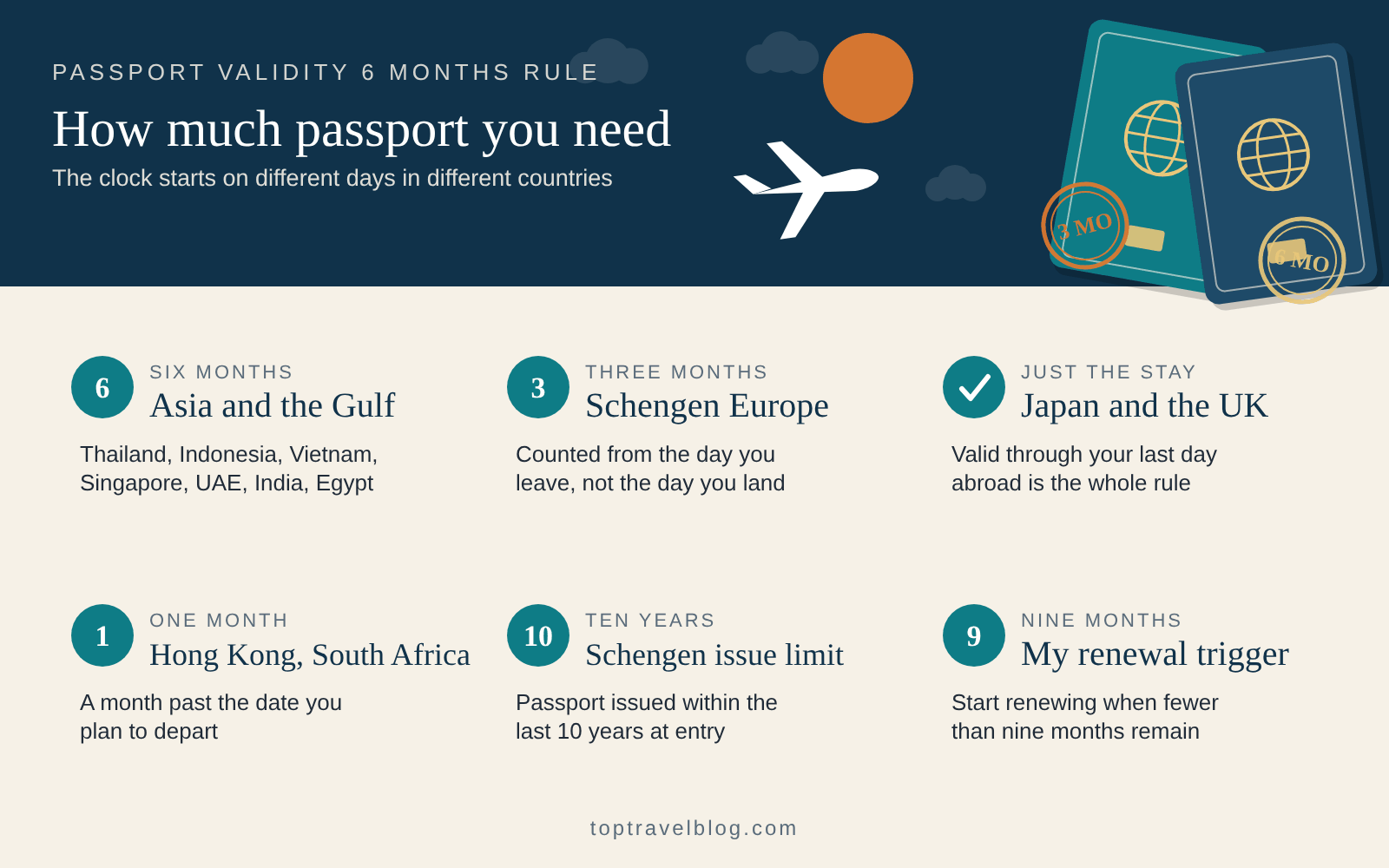
- Six-month group: Thailand, Indonesia, Vietnam, Singapore, the Philippines, Cambodia, the UAE, India, Egypt, Israel, Peru, Malaysia, Kenya, Tanzania and Jordan list six months of remaining validity on arrival.
- Three-month group: the Schengen area (three months after your planned departure, passport issued within the past 10 years) and New Zealand (three months after departure).
- Stay-only group: Japan and the United Kingdom need a passport valid for your whole stay and nothing more.
- One-month group: Hong Kong and South Africa want a month beyond your departure date.
- Who enforces it: the airline, at check-in, usually before a border officer ever sees you. A denied boarding is the usual result, and fares are rarely refunded.
- My rule: if fewer than nine months remain when you start planning an international trip, renew first and book second.
What the passport validity 6 months rule actually says
Strictly speaking there is no single passport validity 6 months rule. There is a habit among immigration authorities of requiring that your passport outlive your trip by some margin, and the margin is set by each country on its own. Six months is the most common number, which is why the phrase stuck.
A country that uses it usually writes something like “passport valid for at least six months from the date of arrival.” The U.S. State Department repeats each country’s wording on its country information pages, under the entry, exit and visa requirements heading. That page, not a blog post and not a friend’s memory, is where the number for your destination lives.
The passport validity 6 months rule is about remaining life, not expiry
The mistake is reading the passport validity 6 months rule as “my passport must not expire during the trip.” Under the passport validity 6 months rule your passport can expire after you are home and still fail. A passport that expires four months after you land in Bangkok is valid for the whole trip and invalid for entry.
What counts is the gap between the date the clock starts and the expiry printed on the photo page. Count in calendar months, so arriving on March 1 means the passport must be valid through at least September 1.
Three players, three checks
Three different parties can apply the passport validity 6 months rule, and they do not always agree. The first is the airline, which checks at the counter or online check-in and can refuse to carry you. The second is the border officer, who applies the country’s law when you arrive. The third is the visa or authorization system, such as an eVisa portal, which may reject an application if the passport is short.
The airline is the strictest in practice. Carriers face fines and the cost of flying you back if a country refuses entry, so they apply the destination’s rule without exception and sometimes a little more cautiously.
Worth knowing: The airline sees your passport first and has very little discretion to wave you through. A border officer might have bent a rule by a few days; the person at the check-in desk almost never will.
The same logic is why the passport validity 6 months rule matters more than its modest wording suggests. A strict reading is the only reading you will meet at the desk. If you want the wider list of documents that sits around it, our international travel documents checklist covers the rest of the paperwork in one place.
Why countries ask for 3 or 6 months of validity
The passport validity 6 months rule looks arbitrary until you think about it from the border officer’s side. Governments are not trying to inconvenience tourists. They are protecting themselves against a short list of practical problems.
A margin for delays and changed plans
Trips run long. A missed connection, a hospital stay, a strike or a hurricane can add days or weeks to a visit. If your passport expires the day after your return flight, one cancelled flight leaves you inside the country on an expired document. A buffer of three or six months means the country will not be stuck with a traveler who cannot legally leave.
Repatriation and removal
If a visitor has to be deported or sent home, the receiving country has to accept a valid passport. Authorities want that document to stay valid long enough for the paperwork to finish. This is also the reason the passport validity 6 months rule is usually tied to the date of entry: it is a statement about how much runway the passport has when you cross the line.
Visas, stamps and security
Many visas and entry permits are issued for a fixed term, and officials do not want a permit that outlasts the passport it is attached to. Newer systems, including the European Union’s Entry/Exit System, record each traveler’s passport data and travel dates, which makes an expiry that sits close to the trip easy to flag.
Why the passport validity 6 months rule applies in some places and not others
The six-month figure traces back to international aviation practice and to the way countries copy each other’s wording. Some have never updated it. Others, including the United Kingdom and Japan, dropped the buffer because they decided a passport valid for the stay was enough.
That is also why you will see the same destination described differently by an embassy, an airline and a travel forum. The wording on a government site is the rule. Everything else is commentary.
The four ways countries count: arrival, departure and the stay
Almost every version of the passport validity 6 months rule falls into one of four patterns. Learn the patterns and the country list becomes easy to read.
Six months from arrival
Typical of Southeast Asia, the Gulf and parts of Africa and Latin America
The passport must still have six months left on the day you enter. Trip length does not matter, because the clock starts at the border. A one-week trip and a 60-day trip face the same test.
Three months after departure
The Schengen area and New Zealand
The clock starts on the day you plan to leave, so a long trip needs a longer passport. A 30-day trip needs the passport to run through about four months after you land, and a 90-day trip about six months.
Valid for the stay
Japan and the United Kingdom
No buffer at all. The passport has to be valid on every day you are in the country. The UK’s standard visitor guidance says the passport must cover your entire planned stay, and Japan applies the same idea.
One month after departure
Hong Kong and South Africa
A short buffer counted from your departure date. It rarely catches anyone, but it is still the rule on paper, and it is the kind of margin airlines apply without discussion.
There is a fifth pattern worth naming, the age limit. The Schengen rules also require that your passport was issued within the previous 10 years on the day you enter. An adult U.S. passport book is valid for 10 years, so most Americans never hit it, but anyone using a very old document with unusually long validity should know it exists.
How the passport validity 6 months rule changes with arrival versus departure counting
Under an arrival rule, a long stay does not hurt you. Under a departure rule, it does. Take a 45-day trip that begins June 1. A six-month-from-arrival country needs the passport valid through December 1. A three-months-past-departure country needs it valid through about October 16, because you leave on July 16 and add three months.
So the “stricter” rule depends on the trip. For anything over three months, the departure-based rule is the more demanding one.
The passport validity 6 months rule, country by country
This is the list I work from when a reader asks how the passport validity 6 months rule applies to a specific trip. It reflects the entry rules published by each government and relayed through the State Department’s country pages as of November 2026. The destination’s own wording always controls, and the groups below show the pattern for places Americans visit most.
Where the passport validity 6 months rule applies on arrival
Thailand, Indonesia, Vietnam, Singapore, the Philippines, Cambodia, Malaysia, the United Arab Emirates, India, Egypt, Israel, Jordan, Peru, Kenya and Tanzania all list six months of validity for arrival. The visa side varies a lot. Americans can enter Thailand visa-free for 60 days per entry, Singapore and the UAE for 90 days and the Philippines for 30. Indonesia, India, Cambodia and Tanzania typically involve an eVisa or visa on arrival.
Indonesia adds a second condition, at least two blank pages, which the State Department page for Indonesia states alongside the six-month figure. Put the two requirements together and a passport that looks healthy on expiry alone can still fail on a nearly full page spread.
Three months beyond departure
The Schengen area covers 29 countries, including France, Italy, Spain, Germany, Greece, Portugal and the Nordic states, and the shared rule is three months past your planned departure from the area. The U.S. Department of Transportation’s passport guidance for Europe describes the three-month requirement, and the State Department’s Schengen fact sheet carries the full text. New Zealand uses a similar three-month margin.
Ireland is the exception that surprises people. It sits outside Schengen and, like the UK, asks only for a passport valid for your stay.
Valid for the stay
Japan and the United Kingdom sit here. The UK’s standard visitor guidance is explicit: the passport or travel document has to cover your entire planned stay, with no minimum period beyond that. Travelers heading to Britain will also want our guide to the UK ETA for U.S. citizens, since the authorization is tied to your passport details.
Mexico and Canada ask U.S. citizens for a valid passport; neither publishes a six-month buffer for American visitors.
A month beyond departure
Hong Kong and South Africa fall in this group. The buffer is short and easy to meet, which is the point of including it: if you are planning a combined trip, the strictest country on the itinerary sets your standard.
Latin America, the Caribbean and Africa
This is the group where written rules and airline practice drift apart the most. Peru lists six months. Many Caribbean islands and Central American countries ask only for a passport valid on arrival or for the stay, but some airlines flying those routes ask for more than the written minimum. Kenya and Tanzania list six months, and safari itineraries add blank-page requirements and yellow fever paperwork on top.
When I plan a trip here I carry a passport with six months or more, regardless of the written minimum. It costs nothing if the rule is looser and saves the trip if the airline is stricter.
Which number governs a multi-country trip
Combined itineraries are where people slip. The strictest requirement on the whole route sets your standard, and the clock for each leg starts on its own date. Here is how that works for four common trips.
Bangkok, Singapore and Bali
Southeast Asia loop
Every stop lists six months from arrival, and Indonesia adds two blank pages. Count from your first landing in Thailand, which is the earliest and therefore the hardest test, and then check that no later leg is stricter.
Rome, Paris and Barcelona
Schengen grand tour
One rule covers the whole area: three months past the day you leave Schengen. The trip is one stay, so count from the final departure, not from each country.
Tokyo, Seoul and Hong Kong
North Asia
Japan wants validity for the stay, Hong Kong a month past departure. South Korea does not publish a six-month buffer for Americans, so the one-month margin is the binding figure, which is easy to meet.
Safari plus a Dubai stopover
Africa and the Gulf
Six months from arrival applies in the UAE and in Kenya and Tanzania, so the strictest clock starts the day you first land. Add blank pages for the safari countries.
Tip: Build your trip around the strictest rule on the itinerary, not the first country. A Singapore stopover followed by two weeks in Japan is a six-month trip as far as your passport is concerned.
Countries also change their wording, and authorities sometimes tighten or relax a rule with little notice. Airlines apply the stricter reading in the meantime. When you cannot tell which figure governs your trip, treat the passport validity 6 months rule as the safe default.
For travel advisories, which are a separate question from entry rules, see our explainer on travel advisory levels explained.
What the passport validity 6 months rule does not cover
A few related requirements get lumped in with the passport validity 6 months rule, and mixing them up causes its own confusion. Here is where the lines fall.
Passport validity is not visa validity
An eVisa, a visa on arrival or an electronic authorization has its own dates. A visa might be good for 90 days from entry while your passport only has five months left, and the passport is still the document that fails. In the other direction, an authorization is tied to the passport you applied with, so a renewal usually means applying again.
Coming home to the United States
The passport validity 6 months rule is a destination rule. It does not govern your re-entry to the United States as a U.S. citizen, who needs a valid passport to board an international flight home. Travelers with a non-citizen partner or friend have a separate issue: foreign passports generally need to be valid for six months beyond the intended U.S. stay unless the traveler’s country is on the exemption list that people call the six-month club.
A passport valid for the stay is still not a green light
Even in the countries that ask for nothing more than a passport valid for your stay, I carry three to six months. The reason is practical. Flights get cancelled, hospitals keep people longer than planned, and a passport that expires halfway through a delay becomes a problem exactly when you have the least time to fix it.
Treat the written minimum as the legal floor and the six-month habit as the planning floor. They are different numbers, and the second one is the one that keeps you flexible when a trip changes.
Applying the passport validity 6 months rule in five steps
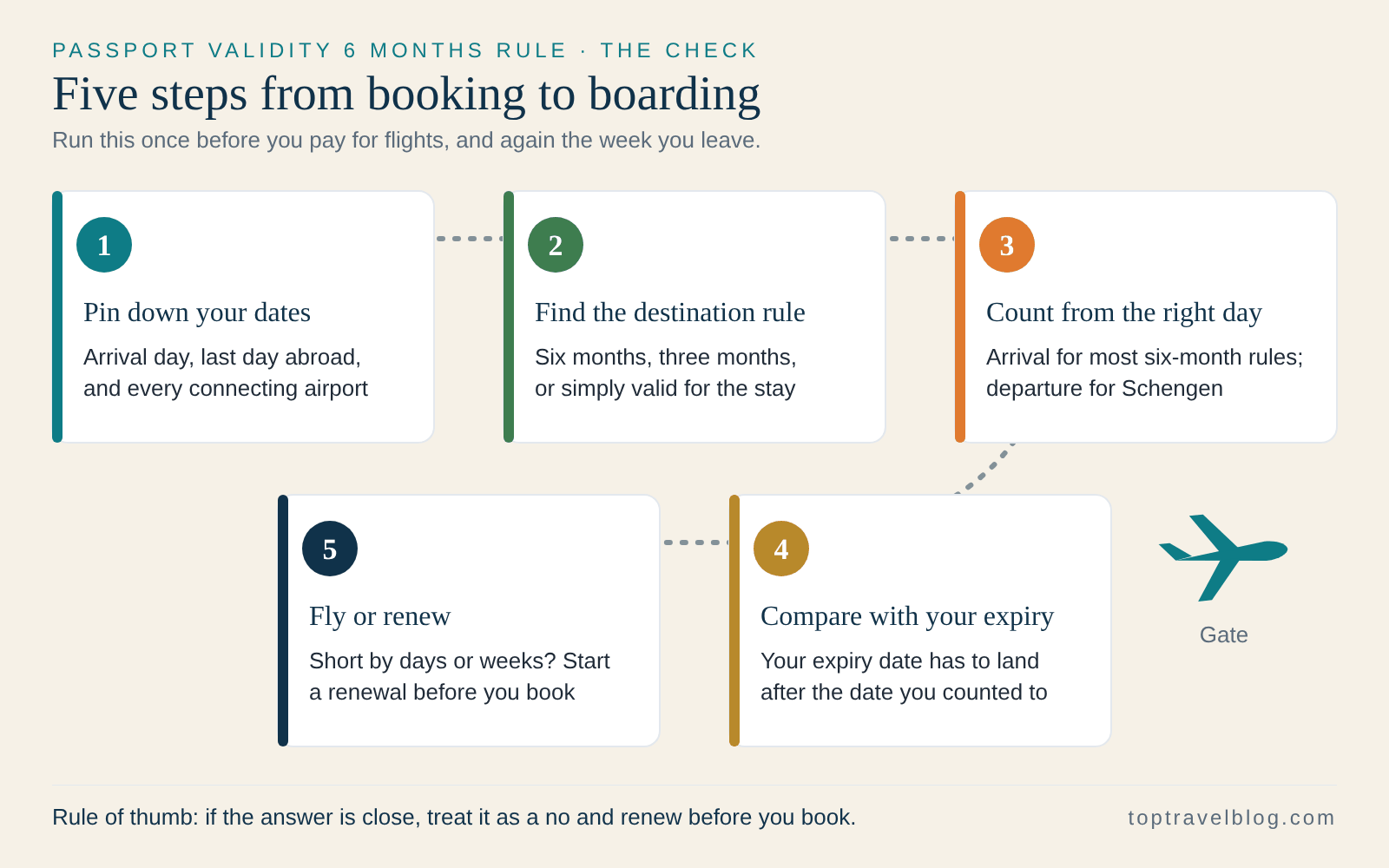
This is the whole process of applying the passport validity 6 months rule. It takes ten minutes, needs only your trip dates and your passport, and catches almost every problem I have seen. Do it before you buy flights, not after.
How to read a State Department country page
Every country page has a section called entry, exit and visa requirements. The passport line is usually near the top and reads something like “passport validity: six months” or “must be valid for the duration of your stay.” Read three things: the number, the starting point and any blank-page line.
If the page says six months and gives no start date, assume arrival. If it names “departure” or “exit,” count from your last day in the country. When the page and your airline disagree, the airline’s reading is the one you have to satisfy at the counter, so follow the stricter of the two and ask the airline to explain the difference in writing.
The same page also lists any visa, e-visa or arrival-card requirements, health entry rules and the current travel advisory level. That makes it the one page I read start to finish for any country I have not visited recently.
Step 1
Pin down your dates
Write down three dates: the day you land in your first foreign country, the day you leave your last one, and the dates of every connecting airport in between. If you are still choosing dates, use the latest you might travel. Dates that drift later can turn a pass into a fail.
If the trip includes a cruise, add the day the ship returns to a U.S. port, since the cruise line may apply its own margin. See how to plan a trip for where this step sits in the larger sequence of booking decisions.
Step 2
Find the destination’s rule
Open the State Department country page for each country on the itinerary and read the entry requirements. Look for the passport validity 6 months rule in one of four phrasings: six months, three months, valid for the stay, or a month beyond departure. Note whether it counts from arrival or departure, and note any blank-page requirement.
If a country lists no figure at all, treat it as valid for the stay, and carry at least six months of margin anyway, because airline systems sometimes hold a stricter entry than the government page.
Step 3
Count from the right day
For an arrival rule, count forward from the day you land. For a departure rule, count from the day you leave that country or, for Schengen, the area as a whole. Use calendar months, and count to the same date. Do the arithmetic on paper rather than in your head; this is the step where most people misapply the passport validity 6 months rule.
Step 4
Compare with your expiry date
Find the expiry date printed beside your photo. It must fall after the date you counted to in step 3, for every country on the list. If it is a close call, a difference of days not months, treat it as failing. Counter staff do not round in your favor.
Step 5
Fly or renew
If you pass, book with a clear conscience. If you fail or it is close, renew first. Our U.S. passport guide walks through the application, routine and expedited timelines and urgent travel options. Then wait until the new passport is in hand before booking nonrefundable flights.
Already booked and short? Start an expedited renewal immediately and keep the airline informed. Flights booked on one passport number do not need rebooking when you get a new one, but the airline’s record of your passport details does need updating before you fly.
Worked examples: the same passport, different trips
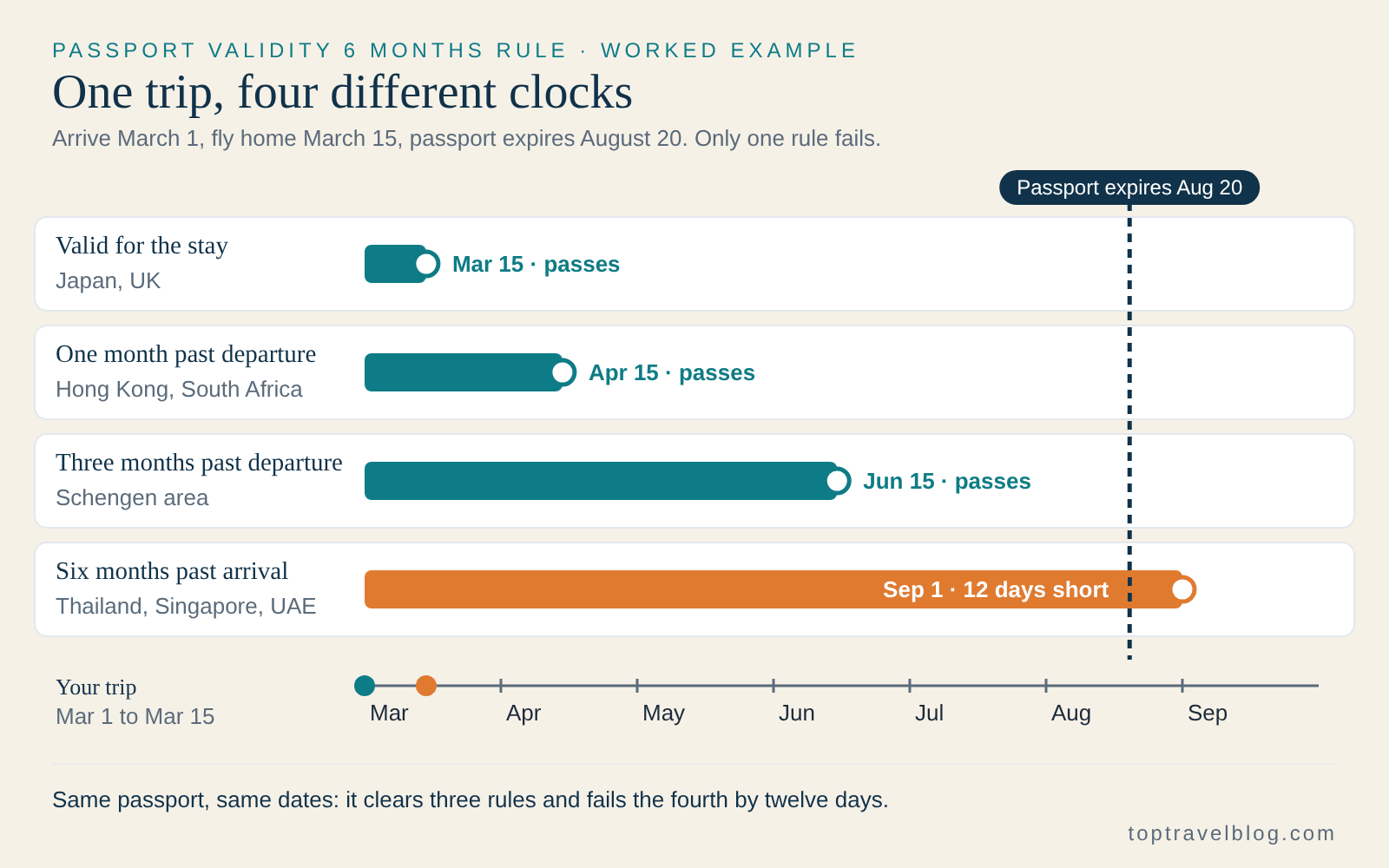
Numbers make the passport validity 6 months rule concrete. Here are the scenarios I use when someone tells me their passport is probably fine.
The Thailand trip that fails the passport validity 6 months rule by 12 days
Maya books two weeks in Thailand starting March 1. Her passport expires August 20. She is home on March 15, and it expires five months later, which looks comfortable. Under the passport validity 6 months rule the passport has to run through September 1 at the moment she lands. It is 12 days short.
The airline will turn her away at check-in. Renewing takes weeks, so she has to choose between an expedited renewal and a lost fare. The same passport would have been fine for the UK, Japan, Hong Kong and Italy.
The 12-day Italy and France trip
Dan leaves for Rome on September 10 and flies home from Paris on September 22. Both are Schengen countries, so the clock starts on September 22, and his passport must run through December 22. His expires January 15, so it passes by about three weeks.
If he stretched the trip to the Schengen maximum, 90 days, the same passport would fail. Longer trips push the departure date later and make the rule bite harder.
The layover that counts
Priya is flying to Bali with a connection in Singapore. The six-month rule for Indonesia applies at the end of the journey, but the airline will also check that her passport clears Singapore’s entry rule. In practice she needs the strictest figure on the itinerary, which is six months, and two blank pages for Indonesia.
The cruise from Florida
Cruise lines publish their own passport rules for international sailings, and several recommend a margin of around six months past the end of the voyage. On closed-loop sailings that start and end at the same U.S. port, citizens can sometimes board with a birth certificate and photo ID. I would still carry a passport, because a missed boat or a medical flight home from a foreign port needs one. The cruise line’s rule is the one applied at the pier.
The honeymoon booked a year out
Sam and Jordan book a trip 11 months ahead and see that Jordan’s passport has seven months left today. By departure it will have under four months, which fails every six-month destination and may fail a three-month one. Renewing immediately costs a few weeks and some fees. Waiting until six months out costs the trip.
The best protection against failing the passport validity 6 months rule is to check the passport when you set the budget, which is a habit our travel insurance guide touches on, because standard policies typically do not cover a trip you cannot take for lack of a valid passport. Look for that exclusion before you buy.
Airlines, layovers and cruises: where the passport validity 6 months rule is really enforced
The border officer is the last checkpoint. The airline is the first, and for most travelers it is the only one that matters.
The check-in desk and the database
Airlines match your passport against an industry entry-requirements database before issuing a boarding pass, which is why the same agent who barely glances at your face will stop you over an expiry date. The check happens online as well, so you may see a warning in the app and not at the airport.
If you are refused boarding for passport validity, the carrier is usually not obliged to refund the ticket, and changes are at their discretion. That is the practical cost of the passport validity 6 months rule: not a fine, but a missed trip and a ticket you may not recover.
Transit and connections
Airlines look at every country on your itinerary, not just the destination. If you transit through a country where you stay airside, the rule may not apply to you at the border but the airline can still require it. If you leave the airport during a layover, you are entering the country and its passport rule applies.
Cruises and tours
Cruise lines, rail operators and tour companies set their own margins, usually matching or exceeding the strictest port on the route. Tour operators sometimes require validity for the entire booking window. Read the document requirements in your confirmation email and keep a copy of your passport photo page separate from the passport itself.
If you are denied boarding
Ask the agent to write down the reason and the rule they applied. Contact the nearest passport agency for an expedited appointment if you need a new passport quickly, and ask the airline about rebooking. If you are already abroad and your passport is damaged or nearly expired, the nearest U.S. embassy or consulate handles replacements and emergency passports, as the State Department’s passport services pages explain. Enrolling in the free program described in our guide to the Smart Traveler Enrollment Program gives the embassy a way to reach you during a crisis.
When to renew: the nine-month habit
Renewing a U.S. passport is not hard. It is just slower than people expect, and it is the single easiest way to stay out of trouble with the passport validity 6 months rule.
Why nine months
Nine months gives you a six-month buffer plus a three-month cushion for a long trip or a slow renewal. It also covers the common planning window: if you look at a trip a year out, you are renewing while there is plenty of runway.
Renew at nine months and you stay clear of the passport validity 6 months rule on every route, with room for a slow renewal. Renew at six and you are already at risk for any six-month destination.
What renewing costs you
When you renew early, the new passport is valid for 10 years from its own issue date. The remaining months on the old passport are not added. So renewing at nine months costs you nine months of validity you had paid for. That is a real cost, though a small one compared with a missed flight.
Fees and current processing times are published on the State Department’s passports section, including the extra fee for expedited service. Our U.S. passport guide compares routine and expedited timelines and explains when you qualify to renew online or by mail.
Backing into a renewal date
Work backward from departure. Start with the strictest figure on your route, say six months. Add the days you need for the renewal itself, which run to weeks on routine service. Add a cushion of a month in case the application is returned for a photo or signature problem. The total tells you the latest day to apply.
For a September trip to a six-month country, that means the passport needs to run through the following March, and the application should go in by spring at the latest. Starting in early summer works only if you are paying for expedited service and have no room for error. I would rather start in April and forget about it.
If you are already short
You have four realistic options. Expedited renewal is the usual answer when the trip is more than a few weeks out. For urgent travel, the State Department offers appointments at passport agencies when you are leaving within 14 days, or within 28 days if you need a foreign visa. You can also move your travel dates, which is rarely cheap, or switch to a destination with a shorter requirement.
Our U.S. passport guide lists the steps for urgent travel and what to bring. The point is to decide quickly, because the passport validity 6 months rule will not bend for a tight timeline: every day spent hoping the airline will not notice is a day off a renewal timeline that is already tight.
Who can renew by mail or online
In general, adults whose passport was issued when they were 16 or older, within the past 15 years, undamaged and in their current name, can renew without an in-person appointment. Everyone else, including children under 16, starts over with a new application.
Worth knowing: The U.S. passport card is not valid for international air travel. It works at land and sea crossings with Canada, Mexico and the Caribbean, but it will not get you onto a plane.
Europe, EES and ETIAS: what changes the passport math
The three-month Schengen rule did not change with the Entry/Exit System, but the system makes it more visible. According to the European Commission’s border-crossing page, the EES became fully operational on April 10, 2026. It registers non-EU travelers on short stays, which means your passport data and entry and exit dates are now recorded each time you cross.
Our Europe EES explained guide describes what to expect at the booth, including the first-time registration.
ETIAS is a separate step. It is the EU’s travel authorization for visa-exempt visitors, and as of early November 2026 it is not yet in operation. The Dutch government’s ETIAS page says applications are not being accepted and that the start date will be announced several months ahead.
When it launches, the authorization will be linked to the passport you use to apply, so a renewal after approval means a new one. Our ETIAS for U.S. citizens guide covers timing and who needs it. The practical lesson for now is to renew before you apply for anything that attaches to your passport number.
Blank pages, damage and children’s passports
The passport validity 6 months rule is the most common passport problem, but not the only one. Three others come up often enough to be worth a short section.
Blank pages
Some countries require one or two blank pages for stamps. Indonesia asks for two, and the State Department lists blank-page requirements alongside the validity figure on each country page. U.S. passport books no longer have an endorsement section, so what counts is unused visa and stamp pages. If your passport is almost full, a renewal solves the problem along with validity.
Damage
Water damage, a torn page, a loose cover or a chewed corner can lead an airline or officer to refuse a passport as invalid, even when the expiry date is fine. A passport that looks tampered with gets refused fast. If yours has been through the wash, replace it before you book.
Children’s passports
Passports for children under 16 are valid for five years, not 10, which means they expire twice as often and are more likely to be short on validity. Children’s passports also cannot be renewed by mail, so plan for a longer lead time and for both parents’ involvement. Many families discover this the month before a trip.
Family and group trips
On a group booking, the shortest passport sets the date for everyone. Families sit at the greatest risk because the children’s five-year passports expire on different schedules from the parents’ ten-year ones, and one person’s expiry can hold up the whole trip. Pull every passport out at the same time, write the expiry dates in one list and compare them with the strictest rule on the route.
The same applies to travelers with a second nationality. Enter and leave the country on the passport the rules assume you are using, and make sure that one meets the requirement, because mixing passports at the airline desk and the border creates records that do not match.
Common mistakes with the passport validity 6 months rule
These are the ones I see most. Each is easy to avoid once you know it exists.
- Counting to the end of the trip. Under the passport validity 6 months rule the clock starts on arrival, and your return date is irrelevant to the test.
- Assuming one version of the passport validity 6 months rule works everywhere. The same passport can pass Japan, pass Italy and fail Thailand. Check each country on the itinerary.
- Forgetting the layover. A connecting country can add its own requirement, and the airline applies the strictest.
- Trusting a forum or a friend. Rules change and wording differs between airlines and embassies. Read the government page.
- Booking first and renewing later. Nonrefundable fares and a renewal that takes weeks is how trips are lost.
- Ignoring blank pages. A passport with ten years left but no free page can still be refused where a page requirement exists.
- Renewing at the last minute and then discovering the new passport has to be linked. Visas, authorizations and airline records tied to the old number need updating.
- Rounding in your favor. Five months and 20 days is not six months.
Passport validity 6 months rule: frequently asked questions
Is there really a passport validity 6 months rule for U.S. citizens?
Not one universal rule. The passport validity 6 months rule is shorthand: each country sets its own margin, and six months is the most common number, used by Thailand, Singapore, the UAE, India and many others. Schengen uses three months after departure, Japan and the UK require validity only for the stay. The State Department’s country pages list each figure.
Does the six months count from arrival or from departure?
It depends on the country. Under the passport validity 6 months rule, most versions count from the date you enter. Schengen’s three-month rule counts from the date you plan to leave the area. The wording on the country’s official entry page tells you which, and the airline applies that reading at check-in.
What happens if my passport has five months left and the country wants six?
Under the passport validity 6 months rule the airline will almost certainly refuse to board you, and if it did not, the border officer could deny entry. You would be responsible for the ticket and any onward costs. The fix is an expedited renewal before you travel, not an argument at the counter.
Do I need six months of validity to visit Mexico or Canada?
No. The passport validity 6 months rule does not apply there. For U.S. citizens, both ask for a valid passport and publish no six-month buffer for American visitors. Many people still renew early, because a passport with weeks left is a risk if a trip runs long. Land crossings can also accept the passport card, but flights cannot.
Does Europe require six months?
No, the passport validity 6 months rule does not apply to Schengen. Those countries require your passport to be valid for at least three months after your planned departure from the area, and issued within the previous 10 years. Ireland, outside Schengen, only requires validity for your stay. The rule is easy to meet unless your trip is long or your passport is near expiry.
Can I use the remaining validity when I renew early?
No. A renewed U.S. passport is valid for 10 years from its issue date, and the old passport’s remaining months are not added. That is why I suggest renewing at nine months, not 12, if you want to keep as much validity as possible while staying well ahead of the strictest rules.
Do I need six months if I am only transiting through an airport?
The airline can apply the passport validity 6 months rule to a layover even when the country’s law would not. If you stay airside, you are not formally entering the country, but carriers check every segment. If you leave the airport on a long layover, you are entering and the entry rule applies. Plan for the strictest figure on the route.
How long does it take to renew a U.S. passport?
Routine service takes weeks and expedited service is faster for an additional fee. Both timelines move, so the State Department’s passport pages list current ones. Our U.S. passport guide covers the process, including urgent travel appointments for trips inside a few weeks.
Does travel insurance cover a denied boarding for passport validity?
Typically not. A denied boarding under the passport validity 6 months rule falls on you, and standard policies list an expired or invalid passport among the things you are responsible for, so trip cancellation benefits do not apply. Read the exclusions in the policy before you buy, and treat the passport check as your job.
Is the passport card good enough for international trips?
Only for land and sea crossings with Canada, Mexico and the Caribbean. It is not valid for international air travel, whatever its expiry date. If you fly, you need the passport book.
What counts as a blank page?
A page with no stamp, visa or marking, usually a visa page. Some countries require one or two. Indonesia asks for two. Endorsement pages no longer exist in U.S. passport books, so the count is simply the unused pages left in your passport. The passport validity 6 months rule and the blank-page rule are separate tests, and you need to pass both.
One last thing before you book
The passport validity rules are boring, which is why they catch people. Nobody dreams about a passport. Then the fare is bought, the hotel is paid for, and a person at a desk is looking at a date on a small blue book.
I now treat the passport as the first line in any trip budget, ahead of flights. Take it out, read the expiry date and put it in your calendar at nine months and at twelve. If you land on the safe side, you never think about the passport validity 6 months rule again.
The few minutes it takes are the cheapest insurance in travel. If you want to see where passport checks fit in the rest of your preparation, start with our international travel documents checklist and the step-by-step planning guide.
Related planning guides
- U.S. Passport Guide: apply, renew, processing times and urgent travel — the step-by-step companion when your passport fails the check.
- International travel documents checklist for U.S. citizens — everything else that has to be in your bag.
- Europe EES explained: what U.S. travelers can expect at Schengen borders — how the new border system records your passport.
- ETIAS for U.S. travelers: what it is, who needs it, cost and launch timing — the authorization tied to your passport number.
- Travel insurance explained — what a policy will and will not cover when documents go wrong.