Europe EES explained in one breath: since April 10, 2026, every American who lands in a Schengen country for a short stay gets photographed and fingerprinted by a border officer or a self-service kiosk the first time, and from then on the system quietly counts your days. There is nothing to apply for, nothing to pay and no form to fill in at home.
The most useful part of Europe EES explained for a traveler is not the technology, it is the schedule. What you need is a plan for time. Lines at the biggest airports have run from a few minutes to two hours, and the rule that once let airports pause biometric checks lapsed on September 6, 2026. This guide covers who is registered, what happens at the booth, how the 90-day rule is enforced, and how to build a trip that survives a slow morning.
I have spent years helping readers plan Schengen trips, and this system now generates more questions than anything else in my inbox. The most common mix-up is with ETIAS, a different system that is not running yet. I will keep the two apart throughout, because a surprising number of websites do not.
Everything below is based on the European Commission’s EES page, Frontex and national border-authority pages, reported queue data from the summer of 2026, and my own trips. Where something is still unsettled, I say so plainly instead of guessing.
Quick facts: Europe EES explained at a glance
- Best for: Americans planning any short trip to the Schengen Area, from a long weekend to a 90-day stay.
- What EES is: A digital border register that records your face, fingerprints and passport data on entry and exit. It replaced passport stamps and has been fully operational since April 10, 2026.
- What you must do: Nothing in advance. No application, no fee. Register at a booth or kiosk on your first crossing.
- Who is exempt: EU and Schengen citizens (including dual U.S. citizens entering on that passport) and long-stay visa or residence permit holders. Children under 12 are photographed but not fingerprinted.
- Time to allow: Roughly 2.5 to 3 hours between landing and an onward flight at a big hub on a first-time morning arrival; about 70 to 90 seconds per person at the front of the line.
- The 90/180 rule: Up to 90 days in any rolling 180-day period across all 29 Schengen countries. EES counts it for you.
- Not the same as ETIAS: ETIAS is a 20-euro online authorization that is not yet operating. As of November 2026 no site can legitimately sell it.
- Key caveat: The temporary flexibility that let airports pause biometrics lapsed on September 6, 2026, so plan as if every check happens.

Europe EES explained in plain English: what the system actually does
Start with the basics, because Europe EES explained properly begins with a definition. The Entry/Exit System, EES for short, is an automated database that registers non-EU nationals every time they cross the external border of a participating European country for a short stay. It is run by eu-LISA, the EU agency that manages large-scale border and security IT systems, and it replaces the ink stamp in your passport.
That last point is the one most travelers notice first. The officer used to flip to a blank page and thump a stamp. Now the record lives in a database: your name, passport details, the date, time and place of each entry and exit, and a facial image and fingerprints. Refusals of entry go in the same record.
What gets recorded, in the order it usually happens
In any Europe EES explained summary, this list is the heart of it. The French foreign ministry’s page for visitors lists the data in two groups. The first is your travel document: full name, date and place of birth, sex, nationality, document number, issuing country code and expiry date. The second is the trip itself: where, when and why you crossed, entering or leaving.
The biometrics are the third piece. A camera takes a photo of your face, and a scanner takes your fingerprints. Children under 12 skip the fingerprints but are still photographed. After the first registration, later crossings mostly mean a face match and a fingerprint check against the record that is already there.
Why Europe built it
Europe EES explained from the government side comes down to two reasons. The first is counting: a stamp is easy to miss, easy to smudge and nearly impossible to add up across a dozen trips, so officers had no reliable way to see whether someone had overstayed the 90-day limit. The second is identity: matching a face and fingerprints to a stored record makes it far harder to cross on a second passport.
The Commission reports that in the first months more than 45 million border crossings were registered and over 24,000 people were refused entry, including more than 600 identified as security risks. One case in Romania involved a person using two identities who had already been refused three times by different countries. Whatever you think of that trade, it is the trade being made.
What Europe EES explained does not include
Before going further, here is what Europe EES explained does not include. It is not a visa. It is not a travel authorization. It is not something you apply for, and no one can sell you a faster version of it. The French government page puts it bluntly: there is nothing to do before traveling. If a website offers to register you for EES in advance for a fee, it is not an official channel.
It is also separate from ETIAS, which will be a paid online authorization once it launches. I cover that difference in its own section below, and our guide to ETIAS for U.S. citizens goes deeper on the application side.
Who EES applies to, and who is left out
Europe EES explained for Americans starts with eligibility. EES covers non-EU nationals coming for a short stay, defined as up to 90 days in any 180-day period. That includes Americans, who do not need a visa for Schengen trips of that length. The Commission’s wording is about nationality and purpose of stay, not about how you travel, so it applies at airports, seaports, train stations and land crossings alike.
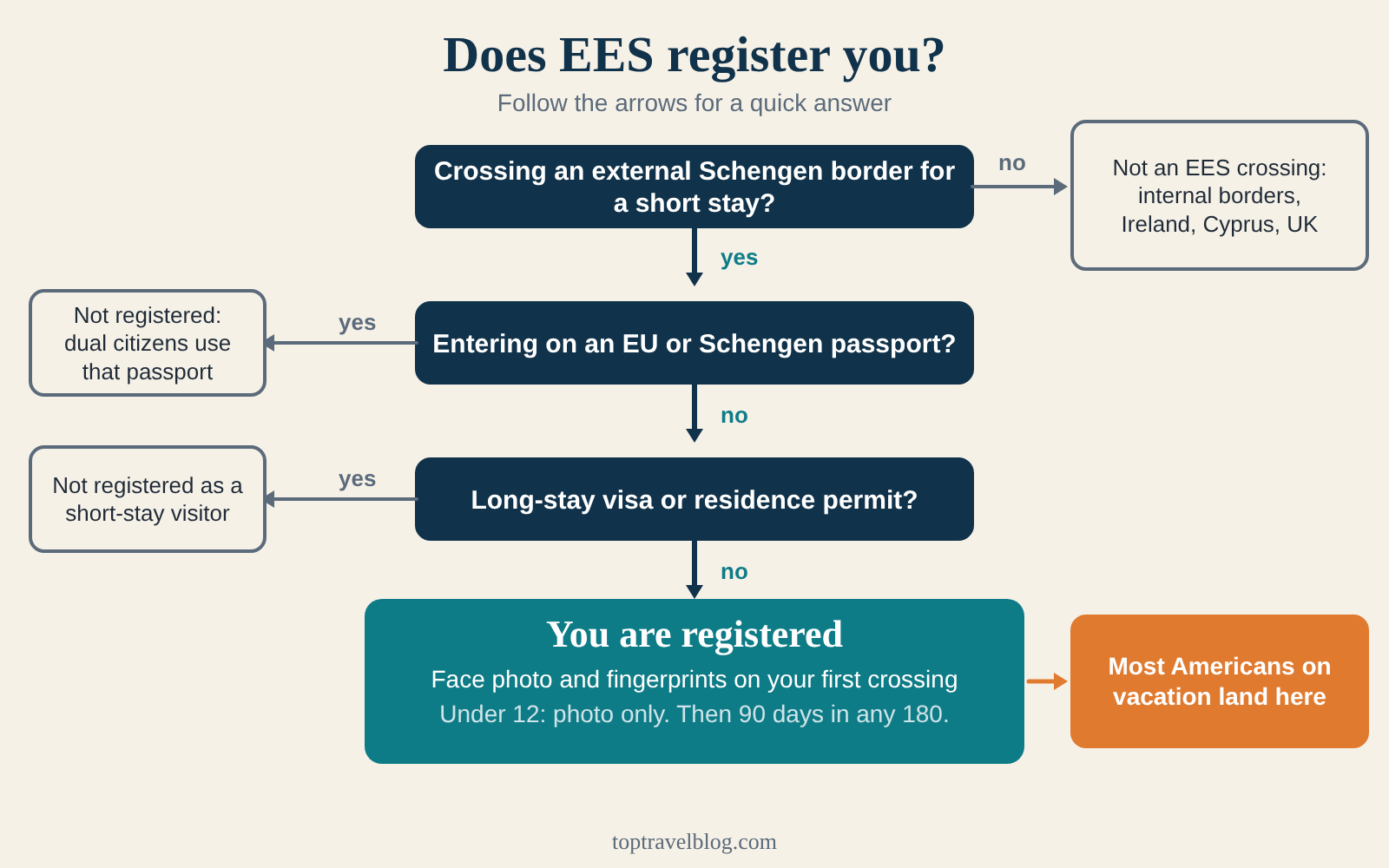
Registered at the border
U.S. passport holders on a tourist or business visit
You are the main audience of this guide. Expect a photo and fingerprints on the first crossing, then face and fingerprint matching afterward. No pre-registration is required, although a few countries accept an optional app upload.
Registered, with a lighter process
Children under 12
A facial image is taken, fingerprints are not. A parent can usually keep the child close during the process. Each child still needs his or her own passport, and kiosks are designed for one traveler and one passport at a time.
Not registered
Citizens of EU and Schengen countries
This includes Irish and Cypriot citizens. An American who also holds an EU or Schengen passport does not go through EES and should enter on that passport. Carry both passports and use the right one at the right place.
Not registered
Holders of long-stay visas and residence permits
The French page says personal data is not registered for holders of long-stay visas. If you have moved to Europe on a national visa or residence card, EES is not tracking your days in the same way.
Not registered
Nationals of Andorra, San Marino, Monaco and the Holy See
Rare in an American’s travel circle, but the exemption is part of the official list.
Why dual citizens get a pass, and what to carry
For readers with roots in Europe, Europe EES explained has a special chapter. Plenty of Americans hold a second passport through a grandparent or a spouse’s family. If yours is Irish, Italian, Polish or from any other EU or Schengen country, you are not a short-stay non-EU traveler when you use it, so EES does not apply. The practical tip is to use that passport for all your crossings during the trip.
Mixing passports is where trouble starts. If you enter on your U.S. passport and leave on your Italian one, the system sees an entry with no exit and may eventually flag an overstay. Pick one document for each trip and use it every time you cross an external border. Our international travel documents checklist covers the paperwork side of carrying two passports.
Do you need EES for a cruise or a ferry?
On the sea side, Europe EES explained has a short answer. Yes, in principle. EES applies at all external borders of the participating countries, and that includes sea ports. In practice, how your cruise line and the port authority handle it varies by itinerary, and the cruise line will tell you where checks happen. One narrow exception from ABTA’s guidance for British travelers: UK-to-UK cruises do not require EES registration.
Day trips are a related trap. A morning ferry from a Greek island to the Turkish coast or from Croatia to a neighboring Balkan country is an external-border crossing, and every one of those crossings is recorded. The border does not care that the trip is short, only that the line on the map is the Schengen edge.
The 29 countries that use EES, and the places that do not
The list matters because Europe EES explained is only useful if you know which borders it covers. EES runs in the 29 countries of the Schengen Area: Austria, Belgium, Bulgaria, Croatia, Czechia, Denmark, Estonia, Finland, France, Germany, Greece, Hungary, Iceland, Italy, Latvia, Liechtenstein, Lithuania, Luxembourg, Malta, the Netherlands, Norway, Poland, Portugal, Romania, Slovakia, Slovenia, Spain, Sweden and Switzerland. That is the same list that applies to the 90-day rule.
Three details about that list surprise people. Norway, Iceland and Switzerland are not in the EU but are in Schengen, so you are registered there too. Ireland and Cyprus are in the EU but not in the system, so they still use manual passport checks. And the United Kingdom, Albania, Serbia, Montenegro, North Macedonia and Turkey sit outside it entirely.
Inside EES and the 90-day count
Most of the continent you picture
France, Italy, Spain, Germany, Portugal, Greece, the Netherlands, the Nordics, Switzerland, Croatia and Central Europe. Time spent here counts against your 90 days, and every external-border crossing is recorded.
Outside EES, EU members
Ireland and Cyprus
Both still check passports by hand. Days in Ireland or Cyprus do not count against the Schengen 90, which makes Dublin a useful reset stop on a long itinerary.
Outside EES, not in the EU
UK, Albania, Serbia, Montenegro, North Macedonia, Turkey
Different rules apply on arrival. For the UK, you need an electronic travel authorization, covered in our UK ETA guide for U.S. citizens.
Where Europe EES explained works differently: Dover and Folkestone
One corner of Europe EES explained is an exception worth knowing. The dual British and French border at Dover, Folkestone and on the Eurostar from London St Pancras works differently. ABTA, the UK travel association, explains that checks happen at the UK side on departure, so you are not repeated on arrival in France. Eurotunnel and Eurostar passengers should follow their operator’s instructions, as the layout differs between the terminals and trains.
If your trip combines London with Paris or Brussels, this is the one border where the order of events flips. You finish the Schengen entry formalities before the train leaves the UK, so the officers you meet on the English side are the ones who register you.
A short timeline: from October 2025 to the lapse in September 2026
Europe EES explained as a timeline is shorter than the headlines suggest, but the dates matter because articles from 2024 and 2025 are still out there and still wrong. Here is the sequence as the Commission and Frontex describe it.
- April 2016: the Commission proposes the system. November 2017: the regulation is adopted. It then waits years for the technology to catch up.
- July 26, 2025: Regulation (EU) 2025/1534 enters into force and allows a progressive start. October 12, 2025: EES begins operating in a phased rollout at borders in 29 countries.
- April 10, 2026: the system becomes fully operational. From this date it replaces passport stamping entirely, and every non-exempt traveler is registered.
- Spring and summer 2026: member states could use temporary flexibility to pause biometric collection at a crossing point when queues grew excessive. Reports in August named Paris, Amsterdam, Frankfurt, Brussels and Milan among hubs where this happened at times.
- September 6, 2026: that flexibility expired. Airlines and airports asked the Commission to extend it, and as of November 2026 I have found no official announcement that it was.
Watch out: The practical effect of that last date is that you should plan as if the biometric check will happen every time. Some travel sites still describe airports as able to skip it when the line is long. That option no longer exists on paper, and I would not build a connection around it.
Any honest Europe EES explained timeline ends here for now. The Commission has said that the system has “broadly worked well” over the summer while it talks to a few countries about adjustments at specific crossing points. Industry groups tell a harder story, which I get to in the queues section. Both are partly right, and the gap between them is mostly about which airport and which hour.
Europe EES explained step by step: your first arrival at a Schengen border
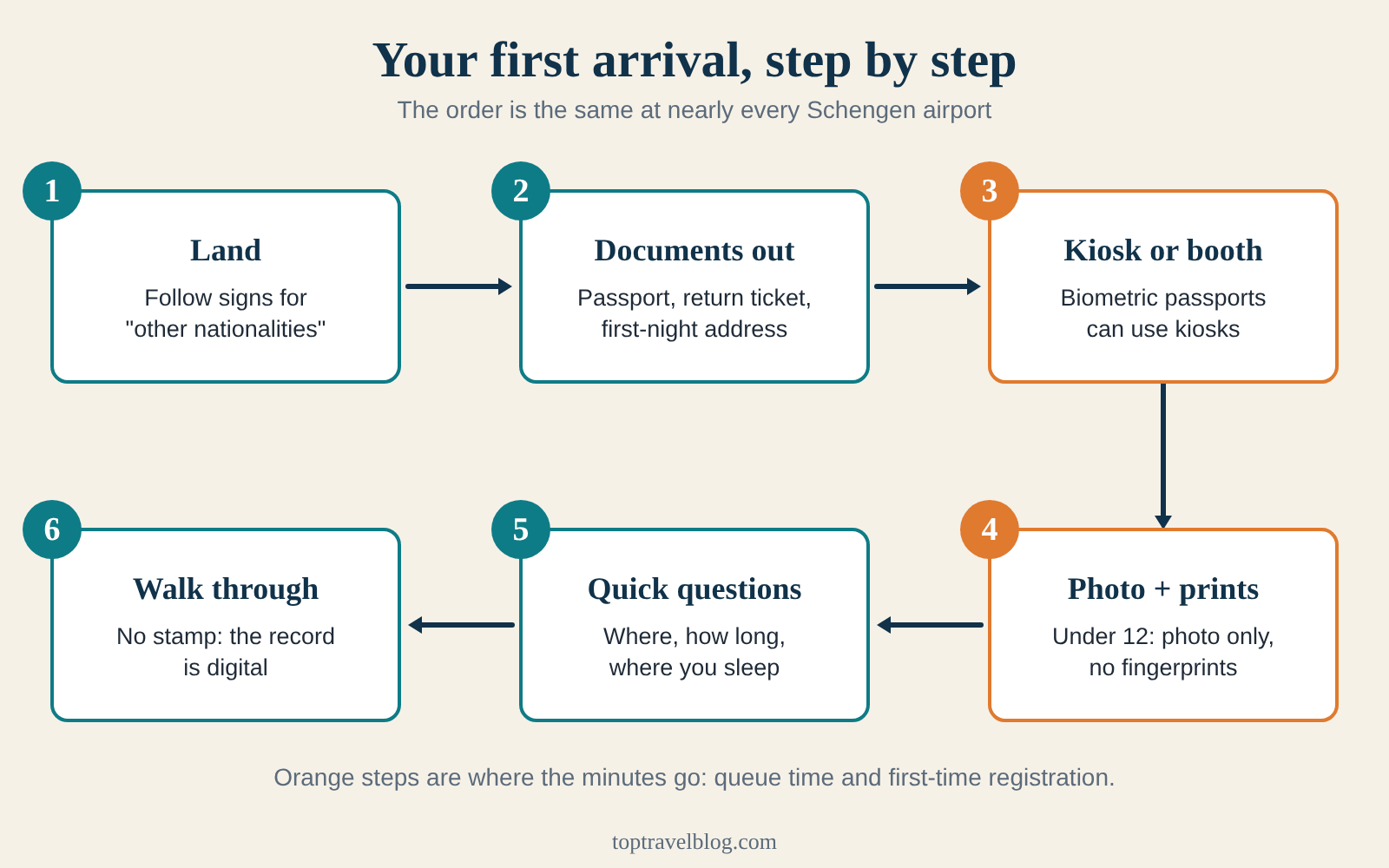
This is the practical core of Europe EES explained: the sequence I would expect on a first arrival in the Schengen Area, written for someone stepping off a long-haul flight with a U.S. passport. Details differ by airport, and some borders still run booths where others run kiosks, but the order below holds nearly everywhere.
Step 1
Land, then follow the non-EU signs
After landing at your first Schengen airport, follow the signs for passport control. You will usually see lanes for EU, EEA and Swiss passport holders and a separate set for all passports or “other nationalities.” Americans use the second set. If you connect on to another Schengen country from here, this is where your entry is processed, not at your final airport.
The first lesson is that your first Schengen airport matters. A Chicago to Frankfurt to Florence trip sends you through border control in Frankfurt, even though you are really going to Italy, and the Frankfurt queue is the one that can sink a 90-minute layover.
Step 2
Have the documents in your hand, not in a bag
Take out your passport before you reach the lane. Keep your onward or return ticket and the address of your first night’s lodging somewhere you can reach in seconds. The ABTA guidance advises having the accommodation address ready because border questions may be asked, and some are now asked electronically.
If you are traveling as a family, collect everyone’s passports and keep them in the order your group stands in. Kiosks are built for one traveler holding one passport, so a family stack handed to a single parent slows the whole line.
Step 3
Kiosk or booth, depending on the airport
The kiosk question is where Europe EES explained varies most by airport. Some airports have self-service kiosks where you scan your passport, have your photo taken and, in many cases, give fingerprints without a person involved. Holders of biometric passports, marked with a small gold camera logo on the cover, can generally use these where they exist. U.S. passports issued in recent years carry that logo.
Other airports send first-time travelers to a staffed booth. The officer scans the passport, takes the photo and fingerprints, and asks the usual questions about where you are staying and how long. The Commission puts an average completed check at about 70 seconds. Industry groups measured longer for the first registration, so budget more for your first time.
Step 4
The photo and the fingerprints
The camera wants a straight-on face, glasses off if the officer asks, and no hat. A kiosk will tell you to look at the lens. The fingerprint scanner takes a set of prints, and an officer may ask you to repeat if the scan is poor. Dry hands help; if yours are very dry, a little moisture before you step up avoids repeated attempts.
If you decline, the answer is not complicated. Travelers who refuse biometric collection can be refused entry. If an injury, bandage or condition makes a scan difficult, say so calmly and early, and let the officer decide how to proceed. Do not hide the problem and hope the machine passes it.
Step 5
The officer’s questions
Nothing about the interview is new in Europe EES explained, except the record. Expect the questions you have always been asked: where you are going, how long you will stay, what you will do and where you are sleeping. The answers should match your booking. The difference now is that the same data point is recorded and matched against your entry date, so a vague answer such as “a few months” attracts attention that “twelve days, Lisbon and Porto” does not.
The officer may ask for proof of onward travel. A screenshot of your return flight is enough for most people. Keep it offline in case your phone has no signal in the terminal.
Step 6
Walk through, and do not expect a stamp
When the check is complete, the gate or the officer lets you through. You will not necessarily get a stamp, because the whole point is that the record is digital. Do not ask for one as a souvenir at a busy booth; it holds up the line behind you. Take a photo of your boarding pass and keep it, for reasons I explain in the section on correcting records.
Tip: Order matters more than speed. Be the person who steps up with an open passport, a returned ticket on the phone and a calm answer ready. The officer’s own process takes a roughly fixed number of seconds. What adds minutes is fumbling, so removing fumbling is the only part of the process you control.
What a first registration feels like in numbers
Timing is the hardest part of Europe EES explained to pin down. The best honest summary of the timing is a spread. The Commission puts an average completed check at around 70 seconds. IATA has said standard passport checks now take roughly 90 seconds, up from 20 to 25 seconds before the system. Those are per-person figures once you reach the front. Queue time is a separate thing, and it depends on the hour and the airport.
A family of four registering for the first time will often take several minutes at the front of the line, because each person goes through individually. That is normal. What would be unusual is being waved through with no biometric step at all, which is no longer the intended behavior.
Second trips, departures and how the system uses your record
The second trip is where Europe EES explained gets easier. After your first registration, the system holds your data. On a later trip, officers or kiosks match your face and fingerprints against what is stored, and they add the new entry. That is generally faster, but you may still queue for the terminal. ABTA says repeat travelers within three years, with the same passport, generally skip the full registration.
The departure scan counts too
Departures are the half of Europe EES explained that people forget. EES records exits as well as entries. Leaving a Schengen country for a non-Schengen destination, including a flight home to the U.S., means another check at the exit control. At major hubs, add time at departure. Americans often assume only arrival is slow, and then discover that a flight home from Frankfurt or Paris needs an early arrival of a different kind.
For flights from Europe, ABTA advises arriving at least two hours before departure as a minimum. For long-haul flights from large airports, I would add a margin on top of whatever your airline’s own recommendation is, particularly in the morning bank of departures.
What happens when you change passports
Passport changes are a small corner of Europe EES explained that still catches people. The record is tied to the passport number as well as your face and fingerprints. If you renew your U.S. passport between trips, your face and fingerprints still identify you, but the three-year shortcut that ABTA describes assumes the passport has not been renewed, so expect a slower second trip after a renewal. Our U.S. passport guide explains how renewal timing works if you are close to expiry.
Related is the passport-validity rule itself. Schengen countries generally expect your passport to be valid for at least three months beyond the day you plan to leave, and to have been issued within the previous ten years. That rule is the subject of our guide to the passport validity 6 months rule, which compares Schengen with countries that ask for six.
What happens to your data: retention, access and your rights
Privacy is a fair part of Europe EES explained, and the numbers are specific. Handing over fingerprints to a foreign government is a fair thing to think about, and the most useful answer is the specific one. The retention rules come from the regulation and are published by national authorities; the Danish immigration service’s page lays them out clearly.
Entry, exit and refusal records
3 years
Each individual record is kept for three years from its date.
Your individual file
3 years and 1 day
Kept for three years and one day after your last exit or refusal record, provided no new entry is recorded within that period.
No exit recorded
5 years
If no exit is on file, data is kept for five years after your authorized stay expired.
Who can see it
The access question is central to Europe EES explained for the privacy-minded. Schengen member states can access EES data for border management, easing border crossings, immigration checks and law enforcement. Europol can access it for law enforcement. Under strict conditions, data may be passed to a member state, a third country or an international organization for return or law enforcement purposes.
Overstayers are added to a list that national authorities can see. That list is the part that matters for ordinary travelers, because it is how a mistaken record turns into a problem at the next border. The remedy is below.
Your rights if something is wrong
Rights are the part of Europe EES explained that most articles skip. You have the right to access your data, to have inaccurate or incomplete data corrected or completed, and to have unlawfully processed data erased or restricted. Contact the authority that registered you or the data protection officer for that authority. For European-level complaints, the European Data Protection Supervisor handles them at edps.europa.eu.
If an overstay in the record is wrong and you can show that unforeseeable, serious events caused a late exit, your data can be corrected or completed and you can be removed from the overstay list. This is the legal path for a canceled flight, a hospital stay or a strike that stranded you past day 90.
Tip: Keep the evidence of every crossing: boarding passes, e-ticket receipts, ferry or train confirmations. ABTA tells travelers that if entries or exits are recorded incorrectly, they can ask for an update with evidence such as boarding cards. A folder in your email called “EES” costs nothing and can save you an argument.
The Travel to Europe app and why it does not skip the booth
The app belongs in any Europe EES explained guide, with its limits attached. Frontex built the Travel to Europe app so that travelers can pre-register some of their data. In the app you can submit your travel document details and a facial image, and you can complete the border questionnaire. You can do it within the 72 hours before arriving in or leaving the EU. Fingerprints are not collected through the app; they are scanned at the border with a border guard present.
Use of the app is voluntary for each country. Frontex says Sweden was the first to confirm it, at selected crossing points including Stockholm Arlanda, and Portugal launched it in March 2026, according to Euronews. Travelers need a valid biometric passport, and the Frontex page is clear that pre-registration does not guarantee the right to cross.
Should you use the app
My view is simple. If your first Schengen airport is in a country that accepts the app, use it, because the questionnaire and the photo are the slow, fiddly parts of a kiosk. If it is not, do not spend your layover looking for a workaround. The app does not let you skip the booth,.
Download only the official app from the Frontex and European Union listings, not a lookalike with a similar name. The Commission and Frontex warn about unofficial sites around EES and ETIAS. The official ETIAS pages state that no website currently issues ETIAS authorizations, and ABTA counts more than 60 unofficial sites offering them.
What the app cannot do
It cannot register your fingerprints, pre-clear you through the line or guarantee you will be admitted. It does not apply to every airport, and the countries that use it can change which crossing points accept it. Treat it as an optional head start, not as a lane of its own.
The queue problem, honestly: what the summer of 2026 showed
Nobody who has stood in a July line at a hub would call this system simple, so here is Europe EES explained with the numbers attached. The system works, and it also moves slower than the stamp did. The official line and the industry line differ, and I think the fair summary is that both are describing the same thing from different ends of the day.
The numbers are where Europe EES explained gets uncomfortable. IATA says a standard passport check now takes about 90 seconds, up from 20 to 25. Reported waits at Frankfurt reached 120 minutes in July, up from 60 a year earlier, according to Financial Times and Qsensor data cited by Euronews. A wait-time tracker summary reported peak maximums of 120 minutes at Amsterdam Schiphol and 60 minutes at Munich. These are maximums, not averages.
What the reports agree on about Europe EES queues
Europe EES explained from the queue data comes down to three patterns I trust. Early-morning long-haul arrivals, roughly 6 a.m. to 10 a.m., are the worst window at big hubs because several transatlantic flights land together. First-time registration takes longer than a repeat check. And there is no official live wait-time feed, so any site that claims precise live numbers is estimating.
Off-peak, the same airports have cleared travelers in something like 10 to 20 minutes, which tells you the system itself can cope; it is bunching that hurts. On the worst peak days, industry bodies reported waits over two hours, and in extreme cases several hours. That is the tail you plan for, not the middle.
What changed on September 6
To understand why this date matters, here is Europe EES explained at the rule level. Until that date, a country could pause biometric collection at a named crossing point for up to six hours during excessive queues. During a pause your entry or exit was still recorded and your passport still checked, your 90/180 count still ran, and your registration could move to a later trip. Those pauses applied to specific crossing points, not whole countries.
Nine countries asked the Commission to keep the option alive. As of November 2026 I have found no official statement that it was extended, and IATA and ABTA were still asking for it. The Commission says the system has broadly worked well and that it is working with a few member states on specific crossings. My advice is to plan as if every traveler is fully registered every time.
Watch out: Do not assume a long queue will earn you a waiver. Some travel sites repeat the idea that officers skip fingerprints when lines get long. After September 6, that was no longer the rule on paper, and a flight planned around a skipped check can strand you.
How much time to add
Here is Europe EES explained as a set of numbers you can use. These are my buffers, built from the reported ranges rather than any official guidance. They are conservative on purpose, because a missed connection costs far more than a long wait in a coffee shop.
First Schengen airport, first time, morning arrival
2.5 to 3 hours
If this is a large hub and you land between 6 and 10 a.m., treat anything under two and a half hours between landing and your onward flight as a gamble.
Same, but afternoon arrival
1.5 to 2 hours
Fewer long-haul flights land at once, and most queues shrink. Still allow for a first-time registration.
Already registered on a 2026 trip
1 to 1.5 hours
Matching is faster. You may still queue for the terminal, so do not squeeze to the pre-system minimum.
Leaving Europe for the U.S.
3 hours before departure at a large hub
Exit is recorded. Add time on top of your airline’s own recommendation if you fly out in the morning bank.
Europe EES explained for flights: where you enter decides where you wait
The first-airport rule is the most useful single fact in Europe EES explained. The detail that catches Americans out is that you clear Schengen border control at the first Schengen airport you land in, not at your destination. Fly Newark to Amsterdam to Athens and you are registered in Amsterdam. Fly Boston to Dublin to Rome and you clear Irish immigration in Dublin, then enter Schengen in Rome, because Ireland is outside the system.
Choosing a first airport
When you have a choice, I choose the first airport by queue risk as much as price. A direct flight into the final destination means one border check at a place where you are about to stay anyway, with no connection to miss. That is worth some money, and it is the single biggest thing you control. Our guide on how to find cheap flights covers how to price that trade-off.
If you must connect inside Schengen, look at the layover as the sum of your border check, your terminal change and a real margin. Many Americans pick a 75-minute connection because the price is lower and learn what the Frankfurt queue looks like. A cheap fare that lands in the morning crush with a short connection can cost you the onward flight.
One ticket or two: the booking choice in Europe EES explained
Ticket structure is a quiet but important chapter of Europe EES explained. A single booking protects you. If your arrival is late because of a queue and your onward flight is on the same ticket, the airline will usually rebook you. If the second flight is a separate booking, you carry the risk. There is no automatic compensation for border delays, so the protection is the ticket structure and, where you can buy it, travel insurance with missed-departure cover.
Our travel insurance guide explains what missed-departure and delay cover actually pay for, and what they exclude. Read the exclusions before you buy, because many policies treat a border queue differently from an airline delay.
Seat, bags and the rest of the small stuff
Small habits count in Europe EES explained, and seat choice is one of them. A seat near the front of the aircraft gets you to the passport lane sooner, and The Points Guy’s reporter recommends exactly that after nearly missing a transatlantic connection.
Carry-on only helps once you are through. Checked bags usually come out slower than a registration takes, so it rarely changes the outcome, but it does stop you from worrying about a bag during the queue. Our carry-on packing list shows how to do a week with one bag.
Keep chargers and a battery in your day bag. A long queue is a bad moment for a dead phone, which is also where your return ticket, hotel address and the Travel to Europe app live.
The 90/180 rule and how EES enforces it
The day count is the other half of Europe EES explained, after the biometrics. The 90/180 rule is simple to state and surprisingly easy to misjudge. You may stay in the Schengen Area for up to 90 days in any rolling 180-day period. The 180 days is not a calendar half-year. On any given day, you look back 180 days and count every day you spent inside the Schengen Area in that window.
Counting is where Europe EES explained touches your calendar. Before EES, an officer relied on stamps and your honesty to count that. Now the system counts it, and it flags overstays automatically. The European Commission runs an official short-stay calculator on its Home Affairs site, and I recommend using it when your plans include more than one long Schengen trip in a year.
What counts and what does not
Counts toward the 90
Every day inside a Schengen country
Arrival and departure days both count as days. A trip from the 1st to the 10th is 10 days, not 9.
Does not count
Days in Ireland, Cyprus and the UK
These are outside the Schengen Area. A week in Ireland between two Schengen trips is a week of clean air for the counter.
Does not count
Days in Albania, Serbia, Montenegro, North Macedonia, Turkey and the rest of non-Schengen Europe
Each is a separate border crossing, and each crossing is recorded.
Three worked examples
A three-week trip. Eight days in Italy, six in Switzerland and seven in France is 21 days. All three countries count. You are well inside the limit, and the first airport is the only place where biometrics are taken. Your exit at the end is the second time your record is touched.
A spring trip and an autumn trip. Say you spend 70 days in Portugal and Spain, leave, and return when the last day of the first trip is 100 days behind you. On the first day of the second trip, the whole first stay is still inside the 180-day look-back, so 70 days are already used and you have about 20 left. If you wait 120 days instead, the oldest ten days of the first stay have rolled out of the window, and roughly 30 days remain.
A long trip with a break in Ireland. Fifty days in Spain, three weeks in Ireland, then another 50 days in Spain. The Irish days do not count, but they do not pause the count either. The 180-day window keeps rolling, so most of those first 50 days are still in view when you return. Doing this arithmetic by hand is exactly where people go wrong, and the calculator exists for it.
Watch out: Many of the long-stay mistakes I hear about involve people who assume leaving the Schengen Area for a weekend resets the clock. It does not. The count is a rolling window, not a reset. If your plan is to stay near the limit, the only comfortable answer is to leave margin.
If you want to stay longer than 90 days
The limits of Europe EES explained show up here: it records days, it does not grant more. A short-stay visa-free trip tops out at 90 days. Staying longer requires a national long-stay visa or a residence permit from the country you plan to live in, applied for before you travel. That is a legal and immigration question, and I do not give personal advice on it. The country’s embassy or consulate is the source. What EES changes is that overstaying is now visible rather than easy to hide.
EES, ETIAS and the UK ETA: three systems that get confused
Keeping the systems apart is half of Europe EES explained. These get mixed up in headlines, in airline emails and in the worst kind of lookalike website. The short version: EES is a border registration, and it is live. ETIAS is a pre-travel authorization, and it is not live. The UK ETA is a separate British authorization with its own rules.
EES
Live since April 10, 2026
A database that registers your face, fingerprints and passport data at the border. No application, no fee. It applies to all non-EU short-stay travelers at Schengen external borders.
ETIAS
Not operating yet
An online travel authorization for visa-exempt travelers, with a fee of 20 euros and, according to ABTA, a three-year validity. The official ETIAS page says the EU will announce a start date several months in advance, and it no longer shows the earlier late-2026 window. Reporting points to 2027.
UK ETA
Separate, for the UK only
Britain runs its own electronic travel authorization for visitors like Americans. It has nothing to do with EES and does not register you in the Schengen system. See our UK ETA guide for U.S. citizens.
What ETIAS will change when it arrives
Europe EES explained will change slightly once ETIAS exists, so here is the picture. When ETIAS starts, you will apply online before you travel, pay the fee, and receive an authorization linked to your passport. EES will still register you at the border, so you will go through both. That is why the two are easy to blur: ETIAS is the permission to travel, and EES is the record of the crossing.
The French government page notes that a decision is issued within a maximum of 96 hours of application, though longer checks are possible. I would not wait for the last minute once it is live. Our guide to ETIAS for U.S. citizens will carry the launch date and the application steps once there is a real one to give.
Watch out: As of November 2026, you cannot apply for ETIAS, and any website that claims to take an application is not official. The Commission’s ETIAS pages say so directly. If you see an ETIAS payment page today, close the tab and do not enter card details.
Europe EES explained for families, travelers with disabilities and other special cases
Traveling with kids
Family travel is a common request in Europe EES explained. Children under 12 are photographed but not fingerprinted. Teenagers 12 and older are treated like adults, which means fingerprints. Each child needs a passport, and at a kiosk each person holds his or her own. Younger kids who cannot stand still for a photo are an everyday sight at passport control, and officers deal with them all day.
For the family line, send the adult with the least patience ahead with the papers, and keep the youngest kids close to a parent in the queue. Snacks and a tablet with downloaded video buy you more peace than any trick I know. Our international travel packing list covers what to keep in the day bag.
If fingerprints are hard to read
Worn fingertips, skin conditions and bandages can make scans fail. If it happens, tell the officer early and calmly. Do not rub your hands raw trying again. What usually helps is asking for a moment, drying or lightly moistening the hands and trying a second time. If you have a condition that affects your hands or mobility, say so at the booth rather than at a kiosk.
Trains, buses, cars and land crossings
Land borders are the least-discussed part of Europe EES explained. Eurostar and Eurotunnel are covered above. Other rail and road crossings at a Schengen external border register you in the same way, and long queues at road borders in the Balkans are a normal summer sight. If you are driving between a Schengen country and a neighbor outside it, such as Croatia into Bosnia or Hungary into Serbia, allow extra time and carry your documents.
Cruises
Cruise passengers are in a slightly different position, because the line often handles paperwork in batches, and the timing depends on the ports. If your itinerary starts in a Schengen port, you will usually be registered at the start. If it ends there, you will be recorded on exit. Ask the cruise line what its process is and follow it.
Business travel and remote work
Business trips fit into Europe EES explained the same way as vacations. A short business trip, a conference or a client meeting generally falls under the same 90-day short-stay rules. Working remotely for a U.S. employer while you travel is a different legal question that varies by country, and I do not give legal advice on it. The EES simply records the days you are present.
Scams, fake sites and fees that do not exist
No Europe EES explained guide would be complete without a word on scams. Because EES is new and ETIAS is delayed, the web is full of sites that profit from confusion. The rules are short. EES costs nothing, and you cannot buy a faster version. ETIAS is not accepting applications. Official information lives on the EU’s pages, Frontex, the European Commission’s Home Affairs site and national government sites such as the French diplomatic portal and national police pages.
Two patterns repeat. The first is a site that looks official and offers to “register you for EES” or “apply for ETIAS” for a service fee. The second is an email that claims your trip is at risk unless you pay. Neither exists. The same applies to anyone at an airport offering to speed you through for cash; the line is the line.
At the airport itself, the usual rules apply: officers wear uniforms and sit in booths or stand at kiosk areas, and nobody asks you for a payment to complete an EES registration. If you are unsure whether a request is real, step out of the line and ask an airport information desk or the airline.
Planning a Schengen trip around EES, from flights to hotels
Turning Europe EES explained into a plan is mostly arithmetic. The cleanest way to use everything above is to build the schedule backward from the border. The checks are quick for most people most of the time, so you do not need to plan around the average. You plan around the bad morning, and then you are relaxed on all the others.
If you are new to building a trip from scratch, our step-by-step guide on how to plan a trip lays out the order I follow. The Schengen-specific additions are small, and they are all about time.
Europe EES explained and the short first day
Day one is where Europe EES explained meets your itinerary. Count your arrival day as a half-day at best. After a transatlantic overnight flight, a first-time registration, a train into town and a hotel that may not have your room ready, there is rarely energy left for a timed museum entry. I book nothing nonrefundable before 3 p.m. on arrival day and never a dinner I would hate to miss.
That rule matters more than it used to. A two-hour queue turns a 10 a.m. museum slot into a lost fee. If you want a booked activity on day one, choose one with free cancellation, or choose an evening one and treat the afternoon as slack.
Hotels and the first night, with Europe EES explained in mind
Lodging is a quiet corner of Europe EES explained. When you choose a hotel for the first night, pick one that lets you drop your bags early or has a flexible check-in. Late and early arrival procedures matter more when the airport is the unpredictable part. Our guide on how to choose a hotel covers cancellation terms and fees, which are the details that save money when a flight or a queue moves your day.
Tell the hotel your flight number if it asks. Most front desks will hold the room if they know your plane landed in Frankfurt and the line is long. Hotels in Europe see this every day, and a one-line email beforehand is far better than a phone call from the queue.
Airport transfers and pre-booked tickets
Transfers are another place Europe EES explained changes your booking habits. Pre-booked airport trains with fixed times are a bad match for a first-time registration. Look for open tickets or tickets valid for the day. Likewise, a private driver who tracks your flight is more forgiving than a shuttle with a fixed pickup. A taxi or a metro ticket bought on the spot cannot be missed.
Keep any timed booking for the first afternoon refundable, and place the nonrefundable ones from day two onward. Rental cars are the other place where a delay costs money: if you pick up at the airport, tell the counter your flight and expect a wait at the border before you ever reach the desk.
Spreading your Schengen days, Europe EES explained for long stays
For long stays, Europe EES explained turns into a calendar exercise. If you are near the 90-day limit, plan the shape of your year rather than a single trip. Keep a simple note with your entry and exit dates, count them with the official calculator before you book a second trip, and leave a few days of margin. A strike or a canceled flight can push your exit date and turn a clean plan into an overstay record.
Which kind of traveler are you? Five common situations
The first-time European vacationer
Two weeks, three cities
Fly directly into your first city if you can. Use the Travel to Europe app if the country accepts it. Book day-one activities that are refundable. Expect one registration on arrival and one check on departure. Read the passport-validity page in our documents checklist and you are done.
The family with young kids
One week, one base
Choose a direct flight or a long connection of at least three hours. Stay together in the queue and keep everyone’s passports in one folder. Children under 12 skip fingerprints. Pad the first day with a quiet afternoon.
The multi-country rail traveler
Three weeks, five countries
Your only registration is at the first external border and the last. Inside Schengen you move without checks, apart from occasional spot controls. Keep your passport accessible. The 21 days sit well within the 90 limit.
The long-stay snowbird or sabbatical traveler
60 to 85 days
The count is the story. Use the calculator, keep your boarding passes and leave a margin of a week or more. Plan a short break in Ireland or the UK if you are heading for a second stretch.
The dual citizen
Any length
Enter and leave on your EU or Schengen passport only. EES does not apply to you in that case. Carry the U.S. passport for your return to the States, since you must use it to enter the U.S.
A sample arrival day, hour by hour
These times are illustrative, not a schedule from any airport, but they show how the day stacks up. Say you land in Frankfurt at 7:30 a.m. on an overnight flight from Chicago, with a connection to Florence booked for 11:15 a.m. on the same ticket. That is a three-hour-forty gap on paper and a comfortable one in practice.
You are off the plane by 7:50 a.m. if you sat near the front. The walk to the non-EU lanes takes 10 minutes. A queue of 30 to 60 minutes is realistic, so you reach the booth around 8:50 a.m., and a first registration of a few minutes puts you through by 9:00. You then walk to your gate, clear security again if required, and still have more than an hour in hand.
Now run the bad version. The line takes two hours, and you are through at 10:00 a.m. The gate is a 20-minute walk and boarding closes at 10:40. You make it, with room for a coffee. With a 75-minute connection, the same line puts you at a closed gate and a rebooking desk. The gap between those two outcomes is not luck. It is the margin you built into the ticket weeks earlier.
Five myths about the Entry/Exit System that keep circulating
Myth 1: you need to register before you fly
The first myth in Europe EES explained is also the most common. You do not. The French government page says plainly that there is nothing to do before traveling, and the Commission describes registration as something that happens at the border. The optional app can carry some of your data ahead of you, but even then the booth or kiosk step is still required.
Myth 2: Global Entry or another trusted traveler program speeds you through
Those programs are for U.S. customs and border protection and do not carry over to Schengen border control. A U.S. membership card does not move you into a shorter lane in Frankfurt or Paris. The only ways to make your European check faster are to have a biometric passport, to be a repeat traveler with a record on file and to arrive when the airport is quiet.
Myth 3: the system ends the need for a passport stamp as proof
Travelers sometimes worry that without a stamp they cannot prove when they entered. The record is digital, and you can ask the authority that registered you to access your data. Your own proof is the boarding pass, which is why I keep photographs of every one. A boarding pass is also what ABTA says to use when asking for a correction.
Myth 4: EES and ETIAS are the same thing
Myth four in Europe EES explained is the one that costs people money. They are not. EES is a border registration that has been live since April 10, 2026. ETIAS is a travel authorization that has not launched. You will eventually go through both, but at different moments and with a fee attached to only one of them.
Myth 5: it only affects the first arrival
The last myth in Europe EES explained is about scope. It affects arrival, departure and everything in between, because exits are recorded as well as entries and the 90/180 count runs off those records. The one place EES does not follow you is the interior: you are not registered each time you cross an internal Schengen border by train or car.
Your pre-trip EES checklist: two weeks out to departure day
Here is Europe EES explained as a to-do list. Most of this is the ordinary document routine, with a few additions. I like to do it in two passes, a fortnight before and the day before, so there is no last-minute scramble. Our international travel documents checklist covers the full list, and this is the EES-specific subset.
- Check the passport dates. Make sure the passport has enough validity beyond your planned departure and was issued within the past ten years. If it is close, renewal timing is covered in our U.S. passport guide.
- Save the booking details. Keep your return or onward ticket, your first night’s address and your travel dates in one folder, online and offline.
- Decide on the app. If your first Schengen country accepts the Travel to Europe app, install the official one and plan to submit your details inside the 72-hour window.
- Count your days. Use the official short-stay calculator if you will be near 90 days in any 180-day period, including earlier trips this year.
- Rebuild your connections. Compare your layover against the buffers earlier in this guide, and move to a longer connection if you are inside the risk zone.
- Sort your insurance. Read the missed-departure and delay terms. The travel insurance guide explains the difference.
- Pack the day bag. Passport, phone, charger, battery, a pen, water and a snack. See the Europe packing list for the rest.
- Register with STEP. The State Department’s free program sends embassy alerts for your destination. Our STEP explainer covers what it does and does not do.
- Photograph your boarding passes on arrival and departure, and keep every crossing receipt in the same folder.
On departure day
On the day itself, Europe EES explained is about margin. Leave for the airport earlier than your airline’s minimum. Eat before you go, because a long queue is a poor time to be hungry. Have your passport out as you reach the lane, and keep your phone charged for the boarding pass and return ticket. Look at the airport’s own social channels and the airline app on the morning you fly, since booth changes and pauses can happen within a single day.
You can also check the destination country’s travel advisory level before booking. Our guide to U.S. travel advisory levels explains what each of the four levels actually means, and it is worth a read for any country with border complexity.
Twelve mistakes I see with EES, and how to avoid them
- Treating a 75-minute connection as safe. Your first Schengen airport is where you queue. Give a large hub two and a half to three hours on a morning arrival if it is your first registration.
- Believing ETIAS is already required. It is not operating, and there is no application. Do not pay anyone for it.
- Paying for “EES registration”. EES is free and happens at the border. Any site that sells it is not official.
- Mixing passports. Dual citizens who enter on one passport and leave on another create an entry with no exit. Use one document per trip.
- Assuming a weekend in Ireland resets the count. The 180-day window rolls. Ireland and the UK do not count toward the 90, but they do not wipe your earlier days either.
- Booking a nonrefundable activity on arrival morning. A single long queue can eat the slot. Pick refundable options for day one.
- Skipping the departure buffer. Exits are recorded too. Arrive earlier for flights home from big hubs than you did before the system.
- Buying two separate tickets with a tight gap. A border delay is not usually compensated. Book one itinerary or leave real margin.
- Refusing biometrics. Travelers who do can be refused entry. If something prevents a scan, explain it early and let the officer decide.
- Relying on old articles. Anything that says the system starts in 2024 or 2025, or that airports can skip the biometric step, is out of date. Use official pages and recent reporting.
- Throwing away the evidence. Keep boarding passes and booking receipts. If a record is wrong, those are how you correct it.
- Over-planning day one. Fatigue plus a long line equals a missed dinner. Leave slack.
Frequently asked questions about Europe EES explained
Is the EES live now, and when did it start?
Yes. EES began operating in a phased rollout on October 12, 2025, across the 29 countries that use it, and became fully operational on April 10, 2026. Since that date it replaces passport stamping for all non-exempt short-stay travelers, including Americans. Ireland and Cyprus are outside the system and still use manual checks.
Do Americans need to apply or pay for EES?
No. There is no application and no fee. The French government’s page for visitors says there is nothing to do before traveling. You are registered at the border when you arrive, with a photo and fingerprints. Any website that offers to register you or charges a fee for EES is not an official channel.
Is ETIAS required right now for a trip to Europe?
No. ETIAS is not operating and is not accepting applications. The official portal says the EU will announce the start date several months ahead and no longer shows the earlier late-2026 window, and press reports point to 2027. When it launches it will cost 20 euros. Do not pay any site that claims to process it today.
Will I be fingerprinted every time I enter Europe?
You provide fingerprints and a photo the first time. On later trips, officers or kiosks match your face and fingerprints against the stored record, so the process is generally quicker. ABTA says that repeat travelers within three years, using the same passport, generally skip the full registration. You may still queue for the terminal.
What happens if I refuse to give fingerprints or a photo?
Travelers who refuse biometric collection can be refused entry. If you cannot give fingerprints because of an injury or a medical condition, tell the officer early and calmly and let them decide how to proceed. Children under 12 are not fingerprinted but are still photographed, so the process is lighter for families.
How long are the lines, really?
Queue length is the hardest question in Europe EES explained. It depends heavily on the airport and the hour. IATA says a standard check now takes about 90 seconds per person. Frankfurt reached waits of 120 minutes in July, and Amsterdam had similar peaks, while off-peak waits at the same airports were roughly 10 to 20 minutes. For a first registration at a large hub in the morning, I plan for up to three hours.
Can airports still skip the biometric check when the line is long?
The temporary flexibility that let countries pause biometric collection at a crossing point for up to six hours expired on September 6, 2026. Industry groups asked for an extension, and I have found no official announcement that one was granted. Plan as if the check will always happen, and treat any skipped check as luck, not a rule.
Does time in the UK or Ireland count toward the 90 days?
No. The 90/180 rule counts days inside the Schengen Area only. Ireland, Cyprus and the United Kingdom are outside it, along with non-Schengen Balkan countries and Turkey. But days outside do not reset the count either, because the 180-day window keeps rolling. Use the official short-stay calculator for anything close to the limit.
What if my entry or exit was recorded wrongly?
For errors, Europe EES explained offers a practical remedy. You can ask the authority that registered you to correct it. Bring evidence: boarding passes, ticket receipts, hotel bills. ABTA advises travelers to request an update with proof such as boarding cards. If an overstay was caused by unforeseeable, serious events, your data can be corrected and you can be removed from the overstay list.
How long is my EES data kept?
Each entry, exit or refusal record is kept for three years. Your individual file is kept for three years and one day after your last exit or refusal record, if there is no new entry in that time. If no exit was recorded, the data is kept for five years after your authorized stay ended, according to the Danish immigration service.
Does EES apply if I have a second EU passport?
No, as long as you enter and leave on the EU or Schengen passport. EU and Schengen nationals are not subject to EES. Use the same passport on every crossing during the trip, and carry your U.S. passport for your return to the United States, since U.S. citizens must use it to enter.
Do I still need to arrive earlier at the airport when leaving Europe?
The exit side of Europe EES explained gets a short answer here. Yes, particularly at large hubs. Exits are recorded too, and ABTA suggests arriving at least two hours before departure as a minimum for flights from Europe. For a long-haul morning departure from a big airport, I would add a margin beyond your airline’s recommendation.
One last thing before you book
Europe EES explained, at its best, removes the unknowns. Most of what makes the Entry/Exit System feel stressful is the unknown: which line, how long, what they will ask. Once you know the sequence, it is mostly a matter of arriving with your documents in your hand and a margin in your schedule.
Build the trip so that a two-hour queue is an annoyance and not a catastrophe. Book the flight that lands at a reasonable hour, keep day one light, save your boarding passes, and leave the lookalike websites alone. Do those four things and Europe EES explained comes down to a photo, a scan and a good dinner at the end of the day.
Related planning guides
- ETIAS for U.S. travelers: what it is, who needs it, cost and launch timing — the authorization that is not live yet, and what it will add on top of EES.
- UK ETA for U.S. travelers: cost, application, validity and transit rules — the separate British system if your Schengen trip includes London.
- International travel documents checklist for U.S. citizens — everything to have in your hand before you reach any border.
- Passport validity rules: why some countries require 3 or 6 months remaining — how Schengen compares with countries that ask for more.
- U.S. passport guide: apply, renew, processing times and urgent travel — renewal timing if your passport is close to its limit.
- How to plan a trip step by step: from idea to booked itinerary — the order I follow for every trip, including the Schengen ones.