

Four days. That is my honest answer to the question I get asked most about this city, and it is the length this Paris itinerary is built around.
Four days gives you the islands and the Latin Quarter, a full Louvre morning with the Arc de Triomphe at sunset, the Eiffel Tower with the Musée d’Orsay, and a last day split between Montmartre and the Marais. Three days works if you trim the museums. Five is better if you want one slow morning with a café crème and nothing on the schedule.
The verdict in one sentence: Paris rewards people who book the three or four tickets that sell out, sleep within a short walk of a Metro station, and then walk. This Paris itinerary suits first-time visitors, couples, friends and families with kids old enough to manage a 90-minute museum visit and a lot of stairs. It is a poor fit for anyone who needs a car (don’t rent one) or who wants a beach week with a city attached.
I have done Paris in every season, once with my parents who walk slowly and once with a friend who wanted to see everything before lunch. What follows is the Paris itinerary I would hand a friend: the order of days that keeps you from crossing the Seine six times a day, current fares and ticket prices as of November 2026, where to sleep, and the mistakes I watch visitors make in line at the Louvre and on the Metro platform at Châtelet.
Quick facts: this Paris itinerary at a glance
- Best for: first-time visitors, couples, friends, families with kids 8 and up, anyone who enjoys walking and does not mind stairs.
- Ideal trip length: 4 full days, plus an arrival evening and a departure morning.
- How to get around: the Metro and RER at €2.55 a ride (a Navigo Easy card holds the tickets), plus 6 to 9 miles of walking a day. No rental car.
- Booking priorities: Louvre timed entry, Eiffel Tower summit or second-floor slot, a Sainte-Chapelle slot, Musée d’Orsay if you want a morning start, and dinner for Friday or Saturday.
- Pacing: one anchor area per day, the big sight before lunch, a long lunch, and an evening you can drop if your feet give out.
- Key caveats: the Louvre is closed Tuesdays, Orsay and Versailles Mondays; July and August can be hot with little air conditioning; the Eiffel Tower lines and the pickpockets are real; and the Louvre now charges non-European visitors €32.

Best time to go: when this Paris itinerary works best
If I could choose only one window, it would be the first three weeks of October. Daytime highs sit in the low 60s Fahrenheit, the light is soft, the chestnut trees along the Tuileries turn yellow, and the terraces are still open with heaters on. The crowds are thinner than in July and prices are well below the summer peak. Every day of this Paris itinerary works in that window.
My second choice is late April through early June, when the gardens are green and the days are long. Rain is more frequent than in autumn, so carry a packable jacket. If you can only travel in summer or winter, both work with the adjustments below.
Here is how I think about each stretch of the year, because the right Paris itinerary changes with the thermometer.
January to mid-March: cheap rooms and short lines
This is the only stretch of the year when a good central hotel can feel like a bargain. After the holidays, rates fall and stay low until spring. The trade is gray skies, highs in the 40s and a damp cold that gets into your coat. Museum lines shrink, and you can often walk into a bistro on a weeknight without a reservation.
Sunset comes around 5:15 p.m. in January, so I move the Arc de Triomphe and the cruise to the late afternoon and put the museums after lunch, which is how I would shape any winter Paris itinerary. Pack real gloves. The Paris sales (les soldes) start in the second half of January and again in late June, which matters if you are shopping.
Late March to early June: the gardens wake up
April is unpredictable, with warm afternoons and sudden showers in the same hour. The Tuileries, the Luxembourg Gardens and the Place des Vosges fill with people on the first dry weekend. Hotel rates climb through April and are firmly high by the long weekends in May, when France takes several public holidays and Parisians leave town.
The Paris Marathon in early April closes streets around the Champs-Élysées and Bastille for a morning. Day 2 and Day 4 of this Paris itinerary can be swapped if your dates collide. Late May and early June are my favorite stretch for long evenings: it is still light at 9:30 p.m.
Mid-June to August: long days, heavy heat
Paris was built for a cooler climate. Average highs in July sit in the upper 70s Fahrenheit, but heat waves push the city into the 90s and, in 2019, above 100. Many older hotels, apartments and Metro cars have little or no air conditioning, and the stations on Lines 1 and 4 can feel like a sauna. When you book, treat air conditioning as a requirement you confirm in the listing, not an assumption.
In August, some small neighborhood restaurants and bakeries close for a few weeks while their owners go on vacation, and the big sights get the loudest crowds. Summer compensates with 10 p.m. sunsets, riverside events, free outdoor cinema in July and the Paris Plages beach strips along the Seine. If you come then, flip every day of this Paris itinerary so the walking happens before 11 a.m. and after 6 p.m., with museums in the hot middle.
September and October: the sweet spot
Early September is warm and bright and the city refills after the summer break. Fashion Week runs in late September and early October and some trade fairs fill hotels across the city, so rates jump on specific dates. Otherwise this is the season when every day of the plan below works as written, including the walk through the Tuileries at golden hour and a dinner on a terrace.
By late October the days shorten fast and the clocks go back at the end of the month. The Eiffel Tower and the bridges look their best against a blue-hour sky around 6:30 p.m.
November to December: gray, quiet, then festive
November is the quietest month for sights and one of the better ones for prices. It is also cold, wet and dark by 5:15 p.m. The Christmas lights go up on the Champs-Élysées in late November, the department-store windows on Boulevard Haussmann open to families in the same week, and the markets and ice rinks appear in December.
The second half of December is magical and expensive, and the holiday week between Christmas and New Year is the most crowded stretch outside August. If December is your only option, book the Louvre and the Eiffel Tower the day your slots open and plan indoor afternoons.
Tip: Whatever month you pick for your Paris itinerary, look up the sunset time before you book the Eiffel Tower or the Arc de Triomphe. In late June the sun sets after 9:50 p.m., in late December it is down by 4:55 p.m. The sunset slot sells out first, so your Day 2 and Day 3 evenings depend on that single number.
Days of the week matter as much as the month
The Louvre is closed on Tuesdays. The Musée d’Orsay and the Palace of Versailles are closed on Mondays. The Louvre stays open until 9 p.m. on Wednesdays and Fridays, and Orsay until about 9:45 p.m. on Thursdays. Many museums and the big public sights close on May 1 and December 25, and a surprising number of small restaurants close on Sundays or Mondays.
I build this Paris itinerary around a Thursday-to-Sunday or Wednesday-to-Saturday stay, and I note the swaps wherever a closing day would break the plan. A Tuesday-to-Friday stay breaks Day 2, which I explain in the day plan.
How many days you really need for a Paris itinerary
Four full days is the number I recommend to first-time visitors. It is enough to see the headline sights without a death march, and each day still has room for a long lunch, a café stop and one thing you did not plan. Count only full days. A seven-hour flight that lands at 8 a.m. gives you a half day at best, and jet lag will take most of it.
Three days is the minimum I would ever suggest. It forces a choice between the Louvre and Orsay, makes the Montmartre morning a compromise and leaves no room for Versailles. If three is all you have, drop the Day 4 Marais afternoon and keep the Montmartre morning for the first day after you land.
Five days is where Paris gets comfortable. You can add Versailles without gutting a day, linger at the Rodin Museum or the Orangerie, or simply sit in a café. Six or seven days make sense only if you want to leave the city: Giverny, the Loire châteaux or Champagne are all easy rail trips.
Combining Paris with other cities
Paris is the natural start or end of a longer Europe trip. London is about two hours and 20 minutes away on Eurostar, and my London itinerary uses the same four-day rhythm if you want to pair the two capitals. For a warmer second stop, fly to Rome and use the Rome itinerary or add Paris to the front of a route that continues through the 10 days in Italy itinerary.
If you are building a bigger trip, the order of planning matters more than the cities. My guide on how to plan a trip walks through budget, dates and bookings in the sequence that avoids expensive changes later. Then work out flights with the how to find cheap flights strategy, because Paris fares to Charles de Gaulle swing widely by day of the week.
The arrival day problem
Most flights from the US East Coast land in Paris between 6 a.m. and 9 a.m. Your hotel will rarely have a room ready, and you will be tired. My routine is to drop my bags at the front desk, walk for two hours in daylight, eat a real lunch around 1 p.m., and then take a short nap before dinner. Daylight and walking reset your body clock faster than a hotel bed at 10 a.m.
This Paris itinerary starts on the first full day, but the neighborhood walk in Day 1 doubles as an arrival-day plan if you land that morning. If you arrive in the evening, eat near the hotel and go to bed.
How this Paris itinerary is built
Paris is easier to plan once you see its shape. The Seine runs through the middle in a gentle arc, with the Right Bank to the north and the Left Bank to the south, and the two small islands in the center are the oldest part of the city. Most visitors waste hours by zigzagging across the river, so each day of this Paris itinerary keeps you on one bank for the morning and crosses once, on foot, over a bridge worth walking.
The order is deliberate too. Day 1 is gentle, flat and close together, which suits a tired traveler. Day 2 puts the heaviest museum early in the week, when you have the most energy. Day 3 is the postcard day. Day 4 is the slow one, with hills in the morning and a long afternoon on level ground. If you swap days, keep that rhythm: one heavy morning, one lighter one, never two museum mornings in a row.
Shorter and longer versions of this Paris itinerary
For a 3-day Paris itinerary, keep Day 1 and Day 3 as written and merge Day 2 with the Marais: do the Louvre from 9:00 to noon, lunch near the Palais Royal, then walk east along Rue de Rivoli to the Place des Vosges, and take Montmartre on the first morning of your next trip. You lose the Arc de Triomphe sunset, which I can live without.
For a 5-day Paris itinerary, add Versailles as its own day, which is the cleanest way to do it, and use the fifth day for either Giverny, Monet’s house and gardens, which opens from April to October, or a lazy Sunday that takes in a flea market, a long lunch and an evening at the Opéra Garnier. A 6-day version adds a day in the Loire Valley or Champagne by train.
If you have a layover rather than a trip, the shortest useful Paris itinerary is half a day: Île de la Cité and the Sainte-Chapelle, lunch on the Île Saint-Louis, and the RER back to the airport. Leave at least three hours before an international flight, because border checks and security can run long.
Where to stay in Paris for a first visit
The question of where to stay in Paris decides more about your trip than any ticket you buy. The wrong base costs you 30 minutes each way on a hot Metro line and turns every “let’s go back to the room for an hour” into a non-starter. The right one puts you inside a 15-minute walk or a single direct train from most of this Paris itinerary.
Paris is smaller than people expect: the 20 arrondissements spiral outward from the Louvre in a snail shape, and almost everything on a first visit sits in the first through ninth, so number matters. My rule: sleep south of the Gare du Nord, north of Montparnasse, and within five minutes of a Metro station that serves a line you will use twice a day, such as Line 1, 4 or 7.
Expect small rooms. A double in a central three-star hotel is often 130 to 200 square feet, the bathroom may be the size of a closet, and many older buildings have a lift that fits two people and one suitcase. That is normal, not a problem with the hotel.
On price: a clean, well-reviewed central three-star hotel runs roughly €150 to €300 a night in the shoulder months, €250 to €400 or more in June and September fashion weeks, and the four-star category starts around €350. I never promise a specific rate because they move weekly. Budget travelers can find hostel beds from about €35 to €60 and basic two-star rooms from about €100 in the 10th, 11th and 13th arrondissements.
Add the tourist tax, which the hotel collects per person per night and which rises with the star rating, roughly €3 for a two-star up to about €8 or more for a four-star and well beyond that for a palace hotel. Compare the hotel’s own site against two booking engines and look at the total with taxes. My guide on how to choose a hotel covers fees, cancellation terms and review traps in more detail.

The five areas I recommend for a Paris itinerary, and who each one suits
Latin Quarter and Saint-Germain (5th and 6th)
Best for: first-timers, walkers, anyone who wants to stroll at night
This is where I put most first-timers. You are a 10-minute walk from Notre-Dame, five minutes from the Luxembourg Gardens, and the cafés on Rue Mouffetard and around Saint-Germain-des-Prés are open late. Line 4 and RER B are close for the airport and Montmartre.
The trade-off is price in the best blocks, and tourist traps on Rue de la Huchette. Stay on streets such as Rue Saint-Jacques and around Place Maubert rather than directly on the main drags.
Le Marais (3rd and 4th)
Best for: couples, food lovers, shoppers, Day 4 convenience
Narrow medieval streets, galleries, the Place des Vosges and Paris’s best street food within a short walk. Line 1 runs straight to the Louvre and Champs-Élysées. It is one of the livelier nights in the city, which is the downside: weekend noise on Rue Vieille du Temple and Rue des Rosiers can be real, so ask for a courtyard room.
Near the Louvre and Opéra (1st and 2nd)
Best for: short trips, rainy-day museum strategy, first nights
This is the center of the center, with the Louvre, the Palais Royal and the covered passages in walking range. Hotels are expensive, restaurants lean touristy near Rue de Rivoli, and the streets are quiet after 9 p.m. south of the Palais Royal. Look at the 2nd arrondissement side streets for better food.
The 7th (Eiffel Tower and Invalides)
Best for: families, luxury travelers, a residential feel
Calm, elegant and residential, with the Rue Cler market street and the Eiffel Tower in walking range. It is a long way from Montmartre and the Marais, there is little nightlife, and a restaurant dinner means a Metro ride. I only pick it for people who prioritize quiet nights and a tower view over convenience.
South Pigalle and the 9th (SoPi)
Best for: budget-minded travelers, second-timers, food and cocktail fans
Lines 2, 12 and 7 bring you to the Louvre area in 15 minutes, and Rue des Martyrs is one of the best food streets in the city. Hotels cost roughly 20 to 30 percent less than the 6th. Pigalle’s edge, near Boulevard de Clichy, is sleazy after dark, so stay on the south and west side of the neighborhood and read the street on the map before booking.
Areas I’d skip on a first visit
The blocks directly around the Gare du Nord and Gare de l’Est: handy for the Eurostar and the airport train, but gritty, and not where you want to walk home alone at midnight. The 15th and 16th arrondissements: quiet and residential, but far from the sights of this Paris itinerary. Anywhere that advertises “20 minutes from Paris” in Versailles or the suburbs, a number that assumes a perfect connection at noon.
Airport hotels near Charles de Gaulle only make sense for the night before a 6 a.m. flight. Montmartre is lovely, but the steep hill, the stairs and the tourist-driven prices make it a poor base for a first stay, and the Metro stations on the hill have long stair climbs.
Hotel or apartment rental
Apartments make sense for families or stays of five nights or more, but Paris regulates short-term rentals, caps the number of nights a primary residence can be rented, and requires a registration number on the listing.
For a four-day Paris itinerary I choose a hotel because a front desk holds your bags before check-in, handles airport transfers and solves problems at 11 p.m. If you rent an apartment, read the listing for the floor, the lift, the air conditioning and the check-in procedure, and avoid fifth-floor walk-ups unless you travel light.
Booking details that matter
- Ask for a quiet room, preferably on a courtyard or higher floor. Street-facing rooms in the Marais and Latin Quarter get late-night noise.
- If the hotel has no air conditioning, ask whether there is a fan. This matters from June through September.
- Book a flexible rate unless the discount is above 20 percent, because flight changes happen more often than hotel discounts.
- Photograph your passport and keep it separate from the original. Hotels in France collect passport details at check-in for guests from outside the EU.
Before you fly: passports, EES, ETIAS and money
Sort this part of your Paris itinerary early, because paperwork is the one thing you cannot fix at the airport.
US citizens do not need a visa for tourist stays of up to 90 days in any 180-day period across the Schengen Area. Your passport should be valid for at least three months beyond the day you plan to leave, and French border officers expect it to have been issued within the last 10 years. Keep a copy of your hotel booking and return flight handy in case the officer asks where you are staying.
Since the Entry/Exit System began rolling out on October 12, 2025, non-EU visitors have had their fingerprints and a facial image captured on arrival, and the French Ministry for Europe and Foreign Affairs states that the system has been fully operational since April 10, 2026. Plan to arrive at the border kiosk with a charged phone and a spare ten minutes at busy airports. Children under 12 are not fingerprinted.
ETIAS is the second change. The ministry describes it as an online travel authorization of €20, valid for three years, with approval that can take up to 96 hours, and says it is expected in the last quarter of 2026. If it is live by the time you fly, apply only through the official EU site. Lookalike websites charge high fees for the same form, and the ministry itself warns against them. The French diplomatie.gouv.fr EES and ETIAS page lays out the rules.
Money, phone and plugs
Use a debit or credit card with no foreign transaction fee and a chip, because nearly everywhere in Paris takes contactless. Carry €50 to €100 in cash for markets, small cafés and public toilets. When a card terminal or ATM offers to charge you in dollars, choose euros. That “dynamic currency conversion” is a bad exchange rate dressed up as a convenience.
For planning I convert at roughly $1.15 to the euro, which means a €2.55 Metro ride is about $2.95 and a €32 Louvre ticket is about $37. French outlets are Type E, 230 volts, so bring a plug adapter; most phone chargers handle the voltage. Tipping is not required because service is included by law, though rounding up a few euros at a nice dinner is a courtesy.
Tip: Learn five words: bonjour, merci, s’il vous plaît, excusez-moi and au revoir. Start every interaction, in a shop, café or bakery, with “bonjour”. It changes the tone of the whole exchange more than any phrase in your guidebook.
The 4-day Paris itinerary, day by day
Each day of this Paris itinerary has one anchor area so you are never riding the Metro back and forth across the river. Mornings start early because the big sights are measurably better at 9 a.m. than at 11, and evenings are built to be dropped if your feet are done. Walking times are real-world times at a visitor’s pace with photo stops, not the optimistic number a map app gives. Transit times include the walk to the platform and a short wait.
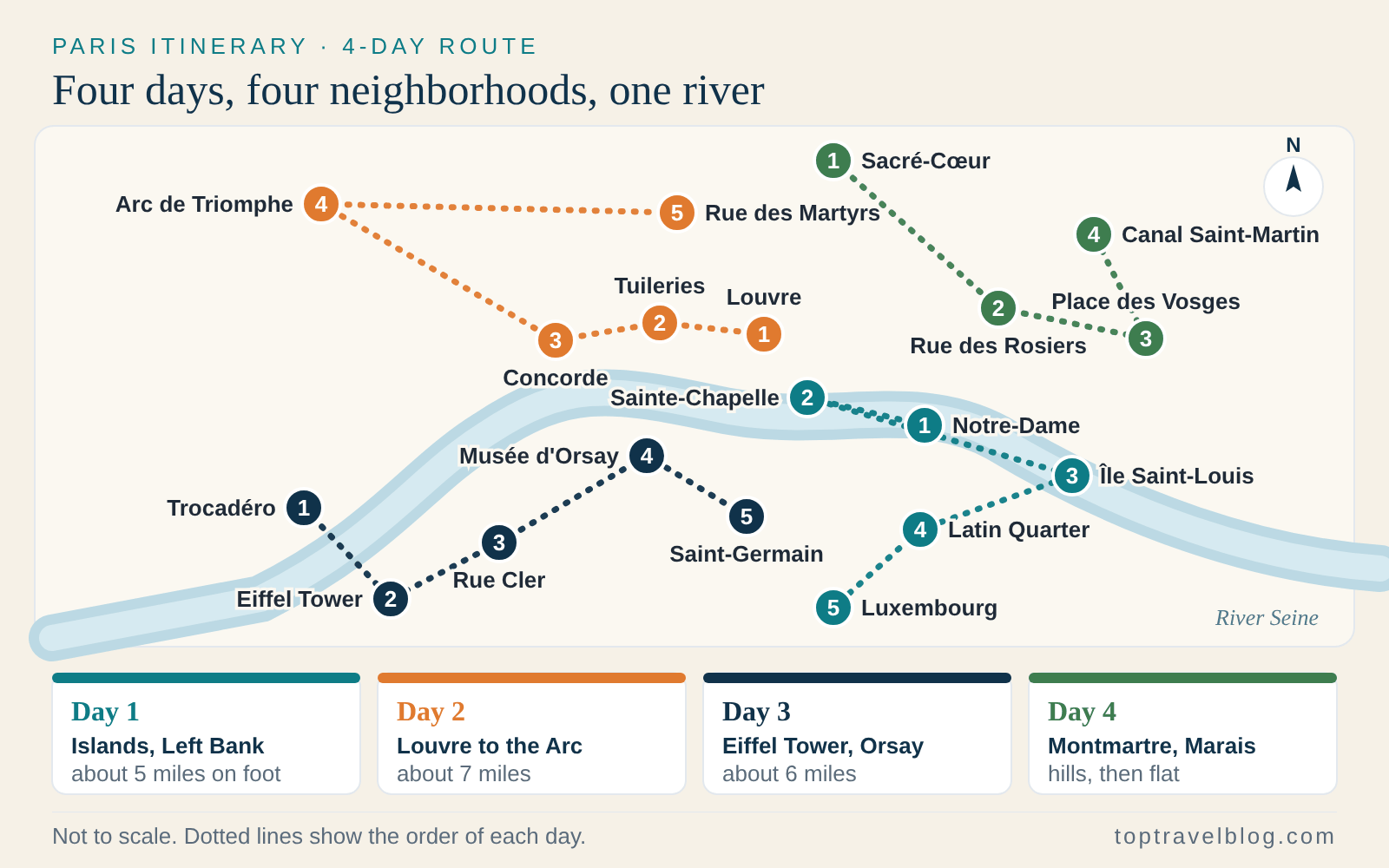
Day 1
Notre-Dame, Sainte-Chapelle, the islands and the Latin Quarter
Day 1 of this Paris itinerary is flat, compact and forgiving, so it works whether you slept on the plane or not. You will cover roughly 5 miles, almost all of it along the river and through the Latin Quarter.
Morning: Notre-Dame and Sainte-Chapelle
Start your Paris itinerary at Notre-Dame at 8:00 a.m., the easiest hour to see the cathedral. It reopened in December 2024 after the 2019 fire, and entry is free. You can book a 30-minute slot on the cathedral’s official site, notredamedeparis.fr, or walk in and queue. Early on a weekday the wait is short. By late morning in high season it can stretch past an hour.
Inside, look up. The stone has been cleaned to a pale cream, and the rebuilt vault and the stained glass of the rose windows are worth a slow five minutes.
Walk around the outside afterward: the flying buttresses from the quiet garden of Square Jean-XXIII behind the apse, and the spot on the Parvis marked Kilometer Zero, the point from which road distances in France are measured. Allow 60 to 75 minutes. The tower climb is a separate ticket of roughly €16 for 424 steps, and I would skip it if you are also doing the Arc de Triomphe and Eiffel Tower.
Then walk five minutes to Sainte-Chapelle, on the grounds of the Palais de Justice. Book a 9:30 or 10:00 slot online. Everyone, including ticket holders, passes airport-style security, and the line is separate from the ticket queue, so arrive 20 minutes early. An adult ticket from outside Europe runs roughly €22.
The lower chapel is dim and unremarkable. Climb the spiral stairs and the upper chapel opens up: 15 stained-glass windows, more than 1,000 scenes, and light that changes with the hour. It was built in the 1240s to house relics of Louis IX. Give it 40 minutes, longer if the sun is out. The Centre des monuments nationaux runs the ticketing.
Late morning: the islands
Cross the Pont Saint-Louis footbridge from behind the cathedral to the Île Saint-Louis. This small island, a five-minute walk from Notre-Dame, is where Paris feels like a village: stone mansions, a single main street and almost no chain stores. Walk Rue Saint-Louis en l’Île end to end, stop at Berthillon for a scoop of ice cream even at 11 a.m. (the salted caramel is the one everyone orders), and cross back along the Quai de Bourbon for the best Seine views of the cathedral.
From the Left Bank side of Pont Saint-Louis, walk west along Quai de Montebello past the bouquinistes, the green boxes where booksellers have worked for centuries. Many sell postcards and posters now, but a few still sell old books and prints. This stretch is the postcard walk of Paris.
Lunch and the Latin Quarter
Cross to the Left Bank at Pont au Double and you are at Shakespeare and Company, the English-language bookshop at 37 Rue de la Bûcherie. It is not the original shop, but it is the one with the reading nooks, and a line often forms outside on weekend afternoons. Go in, buy a paperback, ask them to stamp it. Do not eat on Rue de la Huchette or Rue Saint-Séverin, where the menus with photos and “Paris special” signs are aimed at passing foot traffic.
Instead, walk 10 minutes uphill to the Place Maubert market, which runs Tuesday, Thursday and Saturday mornings, or to Rue Mouffetard, a cobbled market street with crêpe stands, cheese shops and a tiny wine bar every few doors. A typical lunch in a neighborhood bistro, a plat du jour with a coffee, runs €18 to €26. A sandwich from a boulangerie is closer to €5 to €7.
Afternoon: the Luxembourg Gardens
Walk 20 minutes up Boulevard Saint-Michel to the Luxembourg Gardens, or ride RER B one stop from Saint-Michel–Notre-Dame. The park is the Paris living room: green metal chairs you can move anywhere, a pond with toy sailboats for kids to rent, a carousel, tennis courts, a puppet theater and about 100 statues. On the Palais du Luxembourg side, Marie de’ Medici’s palace now houses the French Senate and is not open for ordinary visits.
Take an hour here, not 15 minutes. Sit, read, eat a pastry from a bakery you passed, and watch Parisians do the same. Then walk 10 minutes east to the Panthéon or west to the Saint-Sulpice church, which has a Delacroix mural in a side chapel and is free to enter.
Tip: Paris museums and churches check bags. Carry a small day bag, not a big backpack, and keep a refillable water bottle. Fountains marked “eau potable” around the city, including the Wallace fountains, are free drinking water.
Evening: Saint-Germain and the Seine
Dinner on the Left Bank, around Rue de Seine, Rue de Buci and Rue du Cherche-Midi, is easy: bistros, wine bars and a few places that have been around for decades. Book Friday and Saturday nights; walk in on weekdays before 7:30 p.m. A three-course bistro dinner with a glass of wine runs roughly €45 to €70 per person.
After dinner, walk to Pont Neuf, the oldest standing bridge in Paris despite the name, and continue to the Square du Vert-Galant at the tip of the Île de la Cité. The park at the island’s western point is free, quiet and one of the best evening river views in the city.
If it rains: swap the Luxembourg Gardens for the Musée de Cluny, the medieval museum with the Lady and the Unicorn tapestries. With kids: rent a sailboat at the Luxembourg pond and ride the carousel. In winter: reverse the afternoon, going to Sainte-Chapelle at the first slot of the day.
Day 2
The Louvre, Tuileries and the Arc de Triomphe
Day 2 of this Paris itinerary is the heavy one: a museum morning, a garden walk and a monument at sunset. Budget about 7 miles on foot, and wear your best shoes.
Morning: the Louvre without the panic
The Louvre is the biggest museum in the world by display area and the single easiest place to waste a day. The goal on this Paris itinerary is three hours, not eight. Book the 9:00 a.m. timed entry at louvre.fr. From January 14, 2026, adult tickets cost €32 for non-European visitors and €22 for EEA residents and citizens, and under-18s enter free. The museum is closed on Tuesdays and stays open until 9 p.m. on Wednesdays and Fridays.
If Day 2 falls on a Tuesday, swap it with Day 4 and do Montmartre and the Marais first. If you have a Wednesday or Friday, consider shifting your timed entry to 6 p.m., when the daytime tour groups have gone and the museum is calmer.
Enter through the Carrousel du Louvre, the underground entrance reached from the Palais Royal–Musée du Louvre Metro stop on Line 1 or from 99 Rue de Rivoli. It is usually the least crowded way in, and the glass pyramid has the longest queue. Bags above 55 by 35 by 20 centimeters and suitcases are not allowed.
Your route: go straight to the Denon Wing and the Mona Lisa in Room 711 first, because the crowd builds hourly. It is smaller than you expect, behind glass, and the best view of it is probably from the back of the room. Then turn around and look at the Veronese painting across from it, The Wedding at Cana, the largest painting in the building. Pass the Winged Victory of Samothrace on the Daru staircase, then walk to the Venus de Milo in Room 345 in the Sully Wing.
With the time that is left, pick one thing. The Egyptian antiquities on the Sully ground floor are my first choice. The Napoleon III apartments in the Richelieu Wing, all gilt and red velvet, are my second, and are almost always empty. Leave by 12:30.
Lunch and the Tuileries
Walk five minutes north to the Palais Royal gardens, where the arcades hold small restaurants and the lawn is a good place for a sandwich, or 10 minutes to Galerie Vivienne, one of the covered passages with a mosaic floor and glass roof. For a more local lunch, Rue Montorgueil in the 2nd has a market street, a famous pastry shop and a dozen reasonable cafés.
After lunch, walk the length of the Tuileries Garden from the Louvre end to the Place de la Concorde, about 25 minutes with a coffee stop. If you want one more museum, the Musée de l’Orangerie at the west end holds Monet’s Water Lilies in two oval rooms and takes about an hour. It is closed on Tuesdays.
Late afternoon: Concorde to the Arc
At the Place de la Concorde, stop at the Luxor Obelisk, a 3,300-year-old pillar given to France by Egypt in the 19th century. Then take Metro Line 1 from Concorde to Charles de Gaulle–Étoile, about six minutes. You can walk the Champs-Élysées instead, 1.9 kilometers or a bit over a mile, and I will be honest: it is a wide, crowded shopping boulevard with chain stores and little charm. Take the train and save your legs.
Do not try to cross the roundabout at street level. Use the underground passage from the top of the Champs-Élysées. The terrace costs roughly €16 to €22, depending on the season, and takes about 284 steps. From the top you see twelve avenues radiate from the monument, the Eiffel Tower to the southwest and the towers of La Défense to the northwest. Go about an hour before sunset. At 6:30 p.m. every evening, veterans’ groups relight the flame at the Tomb of the Unknown Soldier at the base.
Evening: Rue des Martyrs and the 9th
Take Line 2 from Charles de Gaulle–Étoile to Pigalle, about 15 minutes. From the metro stop, walk south along Rue des Martyrs, a food street with cheese shops, butchers, rotisseries and bakeries, and dine at a wine bar or a restaurant near Rue Lamartine. This is one of the neighborhoods where locals actually eat, and prices are 20 percent lower than around the Louvre.
If it rains: the Louvre can take the whole day if you add a long lunch inside, then see the Orangerie. With kids: shorten the Louvre to two hours, cut the Arc and go to the Jardin des Tuileries carousel and playground. In winter: the Tuileries holiday market and Ferris wheel run from late November to early January.
Day 3
The Eiffel Tower, Rue Cler and the Musée d’Orsay
Day 3 of this Paris itinerary is the postcard day, built around one booked ticket and one museum. The distances are short, but the lines are not.
Morning: Trocadéro and the tower
Start at the Trocadéro (Metro Lines 6 and 9) at 8:30 a.m. The terrace across the Seine from the Eiffel Tower has the classic photo, and at that hour you share it with joggers and a few photographers rather than a crowd. Walk down through the gardens and across the Pont d’Iéna, about seven minutes, and be at the security line 20 minutes before your booked slot. Late arrivals can be refused, and tickets are not refundable.
Book a 9:30 a.m. slot on the tower’s official site, toureiffel.paris. Adult prices run roughly €23 for the lift to the second floor and about €36 for the lift to the summit, and the stairs to the second floor cost roughly €13 to €14 for 674 steps. Slots open about two months ahead and sell out on weekends. Nothing else on this Paris itinerary is as dependent on advance booking. Security is airport-style, and large bags, luggage and sharp objects are not allowed, so leave your daypack at the hotel.
Which level for a first Paris itinerary? I pick the second floor by lift. It is lower and closer to the street, so you see the city’s texture, the Seine and the monuments in detail. The summit is more crowded, behind glass and far higher, but on a clear day the 360-degree view is a once-in-a-trip experience. If you want the summit, book a slot at the top and take the lift all the way. Plan on two to two and a half hours with security.
Lunch: Rue Cler
From the tower, walk through the Champ de Mars to the Rue Cler, a pedestrian market street in the 7th that is 15 minutes away on foot. It has fromageries, charcuteries, bakeries and a few sit-down bistros, and eating well here costs less than eating on the tower’s lawn. Buy a baguette, cheese and fruit and have a picnic at the Champ de Mars, or sit down for a plat du jour at €18 to €25. Locals stand at the counter for coffee, which costs about half the seated price.
Afternoon: Pont Alexandre III and the Musée d’Orsay
Walk toward the Seine and along the river to the Pont Alexandre III, the most ornate bridge in Paris, with gilded statues on tall pillars. It takes about 25 minutes from Rue Cler. On the far bank, walk back toward the Left Bank and the Musée d’Orsay, a former railway station that is now the best Impressionist collection in the world. Entry is about €16 online, and there is a €12 evening rate on Thursdays after 6 p.m. The museum is closed on Mondays.
Go straight to the top floor, the fifth, where the Impressionists hang: Monet, Renoir, Degas, Van Gogh, Cézanne. The giant clock behind the glass has a view across the Seine to Sacré-Cœur. Spend two hours, then walk the ground floor sculpture hall on your way out. If you lose steam, leave. The Orsay is the museum I would see in two hours rather than four.
If Day 3 lands on a Monday, swap the Orsay for the Musée de l’Armée at Les Invalides, which holds Napoleon’s tomb under a gilded dome and is open on Mondays. On a Thursday, do the opposite: save the Orsay for the evening.
Evening: Saint-Germain, a Seine cruise and the sparkle
After the Orsay, cross the Pont des Arts to the Louvre side or walk through Saint-Germain-des-Prés for dinner. Book a table for 7:00 or 7:30 p.m. Then take a Seine cruise at dusk. Bateaux Parisiens, Vedettes du Pont Neuf and Bateaux-Mouches all run one-hour trips, typically roughly €15 to €25, from piers near the Eiffel Tower and Pont Neuf. Sit on the open upper deck and bring a layer, because it is colder on the water than you expect.
After dark, the Eiffel Tower sparkles for five minutes at the top of every hour. Time the cruise or a walk on the Pont de Bir-Hakeim for one of those moments. It is free, silly and exactly as good as everyone says.
Warning: Never buy Eiffel Tower tickets from anyone on the street or at the base of the tower who says the official site is sold out. Those are scams that sell either fake tickets or a guided tour at a markup. Use the official site and, if a slot sells out, look again 24 to 48 hours ahead, when cancellations appear.
If it rains: the Orsay runs longer, with lunch inside the museum’s restaurant, and you skip the summit. With kids: the Champ de Mars playground is a short walk from the tower, and the cruise is a good calm end to the day. In winter: the tower tends to be less crowded and the cruise is heated indoors, but the open deck is cold.
Day 4
Montmartre, the Marais and a last evening
The last day of this Paris itinerary trades monuments for neighborhoods. Expect hills before lunch and flat, wandering streets after it.
Morning: Montmartre before the tour buses
Take Metro Line 12 to Abbesses at 8:00 a.m., the deepest station in the system. The lift is usually the better choice over the 200-step spiral staircase. Walk up the hill through the quiet backstreets to the Sacré-Cœur Basilica, which is free to enter and opens early. The steps in front of it have a panoramic view of the city, and at 8:30 on a weekday you can have them to yourself. The dome climb is a separate ticket and I would skip it.
Walk the loop: Rue de l’Abreuvoir, one of the prettiest streets in Paris, the Clos Montmartre, a small working vineyard, the Place du Tertre with its portrait artists, and the Musée de Montmartre, whose garden once belonged to Renoir. Paris’s famous “I Love You” wall is a five-minute walk back near Abbesses.
Be firm in the busy squares. At Sacré-Cœur, people tie “friendship” bracelets on your wrist and demand payment. Keep your hands in your pockets, say “non, merci” and keep walking. Near the Place du Tertre, check the prices before you sit for a portrait. Metro Line 12 and the narrow stairs are also pickpocket territory.
Lunch and the move to the Marais
Have a long lunch in Montmartre or on the way. From Anvers, Line 2 to Barbès–Rochechouart, then Line 4 toward Châtelet takes about 25 to 30 minutes with the change. Taking a taxi or rideshare costs roughly €20 to €30 and saves 10 minutes. From Châtelet, the Marais is a 15-minute walk east, or one stop on Line 1 to Hôtel de Ville.
Afternoon: the Marais
The Marais is where this Paris itinerary slows down. Start at the Place des Vosges, the oldest planned square in Paris, built in 1612, with its red-brick arcades and gardens. Victor Hugo’s apartment on the corner is a free museum for its permanent collection. Then walk to Rue des Rosiers, the old Jewish quarter, and eat a falafel at L’As du Fallafel, which is closed Saturdays. Eat standing and expect a line.
Next, pick one museum. The Musée Carnavalet tells the story of Paris in 3,000 years of objects and is free for its permanent collection. The Musée Picasso is housed in a 17th-century mansion and is a good alternative. Both are closed on Mondays. Then walk the Rue des Francs-Bourgeois for shopping, the Marché des Enfants Rouges for snacks, and finish with a coffee in a courtyard.
Evening: the last night
For your final night, choose the dinner you will remember. Reserve a table in the Marais or walk to the Canal Saint-Martin for an aperitif on the banks, which locals do in warm weather. If the weather is dry, end with a walk along the Seine from the Hôtel de Ville to the Île de la Cité, Notre-Dame lit up, the river quiet. That bookend to Day 1 is my favorite hour of this Paris itinerary.
If it rains: swap Montmartre’s outdoor loop for the covered passages (Galerie Vivienne, Passage des Panoramas), and spend the afternoon at the Carnavalet. With kids: the Montmartre funicular and the carousel at the foot of the hill are a hit. In winter: dress warmly for Sacré-Cœur at 8 a.m., and take the hot chocolate break early.
Swapping in a Versailles day trip
Versailles is the one big excursion I would do on a first visit if you have a fifth day, and the first thing I would cut if you only have four. The palace is spectacular and crowded, the gardens are huge, and the round trip eats a half day before you step inside. If you are determined to go, replace Day 4.
Take the RER C to Versailles Château Rive Gauche. It takes 35 to 40 minutes and a standard €2.55 ticket covers the ride. The palace is closed on Mondays, and entry is by timed slot, mandatory since 2023. Prices run roughly €21 for the palace alone and about €30 to €35 for the Passport, which includes the Trianon estate and gardens on musical-fountain days.
Arrive for the 9:00 a.m. slot, when the Hall of Mirrors is almost empty. By 10:30 it is crowded. The gardens are free on most days, and you can rent a rowboat on the Grand Canal. The Trianon estate opens at noon. Official details are at chateauversailles.fr. Come back to Paris by 4 p.m. if you want a proper dinner.
Getting around on a Paris itinerary: Metro, RER and airports
Most of this Paris itinerary is on foot, and the Metro fills the gaps. Think of the Metro as a tool for the long hops, not the whole plan.
Paris has 14 numbered Metro lines plus the RER commuter trains, which cross the center faster than the Metro on a few routes. Trains run from about 5:30 a.m. to roughly 1:15 a.m., and until about 2:15 a.m. on Friday and Saturday nights. Line 1 crosses the city east to west and passes the Louvre, Concorde, the Champs-Élysées and the Arc de Triomphe, so it is the line you will use most. Line 4 runs north to south through Châtelet and Saint-Michel.
Fares in 2026
The Île-de-France Mobilités 2026 fare page lists the current prices. A single ticket for the Metro, RER or train in the region costs €2.55, and a single bus or tram ticket costs €2.05. The Navigo Easy card, which costs about €2, is a rechargeable card you can load with single tickets or passes. You can also load it on a phone. A Navigo day pass for zones 1 to 5 costs €12.30, and the weekly pass is €32.40.
The math is simple for a Paris itinerary of four days. A full day of this Paris itinerary uses about four rides, or roughly €10, so a day pass rarely pays off unless you ride five or more times. The weekly pass runs Monday to Sunday only, so it is worth it only if your four days start on a Monday or Tuesday and you add Versailles.
From the airport
Charles de Gaulle (CDG) is 23 kilometers northeast of the center. The RER B takes about 35 to 45 minutes to Châtelet–Les Halles, Saint-Michel and Luxembourg, and an airport ticket costs €14. Taxis charge flat fares from CDG to the center, roughly €56 to €65 depending on the bank of the river, and rideshare is similar plus traffic. Expect 45 to 90 minutes by road, and add more at rush hour.
Orly (ORY) is closer, and Metro Line 14 now reaches the airport, connecting to Châtelet and Gare de Lyon in roughly 25 to 30 minutes. The Orlyval shuttle costs €14, the same airport fare. Taxis from Orly cost roughly €35 to €50 flat. Read the signs: only official taxi ranks, never someone who approaches you in the arrivals hall.
Tip: Airport trips are priced separately from the standard €2.55 ticket, so a regular ticket will not open the gate at the RER B airport stations. Buy the airport ticket at the machine and keep it until you exit at the other end. A ticket lost halfway earns a fine from the inspectors who patrol the platforms.
Metro habits that save trouble
- Keep your ticket until you leave the station. Inspectors work the platforms and RER exits, and fines for no valid ticket start at €50 or more.
- Stand away from the doors when the train is crowded. Pickpockets work Line 1, Line 4 and the Châtelet interchange.
- Many stations have no lift and long staircases, so pack light. Line 14 is the exception and is fully accessible.
- Taxis, rideshare and Vélib’ bikes fill the gaps. Walking is faster than the Metro for any trip under 1.2 kilometers.
What a Paris itinerary costs
Paris is not cheap, but it is not New York either. The biggest variable is your hotel, and the second is how many sit-down meals you buy. These are rough daily figures per person, not including flights, and assume a couple sharing a room.
Budget, about €110 to €160 a day. At this level a Paris itinerary leans on bakeries, picnics and free sights. A hostel bed or a basic two-star room split two ways, bakery breakfasts and sandwiches, one bistro dinner, the Metro, and one major paid sight a day. Museum free days and walking cover the rest.
Mid-range, about €220 to €330 a day. A central three-star hotel split two ways, a café breakfast, a plat du jour lunch, a bistro dinner with wine, the Metro and two paid attractions a day. This is what I would plan on for most first visits, and it is the level this Paris itinerary assumes.
Comfortable, about €400 to €600 and up. A four-star hotel, restaurant lunches and dinners, a Seine cruise, taxis at night and a guided visit. The numbers grow quickly in the luxury range.
What the big tickets add up to
For this Paris itinerary, a non-European adult spends roughly €32 at the Louvre, €16 at the Orsay, €22 at Sainte-Chapelle, €16 to €22 at the Arc de Triomphe, €23 to €36 at the Eiffel Tower and €15 to €25 on a cruise. That is around €125 to €155 per person before food and transport. Versailles adds about €30 to €40 with the train.
Is the Paris Museum Pass worth it?
The pass, priced roughly €85 for two days, €105 for four and €125 for six, covers the Louvre, Orsay, Versailles, Sainte-Chapelle and more than 50 other sites, but not the Eiffel Tower. It also requires a timed reservation at nine busy sites, including the Louvre, Orsay and Versailles. The validity runs in hours from your first scan.
With the Louvre at €32, Orsay at €16, Sainte-Chapelle at about €22 and Versailles around €30, the four-day pass starts to pay off only if you visit at least four paid sites in the window. On this Paris itinerary I do it with individual tickets, because I would rather choose slots than race through a long list. If you plan to add Versailles and several smaller museums, run the numbers.
Taxes, tipping and small costs
Hotels collect a tourist tax per person per night, roughly €3 to €16 depending on the category. A bakery breakfast of coffee and a croissant runs roughly €4 to €7. A café espresso at the counter costs about €2 and about double at a table on a major boulevard. Tap water at a restaurant, an “une carafe d’eau”, is free and legally must be offered.
What to book before you fly: the Paris itinerary tickets that sell out
A Paris itinerary does not need the six-month planning that some cities do. It needs a short list and some discipline about timing. Here is the order I book things.
- The Eiffel Tower slot. The official site releases tickets about two months ahead. Book the day they open for a weekend or an evening, and allow a 9:30 a.m. slot as your fallback.
- The Louvre timed entry. Reserve at louvre.fr four to eight weeks ahead for a morning slot, longer in July and August. Evening slots on Wednesday and Friday last longer.
- Sainte-Chapelle. Book a first-of-the-day slot a few weeks ahead in high season.
- The Musée d’Orsay. Book online if you are visiting on a weekend or want a morning start; the first Sunday of the month is free but requires a reservation.
- Dinner on Friday and Saturday. Reserve the one or two meals you care about. In popular bistros, a table for two on a Saturday often needs a week or two of notice.
- Versailles. If you are going, book a timed slot at least a week ahead in the high season.
I book the flights and the hotel first, and the timed tickets the moment my dates are fixed. The how to find cheap flights guide explains how to search and when to buy, and my how to plan a trip guide gives the order of everything else. If you add the Notre-Dame towers, the Catacombs or a night at the Moulin Rouge, those are booked in the same way, a few weeks ahead on the official sites.
Warning: Many sites sell “skip-the-line” tickets at a premium that gives you the same timed entry you can get on the official page. For the Louvre, the Eiffel Tower and Versailles, buy from the official site, or from the Paris tourist office, parisjetaime.com, whose ticket shop is the city’s own. Guided tours can be worth the price, but only if you want the guide.
Food on a Paris itinerary worth planning around
A good Paris itinerary treats meals as sights. You do not need a Michelin star to eat well in Paris, but you do need to avoid the places that sell the idea of eating well. The rule I follow: walk two streets away from the main sight, look for a short menu in French, a blackboard with a plat du jour, and locals at the tables. If the menu has photos, keep walking.
What to eat
Breakfast is a croissant or pain au chocolat and a café crème at a boulangerie or a café. For lunch, order the formule or plat du jour, a two-course set meal at €15 to €25 that is the best-value meal in the city. Dinner starts at 7:30 or 8:00 p.m. in most restaurants, and kitchens close by 10:00 p.m.
Classic dishes worth ordering: steak frites, duck confit, onion soup, croque monsieur, a jambon-beurre sandwich on a baguette, and anything labeled “maison”. Cheese and wine are the other half of the culture. Crêperies are the cheapest sit-down meal in the city, and Brittany-style buckwheat galettes with a cider are a real lunch.
Markets, bakeries and the picnic
Picnics are underrated. Buy a baguette tradition (the better loaf), cheese, ham, fruit and a bottle from a caviste, and eat in the Luxembourg Gardens, the Place des Vosges or on the Seine at the Île Saint-Louis tip. The market streets I would use are Rue Cler, Rue Mouffetard and Rue Montorgueil. Marché Bastille on Thursday and Sunday mornings is one of the largest in the city.
Two traditions that confuse visitors
Waiters will not bring the bill until you ask for it, and this is not rudeness; lingering is the point. Say “l’addition, s’il vous plaît.” And a bistro table is yours for the evening, so do not expect to be rushed out. If you want to eat early, tell the host when you reserve.
Common mistakes on a first Paris itinerary
These are the ones I see every week, in rough order of how much they cost in time, money or mood.
1. Booking the Louvre for a Tuesday
The museum is closed on Tuesdays, and the Orsay and Versailles are closed on Mondays. Visitors build a perfect schedule and discover the gap on the doorstep. Lay out the closing days before you fix the order of your Paris itinerary, and put the Louvre on a Wednesday or Friday if you can.
2. Trying to see the whole Louvre
Walking the Louvre end to end is about 10 miles of galleries. In a four-day Paris itinerary the Louvre gets one morning. Pick three or four things, leave at lunch and spend the afternoon outside. The museum fatigue you feel at 1 p.m. is real, and the tour group around the Mona Lisa is worse after 11.
3. Buying tickets from a stranger
Fake tickets, “skip-the-line” scams and aggressive street sellers cluster around the Eiffel Tower, the Louvre and Montmartre. Buy from the monument’s own site. If the site shows a sold-out day, change the day.
4. Falling for the street scams
The ones to know: friendship bracelets at Sacré-Cœur, the “gold ring” someone picks up near you, clipboard petitions at the Louvre and Trocadéro that are a distraction for a pickpocket, and a three-card game on a folding table. The rule is simple: do not stop, do not sign and keep your phone in a front pocket with a zipper or a bag you can see.
5. Staying in a cheap hotel too far out
Saving €60 a night by sleeping in the 18th or 19th arrondissement, or a suburb, costs 40 minutes a day in transit. On a four-day trip, that is three hours of your trip. A smaller room near a good Metro stop beats a larger one in a long commute.
6. Eating at the first terrace you see
The cafés directly facing the Eiffel Tower, the Louvre pyramid and Notre-Dame charge double for average food. Walk two blocks. That one habit saves the average visitor €30 to €50 a day.
7. Starting at 10 a.m.
The best light and the thinnest crowds come before 9:30, so a Paris itinerary should open early. A late start puts you in the Louvre line at its worst, in the Eiffel line at midday and in the Metro at rush hour. This Paris itinerary starts early on purpose.
8. Ignoring the weather and packing the wrong shoes
Cobblestones, stairs and a lot of walking turn new shoes into a problem by day two. Bring broken-in walking shoes and a rain jacket. Umbrellas are overpriced and fall apart in the wind. In summer, pack for heat, because many rooms and Metro cars lack air conditioning.
9. Using a rental car
Parking is scarce and expensive, the Périphérique ring road is stressful and the Metro is faster for almost every journey in this Paris itinerary. Rent a car only when you leave the city, and pick it up on your way out of town.
10. Skipping the empty afternoon
Four days of back-to-back plans turns any Paris itinerary into a blur. Leave one afternoon free, ideally on Day 3 after the Orsay, to sit in a café, window shop or follow a street you like. Many of my best memories of Paris were from those unscheduled hours.
Frequently asked questions about this Paris itinerary
Is 4 days in Paris enough for a first visit?
Yes, and it is the length this Paris itinerary is built on. Four full days cover the islands and the Latin Quarter, the Louvre and the Arc de Triomphe, the Eiffel Tower and the Orsay, and Montmartre and the Marais, with half-days of slack. Three days works if you cut one museum. Five or more let you add Versailles, Giverny or a slow day.
What is the best area to stay in Paris for first-time visitors?
The Latin Quarter and Saint-Germain (5th and 6th arrondissements) and Le Marais (3rd and 4th) are my two picks. Both suit a first Paris itinerary: they are walkable, central and full of restaurants, and both have good Metro access. Choose the Left Bank if you want a classic, quieter feel, and the Marais if you want livelier nights, shopping and food.
Is the Paris Metro easy for tourists?
Yes. Lines are numbered and colored, signs show the last stop in the direction of travel, and a single ticket costs €2.55. The system is crowded at rush hour and many stations have stairs and no lift. A Navigo Easy card saves queueing. Walk when the destination is under 15 minutes away, because you see more of the city.
How much money do I need per day?
For a couple sharing a room, I plan roughly €110 to €160 per person per day for a budget Paris itinerary, €220 to €330 in the middle, and €400 or more for comfort, not including flights. The hotel is the largest variable. Museums add about €16 to €36 each for non-European visitors.
Do I need to book the Eiffel Tower and Louvre in advance?
Yes for both. Tickets for the Eiffel Tower go on sale about two months ahead and sell out on weekends. The Louvre uses timed entry, and morning slots disappear in peak season. The Musée d’Orsay, Sainte-Chapelle and Versailles also reward booking. Walk-up tickets sometimes exist, but you gamble on a long queue.
Is Paris safe for tourists?
Paris is a major city with ordinary big-city risks, and the main one is pickpocketing and scams in crowded areas such as the Metro, the Eiffel Tower and Sacré-Cœur. On any Paris itinerary, keep your phone and wallet in front pockets or a zipped bag, ignore people who approach with petitions or bracelets, and read the State Department’s current France travel advisory on travel.state.gov.
Can I use US dollars or do I need euros?
You need euros for a Paris itinerary. Use a card with no foreign transaction fee for most purchases, and carry a little cash for markets and small cafés. Decline the terminal’s offer to charge in dollars. ATMs at banks give a better rate than currency exchange kiosks at the airport or in tourist areas.
Do I need a visa or ETIAS to visit Paris?
US citizens do not need a visa for up to 90 days in any 180-day period, and a passport valid for at least three months after departure is required. The Entry/Exit System collects fingerprints and a photo at the border. ETIAS, a €20 online authorization, is expected in the last quarter of 2026, and the official EU site is the only place to apply.
What should I pack for four days in Paris?
For a four-day Paris itinerary, bring comfortable broken-in walking shoes, layers, a packable rain jacket, a small zipped crossbody bag, a power adapter for Type E sockets and a refillable water bottle. Parisians dress neatly, so one or two smarter outfits help for dinner. Leave large backpacks at the hotel because museums and monuments search bags.
Can I do this itinerary in winter?
Yes. The itinerary works in winter with the adjustments noted in each day: indoor afternoons, an early start for short daylight, and the cruise on a covered boat. January and February are the cheapest months for hotels. December is beautiful and crowded, with Christmas lights and markets, and the Louvre and Eiffel Tower sell out.
Is Paris good for families with kids?
Yes, if you slow this Paris itinerary down. The Luxembourg Gardens, the Tuileries carousel, a Seine cruise and the Eiffel Tower are hits with children. Trim the Louvre to two hours and skip the Catacombs for young kids. Kids under 18 enter the Louvre free, and many museums offer free or reduced entry.
One last thing before you go
The thing I would do differently next time, every time, is leave one afternoon completely empty. Not free time to shop, not an optional museum, but nothing, with the intention of walking out of the hotel and turning whichever way the light looks better.
The best hours I have spent in Paris were unplanned: a church concert I walked into on a rainy evening, a bench on the Île Saint-Louis with a bag of cherries, a wrong turn in the 11th that ended in the best roast chicken of the trip. A Paris itinerary is scaffolding. The city fills it in.
The other thing I would say is to be kind to yourself about pace. Four days of this Paris itinerary is about 25 miles of walking, a lot of stairs and several early mornings. Hitting a wall on the afternoon of Day 3 is normal, and the fix is a 90-minute hotel rest, not a fourth museum. Build the first trip so that you want to come back, because most people do.
If this trip is part of a bigger Europe plan, the same format works in other cities after this Paris itinerary. I wrote the Barcelona itinerary, the Amsterdam itinerary, the Prague itinerary, the Budapest itinerary and the Vienna itinerary the same way, with day order, current prices and the bookings that matter.
Related planning guides
- London itinerary: the best 4 days for first-time visitors — the Eurostar-friendly capital two hours and twenty minutes from Paris.
- Rome itinerary: the best 4 days for ancient sites, food and neighborhoods — the next stop if you want warmer weather and more ruins.
- 10 days in Italy: Rome, Florence and Venice itinerary — a longer route that pairs naturally with a Paris start.
- How to choose a hotel: location, reviews, room type, fees and cancellation terms — the checklist behind the neighborhood advice above.
- How to find cheap flights: a practical search strategy — the search routine for the transatlantic leg.
- Barcelona itinerary: 3 days of Gaudí, tapas, beaches and Old Town — a warm, walkable Mediterranean follow-up.


