

Four days is the number I would give anyone planning a first trip to this city, and it is the number this london itinerary is built around.
Four days is the length I keep returning to, because it is enough for Westminster and the royal sights, the Tower and the river, the big free museums and the West End, and one slower day in Kensington and Notting Hill, with a little slack for rain, jet lag and the pub you did not plan on.
Three days works if you accept one museum and no day trip. Five is better if you want a morning with nothing in it.
The verdict in one sentence: London rewards people who book the four or five things that really do sell out, tap a contactless card for every ride, and walk the rest in comfortable shoes. This london itinerary suits first-time visitors, couples, friends, and families with kids old enough to handle Tube stairs and long museum floors.
It suits less well anyone who wants a quiet, car-friendly trip (don’t rent one) or a beach week with a city attached.
I have flown into London more times than I can count, in fog, in a heat wave, with a toddler, and alone with a notebook. What follows is the london itinerary I would hand a friend: the order of days that keeps you from crossing the river four times, current fares and ticket prices as of November 2026, where to sleep, and the mistakes I see at the Westminster Abbey queue every week.
Quick facts: this London itinerary at a glance
- Best for: first-time visitors, couples, friends, and families with kids 7 and up.
- Ideal trip length: 4 full days, arriving the evening before and leaving the morning of day 5.
- Getting around: the Tube, buses and the Elizabeth line, all on one contactless card. Zones 1 and 2 cost at most £8.90 a day; you will also walk 6 to 9 miles on most days.
- Entry rule for Americans: a UK Electronic Travel Authorisation (ETA) costs £20 and lasts up to six months of travel; apply on gov.uk before you fly.
- Booking priorities: Tower of London timed entry, Westminster Abbey, a West End show, one or two free tickets (the Sky Garden, the British Museum), and any afternoon tea you care about.
- Pacing: one anchor area per day, one big sight before lunch, one after, and an evening you can drop.
- Key caveats: Westminster Abbey is closed to sightseers on Sundays; hotel prices already include 20 percent VAT; December days end around 4 p.m.; August is the busiest and often the stickiest month.
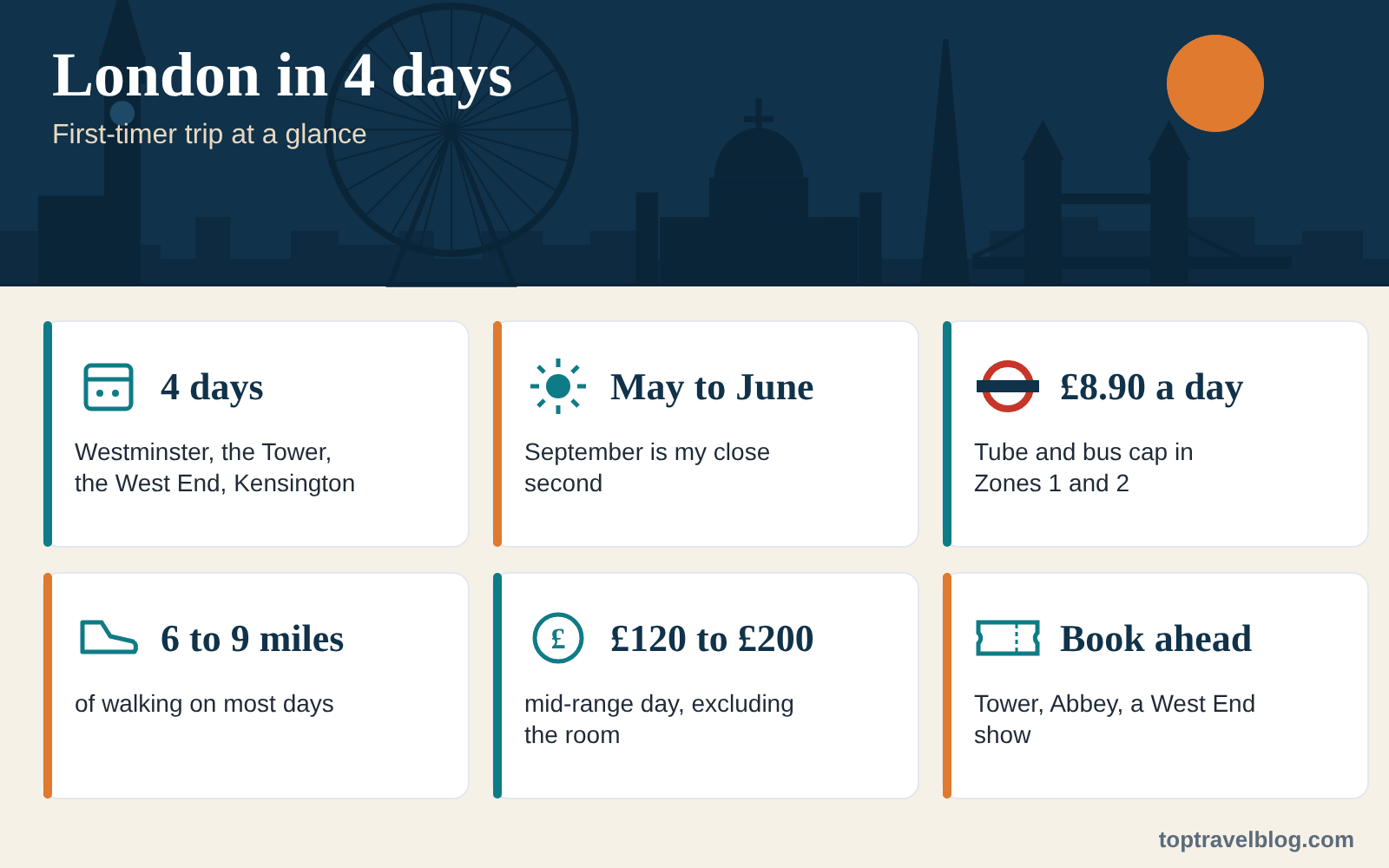
Best time to go: when this London itinerary works best
If I could pick one window, it would be late May through June, with September a close second. Days are long (the sun is still up after 9 p.m. in June), highs sit in the high 60s to low 70s Fahrenheit, and the parks are at their best. Rain happens in every month, so you plan for it rather than hope against it.
The second-best window is late March through early May, when the daffodils are out in St James’s Park and the crowds have not hit their summer peak. April is changeable, so carry a light waterproof jacket and treat the umbrella as part of your daypack.
Here is how I think about each stretch of the year, because the right london itinerary changes with the daylight.
January to early March: cheap rooms, short days
This is the cheapest stretch for flights and hotels, and the museums are calm on weekdays. The trade-off is daylight: the sun sets around 4 p.m. in December and a little after 5 p.m. by late February, so outdoor sights like the Tower, the river walk and Greenwich need to happen before lunch.
Temperatures hover in the 40s Fahrenheit, with a damp chill that gets into your bones more than the number suggests. Pack layers and a proper coat.
April to June: the sweet spot
Parks flower, outdoor tables reopen along the South Bank, and Wimbledon and Chelsea Flower Show season bring a buzz without closing any of the big sights. School holidays and bank holiday weekends (the first and last Mondays in May) are busier, so aim for midweek dates if you can.
Late May is my favorite week for this london itinerary: long evenings, mild air, and enough daylight to fit a river walk after dinner.
July and August: warm, crowded, expensive
The weather is lovely on a good day and heavy on a bad one. Older Tube lines get uncomfortably hot, and the lines at the Tower and Westminster Abbey are at their longest. Hotels cost the most, and everything popular books out earlier.
If summer is your only window, front-load your timed tickets in the morning and plan your afternoons around parks, the river and air-conditioned museums.
September and October: my second choice
September often has a settled, golden stretch that feels like an extension of summer, with fewer tourists after the first week. October gets cooler and wetter, but the leaves in Hyde Park and Regent’s Park are worth the umbrella.
Rates drop from their summer peak and the theater season is in full swing.
November and December: dark early, festive late
Late November through December brings Christmas lights on Regent Street and Oxford Street, markets along the South Bank and at Hyde Park’s winter fair, and hotel prices that climb sharply in the second week of December. The upside is atmosphere. The downside is crowds, dark afternoons, and rain that arrives sideways.
If you pick December, shift the outdoor-heavy parts of this london itinerary to the morning and enjoy the lit-up streets in the evening.
Tip: Whatever month you pick for your london itinerary, look up the sunset time before you book anything outdoors. A Tower of London ticket at 3:30 p.m. in December means walking the battlements as the light goes. A 9 a.m. slot in the same week gives you a full morning of daylight.
Before you book: entry rules, money, phone and plugs
Americans need a UK Electronic Travel Authorisation to enter the country as visitors. As of November 2026 the ETA costs £20 per person, children and babies included, and it lets you travel for up to six months at a time. The government’s ETA guidance on gov.uk explains who needs one and links to the only official application; other sites that look official add their own fees.
Apply a few days before you fly, not at the airport, because the ETA is the one piece of paperwork that can stop a london itinerary before it starts. Your passport must be valid for the length of your stay, and the name on the ETA has to match your passport exactly.
Money is simple if you use a card that charges no foreign transaction fee. Almost everything in London accepts contactless, including market stalls, buses, and small pubs, and some places no longer take cash at all. I carry about £50 in notes for emergencies and a tip jar here and there.
Tipping works differently from the U.S. Many restaurants add a 12.5 percent discretionary service charge to the bill; if it is on the bill and the service was fine, you pay it and add nothing more. Pubs do not expect a tip at the bar, and taxi drivers appreciate rounding up.
The practical gear list for a london itinerary is short. UK sockets use a three-pin Type G plug at 230 volts, so bring an adapter, and check that chargers are dual-voltage (most phone and laptop chargers are). Your U.S. phone works on UK networks, but roaming is expensive on some plans, so turn on an eSIM or an international plan before you land.
- Carry a physical backup card in case your phone dies, and keep it somewhere other than your phone case.
- Download offline maps of central London; Tube stations have patchy signal underground.
- Wear walking shoes you have already broken in. London is a walking city, and the paving is uneven.
How many days you really need for a London itinerary
Four is my answer, and here is how the other lengths play out.
Two days: the highlights sprint
With two days you cannot do both the Tower and the museums without feeling rushed, so choose. My pick from this london itinerary is Day 1 (Westminster, Buckingham Palace, the South Bank) followed by Day 2 (Tower of London, St Paul’s, the City). You skip the big museums, see a show on night one, and eat dinner by the river on night two.
Expect to be on your feet from 8 a.m. to 10 p.m. both days.
Three days: the compromise
Three days gives you Westminster and the South Bank, the Tower and the City, and a combined museum-and-West-End day. You lose Kensington and Notting Hill but keep the sights that define the city. If you only have three days, combine Day 3 and Day 4 below, and pick either the British Museum or the Victoria and Albert, not both.
Four days: the plan below
Four full days lets each area breathe. Day 1 covers Westminster and the royal sights, Day 2 the Tower and the river, Day 3 Bloomsbury, Covent Garden and Soho, and Day 4 Kensington, Hyde Park and Notting Hill. Every day has a loose afternoon you can sacrifice to jet lag.
Five to seven days: day trips and depth
With five or more days, the london itinerary gets room for a day away: add one day trip. Windsor Castle and Hampton Court are the easiest by train from the city, Greenwich is a short boat ride, and Oxford, Bath and Stonehenge each need a full day. I cover how to choose between them in the day-trip section further down.
Seven days lets this london itinerary add the Harry Potter studio tour, Kew Gardens, and a slow day in the East End without cutting anything.
Tip: Plan your arrival day as a throwaway. Most flights from the U.S. East Coast land between 6 a.m. and 9 a.m., and hotels will not have rooms ready until mid-afternoon. Drop your bags, take a walk along the river for fresh air, eat an early dinner, and sleep. Day 1 of this london itinerary starts the next morning.
Where to stay in London for a first visit
London is enormous, but a first-time visitor needs only a few neighborhoods. What matters is a Tube station within a five-minute walk, a direct line to the places you will visit most, and a street you will not mind walking at 11 p.m. after a show.
Hotel prices in the UK include 20 percent VAT in the listed rate, and London has no separate city tourist tax, so the price you see is the price you pay (breakfast and resort-style fees are the exceptions to look for). If you want the full framework for comparing options, my guide on how to choose a hotel walks through location, reviews, fees and cancellation terms.

The five areas I recommend for a London itinerary, and who each one suits
Covent Garden and Soho (Piccadilly, Northern and Elizabeth lines nearby)
Best for: first-timers, theater nights, walking everywhere
This is where I put most people on their first london itinerary. You are a 10-minute walk from Trafalgar Square, the National Gallery and every major West End theater, and the Covent Garden and Leicester Square stations connect to most of the city in one change or less.
Rooms are small and expensive for what they are, and Friday and Saturday nights are loud. Ask for a courtyard-facing room.
South Kensington and Knightsbridge (District, Circle and Piccadilly lines)
Best for: families, museum lovers, a calmer residential feel
White stucco terraces, a few superb bakeries, and the V&A, Natural History Museum and Science Museum all within a 10-minute walk. The Piccadilly line runs straight to Heathrow in about 50 to 60 minutes, which makes arrival and departure days easy.
Dinner options are more sedate and pricey than Soho, and you will take the Tube to reach the East End.
Bankside and Southwark (Jubilee line and the river)
Best for: river views, Day 2 convenience, evening walks
You are 10 minutes from the Tate Modern, Shakespeare’s Globe and Borough Market, and the Jubilee line reaches Westminster and Canary Wharf quickly. Evenings on the Thames Path are some of the best free entertainment in the city.
Hotels cluster around Blackfriars and London Bridge, and weekend nights fill with pub crowds on the riverside.
King’s Cross and Bloomsbury (Piccadilly, Victoria, Northern and Circle lines)
Best for: Eurostar connections, budget-conscious travelers, the British Museum
King’s Cross and St Pancras sit side by side, with trains to Paris, Brussels and Edinburgh and six Tube lines. The British Museum is a 20-minute walk, and the area has some of the better mid-range hotels in the city.
The immediate station area can feel rough late at night, so choose a hotel on a side street in Bloomsbury rather than on Euston Road.
Paddington and Bayswater (Bakerloo, Circle, District and Elizabeth lines)
Best for: arrival from Heathrow, budget, easy Hyde Park access
The Elizabeth line takes you from Heathrow to Paddington in about 15 minutes, and the area has a dense mix of hotels at lower prices than the West End. Hyde Park is across the road and Notting Hill is a 20-minute walk.
Some blocks look tired and the streets are less lively at night; it is a convenient base more than a destination.
My pick, and the one I would avoid
If this is your first trip and you want one answer, stay in Covent Garden or the quieter streets of Bloomsbury just north. You walk to a lot, the Tube is close, and you come home to somewhere that feels like London.
For a london itinerary that depends on evenings out, I would avoid the cheapest hotels near Heathrow unless you have a very early flight, and chains in Zone 3 or beyond that advertise “central London access.” A 35-minute Tube ride each way costs you more in time than you save in room rate, and it makes every evening feel like a commute.
If you are comparing flights as well, how to find cheap flights covers the search strategy that tends to save the most on transatlantic fares, and how to plan a trip covers the order in which to book everything else.
Getting around: the Tube, buses, the Elizabeth line and airport transfers
London’s public transport is excellent, and the pay-as-you-go system is simpler than it looks. You do not need to buy a paper ticket, a Travelcard or a visitor pass for a four-day london itinerary. Tap the same contactless card or phone on the yellow reader at the gate when you enter and again when you leave, and the system calculates the cheapest fare for the day.
Use the same card or device each time, because the daily cap only works on one payment method. If you have a phone wallet and a physical card, pick one.
Fares and daily caps
From March 2026 a single adult fare inside Zone 1 costs £3.10 at peak times and £3.00 off-peak. Peak is weekdays from 6:30 to 9:30 a.m. and 4 to 7 p.m., based on when you tap in. The cap is what matters: at the Transport for London fares pages, the daily cap for Zones 1 and 2 is £8.90, and for Zones 1 to 6 it is £16.30, with a Monday-to-Sunday weekly cap of £44.70 for Zones 1 and 2.
Almost every sight in the london itinerary sits in Zones 1 and 2, so a heavy Tube day tops out around £9 and a light day costs £3 to £6. The TfL fares information lists the caps and peak hours.
Buses charge a flat fare of a little under £2 for any journey, with a low daily cap, and they are a good way to see the city above ground. Children under 11 travel free on most TfL services when accompanied by an adult, and 11 to 15-year-olds can get discounted fares if you register their Oyster photocard.
How I use each mode on a london itinerary
- The Tube is fastest for crossing the city, especially on the Jubilee, Northern and Piccadilly lines. Stand on the right on escalators and let people pass on the left.
- The Elizabeth line is the newest and most comfortable line, with air-conditioned trains and a direct run from Heathrow through Paddington, Bond Street, Tottenham Court Road and Farringdon to Liverpool Street.
- Buses are perfect for the Westminster-to-St-Paul’s stretch or Kensington-to-Notting-Hill, and the top front seat on a double-decker is the cheapest sightseeing tour in town.
- Thames Clippers river boats run from Embankment, Bankside and Tower piers to Greenwich. They are pricier than the Tube but beat it for scenery.
- Walking is the main mode of any london itinerary in Zone 1. Westminster to the London Eye is 15 minutes; Covent Garden to Soho is 5.
- Black cabs are metered, reliable, and take cards, but a ride across Zone 1 can cost £15 to £30 depending on traffic.
Watch out: The Tube is not always step-free. Many older stations have long stairs and no lifts, and a few of the deepest stations take several minutes to exit. If you have a stroller or limited mobility, the Tube’s step-free map and the Elizabeth line are your best friends, and buses are always step-free.
Airport transfers
Heathrow is the easiest. The Elizabeth line runs to Paddington, Bond Street and beyond in 30 to 40 minutes, with a fare from Zone 1 of £15.50 since March 2026. The Piccadilly line is cheaper, covered by your daily cap, and takes around 50 to 60 minutes to Covent Garden, but the carriages are small and can get packed with luggage.
Gatwick is served by the Gatwick Express and Southern/Thameslink trains to Victoria and London Bridge in about 30 to 45 minutes. Stansted has the Stansted Express to Liverpool Street in about 45 to 50 minutes. Luton and London City have their own rail and DLR links; City Airport is the easiest of all, with the DLR reaching Bank in about 25 minutes.
Taxis from Heathrow to central London run roughly £60 to £110 depending on traffic and destination. If you land with a heavy bag after a red-eye, the Elizabeth line is still the better compromise.
If you are continuing to Europe, St Pancras International is the home of Eurostar. My Paris itinerary picks up where this one ends, with a train that takes about two and a half hours.
Tip: Look right, then left. UK traffic drives on the left, and the pavement at crossings often has “LOOK RIGHT” painted on the road for tourists. It saves lives, and I still glance at the paint after 20 trips.
The 4-day London itinerary, day by day
The days of this london itinerary are arranged by geography so that you cross the Thames deliberately rather than constantly. Westminster and the South Bank come first because Big Ben, the Abbey and the Eye all sit within a mile of each other. The Tower and the City follow on Day 2, the British Museum and West End on Day 3, and the museum quarter, Hyde Park and Notting Hill on Day 4.

Each day of the london itinerary has a morning, afternoon and evening, plus a rainy-day swap and one thing to book in advance. Treat the evening as optional on every day except the show night.
Day 1
Westminster, royal London and the South Bank
Morning: Westminster Abbey and Parliament Square
Start your london itinerary at Westminster station at 9 a.m. The Elizabeth line does not stop here; use the Jubilee, District or Circle lines. Exit toward Parliament Square and you are facing Big Ben (the clock tower is officially the Elizabeth Tower) and the Houses of Parliament across the road.
Walk across Westminster Bridge for the classic photograph, then come back and walk the length of the Parliament building toward the Abbey. It takes about 10 minutes in total, and the best light falls on the Gothic façade in the morning.
Westminster Abbey is where monarchs are crowned and married, and where Newton, Darwin and Dickens are buried. An adult ticket costs £32 as of November 2026, and the church is open to sightseers Monday to Saturday; on a typical weekday general admission runs from 9:30 a.m. to 3:30 p.m., and the Westminster Abbey website lists the day-by-day times. Sundays are for worshippers only, and you can attend a service free.
Allow 90 minutes to two hours. The multimedia guide is included, and it is worth taking because the Poets’ Corner and the Coronation Chair are easier to understand with context. Photography inside is not allowed, so enjoy it with your eyes.
Tip: Book your Abbey timed entry for 9:30 a.m. on a weekday. By 11 a.m. the queue to get in snakes around the courtyard, and tour groups slow every aisle.
Late morning: St James’s Park and Buckingham Palace
From the Abbey, walk up Great George Street into St James’s Park, a 10-minute stroll. Cross the footbridge over the lake for views both ways: the Palace at one end and the Horse Guards at the other. The pelicans have lived here since the 1660s, and they are weirdly relaxed about crowds.
Buckingham Palace is at the far end, 15 minutes on foot. The Changing of the Guard takes place on Monday, Wednesday and Friday, with the procession starting around 10:45 a.m. and the ceremony beginning around 11 a.m. According to the Household Division, ceremonies can be altered or cancelled at short notice, especially in wet weather.
For a decent view you need to arrive by 10 a.m. and stand near the gates or the Victoria Memorial. Honestly, I find it a crowded ceremony with a lot of marching and not much detail. If you are not on a Monday, Wednesday or Friday, just walk the Mall to the front of the Palace and move on.
Lunch: Victoria or Strutton Ground
You have two realistic options. The first is a quick pub lunch near Victoria station, where there are several traditional pubs on Buckingham Palace Road and Victoria Street serving pies, fish and chips and Sunday roasts. Expect £14 to £22 for a main.
The second is the lunchtime street food at Strutton Ground, a short market street near St James’s Park station with sandwiches, wraps and hot boxes for about £8 to £12. It is a London office-worker lunch, and it is what I do when I want to keep moving.
Afternoon: Whitehall, Horse Guards and the Churchill War Rooms
From the Palace, walk back through the park and out onto Horse Guards Parade, where mounted sentries stand outside the arch on Whitehall. From there it is a 5-minute walk to Downing Street (the gates are closed to the public, but you can look through the railings at the end of the street) and the Cabinet War Rooms.
The Churchill War Rooms are the underground bunker where Winston Churchill’s government worked during the Blitz. It is a small, fascinating place that takes about 90 minutes to see properly. It is the one museum in Westminster I would pay for, over Madame Tussauds, which I would skip.
If museums are not your thing, skip the War Rooms and walk down to Trafalgar Square instead, which takes 10 minutes, then loop back along the river.
Evening: the South Bank and the London Eye
Cross Westminster Bridge and walk east along the Thames Path. The South Bank is London’s best evening promenade: street performers, book stalls under Waterloo Bridge, the National Theatre, and the Southbank Centre. You pass the London Eye, which costs £29 per adult online and £39 on the day for the standard experience, as listed on the London Eye ticket page.
A flight lasts about 30 minutes and you get views to Windsor on a clear day. Book a slot an hour before sunset if you want the lights coming on. I give the Eye a lukewarm recommendation: the view is good but not as high as the Shard or as free as the Sky Garden, and it looks better from the ground.
For dinner, continue along the river to Gabriel’s Wharf or Borough, or cross Waterloo Bridge for Covent Garden.
*Logistics:* Day 1 of the london itinerary covers about 6 miles on foot. Westminster station to the Abbey, 5 minutes. Abbey to Buckingham Palace, 25 minutes via St James’s Park. Palace to Horse Guards, 15 minutes. Horse Guards to Westminster Bridge, 10 minutes. Bridge to the London Eye, 3 minutes.
Rain, kids and winter swaps for Day 1
In rain, swap the park for the Imperial War Museum in Lambeth (free, 20 minutes from Westminster by bus) and move the Abbey to the afternoon. With kids, the pelicans, the changing of the guard on a dry Monday, and the Eye are the best bets. In winter, the Winter Wonderland fair in Hyde Park runs from late November to early January, and the Abbey and the Tower are festive without being any quieter.
Day 2
The Tower, Tower Bridge, the City and the river
Morning: the Tower of London at opening time
Take the District or Circle line to Tower Hill and arrive 15 minutes before opening. The Tower opens at 9 a.m. Tuesday to Saturday and 10 a.m. on Sunday and Monday, with last entry at 5 p.m. An adult ticket is about £37, and the Historic Royal Palaces site sells timed tickets.
Go straight to the Crown Jewels first, before the queue builds to an hour or more by 11 a.m. The collection includes more than 23,000 gemstones, and the Cullinan diamonds in the Sovereign’s Sceptre and the Imperial State Crown are the highlight. Then take the free Yeoman Warder (Beefeater) tour, which leaves from near the entrance every 30 minutes or so and runs about an hour.
After the tour, climb the battlements to the White Tower and the Bloody Tower, walk the wall walk, and spend 30 minutes in the Royal Armouries. The ravens by the Wakefield Tower are not decorative: legend says the kingdom falls if they leave.
Allow three hours. It is the longest single visit in this london itinerary, and you will want lunch afterward.
Tower Bridge and the Thames
Walk out of the Tower and across the footbridge to Tower Bridge. The bridge is often confused with London Bridge, a plain modern crossing a little upstream, and the confusion makes locals smile. The roadway lifts for tall ships a few times a week, and the bridge publishes the lift times online.
The Tower Bridge Exhibition lets you walk the glass-floored high-level walkways, which is a good 45 minutes and a good rainy-day option. Skip it if you are tight on time and see the bridge from the south bank instead.
Lunch: Borough Market
Cross the bridge and walk west along the south bank 20 minutes to Borough Market, past the Hay’s Galleria arcade and the HMS Belfast. Borough Market is London’s best-known food market, with stalls selling raclette, scotch eggs, oysters, doughnuts and curries. Most stalls are open Wednesday to Sunday, with fewer traders early in the week, and Saturday is the busiest.
Eat standing up and expect to spend £12 to £20. Come before noon to avoid the line at the best stands, and take a pastry to go for later.
Afternoon: Tate Modern, the Millennium Bridge and St Paul’s Cathedral
From Borough Market, it is a 10-minute walk to the Tate Modern, a huge former power station with free entry to the permanent collection. The Turbine Hall is free and often hosts large installations. Take the lift to the viewing level on the Blavatnik Building for free views across the City.
Cross the Millennium Bridge, a pedestrian bridge that points straight at St Paul’s. The cathedral costs £27 on Monday to Saturday, opens at 8:30 a.m., and has last entry around 4 p.m., according to the St Paul’s Cathedral website. The dome climb (about 528 steps to the Golden Gallery) rewards you with a view over the City.
If you only have energy for one, choose the cathedral interior and the Whispering Gallery over the climb.
Evening: the Sky Garden or a pub in the City
Walk east through the narrow lanes of the City to the Sky Garden, a free garden terrace at the top of the “Walkie Talkie” tower at 20 Fenchurch Street. Entry is free but tickets must be booked online ahead of time, and they are released in batches that vanish fast. If you miss out, book a table at one of the restaurants and you get access.
Finish with a pint at a historic pub: the Ye Olde Cheshire Cheese off Fleet Street or the Lamb and Flag in Covent Garden are both atmospheric and serve decent pies.
*Logistics:* Day 2 of the london itinerary covers about 7 miles. Tower Hill to the Tower, 3 minutes. Tower to Borough Market, 25 minutes. Borough Market to Tate Modern, 12 minutes. Millennium Bridge to St Paul’s, 5 minutes. St Paul’s to the Sky Garden, 15 minutes.
Rain, kids and winter swaps for Day 2
In rain, add the Tower Bridge Exhibition, the Museum of London Docklands, and a long lunch at Borough Market under its roof. With kids, the armour and the ravens at the Tower, and the glass floor on Tower Bridge, keep little ones busy. In winter, shift the Tower to the first slot of the day while there is light, and finish at St Paul’s with choral evensong instead of the dome climb.
Day 3
Bloomsbury, Covent Garden, Trafalgar Square and a West End night
Morning: the British Museum
Take the Piccadilly or Central line to Holborn, Russell Square or Tottenham Court Road, and walk 10 minutes to the British Museum on Great Russell Street. Admission is free, and the museum is open daily from 10 a.m. to 5 p.m., with late opening until 8:30 p.m. on Fridays, as the British Museum visitor page lists. A free timed ticket is recommended and gets you priority entry in busy periods.
Bags are searched at the door, and large bags and wheeled suitcases are not allowed in, so leave luggage at the hotel.
The mistake on a london itinerary is trying to see everything. The museum holds around eight million objects, and a fast loop of the highlights alone takes two hours. My route: the Rosetta Stone (Room 4), the Parthenon sculptures (Room 18), the Egyptian mummies upstairs, and the Sutton Hoo helmet and Lewis chessmen. Then stop.
In my experience the quietest hour is the first one after opening on a weekday, and the Great Court is the best place for a coffee break between wings.
Late morning: Bloomsbury and Neal’s Yard
Walk south through Bloomsbury’s Georgian squares toward Covent Garden, about 15 minutes. Along the way, Lamb’s Conduit Street and Museum Street have independent bookshops and cafés. If you love books, the Cecil Court lane off Charing Cross Road has antiquarian dealers, and Foyles, the big bookshop on the same road, is a good rainy-day stop.
Neal’s Yard in Covent Garden is a tiny courtyard of rainbow-painted buildings with a wholefood café and a good place for a quick lunch. Expect £10 to £14 for a bowl or sandwich.
Afternoon: Covent Garden, the National Gallery and Trafalgar Square
Covent Garden’s covered market is an 18th-century piazza with street performers and craft stalls under the portico of St Paul’s Church (the actors’ church). Browse for 30 minutes, avoid the chain restaurants around the main square, and keep going.
Ten minutes south, Trafalgar Square is dominated by Nelson’s Column. The National Gallery on the north side is free and holds the best collection of European painting in the country: Van Gogh’s Sunflowers, Turner’s Fighting Temeraire, Constable’s Hay Wain, and Leonardo’s Virgin of the Rocks. Allow 90 minutes for this stop of the london itinerary, or an hour if you pick six paintings and go straight to them.
The gallery is open daily and stays open late on Fridays. In my experience the Sunflowers room can be busy, but the rooms around it are almost empty.
If you prefer something more modern, the National Portrait Gallery next door reopened after its renovation, and it is a calmer and more personal collection.
Late afternoon: afternoon tea or a pub
Around 4 p.m. London does afternoon tea well, and it is a good reset between sightseeing and a show. The formal hotel versions (The Ritz, Claridge’s, Fortnum and Mason) cost roughly £70 to £120 per person and book out weeks ahead. A cheaper way is a scone and a pot of tea at a café for £8 to £12, which I do half the time.
If tea is not your thing, a pint in a pub with a roaring fire in winter or a beer garden in summer is just as local.
Evening: Soho dinner and a West End show
Most West End curtains go up at 7:30 p.m. Monday to Saturday, with matinees usually on Wednesdays or Thursdays and Saturdays. Book a dinner in Soho or Chinatown first, around 5:30 to 6 p.m., so you are not rushing. Many theatres have a pre-theatre menu at £25 to £40 for two or three courses.
Official ticket sellers include the theatre’s own box office, Ticketmaster and Todaytix. The TKTS booth in Leicester Square sells same-day tickets, often at a discount, and the line moves faster than you would expect. Avoid the unofficial booths in the arcades around Piccadilly Circus, which add heavy fees.
For dinner, Soho’s Berwick Street, Dean Street and Chinatown’s Gerrard Street are all within a ten-minute walk of most theatres. A bowl of noodles at a Chinatown spot costs £12 to £16 and is quick.
*Logistics:* Day 3 of this london itinerary covers about 6 miles. Holborn station to the British Museum, 8 minutes. Museum to Covent Garden, 15 minutes. Covent Garden to Trafalgar Square, 12 minutes. Trafalgar Square to Soho, 8 minutes.
Rain, kids and winter swaps for Day 3 of the london itinerary
In rain, Day 3 of the london itinerary is already the right place: the British Museum and the National Gallery hold a full day of cover, with the covered market in between. With kids, the Egyptian mummies and the Rosetta Stone work well, and a matinee on Saturday replaces the evening show. In winter, finish at the Covent Garden Christmas lights and skip the walk across Trafalgar Square after dark.
Day 4
Kensington, Hyde Park and Notting Hill
Morning: the Victoria and Albert Museum or the Natural History Museum
Take the District, Circle or Piccadilly line to South Kensington and follow the pedestrian tunnel to the museum quarter. Two choices, both free: the Natural History Museum (dinosaurs, Hope the blue whale skeleton, a cathedral-like building) or the Victoria and Albert Museum (fashion, ceramics, the Cast Courts and jewelry).
With kids, pick the Natural History Museum and arrive at 10 a.m. with a timed ticket on weekends. Without kids, I pick the V&A, which is quieter and more surprising. Allow 2 to 2.5 hours either way.
If you have more energy, the Science Museum next door is free for the main galleries, and the Design Museum on Kensington High Street is ticketed but a good change of pace.
Late morning: Kensington Gardens and Hyde Park
From the museums, walk north through Kensington Gardens, past the Albert Memorial and the Round Pond to Kensington Palace. The Palace is ticketed and takes about 90 minutes, and it is worth it if you are interested in royal history; otherwise admire the Sunken Garden from the path and keep walking.
Continue to the Serpentine, where you can rent a pedalo or rowing boat in summer, and then along the water to Speakers’ Corner by Marble Arch. The park is huge, and a loop from Albert Hall to Hyde Park Corner takes about an hour.
Lunch: Notting Hill
Walk to Queensway or Bayswater and take the Tube one or two stops to Notting Hill Gate, or simply stroll west along Bayswater Road for 25 minutes. Portobello Road is the heart of the neighborhood, with antique dealers on Saturdays, fruit and vegetable stalls, and the pastel-painted townhouses on Lancaster Road and Elgin Crescent. The Saturday market is the busiest day, and weekdays are quieter but have fewer stalls.
Eat at one of the cafés on Portobello Road or a classic pub on a side street. Expect £14 to £22 for a main. The film made the colored houses famous, and the crowds on a Saturday show it.
Afternoon: Harrods and the Knightsbridge shops, or the Wallace Collection
If you enjoy department stores, Harrods in Knightsbridge is a spectacle even if you buy nothing: the Food Halls are the highlight. Entry is free, though bags may be checked and there is a dress code for some departments.
For something quieter, the Wallace Collection in Marylebone is a free, tucked-away museum of armor, French porcelain and old master paintings in a grand townhouse. It closes in the early evening, so go before 4 p.m.
Evening: Primrose Hill or a Thames farewell
You have two good options for your last night. The first is a taxi or Tube to Camden Town and a walk to the top of Primrose Hill at sunset, where the whole skyline of the city spreads out, from the Shard to the BT Tower. Bring a drink and a blanket.
The second is a river cruise from Westminster Pier to Greenwich or Tower, with the city’s landmarks lit up. A sunset ride is a calm way to see the places you visited on Days 1 and 2.
*Logistics:* Day 4 of this london itinerary covers about 7 miles. South Kensington station to the Natural History Museum, 5 minutes. Museum to Kensington Palace, 20 minutes. Palace to the Serpentine, 15 minutes. Marble Arch to Notting Hill Gate, 10 minutes by Tube.
Rain, kids and winter swaps for Day 4 of the london itinerary
In rain, spend the morning at both the V&A and the Science Museum, and take a bus to Portobello Road in the afternoon. With kids, the Natural History Museum and a pedalo on the Serpentine are the winners. In winter, Hyde Park’s Winter Wonderland is a loud, lit-up alternative to the Serpentine walk.
Day trips from London: which one to add on day five
A fifth day is where this london itinerary can stretch beyond the city. I would pick one, not two, and match it to your interests.
Windsor Castle (about 30 to 55 minutes by train from Paddington or Waterloo)
Best for: royal history, a manageable half day
Windsor is the oldest and largest occupied castle in the world, and the town is compact and easy. Combine it with a stroll to Eton and the riverside.
The castle closes on days when the royal household uses it for state events, so a weekday outside those dates is the safest bet.
Greenwich (about an hour by river boat from Westminster, or 20 minutes on the DLR from Bank)
Best for: maritime history, park views, a laid-back afternoon
The Cutty Sark, the Royal Observatory and the Prime Meridian, and the covered market are all within a 15-minute walk. The view from the observatory hill is one of the best in the city.
It is easy to add to Day 4 if you are skipping Notting Hill.
Hampton Court Palace (about 35 minutes by train from Waterloo)
Best for: Tudor history, gardens and the famous maze
Henry VIII’s riverside palace has kitchens, great halls and gardens that take at least four hours to see properly.
It can feel remote on a gray day, so save it for dry weather.
Oxford or Bath (about 1 hour by train from Paddington)
Best for: college architecture, Roman baths, Georgian streets
Both are full-day trips, and both are well served by direct trains. Oxford is a walking day of colleges, and Bath combines Roman history with a thermal spa.
They make Day 5 long; leave early and book return tickets in advance.
Harry Potter Studio Tour (about 20 minutes by train from Euston plus a shuttle)
Best for: families and fans
The studio at Leavesden shows real sets and props from the films. It is a timed, sold-out-in-advance ticket, so book it as soon as your dates are fixed.
It is a half-day trip but with the travel it eats most of a day.
Tip: If you are weighing a Europe route, London pairs naturally with other cities. The Eurostar from St Pancras reaches Paris in around two and a half hours, so my Paris itinerary is a good second leg, and the Amsterdam itinerary works as a short rail-and-ferry or flight add-on.
London itinerary variations: 3 days, 5 days, kids and winter
The 4-day plan above is the backbone. Here is how I adjust it for different trips.
The 3-day london itinerary
Keep Day 1 and Day 2 as written. Merge Day 3 and Day 4 by choosing either the British Museum and a West End show, or the V&A and Notting Hill, and drop the other. If you only have one museum morning, I recommend the British Museum for first-timers and the Natural History Museum for kids.
The 5-day london itinerary
Add one of the day trips above, or add a slow day in the East End: Spitalfields Market, Brick Lane for curry and bagels, Columbia Road Flower Market on Sunday morning, and Shoreditch street art. Add Kew Gardens in spring or early summer for a calm half-day.
A london itinerary with kids
Replace the Churchill War Rooms with the Imperial War Museum, add the Science Museum on Day 4, and keep the Tower of London, the London Eye and the Natural History Museum. Kids under 11 travel free on TfL services, and many museums are free, so it is a good family city. Build in downtime in the afternoon, and book the theater matinee rather than the evening show.
A winter london itinerary
Start each day with the outdoor sight, then move indoors by 1 p.m. as the light fades. Winter highlights include the lights on Regent Street, ice skating at Somerset House or the Natural History Museum, and evenings in pubs with a fire. Book the afternoon tea early, because December is the busiest month.
A london itinerary on a budget
London is expensive, but a surprising number of the best things are free: the British Museum, National Gallery, Tate Modern, V&A, Natural History Museum, Science Museum, Sky Garden, and most of the parks. Combine the free museums with one paid headline attraction (the Tower or the Abbey) and you can have a rich trip on a modest budget.
Map logic: why this London itinerary is ordered the way it is
London looks like a tangle on a map, and most of the time visitors lose is spent crossing it in the wrong order. The river does the organizing for you if you let it. Everything in this london itinerary hangs off the Thames, which curves from west to east through the middle of the city.
Four zones, four days
Zone one is Westminster and the South Bank, where the big political and royal sights are packed within a mile. Zone two is the eastern stretch of the river: the Tower, Tower Bridge, the City and Bankside. Zone three is the cultural north bank, from Bloomsbury through Covent Garden to Soho and Trafalgar Square. Zone four is the western museum quarter and the parks.
Each zone is a walkable cluster of about three to four square miles, and the Tube or a bus connects one to the next in 15 to 25 minutes.
The three rules I follow
- One river crossing a day, ideally two. The bridges are lovely, but each crossing costs you ten minutes and some energy.
- Put the timed ticket first. Every day starts with the sight you booked, then the loose parts of the day wrap around it.
- Finish near dinner. The last stop of each day sits within ten minutes of a good evening street, so you are never crossing town hungry.
Where the Tube beats walking, and where it does not
In the middle of the city, walking between sights is usually quicker than going underground, because stations are deep and platforms are long. Covent Garden to Leicester Square by Tube is a long way around for a four-minute walk. Use the Tube for the long hops: Tower Hill to Holborn, Holborn to South Kensington, or Westminster to Tower Hill.
The Jubilee line is the best of them for this london itinerary, linking Westminster, Waterloo, Southwark, London Bridge and Canary Wharf in a single ride. The Elizabeth line is the quickest from Tottenham Court Road to Liverpool Street or Paddington.
If your plan changes
London itineraries break most often on weather and tired feet. The cleanest way to reshuffle is to swap whole days rather than parts of them. Day 3 (museums and the West End) can move to Day 1 if it pours, and Day 4 can swap with Day 2 if the Tower queue is long. Keep the anchor ticket and move the loose parts.
If you are building a longer trip around this plan, the same logic carries to other cities: my Barcelona itinerary and Vienna itinerary both use one-cluster-per-day planning, and the Prague itinerary and Budapest itinerary follow the same pattern for central European stops.
What this London itinerary costs per day
London is one of the more expensive cities in Europe, but the spread between tiers is wide, and a handful of free attractions carry a lot of weight. All figures below are in pounds, because that is what your card will show, and they are per person per day excluding flights and the room.
Budget: roughly £50 to £80 a day
Food is the main lever in a budget london itinerary. Breakfast in a café or from a supermarket meal deal (a sandwich, snack and drink for around £4 to £5 at Tesco, Sainsbury’s or Boots) keeps you under £10, and a pub lunch or market stall is £10 to £15. Dinner is a casual curry or noodle bar at £12 to £18. Add the Tube cap of up to £8.90 and one paid attraction every other day.
On this tier you do the free museums, the parks and the markets on most days, and pay for one headline ticket such as the Tower or the Abbey.
Mid-range: roughly £120 to £200 a day
You eat a sit-down lunch and a proper dinner with a drink, add one or two paid attractions a day (Abbey £32, Tower about £37, St Paul’s £27, London Eye £29 online), and take the occasional black cab. A West End ticket adds roughly £40 to £120 on top depending on the seat and show. This is where most first-time visitors land when they follow a london itinerary like this one.
Comfortable: £250 and up a day
At this level you add a big restaurant dinner, afternoon tea at a famous hotel, front-stalls theatre seats, taxis between sights, and perhaps a guided tour at the Tower or a private Thames cruise. The experience is not necessarily better than the mid-range version, but it is smoother.
The room
Hotel rates for a london itinerary vary more by season and day of the week than by star rating. As a rough guide, a clean mid-range double in Zone 1 or 2 often runs from about £140 to £260 a night in spring and fall, higher in July, August and December, and lower in January and February. Rates are VAT-inclusive.
Weekend nights in the West End and near big events are the most expensive, while hotels around King’s Cross and Paddington can undercut them. For a framework on weighing price against location, see how to choose a hotel.
What I would not spend money on
- Hop-on hop-off buses. The Tube and walking are faster, and the live commentary adds little.
- Madame Tussauds. The line is long and the price is high for what it is.
- Shopping on Oxford Street. The shops are the same chains you have at home, with more crowds.
- Tourist-trap restaurants around Leicester Square and Piccadilly Circus. They have big signs and mediocre food.
What to book ahead for a London itinerary
Most of London is walk-up friendly. A small set of attractions are not, and a little advance planning saves hours of queuing. This is the london itinerary shortlist, in order of how early I would book.
- Harry Potter Studio Tour (if you want it): book as soon as your dates are fixed. Slots sell out weeks to months ahead, especially on weekends and school holidays.
- West End shows with big names: book a few weeks ahead for a good seat, or use the TKTS booth in Leicester Square and apps like Todaytix for same-day tickets if you are flexible.
- Afternoon tea at a famous hotel: two to six weeks ahead for weekends.
- Tower of London: choose a timed slot a few days ahead, and aim for the opening hour.
- Sky Garden free tickets: released ahead of time in batches and gone quickly. If you cannot get free tickets, a restaurant booking there gets you in.
- Westminster Abbey: book online for the first slot on a weekday; walk-ups queue.
- British Museum: a free timed ticket gives you priority entry.
- London Eye: the online price is lower than the walk-up price, so booking even the same morning saves money.
- Restaurants on Friday and Saturday evenings: book anything you care about a week or two ahead.
For the order in which to book flights, hotels and tickets across a whole trip, my guide on how to plan a trip gives the sequence I follow every time.
Watch out: Third-party “skip the line” tickets for the Tower, the Abbey or St Paul’s often cost 30 to 50 percent more than the official price and add little, since official timed entry already limits queues. Buy from the attraction’s own website.
Food and experiences worth planning your London itinerary around
Planning a london itinerary around meals is easy, since the city’s reputation for bland food is about 30 years out of date. The city has some of the best Indian, Turkish, Chinese, Caribbean and modern British cooking in Europe, and it is easy to eat well without spending much.
Pubs: how they actually work
A traditional pub is a good place for lunch or a quiet evening. You order at the bar, pay at the bar, and carry your drinks and food to a table; there is usually no table service, and tipping at the bar is not expected. Order food by table number.
A pint of beer costs around £6 to £8 in central London. Many pubs close their kitchens by 9 or 10 p.m., so eat before the last order.
What to eat
- Fish and chips: best from a proper chippy rather than a tourist spot. Expect £14 to £20 sit-down.
- Sunday roast: beef, roast potatoes, Yorkshire pudding and gravy, served at pubs on Sunday afternoons. Book ahead and expect £18 to £26.
- Full English breakfast: eggs, bacon, sausage, beans, toast and tomatoes, at cafés for £8 to £14.
- Curry: Brick Lane in the East End and Drummond Street near Euston are the classic areas, and the city has dozens of excellent smaller places.
- Pie and mash: an old working-class dish at traditional shops like Manze’s, which is cheap and filling.
- Scones and clotted cream: the jam goes first or the cream goes first, depending on whether you are in Devon or Cornwall, and nobody in London will care.
Food markets I actually recommend
Borough Market is the best-known, with the Day 2 plan above. Maltby Street Market in Bermondsey is a calmer weekend alternative. Broadway Market in Hackney is good for a Saturday lunch, and Camden Market is better for the atmosphere than the food. Spitalfields and Brick Lane combine well on a Sunday.
Afternoon tea, done sensibly
Formal afternoon tea is a three-tier stand of finger sandwiches, scones and cakes with a pot of tea. It is an event, not a meal, and I do it once per trip. Choose one place, book it, and skip lunch. If you want it cheaper, many department stores and museum cafés offer a lighter version for around £25 to £40.
How London works for a london itinerary: small rules that make the trip easier
These are the habits that make the day smoother and keep you from looking lost.
Tube etiquette on a london itinerary
Stand on the right of escalators, walk on the left. Let people off the train before you board. Don’t block the doors, and take your backpack off in crowds. Silence is the norm on the Tube, and talking loudly is noticed.
Pickpockets and phone snatching
I never say a city is “safe”, but London is generally comfortable to walk around in. What to be aware of: pickpockets in crowded places like Oxford Street, Leicester Square, Camden and the Tube at peak hours, and thieves on mopeds snatching phones from hands near roads. Keep your phone in a front pocket and avoid using it at the curb.
Queuing and politeness
The queue is respected. If you see a line at a bus stop, a coffee counter or a market stall, join the end. “Sorry” is a conversation starter, and “cheers” means thank you.
Opening hours
Many shops close earlier than in the U.S., typically at 6 or 7 p.m., except in the West End. Sunday trading hours are shorter, with large shops allowed to open for six hours. Many restaurants close one day a week, often Monday or Sunday evening.
Weather and clothing
Layers matter more than a heavy coat. London weather changes by the hour, so a light waterproof jacket and comfortable, water-resistant shoes are worth more than a stylish umbrella that turns inside out.
Common mistakes on a first London itinerary
These are the ones I see every week, in rough order of how much they cost in time, money or mood.
- Trying to cross the Thames too often. Pairing a South Bank sight with a North Bank sight three times in a day eats hours. Group by area, as this london itinerary does.
- Buying paper tickets or a Travelcard. Pay-as-you-go with contactless is cheaper for almost every visitor and caps your day automatically.
- Switching cards on the Tube. Tap the same card or phone in and out; if you switch, the system treats each as a separate journey and the daily cap fails.
- Showing up at the Abbey on a Sunday. The church is closed to sightseers on Sundays, and visitors often arrive to find the doors shut.
- Skipping the booking window for the Tower and the Sky Garden. Both are easy to book, and both can sell out when you try on the day.
- Eating at the first restaurant you see near a landmark. The best meals are a street or two away from the headline sights.
- Trying to see the whole British Museum. Choose five objects and go slowly.
- Booking a hotel outside Zone 2 to save money. The saving disappears in commute time.
- Forgetting that daylight is short in winter. Do the outdoor sights first.
- Trusting unofficial ticket sellers. Use the theater box office, TKTS or an authorized app.
- Bringing a rental car. Congestion charging, ULEZ rules and parking costs make a car a liability in the center.
- Overpacking the schedule. Four days is enough. Leave one afternoon empty.
Frequently asked questions about this London itinerary
Is 4 days in London enough for a first visit?
Yes, and it is the length this london itinerary is built on. Four full days cover Westminster and the royal sights, the Tower and the river, the big free museums and the West End, and a slower day in Kensington and Notting Hill. Three days works if you cut one museum, and five days lets you add a day trip to Windsor, Greenwich or Oxford.
Do Americans need a visa for London?
Americans traveling for tourism for up to six months do not need a visa, but they do need a UK Electronic Travel Authorisation. The ETA costs £20 as of November 2026 and is applied for online through the official gov.uk service. Each traveler needs one, including children. Apply before you fly and keep your passport details identical.
What is the best area to stay in London for first-time visitors?
For this london itinerary, Covent Garden and Soho put you in walking distance of the West End and many central sights, with good Tube connections. South Kensington is better for families and museum lovers, Bankside for river views, and King’s Cross for Eurostar and budget rates. Avoid hotels beyond Zone 2 unless the price gap is large.
How do I pay for the Tube as a tourist?
Tap a contactless card or phone on the yellow reader at the gate when you enter and leave. The system caps your day at £8.90 in Zones 1 and 2 and £16.30 for Zones 1 to 6 as of 2026. Use the same card each time. You do not need an Oyster card or a Travelcard for a short stay.
What is the best way to get from Heathrow to central London?
The Elizabeth line is my pick: it is comfortable and fast, taking about 30 to 40 minutes to central stops like Paddington and Bond Street, with a Zone 1 fare of £15.50 since March 2026. The Piccadilly line is cheaper and slower at around 50 to 60 minutes. A taxi to central London is roughly £60 to £110.
How many days do I need for the Tower, Abbey and museums?
Allow roughly three hours for the Tower, two for the Abbey, two to three for the British Museum, and about two for St Paul’s. In this london itinerary they are spread across three separate days, so you rarely have more than one big ticket per day.
Which London attractions are free?
The British Museum, National Gallery, Tate Modern, V&A, Natural History Museum and Science Museum are free, as is the Sky Garden (with a timed booking), most of the parks, and many churches. Westminster Abbey, St Paul’s and the Tower are the big paid sights, and I would pay for at least one of them.
Is London expensive for tourists?
It can be. A mid-range day costs roughly £120 to £200 per person without the room, and rooms in Zone 1 often start around £140. But a handful of free museums, free parks and market lunches can cut the cost dramatically, and the Tube cap keeps transport predictable.
What should I wear in London?
Layers and comfortable shoes. London weather changes quickly, so carry a light waterproof jacket even in summer. In winter, add a warm coat and a hat. Smart casual is fine almost everywhere, including theaters; only a few high-end restaurants and afternoon tea venues have dress codes.
Can I do London and Paris in one trip?
Yes. Eurostar runs from St Pancras to Paris Gare du Nord in around two and a half hours. A common plan is four days here, then three or four in Paris. My Paris itinerary is built for exactly that second leg, and the same planning rules in how to plan a trip apply to both.
One last thing before you go
The thing I would do differently next time, every time, is leave one afternoon completely empty. Not “free time to shop,” not “optional museum,” but nothing, with the intention of walking out of the hotel and turning whichever way looks better.
The best hours I have spent in this city were unplanned ones: a lunchtime concert in a church off Trafalgar Square, a bench in a Bloomsbury square watching dogs and barristers go by, a wrong turn that ended in the best curry of the trip. A london itinerary is scaffolding. The city fills it in.
The other thing I would say is to be kind to yourself about pace. Four days of this plan is roughly 26 miles of walking, three early mornings and four late nights. It is normal to hit a wall on the afternoon of Day 3, and the fix is a 90-minute hotel nap, not a fourth gallery.
If you are weighing London against a transatlantic alternative, my New York City itinerary is built the same way, and for the next stop in Europe the Rome itinerary and the Barcelona itinerary both pick up well from here.
Related planning guides
- Paris itinerary: the best 4 days for first-time visitors — two and a half hours away by Eurostar from St Pancras, planned the same way.
- Rome itinerary: the best 4 days for ancient sites, food and neighborhoods — the next big European city if you are building a longer trip.
- How to plan a trip step by step — the order I book flights, rooms and tickets in.
- How to find cheap flights — the search strategy that tends to save the most on the Atlantic crossing.
- How to choose a hotel — location, reviews, fees and cancellation terms, explained.
- Amsterdam itinerary: 3 days of canals, museums and neighborhoods — a short flight or train hop from London.


