

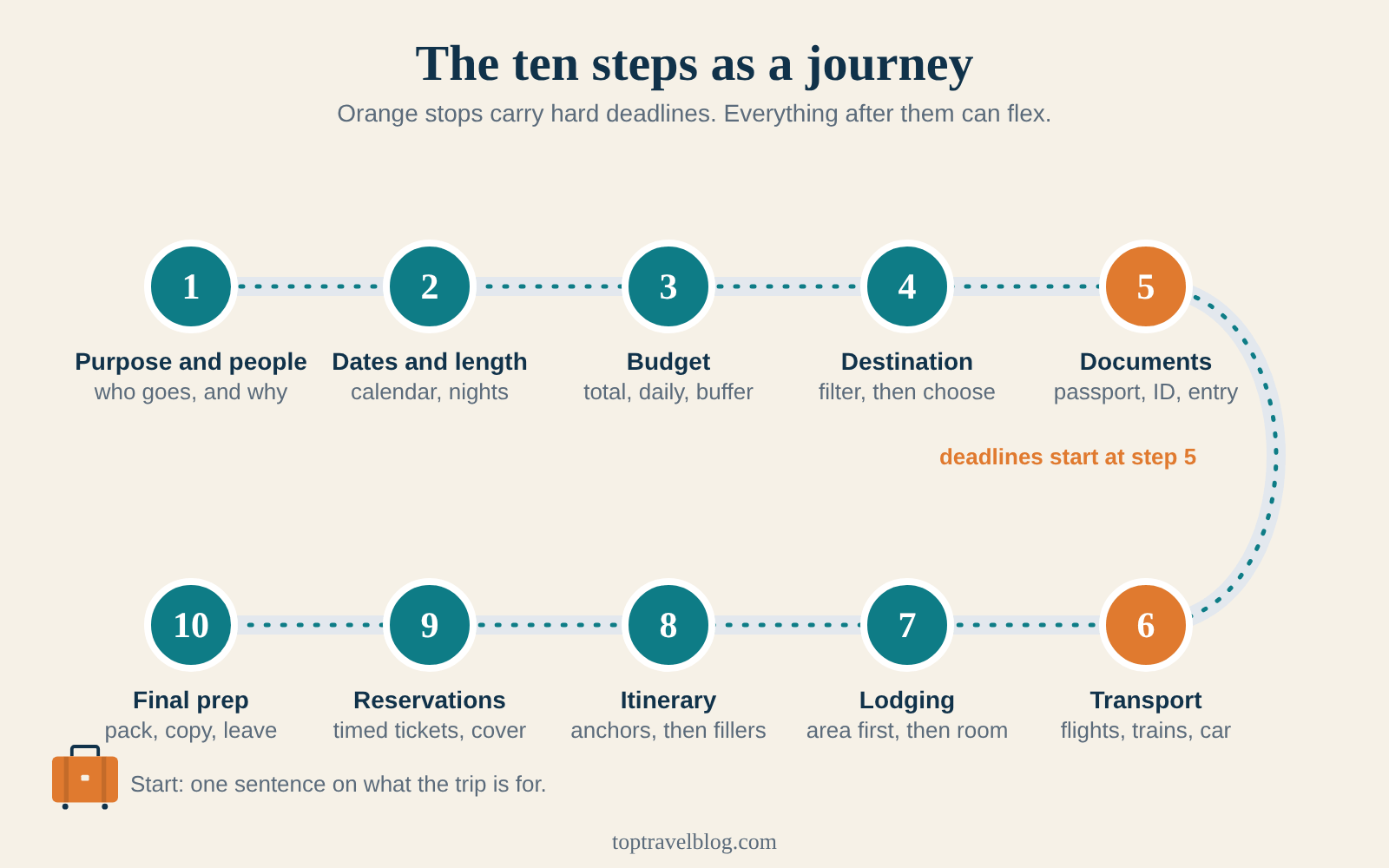
Start with the answer. How to plan a trip comes down to ten decisions made in a fixed order: why you are going and with whom, which dates and how many days, how much money, which place, whether your documents are valid, how you will get there, where you will sleep, what you will do each day, what needs a reservation, and what to sort out in the last two weeks.
Most attempts at how to plan a trip go wrong because people make these decisions in the wrong order. They book a hotel before they know their dates, or fall in love with a destination before checking that their passport expires too soon.
Do them in order and each choice in how to plan a trip narrows the next one. By step eight you are not staring at the whole internet, you are filling in a frame you already built. A weekend away takes an evening or two of this. A two-week international trip takes a few weeks of small sessions, spread across three to nine months.
This guide is the long version of how to plan a trip, written the way I would explain it to a friend planning a first big trip. It is also the hub for the rest of our planning library, so you will find links out to the deeper guides on flights, hotels, itineraries and trip length when a step needs more room than it gets here.
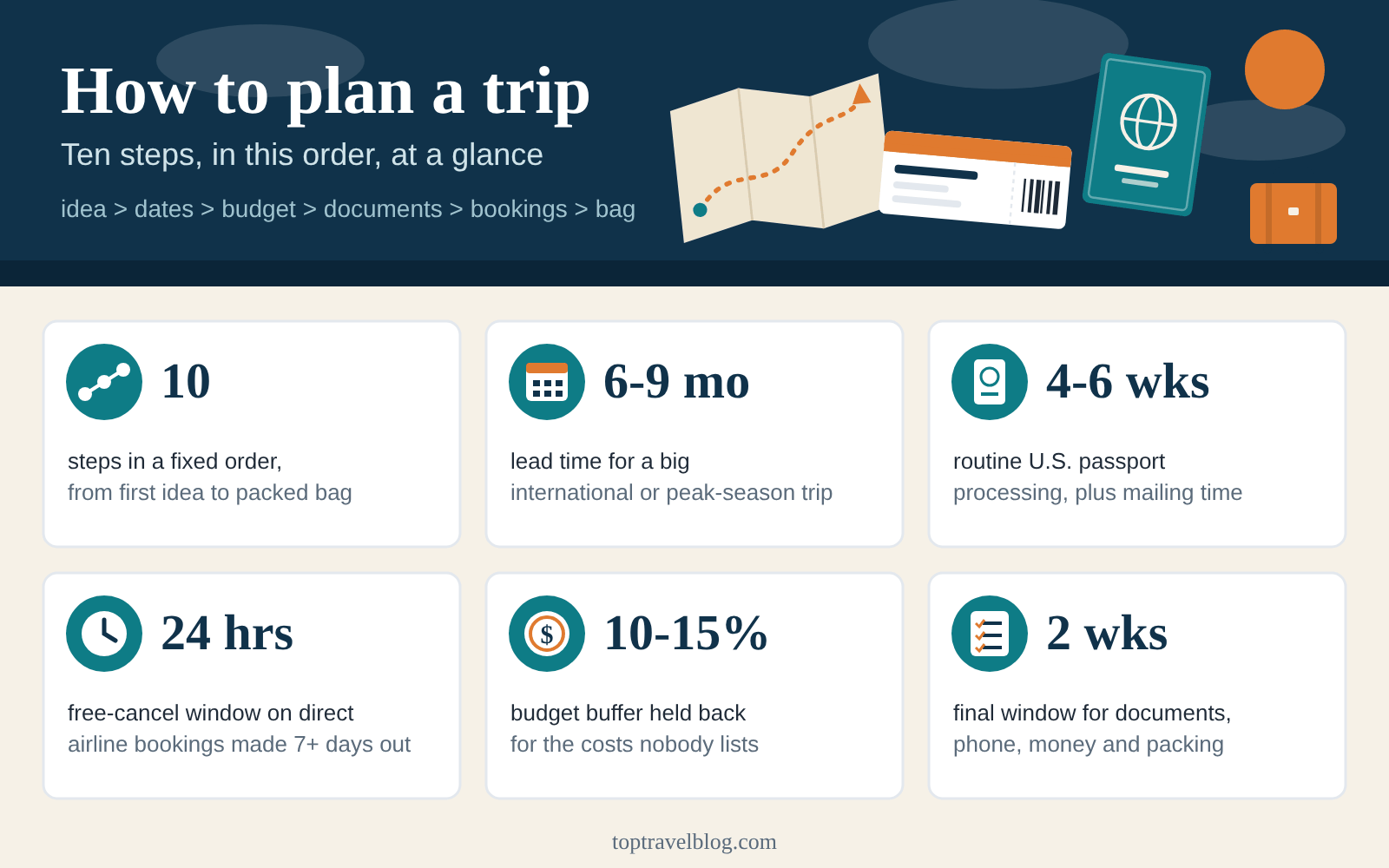
Quick facts: how to plan a trip at a glance
- Best for: first-time planners, anyone who feels overwhelmed by too many tabs, couples and families coordinating dates, and people moving from short getaways to longer or international trips.
- The ten steps: purpose and travelers, dates and length, budget, destination, documents, transport, lodging, itinerary, reservations, final preparation.
- Lead time: 2 to 4 weeks for a domestic weekend, 2 to 4 months for a week in the U.S. or Canada, and 6 to 9 months for a long international trip or a peak-season family holiday.
- The two deadlines that are not flexible: your passport (routine processing is 4 to 6 weeks, plus mailing, according to the State Department) and any ticket that sells out, such as a national park lodge or a timed museum entry.
- Time to plan: roughly 3 to 6 hours for a weekend, 10 to 15 hours for a week, 20 to 30 hours for a two-week international trip. Most of it is the itinerary step.
- What to avoid: booking nonrefundable anything before you have settled dates, budget and documents.
The method behind how to plan a trip: ten steps, one order
Think of a trip as a funnel. At the top is a vague wish (“somewhere warm in February”). At the bottom is a folder with confirmations, a day-by-day plan and a packing list. Every step in between removes options. That is the point. A trip you can describe in one sentence, with the dates, the people and a number for the budget, is easy to plan. A trip described as “Europe, sometime, cheap” is not.
In how to plan a trip, the order matters because of what each decision costs to reverse. Choosing a purpose and traveler list costs nothing to change. Dates cost almost nothing until you buy a ticket. Flights and hotels cost something to change, and the deposit on a tour or a rental costs more. So you settle the cheap-to-change questions first, and you commit money in the order that keeps your options open the longest.
The ten steps in plain language
Here is how to plan a trip in its shortest form, before the detail. You will see each of these as a numbered step further down.
- Purpose and people. What do you want the trip to do for you, and who has a say?
- Dates and length. The calendar, the school or work constraints, and the number of nights.
- Budget. A total, a per-day number and a buffer.
- Destination. One place, a region or a route, chosen against steps 1 to 3.
- Documents. Passport, ID, visas or travel authorizations, vaccines if relevant.
- Transport. Flights, trains or a car to get there, and how you will move around once you arrive.
- Lodging. The area first, the property second.
- Itinerary. Anchor activities, then pacing, then fillers.
- Reservations and extras. Timed tickets, restaurants, insurance, local SIM or eSIM, money.
- . Final preparation. Packing, home, phone, a printed folder and a last pass at the plan.
Why this order beats the “pick a hotel first” habit
Hotels are the most seductive thing to book early because the photos are good and the free cancellation feels safe. The trouble is that a hotel is a decision about a place and a date, and you have not settled either yet.
I have watched friends lock a refundable room, then discover that the flight on those dates costs $400 more than the flight three days later. They end up shifting the whole trip around a room they chose in a hurry.
Flights are the opposite problem. They are the expensive, least flexible piece, and fares move. Even so, you should not buy one until your documents and dates are certain. The sections below show where each purchase belongs in the sequence, and the countdown further down puts every deadline on a single timeline.
How long the whole process should take
For a domestic weekend, I give myself two to four weeks, mostly because good small hotels and restaurants fill up on Fridays. For a week-long trip inside the United States, I like to start about three months out; that is enough to catch decent fares and still find the room you want.
International trips deserve more room. Start six to nine months ahead if the trip falls in summer or around a holiday, or if anyone in your party needs a new passport.
None of that means you spend those months planning continuously. In practice, you do an hour or two of focused work every week or two, with long gaps where you simply wait for fares or a booking window to open. The gaps are not wasted. They are the reason a long lead time produces a better trip than a frantic one.
Step by step: how to plan a trip from first idea to departure day
The next ten sections are the working part of how to plan a trip. Read them once straight through, then come back to whichever step you are stuck on. Each one ends with a short rule I actually use, because the checklists you find elsewhere rarely tell you what to do when two good options collide.
Step 1
Decide what the trip is for, and who gets a vote
The first decision is the one people skip, and it quietly shapes everything. Ask what you want to feel at the end. Rested? Stimulated? Closer to your partner? Proud of having handled something hard? A beach week and a city museum week are both fine trips, but they are different trips, and you cannot plan for both at once.
Then write down who is coming and what each person needs. A teenager who wants a day with nothing scheduled, a parent who cannot do more than a mile of walking, and a partner who has always wanted one specific museum are all constraints. Naming them on day one prevents the argument on day four. For a deeper look at designing around a group, our guide to how to make a travel itinerary covers pacing for mixed energy levels.
Keep the purpose to one line. Mine usually reads like “five relaxed days in a walkable city with good food and no rental car.” That sentence will rule out half the destinations you are considering, which is exactly its job.
Tip: Ask every traveler for one must-do and one must-avoid before anyone opens a booking site. Two lists of two or three items each settle most disputes in advance, and they take ten minutes.
Step 2
Fix the dates and decide how many days
In how to plan a trip, dates come before destination for most people, because work, school and shared calendars are the hard limits. Start with the days you can actually be gone, then widen. If you have flexibility, build a short list of possible windows rather than one fixed week. Fares and hotel rates differ more by the week than by the destination, and a flexible window lets you take advantage of that.
Season matters more than people expect. A city that is perfect in October can be miserable in August, and a beach town can be pleasant in May and closed in January. When I compare two destinations for the same dates, I look at four things: daytime temperature range, rainy or monsoon season, major local holidays and school vacations, and the length of daylight.
The last one is underrated. A winter trip to northern Europe gives you only six or seven hours of useful daylight, which changes how you build an itinerary.
How many days you actually need
Length is a trade-off between travel time and experience. A good rule is to count the days you will spend there, not the days you are away. Long-haul flights eat the first and last day. If you cross six or more time zones, expect the first full day to feel half-speed.
For a U.S. city, three to four full days is usually enough for a first visit. For a theme park destination, plan on one day per major park plus a rest day. For Europe, I would not plan fewer than four nights in any single city you are flying into, and I would keep a two-week trip to two or three bases at most.
Our guide on how many days you need for a vacation goes through this by trip type.
Add one buffer day when you can. An empty day at the end of a trip is cheap insurance against a cancelled flight, a stomach bug or plain exhaustion, and it often becomes the day you remember best.
Step 3
Set the budget before you fall for a place
Any honest answer to how to plan a trip on a budget has three numbers: a total you will not exceed, a daily spending figure for food, local transport and activities, and a buffer of 10 to 15 percent for surprises. Write all three down. Most people only know the total, and then they cannot tell whether a given dinner is a fair choice or an overspend.
Break the total into categories in a rough order of size: transport to the destination, lodging, food, activities, local transport and everything else. For most trips, flights and lodging together take 55 to 70 percent. Food comes next. If your total is short, those are the first two places to look, and the savings usually come from dates and location rather than from skipping experiences.
Be honest about how you spend. If you know you buy a coffee and a pastry every morning, put it in the budget. If you will want one or two special meals, name them. A realistic budget that includes your habits is much more useful than an aspirational one that you quietly abandon on day two.
Money you forget to count
Several costs are easy to miss: checked bags and seat selection on budget airlines, resort or destination fees added at checkout, airport transfers, tips in the U.S., foreign transaction fees if your card charges them, travel insurance, pet or house care at home, and the ordinary bills that continue while you are gone.
A trip that looks affordable on the booking page can run 15 to 25 percent over once these appear. Our guide to how to choose a hotel explains how to read the total price, including fees, before you commit.
Tip: Pay for as much as you can in advance and use the daily number only for the rest. Prepaid flights and lodging are less tempting to renegotiate than a number sitting in your bank app.
Step 4
Choose the destination against your first three answers
Now you can choose a place, and this is where how to plan a trip becomes filters rather than daydreaming. Take your purpose line, your dates and your budget, and test each candidate against them. Does the weather fit those dates? Can you reach it without losing two days to connections? Does a realistic daily cost fit your number? Does it match what each traveler asked for?
I like to shortlist three places and score them quickly on four things: travel time from home, daily cost on the ground, how well the season fits, and how easy it is to be there without a car. The one that wins on three of four is usually right. The others go on a list for another year.
Narrow wide ideas to one decision
If your idea is broad, such as “Europe,” ask which part of it you actually want. Pick a country or a pair of nearby cities, then build outward. The mistake is trying to see five countries in ten days. Most of those trips become a tour of train stations.
If you want to stitch several places together, read how to plan a multi-city trip first, and look at whether open-jaw flights let you arrive in one city and leave from another without backtracking.
Domestic or international for a first big trip
If you are choosing between the two, ask what you are trying to learn. A domestic trip teaches you how you travel: your pace, your tolerance for crowds, what you pack and never use. It costs less to get wrong. An international trip adds a passport, different power sockets, different money and often a language barrier.
Neither is better, but if you have never done anything beyond a weekend away, a mid-length domestic trip is a gentle test run. Once you are ready for the next step, our first international trip guide is where I would send you.
The rule I use for how to plan a trip: choose the destination that fits the constraints, not the one that wins the most attention online. The best trips I have taken were rarely the ones I saw on a social feed.
Step 5
Sort out documents before you buy anything nonrefundable
Documents are the step of how to plan a trip with real deadlines, and it is the one I would never leave until later. Open your passport and read the expiration date. Many countries want at least six months of validity beyond your arrival date, and Schengen countries want at least three months beyond your planned departure, with the passport issued within the previous ten years.
Some airlines will refuse to board you if you do not meet the destination’s rule, and no refund follows.
If you need a new passport or a renewal, the State Department’s own figures set the schedule. At the time of writing, routine service takes 4 to 6 weeks and expedited service 2 to 3 weeks, and in both cases mailing can add up to two more weeks. Expediting costs an extra $60, and 1-to-2-day return delivery costs $22.05.
For a first adult passport book, I budget roughly $165 in total, because there is a separate acceptance fee on top of the application fee. The State Department passport pages list the current fee table and the appointment rules for urgent cases.
Domestic travel needs ID too
Since May 7, 2025, TSA has required travelers 18 and older to show a REAL ID-compliant license, an enhanced driver’s license, a passport or another accepted ID to fly inside the United States. A star on the top of your license usually means it is compliant. If yours has no star, a passport works instead, so a domestic trip is also a reason to look at what you have. TSA’s REAL ID page lists every accepted document.
Visas, authorizations and the new European entry rules
U.S. passport holders can visit many countries without a visa for short stays, but that does not mean there is no paperwork. Some places want an online authorization, a pre-arrival form or proof of onward travel. Search the destination on the State Department’s country information pages, then read the entry section carefully rather than relying on a forum post.
Europe has been changing. The EU’s Entry/Exit System registers non-EU visitors at Schengen borders with a facial image and fingerprints on the first entry; it is not a visa and there is nothing to apply for in advance, but leave extra time in the arrival hall at busy airports. A separate online travel authorization called ETIAS, widely described as costing about 20 euros and valid for up to three years, has been scheduled to come into force around the end of 2026 with a transition period.
The EU’s travel-europe site is where the official dates are published. Our international travel checklist keeps the full document sequence in one place.
Health, advisories and registration
Look up the country’s travel advisory level on travel.state.gov. Levels run from 1 (exercise normal precautions) to 4 (do not travel), and the text under each level explains specific regions or risks. Read the actual paragraph. A Level 2 country can be perfectly reasonable for most visitors, and a Level 1 country can still have a neighborhood or border you should avoid.
For health, the CDC’s travelers’ health pages list recommended vaccines and medicines by destination. Some need weeks of lead time. Enroll in the State Department’s STEP program so the embassy can reach you in an emergency; it takes five minutes. And if you take prescription medicine, carry it in its original container and bring a copy of the prescription.
Watch out: Do not buy a nonrefundable ticket until your passport is in hand or your renewal has a tracking number and a delivery estimate that clears your departure by at least two weeks. People lose more money to this one mistake than to any other in this guide.
Step 6
Book transport: how you get there and how you get around
Transport has two parts that people often blur: the long leg to the destination and the local movement once you arrive. Handle the long leg now and the local movement when you build the itinerary.
Flights: the search, the timing and the fine print
Search with flexible dates. Calendar and price-graph views on Google Flights or the airline sites show you the cheapest days and often reveal that shifting by a day or two saves $100 or more per ticket. Look at nearby airports too, and compare the total cost with the ground transport you would need. Our guide to how to find cheap flights goes through the search strategy and the traps in detail.
My timing rule of thumb is to start watching domestic fares about two to three months before a peak trip and book once you see a price you would be happy with. For international flights, start watching four to six months out and buy when the price is reasonable rather than waiting for a perfect drop that rarely arrives. Holiday weeks are the exception. Buy those early.
Read the fare class. Basic economy can exclude a carry-on bag, seat choice and changes, and the savings often vanish once you add them. For connections, I allow at least 60 to 90 minutes domestically and 90 minutes to two hours when you change terminals or clear immigration. If you are buying separate tickets for each leg, leave much more time, because the airline owes you nothing when the first flight runs late.
What the rules give you when plans change
The Department of Transportation says that for tickets bought directly from an airline at least seven days before departure, the airline must either let you cancel within 24 hours for a full refund or hold the fare for 24 hours at no charge. The same page says that if an airline cancels or significantly changes a flight and you decline the alternative, you are owed a refund.
The department defines a significant change as a departure or arrival three or more hours different on a domestic flight, or six or more on an international one. The details are on the DOT refunds page.
That 24-hour window is the most useful safety net in the whole process. Use it: book when you find a good fare, then spend the next day thinking about whether it still makes sense.
Trains, buses and cars
For trips of three to five hours on a corridor with good rail, such as Boston to New York or Paris to Brussels, a train beats a flight door to door. For rural regions, national parks and anywhere with limited transit, a car is usually the practical answer. If you are planning a driving trip, our guide on how to plan a road trip covers route, stops, fuel and backup plans.
Think about the unglamorous parts: the cost of airport parking, the price of a taxi at 11 p.m., and the transit pass that covers the route into town. They add up to a surprising share of the budget, and they are easy to settle now.
A note on stopovers and long connections
If you have a long connection abroad, you might turn it into a short visit. Some airlines allow a stopover of a day or more at no extra airfare. Read the rules in stopover vs layover before you assume it will be free, because the way the ticket is priced decides whether it is.
Step 7
Choose the area first, then the lodging
My rule for lodging in how to plan a trip is to pick where you will sleep by location, then by property. A mediocre hotel in the right area beats a beautiful one an hour from everything. Look at a map, mark the three or four places you most want to be, and find the neighborhood that sits closest to the center of those points with a direct transit line.
Then compare options on total price, not the nightly headline. Add taxes, resort fees and cleaning charges. Read the cancellation terms line by line, because free cancellation until two days before arrival is a very different product from free cancellation until the day you book. Our guide on how to choose a hotel explains how I weigh location, reviews, room type, fees and cancellation terms.
Hotels, apartments and everything in between
Hotels make sense for short stays, solo travelers and trips where you want daily housekeeping and a front desk. Apartments make more sense for families, groups, stays of a week or more, and destinations where you will want to cook. Read recent reviews from the last six months and look for patterns, not single complaints. Three people mentioning street noise or a long walk to the station is information. One person upset about a towel is not.
When to book
For most destinations, book a refundable room as soon as your dates are firm. That locks a decent rate without much risk, and you can still rebook if the price falls. For popular dates, such as national park summers, major festivals, cherry blossom season or the week between Christmas and New Year, refundable inventory can disappear months ahead. For a quiet shoulder season in a big city, you can wait.
Tip: Put a calendar reminder on the free-cancellation deadline of every refundable booking. It is the cheapest piece of discipline in travel planning, and it saves real money when plans change.
Step 8
Build the itinerary around anchors, not a minute-by-minute schedule
This is the step where most of your hours go, and it is also where trips are won or lost. The idea is to build in layers. First choose the anchors: the two or three things that are the reason for going, such as a museum, a hike, a show, a famous street or a family visit.
Put one anchor in each day, or one per half-day if they are big. Then add pacing, then fillers.
Place each anchor by geography. Group everything that sits near each other onto the same day and avoid crossing a city twice. A day that starts at the north end of town, jumps south for lunch and returns north for dinner can lose two hours to transit. That is the single biggest planning error I see in other people’s spreadsheets.
Pacing: how much a day can hold
Plan one major activity in the morning, one in the afternoon and a loose evening. Leave a gap of an hour or more in the middle of the day for lunch and a sit-down. For a first visit to a big city, I cap the walking at around eight miles a day; for older travelers or young children, I plan five.
Every fourth or fifth day should be light, with one anchor at most. Our dedicated guide to how to make a travel itinerary goes through the layers in more detail, including templates for slow and fast travelers.
Remember that opening hours decide the order. Many museums close one day a week, often Monday, and some churches and small sites close in the afternoon. Markets are best in the morning. Viewpoints want sunset, which means working out the actual time for your dates. Put those fixed-time items on the calendar first and build the rest around them.
Use real travel times, not map distances
A route that looks short on a map can take much longer in practice. Add the walk to the station, the wait for the train, any transfer and the walk at the other end. As a rough planning rule, I add 15 minutes to any transit estimate in a city I do not know. For intercity moves, count from door to door, including the time to reach the airport or station and get through security or boarding.
Rain plans, kid plans and slow-day plans
Write one indoor alternative for each outdoor-heavy day. A museum, a covered market, an aquarium or a long lunch will do. If you travel with children, add a playground or a snack stop to every day, because the plan that works is the one that allows for a meltdown. And if you are traveling in extreme heat or deep winter, move outdoor items to the part of the day when the weather is best.
Step 9
Handle reservations, insurance, money and connectivity
After the itinerary exists, how to plan a trip gets simpler, because you know exactly what needs booking. Make a list of the items with limited capacity: timed-entry museums, national park permits, popular restaurants, shows, ferries, guided tours, and any attraction that has a daily quota. Book those as early as the booking window allows, and then book everything else around them.
Some booking windows open far ahead. Certain national park lodges and permit systems release inventory months in advance, and some restaurants open reservations 30 days or more before the date. Look up the window for each item and put it on your calendar. The countdown further down gathers these into one timeline. For free-to-enter places, you can leave things loose.
Travel insurance
Insurance is a purchase you should understand before you buy. A policy can cover medical care abroad, trip cancellation for listed reasons, trip interruption, baggage loss and delay, and sometimes emergency evacuation. Your own health plan may not pay for care outside the U.S., and medical evacuation can cost tens of thousands of dollars.
Read what counts as a covered reason for cancellation, because most policies exclude simply changing your mind. Buy within the window that includes pre-existing condition coverage if you want it, which is usually a short period after your first trip deposit.
Your credit card may also provide trip delay or baggage coverage when you pay with it. Read the benefit guide and note what you need to do to activate it, such as paying for the full fare with that card.
Money, cards and phones
Bring two payment cards that work abroad, from different networks if possible, and keep them in separate places. Tell your bank about international use if it asks you to. Use a card without foreign transaction fees when you can, and when a terminal offers to charge you in dollars, choose the local currency; the dollar conversion nearly always costs more.
Carry a small amount of local cash for the first day, enough for a taxi or a snack when a card machine fails.
For your phone, compare your carrier’s international day pass with an eSIM, which is a downloadable data plan that works with most recent phones. For a week abroad, an eSIM is often cheaper, but the right choice depends on your plan. Download offline maps for your destination, which also save battery and data.
Documents, copies and emergency contacts
Take photos of your passport photo page, insurance card, prescription and reservation numbers, and store them in an offline folder and in a cloud service. Give a copy of your itinerary to one person at home. This costs nothing and is useful if you lose a phone or a wallet.
Step 10
Do the final preparation in the last two weeks
Two weeks out, how to plan a trip turns from decisions into logistics. Re-read every reservation and write down the confirmation numbers, addresses, check-in times and cancellation deadlines in one place. Work out the route from the airport to your first night’s lodging, including what you will do if you arrive late. Confirm that your card and your phone are set up for the destination, and set your home for an absence: mail, plants, pets, a light on a timer.
The packing list that actually works
Pack from the weather forecast and the itinerary, not from a generic list. Choose a color palette so that everything goes with everything, bring one pair of shoes you have already broken in, and stop at one carry-on and a personal item unless you have a reason for more. Keep medicines, documents, a charger and one change of clothes in your carry-on, because checked bags go astray at the worst moments.
Check the airline’s baggage rules for the specific fare you bought, and the rules for liquids and batteries. TSA’s 3-1-1 rule limits liquids in a carry-on to containers of 3.4 ounces or smaller, and spare lithium batteries and power banks must travel in the cabin, not in checked bags. Weigh your bag at home so that the airport counter holds no surprises.
The night before
Check in online, download boarding passes and put your phone, wallet, passport and keys in the same place. Charge everything. Set two alarms. Leave for the airport earlier than you think you need to: I aim for about two hours before a domestic departure and three before an international one, and I adjust for the airport’s reputation.
How to plan a trip in six common situations
The method for how to plan a trip stays the same across trip types, but the weight shifts. Here is how I would apply it in the six situations readers ask about most. Treat these as worked examples and substitute your own details.
How to plan a trip for a three-day weekend
With only three days, destination and transport carry most of the weight in how to plan a trip. Choose a place you can reach in under three hours door to door, book flights or a train for Friday evening or Saturday morning, and aim for no more than two anchors per day.
Skip the long list of attractions and choose a single neighborhood to live in. Our guide on planning a three-day weekend trip covers how not to overpack the schedule.
For a weekend, I would book the lodging first and the transport second, because the best small hotels disappear first and a train ticket is easy to find. That is the opposite of the long-trip order, and it is a good example of why the sequence is a guide rather than a law.
How to plan a trip for one week
A week is the easiest length for how to plan a trip: long enough to relax and short enough to keep a single base. Choose one city or region, give yourself five full days of activities, and protect the others as arrival, departure and one rest day. A weekly structure works well here: two heavy days, one light day, two heavy days, one flexible day. Use our 7-day vacation itinerary framework to reuse the same shape for different places.
How to plan a trip for two weeks
On a two-week trip, how to plan a trip is mostly a question of one slow place or two or three bases. I prefer two bases with a transit day between them, because three bases usually means a lot of packing.
Plan around travel days, and budget more for lodging changes and luggage. See our guide to planning a two-week trip for pacing, rest days and budget, and, if you are heading to the continent, the version for a two-week Europe trip.
How to plan a trip with several cities
The more cities, the more of how to plan a trip is really about movement. A useful limit is to count the transit time between each pair of cities and make sure that no single day loses more than a third of its waking hours. Think in pairs and trios of cities that are connected by fast rail or cheap short flights. The guide on multi-city trips goes through this arithmetic.
How to plan a trip by car
A driving trip changes the order of how to plan a trip. Start with the route and daily driving time, then place the overnight stops, then fill in activities along the way. Keep daily drives under five or six hours when you want to enjoy the stops. Book popular overnight stops early and keep one night flexible. Our road trip guide has the details on fuel, rest and backup plans.
How to plan a trip for your first time abroad
How to plan a trip abroad for the first time is mostly about removing unknowns. Choose a destination where English is common or where transit is simple, keep the stay to a week, and arrive on a weekday morning if you can. Save the paperwork for the front of the process and use the first international trip guide for the extra steps.
What to book and when: the countdown that makes how to plan a trip manageable
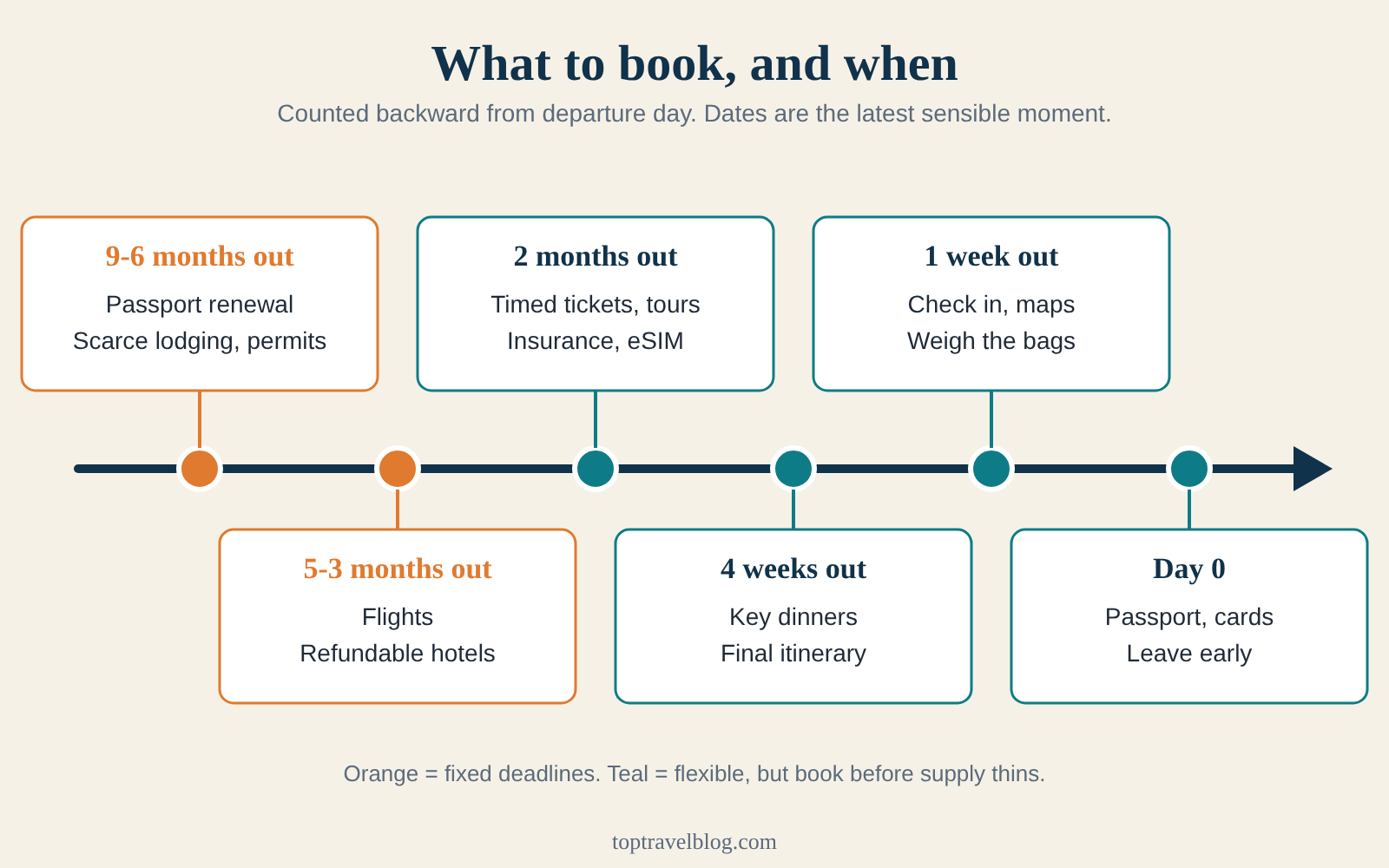
The ten steps of how to plan a trip tell you the order of decisions. The countdown tells you the order of deadlines, and they are not the same thing. Some things must be bought early because supply runs out. Some should be bought late because prices fall or plans shift. Here is the schedule I work from for a major international trip, counted backward from the day you leave.
Nine to six months out
This is the stage for anything with a long lead time. Renew or apply for passports. Choose the dates and the destination. Open a shared note with your travel partners. If your trip falls in peak season, or involves a national park lodge, a safari, a cruise, a train with limited seats or a big festival, book the scarce item now. Everything else can wait.
If you are saving for the trip, set up an automatic transfer. Divide the target budget by the months remaining and move that amount each payday. It sounds dull, and it removes the biggest source of stress, which is paying for everything at once.
Five to three months out
Book flights. For long-haul trips this is typically the window with the widest choice and reasonable prices. Book a refundable or flexible hotel for each stop, and start your itinerary draft. Look up the booking windows for timed-entry tickets and restaurants and put them on your calendar. If anyone needs vaccines, make the appointments now.
Two months out
Reserve the timed-entry attractions, tours and trains that you identified. Buy travel insurance if you want the benefit that applies shortly after the first deposit. Choose your phone plan or eSIM. Draft the packing list, which reveals what you need to buy, like a good pair of walking shoes, while there is still time to break them in.
Four weeks out
Reserve the dinners that matter. Check the long-range weather outlook and adjust the plan. Finalize the itinerary and share it with the people who need to see it. Review your lodging cancellation deadlines. If a fare has fallen significantly and your ticket allows changes, ask the airline whether it will reissue the difference as credit.
One week out
Check in online when it opens, usually 24 hours before departure. Download boarding passes, offline maps and the entertainment you want. Weigh your bags. Print or save every confirmation. Review the weather and trim the packing list. Let the bank know about your plans if it asks.
The day before and the day of
Do a last pass on documents: passport, ID, cards, medications, chargers. Leave early. When you arrive, send a quick note to the person at home who has your itinerary, and then enjoy it.
Tip: If this sequence for how to plan a trip feels heavy, collapse it into three checkpoints: lock the documents and dates, lock the flights and the scarce tickets, and lock the details. Every other decision slots into one of those three.
A full worked example: how to plan a trip for two people in eight nights
Abstract steps are easier to grasp with a concrete case, so here is a made-up couple, Maya and Dan, going through the process. They have eight nights in October, a total budget of about $5,500, and one rule: no rental car.
Steps 1 and 2: purpose and dates
Their one-line purpose is “slow mornings, great food, a few good walks, not too many hotels.” They have a fixed window, the second and third weeks of October, and they like cool weather. That already removes the hottest destinations and the ones with a long rainy season.
Step 3: budget
They set $5,500 as the ceiling and split it roughly into 30 percent for flights, 35 percent for lodging, 20 percent for food, 10 percent for activities and local transport, and a 5 percent buffer. They spend a little time asking themselves if a $60-per-night difference in lodging will change the trip, and decide it will not.
Step 4: destination
They shortlist three cities in Europe that are reachable on a direct flight from their home airport, and score them on cost, weather and walkability. One of them drops out because the flight would cost more than 30 percent of their budget. A second drops out because they want hiking within an hour of the city. The third wins on three of four counts.
Steps 5 and 6: documents and transport
Dan’s passport expires in five months. That is a problem for Schengen entry, which wants three months past departure, and it would also fall below the six-month rule that some airlines apply. He starts a renewal the same week, with routine service, six months out. Only after the tracking number appears do they buy flights, using the 24-hour window to rethink the fare.
Steps 7 and 8: lodging and itinerary
They choose a small hotel two blocks from a metro line, near the three places they most want to see. Then they build the itinerary: one anchor each day, one rest day in the middle, and a dinner reservation on the two nights that matter. They leave their last day nearly empty because the flight home leaves in the evening.
Steps 9 and 10: extras and final prep
They book two timed tickets, buy an eSIM, take photos of their documents, and plan the route from the airport to the hotel. Two weeks out they re-read every confirmation and put the details into one note. The whole process took about 18 hours, spread over five months. Nothing in it was difficult. It was only sequenced.
How much to budget when you plan a trip, in plain numbers
I do not give hotel room rates in guides, because they swing more than almost any other figure in travel, and a number I cannot support is worse than no number. What I can give you is the shape of a budget and the questions that move it.
The three layers of cost
First, the fixed costs: transport to the destination, lodging, insurance, visas or fees. These are known before you leave, and they usually account for most of the total. Second, the daily costs: meals, local transit, entry fees, coffee, tips and small purchases. These vary with your habits and the country. Third, the buffer, which exists because something will cost more than you expected.
Budget, mid-range and comfortable travel in prose
On a tight budget, you save by choosing cheaper dates, accepting longer routes, staying outside the center and eating the main meal at midday, when many restaurants run set-price lunches. The trade-off is time and some comfort, and it is a very good way to see a place if you are flexible.
At the mid-range, you pay for location. You stay near transit, take a taxi when you are tired, and book a few guided experiences where a guide adds real value. This is where most travelers find the best balance, because a well-located room buys back hours every day.
At the comfortable end, you pay for ease: direct flights, a nicer room in a quiet area, private transfers, and dinners without a time limit. The danger here is not the price but the temptation to book everything at that level. Mix tiers. Splurge on the two or three things you care about and spend modestly on the rest.
Where the money leaks
Airport transfers and taxis, restaurant tourist traps near major sights, resort and destination fees, baggage fees, currency conversion at poor rates, and unplanned souvenirs are the usual leaks. A written budget makes them visible. If you only fix one thing, fix the exchange-rate trap: always pay in the local currency.
When the budget does not fit
If the numbers do not work, change one of four variables, in this order: dates, destination, length, then comfort level. Shifting the dates by a week or choosing a nearby city often cuts 20 percent or more. Shortening the trip by a day is next. Cutting the comfort level comes last, because a trip you do not enjoy is not a saving.
For a thorough look at the flight side of the equation, read how to find cheap flights. On the lodging side, the guide to how to choose a hotel shows which fees to look for.
How to plan a trip to a big U.S. city: five worked examples
The easiest way to learn how to plan a trip is to watch the same method produce different answers in different places. Here are five American cities and what changes in each. They also link to the full day-by-day plans we have built with exactly this process.
New York City
Trip length: 4 full days
The scarce items are the Statue of Liberty crown or pedestal tickets, a Broadway show and a skyline observation deck at sunset. The city is built for walking and the subway, so skip the rental car.
The full plan is in our New York City itinerary, which shows how the scarce tickets fix the shape of each day.
Las Vegas
Trip length: 3 days
The scarce items are a few headline shows and one or two restaurant reservations. The real planning problem is heat and distance: the Strip looks walkable on a map and is not.
Our Las Vegas itinerary splits the days between the Strip and the places off it.
Orlando
Trip length: 5 to 7 days
Here the order of planning inverts. Choose which parks you want, then work out ticket type, then lodging by park access, then flights. Park days are long, so rest days matter.
The Orlando vacation guide works through tickets, areas and how many days you need.
Los Angeles
Trip length: 4 days
Distance is the central problem. Traffic turns a ten-mile move into an hour, so group each day by region and decide early whether to rent a car.
The Los Angeles itinerary groups beaches, neighborhoods and landmarks by area for that reason.
Miami
Trip length: 3 days
Beaches, neighborhoods and dining dominate, and the weather decides much of the plan: summer afternoons bring storms, and hurricane season runs from June through November.
The Miami itinerary covers South Beach, Little Havana and the places beyond them.
What the five have in common
In every case, the scarce item shaped the plan. In New York it was a ticket, in Orlando a park pass, in Los Angeles the freeway and in Vegas the heat. If you can name the single constraint that dominates a destination, you have understood most of how to plan a trip there. Everything else is detail around that constraint.
It is also why a template from one place rarely transfers to another. A New York plan stuffed into Los Angeles would collapse in traffic. A Las Vegas plan in Orlando would ignore the fact that the theme parks are the entire reason to go. Apply the ten steps, then let the destination change the weight you give each one.
Planning around the calendar: how to plan a trip in each season
Season is the variable that changes the most in how to plan a trip, and it is the one that people research least. A few notes from experience.
Winter
When you consider how to plan a trip in winter, short days compress sightseeing, so front-load outdoor activities and keep indoor ones for the dark hours. Snow and ice disrupt flights, especially through northern hubs, so avoid tight connections and book morning departures, which are less likely to be affected by earlier delays. Holiday weeks are expensive and crowded, so if you can travel the week after New Year, you often gain cheaper fares and thinner crowds.
Spring
Spring is a reliable choice for how to plan a trip for many destinations, with milder weather and lower prices than summer. Watch for school breaks, which cluster in March and April, and for local festivals that fill hotels. When you plan a trip for spring, ask whether the major sights will be open, since some mountain and island destinations have not yet started their season.
Summer
For how to plan a trip in summer, remember that it is the most expensive and most crowded period in most places. If you must go then, book early, start days early to avoid heat and lines, and take a midday break indoors. In hot regions, build the plan around morning and evening. For national parks, summer reservations can open months ahead.
Autumn
Autumn is my favorite season for how to plan a trip, because the crowds fall away while the weather is still good in many places. Foliage destinations have narrow peak windows that vary from year to year, so keep dates flexible, and book lodging early for the peak weekends. Hurricane season affects the Atlantic coast and the Caribbean into November, so look at flexible terms and insurance.
Staying aware without letting worry take over the plan
I never call a place safe, and I would be wary of anyone who does. Every destination has some risk, and it varies by neighborhood, hour and behavior. The useful question is what to be aware of and how to prepare, and the planning process has a place for each answer.
During step 5, read the advisory and the section for the specific regions you plan to visit. During step 7, read lodging reviews for comments on the area at night. During step 8, put late-evening moves on routes with good transit or a reliable taxi option. In step 9, buy insurance that covers medical care and evacuation, and enroll in STEP. In step 10, split your cards, copy your documents and share your itinerary.
Beyond that, use the ordinary habits of any city: keep your bag zipped and in front of you on crowded transit, be skeptical of strangers who approach with an offer, such as a free bracelet, a petition or a helpful stranger at a ticket machine, and use official taxis or ride apps rather than unmarked cars. These habits fit in one paragraph and prevent most of the unpleasantness that travelers meet.
Four planning styles, and which one fits the way you travel
There is no single correct way to approach how to plan a trip. People plan in different ways, and the best system is the one you will actually use. These are the four patterns I see most often, with the situation each one suits.
The Scheduler
Best for: first big trips, big groups, tight schedules
Every day has a plan, tickets are booked in advance and the route is mapped. This is the safest way to handle a popular destination with timed entries and limited availability.
The danger is rigidity. If you are a scheduler, protect two empty half-days so that one delayed train does not collapse the week.
The Anchor Planner
Best for: most travelers, couples, friends
One or two fixed anchors a day, with everything else open. It is the approach I use and the one that this guide builds toward.
It gives you the security of having booked the important things and the freedom to wander. The risk is leaving the anchors too late and finding them sold out.
The Base Camp Traveler
Best for: families, slow travel, longer stays
You pick one comfortable base and take day trips from it. Lodging is booked once, packing happens once, and the daily plan is light.
The cost is range. You will see less, but you will see it with less stress, and young children and older relatives usually travel better this way.
The Open Road Improviser
Best for: experienced travelers, road trips, flexible dates
Flights and the first and last nights are fixed, and the rest happens as you go. It can produce the best stories.
It works only if you are comfortable with last-minute searching and accept that peak-season places will be full. Never improvise around a holiday weekend.
If you cannot decide how to plan a trip your own way, begin as an anchor planner. It is the most forgiving style, and you can always move toward more structure or less as you learn how you travel.
How to plan a trip when other people are involved
How to plan a trip alone is simple because you are the only decision-maker. Add a partner, a family or a group of friends, and the logistics become social. The method does not change, but the order of two steps does: you need agreement on purpose, dates and budget before anyone searches for a destination.
Couples and friends
Agree on budget first, and agree on it in numbers. Most friction on friend trips comes from money, not from places. If one person wants to spend $300 a night and the other $120, you will either compromise on lodging or split the room types. Talking about that before booking is far cheaper than talking about it in the lobby.
Split the planning work. One person owns flights and documents, one owns lodging, one owns the daily plan. Share a single document with the bookings and the confirmation numbers. A group chat is not a planning tool, because the answer is always buried under forty messages.
Families with children
Children change the pacing rules. Plan one main activity a day, build in nap or quiet time, and pick a base within a short walk or ride of the highlights. Check age and height rules for attractions before you promise anything. Choose lodging with a kitchenette or a fridge when you can, because it saves money and solves the snack problem.
For flying, book seats together when the fare lets you, and compare airlines on their seat-assignment policies, since some charge for it. Keep the first day light, whatever the time zone, and expect the second day to be harder than the first.
Solo travelers
Solo travel is easy to plan and rewarding to do, and the main adjustments are about comfort. Choose lodging in an area with other people around at night, share your itinerary with someone at home, and keep a charged phone and a backup card.
Read recent reviews from other solo travelers. I do not call any place safe, and I do not think anybody can honestly do that, but you can read the advisory, read local guidance and know which areas and situations to approach with care.
Older travelers and mobility needs
Plan for rest and access. Choose lodging with an elevator and a step-free entrance, check how far the station is, and ask whether the sights you want have seats, ramps and accessible toilets. Many major attractions publish accessibility information on their own sites, and some offer priority entrance. Cut the number of daily anchors by a third, and consider hiring a driver or a guide for one or two hard days.
Traveling with a pet or a medical need
Pets add airline, lodging and border rules that vary widely; start the research at the very beginning, since vaccination and paperwork schedules can take weeks. If you rely on medication or a medical device, carry enough for the whole trip plus a few extra days, keep it in your carry-on, and carry a letter from your doctor.
The tools and systems that keep a trip organized
You do not need a special app. You need one place where everything lives. These are the pieces I use, in order of importance.
One master document
The core of how to plan a trip without losing details is to create a single note or document for the trip with sections for dates, budget, bookings, daily plan, contacts and packing. Put confirmation numbers at the top of each booking, with the address, check-in time and cancellation deadline. Share it with your travel partners and keep an offline copy. When something goes wrong at 11 p.m. in a foreign train station, you will be glad it is all in one place.
A map with pins
Open a shared map, save every place you are considering, and use colors or lists for categories: sights, food, lodging, transit hubs. Seeing them on the map is how you notice that the museum you picked and the restaurant you saved are a 40-minute ride apart. Download the area for offline use.
A calendar for deadlines
Put each booking window, cancellation deadline and passport milestone on your calendar with an alert a week ahead. The ordinary human habit of forgetting is the reason this exists.
A simple spreadsheet for money
One tab for the budget, one for actual spending. Update it once a day on the trip, in two minutes, and you will know where you stand. Photograph receipts for large purchases.
A short printed folder
Keep paper copies of the passport page, the first night’s lodging address in the local language, the insurance policy number and a list of emergency numbers. Phones fail, and a printed address helps when a driver does not speak your language.
Using official sources for what changes
Entry rules, fees, hours and timed-ticket systems change. For anything with consequences, use the official site: the State Department for entry rules and advisories, TSA for airport screening, the airline for baggage, the attraction’s own site for tickets and hours. Aggregators and blogs, including this one, are a starting point. The official page is where the current figure lives. For a quick rules summary before leaving, our international travel checklist lists what to settle and where.
Twelve common mistakes when you plan a trip, and how to avoid them
I have made most of these myself, and they are the usual reasons that how to plan a trip goes badly. They are listed roughly in the order they happen, which is also the order in which they get expensive.
- Booking before the documents are settled. A nonrefundable ticket bought before you have read your passport’s expiration date is the costliest mistake on this list. Read the date first, then buy.
- Choosing the destination before the dates and budget. You end up falling for a place that is rainy, closed or unaffordable in your window. Filter first, fall in love second.
- Ignoring total price. A low nightly rate or fare means little until taxes, fees, bags and transfers are added. Compare the final amount on the last screen.
- Overbooking the days. Four anchors a day looks efficient on a spreadsheet and feels punishing by day three. One major activity per half-day is a better ceiling.
- Planning with map distances instead of travel times. A ten-minute line on a map can be a forty-minute journey. Add the walk, the wait and the transfer.
- Too many bases. Every hotel change costs half a day. In a week, one base is better than three, and in two weeks, two or three is plenty.
- Skipping the cancellation terms. Free cancellation can mean different things. Note the exact deadline and the refund method for each booking.
- Leaving scarce tickets for later. Timed-entry museums, popular shows, park permits and certain restaurants sell out. Look up the booking window the day you finish your itinerary.
- Tight connections on separate tickets. If the first flight is late and the second is a different booking, you may pay for a new ticket. Leave a long gap, or book on one itinerary.
- . Forgetting the time zone. The first day after a long flight is not a full day. Keep it light and avoid booking an expensive dinner or tour for that night.
- . No buffer, in money or time. The trip with no spare day and no spare budget turns one problem into three. Keep both.
- . Relying on a single source. A video, a blog and a friend’s memory can all be out of date. Use official pages for rules, hours and fees.
The common thread in this list is order and slack. Nearly every mistake comes from deciding things in the wrong sequence, or from planning a trip so tightly that nothing can go wrong without everything going wrong.
Frequently asked questions about how to plan a trip
What is the first step in how to plan a trip?
The first step in how to plan a trip is purpose and people, not a destination. Write one sentence about what the trip is for and list who is coming, with one must-do and one must-avoid from each traveler. That sentence will narrow your destination choices far more than any search will, and it prevents the common problem of planning a trip that suits only one person in the group.
How far in advance should I plan a trip?
For a domestic weekend, two to four weeks is enough. For a week in the U.S., start two to three months ahead. For international trips, particularly in summer or around holidays, begin six to nine months out, and earlier if anyone needs a passport. National park lodges and big events can open reservations a year ahead, so research those windows first.
How long does it take to plan a trip?
How long how to plan a trip takes depends on the type. A weekend takes roughly three to six hours of real work, a week-long trip about ten to fifteen, and a two-week international trip twenty to thirty. Most of that time goes into the itinerary step. The elapsed time is longer, because you will wait for fares, booking windows and documents between sessions.
Should I book flights or hotels first?
For most trips, settle the dates and the documents, then book the flights, then a refundable hotel. For a short getaway to a place with a few good small hotels, book the room first, because it sells out faster than a train or a plane seat. In both cases, choose refundable options while the plan is still forming.
How much should I budget for a trip?
Set a total, a daily figure and a buffer of 10 to 15 percent. Flights and lodging together usually take more than half. Food, local transport and activities make up most of the rest. Because prices vary so much, build the budget from real quotes for your dates, and add the fees and baggage charges that appear at checkout.
How do I plan a trip on a tight budget?
For how to plan a trip on a tight budget, change the variables in this order: dates, destination, length, then comfort level. Travel in shoulder season, stay near transit rather than in the center, eat the main meal at lunch, and use free or low-cost attractions as your anchors. Keep a daily limit and track it. A cheaper trip you enjoy beats an expensive one you stress about.
How do I plan a trip to another country for the first time?
For how to plan a trip abroad the first time, choose a destination with straightforward transit and a lot of English, keep the stay to about a week, and handle the passport and any entry authorization first. Arrange an eSIM or roaming, tell your bank, carry two cards and some local cash, and book the first night in advance. Our first international trip guide goes into the details.
How many activities should I plan per day?
Plan one major activity in the morning, one in the afternoon and a loose evening. Leave a long midday break. For a first visit to a big city, up to eight miles of walking is a reasonable limit, and fewer for children or older travelers. Every fourth or fifth day should be lighter, with only one anchor.
Is travel insurance worth buying?
It depends on the cost of what you stand to lose and on what your existing coverage provides. For expensive prepaid trips, international travel where your health plan may not apply, or trips with medical risk, I buy it. Read what counts as a covered reason for cancellation, because changing your mind is usually excluded.
What documents do I need to travel?
For domestic flights, a REAL ID-compliant license or a passport, according to TSA. For international trips, a passport with enough validity and, depending on the destination, a visa or an online authorization. Look up the country’s entry requirements on the State Department site. Carry copies of your passport, insurance and reservations.
Can I plan a trip in one weekend?
Yes, how to plan a trip over one weekend works if the trip is short with simple logistics. In one weekend you can decide on purpose and dates, set a budget, choose a destination, book transport and a refundable room, and sketch a day-by-day plan. Leave reservations for scarce tickets for a second session. A long international trip needs more time, mostly because of the documents.
What is the best app or tool for planning a trip?
For how to plan a trip, the best tool is the one you will use. A shared document for bookings, a map with saved pins and a calendar for deadlines cover nearly everything. Specialized apps are useful for particular jobs, such as flight alerts or offline maps, but a single master note keeps you from hunting through email at the airport.
One last thing before you book
The mistake I made on my first big trip, long before I understood how to plan a trip, years ago, was treating planning as the work and the trip as the reward. I built a day-by-day spreadsheet so tight that I spent most of the first week feeling behind. The lesson that took me too long to learn is that the plan exists to protect the trip, not to fill it.
When people ask me how to plan a trip they will enjoy, I tell them to do the dull parts early: documents, dates, budget, the scarce tickets. Then leave real gaps. The afternoon you did not schedule is often the one you describe to friends afterward.
If you take one thing about how to plan a trip from this guide, make it the order. Purpose, dates, budget and destination first. Documents before nonrefundable money. Anchors before fillers. Reservations when the window opens. Slack everywhere. You will make a few mistakes anyway, and that is fine. The system is built so that a mistake costs you an afternoon, not a trip.
When you are ready to go deeper on a particular piece, the guides below pick up where this one leaves off.
Related planning guides
- Travel itinerary guide: how to make a travel itinerary — the day-by-day layer of this process, with pacing templates.
- How to find cheap flights — the search strategy and traps behind step 6.
- How to choose a hotel — location, fees and cancellation terms for step 7.
- First international trip — the extra layer of preparation for a first trip abroad.
- International travel checklist — documents, money and phone setup before leaving the U.S.
- New York City itinerary — a worked example of a four-day plan built with this method.