
The honest answer to how to plan multi city trip itineraries is a single number: count every move between cities as half a day, sometimes a whole one, and subtract it from your trip before you add a single sightseeing stop. A ten-day trip with four cities is not ten days of travel. It is closer to seven and a half, and the rest is spent in stations, airports, taxis and hotel lobbies.
Everything else about how to plan multi city trip schedules follows from that arithmetic. Pick fewer bases than you think you want, order them so you never backtrack, choose the transport for each leg by door-to-door time instead of the headline number, and book the flights as an open-jaw ticket so you do not spend a day returning to where you started.
I have built these trips across Italy, Japan, the Northeast corridor and western Europe, and I have also botched a few. A six-city, nine-day swing through Europe taught me more than any of the good ones: I came home with photos of platforms and a clear understanding of why most people regret the second-to-last city. What follows is how to plan multi city trip routes the way I do now, with real transit times, current entry rules for Europe, and worked examples you can copy.
Quick facts: how to plan multi city trip itineraries at a glance
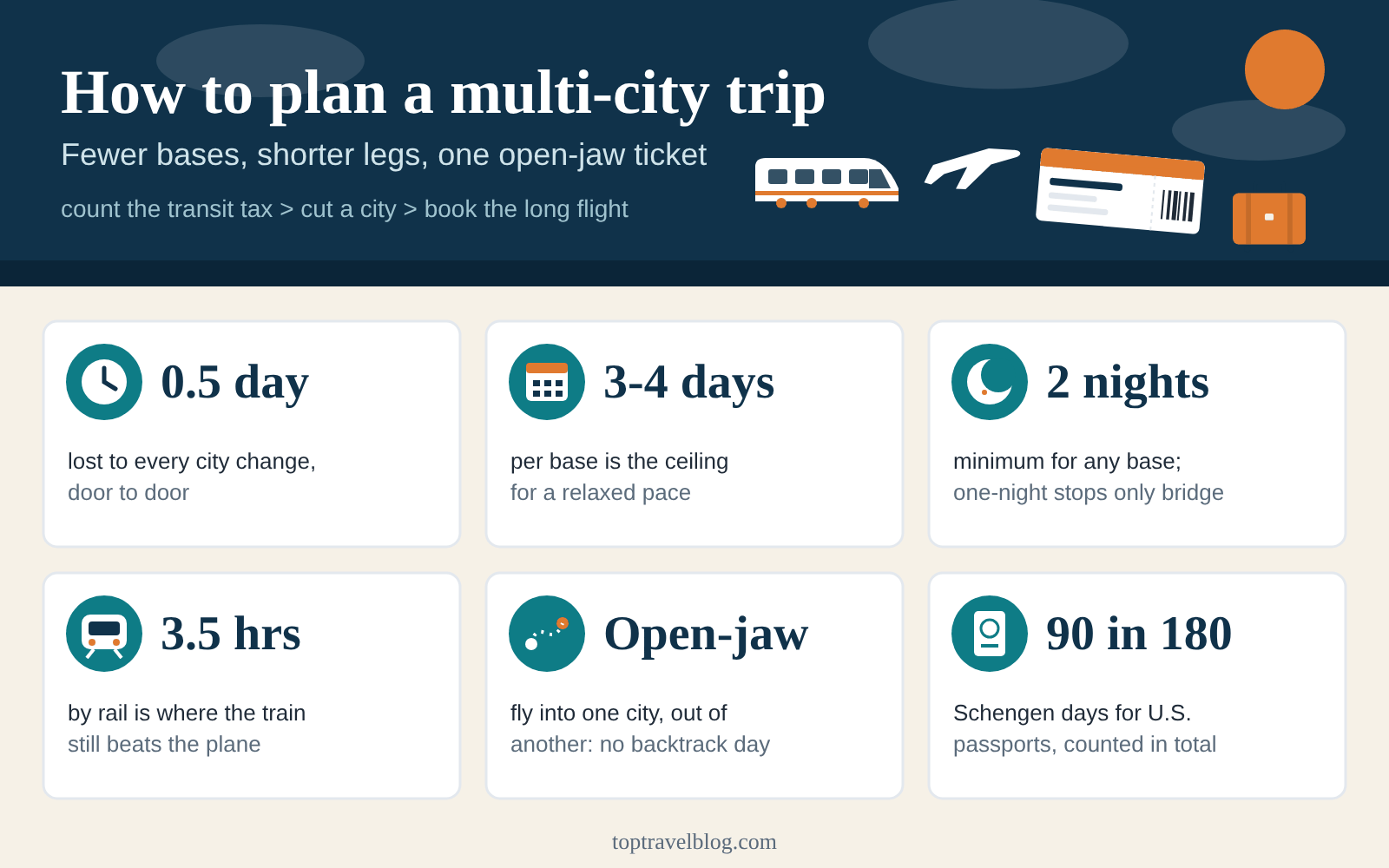
- The core rule: treat each city change as 0.5 to 1 day of lost time. A leg of two to three hours by train costs about half a day door to door; a flight costs most of a day.
- How many cities: roughly one base per 3 to 4 days. Five to seven days supports 2 cities, 8 to 10 days supports 3, two weeks supports 3 or 4, three weeks supports 4 to 6.
- Minimum stay: two nights per base is the floor. One-night stops only make sense as a deliberate bridge between two longer stays.
- Best route shape: a straight line or a gentle arc that ends in a different city from where it began, booked as an open-jaw ticket.
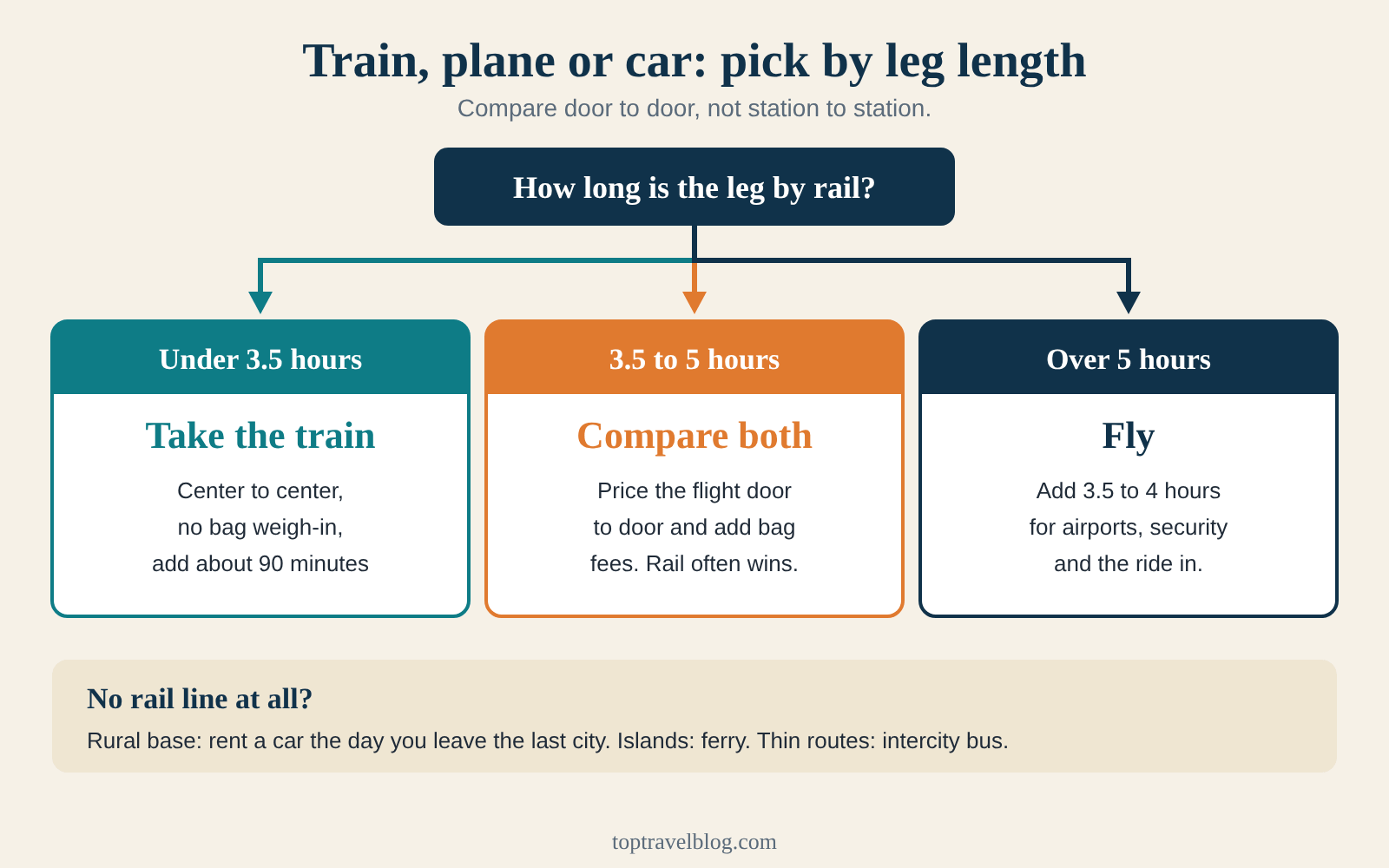
- Transport rule of thumb: under about 3.5 hours by rail, take the train; over about 5 hours, fly; in between, compare door-to-door time and total cost.
- Europe entry: Americans can stay up to 90 days in any 180 in the Schengen Area. The EU Entry/Exit System has registered non-EU visitors at the border since April 10, 2026, and ETIAS is not yet in force.
- Book first: the long-distance flight (open-jaw), the busiest city’s lodging, and any timed ticket that anchors a day.
The one rule behind how to plan multi city trip routes
Here is the math that changed my whole approach to how to plan multi city trip schedules. Say you have ten nights and you want Rome, Florence, Venice and Milan. Each city change involves checking out by 10 or 11 a.m., getting to the station, arriving about 20 minutes before the train, riding for one to two hours, then getting from the destination station to the hotel and waiting until 3 p.m. for the room.
Even on a short, easy train, that is a four- to five-hour disruption, and you are rarely at your best for any of it. Three changes in ten nights means you have given up roughly a day and a half before you have seen a thing.
I call these hours the transit tax, and it is the most useful idea in how to plan multi city trip schedules. A transit tax of half a day is fine for a city you love. It is a bad deal for a city you will see for 36 hours and half remember. When I look at a draft route now, I mark each change as a half-day or full-day cost and ask whether the city at the other end is worth that price.
Short legs do not escape the tax. A 30-minute hop feels free, but you still pack, check out, and haul bags through a station. The tax scales with distance, but it never reaches zero, which is why the first cut I make to nearly every ambitious route is the city with the thinnest reason to be there.
What counts as a “base”
In how to plan multi city trip terms, a base is a city where you sleep at least two nights and unpack at least part of your bag. Day trips from a base do not count as separate cities, and that is the trick that rescues many itineraries. From Florence you can reach Siena, Pisa or Lucca in an easy day. From Kyoto you can reach Nara and Osaka. From Paris you can reach Versailles, Giverny or Reims.
When you have a long list, ask which of the places can be a day trip from a base you already have. It usually removes one city and gives you a full evening back.
Door to door is the only honest measure
Operators advertise station-to-station times, which anyone working out how to plan multi city trip legs should ignore. Your trip is door to door. A rule I use: add 90 minutes to any train, and add three and a half to four hours to any flight, to account for getting to the departure point, security or boarding, the ride itself, baggage and the trip from the arrival point to your bed.
That means a 75-minute flight is a four- to five-hour transfer, and it competes with a three-hour train that leaves from and arrives in the center of town. The train wins more often than people expect, and the Italy and Northeast examples below show it.
Tip: Write each leg as “hotel to hotel” before you compare options. A two-hour train from a central station can beat a 55-minute flight between two airports that sit 40 minutes outside their cities, and it is quieter, with an easy luggage rack and no weight limit.
How many cities fit in the time you have
The most common mistake in how to plan multi city trip schedules is starting with the list of places and then fitting the days around them. Start with the days. A rough ceiling is one base per three to four days, and I hold to it unless every leg is under about two hours.
That rule gives a comfortable range for most trips. If you want a firmer guide to total length first, our piece on how many days you need for a vacation covers the trade-off between travel time and time on the ground.
5 to 7 days
Two bases, maybe one day trip
Pick two cities within about three hours of each other and stay three nights in each. A third city turns the trip into a transit exercise.
Example: New York and Washington by train, or Rome and Florence.
8 to 10 days
Three bases
Three nights, three nights, three nights, with every leg under three hours by train or one hop by plane.
This is where most people overreach. Three good bases beat five rushed ones.
12 to 14 days
Three or four bases
Add a slow stop, usually a smaller town or a coastal base, so there is a day that feels like a vacation.
One longer flight in the middle is acceptable if it replaces two long train days.
3 weeks
Four to six bases
Mix lengths: two bases of five nights, two or three of three, and leave a full unscheduled day.
At this length, laundry and fatigue become real planning inputs.
The pace test
Before I commit, I read the plan from the point of view of day six. By then you are carrying a mild fatigue that has nothing to do with sightseeing. You are tired of deciding where to eat, you want one hotel you do not have to leave, and your phone battery is always at 20 percent.
A route that has you changing city on day six, day seven and day eight is a route that will feel like a forced march no matter how pretty the cities are. Put the longest stay in the middle of the trip, not at the end.
When one city is the better trip
Sometimes the right answer is to stop. If your list has a city that needs three days to do well and another that needs three days and the whole trip is six, you are not planning two cities, you are planning two rushed halves. A single base with generous day trips often gives a richer trip than a pair of hurried ones. My test is simple: if I cannot name two things in the second city that I would be sad to miss, I drop it.
Choose a route shape before you choose cities
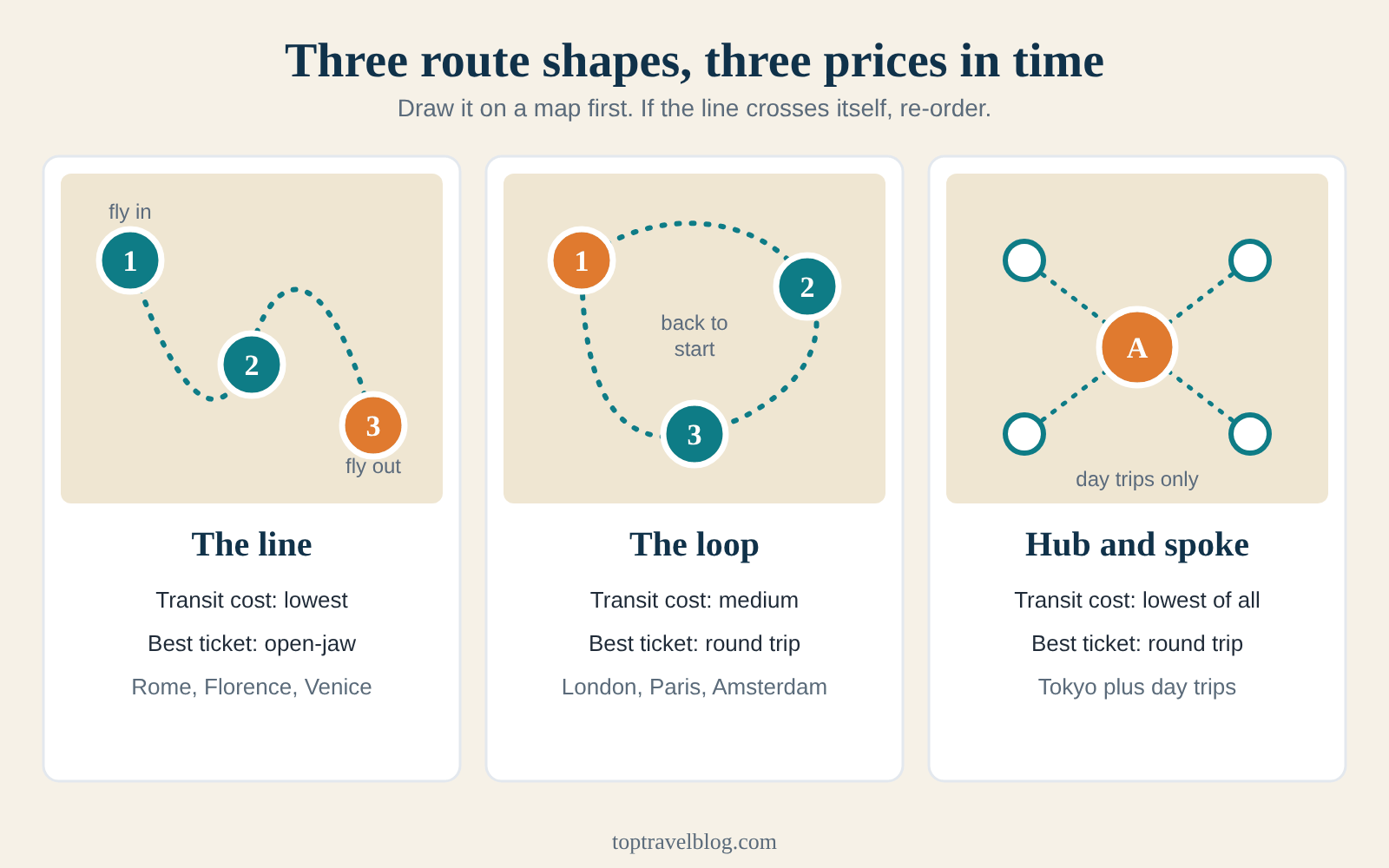
Once you know your number of bases, the next question in how to plan multi city trip routes is geometry. Almost every itinerary falls into one of three shapes, and each one has a different price in time.
The line
The simplest answer to how to plan multi city trip routes is a line: it runs from city A to B to C and ends somewhere new. It has no wasted legs, every move takes you forward, and it pairs naturally with open-jaw flights. Rome to Florence to Venice, or Tokyo to Kyoto to Hiroshima, are lines. If the geography allows it, this is my default.
The price of a line is that your arrival and departure airports are different, which is exactly what open-jaw tickets are for. Our guide to open-jaw flights explains how to price these, and in most cases they cost about the same as a round trip.
The loop
A loop, the other common answer to how to plan multi city trip routes, returns you to your starting city, usually because the cheapest or only airline route goes there. London, Paris, Amsterdam and back to London is a loop. It is fine when the return leg is itself a place worth a night, but it often wastes a day if the last stop is just a train back to the departure airport.
If you must loop, make the closing leg the shortest one and plan the final night near the airport or station you will use in the morning.
The hub and spoke
A hub-and-spoke trip, the gentlest form of how to plan multi city trip days, uses one base and radiates out on day trips. It is the lowest transit tax of all, because you unpack once. Lisbon with Sintra and Cascais, Tokyo with Nikko and Kamakura, or Paris with Versailles and Giverny all work this way.
The hub only works when the hub is well connected. A base with a trunk rail line and early trains opens a dozen excursions. A hotel in a hill town with two buses a day opens none.
The backtrack trap
The classic error in how to plan multi city trip routes is drawing a route that crosses itself: Venice, then Rome, then Florence, then Milan. On a map it looks like a collection of dots. On a train timetable it is two wasted legs. Whenever I sketch a route, I draw it on a paper map with a pencil and look for crossings. If the line crosses itself, I re-order until it does not.
The step-by-step method I use
Here is the sequence I follow every time. It is how to plan multi city trip logistics so that the expensive decisions are made last and the cheap ones first, and each step narrows the next.
Step 1
Fix your nights and your non-negotiables
Everything in how to plan multi city trip timing starts with the total number of nights, including the one before your first long flight if you are leaving from the U.S. Then write down the three things you refuse to compromise: one city you must see, one date that cannot move (a wedding, a festival, a timed ticket), and one thing you will not do, such as an overnight train or a rental car.
These three constraints will cut your shortlist faster than any research. If you are new to building the surrounding plan, the broader process in how to plan a trip step by step shows where this step sits in the larger sequence.
Do not skip the “will not do” item. People who hate driving still end up with a rental car on leg four because it looked cheap, and then spend two hours finding parking in a medieval center.
Step 2
Shortlist, then cut to the base count
The shortlist stage of how to plan multi city trip work is simple: write every city you are tempted by. Then give each one a single-sentence reason that would make you regret skipping it. Cities with weak reasons (“people say it is lovely”) are the ones to cut or turn into day trips.
Now count your bases using the cards in the section above and reduce to that number. Keep one reserve city in case a leg turns out to be harder than expected. For ten days that might mean Rome and Florence are locked, and Venice or Bologna is the optional third.
I find it helpful to rank the bases by how many nights each deserves, rather than assigning equal stays. The biggest city nearly always earns the most nights, while a smaller one can work at two.
Step 3
Order the bases and check for crossings
Put the cities on a map and find the path that makes a line, which is the neatest answer to how to plan multi city trip ordering. Start at the entry airport that is cheapest or easiest to reach from the U.S., not the one you like best. End at the city whose airport has the best onward connections home, because a delayed last-day connection is the one you cannot recover from.
If the line forces an awkward start or finish, check the alternative direction. Many Italy trips work in either direction, so price both and let the fare decide.
When the geography is unfamiliar, search for the rail map of the country on the operator site rather than a generic map, because train lines do not follow straight lines. Direct trains between two cities can be dramatically faster than a path that looks shorter.
Step 4
Price each leg door to door
For every leg of how to plan multi city trip transport, write down three numbers: the station-to-station time, the real door-to-door time using the 90-minute and four-hour allowances, and the cost per person. Add luggage and transfer costs. The rule of thumb is that a rail leg under about 3.5 hours beats a flight, a leg over about five hours favors flying, and anything in between is a spreadsheet question.
The transport section below walks through the cases by country. The point at this step is to find the leg that costs the most, because that leg decides whether the route works.
Step 5
Book the long-haul flight as open-jaw
When you decide how to plan multi city trip flights, search the multi-city (open-jaw) option on the flight search tool of your choice, entering your arrival city for the outbound and your departure city for the return. Compare it with the round trip into your first city. Where the price is similar, take the open-jaw ticket and save yourself a return leg.
Our guide on how to find cheap flights covers the search habits that keep the fare honest, including checking nearby airports and flexible dates.
Book this first. The long flight is the largest and least flexible expense, and fares on it tend to move more than rail or hotel prices.
Step 6
Lock lodging by base, not by night
For how to plan multi city trip lodging, book each base as a block, with a cancellable rate if one is available, and pick the neighborhood for the transport more than the view. For a train-heavy trip, a hotel within a ten-minute walk of the main station saves you a taxi on both ends and lets you drop your bags if the room is not ready.
Be strict about location in the cities where you will arrive and leave by train. A charming hotel across the river looks cheaper on the booking page, but it adds a taxi each way and 40 minutes on a travel day.
Step 7
Reserve rail and timed tickets, then add the fillers
The last stage of how to plan multi city trip work is reservations. Once the bases and dates are fixed, book the trains that need seat reservations (most European high-speed lines, the Shinkansen if you want a specific seat) and the timed tickets that anchor your best days. After that, add the fillers: a market, a walk, an evening.
I plan each base day by day only after these anchors exist. If you want a framework for the day-level part, our guide on how to make a travel itinerary shows how to keep it detailed without it becoming a to-do list.
Tip: Treat the first and last day of every base as a half day. Arrival days start at about 2 p.m. after you’ve dropped your bags, and departure days end by 10 a.m. Plan your big sights for the middle days only.
How to plan multi city trip legs: train, plane, bus or car
Transport is where a good route becomes a good trip. Deciding how to plan multi city trip legs is rarely about price alone, so I use a short decision sequence for every leg and let the numbers fall where they fall.
Trains: the default for anything under about 3.5 hours
High-speed rail is the best part of how to plan multi city trip transport in Europe and Japan, and it is decent in the U.S. Northeast. You board in the center of town, you have no baggage weigh-in, and the 90-minute allowance is generous. In Italy the fast trains between Rome and Florence take roughly an hour and a half, and Florence to Venice is about two hours. Rome to Venice is closer to four.
The Eurostar between London and Paris takes about 2 hours 16 minutes according to Eurostar, and a through-ticket between those two capitals is a better deal for your day than any flight. In Japan, the Nozomi from Tokyo to Kyoto takes roughly 2 hours 15 minutes.
In the U.S. Northeast corridor, Amtrak runs New York to Washington in about three hours on Acela and a bit over three on Northeast Regional trains, and Boston to New York in about 3.5 to 4 hours. For that corridor, I would not fly. You avoid two airport transfers and security lines.
Flights: for the long gaps
For how to plan multi city trip legs beyond about five hours of rail, flying wins, particularly when a low-cost carrier serves the pair. Madrid to Seville is about two and a half hours by high-speed train against a one-hour flight, and the train still often wins door to door. Paris to Rome is a flight. London to Edinburgh is a train of roughly four and a half hours that I enjoy, but a flight if you are short on time.
Beware the cheap fare that is not cheap. Low-cost carriers charge for carry-on bags, seat selection and sometimes printing a boarding pass, and they use airports that can be an hour from the city. Add all of that to the fare before comparing.
Buses and ferries: the underrated middle
Intercity buses are the slow, cheap corner of how to plan multi city trip transport, and they matter in places where rail is thin, such as parts of Portugal, Croatia, the Balkans and the Pacific Northwest. Ferries are the main connector for Greek islands, and the boat times in shoulder season are thin, so a missed ferry can cost you a day.
For overnight options, a night train or an overnight ferry can save a hotel night, but it is a trade: you save a night of lodging cost and lose a night of proper sleep. I use them once per trip at most.
Car: only when rail is a poor fit
In how to plan multi city trip work, a rental car makes sense when the base list is rural, such as Tuscany villages, the Scottish Highlands, or a national park loop. It does not make sense for a trip that is mostly big cities. Parking is expensive, drop-off fees can be steep for one-way rentals, and many historic centers restrict cars to residents.
If you do drive, pick up the car on the day you leave the last city, not when you arrive. A rental that sits in a garage for four days costs money and gives you nothing.
Putting a leg through the flow
Take the example of Florence to Venice. Station to station: two hours. Door to door: about 3.5 hours. A flight would be longer and need a connection. Train wins, no contest.
Now take Rome to Palermo: no practical rail. Flight takes 75 minutes, door to door about five hours. Fine. That is the one leg of the trip where a plane makes sense, and I would schedule it on a day with a late start.
The pattern in how to plan multi city trip legs is that most are obvious once you do the sum. The difficult ones are the 3 to 5 hour band, and in that band I lean toward rail because the schedule is more forgiving when something slips.
Watch out: On separate tickets, a delayed first flight does not entitle you to a rescue on the second. If you build a trip from two airline bookings, leave at least a half day of buffer before any leg that must be made, and keep the second booking refundable where you can.
Booking the long flight for a multi-city route
The long flight is the first thing I book and the part of how to plan multi city trip budgets that moves the most. There are three reliable ways to book it.
Open-jaw into one city, out of another
The first habit in how to plan multi city trip flights is to search “multi-city” instead of round trip. Enter New York to Rome for the outbound and Venice to New York for the return. Most airlines price this close to a round trip, and the savings in time are large. You skip the day back to Rome. The fuller explanation of when it helps is in the guide to open-jaw flights.
Round trip with a long positioning leg
If the open-jaw price jumps, buy a round trip into the cheaper city and pair it with a one-way train or budget flight. Check the sum against the open-jaw fare. On this approach you control the timing of the repositioning flight, which is useful when your last city is a small one.
Use a stopover to add a city
Some airlines let you add a free or cheap stop on the way. Iceland, Portugal, Turkey and the Gulf hubs all promote this. It can turn a connection into a bonus city, and our explainer on stopover vs layover shows how to tell a real stopover from a long wait.
What the DOT rules mean for your bookings
For flights to, from and within the United States, the Department of Transportation requires refunds when an airline cancels or significantly changes a flight and you do not accept the alternative. The department explains these rules at transportation.gov/airconsumer. Those protections cover tickets on a single booking, which is another reason I keep long-haul legs together.
Rules for flights entirely within Europe sit under EU passenger rights, which cover delay and cancellation compensation on most flights departing from an EU airport.
Borders, entry rules and passports across several countries
Learning how to plan multi city trip border crossings means accepting that a multi-country trip adds paperwork a one-city trip skips. For Americans going to Europe, it is not heavy, but it has some new parts in 2026 and 2027 that matter if your trip crosses several borders.
Schengen and the 90-day rule
Most of continental Europe belongs to the Schengen Area, which treats the member countries as one territory for short stays. U.S. citizens can stay up to 90 days in any 180-day period. Moving between France, Italy, Spain and Germany does not reset the clock, and there are usually no passport checks on the way, though some countries carry out spot checks.
The UK and Ireland are outside the Schengen Area, so a London-Paris leg is an international border crossing with passport control at the station. The UK also requires a travel authorization for Americans, called an ETA, before you board.
The Entry/Exit System
The EU’s Entry/Exit System has been fully operating since April 10, 2026. Non-EU visitors are registered on their first entry, which means fingerprints and a photo at the border kiosk, and every later crossing is checked against that record. The EU explains the system at travel-europe.europa.eu.
Queues at the first entry have been a real problem at some large airports in 2026. If your itinerary starts with a tight onward connection, add margin. A second thing to know is that the system tracks days precisely, so a long multi-country trip should count its days inside Schengen carefully.
ETIAS: not yet in force
ETIAS, the separate €20 online travel authorization for visa-exempt visitors, has been announced several times and delayed several times. As of November 2026, no firm launch date has been set, and reporting points to 2027, with a transition period after launch. For a 2027 trip, you should know it is coming and be ready to apply when it opens, but do not expect to need it for a spring trip.
Passports and the rest of the checklist
The first checkpoint in how to plan multi city trip paperwork is the passport, which needs to be valid for at least three months beyond your departure from the Schengen Area, with an issue date in the last ten years. Ask each traveler to check their own. For the wider list of tasks that sit around the border rules, our international travel checklist is where I’d start, and if this is your first time abroad, the first international trip guide adds the basics.
Three worked examples you can copy
Abstract rules about how to plan multi city trip schedules are easier to trust once you see them applied. These three routes are the ones I get asked about most, built with the same method.
Italy in 10 days: Rome, Florence, Venice
How to plan multi city trip flights for Italy is straightforward: the ordering is a line that ends in Venice, which means an open-jaw ticket into Rome and out of Venice. Nights: four in Rome, three in Florence, three in Venice. Rome to Florence is about 1.5 hours on a fast train, and Florence to Venice about two. Total time lost to moves: roughly a day and a half.
Add a day trip to Siena or Pisa from Florence and you have used the hub-and-spoke trick inside a line. My plan for Rome is in our Rome itinerary. On this route, Milan stays off the list unless you add three days, because Venice to Milan is another two and a half hours and the city is not what most people mean by an Italian first trip.
The mistake to avoid is Cinque Terre in the middle. It looks close on a map, but it adds a half-day each way by train and changes the whole route.
The Northeast in 7 days: New York, Philadelphia, Washington
This is how to plan multi city trip stops in the Northeast by rail alone: three bases, and no car. Nights: three in New York, one in Philadelphia, three in Washington. New York to Philadelphia is about 1 hour 20 minutes on the Northeast Regional, and Philadelphia to Washington is a little over two hours. Philadelphia is an exception to my two-night rule, because it is a bridge stop and the stations are in the middle of the city.
If you only want two cities, New York and Washington on Acela is an easy three-hour hop. Our New York City itinerary covers the first base. If you come from Boston, add a night at the start and flip the direction so you finish in Washington, where the airport has a Metro stop.
Japan in 12 days: Tokyo, Kyoto, Osaka and one outlier
For how to plan multi city trip stops in Japan, Tokyo, Kyoto and Osaka form a line along the Tokaido Shinkansen. Nights: five in Tokyo, four in Kyoto, two in Osaka, one extra if you add Hiroshima. Tokyo to Kyoto is about 2 hours 15 minutes, and Kyoto to Osaka is about half an hour on the JR rapid train.
Because Osaka is so close to Kyoto, many people stay in only one of them and day-trip to the other. Hotels in Osaka tend to be cheaper, but Kyoto is the place to sleep, so I use Kyoto as the base and treat Osaka as dinner. For the sights in each city, see our Tokyo itinerary and Kyoto itinerary.
The Japan Rail Pass rose in price in 2023 and again by roughly 5 to 6 percent on October 1, 2026, so on a simple Tokyo-Kyoto-Osaka line, individual tickets generally cost less than the pass. The pass still pays off on longer, more spread-out routes. The Japan Rail Pass site publishes the current pass types at japanrailpass.net.
Luggage, hotels and the logistics of moving every few days
Moving every three days is physically tiring, and the part of how to plan multi city trip logistics people forget is the bags. A trip with four bases and a 26-pound checked bag is a trip with eight lifts up and down station stairs.
Pack for the worst staircase
My packing rule for how to plan multi city trip luggage: plan to carry everything you own up one flight of stairs without help. That usually means one carry-on-size bag per person, and a daypack. If you must check a bag, make sure it is the last thing that goes on and the first that comes off, and don’t pack anything you’d need on the train.
Low-cost carriers are strict about carry-on dimensions in Europe, so a bag that passes on a full-service airline can cost you a fee at the gate. Measure it at home.
Use luggage forwarding in Japan
Japan has an excellent luggage-forwarding system called takkyubin. You hand your suitcase to your hotel front desk, and it arrives at your next hotel the following day for a fee that is typically a few thousand yen per bag. You travel with a small overnight bag on the Shinkansen. It is the single best trick for a Japan multi-city trip, and it is why I prefer Japan for first multi-city trips.
Also worth knowing: oversized suitcases on the Tokaido Shinkansen require a reservation for a seat with a luggage area, which is another reason to forward the big bag.
Station lockers and early arrivals
Most big stations have lockers or staffed luggage storage. They are worth the few dollars on a travel day when your hotel check-in is at 3 p.m. and your train arrives at 11. Drop the bag, walk the city lightly, and collect it later. Ask your hotel to hold bags on departure day as well so you can see the city after checkout.
Hotel logistics
Ask each hotel for check-in and late-checkout flexibility when you book. In my experience a polite request a few days before arrival is enough to get the room early about half the time. Choose a location in walking distance of the station for any base where you arrive late or leave early.
Many European cities charge a per-person, per-night city tax, collected at the hotel and not included in the booking price. Venice also charges day visitors an access fee, though overnight guests are exempt. These amounts are small per night but add up across four bases.
What a multi-city trip costs, honestly
How to plan multi city trip budgets starts with an admission: multi-city trips cost more per day than single-base trips. You pay for the moves, and you give up the discounts that longer stays bring. Here is how I think about the main pieces, without pretending to know your prices.
Transport is the line item that surprises people
For a ten-day, three-city Europe trip, the intercity rail on its own can run from under a hundred dollars per person to several hundred, depending on how early you book and which operators you use. Booking fast trains 60 to 90 days ahead often produces the lowest fares in countries that release them in advance, while same-day tickets for the same seat can cost several times as much.
Add local transit in each city, airport transfers at both ends, and luggage fees if any. These small items add up to a meaningful number, and I put them in a separate line when I budget.
Lodging: base, then neighborhood
In how to plan multi city trip budgets, lodging is the largest cost, and the easiest to control by deciding where you sleep. A hotel near a major station is often more expensive per night than one a short metro ride out, but the extra cost is repaid by saving a taxi and about 40 minutes on each travel day. Two or three nights per base also gets better rates than one-night stops, and some hotels add surcharges for a single night.
Three budget levels
At a lean level, you ride regional trains, use budget carriers carefully, choose smaller hotels outside the center, and cook or eat markets for half your meals. At a middle level, you book fast trains in advance, stay near stations, and eat out once a day. At a comfortable level, you add flights to skip the long legs, book a few private transfers, and pay for central rooms.
The gap between those levels is mostly lodging and the number of long legs. If a budget is tight, the first lever is fewer cities, not a cheaper hotel.
The hidden costs list
Before I lock any how to plan multi city trip budget I add: city tax, bag fees, seat reservations (compulsory on many European high-speed trains), airport express trains, a day of lost lodging for any overnight travel, and one or two unplanned taxis. Together they usually come to a few hundred dollars for a two-week trip.
What to book first, and when
Order matters more in a multi-city plan than in a single-city one, because a change in one booking ripples through the rest. This is the sequence I follow when I decide how to plan multi city trip bookings.
- Long-haul flights. First, because they are the largest cost and the least flexible. Choose the open-jaw route once you’ve locked the first and last city and the rough nights.
- Lodging in the busiest base. Second, preferably with free cancellation. Peak-season city centers fill up first, and a missing room in one city is the thing that breaks a line.
- Timed tickets that anchor a day. Third. These are the museum slots, the Vatican, the Last Supper in Milan, the Alhambra in Granada, a tower or a show. They fix the date of a stay, so the cities need to be arranged around them.
- Rail between bases. Fourth, when fares open. Many European operators release seats about 3 to 4 months ahead, and the lowest fares go first. If you are inflexible about the date, book earlier. If you are not, wait until the route is final.
- Lodging in the remaining bases. Fifth. These are the easiest to change, so they come last.
- Everything else. Restaurants, day-trip tours and local transit passes can wait until a few weeks out.
Refundable first, then fixed
For the first two weeks after you set the route, favor refundable rates. Your plan will change once you price the legs, and you don’t want to pay to change it. Lock down the non-refundable fares only after the route has survived a week of looking at it.
Keep a one-page master
My working document for how to plan multi city trip details is a single page with the dates, cities, confirmation numbers, check-in times and the transit for each leg, with the time of the first train marked in bold. It lives on my phone and as a printout. If you are traveling with others, share it. Multi-city trips fail on communication more often than on logistics.
Mistakes that cost the most time
These are the errors I see most often in how to plan multi city trip drafts, and most of them are the product of enthusiasm. Each one is cheap to avoid before you leave and expensive to fix after.
- Too many cities for the days. The number one reason people come home tired. If you have counted more than one base per three days, cut one.
- One-night stands. A single night in a city means two travel days for one evening. It is occasionally worth it as a bridge, but never more than once per trip.
- Ignoring door to door. Reading a 55-minute flight as 55 minutes. Always add the airport allowance, and compare with the train.
- Backtracking. Visiting a city twice because the route crosses itself. Sketch it on a map and look for the X.
- Booking the first and last days as full days. The arrival day starts in the afternoon, and the departure day ends in the morning. Plan around that.
- Scheduling a big sight on a travel day. Even a short train hop uses up your best hours. Keep sightseeing light on those days.
- Separate tickets with tight connections. If one is late, the second doesn’t wait. Leave a half day, or book as one itinerary.
- Forgetting seat reservations. Many high-speed trains in Italy, France and Spain assign seats and sell out. A rail pass doesn’t always cover the reservation.
- Late check-ins with no warning. Tell the hotel your arrival time. A hotel with a locked front door at midnight is not a good experience.
- Packing for the whole trip. The bag you can’t carry upstairs is the bag that ruins the third city.
The last-city problem
The city you visit last is the quiet risk in how to plan multi city trip schedules: it gets the least energy and the most risk, because you are tired and the flight home is the deadline you can’t miss. I give the last base the lightest plan, with no anchor tickets on the final full day, and I stay near the airport or station for the final night when the departure is before 9 a.m.
Frequently asked questions about how to plan multi city trip itineraries
How many cities is too many for a 10-day trip?
For a 10-day trip, how to plan multi city trip stops comes down to this: three bases is a comfortable maximum and two is a relaxed one. Once you pass one base per three days, you spend more than a quarter of the trip in transit. The test I use is whether you can name two things you would be sad to miss in each city. If you cannot, it is a candidate for a day trip or a cut.
What is the best way to plan multi city trip routes on a map?
Put every city on a map and draw a single line through them without crossing. Start at the airport with the best fare, finish at the one with the best onward connections, and note any leg longer than three hours. If the line crosses itself, re-order the cities. A rail map of the country, rather than a road map, shows which cities are actually connected by fast trains.
Is an open-jaw ticket always cheaper than a round trip?
Not always, but it is often close. Search multi-city and round-trip fares side by side, and count the cost of a return leg in time and money. When the open-jaw fare is a bit higher but removes a six-hour train or a flight, it is usually worth it. Fares vary by airline and route, so price both before you decide.
How long should I stay in each city?
In how to plan multi city trip stays, two nights is the minimum for a base and three is the sweet spot for a major city. Four to five nights suits large cities with a lot of day trips, such as Rome, Tokyo or Paris. One night works only as a deliberate bridge, such as a stop between a long flight and a train leg. Every extra night reduces the share of your trip lost to travel.
Should I take trains or fly between European cities?
My rule for how to plan multi city trip legs in Europe: take the train for legs under about 3.5 hours and compare door-to-door for the 3 to 5 hour band. Rail departs from the center, has generous bag rules, and avoids airport security. Flights win above five hours, or when a train route requires multiple changes. Remember that low-cost airlines charge for bags and often use airports far from the city.
Do I need a visa or ETIAS for a multi-country trip in Europe?
U.S. citizens do not need a visa for stays up to 90 days in any 180-day period in the Schengen Area. The Entry/Exit System has registered non-EU visitors at the border since April 10, 2026. ETIAS, a €20 online authorization, has no firm start date and is reported to be coming in 2027. The UK requires a separate electronic travel authorization for Americans.
Is the Japan Rail Pass worth it for a multi-city trip?
For a simple line such as Tokyo, Kyoto and Osaka, individual Shinkansen tickets usually cost less than a 7-day pass, especially after the 2023 price rise and the further increase in October 2026. The pass makes sense when you cover more distance, such as adding Hiroshima or the north. Add up the individual fares for your own route and compare.
How do I handle luggage when I change cities every few days?
The short answer on how to plan multi city trip luggage: pack a single carry-on-size bag per person, and keep a daypack for the train. In Japan, use hotel luggage forwarding so a suitcase arrives at your next hotel the next day. In Europe, use station lockers on travel days and ask your hotels to hold bags after checkout. Avoid anything you can’t lift up a flight of stairs on your own.
Can I plan a multi-city trip with kids or older relatives?
Yes. How to plan multi city trip days for kids or older relatives means fewer bases and longer stays. I aim for one base per four or five days, keep every leg under about two hours, and avoid early departures. Choose hotels with an elevator and a short walk to the station, because bags are the hardest part. Put the most active day in the middle of a stay and leave the travel days nearly empty.
What is the biggest mistake in how to plan multi city trip schedules?
Treating travel time as free. Every move costs half a day or more, and a plan that ignores that falls apart by day four. The fix is to subtract the transit tax before adding sights, and to cut the weakest city rather than shorten every stay. A trip with two strong bases is nearly always better than one with four thin ones.
One last thing before you book
If you remember only one idea from how to plan multi city trip planning, remember the transit tax. Count it, cut a city to pay for it, and book the long flight as an open-jaw. Everything else is detail that you can fill in over a few evenings.
The best multi-city trips I have taken had the same feel: one slow day in the middle, a base I wanted to stay at longer, and a final city where I had nothing to prove. That is what the route is for.
Related planning guides
- How to plan a trip step by step — the full process that this guide fits inside.
- Open-jaw flights explained — pricing the one-way-in, other-way-out ticket.
- How many days you need for a vacation — trip length against travel time.
- Stopover vs layover — turning a connection into a bonus city.
- How to make a travel itinerary — the day-by-day layer for each base.
- How to find cheap flights — the search habits that protect the fare.