Three days is enough for a first Kyoto trip, and it is the length this kyoto itinerary is built around. One day goes to Fushimi Inari, Kiyomizu-dera and the Gion streets in the east. One goes to Arashiyama in the morning and Nijo Castle and Nishiki Market after lunch. One goes to the Golden Pavilion, the Silver Pavilion and the canal path between them. Add a fourth day and you can slow down or take a train to Nara.
The verdict in one sentence: Kyoto works when you do the famous places early, before the tour buses arrive, and spend the middle of the day on a quiet garden, a long lunch or a seat in a tea house. This Kyoto itinerary suits first-time visitors, couples, friends and families with kids who can walk four to six hours a day.
It suits you less if you want nightlife (that is a short train ride away in Osaka) or if you dislike crowds so much that popular temples will wear on you.
I have been to Kyoto in cherry blossom week, in a July heat wave and on a gray December weekday with almost nobody around. What follows is the kyoto itinerary I would hand a friend: the order of days that keeps you from crossing the city twice, current admission fees and fares, which neighborhoods make good bases, the reservations that matter, and the mistakes I see people make on the stone steps outside Kiyomizu-dera by 10 a.m.
Quick facts: this Kyoto itinerary at a glance
- Best for: first-time visitors to Japan, couples, friends, families with school-age kids, anyone who likes gardens, history and long meals.
- Ideal trip length: 3 full days, with a fourth for Nara or a slower pace. Arrive the night before if you can.
- How to get around: city buses at a flat 230 yen, two subway lines, JR and Keihan trains for Fushimi Inari and Arashiyama, and a lot of walking. Tap an IC card for all of it. No rental car.
- Admissions on this plan: Fushimi Inari and the Gion streets are free; the paid temples and Nijo Castle add up to roughly 4,500 to 6,000 yen per person across all three days.
- Pacing: big sights before 9:30 a.m., a quiet midday, one evening walk. Plan on 15,000 to 25,000 steps a day.
- Key caveats: late March to early April and mid-November to early December are the two crowded peaks; July and August are hot and humid; Kyoto raised its lodging tax in March 2026; and a proposal could raise bus and Nijo Castle prices for visitors from April 2027.

Best time to go: when this Kyoto itinerary works best
If I could pick one window, it would be the second half of October through mid-November, or the last week of May. October days run mild and dry, the maples have not peaked, so crowds are manageable, and the city still feels like a city instead of a queue. Late May is green, warm and quieter than either famous season.
The two famous seasons are real, though, and you should know what they cost you before you book flights.
Late March to mid-April: cherry blossoms
Kyoto’s cherry blossoms usually peak in the first week of April, with the Philosopher’s Path, Maruyama Park, the Imperial Palace’s weeping cherries beside Konoe Pond and the riverbank at Arashiyama among the best spots. Nothing beats it, and nothing is more crowded. Hotels sell out months ahead and rates climb well above the rest of the year.
If you come then, start every day at 6:30 a.m., and treat my day plans below as a menu, not a schedule.
May and June: green and calmer
Late April through May is warm and reliably pleasant, apart from Golden Week at the start of May, when Japanese domestic travel peaks and trains and temples are packed. After that the crowds ease. Mid-June to early July is the rainy season, which is gray and humid but oddly good for moss gardens, and foreign visitors thin out. Pack a compact umbrella and quick-dry layers.
July and August: festival heat
Summer is hot, humid and a little oppressive. Highs sit in the low to mid 90s Fahrenheit, and midday walking between temples is hard work. The reward is festival season: the Gion Matsuri runs through July with big processions on July 17 and July 24, and the Daimonji bonfires light the hillsides on the night of August 16.
If you travel then, flip this kyoto itinerary so you hike and sightsee before 10 a.m. and again after 4 p.m., with museums, shopping arcades and long lunches in between.
Late September to November: autumn color
September is still warm and can bring typhoon rain. October is lovely. The famous maple color arrives from mid-November into early December, with Kiyomizu-dera, Eikando, Tofuku-ji and Arashiyama at their most photographed. Kiyomizu-dera also runs evening openings during the peak weeks, which sell the temple to a different crowd entirely.
Expect the highest hotel rates of the year in the last two weeks of November and the thickest crowds from mid-morning on.
December to early March: cold and quiet
Winter is the secret of this city. Days are cold, roughly 35 to 50 degrees, and snow on a golden pavilion happens maybe once a year, but temples are calm, hotel rates drop, and you can walk into a restaurant on a weekday. Short daylight is the catch: Ginkaku-ji closes at 4:30 p.m. from December to February, and Nanzen-ji at the same time.
Tip: Whatever month you choose for your Kyoto itinerary, build around two things: sunrise and closing times. Most temples open between 8:30 and 9:00 a.m. and close at 5:00 p.m. (4:30 in winter). The mornings are the only truly calm hours, and after 4 p.m. there is no second chance on the paid sites.
How many days you really need for a Kyoto itinerary
Three full days is the length I recommend for a first Kyoto itinerary. Here is what changes at each length, based on the version of the Kyoto itinerary I would give someone with that much time.
2 days in Kyoto: east and west
With two days, take Day 1 (Fushimi Inari, Kiyomizu-dera, Gion) and Day 2 (Arashiyama, then Nijo Castle or the Golden Pavilion) from this kyoto itinerary. You lose the Philosopher’s Path, which is the most pleasant walk in the city, and Nishiki Market gets squeezed into a late snack. Two days is a good length for a Japan trip that also includes Tokyo and Osaka.
3 days in Kyoto: the Kyoto itinerary in this guide
Three days gives each big sight its own half-day, keeps you in one part of the city per day, and leaves room for a long lunch and one evening with no plan. It also absorbs a rainy morning without breaking the schedule. The feeling at the end of two days is “I saw the postcards.” The feeling at the end of three is “I know where I would stay next time.”
4 or more days: now you can slow down
A fourth day opens up Nara, with its giant bronze Buddha at Todai-ji and the deer in the park, which is roughly 45 minutes from Kyoto by train. Or take a relaxed day at Uji for matcha, or in Kurama and Kibune in the northern hills. With five days I would add a tea ceremony, a cooking class and a slow morning at the Imperial Palace grounds.
Pairing a Kyoto itinerary with other places
Most readers fold Kyoto into a longer Japan trip. Tokyo to Kyoto by Shinkansen takes about two hours and twenty minutes, so our Tokyo itinerary for 5 days is the natural first half. The full route appears in our 10 days in Japan itinerary, which gives Kyoto three nights between Tokyo and Osaka.
Osaka is half an hour away by JR Special Rapid train, which makes our Osaka itinerary an easy second base if you want better nightlife and cheaper food.
Worth knowing: Count full days only. A 3 p.m. arrival from Tokyo and an 8 a.m. departure three days later is two days, not three. Use arrival afternoon for a walk around Gion or the Kamo River, a simple dinner and an early bed, and build the Kyoto itinerary below around days that start at 7 a.m.
Where to stay in Kyoto for a first visit
Kyoto has no single center, and the neighborhood you choose decides how many bus rides your trip contains. The city is a flat grid with the Kamo River running through the east side, the station in the south, and the famous temples spread around the edges like a ring.
My general rule for a first visit: sleep within a ten-minute walk of a subway station on the Karasuma Line or the Tozai Line, or near Kyoto Station if you are on a tight transit schedule. If you are weighing hotels, our guide to how to choose a hotel walks through location, fees and cancellation terms.
On price: business hotels near the station and around Shijo and Kawaramachi often cost far less than the same room in Tokyo, but rooms are small and prices spike at the two peak seasons. Boutique hotels and machiya townhouses in Higashiyama and Gion command premium rates, and a night at a traditional ryokan with dinner and breakfast can run to several hundred dollars per person.
I never quote a specific rate because they move weekly; compare the hotel’s own page against two booking sites and look at the total.
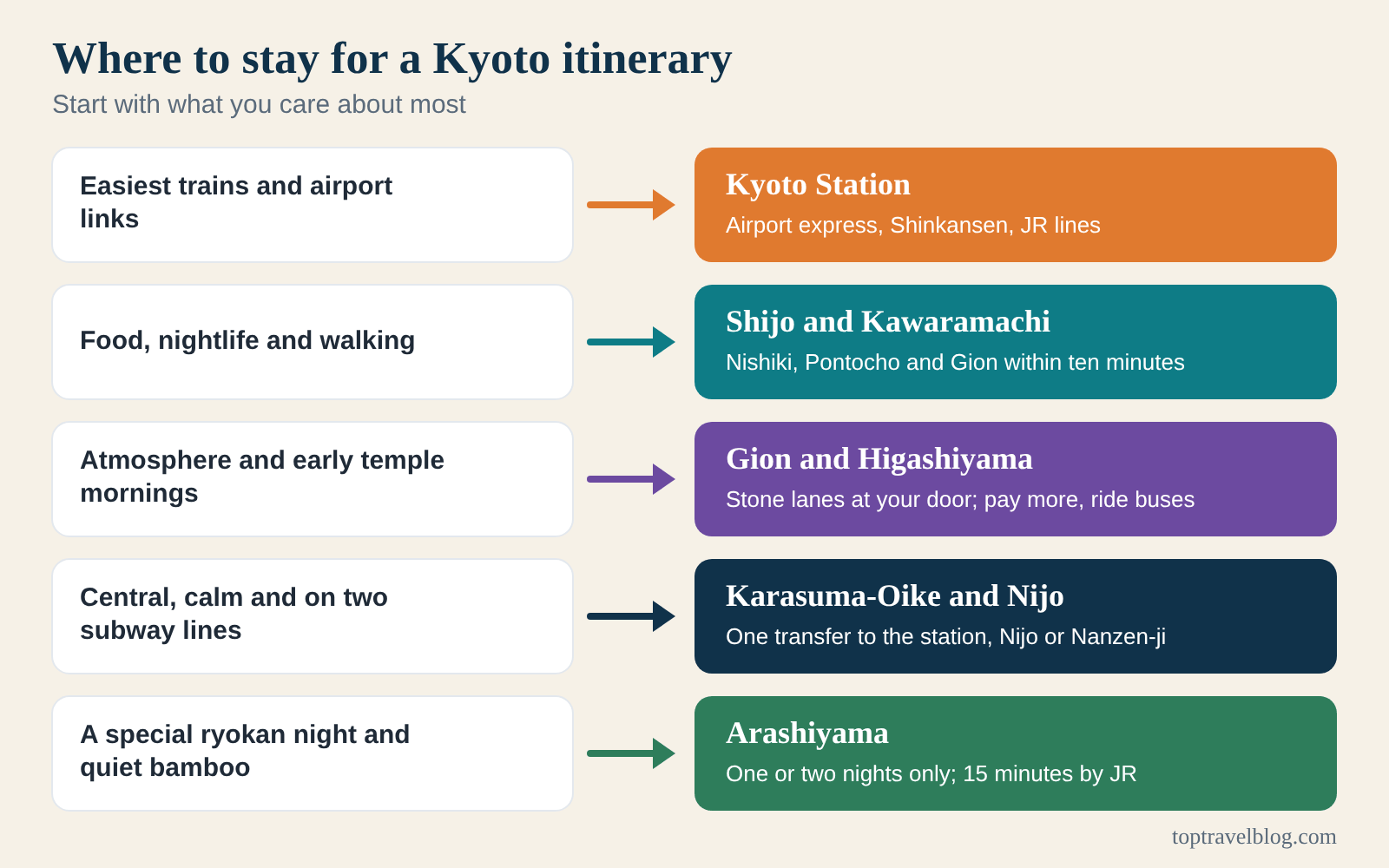
The five areas I recommend for a Kyoto itinerary, and who each one suits
Kyoto Station
Best for: transit-heavy trips, early starts, easy luggage days
This is where I put people on their first trip. Shinkansen, the Haruka airport express, JR trains to Fushimi Inari and Arashiyama, the Karasuma subway line and dozens of bus routes all start here. The station building has a ramen street and a huge food hall, and hotels cover every price.
The trade-off: the surroundings are modern and dull, and you will ride a bus or subway to reach almost any temple.
Shijo, Kawaramachi and Pontocho
Best for: food, nightlife, shopping, walkability
Downtown Kyoto sits between the Kamo River and Karasuma Street. Nishiki Market is a few minutes away, Gion is a ten-minute walk across the river, and the lanes of Pontocho and Kiyamachi have the best concentration of restaurants. The Hankyu line to Osaka stops at Kawaramachi.
Downsides: it is noisy on Friday and Saturday nights, and the rooms in older buildings can be tiny.
Gion and Higashiyama
Best for: atmosphere, couples, early temple mornings
Waking up near the stone lanes of Gion, Yasaka Shrine and Kiyomizu-dera is the most romantic way to do Kyoto, and you can reach Day 1 of this Kyoto itinerary on foot. Machiya guesthouses and ryokan fill these blocks.
The trade-offs are price and the daytime crowds in Ninenzaka and Hanamikoji, and few subway stops, so you rely on buses and taxis for Arashiyama and the north.
Karasuma-Oike and the Nijo area
Best for: central location, quieter nights, subway access
Karasuma-Oike is where the Karasuma and Tozai subway lines cross, which means one transfer takes you to Kyoto Station, Nijo Castle, Keage near Nanzen-ji, or Imadegawa for the Imperial Palace. The streets are residential and calm after dark, with plenty of cafés and small restaurants.
Fewer sightseeing crowds, but less atmosphere than Gion.
Arashiyama
Best for: one or two nights at a ryokan, bamboo at dawn
Sleeping out west lets you have the bamboo grove almost to yourself before 8 a.m. and the river at sunset after the day-trippers leave. It suits a special stay of one or two nights, especially at a riverside ryokan.
It is a poor base for the full three days: it is 15 minutes by JR from the station, 40 or more from the eastern temples, and quiet at night.
Lodging tax and what else to read before booking your Kyoto itinerary
Since March 1, 2026, Kyoto’s accommodation tax is charged per person per night on a sliding scale: 200 yen if the room is under 6,000 yen per person, 400 yen from 6,000 to 19,999 yen, 1,000 yen from 20,000 to 49,999 yen, 4,000 yen from 50,000 to 99,999 yen and 10,000 yen at 100,000 yen or more, as the Kyoto City Tourism Association lists. Most mid-range guests pay 400 or 1,000 yen a night, paid at the front desk.
Beyond the tax, read the cancellation terms, the distance to the nearest station in minutes, and whether breakfast is included. Ryokan prices are often per person, not per room.
The 3-day Kyoto itinerary, day by day
Each day of this Kyoto itinerary has one anchor area so you are never crossing the city twice. Mornings start early, because Kyoto’s biggest sights are better at 7:30 than at 10:30, and evenings are built to be dropped if your feet give up. Walking and transit times in this Kyoto itinerary are real-world times at a visitor’s pace, with photo stops and a wait for the bus.

Day 1
Fushimi Inari, Kiyomizu-dera and Gion at dusk
Early morning: Fushimi Inari opens your Kyoto itinerary
Take the JR Nara Line from Kyoto Station to Inari Station. It is the second stop, takes about five minutes, and costs 150 yen. The shrine is free and open at all hours, and the main gate is across the road from the station. Aim to be at the first torii by 7:00 a.m. By 9:30 the tunnel of orange gates is a slow-moving photo line.
The famous gates start just past the main hall and continue up the mountain.
You do not need to hike to the top. A climb to the Yotsutsuji intersection, the halfway viewpoint over the city, takes 30 to 45 minutes going up, and the gates thin out beyond it, which means fewer people and better photos. The full round trip to the summit takes two to three hours.
I turn around at Yotsutsuji, spend ten minutes on the view, and walk down a different path through the smaller shrines for a calmer descent. Budget about two hours total.
Late morning: Kiyomizu-dera
From Inari, take the Keihan line from Fushimi-Inari Station to Kiyomizu-Gojo, about ten minutes, and walk up Gojozaka and the lanes toward the temple. Expect around 20 minutes on foot, and wear shoes you can climb in. The alternative is a taxi, which is worth the fare on a hot day.
Kiyomizu-dera opens at 6:00 a.m. and closes at 6:00 p.m. (6:30 p.m. in July and August). Admission is 500 yen, and you should plan 30 to 60 minutes inside.
The wooden veranda looks out over the city and the autumn color, and the Otowa waterfall at the bottom of the hall is a short queue for three streams of water. Go early if you can, because by 11 a.m. the grounds are full of school groups and tour buses. If your hotel is in Gion, there is a strong case for reversing today and going to Kiyomizu-dera at 6:30 a.m., then Fushimi Inari later in the afternoon.
Midday: Ninenzaka, Sannenzaka and lunch
The stone-paved lanes that run downhill from Kiyomizu-dera are the Kyoto of postcards: low wooden shopfronts, tea houses, pottery stalls and shops selling yatsuhashi, the cinnamon-flavored rice sweets. They are also the most crowded streets in the city by lunchtime. Walk them anyway, but do not stop for lunch at the first place with an English menu.
Instead continue down to the Kodai-ji area or the back streets near Yasaka Shrine, where soba, udon and yudofu (tofu simmered in broth) shops have lines of locals. A set lunch costs roughly 1,200 to 2,500 yen.
Afternoon: Yasaka Shrine, Maruyama Park and Shirakawa
Yasaka Shrine stands at the end of Shijo Avenue and is free and open at all hours. Walk through, cross Maruyama Park, which has the old weeping cherry that is lit at night in blossom season, and wander toward the Shirakawa canal, a quiet row of willows and restaurant backs a few minutes north of Hanamikoji. This is where I slow down. Budget two hours with a coffee stop.
Evening: Gion and Pontocho
Gion’s main street, Hanamikoji, is public and open, and early evening is when you have the best chance of seeing a geiko or maiko hurrying to an appointment. Private alleys off the main street are closed to visitors, and local groups have posted signs, so stay on Hanamikoji and Shijo Avenue and do not chase anyone for a photo.
Cross the Kamo River by the Shijo bridge to Pontocho, a lantern-lit alley about 500 meters long, packed with restaurants, and have dinner there or one lane over on Kiyamachi, which is a little more casual.
Summer evenings from May through September bring the riverside terraces, called kawayuka, along the Kamo. They are pretty, a bit pricey and worth one dinner. In other seasons, Pontocho is still the easiest place to walk in without a reservation on a weekday and eat well for 3,000 to 6,000 yen per person.
If it rains: Fushimi Inari is still good in a drizzle (the gates shelter some of the path), but skip the summit hike. Swap in the Kyoto International Manga Museum or a long lunch in the Teramachi arcade, and move Kiyomizu-dera to the clearing hour in the afternoon.
Day 2
Arashiyama, Nijo Castle and Nishiki Market
Early morning: the bamboo grove and Tenryu-ji
Ride the JR Sagano Line from Kyoto Station to Saga-Arashiyama Station. It takes about 15 minutes and costs 240 yen, and then it is a 5 to 10 minute walk to the center of the district. Be there by 7:30 a.m. The bamboo path is free and always open, and at that hour you meet joggers and photographers, not tour groups.
By 10 a.m. it is a shuffle.
The path leads naturally from the north gate of Tenryu-ji, a UNESCO World Heritage temple with one of the loveliest pond gardens in Kyoto. It opens at 8:30 a.m.; the garden costs 500 yen, and entering the halls adds 300 yen. I go in for the garden at opening, then walk out through the north gate straight into the bamboo. The sequence works, and you avoid doubling back.
Late morning: Togetsukyo, the river and optional extras
Walk back toward Togetsukyo, the long wooden bridge over the Katsura River, and rent a rowboat or just sit on the bank. If you want more, there are three good options and you should pick one: Monkey Park Iwatayama (800 yen, a ten-minute uphill hike, open until 4:30 p.m. with last entry at 4:00), Okochi Sanso villa (1,000 yen including matcha and a sweet), or the Sagano Scenic Railway, a 25-minute ride along the Hozu River gorge.
I pick Okochi Sanso for its views, but the monkeys are fun with kids.
Lunch in Arashiyama is the tourist-pricing trap of the trip. Soba, tofu and tempura shops along the main street are fine, if not cheap, and the lines at the crepe and croquette stands are mostly for the photos. I would walk away from the bridge one or two blocks for a calmer set lunch.
Afternoon: Nijo Castle
Take the JR Sagano Line back toward the center and get off at Nijo Station, about a 15-minute ride. The castle is a 15-minute walk from there, or a short taxi ride. The Tokugawa shogun’s Kyoto residence opens at 8:45 a.m. and closes at 5:00 p.m., with last entry at 4:00. Castle admission is 800 yen, and the combined ticket that includes the Ninomaru Palace is 1,300 yen.
The Ninomaru Palace is the reason to go in. You walk in socks through painted-screen rooms on the famous nightingale floors, which squeak on purpose, and the garden outside is a good place to sit. Allow 90 minutes. Ninomaru Palace is closed on Tuesdays in January, July, August and December. If you are visiting then, swap in the Imperial Palace grounds, which are free and closed on Mondays.
Late afternoon: Nishiki Market and the arcades
From Nijo, take the Tozai subway line to Karasuma-Oike and walk, or take a taxi, to Nishiki Market, a covered lane about five blocks long with more than 100 shops, one block north of Shijo Avenue. Stall hours run roughly 10 a.m. to 6 p.m., and many close at 5, so be there by 4:30. Grazing here is the best food education in the city.
Try tamagoyaki (sweet rolled omelet), pickles, tofu doughnuts, grilled skewers and the seasonal sweets.
One rule matters: do not eat while walking. Stand at the shop or stall where you bought the food, finish it and move on. Locals consider walking and eating rude and a nuisance in such a narrow lane, and several shops post signs saying so. When you are done, the covered Teramachi and Shinkyogoku arcades run south and north from the market for shopping and coffee.
Evening: a proper dinner
Day 2 is the night I would spend on one real dinner. A kaiseki meal (a multi-course seasonal tasting menu) runs roughly 10,000 to 25,000 yen per person and needs a booking, usually a week or more ahead at good places. A cheaper alternative is an izakaya on Kiyamachi, or ramen at the ramen street on the top floor of the Kyoto Station building, where I end more nights than I admit.
If it rains: Arashiyama in rain is moody and fine for the bamboo, but the river paths get slick. Do Nijo Castle first, when the palace rooms are dry and calm, and save Nishiki Market for the afternoon. The market’s covered lane makes it the best wet-weather stop in the city.
Day 3
Golden Pavilion, Silver Pavilion and the Philosopher’s Path
Morning: Kinkaku-ji, the Golden Pavilion
Kinkaku-ji is in the northwest of the city and opens at 9:00 a.m., which makes it the one site on this Kyoto itinerary where you cannot beat the crowds with an early start. Arrive at 8:40, buy your ticket (500 yen), and be first through the gate. Plan on 30 to 45 minutes. The one-way path loops around the pond and past the pavilion, and the gold leaf glows best before noon.
From Kyoto Station, bus 205 takes about 40 minutes for 230 yen. A faster option is the Karasuma subway line to Kitaoji Station (15 minutes, 260 yen), then a bus or a ten-minute taxi ride. If you are staying near Karasuma-Oike, the subway plus a bus is fastest.
A short walk from the pavilion is Ryoan-ji, with its famous dry rock garden, if you want a quieter second stop.
Midday: cross the city to the eastern hills
This is the one long transfer of the trip, and I accept it because the two pavilions are worth pairing. Take a cross-town bus toward Ginkaku-ji, a ride of 40 to 50 minutes, or a taxi of about half an hour if the group is large. Eat on the way, in the Demachiyanagi area or in one of the soba and curry-udon shops on the approach to the Silver Pavilion.
Afternoon: Ginkaku-ji and the Philosopher’s Path
Ginkaku-ji, the Silver Pavilion, costs 1,000 yen and is open 8:30 a.m. to 5:00 p.m. from March to November and 9:00 to 4:30 p.m. from December to February. It was never covered in silver; the real attraction is the raked sand garden, the moss, and the path that climbs to a viewpoint over the grounds. Give it 45 minutes.
From the exit, the Philosopher’s Path begins. It follows a canal for about two kilometers, lined with cherry trees, small cafés and temples such as Honen-in, and runs south toward Nanzen-ji. Walk it slowly. In cherry season it is jammed; in winter you might have it to yourself.
Total walking time depends on how many cafés you stop at; I allow 60 to 90 minutes.
Late afternoon: Nanzen-ji and tofu
Nanzen-ji is a large Zen temple complex, and the free brick aqueduct, Suirokaku, behind the Sanmon gate is a favorite for photographs. The Sanmon gate (600 yen) has a viewpoint over the grounds, and the Hojo hall with its rock garden also costs 600 yen. Both are open from 8:40 a.m. to 5:00 p.m. (4:30 from December to February), and admission closes 20 minutes earlier.
The neighborhood is known for yudofu, so end the temple day with a tofu set meal.
To get back, walk five to ten minutes to Keage Station on the Tozai subway line, or ride the Tozai line a few stops to Karasuma-Oike for the center. From Keage to Kyoto Station takes about 20 minutes and costs 260 yen.
If it rains: Swap the order. Do the Philosopher’s Path and Nanzen-ji only if the rain is light; in a downpour, spend the morning at Kinkaku-ji (the gold looks even better against gray) and the afternoon in the Kyoto Station complex, Nishiki’s arcades or a tea house with a window.
Getting around your Kyoto itinerary: buses, trains, taxis and airport transfers
You do not need a rental car, and you should not want one. Kyoto’s streets are narrow, parking is scarce and expensive, and the temples all have train, subway or bus access. On any Kyoto itinerary you do need an IC card (Suica, ICOCA or Pasmo, on a plastic card or in your phone wallet) that works on buses, subways and JR trains, so you never fumble for change.
City buses
Inside the central zone, a city bus ride is a flat 230 yen. You board at the back, take a ticket if you are paying cash, tap your IC card on the reader as you leave at the front, and pay when you get off. Buses reach every major site on this Kyoto itinerary, but in peak seasons they are slow and packed with luggage, and they can skip a stop when full.
The old bus-only day pass is gone, so just tap and pay per ride.
One thing to know about 2027: Kyoto’s mayor proposed in October 2026 a two-tier fare system for city buses, starting in the fiscal year that begins in April 2027, in which residents would pay 200 yen and visitors from outside the city 360 yen. The same proposal would price Nijo Castle at 2,000 yen for non-residents against 1,000 yen for residents. It is a proposal that goes to the city assembly in November, not a final rule, so I quote 230 and 1,300 yen throughout this guide.
Subway, JR and private railways for a Kyoto itinerary
Kyoto has just two subway lines. The Karasuma Line runs north-south through Kyoto Station, Shijo and Karasuma-Oike up to Imadegawa and Kitaoji, and the Tozai Line runs east-west through Nijojo-mae, Karasuma-Oike and Keage. A ride from the station to Shijo costs 220 yen and to Karasuma-Oike or Imadegawa 260 yen.
JR covers Fushimi Inari (Nara Line) and Arashiyama (Sagano Line), and the Keihan line serves the Kamo River’s east bank from Fushimi Inari to Gion-Shijo.
Walking, taxis and bikes
Central Kyoto is flat and you will walk 10 to 15 kilometers on a typical day. Taxis are plentiful, clean and metered. I use them for three things: a hill you do not want to climb (Kiyomizu-dera, Ginkaku-ji), a short hop between sights when the bus is late, and any trip back to the hotel after dinner. Split among three or four people, they can be cheaper than the bus.
Rental bikes work well in the flat center but not on temple hills.
Arriving: from Kansai Airport, Osaka, Tokyo and Itami
From Kansai International Airport, the JR Haruka limited express runs directly to Kyoto Station in about 80 minutes, with trains roughly every 30 minutes. The fare is around 3,000 yen for an unreserved seat and roughly 3,600 yen for a reserved one. It is the easiest transfer, with luggage racks and no changes.
From Osaka Station, the JR Special Rapid takes about 30 minutes for 580 yen, and the Hankyu line from Osaka-Umeda reaches Kawaramachi in about 40 minutes for 410 yen.
From Tokyo, the Nozomi Shinkansen takes about 140 minutes, and a ticket costs about 13,300 yen unreserved or roughly 14,000 yen reserved, according to Japan Guide’s Kyoto transport page. Itami Airport is about an hour from central Kyoto by bus. If you land in Tokyo, our cheap flights search strategy explains how to compare an open-jaw ticket into Tokyo and out of Osaka.
What this Kyoto itinerary costs per day
A Kyoto itinerary is cheaper than most travelers expect. Temples cost 500 to 1,000 yen each, a good lunch is 1,000 to 2,000 yen, and transit rarely tops 1,000 yen a day. The room is the big number. At about 150 yen to the dollar, which is how I do quick math, 1,000 yen is roughly $6 to $7.
Budget: roughly $90 to $130 a day per person
A hostel bed or a small business-hotel room shared by two at $40 to $70 per person. Transit of 600 to 900 yen a day. Convenience-store breakfast, a noodle or set lunch at 1,000 to 1,500 yen, and dinner at a ramen shop or izakaya for 1,500 to 3,000 yen. One or two paid temples a day. It is a very good trip, and you never miss a major sight.
Mid-range: roughly $200 to $320 a day per person
A comfortable hotel or a small boutique stay at $100 to $200 per person per night. A taxi or two a day. A café breakfast, a proper lunch at 2,000 to 3,000 yen, and a sit-down dinner at 5,000 to 8,000 yen. Add one kaiseki dinner at 10,000 yen or more, plus a tea ceremony or a cooking class at around 5,000 to 10,000 yen.
Comfortable: $450 a day and up
A ryokan with dinner and breakfast, a high-end hotel in Higashiyama, private guides, taxis between all stops, and a top-tier kaiseki dinner at 25,000 yen or more. A single night at a well-known ryokan can cost more than the rest of the trip combined. Luxury Kyoto is genuinely special, but you do not need it to see the same temples.
The sights, in numbers
On this exact Kyoto itinerary, you pay 500 yen for Kiyomizu-dera, 500 for Tenryu-ji’s garden (800 with the halls), 1,300 for Nijo Castle with the Ninomaru Palace, 500 for Kinkaku-ji, 1,000 for Ginkaku-ji and 600 or 1,200 at Nanzen-ji. Add 800 for Monkey Park if you go. That is about 4,500 to 6,000 yen per person for three days, and Fushimi Inari, Gion, Nishiki Market and the Philosopher’s Path are free.
On shopping: Japan changes its tourist tax-free system on November 1, 2026. You now pay the full price with tax in the shop and receive the consumption tax back by scanning your passport at a terminal at the departure airport, within 90 days, before you check your bags. Purchases must total at least 5,000 yen per shop per day. The Japan National Tourism Organization explains the steps.
What to book ahead for your Kyoto itinerary
The list of things to reserve on a Kyoto itinerary is shorter than you think, but the items on it sell out, and the difference between booking a month ahead and trying from the hotel lobby decides some of the best moments of the trip. Here is what to book, and when.
Months ahead
Your hotel, especially in the two peak seasons and any Japanese holiday week, and a ryokan with dinner, which have a handful of rooms and fill first. If your trip includes a Gion Matsuri weekend or the second half of November, book the room before the flights, using our guide on how to plan a trip step by step to sequence the rest.
Two to four weeks ahead
A kaiseki dinner at any restaurant you have read about. Many require reservations by email or phone, and some only accept bookings through a hotel concierge. A tea ceremony, a cooking class, a kimono fitting or a guided walk, all of which have limited slots.
If you want a private tour of the Kyoto Imperial Household properties, application windows run well before the visit and are handled through the Imperial Household Agency’s official visitor pages.
A few days ahead
Honmaru Palace at Nijo Castle, if you want the separate special opening, which costs 1,000 yen extra and requires an advance web reservation. Seasonal evening openings during cherry blossom, Obon and late-November color weeks, when Kiyomizu-dera stays open until about 9:30 p.m. (last entry 9:00). Nothing needs a ticket in advance, but plan the evening around them early.
What you do not need to book
Fushimi Inari, the bamboo grove, Gion, Nishiki Market, the Philosopher’s Path, Yasaka Shrine and the Imperial Palace grounds are free and open without reservations. Kinkaku-ji, Ginkaku-ji, Kiyomizu-dera, Tenryu-ji and Nanzen-ji sell tickets at the gate, with no timed entry. The Imperial Palace grounds are open without a tour or reservation, closed Mondays and from late December to early January.
Worth knowing: The Imperial Palace’s main hall, the Shishinden, is covered for a renovation that begins in October 2026 and runs for about nine years. The grounds, gardens and other buildings on the visitor route remain open, and the palace is still a good free half-day, just with scaffolding in the main photograph.
Food worth planning your Kyoto itinerary around
Kyoto’s cooking is quieter than Osaka’s or Tokyo’s: seasonal, subtle and built on good water, tofu, vegetables and dashi. You can eat very well on a budget, but you have to know what to order. Here are the dishes I build each day of a Kyoto itinerary around.
Kaiseki and the seasonal tasting menu
Kaiseki is a sequence of small dishes that follow the season, and it is where Kyoto cooking reaches its peak. A proper dinner takes two to three hours and runs roughly 10,000 to 25,000 yen or more. For a lower-cost taste, many restaurants serve a lunch version at a third of the price, which is how I eat kaiseki most trips.
Yudofu, tofu and obanzai
Yudofu, tofu simmered in a kombu broth, is a Kyoto classic, and the temple districts of Nanzen-ji and Arashiyama are the places to try it. Obanzai is Kyoto home cooking, small plates of simmered vegetables, pickles and fish served at casual counters, and it is the cheapest way to eat local food, often 1,200 to 2,000 yen for a set.
Ramen, soba and the station’s ramen street
Kyoto ramen tends toward rich, soy-based broth with thin noodles. The ramen street on the upper floor of the Kyoto Station building gathers a handful of regional shops under one roof, useful on arrival or departure night. Soba and udon shops in Higashiyama and near Nanzen-ji are better lunch value than the tourist lanes.
Matcha and sweets
Uji, a short train ride south, is the green-tea capital of Japan, but you do not need to leave town for a good matcha parfait or a tea ceremony. In Gion and Higashiyama, tea houses serve matcha with a seasonal sweet for roughly 800 to 1,500 yen. Warabimochi, yatsuhashi and dorayaki are the sweets I buy as gifts.
Manners and rules that matter in Kyoto
Kyoto’s residents live in the same streets visitors photograph, and the city has spent several years asking tourists to be considerate. The Kyoto City Tourism Association’s guidelines for visitors ask for exactly what you would expect: respect residents’ privacy, mind your trash and your noise, and avoid crowds at peak hours.
Gion’s private alleys and photography
The narrow side alleys of Gion are private roads. Local councils have asked tourists to stay out of them, put up signs, and warned of fines up to 10,000 yen for unauthorized photography. Public Hanamikoji Street stays open. Do not touch, follow or block a geiko or maiko, and do not shoot a close portrait without asking.
Temples and shrines
Take your shoes off when you see a raised floor and a shoe rack. Keep voices down and phones out of ceremonies. At a shrine, a quick bow at the gate and a small coin offering is customary; do not eat inside the grounds. At Fushimi Inari, stay to the left on narrow stretches so others can pass.
Common mistakes on a first Kyoto itinerary
These are the ones I see every week, in rough order of how much they cost in time, money or mood.
1. Starting at 10 a.m.
Fushimi Inari at 10 a.m. is a queue of selfie sticks. The bamboo grove at 10 a.m. is a shuffle. Kiyomizu-dera at 10 a.m. is a coach-park. Every famous place in this Kyoto itinerary has a 7 to 9 a.m. window that feels completely different. Set an alarm for the first three days and use the afternoons to rest.
2. Trying to see everything in one area per day
Kyoto has more than a thousand temples. The temptation is to add “just one more” to each day. Resist it. Two or three well-chosen sites per half-day beat six rushed ones, and I have never heard anyone say they wished they had squeezed in a ninth temple.
3. Crossing the city in the middle of the day
A bus from Arashiyama to Kiyomizu-dera at 2 p.m. takes an hour in a good season. Group your days by area, as this Kyoto itinerary does, and if you rearrange it, keep the zones together. The one deliberate cross-town hop, from Kinkaku-ji to Ginkaku-ji on Day 3, is the cost of pairing the two pavilions.
4. Relying on the bus in peak season
In cherry blossom and autumn weeks, buses to Kiyomizu-dera, Kinkaku-ji and Ginkaku-ji are packed, slow and sometimes full. Take trains and the subway where you can, walk the last stretch, and use taxis for the hills. Save the bus for off-peak mornings.
5. Arriving with only large suitcases
Hotel lobbies in older buildings are small, stairs are common, and buses are crowded. Ship large bags to your next stop using the luggage-forwarding service and keep a day bag for the temples. Our guide to choosing a hotel covers what to look for in a room and a lobby.
6. Eating only on the tourist streets
The lanes below Kiyomizu-dera and the main strip of Arashiyama have the highest prices and lowest-quality lunches in the city. Walk two blocks away. The same bowl of noodles will cost less and taste better.
7. Chasing geiko and maiko for photos
Some visitors have behaved badly enough in Gion that local residents asked for restrictions. If you are lucky enough to see a maiko, step aside, stay quiet and let her pass. A respectful glance is better than a blurry phone shot.
8. Treating Kyoto as an hour’s detour
Day trippers from Osaka or Tokyo try to see Fushimi Inari, Kiyomizu-dera, Arashiyama and Nijo in a single day. The result is mostly transit. If time is short, pick one area, and pair Kyoto with a longer stay as described in our Osaka itinerary if you are basing there.
Frequently asked questions about this Kyoto itinerary
Is 3 days enough for a Kyoto itinerary?
Yes, and it is the length this Kyoto itinerary is built on. Three full days cover Fushimi Inari, Kiyomizu-dera and Gion, then Arashiyama, Nijo Castle and Nishiki Market, then the Golden and Silver Pavilions and the Philosopher’s Path. Two days works if you drop the north. Four or more days add Nara, Uji or slower mornings.
What is the best area to stay in Kyoto for first-time visitors?
For this Kyoto itinerary, the area around Kyoto Station if you want the easiest transit, or Shijo and Kawaramachi if you want food and walkability. Gion and Higashiyama suit couples who will pay for atmosphere. Karasuma-Oike is the calm, central option on two subway lines. Arashiyama works as a one-night ryokan stay, not a base.
How much does a bus cost in Kyoto and should I buy a pass?
A city bus ride in central Kyoto costs 230 yen flat, and you pay by tapping an IC card on exit. There is no bus pass worth buying for most itineraries, since the old bus-only day pass has gone. A proposal would raise the visitor fare to 360 yen from April 2027, but it has not been adopted. Most people spend 500 to 900 yen a day.
What time should I go to Fushimi Inari?
Be at the first gate by 7:00 a.m. The shrine is free and open around the clock, the JR Nara Line from Kyoto Station takes five minutes, and early arrivals get a tunnel of gates with few people. Climbing to the halfway viewpoint at Yotsutsuji takes 30 to 45 minutes, and the full summit loop takes two to three hours.
How much are the temple admission fees?
For a Kyoto itinerary, Kiyomizu-dera is 500 yen, Kinkaku-ji 500, Tenryu-ji’s garden 500 (800 with the halls), Ginkaku-ji 1,000, Nanzen-ji’s Sanmon and Hojo 600 each, and Nijo Castle 800, or 1,300 with the Ninomaru Palace. For this three-day Kyoto itinerary, expect roughly 4,500 to 6,000 yen per person.
When are the cherry blossoms and autumn leaves in Kyoto?
Cherry blossoms, the busiest time for any Kyoto itinerary, usually peak in the first week of April, starting in late March. Autumn color arrives from mid-November and peaks in late November into early December. Both times bring the highest hotel prices and the biggest crowds, so book rooms months ahead and start every day before 7:30 a.m.
Is it okay to photograph geisha and maiko in Gion?
Not on private alleys, and not by chasing or blocking anyone. Hanamikoji, the public street, remains open, and the neighborhood has posted signs about photography and fines up to 10,000 yen. If you see a maiko, step aside and take a respectful photo from a distance, or none at all.
How do I get from Kansai Airport to Kyoto?
Take the JR Haruka limited express straight to Kyoto Station. It takes about 80 minutes, runs roughly every 30 minutes and costs around 3,000 yen unreserved or 3,600 reserved. From Osaka, the JR Special Rapid takes about 30 minutes for 580 yen. From Tokyo, the Nozomi Shinkansen takes about 140 minutes.
Can I combine Kyoto with Osaka or Nara?
Easily. Osaka is about 30 minutes by JR Special Rapid, and Nara is roughly 45 minutes away by train. Many visitors base in Kyoto for three nights and day-trip to Nara, or move to Osaka for the last nights. Our 10 days in Japan itinerary shows how the pieces fit.
One last thing before you go
The thing I do differently every time I return is leave one afternoon empty. Not a free hour to shop, but nothing: a walk along the Kamo River until I get hungry, a seat in a tea house with a view of a garden, a bench beside the Philosopher’s Path. The best hours I have had in Kyoto were never in a guidebook.
A kyoto itinerary is scaffolding. The city fills in the rest.
Be kind to yourself about pace. Three days of this Kyoto itinerary is a lot of walking, three early mornings and three satisfying evenings. Hitting a wall on Day 3 is normal, and the fix is a long lunch and a nap, not a fourth temple. The pagodas, the gates and the canal will all be here when you come back, and plenty of people do.
Related planning guides
- 10 days in Japan: Tokyo, Kyoto and Osaka itinerary — where Kyoto fits into a longer first trip.
- Tokyo itinerary: the best 5 days for first-time visitors — the big-city half of most Japan trips.
- Osaka itinerary: 3 days of food, nightlife, castles and day trips — the lively neighbor, 30 minutes away.
- How to choose a hotel: location, reviews, fees and cancellation terms — the checklist for the booking page.
- How to find cheap flights: a practical search strategy — getting to Japan for less.
- How to plan a trip step by step — the order to book flights, rooms and tickets.