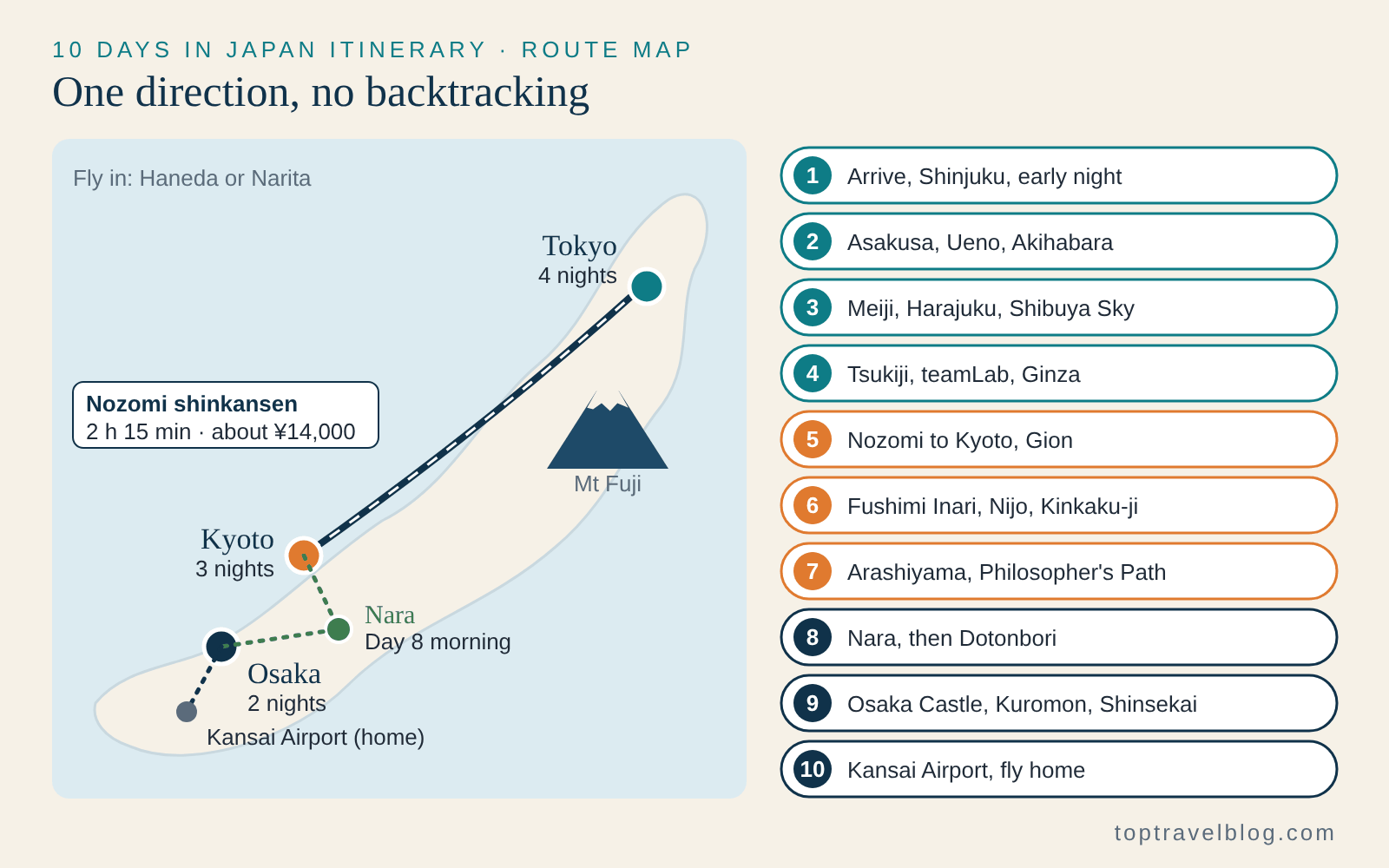
Ten days is the length I would pick for a first trip to Japan, and the route this 10 days in Japan itinerary follows is the one most first-timers end up wanting anyway: four nights in Tokyo, three in Kyoto, two in Osaka, with a Nara morning slotted in on the way.
It gives you the neon and the shrines of the capital, the temples and back lanes of the old capital, and a loud, delicious finish in Osaka, linked by one bullet-train ride and one 15-minute hop.
The verdict in one sentence: fly into Tokyo, fly home out of Osaka, buy individual shinkansen tickets rather than a rail pass, carry a tap-to-pay transit card, and book the four or five things that sell out before anything else.
This 10 days in Japan itinerary suits couples, friends, and families with kids old enough to walk 15,000 steps a day. It is less suited to anyone who wants a slow, one-city trip, or who is hoping to add Hiroshima, Hokkaido and the Japanese Alps. Ten days is a first taste, not the whole meal.
I have built this trip for friends in cherry-blossom season, in November leaf season and in a humid July. What follows is the 10 days in Japan itinerary I would hand you over coffee: the exact order of days that avoids doubling back, current fares and ticket prices as of November 2026, where to sleep in each city, what a realistic day costs, and the mistakes I watch first-timers make at Kyoto Station and Shinjuku.
Quick facts: this 10 days in Japan itinerary at a glance
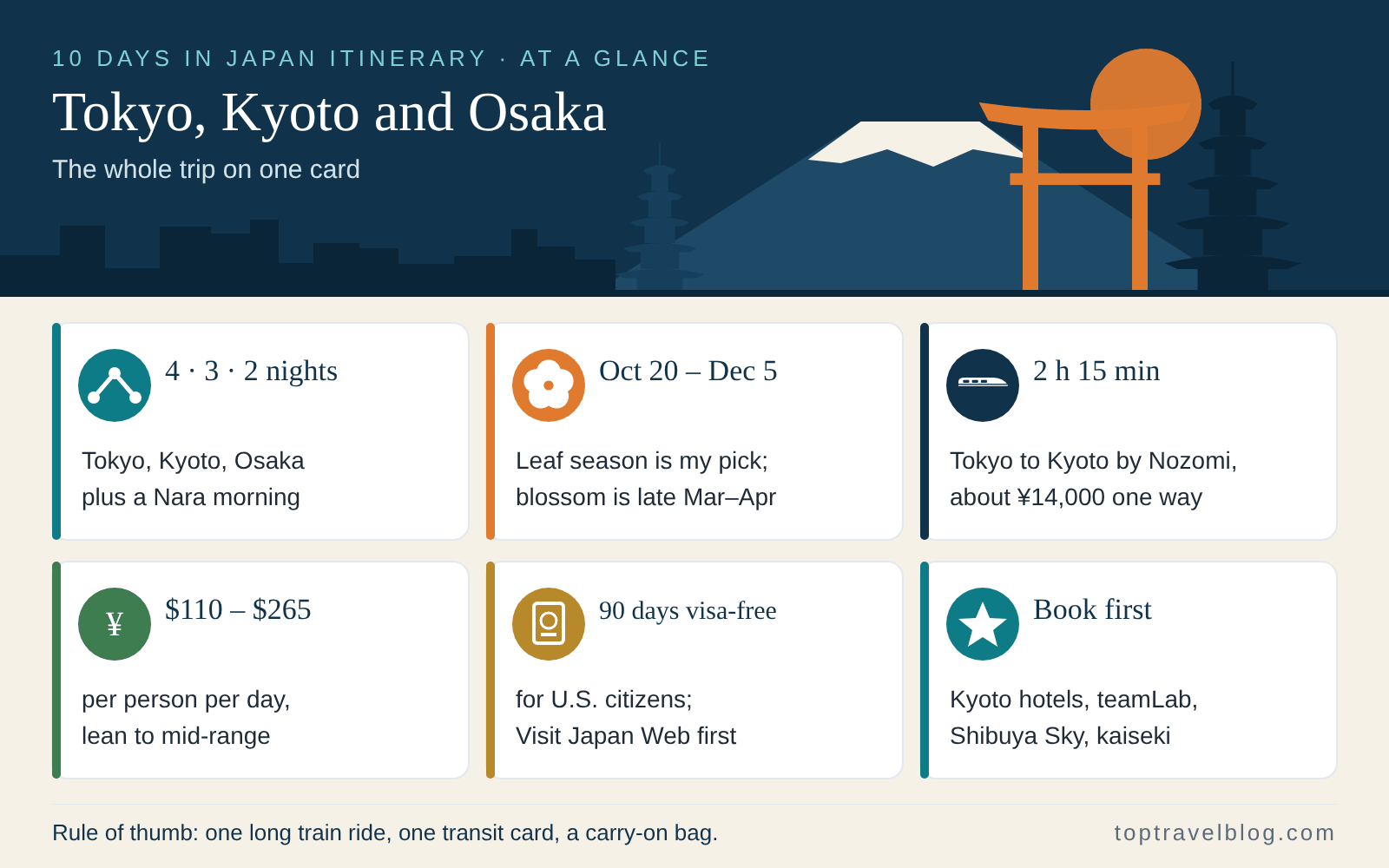
- Route: Tokyo (4 nights), Kyoto (3 nights), Osaka (2 nights), with a Nara morning on Day 8. Fly into Tokyo Haneda or Narita and out of Osaka Kansai.
- Best for: first-time visitors, couples, friends and families with kids who can walk all day. Not ideal for anyone who needs a slow pace or a single base.
- Entry: U.S. citizens can stay up to 90 days without a visa. Complete Visit Japan Web before landing to speed up immigration and customs.
- Getting around: one Tokyo-to-Kyoto Nozomi ride of about 2 hours 15 minutes (roughly ¥14,000), then local trains. A 7-day Japan Rail Pass now costs ¥53,000 and does not pay off on this route.
- Book first: teamLab, Ghibli Museum (if you want it), Shibuya Sky at sunset, any kaiseki or sushi counter dinner, and Kyoto hotels, which sell out earliest.
- Budget on the ground: roughly $110 to $165 a day per person on a lean plan, $185 to $265 in mid-range comfort, $335 and up for a splurge, all before international flights.
- Key caveats: cash still matters at small shops and shrines; luggage does not belong on the Tokyo-to-Kyoto train unless you plan for it; Kyoto’s accommodation tax and a new tax-free refund process both changed in 2026.
Best time to go: when this 10 days in Japan itinerary works best
If I could choose one window, it would be the second half of October through the first week of December. Days are dry and mild, the humidity of summer is gone, and the leaves turn on a staggered schedule that suits this exact route: the Tokyo parks color in late November, while Kyoto’s temple gardens usually peak from mid-November into early December.
The other great window is late March to mid-April for cherry blossom, which is more beautiful and far more crowded. Both seasons need hotels booked early.
Here is how I think about each stretch of the year, because the right 10 days in Japan itinerary changes with the thermometer and the calendar.
Late March to mid-April: cherry blossom
Blossom usually opens in Tokyo in the last days of March and in Kyoto a few days later, and each tree is at its best for only about a week. The timing is a forecast, not a promise, so if you are building your 10 days in Japan itinerary around it, give yourself a flexible Tokyo-first order and stay near a park or a river. Expect the highest hotel rates of the year, crowded temples and tickets for popular timed slots going early.
The reward is real: picnics under the trees along the Meguro River, petals on the Philosopher’s Path, and long evenings at about 10 to 15 degrees Celsius (50s to 60s Fahrenheit).
May and June: green, warm, then rainy
Golden Week, which runs from April 29 through early May, is the worst stretch of the year for crowds and prices, because the whole country is on holiday. Mid-May to early June is lovely, with warm days, green maples and shorter lines. The rainy season, tsuyu, usually arrives in early to mid-June and lasts until roughly mid-July.
It is gray and humid rather than constantly pouring, and museums, department stores and covered arcades in Kyoto and Osaka make rainy days workable in any 10 days in Japan itinerary. Prices drop and the temples feel calmer.
July to September: hot, humid, typhoon-prone
Summer in Japan is hard work. Highs in Tokyo, Kyoto and Osaka regularly sit in the 90s Fahrenheit with humidity that makes the walking in a 10 days in Japan itinerary feel twice as long. Kyoto is a basin and bakes. Festivals compensate: Kyoto’s Gion Matsuri runs through July, and Osaka’s Tenjin Matsuri comes in late July.
August includes Obon, a mid-month family holiday when trains and hotels fill. Typhoon season peaks from August through October, and a direct hit can pause shinkansen service for a day. If you must come in summer, flip each day of the 10 days in Japan itinerary so the walking happens before 10 a.m. and after 5 p.m.
October to early December: the sweet spot
This is the stretch I recommend for a first 10 days in Japan itinerary. October is still warm, November is crisp, and the light is soft for photographs. The weekends in mid-to-late November in Kyoto are very crowded, especially around Kiyomizu-dera, Tofuku-ji and the Arashiyama bamboo grove, so I schedule the busiest temples on weekday mornings.
Kiyomizu-dera runs special evening illuminations during the autumn leaf period, with the temple staying open until 21:30 and last entry at 21:00.
Mid-December to early March: cold, clear, cheap
Winter is the quiet season, with the best rates, the clearest air and the best chance of a sharp view of Mount Fuji from Tokyo. Highs are around 8 to 12 degrees Celsius (mid-40s to low 50s Fahrenheit) in all three cities, and Kyoto occasionally gets a light snow that photographs beautifully.
Many businesses close from roughly December 29 to January 3 for the New Year holiday, which includes some restaurants and shops but not the major shrines, which fill with worshippers. January and February are the easiest months to get a table anywhere, which makes them underrated for a 10 days in Japan itinerary.
Tip: Japan’s sun sets early in winter, around 4:30 to 5 p.m. in Tokyo in December, and many temples close at 4:30 or 5. In any 10 days in Japan itinerary built for November through February, push the big sightseeing earlier in the day and keep the evenings for food, shopping and city lights.
Days of the week matter
Many Tokyo museums close on Mondays, and many Kyoto restaurants close on Wednesdays or irregular days. Weekends bring domestic crowds to Kyoto from Osaka and Tokyo. Public holidays, especially the three-day weekends in January, March, May, July, September and October, put bullet trains at capacity and raise prices at inns.
I build this 10 days in Japan itinerary so the Kyoto temple days land on weekdays when possible, and I flag the swaps where a closure matters.
Why 10 days, and how to split them
Ten days is the point where Japan stops feeling like a checklist. Here is what each length buys you, based on the version of this 10 days in Japan itinerary I would hand someone with that many days.
5 to 6 days: pick one region
With five or six days you cannot do Tokyo and Kyoto well and still sleep. Pick Tokyo plus a day trip (our Tokyo itinerary covers a full five days), or Kyoto and Osaka together, which are 15 minutes apart by rapid train. Do not try to squeeze a 10 days in Japan itinerary into this window by adding the third city.
7 to 8 days: two cities and one hop
A week lets you do three nights in Tokyo, three in Kyoto and one in Osaka, with the shinkansen as your one big transfer. It is a satisfying short cut of the 10 days in Japan itinerary, but you lose a day of Tokyo, which is the city that most rewards a long stay.
10 days: the plan in this guide
Ten days gives Tokyo four nights (three full days plus an arrival evening), Kyoto three nights (two full days plus the half-day of arrival), and Osaka two nights, with Nara tucked into the transfer day. Every city gets a rain day and a slow morning. You can absorb a day of jet lag and a typhoon delay without panic. That is why this is the length I recommend.
14 days: now you can add a region
Two weeks lets you add Hiroshima and Miyajima (a night or two), Kanazawa and Takayama in the Alps, a night in a ryokan in Hakone or Kinosaki, or a few days on Kyushu. I cover the add-ons in the swaps section below. The structure of the 10 days in Japan itinerary stays the same: shinkansen between hubs, a night or two in each, and luggage forwarded ahead.
Pairing Japan with another country
If Japan is one stop on a longer Asia trip and this 10 days in Japan itinerary is only the first leg, the easiest add-ons are a short flight to Seoul (see our Seoul itinerary) or onward to Southeast Asia: Bangkok and Singapore are both direct flights from Tokyo or Osaka. For a warmer second leg, see 10 days in Thailand or 10 days in Vietnam.
The route logic: why Tokyo, Kyoto, Osaka in that order
The 10 days in Japan itinerary flies into Tokyo and out of Osaka. Both cities have major international airports (Haneda and Narita for Tokyo, Kansai for Osaka), and the shinkansen runs west from Tokyo, so you travel in one direction and never backtrack. An open-jaw ticket (into one airport, out of another) often costs about the same as a round trip. Our guide on how to find cheap flights explains how to price it.
If no open-jaw fare works, take the shinkansen back to Tokyo on the morning of Day 10 and fly home from Haneda or Narita.
The 4-3-2 split reflects what each city offers. Tokyo is four cities in one and takes four nights to do justice. Kyoto is a place you walk, and three nights lets you see two temple days and a food evening. Osaka is eat-and-play, and two nights is exactly right for Dotonbori, the castle and either Nara or Universal Studios.
Before you fly: entry rules, flights, money and phones
None of this is hard, but a handful of Japan-specific details are worth sorting out a few weeks ahead. The paperwork for a 10 days in Japan itinerary is short, the money situation is better than it used to be, and the single most useful thing you can do is plan your luggage.
Entry rules for U.S. travelers
U.S. citizens can enter Japan without a visa for stays of up to 90 days, according to the Ministry of Foreign Affairs of Japan. Bring a passport that is valid for the whole stay. Before landing, set up Visit Japan Web (vjw.digital.go.jp), which holds your immigration and customs details as a QR code so you can use the faster lines at the airport.
Japan has announced a pre-travel electronic authorization system called JESTA, targeted for 2028, so it does not touch your 10 days in Japan itinerary in 2027.
Money, cards and cash
Japan is much more card-friendly than it was five years ago, but cash still matters. Most hotels, department stores, train stations and chain restaurants take Visa and Mastercard, while small ramen counters, family-run izakaya, temples with entry booths, some shrines and market stalls may be cash only. Withdraw yen from ATMs at 7-Eleven (Seven Bank) or post offices, which accept foreign cards, and carry roughly ¥10,000 to ¥20,000 at a time.
I use ¥150 to the dollar as a planning round number throughout this guide, so divide by 150 to get dollars.
Taxes and fees that changed recently
Three things changed in 2026. First, the departure tax for international travelers rose from ¥1,000 to ¥3,000 on July 1, and the Japan National Tourism Organization notes it is usually included in your airfare. Second, Kyoto’s accommodation tax now runs from ¥200 to ¥10,000 per person per night depending on the room rate, as laid out on Kyoto’s official travel site.
Third, tax-free shopping changes on November 1, 2026: you pay the tax-inclusive price in the store and claim a refund when you leave Japan, after completing the customs step before check-in. The JNTO explainer on the new tax-free system covers the details, and the practical upshot is to keep receipts and your purchases in your carry-on.
Phones, power and time zones
Buy an eSIM before you fly, or a physical SIM at the airport. Japan runs on 100-volt power with the same flat two-pin plugs used in the U.S., so most chargers work without an adapter. Japan is 13 to 17 hours ahead of U.S. time zones depending on the coast and daylight saving, which means day one is a foggy one. Plan it to be light.
Flights and jet lag
Nonstop flights reach Tokyo from most big U.S. hubs: about 11 to 12 hours from the West Coast and 13 to 14 hours from New York or Chicago. Most arrive in the afternoon or evening, which is why this 10 days in Japan itinerary treats Day 1 as an arrival evening rather than a sightseeing day. If you are comparing airports, Haneda is closer to the center and Narita is farther out. Our guide on how to find cheap flights walks through searching open-jaw fares.
On arrival, get outside in daylight, eat dinner at a local time and go to bed by 10 p.m.
The luggage decision that changes your whole trip
Japan’s train stations have lots of stairs, narrow turnstiles and few elevators in older stops. Bring one carry-on-size rolling bag and a day pack per person. If you need more, ship your large bag ahead with a takkyubin service, which works through hotels and convenience stores and usually arrives the next day for a modest fee. Sending a bag from your Tokyo hotel to your Kyoto hotel means you ride the shinkansen with only a backpack.
Bags with combined dimensions over 160 cm need a reserved seat with an oversized baggage area on the Tokaido Shinkansen.
Where to stay on a 10 days in Japan itinerary: Tokyo, Kyoto and Osaka
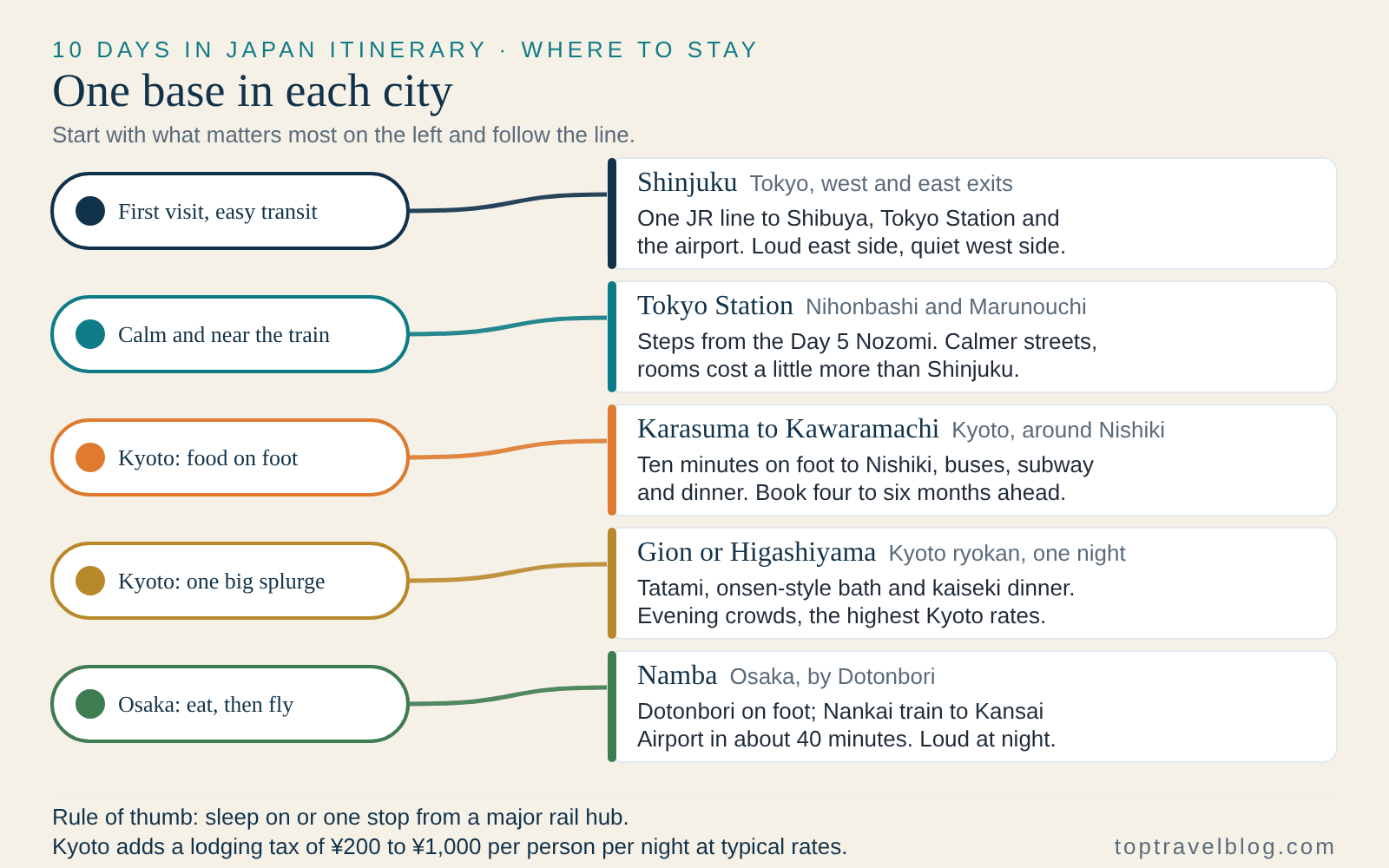
Japan is a country where location matters more than room size. Rooms in business hotels are small, often 13 to 18 square meters (140 to 190 square feet), and the real value is a ten-minute walk to a subway line that goes everywhere. My rule for a 10 days in Japan itinerary: stay on a major rail hub or one stop from it, so you never carry bags up more than one flight of stairs.
Our guide on how to choose a hotel covers cancellation terms and fees, which matter more here than in most countries.
Tokyo: Shinjuku is my pick, Tokyo Station is the calm option
Shinjuku has the busiest station in the world, the best transit access in the city and plenty of hotels at every price. It is loud, bright and a little overwhelming, but you are on one JR line to Shibuya, one to Tokyo Station and one to the airport. The east side is the neon end, the west side has quieter business hotels.
Tokyo Station and Nihonbashi are calmer, close to the shinkansen on Day 5 and slightly more expensive. Asakusa and Ueno give you a more traditional feel and lower prices, with slower journeys to the west side of town.
Kyoto: stay near Karasuma or Kawaramachi, not out by the station
Kyoto Station is convenient for the shinkansen and Fushimi Inari, but the streets around it have little personality. The area between Karasuma-Oike and Kawaramachi, around Nishiki Market, puts you within a ten-minute walk of dinner, buses and the subway. Gion and Higashiyama are the postcard districts, with ryokan and machiya stays at a premium and evening crowds.
If your budget allows only one splurge in the whole 10 days in Japan itinerary, make it one night in a ryokan with a kaiseki dinner in Kyoto. Kyoto hotels sell out first of the three cities, so book these before the others.
Osaka: Namba for food, Umeda for trains
Namba puts you a few minutes from Dotonbori, with a direct Nankai train to Kansai Airport in roughly 40 minutes. It is noisy at night, but you are here to eat and wander. Umeda, around Osaka and Umeda stations, has the better shopping and the JR trains to Kyoto, and it is quieter after dark. Shin-Osaka, where the shinkansen stops, is practical only if you have an early train.
For this 10 days in Japan itinerary I stay in Namba, two stops from Shinsaibashi, on the Midosuji line.
What to look at before you click “book”
Three things. First, the walk from the station to the front door; “5 minutes from the station” in Japan sometimes means 5 minutes plus a flight of stairs plus a sidewalk full of bicycles. Second, the total price with taxes and any service charge: Kyoto’s lodging tax is separate and charged per person per night, so a ¥25,000-per-person room adds ¥1,000, and a ¥15,000 room adds ¥400.
Third, read the most recent reviews for the words “thin walls,” “smoking floor” and “construction.” Many Japanese business hotels still have designated smoking floors.
Ryokan and capsule hotels: one night is enough
A ryokan is a traditional inn with tatami floors, futons, a communal bath and, usually, a multi-course dinner and breakfast included in the price. It is worth one night, not three, and the dinner is the point. Capsule hotels are fun once if you like the idea but are poorly suited to couples and light sleepers.
Skip both if you are traveling with young children, who tend to do better in a family room in a standard hotel.
The 10 days in Japan itinerary, day by day
Each day of this 10 days in Japan itinerary has one anchor area so you are never crisscrossing a city on the subway. Mornings start early because the best sights are measurably better at 8 a.m. than at 11, and the evenings are built to be dropped if your feet give up. Walking times are real-world times with photo stops. Transit times include walking to the platform and a reasonable wait.
Day 1
Arrive in Tokyo and take it slow
Your goal on Day 1 of the 10 days in Japan itinerary is to land, get to the hotel and stay awake until about 9 p.m. Do not plan anything you cannot cancel. Collect your bags, clear immigration with your Visit Japan Web QR code, pick up your transit card and head to the city.
Getting from the airport
From Haneda, the Keikyu line and the Tokyo Monorail both reach central Tokyo in roughly 15 to 30 minutes for a few hundred yen. From Narita, the Keisei Skyliner reaches Ueno in about 40 minutes, and the JR Narita Express runs to Tokyo, Shinjuku and Shibuya for a higher fare. Pay with your transit card where you can and ride the express options if you have heavy bags.
A taxi from Haneda costs far more and is only worth it with a family and a late flight.
The evening: a short walk and a real dinner
Drop your bags, walk for an hour and eat near the hotel. In Shinjuku, I go straight to Omoide Yokocho’s smoky alleys of yakitori, or to a department-store restaurant floor for a quiet dinner of tempura, tonkatsu or soba. Konbini food (7-Eleven, Lawson, FamilyMart) is better than you expect for a late arrival: onigiri, egg sandwiches and hot coffee are cheap and good.
Be in bed by 10 p.m. Jet lag shifts faster if you push through the first evening.
Day 2
Asakusa, Ueno and Akihabara: old Tokyo first
Morning: Senso-ji before the crowds (7:30 to 10:00)
Take the Ginza Line to Asakusa and be at Kaminarimon, the big red lantern gate, by 7:30. The grounds of Senso-ji are open early, the Nakamise shopping street does not open until around 10, and at this hour you share the incense smoke with locals rather than tour groups. By 11 the approach is a slow-moving crowd.
Wave some smoke over yourself, draw an omikuji fortune for a few hundred yen and walk the east side to the small Asakusa Shrine, which is nearly always empty.
Late morning: Kappabashi and a walk to Ueno (10:00 to 12:30)
Walk 15 minutes west to Kappabashi, the kitchenware street, where the plastic-food shops sell realistic sushi keychains and the knife shops will engrave a blade while you wait. It opens around 9 or 10 and is quiet on weekdays. Then ride the Ginza Line six minutes to Ueno and walk into Ueno Park. Lunch at Ameyoko, the open-air market under the tracks, is loud, cheap and cash-friendly: skewers, fried chicken, fresh fruit.
Afternoon: pick a museum or the Akihabara pivot (1:00 to 5:00)
The Tokyo National Museum in Ueno Park holds the country’s best collection of samurai swords, ukiyo-e prints and ceramics, and it closes on Mondays. Allow two hours; it is air-conditioned and gets you out of weather. If museums are not your thing, ride one stop to Akihabara for the multi-floor arcades and shops selling anime goods, retro games and electronics.
Both can be done if you move briskly, but I would pick one and finish with a long coffee break.
Evening: Shinjuku after dark (6:00 onward)
Ride the JR Yamanote Line back to Shinjuku and walk through Kabukicho’s neon to Golden Gai, a six-alley grid of tiny bars seating five to eight each. Some bars charge a cover of ¥500 to ¥1,500 and a few post “regulars only” signs; look for English menus and a “tourists welcome” sticker. For a quieter dinner, the restaurant floors of the big department stores near the station serve excellent set meals.
Logistics: about 12,000 to 16,000 steps. Shinjuku to Asakusa, by the Marunouchi Line to Ginza and a change to the Ginza Line, takes roughly 40 minutes. Rain swap: do the museum in the afternoon and use Akihabara’s multi-floor arcades as your second block.
Day 3
Meiji Shrine, Harajuku, Shibuya and a sunset view
Morning: the forest at Meiji Jingu (8:00 to 10:00)
Meiji Jingu sits behind Harajuku Station, and the walk in is the point: a wide gravel path under a forest of 100,000 donated trees, so quiet that Tokyo drops away within five minutes. Entry to the shrine grounds is free. If you are lucky you will see a traditional wedding procession on a weekend morning. Give it 60 to 90 minutes.
Late morning: Harajuku and Omotesando (10:00 to 12:30)
Takeshita Street is the famous teenage-fashion lane; it is a ten-minute walk and extremely crowded after 11. I would glance at it and move on to Omotesando, the tree-lined avenue of architect-designed flagship stores, and the side streets of Ura-Harajuku for coffee and vintage shops. Lunch here can be a tonkatsu set or a ramen counter ordered through a ticket machine.
The machine takes cash, then you hand the ticket to the cook.
Afternoon: Shibuya on foot (1:00 to 4:30)
Walk or ride one stop to Shibuya and cross the famous scramble crossing, where up to a few thousand people cross at once. For the best view, use the second-floor windows at the Starbucks above the crossing or the station’s connected viewing platform. Browse Shibuya’s department stores and record shops, and take a break; you have a long evening.
Sunset: Shibuya Sky (arrive 30 minutes before sunset)
Shibuya Sky is the rooftop observation deck of Shibuya Scramble Square, about 229 meters above the crossing, with an open-air top level and a view that on clear days stretches to Mount Fuji. Tickets are timed, sunset slots cost more and sell out weeks ahead, so book them on the official site as soon as your dates are set. In December, sunset is around 4:30 p.m., and in July it is after 7 p.m.
Evening: dinner in Shibuya or Ebisu
Skip the chain restaurants around the crossing. Ride one stop to Ebisu for Yokocho, a covered alley of tiny izakaya, or eat at a ramen counter near Shibuya Station. Tonight is a good night for a sit-down meal you have planned.
Logistics: about 13,000 steps. Harajuku to Shibuya is a 25-minute walk or a 3-minute JR ride. Rain swap: spend the afternoon in Shibuya’s department stores, Nezu Museum in Aoyama (closed Mondays), or the Tokyo Metropolitan Government Building’s free observation decks in Shinjuku.
Day 4
Tsukiji, teamLab and Ginza: the waterfront day
Morning: breakfast at Tsukiji Outer Market (8:00 to 10:00)
The wholesale fish market moved to Toyosu in 2018, but the outer market in Tsukiji remains a dense grid of stalls selling tamagoyaki (sweet omelet on a stick), grilled scallops, tuna bowls and strong coffee. Go by 8 a.m.; by 10:30 the lanes are shoulder to shoulder. Many stalls close on Sundays and on some Wednesdays, so plan this on a Monday through Saturday morning.
Eat standing up, throw your trash in the stall’s bin, and do not walk and eat in the lanes.
Late morning: Hamarikyu Gardens and a river ride (10:00 to 12:00)
Walk 10 minutes to Hamarikyu Gardens, a former shogun’s duck-hunting ground with a tea house on a tidal pond and the modern towers of Shiodome behind it. From the dock you can take a water bus up the Sumida River to Asakusa, which makes a nice pivot if you skipped any of Day 2. Otherwise continue to Toyosu.
Afternoon: teamLab Planets in Toyosu (timed ticket)
teamLab Planets is a digital-art installation you walk through barefoot, wading ankle-deep in water under moving light. Tickets are timed and cost roughly ¥4,000 to ¥5,000 per adult; book it two to three weeks ahead and take the earliest or latest slot to avoid the crush. Wear shorts or rolled-up pants, no skirts, and bring a small bag.
Allow two hours. It is one of the few things in Tokyo that photographs as well as it feels in person.
Late afternoon: Ginza and Tokyo Station (4:00 to 7:00)
Ride the Yurikamome back toward Shimbashi and walk into Ginza, the luxury district, where the department store basements (depachika) sell gift-boxed sweets, bento and wagyu at closing-time discounts after about 7 p.m. Walk on to Tokyo Station, whose red-brick Marunouchi facade is lit after dark, and buy your shinkansen ticket for tomorrow if you have not already.
Swap: Ghibli Museum, Kamakura or Hakone
If anime is your reason for the trip, trade the morning for the Ghibli Museum in Mitaka. Tickets are ¥1,000 for adults, sold only in advance, and go on sale at 10 a.m. Japan time on the 10th of each month for the following month through Lawson Ticket; they disappear in minutes. For a day trip, Kamakura is about an hour from Tokyo for a seaside temple walk, and Hakone for a hot-spring day with a good chance of a Fuji view in winter.
Either one costs you Tsukiji and teamLab, so choose deliberately.
Logistics: about 12,000 steps. Tsukiji to Hamarikyu is a 10-minute walk. The Yurikamome from Shiodome to Toyosu takes about 15 minutes. Rain swap: skip Hamarikyu and do teamLab plus the shops of Ginza.
Day 5
Bullet train to Kyoto, then Higashiyama and Gion
Morning: Tokyo Station to Kyoto on the Nozomi
Send your big bag ahead the day before, or be ready to hold it. Take a Nozomi shinkansen from Tokyo Station at around 9 a.m. The ride takes about 2 hours 15 minutes, a reserved ordinary-class seat costs roughly ¥14,000 to ¥14,200, and the slower Hikari takes about 2 hours 40 minutes for a few hundred yen less. Reserve a seat in row E on the right side heading west, which is the side with the Mount Fuji view on a clear day.
Buy a bento and a drink at the station for the ride. Eating on the shinkansen is perfectly normal.
Midday: drop your bags and eat near the station
Arrive at Kyoto Station around 11:30 and take your bags to the hotel, which will hold them until check-in at 3 p.m. Eat lunch in the station building or at a counter in the Karasuma area. The station itself is worth five minutes: its glass-and-steel atrium has a long staircase and a rooftop garden with free views.
Afternoon: Kiyomizu-dera and the lanes of Higashiyama (2:00 to 6:00)
From Kyoto Station, bus 206 takes about 15 minutes and ¥230 to Gojo-zaka or Kiyomizu-michi, followed by a steep ten-minute walk uphill. Kiyomizu-dera costs ¥500 and opens at 6 a.m., which is the time to come on a later day; today you will share it. The wooden stage hangs over the hillside with views toward the city. Allow 45 minutes.
Then walk down through Ninenzaka and Sannenzaka, the two stone-paved lanes of teahouses and pottery shops. They are lovely and packed; keep moving.
Evening: Yasaka Shrine, Hanamikoji and dinner (5:30 onward)
Walk down to Yasaka Shrine, which is open around the clock, and cut through Maruyama Park to Gion at dusk. Hanamikoji Street is the lane of wooden teahouses where geiko and maiko walk to evening appointments. Stay on the public street, do not follow or block anyone, and obey the signs: some private alleys in Gion are closed to visitors, and photography fines are real.
For dinner, Pontocho, a narrow lantern-lit alley along the Kamo River, has dozens of restaurants, though the best-value meals are one block off it.
Logistics: Day 5 of the 10 days in Japan itinerary is about 12,000 steps. Tokyo to Kyoto, 2 hours 15 minutes. Bus 206 from the station to Kiyomizu-michi, 15 minutes. Rain swap: spend the afternoon at the Kyoto Railway Museum or in the covered Teramachi and Shinkyogoku arcades, and go to Higashiyama after the rain stops.
Day 6
Fushimi Inari at dawn, Nishiki Market and Nijo Castle
Early morning: Fushimi Inari (6:30 to 9:00)
This is the walk of thousands of vermilion torii gates up a wooded mountain, and it is free and open around the clock. From Kyoto Station, the JR Nara Line reaches Inari Station in about five minutes for ¥150, and the shrine entrance is across the street. Be there by 7. By 10, the first gates are a shoulder-to-shoulder photo queue.
The full loop to the summit takes two to three hours round trip. I walk to Yotsutsuji, about 30 to 45 minutes up, where the view opens over the city, and then come back down.
Late morning: Nishiki Market and a slow lunch (10:00 to 1:00)
Nishiki Market is a covered lane about 400 meters long, packed with pickles, tofu doughnuts, dashi omelets and skewered seafood. It gets crowded by noon, and Kyoto asks visitors not to eat while walking, so stand beside the stall you bought from. From there, wander the Teramachi and Shinkyogoku covered arcades, or take a seat for a lunch of obanzai, the home-style Kyoto small plates.
Afternoon: Nijo Castle and Kinkaku-ji (1:30 to 5:00)
Nijo Castle, the Tokugawa shoguns’ Kyoto residence, is a short subway ride from the center. Its famous “nightingale floors” squeak on purpose to warn of intruders, and the painted sliding doors are astonishing. Allow 90 minutes. Then take a bus north to Kinkaku-ji, the Golden Pavilion, which costs ¥500, is open from 9 to 5 and takes 15 to 45 minutes; from Kyoto Station bus 205 takes about 40 minutes and ¥230.
Go late in the day, when the tour groups thin out and the light is warm.
Evening: Kamo River and an easy dinner
Walk along the Kamo River, where couples sit evenly spaced along the bank at dusk, and eat somewhere you did not plan. Kyoto is a city of excellent small counters. If you want a tea ceremony, book one in the afternoon on Day 7 rather than adding another timed commitment tonight. Our Kyoto itinerary has more evening options, including nights out in Pontocho and Kiyamachi.
Logistics: about 14,000 steps. Nijo Castle is on the Tozai subway line. Rain swap: skip the summit loop, visit Nijo and Kinkaku-ji in the morning, and spend the afternoon at the Kyoto International Manga Museum or the covered arcades.
Day 7
Arashiyama in the morning, the Philosopher’s Path in the afternoon
Early morning: the bamboo grove and Tenryu-ji (7:00 to 10:00)
Take the JR Sagano Line from Kyoto Station to Saga-Arashiyama, about 15 minutes, and be walking into the bamboo grove by 7. The grove is a short path, and its beauty depends entirely on the hour: at 7 it is quiet and green, at 10 it is a conga line. Next door, Tenryu-ji has one of Kyoto’s finest gardens, and its back gate exits straight into the grove.
Continue up to Okochi-Sanso, a hillside villa garden whose admission includes a cup of matcha and a sweet.
Late morning: the Togetsukyo bridge and lunch
Walk to Togetsukyo, the long wooden bridge over the Katsura River, and eat lunch in the small streets on the river side. Tofu and yuba (tofu skin) are Arashiyama’s specialty. The Iwatayama Monkey Park, a 20-minute uphill walk with a view of the city, is optional and fun for kids; skip it if you are short on energy or time.
Afternoon: Nanzen-ji, the Philosopher’s Path and Ginkaku-ji (2:00 to 5:30)
Ride the subway to Keage and walk through Nanzen-ji, the Zen temple with a brick aqueduct that sits improbably among the pines. The grounds are free and the main hall costs a few hundred yen. Follow the canal north along the Philosopher’s Path, about two kilometers under cherry and maple trees, to Ginkaku-ji, the Silver Pavilion, which has a raked sand garden and a short climb to a viewpoint.
The walk is flat and easy, and it is pleasant in any season.
Evening: kaiseki, or a quiet night in
If you have booked a ryokan night, it starts at check-in around 3 p.m. and dinner arrives at 6 or 6:30. Otherwise, tonight is the right night for a kaiseki or a high-end set meal, a seasonal multi-course dinner that is among Japan’s great food experiences. Book weeks ahead; lunch versions are often a third of the price of dinner.
Logistics: about 14,000 steps. Send your large bag to your Osaka hotel tonight by takkyubin so it is waiting when you arrive tomorrow. Rain swap: Tenryu-ji’s garden is still lovely in rain, and the Philosopher’s Path can be traded for the Kyoto National Museum.
Day 8
Nara in the morning, then Osaka and Dotonbori
Morning: Kyoto to Nara (8:00 to 9:00)
The Kintetsu limited express and the JR Miyakoji Rapid both reach Nara from Kyoto in roughly 45 minutes for under ¥1,000. Travel light: your big bag is already on its way to Osaka. Arrive by 9 and walk through Nara Park, where more than a thousand sika deer bow for crackers sold at stalls for a couple of hundred yen. They bite and they steal paper; hold crackers out of sight until you are ready to feed them.
Mid-morning: Todai-ji and the Great Buddha
The Daibutsu-den, the world’s largest wooden building, houses a 15-meter bronze Buddha. It opens at 8, admission is ¥800 according to Todai-ji’s own site, and the hall is dramatic in a way photographs do not capture. Allow 45 minutes. Then walk 15 minutes up the lantern-lined path to Kasuga Taisha, a shrine in a forest hung with thousands of bronze and stone lanterns.
Lunch: Naramachi and kakinoha-zushi
Drop back into the old merchant streets of Naramachi for lunch. Try kakinoha-zushi, pressed sushi wrapped in persimmon leaves, a Nara specialty, or stop at a stall where mochi is pounded to order. Nara is small, and two and a half to three hours is enough to see its main sights on a first visit.
Afternoon: on to Osaka (2:00 onward)
Take the Kintetsu line from Kintetsu-Nara directly to Osaka-Namba, about 40 minutes. Check in, take a short rest and then head to the canal. Osaka’s rhythm is different from Kyoto’s: louder, friendlier and more food-obsessed. The city is proud to be “Japan’s kitchen,” and you are going to eat your way through it.
Evening: Dotonbori and Hozenji Yokocho
Dotonbori is the neon canal strip with the famous Glico running-man sign and the mechanical crab. Eat takoyaki (octopus balls) from a street cart, then find a seat for okonomiyaki, the savory cabbage pancake cooked on a griddle. Round the night off in Hozenji Yokocho, a lantern-lit stone lane with a moss-covered Fudo Myoo statue that locals splash with water. Our Osaka itinerary goes deeper on where to eat.
Logistics: Day 8 of the 10 days in Japan itinerary is about 15,000 steps. Kyoto to Nara 45 minutes; Nara to Namba 40 minutes. Rain swap: skip the Kasuga Taisha path and keep to Todai-ji and the covered Naramachi lanes.
Day 9
Osaka Castle, Kuromon Market and Shinsekai
Morning: Osaka Castle (9:00 to 11:30)
Take the subway to Tanimachi Yonchome and enter through Otemon Gate. The castle tower opens at 9, costs ¥1,200 and closes its last admission at 5:30 p.m.; lines can exceed 30 minutes on busy days, so arrive at opening. The tower is a 1931 concrete reconstruction with a modern museum inside and good views from the top, but the outside, with its stone walls and moat, is the better part.
The Nishinomaru Garden next door costs ¥300 and is closed Mondays.
Lunch: Kuromon Market
Ride to Nipponbashi and walk into Kuromon Ichiba, the covered “Osaka’s kitchen” market. Grilled scallops, fugu (pufferfish) bites, tuna sashimi and strawberries each run from a few hundred yen to about a thousand. Go before 1 p.m.; many stalls begin to pack up in the middle of the afternoon.
Afternoon: Shinsekai and Tsutenkaku
Take the Sakaisuji line to Ebisucho and walk into Shinsekai, a retro entertainment district built in 1912 around the Tsutenkaku tower. It is the home of kushikatsu, deep-fried skewers dipped once in a shared sauce. There is a rule on every table: no double dipping. Cabbage is free, and you should use it to scoop more sauce.
Sunset: Umeda Sky Building
For a farewell view, ride to Umeda and walk to the Umeda Sky Building’s Floating Garden Observatory. It costs ¥2,000, runs from 9:30 a.m. to 10:30 p.m. and is open air on the top level. Come for sunset, then stroll the glowing Yodobashi plaza below. For a final dinner, return to Namba and eat anything you missed.
Swap: Universal Studios Japan
If you have children or are a Nintendo fan, spend today at Universal Studios Japan instead. The Super Nintendo World area requires a timed-entry ticket, so book it with your park ticket well ahead. Expect a full day of 12,000 steps and long queues unless you pay for an Express Pass. Tickets price by date, and busy days cost the most.
Logistics: about 12,000 steps. Rain swap: the Osaka Museum of Housing and Living, the covered Shinsaibashi arcade, or the National Museum of Art.
Day 10
Depart from Kansai Airport
The last morning of the 10 days in Japan itinerary starts with the Nankai line, which runs directly from Namba to Kansai International Airport. The reserved limited express, the Rapi:t, takes about 40 minutes and costs roughly ¥1,500, while the standard airport express takes a little longer for roughly ¥1,000. Aim to be at the airport three hours before an international flight. If you bought anything tax-free, complete the customs step before check-in, and keep those items in your carry-on.
The terminal has good food and shopping, and a last-minute stop at a convenience store for Kit Kats and rice crackers is a ritual for a reason.
If your flight leaves from Tokyo, take a morning shinkansen from Shin-Osaka to Tokyo (about 2.5 hours) and fly from Haneda or Narita. You lose only a slow Day 10 morning in Osaka, and the other nine days stay the same.
Getting around: shinkansen, IC cards, subways and luggage
Japan’s trains are the reason a 10 days in Japan itinerary works. They are on time to the minute, they go everywhere you are headed, and in the three cities of this 10 days in Japan itinerary you will almost never need a car. The only real decisions are how to pay, which shinkansen to book, and what to do with your bags.
The shinkansen: Nozomi, Hikari and when to book
The Tokaido Shinkansen links Tokyo, Kyoto and Osaka. The Nozomi is the fastest, about 2 hours 15 minutes from Tokyo to Kyoto, and the Hikari takes about 2 hours 40 minutes with a few more stops. A reserved ordinary-class seat on the Nozomi is roughly ¥14,000 to ¥14,200, and the Hikari is a few hundred yen cheaper. You can buy tickets at station machines and windows or in the SmartEX app, and reserved seats become available one month before travel.
For sunny weather, a window seat on the right side heading west gives you the best chance of seeing Mount Fuji.
Do you need a Japan Rail Pass on a 10 days in Japan itinerary?
No, and this is the most common money mistake in Japan planning. The pass’s price went up again on October 1, 2026: a 7-day ordinary pass now costs ¥53,000, a 14-day pass ¥84,000, according to the Japan National Tourism Organization. The pass also excludes the Nozomi without a ¥4,960 supplement each way.
This 10 days in Japan itinerary needs one long shinkansen ride, a few short local trips and a lot of subway rides. The total rail bill is roughly ¥20,000, well under half of the 7-day pass. Buy single tickets.
IC cards: Suica, ICOCA and your phone
A rechargeable IC card pays for trains, subways, buses and many vending machines and convenience stores, and cards from different regions work nationwide. If you have an iPhone 8 or later, you can add Suica to Apple Wallet before you leave home and top up with a credit card. Most Android phones sold in the U.S. lack the chip Suica needs, so carry a physical card instead.
Welcome Suica (no deposit, 28-day life) is sold at JR East Travel Service Centers and airport machines. At Kansai Airport you can buy an ICOCA, the Kansai equivalent.
Tokyo subway tickets and city transit
Tokyo Metro and Toei Subway ride fares run from roughly ¥180 to ¥330. The Tokyo Subway Ticket offers unlimited rides for 24, 48 or 72 hours at ¥1,000, ¥1,500 and ¥2,000, and it is sold online. It does not cover JR lines such as the Yamanote Line, which you will use a lot in this 10 days in Japan itinerary. I skip it and tap a Suica instead, but the 72-hour ticket is reasonable if you plan a metro-heavy Tokyo stay.
Google Maps handles Japanese transit very well, including platform numbers and exits.
Kyoto and Osaka transit
Kyoto has only two subway lines, so buses fill the gaps. Bus fares are a flat ¥230 for a ride within the central zone, you board at the back and pay when you exit with your IC card, and the buses to Kiyomizu-dera, Kinkaku-ji and Ginkaku-ji are crowded at midday. Trains and the subway are faster to Fushimi Inari and Arashiyama. Osaka’s subway is simple, and the Midosuji line links Umeda, Shinsaibashi, Namba and Tennoji.
Luggage, lockers and takkyubin
Coin lockers at stations come in small, medium and large and cost roughly ¥400 to ¥1,000 for a day, but large ones fill up at big hubs. Forwarding services are better: ask your hotel front desk to arrange takkyubin to your next hotel, fill in the form and pay a modest fee. I use it twice in this 10 days in Japan itinerary, on Day 5 (Tokyo to Kyoto) and Day 7 (Kyoto to Osaka), and the trains become much easier.
What this 10 days in Japan itinerary costs per day
A 10 days in Japan itinerary is cheaper than many first-time visitors expect, especially for food and transit, and more expensive for hotels in peak season. Converting at ¥150 to the dollar, here is how three styles of travel look per person per day, not counting international flights. These are planning ranges, not quotes.
Lean: roughly ¥17,000 to ¥25,000 ($110 to $165)
Business hotels or hostel private rooms shared between two, ramen and set lunches, convenience-store breakfasts, an izakaya dinner every other night, local trains, and just one or two paid attractions a day. It is a genuinely comfortable way to see Japan, because even the cheapest places are clean and the service is reliable.
Mid-range: roughly ¥28,000 to ¥40,000 ($185 to $265)
A better business hotel or boutique stay at ¥20,000 to ¥30,000 a night for a double, one sit-down dinner each night, a few paid sights, a ryokan night in the budget and the occasional taxi. This is where most readers land with a 10 days in Japan itinerary.
Comfortable: ¥50,000 and up ($335 and up)
Four-star hotels, a ryokan with kaiseki, a sushi counter dinner at ¥10,000 to ¥25,000 per person, private guides and taxis for tired legs. Top-end ryokan and omakase prices go far higher, and the sky is the limit in Kyoto in November.
Prices you can plan around
A bowl of ramen runs ¥1,000 to ¥1,600, and a weekday lunch set ¥1,000 to ¥2,000. An izakaya dinner with drinks is ¥4,000 to ¥7,000 a person. Temples and gardens cost ¥300 to ¥1,000 (Kiyomizu-dera and Kinkaku-ji are ¥500 each, Todai-ji is ¥800, Osaka Castle ¥1,200). A Tokyo to Kyoto shinkansen is about ¥14,000, and the Umeda Sky Building is ¥2,000. teamLab runs roughly ¥4,000 to ¥5,000.
Kyoto’s lodging tax adds ¥200 to ¥1,000 per person per night at normal mid-range rates.
Where I would save and where I would spend
On a 10 days in Japan itinerary I save on lunch (set menus and department-store restaurants), transit passes (single tickets are cheaper), souvenirs and hotel breakfasts. Spend on location, because a hotel near a major station saves an hour a day, and on one memorable dinner or ryokan night. Our guide on how to plan a trip has a simple budgeting worksheet that works for this itinerary.
Reservations to lock in before you fly
Japan does not sell out the way a Disney park does, but a handful of things disappear. Here is the order I book them in for a 10 days in Japan itinerary, based on how fast each goes.
First: hotels, especially Kyoto
Book Kyoto four to six months ahead, and six or more for cherry blossom and mid-November leaf season. Book Tokyo and Osaka a few months out. Choose rates with free cancellation until a few days before arrival, and re-price if rates fall.
Second: timed tickets
teamLab Planets two to three weeks ahead (earlier on weekends), Shibuya Sky at sunset as soon as your dates are set, the Ghibli Museum on the 10th of the month before your visit, and Universal Studios Japan with a timed Super Nintendo World entry if you are going. Shinkansen seats open one month before departure.
Third: restaurants that matter
For a kaiseki dinner, a sushi counter or a famous yakitori shop, reserve through your hotel concierge or a booking platform one to two months out. Many top places take reservations only by phone or through the concierge and require you to show up on time. Cancel properly if plans change, since no-shows hurt small restaurants and some now charge for them.
Everything else: walk-in
Most temples, shrines, markets, ramen shops and izakaya do not require booking, and trying to schedule them rigidly takes the pleasure out of the 10 days in Japan itinerary.
Food worth planning your 10 days in Japan itinerary around
Eating is the reason many people come, and Japan makes it easy: even a convenience-store lunch is good. Here is how I think about it by meal.
Ramen, sushi and tempura
Ramen is a ticket-machine, five-minute, ¥1,000 meal, usually in a counter room with a dozen seats. Look for a queue of locals. For sushi, a conveyor-belt shop (kaiten-zushi) costs ¥1,500 to ¥3,000 for a satisfying meal, while a counter omakase starts around ¥8,000 and goes up fast. Tempura counters and tonkatsu shops often serve a lunch set for half the dinner price.
Izakaya and street snacks
An izakaya is a casual pub that serves small plates, often with a drink order required at the start and a small seating charge. Order several dishes to share. In Osaka, the street snacks are the meal: takoyaki, okonomiyaki, kushikatsu and negiyaki. In Kyoto, look for yuba, tofu, matcha sweets and obanzai.
Konbini and department-store basements
Convenience stores sell fresh onigiri, sandwiches, fried chicken and excellent coffee, and they are open all hours. The basements of department stores (depachika) are the better version, with prepared foods, bento and sweets, and discounts after about 7 p.m. Both are a lifesaver on arrival day.
Dietary needs
Vegetarian, vegan and allergy-friendly eating is harder than in most countries because dashi (fish stock) is in many dishes, including some that look vegetarian. Carry a translated allergy card, look for shojin ryori (temple cuisine) in Kyoto, and use the ingredient labels at convenience stores. Halal and gluten-free options exist in the big cities but need research.
Etiquette that actually matters
Japanese people are forgiving with visitors, and nobody expects perfect manners. A few habits make the trip easier for everyone.
On trains and in public
Keep your voice down on trains, set your phone to silent, and do not take calls. Stand on the correct side of the escalator, which is the left in Tokyo and the right in Osaka. Public trash cans are rare, so carry a small bag for your own garbage until you reach a hotel or a convenience store. Do not eat while walking in busy areas; stand beside the stall.
At shrines, temples and onsen
At a shrine, bow slightly at the torii, rinse your hands at the water pavilion, then toss a coin, bow twice, clap twice and bow once. At temples, remove shoes where a sign says so and do not photograph inside halls with photo bans. Onsen require you to wash thoroughly before you enter the bath, and many ban visible tattoos, though some offer private baths or cover stickers.
At restaurants and shops
Say “itadakimasu” before a meal and “gochisosama” when leaving. Do not tip: it is not expected and can cause confusion. Place cash on the small tray rather than handing it over. Do not stick chopsticks upright in rice, and do not pass food from chopsticks to chopsticks, because both echo funeral rites.
Swaps: rain, kids, winter and add-ons
A good plan bends. These are the changes I make most often when someone tells me their 10 days in Japan itinerary does not match the one above.
If it rains
Every day above has a rain swap, but the pattern is simple: put museums, department stores and covered arcades in the wet hours and do the open-air temples when it clears. Gardens look better in soft rain, and the crowds thin dramatically. Carry a compact umbrella and a light waterproof jacket; convenience stores sell clear umbrellas for about ¥500 if you forget.
If you are traveling with kids
Children do well in Japan: the trains are an attraction in themselves, and the food is easy for picky eaters. Cut each day of the 10 days in Japan itinerary by one stop, add an afternoon rest, and add Universal Studios Japan on Day 9. Good kid-friendly stops are the Ghibli Museum, teamLab, the deer in Nara, the castle in Osaka and the monkey park in Arashiyama. Strollers are fine on trains, but the older stations have many stairs.
If you are going in winter
Shift the big outdoor sights to the middle of the day, when it is warmest and the light is best, and book dinners for 6 p.m. Add a hot spring stop in Hakone, where the baths and the chance of a clear Fuji view are both good in winter. Many Kyoto sights close by 4:30 or 5, so start early.
If you want to add a destination
The easiest add-ons from Osaka are Hiroshima and Miyajima (about 1.5 hours by Nozomi; a night is ideal), Himeji Castle (about 30 minutes by shinkansen), and Koyasan, the mountain temple complex south of Osaka. From Tokyo, Hakone and Nikko take a night or a long day. Each one replaces a day in the 10 days in Japan itinerary: Hiroshima replaces Day 9, Hakone replaces Day 4.
Do not add more than one extra stop to a 10 days in Japan itinerary. For a longer Asia trip, see our Seoul itinerary, which pairs well with the end of this trip.
If you want a slower pace
For a slower 10 days in Japan itinerary, drop Day 6’s Nijo Castle and Day 9’s Umeda Sky, and treat every second afternoon as free. A slower plan is not a failure; the days with nothing scheduled are the ones people remember. If you have limited mobility, look for hotels directly connected to stations and use taxis for temple hills.
Common mistakes on a first 10 days in Japan itinerary
1. Buying a Japan Rail Pass by reflex
It was a bargain before 2023, and after the October 2026 increase to ¥53,000 for seven days, it rarely pays on a Tokyo-Kyoto-Osaka route. Add up the individual tickets for your own 10 days in Japan itinerary first. Buy the pass only if you are adding Hiroshima, Kanazawa or other long runs.
2. Packing too much
Narrow sidewalks, small hotel rooms, stairs at older stations and a luggage limit on the shinkansen punish big suitcases. Bring a carry-on and a day pack, and plan to do laundry; most hotels have coin machines.
3. Trying to see Kyoto in one day
A day trip from Tokyo means five hours on trains for six hours at temples. Give Kyoto three nights, as this 10 days in Japan itinerary does, so you can go early to the big sights and slow down in the afternoon.
4. Starting temples at 10 a.m.
Fushimi Inari, Kiyomizu-dera and the Arashiyama bamboo grove are three different places at 7 a.m. and 10 a.m. Wake up early on those days and take a nap in the afternoon.
5. Assuming everything takes cards
Tokyo and Osaka are mostly card-friendly, but small shops, temple booths, vending machines and some ramen counters want yen. Carry ¥10,000 to ¥20,000 at all times and refill at 7-Eleven ATMs.
6. Forgetting the new tax-free rules
Since November 1, 2026, you pay the tax-inclusive price and claim the refund as you leave. Keep your receipts, keep the items in your carry-on, and do the customs step before check-in.
7. Booking Kyoto last
Kyoto has the fewest rooms and the most demand. If you book flights first and hotels later, you will pay more for worse locations. Book Kyoto before anything else in the 10 days in Japan itinerary except flights.
8. Skipping early-morning departures to see one more thing
The shinkansen leaves every few minutes, so there is no need to cram. But the ride from Tokyo is the best part of Day 5, and rushing it with luggage in your hands is not. Send bags ahead, arrive 20 minutes early and buy a bento.
9. Eating only in tourist zones
The neon strip near your hotel has the lines, the English menus and the worst value. Walk two streets in any direction and look for a counter with local customers, a short handwritten menu or a ticket machine.
10. Ignoring last trains
Most trains and subways stop between roughly 11:30 p.m. and 12:30 a.m. A taxi across Tokyo after midnight can cost several thousand yen. Plan your evening around the last train back.
11. Misjudging the walking
The plan above covers 12,000 to 16,000 steps a day, plus station stairs. New shoes, thin soles and sandals without socks ruin Day 3. Pack the pair you have already worn for a hundred miles.
12. Overpacking the evenings
Japan’s night life is exciting, but so is being jet-lagged and walking all day. Treat dinner as the fixed event and everything else as optional.
Frequently asked questions about a 10 days in Japan itinerary
Is 10 days enough for Japan?
Yes. A 10 days in Japan itinerary is enough for a first trip focused on Tokyo, Kyoto and Osaka. Ten days gives you four nights in Tokyo, three in Kyoto and two in Osaka with a Nara morning, which is enough time to see the main sights without constantly packing. It is not enough to add Hokkaido, Okinawa or the Alps. If you want those, plan two weeks or more.
What is the best order for Tokyo, Kyoto and Osaka?
For a 10 days in Japan itinerary, fly into Tokyo, take the shinkansen to Kyoto, finish in Osaka and fly out of Kansai. The trains run west with no backtracking, an open-jaw ticket usually costs about the same as a round trip, and you end with Osaka’s food, which is a good way to finish a trip. If your flights force a round trip, reverse the route or return to Tokyo by shinkansen on the last morning.
Do I need a Japan Rail Pass for 10 days?
Not for this 10 days in Japan itinerary. A 7-day pass costs ¥53,000 after the October 2026 increase, while the individual tickets for Tokyo to Kyoto, Kyoto to Nara and Nara to Osaka add up to roughly ¥20,000, plus local rides. The pass makes sense only if you add Hiroshima, Kanazawa or other long shinkansen legs.
How much does a 10 days in Japan itinerary cost?
Excluding international flights, I would plan roughly $1,100 to $1,650 per person for a lean trip, $1,850 to $2,650 in mid-range comfort, and $3,350 or more when you splurge on ryokan and tasting menus. Two people sharing a room save on lodging. The biggest swing factor is the hotel, followed by how many sit-down dinners you book.
Do I need to speak Japanese?
No. Signs in stations and at major sights are in English, translation apps work well, and menus in tourist areas often have pictures. Learning a few phrases (sumimasen for “excuse me,” arigato gozaimasu for “thank you,” and onegaishimasu for “please”) makes a good impression. Google Translate’s camera mode handles menus and signs.
Is Japan a cash-only country?
Not anymore, but cash still matters. Major hotels, chains, department stores and train stations take cards, while small restaurants, temples, markets and vending machines often do not. Carry ¥10,000 to ¥20,000 and refill at convenience-store ATMs, which accept foreign cards. Loading Suica on your phone covers many small purchases.
When is the best month for this itinerary?
Late October through early December is my pick for a 10 days in Japan itinerary, for weather, color and manageable prices, and late March to mid-April is the blossom alternative. Avoid Golden Week, Obon and the New Year holidays unless you can book very early. June is rainy, July and August are hot, and January and February are cold but quiet.
How many steps a day should I expect?
A 10 days in Japan itinerary means 12,000 to 16,000 steps on most days, plus stairs in stations. The longest days are Day 6 in Kyoto and Day 8 in Nara and Osaka. If that is too much, drop an afternoon block, use taxis for Kyoto’s temple hills and build in a rest day after the shinkansen.
Can I do Kyoto as a day trip from Tokyo?
You can, but I do not recommend it for a 10 days in Japan itinerary. The round trip takes about five hours, which leaves you with a rushed few hours and a long night. Staying in Kyoto lets you visit Fushimi Inari and Arashiyama early, before the crowds. If you have only a few days, spend them all in one city.
Do U.S. citizens need a visa for Japan?
No. U.S. citizens can stay up to 90 days without a visa for tourism, using a passport valid for the whole stay. Before landing, complete Visit Japan Web to speed up immigration and customs. Japan has announced an electronic authorization called JESTA, targeted for 2028, which does not affect a 2027 trip.
How does tax-free shopping work now?
From November 1, 2026, you pay the full tax-inclusive price at the store and claim the refund when you leave Japan. Purchases need to total at least ¥5,000 before tax at the same store on the same day. You complete a customs step at a terminal or on Visit Japan Web before check-in, so keep those items in your carry-on.
What should I pack for 10 days in Japan?
A carry-on bag, a day pack, comfortable broken-in walking shoes that slip on and off easily, layers for the season, a compact umbrella, a small towel (public restrooms often lack paper towels), a few small plastic bags for trash and a coin purse for yen. Leave heavy bags at home and send luggage ahead between cities.
One last thing before you go
The thing I would do differently next time, every time, is leave one afternoon empty. Not a free-time block with a list attached, but nothing: out the hotel door and left or right according to which street looks better.
My best hours in Japan have been unplanned ones, such as a tiny coffee counter in Kyoto that took 20 minutes to find, a neighborhood festival in Osaka that spilled into the street, and a shrine in Tokyo that was empty at 7 a.m. A 10 days in Japan itinerary is scaffolding. The country fills it in.
The other thing I would say is to be kind to yourself about pace. Ten days of this 10 days in Japan itinerary is roughly 130,000 steps, one bullet train and a lot of rice. It is normal to hit a wall on the afternoon of Day 6, and the fix is a hotel nap, not a fourth temple.
Treat the evenings as a menu rather than a schedule, remember that the temples, the rivers and the neon will all still be here next time, and you will probably want a next time. Most people do.
Related planning guides
- Tokyo itinerary: the best 5 days for first-time visitors — the deeper version of Days 1 to 4 if you want a longer Tokyo stay.
- Kyoto itinerary: 3 days of temples, food, gardens and historic streets — more temples, tea houses and evening walks than fit in this plan.
- Osaka itinerary: 3 days of food, nightlife, castles and day trips — where to eat and what to add if you stretch your Osaka stay.
- How to find cheap flights: a practical search strategy that avoids common traps — how to price an open-jaw ticket into Tokyo and out of Osaka.
- How to choose a hotel: location, reviews, room type, fees and cancellation terms — the checklist for Japan’s small rooms and strict cancellation windows.
- How to plan a trip step by step: from idea to booked itinerary — the planning order that keeps a multi-city trip on track.