Three days is the right amount of time for a first Osaka itinerary, and this city rewards you for planning around your stomach instead of a checklist of sights.
The plan below puts the castle and the Umeda skyline on Day 1, the great eating streets of Kuromon, Dotonbori and Shinsekai on Day 2, and a day trip to Nara on Day 3, with swaps for Kyoto, Himeji and Universal Studios Japan if you would rather go another way.
Osaka is not Kyoto. There is no single temple district to tick off and no famous street that makes the city. What you get is a working, loud, friendly port city where people say hello to strangers at the counter, argue about whose takoyaki is better, and keep restaurants open until the last train. If Tokyo is the capital that never stops, Osaka is the place you go to enjoy yourself.
I have been to the Kansai region several times, and this is the Osaka itinerary I give to friends: the order of days that avoids crossing the city twice, the current fares and ticket prices, the neighborhoods worth sleeping in, and the small mistakes (like queuing at the wrong takoyaki stand at 1 p.m.) that cost you a good meal.
Quick facts: this Osaka itinerary at a glance
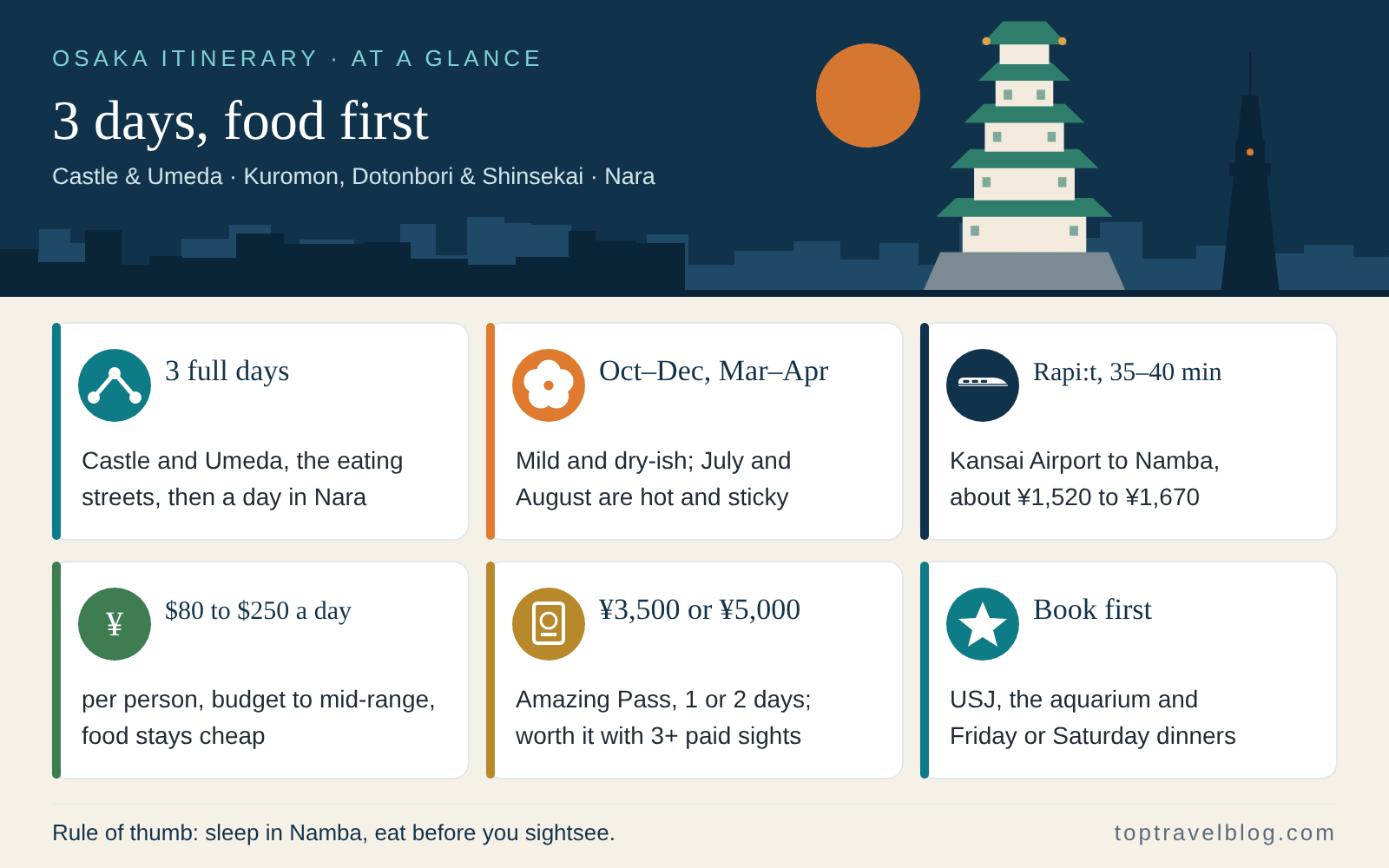
- Best for: first-time visitors to Japan, couples, food-focused travelers, friends who want nightlife, and families with kids old enough to walk 15,000 steps.
- Ideal trip length: 3 full days in the city. Add a fourth day for a second day trip or Universal Studios Japan.
- How to get around: Osaka Metro (fares from ¥190), an IC card or contactless card at the gates, and the JR Loop Line. Day 3 uses the Kintetsu train to Nara for about ¥680 each way.
- Airport: Kansai International (KIX). Nankai Rapi:t to Namba takes roughly 35 to 40 minutes; JR Haruka reaches Osaka Station in about 45.
- Pass math: the Osaka Amazing Pass costs ¥3,500 for one day and ¥5,000 for two. It pays off only on days with two or three paid sights.
- Book first: Universal Studios Japan tickets (if you go), Osaka Aquarium Kaiyukan timed entry, and any dinner you care about on a Friday or Saturday.
- Key caveats: summers are hot and humid, rainy season runs through June and early July, and the Metro stops around midnight, so plan your late-night route before the first drink.
Best time to go: when this Osaka itinerary works best
Late October through mid-December and late March through April are the two windows I would choose. Both windows suit an Osaka itinerary, with daytime highs in the 50s to 70s Fahrenheit, dry-ish weather and long enough days to fit a castle, a market and a night out without rushing.
The trade-off is price. Cherry blossom week in early April and the peak of autumn color in late November push hotel rates and crowds up, and Dotonbori on a Saturday night in either season is a walking-pace crowd from the Ebisu Bridge to Nipponbashi.
Spring: late March to May
Cherry blossoms in Osaka usually peak around the end of March into the first week of April, and the park around Osaka Castle is one of the better places to see them, with the white keep behind the trees. The Osaka Mint Bureau opens its famous cherry tree walkway along the Okawa River for roughly a week in early to mid April, and the line moves slowly but is free.
Golden Week, from late April to the first days of May, is the exception. Trains fill, hotels fill and every attraction has a queue. Plan your Osaka itinerary around it or accept it.
Summer: June to early September
June brings the rainy season, called tsuyu, which lasts into early or mid July. It is more gray drizzle than downpour, and it makes the covered shopping arcades in Shinsaibashi, Tenjinbashisuji and Shinsekai very useful. July and August are hot and sticky, with highs in the low to mid 90s and humidity that makes a 10-minute walk feel long.
The compensation is festivals. The Tenjin Matsuri on July 24 and 25 sends boats down the Okawa River at night and is one of the three big festivals in Japan. If you come in summer, run this Osaka itinerary with the outdoor sights before 11 a.m. and after 5 p.m., and spend the middle of the day in the aquarium or an air-conditioned arcade.
Autumn: late September to early December
September can still be hot, and typhoons occasionally reach Kansai from late August through September, so keep your plans flexible on a couple of days. October is when it turns pleasant. By mid-November the leaves start changing at Osaka Castle Park and in the hills at Minoh, and the evenings are cool enough for a bowl of udon to feel like a plan.
This is my favorite season for the plan below. Every day of the Osaka itinerary works as written, including the long evening walk through Dotonbori.
Winter: mid-December to early March
Winter highs sit in the 40s and 50s, lows can drop to freezing, and snow in the city is rare. Crowds thin out after New Year, and there are real bargains on hotels in January and February.
A winter Osaka itinerary leans on food, and most of the city’s best dishes are hot, griddled or fried, which suits the weather. The sumo spring tournament at the Edion Arena in March is a good reason to schedule a trip, but book tickets early.
Tip: Japan’s calendar bunches travel into three weeks: New Year, Golden Week and Obon in mid-August. During those, domestic travelers fill trains and hotels. If your dates are flexible, shift by a week and you will see a different city and a different bill.
How many days the Osaka itinerary needs
Three days works for most people because it gives you one day for the north, one for the south, and one day out of the city. Here is how the Osaka itinerary changes with the length, assuming you land with some energy on the first day.
2 days in Osaka: choose south over north
A two-day Osaka itinerary skips the Umeda half of Day 1 and keeps the food. Do the castle in the morning, then move straight to Kuromon, Dotonbori and Shinsekai that same afternoon and evening. Day 2 becomes the Nara trip or a slow second pass through Namba. You will feel hurried, but you will not miss the best meals.
3 days in Osaka: the plan in this guide
This three-day Osaka itinerary is the one I would book. Each day has a different character: a morning of history and a night above the city, a full day of eating, and a quieter day among the deer and temples of Nara. It leaves room for a long lunch and one proper evening in a standing bar.
If you arrive at Kansai on a midday flight from the US, count that evening as a bonus, not a day.
4 days in Osaka: add a second day trip
A four-day Osaka itinerary adds Himeji Castle, Kyoto or Universal Studios Japan without cutting anything. I would pick Himeji if you love castles, Kyoto if you have not already seen it on a separate trip, and USJ if you are traveling with kids or Nintendo fans.
For a full Kyoto plan, our Kyoto itinerary covers the temples, gardens and historic streets properly.
5 days or more: use Osaka as a base
An extended Osaka itinerary works because the city is the best base in western Japan for day trips because trains run late and hotels are cheaper than in Kyoto. With five or six days you can add Kobe, Mount Koya or the Kumano trails, or take the Shinkansen to Hiroshima and Miyajima.
If Osaka is one stop of a bigger trip, the 10 days in Japan itinerary shows how Osaka fits between Tokyo and Kyoto, and the Tokyo itinerary covers the other end of the loop.
Pairing Osaka with another Asian city
An Osaka itinerary also makes a good second leg after a stay in Seoul, since the flight is under two hours. Our Seoul itinerary lays out five days there, and the two cities make a food-heavy two-week trip.
If you are building the whole route from scratch, the guide on how to plan a trip step by step helps you sequence flights, lodging and days.
Where to stay in Osaka for this itinerary
Where you sleep decides how late you can stay out. Osaka’s trains are good but not endless, and the Metro stops around midnight, so a hotel within a 15-minute walk of your last drink is worth real money. Most hotels collect a small per-person lodging tax at check-in, usually a few hundred yen a night at most.
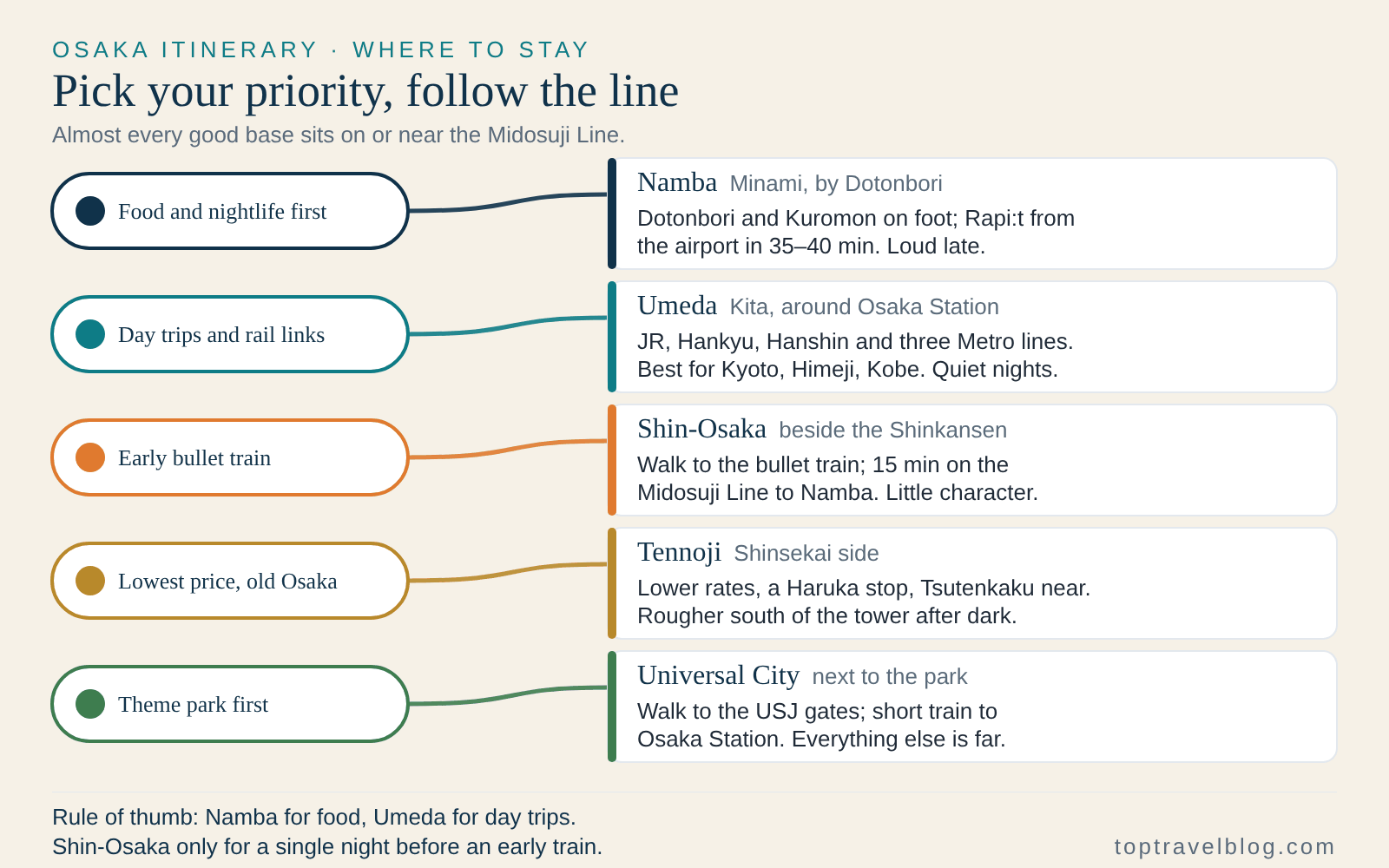
My default for a first Osaka itinerary is Namba, and I will explain why below, along with four alternatives.
The five areas I would consider
Namba and Dotonbori (Minami)
Best for: food, nightlife, first-timers, the Nankai airport train
This is where I put most people. Dotonbori, Hozenji Yokocho, the Kuromon Market and Shinsaibashi are all within a 5 to 15 minute walk, the Midosuji Line stops at Namba, and the Nankai Rapi:t from Kansai Airport arrives right here.
The trade-off is noise. Streets around Soemoncho are loud until 3 a.m., so ask for a room above the 6th floor facing away from the canal.
Umeda and Kita
Best for: rail connections, shopping, upscale dining
Umeda has the JR Osaka Station, Hankyu and Hanshin lines, three Metro lines and the best department stores. It is the easiest base for Kyoto, Himeji and Kobe day trips.
The area feels more like a business district at night, though Kitashinchi and Tenma are a short taxi ride away. Rooms cost a little more than in Namba.
Shin-Osaka
Best for: Shinkansen arrivals, early departures, short stays
You can walk from your hotel to the bullet train. That is the only real argument, but it is a strong one if you arrive on the Tokaido Shinkansen.
The neighborhood has little character, and the Midosuji Line to Namba is a 15-minute ride. I only recommend it for one-night stopovers.
Tennoji and Shinsekai
Best for: budget stays, old Osaka, Abeno Harukas
Prices are lower, the area is close to Shitennoji Temple and the Tsutenkaku tower, and the Tennoji station links JR, Metro and the Haruka airport express.
After dark the streets toward Nishinari get rougher, so I would walk the main roads near Tsutenkaku and take a taxi if you are heading farther south.
Universal City and Osakako Bay
Best for: families doing Universal Studios Japan on two days
Staying next to the theme park shortens the longest day of the trip. The area is built for it, with hotels in walking range and a short train ride to Osaka Station.
Everything else takes time to reach, so stay here only if USJ is the main event.
Which one would I pick
If this is your first trip and you want to be near the food, book Namba. Choose Umeda if your Osaka itinerary is mostly day trips or if you value quiet evenings. Shin-Osaka suits a single night before an early Shinkansen, and Universal City is only worth it for a two-day USJ stay.
When comparing prices, look at the final total with taxes and fees and the walking distance to the nearest Metro station, not the headline rate. A room five minutes from Namba Station beats a cheaper one that adds a 20-minute walk every night.
The 3-day Osaka itinerary, day by day
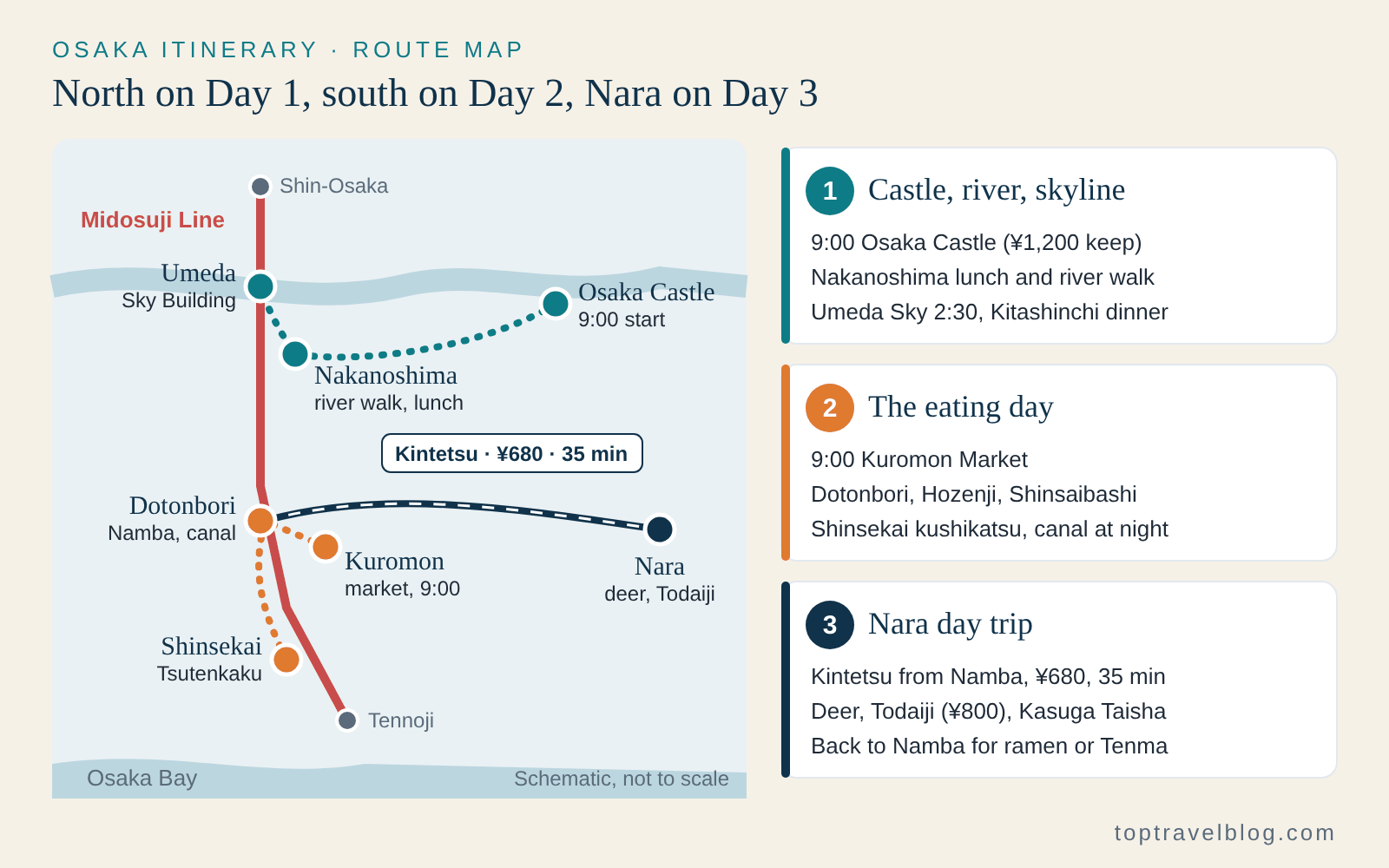
Each day of the Osaka itinerary keeps you in one part of the city so you are never riding the Metro back and forth. Times assume a normal visitor pace with photo stops, and transit times include the walk to the platform. All three days start early, because Osaka’s big sights are quieter at 9 a.m. than at 11, and the evenings are built to be shortened if you run out of energy.
Day 1
Osaka Castle, Nakanoshima and Umeda
Morning: Osaka Castle and the park
Start the Osaka itinerary at the castle: take the JR Loop Line to Osakajokoen Station or the Metro to Tanimachi 4-chome and arrive at the castle before 9 a.m. The grounds are free and open around the clock, the main keep opens at 9, and the first hour is the quietest by a wide margin. Tour groups start streaming in by 10:30.
The keep you see is a 1931 concrete reconstruction with an elevator and a museum inside, so do not expect original timbers. It is still worth the ¥1,200 for the top-floor view over the moat and the city, and for the exhibits on Toyotomi Hideyoshi, who built the first castle here in 1583. The keep is open from 9 a.m. to 6 p.m., with last entry at 5:30. The Osaka tourism board lists the details at osaka-info.jp.
Outside, walk the moat on the Sakuramon side and look for the huge stones in the walls, including the Octopus Stone near the gate. If it is Tuesday through Sunday, add the Nishinomaru Garden (¥300), which closes on Mondays.
Give the whole castle visit about two and a half hours, then take the Metro or JR train two or three stops to Kitahama or Naniwabashi for lunch.
Lunch and Nakanoshima
Nakanoshima is the long sandstone island between two river channels, with old brick public buildings, a rose garden and benches facing the water. Walk west along the river from Naniwabashi, past the Central Public Hall and the Museum of Oriental Ceramics, and stop for lunch around 12:30.
For something local, a bowl of kitsune udon is the right order here. The dish was supposedly invented in Osaka, a thick noodle in dashi with a sweet fried tofu pocket. A good lunch costs ¥800 to ¥1,200.
Allow about 90 minutes for lunch and the river walk.
Afternoon: Umeda Sky Building
From the west end of Nakanoshima it is a 15-minute walk to Umeda, or one stop on the Yotsubashi Line from Higobashi. The Umeda Sky Building is two towers joined by a ring at the top, the Floating Garden Observatory, with an open-air roof deck 173 meters up and a glass escalator between the towers.
The admission is ¥2,000. On the Osaka Amazing Pass it is free before 3 p.m., which is why I schedule it for 2:30 and not at sunset. If your Osaka itinerary has a sunset slot instead, go at golden hour and pay full price (or the 10 percent discount after 3 p.m. with the pass).
Evening: Umeda and Kitashinchi
Umeda after dark is a different Osaka from Dotonbori: cleaner, more expensive and more adult. Ohatsutenjin-dori, the narrow lane by the Ohatsu Tenjin shrine, is packed with small yakitori and skewer bars. The Shin-Umeda Shokudogai arcade has dozens of tiny restaurants under one roof.
For a quieter option, Kitashinchi, a 10-minute walk south, is where salaried workers go for counter-seat sushi and whiskey bars. Order one dish at a time and expect ¥5,000 to ¥8,000 a head. Alternatively, go down to the Takimikoji alley below the Sky Building, built to look like Showa-era Osaka, for a casual set dinner.
Tip: If your jet lag wakes you at 4 a.m., Osaka Castle park at sunrise is a lovely, empty place to walk. The gates are open, the cafes are not, so bring a drink from a convenience store.
Day 2
Kuromon, Dotonbori and Shinsekai: the eating day
Morning: Kuromon Ichiba Market
Day 2 of the Osaka itinerary is the eating day, so start at Nipponbashi Station around 9 a.m. The Kuromon Market is a covered arcade about 580 meters long, with roughly 150 stalls selling fish, tofu, fruit, pickles and grilled seafood. Many of the shops are closed or winding down by mid-afternoon, so it is a morning stop and not a lunch stop.
Go with a loose list. Look for grilled scallops, uni (sea urchin) on the half shell, tamagoyaki on a stick, and strawberries wrapped in mochi in season. The stalls charge more than a regular restaurant, and many ask you to finish at their counter and not eat while walking.
Prices are marked clearly, but a few vendors target tourists with large portions of crab and wagyu. Ask the price before they start cooking.
Allow 75 to 90 minutes. From Kuromon, it is a 10-minute walk to the Dotonbori canal.
Late morning: Doguyasuji and Den Den Town
If you like kitchens, a short detour west along the Doguyasuji arcade takes you through hundreds of shops selling knives, copper pans, ceramics and the plastic food models that fill every restaurant window. A good Japanese kitchen knife can be a lasting souvenir, but remember the tax-free rules in the booking section below.
Nipponbashi’s Den Den Town, to the south, is the city’s answer to Akihabara, with game, anime and electronics shops. Skip it if neither interests you.
Lunch and Dotonbori by day
Reach Dotonbori by midday, since the street is better to see in daylight with fewer people than to fight through at 8 p.m. The Glico Running Man sign at the Ebisu Bridge is the classic photo stop, and the moving crab above Kani Doraku and the giant octopus signs are all within a block.
This is okonomiyaki territory. Order a mixed pancake (butta tama is pork and egg) at a griddle counter and expect ¥1,000 to ¥1,800. Dotonbori has branches of Mizuno and several others with lines, but I would sooner go one block off the main strip, where the same dish is cheaper and the staff has time to flip it in front of you.
For a snack, takoyaki stands line the canal. Eight pieces cost roughly ¥600 to ¥800 and the middle is molten, so wait a minute.
Afternoon: Hozenji, Shinsaibashi and Amerikamura
Walk one block north and step into Hozenji Yokocho, a stone-paved alley with lanterns and the mossy Mizukake Fudo statue, which locals douse with water for luck. It is the quietest 100 meters in Minami.
From there, the Shinsaibashi-suji arcade runs north for about 600 meters of shops. If you want street fashion, turn west to Amerikamura (Ame-mura), where Triangle Park hosts thrift shops and used sneakers.
Use this part of the Osaka itinerary as flex time. Skip the shopping and sit down for coffee if your feet are done.
Late afternoon: Shinsekai and Tsutenkaku
Take the Sakaisuji or Midosuji Line to Dobutsuen-mae station. Shinsekai (“New World”) was built in 1912 in the image of Paris and New York, then faded, and now has a retro neon feel that I find more honest than Dotonbori.
Tsutenkaku Tower is the landmark. The observation deck costs ¥1,500, or is free on the Amazing Pass with a timed ticket, and the mascot Billiken is on the top floor, where visitors rub his feet for luck.
The local meal here is kushikatsu, deep-fried skewers dunked in a shared pot of sauce. The rule is simple and strictly enforced: no double dipping. Use the cabbage to scoop extra sauce onto your skewer.
Evening: Dotonbori at night
Come back to Dotonbori after dark. This is the Osaka of the postcards, with neon signs reflected in the canal. Walk the Tonbori Riverwalk from Ebisu Bridge to Dotonboribashi, and consider the Tombori River Cruise (¥2,000, or free on the Amazing Pass with a timed ticket), which is a 20-minute boat ride with a guide.
For a late dinner, grab a stool in a standing bar or izakaya in the Ura-Namba lanes, south of Dotonbori. Order a beer, two or three small plates and one skewer, then move on. I describe where to drink in the nightlife section below.
Worth knowing: Dotonbori and Soemoncho have touts who approach tourists about bars, massage and hostess clubs. A friendly invitation to “just one drink” is often how people end up with a bill several times what they expected. Say no, walk on, and pick places where the menu with prices is posted outside.
Day 3
A day trip to Nara, then back to Namba
Morning: train to Nara
The third day of this Osaka itinerary leaves the city. Take the Kintetsu Nara Line from Osaka-Namba Station (not JR Namba or Nankai Namba) to Kintetsu Nara. The Rapid Express takes roughly 35 to 40 minutes and costs ¥680. The station sits about a five-minute walk from Nara Park.
Arrive by 9 a.m. Nara is a morning town, and the deer are calmer and the temples quieter before 10.
Nara Park and Todaiji
Nara Park has more than a thousand free-roaming sika deer, considered messengers of the gods at the Kasuga shrine. Shika senbei, the deer crackers, cost ¥200 a pack. The deer bow for them, and then bite your pockets. Keep the crackers hidden until you are ready, and do not wave them around.
Todaiji, about 20 minutes’ walk from the station, holds the Great Buddha inside one of the largest wooden buildings in the world. Admission is ¥800. The hall is more impressive than the photographs, and the Buddha is about 15 meters tall. Give it an hour.
Lunch and Kasuga Taisha
Have lunch along Higashimuki shopping street, where kakinoha-zushi (mackerel sushi pressed in persimmon leaf) is the local dish. Then walk about 15 minutes to Kasuga Taisha, the shrine known for its thousands of stone and bronze lanterns. The outer grounds are free, and the inner sanctuary costs ¥700.
The walking route from the station through the park, Todaiji, lunch and Kasuga is about 6 to 8 km. If your legs say no, skip Kasuga and take the afternoon for the Yoshikien Garden.
Evening: back to Osaka
Take the same train back from Kintetsu Nara, about 35 minutes to Namba. You will be tired, so keep dinner simple. Osaka’s answer to a tired traveler is a bowl of ramen, a plate of gyoza and a beer at a counter near your hotel.
If you still have energy, ride the Metro to Tenma, north of Osaka Castle, where the Tenjinbashisuji arcade (the longest in Japan at about 2.6 km) leads to rows of standing bars and yakitori counters aimed at locals, not tourists.
Tip: If Day 3 lands on a day with heavy rain, swap Nara for the Osaka Aquarium Kaiyukan and Tempozan in the morning and a long, covered afternoon in Shinsaibashi and Namba. Nara is a lot less fun with wet deer.
Rain and winter swaps for the whole itinerary
On a rainy Day 1, start at the Umeda Sky Building at opening, then take the castle in the afternoon, when showers often pass. On a rainy Day 2, spend more time in Kuromon and the Doguyasuji arcades, which are covered, and skip the Dotonbori cruise.
In winter the castle park and Nara are cold, but the sunsets are clear and the crowds are lower. Layer up, wear shoes you can walk in, and expect to eat more hot food.
Day trip swaps for your Osaka itinerary
Nara is my default for Day 3 of the Osaka itinerary because it is the easiest and cheapest, but it is not the only good option. Your Osaka itinerary sits in the middle of Kansai, so four other trips take less than an hour or so by train. Here is how I would choose.
Kyoto: the obvious one, and often too big for one day
Kyoto is about 30 minutes from Osaka Station on the JR Special Rapid (¥580), 40 minutes on the Hankyu line from Umeda to Kawaramachi (¥410), or 15 minutes by Shinkansen from Shin-Osaka. A day gets you Fushimi Inari, Kiyomizu-dera and Gion, and a very full feet-up evening.
I would only do Kyoto as a day trip if you cannot add a night there. Our Kyoto itinerary gives you the three-day version and explains which temples to rank first.
Himeji: for castle lovers
Himeji Castle is Japan’s best-preserved original castle, a white, multi-tiered keep that survived the wars and earthquakes largely intact. The JR Special Rapid from Osaka Station takes about an hour and costs ¥1,520, while the Shinkansen from Shin-Osaka takes about 30 minutes for ¥2,980.
Since March 2026, non-resident admission is ¥2,500, up from ¥1,000, and visitors under 18 enter free. A combined ticket with Koko-en garden is ¥2,600, which is a bargain for the extra ¥100. The walk from Himeji Station to the castle is 15 to 20 minutes along a straight avenue.
Universal Studios Japan: the single biggest day
USJ is a full day in itself, and it is the one trip where booking early really matters. Take the JR Yumesaki Line to Universal City Station, which is a short ride from Osaka Station via Nishikujo, then walk through CityWalk to the gates.
Ticket prices vary by date, so a quiet Tuesday is considerably cheaper than a holiday weekend. Super Nintendo World entry on crowded days needs a timed-entry ticket, which in 2026 is issued only through the official USJ app after you register your admission ticket. Plan to be at the gates well before opening.
The official Universal Studios Japan site lists park hours and ticket tiers.
Kobe and Koyasan: if you have a fourth day
Kobe is 30 minutes from Osaka on the JR line and works as a half-day: Kitano’s old foreign houses, Chinatown and a steak lunch. Koyasan, the mountain temple complex south of Osaka, takes about two hours each way and is worth a night in a temple lodging, not a day.
Neither suits a three-day Osaka itinerary, but both make a good fourth or fifth day.
Getting around Osaka: Metro, passes and airport transfers
An Osaka itinerary is easy to move around because the rail network is simple to learn if you accept that three operators run overlapping lines. The Osaka Metro covers most of the central city, JR runs the Loop Line and long-distance trains, and the private railways (Nankai, Hankyu, Hanshin, Kintetsu) connect to the suburbs and the airport.
From Kansai Airport to the city
The airport has two main terminals, and Terminal 2 (many budget airlines) has no train station. A free shuttle runs to Terminal 1 in about 7 to 10 minutes.
For Namba, take the Nankai Rapi:t limited express. The trip takes 34 to 37 minutes and costs about ¥1,520 to ¥1,670, and seat reservation is required. The cheaper Nankai Airport Express takes 45 to 50 minutes for ¥970 and needs no reservation.
For Umeda or Shin-Osaka, take the JR Haruka limited express, which reaches Osaka Station in about 45 minutes. The foreign visitor ticket costs roughly ¥1,800 to ¥1,900. The Haruka does not stop at Namba.
The Kansai Airport site lists train and bus timetables.
Limousine buses cost about ¥1,300 to ¥1,800 and take 45 to 90 minutes depending on traffic. A taxi to Namba runs ¥15,000 to ¥20,000, and the last Haruka leaves the airport around 10 p.m.
Osaka Metro, IC cards and tapping in
Metro fares start at ¥190 for trips up to 3 km and top out around ¥400. IC cards (ICOCA, Suica, PASMO and others) and contactless Visa, Mastercard and other credit cards work at the gates; a new ICOCA costs ¥2,000 including a ¥500 refundable deposit. Apple Pay and Google Pay work with a transit card in your phone wallet. The Osaka Metro site has maps and timetables.
The Midosuji Line is the spine of the city. It runs north to south from Shin-Osaka through Umeda, Shinsaibashi, Namba and Tennoji, and nearly everything in this guide is on it or one stop away. Service ends around midnight, with last-train times differing by station.
Is the Osaka Amazing Pass worth it?
The Osaka Amazing Pass costs ¥3,500 for one day or ¥5,000 for two. It gives unlimited rides on the Metro, most city buses and the New Tram, plus selected private-line sections, and free entry to about 35 attractions, including Osaka Castle’s museum, the Umeda Sky Building before 3 p.m., the Tombori River Cruise and Tsutenkaku Tower. It is a QR code on your phone, and you need a credit card to buy it.
Here is the honest math for an Osaka itinerary. On Day 1, the castle (¥1,200) plus Umeda Sky (¥2,000) plus a handful of Metro rides gets you to around ¥4,000, so a one-day pass saves about ¥500. On a two-day pass for Days 1 and 2, add Tsutenkaku (¥1,500) and the cruise (¥2,000), and the total value reaches roughly ¥8,000 against ¥5,000, which saves around ¥3,000.
So I buy the two-day pass if I will do three or four of the paid sights, and skip it otherwise. It does not cover USJ or the Kaiyukan Aquarium. The official Osaka Amazing Pass page lists every included site.
The cheaper alternative is the Enjoy Eco Card, a paper day ticket for unlimited Metro and city bus rides at ¥820 on weekdays and ¥620 on weekends and holidays. It makes sense only if you plan to ride six or more times in a day.
What this Osaka itinerary costs
An Osaka itinerary costs less than a Tokyo one and much less than Kyoto at peak times. With the yen at about 150 to the dollar, here is how I would think about each style.
Budget: roughly $80 to $120 a day
A bed in a clean business hotel or capsule hotel, noodles and skewers for most meals, an IC card for trains and one paid sight a day. The food in Osaka is the best argument for a modest budget, since a great meal can cost under $10.
Mid-range: roughly $150 to $250 a day
A private room in Namba or Umeda, a sit-down dinner on most nights, a two-day Amazing Pass, and the Nara trip. This is where most travelers land, and the money goes to the hotel first and food second.
Comfortable: $300 and up
A larger hotel room or a ryokan night, counter-seat sushi or kaiseki at least once, taxis after midnight and a day at USJ with an Express Pass. At the top end, the Express Pass alone can double the cost of the park day.
Hotel rates are the biggest swing, and I will not quote a specific price because they move with the season. Cherry blossom week and November are the expensive ones, and February is the cheap one.
Japan also charges a departure tax of ¥3,000 as of July 1, 2026, which is already included in your airline ticket. Tipping is not expected anywhere, and an izakaya will often add a small seating charge called otoshi (typically a few hundred yen), which comes with a small dish.
What to book ahead
An Osaka itinerary is the easiest big-city plan in Japan to keep loose, so the booking list is short. Four things matter.
- Universal Studios Japan tickets and Super Nintendo World entry. Buy the day pass as soon as your dates are firm, and plan the timed-entry steps in the app.
- Osaka Aquarium Kaiyukan. Entry slots are limited, and same-day tickets are restricted, so a rainy-day plan that depends on it needs a booking. The whale shark in the main tank is the reason to go.
- Any dinner you care about on a Friday or Saturday. Counter-seat restaurants hold six to ten seats. Hotel concierges will book for you, and many places take online reservations.
- Your Haruka or Rapi:t reservation. Rapi:t seats are reserved, and an e-ticket is a little cheaper than paper.
Visa-free entry for US citizens covers stays of up to 90 days. JESTA, Japan’s planned pre-travel authorization, is not expected until the 2028 fiscal year, so it does not affect trips in 2027.
Tax-free shopping changed in November 2026
From November 1, 2026, tourists no longer get the 10 percent discount at the register. You pay the full price, have your passport scanned and claim the refund at the airport, usually back to your card within a couple of weeks. The old 500,000 yen daily cap is gone. Keep purchased items in your carry-on, because a missing item can void the refund on the whole receipt.
What to eat in Osaka
The local word is kuidaore, “eat until you drop,” and it is a fair description of the city. The best Osaka itinerary is one where every day has a plan for three meals and a snack, and you leave room for the next one.
The dishes to order
- Takoyaki: octopus balls from a hot griddle, glazed with sauce and mayonnaise. Eat them at the stand.
- Okonomiyaki: a cabbage pancake cooked on a griddle at your table or counter. Order the Osaka style, with the ingredients mixed in.
- Kushikatsu: deep-fried skewers, the specialty of Shinsekai. Never double dip.
- Negiyaki: a thinner pancake packed with green onion, best in the Juso area.
- Kitsune udon: noodles with sweet fried tofu, the cheapest comforting lunch.
- Yakiniku in Tsuruhashi: grilled beef at the Korean quarter, where the smoke comes out of the shopfronts at dinner.
- Oshizushi: pressed sushi, the older Osaka style, in small boxes.
How to eat like a local
Pay attention to the counter. Most places print a menu with photos, and many have a ticket machine at the door where you pick a dish, pay and hand the ticket to the cook. Cash still matters for small stalls, though cards are accepted much more than they used to be. Trash cans are rare, so carry your trash until you find a convenience store.
If a line is long and mostly local, it is usually worth joining. If it is a queue of tourists photographing the sign, walk one block and sit down.
Osaka nightlife: where to go after dinner
Osaka is a good drinking city because the bars are small, cheap and open late. The risk is a long night with no way home, so look up your last train before you start. A good Osaka itinerary ends each evening within a short walk or a taxi ride of the bed.
Where I would go, in order
- Hozenji Yokocho and Ura-Namba: narrow lanes south of Dotonbori with standing bars and tiny izakayas. This is the right first round, because you can leave after one drink without any awkwardness.
- Shinsekai: old-school standing bars and kushikatsu counters, busy until about 10 p.m. and much quieter after.
- Umeda and Kitashinchi: cocktail bars, whisky rooms and sushi counters for a more polished night. Expect a seating charge.
- Tenma: the locals’ pick, with yakitori and craft beer along the shopping arcade. It is the place I take friends who have already done Dotonbori.
- Amerikamura and Horie: a younger crowd, small clubs and live houses, with the busiest night on Saturday.
Rules that save you money and trouble
Japan’s legal drinking age is 20. Most small bars expect one drink and a small plate per person, and many add a cover charge of a few hundred yen. If an unfamiliar bar has no price list at the door, walk out.
Stay away from anyone who stops you on the street to offer a bar. Order a beer, have two small plates and one skewer, then move on. Leave by 11:30 if you are riding the Metro.
Common mistakes on a first Osaka itinerary
These are the ones I see most often, in rough order of how much they cost in time, money or mood.
1. Treating Osaka as a Kyoto stopover
People book one night, see Dotonbori and leave. Osaka’s best parts, the markets, the standing bars and the neighborhoods, need at least two full days. A good Osaka itinerary treats the city as a destination, with Kyoto as the day trip and not the other way around.
2. Eating where the photos are
The Dotonbori strip is fun, but the best takoyaki and okonomiyaki are often on the side streets. Walk one block off the main drag and look for lines of locals. If the sign is in six languages and the staff is shouting at the street, keep going.
3. Buying the Amazing Pass without doing the math
It saves money only if you visit two or three paid sights a day. I have seen travelers buy it for a day of eating and walking and use it for two Metro rides. Add up the admission prices first, then decide.
4. Landing late with no plan for the last train
The last Haruka leaves Kansai around 10 p.m., and a taxi to Namba can cost ¥15,000 to ¥20,000. If your flight arrives late, book a hotel near the airport for the first night or have a car transfer arranged.
5. Forgetting that Terminal 2 has no train
Budget carriers use Terminal 2, which has no rail station. Allow 10 to 15 extra minutes for the free shuttle to Terminal 1 in both directions, especially on departure day.
6. Visiting Kuromon in the afternoon
Many stalls close early and the best seafood is gone by noon. Go at 9 or 10 a.m., eat standing, and plan a proper lunch somewhere else.
7. Packing the Osaka itinerary too tight
Osaka rewards wandering. Leave one evening open for a bar you stumble into, a festival you did not know about or a second visit to a place you liked.
8. Missing the last Metro
Service ends about midnight. If you are in Dotonbori at 11:45, you are already late. Plan a taxi or a 30-minute walk back, and know that taxis get scarce when the bars empty.
Frequently asked questions about this Osaka itinerary
Is 3 days enough for Osaka?
Yes, and it is the length this Osaka itinerary is built on. Three days covers the castle and Umeda, the food streets of Kuromon, Dotonbori and Shinsekai, and a day trip to Nara. Two days works if you drop the Umeda half of Day 1, and four days lets you add Himeji, Kyoto or Universal Studios Japan without rushing.
What is the best area to stay in Osaka?
Namba is the best first choice for most travelers. It is close to Dotonbori, the Kuromon Market and the Nankai airport train, and late-night food is within a short walk. Umeda is the better base if you plan several day trips by JR or Hankyu, and Shin-Osaka is useful only for an early Shinkansen departure.
How do I get from Kansai Airport to Osaka?
For Namba, take the Nankai Rapi:t, which takes about 35 to 40 minutes, or the cheaper Airport Express, which takes 45 to 50 minutes. For Umeda and Osaka Station, take the JR Haruka, about 45 minutes. Taxis cost ¥15,000 to ¥20,000 and make sense only for late arrivals or groups.
Is the Osaka Amazing Pass worth it?
Only when you stack paid sights. The two-day pass at ¥5,000 pays off if you visit the castle museum, Umeda Sky, Tsutenkaku and the river cruise. For a day of eating and walking, a contactless card or the ¥820 weekday Enjoy Eco Card is cheaper, and the pass does not cover USJ or the aquarium.
Can I do Kyoto as a day trip from Osaka?
Yes, and it is easy. The JR Special Rapid takes about 30 minutes for ¥580, and the Hankyu line takes about 40 minutes for ¥410. Kyoto is large, though, and one day lets you cover only two or three areas. Our Kyoto itinerary has the full plan if you can add a night.
What should I eat in Osaka?
Start with takoyaki, okonomiyaki and kushikatsu, then add kitsune udon for a cheap lunch and yakiniku in Tsuruhashi for dinner. Visit the Kuromon Market in the morning for grilled seafood and fruit. Keep one night for a counter-seat sushi or tempura place if the budget allows.
Is Osaka better than Tokyo?
They are different trips. Tokyo is bigger and more varied, while Osaka is friendlier, cheaper and more focused on food. If you only have time for one, choose by interest. With a week, do both. The Tokyo itinerary is a good companion for the other half.
Do I need cash in Osaka?
Carry some. Cards and IC cards work in hotels, department stores, convenience stores and many restaurants, but market stalls, standing bars and some temples still prefer yen. Seven-Eleven ATMs accept most foreign cards, so withdraw ¥20,000 or so at a time and top up when you need it.
How much walking does this Osaka itinerary involve?
Plan on 8 to 11 miles on the busiest days. Osaka is flat, which helps, but the days are long and the castle and Nara both involve a lot of standing. Wear shoes you have already broken in, and use the Metro for long hops between districts.
How do I find cheap flights to Osaka?
Fly into Kansai International (KIX) and compare it with Tokyo, since an open-jaw ticket into Tokyo and out of Osaka often costs about the same. Our guide on how to find cheap flights walks through the search strategy, the traps and the timing step by step.
One last thing before you go
If I could change one thing about how people plan Osaka, it would be this: leave a late evening open. The best moment I have had in this city was not on any list. It was a counter with eight stools, a cook who handed me a skewer I had not ordered and a stranger who explained, in half English and half gestures, what I was eating.
Osaka is built for that sort of accident. The castle, the Sky Building and Nara give your days a spine, and the meals fill in the rest. Build your Osaka itinerary so it has room for both, and you will want to come back.
Related planning guides
- Kyoto itinerary: 3 days of temples, food, gardens and historic streets — the day trip most people add, planned as a trip of its own.
- 10 days in Japan: Tokyo, Kyoto and Osaka itinerary — how Osaka fits into a first full Japan route.
- Tokyo itinerary: the best 5 days for first-time visitors — the other end of the loop.
- Seoul itinerary: 5 days of palaces, markets, neighborhoods and food — a strong second city for a food-heavy Asia trip.
- How to plan a trip step by step — from idea to booked itinerary.
- How to find cheap flights — a search strategy that avoids common traps.