
Five days is the number I keep landing on, and it is the length this Tokyo itinerary is built around. It is enough to see the big shrines, the neighborhoods that make the city famous, one proper day away from the center, and a few evenings in places that only get interesting after dark, without turning the trip into a forced march.
Four days works if you drop the day trip. Seven is better if you want to add a long lunch anywhere.
The verdict in one sentence: Tokyo rewards people who pick one district per day, buy a handful of timed tickets in advance, and let the trains do the work. This Tokyo itinerary suits first-time visitors, couples, friends, and families with kids who can walk four to six miles a day. It suits you less if you hate crowds in the morning rush, need a car, or want a beach week with a city on the side.
I have flown into Tokyo more times than I can count, in cherry blossom season and in a humid August, once with a stroller and once with only a carry-on and a notebook. What follows is the Tokyo itinerary I would hand a friend: the order of days that stops you crossing the city twice, the current transit fares and ticket prices as of November 2026, where to sleep so you are never more than a short walk from a station, and the mistakes I see first-time visitors make in the first 48 hours.
Quick facts: this Tokyo itinerary at a glance
- Best for: first-time visitors, couples, friends, and families with kids 8 and up who enjoy trains and walking.
- Ideal trip length: 5 full days, plus the day you land and the day you fly home.
- Entry: US passport holders can visit Japan for tourism for up to 90 days without a visa; the Visit Japan Web portal handles immigration and customs forms in advance.
- How to get around: the subway and JR lines with a Suica or Pasmo card on your phone or in your pocket, or the Tokyo Subway Ticket (24 hours 1,000 yen, 48 hours 1,500 yen, 72 hours 2,000 yen). No rental car.
- Booking priorities: your hotel, a timed slot at Shibuya Sky, teamLab Planets, the Ghibli Museum if you want it (tickets go on sale on the 10th of the month before), and dinner at any sushi or yakiniku place you care about.
- Pacing: one anchor district per day, the busiest sight before 9 a.m. or after 5 p.m., and a long dinner you can shorten if your feet quit.
- Key caveats: summer is hot and sticky, cherry blossom weeks double hotel prices, and the last trains run close to midnight, so late nights end in a taxi if you misjudge.

Best time to go: when this Tokyo itinerary works best
If I could pick one window, it would be the second half of October through the middle of November, and the first half of that is better. Days run in the mid-60s to low 70s Fahrenheit, the humidity has finally gone, the sky is often clear, and the ginkgo trees along the avenues turn yellow in late November. The second-best window is late March through April, with a caveat: cherry blossom season is the most crowded and expensive stretch of the year.
Here is how I think about each season, because the right Tokyo itinerary shifts with the thermometer.
December to February: cold, dry and clear
Winter in Tokyo is sunny more often than people expect. Highs sit in the 40s and 50s, rain is rare, and the air is clear enough that Mount Fuji shows up on the horizon from observation decks on the best mornings. Hotels are cheaper than in spring or autumn, apart from the New Year week.
That week is the one to watch. Many restaurants, small shops and even some museums close from roughly December 29 to January 3 while locals travel to their hometowns. Temples, on the other hand, are packed for the first shrine visit of the year. Pack a real coat and gloves, because station platforms are unheated.
March to May: blossoms, crowds and Golden Week
Cherry blossoms usually open in the last days of March and peak in the first week or so of April. The exact dates move by a week either way, and it is the single hardest thing to plan around. Parks like Ueno, Shinjuku Gyoen and the Meguro River fill with picnic tarps, and hotel rates in central wards can run well above their winter level.
Golden Week, from April 29 into the first days of May, is the other pressure point: domestic travelers fill trains and attractions. Late April after the blossoms fade and May after Golden Week are good, mild, greener months to go.
June to August: rain, then heat
The rainy season, tsuyu, usually runs from early June to mid-July. It is not constant downpour; it is gray, damp and warm, with a few heavy days. Summer after that is serious: highs in the upper 80s and low 90s, humidity that soaks a shirt by 10 a.m., and a heat index that makes midday sightseeing unpleasant.
If you travel then, flip this Tokyo itinerary so outdoor walking happens before 10:30 a.m. and after 5 p.m., and use department stores, museums and underground arcades in between. Carry a small towel and a folding umbrella; both are sold in every convenience store and used by half the city.
September and early October: typhoon watch
Early September is still hot. Typhoon season peaks from August through October, and a typhoon passing near the Kanto region can cancel trains and flights for a day. It happens in a minority of years and rarely wrecks a whole trip, but build one flexible indoor day into your Tokyo itinerary, and buy travel insurance that covers weather delays.
By mid-October the pattern turns: the air dries, festivals fill the weekends, and the city is at its most comfortable for walking.
Days of the week matter
Mondays are the quiet trap in Tokyo. Many museums close on Mondays (the Tokyo National Museum and Shinjuku Gyoen among them), and the Imperial Palace East Gardens close on both Mondays and Fridays. Weekends bring locals to the shopping streets, so Harajuku and Shibuya are at their most packed on Saturday afternoons.
I build this Tokyo itinerary so that the days with fixed closures are easy to swap. If your five days begin on a Monday, switch Day 1 and Day 2 and the plan still works.
Tip: Sunset in Tokyo comes early in winter, around 4:30 p.m. in December, and after 7 p.m. in June. Your observation deck booking on Day 2 depends on that one number, so pick the time slot after you know the month, not before.
How many days you really need for a Tokyo itinerary
Five days is where a Tokyo itinerary stops feeling like a checklist. Here is what changes at each length, based on the version of this Tokyo itinerary I would give someone with that many days.
3 days: the greatest hits, no day trip
With three days, combine Day 1 (Asakusa and Ueno), Day 2 (Harajuku, Meiji Jingu and Shibuya) and Day 3 (Toyosu, Tsukiji and Ginza). You miss the day trip, Shinjuku at night and the quieter old neighborhoods, but you hit the temple, the crossing, the market and the food. It works as a stopover on the way to Kyoto, and a reasonable 3-day Tokyo itinerary should leave one meal per day unplanned.
Expect to be exhausted by the end of day two. Jet lag is real here, with a 13 to 16 hour time difference from the US.
4 days: add Shinjuku and a slower evening
Four days lets you add the Shinjuku night, which is the one evening almost everyone wants, and gives you a half-day cushion for rain. You still skip the day trip or squeeze Kamakura into a long, tiring day. If you can only have four, I would still keep Day 4 for the coast and trade the afternoon at Akihabara for a second dinner in a neighborhood you liked.
5 days: the plan in this guide
A 5-day Tokyo itinerary gives each major area its own half-day, plants a proper day trip in the middle where your energy has settled, and leaves the last day for something quiet. It also lets a Tokyo itinerary absorb one bad-weather day without wrecking the trip. If you land from the US on an afternoon flight, the first evening is only for dinner and sleep, and the five days start the next morning.
7 days and beyond
With a week, I would add a second day trip, either Nikko for its elaborate shrine complex and mountain scenery, or Hakone for hot springs and lake views. I would also add a slow day with no tickets at all: a long lunch, a stroll through Yanaka, an afternoon in a bookstore district like Jimbocho.
Beyond a week, most visitors are ready to move on to Kyoto, which is covered in our Kyoto itinerary.
Pairing Tokyo with another city
Most people pair this Tokyo itinerary with Kyoto and Osaka. The bullet train from Tokyo Station to Kyoto takes roughly two hours and 15 minutes, which is why the classic route is Tokyo, then Kyoto, then Osaka, then home. Our 10 days in Japan itinerary strings the three together with exact train times, and the Osaka itinerary covers the food capital at the end of the line.
If you would rather combine Tokyo with another country, the Seoul itinerary is a short flight away.
Before you book: entry, money and phones for a Tokyo itinerary
A few logistics decide whether the first 48 hours are smooth or irritating. None of them are hard, but all are easier to do from your couch than from an immigration line at 6 a.m.
Entry rules for a Tokyo itinerary from the US
US citizens can enter Japan for tourism for up to 90 days without a visa, and the Ministry of Foreign Affairs of Japan lists the exemption on its visa information page. Your passport needs to be valid for the length of your stay, and you will need an onward or return ticket on request. Immigration takes fingerprints and a photo at the booth.
Before you fly, register on the government’s Visit Japan Web service, which stores your immigration and customs details and produces QR codes. It cuts the line time at arrivals noticeably, and the same account matters again on departure if you plan to claim a shopping tax refund.
New costs that appeared in 2026
Two changes affect the budget. First, the international tourist tax paid by every traveler leaving Japan rose from 1,000 yen to 3,000 yen on July 1, 2026, as the Japan National Tourism Organization reports. It is normally added to the airfare, so you will not pay it at the airport.
Second, tax-free shopping changed on November 1, 2026. You now pay the tax-inclusive price at the register and claim the refund when you leave Japan, using a customs terminal or the Visit Japan Web page before check-in. The 5,000-yen minimum spend per store per day still applies, and items you buy must be with you when you fly out, because a receipt is all-or-nothing.
Money: cash is still useful
Japan is far more card-friendly than it was five years ago, but not universally. Convenience stores, department stores, train stations and most hotels take Visa and Mastercard. Small ramen counters, neighborhood izakayas, many temples and shrine stalls, and some vending machines still prefer cash or a transit card.
The ATMs in 7-Eleven and Japan Post branches accept foreign cards and have English menus. Withdraw 30,000 to 50,000 yen at a time and carry it in a coin purse, because coins are everywhere. Tipping does not exist here, and trying to leave one will often cause a server to chase you down the street to return it.
Your phone: eSIM, maps and the transit card
An eSIM bought before you leave is the least stressful way to get data; set it up on the plane and it activates when you land. Google Maps is excellent in Tokyo for train routes. It gives platform numbers, exact fares and the car that will put you nearest the exit, and its walking times are honest.
If you have an iPhone, add a Suica or Pasmo card to Apple Wallet before you arrive and top it up with your card. Android users generally ride with a physical card from a station machine, and since physical card availability has been patchy at times, the phone route is the safer plan where you have it.
Bags, jet lag and the first day
Most flights from the US West Coast and East Coast land in the early afternoon or early evening, after a 12 to 14 hour flight. The temptation is to go straight into sightseeing. I would not. Get to the hotel, drop your bags, walk around the block, eat something simple, and be asleep by 9 p.m. so that Day 1 of the Tokyo itinerary starts at 7 a.m. rather than at noon.
If your bags are heavy, the takkyubin luggage-forwarding counters at both airports send suitcases to your hotel for roughly 2,000 to 3,000 yen per bag, usually arriving the next day. This is the single best money-for-comfort trade in Tokyo.
Where to stay in Tokyo for a first visit
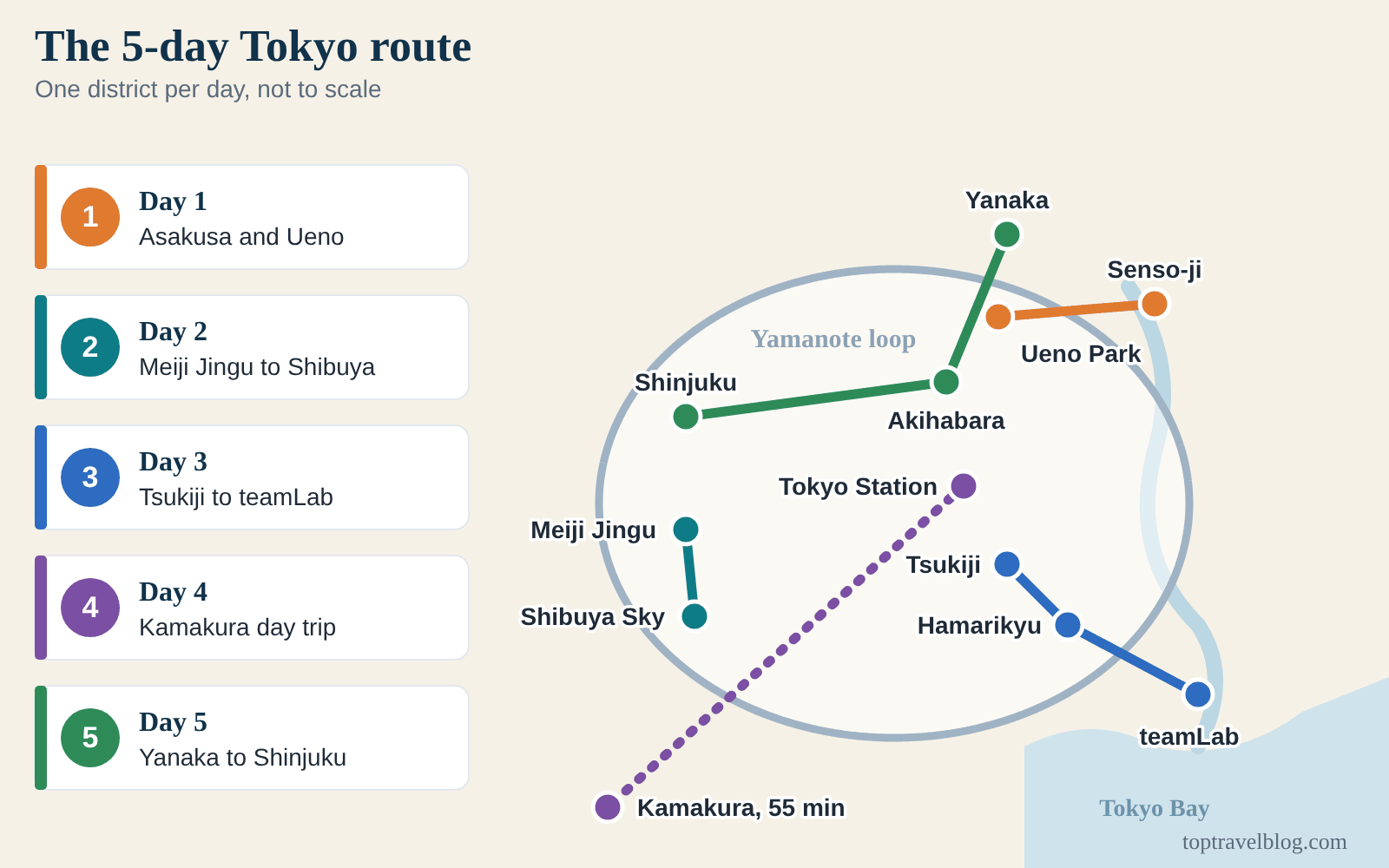
Tokyo is not one city with one center. It is a ring of hubs around the Yamanote Line, the loop railway that connects Shinjuku, Shibuya, Tokyo Station, Ueno and a string of other major stations. The best hotel for a first visit is within a five-minute walk of a station on that loop or on a direct line into it. Everything else is trade-offs. Our guide on how to choose a hotel covers the general method; these are the Tokyo specifics.
Shinjuku
Best for: first-timers who want maximum train options and nightlife.
The busiest station on Earth sits here, which sounds like a drawback until you realize it connects to nearly everything in a single ride. Hotels west of the station have quieter streets; the east side has the neon, the bars and the noise. Expect a loud, bright area at night and a 10-minute station maze every morning.
Tokyo Station and Ginza
Best for: short stays, rail connections, quiet evenings.
This is the easiest base if you are heading to Kyoto by bullet train, and Ginza is a short walk or one subway stop away. It goes quiet after 9 p.m., which is a plus if you want sleep and a minus if you want street life. Rooms are small and well kept, and prices skew higher than elsewhere.
Shibuya
Best for: younger travelers, shopping, late nights.
Close to Harajuku, Omotesando and the best bars and live houses, with a hillier terrain than most of Tokyo. The station is under constant construction and can be confusing. Pick a hotel on the Harajuku or Shinsen side to avoid the loudest streets.
Asakusa and Ueno
Best for: budget travelers, old Tokyo, easy Narita access.
Older and calmer, with cheaper rooms and traditional streets. Ueno has the Skyliner from Narita and the museums; Asakusa has the temple at your doorstep. The trade-off is distance from Shibuya and Shinjuku, which is 25 to 35 minutes by train, and an earlier nightlife curfew.
My pick for a first Tokyo itinerary
For the plan in this Tokyo itinerary, I would stay in Shinjuku or near Tokyo Station. Shinjuku wins on connections and food at all hours; Tokyo Station wins on calm and the bullet train. If you are on a budget, Asakusa and Ueno give you roughly 20 to 30 percent lower room rates for a slower start to the evening.
A typical central business hotel for two runs roughly $120 to $220 a night in most months, higher in cherry blossom season and the autumn peak. Rooms of 130 to 180 square feet are normal, which is small by American standards and fine once you accept that the city is your living room.
Areas I would skip on a first visit
Odaiba and the bay-side hotels look appealing on a map and feel remote in practice: transfers are longer and evenings quiet. Hotels far out on suburban lines advertise a low nightly rate, then charge you 45 minutes each way in time. Narita airport hotels make sense only for the night before a morning flight.

What to check before you click “book” on your Tokyo itinerary hotel
Three things. First, the walking distance to the nearest station exit, not just the station name. A “5-minute walk” to a station with 12 exits can turn into 12 minutes. Second, the total price including the lodging tax; Tokyo charges a small per-person, per-night accommodation tax that is added at checkout. Third, the room size in square meters, and whether the bed is a double or two singles pushed together.
Read recent reviews for noise from nearby train tracks or all-night bars. Lastly, for a longer Tokyo itinerary, hotels with coin laundry on site save you from carrying a week of clothes.
The 5-day Tokyo itinerary, day by day
Each day of this Tokyo itinerary has one anchor area so you are never riding a train across the city twice. Mornings start early because the big sights are better at 8:30 a.m. than at 11, and evenings are built to be shortened. Walking times are real-world times at a visitor’s pace with photo stops, not the optimistic ones from a map. Transit times include walking to the platform and a reasonable wait.
Day 1
Asakusa, the Sumida River and Ueno
Old Tokyo comes first in this Tokyo itinerary, while jet lag still makes the early morning feel normal. Day 1 of the Tokyo itinerary is mostly flat, mostly outdoors, and nearly all of it is free. It also gives you the temple everyone has seen in photos, so you can stop wondering about it.
Morning: Senso-ji before the tour buses (8:00 to 10:30)
Take the Ginza Line to Asakusa Station and walk out toward the Kaminarimon gate, the one with the giant red lantern. Get there by 8 a.m. if you can. The temple grounds never close, and by 10 the approach street, Nakamise, is a shoulder-to-shoulder lane of snack stalls and souvenirs that you will not enjoy.
At 8, you walk through almost alone. The main hall opens in the morning, around 6 or 6:30 depending on the season, and closes in the afternoon, so mornings suit it best. Senso-ji is the oldest temple in Tokyo, with a history that goes back to the seventh century.
Do the ritual the locals do. Waft some incense smoke over any part of you that hurts, rinse your hands at the water pavilion, toss a coin, bow twice, clap twice, bow once more. The omikuji fortune slips cost about 100 yen, and if the English reading is bad, you tie it to the rack and leave it there.
Mid-morning: Nakamise snacks and Kappabashi (10:30 to 12:30)
Once you have seen the temple, walk back down Nakamise and graze. Freshly baked ningyo-yaki cakes, melon pan from Kagetsudo near the gate, and sweet potato snacks are all reasonable at 10:30. Eat standing near the stall rather than walking, as most vendors ask.
Then walk 15 minutes west to Kappabashi Street, Tokyo’s kitchenware row. The shops here sell knives, ceramic bowls, and the plastic food models you see outside restaurants. A good chef’s knife is a real souvenir if you pack it in checked luggage; most shops engrave your name for a small fee.
Lunch and the river (12:30 to 3:00)
Eat lunch in Asakusa. The streets east and north of the temple are full of tempura counters, soba shops and old-fashioned diners with plastic menus. A set lunch runs 1,200 to 2,000 yen. Afterward, walk to the Sumida River and cross toward the Tokyo Skytree, which looms over the east side. The riverside path is a good place to digest, and the view of the tower from the bridge is the photo most people want.
You can go up the Skytree if the sky is clear; the Tembo Deck at 350 meters starts at 1,800 yen for an adult and the Galleria at 450 meters adds 1,400 yen, according to Skytree’s ticket page. I usually skip it, because Shibuya Sky on Day 2 is a better view, but it makes sense on a first clear day.
Afternoon: Ueno Park (3:00 to 6:00)
Ride the Ginza Line from Asakusa to Ueno, a ride of about 8 minutes. Ueno Park is the largest of the central parks, and it contains the Tokyo National Museum, an enormous pond lined with lotus plants and rented swan boats, and several shrines. If you like museums, the Tokyo National Museum has the country’s best collection of Japanese art; admission is roughly 1,000 yen and it is closed on Mondays.
If you do not like museums, walk the park, sit by Shinobazu Pond, and then cross to Ameyoko, the market street along the raised tracks. It is loud, sweaty and full of food stalls, dried fish, sneakers and cheap souvenirs. It is also the best-value shopping stretch you will see in one afternoon.
Evening: dinner around Ueno or Ginza (6:00 onward)
The easiest way to eat here is to walk under the tracks near Ueno Station, where small izakayas set tables on the sidewalk and grill skewers. A beer, three skewers of yakitori and a salad runs about 1,500 to 2,500 yen. If you feel like something more formal, take the subway to Ginza, 10 minutes away, where sushi counters range from conveyor-belt cheap to extremely expensive.
Heads up: If it rains on Day 1, swap in the Tokyo National Museum and its sister galleries for the morning and keep Senso-ji for the evening. The temple is lit up after dark, and the crowds thin out by 7 p.m.
Logistics: Day 1 of this Tokyo itinerary covers roughly 5 to 6 miles on foot. Asakusa Station to Senso-ji, 5 minutes. Senso-ji to Kappabashi, 15 minutes. Asakusa to the Skytree, 20 minutes on foot or one stop by train. Asakusa to Ueno, about 8 minutes by Ginza Line. Ueno Park end to end, 25 minutes.
Day 2
Meiji Jingu, Harajuku, Omotesando and Shibuya
The young, fashionable west is the heart of any Tokyo itinerary. This is the day that pairs a forest shrine with the busiest pedestrian crossing in the world, and it works best when you do it in that order: calm first, chaos second, a view from above to finish.
Morning: Meiji Jingu (8:00 to 10:30)
Take the Yamanote Line to Harajuku Station and walk through the torii gate into Meiji Jingu, a shrine surrounded by a forest of more than 100,000 trees planted a century ago. The gravel path from the gate to the main hall takes 10 to 15 minutes. Admission is free, and it feels like a different city.
If a Shinto wedding procession is passing, stand quietly and do not photograph the bride up close. If you want a calmer break, the Inner Garden nearby charges a small fee and is especially good in June when the irises bloom.
Late morning: Takeshita Street or not (10:30 to 12:00)
Takeshita Street begins right across from the station and is a noisy, crowded alley of crepe stands, character shops and teenage fashion. It is fun for 15 minutes and exhausting for 45. My honest advice is to walk the first block, eat a crepe if you want one, and then leave for Omotesando, the tree-lined avenue a few blocks south.
Omotesando is the architectural walk: glass and concrete flagship stores by famous Japanese architects, quiet side streets with small galleries, and good coffee. It is a ten-minute walk from Takeshita and a world apart.
Lunch (12:00 to 1:30)
The streets behind Omotesando hold dozens of lunch counters. Tonkatsu, curry rice, ramen and omurice all sit within a few minutes. A set lunch costs 1,200 to 2,000 yen. For a quick, cheap, excellent choice, find a ramen shop with a ticket machine at the door: pick a dish by picture, pay, hand the ticket to the cook, and sit at the counter.
Afternoon: Shibuya on foot (1:30 to 4:30)
Walk from Omotesando to Shibuya in about 20 minutes, or hop on the Ginza Line for a single stop. Shibuya Crossing is the main event: up to a few thousand people crossing at once when the lights change, in every direction. The best free view is from the second-floor walkway of the station building or the Starbucks in the Tsutaya building, and either one gives you a better vantage than standing in the middle.
Cross it at least once, then visit the Hachiko statue, the loyal-dog memorial by the station exit. The nearby department stores and the Shibuya Center-gai pedestrian street fill an easy hour.
Sunset: Shibuya Sky (4:30 to 6:30)
Shibuya Sky is the open-air rooftop of the Shibuya Scramble Square tower, 229 meters up. Entry runs roughly 2,700 to 3,700 yen depending on time of day and whether you buy online, with sunset slots priced at the top end. Book the slot at least a week ahead, and a bit earlier in spring and autumn. Arrive 20 minutes before your slot, and keep your bag small, because large items go into lockers.
The best time is about 30 minutes before sunset. You watch the crossing shrink to a pattern, the city go from gold to blue, and, on a clear day, Mount Fuji appear in the west. The roof has no glass in front of you, so your camera will be happy.
Evening: Shibuya at night (6:30 onward)
Dinner choices here are endless. Nonbei Yokocho, the alley of tiny bars, sits next to the tracks near the station. It is atmospheric and pricey for what you get; most bars hold six to ten seats and charge a cover. A better choice for a first night is a standing sushi bar, a gyoza specialist, or a yakiniku restaurant booked in advance.
If you still have energy, walk the backstreets of Dogenzaka for 30 minutes, then take the Yamanote or Fukutoshin Line home.
Logistics: Day 2 of the Tokyo itinerary covers about 5 miles. Harajuku Station to the Meiji Jingu main hall, 15 minutes. Main hall back to Takeshita Street, 15 minutes. Takeshita to Omotesando, 10 minutes. Omotesando to Shibuya, 20 minutes on foot or 3 on the Ginza Line.
Day 3
Tsukiji, Hamarikyu, teamLab Planets and Ginza
The waterfront day: food in the morning, a garden in the middle, one immersive art experience, and a very good evening in the neighborhood where Tokyo does its polished side. Book the teamLab slot first and build the rest of the Tokyo itinerary around it.
Morning: Tsukiji Outer Market (7:30 to 9:30)
The famous wholesale fish auction moved to Toyosu in 2018, but the Tsukiji Outer Market kept its stalls, its narrow lanes and its breakfast crowd. Take the Hibiya Line to Tsukiji Station and be there between 7:30 and 8:30. Stalls begin to close by early afternoon, and by 10 a.m. it is hard to walk without a shoulder in your ribs.
Graze rather than sit. Tamagoyaki, the sweet rolled omelet, is sold on a stick. Grilled scallops, tuna on rice, skewered wagyu and fresh oysters are all around. Expect to pay 500 to 1,500 yen for each bite, so a big breakfast runs 3,000 to 4,500 yen. Many stalls do not like people eating while walking, so eat at the stall or a spot nearby.
Mid-morning: Hamarikyu Gardens (9:30 to 11:00)
Walk 10 minutes from Tsukiji toward the water and you reach Hamarikyu Gardens, a former shogun’s duck-hunting ground, now an island of black pines and a tidal pond with skyscrapers behind it. Entry is a few hundred yen. There is a teahouse on the pond where you can drink matcha with a sweet and watch the towers across the water.
It is the quietest hour of the day and a good reset after the market. If you want to arrive in style, a boat runs from the garden’s pier up the Sumida River to Asakusa in roughly 35 to 40 minutes, but that undoes the geography of your Day 3, so I use it only as a swap for Day 1’s return trip.
Midday: Yurikamome across the bay (11:00 to 12:30)
From the garden, walk to Shiodome or Shimbashi Station and take the Yurikamome, the driverless raised train that runs over Rainbow Bridge toward Toyosu. Sit at the front if you can; the window gives a pleasant, sweeping view of the bay and the skyline behind you. The ride is about 20 minutes and costs a few hundred yen.
Get off at Shin-Toyosu, grab lunch at the mall near the station, and walk one minute to teamLab Planets. It is the easiest connection in this entire Tokyo itinerary, and it replaces a long slog across Ginza.
Afternoon: teamLab Planets (1:00 to 3:30)
teamLab Planets is a digital art museum you walk through barefoot, in water that reaches your knees in one room and in a space of mirrors and floating flowers in another. It takes 90 minutes to two hours. Tickets are timed and sell out, particularly on weekends and in school holidays, so reserve the slot as soon as you know your dates. The official site lists current prices, which sit in the range of roughly 3,200 to 4,000 yen for an adult depending on the date.
Wear shorts or pants that roll above the knee, skip the skirt, and bring a small bag. You will leave your shoes and anything delicate in a locker. The experience is impressive, and a little silly in the best way.
Evening: Ginza and Yurakucho (4:30 onward)
Ride the Yurikamome back to Shimbashi and walk 10 minutes into Ginza. Ginza is Tokyo’s high-end shopping district, full of department stores, art galleries and the Kabukiza theater. Stop at Itoya, the multi-story stationery store, because it is one of the best places for gifts that don’t weigh anything.
For dinner, I like the yakitori alleys under the raised tracks in Yurakucho, a 10-minute walk from Ginza. They are loud, smoky and cheap, with beer by the jug and a tray of skewers for 2,000 to 3,000 yen. For something quieter, Ginza has excellent tempura, soba and sushi counters; book the sushi in advance.
Swap: If you prefer to watch the fish trade than to eat, the Toyosu Market has a viewing gallery for the tuna auction. It runs early in the morning and the market is closed on Sundays, holidays and a scattering of other days. It’s interesting, but more of a process than a spectacle, and I’d choose Tsukiji for a first visit.
Logistics: Day 3 of this Tokyo itinerary is about 4 miles on foot, with two train rides. Tsukiji Station to the outer market, 3 minutes. Market to Hamarikyu, 12 minutes. Hamarikyu to Shimbashi, 15 minutes. Shimbashi to Shin-Toyosu on Yurikamome, about 20 minutes. Return to Ginza via Shimbashi, 30 minutes.
Day 4
Day trip to Kamakura and the coast
By Day 4 your legs are tired and your senses are full, and that is exactly why this Tokyo itinerary sends you out of the city. Kamakura is a small seaside town an hour south, with a giant bronze Buddha, forested temples and a surf-town afternoon. It is the best-value day trip from Tokyo for first-time visitors.
Why Kamakura anchors the Tokyo itinerary day trip, not Nikko or Hakone
Nikko is more spectacular and Hakone has the hot springs, but both are long days with higher fares, and each is better with a night’s stay. Kamakura can be done in a single comfortable day, with no reservation, on regular commuter trains. If you want mountains and onsen, save those for a longer trip. That is the choice I would make in a five-day Tokyo itinerary every time.
Morning: train to Kamakura (8:00 to 10:00)
From Tokyo Station, the JR Yokosuka Line runs to Kamakura in about 55 minutes for roughly 950 yen. From Shinjuku, the Shonan-Shinjuku Line makes the trip in about an hour without a change. Leave by 8:30 and you are in town by 9:30, ahead of the day-trip crowd that fills Komachi-dori by late morning.
If you have a Suica card, tap in and out as normal.
Late morning: Hase and the Great Buddha (10:00 to 12:30)
From Kamakura Station, ride the Enoden, the small, rattling tram that wanders through backstreets, two stops to Hase. Walk to Kotoku-in, where the Great Buddha has sat outdoors since the thirteenth century. It is a bronze figure about 13 meters tall, and for a small extra fee you can walk inside it. Admission is a few hundred yen.
Then walk up the street to Hase-dera, a hillside temple with ponds, a cave of carved deities and a view over the bay. Entry is also a few hundred yen. The hydrangeas in June and the autumn leaves in late November are the highlights of the year.
Lunch: shirasu bowls (12:30 to 2:00)
Kamakura is famous for shirasu, tiny whitebait served raw or lightly boiled over rice. It is a local specialty that you will not find as easily in Tokyo. Pick a small restaurant near Hase or on the walk back, and expect about 1,500 to 2,200 yen for a bowl. Raw whitebait is not served on days when the catch is poor, so you may get a cooked version, which is just as good.
Afternoon: Hokoku-ji or Tsurugaoka Hachimangu (2:00 to 5:00)
Two options, one for each mood. Hokoku-ji is a quiet temple with a small bamboo grove, where you can sit on a bench and drink bowl-whisked matcha for roughly 1,000 yen. It is a short bus ride from the station and a peaceful change after a crowded morning.
The other option is Tsurugaoka Hachimangu, the city’s main shrine, which sits at the head of a long, tree-lined approach from the station. Walk it on the way back, buy a snack on Komachi-dori, and arrive at the station for the 4:30 or 5 p.m. train home.
Evening: rest, then a quiet dinner
You will be back in Tokyo by 6:30, tired and slightly sunburned. Skip anything ambitious. A neighborhood ramen shop, a convenience-store picnic in your hotel room and an early night will leave Day 5 in better shape than another ambitious dinner would.
Logistics: Day 4 of the Tokyo itinerary is 3 to 4 miles on foot plus 2 hours of trains. Tokyo Station to Kamakura, 55 minutes. Kamakura to Hase on the Enoden, 5 minutes. Kotoku-in to Hase-dera, 6-minute walk. Kamakura back to Shinjuku on the Shonan-Shinjuku Line, about 60 minutes.
If it rains: Kamakura is miserable in a downpour, with muddy temple paths and no indoor options to speak of. Trade Day 4 and Day 5 on the morning itself, and use the rainy day for the Ghibli Museum, the Tokyo National Museum or a long lunch in Ginza.
Day 5
Yanaka, Akihabara, Shinjuku Gyoen and Shinjuku at night
The last full day mixes quiet and neon. You start in the old neighborhood that survived the war and the earthquake, move through electric town for something loud and entertaining, rest in a park, and finish in the glowing alleys of Shinjuku. If you only have four days in your Tokyo itinerary, this is the day to cut down to Yanaka and Shinjuku.
Morning: Yanaka (9:00 to 11:30)
Take the Yamanote Line to Nippori and walk toward Yanaka Ginza, a short shopping street of croquette stands, tofu shops and cat-themed souvenirs. The district escaped most of the bombing of 1945 and feels like a slice of mid-century Tokyo. Wander the narrow lanes, the temples and the old cemetery, where cherry trees line the path in April.
Nezu Shrine is a 15-minute walk away, with a tunnel of red torii and, in April, a flower festival of azaleas. Pick a cafe housed in an old wooden building for a coffee. This is the quietest stretch of the whole trip.
Midday: Akihabara (11:30 to 2:30)
Nippori to Akihabara is a short Yamanote Line hop of about 7 minutes. Akihabara used to be an electronics district, then became the center of anime, manga and gaming culture. Multi-story arcades, retro game shops, figure stores and cafes with costumed servers fill the main street, Chuo-dori, which closes to cars on Sunday afternoons.
You do not need to be a fan to enjoy an hour of it. Visit one arcade, one used game store and one department-store-sized shop of capsule toys. Lunch is curry rice, ramen or a conveyor-belt sushi spot; budget 1,000 to 1,500 yen.
Afternoon: Shinjuku Gyoen (3:00 to 5:00)
Take the Chuo Line from Akihabara to Shinjuku, about 15 to 20 minutes, and walk to Shinjuku Gyoen, a large park with a Japanese garden, a French formal garden and an English landscape lawn. Entry is 500 yen and it is closed on Mondays. Closing times shift through the year, and in winter the park shuts around 4 p.m., so look at the posted hours when you arrive.
The greenhouse is a pleasant stop on a wet day. In early November the chrysanthemum exhibition is worth the visit.
Ghibli Museum swap (afternoon)
If you booked Ghibli Museum tickets, replace Akihabara and the park with a morning in Yanaka and an afternoon in Mitaka. The museum takes about two hours, and the walk through Inokashira Park to Kichijoji afterward is lovely. Admission for adults is 1,000 yen, and tickets for each month go on sale at 10 a.m. Japan time on the 10th of the previous month, through Lawson Ticket. They sell out within minutes for popular dates.
Evening: Shinjuku after dark (6:00 onward)
Finish where the city is loudest. Start with the Tokyo Metropolitan Government Building, whose twin towers hold free observation decks open into the evening. It is a decent substitute if you skipped Shibuya Sky. Then walk to Omoide Yokocho, the narrow lane of smoky yakitori counters beside the tracks, for dinner.
Afterward, Golden Gai is a few blocks of tiny bars, each seating five to ten people, many with cover charges of 500 to 1,500 yen. Pick one with a sign in English if you want to be welcomed, and don’t take photos of the other patrons. It is theatrical, a little touristy, and worth an hour.
Logistics: Day 5 of this Tokyo itinerary is 5 to 6 miles on foot. Nippori to Yanaka Ginza, 5 minutes. Yanaka to Nezu Shrine, 15 minutes. Nippori to Akihabara, about 7 minutes. Akihabara to Shinjuku on the Chuo Line, 15 to 20 minutes. Shinjuku Gyoen to Omoide Yokocho, 15 minutes on foot.
How to adjust this Tokyo itinerary for rain, kids and different budgets
No plan survives contact with the weather or a seven-year-old’s blisters. The days of the Tokyo itinerary above are a spine, and these are the adjustments I make most often. Each one keeps the geography intact, so you never undo the logic that keeps the Tokyo itinerary compact.
A rainy-day Tokyo itinerary
Tokyo handles rain better than most cities, because so much of it is covered or underground. On a wet day, spend the morning in the Tokyo National Museum, the middle of the day in a department store basement and a long lunch, and the afternoon in an arcade, a bookstore district or a cat cafe. Stations like Tokyo, Shinjuku and Shibuya contain entire shopping malls under one roof.
Shibuya Sky on a rainy day is a waste, since the outdoor roof can close in bad weather and the view disappears into cloud. If you booked it, move the slot instead of going anyway. Kamakura is the most weather-sensitive day in this Tokyo itinerary, so keep it flexible and swap it with Day 5 when the forecast turns.
A Tokyo itinerary with young kids
Children under eight tolerate Tokyo well and tolerate long walks badly. Cut each day by one anchor. Day 1 becomes Senso-ji and the Skytree with a long playground break in Ueno Park. Day 2 swaps Takeshita Street for Meiji Jingu and the Shibuya crossing from above. Day 3 keeps teamLab, which children love, and drops Hamarikyu.
Plan the Ghibli Museum for Day 5 in place of Akihabara, ask for a seat near the exit on trains, and eat early. Restaurants fill with families around 6 p.m., and the child-friendly ones have crayons and kids’ sets. Our New York City itinerary follows the same logic of one anchor per day if you want a comparison for pacing with children.
A romantic or couples version
For two adults who want fewer crowds, replace Takeshita Street and Akihabara with quieter hours: an early morning at Meiji Jingu, a long lunch in Ginza, a stroll through Nezu in the evening light and a booked dinner at a counter with a view. Book Shibuya Sky for sunset and have a drink at a hotel bar high above the city afterward. This kind of Tokyo itinerary leans on two or three reservations rather than a ticket every day.
A budget-focused version
Almost everything on Days 1, 2 and 4 costs nothing beyond transit and food. To save money, skip Shibuya Sky in favor of the free observation deck at the Metropolitan Government Building, choose teamLab Planets or Hamarikyu but not both, and eat at standing soba shops, set-lunch diners and department store basements. A frugal five-day Tokyo itinerary can come in under $75 a day before the hotel, and you will not feel deprived.
If you only have a layover or one full day
With one day, do Day 2 and walk it from Meiji Jingu to the crossing at sunset. With a long layover from Haneda, take the Keikyu Line to Shinagawa, ride the Yamanote Line to Shibuya and be back at the airport three hours before your flight. A one-day Tokyo itinerary is a sample, not a trip, and the aim is to leave hungry for more.
How to stretch the plan to seven days
Two extra days fit naturally. One goes to Nikko or Hakone, leaving early and returning late. The other goes to a slower Tokyo day: Jimbocho used bookstores in the morning, the Imperial Palace East Gardens in the early afternoon, and a long walk from Tokyo Station through Marunouchi to the Ginza lights at dusk. These two additions turn the 5-day Tokyo itinerary into a version I would happily hand to anyone with a week.
Getting around on a Tokyo itinerary: trains, passes and airport transfers
Tokyo’s rail network looks terrifying on a map and is easy in practice, and every Tokyo itinerary depends on it. The trick is to stop thinking in lines and think in stations: pick the station nearest your destination, type it into Google Maps, and follow the platform numbers. Signs are in English, announcements are bilingual on most lines, and trains run to the minute.
Tap-and-go: Suica and Pasmo
Suica and Pasmo are interchangeable prepaid cards that work on nearly every train, subway, bus and many vending machines and convenience stores in the country. You tap on entry and exit, and the fare is deducted automatically. A typical Tokyo Metro ride costs roughly 180 to 330 yen depending on distance, and the JR Yamanote Line starts at about 150 yen. A busy day on the trains for this Tokyo itinerary comes to 600 to 1,200 yen.
On a phone, add the card to Apple Wallet and top it up there. Otherwise buy a physical card at a station machine and load it with cash.
The Tokyo Subway Ticket: worth it, sometimes
The Tokyo Metro site sells 24-hour, 48-hour and 72-hour passes for visitors at 1,000, 1,500 and 2,000 yen for adults, with half price for children. They cover every Tokyo Metro and Toei Subway line, but not JR trains. That matters, because the Yamanote Line, the Kamakura line and the Chuo Line are all JR.
My rule: if you plan more than six subway rides in 24 hours, the pass pays off. For this Tokyo itinerary, a pass on Day 1 and Day 2 works, while Day 4 needs an IC card anyway. Most people do better with the card alone.
Skip the Japan Rail Pass for a Tokyo itinerary
The nationwide Japan Rail Pass was repriced sharply upward in 2023 and no longer makes sense for a Tokyo-focused trip. It pays only when you add several long bullet-train legs, and even then the math is close. For a Tokyo itinerary like this one, buy individual tickets when you need them. If you extend to the Kyoto and Osaka leg described in our 10 days in Japan itinerary, compare the pass against point-to-point fares then.
Rush hour, last trains and station habits
The morning rush runs roughly 7:30 to 9:30 a.m. and the evening rush from 5 to 7:30 p.m. A packed car is part of the experience but not a good start to a day with a bag and a stroller. Leave a half hour earlier or later. Some lines have women-only cars in the morning peak, marked in pink on the platform.
The last trains leave between roughly 11:30 p.m. and 12:30 a.m., and the first run around 5 a.m. Miss the last train and you are in a taxi, with a base fare of roughly 500 yen plus a night surcharge. Talk on the phone quietly or not at all, and stand on one side of the escalator, left in Tokyo.
Airport to city: Narita
Narita is roughly 35 miles from central Tokyo. The Keisei Skyliner reaches Nippori and Ueno in roughly 36 to 41 minutes, according to Keisei, and the cheaper Access Express is slower, at around an hour, for 1,240 yen to Ueno. The JR Narita Express goes direct to Tokyo, Shinagawa and Shinjuku in roughly an hour. Airport limousine buses run to major hotels and are the easiest option with heavy bags.
A taxi from Narita to the city costs well over 20,000 yen, so do not use one unless you are in a group of four or arriving at 1 a.m.
Airport to city: Haneda
Haneda is much closer, 20 to 35 minutes from the center by any mode. The Keikyu Line runs to Shinagawa in about 15 minutes for a few hundred yen, and the Tokyo Monorail goes to Hamamatsucho in around 15 to 20 minutes. Late-night arrivals at Haneda have taxi and bus options after the trains stop. If you have a choice of airport, take Haneda; the savings in time and fare are real.
What this Tokyo itinerary costs per day
Tokyo is cheaper than most Americans expect for food and transit, and expensive for hotels in peak season. The numbers below are per person per day, not including your hotel, and use a rough rate of about 150 yen to the dollar. They are ranges, not quotes.
Budget: about $60 to $90 a day
Convenience-store breakfast, a set lunch at a local diner or noodle shop, conveyor-belt sushi or ramen for dinner, a few free sights and one paid ticket. Transit is 600 to 900 yen. This works well if you love food and are fine with small portions.
Mid-range: about $120 to $190 a day
One café stop, lunch with a drink, a sit-down dinner with a drink or two, paid entries to Shibuya Sky or teamLab, and transit. This is where most travelers end up and what I would plan a Tokyo itinerary around. You can eat very well at this level every single day.
Comfortable: $260 and up
Booked sushi counters, tasting menus, taxis after dinner and a few extra experiences. There is no upper limit in Tokyo, but this level gives you a table at nearly any restaurant outside the top handful in the world.
Hotels, flights and the rest of the Tokyo itinerary budget
Mid-range central hotels run roughly $120 to $220 a night for a double in most months, more in the peak weeks of cherry blossom season and early November. Round-trip flights from major US hubs land roughly between $800 and $1,600 depending on the month and the carrier; our guide to finding cheap flights explains how to search for them. If you need help with the order of operations, how to plan a trip step by step puts hotel, flight and itinerary in the right sequence.
Add a travel insurance policy, an eSIM at roughly $10 to $25 for a week, and a souvenir budget. Remember the 3,000 yen departure tax, which is included in most tickets.
Tickets and reservations to book ahead for your Tokyo itinerary
A Tokyo itinerary does not need the same level of advance planning as, say, Disney World. Most of the city is walk-up. But a handful of things sell out, and they are the ones you will regret missing.
Book once your dates are fixed
Shibuya Sky sunset slots, particularly on weekends, go first. Reserve at least one to two weeks ahead, and sooner in cherry blossom season or November. teamLab Planets works the same way: timed entry, and the afternoon slots fill on weekends.
Hotels in cherry blossom season and Golden Week are the earliest to disappear. If your dates fall within them, book as soon as you know them and choose a flexible rate.
Book on the right day
The Ghibli Museum is the strangest one. Admission is by advance reservation only, tickets cannot be bought at the door, and each month’s tickets go on sale at 10 a.m. Japan time on the 10th of the previous month, as the museum’s ticket page explains. Set an alarm. Adult admission is 1,000 yen.
If you miss out, it is a pleasant day in Mitaka and Kichijoji anyway, but you will not go inside the museum.
Book if you care about the meal
Top sushi counters, kaiseki restaurants and popular yakiniku places often book out a month or more ahead through their own sites or reservation platforms, and some require a Japanese phone number or a hotel concierge. If you want one splurge, ask your hotel to book it. For everything else, walk in early: lines at 11:30 for lunch and 5:30 for dinner are short, and 12:30 and 7 are long.
No need to book
Senso-ji, Meiji Jingu, Tsukiji, Hamarikyu, Kamakura, Shinjuku Gyoen, the Metropolitan Government Building and nearly every shrine need only your feet. For the Imperial Palace East Gardens, which are free and closed on Mondays and Fridays, the Imperial Household Agency lists the opening hours and closing days.
How to eat well in Tokyo without a plan
You can eat superbly in Tokyo by wandering, because the baseline is so high. Whatever Tokyo itinerary you choose, almost any restaurant with a short menu, a line of locals and a handwritten sign is going to be good. I have eaten more memorable meals from places I did not research than from ones I did.
Ramen, soba and the vending-machine ticket
Many small noodle shops use a ticket machine at the door. Insert cash, press the picture of the bowl you want, and hand the ticket to the cook. A bowl of ramen runs 1,000 to 1,500 yen. Standing soba shops at train stations serve a hot bowl in five minutes for under 600 yen, and they are a perfectly respectable lunch.
Sushi: conveyor, standing and counter
There are three levels. Conveyor-belt shops cost 1,500 to 3,000 yen a person and are good fun with kids. Standing sushi bars cost a little more and give you better fish. Counter sushi with an itamae starts around 10,000 yen and climbs steeply; book those, and tell them in advance if you have allergies.
Izakaya: the Tokyo dinner
An izakaya is a Japanese pub that serves small plates meant to be shared with drinks. Order a round of drinks first, then food in waves. Expect a small table charge of a few hundred yen, which pays for a starter dish. Dinner for two with drinks costs 6,000 to 10,000 yen. Look for a menu with pictures if you do not read Japanese.
Department-store basements and konbini
The basement food halls, called depachika, are the best-kept secret for lunch and picnic supplies. Bento boxes, pastries, salads and desserts are sold in the last hour before closing at a markdown. Convenience stores such as 7-Eleven, Lawson and FamilyMart are not what you think: the egg sandwiches, onigiri rice balls and hot snacks are legitimately good.
Allergies, vegetarians and dietary notes
Dashi, a fish stock, hides in a lot of dishes, including miso soup, noodles and vegetable sides. Strict vegetarians and vegans will find it hard in ordinary restaurants. Shojin ryori, the Buddhist temple cuisine, and dedicated vegan ramen shops are the exceptions. For allergies, a printed card in Japanese listing exactly what you can’t eat is more reliable than any app.
Etiquette that actually matters on a Tokyo itinerary
Japanese etiquette is less rigid than the rumors, and people are tolerant of visitors. A few habits are worth getting right, and most are about being quiet and tidy.
The short list for any Tokyo itinerary
Do not eat or drink while walking in most places; stand near the shop or find a bench. Carry your trash with you, because public bins are rare. Speak quietly on trains and do not take calls. Take off your shoes where there is a step up at the door, and use the slippers provided. Do not stick chopsticks upright in rice, and do not pass food from chopstick to chopstick; both resemble funeral rites.
Shrines and temples
Bow slightly at the torii gate, walk to the side of the central path, and rinse your hands at the water basin if there is one. At a shrine, toss a coin, bow twice, clap twice and bow once. At a temple, put your hands together without clapping. Photography is often banned inside halls. Signs will tell you.
Onsen and tattoos
Public baths ask you to wash thoroughly before entering, and nobody wears a swimsuit. Many still ban visible tattoos, though more places allow them with a cover patch or a private bath option. If you plan an onsen visit on a longer trip, look for a hotel with a private bath you can book by the hour.
Common mistakes on a first Tokyo itinerary
- Packing too much into each day. Tokyo’s distances are long and every transfer eats 20 minutes. Two big anchors and a meal beats five stops.
- Hitting Shibuya Crossing at noon on a Saturday. It is a wall of people. Go on a weekday evening, and look down from above.
- Not carrying cash. Plenty of good restaurants and shrine stalls do not take cards. Keep 10,000 yen in your pocket.
- Missing Monday closures. The Tokyo National Museum, Shinjuku Gyoen and many smaller museums are closed on Mondays; the Imperial Palace East Gardens close on Fridays too.
- Arriving at Senso-ji at 11 a.m. You will fight the tour groups. Be there at 8 or after 5 p.m.
- Ignoring the weather. Summer humidity and typhoon season are real. Plan one flexible indoor day.
- Taking a taxi from Narita. It costs more than a night in a mid-range hotel. Use the train.
- Staying far from a station. A cheap hotel 15 minutes from the nearest platform costs you an hour a day.
- Misreading the new tax-free rules. Since November 2026 you pay the tax-inclusive price in the store and claim the refund when you leave, and because the receipt is all-or-nothing, every item on it has to leave Japan with you.
- Forgetting the last train. Plan a taxi budget or end the night near your hotel.
Frequently asked questions about this Tokyo itinerary
Is 5 days enough for a Tokyo itinerary?
Yes, for a first visit. Five days covers the main shrines, the big neighborhoods, a food market, one immersive art experience and a day trip to the coast. You will not see everything, because nobody does. If you have only four days, drop the day trip. If you have seven, add Nikko or Hakone and a slow day.
What is the best way to get around Tokyo as a tourist?
Trains, with a Suica or Pasmo card on your phone or in your wallet. Tap in and out and let the fare deduct itself. Add walking, which is half of any good day here. The subway tickets for visitors can save money if you ride a lot of Tokyo Metro and Toei lines in a short time, but they do not cover JR trains like the Yamanote Line.
Do I need a visa to visit Japan from the US?
No. US citizens can enter for tourism for up to 90 days without a visa, according to Japan’s Ministry of Foreign Affairs. You need a passport valid for your stay. Registering on Visit Japan Web before you fly stores your immigration and customs information and speeds up the arrival process.
Is Tokyo expensive?
It depends on what you buy. Food and local transit are cheaper than in most large American cities; a good lunch costs 1,000 to 2,000 yen. Hotels in peak season and top-end dining are where the money goes. A mid-range traveler can plan on roughly $120 to $190 a day before the hotel. The newly tripled departure tax of 3,000 yen is a small addition.
When is the best time to visit Tokyo?
Mid-October to mid-November and late March to April are the favorites. Autumn is mild, clear and cheaper than cherry blossom season, while spring brings the blossoms and the heaviest crowds and prices. Summer is hot and humid, and the rainy season is gray but quiet. Winter is cold and dry with clear views of Mount Fuji.
How do I get from Narita or Haneda airport to the city?
From Narita, the Keisei Skyliner reaches Ueno in about 40 minutes, and the JR Narita Express goes direct to Tokyo, Shinagawa and Shinjuku. From Haneda, the Keikyu Line and the Tokyo Monorail take about 15 to 20 minutes to Shinagawa or Hamamatsucho. Avoid taxis from Narita, which cost more than 20,000 yen.
Should I get a Japan Rail Pass for a Tokyo itinerary?
Probably not. The pass was repriced sharply in 2023 and now pays off only with several long bullet-train journeys. A 5-day trip based in Tokyo, with a day trip to Kamakura, costs far less with a prepaid IC card. Compare prices only if you add Kyoto and Osaka.
Can I use credit cards in Tokyo?
Mostly yes, in hotels, department stores, convenience stores and chain restaurants. Small ramen shops, bars, temples and market stalls often want cash. Carry at least 10,000 yen at all times and withdraw more from a 7-Eleven ATM, which accepts foreign cards and has English menus.
Is Tokyo good for kids?
Very. Trains, vending machines, character shops, arcades and the Ghibli Museum entertain most children, and the city is clean and orderly. The challenges are stairs without elevators, crowded trains and a long walking day. Strollers work, but a lightweight one folds more easily. Kids 8 and up handle this Tokyo itinerary well, and younger children need shorter days.
What should I pack for a Tokyo trip?
Comfortable walking shoes you can slip off easily, a small towel or handkerchief because public restrooms often lack hand dryers, a compact umbrella, layers, and a small bag for your trash. Bring a coin purse, a portable battery for your phone and a copy of your passport. Skip bulky luggage, because train stairs are plentiful.
What safety issues should tourists in Tokyo be aware of?
Violent crime is uncommon and the city feels orderly at night, but every big city has risks. Be aware of pickpockets in crowded stations, drink-spiking and overcharging in some Kabukicho and Roppongi bars, and the risk of earthquakes. Know where the exits are in your hotel, and look at the US Department of State travel advisory for Japan before you book.
One last thing before you go
The thing I would do differently, every time, is leave one afternoon completely empty. Not a free-time slot or an optional museum, but nothing at all, with the idea of walking out of the hotel and turn whichever way looks better. The best hours I have had in Tokyo were unplanned: a tiny coffee shop in a side street behind Shimokitazawa, a festival drum procession I followed for three blocks, a bowl of noodles at a counter where the owner wouldn’t let me pay in cash I had just pulled out.
Any Tokyo itinerary is scaffolding, and the city fills in the rest.
The second thing is to be kind to your body. This Tokyo itinerary covers roughly 25 miles of walking, early mornings and late evenings, and jet lag at the start. Hit the wall on Day 3 and take a nap. Trade a museum for a bath. The shrines, the crossing and the markets will still be there next time, and most people do come back. Build the first trip so that you want to.
Related planning guides
- 10 days in Japan: Tokyo, Kyoto and Osaka itinerary — the full route that starts with the days you just read.
- Kyoto itinerary: 3 days of temples, food, gardens and historic streets — the bullet-train sequel, about two hours and fifteen minutes away.
- Osaka itinerary: 3 days of food, nightlife, castles and day trips — for the third leg and some of the best eating in the country.
- How to find cheap flights: a practical search strategy — the step that comes before booking a hotel.
- How to choose a hotel: location, reviews, room type, fees and cancellation terms — a framework that applies to every city.
- Seoul itinerary: 5 days of palaces, markets, neighborhoods and food — a short flight from Tokyo for a two-country trip.