

Seven days is enough to see the best of Costa Rica if you stop trying to see all of it. My answer for first-timers is one loop: land in San José, drive to the Arenal volcano, climb into the cloud forest at Monteverde, finish on the Pacific coast at Manuel Antonio, and fly home from San José. That is the 7 days in Costa Rica itinerary this guide is built around.
It covers roughly 350 miles of driving spread over three travel days, none longer than about four hours. In exchange you get a volcano, hot springs, hanging bridges, a cloud forest, sloths, monkeys and a national park with a beach inside it.
I would give this plan to a couple, a group of friends, or a family with kids old enough to sit in a car for a few hours at a stretch. It is not a beach-resort week, and it is not for anyone who hates mountain roads. If your idea of Costa Rica is a lounge chair on the Guanacaste coast, skip ahead to the route options, where I explain how to swap in a beach-heavy version.
I have made this trip in both the dry season and the rainy season, with a rental car, with shuttles, and once with a toddler who refused to be anywhere without a sloth in view. What follows is the 7 days in Costa Rica itinerary I would hand a friend: the order of days that avoids backtracking, drive times as they really run, what the parks and hot springs cost right now, which tickets sell out, and the mistakes I see travelers make on the road between La Fortuna and Monteverde.
Quick facts: this 7 days in Costa Rica itinerary at a glance
- Best for: first-time visitors who want volcanoes, wildlife and a beach in one trip, couples, friends, and families with kids 8 and up.
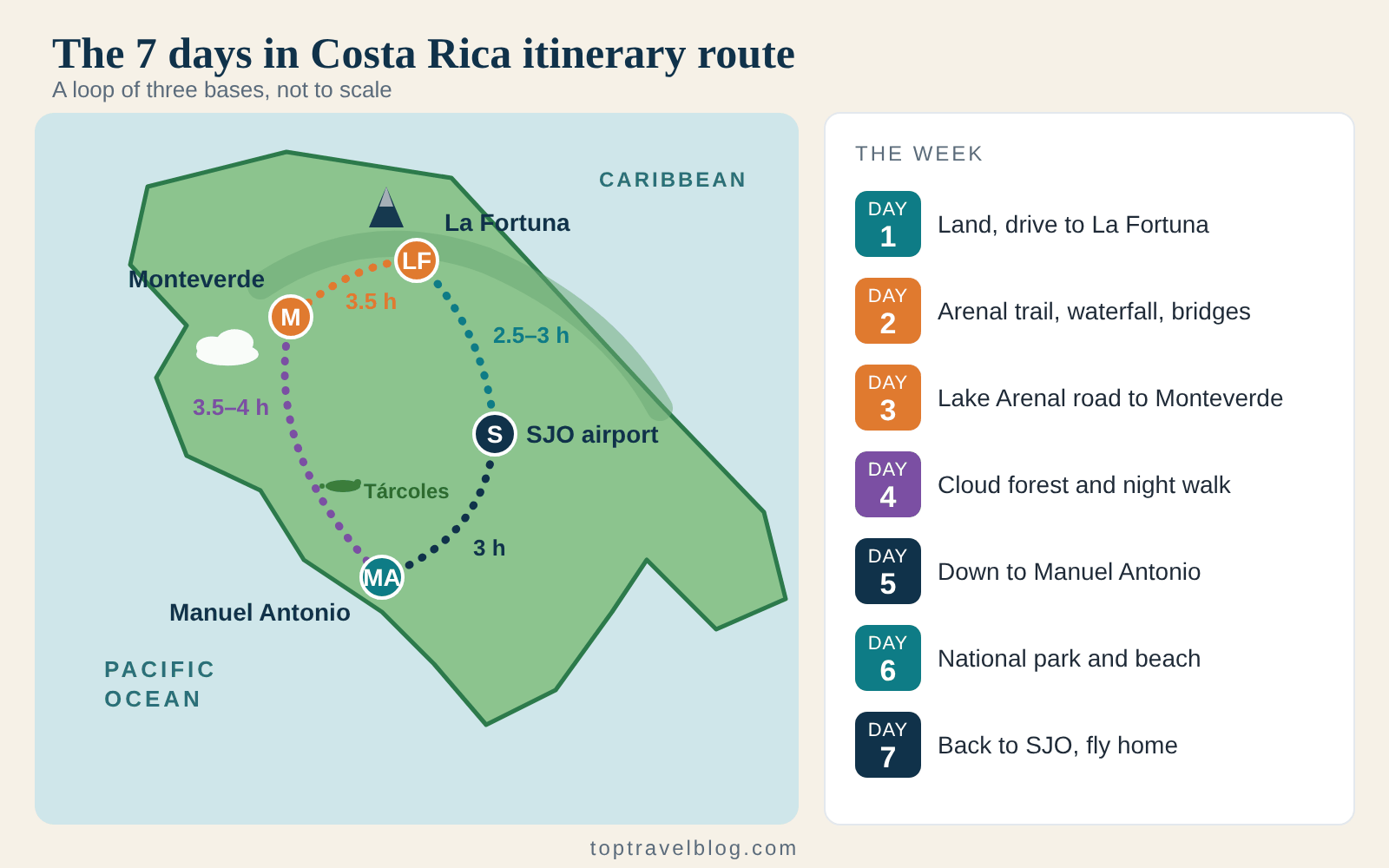
- Route: San José airport (SJO) to La Fortuna and the Arenal volcano (2 nights), then Monteverde (2 nights), then Manuel Antonio (2 nights), then back to SJO.
- Driving time: about 2.5 to 3 hours to La Fortuna, 3.5 hours to Monteverde, 3.5 to 4 hours to Manuel Antonio, and about 3 hours back to the airport.
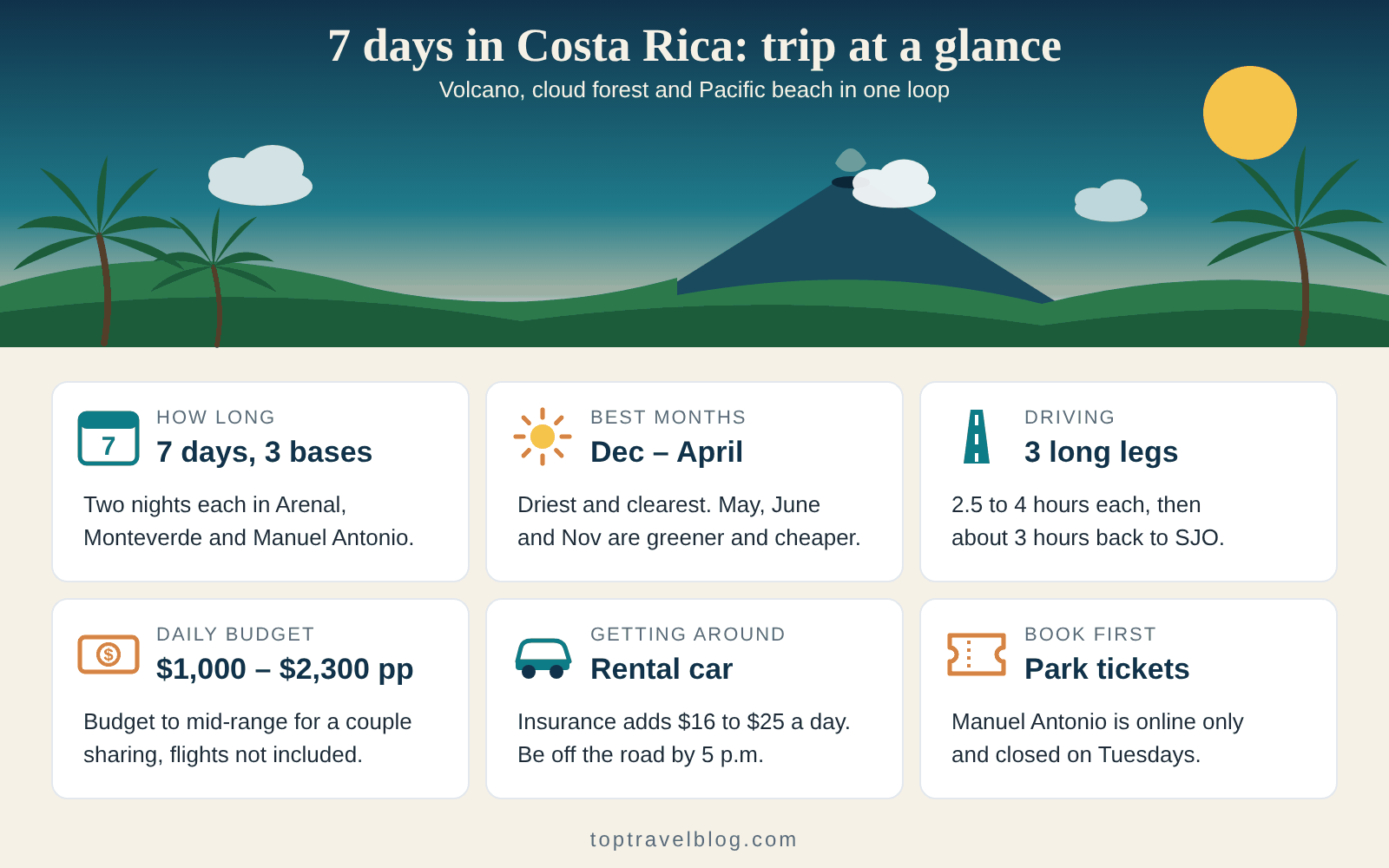
- Best months: mid-December through April for the driest weather; May to November is greener, cheaper and quieter, with rain most afternoons.
- Book first: a rental car or private shuttles, Manuel Antonio National Park timed tickets (online only), Tabacón hot springs if you want them, and a night walk in Monteverde.
- Entry: U.S. citizens do not need a visa for a vacation; carry a passport and an onward or return ticket.
- Key caveats: rental-car insurance adds to the quoted price, roads are slow and often wet, and the State Department advises increased caution in Costa Rica because of crime, mostly petty theft from parked cars.
Best time to go: when this 7 days in Costa Rica itinerary works best
Costa Rica has two seasons, not four, and the temperature barely moves. What changes is rain. The dry season runs from about mid-December through April, and the green (rainy) season from late April through November, with October usually the wettest month.
For this 7 days in Costa Rica itinerary I would choose late January through mid-April if you want the most reliable views of the volcano and the least mud on the trails. I would choose May, June or November if you want to save roughly a third on lodging and share the parks with fewer people.
Here is how I think about each stretch, because the right 7 days in Costa Rica itinerary bends a little with the calendar.
December to April: dry season and high prices
This is the postcard version. Mornings are clear, the Arenal cone shows itself more often than not, and the Pacific side near Manuel Antonio is warm and bright. It is also when rental cars cost roughly double what they do in the green season, hotels in La Fortuna and Manuel Antonio fill up, and the 600-ticket daily cap at Manuel Antonio National Park can sell out two or three days ahead.
The last two weeks of December and Holy Week (the week before Easter) are the busiest. Costa Ricans travel too, and the beaches and the road to the coast fill with local families. If those dates are yours, book the car and the first and last hotels as soon as flights are settled.
The wind is the catch. January and February bring strong, steady winds across the Monteverde ridge and around Lake Arenal, which makes the cloud forest cool and the drive along the lake a bit of a wrestling match with your steering wheel.
May to July: green season and the best value
The rain follows a pattern. Mornings are often clear or partly cloudy, then clouds build around noon and a heavy shower arrives between about 2 and 5 p.m. If you start every day at 7 or 8 a.m. and plan the afternoons around hot springs, coffee tours and long lunches, you lose very little.
The landscapes are at their lushest, wildlife is easier to spot because there are fewer people crowding the trails, and rooms cost noticeably less. Bring a real rain jacket, quick-dry clothes and shoes you do not mind getting muddy. Flip-flops are not hiking shoes.
August to October: the wettest stretch
September and October are the rainiest months on the Pacific side and in the central mountains. Rain can start earlier in the day and last longer, rivers swell, and some unpaved sections between La Fortuna and Monteverde can turn into mud. Landslides can close mountain roads for a day or two.
If you have to travel in these months, choose the plan with the shortest unpaved driving and ask your hotel about road conditions the evening before each travel day. The Caribbean coast, which this route does not visit, often has its driest weather in September and October, which is why some people build a Tortuguero trip for those months instead.
November: the in-between month
Early November still has the tail end of the rains, and by the last week the skies start to clear. Rates stay low until the holiday surge in mid-December. I like the last week of November more than any other time for a first trip: green hills, thin crowds and a better chance of sunshine.
Packing for either season: Layers beat everything else on this route. La Fortuna and Manuel Antonio are hot and humid, while Monteverde sits high enough that evenings call for a fleece and a rain shell. A small dry bag for your phone and passport is more useful than a fancy camera strap.
How many days you need, and the route options for a 7 days in Costa Rica itinerary
Seven days is the smallest amount of time I would call a first trip, and a 7 days in Costa Rica itinerary is the shortest version that still feels like Costa Rica. Five days works if you pick two regions, such as Arenal and Manuel Antonio, and skip the cloud forest. Ten days turns the 7 days in Costa Rica itinerary into a looser trip and gives you room to add Rincón de la Vieja, the Caribbean coast or a slower week at the beach.
Count days honestly, as with any trip that begins with a flight. If you land at 2 p.m. and fly home at 7 a.m. a week later, you have five and a half usable days, not seven. The plan below assumes you arrive in time to drive on Day 1 and fly out in the afternoon or evening of Day 7.
Costa Rica is a little smaller than West Virginia, but its roads are two-lane mountain roads and the country has no real highway network beyond the corridors around San José. A trip that looks easy on a map takes twice as long as the mileage suggests. That is the single most important thing to understand when you plan a 7 days in Costa Rica itinerary.
The three routes people actually choose
Route A: Arenal, Monteverde, Manuel Antonio
Best for: first-timers who want volcano, cloud forest and beach
This is the route in this guide. It trades beach time for variety, and every night is in a different climate zone. Three hotel changes in seven days is the price, and the drive between Monteverde and the coast is the longest of the trip.
If you want only one version of this trip, this is the one I would choose.
Route B: Guanacaste beaches plus Arenal
Best for: travelers who want real beach days
Fly into Liberia (LIR) instead of San José, spend two nights at Rincón de la Vieja or Arenal, then three or four nights on the coast near Tamarindo or the Papagayo peninsula. You drive less, and you swim more, but you skip the cloud forest and Manuel Antonio’s wildlife.
Liberia to La Fortuna runs about three hours.
Route C: Arenal, Tortuguero and the Caribbean
Best for: wildlife and canal boat trips, green-season travel
Tortuguero is reachable only by boat or small plane, and the canal tours at dawn are the best wildlife viewing of any route here. It rains a great deal, and it needs a night at a boat dock hotel on both ends, so it works better in ten days than in seven.
What I would cut if you only have five days
Drop Monteverde from the 7 days in Costa Rica itinerary. It is the most time-consuming stop because the road in from either direction is slow, and the cloud forest, lovely as it is, is the part of the trip most affected by weather. That leaves you with Arenal and Manuel Antonio, three nights each side, and about six hours less driving.
If you only have four or five days and no car, take a private or shared shuttle from San José to La Fortuna and a domestic flight or shuttle on to the coast. Sansa runs short flights between San José and Quepos, the town beside Manuel Antonio, and the airline lists schedules at flysansa.com. The flight is about 30 minutes and replaces a three-hour drive.
What I would add with a few more days
Rincón de la Vieja in the northwest is the first thing I would add to the 7 days in Costa Rica itinerary: a second volcano with steaming fumaroles, mud pots and waterfalls, three hours from La Fortuna. Then a night in Tortuguero, or two nights at a surf town like Santa Teresa if you want sand and sunsets without a resort.
Poás Volcano, an hour from the airport, fits a trip only if you land very early. The park requires timed online reservations through SINAC and the crater is usually clear only in the early morning. I explain this under Day 1 so you can decide.
Which airport: San José (SJO) is the right gateway for Route A, and a round trip into and out of SJO is usually the simplest ticket to price. Liberia (LIR) makes sense only for the beach-heavy Route B. The search steps in our guide on how to find cheap flights work for either airport, and they explain how to compare nearby airports without falling for the fee traps.
Where to stay on a 7 days in Costa Rica itinerary
This 7 days in Costa Rica itinerary has three bases, and each one decides a good part of your trip. I would not try to save a night by splitting stays, because the drive between regions eats most of an afternoon anyway. Two nights each is the minimum that gives you a full day to actually do something.
On price: I never promise a room rate because Costa Rica’s rates swing with the season and the exchange rate. As a rough guide, simple cabins and guesthouses run about $60 to $120 a night for a double, comfortable mid-range lodges with a pool or a view sit around $130 to $280, and the hot-spring resorts and top-end jungle lodges start near $300 and climb quickly. Rates in the dry season run well above those in the green season.
Costa Rica adds a 13 percent sales tax (IVA) to lodging, and many listings show the price before it. When comparing rooms, look at the total with tax. Our guide to how to choose a hotel covers fees and cancellation terms that matter in a country where many small lodges require deposits.
My recommended base in each region
La Fortuna and Arenal (2 nights)
Best for: volcano views, hot springs, waterfalls, rafting
You have two choices. The town of La Fortuna is walkable, has the restaurants and tour offices, and puts you 10 to 15 minutes from the waterfall and hot springs. The road toward the volcano (the Route 142 corridor west of town) has quieter lodges with views of the cone, but you will be driving to dinner.
I pick a lodge on the volcano road if the sky is clear and the budget allows, and the town if I want to walk to dinner. Many lodges there include a day pass to their own hot springs.
Monteverde and Santa Elena (2 nights)
Best for: cloud forest hikes, night walks, coffee, cool evenings
Santa Elena is the town with supermarkets, restaurants and tour operators. The village of Monteverde, higher up and a few miles on, is quieter, closer to the reserve entrances and a little cooler. Hotels along the road between them are within a short drive of everything.
Stay in the town if you do not want to drive after dark. The roads up the hill are narrow, winding and unlit, and I prefer to be done driving by 5 p.m.
Manuel Antonio (2 nights)
Best for: beaches, sloths, monkeys, ocean sunsets
Most hotels sit on the hillside road between Quepos and the park entrance, a winding 4-mile stretch with sea views and steep driveways. Rooms at the top have the views and long walks to the beach, and hotels near the park gate are walkable to the entrance but louder.
I choose a hotel with a good pool and a view on the hill and use a short taxi or the hotel shuttle to reach the beach. Quepos itself is a working town, cheaper and less scenic.
Alajuela near the airport (first or last night)
Best for: an arrival night or an early flight home
If you land after about 2 p.m., sleeping near the airport and driving at dawn is smarter than driving the mountain road to La Fortuna in the dark. Sunset is around 5:30 p.m. all year, and darkness falls fast. A small hotel in Alajuela, 10 to 20 minutes from SJO, makes the first and last nights painless.
Rental car or shuttles: how to get around Costa Rica in 7 days
This decision shapes every day of the 7 days in Costa Rica itinerary, so make it before you book hotels. I rent a car for this 7 days in Costa Rica itinerary. It lets you leave at 6:30 a.m. when the roads are empty, stop at a waterfall without a schedule, and skip the 90-minute hotel pickup windows that shuttles sometimes run. The honest downside is stress: narrow roads, single-lane bridges, motorbikes, potholes and rain.
If you hate driving in unfamiliar places, book private transfers or shared shuttles between the three bases. They cost roughly $60 to $120 per person per leg on shared vans and more for a private car, and the drivers know the roads, but you lose flexibility and you pay for every extra stop.
What rental cars really cost
The price you see in the search results is not the price you pay. Costa Rica requires third-party liability insurance (TPL) on every rental, and it is not covered by your credit card. At the larger local agencies it runs roughly $16 to $25 a day on top of the base rate, depending on car class and agency.
The collision damage waiver (CDW) is the part cards can cover, if you bring a letter from the card issuer that names the coverage and the country. Without that letter, the agency will sell you its own CDW, which can add a similar amount per day. Security holds on your card range from about $100 with full agency coverage to about $2,000 when you rely on your own card.
Read the whole quote, and compare the final total, including all insurance, between two or three companies. Our guide to how to plan a trip has a booking-order checklist that puts the car and the first night’s hotel at the top for exactly this reason.
Driving rules and road realities
You need a valid U.S. driver’s license and your passport (carry a photo of the passport page if you prefer to leave the original in the hotel safe). Waze is the navigation app locals use, and it routes around closures and accidents better than other apps. Download offline maps before you leave Wi-Fi.
Avoid driving after dark if you can. Sunset is around 5:30 p.m. all year, mountain roads have few streetlights, and pedestrians, cyclists and cows walk the shoulder. Gas stations are full-service, so tell the attendant “lleno” (fill it), pay in colones or by card, and watch the pump reset to zero.
Single-lane bridges are common. The rule is that the side with the yield sign waits; if there is no sign, the side that arrives first goes first, and a flash of headlights usually means “go ahead.” Lock the car, put nothing visible inside, and never leave bags in the trunk at a trailhead, which is where thieves look. The State Department’s Costa Rica country page specifically warns about valuables left in locked cars.
Hold your own documents: If a police officer waves you down, stay polite and keep your documents in hand. Impersonators posing as officers have asked tourists for cash. The State Department advises you not to argue, to note the officer’s name and vehicle number, and to call 911.
The 7 days in Costa Rica itinerary, day by day
Each day of this 7 days in Costa Rica itinerary has one anchor and a travel stretch of its own, so you are never doubling back. Drive times are real-world estimates: they include a gas stop and a short pause for photos, but not a long lunch. Mornings start early because the weather is clearest from 6 to 10 a.m. and the animals are most active at the same hours. Sunset falls near 5:30 p.m. every month, so the day ends sooner than you might think.
Day 1
Airport to La Fortuna, with the volcano at dusk
Morning: pick up the car and get out of the Central Valley
Start the 7 days in Costa Rica itinerary with a flight that lands before about 1 p.m. Pick up your car at or near SJO (most agencies run a free shuttle from the terminal), spend 20 minutes inspecting and photographing every scratch, and buy water and snacks at a supermarket in Alajuela before you leave the valley. Set Waze to La Fortuna and expect about 2.5 to 3 hours.
On this 7 days in Costa Rica itinerary the route climbs through Naranjo and Zarcero, a farm town known for the topiary garden outside its church, where hedges are clipped into arches, animals and tunnels. It is free, takes 20 minutes, and is the best stretch to stretch your legs. The cheese and sugar-cane sweets from the stalls around the plaza make a decent road snack.
Afternoon: arrive in La Fortuna by 4 p.m.
From Ciudad Quesada the road drops toward the Arenal plain, the first real payoff of the 7 days in Costa Rica itinerary. If the sky is clear, the Arenal cone appears as a perfect triangle above the pasture, usually around 4 p.m. and gone by dusk. Check in, drop your bags and walk through town for ten minutes to get oriented. The central park, the church and a handful of restaurants are all within five blocks.
If you land late or a flight is delayed, do not push on to La Fortuna in the dark. Sleep in Alajuela and begin Day 1 at dawn. It costs you an evening at the hot springs, not a day of your trip, and the mountain road is a poor place to be tired.
Evening: your first hot springs
The hot springs on this 7 days in Costa Rica itinerary are heated by the volcano’s geothermal system, with pools between roughly 95 and 105 degrees Fahrenheit. Most are inside resorts and sell day passes. Tabacón is the best-known river-fed complex and runs roughly $80 per adult, more with dinner, and I would book a time slot ahead because it caps visitors.
For value, I would pick Baldi (about $47) or Eco Termales (about $47, with a limited-capacity evening slot). Both have a mix of hot pools and a lazy river. Termalitas del Arenal costs about $10, and El Choyin is a free river pool you reach by a short walk off the road. Leave before dark if you try the free one, and do not leave valuables in the car.
Do not drive far after the springs. Order a casado, the plate of rice, beans, salad and a protein that costs roughly $8 to $12, and be asleep by 9.
Logistics: SJO to La Fortuna is about 2.5 to 3 hours and about 75 miles. Naranjo to Zarcero is about 40 minutes, and Zarcero to La Fortuna about 1 hour 20 minutes.
If you land early: Poás Volcano National Park is about an hour from the airport. Entry is $15, reservations open 30 days ahead, and the clearest crater views are around 8 to 9 a.m., with clouds usually in by about 10:30. That works only if you land before 7 a.m., so most travelers skip it.
With kids: Choose a hot spring with shallow pools and a water slide, and be out by 7 p.m. Children handle the drive better if you break it into two stops.
Day 2
Arenal: volcano trail, waterfall and hanging bridges
Morning: the Arenal 1968 trail at opening
The Arenal Volcano National Park trails are managed by SINAC, and the park entrance is roughly $15 per adult. The 1968 trail takes about two hours at an easy pace and ends at a lava field from the eruption that destroyed two villages in July 1968. The volcano has been quiet since 2010, so there is no lava to see, only the cone, the old flow and a good chance of monkeys and coatis.
Be at the gate when it opens. The summit is clearest in the first hours of the day, and by 10 a.m. clouds often settle over the top. Wear closed shoes, bring water and a rain layer, and go slowly in the forest section, where toucans and howler monkeys are most active before it heats up.
Late morning: La Fortuna Waterfall
The waterfall is a 230-foot drop into a swimming pool at the bottom of a staircase of roughly 500 steps. The climb back up takes 20 to 30 minutes and is the hard part. Go early, because the tour buses arrive after 10, and wear shoes with a grip on the wet steps. Swimming is allowed in the pool when water levels are safe; look at the signs and respect them, because the current at the base can be strong after heavy rain.
Afternoon: hanging bridges and an easy lunch
The canopy highlight of this 7 days in Costa Rica itinerary is a set of suspended bridges that gives you views of trees, birds and, with a guide, sloths. The Mistico Arenal Hanging Bridges are the best known here, and a guided walk improves your chances of seeing animals dramatically, because guides carry spotting scopes and know where the sloths hang.
Eat lunch in town after the bridges. The small family restaurants, called sodas, around the central park serve a plate of food for roughly $8 to $12, and the food is better than at the roadside tourist places.
Evening: your choice
I leave the evening of Day 2 in this 7 days in Costa Rica itinerary open on purpose. If you did not do a hot spring on Day 1, tonight is the night, and a different one gives you a comparison. If you are tired, a chocolate tour or a quiet dinner and an early night is a perfectly good plan, because tomorrow’s drive starts early.
Logistics: The park to the waterfall is about 25 minutes by car; town to the bridges is about 20 to 30 minutes. Plan for 2 hours at the 1968 trail, 1.5 hours at the waterfall including the climb, and 2 to 3 hours on the bridges.
If it rains: Move the bridges and waterfall to the afternoon only if the water is calm, and spend the morning at a hot spring instead. Rain is the reason this plan has two nights here.
Swap day: If the weather is clear and you want a different volcano day, the blue water of Río Celeste in Tenorio Volcano National Park is about two hours from La Fortuna; give it the whole day and start at 7 a.m.
With kids: Skip the waterfall stairs for children under 7, and do the bridges with a guide who will let them look through the scope.
Day 3
La Fortuna to Monteverde, around Lake Arenal
Morning: leave by 7:30 and choose your route
This is the day people fear in a 7 days in Costa Rica itinerary, and it is easier than its reputation if you plan it. There are three ways to reach Monteverde from La Fortuna, and none is a quick drive. The direct road runs around Lake Arenal through Tilarán and takes about 3.5 hours, with the last stretch unpaved and bumpy. A fully paved route heads south to the Pan-American Highway and up Route 606, which adds roughly an hour but swaps gravel for asphalt.
The third option is the jeep-boat-jeep transfer: a shuttle to the lake, a boat across it and another shuttle up the mountain. It takes about 3 hours door to door and is a good choice if you have no rental car. If you do have one, it leaves your car stranded on the wrong side of the water, so I would drive.
I take the lake road if the weather is dry and my car has decent ground clearance, and I take the paved route if it has rained for days. Leave La Fortuna by 7:30 a.m. so you arrive in daylight with time to spare.
Midday: the lake road and lunch in Nuevo Arenal
The road along the north shore of Lake Arenal is the prettiest drive of the entire 7 days in Costa Rica itinerary, with the volcano behind you and wind-whipped water on one side. The town of Nuevo Arenal, about an hour in, has a few cafés where the owners know how to make a proper breakfast, and a bakery that has been serving travelers on this road for decades.
After Tilarán the road forks toward Santa Elena. The last stretch is the slow part, with potholes, loose gravel and stretches where you will drive at 10 to 15 miles per hour. Go slowly and keep your headlights on. If clouds roll in on the ridge, your visibility can drop to a few car lengths, which is another reason to arrive before 3 p.m.
Afternoon: check in and take an easy walk
On this 7 days in Costa Rica itinerary you will probably roll into Santa Elena between noon and 2 p.m. Check in, eat lunch and have a coffee. Monteverde is cooler than the lowlands, with misty afternoons that make a hot drink feel earned. Do not plan a long hike on the first afternoon. A short walk on the trails at a smaller reserve or a visit to a hummingbird garden is plenty.
The hummingbird gardens near the reserve entrance have feeders that attract a dozen species, and the entrance is a few dollars, so it is the best low-effort wildlife stop of the afternoon.
Evening: a guided night walk
A night walk is the one thing I would not cut from a 7 days in Costa Rica itinerary that passes through Monteverde. After dark, with a guide and a red-filtered flashlight, you can see red-eyed tree frogs, sleeping birds, stick insects, tarantulas, kinkajous and, if you are lucky, a sleeping sloth. Tours are about two hours, start around 5:30 or 6 p.m. and cost roughly $30 to $45 per person. Book it a day or two ahead in the dry season.
Logistics: La Fortuna to Santa Elena by the lake road is about 3.5 hours and about 65 miles; the paved route is about 4.5 hours. Nuevo Arenal is about 1 hour from La Fortuna. Fill your gas tank in Tilarán or Nuevo Arenal, because there is almost nothing in between.
If it rains hard: Take the paved route and add an hour. A day of rain on the Tilarán road can make the unpaved section a slog, and I would not push through standing water.
With kids: Break the drive at Nuevo Arenal for an hour. A night walk is best for children 8 and older, because it is dark, quiet and requires standing still.
Day 4
A full day in the Monteverde cloud forest
Morning: be at the reserve when it opens
Day 4 of the 7 days in Costa Rica itinerary starts at the Monteverde Cloud Forest Reserve, which opens at about 7 a.m., and the first two hours are the best of the day: cooler, quieter and full of birds. Plan for 3 to 4 hours on the trails. The Sendero Bosque Nuboso and the Sendero El Camino loops give you a mix of mossy trees, ferns, hanging bridges and, in the right season, the resplendent quetzal. Quetzals nest between roughly March and June and are easiest to spot then, near wild avocado trees.
Hire a guide if wildlife matters. Guides carry scopes and know where the birds roost, and the fee is usually a modest price per person in a small group. Without a guide you will see a beautiful forest and very few animals, which is a common disappointment.
Late morning: hanging bridges or a quieter reserve
The cloud forest has two other big draws. Selvatura Park runs a set of suspended walkways in the canopy; self-guided entry is about $55 per adult and takes about 90 minutes, and the sloth sanctuary there adds about $45. The park lists current prices at selvatura.com. The Santa Elena Reserve, a smaller community-run forest nearby, is less crowded and a good choice if you want trails without tour groups.
If you want a zip line, this is where it is done properly. A canopy tour runs about 2.5 hours and about $90 per adult at Selvatura, and the longest cables here cross the forest on lines hundreds of feet above the ground. It is not for everyone, and the add-ons stack up quickly, so decide on the zip line before you decide on the rest of the day.
Afternoon: coffee, cheese and a rest
By 1 p.m. the clouds usually move in. This is when I go downhill to a coffee farm for a tour of about 2 hours that follows the beans from tree to cup. Monteverde was settled in the 1950s by Quaker families from the United States, who made cheese here, and a cheese factory in the village still runs tours. Both are easy afternoons that suit the weather.
Evening: dinner and an early night
Santa Elena has the best restaurant choice of the whole 7 days in Costa Rica itinerary. After a day of hiking I would take a table at one of the places with a view and order the local trout or a simple casado. The road down from the village is dark, so share a taxi if you plan to have a drink.
Logistics: The reserve entrance is about 20 minutes from Santa Elena by car or taxi. Reserve a time slot for the night walk and Selvatura a day ahead in high season. Entrance to the reserve is listed per adult on the reserve’s own site.
If it rains: Rain suits the cloud forest. Wear a poncho and go anyway, because the mist is the whole point; save the canopy bridges for a clearer hour.
With kids: The hanging bridges and the sloth sanctuary are the best kid choices. Skip the zip line for anyone under about 8.
Day 5
Monteverde to Manuel Antonio, with a crocodile stop on the way
Morning: leave by 7:30 and take the paved road down
The drive from Monteverde to Manuel Antonio is the longest of the 7 days in Costa Rica itinerary, at about 3.5 to 4 hours plus stops. You leave on Route 606, which is paved from Santa Elena to the Pan-American Highway, then join Route 1 and head down to the Pacific coast road, Route 34. Go slowly on the descent, because the first section has hairpin turns and few guardrails.
The climate changes sharply on this stretch of the 7 days in Costa Rica itinerary. By the time you reach the coastal plain, the air is hot and humid and the landscape is flat, dotted with oil palm plantations and cattle ranches.
Midday: the Tárcoles River bridge
About 90 minutes from Manuel Antonio, Route 34 crosses the Tárcoles River. Park in the lot at the bridge and walk out onto the sidewalk: American crocodiles, some of them 10 to 15 feet long, rest on the sandbanks below. It is free, takes 15 minutes, and is a good look at how big these animals get. Do not park on the shoulder of the road, and keep your valuables out of sight, because thieves target parked cars here.
Eat lunch in Jacó or Esterillos, where there are plenty of seafood restaurants along the highway. A whole fried fish with patacones (fried plantains) runs about $15 to $20 at a beachside place and is one of the best meals of the trip.
Afternoon: arrive and settle in
You should reach Manuel Antonio by about 2 or 3 p.m. Check in, take a swim in the hotel pool, and let the hours go by slowly. The road up to the hotels is steep, and the hotel staff can give you a short ride if you do not want to drive after dark. If you have energy, walk to Playa Espadilla for the sunset. Rip currents are the biggest hazard on the public beach, so swim near the lifeguard tower or stay in the shallows.
Evening: a sunset dinner
The hillside restaurants above the coast have the views, and they fill up at sunset, so reserve a table by the rail. A plate of fresh fish, a fruit smoothie and the sound of howler monkeys in the trees make a good end to a long drive. Go to bed early, because tomorrow’s park tickets are for early slots.
Logistics: Santa Elena to Route 1 is about 1 hour, then about 2.5 to 3 hours on Routes 1 and 34. The Tárcoles bridge is about 1 hour 30 minutes from Manuel Antonio. Fill up in Esparza or Jacó.
If it rains: The drive is the same, but roads can be slick and the Route 606 descent is slow. Leave an hour earlier and keep your headlights on.
With kids: The crocodile stop is a hit with every child I have met. Buy snacks and drinks in Jacó, since there is little between there and Quepos.
Day 6
Manuel Antonio National Park and the beach
Morning: the park at your time slot
Manuel Antonio is one of Costa Rica’s smallest national parks and one of its most visited, and it is the reason Day 6 of this 7 days in Costa Rica itinerary exists. Tickets are sold online only through the SINAC system, with no gate sales, and each ticket has an entry time. The adult fee for foreigners is about $18, and the park limits visitors to roughly 600 a day on weekdays and a little more on weekends. In the dry season the early slots sell out two or three days ahead.
The park is open from 7 a.m. to 4 p.m. and is closed on Tuesdays, which affects the whole plan: if Day 6 falls on a Tuesday, swap it with Day 5 or Day 7. Bring your passport (or a photo of the ID page) and your confirmation code, and book the 7 a.m. slot if you can, since the sloths and monkeys are most active early and the heat builds after 10.
Late morning: trails and a guide
Take the main trail from the entrance to the beaches and the Perezoso trail up the hill. The Punta Catedral loop has the best views and is the hardest of the trails. Wear shoes with a grip, because roots and wet stones are slippery, and keep your bag zipped. Raccoons and monkeys steal food, and feeding wildlife is illegal.
A guide is not required, but I think it is worth it here. A two-hour group tour runs roughly $25 to $40 per person, and guides set up spotting scopes and know where the sloths and the monkeys spend their days. Without one, you will spot far fewer animals, and with one you are likely to see two or three species of monkey, sloths, iguanas and maybe a coati.
Afternoon: swim and leave before the beach closes
Playa Manuel Antonio, inside the park, is the best swimming beach of the area and the beach highlight of the 7 days in Costa Rica itinerary, with calm water and shade at the back of the sand. The park beaches close around 3 p.m. and food is not allowed, apart from water and fruit. Free lockers near the entrance are good for leaving a bag. Wear reef-safe sunscreen, which the park asks for.
If you want a smaller beach with fewer people, Playa Biesanz is a short drive away and charges a small entry fee. Playa Espadilla outside the park is wide and public but has strong rip currents, and I would swim there only near the lifeguards.
Evening: sunset on the water or a quiet dinner
A catamaran sunset cruise is the most popular evening here, and I recommend it if you like boats; they typically include snacks and a swim stop, and you often see dolphins. Book a day or two ahead. If you would rather stay on land, eat at a restaurant on the hillside, order the day’s fish and watch the sun go down over the Pacific.
Logistics: Hotels to the park entrance are 5 to 15 minutes by car or taxi. Allow 3 to 4 hours inside the park. Parking near the entrance is run by private lots and costs a few dollars, so arrive early to find a space.
If it rains: A light rain keeps crowds away and the animals are still out. In a downpour, do a coffee or chocolate tour in the hills instead and try the beach the next morning.
With kids: Kids over 6 do well in the park with a guide; for smaller ones, the hotel pool and a shorter walk to the nearest beach are enough. The park has few shaded benches.
Day 7
Manuel Antonio back to San José and home
Morning: leave by 8 and stop at Carara
The last drive of the 7 days in Costa Rica itinerary, from Manuel Antonio to San José, is about 3 hours without stops on Route 34 and the toll road, Route 27, which has a few toll booths that cost a few dollars in total. If you have time, stop at the Tárcoles bridge again, or at Carara National Park, which is known for scarlet macaws. Do not fall into the trap of cutting the drive too fine: traffic on Route 27 near San José can add an hour on weekends and holidays.
If your flight leaves before about 1 p.m., spend the last night in Alajuela instead and skip the drive on the day you fly. The 15 minutes from a hotel near the airport to the terminal is worth the lost evening at the beach.
Midday: return the car and get to the terminal
Fill the tank near the airport, return the car at least three hours before your flight, and photograph the car again. Agencies take a few minutes to inspect the vehicle. Plan to reach the terminal by about three hours before an international flight, because the security and check-in lines at SJO can be slow, especially on weekends in the dry season.
If you have a few spare hours, a coffee at a plantation near Alajuela is a pleasant way to end the trip, and the supermarkets by the airport sell packaged Costa Rican coffee at a better price than the airport shops.
Logistics: Manuel Antonio to SJO is about 3 hours and about 105 miles. Add up to an hour on weekends and holidays. Return the car with a full tank to avoid a refueling fee.
If it rains: Leave early, because the coastal road floods in places during heavy rain.
With kids: Pack snacks and downloaded shows for the drive, and stop in Jacó for lunch.
What a 7 days in Costa Rica itinerary costs
These are rough per-person figures for a 7 days in Costa Rica itinerary taken by a couple sharing a room, excluding flights, and they move with the season. I give ranges rather than exact prices because lodging and car rental both swing by a third or more between January and September.
Budget, roughly $1,000 to $1,400 per person. Cabins or guesthouses at about $60 to $110 a night, a compact rental car with insurance at roughly $50 to $90 a day, meals at sodas for about $8 to $12 each, and two or three paid activities. You will skip the priciest hot springs and take a free one instead.
Mid-range, roughly $1,700 to $2,300 per person. Comfortable lodges with pools at about $130 to $280 a night, a better car, restaurant dinners, a guided park visit, the hanging bridges and one hot-spring resort day pass.
Comfortable, roughly $3,000 and up per person. Top-end lodges, private transfers or a driver, private guides at every park and a spa day at one of the hot-spring resorts.
Costs you will not see on the booking page
Restaurant bills add 13 percent sales tax and a 10 percent service charge, so a $30 dinner becomes about $37. Hotel taxes add 13 percent. Parks, hot springs and tours are priced in dollars at most tourist sites, but smaller places want colones, so carry some local currency from an ATM at a bank branch, not the standalone machines in tourist areas.
Rental-car insurance can add $16 to $25 a day, and fuel costs more than in the U.S. Parking at attractions often costs a few dollars. Budget a little extra for tips for guides (about 10 to 15 percent is common) and for the occasional bottle of water, since the State Department notes that tap water is often unsafe in parts of the country.
What to book before you fly
Not much in a 7 days in Costa Rica itinerary requires planning months ahead, but a few things sell out or cost more if you wait.
Manuel Antonio National Park tickets. Book on the SINAC site as soon as you know your date; early slots in the dry season are the first to go.
The rental car or your shuttle transfers. Cars go fast around Christmas, New Year and Easter, and the best rates are for bookings made at least a month or two ahead.
Hotels for the Christmas to Easter weeks. Book three to six months out for the best choice.
Tabacón or another hot spring with capped visitor numbers. Reserve a time slot a few days ahead, and sooner on weekends.
The Monteverde night walk and any guided tours. A day or two ahead is enough in most months, and a week ahead in the dry season.
Everything else, from the waterfall and the Arenal trail to the Tárcoles bridge, you can decide on the day.
What to eat on a 7 days in Costa Rica itinerary
The food on a 7 days in Costa Rica itinerary is simple and good. Look for a soda, a small family-run restaurant that serves a casado: rice, black beans, a salad, fried plantain and a choice of chicken, fish, beef or pork. It costs roughly $8 to $12 and is the best-value lunch in the country.
For breakfast, gallo pinto (rice and beans fried with onion and cilantro) comes with eggs, sour cream and fried plantains, and the coffee is excellent. On the coast, order the fresh fish, ceviche and patacones. In Monteverde, try the local trout and the cheese.
Drink the fresh fruit juices and the agua de pipa (coconut water) at roadside stands. If you are cautious about tap water, ask your hotel, order bottled or filtered water, and skip ice at roadside stalls. The CDC’s travel health notices for Costa Rica list the food, water and mosquito precautions for travelers, including dengue.
Where to see wildlife on this 7 days in Costa Rica itinerary
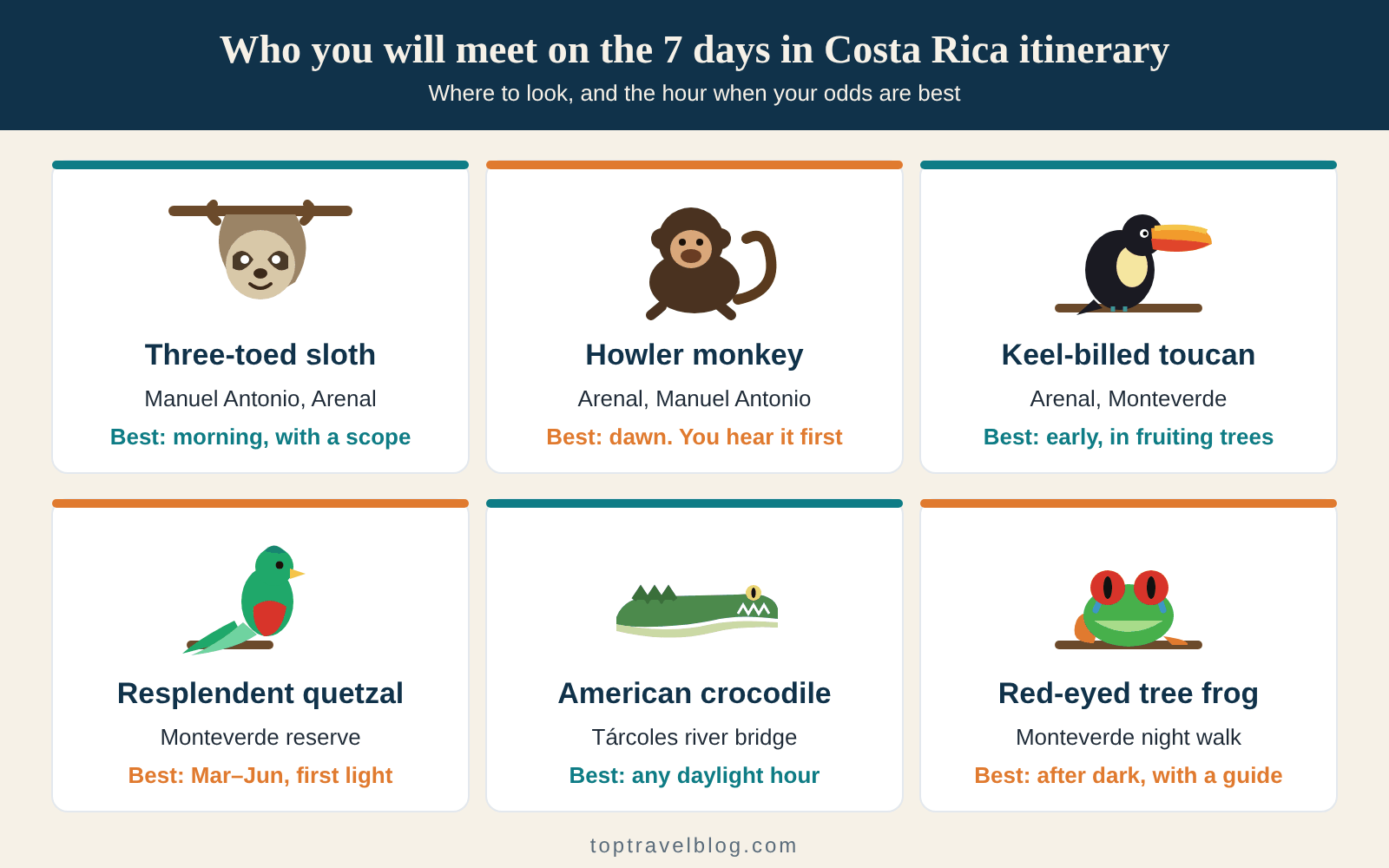
Costa Rica holds about 5 percent of the world’s biodiversity in an area smaller than West Virginia, but you will not see it by driving past it. The key is time of day and a guide. Most animals are active at dawn, and a guide with a scope will find sloths that you would miss from three feet away.
What you can realistically see, stop by stop
Stop by stop on this 7 days in Costa Rica itinerary, at Arenal look for howler monkeys at dawn, toucans in fruiting trees and coatis along the trails. At Monteverde, hummingbirds at the feeders, the resplendent quetzal in the early mornings of March to June, and red-eyed tree frogs on the night walk. At the Tárcoles bridge, American crocodiles. At Manuel Antonio, white-faced capuchins, squirrel monkeys, sloths and iguanas.
Keep your distance and never feed animals. Feeding is illegal, and monkeys that get food become aggressive. Do not use a flash, and keep your voice low. A three-toed sloth that has not moved for an hour is not broken; it is a sloth.
How to adapt this 7 days in Costa Rica itinerary to your trip
The route stays the same for almost everyone. What changes is the pace, the activities you pick and where you spend the money. Here are the four adjustments I make most often when a friend asks me to rework the plan.
Traveling with children
Kids handle this 7 days in Costa Rica itinerary better than adults expect, as long as you treat the drives as part of the day and not as dead time. Break each long leg into two stops, carry snacks and water, and book hotels with a pool, because a swim at 4 p.m. fixes most moods.
The best child-friendly stops are the Zarcero topiary garden, the hot springs with shallow pools, the hanging bridges with a guide who lets children look through the scope, the Tárcoles crocodiles and the beach inside Manuel Antonio. I would skip the zip line for anyone under about 8, the waterfall stairs for toddlers and the night walk for any child who is afraid of the dark.
A honeymoon or couples version
For two people who want less rushing, keep the same bases and cut one activity a day. Spend the Day 2 afternoon at a hot spring, not on the bridges. Take a private guide in Monteverde, where a guide working with just the two of you can find birds that a group would miss.
Spend the money on the hotels in La Fortuna and Manuel Antonio, where a view and a good pool change the whole experience, and be modest in Monteverde, where you will mostly be out. This 7 days in Costa Rica itinerary also suits couples who like a bit of adventure, because the zip line and the white-water rafting day on the Balsa River can be added in La Fortuna without disturbing the rest of the schedule.
A green-season version
If you travel between May and November, keep the route and move the active parts of each day to the morning. Do the park and the trails before noon, keep the afternoons for hot springs, coffee and long lunches, and leave an hour of slack in every driving day.
I would also swap the lake road for the paved Route 606 approach to Monteverde in September and October, and I would ask my hotel about road conditions on the evening before each transfer. The 7 days in Costa Rica itinerary still works, but the margin for error is smaller, and a day of landslide closures somewhere in the mountains is a real possibility.
If you do not want to drive at all
You can do this plan with shuttles, but it is a different trip. Book a shared shuttle from San José to La Fortuna, a jeep-boat-jeep transfer to Monteverde and a shuttle on to Manuel Antonio, and add a private taxi for the activities in each town. The 7 days in Costa Rica itinerary then costs more per person, and you lose the freedom to stop, but you can read, sleep or watch the scenery.
In that case, pick hotels within walking distance of restaurants and tour offices, since taxis between lodges and town add up quickly.
Before you land: money, phones and small things that matter
A few small decisions made at home make the 7 days in Costa Rica itinerary run more smoothly once you are on the road.
Money. U.S. dollars are accepted at most tourist businesses, but change is usually given in colones, and small places prefer them. Withdraw colones from an ATM at a bank branch and keep a few thousand on hand for parking, tolls and sodas. Credit cards work at hotels, larger restaurants and tour operators, and a card without foreign transaction fees saves a few percent.
Phone and maps. Download offline maps and install Waze before you fly. An eSIM or a local SIM gives you data in most towns, though coverage drops in the mountains and along the lake road, which is another reason to save your destination in advance. Share your drive plan with someone at home on the long days.
Health and insurance. Take travel insurance that covers medical care and evacuation, because a private clinic visit can cost real money. Bring insect repellent, sunscreen that is reef-safe and any prescriptions in their original bottles.
Plugs and power. Costa Rica uses the same two-prong outlets as the United States, so you do not need an adapter. Bring a small power bank for the long days of navigation, because Waze drains a battery quickly.
Electronics on the road. Carry a cheap phone mount and a car charger, and keep your camera in a padded bag in the cabin, not on the seat.
Common mistakes on a 7 days in Costa Rica itinerary
1. Trusting the map instead of the clock
Google shows a 60-mile drive as 90 minutes and the road takes three hours. Mountain roads, trucks, single-lane bridges and rain all slow you down. Take the drive times in this 7 days in Costa Rica itinerary as your planning numbers, add a buffer on travel days, and never schedule a timed activity within two hours of arriving.
2. Booking the cheapest car quote
The headline price excludes mandatory insurance, and the difference can be $20 a day or more. Compare the final price with all insurance and fees, and read the security-hold terms, because a $2,000 hold on a credit card can use up a good part of your limit.
3. Driving the mountains after dark
Sunset comes around 5:30 p.m. all year, and the roads have few lights, no shoulders and plenty of animals and cyclists. Plan every transfer in your 7 days in Costa Rica itinerary to finish by 4 or 5 p.m., and if a flight lands late, sleep near the airport and start at dawn.
4. Skipping the guide at the two places a guide matters
Monteverde and Manuel Antonio are the two places where a guide makes the difference between seeing animals and seeing leaves. I save money on tours elsewhere and book a guide at these two, in small groups, with a scope.
5. Arriving at Manuel Antonio without a ticket
The park sells online only and the early slots sell out in the dry season. Travelers who show up expecting to buy at the gate are turned away. Book as soon as your dates are firm, and remember that the park is closed on Tuesdays.
6. Leaving valuables in the car
Parked cars at trailheads, beaches and bridges are the most common target for thieves, and a locked door does not help. The State Department says to keep valuables out of cars, even locked ones, and notes that signal jammers have been used on key fobs, so physically try the handle. Take your passport, wallet and phone with you, or leave them in the hotel safe.
7. Packing for one climate
The route covers hot lowlands, a cool, misty ridge and a humid coast. Bring a rain shell, a fleece, quick-dry shirts, closed shoes with a good grip and a swimsuit. Cotton jeans never dry, and sandals are not hiking shoes.
8. Swimming where the water looks calm
Rip currents are common on Pacific beaches, including Playa Espadilla at Manuel Antonio. Swim near lifeguards, ask a local which beaches are best for swimming that day, and do not swim at river pools after heavy rain.
9. Overscheduling
I see this every year: a traveler tries to fit a hot spring, a waterfall, a coffee tour and a zip line into one day, then spends the evening driving in the rain. Two main activities a day is the right pace for a 7 days in Costa Rica itinerary, and an empty afternoon is part of the plan.
10. Forgetting cash and the 23 percent
Many small shops, parking lots and sodas take only colones. Keep a few thousand colones on hand, and remember that restaurant bills add tax and a service charge on top of the menu price. A $30 dinner is about $37 once you pay everything.
Frequently asked questions about this 7 days in Costa Rica itinerary
Is 7 days enough for Costa Rica?
Yes, if you choose one loop and not three. This 7 days in Costa Rica itinerary covers a volcano, a cloud forest and a national park with a beach, with about 10 hours of total driving split over three travel days. You will not see the Caribbean coast or the far north, but you will see the best-known sights and still have a couple of unhurried afternoons.
What is the best time of year to follow this 7 days in Costa Rica itinerary?
Late January through mid-April is the driest and gives the clearest volcano views, but it is also the most crowded and expensive. May, June and November are my choice for value: greener scenery, rain mostly in the afternoons and lower prices. September and October are the wettest months, with a higher chance of road closures and muddy trails.
Do I need a rental car?
For this 7 days in Costa Rica itinerary I recommend one, because it lets you leave early and stop where you like. Shared shuttles and private drivers work if you do not want to drive, and they cost roughly $60 to $120 per person per leg on shared vans. A 4×4 is not required for the main roads, but a car with some ground clearance helps on the unpaved stretch to Monteverde.
How much does a 7-day trip to Costa Rica cost?
For a couple sharing a room on this 7 days in Costa Rica itinerary and not counting flights, a budget trip runs roughly $1,000 to $1,400 per person, mid-range roughly $1,700 to $2,300, and comfortable $3,000 and up. Car rental with insurance, lodging in the dry season and guided activities are the biggest swings. Taxes add 13 percent to hotels and 23 percent to restaurant bills.
Do I need a visa or special documents?
U.S. citizens do not need a visa for a tourist visit such as this 7 days in Costa Rica itinerary. The State Department’s country page says you should carry a return or onward ticket and that an entry stamp needs one blank passport page. I carry a passport with at least six months of validity, which is the habit airlines like. Read the State Department page for the current wording.
How careful should I be about crime in Costa Rica?
Here is what to be aware of. The State Department advises increased caution because of crime, mostly petty theft and pickpocketing, with occasional armed robbery. Keep valuables out of parked cars, avoid walking alone in isolated areas after dark, use licensed taxis or established ride-hailing and use approved tour operators. Rip currents and flash floods are the other main hazards.
Can I do this 7 days in Costa Rica itinerary with kids?
Yes, with children old enough for a long car ride, roughly 7 and older. The hanging bridges, the sloth sanctuary, hot springs with shallow pools, the Tárcoles crocodiles and the beach at Manuel Antonio all work well. Skip the zip line for little ones and the night walk for anyone who is afraid of the dark, and break the three long drives with a stop each.
Which is better, Arenal or Monteverde?
If I could pick only one, I would pick Arenal for first-timers, because the volcano, the hot springs and the waterfall give you a variety that suits every age. Monteverde is the better choice if you care about birds and cloud forest, and it is cooler and quieter. This 7 days in Costa Rica itinerary includes both, which is why it works so well.
Should I fly into San José or Liberia?
San José (SJO) for this 7 days in Costa Rica itinerary. Liberia (LIR) is better for a beach-heavy trip around Guanacaste, and it shortens the drive to Rincón de la Vieja. For Route A, you will drive about three hours from either airport to La Fortuna, but SJO is closer to Manuel Antonio, where you finish.
How early should I book Manuel Antonio National Park tickets?
As soon as your dates are firm, and at least two or three days ahead in the dry season. The park sells time-slot tickets online only through SINAC, and the early morning slots sell out first. Because the park is closed on Tuesdays, build your itinerary so that the park day falls on another day of the week.
Is there a faster way to get from Monteverde to Manuel Antonio?
Not really. There are no direct flights, and the road is the road. The drive takes about 3.5 to 4 hours. You could fly from San José to Quepos with Sansa to cut the final leg, but you would still have to get from Monteverde to San José first. Shared shuttles take 5 to 6 hours with stops.
How does Costa Rica compare with Mexico or the Caribbean?
Costa Rica is wilder and cooler than the resort coasts of Mexico or the Dominican Republic, with more hiking and wildlife and fewer all-inclusive beaches. If a classic beach holiday is what you want, compare it with our Riviera Maya itinerary or the Punta Cana travel guide; if the jungle is the draw, the Belize itinerary is the closest rival.
One last thing before you go
If I could change one thing about how most people travel this country, it would be the pace. Everyone wants to see more, and the road punishes that urge. Leave one afternoon without a plan, in the hot springs or on a hotel terrace with a coffee, and watch what comes through the trees. A toucan landing on the branch outside your room beats the third attraction of the day.
The other thing I would say is to be kind to yourself about the driving. The three long days of this 7 days in Costa Rica itinerary are tiring, and the potholes and single-lane bridges are part of the deal. Start early, drive slowly, stop often and arrive with daylight left. Most people who follow that rule remember the road as part of the adventure, not the price of admission.
Pura vida is more than a slogan on a T-shirt. It is how people here handle a flat tire, a closed road and a rainy afternoon: with a shrug and a plan B. Pack a little of that, and the trip will take care of itself.
Related planning guides
- Riviera Maya itinerary: 7 days of beaches, cenotes, ruins and resorts — the Mexican Caribbean version of a week away, with resort beaches and jungle cenotes.
- Belize itinerary: 7 days of islands, reefs, ruins and jungle — the closest rival to Costa Rica for jungle wildlife, with a barrier reef thrown in.
- How to plan a trip step by step: from idea to booked itinerary — the order I book things in, which matters when cars and park tickets sell out.
- How to find cheap flights: a practical search strategy that avoids common traps — compare San José and Liberia without falling for the fee traps.
- How to choose a hotel: location, reviews, room type, fees and cancellation terms — what to read before you pay a deposit on a mountain lodge.
- Puerto Rico itinerary: 5 days in San Juan, rainforest and beaches — a rainforest and beach trip with no passport required for U.S. citizens.

