
Seven nights is my answer, and it is the length this punta cana travel guide is built around.
Seven nights lets you spend three or four days doing nothing on a Bávaro beach, add one big boat day to Saona Island, one adventure day at Scape Park, and one long day trip to Santo Domingo or La Romana without feeling rushed. Five nights is the minimum that still feels like a vacation. Ten is only worth it if you plan to split the stay between two resort areas.
The honest verdict: Punta Cana is the easiest beach trip from the eastern United States. Nonstop flights leave from dozens of U.S. cities, the airport sits 15 to 40 minutes from most resorts, and an all-inclusive wristband removes nearly every daily decision. It is not a destination for people who want a walkable town, a food scene to wander through, or a place to explore on foot. Think of it as a very good beach with a few excellent day trips attached.
I have flown into Punta Cana in January, in the shoulder weeks of May, and once at the start of hurricane season when the forecast changed every six hours. What follows is the punta cana travel guide I would give a friend: which area to sleep in, what the entry rules actually are, how to pick a resort without reading 400 reviews, which excursions are worth the 6 a.m. pickup, and what each part of the trip costs.
Quick facts: this Punta Cana travel guide at a glance
- Best for: couples, families with kids of any age, groups of friends, destination weddings, and anyone who wants a warm-water beach week with no logistics.
- Ideal trip length: 7 nights (5 minimum, 10 if you split two areas).
- Best months: mid-December through April for dry, sunny weather; May and early June for lower prices with a modest rain risk. August to October is peak hurricane season.
- Entry: U.S. citizens need no visa. You must complete the free electronic E-Ticket form online before you check in for your flight. The $10 tourist card and $20 departure tax are normally built into your airfare.
- Getting around: prearranged airport transfer, then resort shuttles, taxis and booked excursions. Most visitors never rent a car.
- Book ahead: your resort and room category (months ahead for Christmas through Easter), Saona Island, Scape Park, and any a la carte dinners your resort lets you reserve.
- Key caveats: sargassum seaweed can hit east-facing beaches, especially in spring and summer; tap water is not for drinking; the State Department lists the Dominican Republic at Level 2, Exercise Increased Caution, so leaving resort grounds takes a little planning.

Best time to go: when this Punta Cana travel guide works best
If I had to pick one window, it would be the first three weeks of February, but only if you book early. The weather is dry, the sea is calm on the Bávaro side, daytime highs sit in the mid-80s, and the evenings are comfortable enough for a dinner outside without a jacket. The Dominican tourism board describes the climate as warm year-round, roughly 77 to 90 degrees Fahrenheit, with the driest stretch from December to April.
That is also the expensive stretch. Prices climb in mid-December, spike from Christmas through New Year’s, soften in early January, and climb again for Presidents’ Day week, spring break and Easter. The second-best window, in my opinion, is the last week of April through early June, when rates drop noticeably and the weather is still mostly sunny.
December to April: the dry season
This is when Punta Cana earns its reputation. Rain exists but arrives in short, warm showers that end before you finish a cocktail. Trade winds keep the afternoons breathable, and the water on the Caribbean-facing side near Cap Cana is calm and clear. Every plan in this Punta Cana travel guide assumes these months unless I say otherwise.
The costs: this is when airfare and resort rates are highest, when the pool chairs fill by 8 a.m. at the larger family resorts, and when the best a la carte restaurants book their tables first. If you travel over Christmas or Easter, reserve your room six to nine months out.
May to mid-June: the value window
Humidity builds, afternoon thunderstorms get more regular, and the sargassum risk rises, but you will pay noticeably less for the same room. I like this window for couples without school schedules. Mornings are bright, the afternoons are the time for a nap or the spa, and the sea is usually warm enough that you stay in until your fingers wrinkle. If you follow this punta cana travel guide in May, expect the same plan with a longer midday break.
Sargassum is the wildcard. Brown seaweed drifts across the Atlantic in large mats, and the amount reaching the Dominican east coast varies enormously from year to year. Resorts rake it each morning, and some beaches stay clean while the neighboring one is piled up. If a clear beach matters more than the price, aim for winter.
Late June to November: heat, rain and hurricane season
The Atlantic hurricane season officially runs June 1 to November 30, according to the National Hurricane Center, and activity peaks in mid-August through mid-October, with the statistical high point around September 10. Punta Cana sits on the eastern tip of Hispaniola, which puts it near the usual path of storms that come off Africa. Anyone using this Punta Cana travel guide for a September trip should treat every outing as movable.
Most weeks in these months are simply hot, humid and showery, and prices are the lowest of the year. But if you book September, buy travel insurance that covers named-storm cancellations, and read the policy’s purchase-by deadlines, because coverage for a storm that already has a name is usually excluded.
Tip: If you want summer pricing without the worst hurricane odds, go in June or the first half of July. Late July is hot but historically quieter than the stretch from mid-August to mid-October, and families can still use the school-holiday weeks.
Special weeks to plan around
Dominican Carnival peaks in February and March (the biggest parades are in Santo Domingo and La Vega rather than at the resorts), Semana Santa around Easter fills local beaches with Dominican families, and Christmas week is the single most expensive stretch of the year.
Resorts also host large wedding groups on weekends, which means a quiet-looking Tuesday can turn into a loud Saturday. If you need calm, ask the resort which weekends they have big groups. Build these dates into your punta cana travel guide planning before you price flights.
For the rest of the trip-planning basics, my guide on how to plan a trip step by step covers the order I use for flights, lodging and activities.
How many days to spend in Punta Cana
The tourism board suggests four to seven days for the area, and I agree with the top of that range. Your first day is mostly travel, your last is a transfer, so a seven-night stay gives you five days of actual vacation.
3 or 4 nights: a quick reset
This works if you picked a good resort and want to stay on it. Plan one excursion at most, probably Scape Park or a catamaran day from Cap Cana, and treat everything else as pool and beach time. A four-night trip from the Northeast or Florida is a viable long weekend, especially with an early flight out and a late flight home. A short version of this punta cana travel guide keeps you on one resort and one outing.
5 nights: the practical minimum
Five nights gives you three full resort days plus one big outing. I would use the outing on Saona Island, which is the most distinct experience in the region, and leave the rest free. On five nights, the punta cana travel guide plan drops Santo Domingo entirely.
7 nights: the version in this guide
One week allows a slow pace with two or three outings spread across the week so you are never exhausted. It also lets you absorb a rainy day or a cloudy afternoon without feeling cheated. The day-by-day plan below is built on seven nights.
10 nights or more: split the stay or add Santo Domingo
If you have ten nights, I would spend seven in Bávaro or Cap Cana and three in Santo Domingo’s Zona Colonial or at a beach resort on the south coast near La Romana. A long stay at one all-inclusive gets repetitive by day eight for most adults, which is when guests start eating the same buffet in a different order. A longer Punta Cana travel guide plan needs a second base, or the second week blurs into the first.
Islands in the Caribbean tend to blur together, so if you want to compare options, my Aruba travel guide and Jamaica travel guide cover how those trips differ in feel and cost.
Where to stay: the Punta Cana travel guide to every resort area
“Punta Cana” is less a town than a 30-mile stretch of coast from Cap Cana in the south to Uvero Alto in the north, with Bávaro in the middle. Resorts here are large, self-contained and spread out, so the area you choose decides your beach, your sea conditions, your nightlife, and how long the airport transfer takes.
The airport (PUJ) is at the southern end. Most resorts are 15 to 45 minutes away by road, with Cap Cana and Punta Cana Resort & Club closest and Uvero Alto and Macao farthest. The tourism board credits the area with more than 30 miles of white sand, which is accurate, but the quality of that sand varies by section.
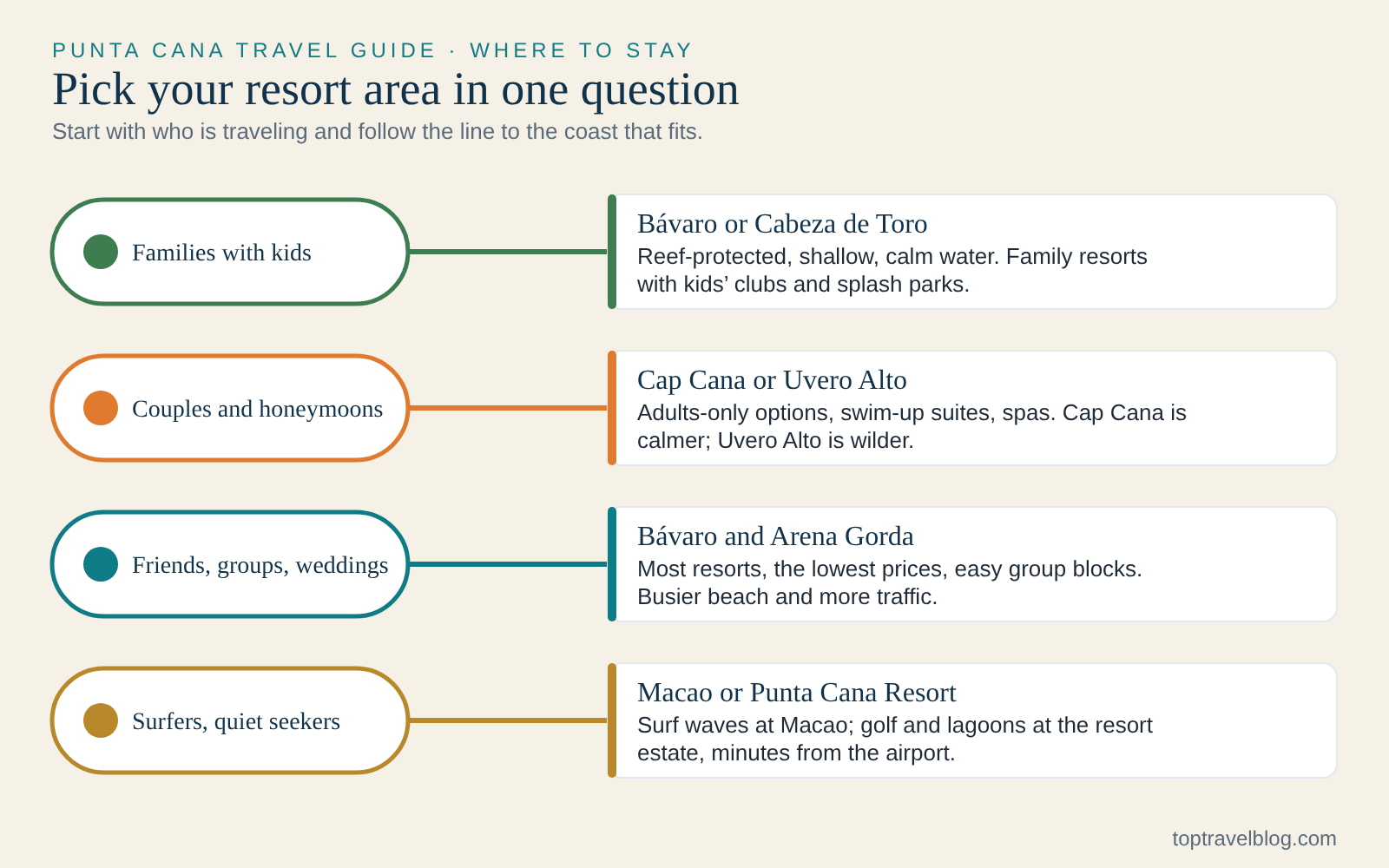
My general rule for a first visit: choose the Bávaro and Arena Gorda strip if you want a lively beach with lots of resort choice, Cap Cana for a quieter and more upscale stay, and Uvero Alto if you want the resort itself to be the destination and do not plan many outings.
The six areas I recommend for a Punta Cana travel guide stay, and who each one suits
Bávaro and Arena Gorda
Best for: first-timers, families, groups, the widest range of prices
This is the classic Punta Cana beach: a long, gently curved strip of pale sand, protected by an offshore reef so the water stays calm and shallow. Dozens of resorts line it, from large family complexes to adult-only options, and the choice makes it the easiest place to find a deal.
The trade-off is that the beach is shared and busy, and the area behind it has become a real town with traffic, plazas and street sellers. Sargassum, when it comes, tends to collect here.
Cap Cana
Best for: couples, golfers, a polished and quiet stay
A planned community on the southern end, with a marina, gated resort grounds, and the Jack Nicklaus-designed Punta Espada golf course. Beaches such as Juanillo are calm and clean, and the airport is the closest of any area, usually under 20 minutes.
It costs more, there is little to walk to outside your resort, and restaurant and taxi prices inside the community run higher. It is where I would send anyone celebrating an anniversary.
Punta Cana Resort and Club (Playa Blanca)
Best for: golf, nature, a low-key upscale feel
Just beside the airport, this large private estate has a cluster of resorts, golf courses, a marina, and the Indigenous Eyes ecological reserve with freshwater lagoons you can swim in. The beach is wide and pleasant, and the pace is calmer than Bávaro.
It is easy for a short stay because the transfer takes minutes, but options are limited to what is on the estate.
Uvero Alto
Best for: adult-focused stays, couples, resort-as-destination trips
North of Bávaro, Uvero Alto has some of the newer large all-inclusives, many with swim-up suites and big pools. The beaches are wilder and prettier, with deeper sand and a tougher shoreline, but the sea is often rougher and the reef is farther out, so swimming can be harder for small kids.
The transfer from the airport is 40 minutes or more, and you are well away from anything outside your resort.
Macao
Best for: surfers, people who want a less developed coast
The tourism board describes Playa Macao as a more natural setting known for surfing. A few resorts sit near it, but the main draw is the public beach, which has Atlantic-style waves and little development. It is a good day trip even if you stay elsewhere.
Not a place for a quiet toddler swim, and not a good choice if you want many restaurants within reach.
Cabeza de Toro and Juanillo
Best for: calmer water, family stretches, shorter transfers
These sit between the airport and Bávaro. The tourism board calls Cabeza de Toro family-friendly and Juanillo calm with turquoise water, and both match what I have seen. You get a quieter beach than Bávaro with a shorter transfer.
The selection of resorts is smaller, which is both the appeal and the limit.
What a room costs, in plain terms
Hotel rates move weekly, so I describe them in ranges rather than quoting a number. A solid mid-range all-inclusive resort in Bávaro, in a standard room for two, usually lands in the low-to-mid hundreds of dollars per night in dry season and noticeably less in the wet months. Premium Cap Cana and adult-only resorts run well above that. Package deals that bundle flights and hotel often beat booking separately, especially from Florida, the Northeast and Atlanta.
Whatever price you see, compare the all-inclusive rate to the room-only rate plus meals; the all-inclusive version wins unless you plan to eat out nightly. For a deeper look at the process, see my guide on how to choose a hotel, which covers fees, cancellation terms and how to read reviews.
How to choose an all-inclusive resort without reading 400 reviews
The all-inclusive decision matters more than the area. Two resorts a few hundred yards apart can offer very different trips, so I use a short list of questions instead of star ratings.
1. Is it a family resort, an adults-only resort, or mixed?
Family resorts have kids’ clubs, splash parks and early dinners, which is wonderful with children and exhausting without them. Adults-only resorts are quieter and tend to have better restaurants and spas. Mixed resorts, which many Punta Cana properties are, can feel crowded at the pool from 10 a.m. to 3 p.m. This is the first filter in any punta cana travel guide worth reading.
2. What is actually included?
Almost every resort includes food, house drinks, non-motorized water sports and entertainment. Premium liquor, specialty coffee, a la carte restaurants, spa treatments, motorized sports and the minibar vary. Read the “what’s included” page for the exact room category you are booking, since the same property may have premium tiers with separate lounges and reserved beach areas. The punta cana travel guide advice here is simple: get the inclusions in writing.
3. How good is the beach in front of it?
Look at recent traveler photos, not the hotel’s own images, and read the most recent month of reviews for the words “seaweed” and “rocky.” Some resorts in Bávaro sit on a perfect sand strip, while others have a rocky shoreline or a reef that makes wading difficult. No punta cana travel guide can promise you clean sand, which is why recent photos matter.
4. How big is it, and how far is the walk?
Some of these resorts cover 100 acres or more. A room at the far end of the grounds can mean a 10-minute walk to the lobby or beach, though many have trams. Request a room close to the beach, restaurants and pool if mobility matters, and ask about elevator access for upper floors. I rarely see a punta cana travel guide mention this, and it matters on day two.
5. How do a la carte reservations work?
This is the hidden frustration of all-inclusive travel. At many resorts, popular restaurants book out in the first days of your stay, and some open reservations only on arrival. Ask whether you can book before you arrive, and do it on day one if not. Of everything in this Punta Cana travel guide, this is the tip people thank me for most.
6. Do you want a swim-up room?
Swim-up rooms are fun and photogenic, but they are on the ground floor beside a shared pool, which can mean noise until midnight and no privacy for the terrace. Many couples choose a high floor with a hot tub instead. Think of it as a trade, and the punta cana travel guide answer depends on your sleep habits.
Tip: Before you book, search the resort name along with “sargassum” and “construction.” Both can change a trip, and recent traveler photos show them far better than any brochure does.
How big are the tipping and add-on costs?
Tipping is not required at all-inclusives but is customary. Many guests give $1 to $2 to bartenders per round or a larger amount at the end, plus a few dollars a day to housekeeping. Bring small U.S. bills, since the resort treats dollars as a normal currency. I also budget for one or two paid extras: a spa day, a private dinner on the beach, or a Wi-Fi upgrade. Plan for these extras the way this Punta Cana travel guide plans for the big costs.
What an all-inclusive day really looks like
People who have never stayed at one tend to imagine either a paradise or a cafeteria. The truth sits between those, and knowing the rhythm helps you plan the rest of this punta cana travel guide around it.
The wristband and the daily rhythm
You get a plastic wristband at check-in that identifies your room category and lets you into restaurants, bars and the beach club. Wear it all week. Breakfast runs roughly 7 to 10:30, lunch at the buffet or a beach grill runs from noon to 3, and the evening restaurants open around 6 or 6:30. Snack bars and room service fill the gaps, though room service sometimes carries a fee. Knowing this rhythm helps you use the punta cana travel guide plan without fighting the schedule.
Most days follow a pattern. Beach or pool in the morning, lunch, a shaded rest in the hottest hours, an activity or a drink around 4, and dinner. Evening entertainment starts at 8 or 9 and usually means a show, live music or a themed party.
Food quality, honestly
The buffets are large and reliable for breakfast, with omelet stations, fruit, pastries and Dominican dishes. Dinner buffets are hit or miss: good grilled meat and fish, mediocre pasta, and endless desserts. A la carte restaurants are usually better, and the best ones involve a short wait for a table. I would rather give you an honest punta cana travel guide than a brochure.
My advice is to eat the Dominican items. Plantains, fresh fish, rice and beans, and tropical fruit are what the kitchens do best, and mango and pineapple taste like the real thing here.
Drinks and tipping
House rum, vodka, gin, beer, wine and cocktails are included. Premium brands may cost extra or require an upgraded room. Bartenders work hard in the heat, and a dollar or two per round gets you a better pour and faster service. I carry a small stack of ones in a waterproof pouch for the beach bar.
Wi-Fi, safes and the small stuff
Most rooms have an in-room safe, sometimes for a small fee. Wi-Fi is typically free in common areas and may need a paid upgrade for rooms. Beach towels are issued with a card, and losing one can cost a few dollars. Ask about these when you check in so you are not surprised at checkout.
Where all-inclusive falls short
The format keeps you inside the resort, so you meet few Dominicans beyond staff. If you want to see the country, you need to leave deliberately. Book at least one outing where you eat local food, and spend an hour in a real town, not a staged shopping plaza. A fair punta cana travel guide has to admit this part.
The 7-night Punta Cana travel guide itinerary, day by day

This plan assumes you land mid-afternoon, stay at a resort in Bávaro, Cap Cana or Punta Cana Resort & Club, and want a mix of rest and outings. Each excursion is placed so you are never doing two long days back to back. Swap the order freely, but keep a beach day between the two heaviest ones (Saona and Santo Domingo).
Day 1
Arrival, wristband and the first sunset
Afternoon: land, clear immigration, get to the resort
Fill in the free E-Ticket form before you leave home, then follow the signs to immigration. The airport has automated migration kiosks for U.S. and Canadian travelers aged 21 and over, which can shorten the line. Your bags will come out on a belt in a hall that smells strongly of coffee and sunscreen, and then you walk through customs into a crowd of drivers holding signs. Day one of this Punta Cana travel guide plan is deliberately light.
Find your prearranged driver, or the desk for the transfer company your resort uses. The ride to most Bávaro resorts takes 20 to 35 minutes, and to Uvero Alto closer to 45. Agree on the total in dollars before you get in if you did not prebook.
Evening: unpack, walk the grounds, eat early
Check in, take the wristband, drop your bags and walk the resort before dinner. Find the pool, beach, snack bar, spa and the a la carte restaurant desk. Book one or two reservations right away, since they go first.
Eat at the buffet tonight and go to bed early. Your first full day starts with an early beach walk, and the best light and the cleanest sand come before 9 a.m.
Day 2
A long, lazy beach day
Morning: the early beach walk
Walk the beach at 6:30 or 7 a.m., when staff are raking and the light is soft. Look at the waterline: you can see how the sargassum is behaving, which reef channels the swimmers use, and where the quiet stretches are. Take a towel to a chair before 9 a.m. at a busy resort, or pay for a reserved beach spot if your room category includes one. This is the habit I would keep from the whole punta cana travel guide plan.
Afternoon: pool, spa or water sports
The middle of the day belongs to shade. Book a spa appointment now rather than later, since afternoon slots are the first to fill. If you want to do something active, most resorts include paddleboards, kayaks and snorkel gear. Motorized water sports like banana boats and jet skis usually cost extra.
Evening: first a la carte dinner
Use one of your reservations. The Italian and steakhouse venues tend to be the most reliable at the larger resorts, while the Asian and Dominican-themed spots vary more. Dress codes are usually long pants and closed shoes for men in the evening.
Day 3
Scape Park and Hoyo Azul
Morning: the cenote and the zip lines
Scape Park, in Cap Cana, is open every day from 9 a.m. to 5 p.m., and its attractions close at 4:30. The signature stop is Hoyo Azul, a turquoise freshwater cenote at the base of a cliff, reached by a walk and a set of stairs. It’s the closest thing in the area to a swimming hole. This is the outing in this Punta Cana travel guide I suggest for families first.
Scape Park sells several ticket levels, including full admission, a version with buggy rides, a version with a sunshine cruise, and the Juanillo VIP day that adds a catamaran cruise, snorkeling and lunch at Juanillo Beach Club. Pick by temperament. If you want the cenote and zip lines only, the basic ticket is enough.
Afternoon: Juanillo Beach or a catamaran
If your ticket includes it, finish at Juanillo, one of the calmest and prettiest beaches in the region. It is a good place to see the contrast between Cap Cana’s polished style and Bávaro’s busy resort strip.
Evening: back to the resort, an easy dinner
You will be tired. Go for a casual meal and an early night. Day 4 starts early.
Day 4
Saona Island, the big boat day
Morning: the early pickup and the Bayahibe marina
Most Saona tours collect you from your hotel around 7 a.m. and drive you to the Bayahibe marina on the south coast, then take you across by catamaran or speedboat. The whole day usually runs eight to nine hours. This is the longest day of the trip, and I recommend taking seasickness tablets the night before if you are prone to motion sickness. Saona is the longest day of this punta cana travel guide itinerary.
Midday: the natural pool and the island beach
The famous stop is a shallow sandbar in open water, where the sea is waist-deep, bright turquoise, and often has starfish on the bottom. After that, you spend two to three hours on a palm-fringed Saona beach with a Dominican lunch of chicken, rice, salad and drinks. The beach is lovely but busy with other tour groups, so arrive early to the better spots.
Prices from the booking sites I looked at start around $89 per person for a standard group tour, with premium small-boat versions running roughly $120 to $160. Ask whether the national park fee is included, since some operators charge it separately at the dock.
Evening: sleep early
You will smell of salt and sunscreen and want a quiet dinner. Day 5 is a rest day on purpose.
Day 5
Recovery day, Indigenous Eyes or the spa
Morning: sleep in and swim
Do nothing before 10 a.m. If you want something low effort, take a walk in the Indigenous Eyes ecological reserve inside Punta Cana Resort & Club, which has freshwater lagoons you can swim in. Access is mainly for resort guests and booked visitors, so ask the concierge at your hotel before heading over. The rest day is the quiet backbone of this Punta Cana travel guide.
Afternoon: golf, spa or a sunset cruise
Golfers should know the region has several well-known courses, including Punta Espada in Cap Cana, designed by Jack Nicklaus, and courses inside Punta Cana Resort & Club. Non-golfers can book a couples massage or take a sunset catamaran from a marina.
Day 6
Santo Domingo or La Romana
Option A: Santo Domingo’s Zona Colonial
The capital is about two and a half hours from Punta Cana, according to the tourism board, so this is a full day with a 6 or 7 a.m. start. It is worth it if you care about history: the Zona Colonial is a UNESCO World Heritage site and contains the oldest cathedral in the Americas, the Alcázar de Colón, and the cobbled Calle El Conde. Of the two day-six options in this punta cana travel guide, this is the harder one.
Most day tours cost roughly $100 to $150 per person and include lunch and a guide. Go with a licensed guide if you can, wear comfortable shoes, and drink water, since the old city is hot and shade is patchy.
Option B: La Romana, Altos de Chavón and Casa de Campo
La Romana is less than an hour away via the Oscar de la Renta (Coral) Highway, according to the tourism board. Altos de Chavón is a replica of a 16th-century Mediterranean village, built in the 1970s, with cobblestone lanes, art galleries and a Greek-style amphitheater above the Chavón River. It is photogenic and quiet in the morning, and best before the heat peaks. This is the easier day-six choice in the Punta Cana travel guide plan.
This is the easier choice if you want a half-day trip rather than a marathon. Combine it with lunch in the village and a stop at Casa de Campo’s marina, then head back for sunset.
Day 7
One more beach morning and the flight home
Morning: last swim, packing and check-out
Check-out is typically around noon, but your flight probably leaves in the afternoon, so ask the front desk to hold your bags. Spend the morning on the beach or at the pool, and leave for the airport at least three hours before an international departure. Traffic on the road to the airport is usually light, but the check-in and security lines can be long on Saturdays and Sundays. The last morning of this Punta Cana travel guide plan is for slow moving.
Before you go, tip your housekeeper and your favorite bartender. Then eat a real breakfast, since airport food is expensive.
If you only have 4 or 5 days
Keep Day 1 (arrival), Day 2 (beach), and add one excursion: Saona if you are adventurous, Scape Park if you have kids, or La Romana if you want something cultural. Skip Santo Domingo. That gives you a realistic, relaxed trip. This shortened punta cana travel guide plan keeps only the best parts.
If it rains
Rain in Punta Cana usually arrives as short, heavy showers. On a wet morning, swap in the spa, a cooking class, a rum tasting or the casino. Scape Park and Saona both run in light rain, though a rough sea can cancel boat tours, so ask the operator about its policy before you pay. A rainy afternoon does not break this punta cana travel guide plan.
If you are traveling with young kids
Keep excursions short. Scape Park and a half-day catamaran are easier than Saona with a toddler, and Santo Domingo’s heat and cobblestones make it a poor fit for under-8s. Choose a family resort with a kids’ club and a shallow, reef-protected beach, and plan an afternoon nap at the room. Parents using this Punta Cana travel guide should shorten every outing by about a third.
Getting to Punta Cana: flights, entry rules and the airport
Punta Cana International Airport (PUJ) is one of the busiest in the Caribbean, with U.S. service on American, Delta, JetBlue, Southwest, Spirit and United, according to the airport’s own website, which lists digital check-in kiosks for those airlines in Terminals A and B. Flights from Miami take about two and a half hours, New York and Boston about four, and Atlanta or Charlotte a bit under four.
For cheaper fares, I search flexible dates and nearby airports. My guide on how to find cheap flights walks through the strategy, and the short version for Punta Cana is that midweek flying in the shoulder months beats weekend flying in February.
What you need to enter
According to the Dominican Republic tourism board, U.S. citizens do not need a visa for tourist stays. You do need a passport, a round-trip ticket, your lodging address, and proof of funds for the stay. This part of the punta cana travel guide comes from the official tourism pages.
The standard rule is six months of passport validity. A temporary measure running through December 31, 2026 lets U.S. tourists enter with a passport that is valid for the length of the stay, but because your trip is in 2027, I would plan on the six-month rule. The airport also states that you need a passport with two blank pages.
The E-Ticket form
Every passenger on a commercial flight must complete the free electronic entry and exit form at eticket.migracion.gob.do. You can file it once you have flight details, and it must be done before you reach the airline counter. One person can enter up to six additional family members on a single form, and each form produces QR codes you can screenshot. Use only the government URL, since look-alike sites charge fees for a free form. Skipping this step is the most avoidable problem in any Punta Cana travel guide.
The $10 tourist card and $20 departure tax are normally included in your airfare, and your airline’s receipt should show it. Stays beyond 30 days carry an additional fee on a sliding scale.
The transfer from the airport
You have three options: a prebooked private transfer, a shared shuttle through your resort or a tour company, or a taxi at the airport. Private transfers cost roughly $30 to $60 per vehicle to Bávaro and Cap Cana, and shared shuttles are cheaper per person but make stops. Prebooking removes the haggling and the line of drivers at arrivals. The punta cana travel guide advice on transfers is to book ahead.
Whatever you choose, agree on the price in dollars before you leave the terminal, and ignore anyone inside the arrivals hall who offers “free” help with your bags and then asks for a tip. A polite “no, gracias” is enough. VIP arrival services exist, priced around $100 per person for the first two guests according to the airport, and I only suggest them for travelers with limited mobility or those arriving with several small children.
Getting around Punta Cana: taxis, rentals and resort shuttles
Most visitors never drive, and I think that is the right choice for a first trip. Roads are busy, lane discipline is loose, motorbikes weave through traffic, and rural roads can have potholes, animals and unlit sections at night.
Taxis and ride-hailing
Taxis wait outside every large resort and run on negotiated fares. Ask the driver for the price before you start, and ask the front desk what a normal fare is to your destination. Uber operates in the country but is not always welcome at resort gates, and pick-up rules at the airport vary, so I would not rely on it for the arrival ride. In this punta cana travel guide I stick to the transport that resorts themselves arrange, since app rules at gates change often.
Excursion vans and private drivers
Booked tours include hotel pickup, which is the simplest solution for most outings. For anything bespoke, such as a Santo Domingo day on your own schedule, hire a private driver for the day. Expect to pay a flat rate in dollars, and agree on the number of stops and the waiting time first. A private driver is the one luxury I recommend in this Punta Cana travel guide.
Renting a car
I only recommend a rental if you plan to base yourself outside the resort zone, travel to Samaná or the north coast, or enjoy driving in a foreign country. Highways between Punta Cana, La Romana and Santo Domingo are in good shape, with tolls on some. Use a major agency, photograph the vehicle before leaving, buy full insurance, and avoid driving after dark. Most readers of this punta cana travel guide can skip the rental counter.
Golf carts and walking
Inside Cap Cana and Punta Cana Resort & Club, golf carts are common, and many resorts operate internal trams. Walking between Bávaro resorts is possible along the beach at low effort, but the heat and sun make it more tiring than it looks on a map.
If you plan to combine Punta Cana with a Mexican beach week, the contrast in transport is huge. In Mexico, a Cancun travel guide describes a hotel zone with buses and a wider choice of independent restaurants, while the Riviera Maya itinerary is closer to a road trip. Punta Cana is the more contained of the three.
What a Punta Cana trip costs
Hotel rates move weekly, so think about costs in layers: flights, lodging, transfers, excursions, and extras. The figures below are rounded planning ranges for a couple traveling from the East Coast, not quotes.
Budget: roughly $1,500 to $2,200 per person for a week
This assumes airfare from the East Coast in shoulder season, a mid-range all-inclusive in Bávaro on a package deal, shared shuttles, and one budget excursion. You will eat at the buffet most nights and skip spa and premium extras. This tier of the punta cana travel guide is for flexible dates and a simple resort.
Mid-range: roughly $2,500 to $3,800 per person for a week
Here you get a better room category, an adults-only or upscale resort in the dry season, a private transfer, two excursions, a spa session and a few paid extras. This is where most of my readers land. Most travelers using this Punta Cana travel guide end up here.
Comfortable: $4,000 and up per person for a week
Premium resorts in Cap Cana or Uvero Alto, suites with a private pool or butler service, private boat charters, a driver for the Santo Domingo day, and a golf round. A destination wedding or honeymoon often sits here. This is the top tier of the punta cana travel guide cost ladder.
Extra costs to expect
Restaurants outside resorts add an 18 percent ITBIS sales tax, and a 10 percent service charge is usually added on top, so a $50 dinner often becomes about $64.
Many Dominican shops accept dollars but give change in pesos at a rate that favors them, so carry small bills and use pesos from an ATM inside a bank branch for local purchases. The exchange rate has been roughly 60 pesos to the dollar in recent months. These extras are the part of any Punta Cana travel guide budget that people forget.
Money-saving moves that work: fly midweek, book the all-inclusive rate, skip resort excursion desks (they usually add a markup compared with reputable tour operators), and bring your own reef-safe sunscreen, which costs far more in resort shops.
The best excursions, ranked by value
Dozens of tours are for sale, many of them similar. These are the ones I would book and the order I would book them in.
Saona Island by catamaran
Best for: nearly everyone, once
The most memorable day trip in the region. Eight to nine hours, 7 a.m. pickup, a shallow turquoise sandbar and two to three hours on an island beach. Pick a smaller boat if you can afford it, since the standard large catamarans carry crowds and loud music.
Scape Park and Hoyo Azul
Best for: families, active couples, groups
Zip lines, a cenote swim, caves and optional buggy or sunshine-cruise add-ons. Easy to do in a morning and early afternoon, and the cenote is the highlight.
Santo Domingo Zona Colonial
Best for: history lovers, repeat visitors, travelers 10 and older
Long, hot, and rewarding. Only go with a guide you trust, and carry water, a hat and cash for small purchases.
La Romana and Altos de Chavón
Best for: a shorter cultural day, photographers
Under an hour away by highway, with an easy stroll through the village and a view of the river. Good as a half-day.
Catalina Island snorkeling
Best for: snorkelers and divers
The tourism board flags Isla Catalina for snorkeling and diving. Departures are from the La Romana and Bayahibe area, so the day starts early.
Los Haitises National Park
Best for: nature lovers who do not mind a very long day
Mangroves and caves in a national park on the Samaná Bay side. It is a long day from Punta Cana, so I only recommend it to travelers who have already done the main outings.
The animal-experience question
Dolphin swims, shark feeding and photo-op animal shows are sold across the area. I skip them. Conservation groups raise welfare concerns about captive marine mammals and handled wildlife, and the experiences are rarely better than a snorkeling day on a reef. If you want wildlife, the sandbar starfish on Saona and the birds in the Indigenous Eyes reserve are better bets. I leave these out of this punta cana travel guide on purpose.
The best beaches around Punta Cana
The Dominican beaches are public by law, so you can walk to most stretches even if your resort is elsewhere, though access points and parking vary. The Dominican tourism board lists these as the headline beaches, and I have added how each feels in practice.
Bávaro Beach
The main resort beach and the one in most photos. The reef offshore keeps the water mild, the sand is soft, and the shallows make it easy for kids. It is also the beach most likely to be crowded and to collect seaweed. If you only visit one beach from this Punta Cana travel guide, make it a walk along this one.
Juanillo Beach
Calm, turquoise water, in the Cap Cana area. It is the one I recommend for a quieter swim and for anyone staying nearby.
Cabeza de Toro
Described by the tourism board as family-friendly. It is quieter than Bávaro, with several resorts along it and a good balance of space and facilities.
Macao Beach
A public beach with waves, popular with surfers and day-trippers. There is little shade and few services, so bring water and sunscreen, and do not leave valuables unattended on the sand. This is the beach in the punta cana travel guide for a half-day outing, not a base.
Playa Blanca and Punta Cana Resort & Club
Wide, white and well-kept, with a calm feel. Best for guests staying on the estate.
Uvero Alto
Wild, scenic and more exposed. The beaches here are beautiful, but swimmers should pay attention to flags and currents, since the reef is farther out than at Bávaro.
For a regional comparison, the Mexican Caribbean coast gets similar sargassum, and my Tulum travel guide shows how a beach town differs from a resort strip like Bávaro.
Food and drink: what to eat in Punta Cana
Resort buffets are broad and uneven. The easiest way to eat well is to book one or two a la carte dinners early, and to try Dominican dishes at lunch so you taste the place instead of only the buffet.
Dishes worth trying
La bandera is the national plate: rice, red beans, stewed meat and salad. Mangú, mashed plantains topped with pickled onions, is the traditional breakfast and often comes with fried cheese or salami. Sancocho, a thick meat and root vegetable stew, is a Sunday classic. Add tostones, chicharrón and fresh fish with coconut sauce, and you cover most of what locals eat. The food chapter of this Punta Cana travel guide starts with these plates.
Drinks: rum, beer and coffee
The Dominican Republic is a serious rum country, with Brugal, Barceló and Bermúdez among the best-known names. Presidente is the standard light beer. Mamajuana, a bark-and-herb rum infusion, is the local novelty, and I find it better in a small sip than a full glass. Dominican coffee and cacao are also worth sampling if your resort or a tour offers it. The drinks list in this punta cana travel guide is short and honest.
Eating outside the resort
Plazas in Bávaro and Cap Cana have independent restaurants, and a short taxi ride lets you sample ceviche, seafood and local spots. Choose busy places, look at where locals eat, and stay with sealed bottled water and drinks poured in front of you.
Etiquette, language and local rhythm
Spanish is the national language, and English is common at resorts but thinner in taxis, small shops and on rural roads. A few phrases go a long way: buenos días, gracias, por favor, cuánto es, and la cuenta, por favor for the bill. Even a short punta cana travel guide should cover this, because small courtesies change how people treat you.
Dominicans greet before they ask, so start with a hello even in a quick transaction. Music is part of daily life, and merengue and bachata play in almost every taxi and beach bar. Time is looser than in the U.S.; a pickup might arrive 10 minutes late, and a restaurant may take longer than you expect. Treat it as part of the pace and not as bad service.
Dress modestly away from the beach. Swimwear belongs at the pool, and a cover-up is polite in a town or a church. Ask before photographing people, especially children and vendors, and tip guides and drivers in dollars or pesos, roughly 10 percent of the tour price when service is good.
Planning a destination wedding or honeymoon here
Punta Cana is one of the most popular wedding destinations for American couples, and resorts handle most of the work. Typical packages include a ceremony site, decor, a cake and a reception venue. Ask what the minimum guest count is for a free ceremony, whether a legal ceremony is available or a symbolic one, and what paperwork is needed. Many readers come to this punta cana travel guide for a wedding, so here is how that works.
Many couples choose a symbolic ceremony at the resort and complete the legal paperwork at home, which avoids residency and document requirements. If you want a legal marriage, ask the resort’s wedding coordinator for a written checklist and expect translations and apostilles on documents.
For guests, ask about a group rate and a shared cancellation policy, and encourage everyone to buy trip insurance. For the honeymoon, I would stay on a few extra nights after the guests leave, since the resort becomes calm again on Monday.
A worked example: a couple’s week, with rough numbers
To make the cost section concrete, here is a rough walkthrough for a couple traveling in late March, from the East Coast, seven nights at a mid-range all-inclusive in Bávaro. These are planning figures, not quotes. This Punta Cana travel guide budget example uses the ranges above.
The big pieces
Round-trip flights land around $450 to $800 per person depending on the city and day of week, with Miami and Atlanta on the cheaper end and spring break weeks on the higher end. The resort for seven nights is the biggest line item, and a couple can usually plan on the low four figures to the mid four figures for the stay, depending on resort tier and room category.
The smaller pieces
A private round-trip transfer might be $60 to $120 total. Saona could be $180 to $300 for two, Scape Park a similar range depending on the ticket tier, and a Santo Domingo day $200 to $300 for two. Tips, a spa treatment, an extra dinner and souvenirs might add $300 to $600.
Where the total lands
Add it up and the trip usually comes to the high four figures for two, with the resort and flights making up roughly three-quarters. The biggest swing factors are the week you travel and the room category you choose. Moving from spring break to a late-April week often saves more than any other single change.
More things to do around Punta Cana beyond the beach
If you want variety between beach days, these are the options I would look at, in rough order of how often travelers enjoy them. This Punta Cana travel guide section is for travelers who get restless by day four.
Golf
Punta Cana is a serious golf destination. Punta Espada in Cap Cana, designed by Jack Nicklaus, is the headline course, and Punta Cana Resort & Club has several courses of its own. Rounds are priced in the low-to-high hundreds of dollars depending on the course and season, and cart and caddie fees are often separate. Tee times in winter go quickly. Golfers should read this Punta Cana travel guide section before picking a resort.
Spa days
Nearly every large resort has a spa, and the treatments are priced well under U.S. levels. Book the day before, ask whether the thermal circuit is included, and expect a tip to be added or suggested. A spa day fits neatly into the punta cana travel guide plan on day five.
Water sports beyond the resort
Beyond the paddleboards and kayaks that come with your room, you can book snorkeling, parasailing, catamaran sails and kitesurfing lessons. Macao is the area most associated with surfing, according to the tourism board, while kiteboarders look farther north along the coast. Use operators with safety briefings and proper life jackets, and skip anything that does not provide them.
Casinos and nightlife
Many resorts have small casinos, and the area has bars, clubs and show venues. The tourism board mentions Coco Bongo, a high-energy nightlife show venue. Nights out are mostly taxi-based, so agree on a return ride before you go and avoid walking back alone. This part of the Punta Cana travel guide is brief because nights are resort-centered.
Cooking, rum and cacao experiences
Short tours let you try cigar rolling, rum tasting, cacao tasting and a Dominican cooking lesson. They are low effort, work in any weather, and put you in contact with Dominican hosts instead of resort staff alone.
Shopping
Souvenirs worth buying include Dominican rum, coffee, cacao, cigars and amber and larimar jewelry. Larimar is a blue stone found only in the Dominican Republic. Buy from established shops, expect to haggle politely at markets, and avoid street sellers on the beach who press items into your hand.
Stretching the trip: Santo Domingo overnight, Samaná and the north coast
If you have ten nights or want something beyond the resort strip, consider adding a second base. These are the three I would look at. A ten-night Punta Cana travel guide plan can use any of these.
Two nights in Santo Domingo
Staying in the Zona Colonial gives you evenings in the old city that a day trip misses, when the cobblestone streets cool down and restaurants fill with locals. The drive from Punta Cana is about two and a half hours, according to the tourism board. Take a private transfer or a comfortable bus, and spend the rest of your trip back on the beach. If you add this to the Punta Cana travel guide plan, trim a beach day.
La Romana and Bayahibe
This region on the south coast has quieter beaches, a calmer pace and access to Catalina Island and Saona departures. It is under an hour from Punta Cana, so you can switch resorts for a few nights and keep a short transfer.
Samaná and the north coast
Samaná is a bigger leap, with whale watching in winter, waterfalls and quieter beaches. It is a long drive from Punta Cana, so it makes sense only with a week or more and a willingness to travel. For a first trip, I would stay with Punta Cana and plan Samaná for a return visit.
How Punta Cana compares with other Caribbean trips
If you are deciding between destinations, here is how I think about it. Punta Cana wins on all-inclusive value, calm reef-protected beaches and nonstop flights from many U.S. cities. It loses to some competitors on walkability and food variety.
Versus Cancun and the Riviera Maya
Mexico gives you more outside the resort: ruins, cenotes, towns. The Riviera Maya itinerary shows how a week there can include several excursions, and the Tulum travel guide covers a more boutique style. Punta Cana is simpler and easier to relax in. Readers choosing between this punta cana travel guide and a Mexico trip should read this part.
Versus Aruba, Jamaica and the Bahamas
Aruba has drier weather and sits outside the hurricane belt, which I cover in the Aruba travel guide. Jamaica has more dramatic scenery and waterfalls, described in the Jamaica travel guide. The Bahamas are the shortest flight from Florida. Punta Cana usually offers more value per dollar for an all-inclusive week.
Versus Costa Rica
Costa Rica is a nature and adventure trip with some beaches, while Punta Cana is a beach trip with a bit of adventure. The 7 days in Costa Rica itinerary shows the contrast, and many travelers choose one or the other depending on whether they want to move or rest.
Versus a U.S. beach week
If you are used to Florida, Miami or Southern California, this is the clearest difference: warmer water in winter and an all-inclusive structure. My Miami itinerary is the right pick if you want a city with beaches rather than a resort week.
What to pack for a Punta Cana trip
This is the shorter version of the list I actually use, built around warm weather, sun and boats. I keep this punta cana travel guide packing list short on purpose.
Clothes
Pack lightweight cotton and linen, two or three swimsuits so one is always dry, a cover-up, a hat with a brim, and sandals plus a pair of closed shoes for dinner. Resort dress codes at a la carte restaurants usually require long pants and closed shoes for men and a dress or smart casual for women. Bring a light layer for air-conditioned dining rooms and the boat ride back from Saona. Treat this as the practical, no-extras version of a punta cana travel guide packing list.
Sun and health
Bring reef-safe sunscreen in SPF 30 or higher, after-sun gel, insect repellent, motion-sickness tablets for boat days, and any prescriptions in their original containers. Pharmacy items at resort shops cost more than at home.
Tech and documents
Passport with six months of validity, printed or screenshotted E-Ticket QR codes, hotel confirmation, travel insurance details, and a copy of your passport stored separately. A waterproof phone pouch, a portable charger and a small dry bag will earn their space on excursion days. Every punta cana travel guide I trust starts with the passport and the E-Ticket.
Small things that help
A reusable water bottle, a couple of dollar bills for tips, a pair of water shoes for rocky entries, and a small zip bag for wet swimwear. If you are traveling with kids, bring floaties and swim diapers, since resort shops sell them at a premium.
Safety, health and money: what to be aware of in Punta Cana
I never call a destination “safe,” and I will not here. What I can do is tell you what the U.S. government says and what I do in practice. Every punta cana travel guide has to handle this honestly.
The State Department’s travel advisory puts the Dominican Republic at Level 2, Exercise Increased Caution. It notes that violent crime, including armed robbery and sexual assault, is a concern throughout the country, and that resort areas tend to be better policed than cities like Santo Domingo because of a concentration of resources. Most visitors to Punta Cana spend their trip on resort grounds and on organized tours without incident.
Practical habits that matter
Use the room safe for passports and spare cards. Do not walk empty beaches or unlit roads alone after dark. Take registered taxis or those arranged by your hotel at night. Keep phones and wallets out of sight in crowded places, and leave jewelry at home. Register your trip with the State Department’s STEP program so the embassy can reach you in an emergency. These habits are the safety core of this Punta Cana travel guide.
Drinks and food
Do not drink tap water, and that includes ice at independent spots you do not trust. Resorts use treated water, but I still brush my teeth with bottled water in the first few days. Keep an eye on your drink, buy sealed bottles when off-property, and treat any cheap unbranded liquor sold outside licensed venues as a risk. This part of the punta cana travel guide is boring and important.
Health
See a travel clinic four to six weeks before departure and read the CDC’s Dominican Republic page for vaccines and disease notices. Mosquito-borne illness, including dengue, is part of the picture in the tropics, so bring repellent and wear it at dusk. Pack stomach medicine, sunscreen, aloe, and any prescription in its original bottle with a copy of the prescription.
Travel insurance
For this trip I buy a policy that covers medical care and evacuation, trip cancellation and interruption, and named storms. Medical care at private clinics near the resorts is good but billed in advance, and a serious problem may mean evacuation to the U.S. Read the exclusions before paying. The punta cana travel guide checklist is incomplete without a policy.
Money
U.S. dollars are accepted at resorts and by tour operators. Carry a mix of small bills, use cards at larger businesses, and use ATMs inside bank branches or the resort lobby. Tell your bank you are traveling, and watch for card skimming at independent shops.
Connectivity and electricity
Plugs and voltage match the U.S. (110 volts, two flat pins), so you do not need an adapter. Check your phone plan for international roaming before you leave, and download offline maps. Resort Wi-Fi is often slow in rooms and better in the lobby.
Who a Punta Cana trip suits, and who should look elsewhere
Families
This is among the easiest family beach trips from the U.S. Reef-protected beaches, kids’ clubs, buffets that handle fussy eaters and short flights make it work. Pick a resort designed for families and a beach with calm water. The mixed-age resort with a water park is the one I would choose for ages 4 to 12. This Punta Cana travel guide is built with families in mind more than any other group.
Couples and honeymoons
Adults-only resorts in Cap Cana and Uvero Alto are made for this. Book a room with a view or a private plunge pool, and use the a la carte restaurants. Beach dinners and sunset cruises are the romantic extras that make the cost worthwhile. A couple using this punta cana travel guide should book the room category first.
Friends and weddings
Groups find it easy because everything is in one place. Many resorts offer wedding packages with group discounts. For a larger group, ask about a block rate and assign a point person to deal with the resort.
Solo travelers
It works, but you pay for single occupancy at many resorts, and the all-inclusive format can feel isolating. Resorts that run group activities and social bars suit solo travelers best.
Travelers with mobility needs
Large resorts have long distances, and not all rooms are accessible. Request an accessible room in writing, ask about beach wheelchairs and ramp access, and confirm how your tour operator handles boat boarding before you book Saona.
Who should choose somewhere else
If you want street life, independent restaurants and walkable neighborhoods, a resort strip will frustrate you. Consider the Puerto Rico itinerary with San Juan’s old town, or the Bahamas travel guide for a shorter flight. For a Caribbean trip with more nature and snorkeling, the Belize itinerary is a good alternative. A good Punta Cana travel guide also tells you when to go elsewhere.
Common mistakes on a Punta Cana trip
These are the ones I see most often, in rough order of how much they cost in time, money or mood.
1. Booking the resort on photos alone
Resort pictures are taken on the best day of the best year. Read recent reviews for beach condition, construction, room age and food quality, and look at guest photos taken in the last three months. This is the first mistake in the punta cana travel guide list, and it is the costliest.
2. Skipping a la carte reservations until day three
The popular restaurants fill in the first 48 hours. Book on arrival, or earlier if your resort lets you.
3. Booking excursions through the resort desk without comparing
The resort desk is convenient, but prices run higher than a reputable operator’s own website for the same boat. Compare, read recent reviews, and check the cancellation terms. This mistake wastes the money the rest of the Punta Cana travel guide helps you save.
4. Planning Saona and Santo Domingo on back-to-back days
Both involve early pickups and long travel. Put a beach day between them, or choose one.
5. Not completing the E-Ticket form
Airline agents may refuse to check you in without the QR codes. Do it at home at the official government website and screenshot the codes. This is the simplest fix in the whole punta cana travel guide.
6. Ignoring sargassum and sea conditions
If you travel in spring or summer, choose a resort with a recent record of clean sand, and consider a pool-focused property as a backup plan.
7. Underestimating the sun
The Caribbean sun at this latitude burns skin in 20 minutes. Reapply sunscreen every two hours, wear a rash guard on boat days, and use reef-safe formulas where you can.
8. Drinking too much on day one
Open bars, heat and dehydration are a bad mix. Eat, drink water, and pace yourself.
9. Carrying everything to the beach
Leave passports, spare cards and extra cash in the room safe. Take only a towel, a phone in a waterproof pouch and some small bills.
10. Not buying travel insurance in hurricane season
If you book between June and November, insurance that covers named storms is a basic precaution. Buy it soon after your first deposit, since coverage for storms usually excludes storms already named when you purchase.
Frequently asked questions about this Punta Cana travel guide
How many days do you need in Punta Cana?
Seven nights is my answer, and it is the length this punta cana travel guide is built around. Five nights is the practical minimum for a real vacation with one excursion. Three or four nights works for a long weekend if you stay on your resort and keep the trip simple.
What is the best month to visit Punta Cana?
February is the best weather, with dry days and calm seas, but it is also among the most expensive months. May and early June offer lower prices with a modest rain and sargassum risk. The Dominican tourism board calls December through April the driest season.
Do U.S. citizens need a visa or passport for Punta Cana?
No visa is needed for tourist stays, but you need a passport. The standard rule is six months of validity, and a temporary measure for U.S. tourists runs through December 31, 2026. You must also complete the free E-Ticket form online before you check in for your flight.
Is Punta Cana safe for tourists?
I do not call any destination safe. The State Department lists the Dominican Republic at Level 2 and notes that crime is a concern nationwide, though resort areas are better policed. Use the room safe, take registered taxis at night, avoid isolated areas, and stay alert in crowds.
Can you drink the tap water?
No. Resorts serve treated water and ice, and I have never had trouble with either, but visitors should drink bottled or purified water, especially off the property. Some people brush their teeth with bottled water for the first few days. Ask for sealed bottles at independent restaurants, and skip ice in places you do not know.
How much does a trip to Punta Cana cost?
A reasonable budget week for one person, with an all-inclusive and one excursion, lands around $1,500 to $2,200. Mid-range trips run roughly $2,500 to $3,800 per person, and upscale resorts start at $4,000. Flights, season and room category make the biggest difference.
Is Punta Cana better than Cancun?
Different, not better. Cancun has a hotel zone with restaurants, nightlife and a short ride to ruins and cenotes, which my Cancun travel guide describes. Punta Cana is more contained and quieter, with calmer reef-protected beaches and a stronger all-inclusive focus.
What is the best area to stay in Punta Cana?
Bávaro suits first-timers and families, Cap Cana suits couples and golfers, and Uvero Alto suits travelers who want the resort to be the destination. Each has trade-offs in beach conditions and transfer time, covered in the where-to-stay section above.
Do you need to rent a car?
Most visitors do not. Airport transfers, resort shuttles and booked tours cover nearly every need, and traffic around Bávaro is busy and unpredictable. A rental only makes sense if you plan to explore well beyond the resort area, and I would avoid driving at night on unfamiliar roads.
Is Saona Island worth it?
Yes, once. The shallow sandbar with its clear water and starfish, plus a palm-lined island beach, is the most distinctive day trip in the area. Expect crowds, an early start and about eight to nine hours door to door. Smaller-boat tours cost more but feel calmer, and they are worth it if your budget allows.
What currency should I bring?
U.S. dollars work at resorts and with tour operators, and Dominican pesos are better for small local purchases such as snacks, taxis in town and market items. Bring plenty of small bills for tips, and use ATMs inside bank branches or hotel lobbies rather than standalone machines on the street.
Is Punta Cana good for a honeymoon?
It can be. Adults-only resorts in Cap Cana and Uvero Alto are built for it, with private pools, beach dinners and spas. Book a higher room category, ask for a quiet room away from the entertainment area, and plan one special evening out, such as a sunset catamaran or a private dinner on the sand.
One last thing before you go
The thing I would do differently next time is leave at least one day completely open. Do not book it, do not plan it. Walk the beach at sunrise, order a coffee, and see where the day goes.
The best moments I have had in this part of the Caribbean were unplanned: a long conversation with a bartender who grew up in Higüey, a late swim when the beach emptied and the water turned the color of green glass, a roadside stop for fresh coconut on the way back from La Romana. A good punta cana travel guide gives you structure. The island supplies the rest.
Pick the right area, book the two or three things that sell out, and spend the remaining days letting the pace slow down. Most people who come once want to return, and a well-chosen first trip is the reason.
Related planning guides
- Cancun travel guide: where to stay, beaches, day trips and how many days you need — the other big all-inclusive beach option, with more to do outside the resort.
- Riviera Maya itinerary: 7 days of beaches, cenotes, ruins and resorts — a week that mixes beach time with Mayan sites.
- How to plan a trip step by step — the order I use for flights, lodging and activities.
- How to find cheap flights — a search strategy that avoids common traps.
- How to choose a hotel — location, reviews, fees and cancellation terms.

