Four days is the right length for a first Los Angeles itinerary, and the one rule that makes it work is simple: stay in one part of the city each day and never cross town twice.
Los Angeles is not a city you “do” the way you do Manhattan or the Strip. It is five or six cities stitched together by freeways that stop moving between 3 and 7 p.m., and most first-timers lose a quarter of their trip sitting in a rental car between Santa Monica and Hollywood.
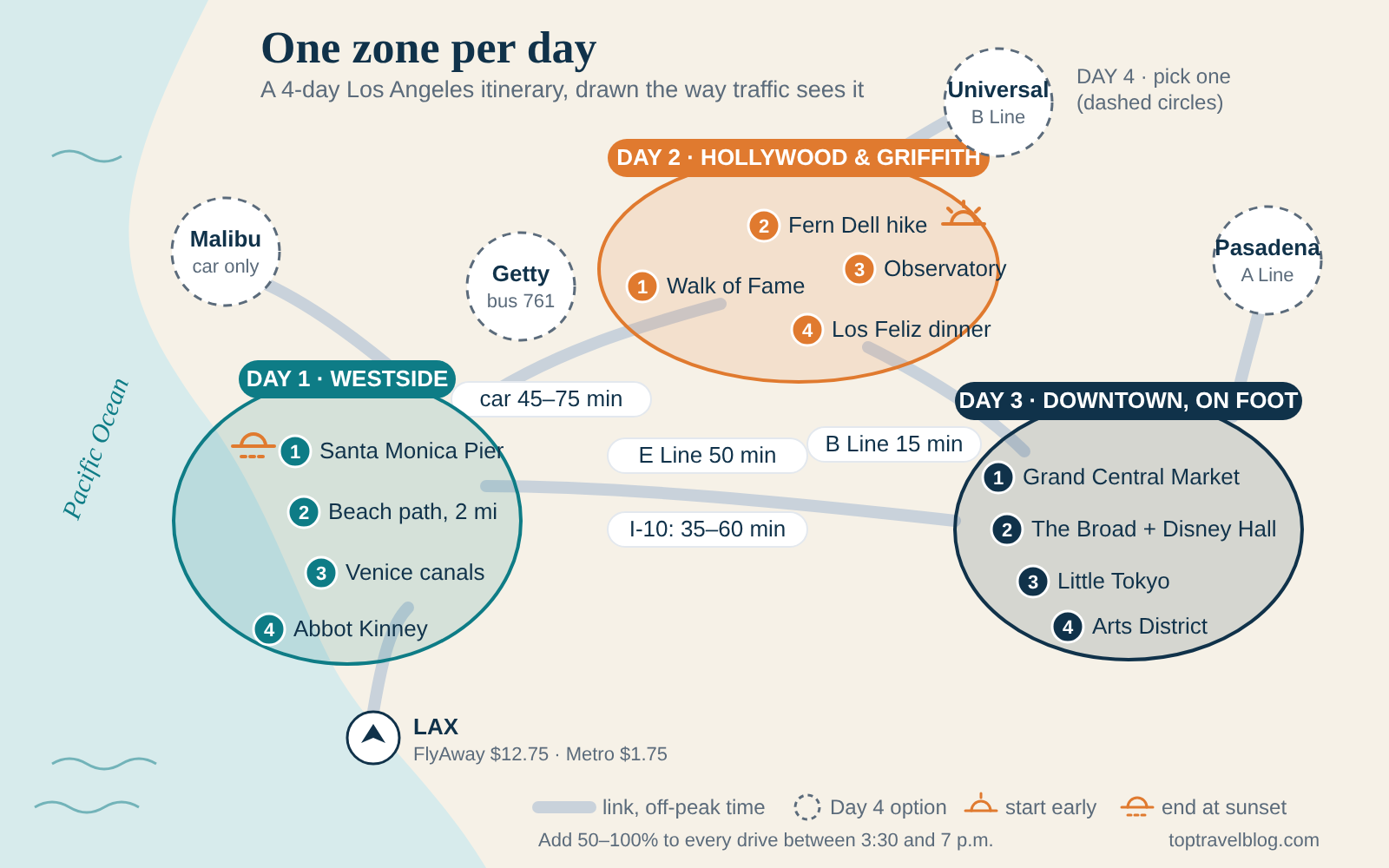
The plan below fixes that by giving each day a single zone: the Westside beaches, Hollywood and Griffith Park, Downtown with the Arts District, and a flexible fourth day you pick based on what you care about.
The verdict in one sentence: a 4-day Los Angeles itinerary is a great first visit if you plan it by geography, a frustrating one if you plan it by a list of famous names. It suits couples and friends who like walking neighborhoods, families with kids old enough to handle a beach day and a theme park day, and anyone pairing LA with a longer California or Southwest road trip.
It suits less well the traveler who wants a compact, walkable downtown with everything within a mile; that city is San Francisco or New York, not this one.
What follows is the plan I actually give friends after a dozen of these trips, with current prices, the honest car-versus-no-car answer, and the swaps that matter when you have kids in tow or the June sky stays gray until two in the afternoon.
Quick facts
- Best for: a Los Angeles first time visit, couples, families with school-age kids, anyone starting or ending a California road trip.
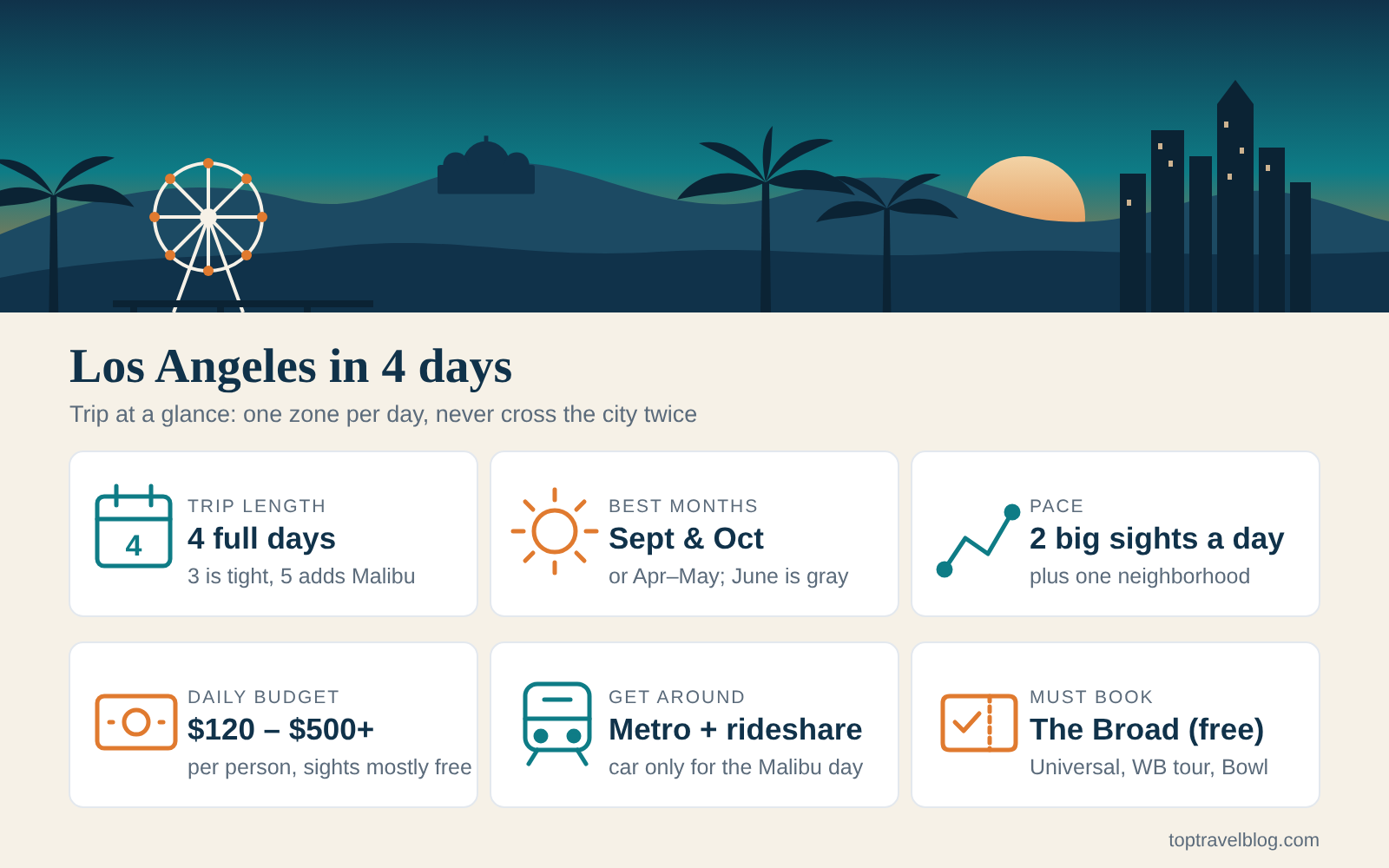
- Ideal trip length: 4 full days (3 is tight, 5 lets you add Malibu or a studio tour without rushing).
- How to get around: one zone per day. Rideshare plus the Metro B and E lines covers 3 of the 4 days; a rental car is only essential for Malibu, the Getty on a tight schedule, or a Pasadena day.
- Booking priorities: free timed tickets for The Broad, Universal Studios date-based tickets, Warner Bros. Studio Tour, a Hollywood Bowl seat in summer, dinner in the Arts District on a Friday or Saturday.
- Pacing: 2 big things per day of the Los Angeles itinerary plus one neighborhood to wander. Start by 9 a.m., be where you want to be before 3:30 p.m. traffic, eat near where you end up.
- Key caveats: parking is $10 to $40 almost everywhere that matters, hotel tax is 14% plus a 2% tourism assessment at larger hotels, and the coast is gray most mornings in May and June.
Best time to visit Los Angeles for this itinerary
For this Los Angeles itinerary the honest answer is September and October. The ocean is as warm as it gets (low 60s°F, which is still cold if you are from Florida), the marine layer that fogs the coast in early summer has mostly burned off, and the air inland is clear enough that you can see Catalina from the Griffith Observatory terrace on a good evening.
Hotel rates dip after Labor Day too. The trade-off is heat: late-September Santa Ana winds can push Downtown and the Valley past 95°F, and that is also peak wildfire season, so check air quality before a Griffith hike.
Spring, from late March through May, is the second-best window for a Los Angeles itinerary. Hillsides are briefly green, crowds are moderate outside spring break weeks, and the Hollywood Bowl is not yet open, which matters only if a summer concert is on your list. The catch is May Gray turning into June Gloom: a low cloud deck sits over the beaches until early afternoon on most days from mid-May through June.
If you visit then, flip the plan so you spend mornings inland (Downtown, Griffith) and hit Santa Monica after 1 p.m. I give a specific swap for that in the day-by-day section.
Summer is the busiest and most expensive season for any Los Angeles itinerary, especially the Westside in July and August when hotel rates near the beach climb well past $400 a night for anything decent. The weather is actually reliable then, with the gloom gone by late June, but Universal Studios waits are the longest of the year and the Santa Monica Pier lots fill by 11 a.m. on weekends.
Winter, from December through February, is the quiet, cheap season. Days are often 65°F and sunny, but this is also when it rains, usually in a few multi-day storms rather than a drizzle. A January trip can be perfect or can be three gray days; pack for both.
Tip: The coast and Downtown are often 15°F apart on the same afternoon. Carry a layer on the beach day even in August; the wind off the water at Venice around 5 p.m. surprises everyone.
How many days in Los Angeles do you really need?
Four. That is the number this Los Angeles itinerary is built around, and it is not arbitrary. The city’s main attractions sit in four clusters that each take most of a day to do properly, and the drive between clusters is 30 to 75 minutes depending on the hour. Three clusters in three days gets you the beach, Hollywood and Downtown. The fourth day is where the trip gets personal: Malibu, the Getty, a theme park or Pasadena.
What changes with 2, 3, 4 or 5+ days
With two days, usually a layover or the tail end of a Vegas trip, do the Westside beach day and the Hollywood-Griffith day of this Los Angeles itinerary, and skip Downtown.
You will not see the “real” city, but you will see the two things people picture when they think of LA. If you are flying in from Las Vegas, the drive is four hours on a good day and six on a Sunday afternoon; our Las Vegas itinerary covers how to time that leg so you are not arriving in LA at rush hour.
With three days, run Days 1 through 3 of this Los Angeles itinerary exactly as written. It is a complete first-time trip. You will miss the Getty and Malibu, which is a shame, but you will have seen the beach, the hills and the center without feeling rushed.
With four days, you add the pick-one day. This 4 days in Los Angeles version is the one I recommend to almost everyone. It also leaves room for one slow morning, which you will want after a travel day and a theme park.
With five or more days, stop choosing. Do the Getty and Malibu on separate days, add Universal if you have kids, and consider a day trip south to Long Beach or Laguna.
Five days is also the point at which renting a car for the whole stay starts to pay off, because the extra days are the car-dependent ones. If you are stringing LA together with Orlando for a two-coast theme park trip, our Orlando vacation guide explains how many park days that side needs, which affects how many you can spare here.
One more framing that helps: in a New York City itinerary of the same length, four days means a dozen neighborhoods on foot and subway. In LA, four days means four neighborhoods done thoroughly. Arrive expecting the New York pace and you will spend the trip in a car feeling cheated.
Where to stay in Los Angeles for a 4-day itinerary
Where to stay in Los Angeles matters more to this itinerary than in almost any other American city, because your base decides how much of your trip you spend in traffic. There is no neutral center. Every neighborhood is close to one of the four days and far from at least one other. The honest approach is to pick the base that is closest to the days you care about most, and accept a longer ride on the others.
My default Los Angeles itinerary recommendation for first-timers without a car is Downtown or Hollywood, because both sit on the Metro B Line and both have rideshare rides to the other zones in the $25 to $45 range off-peak. My recommendation for a couple on a first trip with a car, or who care most about the ocean, is Santa Monica, with the clear warning that two of your four days will begin with a 45-minute drive east.
If you are debating two bases, split the stay: two nights at the beach, two nights in Hollywood or Downtown. The mid-trip hotel change costs you about an hour, and it saves you three or four hours of cross-town driving.
Santa Monica
Best for: couples, families, anyone who wants to walk to the beach every evening
The most walkable base for a Los Angeles itinerary. The E Line runs from Downtown Santa Monica station straight to Downtown LA in about 50 minutes, so you can do Day 3 without a car. Hollywood and Griffith are the painful ones: 45 to 75 minutes by car. Expect $280 to $500 a night in season; the cheaper rooms are inland along Wilshire, a 15-minute walk from the sand.
Hollywood & Los Feliz
Best for: first-timers without a car, nightlife, Griffith hikers
Hollywood/Vine and Hollywood/Highland stations put the B Line under your feet, so Downtown is 15 minutes away and Universal City is one stop north. Griffith is a $15 rideshare or the DASH bus from Vermont/Sunset. The blocks right on the Walk of Fame are loud and a little grim at night; stay a few streets off it or in Los Feliz for a quieter, better-fed version. Roughly $180 to $350.
Downtown (DTLA)
Best for: travelers relying on transit, museum and food people, business trips
The best-connected base for a Los Angeles itinerary without a car: B Line to Hollywood, E Line to Santa Monica, FlyAway bus to LAX from Union Station. Walkable to The Broad, Grand Central Market and Little Tokyo.
The downside is real: parts of Downtown feel empty after 9 p.m., and Skid Row is a few blocks east of the Historic Core, so pick a hotel around Bunker Hill, the Financial District or South Park rather than bargain-hunting by map. Usually $180 to $320, cheaper on weekends.
West Hollywood & Beverly Hills
Best for: a central-ish base with a car, shopping and restaurants, a splurge
Geographically the fairest compromise: 25 minutes to the beach, 15 to Hollywood, 25 to Downtown outside rush hour. No rail, so it only works with a car or a rideshare budget. West Hollywood along Santa Monica Boulevard is lively and walkable at night; Beverly Hills is quiet by 10 p.m. Rates run $250 to $600 and up.
Culver City & Mid-City
Best for: value seekers who still want transit, a second trip
Downtown Culver City has an E Line stop, so Santa Monica is 20 minutes west and DTLA is 30 minutes east by train. It is 20 minutes from LAX by car, which makes it a good first and last night. Hotels are mostly chains at $170 to $280. Hollywood is the weak link, about 35 minutes by car.
Venice & Marina del Rey
Best for: a beachy, slightly scruffy vibe; close to LAX
Venice is a 10-minute drive from the airport and has the best people-watching in the city, but the boardwalk area has a visible homeless population and gets rowdy after dark, so vacation rentals on the walk streets or east of Abbot Kinney are a better bet than anything on Ocean Front Walk. Marina del Rey is newer, calmer and very car-dependent. No rail at all.
Avoid airport hotels for more than the first or last night of your Los Angeles itinerary, and the San Fernando Valley unless Universal is the heart of your trip. Los Angeles charges a 14% transient occupancy tax, and hotels with 50 or more rooms add a 2% tourism marketing assessment on top, so a $250 room is about $290 before any resort or parking fee.
Hotel parking itself runs $30 to $65 a night at most Westside and Downtown properties, which is one more argument for not renting a car for the whole stay.
The 4-day Los Angeles itinerary, day by day
Here is the logic one more time, because it is the whole trick. Each day below stays inside one zone. You drive or ride once in the morning to get there, move around inside the zone on foot, bike or short rideshare, and eat dinner where you end up before heading back after the 7 p.m. traffic break.
The plan assumes you are not in a car between 3:30 and 7 p.m. unless you are already in the right zone. Keep that one promise to yourself and the rest of this Los Angeles itinerary takes care of itself.
Day 1
The Westside: Santa Monica Pier, the beach path to Venice, and a sunset
Morning: Santa Monica Pier before the crowds
Start Day 1 of the Los Angeles itinerary at the Santa Monica Pier by 9 a.m. The rides at Pacific Park do not open until 11 or noon on most days, which is fine; the point of an early pier visit is the empty boards, the fishermen at the end, and the view back at the bluffs with the Palisades behind them. Walk out to the end (about 10 minutes), then find the small “End of the Trail” Route 66 sign near the 1922 carousel.
If you drive, use the beach lots north and south of the pier along Pacific Coast Highway rather than the pier deck itself. Santa Monica raised its rates in January 2026; beach lots and meters now run about $2 an hour, with flat-rate summer and weekend pricing in the main lots that can reach the $15 to $20 range for the day.
The pier deck fills first and costs most. The Downtown Santa Monica parking structures on 2nd and 4th Streets are a 10-minute walk and give you 30 free minutes, then hourly rates; the current table is on santamonica.gov. No car: the E Line ends at Downtown Santa Monica station, four blocks from the pier.
Afternoon: Santa Monica to Venice on the beach path, then Abbot Kinney
The beach path from the Santa Monica Pier to the Venice Boardwalk is 2 miles of flat concrete right on the sand. Walking takes 40 to 45 minutes; renting a bike or e-bike from one of the stands near the pier ($15 to $25 an hour, more for e-bikes) turns it into a 15-minute cruise and lets you continue to Marina del Rey if you have the energy.
This Santa Monica to Venice stretch is the single best hour of the Los Angeles itinerary for most people. Do it in the early afternoon when the light is high and the Muscle Beach regulars are out.
Venice Boardwalk is loud, commercial and a little chaotic, and I still think you should walk the half mile from Rose Avenue to Windward Avenue and watch the skate park for 20 minutes.
The boardwalk has aggressive vendors and a large unhoused population; keep your phone in a front pocket and do not stop for anyone handing you a CD. Then turn inland on Windward and walk three blocks to the Venice Canals, which are quiet, residential and the opposite of the boardwalk in every way. Allow 30 minutes to loop the bridges.
From the canals it is a 10-minute walk north to Abbot Kinney Boulevard, the mile of boutiques, coffee roasters and restaurants between Venice Boulevard and Main Street. Spend 3 to 5 p.m. here: a late lunch at Gjelina or a taco counter ($25 to $40 a head), the shops, and a coffee before the sunset walk.
Evening: sunset from the sand, dinner nearby
Sunset is the one thing I would never skip, even in June when it happens behind a cloud bank. Walk back to the sand at Venice 40 minutes before, or ride 10 minutes north to Palisades Park, the strip of lawn and palms above the pier, to watch the Ferris wheel lights come on.
Dinner is wherever you ended up: Abbot Kinney if Venice, Main Street or Ocean Avenue if Santa Monica. Reserve on a Friday or Saturday; walk-ins at 7:30 p.m. mean a 45-minute wait almost everywhere.
Logistics for Day 1 of the Los Angeles itinerary: Pier to Venice Boardwalk, 2 miles, 45 minutes walking or 15 by bike. Boardwalk to Canals, 10 minutes. Canals to Abbot Kinney, 10 minutes. Abbot Kinney back to the pier, 10 minutes by rideshare ($12 to $18) or the Big Blue Bus Route 1 along Main Street for $1.25. Total walking for the day: 5 to 7 miles.
Swaps:
With kids: do the Pacific Park rides at opening (unlimited-ride wristbands are cheaper online), skip the Venice Boardwalk, and walk the bike path only as far as the Annenberg Community Beach House in the other direction, which has a pool and a playground in summer.
Los Angeles without a car: this day needs no car at all. E Line in, Big Blue Bus or bikes along the coast, rideshare back.
If it’s June Gloom: swap this day with Day 3. Spend the gray morning at The Broad and Grand Central Market, then take the E Line west after lunch; the coast usually clears by 1 or 2 p.m. and the sunset is still yours.
Day 2
Hollywood and Griffith Park: the Walk of Fame, the Observatory and a Los Feliz evening
Morning: Hollywood Boulevard, quickly
I will be blunt about the Walk of Fame, which every Los Angeles itinerary includes and none should linger on: it is a sidewalk with brass stars, surrounded by souvenir shops, costumed characters who expect a tip for a photo, and tour hawkers. Give it 45 minutes, not a morning. Start at the Hollywood/Highland B Line station (or park in the Ovation Hollywood garage, which is $3 to $5 for the first two hours with validation from any shop, then climbs fast).
Walk west along Hollywood Boulevard to the TCL Chinese Theatre forecourt to see the handprints in the concrete, then east past the Dolby Theatre, the Egyptian and the El Capitan. The Ovation complex’s upper terraces have a free, framed view of the Hollywood Sign; that is your photo, and it is better than anything you will get from the street.
On a weekday before 10 a.m. the crowd is thin and the characters are not out yet; by noon on a Saturday it is shoulder to shoulder from Highland to Vine. Eat breakfast in Los Feliz first, not on the boulevard.
Afternoon: the Griffith Observatory hike (or the early drive)
Griffith Observatory is free, open noon to 10 p.m. Tuesday through Friday and 10 a.m. to 10 p.m. on weekends, and closed Mondays. Plan your whole Los Angeles itinerary around that Monday closure if the Observatory matters to you. Admission to the building, the grounds and the public telescopes costs nothing; planetarium shows are a few dollars and worth it if you have 45 minutes. Hours and parking details are on the Observatory’s official site at griffithobservatory.lacity.gov, and they do change for events.
Parking is the problem. The Observatory lot and the metered curb along West Observatory and Western Canyon Roads charge $10 an hour, enforced from noon on weekdays and 10 a.m. on weekends, and the lot is full by early afternoon most days. So here are the three ways I actually do it:
The Griffith Observatory hike from Fern Dell is my pick for this Los Angeles itinerary. Park near the Fern Dell entrance on Fern Dell Drive off Los Feliz Boulevard, where street parking is free but fills by 10 a.m. on weekends, or take a rideshare to the Trails Café.
The walk up through the ferns and then the dirt switchbacks of the West Observatory Trail to the terrace is about 1.3 miles with roughly 500 feet of climbing: 35 to 45 minutes at an easy pace, shaded for the first third, exposed after that.
Bring water and a hat. You come up onto the lawn with the city below you and the Hollywood Sign to your left.
The free Greek Theatre lot at 2700 North Vermont is the second option: on days without a concert, parking there costs nothing, and from the lot you either walk 15 minutes up the road or catch the DASH Observatory bus that loops past. Check the Greek’s calendar first, because on show nights it becomes paid event parking and you can get boxed in.
The DASH Observatory bus is the answer for a Los Angeles itinerary without a car. It runs from the Vermont/Sunset B Line station to the Observatory’s front door every 20 to 25 minutes from 10 a.m. to 10 p.m. and costs 50 cents, or 35 cents with a TAP card. Exact change if you pay cash. It is slow and packed on weekend afternoons, but it is 50 cents.
Give the Observatory 90 minutes: the Foucault pendulum and Tesla coil inside, the Zeiss telescope on the roof after dark, and the west terrace for the view.
Evening: Hollywood Bowl in summer, Los Feliz the rest of the year
From mid-June through late September, a Hollywood Bowl concert is the best evening in any Los Angeles itinerary and should decide which night you do Day 2. The 2026 season ran from the Blue Note Jazz Festival in mid-June to the last weekend of September, with the LA Phil’s opening night on June 20, and 2027 will follow roughly the same shape; the calendar goes up in February at hollywoodbowl.com.
Bench seats in the upper sections for Phil nights start around $15 to $30, and you can bring your own picnic and wine to most LA Phil performances (lease events like big pop shows have stricter rules). Take the Bowl shuttle from one of the park-and-ride lots or walk the 20 minutes up Highland from the Hollywood/Highland station; the stacked parking at the Bowl itself means waiting 45 minutes to leave.
Outside Bowl season, come down the hill to Los Feliz. The blocks of Vermont Avenue between Franklin and Prospect have a bookstore, a dozen restaurants and the 1920s Vista Theatre nearby for a movie; it is calmer and better than anything on Hollywood Boulevard after dark.
Logistics for Day 2 of the Los Angeles itinerary: Hollywood/Highland to Fern Dell trailhead, 10 minutes by rideshare ($10 to $14) or B Line one stop to Vermont/Sunset and a 20-minute walk north. Fern Dell to Observatory on foot, 40 minutes uphill. Observatory to Los Feliz, DASH bus 15 minutes or a 30-minute downhill walk. Los Feliz to a Hollywood hotel, 10 minutes by car; to Downtown, 15 minutes on the B Line from Vermont/Sunset.
Swaps:
With kids: skip the hike and drive up at opening time (noon weekdays, 10 a.m. weekends) when the lot still has space, pay the $10 an hour for two hours, and add the pony rides and the old-fashioned train at the Crystal Springs side of Griffith Park or the LA Zoo on the park’s north side.
Los Angeles without a car: B Line to Hollywood/Highland, B Line to Vermont/Sunset, DASH to the Observatory, DASH back. The only walking you cannot avoid is on the boulevard, which is the point.
If it’s June Gloom or very hot: flip the order. Observatory at noon when it opens (the hills are above the cloud line more often than the beaches are), then Hollywood Boulevard in late afternoon when the light on the theaters is better anyway.
Day 3
Downtown and the Arts District: Grand Central Market, The Broad, Disney Hall, Little Tokyo
Morning: Grand Central Market and Bunker Hill
Downtown is the one day of this Los Angeles itinerary that works entirely on foot, and it is the day people who “hate LA” tend to like most. Start at Grand Central Market on Broadway between 3rd and 4th, open from 8 a.m. Get there before 10 to avoid the line at Eggslut (and decide for yourself whether a $12 egg sandwich is worth 25 minutes; I have stopped waiting and go to the pupusa stand or Sarita’s instead).
Walk the hall once end to end, then exit the Hill Street side. Directly across is Angels Flight, the tiny 1901 funicular that climbs one steep block to Bunker Hill for $1 each way. Ride it; it takes 60 seconds and saves you the stairs.
At the top you are a 5-minute walk from The Broad and Walt Disney Concert Hall on Grand Avenue. Do The Broad first; it is the one museum this Los Angeles itinerary treats as non-negotiable. General admission is free but you need a timed ticket, and this is the one reservation first-timers forget. Free tickets are released online in a monthly batch, with extra tickets released daily at thebroad.org; weekend slots go within hours.
Walk-ups do get in through a standby line, but on a Saturday at 11 a.m. that line is 30 to 60 minutes along Grand Avenue. The museum is open 11 a.m. to 5 p.m. Tuesday, Wednesday and Friday, until 8 p.m. Thursday, and 10 a.m. to 6 p.m. weekends, closed Mondays. Allow 90 minutes; the Infinity Mirrored Room requires a separate same-day sign-up inside, so do that first thing when you arrive.
Afternoon: Disney Hall, the Central Library, Little Tokyo
Walt Disney Concert Hall is next door on this Los Angeles itinerary, and the free self-guided audio tour (most days until about 2 p.m., skipped on matinee days) lets you walk the stainless-steel exterior and the hidden rooftop garden with the rose-shaped fountain. Even without the tour, the public staircase on the Grand Avenue side leads up to the garden. Fifteen minutes is enough unless you are an architecture person.
For lunch, walk south to the Central Library on 5th Street, whose 1926 rotunda and murals are free to see and whose surrounding blocks have good lunch counters. Then take Broadway through the Historic Core past the old movie palaces to the Bradbury Building at 3rd, whose ironwork atrium (the one from Blade Runner) you can see from the lobby for free.
This stretch shows Downtown’s problems up close, with people sleeping in doorways; it is confronting rather than dangerous in daylight in my experience, but it gets emptier and rougher east of Los Angeles Street toward Skid Row. Stay on Broadway, Spring and Main.
Mid-afternoon, walk 15 minutes east to Little Tokyo. The Japanese American National Museum on 1st Street is a serious, moving museum most tourists skip, and the Japanese Village Plaza is the place for mochi, ramen and an hour in the shops out of the heat.
Evening: the Arts District
The Arts District, the last stop on Day 3 of the Los Angeles itinerary, is a 15-minute walk east of Little Tokyo across the Alameda tracks, and it is where I would eat dinner on Day 3 without hesitation. The old warehouses between 3rd and 7th Streets along Mateo, Traction and Industrial now hold a dozen breweries, bakeries and the restaurants that get written about.
Bestia on 7th Place is the one everyone has heard of and needs a reservation weeks ahead; Angel City Brewery on Alameda takes walk-ins and has food trucks. Walk 3rd Street and Traction at golden hour for the murals. On a Friday or Saturday night it is busy until midnight; on a Tuesday it is quiet by 10.
Getting back: the A Line’s Little Tokyo/Arts District station is at 1st and Alameda, with trains to Union Station (one stop) where you transfer to the B Line for Hollywood or catch the E Line west. A rideshare to Santa Monica at 9 p.m. is about $40 to $55 and takes 30 to 40 minutes with the freeway finally clear.
Logistics for Day 3 of the Los Angeles itinerary: Grand Central Market to The Broad, 5 minutes via Angels Flight. The Broad to Disney Hall, 2 minutes. Disney Hall to Central Library, 10 minutes downhill. Library to Bradbury Building, 8 minutes. Bradbury to Little Tokyo, 15 minutes on foot. Little Tokyo to the Arts District, 15 minutes. Total: about 4 miles of walking, all flat except Bunker Hill.
Swaps:
With kids: trade The Broad for the California Science Center at Exposition Park (free general admission, home of the Space Shuttle Endeavour in its new upright display), reachable on the E Line from 7th St/Metro Center in 10 minutes, and keep Grand Central Market and Angels Flight, which children love.
Los Angeles without a car: this is the easiest day of the trip. Everything is on foot or one stop on the A Line.
If it rains: this is also your rain day. The Broad, the library, the Bradbury lobby, the museum in Little Tokyo and the Arts District breweries are all indoors, and the walks between them are short.
Day 4
Pick one: Getty and Beverly Hills, Malibu, Universal Studios, or Pasadena
The fourth day is where every Los Angeles itinerary I have ever written for a friend splits. There are four good options, they are in four different directions, and trying to combine two of them is the classic mistake. Here is how I would choose, with my ranking at the end.
Option A: The Getty Center, then Beverly Hills and Melrose
The Getty Center, my first choice for the fourth day of a Los Angeles itinerary, sits on a hilltop above the 405 in Brentwood, and it is the best free museum in the western United States. Admission is free; you reserve a timed entry online and the catch is the parking, which is $25 per car, dropping to $15 after 3 p.m. and $10 after 6 p.m.
(free after 6 p.m. on Saturdays, when the museum stays open until 9). Hours are 10 a.m. to 6:30 p.m. Tuesday through Friday and Sunday, until 9 p.m. Saturday, closed Monday.
A computer-operated tram carries you from the garage up the hill. Give it three hours: the Impressionist galleries, the Central Garden, and the west terrace view that on a clear day runs from Downtown to the ocean. Without a car, Metro bus 761 stops at the entrance on Sepulveda, or a rideshare from Santa Monica is $20 to $25. Details are at getty.edu.
From the Getty it is 15 minutes to Beverly Hills. Park once in one of the city garages (the first hour or two is free in most of them) and walk Rodeo Drive for 20 minutes, which is enough; it is three blocks of shops you cannot afford, and the fun is the people.
Then head east on Melrose Avenue toward Fairfax for the vintage shops and the murals, and finish at the Original Farmers Market at 3rd and Fairfax, open since 1934, for an early dinner that will not break the budget.
This is the best option for art lovers, for a gray-sky day, and for anyone based in Santa Monica or West Hollywood.
Option B: The Malibu drive
The Malibu option puts a Los Angeles itinerary on Pacific Coast Highway, and the drive from Santa Monica to Point Dume is 20 miles of the California coast everyone pictures, and on a clear weekday morning it is a joy.
Stop at the Getty Villa in Pacific Palisades (free, timed reservation required, same $25 parking as the Center) if you like antiquities, then continue to Malibu Pier and Surfrider Beach, El Matador State Beach for the sea stacks (small lot, $8 to $12, arrive before 11 a.m. or forget it), and Point Dume for the headland walk.
Lunch at Malibu Seafood on PCH, a counter with picnic tables across from the water. Turn around by 2 p.m., because PCH southbound on a weekend afternoon can take 90 minutes for those 20 miles.
Two caveats. This option needs a car; getting a rideshare back from El Matador is slow and expensive. And the Palisades and eastern Malibu stretch hit by the January 2025 fires is still rebuilding, with PCH closures that change month to month; Caltrans posts the current status.
Option C: Universal Studios Hollywood (the kids’ pick)
If you have kids between about 8 and 16, Universal is Day 4 of your Los Angeles itinerary, and you already know it. One-day date-based tickets run roughly $109 to $159 depending on the day, with Express passes (skip-the-line on each ride once) in the $199 to $299 range and parking $40 before 5 p.m.
The park is smaller than its Orlando sibling, so one full day covers it: the Studio Tour tram (the reason to come, 60 minutes, do it first), Harry Potter, Super Nintendo World, which needs a free virtual-queue reservation in the app on busy days, and the Jurassic ride.
The B Line’s Universal City station is right across the street with a free shuttle up the hill, so this is the one theme park in America you can reach by subway. Buy tickets at the official site a week or more ahead; walk-up pricing is highest.
The alternative is the Warner Bros. Studio Tour in Burbank, about $70 to $80 for the three-hour tour as of this writing: a real working lot rather than a theme park. For adults who want soundstages and the Friends set, pick Warner over Universal and keep the afternoon.
Option D: Pasadena and the Huntington
Pasadena is 25 minutes northeast of Downtown on the A Line or the 110, and the day is built around the Huntington Library, Art Museum and Botanical Gardens in San Marino: 130 acres of gardens, a Gutenberg Bible and Gainsborough’s Blue Boy.
Tickets run roughly $25 to $35 on weekdays and more on weekends, parking is free, and weekends need an advance reservation. Pair it with the small, perfect Norton Simon Museum on Colorado Boulevard and dinner in Old Pasadena. This is the quiet, grown-up option and the easiest car-free choice from a Downtown base.
Which one I would pick
For a Los Angeles first time trip with no kids: the Getty, then Beverly Hills and Fairfax. It is the only option that works in any weather, needs no car if you are willing to take a bus, and shows you a slice of the city (Brentwood, Beverly Hills, Fairfax) that the other three days skip.
Malibu is a close second on a clear day with a car. Universal is the obvious call with kids. Pasadena is what I do now that I have done the others, and it is the day I would add if you have five.
Swaps:
With kids: Universal, or the Malibu drive with a stop at the Santa Monica Mountains’ Paramount Ranch and a beach afternoon at Zuma.
Los Angeles without a car: Universal (B Line), the Getty (bus 761 or rideshare) or Pasadena (A Line). Not Malibu.
If it’s June Gloom: the Getty or Pasadena; both are inland and usually under sun by late morning. Save Malibu for a fall trip.
Getting around: car vs. no car, rideshare, Metro and LAX
The most common question I get about any Los Angeles itinerary is whether you need a car, and the honest answer in 2027 is: not for the whole trip, and maybe not at all.
Three of the four days above work on rail and short rideshares. The fourth depends on which option you pick. What you give up without a car is Malibu and spontaneity; what you gain is roughly $70 to $110 a day in rental, insurance, gas and parking, plus the hours you would otherwise spend looking for a space.
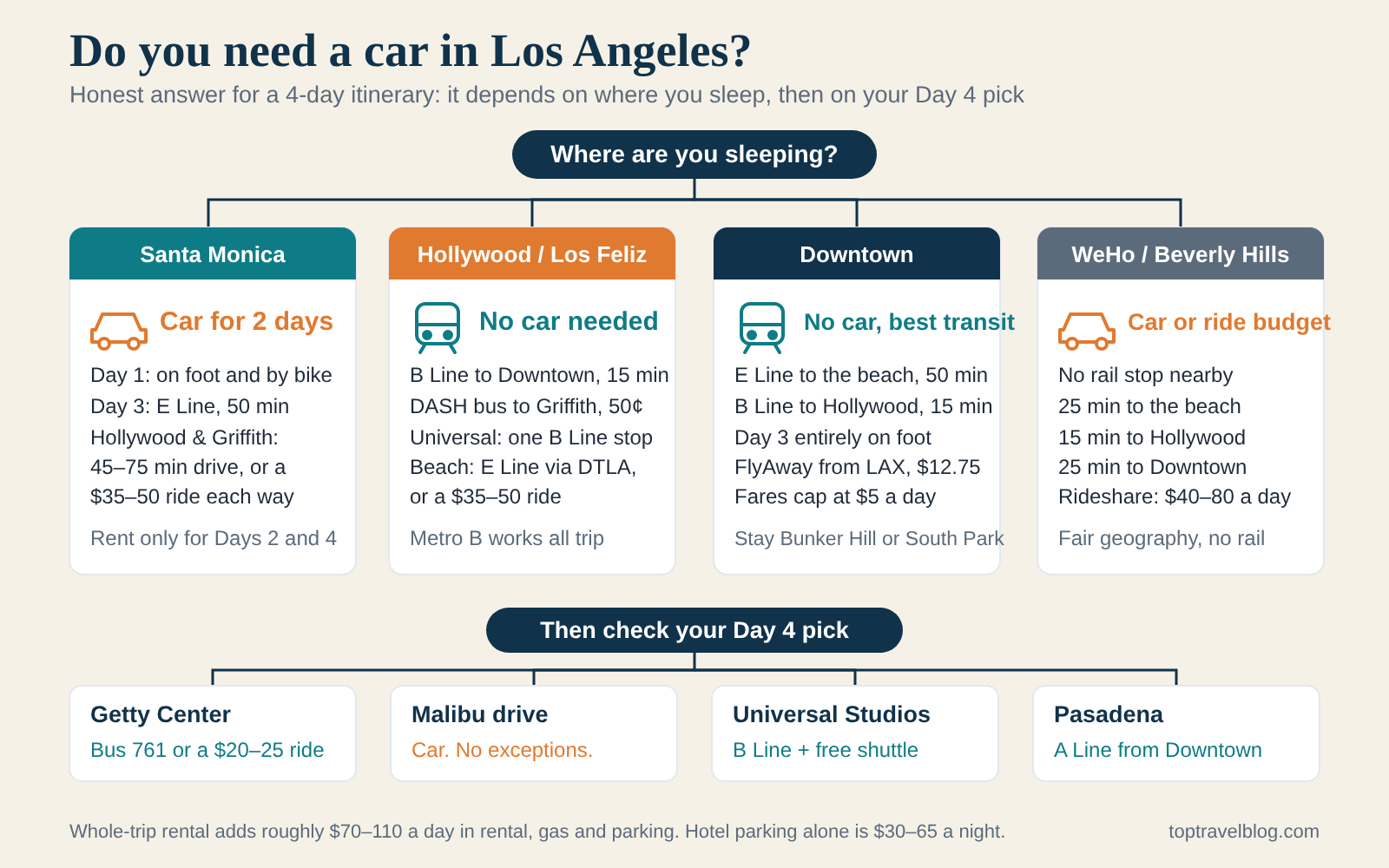
Los Angeles without a car: what actually works
The Metro B Line (the old Red Line subway) runs from Union Station through Downtown to Hollywood/Vine, Hollywood/Highland, Universal City and North Hollywood every 10 to 12 minutes. The E Line light rail runs from 7th St/Metro Center west through Culver City to Downtown Santa Monica in about 50 minutes.
Those two lines connect three of the four day zones; add the DASH Observatory bus, the Big Blue Bus along the coast and the A Line to Pasadena, and a car becomes a convenience. Rail gets uncomfortable mainly late at night, when I switch to a rideshare without a second thought.
Fares for a Los Angeles itinerary on transit are simple. A ride is $1.75 with free transfers for two hours, and fare capping means you never pay more than $5 in a day or $18 in seven days.
You can tap a contactless credit card, Apple Pay or Google Pay directly on the gate or bus reader, or buy a plastic TAP card from a station machine; the current rules are at metro.net. Cash works on buses only, exact change, and does not count toward the cap.
Rideshare costs and timing
Uber and Lyft are everywhere and are the glue of a Los Angeles itinerary without a car. Typical fares outside rush hour: Santa Monica to Hollywood $35 to $50, Hollywood to Downtown $20 to $30, Downtown to Santa Monica $40 to $55, LAX to Santa Monica $30 to $45, LAX to Downtown $45 to $65.
Between 4 and 7 p.m. add 50 percent and 20 minutes. Waymo’s driverless cars cover most of the Westside, Hollywood and Downtown at similar prices. Budget $40 to $80 a day for rideshare on a no-car version of this plan and you will come in under it on the Downtown day.
If you rent a car
Rent it only for the days of the Los Angeles itinerary that need it. The Day 4 Malibu option is the real car day; pick it up the night before from a neighborhood location rather than LAX to skip the airport’s rental-car shuttle and surcharge.
Parking rates to expect: $10 an hour at the Griffith Observatory, $25 at the Getty, $19 to $29 in the garage under The Broad, $15 to $20 for a day at the Santa Monica beach lots, $40 at Universal, and $30 to $65 a night at hotels.
Read every curb sign; street cleaning and permit zones generate most of the $73 tickets visitors get. And remember the pattern that makes the whole plan work: be in your zone before 3:30 p.m., or stay put until after 7.
Arriving at LAX: LAX-it, FlyAway and the Metro connection
Every Los Angeles itinerary begins at LAX, which has been a construction site for the better part of a decade, and the arrival options are finally improving. Here is the current state of play, as flylax.com describes it.
Rideshare and taxis do not pick up at the terminal curb. You walk or take a green shuttle to LAX-it, the pickup lot east of Terminal 1, which is a 5- to 15-minute walk from most terminals and longer with luggage from Tom Bradley. Taxis from there are metered with a flat $55 to $60 fare to Downtown. Rideshare surge pricing hits LAX hard on Sunday evenings.
The FlyAway bus is my recommendation if you are staying Downtown or near a B Line station: $12.75 one way to Union Station, boarding at the blue FlyAway columns on the lower arrivals level outside each terminal, with departures every 30 minutes or so and a 35- to 60-minute ride depending on the 105 and 110 traffic. From Union Station you walk to the B Line. A second FlyAway route serves Van Nuys in the Valley.
Metro finally reaches the airport, which changes the math for a Los Angeles itinerary without a car. The LAX/Metro Transit Center opened in June 2025 and is served by the C and K Lines; from the terminals you take the free LAX Shuttle (route M) to the transit center, then the K Line north to Expo/Crenshaw where you change to the E Line for Downtown or Santa Monica.
Figure 60 to 75 minutes to Downtown and $1.75. The long-promised automated people mover train between the terminals and the transit center was in testing through 2026 with an opening targeted for late that year; if it is running when you land, it replaces the shuttle and cuts the connection to a few minutes. Metro’s LAX page at metro.net/riding/go-metro-to-lax has the current status.
What 4 days in Los Angeles costs
Los Angeles is expensive in a specific way: the sights are mostly free, and everything around them costs more than you expect. The Observatory, the Getty, The Broad, the beaches, Disney Hall and the Central Library cost nothing. Parking, hotel taxes, rideshares and restaurant bills with 20 percent tip plus the 3 to 5 percent “service charge” some places now add are where the money goes. Here is a realistic day per person, two sharing a room.
Budget Los Angeles itinerary, roughly $120 to $170 a day. A hostel bed in Hollywood or Santa Monica ($50 to $80) or half of a $160 motel room on Sunset or in Culver City, Metro for $5 a day, one rideshare, breakfast from a bakery, lunch at Grand Central Market or a taco truck ($12 to $15), and a casual dinner with a beer ($25 to $35).
Skip Universal; do the free museums. This is a very doable trip, and the free-attraction list is longer here than in New York or Miami.
Mid-range Los Angeles itinerary, roughly $250 to $350 a day. Half of a $220 to $320 hotel room in Downtown, Hollywood or inland Santa Monica (so $130 to $180 after tax), $40 to $60 of rideshares, one sit-down lunch and one real dinner at $45 to $70 a head with a drink, a planetarium show, bike rental on the beach, and one paid attraction over the four days such as the Warner Bros. tour or the Huntington. This is the tier the itinerary above is written for.
Comfortable Los Angeles itinerary, $500 and up a day. A beachfront Santa Monica room or a West Hollywood boutique hotel at $400 to $700 plus $50 to $65 valet, a rental car anyway, two reserved dinners a day at the restaurants people fly in for ($100 to $150 a head), Universal with Express, and a Hollywood Bowl box. The ceiling is as high as you like; LA will take it.
The big line items to watch across all tiers: hotel tax (14% city tax plus the 2% tourism assessment at most hotels, so figure 16% on top of the quoted rate), parking ($20 to $65 a day if you drive), and the fourth-day choice, which swings from $0 (the Getty on a bus) to $200-plus per person (Universal with Express and parking).
A family of four doing Universal should expect $550 to $750 for the day including food. Compared with a Miami itinerary of similar length, LA hotels are a little cheaper off the beach and food is comparable; what costs more here is simply moving around.
Tickets and reservations to book ahead for your Los Angeles itinerary
Most of a Los Angeles itinerary is walk-up, which is one of the pleasures of the place. The short list below is what actually sells out or punishes you for not planning, in the order I would book them.
The Broad (free timed tickets). The first booking for any Los Angeles itinerary. Released in monthly batches online with extra tickets daily; weekend mornings vanish within hours of release. Book the day you fix your dates. If you miss out, go on a weekday at 11 a.m. opening and join the standby line, or use the Thursday evening hours when it is quieter.
Universal Studios Hollywood. Date-based tickets are cheapest a few weeks out, and summer and holiday weeks sell the Express passes out entirely. Download the app before you go for the Nintendo World virtual queue.
Warner Bros. Studio Tour. Specific tour times, especially the 9 to 11 a.m. slots, book up one to two weeks ahead in summer. Note that the tour closes for a few days each year around early November and Thanksgiving.
Hollywood Bowl. Big-name summer concerts on a Los Angeles itinerary sell out the day they go on sale in spring; LA Phil classical nights usually have cheap bench seats available the week of.
The Getty Center and Getty Villa. Free, but timed entry reservations are required and weekend slots at the Villa fill a week or two out. Getty Center weekday slots are usually available the day before.
The Huntington. Advance reservations required on weekends and holidays; weekdays are walk-up but still cheaper online.
Dinner on Friday and Saturday. Abbot Kinney, the Arts District and anything that has been on a best-of list in the last year needs a reservation at least a week out, often two to four for the famous ones. Tuesday through Thursday you can mostly walk in before 6:30 p.m.
Rental car for Day 4. Neighborhood rental locations have limited cars and close early on Sundays; reserve a one-day rental a week ahead and ask about pickup hours.
What you do not need to book: the Griffith Observatory (planetarium tickets are sold on arrival and can sell out on weekend afternoons), Grand Central Market, Disney Hall’s tour, the pier, the canals and the Central Library.
Food and experiences worth planning around
I am not going to list thirty restaurants for this Los Angeles itinerary. Here are the handful of food experiences that are specific to this city and that fit naturally into the four days above, plus the three or four things worth bending the schedule for.
Tacos, in the right places
The best cheap meal on a Los Angeles itinerary is a taco from a truck or a stand, and the best ones are not where the tourists are. On the Westside, the trucks along Lincoln Boulevard in Venice and the stands around Pico and Sawtelle do al pastor off the trompo for $2.50 to $4 a taco after dark.
Downtown, the stands around Olympic and the Fashion District, and the Boyle Heights trucks a five-minute ride east of the Arts District, are the ones locals argue about. Mariscos Jalisco on Olympic in Boyle Heights, a truck doing fried shrimp tacos since the 1990s, is 10 minutes from Little Tokyo and worth the detour on Day 3. Bring cash.
Koreatown late at night
Koreatown, which no Los Angeles itinerary should skip at night, sits between Downtown and Hollywood on the B Line (Wilshire/Vermont and Wilshire/Normandie stations), and it is the best late-night food neighborhood in the country.
Korean barbecue at a table grill runs $35 to $60 a head all-you-can-eat; the 24-hour tofu-stew and noodle places along 6th and 8th Streets are a third of that. It fits as a Day 2 or Day 3 dinner for a group that wants something loud and fun, and it is one subway stop from either base.
Thai Town after the Observatory
Thai Town along Hollywood Boulevard east of Western is a 10-minute DASH or B Line hop from Griffith, and the late-night Thai places there (Ruen Pair and Jitlada are the famous names) are where I would eat after a sunset on the terrace instead of anywhere on the Walk of Fame.
Experiences to plan a day around
A Hollywood Bowl picnic concert in summer, already covered, is the first thing to build a Los Angeles itinerary day around. The second is a Dodgers game: Dodger Stadium sits in Elysian Park just north of Downtown, the season runs April through September, and the view from the top deck at sunset is one of the great American ballpark views.
Take the free Dodger Stadium Express bus from Union Station rather than paying $35-plus to park; it runs from 90 minutes before first pitch. The third is a Getty or Griffith sunset on a clear fall evening, and the fourth, for the right traveler, is an early-morning surf lesson at Santa Monica or Venice ($90 to $150 for two hours with a board and wetsuit) on Day 1 before the beach path.
Common Los Angeles itinerary mistakes (and how to avoid them)
1. Planning by landmark instead of by zone. The Los Angeles itinerary that goes “Santa Monica, then the Hollywood Sign, then Downtown dinner” in one day is the one I see most often, and it means three hours in a car. Every day gets one zone. If a landmark is in the wrong zone, it moves to a different day or it gets cut.
2. Driving between 3:30 and 7 p.m. The 10, the 405 and the 101 do not move in the late afternoon, and surface streets are not much better. Plan to arrive in your evening neighborhood by mid-afternoon and stay there. If you must cross town, do it after 7:30 p.m. or before 7 a.m.
3. Renting a car for all four days of a Los Angeles itinerary by reflex. You will pay $70 to $110 a day in rental and parking to use it meaningfully on one day. Rent for the Malibu day only, or not at all.
4. Booking a Santa Monica hotel and expecting to pop over to Hollywood. Santa Monica is a wonderful base for the beach and fine for Downtown by train. Hollywood and Griffith from the beach is a 45- to 75-minute commute each way. Split the stay if the hills matter to you.
5. Showing up to the Griffith Observatory at 4 p.m. on a Saturday by car. The lot is full, the road is a parking lot, and you will miss the sunset circling. Hike up from Fern Dell, use the Greek Theatre lot and the DASH bus, or come on a weekday.
6. Forgetting that the Observatory, The Broad and the Getty are all closed on Monday. If your Los Angeles itinerary includes a Monday, make Monday your beach day or your Universal day.
7. Not reserving The Broad. It is free, which is why people assume they can just walk in. On a weekend that assumption costs an hour in line.
8. Spending a half day on the Walk of Fame. Forty-five minutes. The rest of the morning belongs to Griffith Park.
9. Treating June like summer on a Los Angeles itinerary. The coast is gray until early afternoon from mid-May through June. Inland mornings, coast afternoons.
10. Booking the first LAX rideshare you see at the curb. There is no rideshare at the curb; anyone offering one is unlicensed. Walk to LAX-it, take the FlyAway, or take the shuttle to the Metro Transit Center.
11. Trying to add San Diego or Vegas as a day trip. Both are two-and-a-half to four hours each way on a good day. They are separate trips; our 3-day Las Vegas itinerary explains how to pair the two properly with a night or two in between.
Frequently asked questions about a Los Angeles itinerary
Is 4 days in Los Angeles enough for a first visit?
Yes, if you organize the Los Angeles itinerary by area. Four days covers the beach cities, Hollywood and Griffith Park, Downtown with the Arts District, and one flexible day for the Getty, Malibu, Universal or Pasadena. Three days works if you drop the flexible day. Anything less than three means choosing between the beach and the hills, and anything over five means you have started a Southern California road trip rather than a city break.
Can you do a Los Angeles itinerary without a car?
You can. The Metro B Line connects Downtown, Hollywood and Universal City; the E Line connects Downtown to Santa Monica; the DASH Observatory bus climbs to Griffith; and rideshares fill the gaps for $20 to $50 a trip. The only day in this plan that genuinely requires a car is the Malibu option. Base yourself Downtown or in Hollywood and a Los Angeles itinerary without a car is not a compromise, it is simply cheaper.
Where should a first-time visitor stay in Los Angeles?
For a Los Angeles first time trip without a car, Hollywood or Downtown, both on the B Line with rideshare rides of $25 to $45 to the other zones. For a trip focused on the ocean, Santa Monica, accepting a 45- to 75-minute commute to Hollywood. If you cannot decide, split the stay: two nights at the beach, two nights in Hollywood or Downtown. West Hollywood is the geographic compromise, but it needs a car or a rideshare budget.
What is the best month to visit Los Angeles?
September and October are the best months for a Los Angeles itinerary: warm ocean, clear skies, lighter crowds after Labor Day and lower hotel rates than July. Late March through early May is a close second. Avoid planning beach mornings in May and June, when the marine layer sits on the coast until early afternoon. Winter is cheap and often sunny, but rain arrives in multi-day storms, usually between December and February.
How do I get from LAX to my hotel?
To Downtown or any B Line hotel, the FlyAway bus to Union Station is $12.75, boards outside each terminal at the blue columns, and takes 35 to 60 minutes. For Santa Monica or Venice, a rideshare from the LAX-it lot is $30 to $45. Metro is $1.75 via the free LAX Shuttle to the LAX/Metro Transit Center and the K and E Lines, about an hour to Downtown. Taxis have a flat $55 to $60 fare to Downtown.
Is the Griffith Observatory hike hard?
No. The Griffith Observatory hike from Fern Dell is about 1.3 miles with roughly 500 feet of elevation gain, which takes most people 35 to 45 minutes at a relaxed pace. The first third is shaded; the rest is open dirt trail. Bring a liter of water and avoid starting after 2 p.m. in summer. Griffith Park is open daily from 5 a.m. to 10:30 p.m., so an early-morning climb before the Observatory opens is also an option.
How much does it cost to park at Griffith Observatory and the Getty?
The Observatory lot and the metered curb on Observatory and Western Canyon Roads charge $10 an hour, enforced from noon on weekdays and 10 a.m. on weekends. The Getty Center charges $25 per car, dropping to $15 after 3 p.m. and $10 after 6 p.m., with free parking after 6 p.m. on Saturdays. Both museums are free to enter.
Do I need to book The Broad in advance?
Yes, in practice, and it is the one Los Angeles itinerary reservation people forget. General admission is free, but timed tickets are released online monthly with extra tickets daily, and weekend slots disappear within hours. Walk-ups are admitted through a standby line, which runs 30 to 60 minutes on weekends and is usually short on weekday mornings. The museum is closed Mondays and open until 8 p.m. on Thursdays, the quietest evening to visit.
Is Universal Studios Hollywood worth a day on a 4-day trip?
With kids between about 8 and 16, yes, and it should be the fourth day of your Los Angeles itinerary. For adults without children, usually not; the Warner Bros. Studio Tour in Burbank gives you a real working lot in three hours for about half the price, and you keep the rest of the day. One-day Universal tickets run roughly $109 to $159 depending on the date, with parking at $40, so a family of four should budget $550 to $750 for the day.
How much is the hotel tax in Los Angeles?
Budget 16% on top of room rates in your Los Angeles itinerary. The City of Los Angeles charges a 14% transient occupancy tax, and hotels with 50 or more rooms add a 2% tourism marketing district assessment, so most hotel bills carry 16% in taxes and fees before any resort or parking charge.
A ballot measure to raise the city rate was rejected by voters in 2026, so 14% remains the base rate. Santa Monica, West Hollywood and Beverly Hills are separate cities with their own rates in the same range.
Related planning guides
- New York City itinerary: the best 4 days for first-time visitors — the opposite kind of city: twelve neighborhoods on foot and subway.
- Las Vegas itinerary: the best 3 days on and off the Strip — the natural second leg after LA, with the drive timed properly.
- Orlando vacation guide: theme parks, where to stay and how many days you need — if Universal Hollywood left your kids wanting the bigger version.
- Miami itinerary: 3 days in South Beach, Little Havana and beyond — the other great American beach city, with warmer water and a smaller map.
One last thing before you go
The thing I would do differently on my first Los Angeles itinerary, knowing what I know now, is simple: I would have booked two hotels instead of one. I stayed in Santa Monica for four nights because I wanted the ocean, and I got it, and I also spent close to five hours of that trip on the 10 freeway looking at brake lights.
Two nights at the beach and two nights in Los Feliz would have given me the same sunsets and the Griffith hike at dawn, which I did not manage until my third visit and which is still the best hour I have spent in this city.
The other adjustment is attitude. Los Angeles rewards the traveler who stops trying to see it all and starts trying to see one part of it well. The beach path from the pier to Venice, the dirt switchbacks up to the Observatory, the hall at Grand Central Market at 9 a.m., the murals on Traction Avenue at dusk: none of these are on a checklist, and all of them are the reason people who live here stay.
Give each one the time this Los Angeles itinerary gives it and the city stops feeling like a traffic problem and starts feeling like a place.
Go in October if you can, and treat this Los Angeles itinerary as a shape rather than a script. Hike up on a Tuesday. Reserve The Broad the day you book your flights. And when the sun drops behind the Santa Monica Mountains and the Ferris wheel lights come on, you will understand why nobody who complains about this city ever seems to leave it.