
Three days is the right amount of time for a first visit, and it is the length this Chicago itinerary is built around. That is enough to ride a boat through the canyon of downtown towers, stand in front of the Bean before the crowds arrive, spend a real afternoon at the Art Institute, walk the lakefront, eat deep dish and an Italian beef in the same 48 hours, and still sleep.
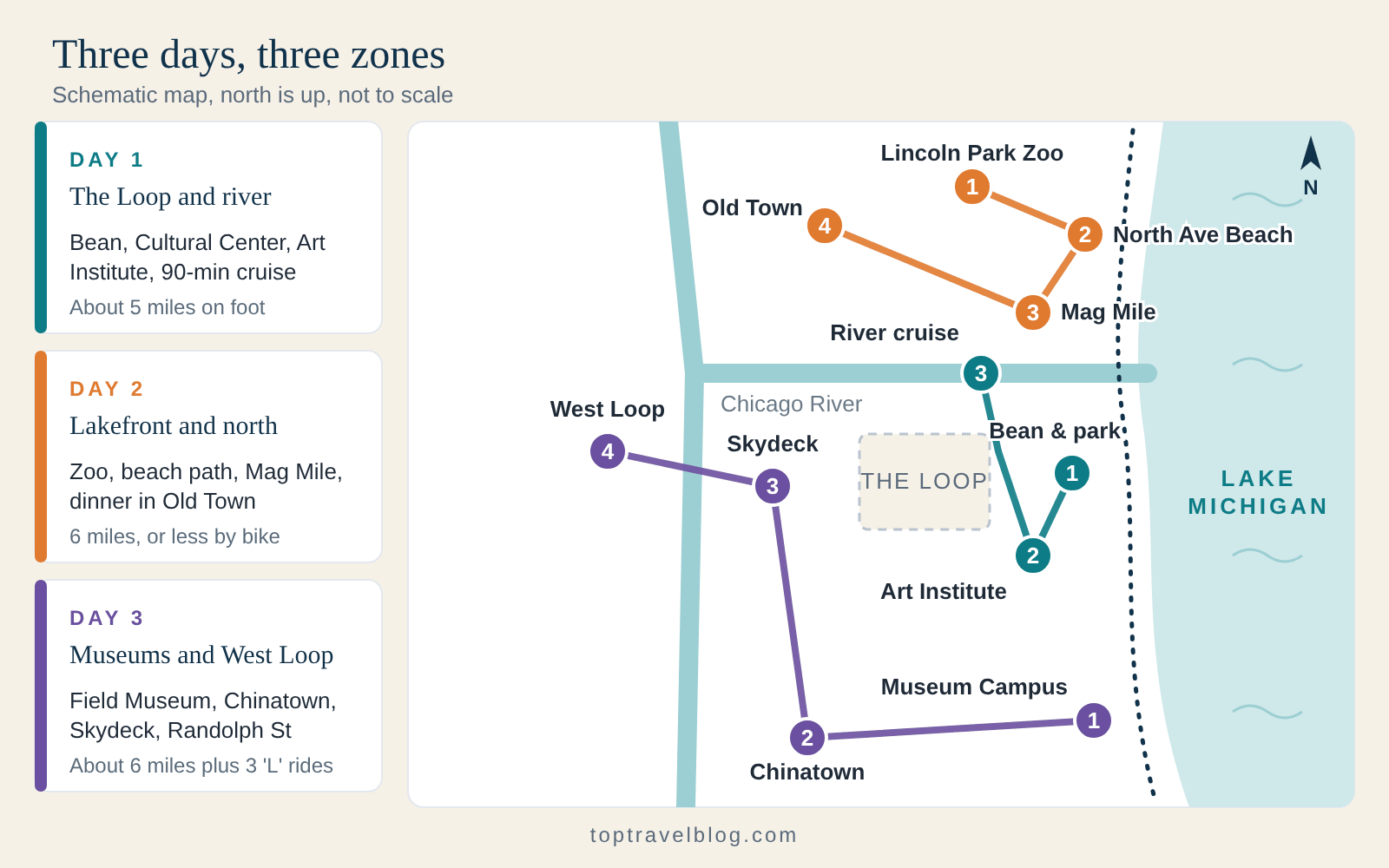
Day 1 is the Loop and the river, Day 2 is the lakefront and the north side, and Day 3 is the Museum Campus and the West Loop. Nothing in it requires a car.
The verdict in one sentence: Chicago is one of the easiest big American cities to plan because the good parts sit in a tight band between the lake and the river, and the ‘L’ trains fill in the gaps. This Chicago itinerary suits first-time visitors, couples, friends, and families with kids old enough to enjoy a boat tour and a long walk. It suits architecture fans especially, since the city invented the skyscraper and has been arguing about the next one ever since.
It is less suited to travelers who want a beach week (the lake is lovely, but it is a city beach) or anyone who plans to drive between sights.
If you are still sorting out flights and dates, my guide on how to plan a trip step by step covers the order I book things in, and this page assumes you have already settled on Chicago.
I have visited in July heat, in a March sleet storm and on a blue-sky October weekend, and the best version of every trip was a little less ambitious than the first draft. What follows is the Chicago itinerary I would hand a friend: the order of days that avoids doubling back, current fares and ticket prices as of late 2026, the two or three reservations that really matter, where to sleep, and the mistakes I see visitors make on the Michigan Avenue Bridge every summer.
Quick facts: this Chicago itinerary at a glance
- Best for: first-time visitors, couples, friends, architecture fans, families with kids 8 and up.
- Ideal trip length: 3 full days, with a Thursday-to-Sunday or Friday-to-Monday stay working best. Add a fourth day for Oak Park or Hyde Park.
- How to get around: the ‘L’ and buses with a Ventra card or contactless phone ($2.50 an ‘L’ ride, $2.25 a bus ride, or a 3-day pass for $15), plus 5 to 7 miles of walking a day. No rental car.
- Booking priorities: the Chicago Architecture Center river cruise (from $57), a timed observation-deck slot at sunset, a Friday or Saturday dinner reservation in the West Loop, and tickets for a Cubs game or a Second City show if you want them.
- Pacing: one anchor area per day, one big paid sight, one free thing that is just as good, and an evening you can drop.
- Key caveats: hotel taxes run roughly 17 to 19 percent; the river cruise season ends in late November; January and February are cold enough to rewrite the plan; Lollapalooza weekend and Marathon weekend push room rates sharply up.

Best time to go: when this Chicago itinerary works best
If I could only pick one window, it would be the first three weeks of September through mid-October. Highs sit in the 70s, the lake is still warm enough to look inviting, the river cruises are running, and the summer festival crowds have gone home. Late May through June is the runner-up, with long evenings and the lakefront finally open for the season.
Chicago’s weather has a reputation, and most of it is deserved: spring can swing from 40 to 80 degrees in a week, and the wind off the lake can make a 50-degree afternoon feel like 38.
Here is how I think about each stretch of the year, because the right Chicago itinerary changes with the thermometer.
January to early March: cheap rooms, serious cold
This is the season for travelers who care more about price than comfort. Downtown rooms drop well below their summer rates, museums are quiet, and you can walk into a good restaurant on a Tuesday. The trade is highs in the teens and 20s on bad days, a wind that finds the gap in every coat, and river cruises that are not running at all.
The Chicago itinerary below still works in winter if you swap the long outdoor stretches for the Cultural Center, the Art Institute, the Pedway and an observation deck on a clear afternoon. Pack real gloves and a hat that covers your ears.
Late March to May: unpredictable, improving
The Chicago Architecture Center river cruises restart in mid-March, but those early sailings are cold, with blankets and hot drinks doing a lot of work. April is the gamble month: sunny and 65 one day, sleet the next. By mid-May the lakefront trail is full of runners and cyclists, the Cubs are home at Wrigley Field.
If your dates fall in this stretch, build each day with an indoor option you can slide in without guilt.
June to August: long days, big events
Summer is when the city is at its most fun and its most expensive. Highs are in the 80s with the occasional heat wave, the beaches are open, free concerts run at Millennium Park’s Pritzker Pavilion, and the river cruises sail several times a day. The downsides are crowds at the Bean by 10 a.m., humid afternoons, and rate spikes around Lollapalooza in early August in Grant Park.
If you come in July or August, flip this Chicago itinerary so the walking happens before 11 a.m. and after 5 p.m., with museums in the middle.
September and October: the sweet spot
After Labor Day the city exhales. Daytime temperatures are comfortable, the light on the glass towers in the late afternoon is the reason architecture photographers love this city, and the cruise season has weeks left to run. The 2027 Chicago Marathon is on October 10, according to the official marathon site at chicagomarathon.com, and that Sunday closes streets across a lot of the north and south sides, so plan Day 2 accordingly if you land on that weekend.
November and December: the holiday run
The cruise season wraps around the Sunday before Thanksgiving, and the city shifts into holiday mode. The Christkindlmarket opens at Daley Plaza on the Friday before Thanksgiving and runs through Christmas Eve, the Magnificent Mile lights festival lights up Michigan Avenue in November, and the Millennium Park skating rink opens. It is festive and cold.
Tip: Whatever month you choose for your Chicago itinerary, look up the sunset time before you book a skyline view. In late June the sun sets after 8:20 p.m.; in late October, around 6 p.m. Observation decks charge more for sunset slots and sell them out first, so your Day 2 evening depends on that one number.
How many days you really need in Chicago
Three full days is the sweet spot, and I will defend that against anyone who says a long weekend is enough or that you need a week. A Chicago itinerary needs at least one full day for the downtown core and the river, which is where the city’s best-known sights are concentrated. It needs a second day for the lakefront and the north side, and a third for the museums and a neighborhood or two.
Two days works if you accept trade-offs. My pick for a two-day Chicago itinerary is Day 1 (Millennium Park, the Cultural Center, the Art Institute and the river cruise) followed by a compressed Day 2 that combines a Skydeck morning with the Magnificent Mile and a deep-dish dinner. You lose the Museum Campus and any neighborhood time.
Four days is the right length if you want to add a day trip or a slower pace. The best fourth-day options are Oak Park for Frank Lloyd Wright’s home and studio, Hyde Park for Wright’s Robie House and the University of Chicago campus, or an extra day for Wrigley Field, the north side neighborhoods and a comedy show. Five days or more lets you add the Indiana Dunes, which sit roughly 75 minutes from downtown by South Shore Line train.
Chicago pairs well with an East Coast leg: the walking-first approach here is the same one I use in my New York City itinerary and my Boston itinerary, and both cities are a short flight from O’Hare.
Count full days only. Chicago O’Hare is about 45 minutes from the Loop by train, and a 4 p.m. arrival gets you dinner, not a day. A Friday-morning arrival and Monday-morning departure gives you the three full days this Chicago itinerary assumes, with Friday and Saturday evenings for dinner reservations.
Where to stay in Chicago for a first visit
Choosing where to stay in Chicago is easier than in most big cities, because the ‘L’ fans out from the Loop and almost every neighborhood worth sleeping in is on a line. The rule I give friends: sleep downtown or just north of the river, within a 10-minute walk of an ‘L’ station, and skip anything that requires a transfer to reach the Loop.
On cost, a clean, well-reviewed downtown hotel room usually runs roughly $200 to $350 a night before tax in the shoulder seasons, and more in summer and around big events. Hotel taxes in Chicago stack up: the combined rate is about 17.4 percent, and since 2026 a 1.5 percent Tourism Improvement District surcharge applies to larger downtown hotels, which pushes their effective rate toward 19 percent. Vacation rentals add a further shared-housing surcharge.
Look at the total with taxes and fees, not the nightly rate on the search page, and compare the hotel’s own site against two booking engines.
The five areas I recommend for a Chicago itinerary, and who each suits
The Loop (State Street to the river, Wacker to Roosevelt)
Best for: architecture fans, first-timers, transit access
This is the historic downtown, ringed by the raised tracks that give it its name. You are steps from Millennium Park, the Art Institute, the Cultural Center and every ‘L’ line. Day 1 of this Chicago itinerary starts at your front door, and it is the best base for a first visit if you can find a decent rate.
Downsides: it is office-heavy, so evenings on weekdays can feel sleepy, and some blocks under the tracks are loud. Stay on the east side near Michigan Avenue for the nicest streets.
River North and the Mag Mile
Best for: dining, nightlife, shopping, convenience
River North is where most of the city’s mid-priced hotels and busy restaurants sit, one ‘L’ stop or a 10-to-15-minute walk from the Loop. The Magnificent Mile is the shopping boulevard that runs north from the river to Oak Street.
It is the most practical base for tourists. Expect crowds and chain restaurants near the bridge, and walk a few blocks west or north for better food.
Streeterville and the Gold Coast
Best for: couples, lake views, a quieter night
East of Michigan Avenue and north of the river, Streeterville sits next to Navy Pier and 360 Chicago, and the Gold Coast just north is residential and handsome, with brownstones and the lakefront a block or two away.
Fewer ‘L’ stations here, so you will rely on buses and a lot of walking. Good for couples and for anyone who wants the lake as their front yard.
West Loop and Fulton Market
Best for: food-focused trips, second-time visitors
Old meatpacking warehouses turned into restaurants, boutique hotels and rooftop bars. The Green and Pink Lines and the Metra stations at Ogilvie and Union are close, and the best dinners in the city are within walking distance.
It is a 15 to 20 minute ‘L’ or bus ride from Millennium Park, and it is quieter than River North on Sunday nights. A strong pick if food is the priority.
Lincoln Park and Lakeview
Best for: families, repeat visitors, a neighborhood feel
Residential and leafy, with the free zoo, the lakefront trail and Wrigley Field a few minutes away. The Brown, Red and Purple Lines run through the area, and the Loop is about 20 minutes by train.
You give up a walk to the big downtown sights, and there are fewer large hotels, so book early. I choose it when traveling with a kid who needs a playground.
Tip: If you only remember one thing from this section: pick a hotel within a 10-minute walk of the Brown, Red, Blue, Orange, Green or Pink Line. Chicago’s ‘L’ is the thread that ties this Chicago itinerary together, and a long walk to the station at the end of a long day is what ruins evenings.
The 3-day Chicago itinerary, day by day
Each day of this Chicago itinerary has one anchor area, so you are never riding the ‘L’ back and forth across the city. Mornings start early because the big sights are better at 9 a.m. than at 11, and evenings are built to be dropped if your feet are done. Walking times are real-world times at a visitor’s pace with photo stops. Transit times include the walk to the platform and a reasonable wait.
Day 1
The Loop, the Art Institute and the river
Morning: Millennium Park and the Cultural Center
Start your Chicago itinerary at Millennium Park by 8:30 a.m. The park is free and open daily from 6 a.m. to 11 p.m., and the official page at chicago.gov lists the entrances on Michigan Avenue and Randolph Street. Go straight to Cloud Gate, the mirrored sculpture everyone calls the Bean. By 10 a.m. in summer there is a line of people waiting for a clean photo; at 8:30 you share it with a few joggers.
Walk underneath it, because the concave arch is the best part and most people never step in.
From there, see Crown Fountain, the pair of glass towers that project faces and spit water, and the Lurie Garden behind the Pritzker Pavilion. The pavilion’s steel ribbons are Frank Gehry’s, and the Great Lawn is where the free summer concerts happen. Give the park 60 to 75 minutes.
Walk two blocks west on Washington Street to the Chicago Cultural Center at 78 E. Washington. It is free, it was built in 1897 as the city’s central library, and it holds a Tiffany glass dome that is one of the great free interiors in the country. Look up in the south stairwell and in Preston Bradley Hall. Plan 30 to 40 minutes.
Late morning and lunch: the Rookery, Pedway or a hot dog
Walk south and west to LaSalle Street, about 12 minutes. Step into the lobby of the Rookery Building at 209 S. LaSalle, an 1888 Burnham and Root design whose light court Frank Lloyd Wright remodeled in 1905. It is usually open to the public on weekdays, and the white-and-gold staircase is a treat. If it is closed, a walk down LaSalle Street still gives you the bank towers of the old Wall Street of the Midwest.
For lunch, I like a Chicago hot dog: all beef, a poppy-seed bun, and a pile of toppings that does not include ketchup. An Italian beef sandwich dipped in juice is the other local lunch; order it ‘dipped’ if you want it soggy on purpose.
Afternoon: the Art Institute of Chicago
Walk back east along Adams Street, about 15 minutes, to the Art Institute at 111 S. Michigan Avenue. The museum opens at 11 a.m. most days and runs until 5 p.m., staying open until 8 p.m. on Thursdays. It is closed on Tuesdays. Adult admission is listed at $32 on the museum’s own site at artic.edu, and children under 14 are free.
Do not try to see it all on a three-day Chicago itinerary. The collection is enormous, and the smartest plan is two hours with a short list: Grant Wood’s American Gothic, Edward Hopper’s Nighthawks, Seurat’s A Sunday on La Grande Jatte, the Chagall America Windows, and the Thorne Miniature Rooms. Then wander the Impressionist galleries until your attention fades.
Tip: The Art Institute has two entrances: the main one at Michigan Avenue and the Modern Wing at 159 E. Monroe. The Modern Wing line is usually shorter, and it puts you straight into the contemporary galleries and the rooftop terrace.
Evening: the architecture river cruise, then dinner
The one thing I would not skip in this Chicago itinerary is the Chicago Architecture Center’s river cruise aboard the First Lady. It lasts about 90 minutes and tickets start at $57, and the dock is on the south side of the river at the Michigan Avenue Bridge, with a black awning at the stairway entrance. Arrive at least 30 minutes before departure, because boarding order matters for the seats you want. Tickets are non-refundable, so pick a date you are sure of.
A volunteer docent narrates the whole route, covering the Wrigley Building, Marina City, the Trump tower, Aqua, the river’s reversed flow and the city’s 1871 fire. The season runs from mid-March to late November. Late afternoon and twilight sailings are the ones to book in advance, because they sell out for weekends and holiday dates. The tour is not recommended for kids under 12, mainly because of the length and the amount of talking.
Afterward, walk the Chicago Riverwalk. This stretch of path along the south bank is about 1.25 miles from Lake Michigan to Lake Street, and the ‘rooms’ near the bridge have bars and snack kiosks with a view straight up the water. For dinner, River North is a ten-minute walk north, and a deep-dish pizza at a place like Lou Malnati’s or Giordano’s will take 45 minutes to bake, so order it by phone before you sit down.
Logistics: Day 1 of the Chicago itinerary covers about 5 miles on foot. Millennium Park to the Cultural Center is 5 minutes, to the Rookery about 12, from there to the Art Institute 15, and from the museum to the river dock about 15. No transit needed unless your feet say otherwise.
If it rains, if you have kids, if it is winter
Rain: swap the Rookery walk for the Pedway, Chicago’s underground walkway network, which links the Cultural Center, the Loop’s buildings and several ‘L’ stations. Spend the extra time in the Art Institute. The cruise runs in a drizzle and is covered on the lower deck, though visibility suffers in heavy fog.
Kids: the Crown Fountain splash pad in summer and the Bean are big hits. Replace the Rookery with a stop at the Maggie Daley Park playground. Winter: skip the cruise, and go up an observation deck at 3 p.m. for the early sunset.
Day 2
Lakefront, Lincoln Park and the Mag Mile
Morning: Lincoln Park Zoo and the lakefront trail
Day 2 of this Chicago itinerary heads north. Take the Brown Line from the Loop (Washington/Wells or Adams/Wabash station) to Armitage, about 20 minutes, and walk 15 minutes east to Lincoln Park Zoo at 2400 N. Cannon Drive. Admission is free every day of the year, the gates are open from 10 a.m. to 5 p.m., and the buildings close at 4:30. The zoo is compact, easy for kids, and the skyline appears over the lagoon from the south pond.
The free zoo is the best bargain in this Chicago itinerary. Parking at the zoo costs $35 to $45 a day, according to the zoo’s own site at lpzoo.org, which is one more reason to take the train. Give the zoo 90 minutes, longer if you are with small children.
From the zoo, walk or bike south along the Lakefront Trail. The paved path runs about 18 miles along the lake, and the stretch from the zoo to North Avenue Beach to Oak Street Beach is the most scenic, with the skyline growing larger as you go. If you want to ride, Divvy bikes cost $1 to unlock plus $0.20 a minute for a classic bike, or a $19.90 day pass that covers unlimited three-hour rides in a 24-hour period, as listed at divvybikes.com.
Late morning and lunch: the Gold Coast and Oak Street
Oak Street Beach sits at the north end of the Magnificent Mile. Walk inland a few blocks to Oak Street itself, a short strip of designer boutiques, and then pick a lunch spot on Rush Street or in Streeterville. If you want a simple, cheap lunch, Portillo’s on Ontario Street in River North serves Chicago dogs, Italian beef and the chocolate cake the chain is known for, in a building with a long line that moves fast.
Afternoon: the Magnificent Mile and the Water Tower
Walk south on Michigan Avenue, the Magnificent Mile. The avenue is a long stretch of flagship stores, but it is also an architecture walk: the 1869 Water Tower at Chicago Avenue is one of the few buildings to survive the 1871 fire, and the Hancock Center rises behind it at 875 N. Michigan. The Wrigley Building and Tribune Tower face each other across the river at the bridge. Allow 90 minutes to walk the Mile from Oak Street to the river, longer if you shop.
If you want a view tonight rather than tomorrow, 360 Chicago on the Hancock’s 94th floor is open daily from 9 a.m. to 11 p.m., with online tickets from $27 for general admission and from $45 if you add TILT, the tilting window ride, according to 360chicago.com. I prefer the Skydeck for first-time visitors, which is why it is on Day 3, but if you are sleeping on the Mag Mile, 360 is the easy choice and you can skip the Skydeck.
Evening: dinner in Old Town and the Second City
Take the Brown Line from Chicago/Franklin to Sedgwick, a short ride, and walk into Old Town, one of the city’s friendliest neighborhoods for an evening. The Second City comedy theater at 1616 N. Wells is the famous name, the training ground for decades of Saturday Night Live cast members. Book the show ahead for Friday and Saturday, since the best seats sell out weeks in advance.
For dinner, this is the right night for a Chicago pizza. Pequod’s, with its caramelized crust edge, Lou Malnati’s buttery crust or Giordano’s stuffed style will each make a different argument. I vote for Pequod’s if you like a burnt-cheese edge and Lou Malnati’s if you want a more balanced slice. Either way, plan on 45 minutes of baking time and a heavy meal.
Logistics: Day 2 of the Chicago itinerary is about 6 miles on foot or less if you bike. The Brown Line to Armitage takes 20 minutes, the lakefront to Oak Street 40 on foot, the Mag Mile walk 90 minutes with stops, and the Brown Line back to Old Town 10.
Swap: a Cubs game at Wrigley Field
In season, from late March to September, swap the afternoon for a Cubs home game at Wrigley Field, 1060 W. Addison, which is a 25-minute Red Line ride from the Loop to Addison. The 1914 ballpark, ivy-covered brick walls and the neighborhood bars across the street make it an experience even for people who do not follow baseball. Day games are easiest to book and the surrounding Wrigleyville bars fill up fast on game days.
If it rains, if you have kids, if it is winter
Rain: replace the lakefront with the Museum of Contemporary Art or the Chicago Architecture Center’s galleries, then add an indoor lunch at the Water Tower Place food court or Eataly in River North. Kids: the zoo is the day of your Chicago itinerary, and the splash fountains and playgrounds in Maggie Daley Park fill the afternoon.
Winter: the zoo is open and unusually quiet, with the penguins and Lion House working well in a cold snap, but the lakefront walk shrinks to a quick look.
Day 3
Museum Campus, Chinatown and the Skydeck
Morning: the Field Museum or the Shedd Aquarium
Day 3 of the Chicago itinerary moves south to the Museum Campus, a lakefront park with three big attractions. Take the Red, Orange or Green Line to Roosevelt and walk 20 minutes east along Roosevelt Road, or take the #146 bus to the campus. The Field Museum at 1400 S. DuSable Lake Shore Drive opens daily at 9 a.m., with last entry at 4 p.m., and is closed Thanksgiving and Christmas.
Pick one museum, not three, or your Chicago itinerary turns into a shuffle between gift shops. The Field Museum is the natural-history choice: SUE the T. rex, the Egyptian tombs, the Hall of Gems and the dioramas. The Shedd Aquarium next door is better for families with young kids, with the Wild Reef and the beluga whales, and its timed-entry tickets are usually cheaper if you buy online. Whichever you choose, arrive at opening, because both fill with school groups by 11.
Illinois residents get free general admission to the Field Museum on certain Wednesdays, so expect crowds if your Day 3 lands on one. Budget three hours for the Field and two to two and a half for the Shedd.
Late morning: the Adler Planetarium skyline view
After the museum, walk five minutes to the Adler Planetarium’s front plaza at 1300 S. DuSable Lake Shore Drive. This is the postcard view of the Chicago skyline, a wide-angle shot of downtown across the water with the lake in the foreground. It is free, it takes ten minutes, and it is the best skyline photo in the city for nothing. You do not need to go inside the planetarium unless a sky show catches your eye.
Lunch: Chinatown, one stop away
Take the 146 bus or a short rideshare to the Red Line and ride one or two stops to Cermak-Chinatown. Chinatown Square, a few blocks west on Archer Avenue, has dim sum, hand-pulled noodles and bakery stops, and it is a rare chance to eat well for $15 a person. The zodiac statues in the square and the red gate on Wentworth are worth a photo.
If you want something local and quick, Wentworth Avenue’s bakeries are a good place to grab a snack.
Afternoon: the Skydeck at Willis Tower
Ride the Red Line north to Jackson and walk west to Willis Tower at 233 S. Wacker Drive, about 8 minutes. Aim to arrive by 3:30 p.m. for golden-hour light. General admission to the Skydeck, on the 103rd floor, starts at $32 for adults and $24 for kids ages 3 to 11, and the expedited line is from $55, according to theskydeck.com. The Ledge, the glass boxes that extend about four feet from the building, is the reason most people go.
My honest view for this Chicago itinerary: pay for the cheaper ticket and go on a clear day. On a hazy or foggy day, the deck is a $32 view of a cloud. The tower is a short walk from the river and from the Loop, and the deck is usually quieter in the last two hours before closing. Allow about 90 minutes including the elevator line.
Evening: dinner in the West Loop, then jazz or blues if you have the energy
On the last night of the Chicago itinerary, the West Loop and its Randolph Street restaurant row are about a mile from the Skydeck, a 20-minute walk or a short ride on the Green or Pink Lines to Morgan. This is where the city’s famous restaurants cluster: Au Cheval for the burger that people line up for, Girl & the Goat for shared plates, and the Publican for pork and oysters. Reserve Friday and Saturday weeks ahead, or go early or late on weeknights.
If you have energy left, Chicago’s jazz and blues clubs are the ideal last night. The Green Mill in Uptown, a former Prohibition-era haunt, has jazz most nights. Kingston Mines in Lincoln Park runs blues until the early hours. Both are an evening you can drop if Day 3 has worn you out, and both are a cab or a Red Line ride from the Loop.
Logistics: Day 3 of the Chicago itinerary is about 6 miles on foot. Roosevelt station to the Field Museum 20 minutes on foot, the Adler 5 more, a transit hop to Chinatown 20 minutes, the Red Line to Jackson 15, and the Willis Tower 8 on foot.
If it rains, if you have kids, if it is winter
Rain: the Field Museum and the Shedd are indoors and easily fill a full day, so skip the Adler skyline stop and shift the Skydeck to the next clear day. Kids: the Shedd is the better pick, and the Skydeck Ledge is a hit for ages 8 and up. Winter: the Skydeck keeps winter hours, and the sunset is early enough that you can see the city light up by 5 p.m.
A fourth day: Oak Park, Hyde Park or an extra neighborhood
If you can stretch this Chicago itinerary to four days, I would use the extra day for Frank Lloyd Wright. Take the Green Line to Oak Park, about 25 minutes, and tour his home and studio, then walk the neighborhood’s Prairie School houses. Hyde Park, on the Metra Electric or the #6 express bus, has Wright’s Robie House and the University of Chicago campus. Both tours need advance booking in season.
Getting around: the ‘L’, buses, bikes and airport transfers
Chicago’s transit system is run by the Chicago Transit Authority, and for a visitor it comes down to one card or one phone. You pay with a Ventra card, the Ventra app, or a contactless credit card or phone tapped at the reader. The CTA’s fare page at transitchicago.com lists an ‘L’ train ride at $2.50 and a bus ride at $2.25 when paid with Ventra or contactless, with up to two transfers free within two hours.
Visitor passes are on the same page: $5 for one day, $15 for three days and $20 for seven days, all valid on CTA and Pace. For this three-day Chicago itinerary, the 3-day pass at $15 is the obvious choice if you plan five or more rides, and with the Brown Line trips on Day 2 and the Red Line trips on Day 3, you will clear that bar. If you ride fewer times, tap a contactless card and pay as you go.
Airport transfers
O’Hare is on the Blue Line, which runs around the clock. The ride to the Loop takes roughly 45 minutes, and the fare out of the O’Hare station is $5 if you pay by the ride, though a visitor pass lets you board there at no extra charge. Midway is on the Orange Line, about 25 to 30 minutes from the Loop, and it costs the regular $2.50. I take the train at both airports.
Buses, bikes and water taxis
Coming from the West Coast? The ‘L’ is easier to learn than the transit in either my San Francisco itinerary or my Los Angeles itinerary, and cars are optional here in a way they are not in Southern California.
Buses fill in where the ‘L’ does not go, such as the lakefront and the Museum Campus. Divvy bikes cost $1 to unlock and $0.20 a minute for classic bikes, or $19.90 for the day pass that includes unlimited three-hour rides, according to the pricing page at divvybikes.com. E-bikes cost more per minute. Water taxis run in the summer months between the river, Navy Pier and Chinatown, which is a fun way to cross the city on a warm afternoon.
Watch out: Pickpocketing and phone snatching happen around crowded ‘L’ stations, the Mag Mile and Millennium Park, as in any large city. Keep your phone in a front pocket on the train and do not hold it near an open door. Late at night, use the cars with the most people, and stay aware of your surroundings.
Reading the skyline: an architecture primer for this Chicago itinerary
You do not need an architecture degree to enjoy Chicago, but a little vocabulary makes every walk better. Any Chicago itinerary should make time for the skyline. The city burned in October 1871, and the rebuilding turned it into an experiment: new steel frames, elevators and fireproof cladding made taller buildings possible. The Home Insurance Building of 1885 is usually credited as the first skyscraper, though it was demolished long ago. What survives is a century of skylines, stacked by era.
Five buildings, five eras
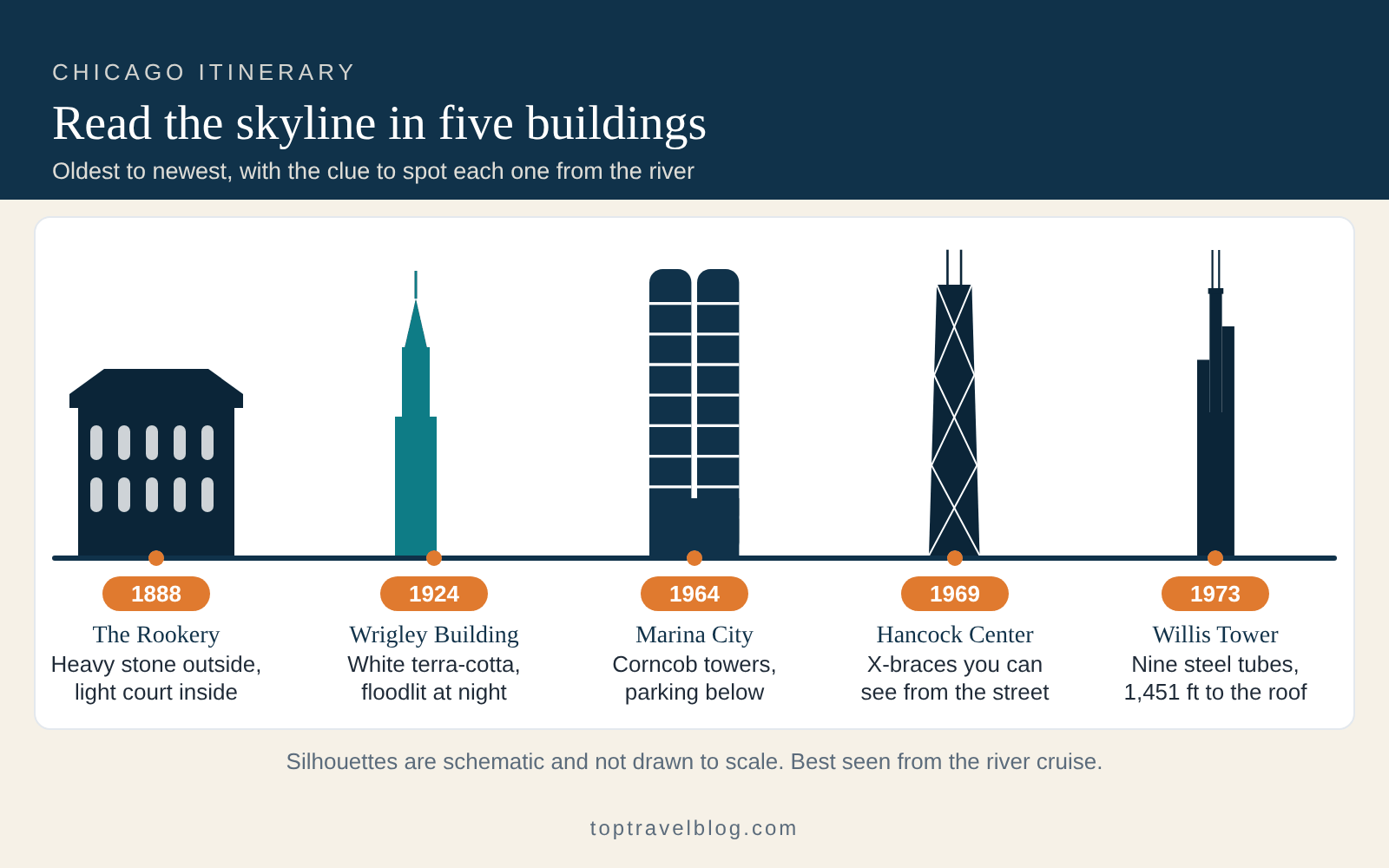
The Rookery of 1888 is the early Chicago school: heavy masonry outside, a light-filled atrium inside, and a staircase that made Wright’s later remodel famous. The Wrigley Building of 1924 is white terra-cotta in a French Renaissance style, designed to be floodlit, and it still glows at night from the river. Marina City of 1964, the pair of corncob towers, put parking in the lower floors and apartments above, with curved balconies that look like petals.
The Hancock Center of 1969 has an exterior X-bracing that serves as both structure and style, so the building tapers without losing strength. The Willis Tower, finished in 1973 and still called the Sears Tower by many locals, stacks nine square tubes of steel and rises 1,451 feet to its roof. Reading the skyline is mostly a matter of noticing what holds each building up.
How to see it without paying extra
The free routes are strong: walk the Riverwalk, look up in the lobbies of the Rookery and the Chicago Cultural Center, ride the Brown Line around the Loop, and stand at the Adler Planetarium for the long view. The Chicago Architecture Center at 111 E. Wacker Drive is open Sunday to Thursday 10 a.m. to 5 p.m. and Friday and Saturday 10 a.m. to 7 p.m., and its site at architecture.org lists dozens of guided walking tours, if you want more depth than the cruise.
What this Chicago itinerary costs per day
Hotels are the biggest line in any Chicago itinerary, so I split costs into three tiers and leave the room rate as a range, since it moves with the season. Everything below is per person, assuming two people share a room.
Budget traveler
Best for: hostels, free attractions, cheap eats
A bed in a hostel or a small budget room, a 3-day CTA pass ($15 total), free Millennium Park, the Cultural Center, the zoo and the Riverwalk, hot dogs and beef sandwiches for lunch and one cheap sit-down dinner. Expect roughly $120 to $180 a day excluding the room, and the Art Institute and a cruise ticket take you toward the top of that range on the days you buy them.
Mid-range traveler
Best for: the plan as written
A comfortable downtown hotel, the Art Institute at $32, the river cruise from $57, the Skydeck at $32, a Field Museum ticket, deep dish for two, and one nicer dinner. Expect roughly $220 to $340 a day per person excluding the room, and the cruise and the two ticketed sights are what push it up.
Comfortable traveler
Best for: good seats, good tables
Expedited Skydeck entry from $55, a Second City show with good seats, a West Loop tasting dinner, a hotel on the river or Mag Mile, and rideshares between neighborhoods. Roughly $400 or more a day per person excluding the room, and the dinners are what move the number most.
Add the room: roughly $200 to $350 a night before tax in the shoulder seasons for a well-reviewed downtown hotel, more in July, August and around the Marathon. Taxes add roughly 17 to 19 percent. Parking at a downtown hotel often costs $60 or more a night, which is one more reason this Chicago itinerary is built around the ‘L’. Many large hotels also add a daily resort or destination fee, so look at the final total.
My two money-saving moves: buy the 3-day CTA pass on day one, and make a free attraction the centerpiece of at least one half-day. The Cultural Center, the lakefront, the zoo and Millennium Park cost nothing and rival the paid options.
Tickets and reservations to book ahead
Most of this Chicago itinerary needs no advance booking, which is the nice thing about it. The list that matters for a Chicago itinerary is short, and I have ordered it by how often a visitor shows up and finds the thing sold out.
1. The river cruise
Weekend and twilight sailings of the First Lady sell out, and tickets are non-refundable, so book once your dates are firm. Tickets are sold through the Chicago Architecture Center and Ticketmaster, and the dock fills with people who did not book at 5 p.m. on Saturdays in July. Weekday mornings are the easy ones.
2. Dinner on Friday and Saturday
The West Loop and River North restaurants that earn the headlines book out two to four weeks ahead for weekend tables. Weeknight tables are easier, which is why the Chicago itinerary puts the big dinner on Day 3. For the famous no-reservation spots, go at 4:30 p.m. or after 9 p.m. and expect a wait otherwise.
3. Observation deck, timed
Both decks sell timed tickets, and buying online is cheaper than at the door, with 360 Chicago listing online prices up to $11 below the gate price. The sunset slots go first. If you are visiting in summer, book the deck the same week you book the cruise.
4. Second City, Wrigley Field, and the Wright tours
The Second City sells out on weekends, Cubs home games sell out on summer weekends and against rivals, and the Frank Lloyd Wright tours in Oak Park and Hyde Park fill in season. If any of these are on your list, book them when you book your hotel.
What you do not need to book
The Art Institute does not require timed tickets, though it encourages advance purchase, and you can buy at the door. Millennium Park, the Cultural Center, the Riverwalk, Lincoln Park Zoo and the lakefront are free and open. The Field Museum and the Shedd are best booked online but rarely sell out on weekdays outside school-break weeks.
Food worth planning your Chicago itinerary around
Chicago is a serious food city, and a good Chicago itinerary treats meals as stops, and the good news is that its signature dishes are cheap. The not-so-good news is that they are heavy, so spread them out. Here is how I would work them into the three days of a Chicago itinerary.
Deep dish, tavern-cut and everything in between
Deep-dish pizza is a thick, buttery crust with the cheese on the bottom and the sauce on top, and it takes about 45 minutes to bake. Do it once, share a pie, and order ahead. Locals more often eat the other Chicago style, thin-crust tavern-cut pizza, cut in squares, which you will find at neighborhood bars across the city. If you want to try both, deep dish on Day 2 and tavern-style on Day 3 works well.
Italian beef and the Chicago dog
These are the two cheap local classics. The beef is thinly sliced and soaked in jus on a long roll, topped with sweet peppers or hot giardiniera. The Chicago dog is all-beef in a poppy-seed bun with yellow mustard, onions, bright green relish, a tomato wedge, a pickle spear, sport peppers and celery salt. No ketchup. Many places will make it with a smile if you ask, but locals will notice.
The West Loop and Chinatown
Chinatown is the best inexpensive meal on this Chicago itinerary, with dim sum and noodles in the $12 to $20 range. The West Loop is where you spend on a destination dinner. If you have to choose one splurge in this Chicago itinerary, make it a West Loop meal booked weeks in advance, and eat everything else cheap.
Common mistakes on a first Chicago itinerary
These are the ones I see every season, in rough order of how much they cost in time, money or mood.
1. Booking the cruise for the wrong time of day
On a Chicago itinerary, midday sailings in August are hot and glary, and a gray-day sailing flattens the buildings. Aim for late afternoon in spring and fall, and twilight in summer, when the glass towers turn gold and then blue.
2. Skipping the lakefront
Many visitors planning a Chicago itinerary treat the lake as a backdrop and never walk it. The Lakefront Trail and the Museum Campus are what make Chicago feel different from other American cities, so leave at least one half-day for it.
3. Doing three museums in one day
The Art Institute, the Field Museum and the Shedd are each a half-day to a full day. Pick two across three days and your feet will thank you. The Chicago itinerary above puts them on separate days for a reason.
4. Driving downtown
Americans who drive everywhere at home (a Las Vegas or Orlando habit, as in my Las Vegas itinerary or Orlando vacation guide) often assume a car is easier. Garage parking downtown often costs $50 to $70 a day and traffic around the Loop is slow. The ‘L’ reaches every sight in this Chicago itinerary, and a rideshare for the last mile is cheaper than a night of garage fees.
5. Underdressing for the wind
The nickname is for the politicians, not the weather, but the wind off the lake is real. In April, October and winter, a windproof layer matters more than a thick sweater, especially on the river cruise and on observation decks.
6. Visiting on Marathon or festival weekends without knowing
The Chicago Marathon on October 10, 2027, the early-August Lollapalooza weekend and the summer air shows all raise rates and close streets. If you are not there for them, pick the adjacent weekend.
Frequently asked questions about this Chicago itinerary
Is 3 days enough for Chicago?
Yes, and it is the length this Chicago itinerary is built around. Three full days cover the Loop and the river, the lakefront and north side, and the Museum Campus and West Loop, with some slack in each. Two days works if you accept cuts, and four lets you add Oak Park or Hyde Park.
What is the best time of year to visit Chicago?
Early September to mid-October is my pick: comfortable temperatures, the river cruises still running and fewer summer crowds. Late May and June are close behind. January and February are cheapest but cold, and August can be hot and humid, with big events pushing rates up.
Where should first-time visitors stay in Chicago?
The Loop, River North and Streeterville put you near the main sights and most ‘L’ lines. The West Loop suits food lovers, and Lincoln Park suits families. Whatever you pick, stay within a 10-minute walk of an ‘L’ station and skip a hotel that needs a transfer to reach downtown.
Do I need a car in Chicago?
No. The ‘L’ and buses reach every sight in this Chicago itinerary, and downtown parking costs $50 to $70 a day. A car is only useful if you want to visit far suburbs or the Indiana Dunes, and the South Shore Line train covers even that.
How do I get from O’Hare to downtown?
Take the Blue Line from the airport’s station. It runs around the clock and takes about 45 minutes to the Loop, and the fare from O’Hare is $5 unless you have a visitor pass. Rideshares are quicker at off-peak hours but cost much more.
Is the Chicago architecture river cruise worth it?
Yes, it is the one paid activity I would not cut. The ninety-minute narrated tour explains the skyline better than any guidebook, and it starts at $57. Book late afternoon or twilight for the best light, and buy ahead for weekends since sailings sell out.
Skydeck or 360 Chicago: which should I pick?
Pick one. The Skydeck at Willis Tower has the Ledge and a downtown-and-lake view, while 360 Chicago sits on the Mag Mile with TILT. I prefer the Skydeck for first-time visitors, but if your hotel is on Michigan Avenue, 360 is more convenient and costs less.
Is Chicago good for families with kids?
Yes, a Chicago itinerary suits families. Lincoln Park Zoo is free, the Shedd and the Field Museum are strong, and the Bean, Crown Fountain and Maggie Daley Park play areas keep young ones busy. The river cruise is best for kids 12 and up, and the Skydeck Ledge works well from about age 8.
Can I do this Chicago itinerary in winter?
Yes, this Chicago itinerary works in winter with changes. Swap the lakefront and the cruise for the Cultural Center, the Art Institute, the Pedway and a late-afternoon deck view. The Christkindlmarket runs from the Friday before Thanksgiving through Christmas Eve at Daley Plaza, and rooms are cheaper outside December.
One last thing before you go
The thing I would do differently next time is leave one afternoon empty. Not an optional museum, not free time for shopping, just nothing, with the intention to walk out and turn whichever way the light looks better. Some of my best Chicago hours were unplanned: a free concert at the Pritzker Pavilion I stumbled into, a wrong turn near the river that ended at a good taco counter, a long walk home along the lake as the skyline turned pink.
A Chicago itinerary is scaffolding. The city fills it in.
The other thing I would say is to be kind to yourself about pace. Three days of this Chicago itinerary is roughly 17 miles on foot, two early mornings and three late nights, and it is normal to flag on the afternoon of Day 2. The fix is a hotel nap, not a fourth museum. Come back in another season and you will see a different city: the lake in October, the river in June, and the snow on the skyline in January.
Related planning guides
- New York City itinerary: the best 4 days for first-time visitors — the other great American walking city, with the same day-by-day approach.
- Boston itinerary: 3 days of history, neighborhoods and waterfront walks — a three-day city plan an easy flight east, built around walking.
- San Francisco itinerary: 4 days without wasting time in transit — a hilly counterpart with its own transit puzzles.
- Los Angeles itinerary: 4 days of beaches, neighborhoods and iconic sights — the car-dependent opposite of this trip.
- Miami itinerary: 3 days in South Beach, Little Havana and beyond — a warm-weather three-day plan for winter escapes.
- How to plan a trip step by step: from idea to booked itinerary — the planning process behind every guide on this site.