
Three days is the right amount of time for a first visit, and it is the length this Barcelona itinerary is built around.
That gets you one day in the Gothic Quarter and El Born with a long, late tapas dinner, one day for Gaudí’s big buildings (the Sagrada Família, Passeig de Gràcia and Park Güell), and one day split between the hill of Montjuïc and the sand at Barceloneta. Two days works if you drop Montjuïc. Four is better if you want a slow morning anywhere.
The verdict in one sentence: Barcelona is a walkable, compact city where about six attractions need a timed ticket, and the people who enjoy it most book those six first and then leave the rest of each day loose enough to wander. This plan suits first-timers, couples, friends and families with kids old enough to walk 6 to 8 miles a day. It is a poor fit if you want a car (you do not) or a quiet, empty old town in July (it does not exist).
I have been to Barcelona in January, May and August, once with my parents and once with a stroller, and the mistakes I describe below are all ones I have made or watched happen at the Sagrada Família gate. What follows is the Barcelona itinerary I would hand a friend: the order of days that keeps you out of the metro, current ticket prices, where to sleep, how to eat dinner at the hour locals do, and what to skip.
Quick facts: this Barcelona itinerary at a glance
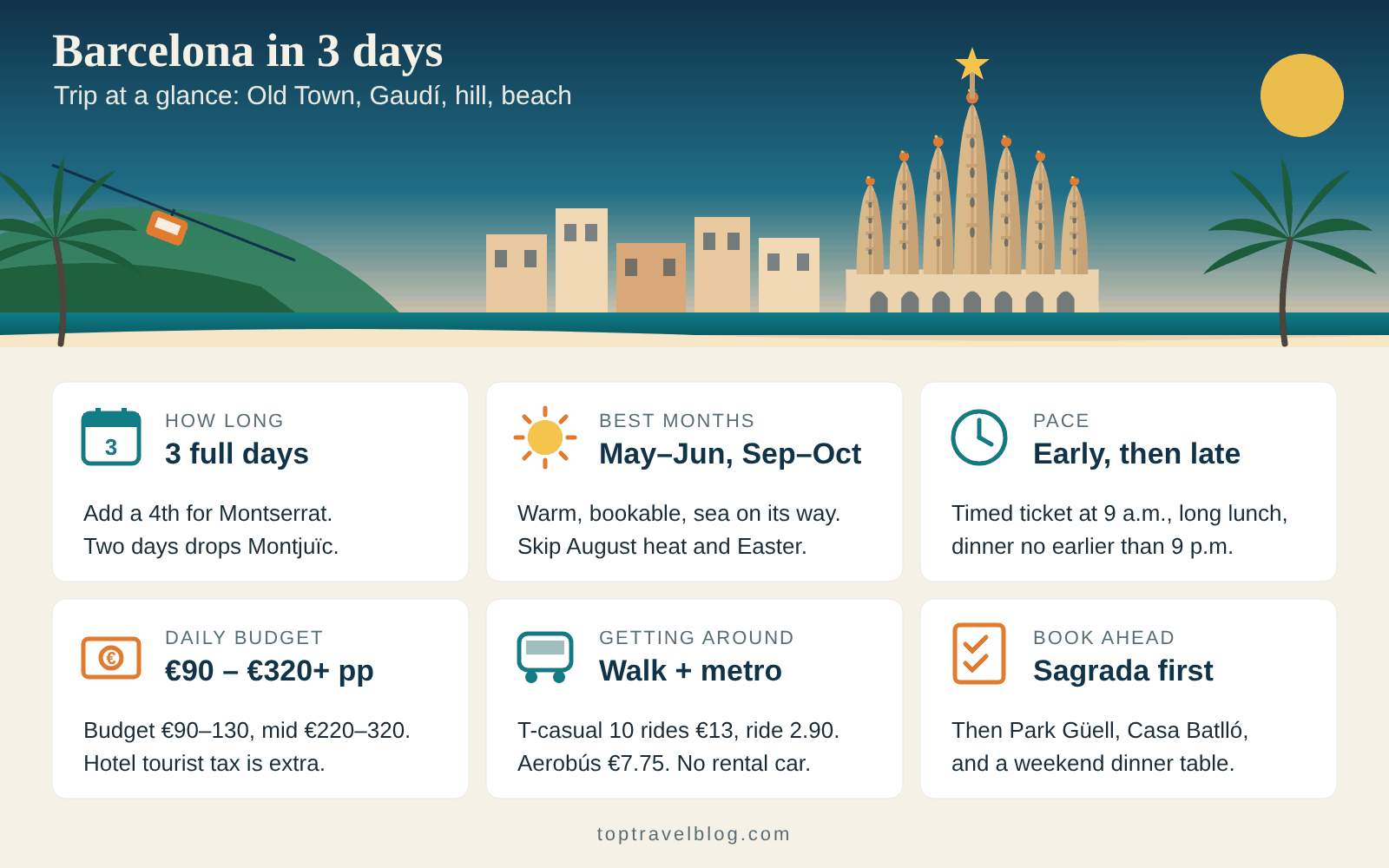
- Best for: first-time visitors, couples, friends, families with kids 8 and up, anyone who likes to walk and eat late.
- Ideal trip length: 3 full days, plus an arrival evening and a departure morning.
- How to get around: mostly on foot, plus the metro (a single ride is 2.90 euros, a 10-ride T-casual card is 13 euros). No rental car.
- Booking priorities: Sagrada Família (26 euros, sells out days ahead), Park Güell (18 euros, timed), one of Casa Batlló or La Pedrera, and a dinner table on Friday or Saturday.
- Pacing: one anchor zone per day, one timed ticket before lunch, one after, and an evening you can cut if your feet are done.
- Key caveats: Barcelona now charges a tourist tax of up to roughly 12 euros per person per night at the top end of lodging; pickpockets work La Rambla, the L3 metro line and the beach; dinner starts at 9 p.m., so plan for it.
This guide covers the plan itself, but a good trip depends on decisions around it. For the booking mechanics I lean on our guide to how to plan a trip step by step, and for the flight I would read the cheap flights strategy before you commit to dates.
Best time to go: when this Barcelona itinerary works best
If I had to pick a single window, it would be late April through early June, and my second choice would be mid-September through October. Daytime highs sit in the low to mid 70s Fahrenheit (about 20 to 25 degrees Celsius), the sea is cold but the beach is lovely, and you can eat dinner outside without sweating through your shirt.
July and August are the opposite: highs of 85 to 90 degrees, humid nights, and cruise ships and school holidays packing every ticket slot. Here is how I think about each stretch of the year.
December to February: quiet, cool, cheaper
A winter Barcelona itinerary is mild by American standards: highs in the high 50s, plenty of sun, and rooms at their cheapest outside Christmas week. The Sagrada Família closes at 6 p.m. from November through February, so the light is short. Nobody swims, but I would still take January over August for the Old Town alone.
March to May: the sweet spot
March is changeable, April is warm in the afternoon and chilly at night, and May is the month I would pick. Park Güell is green and the terraces are open. Easter week pushes hotel prices up, and the Sant Jordi book-and-rose festival on April 23 fills La Rambla with stalls.
June to August: beach weather, big crowds
June is the best month for the sea, with long evenings and the Sant Joan bonfire night on June 23. July and August are hot enough that midday is a poor time to climb anything. Flip the day plans in summer: sightsee until 11 a.m., take a long lunch, and go out again after 5.
Many locals leave town in the second half of August, so a handful of small restaurants close for a few weeks.
September to November: warm sea, thinner crowds
September is my favorite month for the beach: the water has had all summer to warm up and the school-holiday families have gone home. La Mercè, the city’s biggest street festival, lands in the last week of September with human towers and free concerts.
October is still comfortable. November brings heavy, short bursts of rain, which is when the museum swaps in each day below earn their place.
Tip: Whatever month you pick for your Barcelona itinerary, look up the sunset time before you book the Park Güell slot or the Bunkers del Carmel evening. In mid-December the sun sets around 5:30 p.m., and in late June it goes down after 9:15. That one number decides whether your last light on day two happens at the Sagrada Família or on a hilltop.
Days of the week matter too
Spain is not a seven-day shopping country. The Boqueria and many small shops close on Sundays, the Sagrada Família opens late on Sundays (10:30 a.m.), and Monday is the day many museums close.
The MNAC art museum is free on Saturday from 3 p.m., and about fifteen municipal museums are free on the first Sunday of each month. I build this Barcelona itinerary around a Thursday-to-Sunday or Friday-to-Monday stay.
How many days you really need in Barcelona
Three is the number where the trip stops feeling like a checklist. Here is what changes at each length.
2 days in Barcelona: pick Gaudí or the Old Town
With two days, my pick from this Barcelona itinerary is the Gaudí day (day two below) plus a half-day in the Gothic Quarter and El Born. You skip Montjuïc and the beach, and you see only the outside of Casa Batlló.
3 days in Barcelona: the plan in this guide
Three days gives every big sight its own half-day, leaves room for a two-hour wander, and absorbs one rainy morning. If you land on a red-eye from the East Coast, the arrival afternoon is a write-off, so count your first full day as day one.
4 or 5 days: now you can leave the city
With a fourth day I would take the train to Montserrat, about an hour west. A fifth day adds Sitges, the beach town 40 minutes south, or Girona, with its medieval walls and colorful riverfront houses.
Pairing Barcelona with another city
Plenty of readers combine this Barcelona itinerary with other stops. The easy pair for a Barcelona itinerary is Madrid and Seville, covered in our 10 days in Spain itinerary, which uses a fast train to get you between cities. Coming from the other direction, a week in Portugal pairs naturally with a final stop here on a cheap flight from Lisbon.
If you are building a bigger Mediterranean loop, Italy is a short flight away: our Rome itinerary works as the second city, and the longer 10 days in Italy itinerary is the sensible follow-on.
Worth knowing: Count your days honestly. A 4 p.m. arrival at El Prat and a 7 a.m. departure three days later is two full days, not three. Arrival day is for a walk down to the waterfront and a late dinner, nothing more ambitious. Build the Barcelona itinerary below around full days only.
Where to stay in Barcelona for a first visit
Where you sleep decides more about your trip than any ticket you buy. The wrong neighborhood costs you 30 minutes each way on the metro and turns every “let’s go back to the room for an hour” into a non-starter. The right one puts you within a 15-minute walk or a single metro ride of most of this Barcelona itinerary.
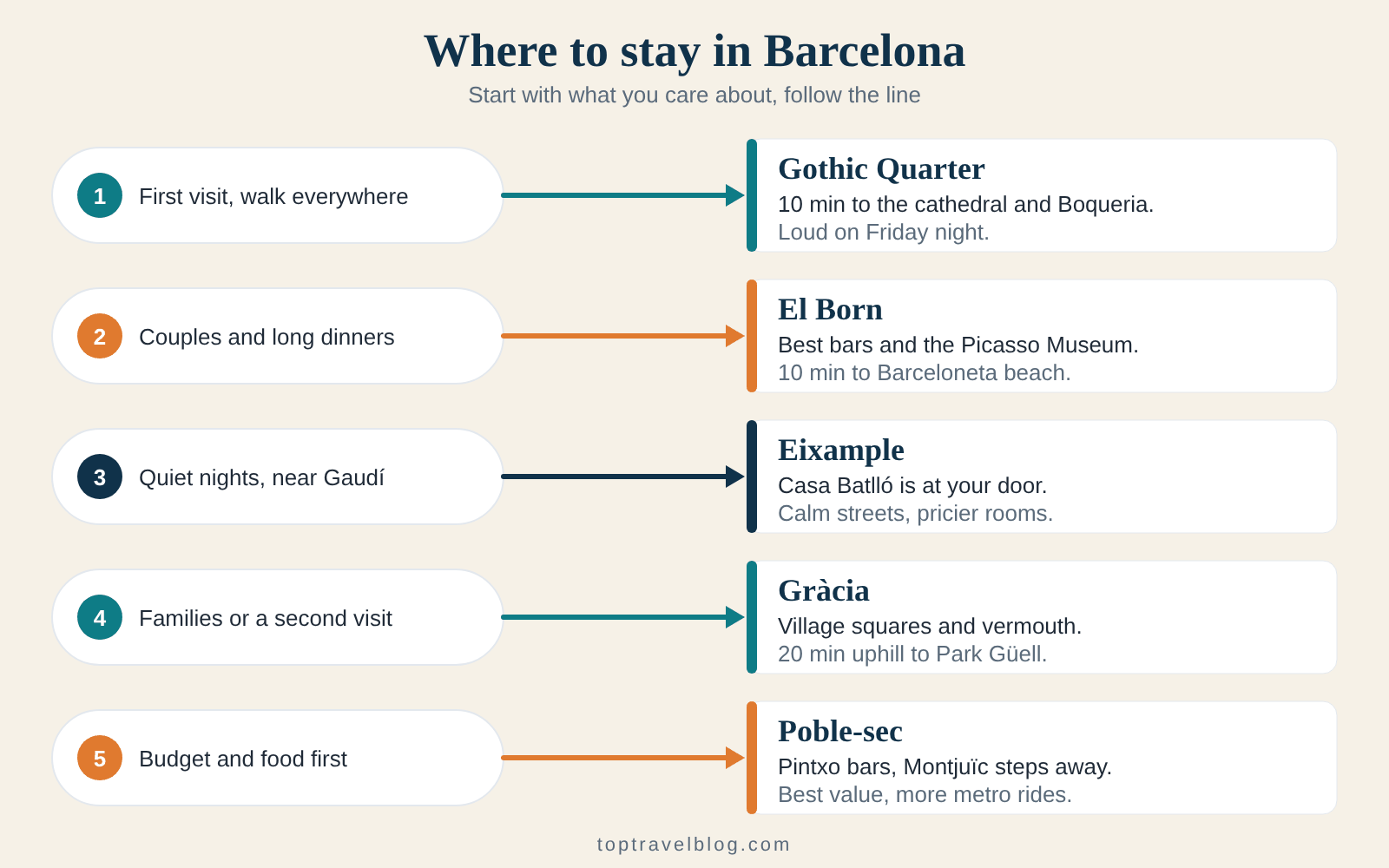
My general rule for a first visit: sleep inside the old ring of the city, between the Gothic Quarter, El Born and the lower Eixample, within five minutes of a metro station, and accept that the room will be small and the street may be loud on Friday night.
On price, a clean, well-reviewed mid-range hotel double in the center runs roughly 130 to 220 euros a night in the shoulder seasons and 200 to 350 in July and August. A good hostel bed is about 30 to 60 euros. These are ranges, not quotes, because rates move every week.
Add the tourist tax to the bill. Barcelona now charges a regional tax plus a city surcharge per person per night, which comes to about 12 euros at the five-star end and less in lower categories, and it is collected at the hotel. Look at the total price with taxes and any city fees on the booking screen. Our guide to how to choose a hotel walks through the other fees and cancellation terms I weigh.
The five areas I recommend for a Barcelona itinerary
Gothic Quarter (Barri Gòtic)
Best for: first-timers, short stays, walking everywhere
This is where I put most people on their first Barcelona itinerary, in particular the blocks between Plaça Sant Jaume and Carrer de Ferran. You are 10 minutes from the cathedral, the Boqueria and the waterfront, and Jaume I, Liceu and Catalunya metro stations are all close.
The trade-off is noise, narrow lanes with delivery scooters, and the pickpocket pressure around Plaça Reial after dark. Pick a room on an upper floor facing an inner courtyard.
El Born
Best for: couples, restaurants, a quieter old-town feel
Across Via Laietana from the Gothic Quarter, El Born has the best mix of small bars, galleries and the Picasso Museum, with Santa Maria del Mar as the anchor. It is a 10-minute walk to Barceloneta beach.
Hotels here are small and often boutique, and it is noisy on Friday and Saturday nights. Choose a street off the main drag such as Carrer del Rec’s quieter side or the blocks near Santa Caterina.
Eixample (Dreta, near Passeig de Gràcia)
Best for: day-two efficiency, shopping, calmer nights
The grid of wide streets north of Plaça Catalunya puts Casa Batlló, La Pedrera and a direct metro line to the Sagrada Família within walking range. Rooms are bigger and cleaner than in the Gothic Quarter, and nights are quiet.
The cost is price (this is the pricey end) and a quieter street life, so you will walk 15 minutes to reach the Old Town restaurants.
Gràcia
Best for: second-time visitors, locals’ neighborhood feel, families
A former village with small plazas, independent shops and lots of outdoor tables. Park Güell is a 20-minute walk uphill and the Gràcia metro station connects to the center in 5 to 10 minutes.
There are few big hotels, so apartments and small guesthouses dominate. It is a lovely base if your trip leans toward evenings over sightseeing efficiency, but the Gothic Quarter is a longer walk.
Poble-sec and Sant Antoni
Best for: budget, food lovers, Montjuïc on day three
Below Montjuïc, Poble-sec has the Carrer de Blai pintxos strip and some of the best-value bars in town; Sant Antoni sits next to it with a restored market. Both are a 15- to 20-minute walk from the Gothic Quarter.
They are less polished and you will take the metro more often, but a room here can be 20 to 40 percent cheaper than in the old center.
Areas I would skip on a first visit
The top of La Rambla near Plaça de Catalunya looks convenient and is full of overpriced hotels beside the most pickpocket-heavy street in the city. Anywhere advertised as “20 minutes from the center” by metro assumes a perfect connection at 2 p.m., not a Saturday night with a late last train.
Hotel versus apartment rental
Barcelona has tightened its rules on short-term tourist apartments, and the city plans to phase out licenses for the vast majority of tourist flats by 2028. For a three-day Barcelona itinerary, I would book a hotel or a licensed aparthotel. If an entire-apartment listing for three nights looks suspiciously cheap, ask for the tourist license number (it should start with HUTB) before paying anything.
What to look at before you click “book”
Three things. First, the nearest metro station and which lines it serves: L3 (green) runs from Liceu through Passeig de Gràcia and on to Sants, L4 (yellow) connects the Old Town with Barceloneta and the Eixample, and L5 (blue) is the direct line to the Sagrada Família. Second, the total price with the tourist tax and any resort or cleaning fee.
Third, the floor and the street. A fifth-floor courtyard room in the Gothic Quarter is a different hotel from a first-floor room above a bar. Read recent reviews for “noise,” “air conditioning” and “lift.”
The 3-day Barcelona itinerary, day by day
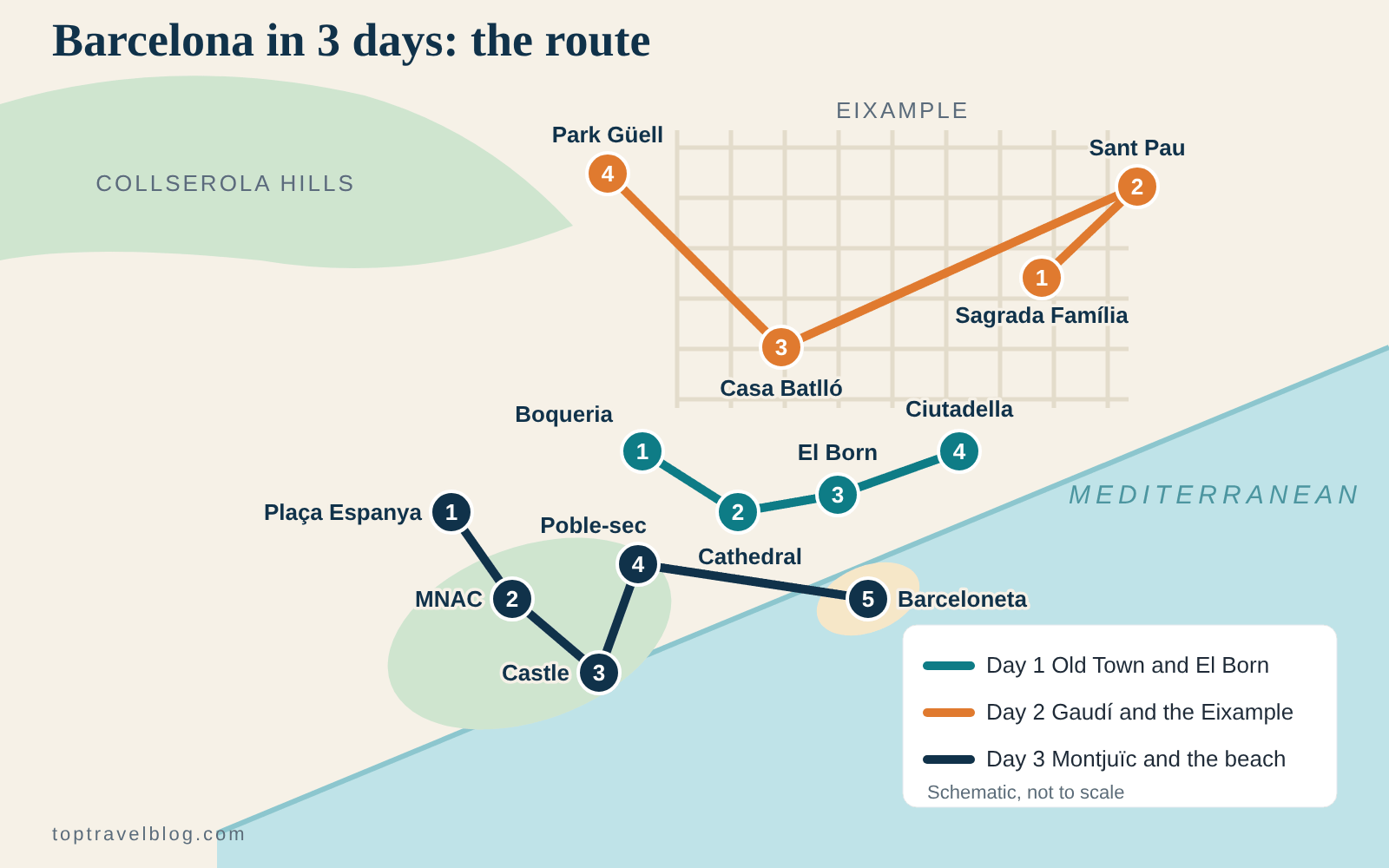
Each day of this Barcelona itinerary has one anchor zone so you are never riding the metro back and forth across town. Mornings start early because the big sights are measurably better at 9 a.m. than at 11, and evenings are built to be dropped if your feet are done. Walking times are real-world times at a visitor’s pace with photo stops, not Google’s.
Day 1
The Old Town: Boqueria, Gothic Quarter and El Born
Morning: La Rambla, the Boqueria and the cathedral
Start your Barcelona itinerary at Plaça de Catalunya at 8:30 a.m. and walk down La Rambla, the tree-lined pedestrian boulevard that runs to the sea. Treat it as a corridor, not a destination: the souvenir stands, the human statues and the overpriced pavement cafés are the least interesting part of Barcelona, and the crowd is a pickpocket’s favorite. Fifteen minutes of walking is plenty.
Halfway down, on the right, is the Mercat de la Boqueria. It opens at 8 a.m., Monday to Saturday, and is closed on Sundays. Go before the tour groups arrive at 10 and eat standing up: skip the juice at the front and walk to the back for a tortilla slice or fried baby squid at a counter. Pinotxo bar near the entrance is the famous breakfast stop.
Turn left through Plaça Reial, a palm-lined square with lamps designed by a young Gaudí, then take Carrer de Ferran to Plaça Sant Jaume, where the city hall and the regional government face each other. Give this stretch 45 minutes.
From there it is a five-minute walk to the Barcelona Cathedral, a Gothic building whose cloister keeps a flock of 13 white geese. Go inside for the nave and cloister, and take the lift to the roof for views over the Old Town. Dress for a church: shoulders and knees covered.
Late morning: the lanes of the Gothic Quarter
Leave the cathedral through the side lanes. Carrer del Bisbe passes under a neo-Gothic bridge and brings you to Plaça del Rei, the medieval royal square. The old Jewish quarter, El Call, is a tangle of lanes where I always get lost for a few minutes, and I count that as part of the plan.
There is real Roman Barcelona under your feet. The Museu d’Història de Barcelona (MUHBA) lets you walk through excavated streets, laundries and wine presses under Plaça del Rei, and it is the best indoor hour in the Old Town on a rainy morning.
Lunch is next on the Barcelona itinerary. On weekdays almost every neighborhood place offers a menú del día, a three-course lunch with a drink for roughly 14 to 20 euros, usually better than the à la carte menu. Can Culleretes, open since 1786, is a decent traditional choice.
Afternoon: El Born, Picasso and the Palau
After lunch, cross Via Laietana into El Born. Start at Santa Maria del Mar, a Gothic church that looks plain outside and astonishing inside, with slender columns and no clutter. Then step onto Carrer de Montcada, a medieval street lined with palaces.
The Picasso Museum sits here in five connected mansions, and its collection of his early work shows how he trained. It is free on Thursdays from 4 to 7 p.m. in the colder months and 7 to 9 p.m., Thursday to Saturday, from May through October, but the free lines are long. Next door, El Xampanyet pours cava and serves anchovies.
A few minutes further, the El Born Cultural Centre sits over the excavated ruins of a neighborhood destroyed in 1714; entry to the ruins is free. Then walk five minutes to the Palau de la Música Catalana, the Modernista concert hall with a stained-glass ceiling. Daytime visits are guided only, so book ahead, or buy a ticket to an evening concert.
Local trick: For a cheap sunset snack, buy almonds and sliced cured ham from a deli near Santa Caterina market and eat on the grass of Ciutadella park, 10 minutes from Santa Maria del Mar. It has a cascade fountain and a pond with rowboats if you have kids.
Evening: tapas at the Spanish hour
Barcelona eats late. Dinner at 9 p.m. is early, and many good places do not fill until 9:30 or 10. Eat lightly at 6 or 7 if you are starving, then settle in. In El Born, Cal Pep on Plaça de les Olles is a classic bar-counter place with a queue and a short, excellent seafood menu; Bar del Pla on Carrer de Montcada is calmer and easier to get into.
Order the way locals do: patatas bravas, pan con tomate, jamón ibérico, croquetas, grilled prawns and a glass of local white, in rounds. Budget about 35 to 55 euros per person with wine.
If it rains, swap Ciutadella for more time in the Picasso Museum. With kids, skip the Palau tour and spend the afternoon in the park.
Day 2
Gaudí day: Sagrada Família, Passeig de Gràcia and Park Güell
Morning: the Sagrada Família at opening time
The Sagrada Família is the only thing in this Barcelona itinerary I would ask you to book months ahead in high season. Standard tickets are 26 euros with an audio guide app, and the tower ticket is 36 euros. Under-30s pay 24 euros, over-65s 21, and children under 11 enter free. Buy only from the basilica’s own site at sagradafamilia.org, because third-party resellers add a surcharge.
Take the metro (L5 or L2 to Sagrada Família) for your 9 a.m. slot. The first slot has the cleanest light through the stained glass and the shortest security line. Enter on the Nativity façade on Carrer de la Marina. Hours are 9 a.m. to 8 p.m. on weekdays from April to September, close at 7 in March and October, and at 6 from November to February. On Sundays it opens at 10:30.
Inside, the stained glass does the work. The eastern windows are cool blues and greens and the western ones warm reds and oranges, so morning visits glow green and afternoon ones burn orange. Allow 90 minutes to two hours.
The main tower, the Tower of Jesus Christ, reached its full height of 172.5 meters in February 2026, and the interior is not expected to open before 2028. The Glory façade is still unfinished. For views today, the towers ticket takes you up the Nativity or Passion side: a lift up, a narrow spiral staircase down.
Late morning: a quiet detour to Sant Pau
From the basilica, take the pedestrian Avinguda de Gaudí, a 10-minute walk, to the Hospital de Sant Pau. This Modernista complex of tile-covered pavilions was a working hospital until 2009 and is a UNESCO World Heritage site. It is far less crowded than Gaudí’s buildings, and skippable if you are tight on time.
Lunch comes next. The Eixample is full of menú del día places, particularly on Carrer de Provença and Carrer de Mallorca. Cervecería Catalana is a famous tapas bar with a queue at peak time; Bar Mut is smaller and calmer.
Afternoon: Passeig de Gràcia and one Gaudí interior
Take the metro to Passeig de Gràcia. The avenue is Barcelona’s most elegant street, and on its Mançana de la Discòrdia block, three Modernista buildings by three different architects stand next to each other: Casa Amatller, Casa Lleó Morera and, most famously, Casa Batlló by Gaudí.
On this Barcelona itinerary, pick one interior. I would pick Casa Batlló for a first visit: the façade looks like a dragon’s back, and inside, the rooms ripple like the sea. Tickets start at about 29 euros online and rise with the tier and with demand; book on casabatllo.es.
La Pedrera (Casa Milà), a five-minute walk up the avenue, is the alternative. Its rooftop of chimney warriors is the best public sculpture garden in the city, and the Essential ticket starts at 29 euros on lapedrera.com. Looking at either from the street costs nothing.
Late afternoon: Park Güell and the sunset hills
Park Güell is Gaudí’s hillside garden, and the Monumental Zone with the tiled lizard, the serpent bench and the Doric colonnade needs a timed ticket: 18 euros for adults, 13.50 for children 7 to 12 and over-65s, bought online on the official Park Güell site. Slots have a 30-minute grace period, and the 10 a.m. to 1 p.m. slots sell out first, so I book a late-afternoon slot.
From Passeig de Gràcia, ride the L3 to Lesseps or Vallcarca and walk 15 to 20 minutes uphill, or take bus 24 to the Carmel entrance, which is flatter. The park is open daily from 9:30 a.m. to 7:30 p.m., and the forest area around the Monumental Zone is free all year.
If your legs are done, skip the ticket. The free hillside paths still have views of the city and the Sagrada Família, and the Bunkers del Carmel, an old anti-aircraft battery about 20 minutes from the park, give the best free 360-degree view in Barcelona. Arrive an hour before sunset, because it fills up quickly with locals and groups, and take water.
Evening: Gràcia
Finish the Barcelona itinerary’s Gaudí day in Gràcia, the former village Barcelona swallowed in the 1890s. Plaça del Sol and Plaça de la Vila de Gràcia are full of outdoor tables. Try a vermut, the sweet red wine with soda and an olive that is the local pre-dinner drink, then eat later.
In winter, swap the Park Güell evening for a late-morning slot and hit the Bunkers around 4:30 p.m. In summer heat, do Park Güell at 9:30 a.m. and the Sagrada Família in the afternoon instead.
Day 3
Montjuïc and the waterfront: views, art and the beach
Morning: Plaça d’Espanya and the hill
The last day of this Barcelona itinerary is the most flexible. Take the metro (L1 or L3) to Plaça d’Espanya at 9 a.m. The two Venetian towers frame Avinguda de la Reina Maria Cristina, a long avenue leading to the Magic Fountain and then up to the Museu Nacional d’Art de Catalunya (MNAC). A series of outdoor escalators on the right side takes the pain out of the climb.
MNAC has one of the best collections of Romanesque church frescoes in the world, and the terrace in front has the best free view of the city. From there, walk to the Olympic Ring, where the 1992 stadium sits. The Fundació Joan Miró is the best museum on the hill if you like modern art.
Midday: the cable car and the castle
The Montjuïc cable car (the Telefèric de Montjuïc) is a ride that costs about 17 euros round trip for an adult when booked online, and it opens at 10 a.m. year-round. The hours run to 6 p.m. in winter and 9 p.m. from June to September, and the timetable and online tickets are on telefericdemontjuic.cat. It climbs to Castell de Montjuïc, a 17th-century fortress with views of the port and the container terminal.
The castle has a grim history as a prison and execution site, which the exhibits cover plainly. Walk downhill through the Mirador de l’Alcalde garden into Poble-sec, where you want lunch.
Lunch: pintxos in Poble-sec
Carrer de Blai is a pedestrian street lined with bars selling pintxos, small bites on bread held together with a toothpick, usually paid for by counting the sticks at the end. A pintxo costs a couple of euros and four or five make a lunch. Quimet & Quimet on Carrer del Poeta Cabanyes is a tiny, shelf-lined standing bar known for tinned seafood and little sandwiches; it fills up fast, so go before 1 p.m. or after 3:30.
Afternoon: Port Vell, Barceloneta and the sea
Walk or take the metro (L3 to Drassanes, or L4 to Barceloneta) toward the port. Along the waterfront, the wooden Rambla de Mar footbridge crosses the marina, and the Museu Marítim, housed in the old royal shipyards, is free on Sunday afternoons. Barceloneta, the former fishermen’s neighborhood, is a grid of narrow streets with laundry on balconies.
The main city beach, Platja de Sant Sebastià and Barceloneta, is wide and packed from June to September, and pickpockets work it, so bring only a towel, a phone and some cash. For more space, walk 15 minutes up the promenade to Bogatell or Mar Bella. The sea is swimmable from June to September.
Evening: dinner, and what to avoid
The restaurants right on the beach promenade sell frozen paella and sangria at inflated prices. Barcelona’s local seafood rice dishes are arròs negre (black rice with squid) and fideuà, a noodle version, and the good ones are served in the backstreets. La Cova Fumada, a family place in Barceloneta, is lunch-only and the home of the bomba, a potato-and-meat croquette; if you missed lunch, aim for a restaurant in the Born or the Raval.
For a final night, the Magic Fountain show runs on selected evenings with music and lights. It is free and crowded; stand on the steps below the MNAC for a better angle.
If it rains on day three, swap the beach for MNAC and the Miró Foundation. With small children, the beach and the playgrounds in Barceloneta beat the castle.
Day trip swap for the Barcelona itinerary: Montserrat
If you have a spare day, or want to replace day three, the monastery of Montserrat is the classic escape. Take the R5 train from Plaça d’Espanya station to the Aeri de Montserrat or Monistrol de Montserrat stop, about an hour, and then the cable car or the rack railway up the mountain. Visit the basilica and the Black Madonna, and walk one of the short trails above the monastery. Leave by 8:30 a.m. and plan on being back by 5.
Getting around Barcelona and airport transfers
Most of this Barcelona itinerary is on foot. The Old Town, El Born and the waterfront are all within a 25-minute walk of each other, and the long hops (the Sagrada Família, Park Güell, Montjuïc) are one metro ride away. You will walk 6 to 9 miles on a typical day, so bring shoes you have already broken in.
The metro and tickets for a Barcelona itinerary
The metro is clean, frequent and easy to read. A single ticket costs 2.90 euros and works on the metro, city buses and the Montjuïc funicular. The T-casual, a 10-ride card for one person in zone 1, costs 13 euros, which brings a ride down to 1.30 euros. Both are sold at machines in every station; the full fare list is on the transit authority’s site at tmb.cat.
The T-casual is not valid at the airport stations on the L9 Sud line, which need a separate 5.90-euro airport ticket. The Hola Barcelona travel card is unlimited travel for 2 to 5 days and does include the airport. It costs roughly 18.70 euros for 48 hours, 27.30 for 72 hours and 35.60 for 96 hours, with a 10 percent discount online, and the clock starts at your first tap.
Do the math before you buy. On a three-day plan I take about 12 rides: a T-casual plus two extra singles and two airport tickets is about 28 euros, which is the same as a 72-hour Hola Barcelona card. If you will use the metro more than four times a day, or you are arriving and leaving by L9 Sud, the card is simpler and a better deal.
Metro hours: until midnight Sunday to Thursday, 2 a.m. on Fridays and all night on Saturdays. When the metro is shut, the NitBus lines run roughly 10:30 p.m. to 5 a.m.
Tip: Put your phone in a zipped pocket and your wallet in a front pocket on the L3 line, La Rambla and the Sagrada Família entrance. The common methods are a quick bump, a map held in your face, or a petition clipboard. Pickpockets rarely use force.
From the airport to your hotel
Barcelona-El Prat is about 8 miles from the center. You have four sensible options, and I pick by arrival time and bags.
- The Aerobús goes from both terminals to Plaça de Catalunya, with stops at Plaça d’Espanya and Gran Via on the way. It costs 7.75 euros one-way and takes about 30 to 35 minutes. This is my default when I land with two bags.
- The metro L9 Sud runs between the airport and Zona Universitària, where you change to L3 for the center. It costs 5.90 euros and takes 30 to 50 minutes in total, and it is the cheapest direct option for lighter packers.
- The R2 Nord commuter train runs from Terminal 2 to Sants and Passeig de Gràcia in roughly 25 minutes for a few euros. It is fast, but Terminal 1 needs a shuttle first.
- A taxi to the center is typically 35 to 45 euros and takes 25 to 40 minutes depending on traffic.
Other ways to move
Taxis are plentiful and metered. Do not rent a car for this Barcelona itinerary: parking is scarce and the Old Town is mostly pedestrian. If you extend to Girona or Montserrat, the regional Rodalies trains do the job.
The fast trains leave from Sants station; Madrid is about 2.5 hours. Our Paris itinerary and London itinerary pair well with a cheap flight north on a multi-city trip.
What a Barcelona itinerary costs
Barcelona is cheaper than London, Paris or most American cities for food and local transport, but the headline attractions are not cheap, and a few small fees accumulate. Here are daily rough figures per person, in euros, excluding flights.
On a tight budget you can do the trip for about 90 to 130 euros a day: a hostel bed or small guesthouse room, a bakery breakfast, a menú del día lunch, tapas for dinner, and the free viewpoints instead of the towers.
A comfortable mid-range trip runs about 220 to 320 euros a day: a central three-star or four-star hotel at a double-room rate split between two, a sit-down lunch, a proper dinner with wine and every major ticket. This is what most readers will spend.
If you want a boutique hotel with a view and a special dinner, 400 euros and up is realistic.
The paid tickets in this Barcelona itinerary add up quickly. The Sagrada Família is 26 euros, or 36 with the towers. Park Güell is 18. Casa Batlló or La Pedrera starts around 29. The Montjuïc cable car is around 17 round trip. That is roughly 90 to 110 euros for the core set before the Palau de la Música tour, Sant Pau or a Picasso Museum ticket.
On the tourist tax, budget for it nightly. It is charged per person per night at the hotel, usually for the first several nights of a stay, and the top rate is currently 12 euros for five-star accommodation. The city has said it plans to raise its share further over the next few years.
Tipping is not expected. Rounding up for good service is plenty. Cards work almost everywhere, though a few market stalls prefer cash.
Tickets to book ahead for your Barcelona itinerary
I think of the bookings as three tiers. The first tier is the stuff that sells out days or weeks ahead in spring and summer. The second tier is the stuff that is nice to have. The third is dinner.
- Sagrada Família (tier one). Book as soon as you know your dates, ideally 3 to 6 weeks out in April through September and 1 to 2 weeks in winter. Pick the 9 a.m. slot. The towers ticket needs its own time slot.
- Park Güell (tier one). Timed tickets are capped at about 1,400 visitors an hour, and the morning slots go first. Book 3 to 5 days ahead in spring and fall and a week or two in summer.
- Casa Batlló or La Pedrera (tier one in peak months). Prices rise as a date fills, so booking early saves money. Night and sunrise visits cost more but are less crowded.
- Palau de la Música Catalana tour (tier two). Daytime visits are guided and limited, so reserve a few days ahead.
- Montjuïc cable car, castle and Miró Foundation (tier two). You can usually buy on the day, but skip the line by booking online.
- Friday and Saturday dinner (tier three). Book a table at any restaurant you care about, especially for groups of four or more. Most small places will take a message on WhatsApp or a reservation form.
One rule that has saved me money: buy from the venue’s own site. Resellers inflate the price, and the Sagrada Família foundation itself warns about it.
The city’s tourism board lists events, museum hours and free-entry days at barcelonaturisme.com. I would skip the Barcelona Card discount pass on three days unless you plan five or more included museums.
Eating and drinking on a Barcelona itinerary: what to plan around
Spanish meal times are the biggest adjustment for American visitors on any Barcelona itinerary. Breakfast is small (a coffee and a croissant or a tortilla slice), lunch runs from 1:30 to 3:30 p.m. and is the big meal, and dinner starts at 9. Restaurants that open at 7 p.m. for tourists tend to serve a worse version of the same menu.
Here are the things worth organizing a day of your Barcelona itinerary around.
- The menú del día. Weekday lunch, three courses plus bread and a drink, roughly 14 to 20 euros. It is not usually offered on weekend nights.
- Pan con tomate. Bread rubbed with tomato, garlic and olive oil. It comes with everything and it is addictive.
- Vermouth hour. Late morning on weekends or before dinner, a glass of vermut with an olive and an orange slice. Gràcia and Sant Antoni do it best.
- Seafood rice. Arròs negre, fideuà and arròs a banda, eaten in a good restaurant in the Born or Barceloneta backstreets, not on the beach promenade.
- Cava and anchovies. A cava bar on Carrer de Montcada makes a good pre-dinner stop.
- Catalan sweets. Crema catalana (the local crème brûlée), xocolata calenta in winter, and the xuixo (a fried, sugared pastry filled with cream) from a bakery in Gràcia.
A few warnings. Sangria is a tourist drink; locals order wine or a caña, a small draft beer. Paella on La Rambla is a trap. Free bread or olives can show up on the bill.
Common mistakes on a first Barcelona itinerary
These are the ones I see every week, in rough order of how much they cost you in time, money or mood.
1. Buying the Sagrada Família ticket on the day
In April through October the earliest slots disappear weeks ahead, and a ticket at the gate is not an option. People arrive, see the queue, and either pay a reseller double or skip the best building in the city. Book first, then plan the rest of the trip around that slot.
2. Booking Park Güell between 10 a.m. and 1 p.m.
Those are the slots that fill first, the light is flat, and the Monumental Zone is at its busiest. A 9:30 a.m. or a late-afternoon slot is better and easier to get. Remember the 30-minute grace window: if the metro is slow, you lose the ticket and the money.
3. Doing the Old Town and Montjuïc on the same day
They sit on opposite sides of the Rambla and Paral·lel, and each deserves a long morning. Each day in this Barcelona itinerary stays in one zone for a reason. If you rearrange it, keep the zones.
4. Eating dinner at 7 p.m. on La Rambla
You will pay more for a frozen version of the dish you came for. Walk three streets in any direction. The same goes for the restaurants with photo menus and a person outside asking you to come in.
5. Leaving valuables in plain sight
A phone on a table, a bag hung on a chair back, a camera around the neck at the Sagrada Família gate. Barcelona’s petty crime is mostly bag-snatching and distraction, not violence, and almost all avoidable.
6. Overplanning July and August
At 90 degrees the Gothic Quarter lanes hold the heat. Cut one afternoon activity per day, move the walking to early morning and evening, and take a long lunch.
7. Skipping the free views
The best views in the city (Bunkers del Carmel, the MNAC terrace, Ciutadella park, Park Güell’s free forest) cost nothing. Spend your money on the three or four tickets that matter.
8. Treating Sunday like any other day
The Boqueria is closed, many shops shut and the Sagrada Família opens late. Plan the markets for Saturday and put the beach on Sunday.
Frequently asked questions about this Barcelona itinerary
Is 3 days in Barcelona enough?
Yes, and it is the length this Barcelona itinerary is designed around. Three days covers the Gothic Quarter and El Born, the main Gaudí buildings and a day for Montjuïc and the beach, each with its own half-day. Two days works if you drop Montjuïc. Four or five days give you time for Montserrat, Sitges or Girona, or just slower mornings.
What is the best area to stay in for a first visit?
The Gothic Quarter or El Born if you want to walk to the Old Town, and the Dreta de l’Eixample near Passeig de Gràcia if you want a quieter night and an easy metro ride to the Sagrada Família. Gràcia suits second visits and families. For a Barcelona itinerary with a lot of walking, a central hotel on an upper floor facing a courtyard is the best compromise.
How much does the Sagrada Família cost, and how far ahead should I book?
A standard ticket with the audio guide app is 26 euros, and the version with the towers is 36 euros. Under-30s pay 24 euros, over-65s 21 euros, and children under 11 are free. In spring and summer, book three to six weeks ahead and choose the 9 a.m. slot. Winter is easier, but weekends still sell out, so a week or two is safer.
Do I need to book Park Güell in advance?
Yes, for any Barcelona itinerary that includes Gaudí. The Monumental Zone is a timed-entry area, with tickets of 18 euros for adults and 13.50 for children 7 to 12 and over-65s, and the number of visitors per hour is capped. Late-afternoon and 9:30 a.m. slots are the easiest to get. The forest around it is free and open without a ticket.
How do I get from the airport into the city?
The Aerobús to Plaça de Catalunya costs 7.75 euros and takes about half an hour. The L9 Sud metro costs 5.90 euros and requires a transfer at Zona Universitària. The R2 Nord train from Terminal 2 reaches Sants and Passeig de Gràcia in about 25 minutes. A taxi is typically 35 to 45 euros. The Hola Barcelona travel card includes the airport metro ride.
Is Barcelona expensive for a 3-day trip?
On a Barcelona itinerary you will find it sits in the middle of Western European capitals: cheaper than Paris or London for meals and transit, comparable to Rome for hotels. Food is where you save most, with a weekday menú del día for 14 to 20 euros. The cost comes from the main attractions, which add up to about 90 to 110 euros per person, and from rooms in July and August.
Is Barcelona safe for tourists?
I would not use the word safe for any big city, and a Barcelona itinerary is no exception. In Barcelona the main thing to be aware of is petty theft: pickpockets and bag-snatchers work La Rambla, the L3 metro line, Barceloneta beach and the lines for the big attractions. Violent crime against visitors is uncommon. Keep a phone and wallet in front pockets, avoid empty lanes late at night, and use taxis after midnight.
Can I do Barcelona as a day trip from another city?
You can, but it shortchanges the city. A day gives you the Sagrada Família and a walk through the Gothic Quarter, and nothing else. If Barcelona is part of a bigger tour, our Spain itinerary shows how to fit it in with Madrid and Seville without rushing.
Do US citizens need a visa for Spain?
US passport holders can stay in Spain and the rest of the Schengen area for up to 90 days within any 180-day period without a visa for tourism, as long as the passport was issued within the last ten years and stays valid for at least three months beyond the planned departure. This Barcelona itinerary is well inside that limit.
One last thing before you go
The thing I would do differently next time, every time, is leave one afternoon empty. Not “free time to shop,” but nothing, with the intention of walking out of the hotel and turning whichever way the light looks better. The best hours I have spent here were unplanned: a free concert in a church near the cathedral, a table of old men playing dominoes in a Gràcia plaza, a wrong turn in El Born that ended in a bar with no menu.
Be kinder to yourself about the pace, too. Three days of this Barcelona itinerary is roughly 20 to 25 miles of walking, a few early mornings and a few very late nights. It is normal to hit a wall on the afternoon of day two, and the fix is a siesta in the room, not a fourth building.
Once your Barcelona itinerary has dates, the best next step is to lock in your dates and book the Sagrada Família slot first, then fill in the rest around it.
Related planning guides
- 10 Days in Spain: Madrid, Seville, and Barcelona Itinerary — the longer trip that puts Barcelona into a full Spain loop.
- Rome Itinerary: The Best 4 Days for Ancient Sites, Food, and Neighborhoods — the other Mediterranean city built for walking and long dinners.
- 7 Days in Portugal: Lisbon, Porto, and Day Trips Itinerary — a cheap flight west from Barcelona and a very different pace.
- How to Plan a Trip Step by Step: From Idea to Booked Itinerary — the booking order I use for every trip, in plain steps.
- How to Find Cheap Flights: A Practical Search Strategy That Avoids Common Traps — the search routine before you commit to dates.
- How to Choose a Hotel: Location, Reviews, Room Type, Fees, and Cancellation Terms — the checklist behind the neighborhood advice above.