

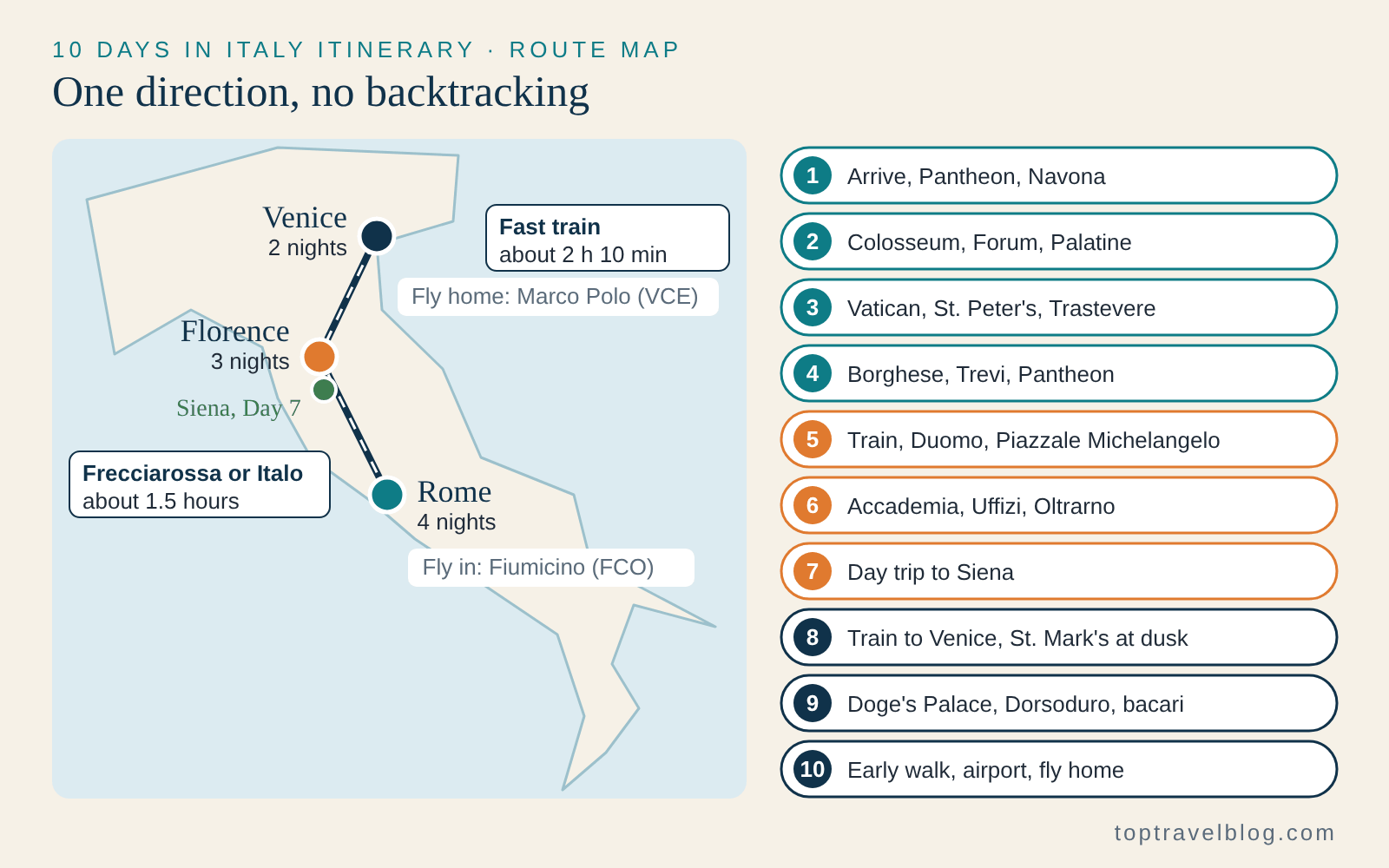
Ten days is the right length for Italy’s big three, and the plan that works is four nights in Rome, three in Florence and two in Venice, with the longest train ride under two and a half hours. That is the 10 days in Italy itinerary I would hand a friend who has never been.
You fly into Rome, finish in Venice, and never double back. Rome gets the ancient sites, the Vatican and the old center. Florence gets the Renaissance plus a Tuscan day trip. Venice gets two nights, which is the minimum for seeing it after the day-trippers leave.
This plan suits first-time visitors, couples, friends and families with kids old enough to walk six miles a day. It is a poor fit if you want beaches, a rental car and a farmhouse in Tuscany, or if you want to see everything from the Alps to Sicily. Italy punishes that kind of ambition.
I have run versions of this route in spring, in August and in the cold week after New Year’s. What follows is the sequence that works, the 2026 prices I could confirm, the tickets that sell out, and the mistakes I watch people make at Termini station with a suitcase in each hand.
Quick facts: this 10 days in Italy itinerary at a glance
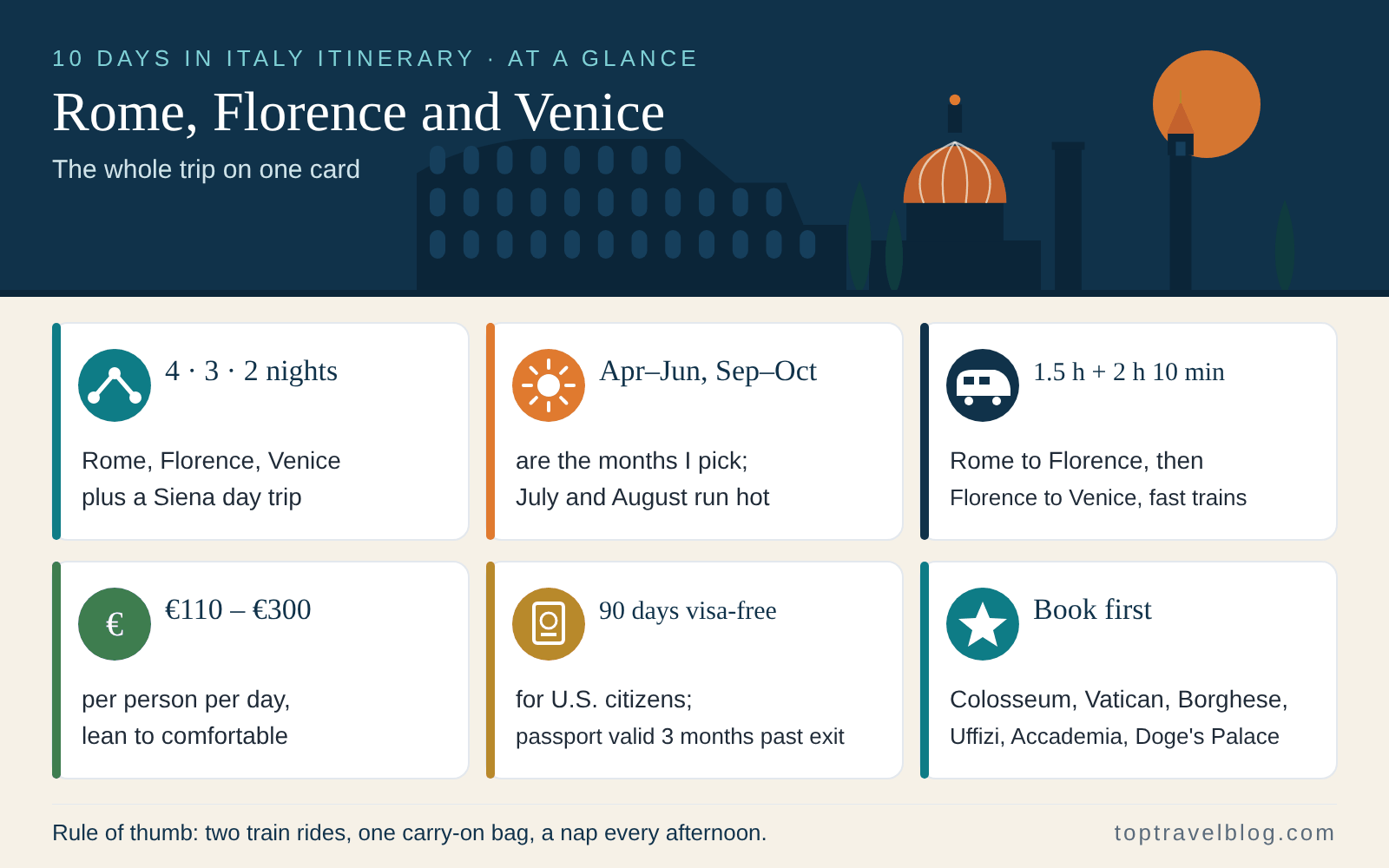
- Route: Rome (4 nights), Florence (3 nights), Venice (2 nights). Fly into Rome Fiumicino, fly home from Venice Marco Polo.
- Best for: first-time visitors, couples, friends, families with school-age kids, anyone who likes to walk.
- Trains: Rome to Florence in about 1.5 hours, Florence to Venice in about 2 hours 10 minutes, both on high-speed Frecciarossa or Italo services.
- Book first: Colosseum, Forum and Palatine (tickets open 30 days ahead), Vatican Museums, Borghese Gallery, Uffizi, Accademia, the Florence dome climb, and the Doge’s Palace.
- Pacing: one anchor area per day, a big sight before lunch, a long lunch, a lighter afternoon. Travel days are half days.
- Key caveats: many Italian museums close on Mondays, the Vatican closes on Sundays, Venice charges a day-visitor access fee on marked days, and August is hot and expensive.
Best time to go: when this 10 days in Italy itinerary works best
If I could pick one window, it would be the last week of April through early June, then mid-September through mid-October. Daytime highs run in the 60s and 70s Fahrenheit, the gardens and hill towns look their best, and the lines, while real, are survivable. September also has the advantage of warm Venice evenings without July’s smell and heat.
July and August are the hard months. Rome and Florence regularly reach the low 90s, many Romans leave town, a handful of family restaurants close for two weeks around August 15, and hotel prices peak. You can still do this trip then, but you need to flip the schedule: outdoor sights before 11 a.m., a long indoor midday, and a second walk after 6.
April to early June: the spring window
Spring is my first choice. Wisteria and roses are out, the days are long, and a light jacket covers most mornings. The catch is that Easter week (Easter Sunday is March 28 in 2027), the late-April holidays (April 25 and May 1) and school-trip season fill every ticket slot, and the Vatican and Colosseum sell out earlier than at any other time. Book those two first. Rain comes in short bursts, so the indoor swaps in each day plan below are about three hours, not whole days.
Mid-September to October: the second window
Early autumn is quieter at the big sites and about as pleasant for walking. Grape harvest is on in Tuscany, so the Siena day trip on Day 7 gets better restaurants and softer light. The one warning is Venice. High water, called acqua alta, starts showing up in October and peaks in November through January, and even a modest event floods Piazza San Marco for a few hours. Pack waterproof shoes if you come late in the month.
November to March: cheapest, quietest, shortest days
Winter is when Italy is least expensive. Rooms in all three cities drop by a third or more outside the Christmas and New Year’s weeks, and you can walk into the Borghese or the Accademia with less planning. Sunset is around 4:45 p.m. in December, Venice can be foggy and wet, and some restaurants close one extra day a week. If you can handle cold rain, this is a good value trip. Christmas week and the Carnival weeks in February are the exceptions.
Days of the week matter as much as the month
Most state museums in Florence, including the Uffizi and the Accademia, close on Mondays. The Vatican Museums close on Sundays except the last Sunday of the month, when entry is free and the lines are brutal. Many churches close from roughly noon to 3 or 4 p.m. I built this 10 days in Italy itinerary around arriving on a Thursday so those closures land in the right place. A Thursday arrival puts the Uffizi and the Accademia on Tuesday and your Monday on a train.
Tip: If your flight lands on a different day, shift the whole plan rather than swapping single days. The order Rome, Florence, Venice only works if the museum days stay in Florence’s Tuesday to Sunday window. Starting on a Monday, for example, means you reach Florence on a Friday, which still works, as long as Day 6 does not fall on a Monday.
How many days you really need for Italy
Ten days is the number where Italy stops feeling like a sprint. It lets you see three cities properly, take one real day trip, and still have a dinner that lasts two hours. Here is how the same 10 days in Italy itinerary changes at other lengths.
7 days: Rome and Florence, plus a quick Venice
Seven days works if you keep it to two cities and treat Venice as an overnight. Four nights in Rome, two in Florence and a one-night stop in Venice means two train rides in the first week and no Tuscan day trip. It is rushed but doable. I would rather drop Venice entirely and spend the extra nights in Florence than do three cities in seven days.
10 days: the plan in this guide
Ten days gives each city a proper visit, with a half day of slack in each. Rome gets three full days plus an arrival evening. Florence gets a travel afternoon, a museum day and a day trip. Venice gets a full day and a departure morning. You will walk 15,000 to 25,000 steps on most days, so build the rest around shoes and a late lunch.
12 to 14 days: add depth, not cities
With two extra days I would add a third night in Venice and a fourth in Florence rather than a fourth city. If you want a fourth stop, the best additions are Bologna (35 minutes from Florence by fast train and one of the best food stops in Italy) or the Cinque Terre from Florence, which needs two nights and an early start. Naples and the Amalfi Coast are a separate trip from Rome, not an add-on.
Pairing Italy with another country
Many readers stack this with another European trip. Our Paris itinerary or London itinerary make sensible openers, since both cities have cheap, frequent flights to Rome or Venice. If you want a second big Mediterranean trip, the 10 days in Spain itinerary and the 10 days in Greece itinerary use the same structure of city, city, coast.
Count only the full days
A 4 p.m. arrival at Fiumicino and a noon departure from Venice is nine days of sightseeing, not ten. Day 1 below is deliberately light for that reason, and Day 10 is a morning only. If you land at 7 a.m. after an overnight flight from the East Coast, you can start Day 1 earlier, but take the nap anyway. The jet-lagged Colosseum visit is the one nobody remembers.
Worth knowing: This guide assumes nine nights and a Thursday arrival. If you only have eight nights, take Venice down to one night and keep the rest. Do not cut Florence: the Uffizi and the Accademia are the reason to go.
Where to stay on a 10 days in Italy itinerary
You will change hotels twice, so the choice in each city is about walking distance and train access, not about the room. My rule for all three: sleep inside the historic center, within a 15-minute walk of the sights you will visit most, and within a short ride of the station on the days you move.
Prices move with the season. As a rough guide for shoulder months, a clean, well-reviewed three-star in Rome or Florence runs about €130 to €220 a night, and Venice runs 20 to 40 percent higher for the same quality. Add the city tourist tax, charged per person per night at the hotel and ranging from a few euros to around €10 or more at higher star ratings, usually capped at a few consecutive nights.
Breakfast in Italy is a cappuccino and a cornetto at the bar for about €3, so a hotel that charges €20 for a buffet is not a bargain. Book the room-only rate and walk to the nearest bar.
Rome: where to base your 4 nights
Centro Storico (Pantheon, Piazza Navona, Campo de’ Fiori)
Best for: first-timers who want to walk everywhere
This is the base I would choose again. From a hotel between the Pantheon and Campo de’ Fiori you reach the Trevi Fountain in 10 minutes, the Forum in 20 and the Vatican in 30. Evenings are lively, restaurants are everywhere, and the pickpocket-heavy crowds thin out after 11 p.m. You pay a premium for the address, and the cobblestones are hard on wheeled suitcases.
{{/card}}
Monti (between the Colosseum and Termini)
Best for: couples and anyone with an early Colosseum slot
A hill district of small streets, wine bars and independent shops, about 10 minutes on foot from the Colosseum and 12 from Termini station. That last point matters on Day 5, when you take the Florence train. The walk to the Pantheon is about 25 minutes. Prices run a little below the Centro and nights are calmer.
{{/card}}
Trastevere
Best for: food lovers and second-time visitors
Ivy-covered lanes, trattorias and a crowd that peaks after dinner. It is the most atmospheric neighborhood and the noisiest. The walk to the Vatican is about 35 minutes, and the tram to Termini is slow, so I only suggest it if you want evenings over speed. Choose a hotel off the main restaurant streets of Via della Scala and Piazza Santa Maria.
{{/card}}
I would avoid the blocks immediately around Termini unless you need an early train. The area is grimy at night, and the rooms are cheap for a reason.
Florence: where to base your 3 nights
Duomo and San Marco area
Best for: first-timers and museum days
The old center is small enough that everything is walkable, and the blocks within 10 minutes of the Duomo put the Accademia 8 minutes away, the Uffizi 12 and Santa Maria Novella station 10. It is also where the crowds are, so pick a side street over a hotel with a Duomo view that costs €100 more.
{{/card}}
Santa Maria Novella and Santo Spirito
Best for: convenience and food
Staying near the station makes Days 5 and 8 easy, and the streets toward Santo Spirito, across the river, have the best evening restaurants. The train station block itself is dull and a little rough at night. I prefer the Oltrarno side for dinner and a hotel within five minutes of the Arno.
{{/card}}
Venice: where to base your 2 nights
Cannaregio
Best for: first-timers who want local streets and good value
My pick. It is the northern neighborhood beside the station, with real residents, the Jewish Ghetto, canalside bars on the Fondamenta della Misericordia, and cheaper rooms. A 10-minute walk or a single vaporetto stop takes you to the station, and 25 minutes on foot reaches Rialto.
{{/card}}
Dorsoduro and San Polo
Best for: art, quiet evenings, a short walk to San Marco
Dorsoduro has the Accademia and Peggy Guggenheim, plus student bars on Campo Santa Margherita. San Polo sits beside the Rialto Bridge and the market. Both are central and atmospheric. Both cost more, and both have more bridge stairs between you and your luggage.
{{/card}}
Staying in Mestre, the mainland district, saves €50 to €80 a night and costs 10 minutes by train each way plus a daily headache. It is workable for two nights only if you accept that the evenings, when Venice empties out, are the best part.
What to check before you book a room
Three things. First, luggage logistics: ask how many stairs lead to the room, because many Venice and Rome buildings have none or a tiny lift. Second, air conditioning, which is not a given in older hotels and matters from June through September. Third, the location relative to the station on the days you move. A hotel 25 minutes from Termini with a 6:45 a.m. train is a choice you will regret at 5:30.
The 10 days in Italy itinerary, day by day
Each day has one anchor area so you are not crossing a city twice. Mornings start early because the big sights are measurably better at 8:30 than at 11. Walking times are real-world times at a visitor’s pace with photo stops. Evenings are written as menus, not schedules, and every day has a rain swap.
Day 1 (Thursday)
Arrive in Rome: settle in and walk the old center
Arrival: Fiumicino to your hotel
From Fiumicino airport, the Leonardo Express to Termini station takes about 32 minutes and costs €14, with trains every 15 minutes through the day. From Termini, take a taxi or the metro to your hotel. A fixed-fare taxi from the airport to anywhere inside the Aurelian Walls costs €50 and is the better choice for two or more people with luggage. Do not accept rides from the touts in the arrivals hall.
The 10 days in Italy itinerary opens slowly on purpose. Check in, and if you landed early, sleep for 90 minutes. This is the one nap I always recommend.
Evening: Pantheon, Piazza Navona and a first plate of pasta
At around 6 p.m., walk to the Pantheon, which is lit in the evening and far less crowded than at noon. Continue five minutes to Piazza Navona and Bernini’s Fountain of the Four Rivers. For dinner, skip the tourist squares and walk two or three blocks away. Look for a short menu in Italian and a table of locals. Expect roughly €14 to €20 for a pasta main. Home by 10.
Tip: Try cacio e pepe or carbonara on night one. Rome’s classic pastas use pecorino, guanciale and eggs, and the version at a neighborhood trattoria will reset your standard for what pasta means.
Day 2 (Friday)
Ancient Rome: Colosseum, Forum, Palatine Hill
Morning: the Colosseum at opening
The first full day of the 10 days in Italy itinerary starts with the Colosseum, so be there for the first entry slot. The amphitheater opens at 8:30 a.m. year-round and the Forum and Palatine at 9. The standard combined ticket costs €18 and covers all three for 24 hours, but tickets are named and ID is checked at the gate. Official tickets go on sale 30 days before your date and morning slots sell out in peak months, so set a reminder for the day your window opens.
Give the Colosseum 75 minutes; the Forum and Palatine fit the rest of the 10 days in Italy itinerary’s ancient morning. The underground and arena tickets (€24) sell out within minutes; chase them only if the hypogeum is why you came.
Late morning: Roman Forum and Palatine Hill
Walk through the Arch of Constantine into the Forum, then climb the Palatine for the view back over the ruins and the Circus Maximus. Allow two hours; there is almost no shade and fewer benches than you would like. Bring water and a hat from May to September. A printed guide or audio app earns its place here, because the Forum is a field of broken columns without one.
Lunch: Monti
Leave the Forum by Via dei Fori Imperiali and walk 10 minutes to Monti for lunch. Pizza al taglio, a trattoria pasta or a supplì from a counter all land at €5 to €15. Sit down, drink water, and stay out of the sun for an hour.
Afternoon: Capitoline Hill and the Aventine view
From Monti, walk back toward Piazza Venezia and climb Michelangelo’s steps to Piazza del Campidoglio, the hilltop square above the Forum. The Capitoline Museums on its sides hold the original Marcus Aurelius statue. Then take a bus or a 20-minute walk to the Aventine Hill, where the keyhole of the Priory of the Knights of Malta frames St. Peter’s dome. Finish with the orange garden at sunset.
If it rains, move the Capitoline Museums to the afternoon and skip the Aventine. Dinner in Testaccio.
Day 3 (Saturday)
The Vatican and Trastevere
Morning: Vatican Museums and the Sistine Chapel
Book the first slot you can get; the Vatican Museums open at 8 a.m. Monday to Saturday. Tickets are €20 at the door or €25 booked online with the booking fee, and children under 7 enter free. Online is the only sensible way, because the gate line can run two hours.
The route runs about 90 minutes through the Gallery of Maps and Raphael Rooms to the Sistine Chapel. Photos are not allowed in the chapel and staff will ask for silence, with limited success. Shoulders and knees must be covered, enforced at the door.
Late morning: St. Peter’s Basilica
The Sistine Chapel shortcut into St. Peter’s is for guided groups, so independent visitors walk around the outside, about 15 minutes. The basilica is free, with a security line that can take 30 to 60 minutes after 10 a.m. The dome climb has 551 steps if you do not use the lift for the first section and costs roughly €10 to €22. It is worth it for the rooftop view, and not worth it if you are already tired.
Lunch and afternoon: Castel Sant’Angelo and the river
Walk 15 minutes along Via della Conciliazione to the Tiber and the Castel Sant’Angelo, the old papal fortress, which costs about €15 and rarely needs advance booking. Cross the Ponte Sant’Angelo with its Bernini angels and have a late lunch in the Prati streets behind the Vatican, where local lunch crowds beat the tourist menus on the main avenue.
Evening: Trastevere
Take bus 23 or a taxi across the river to Trastevere for an aperitivo, a wander through the lanes and dinner. It gets loud and crowded after 8 p.m., so walk to the quieter streets around Piazza di San Cosimato. Pickpockets work the buses to and from the Vatican, so keep your bag in front of you.
Day 4 (Sunday)
Baroque Rome: Borghese, Spanish Steps, Trevi and the Pantheon
Morning: Galleria Borghese
The Borghese Gallery is the best small museum in Rome and the one that sells out first. Entry is by reserved two-hour session, with tickets at €16 plus a €2 booking fee, and the slots open about 30 days ahead. Set a reminder. This stop keeps the 10 days in Italy itinerary’s Rome chapter from being only ruins. The collection holds Bernini’s Apollo and Daphne and Caravaggio’s paintings, and two hours is exactly the right length.
After the gallery, spend an hour in the Villa Borghese park, then walk down to Piazza del Popolo.
Midday: Spanish Steps and Via Condotti
It is a 15-minute walk from Piazza del Popolo to the Spanish Steps, which are crowded and gloriously free. Climb them for the view and leave. Via Condotti below is where the luxury stores line up; if you are not shopping, cut over to Via Margutta, a quiet lane that once housed artists.
Afternoon: Trevi Fountain and the Pantheon
Walk 12 minutes to the Trevi Fountain. Since February 2026, tourists pay €2 to step into the basin area right in front of the water, from 9 a.m. to 10 p.m., payable online or by card at the entrance. You can still see it from the street for free, and I think the street view is fine. Then walk eight minutes to the Pantheon. Entry costs €7 and the oculus is the draw. Give it 30 minutes.
Evening: the farewell dinner
For your last night in Rome, reserve a table in the Centro or Monti on Sunday, since many neighborhood places close one day a week. Order the Roman standards you skipped: a plate of carciofi alla giudia in season, saltimbocca, a bowl of gricia. A walk past the Colosseum lit up at 10 p.m. is a good send-off. Pack tonight, because the train leaves in the morning.
If it rains, spend more time inside the Borghese and swap the park for the Capitoline Museums if you skipped them on Day 2.
Day 5 (Monday)
Train to Florence: Duomo and the old center
Morning: Rome to Florence by high-speed train
The second leg of this 10 days in Italy itinerary is the train. Take a morning Frecciarossa or Italo from Roma Termini to Firenze Santa Maria Novella. The ride takes about 1.5 hours and trains run every 15 to 30 minutes. Book a seat in advance, since both services assign seats and advance fares are much cheaper than walk-up ones. Arrive at Termini 30 minutes before departure, because the platform is posted only 10 to 15 minutes before.
Leave your bags at the hotel if check-in is not ready. Florence is small, and a station walk to most hotels is 10 minutes.
Afternoon: Duomo, Baptistery and Piazza della Signoria
Florence’s cathedral complex anchors the city and your first afternoon of the 10 days in Italy itinerary. The Duomo interior is free to enter and the facade is as dramatic as the pictures. The dome climb, with 463 steps and no lift, needs a timed reservation and tickets start around €30. Book the earliest slot you can, ideally at 8:30 on Tuesday or Wednesday rather than today.
Today, see the exterior, the Baptistery’s bronze doors and Giotto’s bell tower. Walk 10 minutes to Piazza della Signoria and Palazzo Vecchio.
Evening: Ponte Vecchio and Piazzale Michelangelo
Cross the Ponte Vecchio and head up to Piazzale Michelangelo for sunset, a 30-minute uphill walk or a bus ride. It is crowded and wonderful, and the golden light on the dome is the single best view in Florence. Dinner in the Oltrarno, near Santo Spirito, where the evening crowd is locals and students.
Tip: Monday is the day the Uffizi and Accademia are shut. That is why Day 5 is a travel and wander day in this 10 days in Italy itinerary, and why Tuesday is your museum day.
Day 6 (Tuesday)
Florence’s museums: Accademia, Uffizi and the Oltrarno
Morning: the Accademia and Michelangelo’s David
Be at the Accademia Gallery when it opens. Admission is €16 plus a €4 reservation fee, and you want the booking. David stands at the end of the long hall, flanked by Michelangelo’s unfinished Prisoners, and 45 minutes is plenty. On Saturdays and in summer the line outside runs around the block by 9.
Late morning and lunch: Mercato Centrale and San Lorenzo
Walk to the San Lorenzo market and the first-floor food hall at Mercato Centrale for lunch. Try a lampredotto sandwich if you are adventurous or schiacciata if you are not. Eat quickly, since your Uffizi slot is the thing you cannot miss.
Afternoon: the Uffizi Gallery
The Uffizi is open Tuesday to Sunday from 8:15 a.m. to 6:30 p.m. A ticket costs €25 on the day or €29 booked in advance, and an afternoon ticket for entry after 4 p.m. runs €16 to €20. Book a mid-day slot, since the first slots sell out first. Give it three hours and choose your priorities: Botticelli’s Birth of Venus and Primavera, Leonardo’s Annunciation, and the Caravaggio room.
Evening: the Oltrarno
Cross the Ponte Santa Trinita and spend the end of the day in the Oltrarno, where artisans still work in small workshops. Aperitivo near Piazza Santo Spirito, then dinner. A bistecca alla fiorentina, priced by weight and shared by two, is the local indulgence and costs roughly €50 to €80. If you do not eat steak, ribollita and pici are the Tuscan comfort food.
If it rains, move the Oltrarno workshops to the morning and spend the afternoon in Palazzo Pitti.
Day 7 (Wednesday)
Day trip to Siena
Why Siena, and how to get there
Siena is the one Tuscan hill town that justifies a day trip within this 10 days in Italy itinerary. Direct buses run from the bus station next to Santa Maria Novella in about 75 minutes, for roughly €10 each way, and they are easier than the train, which needs a change. A day trip by bus works without a rental car, and driving in the historic center is restricted by ZTL cameras that mail fines to your home months later.
Morning and midday: Piazza del Campo and the Duomo
Arrive by 9:30 and walk to Piazza del Campo, the shell-shaped main square. The Torre del Mangia (roughly 400 steps) gives the view. Then visit the striped-marble Duomo and its Piccolomini Library, which holds frescoes so bright they look new. Lunch is pici pasta and wild boar ragù at a trattoria in a side lane.
Afternoon: back for a slow evening
Leave Siena around 4 p.m., rest in Florence, and have dinner on the Arno. If you would rather skip Siena, the alternatives are Pisa (an hour by train) or Bologna (35 minutes by fast train), or a free day in Florence for the Pitti Palace and Boboli Gardens. Pack tonight.
Day 8 (Thursday)
Train to Venice and the first evening
Morning: Florence to Venice
The last leg of the 10 days in Italy itinerary is the Venice train. Take an Italo or Frecciarossa from Santa Maria Novella to Venezia Santa Lucia, a ride of about 2 hours 10 minutes. Make sure your ticket says Santa Lucia, not Mestre, the mainland stop before the lagoon. Many trains stop at both, and getting off one stop early is the commonest first-timer error.
Arrival: the Grand Canal
Step out of Santa Lucia and the Grand Canal is right there. A single vaporetto ticket costs €9.50 and is valid for 75 minutes, and Line 1 stops at every landing along the canal and takes about 40 minutes to reach San Marco. A 24-hour travel card is €25, worthwhile only if you plan more than two rides. Walking is often faster than the boat for short hops. A water taxi from the station costs €80 or more.
Afternoon: get lost on purpose
After you check in, have a cicchetti lunch (small bar snacks of fish, polenta and meatballs) at a bacaro in Cannaregio. Wander toward Rialto without a map for an hour; you will get lost, and it will not matter. Venice rewards slow walking.
Evening: Piazza San Marco at dusk
Reach St. Mark’s Square after 6 p.m., when the day-trippers have gone. The square at sunset is the reason to stay overnight. Have a spritz at a bacaro rather than at the square’s cafes, where a coffee costs several times the usual price.
Day 9 (Friday)
A full day in Venice: Doge’s Palace, Dorsoduro and the lagoon
Morning: the Doge’s Palace and St. Mark’s Basilica
Be at the Doge’s Palace at opening. The ticket costs €35 as of January 2026, or €30 if you book at least a month ahead, and it includes the Correr Museum and the Marciana Library rooms. Take the Secret Itineraries tour if you can get a slot. Then enter St. Mark’s Basilica, free but with a small booking fee for the reserved line, and plan 30 minutes.
Midday: Rialto and lunch
Walk 12 minutes to the Rialto Bridge and the market, where the fish market runs on weekday mornings and the produce stalls nearby are photogenic. Have lunch away from the bridge, down any lane. A sit-down meal with wine runs €25 to €40.
Afternoon: Dorsoduro and the Zattere
Cross the Accademia Bridge into Dorsoduro. Visit the Peggy Guggenheim Collection if you like modern art, then walk the Zattere promenade along the Giudecca Canal in the late light. The church of Santa Maria della Salute is the grand dome at the end of the Grand Canal.
Evening: a bacaro crawl in Cannaregio
Finish with a crawl along the Fondamenta della Misericordia and the Ghetto: a spritz, a plate of baccalà mantecato on bread, another round. Two or three bars, €2 to €4 per snack, and dinner is optional.
If the weather is clear and you have the energy, swap the Doge’s Palace for a morning lagoon trip: Line 12 from Fondamente Nove reaches Burano in about 40 minutes. The islands are exempt from the access fee. In rain, keep the Doge’s Palace and skip the Zattere.
Day 10 (Saturday)
Departure morning in Venice
Morning: one last walk and the airport
The 10 days in Italy itinerary ends the way Venice is best seen, which is early. Get up and walk the empty lanes between San Marco and Rialto while the shopkeepers raise their shutters. It is the most peaceful Venice you will see.
Then collect your bags and head to Marco Polo airport. The ATVO or ACTV bus from Piazzale Roma takes 20 to 35 minutes and costs around €8 to €10. Alilaguna boats take 60 to 75 minutes at roughly €15 to €18. A private water taxi starts around €120 per boat. Be at the airport three hours before an international flight.
Getting around on a 10 days in Italy itinerary
The two long moves in this 10 days in Italy itinerary are trains, and everything else is on foot. Never rent a car for this route. Italian historic centers restrict traffic with ZTL zones, cameras photograph your plate, and the fine arrives at your US address months later. Venice has no cars at all.
Trains between the cities
Trenitalia’s Frecciarossa and Italo run Rome to Florence in about 1.5 hours and Florence to Venice in about 2 hours 10 minutes. Both operators sell on their own sites (trenitalia.com and italotreno.it) and the apps work well in English. Advance fares often start around €20 to €30 a leg, while walk-up fares for the same seat can run double. Book once your flights are set, ideally 4 to 8 weeks out.
Rail strikes (sciopero) happen several times a year, usually announced a week or two ahead and lasting 8 to 24 hours. Do not schedule your last train the same day as an international flight. Regional trains need a ticket validated in the green machine on the platform. High-speed tickets do not.
In the cities
Rome’s basic bus and metro ticket is the BIT at €1.50, valid for 100 minutes, and a 24-hour pass is €8.50. I use public transport six or eight times in four days, so a handful of single tickets is cheaper than a pass. Florence is walkable end to end in 30 minutes, and Venice is a pedestrian city with the vaporetto, covered above, as its only metro.
Airports and open-jaw flights
Fly into Rome Fiumicino and out of Venice Marco Polo, which most airlines price as a multi-city ticket for little more than a round trip. It saves a full day of backtracking. When you compare fares, our guide on how to find cheap flights explains why a multi-city search sometimes beats two one-ways. The airport-to-hotel steps are in Day 1 and Day 10 above.
Entry rules for US passport holders
US citizens can visit Italy visa-free for up to 90 days in any 180-day period, with a passport valid for at least three months beyond the day you leave the Schengen area. Since late 2025 the EU’s Entry/Exit System registers non-EU travelers at the border with a photo and fingerprints, and the EU’s ETIAS page describes the separate travel authorization planned for later. Plan the trip around today’s rules, and read our guide to how to plan a trip for the full order of operations.
What this 10 days in Italy itinerary costs
Costs for the 10 days in Italy itinerary below are per person per day, excluding international flights, for two people sharing a room. They are rough, because hotel rates swing with the season, but the building blocks are real prices from the sections above.
Lean: about €110 to €160 a day
A clean budget hotel or guesthouse at €70 to €100 per person, a cornetto and cappuccino for breakfast at €3, pizza al taglio or a sandwich for lunch at €5 to €9, pasta and wine at a trattoria for €18 to €28, and entry fees averaging €15 to €20 a day. Add the two train rides at roughly €25 to €40 each. Over the full trip this lean 10 days in Italy itinerary lands at about €1,100 to €1,600 on the ground.
Comfortable: about €200 to €300 a day
A three or four-star hotel at €110 to €170 per person, a sit-down lunch with wine at €20 to €30, a three-course dinner at €40 to €60 with wine, and €25 to €40 a day in entry fees as you add the Vatican, the Borghese, the Uffizi and the Doge’s Palace. This is the level I would plan for most readers, and it totals about €2,000 to €3,000 for the 10 days in Italy itinerary.
Generous: €400 and up
Boutique hotels, a guided small-group tour for the Vatican or the Colosseum underground, taxis door to door, and a long dinner with a good bottle. Venice pushes this tier the highest, because a canal-view room there costs what a five-star costs in Florence.
Hidden costs
The coperto, a cover charge of roughly €1.50 to €3 per person, appears on many restaurant bills and is normal. The Trevi Fountain fee, the Venice access fee on marked days and the city hotel tax add €15 to €40 to a trip for two. Tipping is not expected beyond rounding up, and a 5 to 10 percent tip for great service is generous. Foreign-transaction fees on credit cards add up, so use a card that does not charge them.
What to book ahead on a 10 days in Italy itinerary
These are the reservations that decide whether your 10 days in Italy itinerary runs smoothly. I list them in the order you should book them.
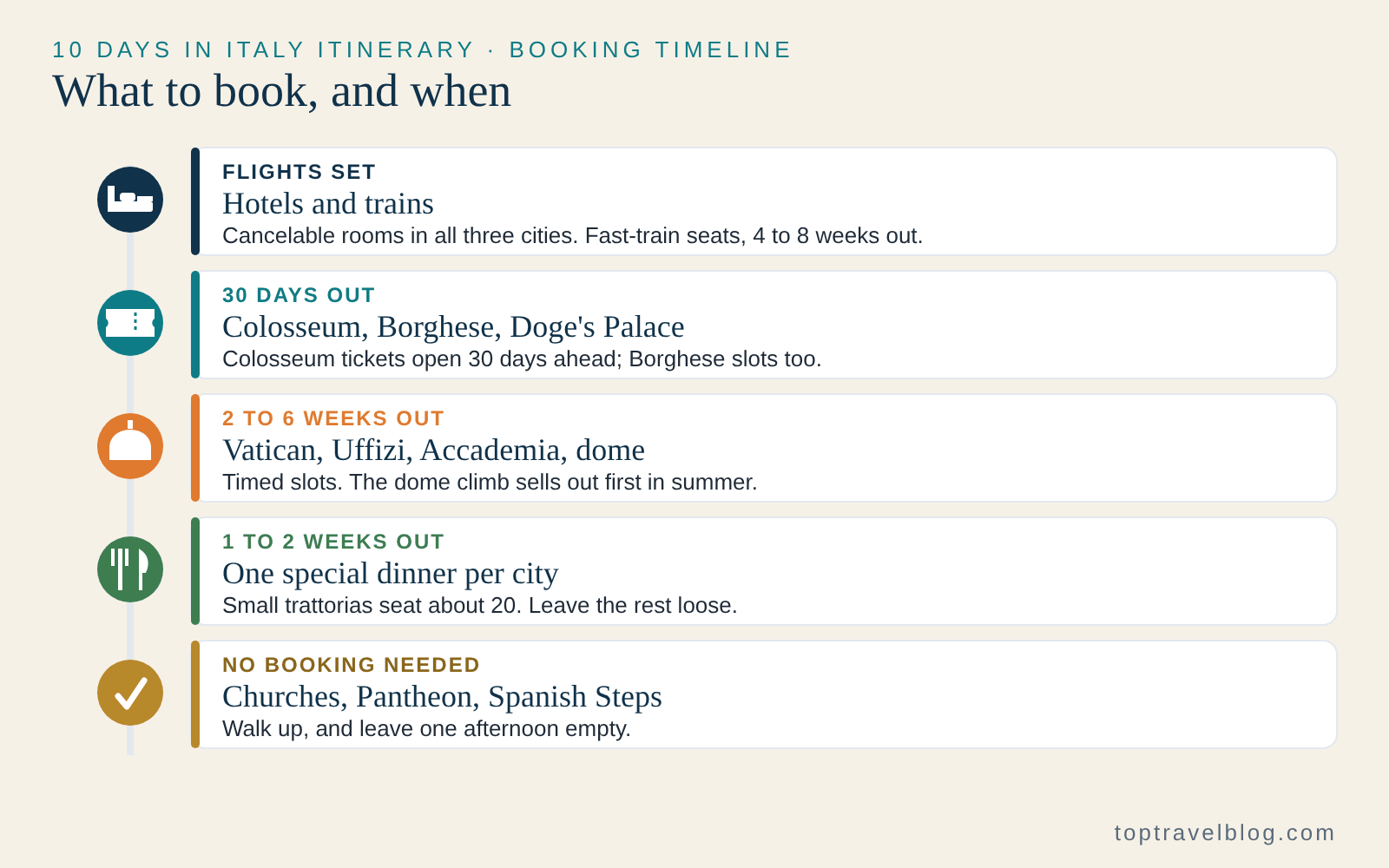
Book as soon as the flights are set
- Hotels in all three cities. Cancelable rates are common, and Venice and Rome fill up for spring weekends.
- High-speed trains. Fares are cheapest when sales open, and seats sell out on Friday and Sunday.
Book 30 days ahead
- Colosseum, Forum and Palatine. Tickets are released 30 days before the visit date, and the early slots go quickly. The official sale is on the Colosseum Archaeological Park site.
- Galleria Borghese. Slots open about 30 days ahead for the 9, 11, 1, 3 and 5 sessions.
- Doge’s Palace. Booking at least a month ahead saves €5.
Book two to six weeks ahead
- Vatican Museums. Timed online tickets are sold through the official Vatican Museums site. The first and last slots of the day are the quietest.
- Uffizi and Accademia. The Uffizi Galleries site sells the Uffizi, and the Accademia sells separately. Book both in the same week you set your dates.
- Florence dome climb. Timed slots sell out two or three weeks ahead in summer.
Book as the trip nears
One special dinner per city, booked a week or two out, since the best small trattorias seat 20 people. Everything else, including churches, the Pantheon and the Spanish Steps, does not need advance booking.
Eating well on a 10 days in Italy itinerary
Italian regional food changes at every stop, which is half the reason to build a 10 days in Italy itinerary around three cities. In Rome, order the four classic pastas (carbonara, cacio e pepe, amatriciana, gricia), supplì, and carciofi alla giudia in season. In Florence, look for ribollita, pici, bistecca and lampredotto, and a schiacciata sandwich for a quick lunch. In Venice, the specialties are fish: sarde in saor, baccalà mantecato, risotto al nero di seppia and spritz at a bacaro.
Lunch is the cheapest good meal of the day, and many restaurants run a lunch menu at €12 to €18. Dinner starts at 7:30 and is relaxed. Skip any place with a picture menu, a host on the sidewalk, or a table facing a major monument. Walk three blocks and the quality doubles while the price halves.
Gelato quality shows in the color. Banana-yellow pistachio and bright mint are signs of artificial flavor, and natural pistachio is a dull olive. Pick shops with the flavors stored in covered metal tubs, and a cone costs €2.50 to €4.
Common mistakes on a first 10 days in Italy itinerary
These are the ones I see every week, in rough order of cost.
1. Adding a fourth city
Naples, Cinque Terre, Lake Como and Tuscany are each a lovely trip. Adding any of them to this 10 days in Italy itinerary costs you a night in the cities you came for and a day of packing. If you want to add something, trade a Siena day for it, not a night.
2. Booking the Colosseum the week before
The best slots in your 10 days in Italy itinerary go weeks ahead in spring and fall. Set a reminder for the day the 30-day window opens, buy from the official site and avoid resellers who charge €30 to €50 for the same entry.
3. Arriving at Termini 5 minutes before the train
Platforms are posted 10 to 15 minutes before departure, and Termini is huge. Be there 30 minutes ahead and read the board.
4. Hauling a big suitcase
Cobblestones, narrow stairs and the Venice bridges punish big bags. One carry-on and a small backpack is the standard I stick to, and laundry is cheap.
5. Visiting the Vatican on a Sunday
The Vatican Museums are closed on Sundays, except the last Sunday of the month when entry is free and the queue runs for hours. Plan around that or you will lose half a day.
6. Dressing wrong for churches
Shoulders and knees must be covered at the Vatican and most churches. A light scarf solves it.
7. Eating on the tourist squares
Restaurants right on Piazza Navona, the Trevi Fountain and Piazza San Marco charge more for worse food. Walk a few blocks.
8. Ignoring pickpockets
The Termini area, metro line A, bus 64 and the crowds at the Trevi, Colosseum and Spanish Steps are where they work. Keep your phone and wallet in front pockets and zip your bag.
9. Doing Venice as a day trip
Venice at 11 a.m. is a theme park. Venice at 7 p.m. is the real city. Two nights is the minimum, and it is the cheapest way to avoid the access fee on marked days, since overnight guests are exempt when registered.
10. Skipping the nap and the pace
You will walk 6 to 10 miles a day. A hotel nap at 3 p.m. is not laziness. It is how you stay awake for the 9 p.m. dinner.
Frequently asked questions about this 10 days in Italy itinerary
Is 10 days enough for Rome, Florence and Venice?
Yes. Ten days is the length this 10 days in Italy itinerary is built on, and it covers Rome in four nights, Florence in three and Venice in two. You will not see every museum, but you will see every major sight and have time for lunch. With fewer than seven days, three cities feel rushed.
What is the best order to visit Rome, Florence and Venice?
Rome first, Florence second, Venice last, flying into Rome and out of Venice. The order saves a full day of backtracking and puts the busiest ancient sites at the start, when your energy is highest. The 10 days in Italy itinerary also works in reverse if your flights are cheaper into Venice.
How much does a 10 days in Italy itinerary cost?
On the ground, roughly €1,100 to €1,600 per person at a lean pace, €2,000 to €3,000 at a comfortable one, and €4,000 and up at a generous one. That excludes international flights. Hotels are the largest cost, followed by dinners and the two train rides.
Do I need to book museums in advance?
For the Colosseum, Vatican Museums, Borghese, Uffizi, Accademia, the Florence dome and the Doge’s Palace, yes. Those sell out in spring, summer and fall, and the day-of line can run an hour or two. Everything else, including churches, the Pantheon and most neighborhoods, needs no reservation.
Is the train better than flying between Italian cities?
For this route, yes. Rome to Florence takes about 1.5 hours city center to city center, and Florence to Venice about 2 hours 10 minutes. Flying adds airport transfers, security and baggage time, and costs more. High-speed trains are the best part of an Italy trip.
Should I rent a car for Tuscany?
Not for this plan. Cars are a hassle in all three cities, and the one Tuscan stop, Siena, is easy by bus. If you want a week of hill towns and vineyards, that is a different trip, and I would rent the car only for those days.
What is the Venice access fee?
In 2026 the city charged day visitors €5 if paid at least four days ahead, or €10 later, between 8:30 a.m. and 4 p.m. on marked calendar days. Overnight guests are exempt, and so are the islands such as Murano and Burano. The city publishes the yearly calendar at cda.veneziaunica.it.
Is the Trevi Fountain still free?
Seeing it is free. Since February 2026, tourists pay €2 to enter the basin area in front of the water, from 9 a.m. to 10 p.m., according to Turismo Roma. Children under 5 are exempt. Most visitors find the view from the street plenty.
Do I need a visa or ETIAS for Italy?
US citizens do not need a visa for stays up to 90 days. ETIAS, the planned EU travel authorization, is not operating as of November 2026, and the Entry/Exit System already registers travelers at the border. Make sure your passport is valid for at least three months after you leave.
What should I pack for 10 days in Italy?
Broken-in walking shoes, layers, a light scarf for churches, a power adapter (Italy uses Type F and L plugs at 230 volts), a small crossbody bag with zippers and a refillable bottle, since fountains in Rome give good drinking water. Pack in one carry-on and a daypack if you can.
Can I do this 10 days in Italy itinerary with kids?
Yes, with adjustments to the pace. Book the earliest Vatican slot, keep museum mornings to two hours, and promise gelato at the end of each one. The Colosseum and Forum suit kids of about 8 and up. Venice is fun for kids because of the boats, and the Florence dome climb works from about age 8, since it is 463 steps with no lift.
One last thing before you go
The best hours I have spent in Italy were not on any list. A quiet bar in Cannaregio, a church in Rome I walked into to get out of the rain, a wrong turn in Florence that ended in the best lunch of the week.
Leave one afternoon empty. A 10 days in Italy itinerary is scaffolding, and Italy fills it in. If this plan lights a fire for another trip, the Rome itinerary goes deeper on the city you will spend the most time in.
Related planning guides
- Rome itinerary: the best 4 days for ancient sites, food and neighborhoods — the deep dive on your first and longest stop.
- How to plan a trip step by step — the order to book flights, hotels and tickets.
- How to find cheap flights — a search strategy that avoids the common traps.
- 10 days in Spain: Madrid, Seville and Barcelona — the same structure for the next trip.
- 10 days in Greece: Athens, Santorini and one more island — Mediterranean ruins plus island time.