
Three cities, nine nights, no rental car: that is the shape of the 10 days in Spain itinerary I recommend to almost everyone who asks. Spend three nights in Madrid, three in Seville and three in Barcelona, fly into the first and out of the last, and connect them with one high-speed train and one short flight.
It gives you the Prado and the Royal Palace, the Alcázar and the Andalusian old quarter, and Gaudí’s Barcelona, with a day trip to Toledo and a day trip to Córdoba slotted in where the trains make them easy.
The verdict in one sentence: Spain rewards travelers who book three or four timed tickets, ride the trains instead of driving, and accept that dinner starts at 9 p.m. This plan suits first-time visitors, couples, friends and families with teenagers who like to be on their feet six hours a day.
It is a poor fit for anyone who wants a beach week (go to the Balearics or the Costa del Sol instead) or who hates packing up every three days.
I have made this exact loop in spring, in October and once in a July heat wave I would not repeat. What follows is the 10 days in Spain itinerary I would hand a friend: the order of cities that avoids backtracking, the real train and flight times, which hotel areas save you an hour a day, current ticket prices in euros as of November 2026, and the mistakes I watch people make at the Sagrada Família gate.
Quick facts: this 10 days in Spain itinerary at a glance
- Best for: first-time visitors, couples, friends, families with kids 10 and up, anyone who likes walking cities and long dinners.
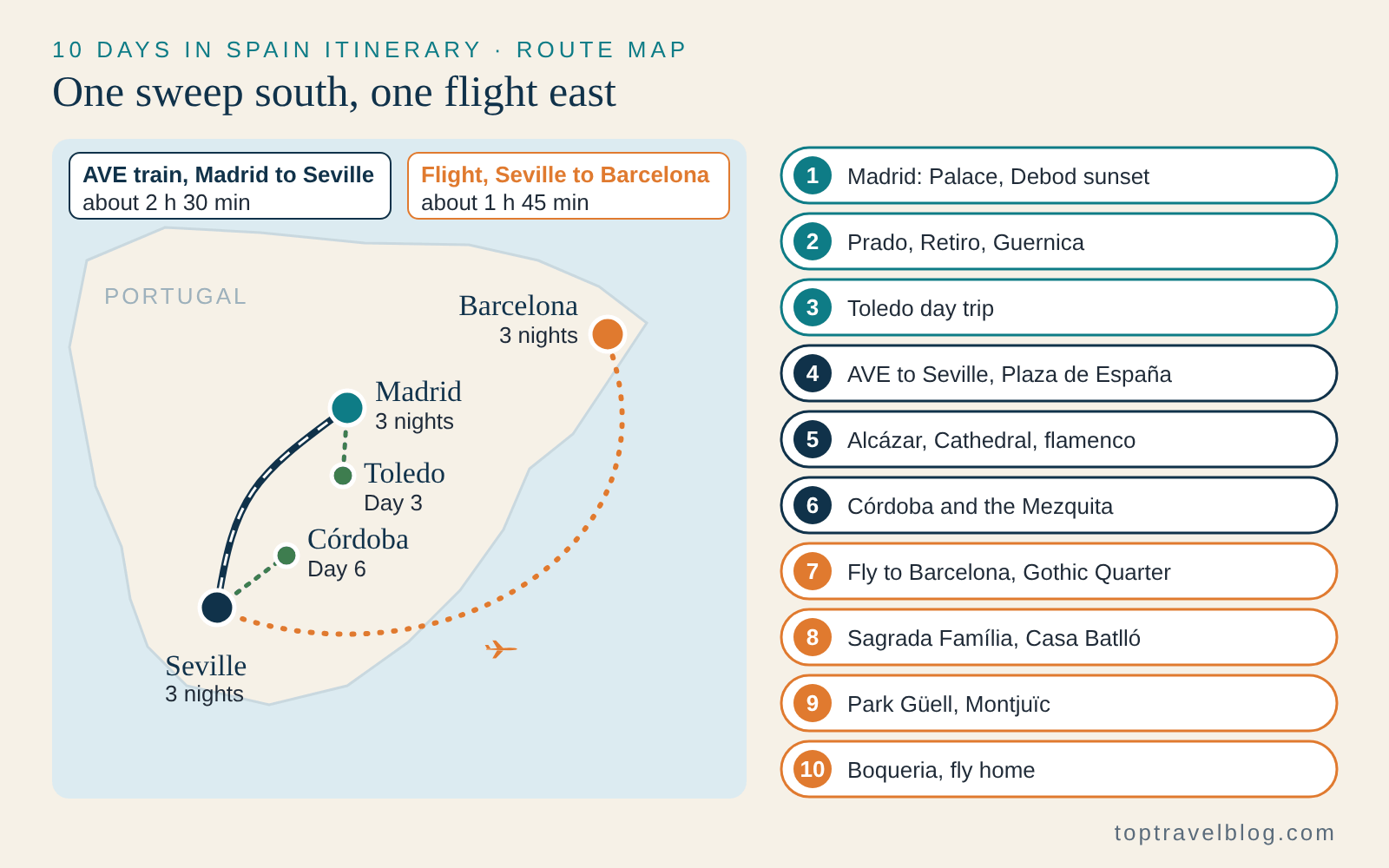
- Route: Madrid (3 nights, with a Toledo day trip), Seville (3 nights, with a Córdoba day trip), Barcelona (3 nights). Fly into Madrid, out of Barcelona.
- Between cities: Madrid to Seville by high-speed train in about 2 hours 30 minutes; Seville to Barcelona by a flight of about 1 hour 45 minutes (the train takes roughly 5.5 hours).
- Booking priorities: Sagrada Família (€26, or €36 with the towers), the Alcázar of Seville, Park Güell, your Madrid–Seville train, and a Prado slot if you will not use the free hours.
- Pacing: one anchor neighborhood per day, big sight in the morning, a long lunch, an evening you can drop.
- Key caveats: Seville in July and August regularly passes 100°F; Spanish restaurants mostly serve dinner from 8:30 or 9 p.m.; Barcelona’s tourist tax doubled in April 2026; entry now runs through the EU’s Entry/Exit System.

Best time to go: when a 10 days in Spain itinerary works best
Spain is the one country where the best month depends on which city you are standing in, and a three-city route crosses three climates. Seville is the constraint. It is one of the hottest major cities in Europe in summer, and no amount of good planning makes 2 p.m. in the Alcázar gardens pleasant at 104°F.
So I pick the window around Seville and let the other two cities cope.
My answer: mid-April to early June, or late September through October. Seville runs from the high 70s to the mid 80s in those weeks, Madrid is dry and sunny, and Barcelona is warm enough for the beach by late May and still swimmable in early October. Here is how each stretch of the year plays out for this route.
March and April: orange blossom, Easter and the Feria
Seville in spring is the Seville of the postcards, with orange trees in bloom and cafés spilling onto the pavement. It is also the most expensive and crowded stretch of the year. Semana Santa, Holy Week, runs from March 21 to 28 in 2027 (Easter Sunday falls on March 28), and the processions fill the old quarter from afternoon until the early hours.
Hotel rates in Seville can double that week and trains sell out weeks ahead.
May and June: my favorite window
Late May is the sweet spot. Seville is in the low 80s, the Madrid terraces are open until midnight, the Barcelona beaches have lifeguards again, and the big sights have not yet reached summer queue lengths. Patio season in Córdoba (early to mid May) is a good reason to put the Córdoba day trip in that month.
July and August: only if you must
Seville averages a daytime high near 97°F in July and August, and heat waves of 105°F are not unusual. Madrid is hot and dry, in the 90s, and Barcelona is humid with the heaviest crowds of the year. Many Madrid restaurants and small shops shut for a few weeks in August as locals leave town.
September to February: the other sweet spot, then winter
September is still hot in Seville (low 90s early in the month) but cooling fast, and Barcelona’s sea is at its warmest. October is excellent everywhere: Seville in the low 80s, Madrid in the 70s, and the Barcelona crowds thinning. The caveat is rain, which returns in October and November in the north, with the occasional short, heavy storm.
The Mercè festival in Barcelona, around September 24, packs the old town with free concerts and human towers. Winter (November to February) is the budget season, with cold, bright days in Madrid, mild ones in Seville and daylight ending near 5:45 p.m., so the plan front-loads the sights; it is a fine time for the 10 days in Spain itinerary if you do not need to swim.
Tip: Look at sunset times before you lock the order of Day 2 and Day 9. In late October the sun sets around 6:30 p.m. in Madrid, in June after 9:15 p.m. The two best free sunsets on this route, the Templo de Debod in Madrid and the Montjuïc viewpoints in Barcelona, depend on that single number.
Days of the week that change the plan
The Reina Sofía is closed on Tuesdays. Many Madrid museums run free hours at the end of the day, and the Prado’s free window is the last two hours (6 to 8 p.m. Monday to Saturday, 5 to 7 p.m. on Sunday). The Sagrada Família opens at 10:30 a.m. on Sundays instead of 9.
How to split 10 days in Spain between Madrid, Seville and Barcelona
Ten days is enough to see three Spanish cities properly and not enough to see four. That is the honest trade-off, and it is the reason this plan has three bases instead of four or five. In any 10 days in Spain itinerary, every extra city costs you roughly half a day in checkout, transfer and re-orientation, which on a ten-day trip is five percent of your vacation per move.
The 3-3-3 split I recommend for a 10 days in Spain itinerary
Three nights in each city is the core of this 10 days in Spain itinerary. Madrid gets Days 1 to 3 (arrival, the museum day, and Toledo), Seville gets Days 4 to 6 (afternoon arrival, the Alcázar day, and Córdoba), and Barcelona gets Days 7 to 10 (Day 7 afternoon, a full Gaudí day, a Park Güell and beach day, and a morning before your flight).
If you have 12 or 14 days
The extra days should go where the hops are longest. Add two nights in Granada for the Alhambra (a 2.5-hour trip from Seville by bus or about 3 hours by train, so it needs a night) or give Barcelona a day trip to Girona or Montserrat. Two weeks also lets you add the Basque coast, but San Sebastián pulls your route north and breaks the clean Madrid-to-Barcelona line.
Do not add a fourth city to ten days.
Pairing Spain with another country
Spain pairs easily with Portugal by a one-hour flight from Seville to Lisbon, and our 7 days in Portugal itinerary covers the Lisbon and Porto leg. If you want a longer European trip, the 10 days in Italy itinerary follows the same three-city logic from Rome to Venice, and the 10 days in Greece itinerary covers the island version, with our guide to the best Greek islands for first-time visitors to help you choose.
For a London, Paris or Rome add-on, see the London itinerary, the Paris itinerary and the Rome itinerary.
Worth knowing: Count the days honestly. An overnight flight that lands in Madrid at 8 a.m. gives you a real Day 1. One that lands at 4 p.m. does not, and the plan below then loses its Royal Palace morning. A flight home at 7 a.m. on Day 10 also costs you the last day. If planning the whole trip is new to you, our guide on how to plan a trip step by step covers the order of booking.
Trains, flights and the order of cities on a 10 days in Spain itinerary
The route logic of a 10 days in Spain itinerary is simple once you see it on a map. Madrid sits in the middle of the country, Seville is five hours south of Barcelona by the fastest train, and Barcelona is on the northeast coast. Running Madrid, Seville, Barcelona is a single sweep with one awkward hop at the end. Running Barcelona, Madrid, Seville is a smoother line, but it leaves you flying home from Seville, which has far fewer long-haul options.

Madrid to Seville: take the train
The high-speed AVE, plus the cheaper AVLO, iryo and Ouigo services, covers the 290 or so miles in about 2 hours 30 minutes. Trains leave Madrid Puerta de Atocha and arrive at Sevilla-Santa Justa, about a mile and a half from the old quarter. There are roughly two dozen departures a day.
Advance fares run from the low teens in euros on the budget operators to about €35 to €50 on standard AVE; last-minute and holiday tickets can pass €100. Renfe sells its tickets about two months out, and the cheapest fares go first.
Flying makes no sense here. By the time you add the airport transfers, security and boarding, a 55-minute flight takes longer door to door than the train, and the train drops you in the middle of the city. Arrive at the station 20 to 25 minutes before departure, because the gates close about ten minutes before the train leaves.
Seville to Barcelona: the one hop that needs a decision
Direct trains take about 5 hours 30 minutes and cost from roughly €20 to €60 booked ahead, with walk-up fares well over €100. Nonstop flights on Vueling, Iberia and Ryanair take about 1 hour 45 minutes, with advance fares often in the €25 to €60 range.
For the 10 days in Spain itinerary I pick the flight: an 8:30 or 9 a.m. departure puts you in Barcelona by noon with the afternoon free, where the train costs you the whole of Day 7.
Entry rules for U.S. travelers on a 10 days in Spain itinerary
U.S. passport holders can visit Spain without a visa for up to 90 days in any 180. Since the Entry/Exit System became fully operational on April 10, 2026, border officers register fingerprints and a facial image at your first entry to the Schengen area, which adds time at passport control. Allow an extra hour for arrivals.
The separate ETIAS travel authorization, a €20 online application for U.S. citizens, is planned for the last quarter of 2026 and the EU has said the exact start date will be announced in advance; the official EU travel site carries the current status. Your passport needs to be valid for at least three months after your departure date.
Where to stay in Madrid, Seville and Barcelona on a 10 days in Spain itinerary
For a 10 days in Spain itinerary, the right neighborhood in each city puts you within a 15-minute walk of that day’s anchor sights and a few minutes from the train or airport link. The wrong one costs you a taxi each way. I would rather have a small room in the right place than a bigger one a metro ride away, because on a trip this short you will use the room mostly to sleep.
One cost to budget for: Barcelona levies a tourist tax that doubled in April 2026. The regional portion is now €7 per night for luxury hotels and €3.40 for four-star hotels (lower for other categories), and the city adds its own surcharge on top. It is paid at the hotel, per person, and it is charged for a limited number of nights per stay. Madrid has no tourist tax at present.
Madrid: three areas I would pick
Sol, Plaza Mayor and La Latina
Best for: first-timers who want to walk everywhere
This is the old Habsburg heart, and the Royal Palace, Plaza Mayor and Mercado de San Miguel are all within ten minutes on foot. The Sol interchange puts you on the Metro and Cercanías lines, and Cava Baja has the best tapas crawl in the center.
Barrio de las Letras and Huertas
Best for: museums, tapas bars and an easy walk to the Prado
My pick for the Day 2 plan. The Prado is a 10-minute walk, the Thyssen is next door, and Atocha station is 15 minutes away on foot, which matters on the morning you leave for Seville.
Salamanca and Retiro
Best for: quiet nights, shopping, Retiro Park mornings
Wide, tree-lined streets, polished hotels and a less touristy feel. You are a 10-minute walk from Retiro Park and 20 from the Prado.
Seville: three areas I would pick
Santa Cruz
Best for: atmosphere, walking to the Alcázar and Cathedral
Whitewashed alleys, orange trees and a two-minute walk to the Alcázar gate. It is the prettiest base and the most expensive.
El Arenal and the Cathedral area
Best for: location, tapas bars, easier taxi access
Between the bullring and the Cathedral, with the Guadalquivir River on one side. Flat, central and full of tapas bars on Calle Arfe and Calle Zaragoza.
Triana
Best for: nightlife, local feel, second visits
Across the Isabel II bridge, the old gypsy and potters’ quarter has a neighborhood feel, riverfront bars and the best sunset views back toward the Cathedral. It is a 15 to 20 minute walk to the Alcázar.
Barcelona: three areas I would pick
Eixample, near Passeig de Gràcia
Best for: first visits, Gaudí, easy transport
Wide grid streets, Casa Batlló and La Pedrera on your doorstep and the Sagrada Família 25 minutes on foot or two stops by metro. Passeig de Gràcia station connects to the airport train.
Gothic Quarter and El Born
Best for: atmosphere and walking, short stays
Medieval lanes, the Cathedral, Santa Maria del Mar and a 15-minute walk to the beach at Barceloneta. It is lively at night, with bars on Carrer dels Escudellers and Passeig del Born, and pickpockets are a real issue on the busiest streets.
Gràcia
Best for: a local feel, plazas, Park Güell mornings
A former village with small squares full of outdoor tables and independent shops. It is closer to Park Güell, about 25 minutes on foot or a short bus ride, but further from the old town beaches.
The 10 days in Spain itinerary, day by day
Each day has one anchor neighborhood so you are never crossing a city twice. Mornings start early because Spain’s big sights are far better at 9:30 than at noon, lunch is the long meal and the real break, and evenings are built to be dropped if your feet give out. Walking times are real-world times with photo stops, not Google’s. Train times include a sensible margin.
Day 1 · Madrid
Arrival, Habsburg Madrid and a sunset at Debod
Getting in. The Metro’s Line 8 links all Barajas terminals to Nuevos Ministerios. The ticket is the normal €1.50 to €2 fare plus a €3 airport supplement. The Cercanías commuter line C-1 runs from Terminal 4 to Atocha for about €2.60. The Express bus 203 runs 24 hours to Puerta de Atocha for €5, and a taxi to anywhere inside the M-30 ring road is a fixed €33, luggage included.
Morning and early afternoon. Drop your bags and go straight outside, even if you are tired; daylight is the cure for jet lag, and Day 1 of this 10 days in Spain itinerary is built around it. Walk to the Plaza Mayor, have a coffee at the edge of the arcade rather than in the middle, and head through the arch to the Mercado de San Miguel.
I find the market more of a photo stop than a lunch (it is packed and pricey), so I walk on to Casa Labra near Sol for a fried cod croquette and a small beer.
From there walk 10 minutes west to the Royal Palace, one of the largest royal palaces in Europe. Admission is in the high teens of euros, and a visit takes about 90 minutes. Beside it, the Almudena Cathedral is free to enter, and the Sabatini Gardens on the north side are a free place to sit.
Late afternoon and evening. Walk up through the Plaza de España to the Templo de Debod, an Egyptian temple more than 2,000 years old that was moved here stone by stone and rebuilt in the early 1970s. It is free, and the terrace facing west is the best sunset spot in the center.
Stay awake until at least 9 p.m.; that single rule makes the rest of the 10 days in Spain itinerary far easier. Dinner is at 9 anyway: head to Cava Baja in La Latina and bar-hop for croquettes, tortilla, and anything with Iberian ham.
If you want a historic dinner, Sobrino de Botín dates to 1725 and needs a reservation.
Logistics: about 4 miles on foot. Sol to the Royal Palace 12 minutes, Palace to Debod 15, Debod to La Latina by metro or a 25-minute walk. If it rains: swap the palace to the morning and go to the Thyssen in the afternoon.
Day 2 · Madrid
The Prado, Retiro Park and Picasso’s Guernica
Morning. Be at the Prado when it opens at 10 (open 10 to 8 Monday to Saturday, 10 to 7 on Sundays). General admission is €15, and the Prado’s official site sells timed tickets at face value. Give it two hours, and do not try to see everything; no 10 days in Spain itinerary survives a full day inside one museum.
Start with Velázquez’s Las Meninas, then Goya’s Black Paintings downstairs, then Bosch’s Garden of Earthly Delights, which is smaller than you expect and a better painting than most people realize.
Midday. Cross the road to the Retiro Park, a 5-minute walk from the museum, and spend an hour by the boating lake and under the Monument to Alfonso XII. The Crystal Palace inside the park has been closed for works, so enjoy the outside and the rose garden instead. Lunch is a menú del día in the Barrio de las Letras: three courses, a drink and bread for roughly €15 to €20 on weekdays at most places south of Calle Atocha.
Afternoon. The Reina Sofía is a 15-minute walk from the Prado. Entry is €12, and it is closed on Tuesdays. Go straight to the second floor for Picasso’s Guernica, which has a room to itself and is surprisingly large; it takes about 20 minutes to take in properly. Free hours are Monday and Wednesday to Saturday from 7 to 9 p.m. and Sunday from 12:30 to 2:30 p.m., and entry requires a free ticket you can book on the Reina Sofía’s official site.
Day 3 · Toledo
A day trip to the city of three cultures
Getting there. Renfe’s Avant trains leave Madrid Puerta de Atocha roughly hourly and reach Toledo in about 35 minutes, for around €11 to €14 each way. Toledo’s station sits at the bottom of the hill, and free escalators (the Escaleras de Safont) climb to Plaza de Zocodover in under ten minutes. Take a 9 a.m. train and you are in the old town by 10.
The old town. Toledo is a walled hill inside a loop of the Tagus River, and it has been home to Christians, Jews and Muslims. Start at the Cathedral, a Gothic landmark with a famously extravagant sacristy that holds paintings by El Greco, Goya and Velázquez. Then walk to the Church of Santo Tomé, where El Greco’s The Burial of the Count of Orgaz hangs in a small room and justifies the entrance fee on its own.
Lunch and viewpoint. Toledo is known for marzipan, partridge stew and hearty roasted meats, and the streets near Zocodover are full of tourist menus. Walk five minutes off the main lanes for better value. After lunch, cross the Puente de San Martín and continue up to the Mirador del Valle on the south side of the river, from where the whole city sits above the Tagus.
It takes about 40 minutes on foot and is the best photograph of the day, and the best reason to give Toledo a place in a 10 days in Spain itinerary.
Return and evening. Take the 5:30 or 6:30 train back, because weekend afternoon trains sell out and the last ones are packed. Spend the evening in Malasaña, the former counterculture quarter north of Gran Vía, for a relaxed dinner and one last drink before the move south.
Day 4 · Madrid to Seville
High-speed south, then Plaza de España at golden hour
The train. Book a midday departure so you arrive in Seville in time for lunch or a late-afternoon walk. The ride takes about 2 hours 30 minutes through olive groves and the Guadalquivir valley, with a snack bar on board. Santa Justa is a 10-minute taxi ride from most old-town hotels, so Day 4 of the 10 days in Spain itinerary costs you very little time. Seville’s taxis are metered and the ride rarely exceeds €10 to €12.
Late afternoon. After checking in, walk or taxi to the Plaza de España and the María Luisa Park. The 1929 semicircular palace has tiled alcoves for each Spanish province, and a canal with rowboats runs in front. It is free, and the best light comes about two hours before sunset. Stroll the park for 45 minutes, passing the Plaza de América and its pigeons.
Evening. Seville eats late, and a tapas crawl is the main event. El Rinconcillo, which claims to date from 1670, is the old-school pick, and the bars along Calle Arfe and in the Arenal are better for small plates. Order the local staples: salmorejo (cold tomato soup), carrillada (pork cheek) and espinacas con garbanzos. Finish on the Triana bridge for the view back at the lit-up Cathedral.
Day 5 · Seville
The Alcázar, the Cathedral and a flamenco night
Morning. The Real Alcázar of Seville is the best single sight on this 10 days in Spain itinerary, and tickets are timed in 30-minute slots. Book the 9:30 a.m. slot on the Alcázar’s official site. General admission is roughly €15 to €16, with the Cuarto Real Alto, the royal apartments, about €5 more. You must show the QR voucher with the passport you booked with.
The palace’s carved stucco and tiled halls are the work of Christian kings who hired Muslim craftsmen, and the Hall of Ambassadors with its wooden dome is the highlight. The gardens have peacocks, orange trees and a mazelike hedge garden. If it is hot, the shade here is limited, so wear a hat.
Midday. Lunch in Santa Cruz at a place away from the main lanes: the streets north of Calle Mateos Gago, toward Calle Mesón del Moro, are quieter. The standard menu del día is cheaper and better than the picture menus facing the cathedral.
Afternoon. The Cathedral and its Giralda tower are next door. Entry is €14, with a €1 online booking fee included, and it is sold through the Cathedral’s official site with the passport number required. Tickets can sell out a week ahead in busy months, and online ticket holders use the Lizard Gate. The Giralda climb is a series of ramps rather than stairs and takes about 15 minutes. The view of the orange-tree courtyard is the reward. Plan 75 to 90 minutes.
Evening. Rest for two hours; this is the siesta window and most things are shut anyway. For flamenco, I prefer a small venue where the stage is a few feet from your table. The Casa de la Memoria in Santa Cruz and the Museo del Baile Flamenco are the two I would start with, and tickets generally run from the high €20s to the €40s. Book the late 8 or 9 p.m. show and eat afterward.
Logistics: about 4 miles on foot, much of it in shade if you pick your streets. Rain swap: add the Hospital de los Venerables or the Museo de Bellas Artes, one of Spain’s best painting collections and cheaper than most. Kids: the Alcázar gardens and the Giralda ramps work well for children aged eight and up.
Day 6 · Córdoba
A morning train to the Mezquita and back for sunset in Triana
Getting there. The high-speed train from Seville-Santa Justa to Córdoba takes about 45 minutes, with fares from roughly €10 to €35 each way depending on how early you book. Take one of the first departures after 8 a.m. (this is the one day of the 10 days in Spain itinerary where an early start really matters) so you reach the Mezquita before the tour groups, and plan a return between 4 and 6 p.m. The Córdoba station is a 15-minute walk from the old town.
The Mezquita-Catedral. This is the reason for the trip. The 8th-century mosque, with its forest of red-and-white striped arches, was converted into a cathedral in the 16th century, and a Renaissance nave sits in the middle of it. Entry is around €13, and the visit takes 60 to 90 minutes. Go in with an eye for the mihrab, the prayer niche, which is the most ornate part of the building.
The rest of the day. Walk the Judería (the old Jewish quarter), whose lanes are narrow enough to touch both walls. Look for the Calleja de las Flores, where a tiny square frames the Mezquita’s bell tower. Lunch is salmorejo, a thicker, creamier cousin of gazpacho, and rabo de toro, braised oxtail. Then cross the Roman Bridge for the view back at the old town from the Calahorra Tower side, and return through the Alcázar de los Reyes Cristianos gardens if you have time.
Evening. Back in Seville, cross to Triana in the early evening for a drink on the riverbank. The Calle Betis stretch looks across the water to the Torre del Oro and the old town, and at sunset the light is excellent. Dinner can be a second tapas night in Triana’s Mercado, then an early finish.
Day 7 · Seville to Barcelona
Fly east, then the Gothic Quarter and El Born
The flight. Take a morning nonstop from Seville (SVQ) to Barcelona (BCN), around 1 hour 45 minutes. Seville’s airport is about 6 miles from the center, reached by taxi or the airport bus. Aim to be at the airport 90 minutes before departure for a domestic Schengen flight. Day 7 of the 10 days in Spain itinerary is the only real travel day, so pack a carry-on only for this hop, because low-cost carriers charge for checked bags and weigh cabin bags.
Barcelona airport to the city. The R2 Nord train from Terminal 2 reaches Barcelona-Sants in about 20 minutes and Passeig de Gràcia in about 27, for €5.50, and a free shuttle links Terminal 1 to it. The Aerobús runs to Plaça de Catalunya in roughly 35 minutes for €7.75 and operates around the clock. The metro’s L9 Sud costs €5.90 on the airport ticket but needs a change and takes close to 50 minutes. A taxi is a metered €35 to €45.
Afternoon. Drop your bags and have a late lunch in El Born. Then walk the Gothic Quarter: the Cathedral (La Seu), the Plaça Sant Jaume with the city hall and the Catalan government building, and the lanes of the Call, the medieval Jewish quarter. Santa Maria del Mar, the Gothic basilica on the Born side, is the one I would not skip, and the plain interior is calmer than any other church on this trip.
Evening. Walk east across Via Laietana to the Born for cava and tapas. Passeig del Born is the main strip, but the side streets such as Carrer dels Flassaders are cheaper. A late dinner, around 9 p.m., is normal. Keep your phone and wallet in a front pocket on Via Laietana and the Ramblas edge, where pickpocketing is the single most common complaint.
Day 8 · Barcelona
Gaudí day: Sagrada Família, Sant Pau and Passeig de Gràcia
Morning. Day 8 is the heart of the 10 days in Spain itinerary for most people. The Sagrada Família opens at 9 a.m. Monday to Saturday (10:30 on Sunday), and the first hour is the quietest. Tickets are sold only online. The basic ticket with the audioguide app is €26, with the towers it is €36, and under-30s and students pay €24 and €34, according to the basilica’s official price page. Slots are released about two months ahead.
Book as soon as your flights are fixed, since the tower slots go first.
Inside, the stone columns branch like trees and the stained glass throws color across the nave, with the cool blues and greens on the Nativity side and the warm oranges on the Passion side. Plan about two hours. The central Tower of Jesus Christ was completed in 2026, which makes this the tallest church in the world, and the new spire changes the skyline from every hill in the city.
Late morning. Walk 10 to 15 minutes down the Avinguda de Gaudí to the Hospital de la Santa Creu i Sant Pau, a Modernista hospital complex by Lluís Domènech i Montaner that far fewer people visit and that I find as impressive as anything by Gaudí. If you want a rest, it has a calm garden and a café.
Afternoon. Take the metro to Passeig de Gràcia for the Casa Batlló and La Pedrera (Casa Milà). Casa Batlló is the more imaginative interior, with tickets from about €29 for the basic entry up to €50-plus for premium ones, and open daily to 10 p.m. La Pedrera has a rooftop of chimney warriors and a quieter, more architectural visit. Do one, not both, unless you are a Gaudí devotee. I pick Casa Batlló for first visits and La Pedrera for the rooftop at sunset.
Evening. Eat in the Eixample or head to the Poble-sec neighborhood on Carrer de Blai, a pedestrian street lined with pintxo bars where you pay by counting toothpicks. For a concert, the Palau de la Música Catalana is the most beautiful hall in the city, with tickets for a variety of evening shows.
Day 9 · Barcelona
Park Güell, Gràcia and Montjuïc at sunset
Morning. Park Güell’s ticketed Monumental Zone costs €18 and works on timed slots, with a 30-minute grace window after your start time. The 9:30 a.m. slot is the best for this 10 days in Spain itinerary, before the tour groups and the heat arrive, and lets you see the mosaic salamander and the terrace bench without a queue. Come via the Carmel entrance by bus 24, which is a flatter walk than from the Lesseps or Vallcarca metro stops, a steep 15 to 20 minutes uphill.
Late morning. Walk down to Gràcia, the village-like district below the park, for coffee on Plaça de la Virreina or Plaça del Sol. It is a good place for a relaxed lunch of fideuà (noodle paella), grilled vegetables and local wine. The Mercat de la Llibertat is a small market where you can eat at the counters.
Afternoon. This is the beach-or-hill decision. For the beach, the metro to Barceloneta takes 20 minutes and the sand is free, crowded and fun in summer. For a quieter afternoon, take the funicular and cable car up Montjuïc, which has gardens, the Joan Miró Foundation, and the city’s best panoramic terraces. I choose Montjuïc in cooler months and the beach from late May to early October.
Evening. Watch sunset from the Montjuïc castle walls or from the terrace at the Museu Nacional d’Art de Catalunya, where the Magic Fountain below puts on a free light-and-music show on set evenings in the warm months. Then a farewell dinner in the Born or Gràcia, with a seafood rice and a bottle of cava, since this is your last full night.
Day 10 · Barcelona
One last market morning, then the flight home
Morning. If your flight leaves after 2 p.m., the last day of the 10 days in Spain itinerary gives you a real morning. Go to La Boqueria before 10 a.m., because the market on La Rambla turns into a tourist crush after that. Eat at the counters in the back or skip it and walk to the Mercat de Santa Caterina, a few minutes from the Cathedral, whose colored mosaic roof is better than its crowds. Both open at about 8 a.m.
To the airport. The R2 Nord from Passeig de Gràcia or Sants to Terminal 2 takes 25 to 30 minutes, and the shuttle bus takes you to Terminal 1 if you need it. A taxi from the center is €35 to €45 and about 25 minutes without traffic.
Getting around: Spanish metros, trains and airport transfers
Madrid
The Metro is fast, cheap and easy to read, with single rides at about €1.50 to €2 depending on distance, rising by €3 if the journey starts or ends at an airport station. The Cercanías commuter trains cover Atocha, Chamartín and Terminal 4. Most of the center is walkable, and you will use the Metro mainly for the Day 1 airport run and the Day 3 and Day 4 station trips.
Barcelona
Barcelona’s single metro ticket costs €2.90 in one zone. The T-casual card, 10 trips for €13.00, is the better value and can be shared between travelers, and the airport needs its own €5.90 ticket. Sagrada Família, Passeig de Gràcia, the Gothic Quarter and Park Güell are all served by metro or bus, and I walk the rest.
Between cities and day trips on a 10 days in Spain itinerary
Renfe, iryo and Ouigo all sell tickets online, and I would buy your Madrid–Seville train as soon as dates are fixed, through Renfe’s official site or the operator’s own app. Keep the QR code on your phone. For the flight to Barcelona, book directly with the airline and decide on carry-on versus checked luggage first, because the budget carriers charge extra for checked bags.
What this 10 days in Spain itinerary costs
Spain is cheaper than France or Italy for restaurants and hotels, which helps a 10 days in Spain itinerary stretch further, and the biggest costs are the flights from the U.S. and the three-night hotel stops. These figures are per person per day, assuming two people sharing a room, in shoulder season (May, early June, late September, October). I quote euros for what you will actually pay and keep dollar ranges rounded, because exchange rates move.
Budget: roughly $130 to $180 a day
A hostel private room, a small guesthouse or a basic city hotel at about €50 to €80 per person per night. Menú del día lunches at €12 to €16, tapas dinners at €20 to €30, a €10 metro and bus allowance, and one paid sight a day at most. The Prado’s free hours, Plaza de España, Debod, the cathedrals’ Sunday free window and Park Güell’s free upper area carry you far.
Mid-range: roughly $230 to $320 a day
A comfortable three- or four-star hotel in a good location at about €75 to €120 per person per night, one proper sit-down dinner a day with wine, and all the headline tickets: the Alcázar, Sagrada Família with towers at €36, Casa Batlló and Park Güell. This is where most people on a 10 days in Spain itinerary land, and it is a very good trip.
What the transport adds up to
For the whole route, budget about €150 to €220 per person for the intercity moves: the Madrid–Seville train (€25 to €50 booked ahead), the Seville–Barcelona flight (€30 to €80), the two day trips (about €25 for Toledo return, €25 to €60 for Córdoba), plus airport transfers. The tickets for the main sights add up to roughly €120 to €180 per person if you do all of them.
Tickets and reservations to book before you fly
Spain is less locked down than Italy or Paris, but five things on a 10 days in Spain itinerary should not wait. Book them in this order, as soon as your flights are fixed.
1. Sagrada Família. The official site opens slots roughly two months ahead, and the cheapest morning slots and the tower tickets go first. Peak months, Easter and Christmas need booking weeks ahead, and hours can shift on days with special events inside the basilica.
2. Your Madrid–Seville train. Fares rise as seats sell. If you want a specific midday departure on Day 4, book at least four weeks out, more in spring.
3. The Alcázar of Seville. The timed entry means the 9:30 slot can sell out several days ahead in busy months, and the Cuarto Real Alto has its own limited capacity. The tickets are non-refundable.
4. Park Güell. Slots between 10 a.m. and 1 p.m. sell out first. In spring and fall, a few days ahead is usually enough; in summer allow a week or two.
5. A flamenco show in Seville. Small venues have few seats, and the late shows fill first.
Eating on Spanish time
The single biggest adjustment on any 10 days in Spain itinerary is the clock. Breakfast is a coffee and a pastry or toast with tomato and olive oil, lunch is from about 2 p.m., and dinner begins at 9 p.m. at most places, with kitchens that reopen at 8:30 p.m. for the early crowd. A lot of tourist restaurants serve earlier, and the food is usually worse.
The menú del día is the best value in Spain. Three courses, bread, a drink and coffee for about €13 to €20 on weekdays. Look for the handwritten board and the table of office workers. Tapas culture differs by city: in Madrid and Seville you often get a small free tapa with your drink in older bars, while in Barcelona you pay for pintxos and small plates.
Common mistakes on a first 10 days in Spain itinerary
These are the ones I see most on a 10 days in Spain itinerary, in rough order of how much they cost in time, money or mood.
1. Adding a fourth city to a 10 days in Spain itinerary
Granada, Valencia, San Sebastián and Ronda are all worth visiting, and adding any of them to a ten-day trip means losing a day in transit and a night in each of the cities you do see. I would rather have three cities done well. Add a fourth only if you stretch to 12 or 14 days.
2. Booking Seville in July or August without a plan for the heat
The sun does not negotiate, and it ruins a July 10 days in Spain itinerary faster than any missed ticket. If summer is non-negotiable, schedule the Alcázar at 9:30, be indoors from 1 to 6 p.m., and do your walking after sunset. Better, move Seville to a shoulder month.
3. Showing up at the Sagrada Família without a ticket
Tickets are online only, and same-day slots often vanish. This is the one place where I will say that a day-of plan fails. Book it, and book the earliest slot you can bear.
4. Eating dinner at 6 p.m.
You will get a menu aimed at tourists and an empty room. Eat a big lunch at 2 p.m., a small snack at 6, and go out for dinner at 9. The meal is better, the atmosphere is better and you will not be hungry again at midnight.
5. Flying Seville to Barcelona in the afternoon
The morning flight leaves you the afternoon. An afternoon flight eats Day 7 and leaves you jet-lagged at dinner. Take the earliest nonstop that you can reach comfortably.
6. Carrying valuables in the wrong pocket
On a 10 days in Spain itinerary, pickpockets target the Madrid Metro around Sol, the Ramblas and Gothic Quarter in Barcelona and the lines for the big sights. Use a front pocket or a zipped cross-body bag, keep the phone off café tables, and never leave a bag on the back of a chair. It is common but rarely violent, and a small amount of attention solves most of it.
7. Not allowing time for the border
The new Entry/Exit System adds fingerprints and a photo at your first entry. Plan an hour more than usual at arrival and departure, and do not book a tight connection on the same ticket as your transatlantic flight.
Frequently asked questions about a 10 days in Spain itinerary
Is 10 days enough to see Spain?
Ten days is enough for three cities done properly, which is what this plan covers: Madrid, Seville and Barcelona, with day trips to Toledo and Córdoba. It is not enough to see the whole country. Spain has more variety than most travelers expect, from the green north to the Balearic Islands, so think of ten days as a first visit rather than a complete one.
Is it better to start a 10 days in Spain itinerary in Madrid or Barcelona?
Either works. I start in Madrid because overnight flights from the East Coast land there in the morning and it puts Barcelona’s beach at the end of the trip. If your best fare is into Barcelona, reverse the route: Barcelona, a flight to Seville, the train to Madrid, and fly home from Madrid, with Toledo on the last full day.
How do I get from Madrid to Seville?
For a 10 days in Spain itinerary, take the high-speed train from Madrid Puerta de Atocha to Sevilla-Santa Justa. It takes about 2 hours 30 minutes and runs roughly every hour, with Renfe’s AVE and AVLO, iryo and Ouigo competing on price. Advance fares range from the low teens to about €50, and last-minute tickets cost more. A flight takes longer once you count the airports.
Should I fly or take the train from Seville to Barcelona?
For a 10 days in Spain itinerary, I fly. A nonstop takes about 1 hour 45 minutes, against roughly 5 hours 30 minutes by train, and costs about the same. The train is the better choice only if you dislike flying or want the scenery and can spare a day. The third option is to travel via Madrid with a night there.
What is the best month for 10 days in Spain?
Late April to early June and late September to October. Seville is warm but not punishing, Madrid is dry and sunny, and Barcelona is pleasant for the beach in late May and early autumn. July and August are the hardest, with Seville above 100°F. Semana Santa and the Feria de Abril are exceptional but expensive and crowded.
How much does a 10-day trip to Spain cost?
For a 10 days in Spain itinerary, a budget traveler can manage roughly $130 to $180 a day on the ground, a mid-range traveler about $230 to $320, and a comfortable trip starts near $400. The flights from the U.S. are separate. Hotels and the main tickets are the biggest items, and meals are cheaper than in France or Italy.
Do I need a visa or ETIAS for a 10 days in Spain itinerary?
U.S. citizens do not need a visa for stays up to 90 days in any 180. The EU’s Entry/Exit System has been fully running since April 10, 2026, which means fingerprints and a photo at your first entry. ETIAS, a €20 online authorization for visa-exempt travelers, is planned for the last quarter of 2026, and the EU travel site carries the start date once it is announced.
Can I do this itinerary with kids?
What if I only have time for one more city?
One last thing before you go
The thing I would do differently next time is leave one afternoon empty. Not “free time to shop,” but nothing: a long lunch in Seville that runs until the shops reopen, or a walk in Gràcia with no destination.
The other thing I would say is to be kind to yourself about pace on a 10 days in Spain itinerary. This 10 days in Spain itinerary is roughly 35 miles of walking, three early mornings and a lot of late nights. It is normal to hit a wall on Day 6, and the fix is a siesta, which the whole country has agreed on for centuries, not another museum.
Treat the evenings of your 10 days in Spain itinerary as a menu and the mornings as the schedule, and Spain will do the rest.
Related planning guides
- Barcelona itinerary: 3 days of Gaudí, tapas, beaches and the old town — the deep dive on the last leg of this route.
- 7 days in Portugal: Lisbon, Porto and day trips — the natural add-on or alternative next door.
- 10 days in Italy: Rome, Florence and Venice for first-time visitors — the same three-city logic with Italian trains.
- 10 days in Greece: Athens, Santorini and one more island — the island version of a ten-day plan.
- Rome itinerary: 4 days of ancient sites, food and neighborhoods — a city break to pair with Spain.
- How to plan a trip step by step — the booking order that keeps a multi-city trip simple.