
Four days is the right amount of time for a first visit, and it is the length this Mexico City itinerary is built around. That is enough for the historic center and its Aztec ruins, the great anthropology museum in Chapultepec Park, a slow day in Roma, Condesa and Coyoacán, and a morning at the pyramids of Teotihuacan, with real meals in between.
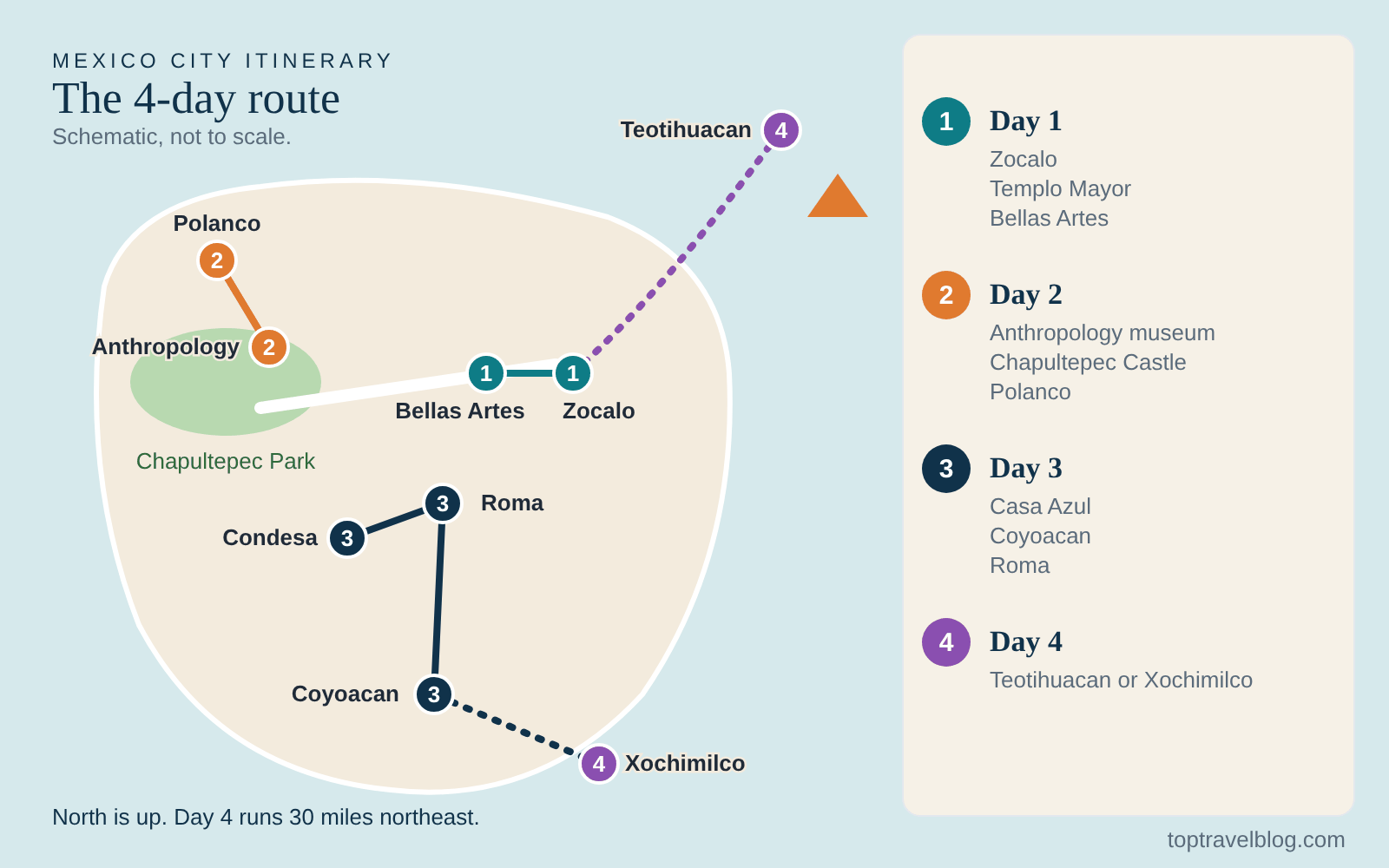
Every day of this Mexico City itinerary uses one district: Day 1 is the Centro Histórico, Day 2 is Chapultepec and Polanco, Day 3 is Coyoacán and the Roma and Condesa neighborhoods, and Day 4 is Teotihuacan or the canals of Xochimilco.
The verdict in one sentence: this is one of the best-value big cities in the Western Hemisphere, but it is huge, high and loud, so the plan works when you keep each day to one part of town and eat well instead of racing. It suits first-time visitors, couples, friends, food-focused travelers and families with kids old enough to walk a few miles.
It is less suited to anyone who wants a beach (see the Riviera Maya and Puerto Vallarta guides below) or who expects to cover the whole metro area in a long weekend.
I have been to Mexico City several times, in the dry season and in the afternoon-thunderstorm months, and the trips that went best were the least ambitious on paper. What follows is the Mexico City itinerary I would hand a friend: the order of days that avoids sitting in traffic, current ticket prices and transit fares as of late 2026, the two or three reservations that really matter, where to sleep, and the mistakes I watch visitors make in the first 48 hours.
Quick facts: this Mexico City itinerary at a glance
- Best for: first-time visitors, couples, friends, food travelers, and families with kids 8 and up.
- Ideal trip length: 4 full days. Arrive the evening before, because the city sits at about 7,350 feet and the first day goes better after a night of sleep.
- How to get around: the Metro is 5 pesos a ride, Metrobús is 6 pesos, and ride-hailing apps fill the gaps for a few dollars a trip. No rental car.
- Booking priorities: Frida Kahlo Museum timed tickets (the general ticket is 320 pesos), a table at any tasting-menu restaurant you care about, and a driver or bus plan for Teotihuacan.
- Museum entry: the National Museum of Anthropology, Templo Mayor, Chapultepec Castle and Teotihuacan are each 210 pesos for foreign visitors. Most are closed Mondays.
- Key caveats: altitude and thin air on day one, afternoon rain from roughly June to September, tap water you should not drink, and the U.S. State Department advises increased caution in Mexico City, especially at night outside well-patrolled areas.

Best time to go: when this Mexico City itinerary works best
If I could only pick one stretch, it would be March through May, or the dry months of November through February if you can handle cool mornings. The city sits at roughly 7,350 feet, so it is never tropical: days are warm and dry in spring, evenings drop quickly, and the sun is stronger than you expect.
Rain is the other variable. From about June to September the pattern is a clear morning and a heavy storm between 3 and 6 p.m., which is manageable if you plan indoor stops for the afternoon.
Here is how I think about each stretch of the year, because the right Mexico City itinerary changes with the calendar.
November to February: dry, sunny, cool at night
This is the stretch I recommend most often. Days are mostly sunny and pleasant, usually in the 60s and low 70s Fahrenheit, while nights in December and January can fall into the 40s. Bring a real jacket for the evenings, because most homes, restaurants and hotels have no central heating.
Early November is Day of the Dead, which reshapes any Mexico City itinerary and is covered below, and the last two weeks of December are busy with domestic travelers. Air quality can be poorer in the dry winter months, so if you are sensitive to smog, plan the outdoor walks for the morning.
March to May: the warmest, driest weeks
April and May are the hottest months, with afternoons in the upper 70s and low 80s and strong sun at altitude. Wear sunscreen even on cloudy days. The jacaranda trees bloom purple across the city in March and April, which is the best free show in town and makes the Roma, Condesa and Coyoacán walks on Day 3 especially pretty.
For a spring Mexico City itinerary, note that Holy Week (Semana Santa) empties the city of locals and fills the highways, so museums are quieter but the pyramids and Xochimilco get crowded with Mexican families.
June to September: afternoon storms, green parks, lower prices
Summer is the rainy season. Mornings are usually clear and cool, then clouds stack up and the rain arrives, often with hail and flooded street corners. A rainy-season Mexico City itinerary works if you flip each day: outdoor sights in the morning, museums and long lunches after 2 p.m., and a pocket umbrella always in the bag.
Hotel rates are softer than in the dry months, and the parks are at their greenest. The trade is traffic: a short ride that takes 15 minutes at 11 a.m. can take an hour at 5:30 p.m. in a downpour.
October: the quiet start of the best season
The rains taper off in October, the air clears, and the city starts filling up for Day of the Dead. Mid-October is one of my favorite times to go, because the weather is good and the ofrendas (altars) are beginning to appear in plazas and shops before the heaviest crowds arrive.
Day of the Dead: late October and early November
Day of the Dead is celebrated on November 1 and 2 and the city fills with altars, marigolds, face painting and a large parade. It is a family holiday first, so go in with respect: no costumes that mock the dead, ask before photographing people at cemeteries, and remember that some neighborhood events are private family time. The city’s tourism office lists the official events at mexicocity.cdmx.gob.mx.
Book rooms three or four months ahead for this window, and expect prices to be noticeably higher. If you are building your first Mexico City itinerary around the holiday, add a fifth day for the cemetery and neighborhood events, which sprawl across the city.
Tip: Mexico is a country of long weekends and national holidays. The big ones are Semana Santa, the Independence Day weekend around September 16, Day of the Dead, and the last two weeks of December. Museums and archaeological sites fill with Mexican families on those dates, so arrive at opening time.
If you are still deciding on dates, my general trip-building process is laid out in the guide on how to plan a trip step by step. The short version is to pick your month first, then your length, then everything else.
How many days you really need for a Mexico City itinerary
Four full days is the number I would defend for a Mexico City itinerary. Mexico City is one of the largest metro areas on earth, and the sights are scattered, so each day needs a single anchor district. Four days gives you the historic center, Chapultepec and Polanco, Coyoacán and the Roma and Condesa neighborhoods, and one day trip, with a half-day of slack in each.
If you only have 2 or 3 days
For a two-day Mexico City itinerary, I would do Day 1 (Centro Histórico) and Day 2 (Chapultepec and the anthropology museum, then dinner in Roma or Polanco). You skip the pyramids and Coyoacán and you will feel it, but it is a legitimate long weekend.
For three days, add Day 3 (Coyoacán, Casa Azul and Roma and Condesa) and save Teotihuacan for the next trip. Do not try to squeeze Teotihuacan into a three-day Mexico City itinerary unless you leave at 8 a.m. and give up the museum afternoon.
If you have 5 days or more
A fifth day on your Mexico City itinerary lets you do both Teotihuacan and Xochimilco, or add the University City campus (UNAM, a UNESCO site with Rivera and Siqueiros murals), the Basilica of Guadalupe, or a long lunch you do not rush. Day six and seven are good for Puebla or Cuernavaca, but at that point I would also ask whether you want a beach finish.
Many travelers pair the capital with the coast. A week might be four days here and three in Tulum; the Tulum travel guide and the Riviera Maya itinerary cover that second half, and the Puerto Vallarta itinerary works the same way on the Pacific side.
Where to stay in Mexico City
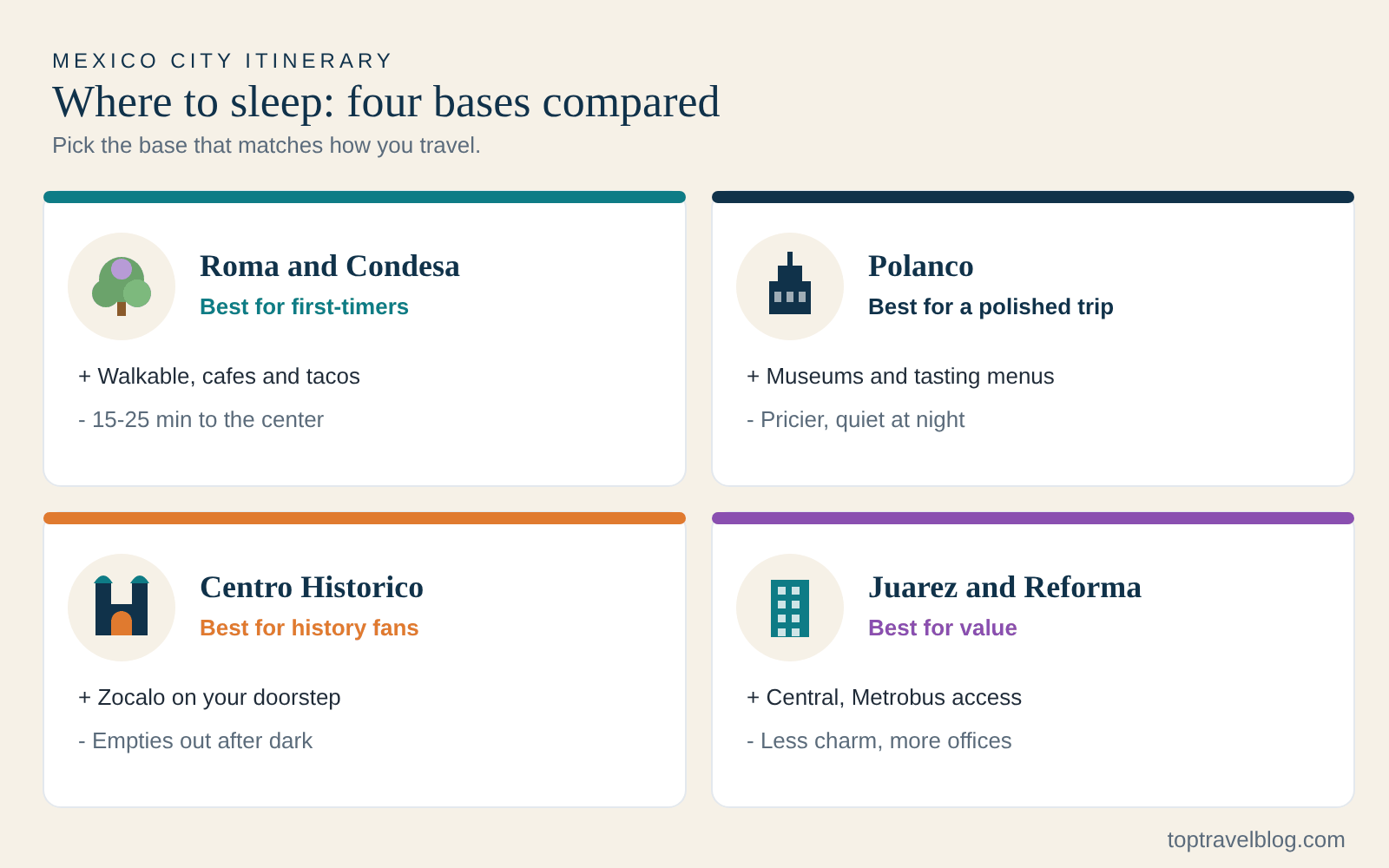
For a first Mexico City itinerary I recommend Roma Norte or Condesa. Both are walkable, tree-lined, packed with restaurants and cafes, and a 15 to 25 minute ride from the Centro Histórico and Chapultepec. The other three areas below make sense for specific trips.
Roma Norte and Condesa
Best for: first-timers, couples, food lovers
Art Nouveau mansions, Parque México, Avenida Amsterdam, and the densest cluster of good restaurants and coffee shops in the city.
Trade-off: it is popular with foreign remote workers, so rates run higher than the rest of the city and the streets feel less local. Quiet side streets away from Avenida Álvaro Obregón sleep better.
Polanco
Best for: upscale travelers, short museum trips
The shopping and fine-dining district beside Chapultepec Park. Wide avenues, hotels with real service, and the Soumaya and Jumex museums nearby.
Trade-off: it is the most expensive area and feels corporate after dark. It is the best choice if you want to walk to the anthropology museum on Day 2.
Centro Histórico
Best for: history fans, short stays
You wake up near the Zócalo, the cathedral and Templo Mayor, and you are on the Metro in two minutes.
Trade-off: it empties out after dark, can be noisy, and the street scene at night is rougher. I would stay here only if you will be in at a reasonable hour.
Juárez and Reforma
Best for: budget-minded, central
Between Centro and Chapultepec along Paseo de la Reforma, with chain hotels, a lot of good food and quick Metrobús access.
Trade-off: less charm than Roma, with some blocks that feel like office towers. It is good value for a first night near the airport route.
Whichever area you choose for your Mexico City itinerary, book a hotel or an apartment with good reviews that mention noise and air conditioning or windows. Mexico City hotels add 16 percent VAT plus a local lodging tax of roughly 3 percent, and many mid-range properties list rates before tax. Ask for a room above street level if you are a light sleeper; early morning delivery trucks and weekend parties are routine.
The 4-day Mexico City itinerary, day by day
A few ground rules before the days start. Most museums and archaeological sites in the city are closed on Mondays, so the plan below assumes you arrive on a Tuesday through Friday. If your first full day is a Monday, use the swap at the end of this section.
Sundays are busy with local families, and the free Sunday admission applies to Mexican nationals and resident foreigners, not tourists, so you pay the full price either way.
Distances matter more than they look on a map, and they shape this Mexico City itinerary more than any attraction does. Traffic here is slow in a way that surprises Americans, so I order each day to keep rides short and use the Metro or Metrobús when a route is straight. Allow 30 to 45 minutes between districts and do not stack two far-apart sights back to back.
Day 1
The Centro Histórico: Zócalo, ruins and the Palace of Fine Arts
Morning: the Zócalo, the cathedral and the Palacio Nacional
Start your Mexico City itinerary at the Zócalo at 9 a.m., when the square is huge, flag-lined and still quiet. This is the main plaza of the capital and one of the largest public squares in the world. On one side is the Metropolitan Cathedral, built over roughly 250 years, which is visibly sinking, and the floor is angled slightly in places. Go in; entry to the main nave is free.
On the east side, the Palacio Nacional (the president’s offices) has free entry and Diego Rivera’s murals of Mexican history along the main staircase. Bring your passport, because you must show ID, and expect a security line. Allow 45 to 60 minutes.
If the plaza is closed for an event, which happens often, walk around the edge to Calle Moneda and the Templo Mayor entrance instead. Stage setups for concerts and marches are routine, and a closed Zócalo is not a sign of trouble.
Late morning: Templo Mayor and the Aztec capital under the city
A block north of the cathedral, the Templo Mayor was the main temple of Tenochtitlan, the Aztec capital that stood here before the Spanish arrived. Excavations began in the 1970s after workers uncovered a huge carved stone disc of the goddess Coyolxauhqui. The outdoor ruins are a maze of platforms and stone walkways, and the attached museum holds the best of what was found.
Tickets are 210 pesos for foreign visitors (105 for Mexican nationals and residents), the site is closed Mondays, and I would give it 90 minutes. The INAH sites database lists the national museums and archaeological zones if you want to plan around other stops.
Lunch: tacos, a market or a historic cafe
For a first meal, walk west on Calle 5 de Mayo to Café de Tacuba, which has been serving enchiladas and hot chocolate since the early 1900s in a tiled dining room. It is not cheap by neighborhood standards but it is atmospheric and reliable. For something cheaper and quicker, the stalls around the Mercado San Juan and the taco counters on Calle Bolívar are the kinds of places locals use for a standing lunch.
Order a few tacos al pastor or suadero, add salsa carefully, and drink bottled water or a fresh agua de jamaica from a place with busy turnover. I explain street-food rules in the food section below.
Afternoon: Casa de los Azulejos, Torre Latinoamericana and Bellas Artes
Continue west on Madero, the pedestrian street, to the Casa de los Azulejos, an 18th-century palace covered in blue-and-white tile, now a restaurant and shop where you can look around for free. A few steps further is the Torre Latinoamericana. The observation deck on the 44th floor and above gives you a view across the entire basin, and it is the best way to understand how huge the city is. Go on a clear afternoon, before the storms in summer.
Then finish this Mexico City itinerary stretch at the Palacio de Bellas Artes, the white marble and gold-domed opera house that is the most photographed building downtown. Inside, the museum floors hold large murals by Rivera, Orozco and Siqueiros, including Rivera’s “Man, Controller of the Universe.” I would pay the roughly 90-peso entry for the murals alone.
Evening: Alameda Central and a late dinner
To close Day 1 of the Mexico City itinerary, walk through the Alameda Central, the park next to Bellas Artes, as the lights come on. Families sell balloons and elote (corn on the cob with mayo, cheese and chile), and it is a good place to watch the city unwind. For dinner, many travelers head back to Roma or Condesa. If you are staying downtown, a sit-down meal on Calle Regina, a pedestrian street a few minutes south of the Zócalo, is lively and busy until late.
Logistics: Day 1 of the Mexico City itinerary is about 4 to 5 miles on foot. Zócalo to Templo Mayor, 5 minutes. Templo Mayor to Madero and the tile house, 12 minutes. Madero to Bellas Artes, 10 minutes. The Metro (Zócalo and Bellas Artes stations) connects the two ends in 8 minutes for 5 pesos.
Watch out: Pickpockets work the Metro, the Zócalo crowds and the pedestrian streets, usually in pairs. Carry your phone in a front pocket or zipped bag, keep your wallet to a small amount of cash, and do not stand holding your phone by an open Metro door. Skip the aggressive photo-for-money characters in costumes; a polite no and a keep-walking is enough.
If it rains: swap the Torre Latinoamericana for the Museo Nacional de Arte (MUNAL) beside Bellas Artes, and linger over a long lunch. With kids: in this Mexico City itinerary the observation deck and the Alameda are the hits; the cathedral and the Palacio Nacional run long for little ones.
Day 2
Chapultepec, the anthropology museum and Polanco
Morning: the National Museum of Anthropology
On Day 2 of the Mexico City itinerary, arrive at the National Museum of Anthropology when it opens at 9 a.m. This is the museum I would not skip from any Mexico City itinerary, and the reason is the Mexica (Aztec) hall, which holds the huge Sun Stone, and the ground-floor halls on Teotihuacan, the Maya and Oaxaca. The building itself is an architectural landmark with a vast courtyard and a dramatic umbrella fountain.
The museum is open Tuesday through Sunday, 9 a.m. to 6 p.m., and the ticket is 210 pesos for foreign visitors. Plan three hours. If you are doing Teotihuacan on Day 4, go through the Teotihuacan hall carefully today and you will understand the site before you visit it.
Late morning: Chapultepec Park and the castle
Chapultepec is one of the largest urban parks in the Western Hemisphere, about twice the size of Central Park. From the museum, walk or take a short ride up to Chapultepec Castle, the hilltop palace that was home to emperor Maximilian and later the presidents. It now houses the National Museum of History, with period rooms, murals and a long terrace over the city.
Tickets are 210 pesos for foreigners and the castle is closed Mondays. The hill is a 10 to 15 minute uphill walk, or ride the little tram (Chapultrén). Give it two hours, including the views.
On a Sunday, ignore the crowded lawn and walk out to Paseo de la Reforma, which closes to cars for a long stretch in the morning for a free bike ride and walking day. Bikes are available to rent at the stations along the route, and it is a nice contrast with the weekday traffic.
Lunch: Polanco, a short ride away
From the park, Polanco is a 10 to 15 minute walk or a short ride. The tree-lined streets around Calle Presidente Masaryk and Parque Lincoln are good for lunch. This is the district for high-end Mexican restaurants, including Pujol and Quintonil, both of which are on the world’s best-restaurant lists and need reservations well in advance. For a simpler meal, taquerias and cafes around Avenida Horacio fill the same need for a third of the price.
If you want one splurge on the trip, lunch is easier to book than dinner and often costs a little less.
Afternoon: Museo Soumaya and a walk
The Museo Soumaya, a silver, hourglass-shaped building in Plaza Carso a few minutes’ ride from Polanco, holds a large collection of European and Mexican art, including a set of Rodin sculptures, and admission has long been free. It is a good quiet hour if the museum morning has worn you out. The nearby Jumex Museum is better for contemporary art and is the stronger choice for modern-art fans.
If you would rather walk, wander Parque Lincoln and the side streets of Polanco, where small bookstores, bakeries and design shops make an easy afternoon.
Evening: dinner in Polanco, Roma or a mezcal bar
Dinner is your choice between a tasting menu in Polanco, a lively dinner in Roma Norte, or a smaller meal and an early night. After a morning at the museum and a day at altitude, I usually go for the third. If you want a drink, a mezcal bar in Roma or Condesa will pour you flights with an explanation, and the staff are usually happy to guide a beginner.
Logistics: Day 2 of the Mexico City itinerary is about 4 to 6 miles of walking. Museum to castle, 15 minutes on foot. Castle to Polanco, 20 to 25 minutes on foot or 10 by ride. Polanco back to Roma or Condesa, 20 to 30 minutes by ride depending on traffic.
Tip: Altitude hits hardest on the second afternoon. If you get a headache or feel winded on stairs, drink water, slow your pace, and avoid heavy alcohol on the first two nights. Most visitors adjust within 48 hours.
If it rains: this day works well, because the museum and the castle are mostly indoors. With kids: the Chapultepec Zoo is free, and the Papalote Children’s Museum is nearby. In a hurry: go through the anthropology museum in 2 hours and skip the castle.
Day 3
Coyoacán, Casa Azul and the Roma and Condesa neighborhoods
Morning: the Frida Kahlo Museum (Casa Azul)
Book the earliest Frida Kahlo Museum slot you can get for Day 3 of the Mexico City itinerary and arrive 10 minutes early. The Casa Azul in Coyoacán is where Frida Kahlo was born, lived with Diego Rivera for years, and died; today it is a museum of her paintings, her clothes, her studio and the garden. General admission is 320 pesos through the museum’s official ticket site.
The museum is open Tuesday to Sunday (Wednesdays start at 11 a.m.), closes at 6 p.m., and the tickets are timed, with popular dates selling out. A visit takes about an hour, which is shorter than most visitors expect.
Skip the third-party resellers who add a large markup. The official site sells timed tickets directly, and I would buy yours the same week you book flights. Photos of the artworks are allowed on a phone without flash, and the museum has no parking, so take a ride-hailing car or the Metro.
Late morning and lunch: Coyoacán’s plazas and market
From Casa Azul, it is a pleasant 15-minute walk through quiet cobbled streets to the Jardín Centenario and the Plaza Hidalgo, the two linked plazas at the center of Coyoacán. This old village was swallowed by the city long ago and still feels like a town: street musicians, balloon sellers and families on Sundays. The church and the old Casa de Cortés sit on the plaza.
For lunch, the Mercado de Coyoacán is the place I would go: tostadas piled with ceviche, mole and cochinita pibil from stalls that locals queue at, usually for around 40 to 90 pesos each. Eat at the busiest counter and you will rarely go wrong.
Afternoon: Viveros and an easy ride back
On Day 3 of the Mexico City itinerary, walk off lunch in the Viveros de Coyoacán, a wooded nursery park a few blocks away where joggers run under tall eucalyptus trees. It is one of the calmest spots in the city and a reasonable place for a 30-minute stroll.
Then take a ride-hailing car or the Metro back to Roma or Condesa. A car takes 25 to 40 minutes in normal traffic, and the Metro Line 3 goes north in a straight line, though it is crowded at rush hour. If you want a second museum, the Anahuacalli, a Diego Rivera-designed volcanic stone pyramid housing his collection of pre-Hispanic art, is a short ride from Coyoacán and a good swap for the Viveros walk.
Evening: Roma Norte, Parque México and Condesa
Spend the last light of the afternoon walking Roma and Condesa. Start on Avenida Álvaro Obregón, the tree-lined median of Roma Norte, with its sculptures and benches. Cross into Condesa and loop through Parque México, a 1920s park with a duck pond, an open-air theater and dog walkers at all hours. Avenida Amsterdam, the oval street that wraps around the old racetrack, is one of the nicest walks in the city.
Bookstores, bakeries and design shops line the side streets. Pick one bakery for a pastry and one cafe for coffee, then sit on a bench and watch the evening begin.
For dinner, this is where the capital’s dining scene is easiest to sample on a Mexico City itinerary. You can eat well in Roma and Condesa at almost any price, from tacos at a counter to a chef’s-table dinner. Reserve for Friday and Saturday nights, and walk in on weeknights. If you want a nightcap, a mezcalería or a rooftop bar is never more than a few blocks away.
Logistics: Day 3 of the Mexico City itinerary is a gentle 4 to 5 miles. Casa Azul to the Coyoacán plazas, 15 minutes. Plazas to Viveros, 10 minutes. Coyoacán to Roma, 25 to 40 minutes by car. Roma to Condesa on foot, 10 to 15 minutes.
If it rains: do Casa Azul and the Anahuacalli, then spend the afternoon in a cafe or a bookstore in Roma. With kids: the Viveros, Parque México and the Coyoacán plaza (with its tamales and ice cream) are the draws. Without a big appetite: a market lunch and a late snack is enough.
Day 4
Teotihuacan, or a day on the canals of Xochimilco
Option A: Teotihuacan, the pyramid day for your Mexico City itinerary
Teotihuacan is the largest pre-Hispanic city in the Americas and sits about 30 miles northeast of the center. At its peak, around the 5th century, it was among the biggest cities in the world. The Avenue of the Dead runs for about a mile past the Pyramid of the Moon, the Pyramid of the Sun and the Citadel. The scale is hard to appreciate in photographs.
Admission is 210 pesos for foreign visitors. Go as early as you can, because the site gets hot by midday and the tour buses arrive between 10 and 11 a.m.
Getting there on a Mexico City itinerary: the simplest way is a public bus from the Autobuses del Norte terminal, which takes roughly an hour to an hour and a half depending on traffic and costs a few dollars each way. Ask for the Teotihuacán bus and get off at the gate you want. Alternatively, hire a driver or join a small-group tour with a guide, which costs more but saves you the logistics and gives you a context for what you are looking at.
Plan 3 hours at the site and 2 to 3 hours of round-trip travel. You are back in the city by 2 to 3 p.m.
Bring a hat, sunscreen and water, because there is almost no shade, and wear flat shoes. Climbing the Pyramid of the Sun has been closed to visitors for years, but you can walk up part of the Pyramid of the Moon’s platform for the view down the avenue, depending on what the site allows that day. Hot-air balloon flights at sunrise are available, and they are a splurge you can skip.
Avoid the touts. People at the gates and along the avenue will sell you handmade obsidian trinkets, jaguar-call whistles and guide services. A firm “no, gracias” works. If you want a guide, hire one at the official entrance, agree on the price and the duration first, and pay at the end.
Option B: Xochimilco and its floating gardens
If you have already seen the pyramids or do not want a long transit day, Xochimilco is the alternative. The canals and chinampas (raised farm plots) here are what remains of the lake system the Aztecs farmed. You rent a trajinera, a flat-bottomed colorful boat that holds up to about 18 people, and drift for an hour or two with a pole man steering.
The going rate is roughly 700 to 800 pesos an hour per boat, not per person, so it is cheapest with a group. Buy from the ticket window at an official embarcadero such as Nuevo Nativitas, Cuemanco or Fernando Celada, and agree on the price and time before you step in.
Mariachi and food boats paddle up alongside; ask the price of a song or a beer before you accept, and bring cash. Go on a weekday morning to avoid the weekend party boats.
Xochimilco pairs nicely with the Anahuacalli museum and the Coyoacán area, so if you chose this option, move Anahuacalli from Day 3 to Day 4 and finish with an early dinner.
Evening: a farewell taco crawl
Whichever option you choose, end the Mexico City itinerary with a taco crawl. Tacos al pastor, shaved from a spit with pineapple on top, are the city’s signature, and a good taqueria in Roma or Condesa will be crowded and cheap. Order three or four at a time rather than ten, and stay for the second round. Finish with churros and hot chocolate, or go to a mezcal bar for a last flight.
Tip: The bus terminal for Teotihuacan, Autobuses del Norte, has its own Metro station on Line 5, so the Metro is the cheap way to reach it. Leave your hotel by 7:30 a.m. in summer, because the site is packed and the heat is hard by noon.
If your first full day is a Monday
Many museums are closed Mondays, so the Mexico City itinerary above needs a swap. On Monday, spend the day outdoors: walk Chapultepec Park and Reforma, ride the Xochimilco canals (the boats run daily), and wander Roma and Condesa. Then move the Centro Histórico museums to Tuesday and the anthropology museum to Wednesday.
The Zócalo, the cathedral and the Palacio Nacional’s courtyard stay open to look around, and Bellas Artes’ public areas have different hours, so I would save the indoor ticketed sights for Tuesday through Sunday.
Getting around: Metro, Metrobús, ride-hailing and airport transfers
Mexico City has an enormous transit system, and for this Mexico City itinerary you will use a mix of walking, the Metro and ride-hailing apps. As of mid-2026, the Metro costs 5 pesos per ride with free transfers between lines, and the Metrobús costs 6 pesos. The city government decided against a fare increase for the World Cup year, according to TV Azteca’s fare report.
The Metro: fast, cheap and crowded
The Metro runs from about 5 a.m. on weekdays, later on weekends, and trains are loud, packed at rush hour (roughly 7 to 10 a.m. and 5 to 8 p.m.) and a pickpocket favorite. Buy the rechargeable Tarjeta de Movilidad Integrada at a station window and top it up in small amounts. It also works on Metrobús.
The front cars on most lines are reserved for women, children and seniors, and you will see signs and guards at platform ends. If you are traveling with a bag, the first car after the women’s cars is quieter and a good choice. Avoid the Metro with a big suitcase.
Metrobús, trolleybuses and the Cablebús
The Metrobús is a bus rapid transit system with its own lanes, which makes it faster than cars on long straight routes like Avenida Insurgentes. Line 4 goes to the airport. Pay with the same card. The Cablebús (gondola lines) is cheap and spectacular but mostly serves neighborhoods outside the tourist loop, so treat it as an excursion rather than a commute.
Ride-hailing and taxis
For most trips between districts, I use Uber or DiDi. The price is shown before you book, fares for a 20-minute ride are often just a few dollars, and the driver’s plate and name are on the app. Wait inside until the car arrives, check the plate, and sit in the back seat.
If you hail a street taxi, use a taxi from a hotel or restaurant stand (sitio) and not one waved down on the street, particularly at night. This is the advice I give every friend, and it is also in the U.S. State Department’s guidance below.
From the airport to your hotel
Mexico City’s Benito Juárez International Airport (AICM) has two terminals. On any Mexico City itinerary the cheapest airport route is Metrobús Line 4, which leaves from Terminal 1 (gate 7) and Terminal 2 (gate 2), runs from about 4:30 a.m. to midnight, and costs 30 pesos. It takes you to the Centro Histórico and Paseo de la Reforma. Details are on the airport’s transportation page. Pay with a contactless card, phone or Metrobús card, with no cash.
For Roma or Condesa, I take an authorized airport taxi from the booth inside the terminal (you pay in advance for a fixed fare) or a pre-booked car. It takes 25 to 50 minutes depending on traffic, and the cost is usually in the range of a few hundred pesos.
The airport is also a stop on trips to the Caribbean coast; the Cancun travel guide covers the other end of that flight, which is only about two hours.
What the State Department says about safety
I never call a big city safe, and this one is no exception. The U.S. State Department’s Mexico travel advisory lists Mexico City at Level 2, exercise increased caution, noting frequent petty crime in tourist and non-tourist areas and advising extra care at night outside well-patrolled areas.
In practice, I stick to the districts in this Mexico City itinerary, take ride-hailing after dark, keep valuables out of sight, and avoid walking alone late at night away from busy streets. Those habits are normal in any large city, and they work here.
What to eat and how to eat it safely on a Mexico City itinerary
Food is half the reason to build a Mexico City itinerary at all, and the city rewards people who eat in the right places at the right times. The big meal is lunch, called the comida, usually between 2 and 4 p.m. Dinner is later and lighter than in the United States, and many restaurants do not fill until 8:30 or 9 p.m.
Tacos, and which ones to order
Tacos al pastor (marinated pork from a vertical spit, with pineapple) are the city’s signature. Suadero (a soft cut of beef), campechano (a mix of meats), tripa, cabeza and carnitas are the other regulars. Tacos are small, so order three or four and add more. A plate of tacos at a busy stand usually runs from 15 to 40 pesos each, depending on the district.
Salsas range from mild to hot. Taste a drop first, because the red one is often the hot one. A squeeze of lime and a spoon of onion and cilantro are free at most counters.
Breakfast, markets and street snacks
Breakfast here is a serious meal. Chilaquiles (fried tortilla chips in red or green salsa, with egg or chicken) and huevos divorciados are standard. For something sweet, a pan dulce from a panadería with a coffee costs under two dollars. In markets, a tlacoyo (a stuffed blue-corn cake) or a quesadilla with squash blossom is cheap, hot and filling.
Mid-afternoon, look for elote or esquites (corn in a cup with mayo, cheese and chile), churros with chocolate, and fresh juices. In the evening, tamale carts roll by with a recorded call that you will recognize before you learn the words.
Tap water, ice and how I handle street food
Do not drink the tap water. Brush your teeth with bottled or filtered water if you have a sensitive stomach, and use the bottled water most hotels leave in the room. Ice in restaurants is usually made from purified water, and I do not worry about it in a reputable place.
For street food, I follow the same rule everywhere: eat at stands with a crowd, where the food is made fresh in front of you, and avoid anything that has been sitting out. Your stomach may still need a day or two to adapt, so keep the first dinner simple and carry electrolyte packets and an anti-diarrheal.
The tasting-menu question
Mexico City has several of the best restaurants in Latin America, and they are comparatively affordable next to their New York or London equivalents. They also book out months ahead. If one of them is a reason you came, reserve at the first opportunity. If not, a long lunch at a good bistro in Roma or a market-hall tasting does the job for much less.
A few rules on tipping and bills. A tip of 10 to 15 percent is standard at sit-down restaurants, and it is not included unless the bill says so. Ask for the check by saying, “La cuenta, por favor.” Many places have a card terminal that is brought to the table, and you should keep it in sight. Small shops and stalls usually take cash only.
What a Mexico City itinerary costs
A Mexico City itinerary is cheaper than most U.S. city trips for food, transit and museums and similar in price to them for good hotels. Exchange rates move, but at roughly 18 pesos to the dollar, which is where I have budgeted, a 210-peso museum ticket is about $11 to $12.
Budget: roughly $90 to $140 a day
A hostel dorm or a simple private room, tacos and market lunches, Metro rides and the odd ride-hailing trip, and two or three paid museums. This is a perfectly good way to see the city. The trade-off is a smaller room, more noise and less flexibility on late nights.
Mid-range: roughly $200 to $320 a day
A well-reviewed boutique hotel or apartment in Roma, Condesa or Polanco, a sit-down lunch and a good dinner, ride-hailing for most trips, and every paid sight in this plan. This is the tier I would recommend for most couples and friends. Day 4 with a private driver or small-group tour to Teotihuacan lands in this range.
Comfortable: $400 and up
A high-end hotel in Polanco, one tasting menu, private guides at the museums and a driver on the long days. The prices at the top end rise quickly, but you will rarely pay the equivalent of a comparable New York meal or room.
The honest summary for a Mexico City itinerary: lodging is the biggest line, food is the best value, and the paid sights add up to about $50 to $70 per person across the four days. If you want a tropical add-on after the city, the Los Cabos travel guide and the Punta Cana travel guide show how beach prices compare.
Money, cards and tipping
Cards work in most restaurants, hotels and big shops, but carry 1,000 to 2,000 pesos in cash for markets, tips, taxis and stalls. Use an ATM inside a bank or a mall, and decline the “dynamic currency conversion” prompt to be charged in dollars; always choose pesos. Notify your card issuer before you fly, and carry a no-foreign-fee card if you have one.
Tickets and reservations to book ahead
Mexico City needs less advance booking than New York or Paris, which is part of its charm. The things I reserve before a Mexico City itinerary begins are short.
The Frida Kahlo Museum. Timed tickets sell out, and the official site shows low availability on busy dates. Book as soon as your dates are set.
Any tasting-menu restaurant. The top spots in Polanco and Roma open reservations well ahead, and the best tables go first.
Your Teotihuacan transport. The public bus needs no booking, but a private driver or small-group tour with a guide is worth securing a week ahead in high season.
Hotels around Day of the Dead and Holy Week. Three to four months ahead.
Everything else, including the Anthropology Museum, Templo Mayor and the castle, you can buy at the door. Arrive at opening time on weekends and holidays.
For the broader process of choosing dates, booking flights and sequencing a trip like this, the step-by-step trip planning guide lays out the order I use.
Common mistakes on a Mexico City itinerary
1. Trying to see too much on day one
You land at altitude after a flight, and the city is much bigger than it looks on a map. The most common mistake I see in a Mexico City itinerary is a day-one plan with five stops across three districts. Pick one area and one museum, then eat a good dinner and sleep.
2. Ignoring the altitude
At about 7,350 feet, alcohol hits harder and stairs feel steeper. Drink water, take it easy on the first night, and do not schedule a hike on day one.
3. Visiting museums on Monday
Many are closed. Put outdoor sights on Monday and keep the big museum days for Tuesday through Sunday.
4. Booking Casa Azul at the last minute
This is the ticket that sells out. Book it when you book your flights, and pick a morning slot.
5. Hailing taxis off the street
Use ride-hailing apps or a taxi from a hotel or a sitio. It costs a little more, and it removes the risk of an unlicensed car.
6. Drinking tap water or skipping hand-washing
Most traveler’s stomach trouble comes from water and from hand-to-mouth habits. Use bottled water, and wash or sanitize your hands before you eat.
7. Scheduling a full Mexico City itinerary in the rainy afternoons
From June to September, afternoons are for museums and long lunches. Put your outdoor walks in the morning.
8. Flashing valuables on the Metro
Phones are stolen out of hands near doors. Use a front pocket and keep your head up.
9. Forgetting that the capital is only one part of a trip
Two or three days of coast afterward makes the whole vacation better. The 7 days in Costa Rica itinerary and the Aruba travel guide are good next-trip ideas if Mexico leaves you wanting more warm-weather planning.
Frequently asked questions about this Mexico City itinerary
Is 4 days enough for a Mexico City itinerary?
Yes, and it is the length this Mexico City itinerary is built on. Four full days cover the historic center, Chapultepec and the anthropology museum, Coyoacán with Roma and Condesa, and a day trip to Teotihuacan or Xochimilco. Three days works if you skip the day trip. Five or more days let you add the University City campus, a slower pace or a night in Puebla.
What is the best area to stay in Mexico City for first-time visitors?
Roma Norte or Condesa. Both are walkable, packed with restaurants and cafes, and 15 to 25 minutes from the Centro Histórico and Chapultepec. Polanco is better if you want upscale hotels and walkable museum access, and the Centro Histórico suits history lovers who will be back in the hotel by dark.
Is Mexico City safe for tourists?
No big city is safe in an absolute sense, and the U.S. State Department lists Mexico City at Level 2, exercise increased caution. Petty crime is common, and extra care is advised at night outside well-patrolled areas. Millions of visitors have trouble-free trips by using ride-hailing after dark, keeping valuables out of sight and staying in the districts in this plan.
How much does the Metro cost and how do I pay?
A Metro ride costs 5 pesos and transfers between lines are free. Metrobús is 6 pesos. Buy the rechargeable mobility card at a Metro station and add money in small amounts; it works on both. The Metrobús to the airport costs 30 pesos and does not accept cash.
How do I get from the airport to my hotel in Mexico City?
The cheapest way is Metrobús Line 4 for 30 pesos from either terminal, about 4:30 a.m. to midnight. A prepaid airport taxi from the authorized booth, or a pre-booked car, is easier with luggage or at night. Expect 25 to 50 minutes to Roma, Condesa or Polanco depending on traffic.
How do I visit Teotihuacan from Mexico City?
Take a bus from the Autobuses del Norte terminal, about an hour to an hour and a half each way, or hire a driver or join a small-group tour. Admission is 210 pesos for foreign visitors. Arrive early, bring water, sunscreen and a hat, and expect to be back in the city by mid-afternoon.
What should I pack for a Mexico City itinerary?
Comfortable broken-in walking shoes, a light jacket for cool evenings, sunscreen, a compact umbrella or rain jacket for the summer months, and layers because the weather changes with the altitude and time of day. Bring a small zipped crossbody bag, a reusable water bottle and any medication you take, in its original container.
Is it worth adding a beach to a Mexico City itinerary?
Yes, if your Mexico City itinerary stretches to a week or more. Many travelers add three or four days on the coast after the capital. The Riviera Maya and Tulum are about two hours by air, and Puerto Vallarta and Los Cabos are on the Pacific side. Ask for the same hotel dates, so the connections are easy.
One last thing before you go
The thing I would do differently next time, every time, is leave one afternoon empty. Not an optional museum, not shopping time, just a gap. Some of my best hours in this city have been unplanned: a long lunch in a market that turned into a three-hour conversation, a walk through Parque México when the jacarandas were blooming, a wrong turn that ended at a perfect tamale cart.
A Mexico City itinerary is scaffolding. The city fills it in better than any list can.
The other thing I would say is to be kind to your own pace. Four days of this plan is roughly 18 to 22 miles of walking at altitude, plus a day trip. It is normal to hit a wall on the afternoon of Day 2, and the cure is a nap and a late dinner, not a third museum. Most people who come once come back, so build the first trip so that you want to.
Related planning guides
- How to plan a trip step by step — the order I use to go from a vague idea to a booked itinerary.
- Riviera Maya itinerary: 7 days of beaches, cenotes, ruins and resorts — the natural beach finish after the capital.
- Tulum travel guide: beaches, ruins, cenotes, where to stay and costs — a quick flight from Mexico City.
- Puerto Vallarta itinerary: 5 days of beaches, food and day trips — the Pacific-coast option.
- Cancun travel guide: where to stay, beaches and day trips — the other end of the most common Mexico City connection.