Here is the short answer on ETIAS for US citizens as of November 2026: it is a coming online travel authorization for Americans visiting Europe’s Schengen area and Cyprus, it costs €20 and lasts up to three years, and it does not exist yet. The European Union has not opened applications, has not published a start date, and has said it will announce one several months before launch. Nobody can apply for it today, and nobody legitimate is selling it.
That is the part most pages on ETIAS for US citizens bury under a pile of “apply now” banners. If a site is taking your money for ETIAS for US citizens right now, it is not the European Union, and the rest of this guide explains how to tell the difference.
The long answer is more useful, because ETIAS for US citizens will matter to a lot of 2027 trips once it starts. I have been tracking this system for years, and I have watched its start date slide from 2021 to 2022, 2023, 2024, 2025 and now into an open question. Planning a European trip around a rule that keeps moving takes a little structure, and that is what you get below.
Quick facts: ETIAS for US citizens at a glance
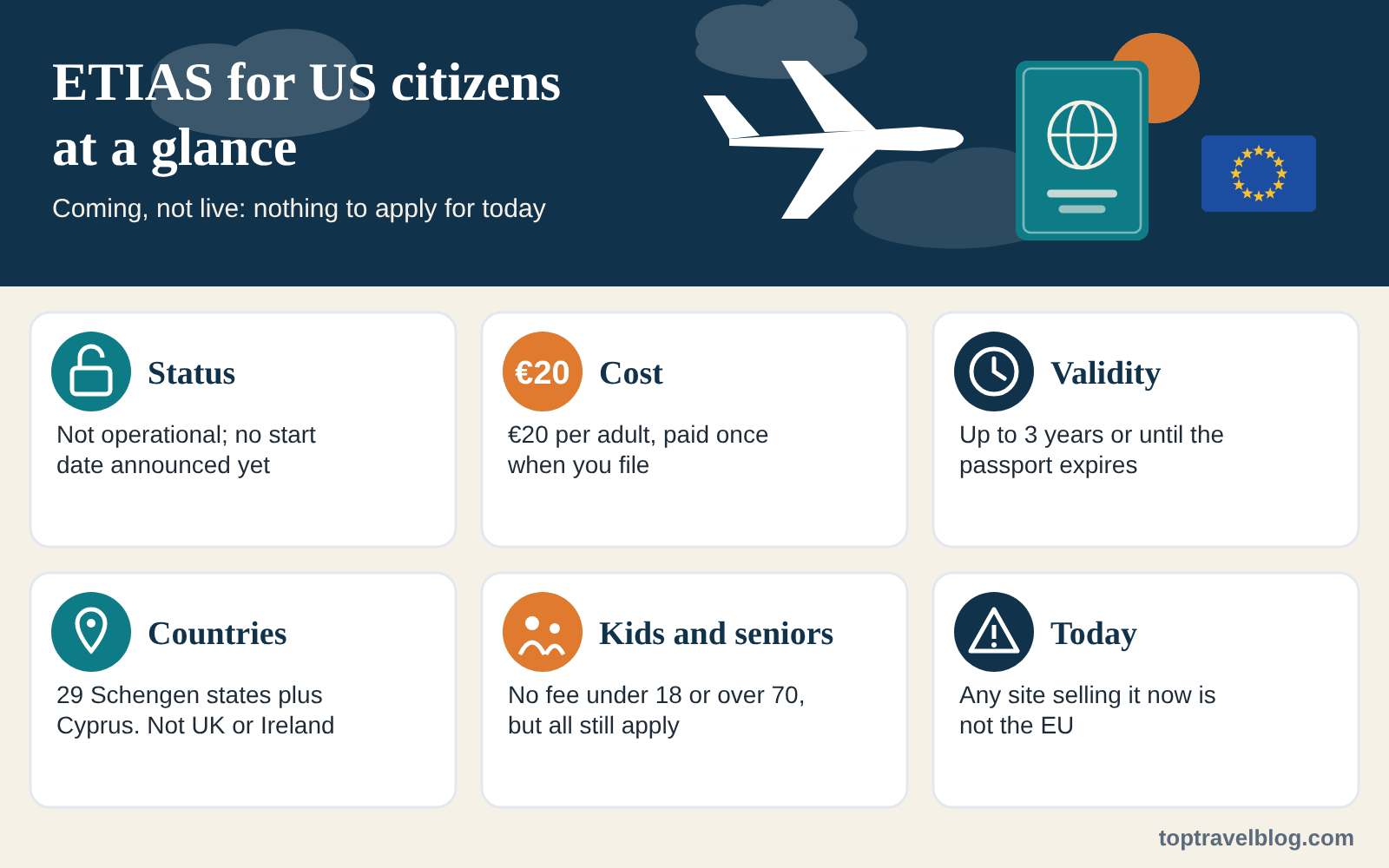
- What it is: a coming online travel authorization for visa-free visitors to 30 European countries, linked to your passport. It is not a visa.
- Status (November 2026): not operational. No applications are being collected and no start date has been announced.
- Cost: €20 per adult, one payment. No fee under age 18 or over 70, but every traveler still needs one.
- Validity: up to three years or until the passport expires, for stays of up to 90 days in any 180-day period.
- Countries: the 29 Schengen countries plus Cyprus. Not the UK and not Ireland.
- Today: travel on a valid passport and register under the Entry/Exit System, live since October 12, 2025. Anyone selling ETIAS now is not official.
I wrote this guide for American leisure travelers: people planning a week in Italy, a summer in Portugal, a cruise that touches Greece, or a layover that turns into three days in Amsterdam. I will cover what ETIAS for US citizens is, who needs it, what it will cost, what you will fill in, how it differs from the Entry/Exit System that is already running, and what to do while you wait.
What ETIAS for US citizens actually is
ETIAS stands for the European Travel Information and Authorisation System. For ETIAS for US citizens, think of it as a pre-screened permission slip attached to your passport. You answer a set of questions online, pay a fee, and the system runs your details against security and migration databases. Most of the time it approves you automatically within minutes. The approval is stored electronically, linked to the passport you used, and checked by the airline at check-in and by border officers on arrival.
ETIAS for US citizens is not a visa. Americans still do not need a visa for short stays in the Schengen area, and ETIAS does not change that. It does not extend how long you can stay, which remains 90 days in any 180-day period. It does not let you work. It is simply a gate you will pass through before the gate at the airport.
Why Europe is building it
The European Union wants to know who is coming before they arrive. At the moment an American can book a flight, board, land in Paris and meet a border officer who has never seen that person’s name. ETIAS moves the first check to the weeks or days before the trip, using the same logic the United States applies to visitors from visa waiver countries through ESTA, the Electronic System for Travel Authorization run by US Customs and Border Protection.
The official description from the European Commission calls it a largely automated IT system for visa-free travelers heading to the Schengen countries. You can read the Commission’s own summary on its ETIAS page, which states plainly that the system is not yet operational and that no applications are being collected.
What ETIAS for US citizens is not
Three misunderstandings come up constantly, so let me clear them out.
- It is not the Entry/Exit System. EES is a border registration scheme that records your fingerprints and photo when you first enter. It is already live. ETIAS is an authorization you obtain before you travel. The two will work together, but they are separate steps.
- It is not a Schengen visa. A visa is an application to a consulate, usually with an appointment and supporting documents. ETIAS is a form and a fee with no consulate involved.
- It is not a guarantee of entry. Even with approval, the officer at the border makes the final call. In practice that is rarely an issue for a normal tourist, but the paperwork is a permission to travel, not a promise.
If you want the border-registration side in detail, my guide to Europe EES explained walks through what happens at the booth, what the kiosks do, and why the first weeks had long lines at some airports.
The idea behind the name: authorization, not approval of you
I find the wording helpful. ETIAS authorizes a specific passport to travel for a specific window. If your passport changes, the authorization is gone. If the three years run out, you apply again. The system is built around the document, not around your reputation as a traveler, and that explains many of the rules in later sections, including why a renewed passport means a new application.
Is ETIAS for US citizens live? Status and launch timing
No. As of November 4, 2026, ETIAS for US citizens is not live: the European Commission’s page states that the system is not yet operational and that no applications are being collected. The same page says the European Union will announce the specific start date several months before launch. It does not name a quarter or a year. That sentence is the most important fact in this entire guide, so I will repeat what it means in practice: there is nothing to apply for and nothing to pay for.
How the start date kept moving
The idea was proposed in 2016 and the regulation was adopted in 2018. At that time the start was planned for 2021. The date then moved to 2022, then to 2023, then to the end of 2024, and then to 2025. Each delay of ETIAS for US citizens had its own explanation, mostly the sheer size of the IT build and the need for ETIAS to sit on top of other systems that had to be finished first.
The Entry/Exit System came first and had its own troubled rollout. EES started on October 12, 2025, in a phased way across the external borders of the participating countries, and the phase-in period ended with full operation on April 10, 2026. ETIAS was meant to follow, and for a while the official line was that it would start in the last quarter of 2026. That quarter is now almost over and the Commission’s page no longer carries that wording.
What the current lack of a date means for 2027 trips
My working assumption for trips in 2027 is that ETIAS for US citizens may or may not be mandatory when you fly, and that you should plan for both. I know that is unsatisfying, but any article giving you a firm date for ETIAS for US citizens is guessing, and the track record of the guessing is poor.
Here is how I think about it in three scenarios.
- It has not launched by your trip. You travel on your passport alone, as Americans do today, and you register at the border under EES like everyone else.
- It has launched and is in the optional phase. The regulation provides for a transitional period after launch during which the authorization is not yet compulsory. You could apply early or travel without it, depending on what the Commission announces.
- It is mandatory. You apply online, pay €20, and wait a few minutes to a few days for the decision before booking nonrefundable flights.
Tip: Because the EU has promised to announce the date several months ahead, you will not be surprised at the airport. A launch will come with a public announcement, a live official website and a period when airlines and travel sites report on it widely. Nothing in the current situation requires you to act today.
The transitional period and the grace period
The 2018 regulation builds in a soft landing. For an initial period after launch, set at six months in the regulation and extendable by the Commission, ETIAS is available but not required. After that, a further grace period applies in which travelers who have never needed ETIAS before and are making their first trip since it became mandatory can still be let in without it, provided they meet the other entry conditions.
I would not plan a trip around either window. The rules on both depend on the actual launch date, which does not exist, and the Commission can change the length of the first. Treat them as a cushion, not a strategy.
Why I do not trust date predictions
Search for the launch date and you will see dozens of sites promising a precise day. Many of them sell application services, so they have a reason to make ETIAS sound imminent. The honest sources, the Commission and the border agency that builds the system, avoid committing. When the official page drops a target quarter without a press release, believe the omission.
The same caution applies to the opposite claim. Some commentators say ETIAS will never happen. I do not believe that either. The regulation is law, the money has been spent, and the fee has even been raised. It will arrive. The only question is when, and for now the right posture is patient preparation. For a broader look at the paperwork side of a European trip, see my international travel documents checklist.
Who needs ETIAS for US citizens, and who does not
Once ETIAS for US citizens is mandatory, every American who is not an EU citizen and who is visiting the covered countries for a short stay will need one. That includes tourists, business travelers on short trips, people visiting family, and people in transit who enter the territory. It includes children of any age and travelers over 70, although those two groups pay no fee.
The 30 countries ETIAS will cover
ETIAS for US citizens applies to 30 European countries. Twenty-nine of them are in the Schengen area: Austria, Belgium, Bulgaria, Croatia, Czechia, Denmark, Estonia, Finland, France, Germany, Greece, Hungary, Iceland, Italy, Latvia, Liechtenstein, Lithuania, Luxembourg, Malta, the Netherlands, Norway, Poland, Portugal, Romania, Slovakia, Slovenia, Spain, Sweden and Switzerland. The thirtieth is Cyprus, which is not yet part of Schengen but is covered by the system.
One authorization works for all of them. You do not apply country by country, and you do not need to name every stop on the way. You do state where you plan to spend your first nights, but that is a data field, not a restriction.
Covered by ETIAS
Italy, France, Spain, Greece, Germany
All of the usual first-trip countries are in. The authorization is shared, so a two-week loop through three of them needs a single approval and a single fee.
Covered, easy to forget
Norway, Iceland, Switzerland, Liechtenstein
They are not in the European Union, but they are Schengen members and the system covers them. A Swiss rail trip needs the same permission as a Paris weekend.
Covered, not in Schengen
Cyprus
Cyprus sits in the EU but has not yet joined Schengen. ETIAS includes it, so a Greek island trip that adds Cyprus needs no second form.
Not covered
Ireland, United Kingdom
Ireland is in the EU but outside Schengen and ETIAS. The UK has its own scheme, the ETA, covered in my guide to the UK ETA for US citizens.
Not covered
Albania, Montenegro, Serbia, Turkey
These Balkan and nearby countries are outside the system and set their own rules for Americans. A day trip from Dubrovnik into Montenegro is a different country’s border.
Microstates
Monaco, San Marino, Vatican City
There are no routine border posts, so you reach them through France or Italy. You will already have entered a covered country, and that is where ETIAS applies.
Situations where an American does not need ETIAS
Some travelers hold documents that put them outside the scheme. The following do not need ETIAS for US citizens, as the rules are built:
- Holders of a Schengen visa, a long-stay national visa or a residence permit issued by one of the covered countries.
- Anyone who is a citizen of an EU country, including Americans with a second passport from Italy, Ireland, Germany or elsewhere. They enter on that passport.
- Travelers who stay inside the international transit zone of an airport and never pass border control, for example a connection in Frankfurt that stays airside from landing to departure.
That last one catches people out in the other direction too. If your connection forces you to claim luggage and clear the border, you have entered the area, and the airside exemption no longer applies.
Dual citizens, green card holders and other passports
ETIAS is tied to a passport, not a person. An American with a second passport from another visa-free country uses whichever passport they will present at the border and applies with that one. A dual US-EU citizen simply enters on the EU passport and needs nothing. A dual US-Canadian citizen would apply with the passport they plan to use, and it should be the same one the airline sees.
Green card holders have a trickier path because their entry rules depend on the nationality printed on the passport they carry, not on their US residency. If that passport is from a country whose citizens need a Schengen visa, ETIAS is not the right tool. If it comes from a visa-free country, ETIAS applies to them in the same way it applies to an American.
Worth knowing: Use one passport consistently on a trip. If you apply with your US passport but present your second passport at the border, the electronic record will not match, and an officer will have a reason to slow you down. Match the passport on your ticket, your ETIAS record and your border crossing.
Children, teenagers and adults over 70
Every child needs their own ETIAS, even an infant. A parent or legal guardian files the application on a minor’s behalf. The fee is waived for applicants under 18 and over 70, as the Commission states when it describes the new €20 charge. The waiver covers the money only. Those travelers still apply and still get an approval attached to their passport.
For a family of four with two adults aged 40 and two children, the total is €40. Add a 72-year-old grandparent traveling with you and the number stays €40, which is one of the few times a European rule works in a family’s favor.
Short stays only
ETIAS is for short stays: tourism, business meetings, family visits, short courses, medical visits and transit. It is not for people who plan to live, study for a semester or work in Europe. Those plans go through a national visa or residence process, and you apply for that at the relevant consulate. Staying beyond 90 days within any 180-day period is an overstay no matter what the authorization says.
ETIAS for US citizens: cost, validity and passport rules
The fee for ETIAS for US citizens is €20 per adult. It was originally planned at €7, and the Commission formally raised it to €20, explaining that the increase covers operating costs and inflation and brings the charge closer to comparable schemes elsewhere. The new amount takes effect when ETIAS becomes operational. At recent exchange rates that comes to somewhere in the low $20s, and the actual dollar charge will depend on your card issuer’s rate and any foreign transaction fee.
What you pay for
The payment is a single fee per applicant, paid by card when you file. It is one charge for the full validity period, not an annual subscription. There is no extra premium for faster processing, because the system is automated and everyone is in the same queue. If a website offers a “priority” ETIAS tier at a higher price, that is a clear sign it is a private reseller.
One adult, one trip
€20
A single payment, valid for up to three years. If you only visit Europe once, the cost per trip is the full €20.
Two adults, three trips
€40
The same €20 each, spread over three years of multiple entries. For repeat visitors the per-trip cost falls quickly.
Family of four with two children
€40
Children under 18 pay nothing, though each child still needs an approved authorization linked to their own passport.
Group with a traveler over 70
€20 per adult under 70
Anyone over 70 pays no fee, but they still apply. Tour operators should plan for the paperwork, not the money.
How long ETIAS for US citizens stays valid
An approved authorization is valid for three years or until the passport it is linked to expires, whichever comes first. During that time you can enter as many times as you like, for stays up to 90 days within any 180-day period. The authorization does not reset your day count.
The passport clause is the one that bites. A US passport with eight months left gives you an ETIAS of eight months, even though you paid for the full term. Renewing the passport means a new application and, in principle, a new fee. I would rather renew a passport first than pay €20 to cover a short window.
Passport requirements for the trip itself
ETIAS for US citizens sits on top of the normal Schengen entry conditions. For an American, the passport must have been issued within the last ten years and must be valid for at least three months beyond the date you plan to leave the Schengen area. My own safety margin is longer, because airlines have their own habits and an expiring passport makes everything else more stressful.
The State Department explains passport validity and renewal on its passports page. For a deeper look at timing, see my US passport guide and the piece on the passport validity rules, which explains the three- and six-month rules that different countries apply.
Tip: Make the passport decision first. If your passport expires within a year, renew it before you pay for ETIAS for US citizens, because the authorization dies with the old document. A fresh ten-year passport also gives you one ETIAS term that actually lasts three years.
Is the fee for ETIAS for US citizens refundable?
The fee is paid when you apply, and I would assume it is not refunded if your application is refused or your trip is canceled. The authorization does not depend on your flight booking, so a canceled trip does not cancel the approval. If you cancel a trip in March and rebook in June, the same ETIAS covers you, provided the passport is unchanged.
How applying for ETIAS for US citizens will work
Nothing here can be done today, but the shape of the ETIAS for US citizens application of the application is well defined in the regulation and the Commission’s descriptions, and knowing it removes most of the anxiety. When ETIAS for US citizens opens, I expect the process to look like the following. The map below shows the whole path, from checking your passport to the moment the airline scans your record.
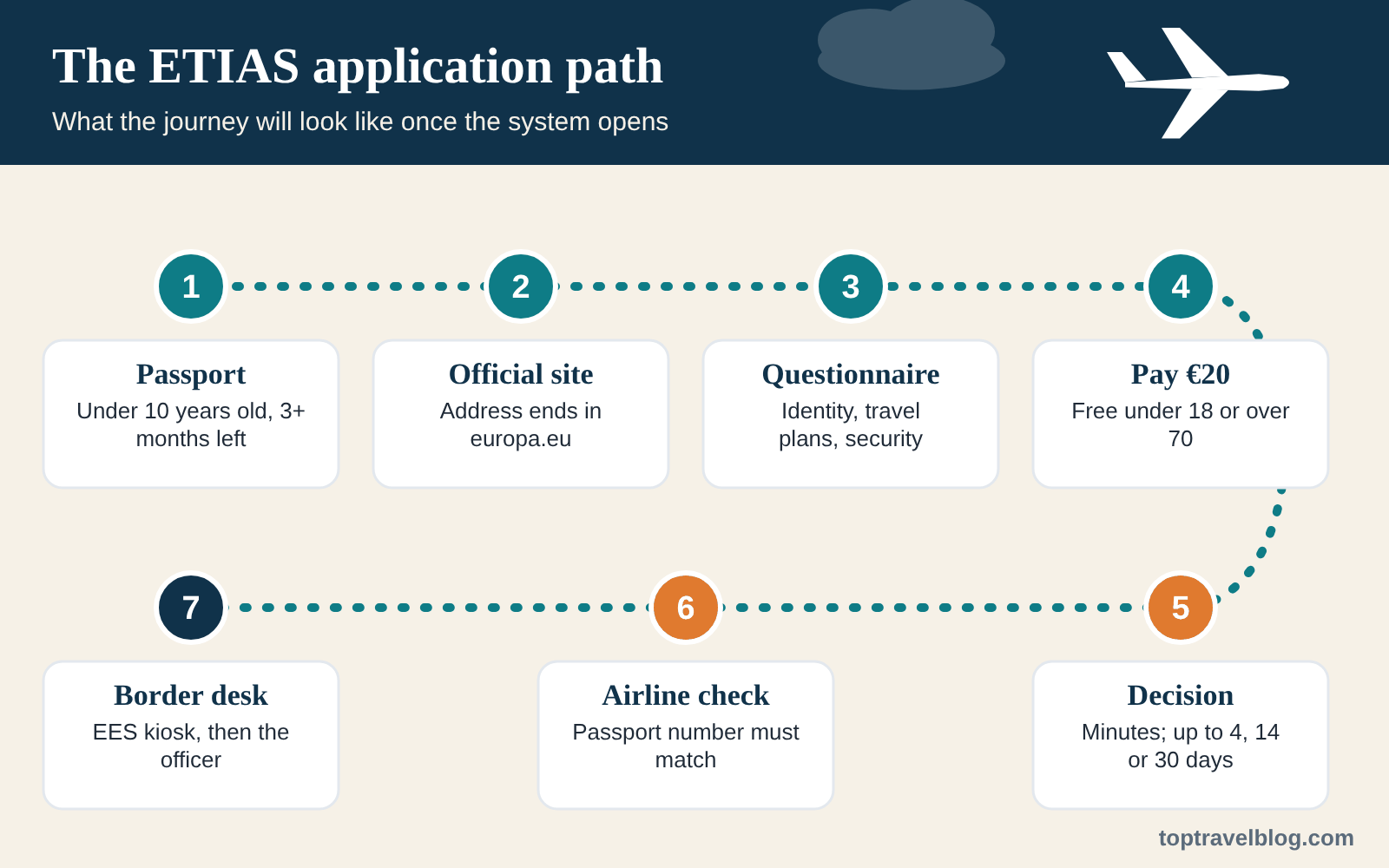
I have written the ETIAS for US citizens process as steps so you can see where the time goes. The application itself takes about ten minutes. The slow parts are the ones around it: renewing a passport, collecting travel details and, for a small share of applicants, waiting for a manual review.
Step 1
Check the passport before anything else
Look at the issue date and the expiry date on your US passport. It needs to be less than ten years old and valid for at least three months past your planned departure from the Schengen area. For ETIAS for US citizens it also needs to be the passport you will actually carry on the trip, because the approval is bound to it.
If you are close to the edge, renew first. The US passport guide covers routine and expedited timelines, and the State Department posts current processing times at travel.state.gov. A new passport issued after you apply will not carry your old ETIAS across.
Step 2
Find the official site, and only the official site
When ETIAS opens, there will be an official website and possibly an official mobile app run by the European Union. The Commission’s page says applicants will apply through an official website or app. The domain will end in europa.eu. Anything else is a private company charging a service fee on top of the government fee, or worse.
Open the site by typing the address you found on the Commission’s own pages, not by clicking a search ad. I come back to this in the scams section, because it is where Americans lose the most money.
Step 3
Gather what you need
Keep these within reach before you start:
- Your passport, with the machine-readable lines at the bottom of the photo page. Chip-enabled e-passports are standard for Americans today.
- A working email address you read, since the decision and any follow-up come by email.
- A phone number and your home address.
- A credit or debit card for the fee, unless you are under 18 or over 70.
- Your first intended country and address in Europe. A hotel name is enough; you do not need a full itinerary.
- Details of your current occupation and education level, which the system asks for.
For a minor, a parent or guardian completes the form and answers on the child’s behalf.
Step 4
Answer the questionnaire honestly
The form asks for your identity, passport, contact details and travel plans. It also contains security and health questions. These cover criminal convictions, previous stays in conflict zones, past refusals of entry or orders to leave a country, and certain serious diseases. The regulation also asks about any earlier removal from a European country.
Answer truthfully and in full. A mistake is fixable, but a false answer is the one thing that can turn a routine approval into a refusal. If you have a conviction that you think might matter, say so. Hiding it is worse than disclosing it, because the system checks databases and the form is a signed statement.
Step 5
Pay the fee and submit
Payment is by card. Adults between 18 and 70 pay the €20 fee. Everyone else files the application at no cost. You get a confirmation and an application number by email. Keep that email, because it is how you track the case if it goes beyond the automatic stage.
Step 6
Wait for the decision
Most applications are expected to be decided in minutes. If the automated check finds a possible match in one of the databases, a person at the ETIAS National Unit reviews the file, and the regulation gives the system up to four days to decide. If the unit needs more information or documents from you, the deadline extends to up to 14 days, and an interview request can stretch that to as long as 30 days.
That tail is rare, but it explains my advice to apply at least a few weeks before a nonrefundable trip, not the night before flying. The European Commission’s travel information site is the place where the process will be published when it opens.
Step 7
Save the approval and travel
An approval comes by email, and the record is stored electronically against your passport number. Keep a screenshot of the email as a backup, but you do not need to print it or show it, because the airline and the border officer see it on their screens. Before you fly, make sure the passport number on the booking matches the passport number you used on the form.
Tip: Make the ETIAS filing part of the same afternoon as other paperwork: passport check, travel insurance, seat selection. A single deliberate session beats three scattered reminders. My international travel documents checklist has a countdown that fits it in.
What if the ETIAS for US citizens application is refused
A refusal comes with a reason in the notification. The regulation gives refused applicants a right to appeal under the national law of the country that took the decision, and the refusal notice names the authority and the procedure. A refusal does not mean you are banned from Europe. It means this authorization was not granted.
Common reasons in similar schemes include a security alert, a past immigration problem, a false statement or an issue with the travel document. If you are refused and you have a trip booked, the appeal route is slow, so a travel insurance policy that covers trip cancellation for a denied authorization is worth reading carefully. My travel insurance guide explains how cancellation coverage and its exclusions work.
Name changes, new passports and lost passports
A change of name, a new passport number or a lost passport means a fresh application, because the record is linked to the document. If you lose a passport during the validity period, you apply again with the replacement. If your name changes after a marriage and your passport is reissued, treat it as a new document.
ETIAS for US citizens vs EES vs the 90/180 rule vs the UK ETA
Most of the confusion I hear about ETIAS for US citizens comes from mixing it up with other things that have similar acronyms. They are separate, they happen at different moments, and each has a different owner. The infographic sorts them by when they happen in your trip.
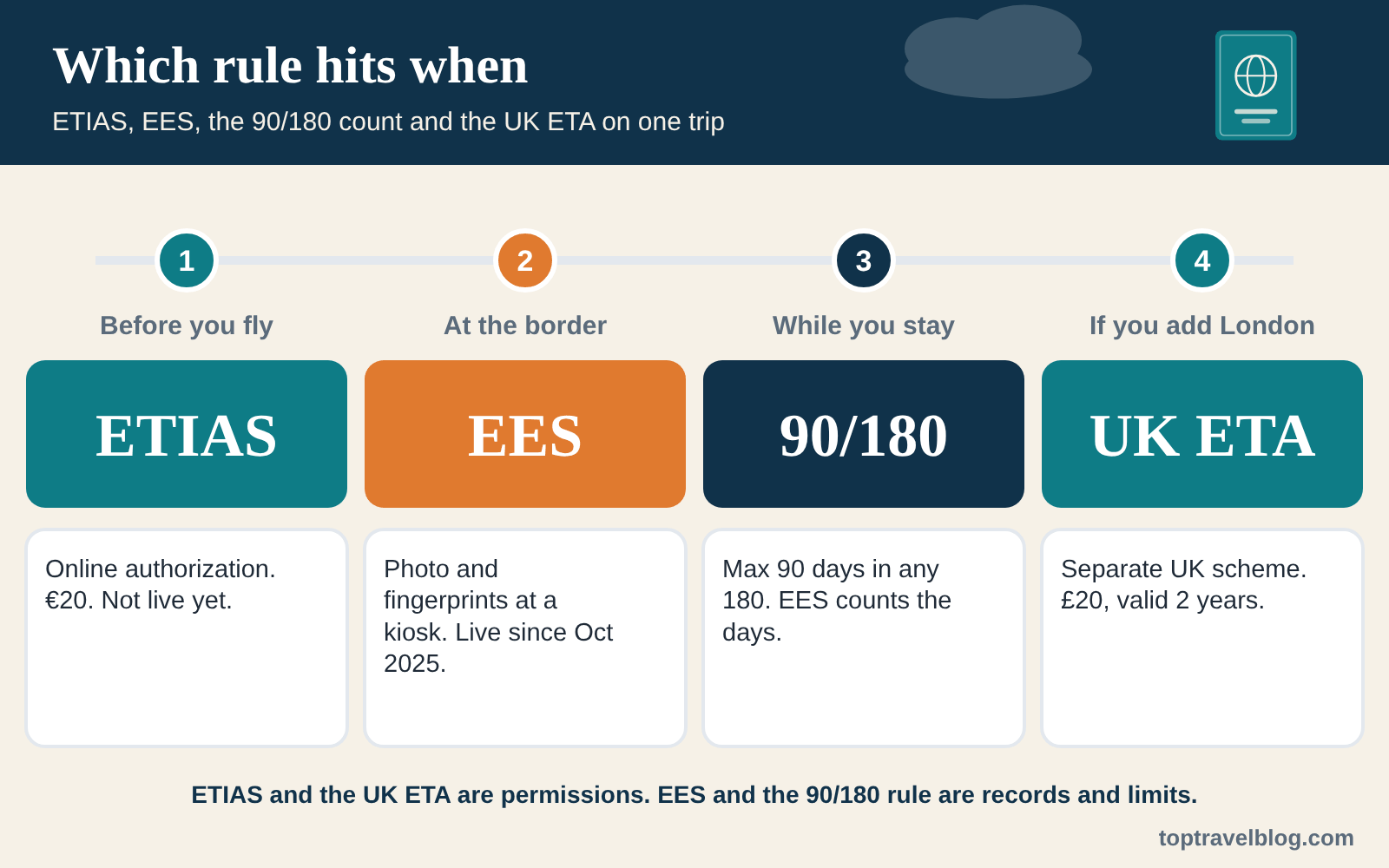
Side by side in plain words
- ETIAS is an online authorization you get before you travel. It is not live. It costs €20, lasts up to three years, and is checked by the airline and the border.
- EES is a border registration. It is live since October 12, 2025 and fully operational since April 10, 2026. It takes your photo and fingerprints once, at a kiosk or booth, and it costs nothing. The details are in my EES explainer.
- The 90/180 rule is the cap on how long you can stay. It has existed for years. EES will count the days automatically, which removes the guesswork that used to make overstays easy.
- The UK ETA is a separate scheme run by the British government for the UK only. It costs £20 and lasts two years, according to the UK government’s ETA page. A London-and-Paris trip needs the UK ETA now and, later, ETIAS for the French leg.
How the three European pieces will work together
When ETIAS for US citizens arrives, the sequence should be: apply online, fly, have the airline check your authorization, register at an EES kiosk if it is your first entry, and meet the officer. Once your EES record exists, later entries become faster, because the system already holds your biometrics. EES and ETIAS are designed to share data, so the border officer sees both on one screen.
For Americans, the biggest practical change of ETIAS for US citizens is not the paperwork but the pre-trip habit. Today you can book a European trip on a whim. Once ETIAS is mandatory, a last-minute flight needs a short pause for an application. That pause is usually minutes. It is still a pause, and the exceptions are the cases that cost people trips.
ETIAS, ESTA and the reciprocity argument
You will see the claim that ETIAS is just Europe’s version of ESTA. It is close in purpose and different in details. Both let a government screen visa-free visitors in advance. ESTA is run by the US Department of Homeland Security and is described on the CBP ESTA site. ETIAS is run by the EU, covers a different list of countries, and costs a different amount.
If it helps you picture the process, the experience will probably feel like applying for an ESTA in reverse. You will fill in similar fields and wait a similar length of time. You will pay a small fee and receive an electronic record. The main difference is that you are now the foreign visitor.
Fake sites selling ETIAS for US citizens, and how Americans get caught
This is the section I most want you to read. The ETIAS system is not live, but a whole industry of look-alike websites is. They use the words ETIAS, EU and Europe in the domain, show flags and official-looking logos, and offer to “apply now” for €70, €90 or more. Some deliver nothing. Others take a service fee and promise to submit a form that cannot yet be submitted.
The Commission’s page is blunt on the subject: the system is not operational and applications are not being collected. If an ad says otherwise, the ad is wrong.
How to spot a fake in ten seconds
- It asks for payment today. There is nothing to pay for.
- The domain does not end in europa.eu. A dot-com or dot-org is a company.
- The price is higher than €20, or it shows a “processing fee” in addition to the government fee.
- It promises “priority,” “express” or “guaranteed approval.” The automated decision is the same for everyone.
- It collects more than the official form would, such as copies of your driver’s license or Social Security details.
Why the fakes work on Americans
Americans are used to ESTA-style sites and to the idea that a trip needs a paid authorization. When someone sees “ETIAS” in a search result, the natural assumption is that it is the thing to buy. The sites advertise heavily because the real system is not there to compete. Some are honest resellers who charge a markup for a service that did not need to exist. Others are phishing operations that harvest passport data.
Worth knowing: If you have already paid a site for ETIAS, contact your card issuer and dispute the charge, explaining that the authorization was not available. Watch your statements for repeat charges, and consider placing a fraud alert if you submitted a passport scan. Do not wait for the site to refund you.
What the real ETIAS for US citizens site will look like
When the system opens, the Commission and the border agencies will publish the official address and will announce it through national tourism boards and embassies. The State Department will almost certainly note it on its pages for the Schengen countries. Until then, the correct place to read about ETIAS is the Commission’s own site, together with sources that cite it. The Smart Traveler Enrollment Program is a free State Department service that sends embassy updates, and it is one way to hear about changes early.
Do not pay for guidance either. This guide, the Commission’s pages and the State Department are enough. If a site’s main selling point is that it “will submit the application for you,” you are paying for something the official site does for free, with an extra layer between you and your data.
Worked examples: five trips and what ETIAS for US citizens means for each
Rules for ETIAS for US citizens are easier to hold onto with a real itinerary attached. These are composite travelers I have seen variations of, with the details changed. In each case I assume ETIAS has launched and become mandatory, because that is when the question gets interesting. If it has not launched on your travel date, none of the application steps apply.
The two-week Italy and Switzerland trip
Priya and Dan fly from Chicago to Rome, take trains to Florence and Venice, then cross to Lake Como and Zermatt. They are two adults and a 12-year-old. One ETIAS covers Italy and Switzerland because both are among the 30 countries, so they file three applications: two at €20 and one for the child at no charge. The family spends €40.
They apply six weeks before departure, at the same time they book hotels. The decisions arrive within the hour. The thing that nearly trips them up is the daughter’s passport, which expires four months after their return. That is legal for Schengen’s three-month rule, but I would still renew it, and they do. The new passport is issued before they apply, so the ETIAS attaches to the right document.
The London, Paris and Dublin route
Marcus is planning ten days: three in London, four in Paris, three in Dublin. His paperwork is split across three jurisdictions. London needs a UK ETA, which costs £20. Paris needs ETIAS for US citizens once it is mandatory, because France is covered. Dublin needs neither, since Ireland sits outside both the UK and ETIAS systems and Americans enter on a passport alone.
This is the itinerary that causes the most muddle. The order matters for EES too. He lands in London, takes the Eurostar to Paris, where French border officers carry out their checks in London before he boards, and then flies on to Dublin. Each leg has a different rule, and only the French one involves ETIAS. My guide to the UK ETA has the British side in detail.
The cruise with a Greek port stop
Alice and Ron board a Mediterranean cruise in Barcelona that calls at Naples, Santorini and Athens. Spain, Italy and Greece are all covered countries. The ship may handle formalities at the first port, but the regulation treats a traveler stepping ashore in a covered country as entering it. My assumption, and the one I would plan around, is that cruise passengers who go ashore need ETIAS.
The cheap insurance here is to apply well before final payment, since cruise lines tend to publish their own guidance for new border rules. The lesson from the EES rollout was that cruise terminals and airports each find their own rhythm. Expect an announcement from the cruise line rather than from the Commission.
The 80-day summer in Portugal and Spain
Hannah works remotely and wants eleven weeks in Lisbon, Porto and Seville. ETIAS lets her enter for up to 90 days in any 180-day period, so 80 days fits, but the margin is thinner than it looks. She needs to count every day she spent in Schengen in the previous six months, including a ski week in January and a long weekend in Madrid in March.
The ETIAS approval does not tell her how many days she has left. The EES record will. If she plans a longer stay or wants to work for a local company, she needs a national visa or residence route, not an ETIAS. Remote work for a US employer is a gray area in many countries, and a short email to the relevant consulate is a better source than a travel blog.
The last-minute weekend in Amsterdam
Jordan sees a cheap fare to Amsterdam on a Tuesday and wants to leave Friday. Once ETIAS is mandatory, Jordan opens the official site, files in about ten minutes and sees an approval in under an hour. That is the usual outcome.
The problem is the small fraction of applications that go to manual review. A flagged application can take up to four days and, in a longer case, up to two weeks. For a last-minute trip, that means a paid flight with no authorization. I tell people in Jordan’s position to apply first, then buy the ticket. The exception is a fare so cheap that losing it would not hurt. If you are hunting deals, my guide on how to find cheap flights covers the search side.
What these five have in common
None of them has to do anything unusual. In every case ETIAS for US citizens is a small task. They need a valid passport, a sensible order of operations and the habit of reading the official announcement when the system opens. Most of the trouble in the examples was caused by the passport or the timeline, not by the ETIAS form itself.
Planning a 2027 Europe trip around ETIAS for US citizens
If you are booking Europe for 2027 right now, the uncertainty around ETIAS for US citizens is annoying but manageable. You do not need to cancel anything, pay anyone or wait. You need a plan that works whether ETIAS has launched or not.
A simple decision rule for ETIAS for US citizens
Ask yourself one question: “Will I be in Europe before the launch date plus any optional period?” Nobody can answer it with certainty today. So build a trip that works either way.
- Book flights and hotels as you normally would. Choose fares with free or low-cost changes if you are nervous about dates.
- Keep your passport valid for the whole window, not just the trip, so that an ETIAS filed in the spring does not expire the day before you land.
- Put a reminder in your calendar for eight weeks before departure to read the Commission’s ETIAS page and see whether anything changed.
- Apply as soon as the system is open and the authorization is mandatory or recommended for your travel dates.
Timeline from now to departure
The following countdown works for a summer 2027 trip. Shift it earlier or later to match your date.
☐ Now to January: renew a passport that will be within a year of expiry. The US passport guide explains how.
☐ January to March: book flights and the first hotel. Use the hotel framework in how to choose a hotel and look for flexible terms.
☐ March: add travel insurance, ideally with cancellation coverage that includes a denied entry authorization. See the travel insurance guide.
☐ Eight weeks before departure: read the Commission page again for a launch announcement.
☐ Six weeks before departure: apply if ETIAS is live and mandatory. Wait for the decision before paying for anything nonrefundable.
☐ Two weeks before: save the approval email, match the passport number to your ticket, and enroll in STEP.
Booking order if ETIAS is live
For a trip taken after launch, I would apply before booking nonrefundable hotels but after booking flights that can be changed. Flights are the first thing that breaks if an authorization is denied, because airlines check ETIAS at check-in and can refuse boarding. If you are booking an expensive nonrefundable fare, wait for the approval. The few days of delay cost nothing, and the price of a missed flight is high.
Airlines are the first checkpoint for ETIAS for US citizens
The regulation requires carriers to check that a passenger has a valid ETIAS before boarding. That makes the airline the real gatekeeper, in the same way it is for ESTA coming to the United States. If the system cannot find your record, the agent at check-in will not let you on. They are not being difficult. Carriers are fined for carrying passengers who are refused entry.
For this reason, the passport number on your booking must match the passport number on your approval. Many airlines will ask you to read out the details at check-in, so having the passport in your hand matters.
Budget the small stuff
ETIAS for US citizens adds €20 per adult, which is small beside the cost of flights. It also adds a little time, and that time is the risk. Put the application into your planning the way you would a passport photo: not expensive, easy to forget, annoying to do at the airport. My Europe packing list has a documents section that works as a reminder, and the broader how to plan a trip guide shows where entry rules fit into the whole sequence.
If your trip is soon, skip ETIAS for US citizens for now
For a trip in the next few months, you are almost certainly traveling before ETIAS is live. You will go on your passport, register under EES and move on. The only relevant paperwork is the passport rule and, if you are including the UK, the ETA. Do not buy an “ETIAS” product to be safe, because you would be paying for something that cannot yet be issued.
At check-in and at the border: what to expect with ETIAS
I find it helpful to imagine the whole journey in real time. Here is how I expect a trip from New York to Paris to look once ETIAS for US citizens is mandatory, based on the regulation and how similar systems work.
At the airline counter or in the app
You check in online or at the desk. The airline’s system queries the ETIAS database using your passport number. If you have a valid authorization, the check goes through without a visible step. If not, the agent asks you to apply, or in the worst case denies boarding. This is why the passport scan at check-in is so important.
On arrival
At passport control you meet an officer, possibly after using an EES kiosk if it is your first visit since October 2025. The officer sees your passport, your EES record and your ETIAS together. Routine questions follow: where are you staying, how long, and what is the purpose of the trip. The officer decides on entry. Answers should match what you wrote on the form.
Have a booking confirmation and a return flight handy. The Schengen rules allow an officer to ask for proof of means and a return or onward ticket, even though in practice most Americans on leisure trips are waved through.
Crossing borders inside Schengen
Once you are inside the Schengen area, you move between member countries without systematic border checks. You do not show ETIAS again at the Italian-French border. Spot checks can still happen, and police can ask for your passport on trains. Carry the passport, not a photocopy, whenever you cross a border on land.
Special cases people ask about
- Arriving by car or train from a non-covered country. The requirement applies at any external border, not only airports. A drive from Montenegro into Croatia, or a train from London to Paris, brings you in at an external border.
- Connecting at an airport. Staying airside throughout does not count as entering. If you leave the secure zone, you enter.
- Arriving on a one-way ticket. Possible, but the officer is more likely to ask about onward plans. Have a way to show you will leave.
- Flying in through a hub outside the system. If you connect in Istanbul or Dubai, the airline checks your authorization when you board the flight that lands in a covered country, and that is the check that matters.
How ETIAS for US citizens touches the most popular American routes
Most of my readers are not thinking about regulations. They are thinking about Rome, Paris, Barcelona or a ring road around Iceland. So here is how ETIAS for US citizens maps onto the itineraries Americans actually book. All of the countries below are covered, and the point is what changes around them.
Italy, France and Spain first trips
One authorization, any order
A Rome, Florence, Paris, Barcelona loop needs a single approval. Nothing changes at the Italian-French or French-Spanish border, because you are already inside Schengen. The authorization is checked at the first airport.
Greek islands and Cyprus
Ferries and short flights
Greece and Cyprus are both covered, so a Santorini, Crete and Larnaca trip shares one approval. Ferry arrivals from outside the system, such as Turkey, are external-border crossings and are the places an officer asks questions.
Iceland and Norway
Non-EU, still covered
Both belong to Schengen and to ETIAS. A Reykjavik stopover on the way to the rest of Europe is your first Schengen entry, so the checks and the authorization apply there.
Switzerland and Austria by rail
Scenic trains
Two covered countries, one document. Swiss rail trips often end in Italy or Germany, and none of those crossings repeats the check.
Germany and Central Europe
Berlin, Prague, Vienna, Budapest
All four countries are covered. If the route continues to Serbia or Bosnia, you leave Schengen and enter a country with its own rules.
Portugal and the Azores
Long stays
Portugal is a favorite for stays of several weeks. ETIAS lets you stay up to 90 days in any 180, and the Azores and Madeira count as Portuguese territory in the Schengen calculation.
Multi-country trips that leave the system
The trips that cause confusion are the ones that cross the edge of the covered list. A route from Croatia to Montenegro to Albania leaves Schengen at the Croatian border and then crosses two more national borders. The UK, Ireland, Turkey, Morocco and most of the Balkans each have their own entry rules for Americans, so each needs its own research. I write down every country on the route and mark which are on the ETIAS list, which have their own authorization, and which need only a passport.
For a long list of countries, my international travel documents checklist helps, and the broader international travel packing list is where I keep copies and backups of everything.
Layovers that turn into trips
A connection in Amsterdam, Frankfurt, Paris or Madrid is one of the quietest ways to end up needing ETIAS. If the airline forces you to change terminals or claim bags, you pass border control, and the entry counts. If you plan a long layover to see the city, treat it as a short visit to Europe and have the authorization in place first.
Staying inside the 90-day cap
A long route through Europe adds up faster than it feels. Two weeks in spring, a month in summer and a long autumn trip can push you toward the limit within 180 days. EES now tracks the count, and ETIAS will sit alongside it. A simple spreadsheet with entry and exit dates is the most reliable defense, and a good idea even for people who think they are nowhere near the cap.
Special situations for ETIAS for US citizens: records, health, refusals and data
The questionnaire is short for most people. A minority of travelers have something in their history that might matter, and I would rather you read about it here than learn about it at the screen.
Criminal records
The form asks about convictions for serious offenses. A minor traffic matter or an old misdemeanor is generally not what the question is about, but the regulation lists categories, and the wording on the real form is what counts. Read each question literally and answer exactly what is asked. If a question applies to you, a refusal is possible, and the notification explains the appeal path.
Past refusals of entry or overstays
If you were ever refused entry to a European country or ordered to leave one, the form asks, and you should say so. An old overstay does not automatically end your chances, but it does draw a manual review, which is slower. The correct approach is to answer, add any explanation the form allows, and apply earlier than usual.
Health questions
The application includes questions about specified serious diseases that could threaten public health. It is not a medical history form and does not ask for a diagnosis list. For most travelers the answer is plainly no. If you have a medical concern, the better place for questions is your doctor and the CDC’s travelers’ health pages, not a travel blog.
What happens to your data
The system stores the information you submit and the decision. The regulation sets a retention period, which I understand to be the life of the authorization plus a further five years, and gives you rights to access and correct your data. That is a long time to hold a passport number, which is another reason to use only the official site. A private reseller keeps its own copy.
Accessibility and help
The regulation sets up a central unit and national units to handle follow-up on applications that need a person to look at them. For travelers who struggle with online forms, a trusted family member can help fill in the application, and a travel agent may submit it for you, though the traveler remains responsible for the answers. Do not hand your passport scan to an unfamiliar service.
Myths about ETIAS for US citizens
A topic with this much delay attracts folklore. These are the claims I hear most often, and what the official material supports.
“I have to apply this year”
You cannot. The system is closed, and the Commission has said it will announce the opening date months ahead. Any article telling Americans to apply now for ETIAS for US citizens is selling something. When someone says “apply before the price goes up,” they are talking about the move from €7 to €20, which has already been decided and applies when the system opens.
“ETIAS is a tax on tourists”
It is a fee that funds the system, in the same way a US ESTA fee funds that program. It is not the separate tourist taxes some European cities add per night at hotels, which are collected locally and are a different thing entirely. If you are budgeting a trip, ETIAS for US citizens is a small line item next to a €5 to €10 nightly city tax in some places.
“Once I have it, I can stay as long as I like”
The authorization is valid for up to three years, but each stay is capped at 90 days in any 180-day period. ETIAS for US citizens is permission to arrive, not permission to remain. The count of your days comes from your entry and exit stamps and, now, from your EES record.
“It replaces my passport check”
You will still show a passport, and an officer will still decide. The authorization is one more record on the screen. The officer can refuse entry to someone with a valid ETIAS, and the paperwork says so openly.
“Americans are exempt because the US is a close ally”
No category of friendly nationality is exempt. The regulation applies to all visa-exempt third-country nationals. Americans are part of the group the system was built for, which is why every guide to ETIAS for US citizens, including this one, treats the US passport as the default case.
“I will just get it at the airport”
Airlines check at boarding, which means the authorization has to exist before you reach the gate. A fast approval may let you file on the day, but I would not build a plan on it, because a manual review can run for days.
Questions to put to tour operators, cruise lines and airlines about ETIAS for US citizens
If you are booking through a company, ask it how the company will handle ETIAS for US citizens. A good operator already has an answer. A weak one repeats a date it read online. Here are the questions I would ask.
- Does your tour price include the ETIAS fee? If it does, who files the application, and do you get a copy of the approval?
- What happens if the authorization is delayed or refused? Look for a clear refund or rebooking policy in writing, not a verbal promise.
- Do you handle the application, or do I? The fee is the same, and the answers are legally mine, so I prefer to file it myself.
- Which passport do you have on file? A mismatch with the passport I carry is the most common source of check-in trouble.
- When will you update your terms for ETIAS? A company that commits to updating its booking terms after the Commission announces a date is thinking ahead.
Travel agents are useful here, particularly for older travelers who dislike online forms. The caution is simple: an agent can submit the application, and you still carry the responsibility for the answers. Read them before they go in.
Group trips and family reunions
For a group of eight or ten, the paperwork becomes its own project. Ask one person to build a shared document with each traveler’s full name as it appears on the passport, the passport number, the expiry date and the date of birth. When ETIAS for US citizens opens, each traveler applies for themselves, or a family member applies for a child, and each person forwards the approval email. A group leader who collects approval emails a month ahead can spot a mismatch early.
Seniors in the group deserve one more thought. A traveler over 70 pays no fee but still needs an authorization. People assume the age waiver is an exemption from the whole process, and that is the mistake that leaves a grandparent stuck at the airline desk.
Common mistakes with ETIAS for US citizens
These are the errors I expect to see most often, based on how people handled ESTA, the UK ETA and the EES rollout. Many are small. A few cost trips.
- Paying for it before it exists. The single most common mistake is buying ETIAS from a private site now. There is no product to buy, and the money is gone.
- Treating the three-year validity as a promise. The authorization ends with the passport. If your passport has a year left, your ETIAS has a year left.
- Using a different passport at the border. Dual nationals must present the same document they used to apply.
- Leaving the application to the last day. Most decisions are quick, but a small share take days. A flight you cannot change turns a delay into a loss.
- Forgetting the children. Every minor needs an authorization, filed by a parent. A family of five needs five approvals, even if only two people pay.
- Assuming ETIAS covers the UK or Ireland. It covers neither. A trip that includes Britain needs the UK ETA, and Ireland follows its own rules.
- Confusing ETIAS with the 90/180 rule. The authorization does not give you extra days. You still count your Schengen days across a rolling 180-day window.
- Ignoring the passport age rule. A passport issued more than ten years ago can be refused at Schengen borders even if it has months left on its face.
- Skimming the questionnaire. A rushed false answer, such as ticking “no” to an earlier entry refusal that you forgot, can lead to a refusal or a revoked authorization.
- Believing every source. Check the date and the author. Any page that gives a precise ETIAS start date without citing the Commission is guessing.
Tip: If you remember only one thing from this list, make it numbers 1 and 2. Both are about money and time, and both are easy to avoid. Do nothing until the Commission announces a date, and treat your passport as the real anchor of the trip.
Frequently asked questions about ETIAS for US citizens
Do US citizens need ETIAS right now?
No. ETIAS is not operational and no applications are being collected, according to the European Commission. Americans enter the Schengen area on a valid passport for stays up to 90 days in any 180-day period, and register at the border under the Entry/Exit System. Any site selling an ETIAS for US citizens today is not official.
When will ETIAS for US citizens start?
There is no announced date. The Commission says it will announce the start several months in advance, and its page no longer gives a target quarter. Earlier plans pointed to the last quarter of 2026. For a 2027 trip, plan for the possibility that it launches and the possibility that it does not.
How much will ETIAS cost an American?
The fee is €20 per adult, raised from an earlier €7. Travelers under 18 and over 70 pay nothing. The fee takes effect when the system becomes operational, and the dollar amount depends on the exchange rate and your card’s foreign transaction terms.
How long is ETIAS for US citizens valid?
An approved authorization lasts for three years or until the linked passport expires, whichever is first. During that time you can enter as often as you like, for stays up to 90 days within any 180-day period. A new passport requires a new application.
Is ETIAS the same as a Schengen visa?
No. A visa is a consular process that Americans do not need for short stays. ETIAS is an online authorization for visa-free travelers, with no appointment and no supporting documents beyond the form. It does not extend your stay or allow you to work.
Which countries does ETIAS for US citizens cover?
Thirty: the 29 Schengen countries, including Bulgaria, Romania and Croatia, plus Cyprus. Ireland and the United Kingdom are not covered. The UK runs its own ETA, described in my UK ETA guide, and Ireland lets Americans in on a passport.
Do children and seniors need ETIAS for US citizens?
Yes. Every traveler needs one, including infants and people over 70. A parent or guardian applies for a child. The fee is waived for applicants under 18 and over 70, so a family with children often pays only for the adults.
How long does the decision take?
Most decisions are expected within minutes because the system is automated. A manual review can take up to four days, up to 14 days if more information is requested, and up to 30 days if an interview is required. Apply with margin before any nonrefundable booking.
What is the difference between ETIAS and EES?
EES is the border registration of fingerprints and a photo, live since October 12, 2025, and fully operational since April 10, 2026. ETIAS is a separate online authorization that will come before it in your journey. You will need both once ETIAS starts. See my EES explainer.
Can I get ETIAS at the airport?
I would not expect so. The airline checks the authorization when you board, so you need it before you reach the desk. A last-minute application on a phone at the airport may be possible if the system is fast, but a manual review would leave you stranded.
What if my ETIAS for US citizens application is refused?
You receive a notice with the reasons and information on how to appeal in the country that refused you. A refusal does not ban you from Europe. Consider whether travel insurance covers a canceled trip in that case, and read the exclusions in my travel insurance guide.
Is it safe to apply for ETIAS for US citizens through a third-party website?
I would not. Third-party sites add a fee, and they hold your passport data. The official application will be on a europa.eu domain, and the fee is the same €20 whoever submits it. Use the official site and nothing else.
Does ETIAS apply if I only change planes in Europe?
Not if you stay airside and never pass border control. If you leave the secure zone, claim luggage or have to clear passport control to board the next flight, you enter the covered area and need the authorization.
One last thing before you book
The real work with ETIAS for US citizens is not the form. It is keeping calm while the date stays vague. Renew a passport that is running short. Book flights you can change. Ignore the sites telling you to apply today. When the Commission announces a start date, you will have months to act, and the application is ten minutes of typing.
Until then, go back to the part of planning that is more fun. Pick the cities, then read an itinerary for the places you are already sure of. I wrote guides for New York City, Las Vegas and Miami for the weekends before the big trip, and the Orlando vacation guide and Los Angeles itinerary cover the family end of the calendar.
Related planning guides
- US passport guide: apply, renew and urgent travel — the passport comes first, because an ETIAS approval dies with the document.
- Europe EES explained — the border registration that is already live, and what happens at the kiosk.
- UK ETA for US citizens — the British authorization that covers London and Edinburgh, not ETIAS.
- International travel documents checklist — every document, in the order that avoids last-week panic.
- Passport validity rules: 3 and 6 months — why some countries want more validity than Schengen does.
- Travel insurance explained — cancellation, medical cover and the exclusions that matter.