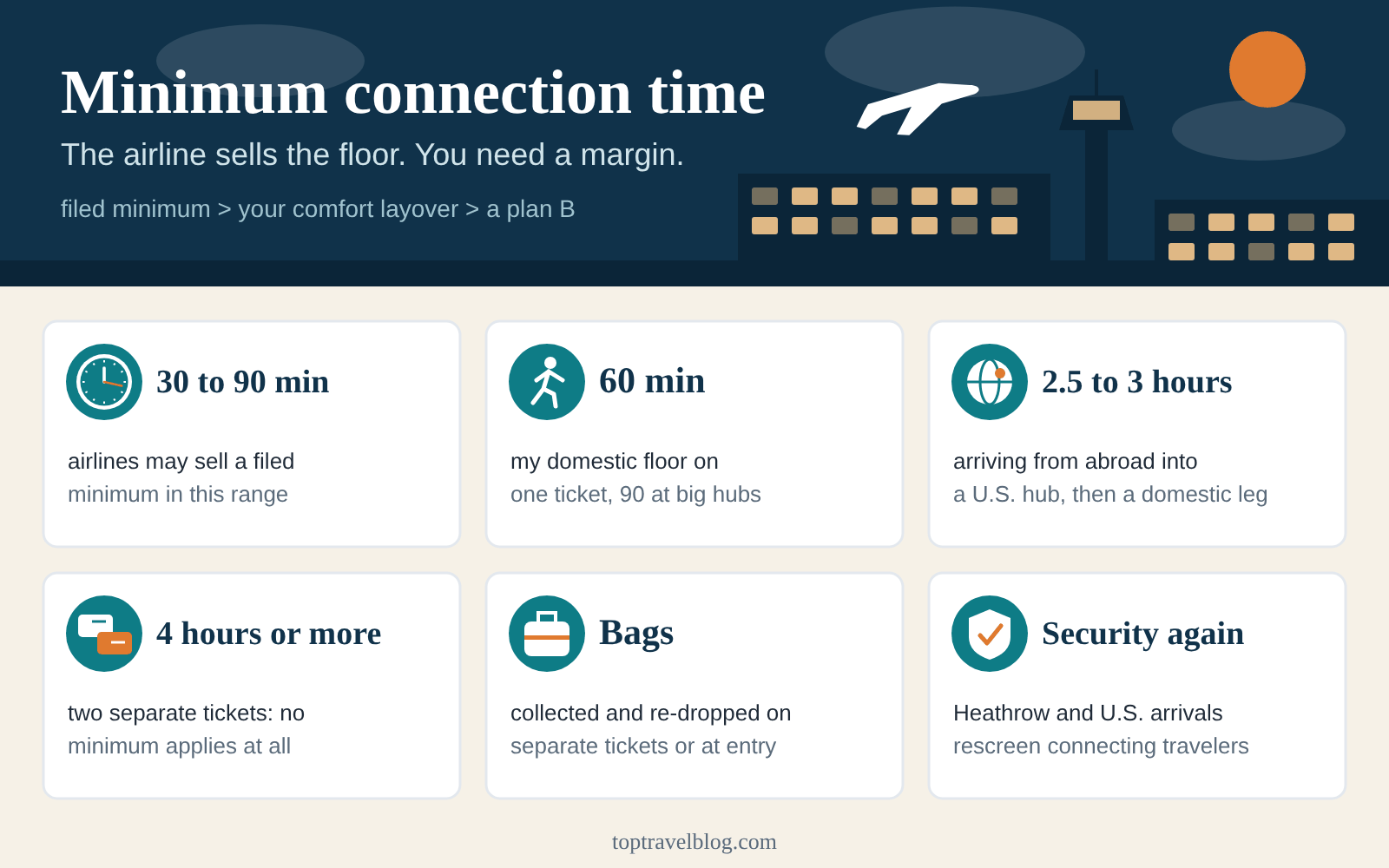
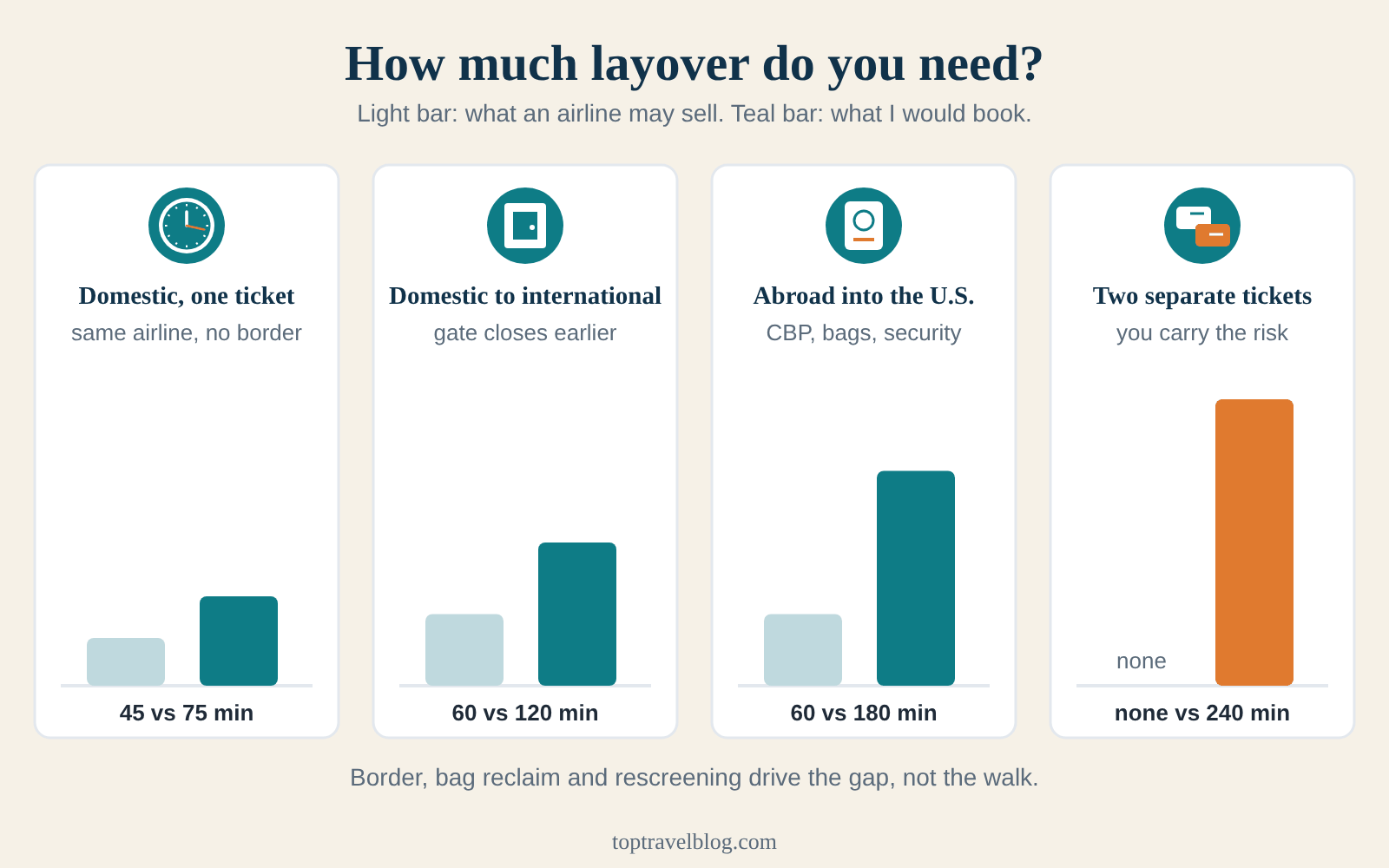
The minimum connection time airport figure is the shortest layover an airline is willing to sell you on a single ticket, and it is almost never the layover you actually want. For most U.S. domestic connections on one ticket, I would not go below 60 minutes. For an international flight into the United States that involves customs, a bag reclaim and a second security screening, I want at least 2.5 to 3 hours. On separate tickets, plan on 4 hours or more.
That is the short answer. The long answer is that a minimum connection time airport number is a scheduling rule, written for an on-time flight, an average walker and a clear path through the building. It is not a promise that you will make the second flight.
I have sprinted through Atlanta’s concourses with eleven minutes to spare, and I have also sat in a Heathrow terminal watching a boarding gate close because the passport line moved at the speed of a wedding procession. Both happened on tickets that were perfectly legal to sell.
This guide explains where the minimum connection time airport numbers come from, why they differ so much between airports and between types of trips, and how to turn them into a layover you can trust. You will get my own comfort rules for four kinds of connection, worked examples from real hubs, a step-by-step routine for the day of travel, and what to do the moment your first flight lands late.
Quick facts: minimum connection time at the airport, at a glance
- What it is: the shortest transfer time airlines and airports allow for a passenger, and the bags, to move between two flights on the same booking.
- Typical range: a minimum connection time airport filing runs roughly 30 to 90 minutes, depending on the airport, the terminals and whether a border is involved.
- My comfort rule, domestic: 60 to 90 minutes on one ticket, 2 hours at a large hub with a terminal change.
- My comfort rule, arriving from abroad: 2.5 to 3 hours into a U.S. hub, because of customs, bag handling and security.
- Separate tickets: no minimum connection time airport rule applies; British Airways itself suggests at least 4 hours.
- If you miss it on one ticket: the airline owns the problem and normally rebooks you at no charge; on two tickets, you own it.
- Biggest hidden delays: immigration queues, a terminal change, a late-arriving gate, a security screening you did not expect.
What a minimum connection time airport figure actually is
A minimum connection time, usually shortened to MCT, is the shortest gap between two flights that an airline is allowed to sell as a single itinerary through a given airport. The industry data company OAG, which maintains the connection tables that booking systems use, describes it as the shortest allowed time for a passenger and their luggage to transfer between flights.
Airlines list the same idea in their contracts of carriage under names such as “minimum layover time” or “legal connection time.”
Think of it as a filter in the search engine. If the two flights you want are closer together than the minimum connection time airport rule allows, the booking system simply refuses to show them as a connection. If they are farther apart, the itinerary appears, whether or not you would have chosen it.
Who decides the number
Three groups feed every minimum connection time airport table, and it helps to know which one you are looking at.
The first is the industry standard for a given airport. The airlines that serve the airport agree on a value through an operators’ committee, and IATA, the airline trade body, approves and publishes it. That value is the default for the airport.
The second is the airport itself, which can set its own standard when the physical layout demands it. Customs and immigration clearance, a terminal change, bag collection and the walk from gate to gate are the usual reasons.
The third is the airline. Carriers file exceptions, and they have a commercial reason to do it: a shorter connection makes the total trip shorter, and a shorter trip tends to rank higher in search results. OAG says it handles more than 157,000 standard MCTs and airline-specific exceptions, and that London Heathrow alone has well over two thousand carrier exceptions.
So there is no single minimum connection time airport rule for a city. There is a default, plus a stack of exceptions that depend on which airline you fly in on, which airline you fly out on, and sometimes which flight numbers.
A real example of the layers
OAG uses Miami to show how it works. The domestic-to-international standard at MIA is one hour. American Airlines files an exception of 55 minutes for connections involving any other carrier. American then makes a further exception for British Airways connections, which falls back to the one-hour standard.
Same airport, same type of trip, three possible minimum connection time airport numbers depending on the airlines on your ticket. Nothing is wrong with that; it just means that “what is the MCT at Miami” is a question without a single answer.
Tip: When you search on an airline’s own website or on Google Flights, the shortest connection it shows you is usually the airline’s filed minimum connection time airport value, not a recommendation. Treat the first itinerary with a 35 or 40 minute connection as a warning label rather than a bargain.
What the minimum connection time airport rule covers, and what it leaves out
Here is what the number is supposed to cover: getting off the aircraft, walking or riding to the next gate, clearing any required screening or border check that sits on the path, and, for checked bags, moving them from one aircraft to the next. Airlines also build in the time needed to turn the departing aircraft around and close the door.
Here is what it quietly leaves out.
Delays, even small ones
The minimum connection time airport figure assumes the first flight lands on schedule. A flight that lands 25 minutes late on a 50-minute connection has already used up half of what the schedule gave you before you stand up. Arrival delays are the single most common reason connections fail, which is why a number that looks fine on a clear morning looks reckless on a thunderstorm afternoon.
Your pace and your row
The rule assumes a typical walker who is near the front of the cabin. If you are in row 38 of a widebody, you may spend eight to ten minutes just getting off the aircraft. If you are traveling with young children, a stroller, a cane, a wheelchair or a carry-on that has to be gate-checked, double whatever you assumed.
Border and security queues on the day
A minimum connection time airport value for international arrivals counts a normal immigration queue. It cannot count the morning when three long-haul flights land together and half the booths are staffed. At Seattle-Tacoma, the Port of Seattle says on its connecting-passenger page that customs processing can take 60 minutes or longer in peak periods, which it lists as holidays and summer, typically 10 a.m. to 3 p.m.
You can read how the airport frames it at the Port of Seattle international connections page.
Watch out: A legal connection and a comfortable connection are different things. A 45 minute minimum connection time airport rule means the airline will not sell you 44 minutes. It does not mean 45 minutes is enough for you on a Friday evening in July.
Seven things that stretch a connection beyond the minimum connection time airport figure
Before the four connection types, here are the variables that stretch a minimum connection time airport figure into a real layover. I run through them every time I look at a layover. Each one adds or removes real minutes, and none of them appear in the published table.
1. How late is the inbound likely to be?
Morning versus afternoon, summer storms, winter de-icing
A 6 a.m. departure from a quiet airport almost always lands on time; a 4 p.m. flight into a thunderstorm region often does not. If the inbound is the kind that slips, treat the schedule as optimistic and add 30 minutes.
2. Where are the two gates?
Terminal, concourse and walking distance
Same concourse is a few minutes. Opposite ends of a long concourse is 15 minutes at a brisk walk. A different terminal can mean a train, a shuttle bus or a second security line. Look up both gates in the airline app the day before.
3. Is there a border in the middle?
Customs, immigration or a Schengen passport check
Anything that makes you speak to an officer adds an unpredictable block of time. Arriving in the United States from abroad, you clear Customs and Border Protection before you connect; arriving in the Schengen area from outside it, you clear passport control at the first Schengen airport.
4. Are your bags going through?
One ticket versus separate tickets
On one ticket, bags normally travel through to the final city. On separate tickets, or when you enter a country on the way, you collect and re-drop them, which adds 30 to 60 minutes before you start walking to security.
5. Is security repeated?
Rescreening after an international arrival
Connecting passengers at Heathrow go through security again, and arriving international passengers who connect in the United States are screened again by the TSA. Plan on 10 to 40 minutes.
6. What time of day and which season?
Peak banks and holidays
Hubs run in waves. A connection at 8:45 a.m. when six flights land at once is slower than the same connection at 2 p.m.
7. Who is traveling with you?
Kids, mobility needs, heavy carry-ons
If someone walks slowly or needs assistance, the airport minimum stops being a useful guide. British Airways notes that an electric buggy at Heathrow Terminal 5 takes 10 to 15 minutes to arrive and must be requested at least 48 hours ahead.
When I add these up for a trip, a published 50 minute minimum connection time airport figure often becomes 75 or 90 in my head. That is not paranoia. It is the difference between an itinerary that depends on everything going right and one that survives a small mistake.
The four kinds of connection and how much time each one needs
A minimum connection time airport table sorts connections into types, and so should you. Here is the number I would personally book for each, rather than the number the airline would sell.
1. Domestic to domestic, one ticket
This is the simplest case. You land, you stay airside, you walk to the next gate, and your bag follows you. No border, no second screening, no reclaim.
At large U.S. hubs, the filed minimum connection time airport value can be as low as 30 to 45 minutes. One Atlanta-focused layover guide describes the airport’s own domestic minimum as 35 minutes, with stress-free connections starting around 45 minutes and an ideal of about an hour and ten.
My rule: 60 minutes if both flights are on the same airline and the same concourse, 75 to 90 minutes if you change concourses at a big hub, and two hours if you change terminals and security stays behind you.
2. Domestic to international, one ticket
Here you leave a U.S. domestic flight and board an overseas departure. There is no border formality on the way out of the United States, but international departures often leave from a different terminal or concourse, they board earlier, and the gate closes earlier.
At Miami, the standard for this connection type is one hour. In Atlanta, domestic-to-international transfers typically involve a move to Concourse E or F. I would not book less than 90 minutes, and I would prefer two hours, because the gate closure and boarding process for a long-haul flight start well before departure.
3. International to domestic, arriving in the United States
This is the hardest one for travelers to judge, and the one where I give the most conservative advice. You land from abroad, walk to immigration, wait in the passport queue, collect your checked bags, clear customs, hand the bags back to the airline, ride to the departure terminal and clear security again.
The Port of Seattle states that processing at its main terminal can take an hour or longer in peak periods and that connections of 60 minutes or less may be rebooked, depending on the airline. One Atlanta-focused layover guide says its author would not be comfortable with less than an hour and a half and prefers 2.5 hours, because customs can take about ten minutes or a few hours.
My rule, whatever the minimum connection time airport table says: 2.5 hours minimum, 3 hours in summer or around a holiday. If you hold Global Entry, you can often cut the passport step to a few minutes at a kiosk, and I will still keep 2 hours.
4. International to international
This covers the classic London, Frankfurt, Paris or Amsterdam transfer between two long-haul or regional flights. Whether a border is involved depends on the airport and the flights.
At Heathrow, connecting passengers on one ticket generally stay airside and do not clear immigration, but they do go through security again. Heathrow says same-ticket connections usually do not require passing through immigration, that a free shuttle bus runs between terminals about every ten minutes, and that all connecting passengers screen again.
At Schiphol, the filed minimum is often quoted as 50 minutes. Transferring between a non-Schengen flight and a Schengen flight involves passport control, and passengers report long queues at peak hours.
My rule when the minimum connection time airport figure is 50 to 60 minutes: 90 minutes within one terminal, two hours across terminals, and three hours when a Schengen passport check sits in the middle.
Tip: Pick the airline’s home hub for the connection when you can. Heathrow on British Airways, Atlanta on Delta, Schiphol on KLM. Hubs are designed around their own airline’s transfers, with shorter walks, shared terminals and agents who see your itinerary in the same system.
Why a minimum connection time airport rule disappears on separate tickets
Everything above assumes one booking: one record locator, one fare, one airline or a set of partner airlines that sold the trip together. The moment you buy two tickets, the minimum connection time airport table stops applying to you.
Heathrow states this plainly. Minimum connection times do not apply to separate tickets, and passengers on separate tickets need to allow extra time for baggage reclaim, passport control, a terminal transfer, check-in and security. The Heathrow connecting flights page spells out that separate tickets are not treated as connections at all.
British Airways says it more bluntly on its connecting at Heathrow page: for separate tickets, allow a minimum of four hours, because you will need to reclaim your bags and may need to change terminals. It also notes that you could be liable for extra costs or need to buy a new ticket if you miss the second flight.
What changes when you self-connect
The airline that carried you in has no duty to get you to the second flight. If the first flight is delayed by three hours, the second airline sees a no-show and can cancel the rest of your reservation. Your bags will not be checked through, so you collect them, pass through the border if there is one, find the second airline’s counter, drop the bags and clear security. All of that happens before you ever think about the gate.
When self-connecting is worth it
I do it sometimes, for savings that are large enough to pay for the risk. The honest test is simple: would the saving buy the replacement ticket if it all went wrong? If a self-connected trip saves $120 and a last-minute one-way on the same route costs $450, you are betting on the odds.
My conditions for a self-connect:
- At least 4 hours between the first landing and the second departure, 5 to 6 if a border is involved.
- Carry-on bags only, or a first flight that lands a full day before the second.
- A second airline with a flexible change policy, or a refundable fare for the onward leg.
- A route where several later departures exist the same day, so a miss costs an afternoon, not a night.
The broader price tactics, including when splitting a ticket makes sense, are in our guide on how to find cheap flights.
The protection is the product
A single ticket means that if a delay or cancellation causes you to miss the second flight, the airline rebooks you at no charge. I walk through bags, rights and rebooking in our guide to what happens if you miss a connecting flight. That protection is the real thing you buy with a one-ticket itinerary, even when the other airline’s fare looks cheaper.
How the minimum connection time airport picture looks at five real hubs
The minimum connection time airport numbers below come from airport and airline pages where I could find them, and from published layover guides where I could not. They are starting points for the logic, not a table to memorize.
Atlanta (ATL)
Domestic hub, Delta fortress, an underground train
Domestic concourses T, A, B, C and D and the international concourses E and F are all linked airside. You do not leave security to move between them; an underground train and walkway do the linking. Walking between adjacent concourses takes roughly six minutes and the whole span from T to F is closer to half an hour on foot. One detailed guide calls 35 minutes the airport’s domestic minimum and suggests about an hour as comfortable.
Miami (MIA)
Domestic-to-international and Latin America
The OAG example above shows MIA as an airport where airline exceptions bend the same one-hour standard. American Airlines hubs its Latin America traffic here, and international arrivals clear customs before the onward leg. I would not trust anything under 90 minutes for an international arrival followed by a domestic flight.
Seattle (SEA)
Peak-hour customs and a bag drop-off
The Port of Seattle warns that processing can take 60 minutes or longer in peak periods and says connections of 60 minutes or less may be rebooked, depending on the airline. A small share of passengers on each flight qualify for an express lane, issued by the airline at the gate. Build in two and a half hours.
London Heathrow (LHR)
Four terminals, shuttle buses and security again
Heathrow says the free inter-terminal shuttle runs about every ten minutes, and everyone connecting screens again. British Airways lists Heathrow Express as 20 minutes and the Underground as 16 minutes between Terminals 3 and 5, and notes you must be at your onward gate at least 20 minutes before departure.
Amsterdam Schiphol (AMS)
One terminal building, Schengen border in the middle
KLM’s own blog cites a 50 minute minimum for transfers. Passengers report that passport control at the Schengen boundary and the second security check are what make a quick transfer feel tight,.
Notice what the five minimum connection time airport examples have in common. The published minimum is a floor made of walking time, and the delays that actually decide the outcome are queues: a border officer, a security lane, a train that has not arrived.
That is why I judge a minimum connection time airport by its queues, not its map. A compact terminal with one passport hall can be slower than a sprawling one with automated gates.
Tip: Hubs where you have to change terminals before security tend to be the least forgiving. If your itinerary includes one, search for a flight that keeps both legs in a single terminal, even if it costs $40 more. The ticket price rarely accounts for the stress or the risk of the missed flight.
What the CBP baggage pilot changes, and what it does not
U.S. Customs and Border Protection started a program in April 2025 called International Remote Baggage Screening. CBP officers review the x-ray images of checked bags taken at the foreign airport before the plane lands, and connecting passengers on participating flights can continue without reclaiming their bags unless a bag is flagged for further inspection. The test began with American Airlines on its daily Sydney to Los Angeles flight, and CBP said it would expand to other routes and airlines.
You can read the announcement in the CBP news release on remote baggage screening.
If your route is in the program, your connection gets simpler. On every other route, assume you will still reclaim and re-drop your bags. I would never plan a tight connection on the hope that the program applies.
The day-of-travel routine for a connection you actually make
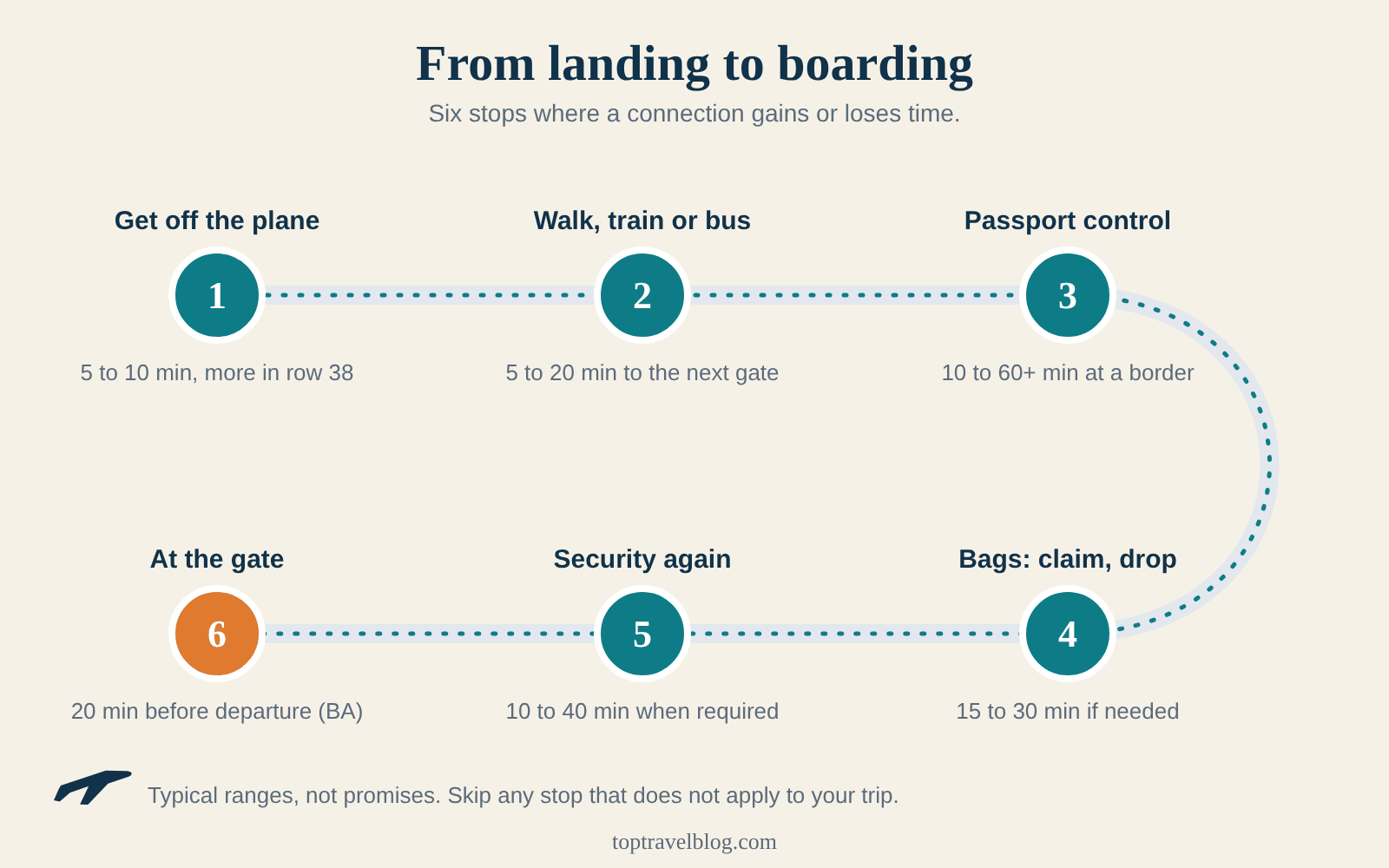
Understanding the minimum connection time airport rule is half the job. The other half is how you behave between the two gates. Here is the sequence I follow, whether the layover is 55 minutes or three hours.
Step 1
Read the connection before you book
Open the itinerary, compare it with the minimum connection time airport rule for that hub, and find the layover length, the airport code, the arrival and departure terminals, and whether the fare is one ticket. Anything below 60 minutes on a domestic trip, or below two hours when you arrive internationally, needs a good reason.
Look at which airline operates each leg. A codeshare, where one airline sells a flight that another operates, can put your connection in different terminals than you expect, because the terminal is set by the operating carrier.
Step 2
The night before, learn both gates
In your airline’s app, open the flight details and look at the arrival gate (once it posts) and the departure gate. Then open the airport map. Count the distance in concourses and trains, not in minutes.
Take a screenshot of the map. Airport Wi-Fi is fine, but your phone’s signal inside an underground walkway might not be.
Step 3
In the air, watch the arrival time
Most airlines show a live arrival estimate on the seatback screen or in the app. If the pilot announces a delay, tell the flight attendant at once and ask whether connecting gate information is available. On some airlines, agents will hold a connecting flight for a few minutes when a group of passengers is arriving late; they cannot do that if they do not know you exist.
Step 4
On landing, move before you plan
Stand as soon as the seat belt light goes off. Read the gate numbers in your app from the jet bridge. Follow signs for “Connecting Flights” or “Flight Connections,” which at Heathrow are purple and at most U.S. airports are white on a dark background.
If the next gate is in another terminal, find the train or shuttle first. If it is within walking distance, walk quickly; walking is usually faster than waiting for a train to arrive.
Step 5
Clear whatever stands in the middle
If a border is required, join the shortest line that you are allowed to use. U.S. citizens and many eligible travelers can use Mobile Passport Control, a free app, and Global Entry holders use kiosks. Customs and Border Protection explains Global Entry on its Global Entry page, which lists the five-year fee as $120.
If your bags need to be reclaimed, do it quickly and head straight for the airline’s transfer drop. At Seattle, for example, the Port of Seattle points connecting passengers to follow the orange walls to the left to hand off bags and says some airlines require the drop on the ticketing level.
Step 6
Reach the gate with time to spare
British Airways asks that you reach the onward gate at least 20 minutes before departure at Heathrow. Gate closure on U.S. domestic flights is typically 10 to 15 minutes before departure. Gate agents do not wait for you at the door; the aircraft is already on a schedule for its slot.
If you are late, speak to the agent at once and ask for rebooking. Do not wait for the board to update.
Watch out: Walking to a gate where the plane is still boarding does not guarantee that you will fly. Once the boarding door is closed, many airlines will not reopen it, even if the aircraft has not pushed back.
Worked examples: is this connection enough?
Rules are easier to remember with examples. Here are six situations that I see all the time, and my honest read on each.
Scenario 1: 45 minutes, same airline, same concourse, domestic
A morning flight from Denver connects to a flight to Dallas on the same airline, with a 45 minute connection at the same hub. A 45 minute connection sitting right at the minimum connection time airport floor works most days. If the first flight is a regional jet that parks at a remote stand, it does not. I would take it if the inbound is rarely late and I have only a carry-on; I would not if the first leg starts from a snowy airport in January.
Scenario 2: 55 minutes, terminal change at a big hub
Here you arrive in Terminal 1 and depart from Terminal 4. The airline sold it because it clears the minimum connection time airport filing, which only tells you that it fits their model. If the terminals connect airside by train, 55 minutes is workable with a checked bag that must be moved. If you have to exit security and re-enter, it is not. Add 30 minutes for that and you have the connection I would book.
Scenario 3: 1 hour 20 from Frankfurt, then 2 hours 45
You land at 1:10 p.m. and your next flight leaves at 2:30. In a quiet lull immigration could take 15 minutes; on a summer Saturday it could take 70, and bag claim, customs, the bag drop and a second TSA screening still remain. The airline calls that a legal connection. I call it a gamble. A 3:55 p.m. departure is the one I would book, because a long queue is absorbed and a short one buys lunch.
Scenario 4: 4 hours, separate tickets, Heathrow
You land on one airline at Terminal 2 and fly out on another from Terminal 5, with no common booking. You need to clear UK immigration, collect your bag, travel to Terminal 5 by Heathrow Express or the Underground, drop the bag at the new airline and clear security. Four hours is the minimum British Airways itself suggests. I would add another hour in summer.
Scenario 5: 75 minutes at Schiphol, non-Schengen to Schengen
Arriving from New York with a flight to Barcelona. The transfer is inside one terminal building, but you need to pass Schengen passport control, then security again. Fifty minutes is the filed minimum connection time airport number; 75 gives you a bit of cushion, and I would be uncomfortable with less if the arrival is during the morning wave when many transatlantic flights land together.
Scenario 6: 90 minutes with a toddler and a stroller
Parents often ask me whether 90 minutes is safe. It is in a single concourse. Add the stroller drop at the jet bridge, a diaper stop, and a family-lane security line, and 90 minutes becomes 60 of usable time. For international arrivals with kids, I would push the layover to three hours and treat any food stop as a bonus.
What to do when the first flight is late and the minimum connection time airport window is gone
Sooner or later you will be sitting on a plane that is 40 minutes behind with a 55 minute connection. This is the section I wish someone had handed me at 22.
In the air or on the taxiway
Open the airline app. Many airlines now rebook automatically when they see a connection breaking, and the app may already show a new flight. Accept it if it is acceptable; do not wait until the desk line forms.
If the pilot announces the delay, ask the crew whether the onward flight is expected to wait. Do not expect a promise. Crews and gate agents know a lot more than the board does about whether the outbound is itself delayed.
On the ground, one-ticket case
If you are on a single ticket and the airline caused the delay, you are the airline’s problem. Go to the connecting gate first if the walk is short, because the agent can hold the door for passengers who are visibly on the way. If the flight has left, go to the nearest customer service desk or use the app or phone line, whichever has the shorter wait.
I explain the rebooking steps, bag handling and rights in detail in our guide on what to do when a flight is canceled or delayed and in the separate walkthrough of missed connections.
What the U.S. refund rule says, and what it does not
Since October 2024, the Department of Transportation’s rule requires U.S. airlines and ticket agents to give automatic refunds when a flight is canceled or significantly changed and you decide not to travel. A significant delay is one that makes you arrive more than three hours late on a domestic flight, or more than six hours late on an international one.
The rule also covers bag fees when checked luggage is not delivered within 12 hours on a domestic itinerary, or 15 to 30 hours on an international one, depending on the flight length.
The refund rule is about getting your money back if you give up the trip. It does not shorten a minimum connection time airport rule and does not decide who pays for a hotel. I cover the details in our guide to airline refund rules in the U.S., and the official consumer pages sit on the Department of Transportation air consumer site.
Tip: The best moment to rebook is the moment you know. If your first flight is delayed and the app shows a protected alternative, take it before the line forms. The people who stand at the counter for three hours were usually the people who waited to be sure.
How to book connections that survive real life
Now the decision part, the one that saves the trip before it starts: how to read a minimum connection time airport figure when you choose an itinerary. These are the rules I follow when choosing a connecting itinerary from search results.
Treat the shortest minimum connection time airport itinerary as the cheapest, not the best
Flight search tools sort by price or by total duration, and both rankings tend to float up itineraries with the thinnest connections. Every result shows its layover length, so read it before you click, and use the Connecting airports filter to drop hubs you do not trust. I reject anything under 60 minutes for domestic trips, whatever the minimum connection time airport table allows, and under 2 hours for international arrivals into the United States.
Our guide on how to use Google Flights walks through the filters step by step.
Price the margin
A layover above the minimum connection time airport value costs you time, not usually money. A tight one costs you nothing until it fails, and then it costs a lot. Think of the extra 90 minutes as the premium on insurance.
Sometimes the longer connection is cheaper because airlines price off-peak flights lower. When it is $30 more for a layover that is 90 minutes longer, I take the longer one almost every time.
Fly early in the day
The first wave of departures is the most reliable. A 7 a.m. flight starts the day with an aircraft that spent the night at the gate. By late afternoon, delays from earlier in the day, weather, and air traffic control restrictions have stacked up. If your connection is the only flight to your destination, put the trip in the morning so that a miss leaves you the same day to recover.
Check where your bags are tagged to
At check-in, read your bag tag and make sure it lists the final airport code, not the connection city. A tag that ends in the connection city means you will have to claim and re-drop it, which kills a tight connection.
If you are building a bigger itinerary, the same discipline applies in how to plan a trip: the transfer points are where the plan is weakest, so they get the most buffer.
What a tight connection really costs you
The minimum connection time airport rules are written around the airline’s convenience, so it is worth pricing the connection from your side. I think in two tiers.
On a budget, the tempting move is the shortest legal layover, the one sitting on the minimum connection time airport floor, because it is often the cheapest fare and the shortest trip. That works when you carry only a bag that fits under the seat, the first leg is dependable, and a later flight exists the same day. If any of those fail, the cheap fare becomes the expensive one.
In the middle, which is where I live, you pay for a one-ticket itinerary with 75 to 120 minutes on domestic trips and about three hours for international arrivals. The fare is typically a little higher than the thinnest connection and the stress is far lower.
The hidden cost of a missed connection
When a missed connection is the airline’s fault, the rebooking itself is free. What isn’t free is the rest: an evening in the airport, a hotel night you pay for if the delay was weather, a rental car that expires, a tour that departs without you.
The cost that surprises people most is the second one. A missed connection that pushes your arrival back by a day can invalidate a prepaid hotel or an activity booked for the first morning. That is why I never book a non-refundable event on the day I arrive after a connecting flight.
If you booked the whole trip on short notice and the 24 hours after booking matter, our guide to the 24-hour flight cancellation rule explains when you can still back out of a ticket that has a bad connection.
Common mistakes with a minimum connection time airport rule
These are the errors I see most, in the order they tend to cost people.
1. Treating the minimum connection time airport figure as the recommendation
The most common mistake. The airline lists a 40 minute connection because its system allows it. If your trip depends on the flight, choose a layover you would be comfortable with if the first leg runs 20 minutes late.
2. Forgetting that a border adds time that no one prints
Your itinerary and its minimum connection time airport figure show only the layover, not the immigration line in the middle. When you arrive from abroad into the United States, add customs, bag reclaim and a second security screening to your mental math before you look at the clock.
3. Self-connecting with a tight window
Two separate tickets and two hours of layover is the combination that ends with a rebooking fee and a lost night. If you must self-connect, follow the four-hour rule that British Airways itself suggests.
4. Not looking at the terminal map
A “five-minute walk” on paper can be a train ride and a landside shuttle. Check the map for both gates the day before and add what it shows.
5. Waiting in the customer service line
Rebook in the app or by phone while you walk to the gate. By the time you reach the front of a long line, the flights are full. The agents at the counter are using the same system you can reach on your phone.
6. Checking a bag on a very short connection
A checked bag is one more item that has to make the transfer on time. If your connection is under an hour and the trip allows it, travel with carry-on only. Gate-check if the overhead bins are full.
7. Ignoring the last flight of the day
A missed connection at 8 a.m. is annoying. A missed connection at 9 p.m. with no later flight is a hotel. If the second flight is the last one of the day, add a large margin or move the trip to the day before.
Frequently asked questions about minimum connection time at the airport
What is a good minimum connection time airport rule of thumb for domestic flights?
For a single ticket inside the United States, I use 60 minutes as the floor at a small or mid-size airport and 75 to 90 minutes at a big hub where you change concourses. If you change terminals and have to go back through security, plan on two hours. These are my own comfort numbers, not airline rules; the airline’s filed minimum is often 30 to 45 minutes.
Is 45 minutes enough for a connecting flight?
A connection at the minimum connection time airport floor of 45 minutes can work, if both flights are on the same airline, the first one is on time, the gates are in the same concourse and you are traveling with a carry-on bag. It is not enough if a border check, a terminal change or a checked bag is involved. At a large hub in winter or summer storm season, I treat 45 minutes as a coin flip and choose a longer layover when I can.
How long do I need when I land from abroad in the United States?
Plan on at least 2.5 hours, and 3 hours in summer or around holidays. You need time for passport control, bag reclaim, customs, handing your bag back to the airline and a second TSA screening. The Port of Seattle says processing can take an hour or more at peak times. Global Entry or Mobile Passport Control can shorten the first step, but not the others.
Do minimum connection times apply to separate tickets?
No. Heathrow says outright that minimum connection times do not apply to separate tickets, and British Airways recommends at least four hours between flights on separate bookings. The second airline has no obligation if your first flight is late. If you self-connect, carry-on only and a flexible onward fare are the two things that reduce the risk.
What happens if I miss a connection on the same ticket?
The airline that issued the ticket is responsible for getting you to your destination. In practice that means it rebooks you on the next available flight at no extra charge, and it should send your bags along. What it owes beyond that, such as meals or a hotel, depends on the airline’s policy and the cause of the delay. Our guide to missed connecting flights covers the details.
Why do airlines sell connections shorter than I can realistically make?
Because a minimum connection time airport value is built on the assumption that everything goes right, and because a shorter connection can make an itinerary look faster and rank higher in search results. OAG notes that airlines file exceptions to the airport standard partly for competitive reasons. The system protects the schedule, not the passenger’s comfort, which is why I add my own buffer.
Do I have to go through security again when I connect?
It depends on the airport and the trip. At Heathrow, every connecting passenger goes through security again. In the United States, passengers arriving from abroad who connect to a domestic flight are screened again by the TSA. On domestic connections inside one airport, you normally stay airside and do not rescreen, unless you have to leave and re-enter to change terminals.
How early do the gates close?
It varies by airline and airport. British Airways asks that you be at the onward gate at least 20 minutes before departure at Heathrow. On most U.S. domestic flights, boarding closes roughly 10 to 15 minutes before departure. Once the boarding door is closed, many airlines will not reopen it, so arriving at the gate after closing time often means rebooking even when the plane is still there.
How can I find the minimum connection time airport figure for my itinerary?
Your booking record and the airline app show the layover length, and the airline’s website usually lists its minimum for each airport in the booking tools. Because the table differs by airport, terminal and airline pairing, read the layover as a minimum for the airline, not as a recommendation for you. The OAG guide to minimum connection times explains how the tables are built.
One last thing before you book
The pattern I have noticed over the years is that nobody regrets an extra hour at a connecting airport, and almost everybody remembers the sprint. A long layover is one of the few parts of travel where you can pay a small, predictable price to avoid a large, unpredictable one.
If you take only three ideas from this guide, make them these. Book on one ticket whenever you can, so that a late arrival is the airline’s problem. Add your own buffer to the filed minimum connection time airport figure: roughly an hour for domestic, two to three hours when a border or a bag reclaim sits in the middle. And look at the map before you book, not after you land.
When you are working out the whole trip, start with our guide on how to plan a trip step by step, and treat the connection as a place where you add a buffer instead of removing it.
Most connections, even short ones, work out. The point of a margin is the day they do not. Build the trip so that the day is an inconvenience rather than a disaster, and then go enjoy wherever the second flight takes you.
Related planning guides
- How long of a layover do you need for an international flight? — the longer-haul version of this article, with border and visa timing.
- What happens if you miss a connecting flight? — rebooking, bags and what you are owed.
- Flight canceled or delayed? What to do first — the steps to take before you join the line.
- How to find cheap flights — a search strategy that avoids the thin-connection trap.
- Airline refund rules in the U.S. — cancellations, significant delays and bag fees.
- How to choose a hotel — for the night a missed connection turns into.