Three hours is the number I give most people, and it is the figure this guide is built around: for a connection that involves crossing a border, three hours is a safe international layover time, two hours is the realistic floor, and anything under 90 minutes is a bet you are placing against your own airline.
That sounds like a lot if you have read the minimum times on airline booking pages. Those minimums are real, but they describe the fastest a bag and a passenger can legally move through an airport on a perfect day. They are not the same thing as the time you personally need once you add a late inbound flight, a long line at passport control and a gate at the far end of the terminal.
This guide covers how to pick your international layover time for the most common trips: Europe to the United States and back, a U.S. connection on the way to Latin America or Asia, and a European hub on a trip that ends somewhere else entirely. It explains what actually happens between the two flights, which airports are slow, when a long layover turns into a chance to leave the airport, and what to do when the numbers go wrong.
I have made these connections through Heathrow, Frankfurt, Amsterdam, Atlanta, Newark and Miami, once at a sprint with a boarding pass printed on the plane and several times with five hours to spare and a very good sandwich. What follows is what I would tell a friend before they hit the book button.
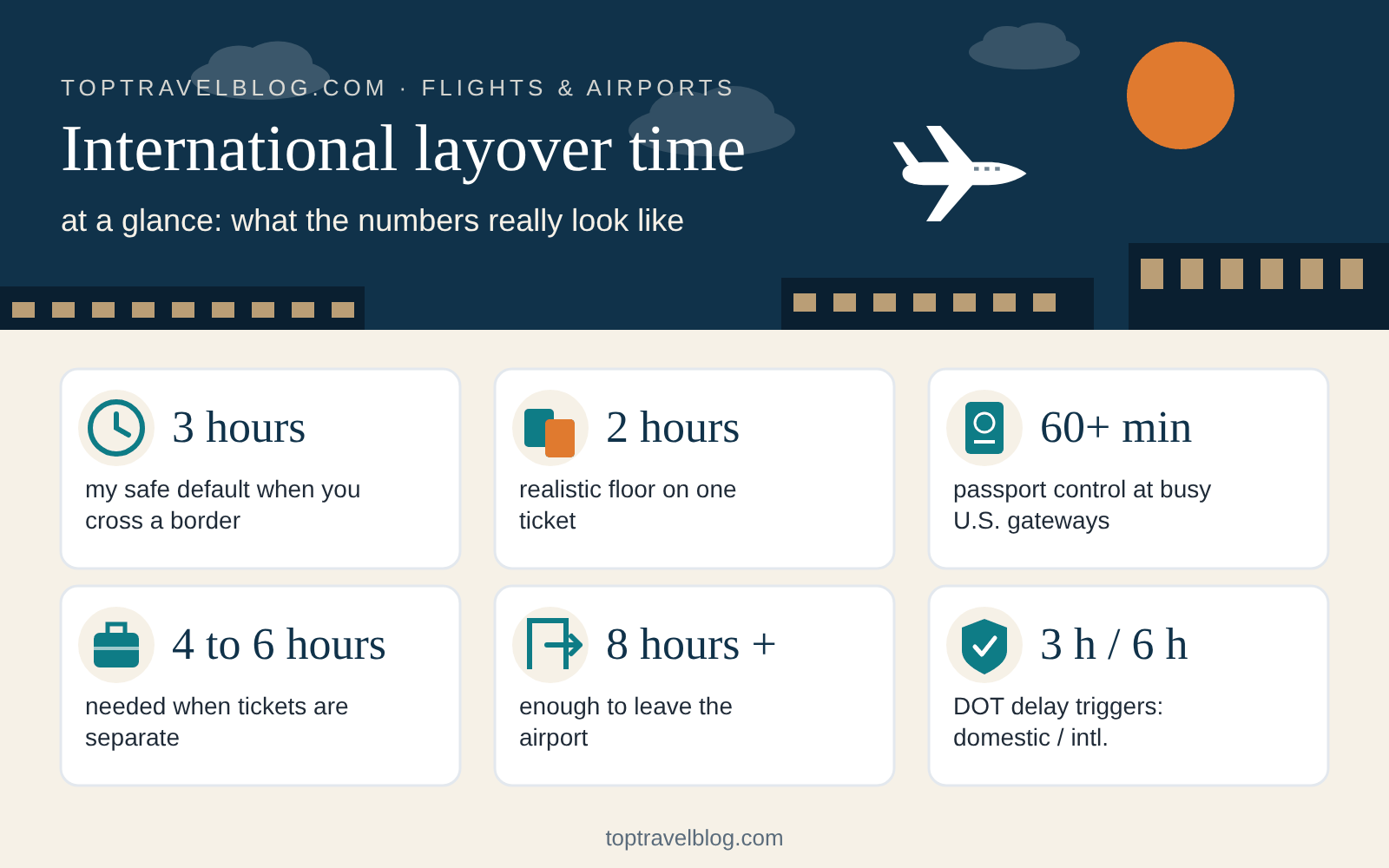
Quick facts: international layover time at a glance
- My safe default: 3 hours when you arrive in the U.S. from abroad and connect onward; 2.5 to 3 hours in Europe if you change terminals or cross from a non-Schengen to a Schengen flight.
- Realistic floor: about 2 hours on one ticket at a mid-size airport with carry-on bags only.
- Separate tickets: 4 to 6 hours, because a missed second flight is entirely your problem.
- Too long? Past about 8 hours you can usually leave the airport; past 24 hours you have a stopover, not a layover.
- Protection: on a single booking the airline rebooks you if the first leg makes you miss the second.
- Biggest time-eaters: immigration lines, a terminal change, bag drop-off, and security re-screening.
How much international layover time you need: the short answer
Here is the version you can screenshot. These are my recommended international layover time figures for a single ticket, written as the gap between your first flight’s scheduled arrival at the gate and your second flight’s scheduled departure.
Arriving in the U.S. from abroad, then a domestic flight
Recommended: 3 hours (floor 2 hours)
You must clear passport control, collect checked bags, go through customs, hand the bags back and pass TSA screening again. At big gateways that chain can take 90 minutes on a quiet morning and more than two hours when several wide-body flights land together.
Domestic flight, then an international flight from the same U.S. airport
Recommended: 2.5 hours (floor 90 minutes)
Your bag is checked through, you usually do not clear any border, and the main risk is a terminal change. International boarding closes earlier than domestic, so the margin matters more than it looks.
Non-Schengen to Schengen in Europe (for example London to Paris)
Recommended: 2.5 hours (floor 90 minutes)
Passport control or a security re-screen may sit between you and the gate. Big hubs like Heathrow and Frankfurt involve trains, buses or long corridors.
Two long-haul flights through a major hub (for example Dallas to Doha via a European airport)
Recommended: 2 to 3 hours (floor 90 minutes)
Same-airline transfers inside one terminal can be quick. Alliance partners in different terminals are not.
Separate tickets, any route
Recommended: 4 to 6 hours
You collect your bags, check in again and clear security again. If the first flight is late, the second airline owes you nothing.
If you only remember one idea, make it this: the right international layover time is a function of three things you can look up before booking. How many border and security checkpoints stand between the two gates, whether the airline is protecting the connection, and how much of the day the arriving flight is likely to run late.
The rest of this guide takes those three questions about international layover time apart, starting with why the airline’s number and mine are so far apart.
Airline minimum vs. the international layover time you really need
Every airport publishes a minimum connection time, usually shortened to MCT. It is a number that airlines and booking systems use to decide which two flights can be sold together on one ticket. If a flight pair is shorter than the MCT, the system will not offer it as a single itinerary.
MCT is the shortest international layover time the airport and airline consider workable under normal conditions, and it varies a lot. Examples reported when British Airways lengthened its Heathrow Terminal 5 connection to 75 minutes included Frankfurt at 45 minutes, Amsterdam at 50, Paris Charles de Gaulle at 60 and Vienna at 25. I walk through how these numbers are set in the guide to minimum connection time at an airport, and it is worth reading if you want the mechanics.
Why the minimum is not your target
MCT assumes your first flight lands on time, parks at a convenient gate, and that your bags and your body both make the trip without anything unusual. That is the best-case scenario and it is baked into the number on purpose, because airlines want to sell as many connections as possible.
What it does not assume is a 25-minute arrival delay, a ten-minute wait for a bus gate, a family ahead of you at passport control whose child has no documents ready, or a 60-minute line at security because the airport is in a school holiday week. All of those are ordinary. Any single one of them takes a 60-minute connection and makes it a gamble.
A simple way to build your own international layover time
Take the airline’s MCT, then add the delays that apply to your trip. Add 30 minutes if you are crossing into a country where you must clear immigration. Add another 30 if your route involves a terminal change by train or bus. Add 30 more if either flight is scheduled for a peak arrival window such as late morning in a U.S. gateway, or if you are traveling with children or a lot of carry-on.
That gives you a personal international layover time of roughly two to three hours for the usual trip, which is exactly the range I recommended above. It is not magic. It is just the MCT plus a margin that matches how airports behave on a real Tuesday.
Tip: Look at the day of the week and the hour. A Saturday-morning arrival into New York, Miami or Atlanta puts several long-haul flights at the immigration hall at once. The same connection at 4 p.m. on a Wednesday can feel like a different airport. When I have a choice, I add 30 minutes to the morning rush rather than trying to be clever with a tighter option.
Where your international layover time actually goes
It helps to picture your international layover time as a stack of small tasks rather than one block of hours. When people tell me their international layover time was only 70 minutes, they usually mean they got lucky with every item on this list. When someone says they needed three hours, one of the items ran long.
Deplaning and the walk
Getting off a wide-body aircraft can take 10 to 20 minutes if you sit near the back. Then comes the walk. At a hub like Atlanta, Frankfurt or Heathrow the walk to the next checkpoint can be 15 minutes, and a train or shuttle adds more. If your gate has no jet bridge and you take a bus to the terminal, the whole step stretches again.
Border control and customs
This is the biggest variable. On arrival in the United States, you go through U.S. Customs and Border Protection even if you are only passing through. Port of Seattle, which lays out the process clearly, says processing can take 60 minutes or longer during peak periods such as holidays and summer, and that many international flights land between 10 a.m. and 3 p.m. Pacific time. You can read their international connections page as an example of the sequence at a U.S. gateway.
In Europe, the rules are different. If you fly from a non-Schengen country such as the United Kingdom into a Schengen airport and continue to another Schengen country, you are normally checked at the first Schengen entry point. The EU’s Entry/Exit System, which became fully operational on April 10, 2026, registers non-EU travelers with a photo and fingerprints on first entry, and you can read how it works on the official EU travel site. A first visit means a few extra minutes at the booth.
Baggage and the second hand-off
If your bags are checked through to the final destination, you will not touch them in the Schengen area or on most flights between non-U.S. countries. In the United States, though, international arrivals must collect bags before customs, then drop them again at the connecting belt. That step alone is often 20 to 40 minutes, partly because your bag must come off the carousel first.
Security re-screening
You usually go through another security check when you arrive from abroad in the United States, and at many European and Asian hubs you are screened again if you connect from a non-EU flight. The 3-1-1 liquid rule still applies for carry-on, which matters if you bought a bottle of water or duty-free alcohol at the previous airport. A sealed duty-free bag helps, but the rules for it are specific, so ask at the shop.
The gate, the boarding window and the unexpected
Boarding closes before departure. Airlines usually stop boarding 10 to 20 minutes before the scheduled takeoff, and on international flights the cutoff is often at the longer end. Subtract that window from the departure time before you count your layover, because the useful part of the connection ends well before the time printed on your boarding pass.
That is why a nominal 90-minute international layover time is, in practice, a 40- to 50-minute race to the gate. It is also why the number I give people is three hours and not two.
Arriving in the U.S.: the step-by-step international layover time
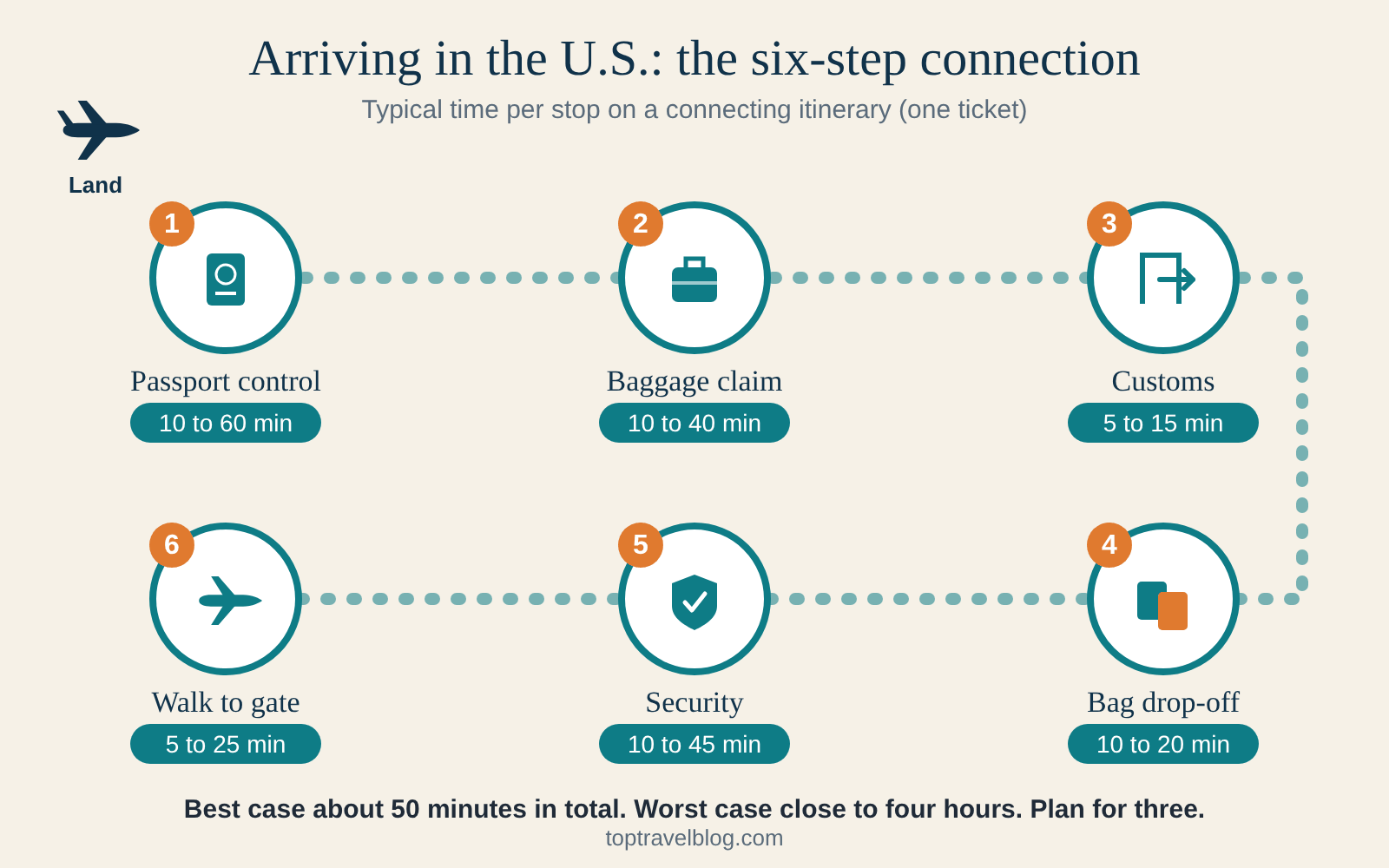
If you take only one connection type seriously when planning international layover time, make it this one. Arriving in the United States from another country and continuing on a domestic flight is the connection where good travelers lose flights, and where my three-hour number comes from. The path is the same at almost every airport, even though the signs differ.
Step 1
Passport control: 10 to 60 minutes
You walk from the aircraft to the federal inspection area and join the immigration line. U.S. citizens and returning residents use the passport lane; visitors fill out their arrival details and are fingerprinted if they are on a first entry. At a big gateway on a quiet morning, 10 to 20 minutes is common. After a cluster of wide-body arrivals, an hour is not unusual.
Two shortcuts matter. Global Entry, CBP’s trusted traveler program, sends members to kiosks and usually cuts the wait to a few minutes. Mobile Passport Control, the free app from CBP, lets U.S. and Canadian citizens submit their details before inspection and use a faster lane at 27 airports and four seaports. Both are worth having if you connect through the U.S. more than once a year.
Some airlines also run an express connection program for tight connections: at certain airports, agents can flag a small number of passengers on a flight for a quicker lane, usually after you land and tell an airline representative. It works at some gateways and not others, so treat it as a rescue and not a plan.
Step 2
Baggage claim: 10 to 40 minutes
Even if your bag is labeled to your final city, you collect it here. Carousels on international arrivals are slow because the flight just emptied 300 or more suitcases. If you traveled carry-on only, you skip this step entirely, and that single decision is worth 20 to 30 minutes.
Step 3
Customs: 5 to 15 minutes
After you pick up your bag, you hand a customs declaration (often electronic now) to an officer or a kiosk. Most travelers with nothing to declare walk straight through. If you are carrying food, plants, or more cash than the limit, say so, because an agricultural inspection can add significant time, and a missed declaration can carry a fine.
Step 4
Bag drop-off and the walk to security: 10 to 20 minutes
Just outside customs there is a belt or counter where you drop the bag for your onward flight. The signs usually say Connecting Flights. At some airports you hand the bag back at an airline desk after exiting into the public arrivals hall, and you then walk back in through a different door. Follow the orange or yellow connecting-passenger signs and ask an airline agent if the signs run out.
Step 5
Security screening: 10 to 45 minutes
You pass through TSA screening again, with your shoes, laptop and liquids rules in place. Some airports have a dedicated connecting-passenger checkpoint with a shorter queue. At others the checkpoint at the international arrivals building is closed at certain hours, and you have to exit and use a main terminal checkpoint, as Port of Seattle explains for its South Satellite. A TSA PreCheck membership helps only where the lane exists for connecting passengers.
Step 6
The walk or train to the gate: 5 to 25 minutes
Then you travel to the next gate. In Atlanta, you take the underground train. In Chicago O’Hare you may change terminals by walking or tram. In Newark and JFK you might need an AirTrain or a shuttle bus if your connection departs from a different terminal. The bigger the airport, the more time you should budget.
Add up the best-case column of this international layover time and you get about 50 minutes. Add up the worst-case column and you get close to four hours. Three hours sits in the zone where 90 percent of days work out and the rest of the days you still have a chance to run.
Watch out: The most common error I see at U.S. gateways is a traveler who clears immigration, grabs the bag and then joins the wrong line because the arrow said Baggage and Ground Transportation. Look for the word Connections every time you reach a fork. Taking the wrong exit sends you into the public arrivals hall, and getting back in means a second TSA screening.
Which U.S. airports are kinder to tight connections
Airports built around international connecting traffic tend to give you the easiest international layover time. Houston Bush, Dallas Fort Worth, Atlanta and Miami all process large numbers of connecting passengers every day and have signs and staff for them. Smaller airports with a single international wing, and airports where the immigration hall is far from the domestic gates, are the opposite.
If your itinerary lets you choose, pick the airport that handles connections every day. A well-run big hub with a 2:45 connection is usually less risky than a 2:30 connection at an airport that sees three international flights a day.
The reverse: U.S. departure to an international flight
Leaving the United States is much easier. You do not clear any border on departure, so a domestic flight into your international departure airport usually needs only the walk and, in some cases, a terminal change. For international layover time on this leg I use 2.5 hours if the two flights are in the same terminal and three hours if they are not. If you have a first flight with a history of delays, add 30 minutes.
What can go wrong is the check-in cutoff for the international leg. If your bags are not checked through on a single ticket, you may need to check in again and drop a bag within the airline’s cutoff, commonly 60 minutes before departure for international flights. On a single ticket with through-checked bags, that stress mostly disappears.
If you are building a longer trip around a U.S. gateway, the same idea applies to your first city. Someone landing in New York from London who keeps going to Boston is on the same path as someone staying; if you plan to stay, see my New York City itinerary for what to do after you clear customs.
Connecting in Europe and the UK: international layover time on the other side
European connections are more confusing than American ones because three systems overlap. There is the Schengen area, the United Kingdom, which sits outside Schengen, and a handful of other countries with their own border rules. Where your two flights sit in that map decides your international layover time.
Same Schengen zone, same ticket
If you arrive in Frankfurt from a non-Schengen country and continue to Madrid, you are normally checked at Frankfurt, because that is where you enter Schengen. If you arrive from outside the area and continue to a non-Schengen city, you generally stay airside and just pass security. The question that changes your international layover time is whether you have to clear border control at the hub.
As a working international layover time, I use 2 to 2.5 hours for a transfer where you clear Schengen entry, and 90 minutes to 2 hours when you stay in the transit area at a hub with short walking distances. If the airport requires a train between terminals, add 30 minutes.
Heathrow, Frankfurt, Amsterdam and Paris
London Heathrow
Best known for: terminal changes and long walks
Connections between terminals use transfer buses and trains, and some require another security screening. British Airways lengthened the Terminal 5 minimum to 75 minutes on some flights. I plan 3 hours for a Heathrow terminal change and about 2 hours for a same-terminal connection.
Frankfurt
Best known for: size and the Schengen/non-Schengen split
Published connection minimums here are short, around 45 minutes in the example above, but the airport is huge and passport checks come into play when you move between zones. I book 2.5 hours if I cross zones.
Amsterdam Schiphol
Best known for: a single-terminal layout
Everything is under one roof, so walking is easier than at most hubs. Published minimums are around 50 minutes. I still keep 2 hours for a non-Schengen to Schengen change.
Paris Charles de Gaulle
Best known for: terminals that are far apart
Minimums are around 60 minutes in published examples, but moving between Terminal 2 halls or to Terminal 1 can take a long time. I treat 2.5 to 3 hours as the number for anything that is not a same-terminal connection.
The pattern with international layover time in Europe is that hubs publish short minimums because their systems handle connections well on a good day. When you are the person who has to walk, queue and sometimes ride a bus, give yourself the extra hour.
Connecting through the UK
If your itinerary involves passing through UK border control, you now need an electronic travel authorisation. The UK government lists the ETA at £20 and says each person traveling needs one, including children. If you stay airside and do not pass through UK border control, an ETA is generally not part of the equation, but you can read the rules on the UK government ETA page. The practical effect on your international layover time is that a change of airport in London (Gatwick to Heathrow, for example) always means passing the border.
Separately, I would not plan an international layover time of less than six hours for a Heathrow to Gatwick transfer even with a ticket on one booking. You exit, clear border control, travel across London and check in again. It is a trip in itself.
Elsewhere: Asia, the Gulf and Latin America
Hubs in the Gulf and Asia, such as Doha, Dubai, Singapore, Seoul and Tokyo, are designed around transfers, with separate transfer security and short walks. Two hours is a comfortable international layover time there on a single ticket. In Latin America the situation is mixed: some hubs are efficient, and in others you must exit, clear immigration and check in again. When I do not know an airport well, I look at the airline’s own transfer instructions and add an hour.
Worked examples: choosing your international layover time by route
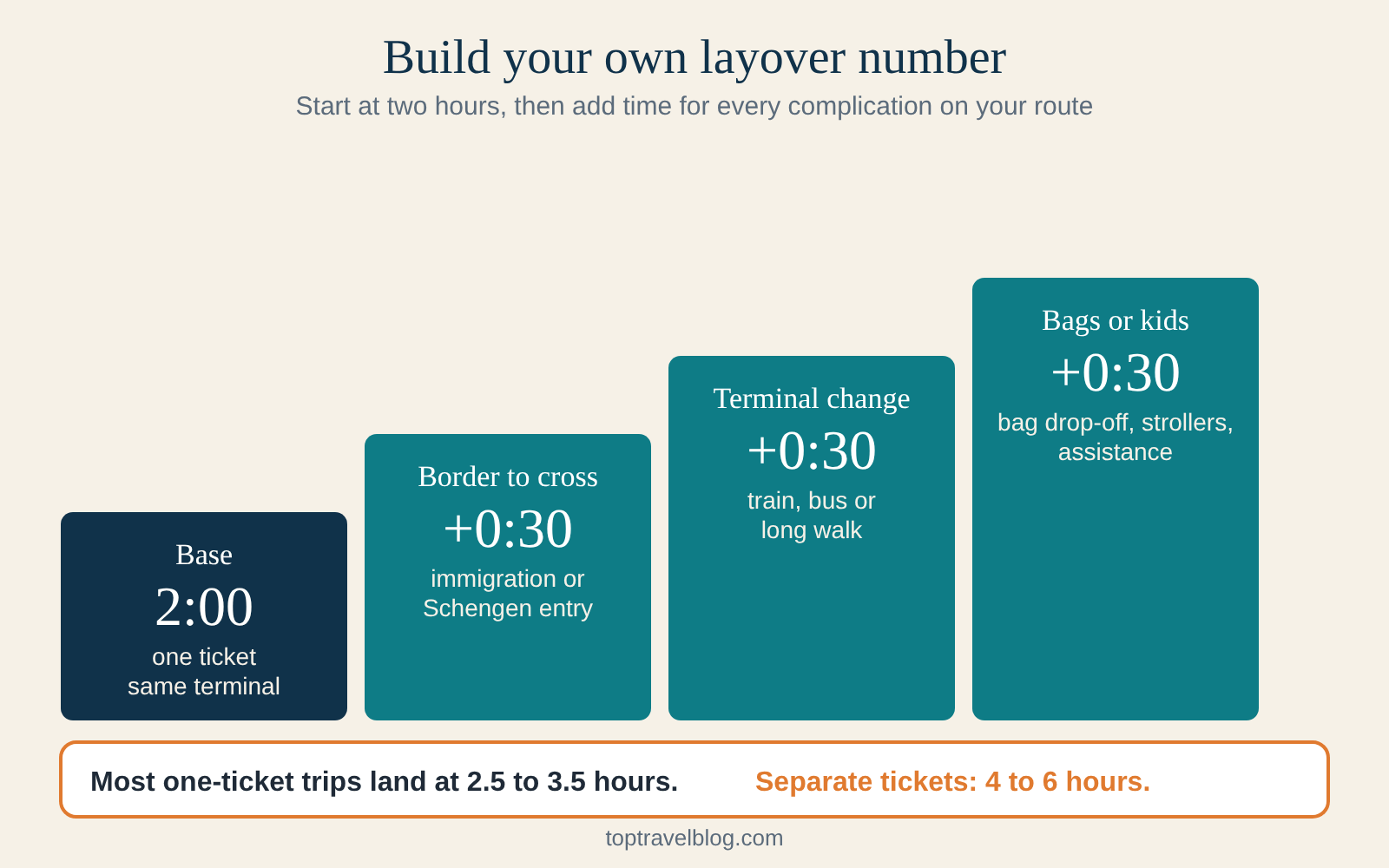
Rules are easier to trust once you have seen them applied. Here are six examples of international layover time drawn from the kinds of trips readers ask me about, with the number I would pick and why. The airlines and airports are examples; the logic carries over to similar routes.
London to Orlando via Atlanta, one ticket
My pick: 3 hours or more
You arrive in the U.S. at Atlanta, so you clear immigration, collect bags and hand them back, then go through security again. A 2-hour international layover time works with carry-on only. With two suitcases and a child, I would choose the 3.5-hour flight and spend the extra time eating.
Chicago to Lisbon via Newark, one ticket
My pick: 2.5 hours
This is domestic then international from the same airport. There is no border to clear, but the terminal change at Newark and the earlier international boarding make a 90-minute option feel tight. A 2.5-hour connection gives you a snack and a margin.
Rome to Boston via Frankfurt, one ticket
My pick: 2.5 hours
You clear Schengen exit at Frankfurt or stay airside depending on gates, and you may be screened again on the way to the U.S. flight. I pick 2.5 hours for the big hub and a morning departure to avoid late-inbound chains.
Seattle to Tokyo to Bangkok, one ticket
My pick: 2 hours
Asian hubs are built for transfer. A 2-hour option in Tokyo with a same-terminal gate is comfortable. Anything below 90 minutes is where I start looking at the alternatives.
Dublin to Los Angeles, with a U.S. preclearance
My pick: 2 hours at the U.S. gateway
Because you clear U.S. border control at Dublin before the flight, you land as a domestic arrival and walk straight to the next gate. This is the one case where a U.S. connection is quicker than the normal rules suggest.
Two separate tickets: Madrid to Miami, then Miami to Nassau
My pick: 5 hours
Different tickets mean you collect bags, check in again and clear U.S. customs. If the first flight is late, the second airline will not wait. Five hours is the most comfortable number, and 4 is my floor.
Notice that the Dublin case is different. Preclearance, which lets you complete U.S. immigration and customs before boarding at certain airports abroad, moves the work you would do in the United States to the departure airport. It is a real advantage, and I would pick a preclearance routing with a short international layover time over a slightly cheaper alternative when I had a tight connection.
A quick test for any connection you are looking at
Open the itinerary and answer four questions. Does the layover cross a border? Does it involve a terminal change? Is it one ticket or two? What time of day does the first flight land? Start your international layover time at two hours, add 30 minutes for each yes, and compare the total with the connection you were offered.
If the offered layover is within 15 minutes of your total, you are fine. If it is more than 30 minutes shorter, look for another flight. If it is more than an hour longer, you are probably paying for something you do not need, and that is a good moment to see whether the airline offers a better routing. For help finding those alternatives, my guide to using Google Flights explains how to filter by layover duration and connecting airport.
One ticket or two: how it changes your international layover time
The most important variable in international layover time that I have not yet covered is not time at all. It is whether the two flights are on the same booking.
A single ticket (or a protected itinerary)
On one booking, the airline sells you a connection and takes responsibility for it. If your first flight is late and you miss the second, the airline rebooks you at no extra charge on its next available flight, and in many cases offers a hotel or meal vouchers if the delay is within its control. On a protected booking your international layover time is backed by the airline. My guide to what happens if you miss a connecting flight walks through the rebooking steps, bag handling and the rights that apply.
This is why a 2-hour international layover time on one ticket can be safer than a 4-hour layover on two tickets. The shorter connection comes with a safety net. The longer one does not.
Separate tickets
When you book two flights separately, even on the same airline, the airline treats them as unrelated trips. If the first flight is late, you may lose the second flight and the fare along with it. On separate tickets the international layover time also has to cover collecting your bags, checking in again and clear security and sometimes immigration, which is why I recommend a minimum of 4 hours and 5 to 6 hours if the first flight arrives in the evening.
Sometimes separate tickets save real money. This is common when a low-cost carrier serves the second leg. If you go that way, pick a first flight that arrives early in the day so that a late inbound flight still leaves you with a later departure to catch. Many travelers also build in an overnight at the connecting city for an international separate-ticket trip, which takes the pressure off completely.
If you are comparing options, my guide on how to find cheap flights explains when self-connecting makes sense and when the saving is not worth the risk.
What the U.S. rules say when delays happen
The U.S. Department of Transportation requires airlines to give automatic refunds when a flight is canceled or significantly changed and you decline the alternative. The rule counts a delay of three hours or more for a domestic flight and six hours or more for an international flight as significant, and a change of airport or an added connection counts as well. You can read the details on the DOT aviation consumer protection pages.
This matters for layovers because the rule covers tickets sold for U.S. travel, including flights to and from the United States, not every flight you take. For a deeper walk-through of your options, see the airline refund rules and what to do when a flight is canceled or delayed.
Long layovers: visas, leaving the airport and stopovers
The opposite problem is an international layover time that is too long. A 9-hour international layover time in the middle of the day is a gift if you plan it and a slog if you do not. Here is how I think about it.
Under 4 hours: stay put
Leaving the airport when your international layover time is shorter than four hours is rarely worth it. After transit time to the city, a security re-screen and a margin for being back, you have very little real time. The exception is a city with a fast train directly from the airport, where 4 hours can be enough for lunch and a walk.
5 to 8 hours: a short outing with a hard stop
If your international layover time is between five and eight hours, you can often leave. Make sure you know how long the train or taxi takes each way, add a 30-minute buffer, and decide in advance when you will turn around. A good rule is to be back at the airport at least 3 hours before your next flight on an international departure.
You need to hold the right documents too. If you leave the airport, you pass through immigration in that country, which may require a visa or travel authorization depending on your nationality. For a U.S. citizen, that usually means checking whether the country requires an eVisa or ETA, and the UK’s £20 ETA mentioned earlier is one example.
8 to 24 hours: an overnight, done properly
A long international layover time that includes a night usually works better if you book a real hotel and treat it as a half-day trip. If your ticket is a single itinerary, your bags are often checked through, which means you travel light into the city. If they are not, ask the airline whether you can retrieve them.
If you are choosing a hotel for a short stay, my guide to how to choose a hotel covers location, fees and cancellation terms, and the same logic applies to an airport hotel. Pay attention to shuttle hours: a 24-hour shuttle is worth a lot at 5 a.m.
Over 24 hours: it is a stopover
Some airlines allow a deliberate stopover of a day or more at a connecting city, sometimes for no extra airfare. Iceland, Portugal, Turkey, the Gulf states and Singapore all have well-known stopover programs. A stopover changes the planning: you now need accommodation, local transport and possibly a visa. It becomes a mini-trip, and my guide on how to plan a trip helps you decide whether it fits your plans.
Watch out: A layover with a long gap often means you are on the same ticket as a flight that is not guaranteed to leave on time. Do not take on a risky city outing if a delayed arrival means you will be rushing back. Treat the last two hours before your next flight as sacred and stay near the airport if the weather or the news looks bad.
Bags, kids, reduced mobility and other multipliers
The international layover time numbers above assume an adult traveling alone with a carry-on. Real trips have more people and more luggage. Each of these factors adds minutes, and they stack.
Checked bags
Add 30 minutes on U.S. arrivals
On a U.S. arrival, you collect and hand the bags back, and that adds time. If you can fit your trip in a carry-on, you also remove the risk of a bag missing the connection.
Children and strollers
Add 30 to 45 minutes
Moving two small children through immigration, a bathroom stop and a long walk is not a five-minute job. Consider asking the airline for a family lane.
Reduced mobility
Add 45 to 60 minutes
Request wheelchair assistance when you book. Assistance staff are often shared across many arriving flights, so the wait to get off the plane can be long. Book a longer layover to match.
Elderly or first-time international travelers
Add 30 minutes
Unfamiliar signs and forms slow people down. Give yourself time to read, ask and rest.
Late-night or early-morning flights
Add 30 minutes
Fewer staff at security, closed shops and reduced train service can all slow a late or early connection. The airport is calmer, but not always faster.
Winter weather
Add 60 minutes, or pick a southern hub
Snow and ice produce late inbound flights. A connection through a northern hub in January has a real chance of being missed through no fault of your own.
It is easy to think I am being overly careful, but I have been the person at the back of a passport line watching the clock. You do not get that time back by being brave. You get it back by choosing the longer connection when you book.
Tip: Request your boarding passes for both flights before you leave home. If the airline cannot issue the second pass on a single ticket, take a screenshot of your itinerary and head to the transfer desk at your first airport rather than waiting until you land.
How to pick the right connection when you book
Most of the work on international layover time happens in the search results. These are the habits that improve your odds before you pay.
Sort by more than price
Cheap itineraries often have the shortest connections, because airlines pair the earliest arrival with the first available departure. When two options are within $40 of each other, I pick the one with the longer international layover time. A flight search tool lets you filter by layover duration, and my guide on using Google Flights shows how to set a minimum connection time so the short ones disappear from your results.
Choose the earlier first flight
When you compare options for international layover time and the first leg departs at 7 a.m. versus 4 p.m., the earlier flight leaves more recovery time in the day. A delayed morning flight can still catch an afternoon connection. A delayed evening flight cannot catch anything, because the last departure has gone.
Look at the airline’s own transfer information
Airlines publish connection guides for major hubs, including which terminal handles which flight and how to reach it. I read the guide for my connecting airport the week before travel. Ten minutes of reading saves much more than that on the day.
Avoid the last flight of the day
If your second flight is the last one to your destination, a missed connection means a night in the connecting city, a new hotel and a changed plan. When the budget allows, take the second-to-last departure. You may give up an hour of destination time, but you gain an escape route.
If you are building the whole trip from scratch, read the broader steps in my guide to planning a trip step by step before you fix the flights, because arrival and departure days shape everything else.
When the clock runs out: what to do if you are about to miss the connection
Even a well-chosen international layover time can fail when delays happen. These are the steps I follow when a connection is at risk, in order.
Step 1
Tell someone before you land
If you have a tight connection and your plane is late, tell a flight attendant during the descent. They sometimes know whether the connecting flight is held, and they can ask the crew to help you deplane quickly when you sit near the front. They cannot promise anything, but asking costs nothing.
Step 2
Check the departures board and the airline app
When you land, turn off airplane mode and open the airline app. A rebooking offer may already be waiting. If the connecting flight is delayed too, you may have more time than you thought. If it is gone, go straight to the airline’s transfer desk or call the airline while you walk.
Step 3
Ask for the next flight, not for a refund, unless you want one
On a single ticket, the airline is responsible for getting you to your destination. Ask for the next available flight, including on a partner airline, and ask about a hotel or meal vouchers if the delay was within the airline’s control. If you decide you no longer want to travel, you may be entitled to a refund; read the airline refund rules for what applies.
Step 4
Keep your documents and receipts
Keep your boarding passes, bag tags and receipts for meals and hotels. If the airline does not cover your costs, you may be able to claim them from your travel insurance or credit card. A photo of the delay notice on the departures board is useful too.
The full set of options for a missed connection, including bag handling and what you are owed, is in the flight canceled guide and the missed connection guide. The short version is that you are in much better shape on a single ticket than on two.
Common mistakes when planning international layover time
- Booking the shortest connection because it saves a few dollars. A 75-minute connection that costs $30 less is not a bargain once you count the risk. Pick the longer one unless the shorter is protected and you travel light.
- Trusting the airline minimum as your target. The minimum is the lowest number the system allows. Your international layover time should be built from your route, not from the booking engine.
- Forgetting that you must collect your bags on a U.S. arrival. Even a through-checked bag comes off the carousel at your first U.S. airport. Plan for the carousel, customs and the drop-off belt.
- Mixing up separate tickets and one itinerary when you set international layover time. If your confirmation shows two booking codes, you are on two tickets. Add hours, not minutes, to your international layover time.
- Ignoring the terminal change. A connection that looks short on paper can involve a train ride, a bus or a long walk plus a second security screen. Read the terminal for each flight before you pay.
- Scheduling the connection at the end of the day. If the last flight is canceled, there is no way out until tomorrow. Take the earlier connection and keep the evening for the delay.
- Leaving the airport on a tight layover without checking entry rules. If you exit, you pass through immigration. If you need an ETA or visa, you need it before you step off the plane.
- Buying liquids after security at the first airport. Water, wine and duty-free bottles from the departure airport can be confiscated at the next screening unless sealed correctly. Drink the water or buy it again after the checkpoint.
- Not carrying a printed or saved copy of the second boarding pass. If your phone dies or the app freezes, the transfer desk will print it, but only if you reach the desk. Save it to your wallet and take a screenshot.
- Treating a delay as someone else’s problem. If the connection is at risk, act in the air and on the ground. The agents who can help you work through a list, and the first people to ask usually get the best seats on the rebooked flight.
Frequently asked questions about international layover time
How long of a layover do you need for an international flight?
For most trips, three hours is a safe international layover time, and two hours is the realistic floor on a single ticket. If you arrive in the United States and connect onward, three hours accounts for passport control, bags, customs and security. On separate tickets, plan four to six hours.
Is a 1-hour layover enough for an international flight?
Usually not. One hour is too short if you cross a border, change terminals or collect and drop bags. It can work inside one terminal at a transfer-friendly hub on a single ticket, with carry-on only and an on-time arrival. I would treat it as a last resort and look for a longer option.
Is 2 hours enough for an international layover?
Two hours works at many airports on a single ticket with carry-on bags, especially in Asia and the Gulf where transfers are designed for speed. At large U.S. gateways with immigration, it is tight on busy days. Add 30 minutes if there is a terminal change, bags or children.
What is the minimum connection time for an international flight?
It depends on the airport and airlines. Published examples range from 25 minutes at Vienna to 75 minutes at Heathrow Terminal 5 for some British Airways flights. Those figures are what the booking system allows, not what I would plan. Read more in my guide to minimum connection time at an airport.
Do I have to go through customs on a layover in the U.S.?
Yes, if you arrive from another country and continue on a flight, you clear U.S. immigration and customs at your first U.S. airport. You collect checked bags, pass customs, drop the bags again and clear TSA security. The exception is preclearance, where you clear U.S. inspection before leaving a foreign airport.
Do I need a visa for an international layover?
It depends on whether you leave the secure transit area and on your nationality. If you stay airside, many countries do not require entry documents for most travelers, but some do. If you pass through border control, as in the UK where an ETA currently costs £20, you may need authorization. Ask the airline about your route when you book.
What happens if I miss my connection on one ticket?
The airline rebooks you on its next available flight at no extra charge, and your bag normally follows. Depending on the cause, you may also receive a hotel or meal vouchers. On separate tickets, the second airline has no obligation. The details are in my guide to missing a connecting flight.
Should I book separate tickets to save money?
Only if you can absorb the risk. The saving can be real, but you lose the airline’s protection, and you must collect and re-tag your bags yourself. If you do, pick an early first flight and leave at least four hours, or stay overnight. Use a careful search strategy to see whether the price gap is large enough.
How long is too long for a layover?
Past about eight hours an international layover time begins to feel like a wait, and past 24 hours it is a stopover. Between five and eight hours you can leave the airport if you have the documents and a clear plan to return. Beyond that, a hotel or a short city stay is usually a better use of the time.
Can I leave the airport during a layover?
Often yes, if your entry documents are in order and your bags are checked through or stored. Allow time for border control in both directions, transport to the city and a three-hour buffer before your next flight. If you are on separate tickets, you must collect your bags anyway.
Does Global Entry shorten a layover?
On a U.S. arrival, yes. Global Entry members use kiosks at passport control and often save a significant amount of time. Mobile Passport Control is a free alternative for U.S. and Canadian citizens at 27 airports. Neither removes baggage claim or security, so I still plan around two and a half to three hours.
One last thing before you book your international layover time
If I could reduce this whole guide to one habit, it would be choosing the connection first and the price second. A saved $40 vanishes the moment you are standing in a line with 20 minutes left on the clock.
Pick an international layover time of three hours for a normal border-crossing connection. Choose two only when you have a carry-on, a single ticket and a transfer-friendly hub. Choose five or six when the tickets are separate. And when an itinerary gives you a long gap, treat it as an opportunity, not a penalty: a good meal, a train into town or a night in a real bed beats a night in a terminal chair.
Then go and enjoy the trip you are connecting toward. Planning your international layover time well is how you make sure you arrive at all.
Related planning guides
- Minimum connection time: how much airport transfer time is actually enough? — the technical numbers behind the airline minimums.
- What happens if you miss a connecting flight? — rebooking, bags and rights when a layover goes wrong.
- Google Flights guide: date grids, price tracking and flexible airports — filter by layover length before you pay.
- How to find cheap flights: a practical search strategy — when a cheaper fare is worth a shorter connection.
- How to plan a trip step by step — where the flights fit in the rest of your plan.
- Airline refund rules in the U.S. — what you are owed when a flight is canceled or significantly delayed.