

A hotel can advertise a room at $129 a night and charge you $190 by the time you check out. That gap is almost always made of hotel resort fees, destination fees and a handful of smaller add-ons, and for years it stayed invisible until the last screen of the booking or, worse, until the front desk handed you the folio.
The short answer for 2027 trips: hotel resort fees are still legal, but since May 12, 2025 a federal rule requires hotels and booking sites in the United States to show the total price, mandatory fees included, the first time a price appears. Taxes can still be added at the end. Optional charges, like parking you decline or a spa, can too.
That means you can finally compare two hotels on the same footing, if you know where to look and which numbers to ignore. This guide shows you how I do it: what each fee really covers, how the new rule works in practice, which cities and chains lean on these charges, how to price a stay in two minutes, and what to do when the number on your receipt does not match the number you were promised.
I have been burned by these charges more than once, including a Vegas weekend where the “cheap” hotel ended up costing more than the one next door. I now compare every stay by total nightly cost, not the headline rate, and that one habit saves me real money on most trips.
Quick facts: hotel resort fees at a glance
- Best for: anyone comparing hotels in Las Vegas, Florida, Hawaii, big cities or any resort area, and anyone who has been surprised by a folio before.
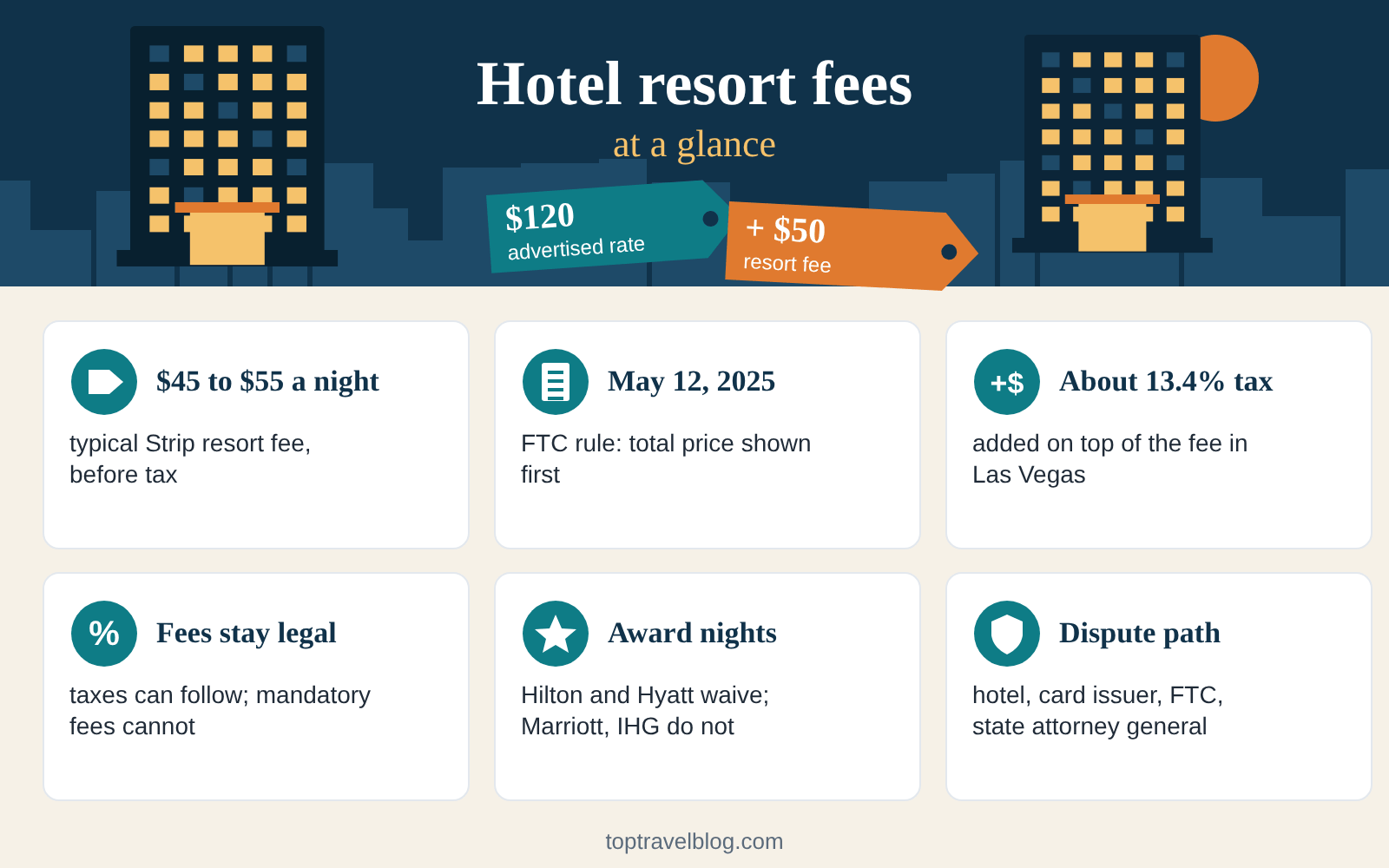
- The rule in one line: since May 12, 2025 the FTC requires US hotels and booking sites to show a total price with all mandatory fees at the start of the purchase process. Taxes may be added later.
- Typical size: Las Vegas Strip fees run roughly $45 to $55 a night before tax at the big casino resorts. Fees elsewhere vary widely by market and by brand.
- Tax on top: fees are usually taxed too, so a $50 fee in Clark County, Nevada becomes about $57 once the roughly 13.4 percent lodging tax is added.
- Fees you can avoid: parking if you do not drive, minibar, spa add-ons. Fees you generally cannot: the mandatory resort or destination charge.
- Where to complain: the hotel first, then your card issuer, then reportfraud.ftc.gov, the CFPB and your state attorney general.
- Time to compare two hotels: about two minutes once you use the method in Step 3 below.
What hotel resort fees actually are (and what they are not)
A resort fee is a mandatory daily charge a hotel adds on top of the room rate. The hotel says it covers amenities: Wi-Fi, the pool, the gym, a bottle of water, local calls nobody makes, a printed boarding pass, a beach chair. You pay it whether you use any of that or not. The name changes by market. In cities, you often see “destination fee,” “amenity fee” or “urban fee.” Same idea, different label.
The reason hotels charge hotel resort fees is not a mystery. Booking sites sort and filter by price, so a lower headline rate wins the click. The fee, shown later or in smaller type, brings the revenue back. For a long time the extra cost also sat outside some commission calculations, which made it attractive for chains and for independent owners alike.
What makes a charge a true mandatory fee is simple: you cannot decline it. If the hotel lets you opt out at check-in, it is not mandatory, and the FTC rule treats it differently. If the hotel removes it only for certain loyalty members or certain booking types, it is still mandatory for everyone else.
The usual suspects on a hotel folio
Here is how I sort the charges that show up on a bill, because only some of them belong in your total before you book.
Mandatory resort or destination fee
Counts toward the total price
A flat nightly amount, per room, not per person. It belongs in the headline total. This is the one the rule is aimed at, and it is the one to compare across hotels.
Taxes and government charges
Can be added at the end
State and local lodging taxes and tourism assessments. They vary by city and are legitimately shown separately, though the rule says they must be labeled as government charges and not mixed into a vague line.
Parking, valet and self-park
Only if you cannot avoid it
If you arrive by car, a daily parking charge in a city center is a real part of the trip cost, but it is optional in the legal sense. Rideshare, transit and walking make it avoidable.
Cleaning or housekeeping fee
Counts if mandatory
More common at apartment-style and vacation-rental properties. If it applies to every stay, it should be in the total.
Incidental deposit
Not a fee, but a hold
A refundable authorization on your card, typically per night, to cover extras. It is not revenue, but it ties up credit limit and surprises people on debit cards.
Optional extras
Never in the total
Spa treatments, breakfast, minibar, early check-in upgrades, pet fees if you do not bring a pet.
The two lines that cause the most arguments are the first and the last. The first because hotels sometimes bundle three or four charges together and call the bundle a single “fee.” The last because properties sometimes list a charge as optional when the room is unusable without it, like a pool-view room where the “optional” pool access is the only amenity.
Hotel resort fees versus destination fees versus amenity fees
In practice the differences are mostly branding. A resort fee tends to appear at beach and desert properties and in Vegas. A destination fee is the city-hotel version, and a few chains use “amenity fee” or “facility fee.” Legally, under the FTC rule, none of this matters. If it is mandatory, it goes into the total price.
What matters for you is what is bundled. A fee that includes a daily breakfast credit, bike rental or a beach setup can be good value if you use it. A fee that offers only “high-speed Internet” and “newspapers” is a plain surcharge, and I treat it as part of the room rate and nothing more.
What the 2025 FTC rule changed for hotel resort fees
The Federal Trade Commission announced its Rule on Unfair or Deceptive Fees on December 17, 2024, and the part covering short-term lodging took effect on May 12, 2025. The full text is in the Federal Register. It covers hotels, inns, vacation-rental platforms and the online travel agencies that sell stays to US customers, regardless of where the seller is based.
The core requirement is plain. A seller must show the total price, including all mandatory fees, at the beginning of the purchase process, and show it more prominently than any partial price. In practice, the first price you see on a search result page should already include the resort fee. The hotel can still break the fee out underneath, but the total has to lead.
What the rule does and does not do
- It does not ban hotel resort fees. A hotel can still charge $55 a night as long as the $55 is in the price you see up front.
- It does not make hotels lower their prices. It only changes how they present them, so the cheaper-looking hotel may no longer look cheaper.
- It lets taxes stay out of the total. Government-imposed taxes, delivery charges and optional add-ons can come later, though they must be disclosed before you commit to pay.
- It restricts vague labels. A fee called a “service fee” or “processing fee” needs an explanation of what it is for, and an optional fee cannot be presented as government-mandated.
- It applies to bookings made after May 12, 2025. Reservations made before that date are not covered, but a fee on a booking you make today is.
Penalties for hiding hotel resort fees are real on paper. The FTC can seek civil penalties per violation, which in the 2025 inflation adjustment came to $51,744 each, and each instance can count separately. Enforcement priorities depend on the agency, so I treat the rule as a floor of transparency rather than a promise that every site will comply perfectly.
Tip: When a booking page still shows a low rate in large type and a fee in small type, screenshot it. That image is your best evidence for a refund request, a card dispute or a complaint, and it takes five seconds.
What changed in the real world
The big chains already displayed fees on the final booking screens before the rule. What changed is the search results. Many sites now show a nightly price that includes the mandatory fee, and some added a toggle labeled total price or “include fees.” Airbnb had introduced its total price display in 2022, so vacation-rental searches were ahead of the hotels.
The Nevada Resort Association, whose members charge some of the best-known hotel resort fees, said they already disclose these fees during booking, and that the rule would level the playing field across the travel industry. In my own searches since the rule took effect, the Vegas results look noticeably more honest than they did two years ago, though a few sites still lead with a base rate and make you open a details panel for the total.
One more thing the rule does not do: it does not tell hotels how to word the fee on the receipt, or how they treat it when you cancel. That is why the cancellation terms matter as much as the headline number, and why I send readers to our guide on hotel cancellation policies before they prepay anything.
State laws that also cover hotel resort fees
Federal rules are only half of the picture. Several states have their own all-in pricing laws, and for a traveler they work as a second layer of protection, usually with the state attorney general as the enforcer.
California
In force since July 1, 2024
SB 478, the Honest Pricing Law, requires advertised prices to include all mandatory fees, with government taxes the main exception. A companion bill, AB 537, adds lodging-specific rules. A $150 room should show as $150 all-in, not $150 plus a resort charge.
Minnesota
In force since January 1, 2025
HF 3438 requires advertised prices to include mandatory fees and surcharges, excluding taxes. Hotels must also disclose the percentage of any automatic gratuities.
Massachusetts
Regulations from 2025
The attorney general’s rules require businesses to disclose the total price up front, including mandatory service fees, and treat violations as unfair and deceptive practices.
Other states
Colorado, Virginia, Oregon and more
A growing list of states have passed or moved bills on all-in pricing. The details differ on what counts as an exception, so your state attorney general’s consumer page is the plain-language source for local rules.
Because several state laws apply to online sales to residents of that state, a booking site that follows California’s rule often ends up showing everyone the all-in price. That is part of why the display changes in 2025 looked so broad. A traveler in a state without its own law still benefits from the federal rule.
If a dispute goes past a simple refund, your state attorney general’s office is where I would go. California residents can use the Attorney General’s consumer protection page, and the federal government’s state consumer protection directory points to every other state. Texas has been one of the more active states, with its attorney general settling with several hotel companies over fee presentation.
Where hotel resort fees hit hardest: Vegas, beach resorts and big cities
Not every market charges hotel resort fees, and not every brand does. Knowing the pattern before you search narrows down where to be careful. Hotel resort fees concentrate in places where hotels sell more than a bed: casino resorts, beach and island properties, theme-park areas and a growing number of city-center towers.
Las Vegas: the benchmark for hotel resort fees
Vegas is where most travelers meet hotel resort fees for the first time. At the big Strip resorts the fee typically runs about $45 to $55 a night before tax: Bellagio, Caesars Palace, Venetian, Wynn and the Cosmopolitan sit at the top of that range, while MGM Grand, Mandalay Bay, Luxor, Excalibur and Circus Circus sit a little lower. Industry coverage puts the highest Strip fees near $55, and some off-Strip and upscale properties charge more.
Add Clark County’s lodging tax of about 13.4 percent and a $55 fee costs roughly $62 a night. Over a four-night weekend, hotel resort fees of that size add about $250 you did not see in the headline rate, on top of the room. Casino resorts generally list Wi-Fi, fitness access, local calls and boarding pass printing as the bundle, and a few add pool access or a daily credit.
Loyalty status can remove it at some of these hotels. MGM Rewards Gold, Platinum and Noir members and Caesars Rewards Diamond and Seven Stars members are listed as having the fee waived on eligible cash stays. It is one reason casino loyalty cards matter more in Vegas than airline cards. If you are building a Vegas trip, our Las Vegas itinerary shows where I would sleep and how I handle the fee in the budget.
Beach, island and desert resorts
Hawaii, Florida, the Caribbean’s US territories, Palm Springs and Arizona resort corridors all lean on hotel resort fees, often described as covering beach chairs, towels, water sports and activity programs. Some of these are valuable if you use them, because a pair of loungers at an ocean-front resort can cost more than the fee on their own.
Pull up the amenity list and ask a direct question: would I pay for these things separately? If the answer is no, treat the fee as a tax on the room. Families heading to Orlando-area resorts should read our Orlando vacation guide, where I explain why on-property perks can offset the fee at some properties and not at others.
Big-city towers
New York, Chicago, Boston, Nashville, Washington and other metropolitan hotels have added “destination” or “urban amenity” fees in recent years. They often bundle Wi-Fi, a bottle of water and fitness access, and can run from the low teens into the $40s or $50s a night. A NerdWallet analysis of 160 hotels found an average fee of about $33 a night where one was charged, with Marriott properties averaging the highest among the major chains.
City fees are the ones most likely to be hiding in a hotel you consider “ordinary.” Our New York City itinerary covers where room rates and fees collide most often in Manhattan. If a Midtown property is $40 cheaper than the next one and then adds a $35 destination fee, you gained nothing.
Which properties usually skip hotel resort fees
Smaller independent hotels, many motels, most extended-stay brands and plenty of midscale chains still skip hotel resort fees and charge nothing beyond the room rate and tax. If your trip does not require a pool deck and a fitness suite, those properties often undercut resorts by a wide margin once fees are counted. That is a trade-off to decide on purpose, not by accident.
All-inclusive resorts handle this differently: their rate usually bundles meals, drinks and activities, so a separate resort fee is less common, though taxes and service charges can still be extra. Our all-inclusive resort guide walks through what that model includes and what is billed on top.
How to spot the real total price before you book hotel resort fees
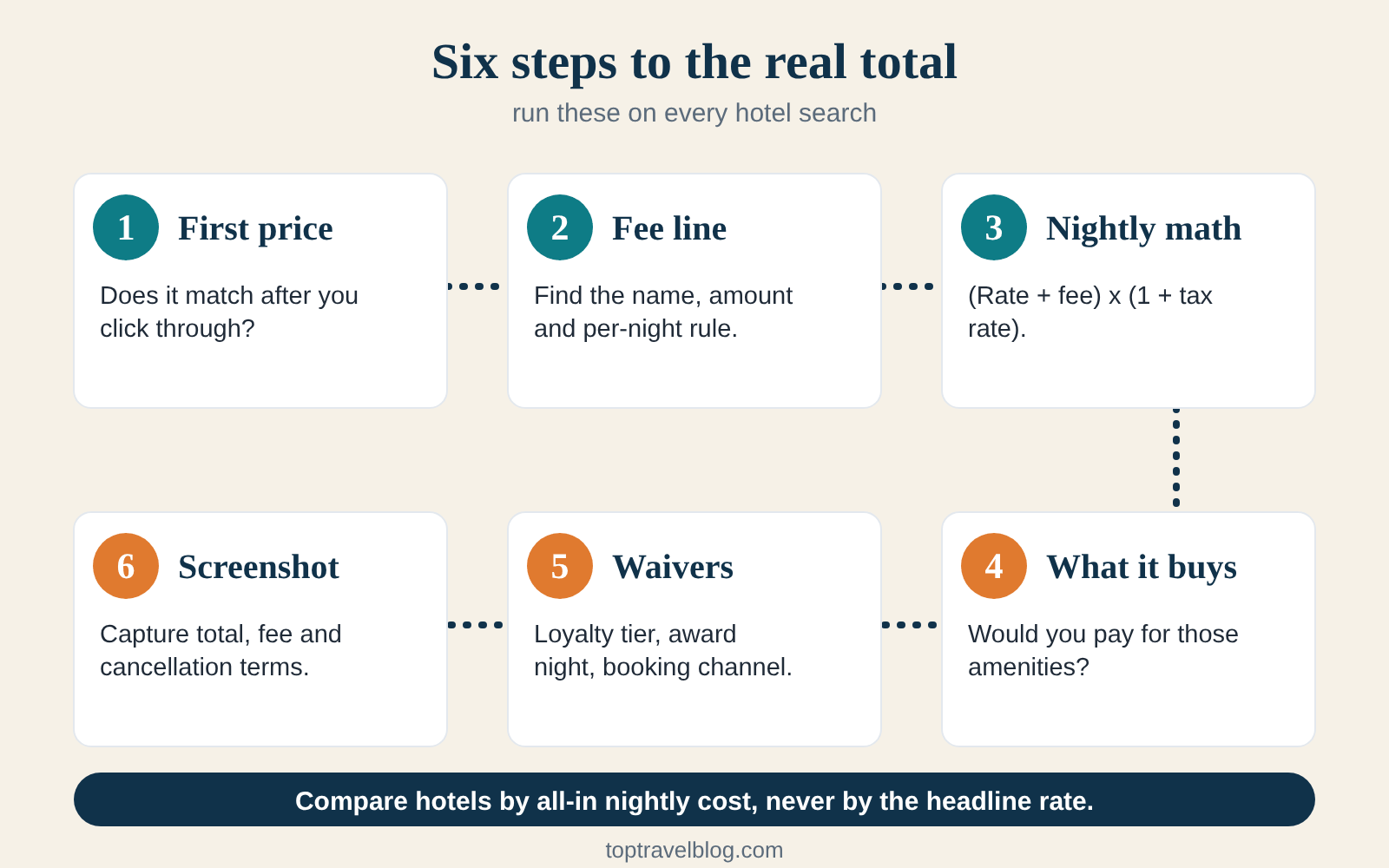
This is the method I use for every hotel search, whether I am planning a long weekend or a family week. It takes about two minutes per hotel and has stopped me from booking the wrong room more often than I can count. The steps work the same on a hotel’s own site and on a booking platform.
Step 1
Start with the first price you see
Look at the price on the search results page, then open the hotel and look again. Under the FTC rule the first price should already include the mandatory fee, so the number should not jump when you click through. If it does, the site is either showing a base rate in large type or not complying, and you now know to dig further.
Step 2
Find the fee line and read its name
Open the price breakdown, usually under a link labeled “price details,” “taxes and fees” or “view breakdown.” Look for the words resort fee, destination fee, amenity fee, facility fee or urban fee. Note the amount and whether it is per room or per person, per night or per stay. Most are per room, per night, but a few are per guest.
Step 3
Do the one-line math for every hotel
Add the nightly room rate, the fee and the tax estimate, then divide by the number of nights. That is your real nightly cost. I do this on my phone with three numbers: rate plus fee, multiplied by one plus the local tax rate. Compare that figure across hotels, never the headline.
Step 4
Decide what your hotel resort fees include
Open the hotel’s own fee page or its FAQ and read what the fee covers. If you would use the pool, the gym or the beach setup anyway, the fee has real value. If it is Wi-Fi and a local call, mentally subtract it from the room’s worth. Hotels that list nothing specific are making a vague claim, which the rule says needs an explanation.
Step 5
Check loyalty and booking-channel rules
Ask whether the fee is waived for your loyalty tier or for award nights, and whether the price differs on the hotel site versus a booking platform. A few minutes here can erase the fee entirely. I cover the program-by-program rules in the loyalty section below.
Step 6
Screenshot the final screen before you pay
Capture the total, the fee line and the cancellation terms. If a folio later shows something different, the screenshot plus your confirmation email is the paper trail. I keep mine in an album named after the trip, and I have used one twice.
A worked example in Las Vegas
Say you are comparing two hotels for a three-night stay. Hotel A advertises $120 a night with a $50 resort fee. Hotel B, a few blocks away, advertises $165 a night and charges no fee. On a lazy comparison, A looks $45 cheaper every night.
Do the math with tax at about 13.4 percent. Hotel A: $170 a night before tax, about $192.75 with tax, or roughly $578 for three nights. Hotel B: $165 a night before tax, about $187 with tax, or roughly $561 for three nights. The “cheaper” hotel costs about $17 more across the stay, and B probably has fewer restrictions on how you use the amenities.
Now suppose A includes a daily $20 drink credit you would actually use. The picture changes again, which is why Step 4 matters. The point is to make the comparison with every number visible, not to assume the no-fee hotel always wins.
The same exercise in a city with a smaller fee
In a city hotel, a $30 destination fee on a $210 room and a $240 room with no fee are nearly identical before tax. Both come out to $240. At that point, location, cancellation terms and bed type should decide it. A fee only matters when the gap between the two totals is big enough to change what you would choose.
Tip: If you book through a platform and the price at checkout looks lower than the hotel’s own site, read whether it is “pay at property.” Some sites show the room rate at booking and collect the fee at check-in, which is exactly the habit the rule was written to stop. Our guide to the best hotel booking sites covers which platforms show the total price by default.
Booking direct or through a platform: who shows hotel resort fees honestly
The rule applies to both hotels and the booking platforms that sell their rooms, which should in theory produce the same total on both. In practice there are small differences, and I check at least two channels for any stay over two nights.
Booking directly with the hotel gives you a clean paper trail, access to loyalty perks and sometimes a fee waiver you cannot get elsewhere. A booking platform gives you wider comparison and, sometimes, a better price. Our deeper breakdown of booking direct versus third-party sites covers the problem-solving side, which matters when a fee dispute starts.
- Hotel’s own site: usually shows the total with the fee itemized, and loyalty members see their own waiver rules applied.
- Large booking platforms: most now display a total price toggle; read whether the figure includes the fee or only the base rate and tax.
- Metasearch sites: they compare many platforms, but the price they show depends on how each partner feeds the data, so open the breakdown before deciding.
- Phone quotes: ask for “the total per night including every mandatory fee and tax” and write down the answer with the agent’s name.
One pattern I watch for: a platform listing a “pay at property” rate with a different fee structure than a prepaid rate. The two can differ by the amount of the fee, so prepaid does not always mean cheaper and flexible does not always mean pricier. The cancellation trade-off often matters more than a few dollars.
Loyalty programs, award nights and when hotel resort fees disappear
Waivers of hotel resort fees are the single most useful trick in this whole topic, and they are also the least understood. What a program waives depends on the program, the booking type and sometimes the property.
Hilton Honors
Waived on all-points reward stays
The waiver applies to reward stays booked entirely with points, including promotional free nights, regardless of elite status. Mixed points-and-cash bookings are less clearly covered.
World of Hyatt
Waived on award stays
Stays paid with points or free night awards avoid the fee. Globalist members also get exemptions on eligible cash stays.
Marriott Bonvoy
Generally not waived
Members pay applicable resort fees on award stays regardless of status, which makes award nights at fee-heavy Marriott resorts less valuable than they look.
IHG One Rewards
Generally not waived
Fees apply to both award and cash bookings regardless of status, so build the fee into your points-versus-cash decision.
Casino programs
Tier-based waivers
MGM Rewards and Caesars Rewards offer waivers at higher tiers on eligible stays, which is why a casino card can be worth more in Vegas than a general travel card.
The practical rule: before you spend points, subtract the fee. A 30,000-point night with a $50 fee attached may be worth less than a cash rate at a no-fee hotel across the street. Read the fee language in your program’s own terms before you redeem.
A free-night certificate from a credit card is a related trap. Some certificates cover the room rate but leave the fee, so you may still pay it. Read how your certificate treats mandatory charges before assuming the night is free.
How to get hotel resort fees reduced, removed or refunded
Most guests never ask, and most front desks have limited power to waive a mandatory charge. Still, there are situations where asking works, and I have had success more than once.
When it is reasonable to ask
- The amenities were unavailable: a closed pool, a broken gym, no beach service. A fee tied to services you did not receive is the strongest case.
- The price you were quoted did not include it: your screenshot or confirmation shows a lower total.
- You are a loyalty member whose tier waives the fee, and it appeared on the bill anyway.
- You booked an award night where the program says fees are waived.
- The fee was higher than the one on your confirmation.
How I word the request
Be calm, specific and brief. Say something like: “The confirmation I booked at showed a total of this amount, and the folio shows an additional resort fee. Can you adjust it?” Have the screenshot ready. Ask for the manager if the front-desk agent cannot change it. Do it at check-in or during the stay, not on the way to the airport, because the hotel has more room to fix it while you are still a guest.
If the answer is no on the spot, ask for the refusal in writing or get the agent’s name, and move to the formal steps below. Raising your voice rarely helps and often ends the conversation.
The formal route if the hotel says no
Start by writing to the hotel’s guest relations or the platform you booked through, with the screenshot and the confirmation number attached. If that fails, dispute the charge with your card issuer as a billing error, explaining that the fee was not disclosed in the total price at booking. Undisclosed mandatory fees are a reasonable basis for a dispute.
Then file reports: the FTC accepts them at ReportFraud.ftc.gov, the Consumer Financial Protection Bureau takes complaints about card billing at consumerfinance.gov/complaint, and your state attorney general handles local consumer-protection cases. Complaints rarely produce a quick refund on their own, but they feed the patterns regulators use to decide whom to investigate. Keep everything in one folder.
Warning: Do not simply refuse to pay the folio balance. Hotels hold your card on file and may charge it, and an unpaid balance can turn a fee dispute into a collections problem. Pay, document, and then dispute.
The charges around hotel resort fees: parking, deposits and early arrival
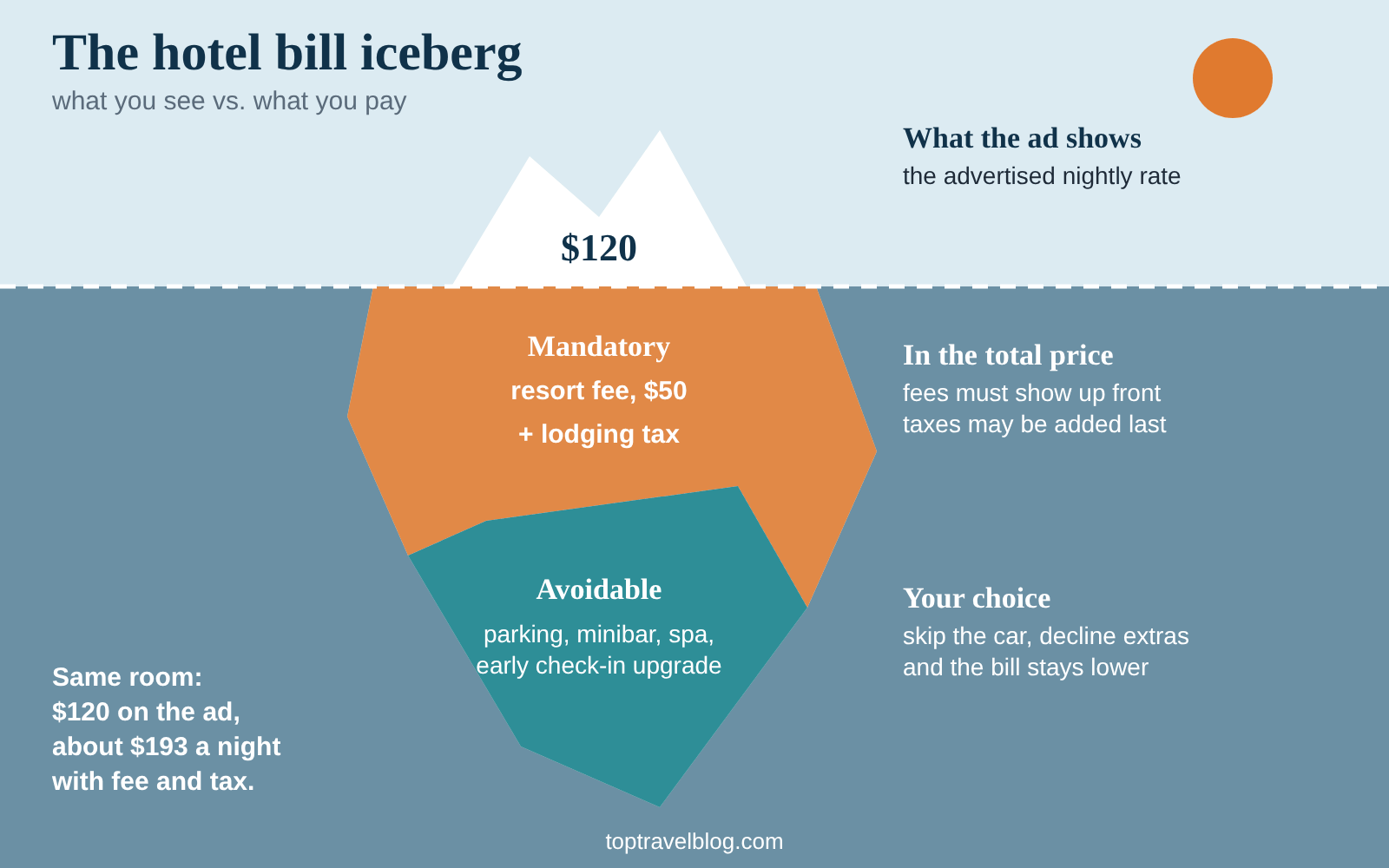
Hotel resort fees get the headlines, but a hotel bill has other layers, and the same logic applies to each: separate what you must pay from what you can avoid. The illustration above shows the iceberg most guests meet, with the advertised rate on top and everything else beneath the waterline.
Parking and valet
In dense downtowns a hotel garage can cost $40 to $70 a night, and valet adds a tip on top. In a city like New York, Chicago or San Francisco, parking can cost as much as a budget room elsewhere. If you can skip the car, skip it. If you cannot, compare the hotel’s rate with a public garage a block away, which is often noticeably cheaper.
Vegas flips this: many casino resorts have charged for self-parking in recent years after decades of free parking, and rental-car travelers should price that in. If your trip is a city break, our trip-planning guide explains how I decide whether a car earns its place in the budget at all.
Incidental holds
At check-in the hotel usually authorizes a hold on your card for the room plus a daily incidental amount, often $50 to $150 a night depending on the property. It is not a charge, but it reduces your available credit and can last a few days after checkout. Debit cards feel this most, since the hold takes cash straight out of the account.
Use a credit card for hotel stays when you can. It gives you a stronger dispute path and keeps the hold off your bank balance.
Early check-in, late checkout and luggage
Some hotels charge for early check-in or late checkout, and a few charge for holding bags. These are optional, so they do not belong in the total price, but they belong in your plan. Our guides to hotel check-in time and hotel check-out time explain what to ask for and when it is free.
Taxes, tourism assessments and the line that confuses everyone
Taxes vary hugely: some cities add a flat occupancy tax, some add a percentage, and some add both along with a tourism improvement assessment. The rule lets taxes sit outside the headline total, but it expects a government charge to be labeled as one. If you see a line like “taxes and fees” in a single amount, that is the place to ask what is in it.
In practice, the resort fee itself is usually taxed. That is why I always use the multiplication method in Step 3 and never just add the fee to the rate. The difference is small per night and adds up fast on a long stay.
What hotel resort fees add to a trip budget
Think of hotel resort fees as a trip-level cost, not a nightly annoyance. A $50 fee on a four-night stay is $200 before tax, and about $227 with the Las Vegas lodging tax. For a family of four that is the price of a good dinner out, a day pass somewhere or a one-way flight on a cheap day.
I use three tiers when I plan, with no pretense of precision, because rates swing with events and seasons.
- Budget stays: choose properties without the charge, such as many motels, midscale chains and extended-stay brands. The savings are often $30 to $60 a night against a resort fee market.
- Mid-range stays: accept a fee if the amenity list is useful, but compare the total against a nearby no-fee hotel before booking.
- Comfortable or splurge stays: fees are usually part of the experience; use loyalty waivers and compare what the fee includes.
A technique I like is to fix the total nightly budget first and shop against that number. If your ceiling is $200 all-in per night, a $150 room with a $45 fee and 13 percent tax fits, while a $160 room with a $50 fee does not. The ceiling does the work and keeps you honest.
For the bigger planning picture, including how lodging fits against flights and activities, see our step-by-step guide to how to plan a trip, and our walkthrough on how to find cheap flights, since flight savings can be the budget that covers the fees.
Choosing a hotel when hotel resort fees are in the picture
Hotel resort fees are one input among several. A hotel that charges $45 a night and sits two minutes from where you will spend all day can beat a no-fee hotel 25 minutes away with a $30 rideshare each direction. That is why I put location, reviews and cancellation terms next to the fee in a single comparison. Our guide on how to choose a hotel walks through that full set.
Questions I ask before I accept a fee
- What exactly is included, and is any of it something I would pay for separately?
- Is it per room or per person, per night or per stay?
- Is it waived for my loyalty tier, my credit card benefit or my booking type?
- Does it change if I cancel, shorten the stay or arrive late?
- Is it refundable if the amenities are closed for renovation or weather?
When a fee is a fair price
I have paid a resort fee gladly at a few places. A desert resort that included shaded cabanas and a shuttle, an island hotel with snorkel gear and kayaks, a city hotel that bundled a real breakfast credit. When the amenity list is concrete and used, the fee is just a different way of pricing the stay.
The hotel resort fees I resent are the fee-plus-nothing kind: a flat $40 for “Wi-Fi, fitness access and local calls” at a property where all three are free at the hotel across the street. The test is not size, it is value.
How fees interact with cancellations and changes
Cancellation rules and the rules on hotel resort fees are separate, which is where people get tripped up. A refundable booking usually refunds the fee along with the room, but not always, and a nonrefundable rate generally treats everything as sunk. If you change dates, the fee can change too, because it follows the new rate plan.
A few practical habits. Read the cancellation deadline in local time, not your own. Photograph the cancellation page. And if a prepaid booking includes the fee in the total, confirm that the refund line item lists it. Our full guide to hotel cancellation policies covers flexible, nonrefundable and deposit rules in detail.
Common mistakes with hotel resort fees
- Comparing headline rates instead of the all-in nightly total. This is the single biggest and most common error.
- Forgetting that the fee is taxed, so the real cost is higher than the fee line.
- Assuming a prepaid price includes everything, when the fee is collected at check-in.
- Assuming loyalty status waives it everywhere. Marriott and IHG, for example, do not waive it on award stays.
- Paying for amenities you could get free nearby, like Wi-Fi and a gym.
- Not screenshotting the final booking screen, which leaves you without proof if the folio differs.
- Refusing to pay the folio balance instead of paying and disputing, which can complicate a card dispute.
- Ignoring parking, which in some cities costs more than the resort fee.
- Treating a “total price” toggle as a guarantee without opening the breakdown.
- Booking a flexible rate and never checking whether the fee is refunded on cancellation.
Frequently asked questions about hotel resort fees
Are hotel resort fees legal in 2027?
Yes. The FTC rule that took effect on May 12, 2025 does not ban hotel resort fees. It requires sellers of short-term lodging to include mandatory fees in the total price shown from the start, with taxes as the main exception. A hotel can charge a resort fee as long as the fee is part of the price you see first.
Can I refuse to pay a mandatory resort fee at check-out?
Not safely. If the fee was disclosed in your total price, you owe it, and the hotel can charge the card on file. If it was not disclosed, pay the bill, then dispute it with documentation: your booking screenshot, your confirmation email and the folio. Refusal at the desk usually creates more trouble than it solves.
Do hotel resort fees apply to award nights?
It depends on the program. Hilton and Hyatt waive them on points-only award stays, while Marriott and IHG generally do not. Casino programs have their own rules. Before redeeming points, add the fee to the cost of the night and compare it with a cash rate.
Are hotel resort fees taxed?
Usually yes. The fee is treated as part of the lodging charge in many places, so the local occupancy tax applies. In Las Vegas that means a $55 fee costs around $62 with tax. Multiply the rate plus the fee by one plus the tax rate to see the real total.
How do I find hotels without hotel resort fees?
Filter search results for total price, then sort by it, and look for hotels where the fee line reads zero. Smaller independents, motels and extended-stay brands often charge none. Reading the price breakdown is faster than relying on a “no resort fee” badge.
Why do booking sites show a different price than the hotel?
Sites calculate display prices differently, and some still show a base rate with the fee in a details panel. A pay-at-property rate may also carry a different fee structure from a prepaid rate. Compare the total on two channels and book the one with the better terms, not just the lower base.
What if the hotel adds a fee not listed at booking?
Show them your screenshot and ask for the fee to be removed or reduced. If they refuse, pay, then write to guest relations, dispute the charge with your card issuer, and file a report with the FTC and your state attorney general. Documentation is what moves these cases.
Are destination fees the same thing as resort fees?
Functionally, yes. Hotels use different labels, such as destination fee, amenity fee or facility fee, but if the charge is mandatory it has to appear in the total price. The name matters less than whether you can decline it and what it includes.
Do resort fees apply to Airbnb and vacation rentals?
The federal rule covers vacation-rental platforms too, so cleaning and service fees that are mandatory belong in the displayed total. Airbnb introduced a total price display in 2022, and the hotel-style resort fee shows up more in managed condo-hotel properties than in private rentals.
Does the rule protect me outside the US?
No. The FTC rule covers lodging sold online to US customers. Stays abroad follow the destination country’s rules, and European and UK consumer laws have their own all-in pricing requirements.
Will the fee be refunded if I cancel?
On a refundable rate, usually yes, since it is part of the booked price. On a nonrefundable or prepaid rate, generally no. Read the cancellation line on the confirmation and keep the screenshot.
One last thing before you book
The honest takeaway is that hotel resort fees are annoying but beatable. The rule has narrowed the gap between the number you see and the number you pay, and the rest of the gap is closed by a two-minute habit: total price, fee name, tax, loyalty, screenshot.
What I would do differently on my first Vegas trip is simple. I would have written the all-in nightly figure on a sticky note for each hotel before I booked. No clever hack, no loophole, just the number that decides the trip. If the numbers are close, pick the better location. If they are not, the fee has already told you which hotel to book.
Treat any hotel that makes the total hard to find as a signal about how the rest of the stay might go, and spend your money at the places that put the real number up front.
Related planning guides
- How to choose a hotel: location, reviews, room type, fees and cancellation terms — the full checklist that puts the fee next to everything else that matters.
- Booking direct vs third-party hotel sites — which channel shows the honest price and who helps when something goes wrong.
- Best hotel booking sites — how to compare rates across platforms without missing a fee.
- Hotel cancellation policies explained — flexible, nonrefundable and deposit rules, and what happens to the fee.
- All-inclusive resorts explained — what is bundled, what costs extra and who it suits.
- How to plan a trip step by step — where lodging sits in the bigger budget.