Book direct when the price is within a few dollars, when your plans might change, or when you care about points and room assignments. Book through a third-party site when it is clearly cheaper after every fee, when you are bundling a flight, or when you have a loyalty tier there that actually pays out.
That is the short answer to booking hotel direct vs third party, and in my experience it settles about eight stays out of ten without any further thought.
The other two stays are where the money and the headaches are. A nonrefundable rate that looks $40 cheaper on a booking site can turn into a lost night when your flight is canceled. A “direct” rate that is $60 higher than an app deal can be a fair price for a room the hotel will actually look after.
This guide to booking hotel direct vs third party gives you the framework I use, the specific rules chains publish, the order of operations for solving a problem, and a set of scenarios so you can find your own situation and read the answer.
I have booked hotels both ways for more than fifteen years, for work trips, family vacations and one very regrettable night in a city I will not name where a booking site had sold the same room twice. What follows is the practical version of booking hotel direct vs third party, not a lecture on loyalty programs. It covers price, flexibility and what happens when something breaks, which are the three things that decide whether a booking was a good one.
Quick facts: booking hotel direct vs third party at a glance
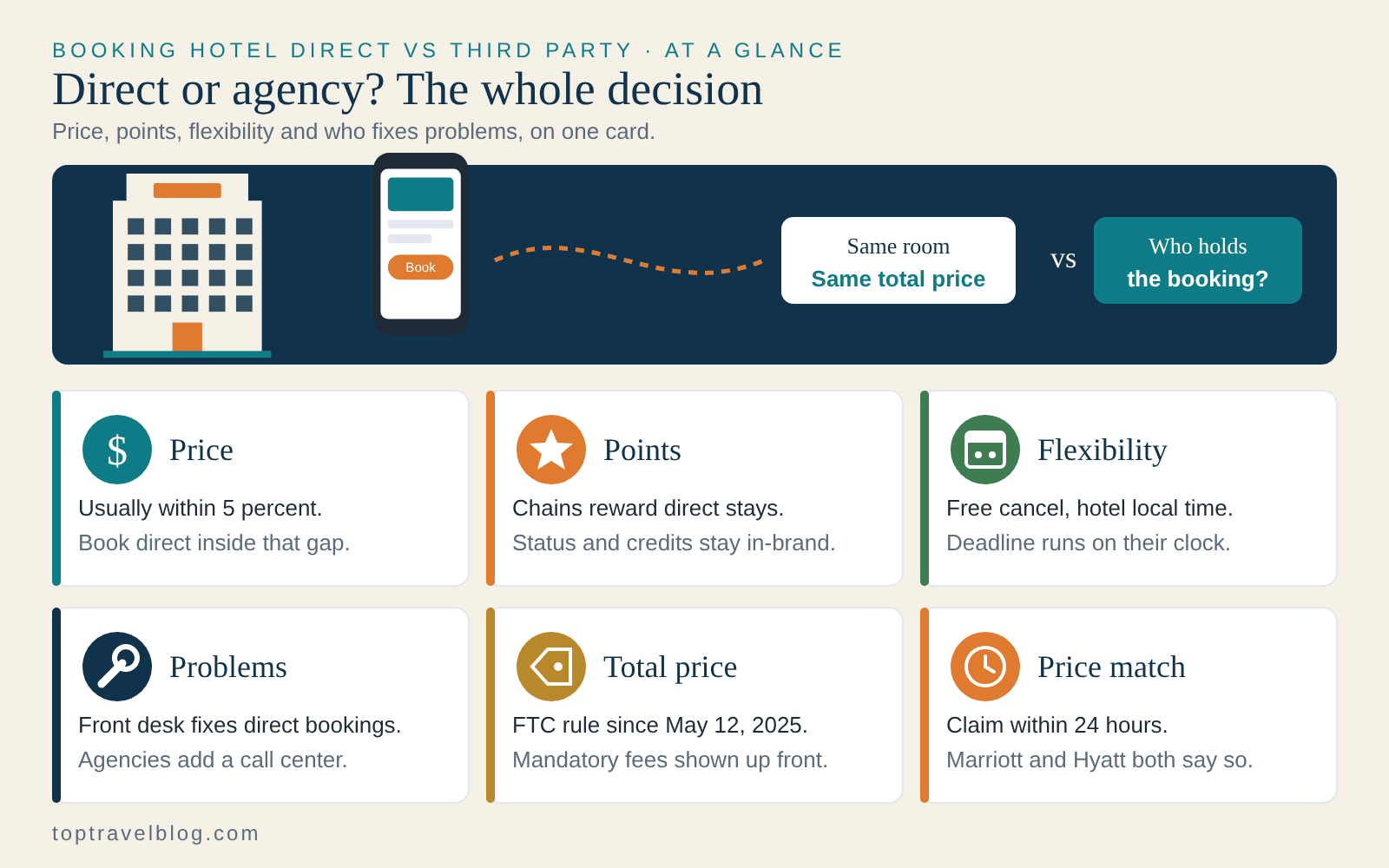
- Default choice: in booking hotel direct vs third party, book direct when the all-in price is equal or within roughly 5 percent, because the hotel owns your reservation and can fix it without a middleman.
- When a third party wins: a real discount of 10 percent or more after taxes and fees, a Genius or similar tier you have already earned, a flight-plus-hotel bundle, or a credit-card portal offer with bonus points you will use.
- Loyalty: the large US chains generally award points and elite perks only on stays booked through their own channels. Marriott, for example, requires a Bonvoy number linked to a booking made on Marriott.com, its app, a reservation center or the hotel itself for its Best Rate Guarantee.
- Price-match claims: Marriott pays an extra 25 percent off or 5,000 points and Hyatt pays an extra 20 percent off or 5,000 points when you find a lower public rate, but both require a claim within 24 hours of booking.
- Flexibility: a direct booking is changed with the hotel; a third-party booking is changed with the site, and some changes need both to agree.
- Problems: if the hotel has no record of you, a direct booking is solved at the front desk; an agency booking can mean waiting on hold with a call center in another time zone.
- Total price rule: since May 12, 2025, the FTC rule on unfair or deceptive fees requires hotels and booking platforms to show a total price with mandatory fees up front, which makes comparisons easier than they used to be.
Booking hotel direct vs third party: what the terms actually mean
Before any booking hotel direct vs third party comparison makes sense, the words need to mean the same thing to both of us, because the industry uses them loosely.
What counts as booking direct
Booking direct means you complete the reservation on a channel the hotel or its brand controls. That is the hotel’s own website, the chain’s website and app (Marriott.com, Hilton.com, Hyatt.com, IHG.com), the hotel’s front desk by phone, or the chain’s reservation line.
The test I use is simple: whose system holds the reservation, and who took your card? If the answer is the hotel or the chain, it is direct. A call to the hotel’s local number counts. A call to a toll-free number printed on a booking site does not, even if the agent is friendly.
What counts as a third party
Third parties come in several flavors, and they behave differently, so it helps to separate them. The online travel agencies, usually shortened to OTAs, are the big names: Expedia, Hotels.com, Orbitz and Travelocity belong to Expedia Group, while Booking.com, Priceline and Agoda belong to Booking Holdings.
Opaque sites such as Hotwire and Priceline’s Express Deals hide the hotel name until you pay. Metasearch tools such as Google Hotels, Kayak and Tripadvisor show prices from many sellers and usually send you off to complete the purchase elsewhere. Credit-card travel portals, such as Chase Travel and Amex Travel, are agencies with a rewards program attached.
Finally, there are wholesalers and bed banks that sell rooms to tour operators and to airlines’ hotel pages, often invisibly. You may think you are booking with an airline and be dealing with a wholesaler three steps removed from the front desk.
Why it matters who holds the booking
In booking hotel direct vs third party, hotels pay agencies a commission, commonly reported in the range of 15 to 25 percent of the room rate, so every third-party booking costs the hotel real money. That is the whole reason chains spend heavily on “book direct” advertising and member-only rates.
It also explains behavior you can sometimes feel at the front desk. A guest who arrives on a heavily discounted agency rate is not the guest the hotel is most eager to upgrade. That is not a universal rule, and plenty of agents are generous regardless, but the incentives point that way, and you should plan as if they do.
Tip: Metasearch is not a third-party booking. Google Hotels and Kayak are shopping windows. If the final click lands on the hotel’s own site, you have booked direct even though you found the room through a comparison tool. This is the cleanest way to get the benefits of both, and I cover it in the step-by-step routine below.
One more distinction: the hotel’s own “direct” price is not always one price. Most chains show a public rate and a lower member rate to people who are logged in to the free loyalty program. The member rate is still booking direct, and it is the reason a quick sign-up often closes the price gap on its own.
Price: which side of booking hotel direct vs third party wins on cost
Everyone wants a one-line answer on price, and the honest one is that neither side of booking hotel direct vs third party wins consistently. What I can give you is a reliable pattern for when each does, plus the traps that make the numbers look different from what you eventually pay.
Why the prices in booking hotel direct vs third party are usually close
Large chains and independent hotels alike often agree to rate parity with the agencies they sell through, which means the hotel promises not to publicly undercut the agency on the same room. The chains get around this with member-only rates, which are treated as a private offer to people who have joined the program.
Marriott’s own site describes member rates as discounts that start at roughly 2 percent and rise from there, depending on the hotel and the day of the week, and that cannot be combined with other promotions. That tells you what to expect: a small, dependable saving, not a miracle.
So for a typical Marriott, Hilton, Hyatt or IHG property, the public price on Expedia and the public price on the chain’s site are within a few dollars of each other. The direct member price is lower by a modest amount, and a sale on either side can flip it.
Where third-party sites beat direct in booking hotel direct vs third party
There are five situations in booking hotel direct vs third party where I have repeatedly found the agency cheaper, and I book there without guilt.
First, loyalty tiers on the agency itself. Booking.com’s Genius program lists three levels: Level 1 on sign-in, Level 2 after 5 bookings in two years and Level 3 after 15 bookings in two years, with stay discounts running from 10 percent at the base up to 20 percent at the top on participating properties, applied before taxes and fees.
Second, bundles. Flight-plus-hotel packages from Expedia or an airline vacations page often price the hotel below its standalone cost, because the package rate is allowed to be hidden. If you are already shopping for flights, run the bundle once. My guide on how to find cheap flights explains how to price the flight side so you can tell whether the bundle is real.
Third, opaque deals in big, overbuilt markets. In a city with thousands of rooms on a slow weekend, a “mystery hotel” in a decent area can come in noticeably under the public rate. The risk is that you cannot choose the property, and the sale is final.
Fourth, last-minute app inventory. Hotels dump unsold rooms the same day to mobile apps, and those prices rarely appear on the hotel’s own site. This is useful for a tight budget and not much use for a vacation you planned months ahead.
Fifth, card-portal promotions. A bonus of 5 to 10 points per dollar through a card’s travel portal can beat the direct price, once you assign a realistic cents-per-point value to the points rather than the generous one on the card’s marketing page.
Where direct tends to win
In booking hotel direct vs third party, direct is cheaper or equal in the following cases. When a hotel runs its own sale, such as “stay three nights, save 15 percent” or a seasonal promo, the offer is usually exclusive to its website. When you can use a corporate, AAA, military or government rate, those almost never appear on agency sites.
When the room comes with something included, such as breakfast, parking or a resort credit, the direct package frequently bundles it at a lower price than buying the extras separately. And when you are booking a hotel with a published best rate guarantee, direct is the only place the guarantee protects you.
Worth knowing: Chain price-match programs reward you for finding a lower rate elsewhere, and they are far less generous than they sound. Marriott’s terms require a match on the same hotel, room, bed type, inclusions, dates and cancellation policy, a rate publicly available and more than 1 percent lower, and a claim within 24 hours of booking. Hyatt’s has the same 24-hour limit. Read the conditions before relying on a guarantee.
How the guarantees actually work
Marriott’s Best Rate Guarantee, as published on Marriott.com, matches a lower comparison rate and then gives you a choice of an additional 25 percent off the room or 5,000 Bonvoy points. The comparison rate has to come from a non-Marriott site, exclude taxes and fees, and be more than 1 percent lower. Some brand families, including Homes and Villas and all-inclusive properties, are excluded.
Hyatt’s guarantee, published at hyatt.com, compares room-only public rates for the same stay and rewards you with a match plus either an additional 20 percent off or 5,000 World of Hyatt Bonus Points, with a claim form due within 24 hours of booking. Hilton and IHG run their own versions under their own terms.
In practice, I have filed these claims about a dozen times over the years. Roughly half were approved; the others failed on a technicality, usually that the cheaper rate had a different cancellation policy or bed type. When a claim does work, it feels great, and when it fails, you are out nothing but ten minutes.
The fee and tax comparison most people skip
In booking hotel direct vs third party, the price shown first is rarely the price charged. Three things move the total, and they move differently on each side.
Taxes and fees: agencies sometimes display the room rate and a separate “taxes and fees” line that includes their own service fee. Hotels display resort or destination fees as a separate line, or only at the end of checkout. I wrote a full walkthrough on hotel resort fees, and the short version is that an agency price without the resort fee can make a hotel look $30 to $50 a night cheaper than it is.
Payment timing: a direct booking often lets you pay at the hotel, which keeps your money in your pocket until you are standing at the desk. Many agency rates ask you to pay at booking and are nonrefundable, which saves you a few dollars at the price of all your flexibility.
Currency: if you book a foreign hotel through a site that converts to dollars at booking, you may pay its exchange rate. Booking in the local currency on a card with no foreign transaction fee is usually better.
A simple price rule I actually follow
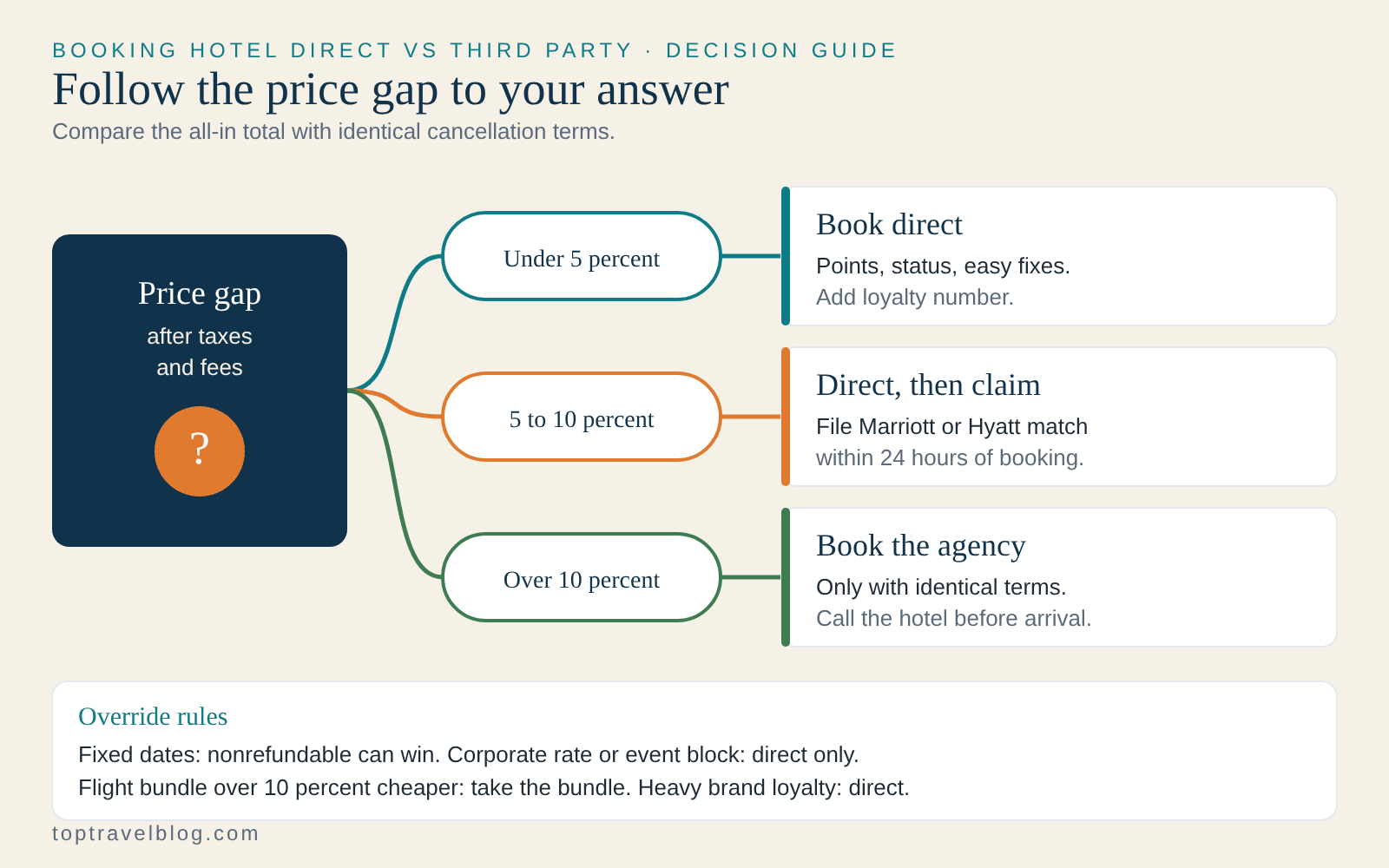
- Collect the all-in total from three places: the hotel’s site while logged in to its program, one agency, and Google Hotels.
- If the gap is under 5 percent or about $15 a night, book direct.
- If the gap is 5 to 10 percent, book direct and file a price-match claim if the chain has one.
- If the gap is more than 10 percent and the cancellation terms are identical, book the agency.
If you want the full comparison of the agencies on the third-party side of booking hotel direct vs third party, my guide to the best hotel booking sites ranks them by how honest their first price is and how easy they are to deal with when something goes wrong.
Points, status and perks: what you give up by booking a third party
Price is the part everyone argues about in booking hotel direct vs third party. Loyalty is the part that quietly decides how the stay feels, and it is where the third-party decision costs people the most without their noticing.
Why points and nights do not follow you in booking hotel direct vs third party
The major US chains generally award points, elite night credits and status benefits only on stays booked through their own channels, and the program terms of Marriott Bonvoy, Hilton Honors, World of Hyatt and IHG One Rewards spell out the exceptions. The practical effect is that a stay booked on an agency often earns no points, counts toward no elite tier and, in the worst case, does not trigger your status perks at all.
If you are a casual traveler with one trip a year, booking hotel direct vs third party hardly matters for loyalty and that may cost you nothing. If you stay ten or fifteen nights a year with one chain, those missing credits can be the difference between a tier with free breakfast and a tier with a bottle of water.
The perks you notice at the desk
Elite members get room upgrades when the hotel has space, late checkout, welcome points, lounge access, free breakfast or a daily credit, and sometimes a better room location. Most of those are discretionary, which means the front desk decides, and a guest who appears in the system as a member who booked direct is simply easier to say yes to.
Even without status, members at most chains get free in-room Wi-Fi and mobile check-in, which Marriott lists as direct-booking benefits. It sounds minor until you are standing at a desk at 11 p.m. with a line, and your phone has already unlocked the room.
When the agency’s rewards are better
There are honest exceptions. If you travel a lot, but across many brands, a single agency’s loyalty program might return more than five separate chain accounts, because everything accrues in one place. Expedia Group runs a shared program across Expedia, Hotels.com and Vrbo, and Booking.com has Genius. If you book a different hotel brand every trip and prefer independent properties, those programs do the job.
The other exception is a card portal. If you hold a card with a travel portal bonus and you value the points sensibly, a prepaid portal booking can return more than a chain’s base earn rate. I would still book direct and use the same card, because the chain’s earn plus the card’s everyday earn often adds up to nearly as much, and you keep the chain’s flexibility.
Tip: Premium card programs are a special case. Amex Fine Hotels + Resorts and similar curated programs sell through the card company, yet they come with their own breakfast, upgrade and late-checkout benefits written into the booking. Those are third-party bookings where the perks travel with the reservation, and they are the main exception to the rule that agency bookings earn less in the room.
A realistic way to value it
For loyalty, my test for booking hotel direct vs third party is one question: how many nights a year do I spend with this brand? Under five, loyalty value is small and price rules the decision. Between five and twenty, join the free program regardless, book direct when prices are close, and let the points build. Above twenty, the status benefits are worth real money, and I will pay a modest premium to keep every night in the program.
That framework works whether you stay in a $140 roadside hotel or a $450 downtown tower. For choosing the property itself, my guide on how to choose a hotel covers location, reviews, room type and fees.
Flexibility: changing and canceling when you book direct vs third party
Flexibility is where booking hotel direct vs third party shows its real difference, and it is also where the headline price is least honest. A cheap rate that cannot change is a bet that your plans will not.
Who you actually deal with
When you change a direct booking, you ask the hotel or use the chain’s app, and the hotel decides. That sounds restrictive, but in practice hotels often bend: they waive a change fee, move your dates within a few days, or credit a deposit toward a future stay.
When you change a third-party booking, the hotel is not your counterparty. The agency is. The agency’s policy sits on top of the hotel’s, and in some cases both have to agree. Hotel staff may be willing to help and unable to touch the reservation, because the booking sits in another company’s system.
The cancellation language that traps people
Every rate has a cancellation term, and the terms differ more than the prices do. The usual types are fully flexible (free cancellation until a set time, typically 24 to 72 hours before arrival in hotel local time), partially refundable with a deposit, and nonrefundable. My longer breakdown of each is in the guide to hotel cancellation policy rules, including how deposits and prepaid rates behave.
Here is what I see go wrong on agency bookings: the free-cancellation deadline is stated in the hotel’s local time, but a traveler reads it in their own. A “cancel by 6 p.m.” on the East Coast and a booking from California gives you three fewer hours than you thought.
The second trap: some sites show “free cancellation” for the room rate but a nonrefundable separate fee for the site’s own service charge or a bundled add-on. The third trap: an agency may take your money at booking while the hotel’s rate would have been pay-at-property, so a refund runs on the agency’s timeline, which can be a billing cycle.
Changes when plans shift
When weighing booking hotel direct vs third party, think about the three most common changes: moving dates, adding a night and changing the name or room. Dates can usually be moved on a direct flexible booking with a call. On an agency booking the same change often means canceling and rebooking at today’s price, which may be higher, with the original refunded only if the rate allowed it.
Adding a night is easiest at the hotel, because the desk can extend you on the same rate if the room is free. Agencies often cannot extend a stay, and a walk-up rate for the extra night may be the highest rate of all.
Name changes matter for gifts and group stays. Hotels can usually change a guest name on a direct booking in a minute. On a third-party booking, name changes may be limited or impossible, so that the person whose name is on the booking has to be the person who checks in.
Where being flexible costs you
I do not want to oversell flexible rates. They cost more, often 10 to 20 percent. If your trip is fixed, such as a wedding, a conference or a graduation, a nonrefundable rate is a reasonable choice, and the savings are real. The mistake in booking hotel direct vs third party is not choosing a nonrefundable rate. The mistake is choosing one without reading the term, which people do constantly because the “free cancellation” filter on a booking site is off by default.
Worth knowing: The cleanest trick for booking hotel direct vs third party in this whole guide: book a flexible rate early, whoever sells it, and keep watching prices. If the rate drops, cancel and rebook. This only works with free cancellation, and it works best direct, where you can also message the hotel and ask them to reprice the existing booking, which many will do.
Travel insurance and card protection
Some travel insurance plans cover hotel prepayments when a covered reason, like illness, interrupts the trip, and the claim is simpler when you have the hotel’s cancellation notice. Some cards add trip-delay or cancellation coverage when you pay for the trip with them. The details vary by card and plan, so read the benefits guide before assuming coverage. Neither replaces choosing the right rate.
Problem solving: who fixes it when something goes wrong
This is the part of booking hotel direct vs third party that I wish someone had handed me before the first time a room was not there. Problems are rare. When they happen, your choice in booking hotel direct vs third party decides how long they take to solve and how much you have to fight.
The reservation that does not exist
You arrive, give your name, and the desk cannot find you. On a direct booking, the agent searches the hotel system, finds a typo or a date mistake, and fixes it in minutes. If the booking is not there at all, you have a confirmation email from the hotel’s own domain, which is strong evidence.
On an agency booking, the hotel may not have received the reservation, the agency may have sent it to the wrong property or the dates may be off. The desk can see a rate code or a confirmation number and, most of the time, honors it. When they do not, you call the agency from the lobby while a line forms behind you. Keep screenshots of the confirmation and the agency’s phone number on your phone.
The overbooked hotel
Hotels sell more rooms than they have on some nights, the same way airlines do. The industry term is “walking” a guest: the hotel places you in a comparable property nearby, usually pays for the first night and often a taxi. Most chains publish policies describing how they handle it, and in practice walks tend to hit late arrivals and guests on the cheapest rates.
That is the part that should worry you. A guest on a deeply discounted agency rate, arriving at 11 p.m., is statistically the most likely person to be sent elsewhere. If you are likely to arrive late, call the hotel in the afternoon, say your estimated arrival, and note it on the reservation. Do this on every booking, whichever channel you used.
The wrong room
You booked a king bed and got two doubles, or you asked for a quiet floor and were put over the nightclub. Room type issues are easier direct. The desk can see exactly what you booked, and the chain’s system can often flag a request. On an agency booking, the room category may be mapped imperfectly from the agency’s description, and the desk may say the agency only guaranteed a “standard room.”
Bed type and accessibility requests belong with the hotel either way. For a detailed list of what rooms are called and what they contain, see my breakdown of hotel room types.
Early arrival, late arrival and late checkout
These requests are discretionary and handled by the hotel, and your booking channel shapes the goodwill. Standard check-in times run around 3 or 4 p.m. and checkout around 11 a.m. or noon. If you land early, ask to leave your bags and for a text when a room is ready. Two guides cover the details: hotel check-in time and hotel check-out time.
Loyalty members can sometimes request early check-in in advance through the chain’s app, which does not work for an agency reservation. It is a small advantage, and on a red-eye morning, a real one.
Disputes about charges
The most common trouble with money is a second charge. Agencies that take payment at booking sometimes issue a “virtual card” to the hotel, while the hotel also asks for your card for incidentals at check-in. That is usually fine, but occasionally the hotel charges the room again, and the refund takes a billing cycle to appear.
The Consumer Financial Protection Bureau explains that you should contact the seller first and then your card company, and that you should send a billing error notice within 60 days of the charge appearing on your statement. Photograph your folio at checkout, keep the receipt, and ask for a printed zero-balance copy.
My escalation ladder
When something goes wrong, work up this list and stop when it is fixed.
First, the front desk agent, calmly and with the confirmation in hand. Second, the duty manager or general manager, asked for by title. Third, the chain’s customer care line or the agency’s, whichever holds the booking. Fourth, a written message to the hotel or chain, with dates, confirmation number and the specific remedy you want. Fifth, a dispute with your card issuer for a charge you did not authorize or a service not provided.
Notice that the direct booking has steps one and two as the main routes and usually ends there. The agency booking tends to have a longer ladder, and the rungs that matter are in a call center. That, more than price, is the reason my answer to booking hotel direct vs third party is direct for anything I cannot afford to have go wrong.
Tip: Save three things on your phone for every booking: the confirmation email as a PDF, a screenshot of the cancellation terms at the moment you booked, and the hotel’s direct phone number. Terms can be edited on a site after the fact. Your screenshot is your proof of what you agreed to.
When the agency is better at solving a problem
To be fair to the third-party side of booking hotel direct vs third party, agencies sometimes solve things faster. Large OTAs have 24-hour phone lines, and if a hotel closes for renovation or a storm, the agency may rebook you into a similar hotel automatically. A hotel with a single local desk may take longer to respond. The size of the agency is both a weakness and a strength: they are hard to reach, but they handle thousands of problems a day.
If you book a small independent hotel directly, you might be dealing with a family that has one person at the desk. I have had both experiences, and I still rate the independent owner’s willingness to fix a problem above a call center’s script.
My step-by-step routine for booking hotel direct vs third party
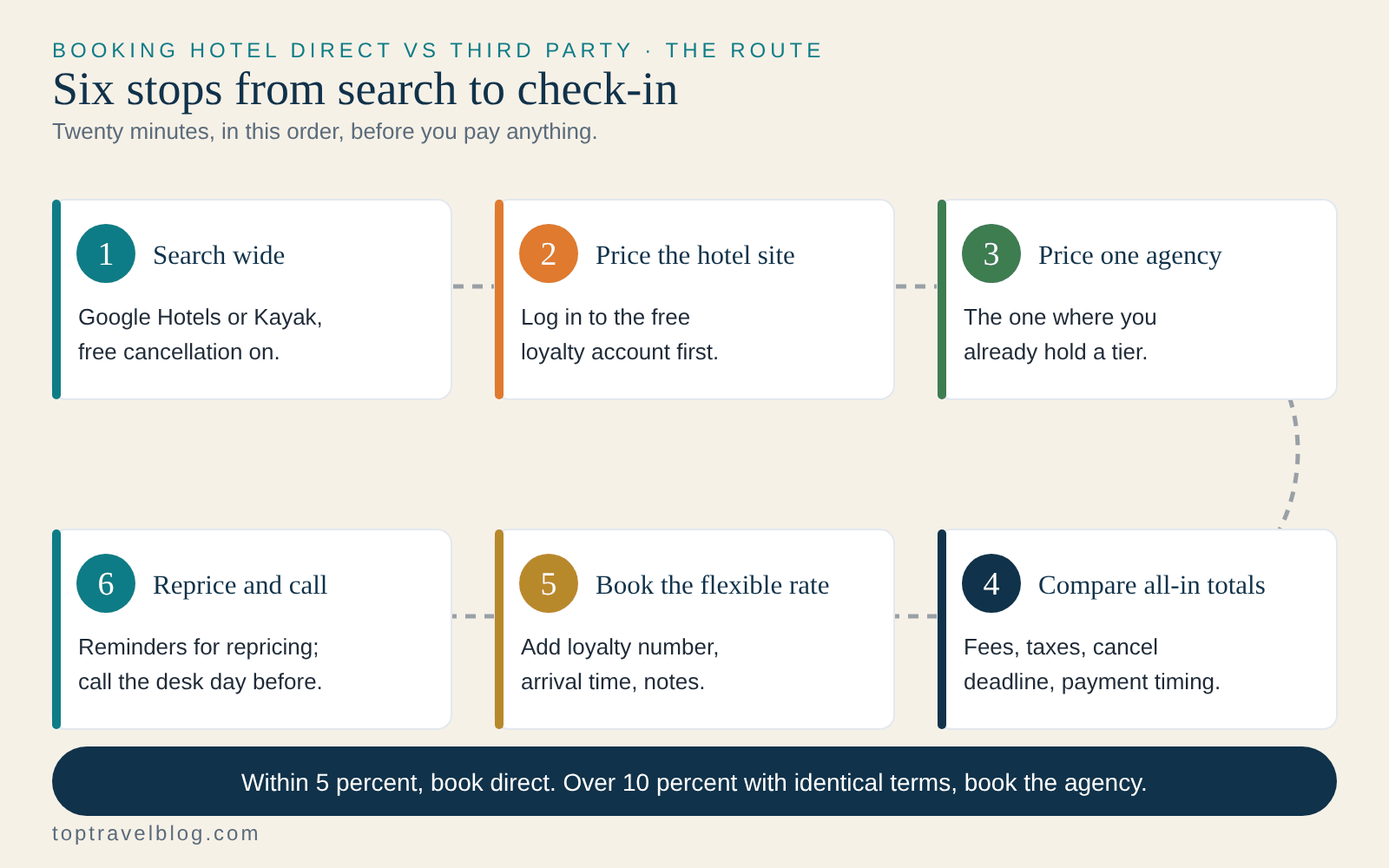
This is the order I follow for booking hotel direct vs third party on every trip, from a weekend in a nearby city to a two-week vacation. It takes about twenty minutes and removes most of the guesswork. If you are also building the trip around the hotel, the wider sequence is in my guide on how to plan a trip.
Step 1
Search wide with a metasearch tool
Start on Google Hotels or Kayak with your dates, number of guests and neighborhood, and turn on the filter for free cancellation. Do not book yet. The point is to learn the going rate for three or four hotels you would be happy with, and to see which sellers are cheapest for each.
Look at the whole price, not the nightly price. Most metasearch tools now show a total with taxes, and since the FTC’s fee rule took effect on May 12, 2025, mandatory fees are supposed to be included in the total price shown at the start. The rule, published in the Federal Register, treats vague charges and late reveals as violations.
Step 2
Price the hotel’s own site while logged in
For the direct half of booking hotel direct vs third party, open the hotel’s or chain’s site, sign in to the free loyalty account and enter the same dates. If you do not have an account, create one. It takes two minutes and unlocks the member rate, which is often the difference between a direct price that looks higher and one that matches.
Also look at the packages and offers pages. Hotels hide “stay longer” discounts, breakfast bundles and resort credits there. Screenshot the final price page, including the fees line and the cancellation language.
Step 3
Price one agency, not five
For the third-party half of booking hotel direct vs third party, pick the agency you already hold a status with, such as Booking.com if you have Genius, or the Expedia family if you collect OneKeyCash. Enter the same dates and take the same screenshot. Checking six agencies wastes time, because their inventory is largely the same and the prices differ by little.
The exception is a bundle. If you are flying, price the flight-plus-hotel package once at the end. The bundle is the one product that is not available in the same form direct.
Step 4
Compare the all-in total and the terms side by side
Lay the screenshots next to each other and read four lines, because this is where booking hotel direct vs third party gets decided: the total after taxes and fees, the cancellation deadline in hotel local time, the payment timing, and what is included. A $22 gap per night shrinks to nothing when one side includes breakfast and the other charges $26 a person for it.
Apply my rule from earlier. Within 5 percent, book direct. At 10 percent or more with identical terms, the agency has earned the booking. In between, book direct and claim a match if the chain offers one.
Step 5
Book the flexible rate and add your details
Whichever side of booking hotel direct vs third party wins, I book the free-cancellation rate unless the trip is fixed. Add your loyalty number at booking, request a bed type, and enter your realistic arrival time. If you are celebrating something, say so in the notes. It costs nothing and the notes are visible to the desk.
Then, if you booked direct on a chain with a guarantee and the price on another site is lower, submit the claim immediately. Both Marriott and Hyatt set a 24-hour window after booking, and you cannot file late.
Step 6
Set a repricing reminder and call before arrival
Put two reminders in your calendar: one for a week after booking and one a week before the cancellation deadline. On each date, search again. If the rate fell, cancel and rebook at the lower price, or ask the hotel to adjust the existing booking.
The day before you travel, call the hotel’s local number, not the chain’s line, to confirm nothing, but to say your arrival time, ask about early check-in and mention any special requirement. Five minutes on the phone buys more goodwill than any program status.
Worth knowing: Do the comparison in a private browser window or while signed out of the agency once. Some sites show different prices depending on whether you are logged in, and logged-in member prices are legitimate, but you want to see both numbers to understand what a discount is really worth.
Scenarios: which side to pick in booking hotel direct vs third party
Rules for booking hotel direct vs third party are tidy and trips are not. Here are the situations I get asked about most, with the answer I would give a friend. Find yours and read the reasoning, because the reasoning transfers to cases that are not listed.
A family week at a theme-park hotel
Pick: book direct
Park hotels often tie benefits like early entry, transportation and package pricing to the hotel’s own reservation. Changes are frequent with kids, so a direct booking with the property is easier to adjust. My Orlando vacation guide shows where the hotel choice changes the day.
A cheap weekend in a big city
Pick: price both, lean agency
When a city is flooded with rooms and you will be out all day, an agency deal or opaque rate can save real money. Accept that the room will be basic and the change terms strict, and read every fee line.
A wedding, conference or fixed event
Pick: direct, using the event block
Event blocks are negotiated with the hotel, and the group code only works on the hotel’s own system. A nonrefundable rate is acceptable here because the date will not move, but the block rate is usually better anyway.
A work trip on a corporate rate
Pick: direct, always
Corporate, government and negotiated rates almost never appear on agency sites, and your points, status and receipts all depend on a direct folio. If your employer has a booking tool, use it and add your loyalty number.
A honeymoon or anniversary
Pick: direct, and call the hotel
Special occasions run on goodwill. Booking direct and mentioning the occasion by phone or in the notes gives the desk the context and the incentive to upgrade you when a room is free. My tips for asking are in the guide on how to get a hotel room upgrade.
A flight plus hotel package
Pick: price the bundle
If the total package saves more than 10 percent over buying separately and the hotel is one you would pick anyway, take it. Know that if the flight changes, the hotel part may not move with it.
A hostel or tiny independent hotel
Pick: ask the property
Independents often give a better rate or a free night extension by email, because they save the commission. Hostels frequently list on agency sites for discoverability; see my hostel guide for first-time guests for what to expect once you arrive.
A last-minute stay tonight
Pick: app first, then call
Same-day apps carry unsold rooms at steep cuts. Before paying, call the hotel and ask for its best walk-up rate. Sometimes it matches. Sometimes the app is $40 cheaper, and you book the app.
Four scenarios in more detail
Let me work through four booking hotel direct vs third party cases with numbers, so you can see the reasoning. All figures are illustrative examples, not quotes.
Example one. You find a mid-priced chain hotel in a city center for $210 a night on an agency site and $219 on the chain’s site with member pricing, both fully refundable, both before $38 in resort fees the agency shows only at the end. After fees, you are at $248 and $257. The gap is $9, about 3.5 percent. Book direct. The points and the desk’s goodwill are worth more than nine dollars.
Example two. You find the same hotel at $168 on an agency with free cancellation, against $219 direct. That is a gap of $51 a night, or about 23 percent, over four nights, more than $200. The terms are the same. Book the agency, but add a note to the reservation with your arrival time, and call the hotel the day before.
Example three. A nonrefundable direct rate is $149 and a refundable one is $179. A trip you are certain about: take the $149. A trip with a work meeting that could move: take the $179, because the $30 is the price of an option. I price it like cheap insurance, and I buy it about two times out of three.
Example four. An opaque deal shows “four-star hotel in the downtown area” at $120, while named four-star hotels there start at $190. If you do not mind where you sleep, it is attractive. If you need to be near a specific venue, it is not, since “downtown” can mean a twenty-minute walk in either direction. Skip it for anything with a fixed address to reach.
Special cases: resorts, big cities, rentals and international stays
The framework for booking hotel direct vs third party holds almost everywhere, but a few kinds of stay bend it. These are the ones I see most often.
All-inclusive resorts and package stays
All-inclusive pricing is built from many parts: the room, the food and drink, the activities and the transfers. Agency packages and the resort’s own site package the pieces differently, so the comparison is only fair when you compare the same board plan and the same room category. Several brands exclude all-inclusive properties from their price guarantees.
My guide to all-inclusive resorts explained goes through what is included and what costs extra, and I would read it before you compare any package price. For the broader question of what kind of property fits your trip, see resort vs hotel.
Las Vegas, where the fee is the price
Vegas is the clearest example of why the total matters when booking hotel direct vs third party. Major resorts charge a daily resort fee that is often in the range of $40 to $60 plus tax, and it appears in different places on different sites. Casino companies also give their best rates and comps to players’ club members who book direct, and the cost of dining and shows can be tied to your account.
If you gamble at all, book direct under your club number so play is rated. If you do not, an agency price that shows the fee clearly can still be the best deal on a quiet midweek stay. My Las Vegas itinerary explains where to sleep for different nights.
New York, Los Angeles and Miami
For booking hotel direct vs third party, big coastal cities are the best agency markets in the country. There are thousands of rooms, prices swing by the night, and hotels use agencies to fill quiet dates. They are also the markets where taxes and fees are highest, and where a late arrival is most likely to be walked on a sold-out night.
In New York, the real price includes city and state hotel taxes and a per-night charge, so compare totals, not nightly rates. My New York City itinerary covers which neighborhoods are worth the premium. For the other two, see the Los Angeles itinerary and the Miami itinerary, where beach-side hotels carry destination fees worth pricing in advance.
Vacation rentals and apartment stays
Rentals sit outside the usual booking hotel direct vs third party debate, because they are almost always a platform booking, since the platform is the marketplace. The platform’s rules, not the host’s, govern cancellations and refunds, and fees such as cleaning and service charges can add a large percentage to the base rate. The rule that applies here is that you pay through the platform and talk to it first when something goes wrong. For the broader trade-offs, see my comparison of vacation rental vs hotel.
International stays
Abroad, booking hotel direct vs third party tilts toward agencies, which are often stronger. Booking.com and Agoda have deep inventory in Europe and Asia, small hotels that do not run polished sites may only be reachable through them, and local-currency pricing can be easy to read. The risks are currency conversion and tax treatment. Some countries charge local taxes at the property, so the agency’s total may leave out a per-night city tax.
My approach abroad is to find the hotel on an agency, then look for its own site. Small hotels often offer a better rate or a free breakfast when you write to them, and you avoid a middleman who may not understand the property.
Fees and the real total price: what the FTC rule changed
For years, the biggest unfairness in booking hotel direct vs third party shopping was the price you saw first versus the price you paid last. In late 2024 the Federal Trade Commission finalized a rule on unfair or deceptive fees, and the part covering short-term lodging took effect on May 12, 2025.
The rule applies to hotels, inns and similar lodging, and to the platforms that sell them. It requires that the total price, including mandatory fees, be shown clearly and at the start of the purchase process, and that it be more prominent than any partial price. The Federal Register notice lays out the text, and law-firm summaries note that government taxes and optional charges may be excluded from the headline total but still must be disclosed before you pay.
What it means for your comparison
For booking hotel direct vs third party, it means the first number you see should now be closer to the number you pay, on both sides. In my own searching since then, I see fewer resort fees revealed on the last page than before, though not zero, and tools that show a “total” sometimes mean “total before taxes.” Use the line that says what you will actually be charged.
It does not fix everything. A nonrefundable rate can still be cheaper than a refundable one, an agency can still charge its own fee and a hotel can still add a charge at the desk for services you chose. Treat the rule as a floor. The comparison discipline in this guide is still the work.
Tip: Look for the words “per night” and “per stay” on every fee line. A $35 “amenity fee” per night is $140 over four nights, and some sites show it as a single small line under the total. If a charge is described only as a “service fee” or “processing fee,” treat it as a flag and find out what it covers before paying.
For the fee types by name, and how they appear on different sites, my guide on hotel resort fees and destination fees is the companion to this section.
Myths about booking hotel direct vs third party that cost people money
Most of the advice floating around on this topic is half true. Here are the claims I hear most, and what I have found when I tested them.
Myth: the hotel always gives you its lowest price on its own website
Often true, not always. Hotels have agreed to keep public prices level with the agencies they sell through, so the website rarely undercuts a booking site by much. The lower number is usually the logged-in member rate or a package. If you treat booking hotel direct vs third party as a contest of public rates, you will keep finding a tie.
Myth: agencies always have the best deals
Agencies advertise discounts loudly, and the discount is often measured against an inflated “usual” rate that nobody paid. Compare against what the hotel actually charges for the same dates. The honest way to judge any booking hotel direct vs third party offer is the final amount charged, with the same room and the same cancellation terms.
Myth: the hotel treats everyone the same
Staff are professional, and most try to help every guest. But the system around them is not neutral. Loyalty members are flagged on screen, agency guests are tagged with a rate code, and upgrade lists are built from those flags. When people ask whether booking hotel direct vs third party affects the room they get, the fair answer is that it nudges the odds, in the same direction every time.
Myth: a price-match guarantee means you cannot lose
Guarantees reward a narrow, like-for-like find, and they are written to be hard to win. They also expire quickly: both Marriott and Hyatt cap the claim window at 24 hours after booking. Treat the guarantee as a bonus, not a reason to skip comparison. A guarantee also does nothing for a third-party booking, which is why it sits on the direct side of any booking hotel direct vs third party comparison.
Myth: third-party bookings are risky
The large agencies are legitimate, regulated businesses and the vast majority of bookings go through without a hitch. The point is not that they are dangerous. The point is that when something breaks, you have one more company between you and the answer. People who say booking hotel direct vs third party is a safety question are usually overstating it. It is a convenience-of-repair question.
Myth: you should always wait for a last-minute drop
In slow seasons it can work, and in busy ones it backfires. Waiting is a bet that the hotel will not fill. For weekends in popular cities, holidays, big events and school vacations, prices usually rise toward the date. A refundable booking made early and repriced later removes the gamble, which is the whole idea behind my routine for booking hotel direct vs third party.
How hotels see the choice: the economics behind the front desk
Understanding the hotel’s side makes the advice easier to remember, because it explains why direct bookings get the benefits they do.
A hotel’s most expensive guest to acquire is the one who comes through an agency. The commission, commonly reported at 15 to 25 percent, comes out of the room revenue, and on a $200 room that is $30 to $50 gone before the guest arrives. A direct booking costs the hotel far less, even after loyalty points and marketing.
That is the reason chains build apps, run member sales and fund advertising about booking direct. For the hotel, the booking hotel direct vs third party split is a line on a profit statement, and every reservation moved from one column to the other is real money.
What that means for you
You can use the hotel’s economics. A direct guest saves the hotel a commission, so a polite request for a small extra, such as a late checkout, a better floor or a breakfast credit, costs the hotel less than it would on an agency stay. I am not saying you are owed anything. I am saying the incentives line up, and a friendly request on a direct booking has a better chance.
Independent and small hotels feel this more than chains, since their margins are thinner. Writing to a small hotel and asking for its best direct rate is one of the most reliable ways I know to beat an agency price, and it is rare for the owner to say no to a clear, polite email.
What agencies offer the hotel in return
Agencies are not charity cases. They give hotels reach that a small property could never buy, fill rooms on slow nights and handle international marketing in dozens of languages. A small hotel in Lisbon or Kyoto may get half its guests from them. So the fairest summary of booking hotel direct vs third party from the hotel’s side is that each channel has a job, and the traveler who understands the jobs gets the best of both.
Where metasearch fits
Metasearch tools like Google Hotels change the picture, because they let the hotel compete with agencies on one screen. Many hotels now bid to show their own price there. When the hotel’s own link appears and the price is close, clicking it is the cleanest way to settle booking hotel direct vs third party without any extra effort.
The right answer depends on who is traveling
The same framework gives different results for different travelers, and it helps to see your own profile.
Occasional vacationers
If you take one or two hotel trips a year, loyalty points will not move your life, and price and flexibility matter most. Compare totals, take free cancellation, and let a clear 10 percent saving decide. For you, booking hotel direct vs third party is mostly a price question with a flexibility filter.
Frequent travelers loyal to one brand
Book direct every time, even for a small premium, and protect your nights. Status benefits, upgrades and free breakfast add up to more than a few dollars a night. This is the group for whom the booking hotel direct vs third party decision is almost always settled in advance.
Families
Families change plans more often, need connecting or larger rooms, and benefit from a hotel that knows the booking. Book direct for flexible dates and room requests, and use an agency only for a clear saving on a standard room.
Business travelers
Use your company’s tool or the corporate rate, add your loyalty number, and keep the folio clean for expenses. Agencies make expense reports harder, because invoices can come from the agency instead of the hotel.
Budget travelers
You will lean on agencies more, and rightly so, because every dollar counts. Keep the discipline: read the fees, prefer free cancellation, and ask small hotels and hostels for direct deals. When the margin is slim, booking hotel direct vs third party becomes a matter of who is cheaper after fees, and that changes by city and by week.
Group trips and weddings
Groups should almost always book through the hotel’s group desk, which holds a block, a negotiated rate and flexible attrition terms. Individual third-party bookings can break up the group and make it hard to keep rooms together.
What to say: short scripts for the calls and messages that work
Half the value of booking direct in the booking hotel direct vs third party choice is that you can talk to the people who control the room. Most travelers never use it because they do not know what to say. These are the lines I use, trimmed to what works.
Asking a hotel to match an agency price
Call the hotel’s local number, not the chain’s line. Say: “I am looking at your hotel on a booking site for these dates at this price with free cancellation. Can you match it, or tell me what you can do on your own site?” Keep it friendly and specific. Front-desk and reservations staff often have room to adjust a rate for a direct booking, because it saves them the commission.
If they say no, ask a second question: “Is there a package or offer that includes breakfast or parking?” You may get the value even if the headline rate stays put.
Asking for something extra on a direct booking
After you book, send a short message or leave a note: “Arriving around 2 p.m. after a long flight. If an early check-in is possible, we would be grateful. Celebrating a birthday, and a quiet room would be wonderful.” Do not demand, and do not name a specific upgrade. Politeness plus a reason works better than a list.
When you booked through an agency and need the hotel’s help
Tell the desk plainly: “I booked through a booking site, confirmation number here. I would like to add a night, change the bed type or ask about early check-in.” Most agents will do what the system allows. If they cannot touch the booking, ask whether they can note the request on the guest profile, which they often can.
When a charge looks wrong
Ask for the itemized folio, ask what each line is, and ask the agent to remove the one that does not match your confirmation. If the hotel says the agency charged you, ask for the agency’s reference. Then call the agency with that reference in hand. Writing it down in the order you did it will save you from repeating yourself on the third call.
When a hotel asks you to cancel the agency booking and rebook direct
This happens with small hotels that would rather pay no commission. If you are offered a better price or a free breakfast, it can be a good deal. Before canceling anything, make sure the new booking is confirmed in writing and that the agency’s cancellation rules will not charge you a penalty. Cancel the old one only after the new one is secure.
Common mistakes when booking hotel direct vs third party
These are the booking hotel direct vs third party errors I see, or have made myself, in roughly the order of how much they cost.
1. Comparing nightly rates instead of totals
A $20 gap per night disappears when one side adds a $35 resort fee. Always compare the full amount charged, with taxes and mandatory fees, for the whole stay.
2. Booking nonrefundable by default
It saves 10 to 20 percent and costs you the whole stay if anything shifts. Use it only when the dates are fixed.
3. Missing the 24-hour claim window
Marriott and Hyatt both require a price-match claim within 24 hours of booking. Compare prices right after you book, while the clock still runs.
4. Forgetting the loyalty number
If you book direct but do not add your number, the points and status credit may not post. Add it at booking and show it at check-in.
5. Misreading cancellation time zones
The deadline is in the hotel’s local time. Set a reminder a full day earlier than the deadline, in your own time zone.
6. Assuming a lookalike site is the hotel
Search results sometimes show sites that look official but are agencies or lead-generation pages. Look at the address bar, and use the link from the hotel’s own listing or the chain’s site.
7. Not saving the terms
Screenshot the rate, the cancellation language and the confirmation. You will need them if the page changes or a dispute starts.
8. Skipping the arrival-time call
Late arrivals on cheap rates are first in line to be walked on a full night. A two-minute call fixes most of that risk.
9. Chasing a $6 saving
Spending an hour to save six dollars a night, and losing points, flexibility and the front desk’s goodwill, is a bad trade. Decide your threshold in advance and stick to it.
10. Paying twice by accident
If you rebook to catch a lower price, cancel the original and keep the cancellation email. Then watch your card for the refund and for any duplicate hold.
Frequently asked questions about booking hotel direct vs third party
Is it really cheaper to book a hotel directly?
Not always. In booking hotel direct vs third party, for large chains the public prices on the hotel’s site and on an agency are usually within a few dollars, and the member rate on the chain’s site is typically a little lower. Agencies win on loyalty discounts, bundles, opaque deals and last-minute apps. The reliable method is to compare the all-in total from the hotel and one agency and book direct when it is close.
Do I earn hotel points when I book through a third-party site?
Usually not. In booking hotel direct vs third party, the major US chains tie points, elite night credits and status benefits to stays booked through their own channels, and their program terms list the exceptions. If points matter to you, book direct and add your member number. An agency has its own program, which may reward you instead, but it is not the same currency.
What is a best rate guarantee and does it work?
In booking hotel direct vs third party, it is a promise that if you find a lower public rate elsewhere, the chain will match it and add a bonus. Marriott offers an extra 25 percent off or 5,000 points; Hyatt offers an extra 20 percent off or 5,000 points. Both require a claim within 24 hours of booking and a like-for-like room and terms. It works when the comparison is clean and fails on technicalities.
Is it safer to book directly with the hotel?
Direct is simpler, which is not the same as risk-free. With a direct booking, the hotel holds your reservation and your card, so there is one party to deal with. Third-party sites are legitimate businesses, but a problem passes through two companies. The main risk to avoid is a lookalike website that is not the hotel at all, so use the chain’s own address.
Can I cancel a hotel booking made through a third party?
Yes, if the rate allows it, but you cancel with the site, not the hotel. Free-cancellation rates can be canceled online by a deadline in hotel local time, and the refund goes back to the original payment method on the agency’s timeline. Nonrefundable rates generally cannot be refunded, regardless of the reason, unless the agency or your insurance makes an exception.
What if the hotel says it has no record of my booking?
Show the confirmation email and number. On a direct booking, the desk can search by name and dates. On an agency booking, ask the agent to look it up by the agency’s confirmation number and, if needed, call the agency from the lobby. If the hotel is full, ask them to place you in a comparable hotel at their expense and note who you spoke with.
Does booking direct get me a better room?
Not guaranteed, but it helps. Upgrades and room assignments are discretionary and favor guests the hotel knows are loyal, members and people who asked politely. A direct booking with a loyalty number and a note on arrival time, bed type and occasion gives the desk more reasons to help. It is an edge, not a promise.
Are hotel booking apps and “secret deals” worth it?
For same-day and last-minute stays, often yes, since unsold rooms are discounted aggressively. For a planned vacation, the savings are smaller and the terms stricter. Opaque deals hide the hotel name until you pay, so use them only when location is flexible. Always read the fee line, since several apps add charges at the last step.
Should I use my credit card’s travel portal?
Only when the portal price matches or beats the direct price and the bonus points are worth something to you. A 5-point-per-dollar portal bonus is attractive on paper. But you give up the chain’s own points and some flexibility. Run the numbers using a realistic value per point, not the card’s headline value.
How do I dispute a hotel charge I did not agree to?
Start with the hotel and ask for an itemized folio. If the hotel does not fix it, contact your card issuer. The Consumer Financial Protection Bureau says to send a billing error notice within 60 days of the charge appearing on your statement. Keep your confirmation, the cancellation terms you saw and any emails with the hotel.
Is a vacation rental booked on a platform considered direct or third party?
It is a platform booking, and the platform’s terms govern payment, cancellation and disputes. You are not dealing with the host in the way you would with a hotel front desk. Message through the platform so there is a record, and read the cancellation policy for that listing before paying.
One last thing before you book
If I could change one habit in how people handle booking hotel direct vs third party, it would be to stop treating the cheapest listed price as the goal. The goal is the stay that goes right at the lowest total cost, including the cost of the one time in ten when something does not.
That is why my default in booking hotel direct vs third party is direct, my exception is a real discount and my insurance is a flexible rate. Booking hotel direct vs third party is not a moral question, and the agencies are not villains. They are tools. Use them when they are better and ignore them when they are not.
The last thing I would say is to keep it boring. Compare three prices, read the terms, add your number, book the refundable rate, and spend the energy you saved on the part of the trip that is actually fun. If you are working out the rest of the trip, my guide to how to plan a trip step by step picks up where this one ends.
Related planning guides
- Best hotel booking sites: how to compare rates without missing fees — the agencies ranked by how honest the first price is.
- Hotel cancellation policies explained — flexible, nonrefundable and deposit rules in plain language.
- Hotel resort fees and destination fees — how to spot the real total price before you pay.
- How to choose a hotel — location, reviews, room type, fees and cancellation terms.
- Vacation rental vs hotel — space, service, fees and flexibility compared.