Missed connecting flight what happens next? If one airline sold you both flights on a single ticket, it owes you a seat on the next available flight to your final destination at no extra charge, and your checked bag follows you. If you bought the two flights separately, nobody owes you anything and the next flight is a new purchase at today’s price.
That single distinction decides almost everything else about missed connecting flight what happens, so the first thing to do once you realize you will miss a flight is to find out which kind of trip you are on.
After the ticket question, three more things matter: whose fault the delay was, how fast you act, and whether you tell the airline what you want instead of waiting to be told. Most missed connections end with a new boarding pass in under an hour for the people who handle those three well.
Here is the long version of the missed connecting flight what happens question, written the way I would talk a friend through it from the gate. It covers the first fifteen minutes, protected versus self-made connections, what U.S. rules actually require, bags, six worked scenarios, the international rules in Europe, overnight costs, and how to avoid the problem next time. For the related disruptions, I link our guides on flight cancellations and airline refund rules where they go deeper.
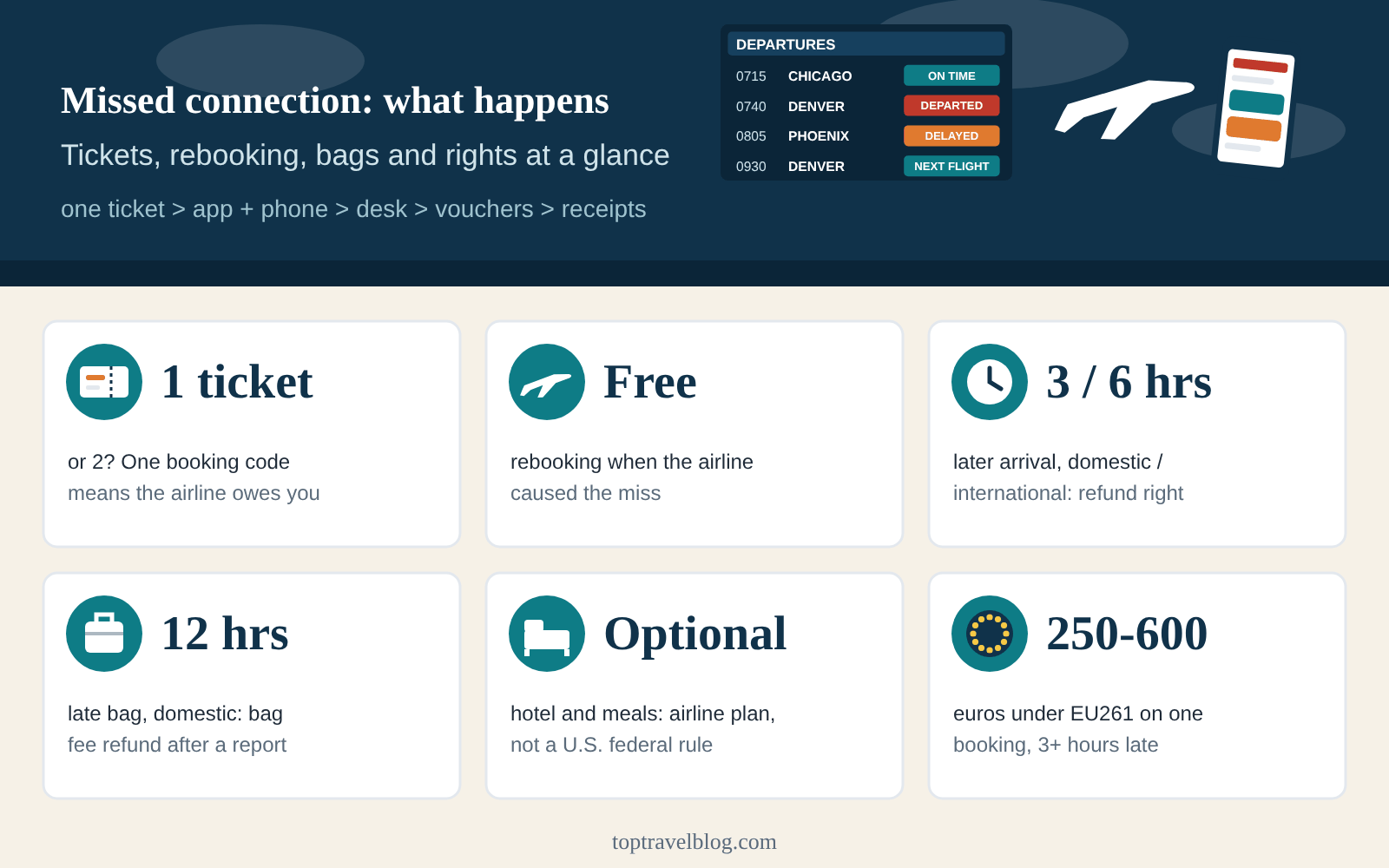
Quick facts: missed connecting flight what happens at a glance
- One ticket, airline’s fault: the airline rebooks you on its next flight with a seat, at no charge. Delta, for example, commits to the next available Delta flight and a partner airline when it has none.
- One ticket, your fault: you may be treated as a no-show on the first leg, which can cancel the rest of the ticket. Go to the desk anyway; many agents will help on a standby or same-day-change basis.
- Separate tickets: the second airline has no duty to you. Expect to buy a new fare or pay a change fee, and to collect and drop off your own bags again.
- Refund right: if the airline’s rebooking arrives 3 or more hours later on a domestic itinerary (6 or more hours international) and you decline it, U.S. Department of Transportation rules entitle you to a refund.
- Not guaranteed in the U.S.: meals, hotels and cash compensation. Airline customer service plans cover some of it when the cause is within the airline’s control.
- Europe: on one reservation, an arrival at your final stop 3 or more hours late can mean EUR 250 to 600 under EU261, unless the cause was extraordinary.
- Keep: the original itinerary, the delay notice, every receipt, and the name of whoever promises you something.
Missed connecting flight what happens in the first hour
The people who sort out a missed connecting flight what happens problem quickest do not argue; they move in parallel. You can do three things at once with a phone and a pair of legs, and that is the entire trick.
As soon as you know the connection is gone (the plane landed late, the gate agent shut the door, the departures board shows your flight as departed or closed), open the airline’s app. Many airlines now show a rebooking screen with the next flights that have seats, and they will confirm a new itinerary in two taps. If the screen offers something you can live with, take it. A flight in your hand beats a better flight in a line.
While the app loads, start walking toward the nearest customer service desk or the gate of your next flight if it is close. Call the airline’s reservation line on speaker at the same time. Phone agents work from the same inventory as the desk agent, and the hold queue is often shorter than the line of 80 people in front of you.
Do not hang up on whichever channel connects first. I have changed a flight on the phone while still 40 people from the front of a desk line, and then walked up and asked the agent only for a seat assignment.
What to ask for, exactly
In any missed connecting flight what happens situation, agents can say yes to a precise request far more easily than to a general complaint. Instead of “what are my options,” say “I missed my connection to Denver because the inbound from Chicago landed 50 minutes late; can you put me on the next flight to Denver, and can you protect me on the 8:10 as a backup?”
Ask for a seat assignment in the same breath, since automated rebooking often hands out middle seats. If your bag was checked through, ask the agent to confirm it has been rerouted to the new flight and to note the new routing on the bag tag.
If the next flight is tomorrow, ask three more things before you leave the desk. Is there a different routing today, even through another hub? Will the airline provide a hotel and ground transportation? And can you have a meal voucher now, not later?
Tip: Take a screenshot of the original itinerary, the delay notice and the new itinerary the moment you have each. Airline apps rewrite your trip in place, and the screenshot is the proof of what you were promised when you file a claim a week later.
Why door closing time matters
A common version of the missed connecting flight what happens story: your inbound plane lands 12 minutes before the next flight leaves, the gate is a 9-minute walk, and the agent has already closed the boarding door. Most U.S. airlines close the door 10 to 15 minutes before departure, and a closed door rarely reopens. Running to the gate is worth trying only if you can arrive before the door closes.
If the inbound flight was late, say so to the agent at the destination gate or in the app chat. In a missed connecting flight what happens case, it changes the airline’s category for your trip from “passenger arrived late” to “misconnect caused by the airline,” and that decides whether you get a free rebooking, a hotel or nothing.
One ticket or two: the detail that decides everything
Every missed connecting flight what happens answer starts with one question: are both flights on the same reservation? A protected connection means the airline sold you the whole journey, in one booking, with one confirmation code. If the first leg runs late, the airline is responsible for getting you to the final city. A self-made connection means you bought two separate tickets, even if they were with the same airline, and each ticket stands alone.
How to tell in thirty seconds
Open your confirmation email or the airline app and look for one confirmation code (also called a record locator or PNR) covering both flights. If both flights appear under one code, you are protected. If the second flight has a different code, it is a separate booking.
A sign on a single itinerary that says “operated by” another airline does not break protection; that is a codeshare partner. If the two flights have different airline names but one confirmation code, you are still in the clear. The question is the booking, not the logo on the plane.
Also look at the receipts. A single itinerary receipt that lists both flights under one 13-digit ticket number is one ticket. Two receipts with two ticket numbers mean two tickets, whatever the airline calls them.
Protected connections: what the airline owes you
On one ticket, the airline that causes the problem fixes it, which is the first half of missed connecting flight what happens. For a misconnect caused by a late first flight, a cancellation, or a schedule change, the typical standard is rebooking on the next available flight to your destination at no charge. Delta’s customer service plan, which the U.S. Department of Transportation summarizes on its airline dashboard, says it will rebook you on its next available flight and, if it has none, on a partner airline at no additional cost.
On that dashboard, Alaska, American, Delta, Hawaiian, JetBlue and United commit to rebooking on a partner or another airline for controllable cancellations. Allegiant, Frontier and Southwest do not make that commitment, so on those airlines you are typically limited to the airline’s own next flight.
Your bag also stays protected. A checked bag on a single ticket is tagged to your final airport, and the airline moves it to your new flight. You do not need to claim it and hand it over again at the connection.
Self-made connections: what really happens
Two tickets means two contracts, and missed connecting flight what happens gets much harsher. If your first flight arrives late and you miss the second one, the second airline sees a passenger who did not show up. It owes you no rebooking, no refund and no hotel, and the first airline only has to deliver you to the airport on the first ticket.
Some airlines will help on goodwill, especially for a short delay that was obviously not your fault. Many will sell you a standby seat or a same-day change at a reduced fee, and a few will do neither. Ask politely and do not count on it.
Self-made connections are not always a mistake. They can save real money, and they are the only way to combine a budget airline with a long-haul carrier. They are a mistake when the connection is short, when you must collect and drop off bags again, or when the second flight is the only one that day. I explain how much time is realistic in our minimum connection time guide, and the buffer rules for trips that cross borders in the international layover time guide.
Watch out: A low fare that includes a separate-ticket connection looks cheaper only until it fails. If the second flight is the only one of the day, a single missed connection can cost more than the savings from the whole itinerary. I only self-connect when I can sleep on the airport side of the delay: a three-hour buffer for domestic and five or six hours for international, and never on the last flight of the day.
Whose fault was it? The cause changes what you get
Airlines sort a misconnect into a few buckets, and missed connecting flight what happens depends on which one you land in, and the bucket decides how generous the help is. The agent will not always say which one you are in, so ask: “Is this considered a misconnect caused by the airline?”
The airline’s fault: late inbound, crew, maintenance
If your first flight left late because of a mechanical problem, a crew shortage, a late-arriving aircraft or a gate issue, the delay is within the airline’s control. This is the strongest position for a missed connecting flight what happens case: you get the free rebooking, and when the next flight is the following day, you can usually expect a hotel, ground transport and a meal.
Delta’s published plan, for example, offers a hotel with ground transportation when a delay, cancellation or misconnect is within its control and leaves you inconvenienced overnight away from home. It also offers a meal or meal voucher when you wait three hours or more past the scheduled departure for a controllable reason. Other airlines publish their own versions, and the Department of Transportation’s dashboard shows who has committed to what.
Weather and air traffic control
In a weather version of missed connecting flight what happens, air traffic control programs and airport closures are outside the airline’s control. You still get rebooked on a single ticket, because the airline contracted to carry you, but the extras shrink. Hotels and meals are usually at your own expense in that bucket, though staff sometimes hand out discounted hotel codes, and big weather events can flood every nearby room within an hour.
My habit in a weather meltdown: book a room on my phone while I am still in the rebooking line. A refundable hotel booking costs nothing to cancel if the airline finds a seat for me, and it beats sleeping on a floor if it does not.
Your fault: a late connection through security or a long walk
If you cleared customs slowly, got lost between terminals, or arrived at the gate after the door closed, the airline considers you late, not delayed. On a single ticket you are typically still its passenger, and many airlines will put you on the next flight for free or a small change fee, especially if the first flight was on time and the cause is minor.
Others treat it as a no-show: your first leg is counted as flown or forfeited, and the rest of the ticket can be canceled. The airline can then sell your seat. The fix is to walk up to the agent immediately, before anything is canceled in the system, and ask for a same-day standby or confirmed change.
What U.S. rules say about refunds, rebooking, meals and hotels
The federal rules behind missed connecting flight what happens are narrower than most travelers assume. The rights that exist are firm, and the Department of Transportation’s refund page is the authoritative source. The comfort extras mostly come from airline policy, not from law.
The refund right
If an airline cancels a flight or significantly changes your itinerary and you decline the alternative, you are owed a refund of the unused ticket to your original form of payment. The department defines a significant change as a departure or arrival that moves 3 or more hours on a domestic itinerary, or 6 or more hours on an international one, a change of origin or destination airport, or an added connection. A downgrade to a lower class of service also counts.
Missed connecting flight what happens becomes a refund situation when the airline’s best replacement is far later than your original arrival. If you were due in Phoenix at 2 p.m. and the airline offers a 7 p.m. arrival, that is five hours late, which crosses the domestic threshold. You can decline and take the money.
Refunds must arrive within 7 business days for a credit card payment and 20 days for other payment types. The refund covers the unused portion of the ticket, so if you already flew the first leg you receive only what is left.
Compensation, meals and hotels
Nothing in U.S. law requires an airline to pay cash for a delay that misses your connection, or to buy you a meal or a hotel room. The 2024 proposal for mandatory cash compensation was withdrawn in November 2025. What you can count on instead is whatever the airline has committed to in its own customer service plan, and the commitments differ.
I treat the plan as a script. If Delta’s plan promises a hotel for a controllable overnight misconnect, I say “under your customer service plan, I’m entitled to a hotel for this misconnect” and ask for the voucher by name. Agents respond better to that than to a demand for compensation.
Rebooking on a different airline
Federal rules do not force an airline to rebook you on a competitor. Some airlines have committed to it for controllable cancellations, and a few do it for misconnects when their own options leave you stranded overnight. If another carrier has a seat leaving sooner, ask for it by flight number. Agents can often endorse the ticket to another carrier, but only if you bring the specifics.
Southwest, Frontier and Allegiant do not make that commitment on the dashboard. On those airlines the practical advice is to take the best available flight on the same carrier and use your time to get the hotel and meal sorted.
Tickets bought through an agent
If you booked through an online travel agency, the airline rebooks and the agency refunds. The merchant of record on your card statement is responsible for the airfare refund when the airline cancels or significantly changes your flight, and baggage and seat fees are claimed from the airline. Start with the airline, because it controls the inventory, then take the money question to the agency. Our guide to the 24-hour flight cancellation rule covers the booking window that sometimes changes this.
The rebooking playbook: five steps from gate to new boarding pass

I run the same missed connecting flight what happens sequence every time, because panic is what makes people skip steps. The picture above shows the order; the sections below explain why each one earns its place.
Step 1
Stop and read what the airline already did
Before you queue, look at the app, the text messages and the email. Airlines that see the delay coming often rebook you automatically and send the new flight before you land. I have walked off a plane to find a new boarding pass waiting in the app and a gate number two terminals away.
If the airline has already moved you, read the new flight carefully: the time, the arrival city and whether it is on your original ticket. A rebooking that arrives 5 hours later than planned still gives you the refund option if you want it.
Step 2
Try the app and the phone at the same time
Open the app’s rebooking screen and call the airline’s reservation number on speaker. Whichever answers first wins. If you have status or a premium card, use the dedicated line; it is typically shorter. In a missed connecting flight what happens case, speed decides the result, and the people in the desk line are all fighting for the same seats.
If the app gives you a flight you like, take it and cancel the call. If it gives you nothing, stay on the phone while you walk to the desk.
Step 3
Make a specific request
Name the flight you want, or the time window, or the alternate airport you can live with. “Anything before noon tomorrow” is a request; “I need help” is not. If your options are poor, ask about a different connecting city, a flight on a partner airline, or a nonstop from a nearby airport. Say what you can accept, then let the agent search.
Ask for the seat you need too. If you have a medical need, a child or a tight onward connection, tell the agent at this stage, not after the new boarding pass prints.
Step 4
Settle the extras before you leave
If the new flight leaves tomorrow, ask for the hotel voucher, ground transport and meal voucher before you step away from the desk. It is much harder to get them afterward. If the agent says the cause is weather, ask whether the airline has discounted hotel rates, and take the hotel code even if you do not use it.
Then ask the single most useful question in the process: “Is everything on my new itinerary protected and ticketed?” It makes the agent check that the change is in the system and not a verbal promise.
Step 5
Protect everything waiting at the other end
Missed connecting flight what happens at the far end is a separate problem: your arrival moves, and every booking at the destination still assumes the old one. Call or message the hotel to say you are arriving late, tell the rental car counter, and notify any driver, tour or restaurant. Many hotels hold a room for a late arrival if told, and most rental counters keep the car until closing.
Put the new arrival time in a text to whoever is picking you up. It is the simplest step, and the one people skip while they are busy with the airline.
Tip: If the desk line is more than about 20 minutes long and the airline has a lounge, the lounge agents can often rebook you faster. Even a day pass sometimes pays for itself on a bad day. Without lounge access, the gate agent at your next gate or a roaming customer service agent with a tablet is the next best bet.
What happens to your checked bag when you miss a connection
Bags make the missed connecting flight what happens story harder than it needs to be, because the answer is different for each ticket type.
On one ticket
Your bag is tagged to the final airport on your boarding pass, so missed connecting flight what happens to the suitcase is simple on one ticket. If you miss the connection, the airline’s system sees the bag as rerouted to your new itinerary, and it travels with you or follows on the next flight. You do not have to claim it at the connection.
Ask the agent to confirm that the bag is rebooked, and look at the new bag tag if they print one. If you are staying overnight, ask whether the bag can be pulled for you. Often it cannot; it will sit in the system and meet you tomorrow, which is why you should always pack a change of clothes, medications and chargers in your carry-on.
On separate tickets
You must collect your bag, carry it through the terminal, and check it in again with the second airline. If you missed the second flight, your bag is in your hands, which is the one upside of a self-made connection. Keep it with you while you sort out a new ticket.
Drop-off times matter: many airlines stop accepting checked bags 45 to 60 minutes before departure. A tight self-connection can fail on bag cutoff alone, even if you make the gate.
When you arrive from abroad in the United States
On an international arrival, you clear immigration and customs at your first U.S. airport, pick up your bag, and then drop it again at a bag-drop belt before security. If you miss your onward flight after that, the bag is already back in the airline’s system and will move to your new flight.
The Department of Transportation notes that bag fee refunds do not apply if you fail to hand a bag back to the airline at your first U.S. entry point. Look for the bag-drop belt as soon as you leave customs, even if a hurry makes it feel optional.
If the bag does not arrive
Under the department’s rules, you can claim a refund of the checked bag fee if the bag is not delivered within 12 hours of a domestic arrival, or within 15 hours of an international arrival on a flight of up to 12 hours, or 30 hours on a longer flight. File a mishandled baggage report with the airline before leaving the airport; the refund depends on that report.
Our guide to delayed baggage covers what to buy, what is reimbursable and how to document it. The shortest advice is to keep receipts for essentials and to ask the airline in writing what it reimburses.
Six scenarios: missed connecting flight what happens in each
Rules are easier to hold when you can see them applied, so here is missed connecting flight what happens in six real situations. These six cover most of the situations I hear about. Names and cities are illustrative; the logic is not.
1. One ticket, late inbound, another flight tonight
You fly Boston to Chicago to Denver on one ticket, the easiest missed connecting flight what happens case. The Boston flight lands 40 minutes late and the Denver flight has left. The delay was the airline’s, so the airline owes you the next Denver flight at no charge.
Open the app. If a 9 p.m. departure shows, take it and ask for a seat assignment. Your bag follows. The airline owes you a meal voucher only if its plan says so, and with a wait of three hours or less most do not offer one. Grab dinner, keep the receipt, and move on.
2. One ticket, last flight of the day
Same trip, but the Denver flight was the last one, and the next seat is at 7 a.m. The airline’s fault gives you the strongest ask. Request the hotel voucher and ground transportation, a meal voucher, and a wake-up-ready boarding pass.
Ask whether a routing through another hub gets you in earlier, even with a long connection. Take a photo of the voucher and the new itinerary. If the airline says no hotel because the cause was weather, book your own refundable room and keep the receipt.
3. One ticket, thunderstorms shut down the hub
A line of storms closes the hub for four hours and half the departures cancel. You are rebooked, but everyone is, and flights are full for two days. The airline still owes you a new flight or a refund, and you will wait with a few thousand other people.
This is when you call the airline and use a second device to check other airlines on Google Flights, since our Google Flights guide shows how to search flexible airports. If the delay is two days, a refund and a new ticket on another airline can be better than waiting. Use that route only after you decline the airline’s rebooking in writing, because accepting one usually closes the refund right.
4. Your own lateness on one ticket
A security line at the connecting airport kept you in the terminal and the door closed as you reached the gate. The first flight was on time. This is your fault, and the airline can treat you as a no-show for the second flight.
For this missed connecting flight what happens case, go to the desk calmly. Ask for the next flight on standby or a same-day change and ask what it costs. Many agents will help for a modest fee or none, especially when seats are open. Do not assume the ticket still works; ask the agent to confirm that the remaining flights on the itinerary are still active so they are not canceled.
5. Two tickets, short layover, no help
The harshest missed connecting flight what happens case: you bought a budget flight from Austin to Atlanta and a separate ticket from Atlanta to Orlando. The Austin flight lands late and you miss the Orlando flight. The second airline owes you nothing.
Ask the second airline what a same-day standby or change costs and compare it with a new one-way fare. If the cost is high, look at nearby airports and other airlines, and read our cheap flights guide for how to price a last-minute one-way without paying panic fares. Keep your receipt from the first airline; some travel cards and insurance policies cover a missed connection caused by a covered delay even on separate tickets.
6. International arrival, then a domestic hop
You land in New York from London at 3:40 p.m. and have a 6:30 p.m. flight to Charlotte on the same ticket. Immigration takes 70 minutes, the bag takes 25, and security takes 30. You miss the flight.
Because it is one ticket and the late arrival was not your doing, missed connecting flight what happens here is routine: the airline puts you on the next Charlotte flight at no cost. Walk to the desk or open the app right away, since the agent will already see that the inbound was late. This case is why I want two and a half to three hours between an international arrival and a domestic connection in the U.S., and why I quote the buffers in our minimum connection time guide.
Missed connections abroad: EU261 and other rules
Outside the United States the missed connecting flight what happens rules are more generous. If your trip touches Europe, you may have rights that do not exist at home, and agents will not always mention them.
EU261 in plain language for a missed connecting flight
EU261 is the European Union’s air passenger regulation. The EU’s Your Europe passenger rights page explains it. It applies to flights departing from an EU airport on any airline, and to flights arriving in the EU on an EU-based airline.
Missed connecting flight what happens under EU261 depends on whether the flights were on one reservation. If they were and you arrive at your final destination 3 or more hours late, you may be owed compensation. The amounts are EUR 250 for flights of 1,500 km or less, EUR 400 for flights between 1,500 and 3,500 km and for longer flights inside the EU, and EUR 600 for flights over 3,500 km.
The exceptions
No compensation is due if the cause was an extraordinary circumstance, such as air traffic management decisions, adverse weather, political instability or security risks. Most technical problems and strikes by the airline’s own staff do not count as extraordinary. There is also no compensation if the delay came from security checks or you missed the boarding time at the transfer airport.
If the airline reroutes you and you arrive late, compensation can be cut in half. Reductions of EUR 125, EUR 200 or EUR 300 apply depending on distance and how late you arrive. That is one reason to read a rebooking offer before accepting it.
Care while you wait
Separate from compensation, EU rules require airlines to give meals and refreshments in proportion to the wait, plus two free calls or emails. If the delay pushes your departure to the next day, the airline should provide a hotel and transport to and from it. If it fails to, you can claim reasonable expenses afterward, so keep every receipt.
A delay of 5 hours or more at departure lets you take a refund and, for connecting flights, a return flight to your starting airport.
The UK, Canada and other regimes
The United Kingdom runs its own version of the regulation for flights departing the UK, and Canada has air passenger protection regulations with their own compensation scale. Many countries have comparable systems. For missed connecting flight what happens abroad, the pattern is the same: rights apply based on where the flight departs and which airline operates it, so the rules for a trip to Europe on a U.S. carrier may differ from the rules on an EU carrier.
When you file, state the facts: the flight numbers, the scheduled and actual arrival times, the booking reference and the reason the airline gave. Most airlines have an online EU261 form, and if they refuse, the national enforcement body in the country of departure can take the complaint.
Hotels, meals and what a missed connection costs you
Money is where most of the frustration lives in any missed connecting flight what happens story, so here is how to think about it before you spend.
When the airline pays
On a single ticket with a controllable cause, missed connecting flight what happens usually includes the airline’s help: expect the airline’s published commitments to apply. That can mean a hotel with a shuttle, a voucher for dinner and breakfast, and sometimes a toiletry kit. Ask at the desk, because a voucher issued on the spot is worth far more than a reimbursement claim.
If the airline cannot offer a room, Delta’s plan says it will reimburse reasonable costs for the room and ground transportation, and if no accommodation is available at all it will provide a credit on request. Other airlines write the details differently, but the logic is the same: if they could not house you, they should not leave you out of pocket.
When you pay
When the cause is weather, air traffic control or your own late arrival, or when you have two tickets, you pay for the room and meal. A reasonable plan is a budget room near the airport with a shuttle, a quick meal, and enough sleep to catch the earliest flight. Expect an airport hotel on a bad night to cost noticeably more than a normal one, since every stranded traveler books at once.
Reserve through a site or app that lets you cancel free until the evening. If the airline finds you a flight in the next hour, cancel the room. Hotels near hubs sell out during a meltdown, so book first and queue second.
What you may be able to claim
A few sources can cover the costs even when the airline will not. Many travel credit cards include trip delay coverage that pays for lodging and meals after a delay of several hours, typically with a daily or per-ticket limit, and travel insurance policies often cover missed connections caused by covered delays. Both usually require you to keep receipts, the delay notice and proof from the airline of the cause.
Read your card’s benefits guide before you travel, not at the gate. The wording about what counts as a covered delay, and whether separate tickets qualify, decides whether you can claim.
Receipts and records
Keep a folder in your phone for the trip. Put in it the original itinerary, the delay notice, the new itinerary, every receipt, and a note of each agent’s name and time. Write down the cause the airline gave. It takes two minutes at the time and saves weeks later.
Who owes you what: a decision guide

The graphic above is the short version of missed connecting flight what happens. It starts with the question that matters most, then branches by cause, and ends with what you can expect. I use the same path in my head at the gate.
If you hold one ticket and the airline caused the delay, you are in the best seat: free rebooking, the refund option if the new arrival is much later, and likely help with a hotel and meals. If you hold one ticket and the cause is weather, you keep the rebooking but lose most of the extras.
If you hold two tickets, your missed connecting flight what happens path is shorter and harder: ask for goodwill, price a new fare, and fall back on credit card or insurance coverage. If you were simply late, the answer depends on how the airline treats a no-show, which is why speed and politeness count for so much.
The one question that saves the most money
Before you buy a new ticket, ask the airline you are standing in front of whether you are protected. If the answer is yes and the cause is theirs, do not pay for a replacement flight yourself. The reimbursement claim is slow and uncertain, and the airline’s own rebooking is free.
The expensive mistake is a traveler who buys a $500 last-minute fare in the first ten minutes and later learns that the original airline owed a free seat on a flight an hour later. If a seat is available and the cause is the airline’s, let the airline fix it.
How to lower your odds of a missed connection
Missed connecting flight what happens is partly luck. You cannot control a thunderstorm, but you control most of the rest, and the choices happen before you buy.
Book one ticket, with a real buffer
For anyone worried about missed connecting flight what happens, the best prevention is to book the whole journey on a single reservation whenever the prices are close. The protection is worth more than the small savings on two separate fares. Choose connections long enough to survive a typical delay: for a domestic hub I want at least 90 minutes, and for any connection that includes customs, a terminal change or a second security screen I want two and a half to three hours.
The minimum connection time an airline loads into its system is a floor for the booking engine, not a promise that you will make it. Our guide to the minimum connection time explains how to read it, and the guide to planning a trip step by step shows where flight timing fits in the rest of the plan.
Fly early in the day
The first flight of the morning has the best on-time record because the plane spent the night at the airport and delays have not yet piled up. If you must connect, put the long, important leg on the morning side. Afternoon and evening connections inherit every earlier delay, which is where most missed connections start (missed connecting flight what happens to you is mostly a timing problem), and the last flight of the night leaves no backup.
Choose the airline and the airport carefully
Hubs with frequent service to your destination give you more rescue options. If your connection city has three more flights to your destination that day, a miss is a minor event; if it has one, a miss costs a night. The same logic applies to the airline: an airline with partners at the hub can rebook you elsewhere when its own flights are full.
When you compare options, look past the headline fare. Our cheap flights guide explains why the lowest price often hides a short layover or a separate ticket, and it is where I would start before you buy.
Pack for a bad night
Carry the essentials in your cabin bag: medications, a phone charger, one change of clothes, toiletries and any documents. It turns a missed connection from a crisis into an inconvenience, particularly if the checked bag is sitting in another city.
After you land: refunds, claims and complaints
The missed connecting flight what happens story does not end at baggage claim, and the money side takes a few emails.
Ask for the refund if you declined the flight
If you refused the airline’s alternative and it owes you a refund, it must send it automatically; if it has not appeared after 7 business days on a card payment or 20 days otherwise, contact the airline in writing. Quote the Department of Transportation refund rules, attach the delay notice, and ask for the refund to the original form of payment.
Submit expense claims
Many airlines have a customer relations form for expense claims. Send the receipts for meals, hotel and ground transportation along with the delay notice and the cause the airline gave. Be specific and polite, and ask for a written decision. If the airline offers a voucher for a smaller amount, you can accept or push back; cash is better than a voucher.
Go to the card or insurer
If you paid by credit card and the airline will not deliver a flight you were owed, a dispute with your card issuer is the next step. Travel insurance and card trip delay claims need the receipts and a letter from the airline that states the delay and its cause, which is another reason to ask for one at the desk.
File a complaint
The Department of Transportation takes consumer complaints about airlines through its aviation consumer protection pages. A complaint does not produce an instant payout, but airlines respond to the department, and many of them resolve the issue within a few weeks.
Common mistakes after a missed connection
These are the missed connecting flight what happens errors I see most, in rough order of how much they cost.
- Joining the desk line and doing nothing else. The app and the phone are faster for most people, so run them together.
- Not checking whether the trip is one ticket or two. Everything else depends on it.
- Accepting a voucher, miles or a rebooking before deciding whether you want a refund. Acceptance usually closes the refund right.
- Paying for a new flight before asking the airline if it owes you one.
- Skipping the cause. A late inbound flight is the airline’s problem; if you do not say so, the agent may code it as yours.
- Leaving the desk without a hotel voucher or meal voucher when the cause was controllable.
- Forgetting the destination: the hotel, the rental car and the person picking you up all still assume the old arrival.
- Not keeping receipts and screenshots, which turns a legitimate claim into your word against theirs.
- Booking separate tickets on a short connection to save a small amount.
- Running out of the secure area on a self-made connection, then discovering the second airline’s bag cutoff has passed.
Frequently asked questions: missed connecting flight what happens
Missed connecting flight what happens if it was the airline’s fault?
On a single ticket, the airline rebooks you on its next available flight to your destination at no charge and moves your bag. If there is an overnight, many airlines’ published plans cover a hotel, ground transportation and meals when the cause is within their control. If the new arrival is 3 or more hours later domestically, you can decline it and take a refund.
Will the airline put me on another airline?
Sometimes. Alaska, American, Delta, Hawaiian, JetBlue and United commit to rebooking on a partner or another airline for controllable cancellations, according to the Department of Transportation’s dashboard. Allegiant, Frontier and Southwest do not. Ask for the specific flight you found, since agents do this more readily when you hand them the flight number.
Missed connecting flight what happens if I booked two separate tickets?
The second airline owes you nothing. You can ask for goodwill, a standby seat or a reduced-fee change, but you should be ready to buy a new ticket. Your first airline only has to get you to the connecting airport. This is why separate-ticket connections need a long buffer.
Do I get compensation for a missed connection in the U.S.?
Federal rules do not require cash compensation for a delay that causes a missed connection. You are entitled to a refund if the airline cancels or significantly changes your flight and you decline the alternative. Some airlines offer vouchers or miles at their discretion, which you can ask for politely.
Missed connecting flight what happens to my checked bag?
On a single ticket, the bag is routed through to your final destination and follows your new itinerary. On separate tickets you collect it and check it in again yourself. A bag that does not arrive within 12 hours of a domestic arrival can qualify for a bag fee refund once you file a mishandled baggage report.
What if I miss the connection because I was late?
The airline can treat you as a no-show, which risks canceling the rest of your ticket. Go to the desk immediately and ask for a standby or a same-day change. Many airlines help for a fee or nothing, but they are not required to, so move fast.
Am I owed a hotel if the next flight is tomorrow?
Not by federal law. It depends on the airline’s plan and the cause. For a controllable cause, airlines such as Delta commit to a hotel and transport. For weather or air traffic control, expect to pay yourself, and ask the agent for a discounted hotel code. Keep receipts in case your credit card or insurance covers it.
How much time do I need between flights?
Domestic connections at large hubs need roughly 90 minutes for comfort, and an international arrival followed by a U.S. connection needs two and a half to three hours. The airline’s minimum connection time is a floor, not a recommendation. Longer is always safer, especially in winter and summer storm seasons.
Does EU261 apply to missed connections?
Yes, when both flights are on one reservation, EU rules apply, and you arrive at your final stop 3 or more hours late. Compensation runs from EUR 250 to EUR 600 by distance, unless the cause was extraordinary, such as weather or air traffic control decisions. Care such as meals and a hotel applies regardless of cause.
Can travel insurance or a credit card help?
Often. Many travel cards and insurance policies cover meals and lodging after a delay of several hours and may cover a missed connection from a covered delay. They typically need receipts and the airline’s written cause. Read the benefits guide before the trip, since terms differ on separate tickets.
One last thing before you fly
Most missed connections end with a new boarding pass and a bad meal, whatever you read about missed connecting flight what happens online. The cases that go wrong are the ones where the traveler waits for the airline to speak first, buys a ticket they did not need to buy, or loses the paper trail that a claim needs.
If you remember three habits, make them these: find out whether you are on one ticket, use the app and the phone while you walk to the desk, and ask for exactly what you want. That is the whole answer to missed connecting flight what happens, and it works on every airline.
Related planning guides
- Flight canceled? What to do before you join the customer service line
- Minimum connection time: how much airport transfer time is actually enough
- Airline refund rules in the U.S.: cancellations, significant delays and bag fees
- How long of a layover do you need for an international flight
- Delayed baggage: what to do at the airport and what may be reimbursed
- How to plan a trip step by step