
Three days is the right length for a first Miami trip, and the best miami itinerary I know splits them cleanly: one day on Miami Beach, one day on the mainland neighborhoods (Little Havana, Wynwood, Brickell), and one day out of the city on Key Biscayne, in the Everglades, or in the old-money corners of Coconut Grove and Coral Gables.
That split works because Miami is not one city. It’s a barrier island with a famous beach, a sprawling mainland where the actual culture lives, and a ring of day trips that most visitors never reach because they parked themselves on Ocean Drive and never left.
This miami itinerary suits couples, friend groups, and families with kids who can handle heat and a bit of walking. It also works for the growing number of people who fly into MIA for a cruise and want 3 days in Miami before they board.
If your idea of a vacation is a lounger and a frozen drink for 72 hours, you can skip most of this and still have a good time, but you’ll have spent a lot of money to see a very small piece of a very big place.
I’ve done this trip in February, in late May, and once (foolishly) in mid-September. I’ll be honest about what each felt like, and about the two things that sour more Miami trips than anything else: the restaurant bill on Ocean Drive and the cost of parking a car on the beach. Both are avoidable. Let’s plan it properly.
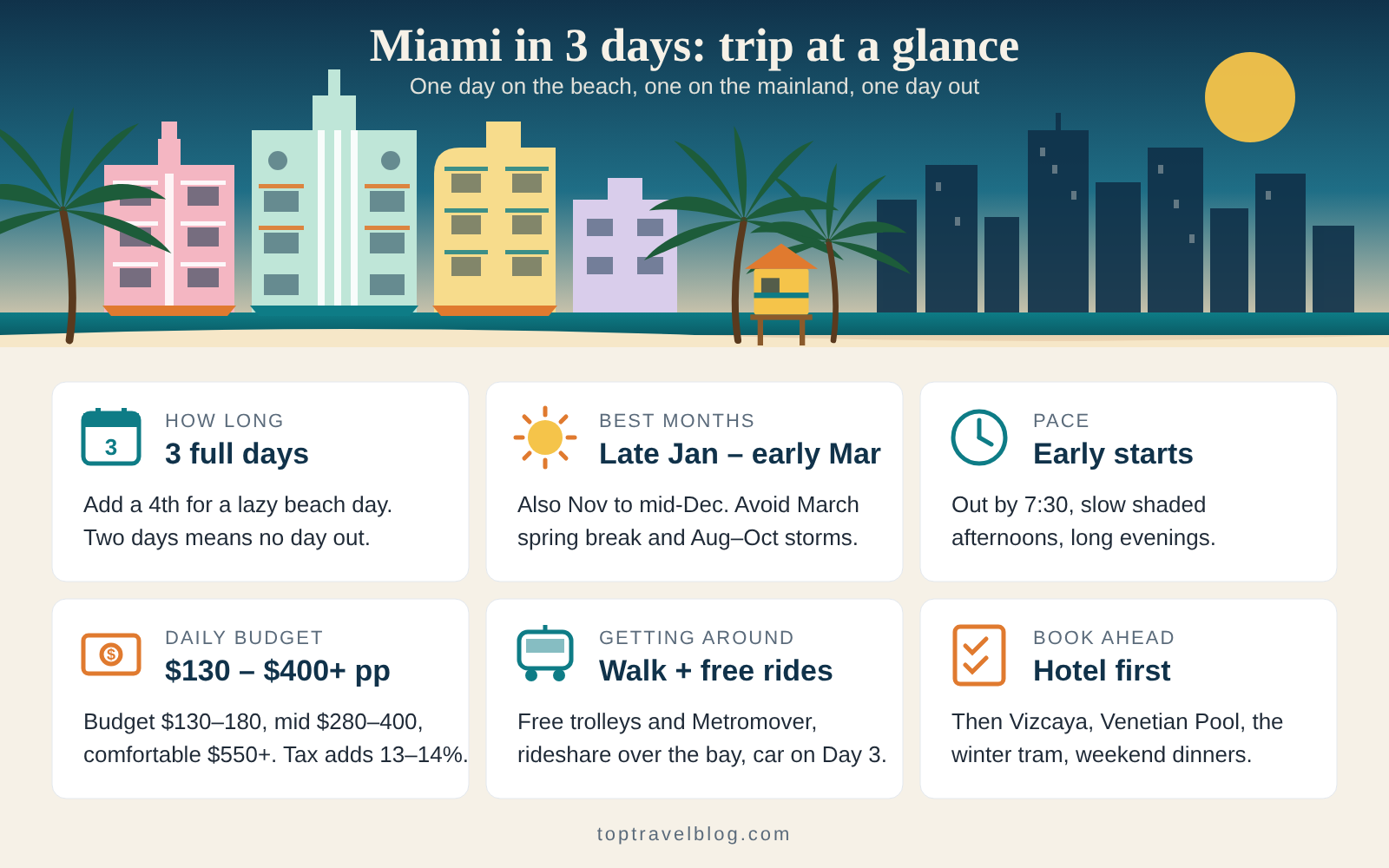
Quick facts
- Best for: first-timers, couples, friend groups, pre-cruise stays, families with school-age kids who tolerate heat.
- Ideal trip length: 3 full days for this miami itinerary (4 if you want a real beach day with no agenda).
- How to get around: walk on Miami Beach, free trolleys on the island, rideshare across the causeways, Metrorail from the airport, free Metromover downtown. A rental car only on Day 3.
- Booking priorities: hotel first (prices swing wildly by week), Vizcaya and Venetian Pool tickets, a Shark Valley tram seat in winter, dinner reservations for Friday and Saturday.
- Pacing: early mornings, slow middays in the shade or the water, long evenings. Miami rewards people who flip their day around the heat, and this miami itinerary does.
- Key caveats: auto-gratuity on Ocean Drive, $4-an-hour parking on the beach, June–November hurricane season, March spring break crowds, and roughly 13–14% tax on top of any hotel rate.
Best time to go: when this Miami itinerary works best
Miami has two seasons, not four, and the one you land in shapes a miami itinerary more than anything else you book. The dry season runs roughly from mid-November through April: highs in the mid-70s to low 80s, low humidity by local standards, and afternoons you can actually walk through.
The wet season runs from May into October, and it is hot, sticky, and punctuated by a thunderstorm that arrives most days between about 2 and 5 p.m., dumps an inch of rain, and leaves.
Hurricane season officially runs June 1 through November 30, with the real risk concentrated from mid-August through early October.
If you can pick any week for your miami itinerary, pick one between late January and early March, or in the first half of December. You get the dry-season weather without the two big crowd spikes. The water is on the cool side in January (low 70s), which Floridians find unswimmable and everyone from north of Atlanta finds perfect.
The months to think twice about
March is spring break, and it changes South Beach in a way that’s hard to overstate. In recent years the city has responded with curfews, closed causeways on peak weekends, $100 parking flat rates and towing, and a heavy police presence on Ocean Drive.
The city publishes its spring break rules each February on miamibeachfl.gov; read them before you book a March trip. If you’re coming for the Art Deco architecture and a quiet beach, March is the wrong month. If you’re 22, it may be the right one.
Mid-August to early October is the trough. Hotels drop to their lowest rates of the year, which is tempting, but the heat index sits above 100°F most afternoons and a named storm can cancel the whole trip. If you book a miami itinerary then, buy refundable rates and consider travel insurance that specifically covers named storms. I did a September trip once and spent two afternoons in the Pérez Art Museum because standing outside was unpleasant. Good museum, but not the plan.
December holidays and Art Basel week (the first week of December) push Miami Beach hotel prices to their yearly peak, and Ultra Music Festival in late March does the same downtown. Both dates matter for your miami itinerary, because a $220 room can become a $600 room on those weekends.
Hurricane season swap for this miami itinerary
If you’re traveling between June and November, build this miami itinerary around flexibility. Do outdoor things in the morning, keep the museum or the Design District as your afternoon fallback, and move Day 3 to whichever day has the best forecast. Airboat operators and the Shark Valley tram run in light rain but cancel in lightning, and Bill Baggs closes its beach when storms roll through. Check the National Hurricane Center seven days out; anything with a cone over South Florida means rebooking, not hoping.
Tip: Flight prices and hotel prices in Miami don’t move together. The cheapest flights into MIA are often in late January and early February, when hotel rates are high. If the hotel is your biggest line item, aim for the first two weeks of November or the first half of December instead.
How many days you really need in Miami
Three. That’s the honest answer for a first visit, and it’s the number this miami itinerary is built around. Two days gets you the beach and Little Havana but forces you to skip Wynwood or the day trip, and you’ll feel it.
Four days gives you a proper beach day with no plan at all, which turns out to be the thing people remember most. Five or more days means you should start adding a Keys overnight or a second Everglades entrance rather than more Miami.
What changes at each length
2 days: Compress Day 1 and Day 2 of this miami itinerary as written below and drop the day trip entirely. Do South Beach in the morning of Day 1, Wynwood in the afternoon, and give Day 2 to Little Havana and Brickell. You’ll see the highlights. You won’t touch the water beyond a dip.
3 days: The full plan below. One island day, one mainland day, one day out. This is the version I’d recommend to anyone asking about miami first time logistics, because it balances the famous stuff with the parts of the city residents actually like.
4 days: Keep the 3-day miami itinerary as it is and add a nothing day on the beach, ideally in Mid-Beach or at Crandon Park where it’s quieter. Or do two of the three Day 3 options instead of choosing. Key Biscayne plus Coconut Grove pair well because they’re both south and both quick.
5+ days: Add Key Largo or Islamorada for a night (roughly 90 minutes to two hours south by car), or ride Brightline up to Fort Lauderdale for an afternoon. If you’re combining Miami with Orlando’s theme parks, which a lot of families do, Brightline runs from MiamiCentral downtown to Orlando International Airport in about three and a half hours; our Orlando vacation guide covers how many park days you need on the other end.
If Miami is one stop of several
Miami pairs naturally with a Florida road trip or a cruise, and awkwardly with the big cities out west because of the flight time. If you’re doing a bigger US trip, I’d put this miami itinerary at the start or end rather than the middle; the New York City itinerary on this site works as the northern bookend of an East Coast trip, and the two cities are a cheap three-hour flight apart. Fly in on a morning flight if you can; you’ll be on the sand by lunch.
Cruise passengers: how to time it
PortMiami sits on Dodge Island between downtown and South Beach, about 15 minutes by car from either and 20 to 30 minutes from the airport. Most ships board from late morning and sail around 4 or 5 p.m., with all-aboard an hour earlier. The classic pre-cruise move is to fly in a day early, stay in Brickell or South Beach, do Day 1 of this plan, and head to the port by noon.
If you’re doing 3 days in Miami before a cruise, run the miami itinerary in the order below and keep Day 3 light enough that a rental car return at MIA doesn’t collide with boarding.
Where to stay in Miami: South Beach vs Brickell and the other two options
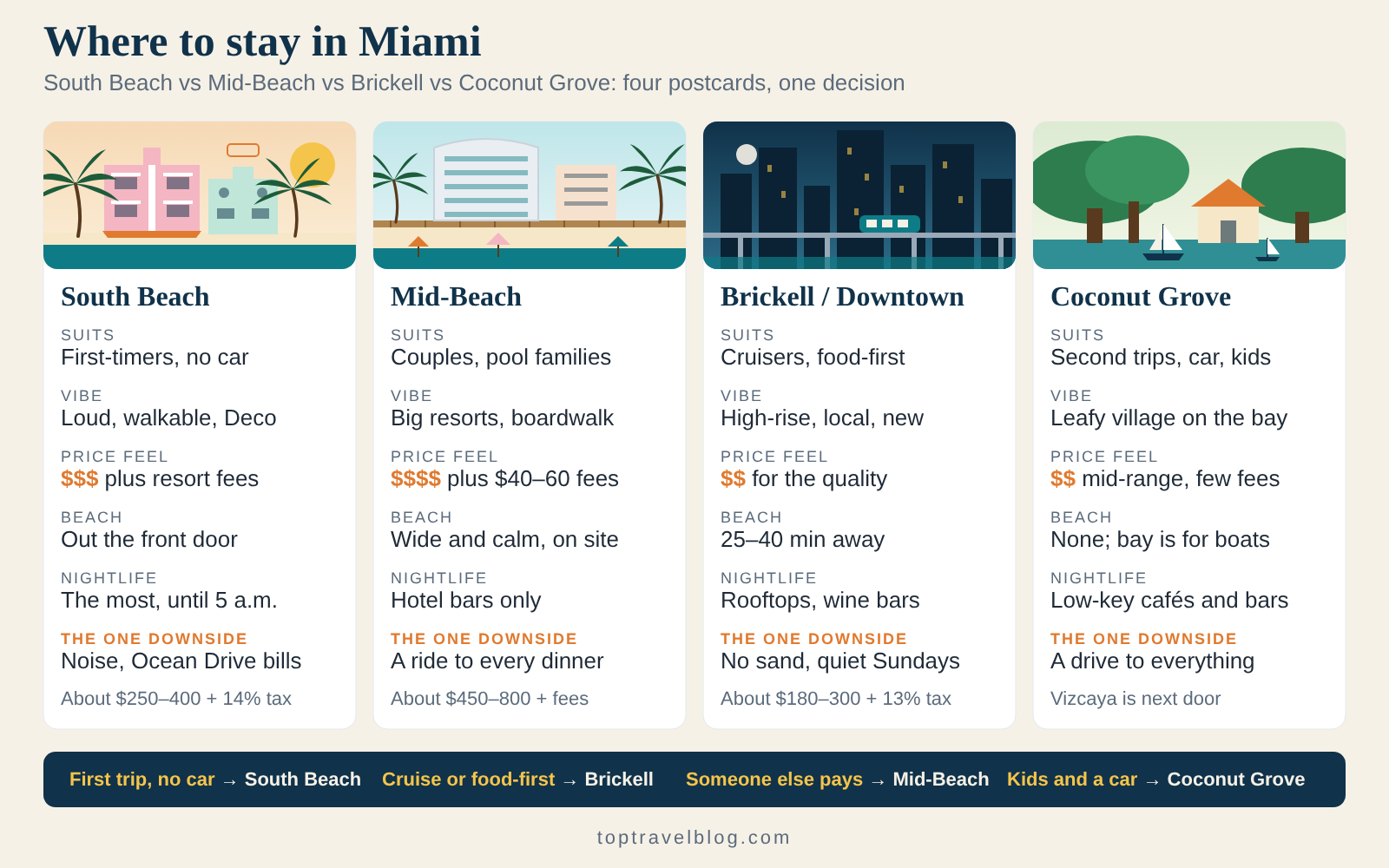
Where to stay in Miami matters more than in most US cities, because the neighborhoods are separated by water and by 20 to 40 minutes of causeway traffic. The decision comes down to one question: do you want to walk to the beach, or do you want to walk to dinner? You can’t easily have both, and the places that promise both (Mid-Beach resorts) charge accordingly. Here’s how I’d think about the four areas that make sense for a 3-day miami itinerary.
South Beach (south of 23rd Street)
Best for: first-timers, friend groups, anyone without a car
You can do Day 1 of the miami itinerary entirely on foot and never think about parking. The Art Deco hotels between 5th and 15th on Collins and Ocean are the real thing, and many have been renovated into decent boutique stays. Downside: noise. A room facing Ocean Drive or Collins on a weekend will not be quiet before 3 a.m. Ask for a courtyard or rear-facing room, or stay on the quieter blocks between Washington and Alton south of 11th Street.
Mid-Beach (roughly 23rd to 63rd Street)
Best for: couples, families who want a pool and a quieter beach
The big mid-century resorts (Fontainebleau, Eden Roc, the Faena strip around 32nd–36th) sit directly on a wider, calmer beach, and the boardwalk runs for miles. Downside: price and resort fees of $40–$60 a night, plus you’re a trolley ride or a $12 Uber from South Beach restaurants. Good if the hotel is the point of the miami itinerary.
Brickell / Downtown
Best for: cruise passengers, business-plus-leisure, people who prioritize food over sand
High-rise hotels, often newer and cheaper than the beach for the same star level, with Metromover at the door and Brightline a short walk away. Little Havana, Wynwood and the port are each 10 to 15 minutes away. Downside: no beach. You’re 25 to 40 minutes from the sand depending on the causeway traffic, and the area empties out a bit on Sunday nights.
Coconut Grove
Best for: repeat visitors, families with a car, anyone who wants shade and trees
Leafy, walkable around CocoWalk and Main Highway, with the bay a few blocks away and Vizcaya practically next door. Hotels are mostly mid-range with a couple of upscale options. Downside: everything on Day 1 and Day 2 of the miami itinerary is a drive or a 25-minute rideshare, and the bay here is for sailboats, not swimming.
South Beach vs Brickell: the actual decision
The south beach vs brickell question is the one I get asked most, so here’s the short version. Stay in South Beach if this is your first miami itinerary, you don’t want a car, and you’d rather pay a bit more for the ability to wander out the door at 7 a.m. and be on Ocean Drive before anyone else.
Stay in Brickell if you’re boarding a cruise, you want a nicer room for the money, you’d rather eat in restaurants locals actually go to, and you’re fine treating the beach as a destination rather than a backdrop.
Price-wise, a decent mid-range room in South Beach in February runs roughly $250–$400 a night before the 14% Miami Beach tax (7% sales tax plus 3% convention tax plus the city’s 4% resort tax) and before any resort fee. Brickell for the same quality is often $180–$300 plus the City of Miami’s 13% combined tax, and resort fees are rarer. Over three nights that gap pays for every Uber across the causeway. In the wet season, both drop by 30–50%.
Coconut Grove is my pick for a second miami itinerary or for anyone with a car and kids. Mid-Beach is my pick if someone else is paying. For comparison, the choice is a bit like the Strip-versus-off-Strip debate in our Las Vegas itinerary: the famous strip is louder and pricier but easier for a first visit, and the alternatives reward people who know what they want.
Worth knowing: Resort fees are the norm on Miami Beach and they’re rarely included in the price you compare online. $35–$60 a night is typical, charged at checkout, often for a pool towel and Wi-Fi you’d have anyway. Hotel parking is a separate $45–$65 a night. Read the fine print before you fall in love with a rate.
The 3-day Miami itinerary, day by day
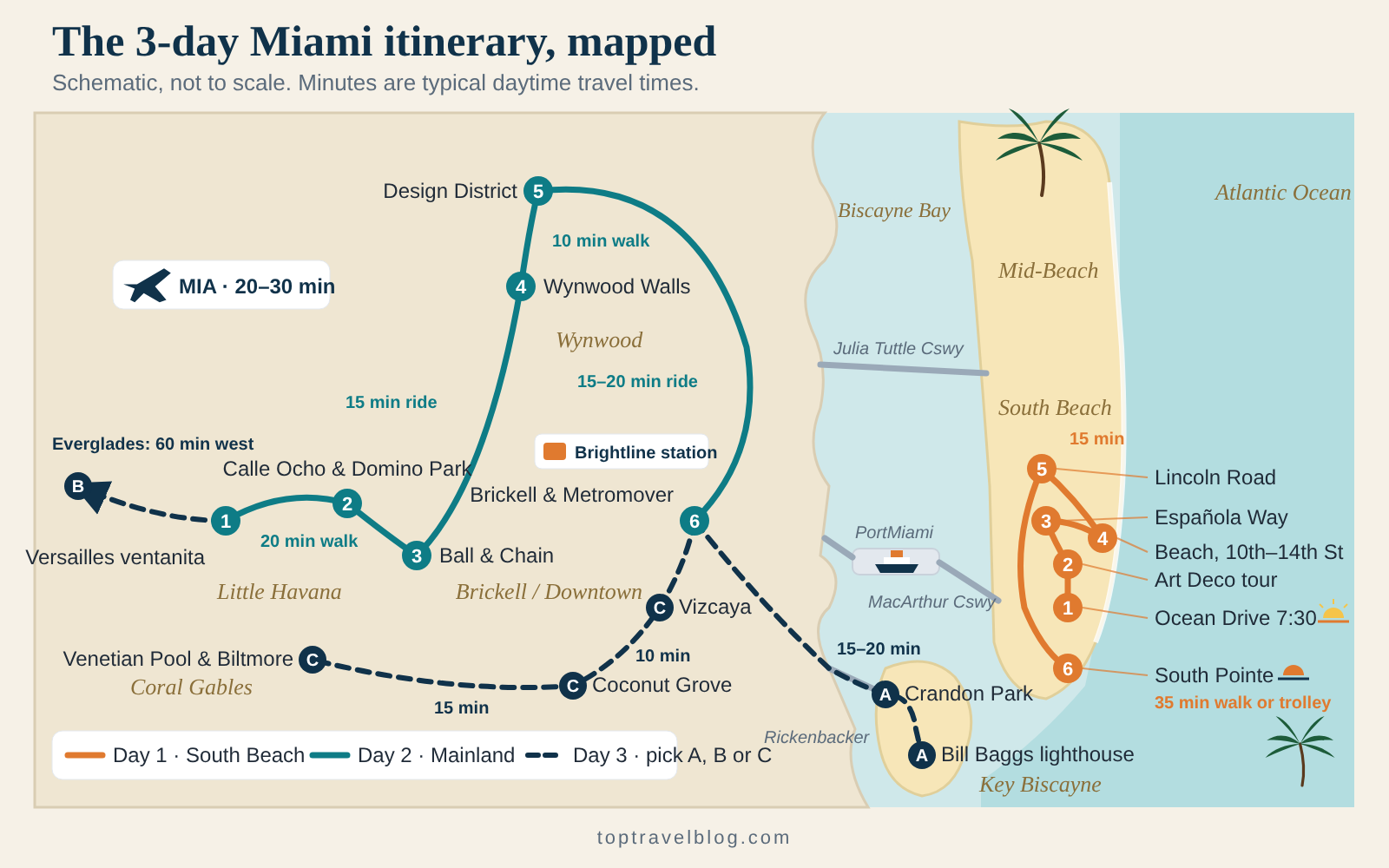
The structure of this miami itinerary is simple: island, mainland, out. Each day starts early because the light is better and the heat isn’t there yet, and each has a swap for rain, for kids, and for the spring break crowd. Travel times below assume normal traffic; add 15 minutes to anything crossing a causeway between 4 and 7 p.m. on a weekday.
Day 1
South Beach: Art Deco, the sand, Lincoln Road and a South Pointe sunset
Morning
Be on Ocean Drive by 7:30 a.m. I mean this literally. Between 7:30 and 9 the street belongs to joggers, delivery trucks and a few photographers, the pastel facades catch low sun from the east, and you can stand in the middle of the sidewalk at the Colony Hotel without someone handing you a menu.
By 11 the same block is a wall of hostesses, cover-band speakers and rented Lamborghinis. Walk north from 5th Street to 15th on the east side of Ocean (the park side), then back south on the west side under the hotel awnings. That’s roughly a mile and 40 minutes if you stop for photos.
Then do it properly with the Miami Design Preservation League’s official Art Deco walking tour, which leaves from the Art Deco Welcome Center at 1001 Ocean Drive. It runs daily, lasts about two hours over 1.5 miles, and currently costs $50 for adults, $40 for seniors and $35 for ages 13–17, with kids 12 and under free; book on mdpl.org.
That price jumped recently and some people balk at it. I still think it’s the best $50 of the miami itinerary, because the guides explain why these buildings look the way they do (eyebrows, porthole windows, the “rule of three”) and after that you see the whole island differently. If $50 feels steep, the Welcome Center sells a self-guided audio version for a fraction of that.
After the tour, cut one block west to Collins Avenue and walk north to Española Way, a two-block pedestrian street of 1920s Mediterranean Revival buildings between 14th and 15th. It’s prettier than it is useful (the restaurants are tourist-priced), so grab a cortadito and a pastelito from a Cuban bakery on Washington Avenue and eat it in the shade there around 11:30.
Afternoon
Beach time is the part of a miami itinerary people under-plan, so be specific about where. The stretch between 10th and 14th Streets, directly east of Lummus Park, has the famous lifeguard towers, public restrooms, and the widest sand in South Beach. It’s also the busiest. If you want the same water with half the people, walk ten minutes north to the 21st–25th Street section, where the boardwalk begins and the hotel crowd thins.
There are no free chairs; beach-club loungers rent for $25–$50 each on peak days, and the vendors are aggressive about it. Bring your own towel and sit on the sand like everyone who lives here.
Plan on two hours in the water and shade, then retreat around 3 p.m. when the sun is at its worst. Walk west on 16th Street to Lincoln Road, the pedestrian mall between Alton and Washington. It’s a shopping street first (the usual national chains plus a few local shops), but the Morris Lapidus architecture, the shaded fountains and the Saturday farmers market make it the best place on the island to kill a hot hour.
The Greater Miami Convention & Visitors Bureau keeps an events calendar; the 1111 Lincoln Road garage at the west end has a free rooftop view.
Evening
Sunset on Day 1 of the miami itinerary is at South Pointe Park, the 17-acre green space at the very southern tip of the island where Government Cut meets the ocean. It’s a 20-minute walk down Ocean Drive from 10th Street, or a five-minute ride. Walk out on the pier, watch the cruise ships leave (most sail between 4 and 6 p.m.), and look back at the skyline across the cut.
The park is free and has restrooms and a splash pad for kids. The sun sets behind Brickell, so it’s a city-silhouette sunset rather than an over-the-water one.
For dinner, the most important advice in this entire miami itinerary: do not eat on Ocean Drive. The restaurants between 7th and 14th are known for $25 cocktails that arrive as 32-ounce towers, menus with unlisted “market” prices, and an automatic gratuity of 18–20% that’s then presented on a receipt with a second blank tip line.
The city now requires that automatic gratuity be disclosed on the menu and the check, but disclosure in 9-point type under a photo of a lobster doesn’t help you much at 10 p.m. If you want the view, have one drink at a hotel bar and ask the price first.
Eat instead on the quieter blocks of South of Fifth (the area below 5th Street), where Joe’s Stone Crab has been doing the same thing since 1913 (stone crab season runs October 15 through May 1; expect a 90-minute wait without a reservation, and Joe’s Take Away next door is the workaround), or on the Alton Road and Sunset Harbour side, where neighborhood places charge neighborhood prices.
A relaxed dinner for two in Sunset Harbour runs $90–$140 with a drink each; the same meal on Ocean Drive can double.
Logistics: everything on Day 1 of this miami itinerary is walkable. Ocean Drive to Lincoln Road is 15 minutes on foot; Lincoln Road to South Pointe is 35 minutes or a free trolley ride on the South Beach Loop (every 20 minutes or so, 8 a.m. to 11 p.m.). Skip the car entirely today.
Swaps: If it rains, move the afternoon to The Wolfsonian–FIU on Washington Avenue (design and propaganda collections, a few blocks from the Welcome Center) and the Bass museum at 21st and Collins.
With kids, trade Lincoln Road for the Miami Beach Botanical Garden and the splash pad at South Pointe, and eat early at the Sunset Harbour places. Spring break crowd: do Ocean Drive at 7 a.m., swim at 21st–25th, and spend the evening in Sunset Harbour or across the bay; the Ocean Drive blocks are closed to traffic and often to sanity on March weekends.
Day 2
Little Havana, Wynwood, the Design District and a Brickell evening
Morning
Day 2 of the miami itinerary starts by crossing the bay early. From South Beach, an Uber to Little Havana is 20–25 minutes and $18–$28 before 9 a.m.; from Brickell it’s a ten-minute ride or a 30-minute walk west along SW 8th Street. Start your little havana walking tour at a ventanita, the walk-up coffee window every Cuban bakery and restaurant has.
The most famous one is at Versailles (3555 SW 8th St), where a cafecito costs around $2 and a colada (a large shot you share among four people in thimble cups) a little more. Order at the window, stand on the sidewalk, and listen to the regulars argue about baseball and politics. That is the attraction.
From Versailles, walk east along Calle Ocho, which is what everyone calls SW 8th Street between roughly 12th and 17th Avenues. In order you’ll pass the Cuban Memorial Boulevard park on 13th Avenue, the Tower Theater (a 1926 Art Deco cinema), and Domino Park (officially Máximo Gómez Park) at 15th Avenue, where older men play dominoes at fixed tables under a mural of the 1994 Summit of the Americas.
Watching is fine and expected; photographing people close up without asking is not. The walk from Versailles to Domino Park is a mile and takes 20 minutes, with a Walk of Fame of Latin stars set in the sidewalk.
Give yourself 45 minutes on this strip: a hand-rolled cigar shop or two (they’ll roll one while you watch), the Azucar ice cream counter at 1503 for a guava-and-cheese scoop, and the galleries around 15th and 16th Avenues. If you’d rather have context than wander, HistoryMiami Museum runs guided Little Havana walks a few times a month for about $30–$40. Otherwise it’s free, and the whole thing takes about two hours.
Afternoon
Ball & Chain (1513 SW 8th St) opens at noon most days and has live music by early afternoon, with no cover before evening. This is the bar that opened in 1935, hosted Billie Holiday and Count Basie, and reopened in 2014 with the pineapple-shaped stage in the back patio restored. Go at 1 or 2 p.m., order a mojito and a plate of croquetas, and watch the salsa dancers who show up on weekday afternoons for the fun of it.
At night it’s a different place: packed, a cover charge, and a line. The afternoon version is the one I’d put in every miami itinerary.
From Little Havana, Wynwood is a 15-minute ride north ($14–$20). The neighborhood is a former warehouse district covered, legally, in murals, and the famous courtyard at its center is Wynwood Walls (2516 NW 2nd Ave). It’s now a ticketed museum: $12 for adults, $10 for seniors 65+, $5 for 13–17, free for 12 and under, per thewynwoodwalls.com.
Some people resent paying to look at street art. I’d pay it once; the curation inside is stronger than the surrounding blocks and there’s shade and a bathroom. Then walk the free murals along NW 2nd Avenue between 20th and 29th Streets, which takes another 45 minutes and is where most of the Instagram photos actually come from.
Wynwood has the best casual lunch of the miami itinerary. The Salty donut shop on 23rd Street has lines on weekends; Zak the Baker a few blocks west is the local kosher bakery everyone sends visitors to; and the food halls around 24th–26th Streets cover everything else.
Budget $15–$25 a head. Then, if you have the energy and any interest in architecture or fashion, the Design District is a 10-minute walk or 5-minute ride north: a luxury shopping district built as an open-air museum, with a Buckminster Fuller dome, a Sou Fujimoto facade, and the free Institute of Contemporary Art (closed Monday and Tuesday). You don’t need to buy anything; the buildings are the point.
Evening
Ride down to Brickell (15–20 minutes, $15–$22) for the evening. The free Metromover loops through Brickell and downtown on a raised track, and riding the Brickell Loop at dusk, with the towers lit up on both sides of the Miami River, is the best free thing in the city.
Get off at Brickell City Centre for dinner options at every price level, or walk two blocks west to the riverfront, where the seafood places along SW 2nd Avenue have been feeding Miamians for decades and a stone crab or grilled fish dinner runs $40–$70 a head.
If you’d rather end the day at the water, Bayfront Park and the Pérez Art Museum Miami sit at the north end of the Metromover loop. PAMM is $18 for adults, $14 for seniors, students and ages 7–18, free for 6 and under, and free for everyone on Thursday after 5 p.m., with the museum open until 9 that night; it’s closed Tuesday and Wednesday, per pamm.org.
The hanging gardens on the bay-facing terrace are the best place in downtown to sit with a drink at sunset, ticket or not.
Logistics: three rideshares on this day of the miami itinerary (roughly $50–$70 total), or do it on transit: Metrorail/Metrobus from Brickell to Little Havana on the 8 bus along SW 8th Street ($2.25), the free Miami trolley’s Little Havana and Wynwood routes, and Metromover for Brickell. Transit roughly doubles the travel time but cuts the day’s transport cost to under $10.
Swaps: If it rains, Little Havana still works in the morning (the ventanitas have awnings), then swap Wynwood’s outdoor murals for PAMM and the Frost Science museum next door.
With kids, go Domino Park, Azucar ice cream, then Frost Science (planetarium and a three-story aquarium) instead of the Design District, and ride Metromover twice because they’ll ask to.
Hurricane season: do Wynwood before noon and Little Havana after the 3 p.m. storm, when Ball & Chain’s covered patio is the right place to be.
Day 3
Choose your day out: Key Biscayne, the Everglades, or the Grove and the Gables
This is the day that separates a good miami itinerary from a forgettable one, and it’s the day most visitors skip. Three honest options follow. I’ll tell you which I’d pick at the end, but the right answer depends on who you’re with and what month it is.
Option A: Miami to Key Biscayne (Bill Baggs lighthouse and Crandon Park)
The miami to key biscayne drive is the easiest day trip in the city: the Rickenbacker Causeway leaves Brickell just south of downtown, crosses two bridges with the skyline behind you, and lands on Key Biscayne in 15–20 minutes.
There’s a toll of about $2.50 collected electronically on the way out; rental cars pass it through with a fee, so expect $5–$8 total on your rental bill. No cash lanes.
Pull off at the top of the first bridge at Hobie Beach for the skyline photo everyone takes, then keep going.
Crandon Park is the first big beach, two miles of calm, shallow, sandbar-protected water on the Atlantic side with picnic shelters and parking that costs roughly $7–$10 per car depending on the day.
It’s the family beach, and the water is noticeably calmer than South Beach. Keep going to the end of the island for Bill Baggs Cape Florida State Park, which charges $8 per vehicle (two to eight people) or $2 per pedestrian or cyclist and opens at 8 a.m. until sundown, per the Florida State Parks site.
The 1825 Cape Florida Lighthouse, the oldest standing structure in Miami-Dade, has free ranger-led tower climbs on limited days and times; they’re sometimes suspended.
The beach at Bill Baggs is the one locals rank above anything on Miami Beach: a mile of sand with no high-rises behind it, a view of the Stiltsville houses standing in the bay, and two casual restaurants (Lighthouse Café and Boater’s Grill) that are fine for fish sandwiches. Rent a bike at the park entrance ($10–$15 an hour) and ride the paved trail along the bay side.
By 1 p.m. on a winter weekend the park hits capacity and closes its gate until cars leave, so arrive by 10. Allow five to six hours for this leg of the miami itinerary, then drive back across the causeway at sunset for the skyline the other way.
Option B: The Everglades (airboat or Shark Valley tram)
The Everglades is the only subtropical wilderness in the country and it starts 40 minutes west of downtown along US-41, the Tamiami Trail. You have two very different ways to fit it into a miami itinerary. The first is an airboat ride at one of the private operators strung along the Trail between Krome Avenue and the Miccosukee reservation (Everglades Safari Park, Coopertown and Gator Park are the long-running ones).
Tours run 30–60 minutes, cost roughly $30–$45 for adults and $20–$30 for kids, and are loud, fast and fun in the way a theme park ride is fun. You will see alligators. You’ll also see a lot of other boats.
The second is Shark Valley, the national park’s entrance at the north edge of the Everglades, about an hour west of Brickell. The two-hour narrated tram ride along the 15-mile loop road costs $36 for adults, $27 for seniors 62+, and $19 for ages 3–12; in winter (late December through April) trams run hourly from 9 to 4 and sell out, so reserve on sharkvalleytramtours.com a week or more ahead.
On top of that is the Everglades National Park entrance fee of $35 per vehicle, good for seven days at any entrance, per the National Park Service. Non-US residents 16 and older now pay an additional $100 per person at the gate, a new national policy that has surprised a lot of international visitors.
At the halfway point of the loop is a 65-foot observation tower with a view across the sawgrass to the horizon in every direction. In the dry season (December through April) the wildlife concentrates around the canal beside the road and you’ll count alligators by the dozen plus anhingas, herons, and the occasional roseate spoonbill.
You can also rent bikes at the visitor center and ride the loop yourself in about two to three hours, which I’d do with teenagers and not with young kids; there’s zero shade. Allow six to seven hours door to door, which makes it the longest day in this miami itinerary. In summer, the mosquitoes make the afternoon genuinely miserable, so this is the winter option.
Option C: Coconut Grove, Vizcaya and Coral Gables (Venetian Pool and the Biltmore)
The third Day 3 option in this miami itinerary stays closest to the city and swaps nature for architecture. Start at Vizcaya Museum and Gardens, the 1916 bayfront estate James Deering built with 34 decorated rooms and ten acres of formal gardens. It’s a 10-minute drive from Brickell or a stop on the Metrorail (Vizcaya station, then a 10-minute walk).
Admission is $25 for adults and $10 for ages 6–12 while parts of the house are under restoration (it was $32 before), kids 5 and under free, open 9:30 to 4:30 and closed Tuesdays, per vizcaya.org. Buy a timed ticket online; weekends sell out and the gardens are far nicer before the 11 a.m. heat.
From Vizcaya, Coconut Grove village is five minutes south. Walk Main Highway and Commodore Plaza, look at the Barnacle (the oldest house in Miami-Dade, in a small state park on the bay, $2 to enter the grounds), and have lunch at any of the sidewalk cafes around CocoWalk.
Then drive 15 minutes west into Coral Gables, George Merrick’s 1920s planned city of Mediterranean Revival mansions and coral-rock entrance gates, to the Venetian Pool: an 820,000-gallon spring-fed public pool built in an old quarry in 1924, complete with waterfalls, grottos, and a sandy area.
Non-resident admission is $23 for adults and $18 for ages 3–12 (kids must be 3 and at least 38 inches), open Tuesday to Sunday 10 to 4:30 and closed Monday, and it stops selling tickets when it hits capacity, so book ahead at coralgables.com.
Finish at the Biltmore Hotel, a block away, whose 1926 tower was modeled on the Giralda in Seville. You can walk into the lobby and around the enormous pool for free, and the Sunday champagne brunch is a Miami institution if you want to spend $100 a head. From here, Miracle Mile (the Gables’ main street) has dinner options at every price, and it’s 20 minutes back to Brickell or 35 to South Beach.
Total day: five to six hours at an unhurried pace, no causeway traffic, and it works in rain, which neither of the other options does.
Which Day 3 would I pick?
Key Biscayne, in almost every case, and especially on a first miami itinerary. It’s cheapest (under $20 in fees for a carload), closest (you’ll be back for a late lunch if you want), has the best beach in the county, and gives you the skyline from the water, which is the image you’ll remember.
Pick the Everglades if you’re visiting between December and April and you’ve never seen a wild alligator; the tram at Shark Valley is a better experience than any airboat, though kids under 8 may prefer the airboat’s noise.
Pick the Grove and Gables if it’s raining, if it’s August, if you’ve already been to Key Biscayne, or if your group would rather look at buildings than lie on sand.
Logistics: all three Day 3 options in this miami itinerary are easier with a rental car for the day (roughly $60–$90 including the airport-free pickup from a neighborhood location). Key Biscayne also works by rideshare ($20–$30 each way from Brickell) plus a bike rental on the island.
Shark Valley has no transit option. Vizcaya is reachable by Metrorail and the Venetian Pool by the free Coral Gables trolley from the Douglas Road Metrorail station, so Option C is the only one you can do entirely without a car.
Swaps: With kids: Crandon Park’s calm water in the morning, the Bill Baggs lighthouse at noon, ice cream in Key Biscayne village after. If it rains: Option C, with Vizcaya’s interiors in the morning and the Venetian Pool once the storm passes (it usually does by 5).
Hurricane season: skip the Everglades entirely from June to October; the heat, the bugs and the afternoon lightning take the pleasure out of it. Spring break: Key Biscayne fills by 11 on March weekends, so go on a weekday or choose the Gables.
Getting around Miami: transit, rideshare, parking and the airport
Miami is a driving city that happens to have a few excellent pockets of transit, and the trick to this miami itinerary is using those pockets and avoiding the rest. The rule I follow: no car on Days 1 and 2, a car (or a few rideshares) on Day 3. Here’s what each option costs and where it actually helps.
Metrorail, Metromover and buses
Metrorail is a single overhead rail line with two branches (Orange to the airport, Green to Palmetto) that runs north–south through the mainland. It will not take you to the beach. It will take you from MIA to downtown and Brickell in about 20 minutes, to Vizcaya and Coconut Grove, and to the Douglas Road station for the Coral Gables trolley.
The fare is $2.25 per ride; a 1-day pass is $5.65 and a 7-day pass $29.25, and if you tap a contactless credit card or phone at the gate the system caps you at $5.65 a day automatically, per the Miami-Dade Transit fare guide. Each rider needs their own card or device.
Metromover is the free, driverless overhead people-mover that loops around downtown and Brickell with 21 stations, roughly 5 a.m. to midnight, every few minutes. It’s genuinely useful for getting between Brickell hotels, Bayfront Park, PAMM, the Brightline station and the Government Center Metrorail hub.
It’s also, as noted, a free skyline tour. Buses cost the same $2.25 as Metrorail; the route 8 along SW 8th Street is the one you’d use for Little Havana.
Metrobus routes 120 (the Beach MAX) and 150 (the Airport Flyer) connect Miami Beach to downtown and to MIA.
The free trolleys
Two separate free trolley systems exist, and people planning a miami itinerary mix them up. The Miami Beach trolley runs four routes on the island (South Beach Loop, Middle Beach Loop, Collins Express, North Beach Loop), 8 a.m. to 11 p.m. daily, roughly every 20 minutes. The City of Miami trolley runs mainland routes including Brickell, Little Havana, Wynwood and Coconut Grove, generally 6:30 a.m. to 11 p.m.
Monday to Saturday and shorter hours Sunday. Both are free, both are slow in traffic, and neither crosses the bay. They’re ideal when you’re already in the neighborhood and want to save a 25-minute walk in 88-degree heat.
Rideshare and taxis
Uber and Lyft are how most visitors move across the causeways on a miami itinerary like this one. Typical daytime fares: MIA to South Beach $28–$45 (Uber’s own route estimate averages $29, but add surge on Friday evenings and during events), South Beach to Little Havana or Wynwood $18–$28, Brickell to Wynwood $12–$18, Brickell to Key Biscayne $20–$30.
Taxis from MIA to Miami Beach charge a flat fare of around $35–$40 to the South Beach zone, which beats a surging Uber. Rideshare pickups at MIA are outside each terminal at designated spots on the arrivals level; follow the signs, and allow ten minutes for the car to reach you.
Driving and parking on Miami Beach
Don’t bring a car onto Miami Beach for Days 1 and 2 of this miami itinerary unless you’ve already paid for hotel parking. Street meters in South Beach charge nonresidents roughly $4 an hour, enforced until 3 a.m. in the entertainment district, and the city has been raising rates each October. Municipal garages charge similar hourly rates with daily caps that run $20–$30, and on big event nights the city switches to flat rates of $30 or more.
Everything is paid through the ParkMobile app; the city runs a $1-an-hour summer promotion through the app from August to October that’s worth knowing about if you’re there then. Current rates are on the Miami Beach parking page, and they change.
Hotel valet or self-parking on the beach is $45–$65 a night, which is why renting a car for your whole stay makes no sense if you’re staying on the island. Rent for Day 3 only, from a neighborhood location rather than the airport, and you’ll save a hundred dollars and several arguments.
From MIA to your hotel, and the Brightline hook
The last logistics question in any miami itinerary is the airport. Miami International is about 20 minutes from Brickell and 30 from South Beach without traffic, 45 or more at rush hour.
Rideshare and taxi are the straightforward options. The cheap option is the MIA Mover (free) from the terminal to the Miami Intermodal Center, then Metrorail’s Orange Line to Brickell or Government Center for $2.25.
For Miami Beach, Metrobus 150 (the Airport Flyer) runs from the same intermodal center to Mid-Beach and South Beach for the same $2.25 fare in about 40 minutes.
Brightline, the private intercity train, doesn’t stop at the airport, but its MiamiCentral station sits downtown directly beside Government Center, one Metrorail stop from Brickell and a straight Orange Line ride from MIA. From there it’s about 35 minutes to Fort Lauderdale (promotional fares from $12–$32, usually $20–$40) and about three and a half hours to Orlando International Airport (fares vary from around $39 on sale to well over $100 close to departure).
For anyone connecting Miami to Orlando or Fort Lauderdale without wanting to drive I-95 or the Turnpike, it’s the civilized choice. Fares and schedules are on gobrightline.com.
If you’re flying into Fort Lauderdale (FLL) because the fare was cheaper, which often happens, a shuttle links the airport to Brightline’s Fort Lauderdale station and the train reaches MiamiCentral in 35 minutes, versus a $70–$100 rideshare to South Beach. Our Los Angeles itinerary faces the same no-car-versus-car question and lands in a very different place, which says something about how walkable Miami’s core neighborhoods actually are.
What 3 days in Miami actually costs
Miami is one of the pricier US cities for visitors, mostly because of the hotels and the add-ons layered onto them. The daily figures below for this miami itinerary are per person, assume two people sharing a room, and exclude flights. Treat them as the shape of the budget, not a quote.
Budget: roughly $130–$180 a day
A hostel bed or a basic room in a non-beach neighborhood ($60–$90 per person per night), transit passes and the free trolleys instead of rideshares, Cuban bakery breakfasts and food-hall lunches at $10–$15, one sit-down dinner at a neighborhood spot for $30–$40, free beaches and free parks, and Day 3 on Key Biscayne by bus and bike.
You’ll pay for one or two tickets (Wynwood Walls at $12, PAMM on free Thursday night). It’s a very doable miami itinerary if you’re disciplined about where you eat.
Mid-range: roughly $280–$400 a day
A three-star South Beach or Brickell hotel at $220–$320 a night before tax and fees (so $140–$200 each including the extras), three or four rideshares a day, the MDPL tour, Vizcaya or the Shark Valley tram, a beach chair once, lunch at $20–$30 and dinner at $60–$90 with drinks, and a one-day rental car for Day 3. This is where the miami itinerary in this article sits, and where most couples end up.
Comfortable: roughly $550–$900+ a day
A Mid-Beach resort or a South of Fifth boutique at $450–$800 a night plus a $50 resort fee and $60 parking, dinner at the big-name restaurants at $150–$250 a head, cabanas rather than chairs, a private Everglades or boat charter instead of the tram. Miami’s ceiling is basically unlimited; this is the floor of the top tier for a comfortable miami itinerary.
The line items that surprise people
Taxes and fees: 14% lodging tax in Miami Beach, 13% in the City of Miami, plus resort fees of $35–$60 and parking of $45–$65, all of which turn a “$250 room” into $380 a night. Tipping: automatic gratuity of 18–20% is standard at Miami Beach restaurants even outside Ocean Drive, so check the bill before you add more.
Beach chairs and umbrellas: $25–$50 per chair in South Beach. The new $100-per-person Everglades surcharge for non-US residents. And the tolls on a rental car, which add administrative fees on top of the toll itself. None of these are reasons not to come. They’re reasons to budget 20% above whatever number you first wrote down.
Reservations and tickets to book before you land
Miami is less reservation-driven than New York or Orlando, but a handful of things sell out or spike in price, and the order below is the order I’d book them in for this miami itinerary.
Six to eight weeks out: the hotel, with a refundable rate, because Miami Beach prices move more than the flights do. If you’re traveling over Art Basel, a holiday weekend, Ultra, or Miami Open tennis (late March on Key Biscayne), book three months out.
Three to four weeks out: Day 3 rental car; Shark Valley tram seats if you’re going December to April; Venetian Pool daily admission, which stops selling at capacity on warm weekends.
One to two weeks out: Vizcaya timed entry (weekends sell out, weekdays usually don’t); the MDPL Art Deco walking tour (small groups, book a specific morning); dinner on Friday or Saturday at any restaurant you’ve read about, because the good ones in Brickell, Wynwood and South of Fifth fill a week ahead.
Don’t bother booking: Wynwood Walls (buy at the door or online that morning), Little Havana (free and unbookable), Bill Baggs and Crandon (first come, first served; just arrive early), PAMM except on free Thursday nights, and the beach itself. Can’t book but should know: the Cape Florida lighthouse tower climbs happen on a limited schedule set by the park, and Joe’s Stone Crab does not take reservations in the main dining room, which is why the line forms at 4:30 p.m.
Worth knowing: Third-party resellers list “skip-the-line” tickets for Wynwood Walls and Vizcaya at a markup. Neither place has a line worth skipping on a weekday morning. Buy from the official sites linked in this article and keep the difference for lunch.
Food and experiences worth planning around
Miami’s food is Cuban at its heart, Caribbean and South American at its edges, and increasingly expensive at its top. You don’t need a list of 30 restaurants. You need five experiences built into your miami itinerary, in roughly this order of priority.
A ventanita cafecito, every morning. The walk-up window is the city’s real café culture, and it’s not limited to Little Havana: there’s one on nearly every mainland block and plenty on Washington Avenue in South Beach.
A cafecito (sweet espresso shot) is about $2, a cortadito (with a splash of steamed milk) slightly more, and a café con leche with a buttered, pressed Cuban toast is a $6 breakfast that beats any hotel buffet. Pay cash if you can and say good morning; it’s that kind of counter.
Stone crab in season. From October 15 to May 1, stone crab claws are the thing to eat, served cold with mustard sauce. Joe’s is the famous name and the one with the 90-minute wait; Joe’s Take Away next door sells the same claws by the pound to eat on a bench in South Pointe Park, which is what I’d do. Expect $40–$70 per person depending on claw size. Out of season, skip it; frozen claws are a shadow of the fresh ones.
A Cuban sandwich done right. Roast pork, ham, Swiss, pickles and mustard on pressed Cuban bread, around $10–$14. The debate about who makes the best one is a sport. Sanguich de Miami on Calle Ocho is the version most locals currently point to, Versailles is the historical answer, and Enriqueta’s in Edgewater is the neighborhood answer. Try two and form your own opinion.
An afternoon at Ball & Chain. Covered above, and listed again here because it’s the single experience people write to say they’re glad they didn’t skip. Weekday afternoon, live son and salsa, no cover, a $14 mojito. Nothing else in Miami gives you that much atmosphere for that little.
One good dinner, booked ahead. Miami’s restaurant scene has gone from an afterthought to a reason to visit in the past decade, concentrated in Brickell, Wynwood, the Design District and South of Fifth. Prices run high ($80–$150 a head for the names you’ve read about), so I’d plan one of these into the miami itinerary and keep the other two dinners casual.
If forced to generalize: the Peruvian and Argentine places are the best value at the top end, and the “Miami Spice” prix-fixe promotion in August and September (three courses for a fixed $35–$60) is the one time of year the expensive rooms are a bargain.
Things I’d skip: the celebrity-chef hotel restaurants on Collins Avenue, anywhere with a hostess on the sidewalk, and the “authentic Cuban” places that have a photo menu and a stage. The authentic ones have a counter, a TV showing baseball, and a cashier who’s been there since 1991.
Common mistakes on a first Miami itinerary
These are the ones I see over and over, from friends and from the questions people send in about their miami itinerary. Most are expensive. All are avoidable.
- Eating on Ocean Drive without reading the bill. The combination of unlisted drink prices, oversized “specials” and an automatic 18–20% gratuity with a second tip line is the most common complaint about Miami, by a wide margin. Ask prices before ordering, photograph the menu, and check the check. If you’ve been double-charged, dispute it with your card company; the city’s consumer protection office also takes complaints.
- Renting a car for the whole trip while staying on Miami Beach. You’ll pay $45–$65 a night to park it at the hotel and $4 an hour anywhere else on the island, and you’ll use it twice. Rent for Day 3 only.
- Never leaving the beach. South Beach is a strip of sand and hotels. Little Havana, Wynwood, Key Biscayne and the Everglades are why Miami is interesting. Give the mainland at least a full day of your 3 days in Miami.
- Starting the day at 10 a.m. In Miami that means arriving everywhere at peak heat and peak crowd. The whole miami itinerary above works because it starts at 7:30 and takes the afternoon slowly.
- Booking a March trip without checking the spring break rules. Ocean Drive closures, midnight curfews, $100 event parking rates and causeway checkpoints are now a yearly feature of March weekends. If you want a quiet trip, avoid the month; if you’re going anyway, stay in Mid-Beach or on the mainland.
- Comparing hotel rates without the tax and resort fee. A 14% tax plus a $50 resort fee plus parking adds 35–50% to the headline rate. Compare the all-in number.
- Taking an airboat tour and calling it the Everglades. The airboats along the Tamiami Trail are fun, but they operate on the edge of the ecosystem, not in the national park. If your miami itinerary has one day out, Shark Valley or Bill Baggs will give you more.
- Underestimating the sun. Miami sits at 25 degrees north. In February the UV index hits 8 by noon. Reef-safe sunscreen, a hat, and water every hour. The people with the worst sunburns on the plane home always say it didn’t feel that hot.
- Leaving anything visible in a parked car. Beach parking lots and the Wynwood side streets see regular break-ins. Trunk everything before you arrive, not in the lot where someone’s watching.
Frequently asked questions about this Miami itinerary
Is 3 days in Miami enough for a first visit?
Yes, if you use them the way this miami itinerary does: one day on Miami Beach, one on the mainland neighborhoods, one day out to Key Biscayne, the Everglades or Coral Gables. You’ll see the Art Deco district, Little Havana, Wynwood and a real beach without rushing. Four days adds a do-nothing beach day, which is the thing most people wish they’d had. Two days means dropping the day trip, and the trip feels noticeably thinner.
Where should I stay in Miami for the first time?
South Beach, south of 15th Street but away from Ocean Drive and Collins, if you want to walk to everything on this miami itinerary and don’t have a car. Brickell if you’d rather have a newer, cheaper room and a better restaurant scene, and you’re fine with a 25-minute ride to the beach. Families with a car do well in Coconut Grove. Mid-Beach resorts are lovely and expensive and work best when the hotel itself is the holiday.
South Beach vs Brickell: which is better for nightlife?
South Beach has the clubs, the hotel bars and the late nights, and Ocean Drive and Washington Avenue are loud until 3 or 5 a.m. Brickell’s nightlife is rooftop bars, wine bars and restaurants that turn into lounges, generally quieter and better dressed, with a big after-work crowd Thursday and Friday. Wynwood sits between the two, with breweries and bars that are busiest Friday and Saturday nights. For a first miami itinerary I’d sleep in Brickell and go out in all three.
How do I get from Miami airport to South Beach cheaply?
Ride the free MIA Mover to the Miami Intermodal Center, then take Metrobus route 150, the Airport Flyer, to Miami Beach for $2.25; it runs about every 30 minutes and takes 40–50 minutes. Rideshares cost $28–$45 and taxis charge a flat $35–$40 to the South Beach zone. If you have more than two people, the taxi flat rate is usually the best deal per person and avoids surge pricing on Friday evenings.
Is the Metromover really free?
Yes. Metromover, the overhead people-mover around downtown and Brickell, has been fare-free for more than two decades and still is. Metrorail and Metrobus cost $2.25 a ride, $5.65 for a day pass, or $5.65 as an automatic daily cap when you tap a contactless card or phone. The Miami Beach trolley and the City of Miami trolley are also free.
How much does parking cost on Miami Beach?
Nonresident street meters in South Beach run roughly $4 an hour and are enforced late into the night, with municipal garages charging similar hourly rates and daily caps around $20–$30. On event nights and spring break weekends the city switches to flat rates of $30–$100. Hotel parking is $45–$65 a night. All of it is paid via the ParkMobile app, and rates rise most Octobers.
What is the Ocean Drive auto-gratuity issue?
Most Ocean Drive restaurants add an automatic service charge of 18–20% to every bill and then print a receipt with an additional tip line, which leads many visitors to tip twice. Some have also been cited for unlisted prices on drinks and specials. The city requires the automatic gratuity be disclosed on menus and checks. Protect yourself by asking prices up front, reading the itemized bill, and declining to add a second tip unless you want to.
Which Day 3 option of the miami itinerary is best with kids?
Key Biscayne. Crandon Park’s water is shallow and calm, the Bill Baggs lighthouse is a short walk with a climb that kids love when it’s running, and you’re back in the city by late afternoon. For kids under 8 who want alligators, an airboat ride is more exciting than the Shark Valley tram. The Venetian Pool is a strong rainy-day option for kids over 3 who meet the 38-inch height minimum.
Can I do this Miami itinerary without a car?
Days 1 and 2 are easier without one. Day 3 depends on the option: Key Biscayne works by rideshare plus bike rental, and the Coconut Grove and Coral Gables day works by Metrorail and the free Gables trolley. Only the Everglades really requires a car, since neither airboat operators nor Shark Valley have transit access. Renting for that one day from a neighborhood location costs $60–$90 and is the cheapest way to keep the whole trip car-free otherwise.
What is hurricane season in Miami and should I avoid it?
June 1 through November 30, with the highest risk from mid-August to early October. Hotel prices are at their lowest then and most days are fine, with an afternoon thunderstorm that passes in an hour. The risk is a named storm forcing a cancellation. If your miami itinerary falls then, book refundable rates, consider insurance that covers named storms, and move the outdoor days to whichever mornings have the best forecast.
Is Little Havana worth visiting, and how long do I need?
Yes, and two to three hours of your miami itinerary is right: a cafecito at a ventanita, the walk along Calle Ocho from Versailles to Domino Park, a cigar roller, Azucar ice cream, and an afternoon set at Ball & Chain. It’s a working neighborhood, not a theme park, so some blocks are just blocks. Go on a weekday morning for the authentic version or on the last Friday of the month for the Viernes Culturales street festival.
One last thing before you go
The trip I’d do differently is my first one. I stayed on Collins Avenue, rented a car at the airport, parked it for $50 a night, ate two dinners on Ocean Drive, and left thinking Miami was a loud, expensive beach.
It took a second visit, staying in Brickell with a friend who lived there, to find the ventanitas, the Metromover at dusk, the afternoon dancers at Ball & Chain, and the beach at Bill Baggs with the Stiltsville houses standing out in the bay. That second trip is the one this miami itinerary is built from.
So if you take one thing from this miami itinerary: give the mainland its day, and give Day 3 to the water or the sawgrass rather than another afternoon on a rented lounger. Get up early, let the afternoon go slow, read every bill, and leave the car at the rental counter until the morning you actually need it.
And order the colada. Four little cups, one sidewalk, and a conversation with a stranger about whether the Marlins will ever be good again. That’s the Miami most visitors fly home without seeing, and it costs about three dollars.
Related planning guides
- Orlando vacation guide — theme parks, where to stay and how many days you need, three and a half hours up the Brightline line.
- New York City itinerary — the best 4 days for first-time visitors, and the natural northern bookend to an East Coast trip.
- Las Vegas itinerary — 3 days on and off the Strip, with the same stay-on-it-or-not decision Miami Beach poses.
- Los Angeles itinerary — 4 days of beaches, neighborhoods and iconic sights, for the other coast’s version of this trip.