
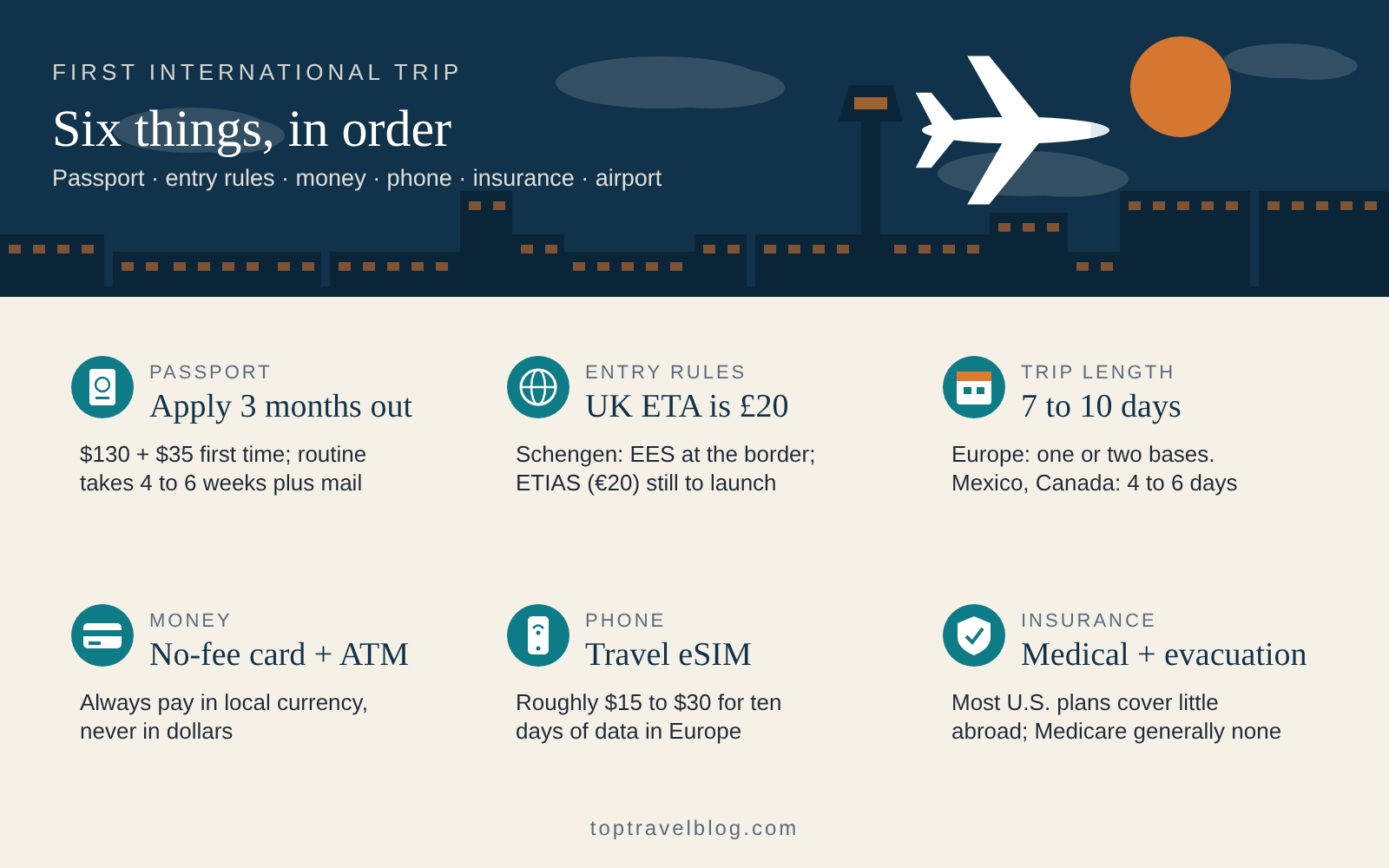
The honest answer to “how do I plan a first international trip?” is that it is the same job as any other trip, with six extra tasks stacked in front of it: a passport, entry rules, a way to pay, a working phone, insurance that actually applies abroad, and a plan for the airport on both ends.
Do those six in the right order and the rest is just choosing somewhere you will enjoy.
Skip them, or leave them to the last week, and a first international trip gets expensive and stressful for reasons that have nothing to do with the place.
I have taken a lot of people on their first trip abroad, and I have been the confused one at a foreign border myself. This guide is the order I would walk you through it over coffee: pick the destination, set the length, get the passport, sort out the entry rules, handle money and your phone, book the flights and rooms, buy the insurance, pack, and get through the airport at both ends.
Along the way I will give you the current fees and rules as of November 2026, plus the mistakes I see new travelers make again and again.
Quick facts: your first international trip at a glance
- Start with: a passport. First-time adult applicants pay $130 plus a $35 acceptance fee, and routine processing takes 4 to 6 weeks plus mailing, so apply at least three months out.
- Best first destinations: Canada, Mexico, the UK and Ireland, or one country in Western Europe. Short flights, easy transit and English or tourist-friendly infrastructure.
- Ideal length: 7 to 10 days for Europe, 4 to 6 days for Mexico or Canada. One base or two, not five.
- Entry rules now: the UK charges a £20 ETA; the Schengen area runs the Entry/Exit System with fingerprints and a photo; the EU’s €20 ETIAS has been scheduled but not yet launched.
- Money: a debit card for ATMs, a credit card with no foreign transaction fee, and a little local cash. Always pay in local currency.
- Key caveats: your U.S. health plan probably will not cover you abroad, your phone can run up a bill in minutes, and the cheapest flight is often the most expensive trip.
How to choose a destination for your first international trip
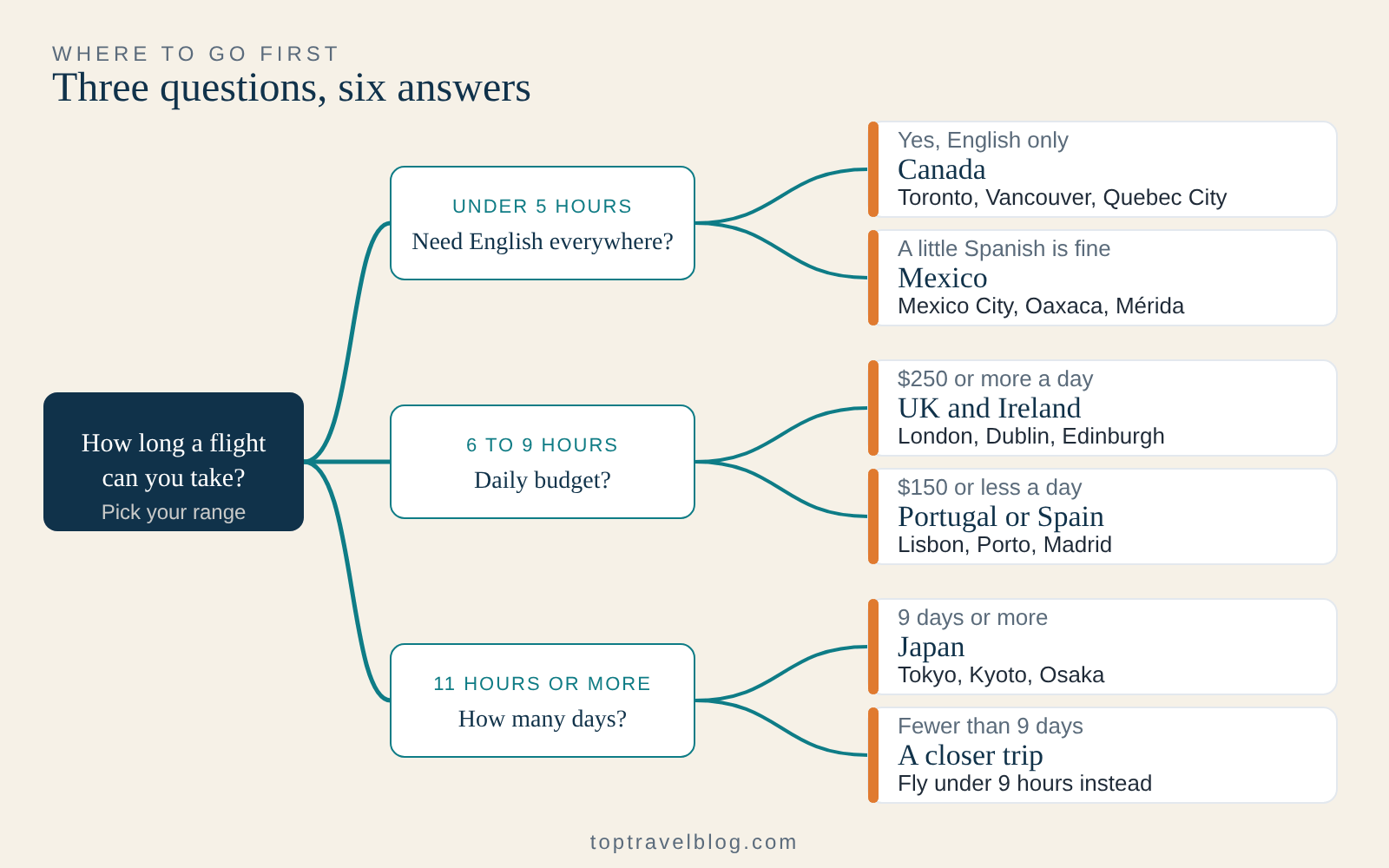
Most advice on this question is a list of famous cities. That is not very helpful, because the right place depends on four things about you, not on what is famous. Before you look at a single photo, answer these honestly: how long a flight you can stand, how much unfamiliarity you want, what you can spend, and how many days you really have.
The flow chart below turns those four answers into two or three realistic places.
Flight time decides more than you think
A first international trip should not begin with a 14-hour flight and a 12-hour time difference unless you are very sure of yourself. Jet lag is real, it eats the first two or three days, and when everything around you is new it is harder to shake. A flight of up to eight hours, with a time shift of six hours or less, is a gentle introduction.
From the East Coast that means Ireland, the UK, Iceland, Portugal, Spain, France and Italy. From the West Coast it points toward Mexico, Canada and the Caribbean, or toward a longer flight to Europe or Japan with a plan to rest on arrival.
The easiest countries to start with
These are the places I steer first-timers toward, roughly in order of how forgiving they are.
Canada
Best for: shortest hop, no language gap, a real passport stamp
Vancouver, Toronto, Montreal and Quebec City feel foreign enough to count (Quebec City especially) while the signage, the tipping and the hotels behave the way you expect. U.S. citizens need a passport to fly in, and no visa or electronic authorization.
Prices in Canadian dollars look lower than they are. Budget in U.S. dollars at the real exchange rate and you will not be surprised.
Mexico
Best for: warm weather, short flights, good value
Mexico City, Oaxaca, Mérida and the Caribbean coast are all a few hours from most U.S. airports. U.S. citizens need a valid passport book to fly in. The practical hurdles are Spanish outside the resort zones and being careful with how you move around at night, which I cover in the on-the-ground section.
Resorts are the easy version; Mexico City is the rewarding one and is perfectly manageable with a little reading.
The UK and Ireland
Best for: language comfort, great rail and walking, first time in Europe
London, Edinburgh, Dublin and the west of Ireland let you practice traveling abroad without a language barrier. Direct flights run from many U.S. cities in 6 to 8 hours. The UK now requires a £20 electronic travel authorization, which I explain below; Ireland has no such requirement for U.S. citizens.
Both are expensive. Plan on pubs and walking, not on bargains.
One country in Western Europe
Best for: culture, trains, and a first big trip
Italy, France, Spain and Portugal reward ten days in one or two cities, with fast trains between them. Spain and Portugal are the most affordable of the four.
This is also where the new border systems apply, so read the entry section before you book. Pick one country; the temptation to add a second is the most common first-timer error.
Japan
Best for: confident planners, safety-conscious travelers, food
Japan is easier than most people fear: signs carry English and rail passengers get clear announcements. It is a long flight (11 to 14 hours from the West Coast and more from the East) with a 13 to 17 hour time difference. U.S. citizens can stay up to 90 days without a visa for tourism.
I would send a first-timer here only with at least nine days and a firm plan for the first two days of jet lag.
Places I would save for your second or third trip
None of these are wrong choices, but each adds friction that will color a first experience. Destinations that require advance visas, or that sit under State Department advisories at Level 3 or Level 4, deserve more preparation than a beginner usually has the patience for. Long overland routes through several countries are the same story.
Safaris, trekking in the Himalayas and Southeast Asia on a three-week loop are all wonderful. They are easier with one round of experience behind you.
Rule of thumb: For a first international trip, pick a destination where you can read the signs, buy a train ticket without help, and find an English-speaking doctor. You can go somewhere harder next time with a lot more confidence.
Check the State Department advisory before you commit
Every country has a travel advisory from the State Department, rated from Level 1 (exercise normal precautions) to Level 4 (do not travel). The ratings and the reasons behind them are on travel.state.gov. I would not call any country “safe” or “dangerous” on a single number. Read the paragraph, because it usually points to specific regions or situations, and that is far more useful than the headline.
The same site hosts the free Smart Traveler Enrollment Program, which I mention again near the end.
How long should a first international trip be?
Seven to ten days is the sweet spot for a first international trip to Europe, and four to six days is plenty for Canada or Mexico. Here is the reasoning, because I want you to be able to adjust it for your own life rather than copy a number.
The first and last days of any trip abroad are mostly lost to flights and jet lag. On a transatlantic trip, you land in the morning, you are not really functioning until the afternoon, and you leave early on the final day. So a “nine-day” trip has about seven useful days.
The general framework for choosing length is in my guide to how many days you need for a vacation trip, and a few specifics apply to a first international trip.
- Under five days: only for Canada, Mexico or the Caribbean. Anything with a time difference of six hours or more will feel like a blur.
- Seven days: the minimum I recommend for Europe. One country, one or two bases, and an unhurried feel.
- Ten days: the best length for a first international trip to Europe. Two bases, one rest day, and time for the thing that goes wrong.
- Two weeks: fine, and gives you the room for a third base, but be sure you want that much unfamiliarity. If you do, the 2-week trip planning guide lays out the pacing.
One base or two
New travelers almost always plan too many stops. Every move between cities costs half a day, once you count packing, checkout, the station, the ride, the arrival and the bag drop. Two bases in ten days is comfortable. Three is a trip of its own. Five is a race.
If you are tempted, my guide on how to plan a multi-city trip shows how to count the real cost of each move before you commit.
A base can also be a hub with day trips. Staying in London and going to Bath or Oxford by train, or staying in Rome and visiting Orvieto, gives you variety with one hotel and one unpacking.
Pick the season with the trip in mind
Shoulder seasons, April to early June and September to October in most of Europe, give you the best mix of weather, thinner crowds and lower prices. July and August are hot and expensive across southern Europe, and December has its own magic along with short days. For a first international trip I weigh comfort over savings: a gray, drizzly week in February is cheaper, and it is also a harder introduction.
Step 1: The passport, the one document you cannot improvise
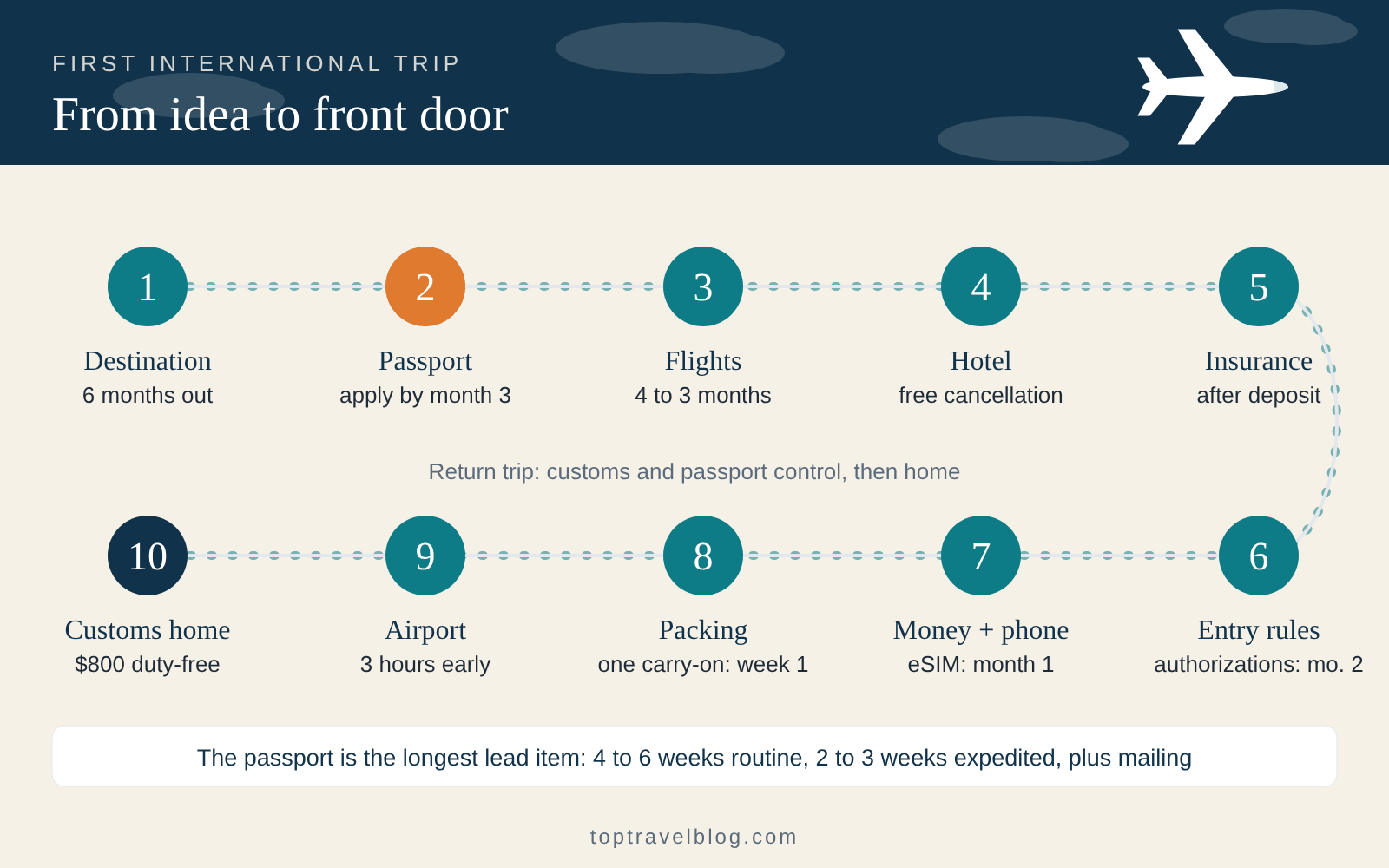
Here is the shape of the whole journey before we go step by step, with the months before departure marked on the path.
Step 1
Apply for your passport before you book anything
If you do not have a passport, every other part of a first international trip waits. Do not book flights first. Apply first, because the booking is refundable only on the airline’s terms, while a passport delay is not under your control.
As of November 2026, the State Department lists a first-time adult passport book at $130, plus a $35 acceptance fee paid to the facility where you apply, so $165 in total. A passport card is $30 (plus the same $35) and works only at land and sea crossings with Canada, Mexico, Bermuda and the Caribbean, never for flights.
Fees and timing in one place
- Adult book, first time: $130 plus the $35 execution fee. You must apply in person at an acceptance facility, often a post office or county clerk office. Appointments book up, so make one early.
- Renewal: $130 for a book if your last passport was issued when you were 16 or older and is less than 15 years old, and you can renew by mail or online.
- Children under 16: $100 plus $35, in person, with both parents or documented consent. A child’s passport lasts five years, an adult’s ten.
- Routine processing: the State Department publishes 4 to 6 weeks, not counting mailing time that can add up to about two weeks.
- Expedited: an extra $60, with a published 2 to 3 weeks plus mailing. One- or two-day return delivery costs another $22.05.
The full details, including photo rules and the online renewal portal, are on the State Department’s passport page.
My timing rule: apply three months out
Three months is not a recommendation I make lightly. Processing times swing with the season, and spring is the slowest because everyone books summer travel at the same moment. If you apply three months out, even a bad month leaves you a cushion. If you are already inside six weeks, pay for expedited service and book an appointment now.
The six-month rule: Many countries require your passport to be valid for at least six months after the day you arrive or leave. The Schengen area asks for three months beyond your departure date, and also requires that the passport was issued within the past ten years. If your passport expires within a year of your trip, renew it before you book. Airlines enforce this at check-in and they will not let you board.
Passport photos and small details
Do not wear glasses in the photo, because they are not allowed. Do not smile broadly. Most drugstore photo counters know the 2-by-2 inch format, and the State Department’s photo rules are strict enough that a rejected photo is the most common cause of delays I hear about.
Sign the passport only when you receive it, then photograph the information page and email the photo to yourself. If you lose the book abroad, a copy makes the replacement at the embassy faster.
Name matching, a quiet source of trouble
The name on your flight ticket must match your passport exactly. Not your nickname, not your married name if the passport still shows your maiden name. If the two differ, call the airline before travel. A small difference such as a missing middle name is usually fine. A different surname is not.
Entry rules for a first international trip: visas, the UK ETA, EES and ETIAS
Having a passport is not the same as being allowed in, and on a first international trip the entry rules are the part people miss. For most popular first trips, U.S. citizens do not need a traditional visa for a tourist stay, but there are now three newer systems that can trip up first-timers: the UK’s electronic travel authorization, Europe’s Entry/Exit System, and Europe’s still-unlaunched ETIAS.
I will state what each one is as of November 2026. This is the part of travel planning that changes most often, so I name the official source for each rule as we go.
The UK: a £20 electronic travel authorization
The UK now requires visitors from visa-exempt countries, including the United States, to hold an Electronic Travel Authorisation. The government page says it costs £20, lasts two years or until your passport expires, and allows multiple trips. A decision usually arrives by email within a day and can take up to three working days.
You apply on the official gov.uk ETA page or in the official app. The phrase to remember is that the government site is the only place to apply. Lookalike sites charge extra and offer nothing in return.
Scam alert: Search results for “UK ETA” and “ETIAS” are crowded with private sites that look official and add their own fees on top. If a URL does not end in gov.uk or europa.eu, you are paying a middleman. A UK ETA is applied for at gov.uk, and an ETIAS will be applied for on the EU’s official travel site.
The Schengen area: the 90-day rule and the Entry/Exit System
The Schengen area covers most of the EU, including France, Italy, Spain, Portugal, Germany, Greece and the Netherlands. U.S. citizens can visit for up to 90 days in any 180-day period without a visa. Ireland and the UK are not in Schengen, so their days do not count toward the 90.
Since 12 October 2025 the EU has been rolling out its Entry/Exit System, and it reached full operation at all Schengen borders in April 2026. When you arrive for the first time, border staff record your passport details, a photo of your face and fingerprints. After that, the system tracks your entry and exit dates automatically. There is nothing to apply for in advance, and nothing to pay.
For a first international trip, the practical consequence is time. At busy airports in 2026 the registration step has added queues, and the European Commission has acknowledged the system “is not perfect.” I tell first-timers to expect a longer border wait on arrival and to avoid booking a tight onward connection in the same airport.
ETIAS: scheduled, not yet running
ETIAS is the EU’s travel authorization for visa-free visitors, similar in concept to the UK ETA. It will cost €20, last three years or until the passport expires, and be linked to your passport. Travelers under 18 and over 70 do not pay but must still apply.
The official ETIAS timeline said operations would begin in the last quarter of 2026, and press reports in July 2026 suggested that launch will slip into 2027. Once it does start, the EU has said there will be a transition period of at least six months in which travelers without an authorization will not be refused entry, provided they meet the other conditions.
If your trip is in 2027, treat ETIAS as a thing that may be required by the time you travel. The EU’s official travel-europe.europa.eu site publishes the start date and will host the application, which takes minutes to complete.
Canada and Mexico
Both countries let U.S. citizens enter for tourism without a visa. By air you need a passport book. By land or sea a passport card is accepted for entry back into the United States, which is why a $30 card is useful if you live near a border.
Mexico issues a visitor permit electronically or at the airport, and allows stays of up to 180 days for tourism, though the officer decides the number of days. Keep the permit receipt, because airlines sometimes ask for it on departure.
Japan and other countries
Japan lets U.S. citizens stay up to 90 days visa-free for tourism. Rules for other countries vary widely, which is why I send beginners to the State Department’s country pages, which list entry and exit requirements, passport validity rules, and local laws for every destination. The country information pages are the official source, and I read the “Entry, Exit and Visa Requirements” section for every trip.
Trusted traveler programs: worth it on a first international trip?
TSA PreCheck costs $78 for the standard five-year enrollment through the main provider, and it speeds the security line for domestic and many international departures. Global Entry costs $120 for five years and includes PreCheck. Its real benefit is the kiosk on the way back into the U.S., which skips the long line at passport control.
If you expect to travel abroad more than twice in five years, Global Entry pays for itself. For a single first trip, I would skip both and use that money for the first night’s dinner. Details are at TSA’s PreCheck page and on the CBP Global Entry page.
Enrollment tip: Global Entry requires an interview, and some enrollment centers book out months in advance. If you want it for a trip in 2027, apply now. The other route is Enrollment on Arrival, which lets you finish the interview at a participating airport on your way back into the U.S.
Step 2: Money abroad without the fees, the fear or the bad exchange rates
Step 2
Set up cards, cash and a daily budget
Money is where people on a first international trip lose the most without noticing. Not on big things, but on a stream of small ones: a 3 percent foreign transaction fee here, a bad airport exchange rate there, a “convert to dollars?” prompt that costs another 5 to 10 percent. Each one is avoidable, and a first international trip is the right moment to set it up properly.
Which cards to bring
Bring two credit cards on different networks (one Visa, one Mastercard is ideal) and one debit card from a bank that reimburses ATM fees or charges none. Pack them in different places. If one is lost or frozen, you keep going.
The credit card you use abroad should have no foreign transaction fee. Many travel cards advertise this, and the fee on ordinary cards is typically around 3 percent of every purchase. On a $4,000 trip, that is $120 for nothing.
American Express is accepted less widely than Visa and Mastercard outside the U.S., so treat it as a backup.
Contactless payment, by card or by phone wallet, is standard across Europe, the UK and much of Asia. In the UK and the Netherlands, you can sometimes go a week without touching cash.
Always pay in local currency
This is the single most useful money habit. When a card machine or ATM asks whether to charge you in dollars or in the local currency, choose the local currency every time. The dollar option is called dynamic currency conversion, and the rate behind it is set by the merchant’s bank, not yours. It is rarely in your favor.
The same goes for ATMs. If the machine offers to “guarantee” the exchange rate, decline it and accept your own bank’s rate.
Cash for a first international trip: how much, and where to get it
Take out cash from a bank-affiliated ATM once you arrive, not from currency kiosks in the arrivals hall. Withdraw enough for a few days, not the whole trip. A reasonable first withdrawal in Europe is the local equivalent of $100 to $150, which covers a taxi, a market lunch and small tips.
Some travelers carry a small envelope of dollars as a last resort. I do this too, but only about $100, because few places outside tourist zones will take it.
Do not exchange currency at home before you leave unless you are afraid of the arrival. The rates at U.S. airport counters and mall kiosks are among the worst you will find anywhere.
Tell your bank: Most banks no longer require a travel notice, but set up the mobile app with alerts and make sure you know the number for reporting a lost card from abroad. A card blocked for a “suspicious” first purchase in Lisbon is a common story, and the fix is a quick call or tap in the app.
What a first international trip actually costs
Costs depend more on where you go than on how you travel. These are rough ranges for one person, excluding flights, for a comfortable but not luxurious pace in 2027. They are my own estimates from years of trips, not quotes, and prices differ by city and season.
- Budget: roughly $90 to $150 a day in Spain, Portugal or Mexico City. Hostel or small hotel, markets and casual lunches, public transport, two paid sights.
- Mid-range: roughly $200 to $320 a day in Italy, France or Germany, and a little more in London or Dublin. A good three-star hotel (shared between two people), a sit-down dinner and one museum or tour a day.
- Comfortable: roughly $400 and up a day anywhere in Western Europe. Four-star hotels, taxis when you feel like it, and the dinners you remember.
Flights are the other half. A round trip from the East Coast to Western Europe in shoulder season often lands somewhere between $600 and $1,200 in economy, and more from the West Coast or in summer. Mexico and Canada are often a few hundred dollars. Hotels are covered further down.
Daily budget trap: The number that surprises new travelers is the “small stuff”: tickets for trains and metros, coffee, a cover charge, a museum reservation fee, a tip. Add 15 percent to whatever your spreadsheet says and you will usually land close.
A note on tipping
Tipping customs vary, and getting them wrong in either direction is a minor embarrassment, not a disaster. In most of Europe a service charge is already included or a small round-up is customary. In Japan, tipping is not practiced and can cause confusion. In Mexico, 10 to 15 percent in restaurants is normal. In Canada, follow U.S. norms.
Step 3: Your phone, data and the bill that arrives a month later
Step 3
Decide how you will get data before you land
Few things ruin the first day of a first international trip like a lost phone signal in an unfamiliar station. Data is also the tool that makes everything else easier: maps, translation, ride apps, tickets, your hotel’s check-in code.
You have three practical choices, and I have used all of them.
Your carrier’s plan for a first international trip
Most U.S. carriers offer an international day pass or a monthly plan that lets you use your regular number and data. It is the simplest option, since nothing changes. The cost is the catch: day passes are often around $10 a day, which becomes $100 over ten days. Some premium plans include free roaming in Mexico, Canada and parts of Europe, so look at what yours already offers before paying for anything.
An eSIM, which is what I use
An eSIM is a digital SIM you install from an app or QR code, with no plastic card. Prepaid travel eSIMs from providers such as Airalo, Holafly and Nomad typically cost a few dollars for a few gigabytes in Europe, so a ten-day trip might run $15 to $30. You keep your regular number for texts, usually on a second line.
You need a recent phone that supports eSIM and is unlocked by your carrier. Install the eSIM at home, on Wi-Fi, and activate it when you land. If the phone is not unlocked, the carrier can usually do it for you before the trip.
A local SIM
Buying a local SIM at the airport or a shop works well and is often the cheapest option for longer stays. It needs an unlocked phone, a few minutes at a counter and sometimes your passport. For one trip of ten days, an eSIM is easier.
What to do before you leave
Download offline maps for each city in Google Maps or Apple Maps, so the route to your hotel works with no signal. Install the transit and ride apps you will need, and download the translation language pack. Take a screenshot of your hotel’s address in the local script and of your booking confirmation.
Turn off background data roaming unless you have a plan that covers it. Put the phone in airplane mode and connect to hotel Wi-Fi if you are not sure. Disable automatic photo backup over mobile data.
Battery habit: A portable battery that holds two or three full charges changes the whole day. Foreign travel is more phone-hungry than home travel, because you are navigating, translating and photographing at once. Keep the battery in your carry-on, never the checked bag, as airline rules require.
Plugs and voltage
The United States uses 120 volts and Type A and B plugs. Continental Europe uses 230 volts and the round two-pin Types C and F; the UK and Ireland use the large three-pin Type G; Japan uses 100 volts and the same flat plugs as the U.S. Most phone and laptop chargers accept 100 to 240 volts, so you usually need only a plug adapter, not a converter. Hair dryers and curling irons often do not, which is why I leave them at home and use the hotel’s.
Step 4: Health and travel insurance that works outside the U.S.
Step 4
Find out what your health plan really covers
This is the part of preparing for a first international trip that people skip, because it is dull and because nothing seems likely to go wrong. In most trips nothing does. When something does, the difference between having coverage and not having it can be a medical bill in the thousands, or tens of thousands.
Your U.S. health plan
Call your insurer and ask three plain questions: does my plan cover emergency care outside the United States, will I have to pay upfront and claim later, and does it cover medical evacuation. Many private plans cover emergencies abroad at a reduced level, and most require you to pay first.
Medicare generally does not cover care outside the United States, as Medicare.gov explains. If you are on Medicare, buy separate travel medical insurance for any trip abroad.
What travel insurance covers, in plain terms
A travel insurance policy bundles several protections, and the right mix depends on the trip.
- Emergency medical: pays for treatment abroad. This is the most important piece for any first international trip, and a limit of at least $100,000 is reasonable for Europe.
- Medical evacuation: pays for transport to a better-equipped hospital or home. Look for a limit of $250,000 or more.
- Trip cancellation and interruption: reimburses non-refundable costs if you cancel for a covered reason such as illness. Read the covered reasons closely, because “change of mind” is almost never included.
- Baggage delay and loss: small payouts, but useful for essentials when a bag arrives two days late.
Cancel-for-any-reason coverage is an upgrade that returns a portion, typically 50 to 75 percent, of your costs for any reason. It must be bought within a short window after your first trip payment and costs significantly more.
How I decide whether to buy it
For a short, inexpensive trip to Canada with a health plan that works there, I often skip it. For anything in Europe, a trip with large prepaid costs, or a traveler with a medical condition, I buy it. A standard policy often costs roughly 4 to 8 percent of the trip cost.
Buy it within a couple of weeks of your first deposit if you want the benefits tied to that timing. Compare plans on an independent comparison site, then read the policy document, not the marketing page.
Credit-card coverage: Many travel credit cards include trip delay or cancellation coverage, but it is often secondary, limited, and applies only if you paid for the trip with that exact card. Read your card’s benefit guide to see whether it includes medical coverage abroad. In most cases it does not.
Medications and health preparation
On any first international trip, carry prescription medicines in their original labeled containers in your carry-on. Bring a printed list of generic names, because brand names differ abroad. Some common medications, including certain ADHD and pain medications, are controlled or banned in some countries, so read the destination’s rules on its government or embassy site before you pack them.
The CDC’s travelers’ health pages list vaccine recommendations by destination. For most first trips to Europe, nothing beyond routine vaccines is recommended. A visit to a travel clinic six to eight weeks before departure is sensible for anywhere farther afield.
Step 5: Booking flights and hotels for a first international trip
Step 5
Book the flight, then the base
Booking order matters more than people expect. The sequence I use is: passport in hand or on its way, dates fixed, flights next, hotels immediately after, and everything else (trains, tours, restaurants) once the first two are locked.
Flights: what to look for beyond the price
My long guide on how to find cheap flights covers the search method. For a first international trip I add a few rules of my own.
- Prefer a nonstop or one short connection. A single connection in the U.S. or at the destination hub is manageable. A connection in a big European airport under about 90 minutes is not, especially in 2026, when border registration at some airports has slowed things down.
- Book one ticket, not two. If your first flight is late and the second is on a separate booking, the airline owes you nothing. A single itinerary protects the connection.
- Arrive in the morning if you can. A flight that lands at 8 a.m. gives you a full day to walk in daylight and stay awake until local bedtime.
- Skip basic economy for a first time abroad. The fare is cheaper, but you often cannot choose a seat, bags cost extra each way, and changes are punishing. The difference adds up fast.
- Pay with a credit card. If an airline cancels or changes your flight, a card gives you stronger recourse than a debit card.
Fares for 2027 are usually cheapest roughly two to five months before a transatlantic trip, though there is no universal rule. Booking much earlier rarely saves more, and booking inside six weeks usually costs more.
Open-jaw and stopover tricks, for later
Flying into one city and out of another saves a day of backtracking on a two-base trip, which is what open-jaw flights are for. A long connection in Reykjavik or Lisbon can turn into a two-day visit through a stopover rather than a layover. Both are excellent ideas that I would still hold back on a first international trip, because they add booking complexity and a second place to manage.
Choosing where to sleep on a first international trip
The principles in my guide to how to choose a hotel hold up abroad, with a few changes I learned the hard way.
Location beats size. A small room within a ten-minute walk of a metro station is better than a large room in the suburbs, because on a short trip you pay for the commute with the only thing you cannot buy back: daylight.
In Europe, rooms are smaller than in the U.S., air conditioning is not guaranteed in older buildings, and a “double” can mean one bed or two. Elevators can be tiny or absent, so a fourth-floor walk-up with two big suitcases is something to think about when you book.
Read recent reviews for noise, heat and the walk from the station. Look at the street on a map. Look at the total price including city tax, which many European cities charge per person per night and collect at the hotel.
Hotel, apartment or something in between
For a first international trip I recommend a hotel with a front desk, ideally one where staff speak English. A person who can call a taxi, hold your bag and explain the metro is worth the premium. Apartments suit longer stays and families who need a kitchen, but they add key handovers, cleaning fees and no one to ask at 11 p.m.
Choose a refundable rate if the price difference is small. A free-cancellation booking lets you keep watching prices without risk.
Step 6: Packing for a first trip abroad
Step 6
Pack one carry-on worth of confidence
For a first international trip, the best packing advice I ever got was to pack for the worst walk, not the best photo. You will walk five to ten miles a day in unfamiliar streets. Everything depends on your shoes and your bag.
The short list
- Shoes: two pairs that are already broken in. Cobblestones are harder on feet than any pavement at home.
- Layers: thin layers you can add or remove, one light waterproof jacket, and one outfit that is nicer if you plan a good dinner. Churches and some sites ask for covered shoulders and knees.
- Daypack or crossbody bag: zip closed, worn in front in crowds.
- Documents folder: passport, printed hotel and flight confirmations, insurance details, and a card with your emergency contacts.
- Medicine kit: pain reliever, stomach remedies, bandages, any prescription in original packaging.
- Power: plug adapters, a portable battery and a short charging cable.
Carry-on or checked bag
I recommend a single carry-on for trips up to ten days. You save time at both ends, you avoid lost-bag risk, and you cannot buy more than you can carry. On trains and metro stairs across Europe, a small bag is a quiet joy.
If you need to check a bag, put one change of clothes, medications and chargers in your carry-on. Rules on liquids at security are 3.4 ounces per container in a single quart-size bag in the U.S., and many airports abroad follow similar limits, though some European airports with newer scanners now relax them. Pack as if the limit applies.
What to leave at home
Leave expensive jewelry, anything you would be heartbroken to lose, and extra cards you will not use. Leave the second pair of “just in case” jeans. Leave the hair dryer; most hotels have one.
Packing test: Lay out everything you plan to bring, then take away a third. The clothes you do not pack are the ones you would not have worn. If you need something, you will almost always find a shop within a block.
Copies and backups
Photograph your passport, insurance card, credit cards (front and back) and prescriptions. Email the photos to yourself and a family member. Keep one paper copy of the passport page in a different bag from the passport itself.
Step 7: Airport day, from check-in to customs on the way home
Step 7
Walk through departure, arrival and the trip home
The airport is the part of a first international trip that makes people most nervous, and it is easier than it looks once you have seen the steps once. Here is the whole sequence.
Departure from the U.S.
For a first international trip, arrive three hours before an international flight. Check in online the day before and download the boarding pass. At the airport, go to the bag drop or the check-in desk, where an agent looks at your passport. Airlines are responsible for confirming that you hold the right documents for your destination, and they check carefully.
Security comes next, then the gate. Check your gate number on the screens: it often changes, and international gates are sometimes in a separate terminal reached by a train. Eat before you board, and buy a water bottle after security.
On the plane
On a long flight, set your watch to destination time as soon as you board. Drink water, skip heavy alcohol, and sleep when it is night at your destination. An eye mask and ear plugs matter more than a neck pillow. A flight attendant will hand out a landing card on some routes; fill it in with the address of your first hotel.
Arrival: passport control and the bags
Follow the signs for “arrivals” and “passport control.” Lines are split by passport type: pick the one for non-EU or “all passports,” not the EU lane. Have your passport, hotel address and return flight details ready. The officer may ask the purpose of your trip, how long you are staying and where. Answer briefly and honestly.
After control, collect your bags, then walk through customs. At most European airports, the green channel means nothing to declare. Cash above €10,000 per person must be declared when entering or leaving the EU.
Getting into the city
Skip the unmarked offers inside the terminal. Use the official taxi rank or the airport train. In most European cities, the train or metro from the airport is the fastest and cheapest choice and is signposted in English. Have the address of your hotel saved offline, and look at the route once before you land.
Taxis from the official rank are fine. The common problem is people approaching you in the arrivals hall offering a ride; politely say no and keep walking.
Jet lag, a plan that works
My routine is simple. Get outside into daylight as soon as possible after landing, even if you are tired. Stay up until at least 9 p.m. local time. Have a short, easy first day with a walk and a good meal rather than a museum. Many people feel normal by the third day for a six-hour shift, a little longer after a long eastbound flight.
A short nap of 20 to 30 minutes before 3 p.m. is fine. A three-hour nap at 4 p.m. is how you end up wide awake at 3 a.m.
The trip home: U.S. customs
On the way back, you complete a customs declaration, usually through the Mobile Passport Control app, Global Entry kiosks or a paper form on the plane. Each traveler can bring back $800 worth of goods duty-free, as long as they have been abroad at least 48 hours and have not used the exemption in the past 30 days. Be careful with food: fresh fruit, meat and some cheeses are restricted. The CBP’s travel pages spell out the limits, and declaring something is always safer than hiding it.
Plan for a longer wait at passport control after landing. Allow at least two hours between your arrival and a domestic connection.
On the ground: staying aware, avoiding scams and getting around
I will not call any destination safe, because it depends on the neighborhood, the hour and what you are carrying. What I can do is describe the problems that new travelers actually run into, which are much more ordinary than the ones people fear.
The scams you will see on a first international trip
Almost all of them depend on you being distracted, hurried or too polite to say no.
- Pickpocketing in crowds and on public transport. Busy metro cars, crowded tourist sites and station platforms are where it happens. Keep your phone in a front pocket or zipped bag. Be wary of anyone who bumps into you or creates a distraction.
- The friendship bracelet, the petition, the “found ring.” Someone approaches, puts something in your hand or asks for a signature, then asks for money. Keep your hands in your pockets, say no thanks and keep walking.
- Unlicensed taxis and meters that never start. Use official ranks, ride apps, or ask the hotel to call. If a driver will not use the meter, get out.
- Restaurants with photo menus and street touts. The best restaurants rarely need someone on the pavement to bring in customers. Walk two streets away from the main attraction.
- Card readers that “don’t work.” Some places claim the reader is broken and push you to pay cash. Keep one eye on your card at all times, and never hand over your PIN.
The State Department’s country pages include a “Safety and Security” section for each destination that describes local crime and scams in more detail than any blog.
Register with STEP before your first international trip
The Smart Traveler Enrollment Program is free. You enter your trip details at step.state.gov, and the nearest U.S. embassy can reach you in a natural disaster, civil unrest or family emergency. It takes about five minutes and I do it for every trip.
Save the embassy’s address and phone number in your phone. You are unlikely to need them. If you do, you will not want to be searching.
Language, etiquette and the five phrases
You do not need fluency. You need five phrases in the local language: hello, please, thank you, excuse me, and “do you speak English?” Asking that last one in the local language before launching into English is a small courtesy that changes the response you get.
Etiquette differs in small ways. In much of Europe, dinner begins late (Spain often after 9 p.m.), service is slower than in the U.S. and the check comes only if you ask. In Japan, you do not eat while walking and you carry your trash. In Italy, many cafés charge more to sit than to stand at the bar. Learn the one or two rules that matter and relax about the rest.
Getting around once you are there
On a first international trip, public transit is the gift of a first international trip to Europe. Learn it on day one. Buy a transit card or use a contactless bank card where the city allows. London, for example, accepts contactless payment on its tube and buses with fare capping, which means you never need to buy a ticket. Paris, Rome and Madrid mostly sell paper or app tickets.
Walk, whenever you can. It is how you find the places you did not plan for. Keep taxis and ride apps for late nights, heavy bags and rain.
Driving abroad
I would not rent a car on a first international trip unless your plan truly requires one, such as the Irish countryside or a Tuscan road trip. Driving is on the left in the UK and Ireland, many European rentals are manual, and Italian historic centers have restricted traffic zones where an unnoticed camera produces a fine months later.
If you do drive, an International Driving Permit from AAA costs roughly $20 and is required in some countries. Ask your credit card or insurer what rental coverage applies abroad before accepting the counter agent’s upsells.
If something goes wrong
A lost passport: report it to the local police for a report, then contact the nearest U.S. embassy or consulate for a replacement. Having a photo of the information page makes this faster. A stolen card: freeze it in the app and call the bank. A medical problem: call the local emergency number (112 across the EU) and then your insurer’s assistance line, printed on the policy.
Stay calm, take notes of names and times, and keep every receipt. Insurance claims are won on paperwork.
A six-month timeline for your first international trip
Here is the schedule I give friends for a first international trip. The exact months shift with your departure date, but the order does not. This also lines up with the longer list in my international travel checklist, which you can follow in parallel.
Six to four months out
- Choose the destination and fix dates, using the decision questions above.
- Apply for a passport or renewal if you need one. This is the longest lead item, so do it first.
- Decide a budget with a 15 percent margin, and open a no-foreign-fee credit card if you do not have one.
- Start watching flight prices on your chosen dates.
Four to three months out
- Book flights on a single ticket with a protected connection.
- Reserve your hotel with free cancellation.
- Buy travel insurance within the early-purchase window if you want cancellation benefits.
- Enroll in Global Entry if you plan to use it. The interview slots go fast.
Two months out
- Book the timed tickets and reservations that sell out, such as famous museums, major attractions and special dinners.
- Apply for the UK ETA, and ETIAS if it has launched by then.
- Plan the rough shape of each day, using the method in how to make a travel itinerary.
- Call your health insurer about overseas coverage and your phone carrier about plans.
One month out
- Order currency only if you want a small amount for arrival, or skip it.
- Install an eSIM, download offline maps and learn the transit system.
- Make a folder of documents on your phone and a paper copy.
- Break in new shoes. Buy plug adapters and the portable battery.
One week out
- Check in with the weather forecast and finalize packing.
- Settle your airport transportation and re-read your flight time.
- Enroll in STEP and share your itinerary with someone at home.
- Set the house: mail hold, pet care, plants, the thermostat.
The day before
- Online check-in, boarding pass saved to the phone and printed.
- Charge everything. Move your cards to the wallet you will carry.
- Eat something sensible and sleep as well as you can.
Reverse the clock: If your trip is less than three months away, do not panic. Apply for the passport first, with expedited service if needed, then compress everything else. Insurance, eSIM and packing take hours, not weeks.
Four first international trip plans, worked through
Abstract advice goes only so far, so here are four trips I might plan for different first-timers. They show how the earlier choices fit together. The figures are rough planning ranges, not quotes.
Scenario 1: a first international trip with a week and a modest budget
Say you have seven days in May, a $3,500 budget for one person and no foreign language. I would send you to Lisbon with day trips to Sintra and Cascais, or to Dublin with a train to Galway.
Lisbon has direct flights from several East Coast cities, a compact center, affordable hotels and food, and English widely spoken. Spend five nights in Lisbon and the last two on the coast near Cascais. The hardest part is hills, so pack good shoes.
Scenario 2: ten days in Europe as a couple
Take two travelers with ten days in September, a mid-range budget and a love of food and walking. This is the classic Italy trip, and the discipline lies in doing less.
I would book four nights in Rome, a fast train to Florence for three nights, and a final three nights in Venice or Bologna depending on taste. Rome to Florence takes about an hour and a half on a high-speed train. Timed entries matter for the Vatican Museums, the Colosseum and the Uffizi.
Two bases are enough for a first international trip. Three is a stretch. If you want to extend the idea later, my guide on how to plan a 2-week Europe trip shows how to string cities together.
Scenario 3: a first international trip for a family with kids
A family of four with children aged 8 and 11 has five days in June. Mexico or Canada beats Europe here, because the flight is short and nobody needs to sleep through a time zone.
Toronto and Niagara Falls give you two simple bases, English everywhere and no currency learning curve beyond a quick conversion. Or choose a beach resort on Mexico’s Caribbean coast with an included day trip to a Maya site. Each child needs their own passport, and both parents must be involved in a first-time application for a child under 16.
Scenario 4: a nervous solo first international trip
A solo traveler in their thirties, wanting a challenge but also reassurance, has nine days in October. I would pick Japan or the UK.
For Japan, the plan is three nights in Tokyo, three in Kyoto, with a bullet train between them and a rest day built in. For the UK, five nights in London and four in Edinburgh by train. In both cases, stay in a hotel with a front desk, book the first night’s transport from the airport in advance, and message a friend at the same time every evening. The aim is not to avoid the unfamiliar, but to keep one thing predictable.
The worries every first-timer has, and what I tell them
Nearly everyone I help with a first international trip raises the same handful of fears. They are reasonable, and each has a practical answer. Naming them early is half the cure.
“What if I get lost or cannot communicate?”
You will get lost once, probably on day two, and it will be fine. A phone with data, an offline map and a hotel card with the address in the local language solve most of it. In cities with a lot of tourism, a first international trip rarely requires more than pointing at a menu or a screen.
If words fail, a translation app with camera mode reads signs and menus, and the conversation mode handles a taxi driver. Download the language pack at home so it works without data.
“What if I miss my connection or my flight is canceled?”
This happens to a small share of travelers, and the protections are better than people think. On a single ticket, the airline must rebook you. For flights departing the EU or the UK, or on EU airlines, consumer rules also require care and sometimes compensation for long delays. The U.S. Department of Transportation publishes airline commitments on its aviation consumer page.
Practical steps: keep your boarding passes on your phone, sit near the gate during a delay, and ask the airline app for the next flight before the line at the desk gets long.
“What if I get sick?”
A pharmacy is the first stop in much of Europe, since pharmacists can advise on minor problems and many medicines are available over the counter. For a real emergency, call 112 in the EU or your destination’s number. The insurance step above is the answer for everything bigger.
Hotels can recommend a doctor who speaks English, and your insurer’s assistance line will often direct you to a clinic and pay it directly.
“What if my card or phone is stolen?”
This is why I tell you to carry two cards in separate places and keep a photo of your documents. Freeze the card in the app within minutes, use the second card, and report the theft to local police for the insurance claim. A phone locked with a passcode and a find-my-device setting is hard for a thief to use.
“Am I going to feel foolish?”
Yes, for about an hour. Everyone does on a first international trip, and almost nobody around you is paying attention. Locals see confused tourists every day and tend to be patient with people who try. A small effort in the local language, even a clumsy one, earns a warmer reception than perfect English delivered impatiently.
Traveling with other people
A first international trip with a friend or partner works best when you agree two things before you leave: one daily thing each person is allowed to veto, and how you handle money. Splitting every coffee with an app is tedious; taking turns paying is easier.
With children, build in a late start and an afternoon break. With older parents, shorten the walking days and choose a hotel near a metro stop.
How to keep a first international trip affordable
Cost is the main reason people postpone a first international trip. There are real savings available without turning it into a miserable one.
Spend where it counts
Put the money in the hotel’s location, a seat on the flight that lets you sleep, and the two or three experiences that drew you there. Cut costs on things you will not remember: expensive airport meals, hotel breakfast, souvenir shops near landmarks.
Cheaper times and places
Midweek flights, shoulder-season dates and fewer cities lower the bill more than any coupon. A week in Lisbon, Porto, Krakow or Mexico City costs far less than the same week in London or Paris, and the experience is no smaller.
Food without waste
Make lunch the main meal when you can. Many European restaurants offer a fixed-price midday menu at well under the dinner price. Markets, bakeries and grocery stores help for breakfast and snacks. Tap water is drinkable in most of Europe, so carry a bottle.
Free and cheap sights
Walking through old neighborhoods, public parks, churches and viewpoints costs nothing. Many museums have free evenings or free first Sundays, though these draw crowds. A city transit day pass is almost always cheaper than taxis.
Use points where they work
If you hold airline miles or card points, a first international trip is the right time to spend them on the flight, which is usually the largest single cost. Taxes and carrier fees still apply to award tickets, so look at the cash amount you will pay at checkout.
Common mistakes on a first international trip
Almost every mistake on a first international trip is one I have made, watched a friend make, or heard about from a reader. None is fatal. Most cost money or a bad afternoon, and all are avoidable.
1. Booking flights before the passport is in hand
A cheap fare is not a bargain if your passport arrives six weeks late. Apply first, book second. If you must book earlier, choose a fare with free cancellation within 24 hours and apply the same day.
2. Ignoring the six-month validity rule
Airlines turn people away at the check-in desk for passports with too little validity left. The rule varies by country, so read the entry section for your destination. If your passport has under a year left, renew first.
3. Planning too many cities
On a first international trip, four cities in seven days is not a trip, it is a timetable. Each move costs half a day. Choose one or two bases and let day trips supply the variety.
4. Underestimating jet lag
Booking a timed, expensive tour for the morning after you land is a gift to the tour company. Leave the first day light and the first evening early.
5. Using the airport exchange counter
The rate is poor and the fee is high. Take a bank ATM and a no-fee card, and pay in local currency every time.
6. Saying yes to “pay in dollars”
It sounds convenient and costs more. Choose local currency on every machine, in every shop.
7. Relying on roaming without checking the plan
Turning on your phone abroad without a plan can mean daily fees. Set up an international plan or eSIM at home, before you leave.
8. Skipping insurance because nothing will go wrong
Probably nothing will. The one time it does, the bill can be larger than the whole trip. For a first international trip to Europe I would always buy at least emergency medical and evacuation coverage.
9. Booking a tight connection
On a first international trip, a 55-minute connection in a large foreign airport, with new border registration, is a gamble. Give yourself at least 90 minutes, or two hours if you must change terminals.
10. Overpacking
Every first-timer packs for the scenario they imagine, not the trip they will take. The bag you roll through cobblestones is the bag you will regret. Take less.
11. Over-scheduling every hour
A day with six timed tickets is a day you will resent. Book the two or three things that sell out, and leave the rest open. The method in how to plan a trip works well here.
12. Being afraid to ask
The people who run hotels, cafés and train stations help travelers all day. Ask a person. Show a screenshot. Smile. The most common memory from first trips is how kind strangers were.
Frequently asked questions about a first international trip
How far in advance should I plan my first international trip?
Start six months out if you can, and at least three months out if you need a passport. The passport is the longest lead item at 4 to 6 weeks routine plus mailing. Flights are usually best booked two to five months ahead for Europe. Timed museum tickets and popular restaurants should be booked as soon as your dates are set.
Where should I go for my first international trip?
Pick somewhere with a short flight, a language you can read or easy English, and good public transport. For most Americans that means Canada, Mexico, the UK, Ireland, or one country in Western Europe. Japan is a strong choice if you are a confident planner with nine or more days.
Do I need a visa for my first international trip?
For tourist stays, U.S. citizens do not need a traditional visa in Canada, Mexico, the UK, Ireland, Schengen countries or Japan. The UK requires a £20 ETA. Schengen countries will require ETIAS (€20) once it launches. Other destinations differ, so read the State Department’s country page for yours.
How much money do I need for a first trip abroad?
For one person in Western Europe, a mid-range pace costs roughly $200 to $320 a day excluding flights, and less in Spain, Portugal or Mexico City. Add flights, which are roughly $600 to $1,200 round trip from the East Coast in shoulder season. Add 15 percent for small expenses you will not plan for.
Is it safe to travel abroad alone for the first time?
Millions of Americans take a first international trip each year, many alone, and I would not use the word “safe” about any place. The risks are mostly petty theft and scams in tourist areas. Choose a hotel with a front desk, share your itinerary, enroll in STEP, avoid walking alone late at night in unfamiliar areas, and read the State Department advisory for your country.
What is the easiest country to visit for the first time?
Canada is the easiest because there is no language gap and a short flight. Ireland and the UK are the easiest in Europe because English is spoken everywhere. Both are expensive. Portugal is the easiest low-cost European option because the cities are compact and many people speak English.
What documents do I need to travel internationally?
A passport book valid for the length of your stay plus the validity your destination requires, any required travel authorization (the UK ETA, and ETIAS once launched), and proof of onward travel if the airline asks for it. I also bring printed hotel details, insurance information and a paper copy of the passport page.
Should I buy travel insurance for my first international trip?
For Europe or any trip with large prepaid costs, yes. Look for emergency medical, medical evacuation and trip cancellation. Many U.S. health plans cover little abroad, and Medicare generally does not cover care outside the country. Policies commonly cost around 4 to 8 percent of the trip cost.
What should I do about my phone abroad?
The cheapest approach is usually a travel eSIM installed before you leave, costing roughly $15 to $30 for a ten-day trip to Europe. Your carrier’s day pass is simpler but often around $10 a day. Download offline maps and your translation language pack before departure either way.
How do I avoid jet lag on a first international trip?
Get daylight right after landing, stay awake until a normal local bedtime, drink water and keep the first day light. If you are crossing six or more time zones, plan to be at about 80 percent for the first two days. A short nap before 3 p.m. helps. A long late-afternoon one does not.
Can I use my U.S. driver’s license abroad?
In some countries, yes, for short stays, but many require an International Driving Permit alongside your license. In the U.S. it is issued through AAA for roughly $20. For a first international trip I recommend skipping the rental car unless the destination really needs one.
What is the biggest mistake first-time international travelers make?
Doing too much. Too many cities, too many timed tickets, too many hours on their feet. Pick one or two bases, book the few things that sell out, and keep an afternoon empty. A relaxed trip beats a crowded one every time.
One last thing before you go
The thing I wish someone had told me before my own first international trip is that the stressful part is the planning, not the travel. Once you are standing in a square you have only seen in photographs, with a coffee in your hand and a phone that works, the fear that kept you at home mostly dissolves.
You will make at least one small mistake. You will take the wrong train, or misread a menu, or arrive at a museum on its closing day. It will become the story you tell afterward.
Use the order in this guide: passport, destination, entry rules, money, phone, flights, rooms, insurance, packing, airport. If you work through them in that order, your first international trip will be one of the easiest big things you have ever planned.
Then leave a whole afternoon with nothing booked. That is when the place gets into you.
Related planning guides
- International travel checklist: everything to do before leaving the U.S. — the printable-style version of the final two months.
- How to plan a trip step by step: from idea to booked itinerary — the general planning method this guide applies abroad.
- How to plan a 2-week Europe trip: countries, routes, trains and flights — the natural next step once one country feels easy.
- How to find cheap flights: a practical search strategy that avoids common traps — for the biggest line in your budget.
- How to choose a hotel: location, reviews, room type, fees and cancellation terms — what actually matters when you cannot see the neighborhood.
- How to build a travel itinerary that is detailed without being exhausting — so day three does not collapse.

