The short version of this international travel documents checklist fits on an index card: a passport with at least six months of life left, any entry permission your destination now requires, proof you can leave again, a way to pay, and copies of all of it that are not in the same bag as the originals.
Everything else in this guide is detail about those five things, plus the handful of extra papers that matter only for certain trips, such as children, rental cars, cruises and prescription medicine.
I have been stopped at a check-in desk because the name on the ticket was a nickname, and I have watched a family of four turned away at a gate because one passport expired nine weeks after the return date. Neither of those is rare. Airlines, not border officers, are the first gatekeepers, and they decide in about ninety seconds whether you board.
What follows is the international travel documents checklist I actually use as a U.S. citizen: what to gather, in what order, how far ahead, and what to leave at home. It is current as of November 2026 and written for trips in 2027, a year in which Europe’s new border systems and the UK’s electronic permit change what Americans have to prepare.
It suits first-time international travelers, people who have not left the country since 2019, parents planning a family trip, and anyone who wants one reliable list instead of ten browser tabs. It is not legal or immigration advice, and it covers U.S. citizens only. Green card holders and other nationalities follow different rules.
Quick facts: the international travel documents checklist at a glance
- Who it is for: U.S. citizens traveling abroad for tourism, short stays of under 90 days.
- The five essentials: passport, entry authorization if required, proof of onward travel, payment and insurance details, and backups.
- Passport timing: routine processing runs 4 to 6 weeks and expedited 2 to 3 weeks, both before mailing time, so start at least three months before you fly.
- Passport cost: a first adult book is $130 plus a $35 acceptance fee; renewal is $130; expedited service adds $60.
- Validity rule to plan around: Schengen countries want the passport valid three months beyond your planned departure; many other countries ask for six months.
- New for 2027: the EU Entry/Exit System is live, the EU’s ETIAS authorization is on its way, and the UK requires a £20 ETA for every American visitor.
- Biggest caveat: a passport card is not valid for international flights, and a REAL ID driver’s license is not a travel document abroad.
The core international travel documents checklist, in one pass
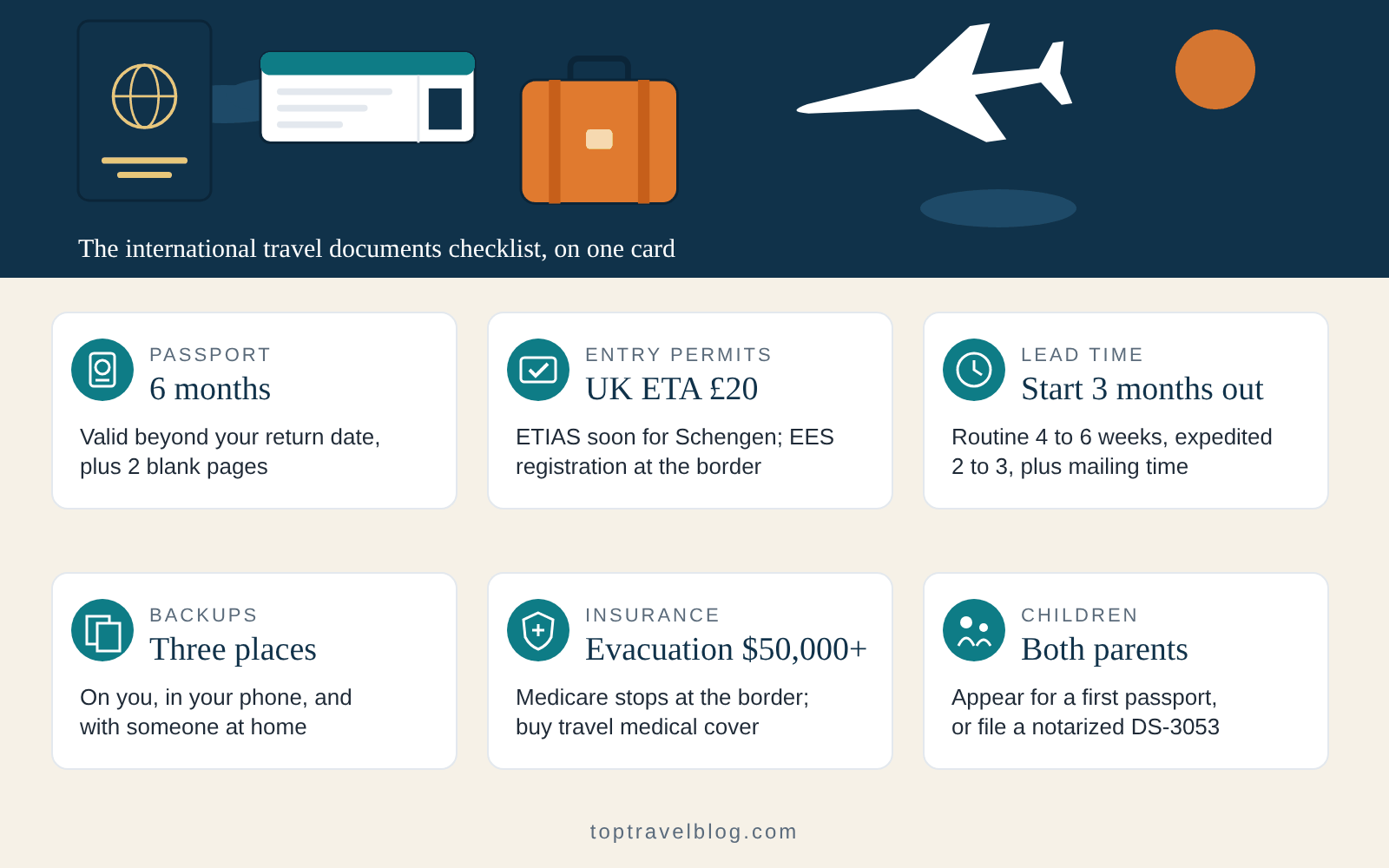
Start with the version of the international travel documents checklist you could screenshot. These are the items that decide whether you get on the plane and through the border. Sections further down explain each one and the situations where more is needed.
The essentials for any international trip
- ☐Valid passport book with at least six months of validity beyond your return date and two or more blank pages.
- ☐Entry authorization where required: a UK ETA, a visa or e-visa, or (once it starts) ETIAS for Schengen countries.
- ☐Proof of onward or return travel, a printed or saved itinerary showing you leave before your permitted stay ends.
- ☐First-night address for every country, because arrival cards and officers ask for it.
- ☐Payment: two different cards from different networks and a small amount of local cash.
- ☐Insurance details: a travel medical policy number and its 24-hour phone line, not just the policy PDF.
- ☐Copies: a photo of your passport page in your phone and a paper copy packed away from the original.
- ☐Emergency contacts written on paper, because a dead phone is not an excuse your hotel can work with.
That list is deliberately short. The rest of the international travel documents checklist is about getting each line right for your particular trip, and about the order in which things have to happen. The passport takes weeks, the permits take minutes to days, and the copies take ten minutes the night before.
If you are still deciding where to go, the order of operations in how to plan a trip step by step puts documents right after you pick dates, which is where I would put them too. Passport validity can rule out a destination you had in mind, and it is far better to find that out before you buy tickets.
The three layers of an international travel documents checklist: required, expected, helpful
I sort every item on my international travel documents checklist into one of three layers so I can tell what is negotiable. Required items stop you at the airline desk or the border: passport, permits, visas. Expected items are the ones an officer or hotel may reasonably ask for: onward ticket, accommodation address, proof of funds. Helpful items cost you nothing to carry and save a bad day: copies, insurance cards, a doctor’s letter.
Most mistakes with an international travel documents checklist happen between layers. People assume that because nobody asked for a return ticket on their last trip, it is optional. Airlines can and do deny boarding when the destination requires proof of onward travel, and the rules are enforced by the carrier, not by the country, so a lenient border officer cannot rescue you from a strict check-in agent.
Why airlines see your documents first
Carriers face fines and the cost of flying you home if they bring a passenger who is not admitted, so they check your passport, visa status and sometimes onward ticket at check-in, often against an automated database. For your international travel documents checklist that means the deadline for having everything in order is the check-in desk or the online check-in window, not the immigration hall.
It also explains why a mismatch you could talk through with a human, such as a middle name missing from the ticket, causes trouble at a kiosk. Fix mismatches with the airline days ahead rather than hoping that an agent will wave it through.
Tip: Put every document into one folder on your phone, offline and not only in an email inbox. A tunnel, a roaming hiccup or a drained battery on arrival is the moment you need the booking confirmation, and offline access is the only reliable way to have it.
Your passport: the first line of any international travel documents checklist
The passport is the document everything else hangs from, so the international travel documents checklist begins with three questions: is it valid long enough, does it have room, and is it undamaged?
Validity: the six-month and three-month rules
There is no single rule. The Schengen Area, which covers most of continental Europe, asks that your passport be valid for at least three months beyond the day you plan to leave the zone. The State Department’s own entry page for Germany describes that requirement as strictly enforced, and also notes that a visa is not required for stays under 90 days.
Plenty of other countries ask for six months from the date you arrive or depart, and a few add a minimum number of blank pages. The reasoning and the country patterns are laid out in the passport validity 6 months rule explained. My own habit is simpler: if the passport has under a year left, I renew it before any international booking, because a rule I have not read yet should never be the thing that costs me a flight.
Count carefully when you fill in your international travel documents checklist. If your passport expires in March 2028 and your return flight lands in October 2027, you have five months of validity after you leave, which fails a six-month test even though the document looks fine on the day of travel.
Blank pages and condition
Some destinations, especially in Africa and parts of Asia, require one or two fully blank pages, and a few ask for the endorsement pages to be clear too. Stamps from a trip you took years ago can eat more space than you expect. Water damage, a torn corner, a cracked cover, loose pages and anything written inside the book can all get a passport refused by an airline even though the State Department issued it.
If your passport has seen a washing machine or a chewed corner, replace it now. It is cheaper than missing a flight, and it removes the argument entirely.
Book versus card
The passport card costs $30 for a first adult card and works only for land and sea entry from Canada, Mexico, Bermuda and the Caribbean. It is not valid for international air travel. I have met travelers who held a card for years and believed it was the same thing, so if you plan to fly abroad even once, get the book. Both cost $160 together, which is the right choice if you drive to Canada often.
Fees and processing times, with real numbers
Current State Department figures: a new adult passport book is $130 plus a $35 acceptance fee, a renewal is $130, and a child’s first book is $100 plus the $35 fee. Expedited service adds $60 and one-to-two-day return delivery adds $22.05. Routine processing runs 4 to 6 weeks and expedited 2 to 3 weeks, both before mailing time, which can add up to two more weeks. The full process, forms and photo rules live in our U.S. passport guide and at the State Department passport pages.
Do the arithmetic backwards when you plan the international travel documents checklist. If you fly in ten weeks, you are inside routine time only if nothing goes wrong. I treat three months as the safe lead time for a first passport and eight weeks as the floor for a renewal.
Watch out: If you travel in less than 14 days, or less than 28 days when you need a foreign visa, the State Department sends you to a passport agency or center by appointment, and it states plainly that an appointment cannot be guaranteed. Do not mail an application in that window.
Renewing early: the quiet bargain in an international travel documents checklist
A renewal costs the same $130 at month nine of validity as at month one, and the remaining time is not credited. Even so, I renew at roughly the twelve-month mark when I have a trip to Asia or Africa on the horizon, because the cost of discovering a six-month rule at the last minute dwarfs the lost months. Adult books are valid for ten years and child books for five.
If you cannot renew by mail: a snag in the international travel documents checklist
You have to apply in person with a new application if your last passport was issued when you were under 16, if it was issued more than 15 years ago, or if it is damaged, lost or stolen. That rules out a surprising number of people who assume they can simply post an old one in. If you fall into one of those groups, add several weeks to the plan and book the acceptance facility appointment first, because slots fill up before summer.
Entry permits: ETIAS, EES, UK ETA and visas
This is the part of the international travel documents checklist that changed most recently, and the part where old advice from friends is most likely to be wrong. Americans still travel visa-free to most of Europe, but visa-free no longer means document-free.
Europe’s EES: what already applies to you
The EU Entry/Exit System replaces passport stamping at Schengen external borders with a digital record. On your first crossing you register at a kiosk or booth: passport scan, a facial image and, for most adults, fingerprints. It reached full operation across the Schengen area in April 2026, so it is the normal way in by 2027.
You do not apply for anything in advance. What you do need is a passport in good condition and a little extra time at your first border post. Europe EES explained walks through the booth experience and what to expect in the queue.
ETIAS: the authorization still on the way
ETIAS is a separate, online travel authorization for visa-exempt travelers entering Schengen countries. Reports from spring 2026 pointed to a launch in the last quarter of 2026, a fee of around 20 euros and validity of up to three years or until the passport expires, with a transition period after it starts. Some later coverage suggests the date may slide toward 2027.
The practical advice for a 2027 trip is to plan a day in your timeline for the application and to read ETIAS for U.S. citizens for the current status. When it applies, you will need your passport, an email address, a card to pay and answers to a short security questionnaire.
The UK ETA, which is already mandatory
The United Kingdom does not belong to Schengen and has its own rule. Americans need an Electronic Travel Authorisation, which the UK government prices at £20. It covers visits of up to six months to the UK, Jersey, Guernsey and the Isle of Man, and every traveler needs one, babies included. You apply through the official GOV.UK ETA page or its application, and the government warns against lookalike sites that charge more. Approval does not guarantee entry, but it is required to board.
One thing trips people up. The ETA is tied to the passport you used to apply, so a renewed passport means a new application. The rules for each situation are in the UK ETA for U.S. citizens guide.
Tip: Use only government addresses for permits. Search results for ETA and ETIAS are full of paid middlemen that look official. The real application starts on a gov.uk or an EU domain, and the price is the official fee with nothing added.
Visas and e-visas for other destinations on your international travel documents checklist
Outside Europe and the UK the picture is a patchwork. Many countries admit Americans without a visa for a set number of days. Others require a visa on arrival, an e-visa you apply for online, or a visa from an embassy, which can take weeks. India, Vietnam, Kenya and Australia, for instance, all use some form of online authorization, and the details and fees differ.
The reliable source is the State Department’s country page for your destination, which lists passport validity, visa needs and entry notes in a quick-facts block. Read it first, and then read the destination government’s own immigration page, since that is the one an officer will actually follow. Where a visa is needed, the State Department treats travel within 28 days as urgent for passport purposes, which is one more reason to start early.
Proof of onward travel and funds
The same State Department Germany page tells travelers to carry sufficient proof of funds and a return ticket, which is typical of visa-free entry. In practice officers rarely ask Americans for bank statements, but airlines do ask about onward tickets, especially for one-way flights and for countries with a strict reputation. If your plan is open-ended, buy a refundable ticket out, or a cheap onward flight you can cancel, rather than argue at the counter.
A quick way to sort your destination
Visa-free with a passport
Much of Europe, many Caribbean islands, parts of Latin America
Passport validity and a ticket out are the main checks. Schengen adds EES registration now and ETIAS when it starts.
Electronic permit first
UK ETA, e-visas for India, Vietnam and others
You apply online days or weeks ahead, pay by card and carry the approval in your phone or on paper. Each traveler needs their own.
Embassy or consulate visa
Countries that require an in-person application
Longer lead time, sometimes an appointment with fingerprints, and a passport with extra validity and blank pages. Start before anything else in the timeline.
Mexico and Canada, since so many Americans drive or sail
For Canada and Mexico the passport book works everywhere, and the passport card works at land and sea crossings. On a cruise that begins and ends in the same U.S. port, a birth certificate and government photo ID can technically be enough, a rule for closed-loop sailings. I still tell people to bring the passport book, because a missed port or a medical flight home turns a closed-loop trip into an international one in a hurry.
The step-by-step timeline from 6 months out to departure day
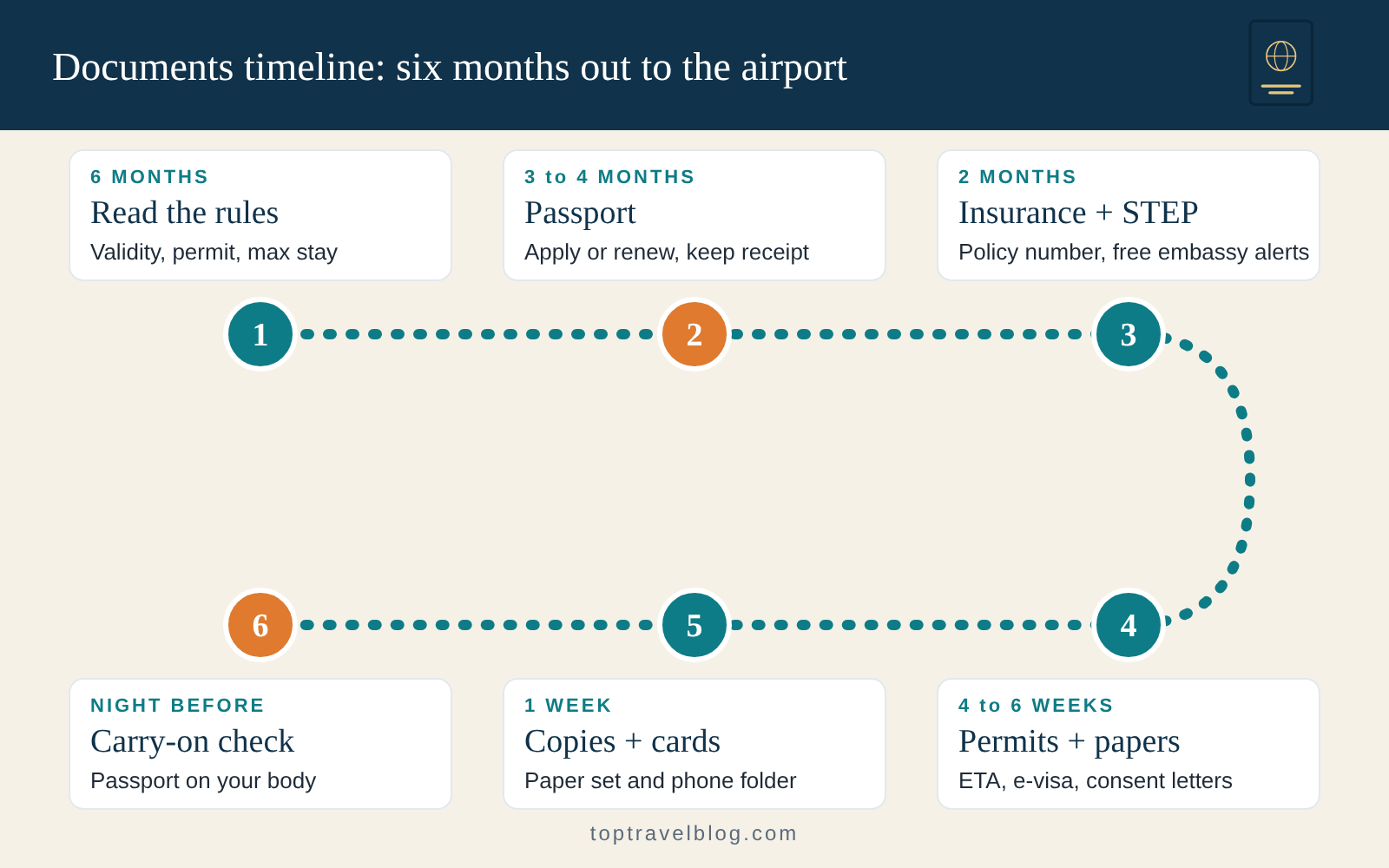
Documents are a scheduling problem more than a paperwork problem. Each piece has a different lead time, and the whole international travel documents checklist falls apart when the slowest one starts last. This is the sequence I follow, from the first booking to the airport.
Step 1
Six months out: read the entry rules before you buy a ticket
Open the State Department page for your destination and write down three numbers: required passport validity, visa or permit requirement and maximum stay. Compare them with your passport’s expiry date. This takes ten minutes and eliminates the single most expensive mistake on any international travel documents checklist. If you are unsure whether to renew, renew.
This is also the right moment to look at flight prices. How to find cheap flights covers the search strategy, and the one rule I would add here is to never buy a ticket for a trip your passport cannot legally make.
Step 2
Three to four months out: apply for or renew the passport
Apply by mail, online if you are eligible to renew, or in person at an acceptance facility for a first passport. Pay for expedited service only if the schedule forces you; at $60 it is cheap insurance but it does not make a mailed envelope arrive faster. Photograph the receipt and the tracking number, and note the day you mailed it.
If the plan includes a visa from an embassy, begin that application at the same time, since it needs the passport and takes the longest.
Step 3
Two months out: book insurance and register the trip
Buy travel medical coverage, the insurance line of the international travel documents checklist, once your tickets are nonrefundable, and save the policy number and emergency line. Then enroll in the free Smart Traveler Enrollment Program, which tells the nearest embassy you are in the country and sends you alerts. Enrollment takes about five minutes and you can add more than one trip.
Step 4
Four to six weeks out: permits, rentals and special papers
Permits are the next item on the international travel documents checklist. Apply for the UK ETA or an e-visa now, not in the week of departure. Authorizations that are usually approved in minutes occasionally take days, and a weekend can eat three of them. Order an International Driving Permit if you will rent a car where one is required, and gather any letters for medication or minors.
Match every booking name to the passport exactly, including middle names where the airline asks for them. Change mismatches now, when airlines will do it for little or nothing.
Step 5
One week out: copies, cards and cash
Photograph the passport page, visas, permits, insurance card and the front and back of each payment card. Print one paper set and email a second to yourself. Tell your card issuers where you are going, load a small amount of local currency, and download offline copies of itineraries and maps.
Step 6
The night before: the carry-on check
Lay everything on your international travel documents checklist out and read it: passport, boarding passes, permits, insurance, cash, cards. Passport and one backup card go in the bag that stays on your body, never the checked bag. Put the paper copies in a different bag from the originals. Then stop. Repacking at midnight is how a passport ends up in a coat that went in the suitcase.
Money, insurance and health papers for your international travel documents checklist
These are not entry documents, but they belong on any serious international travel documents checklist, because they are what you reach for on the day something goes wrong abroad.
Travel medical insurance and evacuation
Medicare generally does not cover care outside the United States, and many private plans pay little or nothing abroad. Standard trip insurance protects your costs, such as canceled flights and lost bags, and usually excludes medical bills. Travel medical insurance is the product that pays for care. The State Department also notes that medical evacuation can cost more than $50,000 and that very few health plans cover the flight home, so it suggests separate evacuation coverage.
My rule for the insurance line of the international travel documents checklist: for any trip involving remote areas, long flights home or older travelers, I buy a policy with evacuation included and write the policy number on a card in my wallet. For a long weekend in a city with a good hospital, I still carry coverage, but I choose lower limits. Keep the claims phone number and the policy ID where you can read them with a dead phone.
Prescriptions and medical letters
The State Department’s guidance is practical. Bring enough medication for the whole trip plus a few extra days, keep it in original labeled containers, and carry a doctor’s letter listing your conditions and medicines by generic name. Some countries restrict medications that are common in the United States, including certain ADHD and pain prescriptions, and some require an import permit. The destination’s embassy is the authority on that, not a forum.
If you rely on an injectable, a CPAP or an insulin pump, carry a letter explaining it and keep the supplies in your carry-on. A note from a doctor on letterhead has solved more security conversations for me than any argument about what the device is.
Vaccination records and health certificates
A few destinations require proof of yellow fever vaccination, mostly when you are arriving from, or have passed through, a country with risk of transmission. Carry the yellow International Certificate of Vaccination if it applies to you. Routine records, such as childhood vaccines and tetanus dates, are helpful for clinics abroad but are not an entry requirement for most tourist trips.
Cards, cash and the paperwork behind them
Carry two payment cards from different networks, say a Visa and a Mastercard, stored in separate places. If a card is captured by an ATM or frozen after a fraud alert, the second one keeps the trip alive. A card with no foreign transaction fee saves roughly 3 percent on every purchase, which adds up on a two-week trip, and it is worth getting before you travel rather than after the first statement.
Write the numbers for the card issuers’ international collect lines on paper, because the number on the back sometimes works only from the United States. Bring a small cash reserve, in the local currency where you can, for taxis and the first meal.
International Driving Permit and rental papers
If you rent a car where you do not read the signs or where the law demands it, an International Driving Permit translates your U.S. license into several languages. In the United States it is issued through AAA and the American Automobile Touring Alliance, and it is valid only alongside your actual license. Rental companies abroad also ask for the credit card you booked with in the driver’s name, and many want you to be 25 or older without a surcharge.
Children, families and name mismatches: the family international travel documents checklist
Traveling with minors adds paperwork that adults forget about because they never met it before kids. This part of the international travel documents checklist is the one I would hand to any parent.
Passports for children
Under-16 passports follow stricter rules. The State Department says a child must apply in person with both parents or guardians present, on form DS-11, and that passports for children under 16 are valid for five years. If one parent cannot attend, that parent signs a notarized Form DS-3053, and if the other parent cannot be located there is a separate procedure with supporting evidence. A child’s book costs $100 plus the $35 acceptance fee.
Budget more time than for an adult, because getting two parents, a birth certificate and a child into one appointment is the actual bottleneck. Do it first.
Traveling with one parent, a grandparent or a friend’s child
A child traveling with one parent, or with an adult who is not a parent, should carry a signed letter of consent from the absent parent or parents, ideally notarized, with contact details and the dates and destination of the trip. Some countries request one by law, and officers are trained to ask about it as an anti-abduction measure. It costs a few dollars at a notary and takes five minutes. Add a copy of the child’s birth certificate, and a custody order where one exists.
Tip: Write the letter yourself in plain English, name the destination and the dates, and add one line in the local language if you can. The simplest consent letter that names the child, passport number and trip is more useful than a legal template nobody reads.
Names that do not match
The name on the airline ticket must match the passport. Marriage, divorce and hyphenated names are the usual culprits. If your passport shows your maiden name and your ticket your married name, correct the ticket, not the passport, unless the passport is due for renewal anyway. Make sure the TSA Secure Flight fields, which ask for name, date of birth and gender as on your ID, match too.
If you have recently changed your name, bring the marriage certificate or court order too. It is overkill on most trips, but when a hotel or a border officer asks about a mismatch the original document ends the discussion in thirty seconds.
International travel documents checklist variations by trip length and style
The essentials never change. What changes is how much of the rest you need. Here is how I scale the international travel documents checklist, starting with the shortest trips.
A long weekend abroad (3 to 5 days)
On a short trip the international travel documents checklist shrinks to: passport, any permit, a screenshot of the hotel and return flight, one card and one backup, and the insurance number. That is all. The risk on a short trip is not paperwork volume but lead time: a UK ETA or a renewal needs to happen before you commit, and a weekend city break does not leave room for a late passport.
One to three weeks in one region
The core international travel documents checklist, plus the doctor’s letter, two cards and a paper copy set. For Europe, read about how the 90 days in any 180 work if you plan to stay long, and keep every flight, train and hotel booking in an offline folder. When you cross a border by train, expect to need the passport at the station, not only at the airport.
Multi-country trips
On multi-country trips each country has its own rule, and the strictest one sets the passport line of your international travel documents checklist. If one country asks for six months and the others for three, plan for six. Entry permits stack: a trip that combines the Schengen area and the UK needs ETIAS (once live) and a UK ETA, while the border between them gets a full passport check. Track onward travel for each leg so you can show it on demand.
Long stays, 90 days and beyond
Tourist rules in Schengen cap you at 90 days in any 180, and the UK permits up to six months as a visitor. Beyond that you are in visa territory, with proof of funds, accommodation and sometimes health insurance requirements that vary by country. Remote work, study and retirement all need a different visa class, and a tourist entry is not a loophole for them. Talk to the consulate before booking anything non-refundable.
Cruises
On a cruise, the international travel documents checklist gets stricter. Cruise lines are strict about passport validity and often require six months because ports can change. Carry the passport on every shore excursion, a paper copy in the ship safe, and any vaccination certificate required by a port. A passenger who misses the ship has to reach the next port with their own documents, so a copy and a card are worth more than they weigh.
Road trips to Canada and Mexico
A passport book or card works at land crossings. If you drive a rental car, ask whether the contract allows cross-border use and carry the paper proof of insurance the border requires. Drivers heading deeper into Mexico may also need a tourist permit and Mexican auto insurance. Your U.S. policy does not cover the car there, and that is the single most common nasty surprise on that route.
Worked examples: the international travel documents checklist in practice
Rules are easier to hold onto when you see the international travel documents checklist applied. Here are four trips I have helped people plan, with the arithmetic shown.
A first passport and a 10-week runway for the international travel documents checklist
A couple wants to fly to Portugal in late June and neither has a passport. They apply in person in early April, about 12 weeks out, pay $130 plus $35 each, and receive the books in roughly five weeks, with mailing time on top. That leaves a six-week cushion before June, enough to book travel insurance, and for ETIAS if it has started by then.
The same couple starting ten days before the flight would have needed an agency appointment, extra fees and a lot of luck. The difference between the two outcomes is entirely when they began.
A passport that looks fine but fails
A friend booked a trip to Thailand in October with a passport that expired the following February. Four months of validity left, so it feels safe. But many Asian destinations ask for six months from entry, and airlines apply that rule at check-in. She renewed by mail seven weeks out and made it, with an expedited fee. The lesson is to calculate validity from the return date and look up the destination, not the calendar.
A family of four to London and Paris
Two adults, two kids aged 8 and 12. Everyone needs a UK ETA, which at £20 each is £80 in total and applies to children as well. The kids’ passports have 18 months left, which passes both the UK and Schengen rules for a spring trip. Because they take the Eurostar, they pass through UK and French border control at the station, so the passports go in the hand bag, not the checked luggage. EES registration happens at the first Schengen crossing.
One parent flies out a day later for work, so the other carries a notarized letter and a copy of that parent’s passport. The notary visit took twelve minutes. Our guide to travel advisory levels helped the family decide whether to add a side trip, which is another document-adjacent decision worth making early.
A retiree on a three-week cruise with excursions
A 70-year-old travels with a heart medication and a pacemaker. His international travel documents checklist adds the doctor’s letter in generic drug names, original pharmacy bottles, a copy of the ECG, medical and evacuation coverage with a pre-existing condition waiver and a card in his wallet naming his emergency contacts. Medicare would not have paid for care abroad, so the policy matters more than the passport. He carries the originals on his body and the copies in the cabin safe.
What to carry, what to copy, and what to leave at home
The worst place to lose a passport is in the same bag as everything else you own. Splitting documents into three places is the cheapest protection in this international travel documents checklist, and it takes about five minutes.
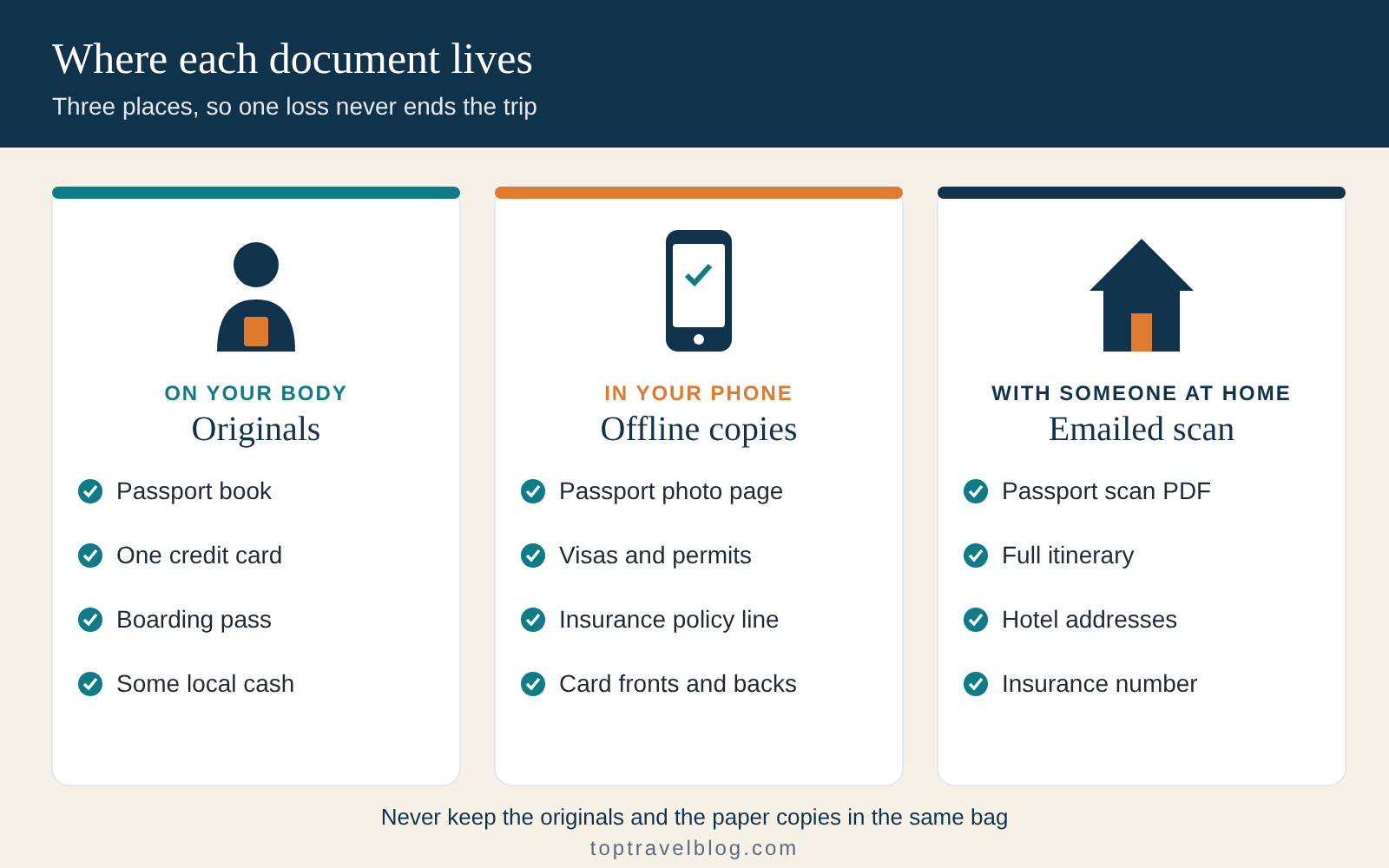
On your body
The passport, one credit card, some cash and your boarding pass live in a zip pocket, a money belt or a small crossbody bag that never leaves your sight. In busy cities the shoulder bag on the back of a chair is how phones and passports disappear. Keep it under your arm, not on the floor beside you.
In the hotel room
A hotel safe can hold the backup card, the second set of paper copies and any cash you are not spending today. Do not leave the passport there unless the destination allows a copy as ID for daily activities, which many do not. In some countries you must carry a passport at all times, and the State Department’s country page says so when that is the case.
Storing your international travel documents checklist in your phone, offline
Photograph the passport photo page, visas and permits, insurance card, vaccination certificate and the front and back of your cards. Store them in a secure notes app or a password manager that works offline, plus an encrypted cloud folder. A photo is not a legal replacement for the original, but it speeds up replacement a great deal.
With someone at home
Email a PDF with the passport scan, itinerary and insurance details to one trusted person. Tell them where you are staying. If everything goes wrong, they can read the passport number to an airline or embassy at 3 a.m. their time while you hold the phone from a lobby.
What to leave at home when you pack your international travel documents checklist
Leave the Social Security card, spare credit cards, the library card, extra IDs and anything that opens an account. A foreign hotel does not need them, and a thief gains from every one. Leave the passport card too if you are flying, since it will not work and is one more thing to lose.
Watch out: A REAL ID driver’s license is for domestic flights and federal facilities. It is not a travel document abroad, and it does not replace the passport at the airline counter. Carry your license for car rentals and as secondary ID, but do not count on it to get you out of the country.
Coming home: customs, re-entry and trusted traveler options after your international trip
The international travel documents checklist does not end when you land abroad. Re-entry has its own paperwork, and the airline will still want to see a valid passport on the flight home.
The customs declaration
Returning U.S. residents fill out a customs declaration, now usually digitally at a kiosk or in the Mobile Passport Control app, listing what they bought and carry. Returning residents generally have a personal exemption of $800 in goods, and certain alcohol and tobacco limits apply. Keep receipts for large purchases. Agricultural items, such as fruit, meat and some cheeses, are the usual cause of an inspection and a fine, so declare them rather than hope.
Cash and monetary instruments above $10,000 in total must be declared when you enter or leave the country. Carrying that amount is legal, but failing to declare it is not, and it is the one rule here with serious penalties. The rules are published by U.S. Customs and Border Protection.
Global Entry, TSA PreCheck and Mobile Passport Control
Global Entry is a CBP trusted traveler program that sends you through a kiosk at the border instead of a queue. It costs $120 for five years and includes TSA PreCheck, so a frequent traveler comes out ahead on time and, often, on money. Interviews are done at enrollment centers, and appointments can run months out. Mobile Passport Control, a free app, offers a smaller version of the same idea at many airports.
Neither is a substitute for the passport. They only speed up the line. If you travel abroad twice a year or more, the fee pays for itself quickly in minutes.
Returning with a lost or expired passport
A U.S. citizen has the right to enter the United States, but airlines will not board you without a valid passport or an emergency document from a consulate. If your passport is lost, the consulate can issue an emergency passport for the trip home. That is why the next section matters.
If a document from your international travel documents checklist is lost or stolen abroad
Even a careful traveler who followed the international travel documents checklist loses things. The recovery plan matters more than the hope of never needing it.
Report the loss to local police if it was stolen, and keep the report, since insurers and the embassy often want it. Contact the nearest U.S. embassy or consulate, where consular staff can issue an emergency passport, usually valid for a limited period for your trip home. Bring the passport photos, the copy of your lost passport, any ID you still have, and proof of your itinerary.
Replace the document rather than hoping it turns up. Once a passport is reported lost or stolen it is invalidated, so finding it again does not make it usable. Cancel affected cards, then tell the people at home. A student I know replaced a stolen passport in Lisbon in two working days because she had a scan, a police report and an appointment on the first morning.
Tip: Enrolling in the Smart Traveler Enrollment Program before you leave puts your contact details with the nearest embassy, which speeds up help during a disaster or an emergency. It is free, and it takes less time than finding the Wi-Fi password.
Wallet theft in crowded places such as metro platforms, markets and festivals is the usual cause. Awareness helps more than fear: keep zips closed, carry the bag in front, and treat unexpected helpers with caution.
Common mistakes on the international travel documents checklist
These are the ones I see most when people work through an international travel documents checklist, in rough order of how expensive they turn out to be.
1. Counting validity from today instead of from the trip
The passport must be valid for months beyond your return or departure date, not beyond your booking date. Count from the last day of the trip. Two minutes with a calendar prevents most denied boardings.
2. Confusing the passport card with the book
The card is cheaper and fits in a wallet, but it is useless on an international flight. Buy the book unless you only cross land borders.
3. Starting the passport too late
Routine processing of 4 to 6 weeks plus mailing sounds manageable until the application is returned for a missing signature or a bad photo. Start at three months, and photograph every page before you send it.
4. Using a lookalike permit website
Paid middlemen rank high in search results for ETA, ETIAS and e-visa. They add fees to the official price, sometimes several times over, and some are outright scams. Type the government address yourself.
5. A ticket name that does not match the passport
Nicknames, missing middle names and a maiden name on the ticket cause check-in delays and fees. Copy the name exactly as printed on the passport photo page.
6. Skipping the onward ticket
A one-way flight to a visa-free country can still be refused at check-in. Book a refundable return, or a cheap leg out, before you leave.
7. Keeping all documents in one bag
A single stolen bag then takes the passport, the cards and the backup copy with it. Spread them between your body, the room and the cloud.
8. Assuming insurance exists
Many travelers believe their health plan or credit card covers medical care abroad. Most do not cover evacuation, and Medicare generally pays nothing outside the country. Read the policy, then buy the right one.
9. Forgetting children’s consent letters
Officers at some borders ask a single parent where the other one is. A notarized letter answers the question in seconds, and the lack of one can mean a long conversation.
10. Leaving permits to the last day
Most approvals arrive in minutes. The one that does not is the one you will wish you had filed three weeks earlier. Apply during step four of the timeline.
Frequently asked questions about the international travel documents checklist
What documents do I need to travel internationally as a U.S. citizen?
At minimum you need a valid passport book. Depending on your destination you may also need an entry authorization such as a UK ETA, a visa, or ETIAS once it starts, plus proof of onward travel. Insurance details, payment cards and copies round out the international travel documents checklist. The State Department country pages list entry rules for each destination.
How early should I get my passport before an international trip?
Start about three months ahead for a first passport and at least eight weeks for a renewal. The State Department quotes 4 to 6 weeks for routine service and 2 to 3 weeks expedited, not counting up to two weeks of mailing. If you travel inside 14 days, you need an appointment at a passport agency, and appointments are not guaranteed.
Does my passport need six months of validity?
Sometimes. Schengen countries ask for three months beyond your planned departure, while many other countries want six months from the date you enter. Airlines enforce these rules at check-in. Plan to the strictest country on your route, and renew early if you have under a year left.
Do I need a visa to visit Europe as an American?
Not for stays under 90 days within any 180-day period in most Schengen countries. You do need a valid passport, and you register at the border under the Entry/Exit System. The ETIAS authorization is expected to add an online step when it launches. Longer stays, work and study require a visa from the country involved.
Do Americans need an ETA for the UK?
Yes. The UK government charges £20 for the Electronic Travel Authorisation, which covers visits of up to six months, and each traveler, including babies, needs one. Apply only through the official GOV.UK channels. The details of the application are in our UK ETA for U.S. citizens guide.
Can I travel internationally with just a passport card?
Only by land or sea to Canada, Mexico, Bermuda and the Caribbean. The passport card is not valid for international air travel, so if there is any chance you will fly abroad, apply for the passport book. Getting both together costs $160 for an adult application, plus the acceptance fee.
What do I need to take my child abroad?
A child’s own passport, valid for five years if issued under 16, and, if traveling without both parents, a signed and ideally notarized consent letter plus a copy of the birth certificate. The first passport requires both parents to appear or a notarized DS-3053. Add a UK ETA for each child if you are going to Britain.
Do I need travel insurance for an international trip?
The law rarely requires it, but you should have it. Medicare generally does not cover care outside the country, and the State Department warns that evacuation can exceed $50,000. Buy travel medical insurance with evacuation, and keep the policy number and a 24-hour phone line where you can reach them without a phone signal.
Should I carry my original passport or a copy?
Carry the original while moving between countries and for any transaction that requires ID, such as exchanging money or collecting a rental. In places where a copy is accepted for daily use, leave the original in the hotel safe. Keep a photo on your phone and a paper copy in a separate bag as insurance.
What if my passport is lost or stolen abroad?
Report it to the local police if stolen, then contact the nearest U.S. embassy or consulate. Staff can issue an emergency passport for the trip home. Bring any ID you still have, passport photos and a copy of the lost passport. Having a scan on your phone speeds the process by a day or more.
Do I need a customs form when I return to the United States?
Yes. Returning travelers declare what they are bringing in, usually through a kiosk or the Mobile Passport Control app, and cash above $10,000 must be declared. Returning residents have a personal exemption of $800. CBP lists the rules at cbp.gov, and agricultural items are the usual cause of problems.
One last thing before you go
The most useful thing I do before any international trip is also the least glamorous. I put the passport, the permit printouts and the insurance card in one folder, take a photo of the lot, and put the folder next to my keys the night before. Everything else in this international travel documents checklist is a way of making that last ten minutes boring.
Boring is the goal of every good international travel documents checklist. Documents are the one part of a trip where nothing exciting should happen. If you start early, count the months on your passport against the strictest country on your route, and keep three copies in three places, the paperwork will take care of itself and you can spend your attention on the trip.
If you are building the rest of your plan, the step-by-step trip planning guide picks up where this international travel documents checklist ends.
Related planning guides
- U.S. Passport Guide: apply, renew, processing times and urgent travel — the full walk-through for the slowest item on the international travel documents checklist.
- Passport validity rules: why some countries require 3 or 6 months — how to calculate it for your route.
- ETIAS for U.S. travelers: what it is, who needs it, cost and launch timing — the latest on Europe’s new authorization.
- UK ETA for U.S. travelers: cost, application, validity and transit rules — the permit every American needs for Britain.
- Smart Traveler Enrollment Program (STEP): what it does and who should enroll — the free registration that connects you to the embassy.
- How to plan a trip step by step: from idea to booked itinerary — where documents fit in the bigger plan.