

A hotel cancellation policy is the fine print that decides whether a change of plans costs you nothing, one night’s rate or the entire stay. Everything in it comes down to one number: the deadline. Cancel before it and you walk away clean. Cancel after it, or simply do not show up, and the hotel keeps money.
Most travelers never find that number until they need it.
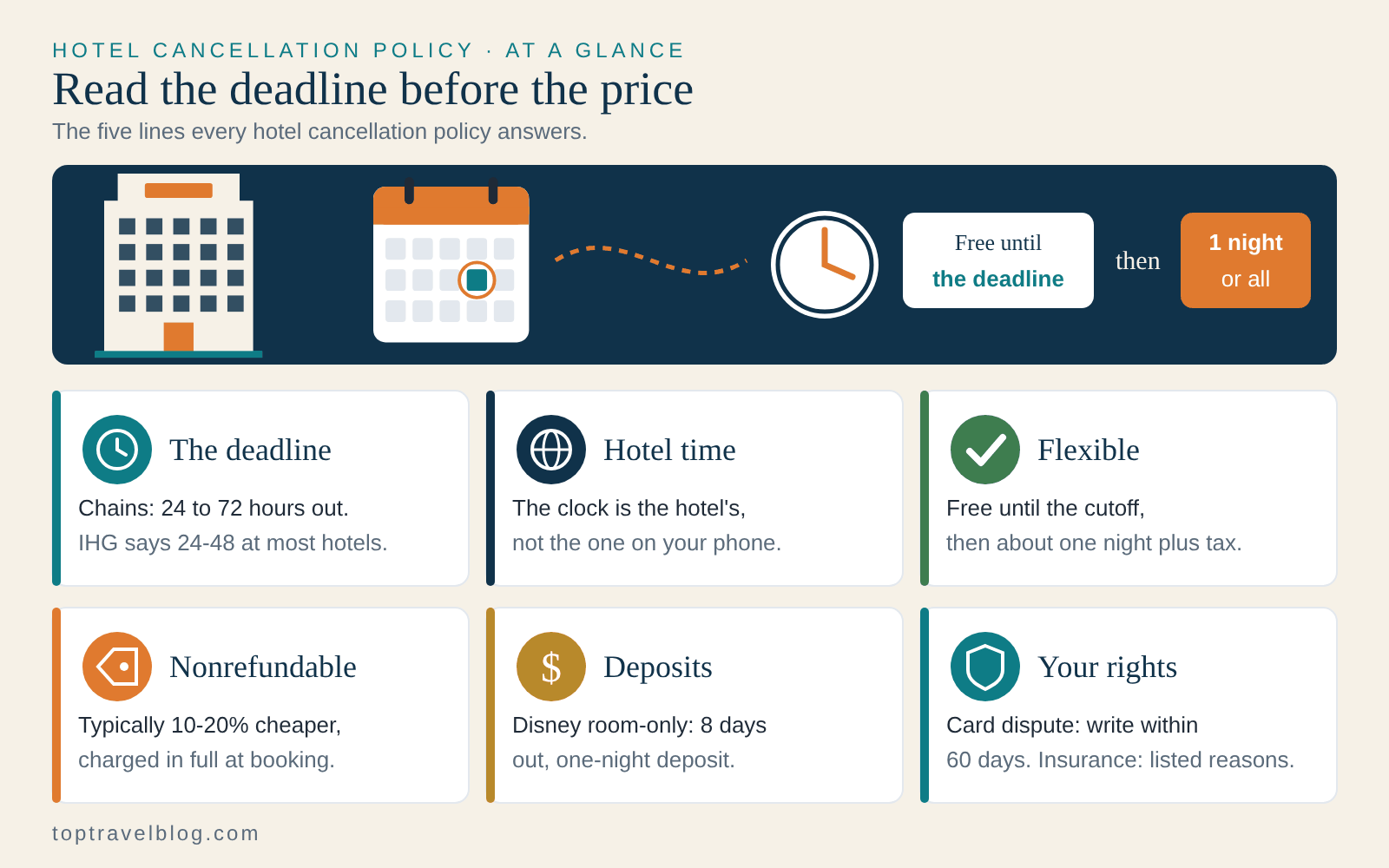
The short version, as of November 2026: the large chains usually set free cancellation somewhere between 24 and 72 hours before arrival, measured on the hotel’s clock, not yours. IHG, for example, says in its guide to flexible and prepaid rates that free cancellation runs “up to 24-48 hours before arrival” at most of its properties. A nonrefundable or prepaid rate is typically 10 to 20 percent cheaper and is charged in full when you book.
Resorts, holiday weekends and theme-park hotels set longer windows and take deposits.
I have booked and cancelled hotels for more than fifteen years, for family trips, work trips and a couple of weddings, and I have paid for my mistakes in all three categories. This guide explains how a hotel cancellation policy is built, how flexible, semi-flexible, nonrefundable and deposit rates differ, how to read the deadline in about two minutes, and what your actual options are once the deadline has passed.
Quick facts: hotel cancellation policy at a glance
- The number that matters: the cancellation deadline, usually 24 to 72 hours before arrival at chain hotels and set in the hotel’s local time. The hotel, not the brand, picks it.
- Four rate families: flexible (free until the deadline), semi-flexible (an earlier deadline for a small discount), nonrefundable or prepaid (charged now, no refund) and deposit rates (a first-night or larger payment that you can lose).
- What a late cancellation costs: usually one night’s rate plus tax on a flexible rate, the full prepaid amount on a nonrefundable one. Resorts can charge more.
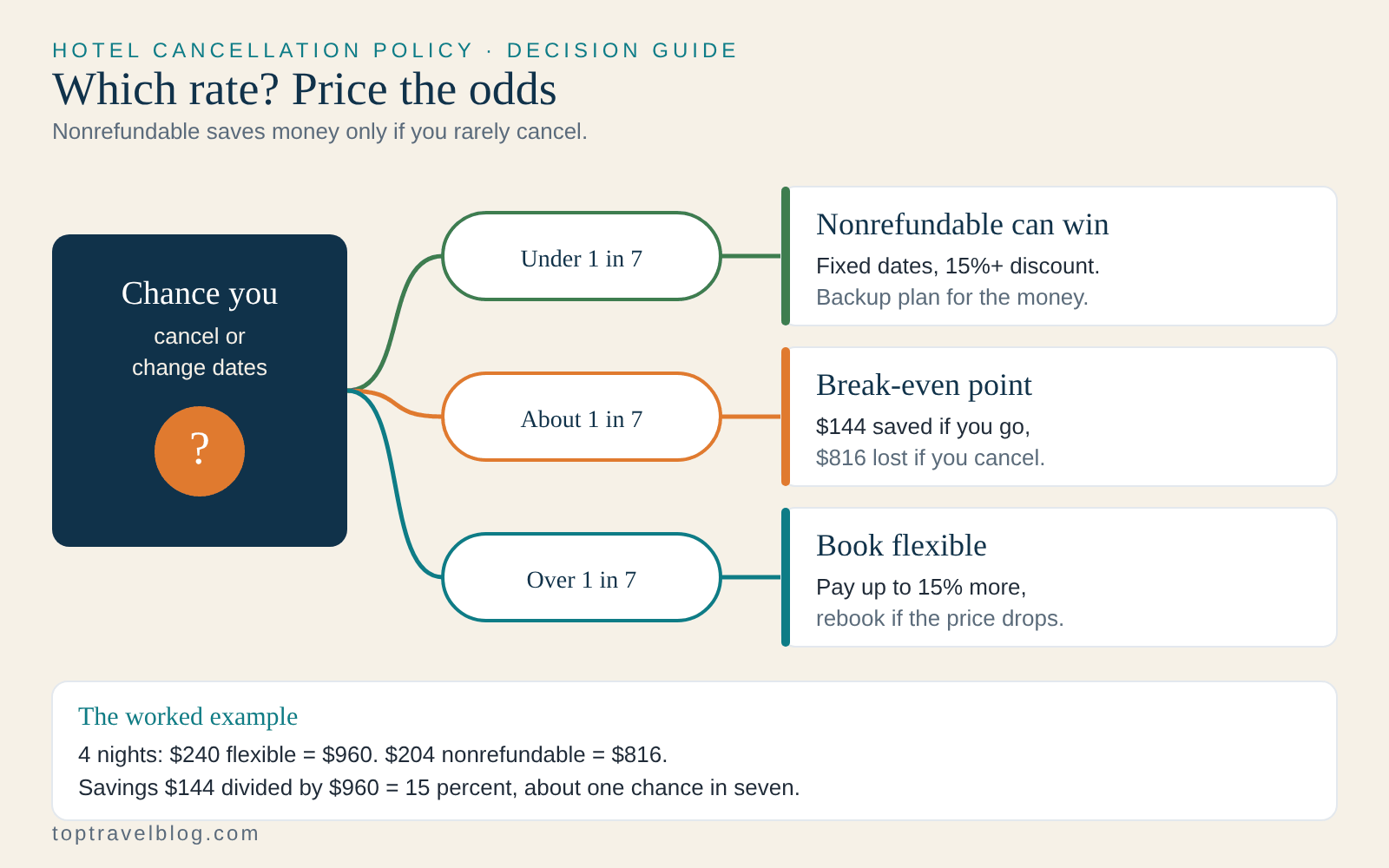
- Price of flexibility: IHG describes advance rates as typically 10 to 20 percent below the flexible rate. If you think there is more than roughly a one-in-seven chance you will cancel, the flexible rate is the better buy.
- Your rights: the FTC fee rule that took effect on May 12, 2025 covers total price, not cancellation windows. Card disputes for billing errors must reach the issuer within 60 days. Travel insurance pays only for reasons its own policy lists, which is a separate document from any hotel cancellation policy.
- Biggest mistakes: reading the deadline in your own time zone, assuming a refundable rate means a same-day refund, and not saving the cancellation confirmation.
What a hotel cancellation policy actually says
Every hotel cancellation policy, however it is worded, answers the same five questions. Once you can find those five answers, the wording stops mattering, and a policy that looks intimidating on the page turns out to be a short list of numbers.
The five parts of a hotel cancellation policy
First, the free-cancellation deadline: the last moment you can cancel without a charge. Second, the penalty after that deadline, which is almost always one night’s room rate plus tax, or the whole stay on a prepaid rate. Third, when you pay: at booking, at check-in or at checkout. Fourth, what happens if you change dates, shorten the stay or swap room types. Fifth, the no-show rule.
Those five lines are the entire hotel cancellation policy. Everything else is decoration.
Where the policy lives on your reservation
You will usually meet a hotel cancellation policy three times: on the rate selection page as a short label such as “Free cancellation until Oct 12” or “Nonrefundable,” on the payment page as a longer paragraph, and in the confirmation email. The email is the document that counts, because it records the terms you accepted on that date.
The Hilton help center describes the same trail: the hotel cancellation policy appears under the rate details of the stay in your account or app, and the confirmation email links to a page where you can modify or cancel.
Why one chain can have a dozen policies
Brands do not set a single policy. Individual hotels set their own deadlines, and the same hotel sets different ones by rate and by date. A Hilton in a business district may allow cancellation until 6 p.m. the day before, while a Hilton resort on the same booking engine asks for a week during school vacations.
That is why a friend’s experience with a brand tells you less than the label on your own reservation.
Tip: Screenshot the cancellation line on the rate page at the moment you book, before the payment screen. If the hotel later says the terms were different, you have a dated record of what the site showed you.
What a hotel cancellation policy does not control
A hotel cancellation policy governs money, not your reservation’s existence. A hotel that says “no refund” has not stopped you from cancelling. It has told you what you will pay for doing so. That distinction matters because cancelling a booking you will not use still frees the room, stops a no-show flag on your loyalty account and sometimes triggers a partial credit.
For the bigger picture of what else to weigh when you pick a property, my guide on how to choose a hotel puts the hotel cancellation policy next to location, reviews and fees.
Hotel cancellation policy by rate type: flexible, semi-flexible, nonrefundable and deposit
Almost every rate you will see falls into one of four families, and each family carries a different hotel cancellation policy. The names change from brand to brand, and the hotel’s marketing department invents new ones every few years, but the money works the same way. Here is each family in plain terms, with what you give up and what you get for it.
Flexible rate
Free cancel until a deadline
The standard room rate. Cancel before the cutoff, usually 24 to 72 hours before arrival at chain hotels, and you pay nothing. Cancel after it and you owe about one night plus tax. You normally pay at the hotel.
Semi-flexible rate
Earlier deadline, small discount
Same shape as flexible, but the free window closes days earlier, often three to five. Members, AAA and senior discounts often sit here. Good when you are sure of the trip but not of the exact week.
Nonrefundable or prepaid
Cheapest, locked in
Charged in full when you book, with no refund if you cancel or change. Names include Advance Purchase, Pay Now and Advance Saver. Typically 10 to 20 percent below the flexible rate, according to IHG.
Deposit rate
Partial payment you can lose
Common at resorts, theme-park hotels and peak-season properties. A first-night or larger payment holds the room and becomes nonrefundable after a set date. Disney World is the best-known example.
Flexible: what you really pay for
A flexible rate is insurance sold inside the room price. You pay a premium, and in return the hotel carries the risk that you change your mind. Most of the time the premium is fair. On a booking made months out, flexible is also a free option to rebook if the hotel’s price drops, which I use constantly and explain below.
The drawback is that people treat flexible as unlimited. It is not. The deadline is real and the hotel enforces it.
Semi-flexible: the middle option people skip
Semi-flexible rates, a feature of several chains’ member and discount programs, are the quiet bargain of the category. You give up the last few days of flexibility and keep the rest. If your trip is a wedding, a reunion or a ski week with a firm date, a deadline of four or five days out costs you nothing in practice.
Read the deadline carefully, though. The label says flexible, and the deadline decides whether it is.
Nonrefundable: when it is the right call
I book nonrefundable rates in exactly one situation: the dates are fixed by something outside my control, the savings are large, and I have a backup plan for the money. A conference, a graduation, a cruise departure that cannot move. For a vacation with kids in school sports season or a flight that might change, the saving is rarely worth the risk.
IHG itself advises paying for the advance rate only when your dates are firm, noting that a higher-priced flexible rate can prevent a much larger loss if plans change.
Deposit rates and what they hide
The word deposit sounds mild, which is why it hides so much risk in a hotel cancellation policy, but the key is the refund date. A resort might take a first-night deposit that is fully refundable until eight days out, as Disney World’s room-only reservations are, and then lose it completely. Others take half the stay, or the whole stay, for peak weeks.
The deposit rule is the part of a hotel cancellation policy most likely to differ from the hotels you have used before, and the most expensive to misread.
Which rate to pick: a quick rule
If the trip is fixed and you can afford to lose the money, take the cheapest. If the trip has a flight that could change, kids, work or weather exposure, take flexible. If it is somewhere in the middle, take semi-flexible. I explain the arithmetic behind that rule in the break-even section further down.
How a hotel cancellation policy deadline works: time zones, cutoffs and peak dates
Deadlines cause more lost money than any other part of a hotel cancellation policy, mostly because people read them the way they read an airline departure time: in their own head, in their own city. Hotels do not.
The hotel’s clock is the only clock
The deadline is nearly always set in the hotel’s local time, a point Booking.com’s own guide to cancelling hotel reservations makes plainly, warning that missing the window by even a few minutes can bring a charge. A traveler in New York cancelling a Honolulu hotel is working across five or six hours depending on daylight saving time.
If the deadline reads “11:59 p.m. two days before arrival,” that is 11:59 p.m. in Honolulu, which is 4:59 or 5:59 a.m. the next day in New York.
Cutoff hours you will see
The common patterns are a fixed hour on the day of arrival (rare now), a number of hours before check-in time (24, 48 or 72), or a calendar day before arrival at a stated time. Over the last decade the big chains have lengthened their windows, and same-day cancellation has become uncommon.
When the label says “48 hours before arrival,” ask whether that counts from the standard check-in time or from midnight. In my experience it counts from check-in time, but a few hotels count from the start of the arrival day, which can cost you most of an afternoon.
Peak dates and event weekends
Hotels tighten the rules when demand spikes. Holidays, festivals, big sports weekends, graduations and conventions often come with longer windows, deposit requirements or nonrefundable-only pricing. Booking.com states that holidays and events may bring longer notice periods or higher fees.
If you are booking Thanksgiving week in New York or New Year’s in Las Vegas, assume the standard rules have changed and read the line twice.
Warning: A cancellation email timestamped after the deadline in the hotel’s time zone is a late cancellation, even if you sent it the same day. Cancel earlier than you think you need to, and set an alarm that fires in the hotel’s time, not yours.
Why you should cancel early even when you have time
Hotels cannot resell a room that is cancelled at the last hour, so some penalize it. Cancelling a week out does the hotel a favor and, in practice, makes the front desk friendlier if you ever need to ask for a favor in return.
The other reason is practical: websites fail. I have watched a cancellation page time out at 11:50 p.m. with ten minutes of free window left. Use the evening before the deadline, not the last half hour.
How major chains and booking sites word their hotel cancellation policy
This section is a map of what each major source says in public, drawn from their own pages as of November 2026. Specific hotels vary, so treat these as the typical pattern and the label on your reservation as the contract.
Marriott Bonvoy
Marriott lets each hotel set its deadline, and standard rates commonly close 24 to 72 hours out. Its Advance Purchase offers are the prepaid family, with Marriott advertising savings of up to 10 percent on its Advance Purchase offer page. The company’s support site points members to a page for finding the cancellation policy on a specific reservation, which tells you what to do: the rate details, not the brand, hold the answer.
Points stays follow a similar window, with a late cancellation costing the points for one night at many properties.
Hilton
Hilton’s help center walks through cancelling in the account, the app or the confirmation email, and says you can cancel at no cost inside the hotel’s window. After it, a late fee may apply and the amount varies by hotel. If you paid a deposit, the hotel that collected it processes the refund, and Hilton says that can take up to 30 days.
Hilton’s Pay Now family is the prepaid, nonrefundable option.
Hyatt
Hyatt hotels mostly use 24, 48 or 72 hours for standard rates, and prepaid rates are not cancellable. Top-tier elite members get an exception on some properties that lets them cancel closer to arrival than the posted deadline. Points and Points + Cash awards follow the hotel’s cash rules, and the points come back if you cancel in time.
IHG Hotels and Resorts
IHG is the chain that explains its structure best in public. Its deals guide says flexible rates allow free cancellation up to 24 to 48 hours before arrival at most properties, and that payment is taken at or near check-in. Prepaid rates are paid in full at booking and are charged in full if you cancel. Changes may carry a fee.
Reward Nights mostly cancel up to one day before check-in, and points go back to your account.
Booking.com, Expedia and other agencies
Third-party sites display the hotel’s own policy and add their own wrapper. Free cancellation commonly runs until 24 to 48 hours before check-in, and some properties allow it until the day of arrival. Nonrefundable rates are generally binding. When a hotel waives a fee for bereavement, serious illness or a disaster, it is the hotel’s choice, and Booking.com says hotels are not obliged to.
For where each channel is easier to cancel, my comparison of booking hotel direct vs third party goes through the trade-offs, and my guide to the best hotel booking sites covers how each site displays the total.
Theme-park and destination hotels
Disney World is the example I get asked about most. Its room-only reservations moved to a rule requiring cancellation at least eight days before arrival for a full refund, with the one-night deposit forfeited inside that window. That is nearly three times longer than a typical city hotel.
Resorts built around a single attraction set their own clock, so read the hotel cancellation policy for the actual property, not for the brand.
Deposits, prepayment and card holds in a hotel cancellation policy
Three different things get called a deposit, and they behave differently when you cancel. Sorting them out saves you a confusing phone call later.
Card guarantee: no money moves
Most flexible reservations only need a card number to guarantee the room. Nothing is charged at booking. The card is how the hotel collects a late-cancel or no-show fee later. IHG notes that guaranteeing a reservation with a card also makes it eligible for its Reservations Guarantee: if the hotel cannot honor the booking, it provides a comparable room and transportation, pays the first night’s rate plus tax and refunds any advance deposit.
Authorization hold: money is reserved, not spent
At check-in, hotels place a hold on your card for the room and an incidentals amount. It is not a charge, but it reduces your available balance, and on a debit card it can tie up real cash for several days after checkout. If you are paying for a hotel and a rental car on the same debit card, this is how you end up with a declined coffee.
Use a credit card for the hold when you can. It keeps your cash free and gives you stronger dispute rights, which I cover later.
Deposit or prepayment: the money leaves your account
A deposit is a real payment, usually the first night or a percentage of the stay, collected at booking or a few weeks later. Prepayment is the whole stay. The refund rule is attached to the date, not to your reason. Resorts and all-inclusives tend to run longer windows and heavier deposits than city hotels, and holiday weeks run longer still.
My all inclusive resort guide explains why those properties are strict, since they commit food, staff and transfers weeks ahead.
How long refunds take
Hilton says that when you paid a deposit in advance, the hotel that collected it processes the refund, and the refund can take up to 30 days, with timing varying by hotel. When you booked through an agency, the money usually comes back through the agency first. So a “refundable” rate is a promise that you will get the money back, not that you will get it by Friday.
Keep the cancellation confirmation until the credit appears on your statement.
Fees on top of the room price
A refund of the room rate does not always include everything you paid. Mandatory fees, taxes and add-ons can follow different rules. Since May 12, 2025, the FTC’s fee rule requires hotels advertising a price to include mandatory fees in the total shown up front, but it is a price-display rule. Read the hotel resort fees guide to see which charges a deposit actually covers.
How to read a hotel cancellation policy, step by step
This is the routine I follow every time I check a hotel cancellation policy before paying, and it takes about two minutes once it is a habit. The six steps run in a fixed order, and each one catches a different kind of mistake.

Step 1
Find the deadline on the rate itself
Open the hotel cancellation policy for the exact room you are about to book, which sits in the rate details and not on the hotel’s general policies page. The cancellation line sits next to the price, often behind a link labeled “rate details” or “cancellation policy.” Write down the date and the time, not just the date.
If you cannot find a time, the deadline is almost certainly the end of that day in the hotel’s time zone, but ask the hotel when the date matters.
Step 2
Convert it to your own time zone
Type the hotel’s city and the deadline into your phone’s clock app and add the city so you can see the difference. A deadline of 6 p.m. in Los Angeles is 9 p.m. in New York. For a hotel more than two time zones away, add a buffer of at least a day.
Step 3
Note the penalty after the deadline
The line should say what you owe: one night plus tax, the full stay, a percentage or a flat fee. If it only says “a fee may apply,” as Hilton’s own help text does, ask the hotel for the amount before you book, because that vagueness is where surprises live.
A one-night penalty on a $300 room is annoying. A full-stay penalty on a 7-night resort booking is a different decision.
Step 4
Check when you pay and what changes cost
Pay at the hotel, pay now and pay later at the agency are three different arrangements, and each changes how the hotel cancellation policy works in practice. Also look for the change rule. Many prepaid rates allow no changes at all, while flexible rates let you shift dates free until the same deadline. If your dates are likely to slide a day, this line matters more than the headline price.
Step 5
Save the proof
Screenshot the hotel cancellation policy, keep the confirmation email and note the confirmation number in your phone. When you cancel, save the cancellation number and the confirmation email too. These two documents settle nearly every dispute at the front desk or with a card issuer.
Step 6
Set two reminders
The first reminder fires three days before the cancellation deadline, in the hotel’s time zone, and says “reprice and decide.” The second fires the evening before the deadline and says “cancel now if in doubt.” The first one catches price drops and plan changes, and the second one catches procrastination.
This whole routine fits a trip described in my guide on how to plan a trip, where booking dates and deadlines go on one calendar.
Choosing between flexible and nonrefundable: the break-even math
The decision between a flexible and a nonrefundable hotel cancellation policy is a bet, and you can price it. You do not need a spreadsheet, only two numbers: how much the nonrefundable rate saves, and how likely you are to cancel.
A worked example
Say a four-night stay costs $240 a night on the flexible rate, or $960 total, and $204 a night nonrefundable, or $816. That is a 15 percent discount, inside the 10 to 20 percent range IHG describes for advance rates. You save $144 if the trip happens as planned. You lose $816 if you cancel.
The break-even is $144 divided by $960, which is 15 percent. If there is more than about a one-in-seven chance you will cancel or change, the flexible rate has the lower expected cost.
How I estimate my own odds
I count the things that could move the trip: a flight booked on a changeable fare, kids’ school or sports schedules, work travel, a family member’s health, a hurricane or snow season, and whether I am also waiting on a visa or leave approval. Three or more of those and I assume the odds are above 15 percent without doing any math.
The rebooking trick that makes flexible cheaper
A flexible rate is a free option on the price. If the hotel lowers the rate after you book, cancel and rebook at the lower price before the deadline. Create the new reservation first, then cancel the old one, so you never leave yourself without a room. This works best on direct bookings, where the hotel can also honor a match.
I have saved $60 to $150 on a week-long stay this way more than once.
When nonrefundable is still smart
Nonrefundable earns its place in four situations: the date is fixed by an event, the discount is above 20 percent, the hotel is a short walk from a transport hub you will use whatever happens, or you carry coverage that reimburses the cost for the reasons most likely to hit you. Outside those, the extra $30 a night buys a lot of calm.
Scenarios: what to do under your hotel cancellation policy when plans change
A hotel cancellation policy makes more sense when you watch it applied. These are the situations I am asked about most, with what I would do in each. The principle behind all of them is the same: act before the deadline when you can, and ask politely when you cannot.
You are inside the free window
This is the easy one. Cancel through the same channel you booked, in the app or account, and wait for the confirmation email. Do not rely on a phone call with no written record. Save the cancellation number.
If you booked through an agency, cancel with the agency, not the hotel, or you can end up cancelled at one and still charged at the other.
You missed the deadline by a few hours
Call the hotel’s local front desk, not the chain’s call center, as soon as you notice. Say what happened, ask for the fee to be waived or reduced and offer something in return, such as rebooking for another date. Front-desk managers have discretion that call-center agents do not, and a polite request on a mid-week property often works.
Do not argue that you did not read it. Ask what they can do.
Your flight was cancelled or delayed
A cancelled flight does not automatically cancel your hotel. Call the hotel as soon as you know, explain the airline’s change and ask to move the date or cancel without a charge. Hotels are often flexible when you can show the airline notice. If the hotel is prepaid and says no, that is the moment to look at your travel insurance or card coverage.
If you will simply arrive late the same night, tell the hotel so the room is not released, and read my notes on hotel check in time for how late arrivals are handled.
You want to shorten the stay
Changing a four-night booking to three nights is a partial cancellation, and the rules can differ from a full one. Some hotels apply an early departure fee, which is spelled out in the hotel cancellation policy at booking or on the check-in registration card. Ask before you reduce the stay, and do it before the cancellation deadline when you can.
If the issue is simply the last morning, read the hotel check out time guide, which covers late checkout and luggage storage without needing a cancellation.
You want a different room
Swapping a king for two doubles, or a standard room for a suite, is a change rather than a cancellation, but it can reset your rate and your deadline. Ask the hotel to confirm that the new room keeps the original hotel cancellation policy. If you are unsure which room you need, my explainer on hotel room types will save you a second change.
A hurricane, wildfire or winter storm is coming
Call the hotel first, and early. The North Carolina Attorney General’s office advises travelers to contact the hotel right away if a natural disaster might prevent them from keeping a reservation, and notes that refunds for prepaid stays will likely depend on the hotel’s policy and your circumstances. Chains and resorts often announce waivers for named storms or evacuation orders.
Disney World, for instance, has allowed fee-free changes when a hurricane warning covers Orlando in the days before arrival.
The hotel is unusable when you arrive
If the power is out, the rooms are uninhabitable or the hotel cannot honor your booking, you are in a different situation from cancelling. The same North Carolina guidance says guests in unsafe or unlivable conditions should be entitled to get their money back. Document the problem with photos and the front desk’s name, and ask in writing for a refund or a comparable room.
The price dropped after you booked
This is not an emergency, it is an opportunity. On a flexible rate, rebook at the lower price and cancel the first reservation. On a nonrefundable rate, call and ask whether the hotel will adjust it. Some will credit the difference if you have not stayed yet.
If you book through a third party, compare the new price against the hotel’s own site before you rebook.
You are a no-show
A no-show is the most expensive way to cancel. The hotel charges the penalty, often a night, and many hotels also cancel the rest of the reservation, so you lose the room for later nights. IHG notes that on a Reward Night, a late cancellation or no-show may bring a no-show fee on your card and delay the return of points.
If you cannot arrive, call before check-in time even if the free window has closed.
How to ask for a waiver: scripts that work
Hotels waive fees under their own hotel cancellation policy every day, and they rarely advertise it. The people who get waivers are not the loudest. They are the ones who ask early, specifically and with an offer of something the hotel values, which is usually a future booking.
The two-line call
Call the property directly. Say: “I have a reservation under [name] for [dates], confirmation [number]. I need to cancel because [one-sentence reason]. I am outside the deadline, so is there anything you can do on the fee?” Then stop talking. Silence after a polite ask is more effective than an explanation.
The email follow-up
After the call, send a short email with the confirmation number, the date of the call and the name of the person you spoke with. Ask them to put the outcome in writing. Even a denial gives you a record, and a written waiver stops a surprise charge three weeks later.
Evidence that helps
Hotels are most responsive to documentation they can file: an airline cancellation notice, a medical note, a death notice for a family member or a news report of a storm. Booking.com notes that hotels may ask for proof such as a funeral notice, a medical note or reports of a natural disaster, and that bereavement requests are best taken to the hotel directly.
Loyalty status and tone
Status helps, but tone helps more. An elite member who asks pleasantly gets a waiver more often than a top-tier member who threatens to leave. If you have status, mention it once. If you do not, mention that you stay with the brand regularly and would like to rebook.
Your rights: the FTC fee rule, card disputes and travel insurance
There is no federal law that sets how long a hotel cancellation window must be. The window is a contract term, and the hotel can choose it. That is why reading the hotel cancellation policy matters. Still, a few protections apply, and it helps to know where they start and stop.
The FTC’s fee rule and your cancellation terms
The Federal Trade Commission’s Rule on Unfair or Deceptive Fees took effect on May 12, 2025 and covers temporary lodging such as hotels, motels and inns. Hotels that advertise a price must show the total, including mandatory fees, up front. Taxes can be left out of the headline total but must be disclosed before payment.
The rule is about price, not about how long you have to cancel. The FTC’s guidance does say that if a business chooses to describe whether a fee is refundable, the statement must be true.
Disputing a charge with your card issuer
If a hotel charges your card in a way that does not match what you agreed to, the Fair Credit Billing Act gives you a process. The FTC explains that you must send a written dispute to the issuer’s billing-inquiries address within 60 days of the first bill showing the error, and the issuer must acknowledge in 30 days and resolve within 90.
Billing errors include a wrong amount or services not delivered as agreed. A charge that matches the hotel cancellation policy you accepted is much harder to dispute, so this is a backstop for mistakes, not a way around a nonrefundable rate.
Travel insurance and cancel-for-any-reason
Trip cancellation insurance repays prepaid, nonrefundable costs when you cancel for a reason the policy covers. The National Association of Insurance Commissioners lists examples such as a doctor-certified illness or injury, a family member’s hospitalization, severe weather and a natural disaster at your home or destination.
Cancel-for-any-reason coverage is an add-on that usually must be bought within a set window after booking, costs more and typically reimburses only part of your expenses. Coverage for a storm generally does not apply once it has been named, so buy early.
Card benefits worth reading
Some credit cards include trip cancellation or interruption coverage for trips charged to the card, with per-person and per-trip caps and a list of covered reasons. The NAIC suggests checking whether your card already offers it. The practical rule: if the supplier offers a credit or voucher instead of a refund, many policies require you to decline it before they will reimburse you.
When to contact a state consumer agency
If a hotel refuses a refund it clearly owes you, for example after a documented unlivable room, a state attorney general’s consumer protection division is the right place to file a complaint. North Carolina’s lists a toll-free line and an online form, and most states have an equivalent.
Special cases: points stays, packages, group blocks and long stays
The standard rules cover most bookings. A handful of booking types change the rules in ways that catch people out, and each one deserves its own paragraph.
Points and free-night awards
Award stays usually mirror the hotel’s cash cancellation window. IHG says most Reward Night reservations can be cancelled up to one day before check-in and that points return to your account right away when you cancel within policy. On Points & Cash bookings, all the points come back, including the ones you bought, but the cash you spent on those purchased points is not refunded.
Treat purchased points as nonrefundable money.
Flight-plus-hotel packages
A bundled price usually carries the strictest rule of any component. The package may be refundable only until the earliest supplier deadline, and a hotel that would have let you cancel two days out can become nonrefundable the moment it is bundled with a flight. Read the package’s terms rather than the hotel’s.
For the bundle-versus-separate question, the decision framework in my direct versus third-party booking guide applies.
Group blocks and weddings
Room blocks come with an attrition clause: you, or the organizer, commit to a share of the rooms and the hotel releases the rest on a cutoff date. Individual guests in a block often have a cutoff 30 days or more before arrival, long before the usual 48 hours. If you are a guest, find the block cutoff date in the invitation, and treat it as your cancellation deadline.
Extended stays and long vacation weeks
Week-long bookings often have longer deadlines than one-night ones, and some properties require a deposit for stays beyond a certain length. If your stay spans a holiday, the whole booking may be treated as a peak booking even if only two nights are peak. Read the dates the hotel cancellation policy applies to, not just the headline.
Corporate rates and AAA, senior and government rates
Discounted member rates frequently carry their own cancellation rules. A corporate rate may allow cancellation until 6 p.m. on the arrival date while a senior rate on the same night requires 48 hours. When two prices look close, compare the cancellation lines before you compare the dollars.
Common hotel cancellation policy mistakes
These are the errors I see most often, and several I have made myself. They are ordered roughly by how much money they cost.
1. Reading the deadline in the wrong time zone
The deadline runs on the hotel’s clock. Convert it, add a day of buffer for distant cities and set the alarm in the hotel’s time.
2. Booking nonrefundable before booking the flights
Fares change and flights get rescheduled. Book the flexible room first and switch to a cheaper rate only when the transport is fixed.
3. Assuming “free cancellation” never ends
Free cancellation is free until a stated moment. Many people remember the word free and forget the clock attached to it.
4. Cancelling by phone with no written record
A call may feel final, but without a cancellation number or email you cannot prove it. Always ask for the number, then watch for the email.
5. Cancelling with the hotel when you booked with an agency
The reservation belongs to the agency’s system. Cancel where you booked, and confirm both sides show it cancelled.
6. Rebooking before cancelling the old room
The reverse is also wrong. Cancelling first can leave you with no room if the cheaper rate disappears. Book the new one, then cancel the old one the same day.
7. Buying insurance after the storm has a name
Policies generally exclude events that are already known. Buy early, and read the covered reasons rather than the marketing page.
8. Ignoring the no-show rule
A no-show can cancel the rest of your stay and charge the penalty. Call before check-in if you will be late or absent.
9. Forgetting the refund is not instant
Hilton says deposit refunds can take up to 30 days. Plan your cash flow, and keep the cancellation proof until the credit posts.
10. Comparing prices without comparing terms
A $20 cheaper room with a 7-day deadline is not equal to a pricier one with a 24-hour deadline. Price the flexibility too.
Frequently asked questions about hotel cancellation policy
What is a standard hotel cancellation policy?
For most US chain hotels, a standard hotel cancellation policy allows free cancellation until 24 to 72 hours before arrival, measured in the hotel’s local time, with a penalty of about one night plus tax afterward. Resorts, holiday weeks and theme-park hotels often require a week or more. IHG puts typical flexible windows at 24 to 48 hours.
Can I get a refund on a nonrefundable hotel booking?
Usually not, but there are routes. The hotel may waive the fee for bereavement, serious illness or a disaster, though Booking.com notes hotels are not obliged to. Travel insurance or a credit card with trip cancellation coverage may repay you for covered reasons. A rate change or a hotel closure can also unlock a refund.
What happens if I cancel a hotel after the deadline?
With a hotel cancellation policy that has passed its free window, you typically owe the stated penalty: one night plus tax on a flexible rate, or the full amount on a prepaid one. Hilton says a late fee may apply and varies by hotel. Call the property promptly and ask politely for a waiver or a date change.
Is the cancellation deadline in my time zone or the hotel’s?
It is almost always in the hotel’s local time. Booking.com’s guidance notes that missing the window even by minutes can lead to charges. For hotels in another time zone, convert the deadline, add a buffer of a day and set a reminder in the hotel’s time.
How long does a hotel refund take?
It depends on who collected the money. Hilton says a deposit refund is processed by the hotel and can take up to 30 days. Agencies can add their own processing time. Keep the cancellation email and confirmation number, and compare your card statement a few days after cancelling.
Do hotels charge if I do not show up?
Yes, most do. A no-show on a flexible rate typically costs a night’s rate plus tax, and on a prepaid rate you lose the amount you paid. Many hotels also cancel the remaining nights. If you will be late, call ahead so the room is held, and if you will not come, cancel before the deadline.
Is it better to book direct or through a third party for cancellations?
For changes and problems, direct is usually easier, because the hotel owns the reservation and can adjust it. Agencies can match the hotel’s terms and sometimes add their own rules or fees. Compare the hotel cancellation policy as well as the price, as I describe in the booking direct versus third-party guide.
Does a hotel cancellation policy apply to points bookings?
Yes. Award stays follow the hotel cancellation policy too. IHG says most Reward Nights can be cancelled up to one day before check-in, with points returned right away inside policy. On Points & Cash stays, the cash paid for purchased points is not refunded. A late cancellation can bring a fee or delay the points.
Does travel insurance cover hotel cancellations?
It can, for covered reasons. The NAIC says trip cancellation coverage repays prepaid costs for causes such as illness, severe weather and natural disasters. Cancel-for-any-reason is an add-on that costs more and reimburses only part of your costs. Policies typically exclude known events, so buy before a storm is named.
Can I dispute a hotel charge with my credit card?
You can for billing errors, such as a wrong amount or services not delivered. The FTC says to write to the issuer within 60 days of the first bill showing the error. A charge that matches the hotel cancellation policy you accepted is hard to dispute, so keep your records and ask the hotel first.
How can I find a hotel’s cancellation policy before booking?
Look at the rate details for your exact room, on the hotel’s site or the agency. The policy appears next to the price and again on the payment page and in the confirmation email. Save a screenshot at booking. On Google Hotels and most agencies you can filter to free cancellation.
One last thing before you book
If I could change a single habit, it would be to read the hotel cancellation policy before I read the price. The cheapest room with a bad hotel cancellation policy is not cheap if your plans move even once, and the room that costs 15 percent more with a 48-hour window is often the better value.
Find the deadline, convert it to the hotel’s clock, save the confirmation, set two reminders and book the flexible rate unless your dates are truly fixed. That routine will save you more money than any promo code.
Related planning guides
- How to choose a hotel — location, reviews, room type, fees and cancellation terms in one framework.
- Booking direct vs third-party hotel sites — price, flexibility and who fixes problems.
- Hotel resort fees and destination fees — how to spot the real total price.
- Hotel check-in time — early arrival, late check-in and what to ask for.
- How to plan a trip step by step — from idea to booked itinerary.