Three days is the right amount of time for a first visit, and it is the number this Nashville itinerary is built around. Day one gives you downtown, the Ryman and the honky tonks on Lower Broadway. Day two covers the Gulch, Music Row and the Parthenon, with a songwriter show at night. Day three goes to East Nashville and Germantown, then ends at the Grand Ole Opry if the calendar cooperates.
The verdict in one sentence: Nashville rewards people who book two or three music experiences in advance and then leave plenty of room to wander, because the best hours here are usually the unplanned ones in a bar you walked into because the band sounded good. This plan suits music fans, couples, friend groups and families with teenagers. It suits small kids less well after dark, and it is a poor fit if you are hoping for beaches, mountains or a quiet weekend.
I have been to Nashville in March, June and October, and the pattern is always the same. People arrive thinking Lower Broadway is the whole city, spend two nights there, and leave having missed the parts that locals actually recommend. What follows is the Nashville itinerary I would hand a friend: the order of days that keeps you from crossing town three times, current ticket prices and bus fares, which neighborhood to sleep in, and the mistakes I see most often.
Quick facts: this Nashville itinerary at a glance
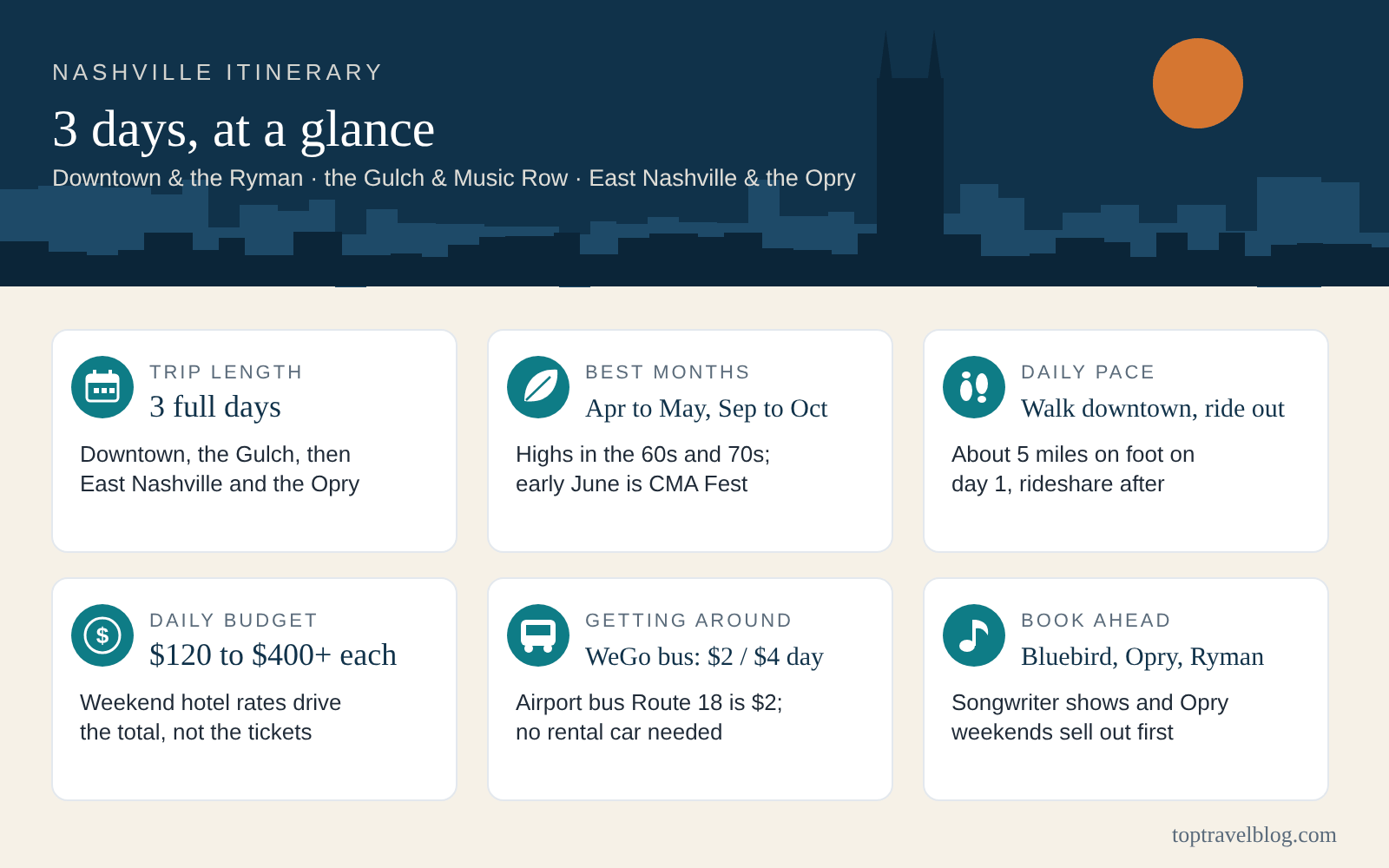
- Best for: music lovers, first-time visitors, couples, friend groups, families with kids 10 and up.
- Ideal length: 3 full days; 2 days works if you cut the Gulch and East Nashville, 4 days adds Cheekwood or the Hermitage.
- Best months: April to May and late September to October, when highs sit in the 60s and 70s and the patios are open.
- Where to stay: Downtown or SoBro for first-timers, the Gulch for a walkable and quieter base, East Nashville for neighborhood character.
- How to get around: on foot downtown, WeGo buses ($2 for a two-hour pass, $4 for a full day), and rideshare for the Opry, Green Hills and East Nashville at night.
- Book ahead: the Bluebird Cafe, a Ryman concert, the Grand Ole Opry, Country Music Hall of Fame tickets for weekends, and any Saturday dinner you care about.
- Key caveats: Lower Broadway is loud and crowded on weekends, Friday and Saturday hotel rates jump sharply, and summer humidity is real.
Best time to go: when this Nashville itinerary works best
If I could only pick one window, it would be late April through May. The dogwoods and redbuds are done, the days are warm without being sticky, the patios are open, and the festival calendar has not yet pushed hotel prices to their summer peak. The second choice is late September through October, when the heat breaks and the evenings are made for sitting outside a honky tonk with the doors wide open.
Here is how I think about each stretch of the year, because a good Nashville itinerary changes with the thermometer.
December to February: quiet and cheap, with a cold edge
Winter is the cheapest time for a room, and the live music does not care what the weather is doing. Highs sit in the 40s on a typical day, with occasional dips below freezing and the odd ice event that shuts the city down for a day. Lower Broadway is far less crowded on weeknights and you can usually walk into any honky tonk without a wait.
The trade-off is that outdoor stretches such as the pedestrian bridge and Centennial Park are less pleasant, so I move them to midday and keep the rest of the day indoors.
March to May: the best stretch, with one warning
Spring is lovely and it is also severe-weather season. Thunderstorms are common, and Tennessee gets tornado warnings that deserve respect, as the March 2020 tornado that cut across North Nashville reminded everyone. Keep a weather app on your phone and know that your hotel has an interior stairwell or lower floor. Most days are fine, with highs from the upper 60s in March to the low 80s by late May.
Hotel rates rise steadily through the spring, and weekends in May are expensive because of graduations, conventions and bachelorette parties.
June to August: hot, humid and busy
Summer highs reach the upper 80s and low 90s with humidity that makes the afternoon feel heavier than the number suggests. Early June brings CMA Fest, which fills downtown with fans, closes streets and sends rooms to the highest prices of the year. If you want the festival, book the hotel the moment dates are announced. If you do not, avoid that week entirely.
In summer I flip the Nashville itinerary so the outdoor walking happens before 11 a.m. and after 6 p.m., with museums and air-conditioned honky tonks in between.
September to November: warm days, cool nights
September is still warm, often in the 80s, and then October gives you the weather that this city should be sold on. Football Saturdays bring crowds downtown when the Vanderbilt and Titans schedules line up with a home game, and hotel prices follow. November is quieter and cooler, with the first holiday lights going up by the end of the month.
Tip: Whatever month you choose for your Nashville itinerary, look at the Friday and Saturday night rates before you book the dates. A Sunday-to-Wednesday stay can cost a third less than the same room over a weekend, and the music is just as good on a Tuesday. Many of the best songwriter nights in town are midweek anyway.
Days of the week matter as much as the month
The Grand Ole Opry mostly runs Tuesday, Friday and Saturday nights. The Frist Art Museum is closed Tuesday and Wednesday, the Tennessee State Museum is closed Monday, and the Parthenon closes at noon on Thursday. The Bluebird Cafe holds an open mic every Monday at 6 p.m. with no minimum and entirely first-come seating, which is the cheapest way into that famous room.
I build this Nashville itinerary around a Thursday-to-Sunday stay with swaps noted where a closure matters, and I give the Tuesday-to-Friday version in the rain notes.
How many days you really need for a Nashville itinerary
Three days is where the trip stops feeling like a checklist. Here is what changes at each length of Nashville itinerary.
2 days: downtown and one music night
With two days you can do the Country Music Hall of Fame, the Ryman and Lower Broadway on day one, then the Gulch, Music Row and an evening show on day two. You lose East Nashville and the Parthenon. It works for a long weekend tacked onto a work trip, and it is the version I would choose for a bachelorette or a guys’ weekend where the schedule is mostly late nights.
3 days: the Nashville itinerary in this guide
A 3-day Nashville itinerary gives each area its own half-day, leaves time for a long lunch, and absorbs one bad-weather afternoon without wrecking the trip. You see the museums, hear live music in three very different rooms, eat hot chicken and a proper biscuit, and still have a morning where the only plan is coffee. That is why I treat three days as the sweet spot.
4 or more days: now you can slow down
A fourth day adds Cheekwood Estate and Gardens, about 20 minutes southwest of downtown, or a half-day at the Hermitage, Andrew Jackson’s plantation east of the city. Both are worth doing, and the Hermitage tells the story of the enslaved people who worked the property as part of the tour.
With five days I would add Franklin, a historic small town about 30 minutes south, and a second night at the Bluebird or the Station Inn.
Pairing Nashville with another city
Nashville pairs naturally with other Southern cities by car or plane. Memphis is about three hours west and Louisville about three hours north. If you are building a longer Southern trip, my New Orleans itinerary covers the other great American music city, and the Savannah itinerary or Charleston itinerary cover the Lowcountry side of the same trip.
Worth knowing: Count your days honestly. A 4 p.m. landing at Nashville International and a 7 a.m. flight home three days later is two and a half days, not three. Arrival evening is for a walk down Broadway and a hot chicken sandwich, nothing more ambitious. Build the Nashville itinerary below around full days only.
Where to stay for your Nashville itinerary
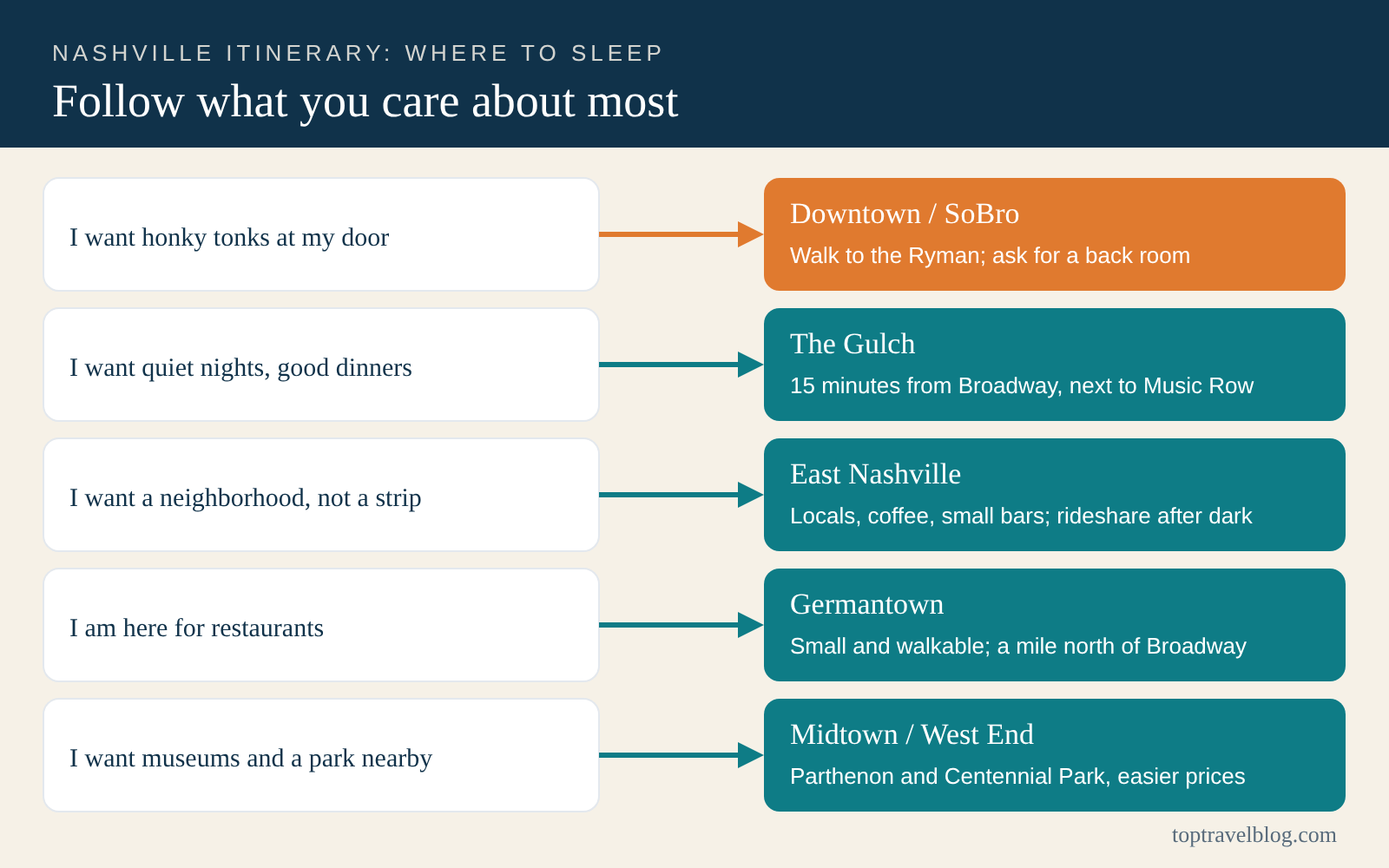
Nashville is spread out in a way that surprises first-timers. Downtown is walkable, the Gulch and Midtown are a 10 to 20 minute walk or a short ride away, and East Nashville, Green Hills and 12 South are all a rideshare. Pick a base that fits your plans for the evenings, because the mornings are easy anywhere.
Downtown and SoBro (Lower Broadway, the Ryman, the riverfront)
Best for: first-timers, short trips, nightlife, people who want to walk to everything
This is where most first visits happen, and it is where I put people who want the full honky tonk experience within a few blocks of the bed. You can walk to the Ryman, the Country Music Hall of Fame, the Johnny Cash Museum and the pedestrian bridge. The cost is noise: rooms facing Broadway and Second Avenue hear music until 3 a.m. on weekends. Ask for a high floor on a side street, or stay in SoBro, a few blocks southeast, for the same access with less volume.
The Gulch and Midtown (Demonbreun, 12th Avenue, Music Row edge)
Best for: couples, repeat visitors, anyone who wants walkable dinners without the crowds
The Gulch is a 15-minute walk from Lower Broadway and sits beside Music Row, which makes it the most practical base for day two of this plan. It has good restaurants, the Station Inn and the “What Lifts You” wings mural. Hotels here run newer and quieter than downtown, though weekend prices are still high. Midtown just west is a little cheaper and close to Vanderbilt and the Parthenon.
East Nashville (Five Points, Woodland Street)
Best for: longer stays, return visitors, people who prefer neighborhoods to nightlife
East Nashville is where a lot of working musicians live, and it feels like a neighborhood rather than a destination. There are small inns and short-term rentals, restaurants that locals fill on weeknights and a ten-minute drive to Lower Broadway. The trade-off is that you will rely on rideshare after dark and a car makes sense if you stay more than three nights.
Germantown (north of downtown near the Farmers’ Market)
Best for: foodies, couples, quieter evenings
Germantown is small and walkable with some of the best restaurants in the city and a short walk to the Bicentennial Capitol Mall. It sits about a mile from Lower Broadway, which is a pleasant 20-minute walk at noon and a rideshare at midnight. Hotel choices are limited, so look at boutique inns and apartments.
My pick for a first Nashville itinerary is the Gulch if the budget stretches, and downtown if you want the music within arm’s reach. I would only stay on Lower Broadway itself if you are comfortable sleeping with earplugs.
What to check before you click book
Three things before you book a hotel for your Nashville itinerary. First, the nightly total after the destination fee and taxes; Nashville hotels commonly add a daily fee on top of the room rate, and a $279 room can become a $340 room. Second, parking, because downtown hotels often charge a large overnight fee for valet or garage and you can skip it if you arrive by air and rely on rideshare.
Third, the floor and the side of the building. A quiet room on a high floor facing away from Broadway is worth more than a bigger room facing the music. Read recent reviews for the words “noise” and “construction,” which come up often downtown.
The 3-day Nashville itinerary, day by day
Each day of this Nashville itinerary has one anchor area so you are not riding back and forth across town. Mornings start early because the museums are calmer at 9 a.m. than at noon, and evenings are built to be dropped if your feet are done. Walking times are real-world times at a visitor’s pace with photo stops, not the numbers a map app gives you.
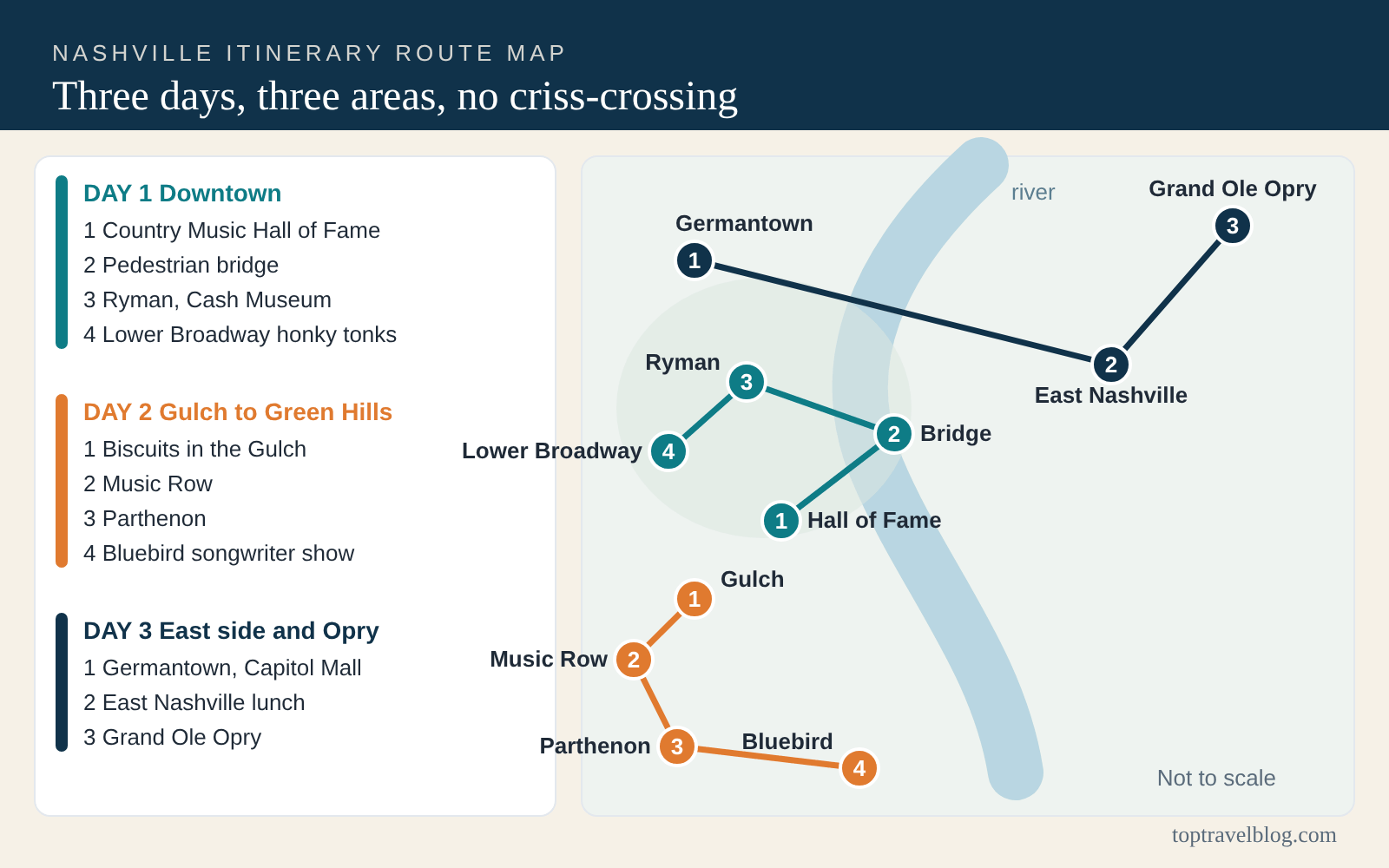
Day 1
Downtown, the Ryman and Lower Broadway
Morning: the Country Music Hall of Fame
The Nashville itinerary opens at the Country Music Hall of Fame and Museum, so be there when the doors open at 9 a.m. Adult admission is $31.95 and youth tickets (ages 6 to 12) are $21.95. Weekend mornings fill with tour groups by 11, and a Saturday at 1 p.m. feels very different from a Thursday at 9. The museum is a building for people who like stories more than memorabilia, and you can easily spend three hours in it.
The core is the Sing Me Back Home exhibit which traces country music from its roots in string bands, gospel and the blues through the Opry era and into the present. The cases hold Elvis’s “Solid Gold” Cadillac, Hank Williams’s handwritten lyrics and Dolly Parton’s rhinestone costumes. Read the labels in the first gallery; they explain why Nashville and not somewhere else became the center of the industry.
Two add-ons are worth the money if you are a real fan. The Studio B tour costs $23 as an add-on, and Hatch Show Print combines with the museum for $54.95 for adults. Studio B is where Elvis recorded more than 200 songs, and I would put it on day two with the Music Row walk, which is covered below. Hatch Show Print is the working letterpress shop that has printed posters for Opry and Ryman shows since 1879, and it is a 10-minute stop, not a half-day.
Late morning: the riverfront and the pedestrian bridge
Walk out the front door and turn toward the river. Lower Broadway is about four blocks north and the Cumberland River is two blocks east. The John Seigenthaler Pedestrian Bridge (the old Shelby Street Bridge) is the best free view in the city, and the walk across and back takes about 25 minutes. Go in the morning for the quiet and the sun on the skyline, or at sunset on any evening with clear weather.
On the way you pass Fort Nashborough at the foot of Broadway, a replica of the 1779 settlement that is free to walk through. It takes ten minutes and gives the downtown a little context.
Lunch: hot chicken on Lower Broad
You will see signs for Nashville hot chicken everywhere, and you should have it once. The classic heat levels run from plain through mild, medium and hot to a version most people regret. Hattie B’s has a Lower Broad location that serves the standard order of a chicken tender plate with white bread, pickles and a side of greens or pimento mac. Lunch lines at Hattie B’s can run 30 to 45 minutes on a weekend, which is why I go at 11 a.m. or after 2 p.m.
If that line looks silly, eat something else. There are plenty of good places in the blocks around Second Avenue, and the better hot chicken in town is on the other side of the river and in neighborhoods you will visit later.
Heat warning: Order one level below what you think you can handle. “Medium” at a serious hot chicken shop is hotter than you expect, and the oil keeps working for an hour after you finish. Have milk, bread and a sweet drink nearby, and do not touch your eyes.
Afternoon: the Ryman and the Johnny Cash Museum
The Ryman Auditorium is a short walk north from Broadway on 5th Avenue, and its daytime tours run every day from 9 a.m. to 4 p.m. The self-guided tour costs $25 plus tax, and children 12 and under are free with a paid adult. The guided backstage tour is $42.52 plus tax and takes about an hour and a half.
The auditorium began as a gospel tabernacle in 1892 and later became the Opry’s home from 1943 to 1974, and its wooden pews and stained glass still make it one of the best-sounding rooms in the country.
I would do the self-guided tour unless you are a serious history person. Stand on the stage, look out at the pews and imagine a 1950s Opry crowd. That moment is the whole point, and it costs less than the backstage version.
Then walk back to the Johnny Cash Museum at 119 3rd Ave South. Adult admission is $32.95 and it is open 9 a.m. to 7 p.m. daily. It is smaller than the Hall of Fame and tells one story well, with his handwritten letters, instruments and a short documentary. Plan 75 minutes. If you only have budget for one of the paid museums today, I would choose the Hall of Fame and skip this.
Evening: Lower Broadway and the honky tonks
Lower Broadway is the street most people picture when they plan a Nashville itinerary. The honky tonks run music from about 10 a.m. to 3 a.m., and most have no regular cover charge. Tipping the musicians is expected, and the bands on stage play for tips more than for a salary. Walk the strip from 2nd Avenue to 5th Avenue and let the sound pull you in.
Start your Nashville itinerary evening at Robert’s Western World, a small and loud room where the house band plays traditional country and the grilled bologna sandwich is a local tradition. Tootsie’s Orchid Lounge is the famous one and always crowded, with three floors and an alley entrance for when the front is jammed. Legends Corner and The Stage on Broadway are both good choices for a second stop.
My rule is simple. Pick two bars, stay for a full set at each, and do not try to see eight. You see more of the music by staying put, and the bands tend to be better in the quieter early evening (6 to 8 p.m.) than at 11 p.m. on a Saturday.
For dinner, eat before the bars or after one set. A sit-down meal at 7 p.m. in a restaurant a few blocks from Broadway is calmer than anything on the strip.
Logistics: Day 1 of the Nashville itinerary covers about 5 miles on foot. Hall of Fame to the pedestrian bridge, 10 minutes. Bridge loop, 25 minutes. Broadway to the Ryman, 6 minutes. Ryman to the Johnny Cash Museum, 6 minutes. Everything on this day is within a 15-minute walk of everything else.
If it rains: Swap the bridge for the Tennessee State Museum (free, Tuesday to Saturday 10 a.m. to 5 p.m., Sunday 1 to 5 p.m.) and keep the Ryman and the honky tonks. The bars are covered and the music does not stop for rain.
With kids: Do the Hall of Fame and the Ryman in the morning, have lunch at 11:30 a.m., and be on Lower Broadway only until about 5 p.m. Many of the bars admit all ages during the day and switch to 21 and over at night, so the afternoon is the window for older children and teenagers.
Day 2
The Gulch, Music Row, the Parthenon and a songwriter night
Morning: biscuits in the Gulch
Take a rideshare or walk 15 minutes from Lower Broadway to the Gulch, a former rail yard turned into a neighborhood of condos, restaurants and murals. Biscuit Love is the breakfast line that locals complain about and join anyway. It has several locations and the one in the Gulch is the original. Go before 8 a.m. on a weekday or accept a 40-minute wait on a weekend.
While you wait, walk to the “What Lifts You” wings mural on 11th Avenue South, which is the most photographed wall in the city. If it looks like a social media backdrop, that is because it is one, and there is usually a short queue of people taking pictures. It takes five minutes.
Late morning: Music Row
From the Gulch, walk or ride five minutes to Music Row, the two parallel streets (16th and 17th Avenues South) where the labels, publishers and studios have been for 60 years. There is not much to see from the sidewalk: low houses, sleek offices, brass plaques. The point is the sense of where songs actually get written.
Walk to the roundabout and the Musica statue at the north end, a bronze sculpture of nude dancers that locals have mixed feelings about. Then, if you booked it, take the Studio B tour that leaves from the Country Music Hall of Fame. The tour is the only way inside, and it is worth it if you love Elvis, Dolly Parton or Roy Orbison.
Skip if short on time: If you are not a serious music fan, treat Music Row as a ten-minute drive-by rather than a stop. The Hall of Fame covers the same material with better exhibits, and the walk is mostly offices. Spend the saved hour in Centennial Park.
Lunch: hot chicken, round two
If you skipped the line downtown, now is the time. Hattie B’s Midtown is near Vanderbilt and the Music Row area, and it is a short rideshare from Music Row. Lunch lines are shorter before 11:30 a.m. than at noon. A tender plate or a half chicken with sides runs about $13 to $20, which is typical for Nashville.
If you would rather skip the heat, try a meat-and-three at a local cafe or sit down for barbecue. Meat-and-three is a Southern tradition: you pick a meat and three sides from a steam table, and a plate costs around $14 to $18.
Afternoon: Centennial Park and the Parthenon
Nashville built a full-scale replica of the Parthenon for the 1897 Tennessee Centennial Exposition, and it is still the stranger and more charming part of the city. Inside is a 42-foot statue of Athena, gilded and enormous, plus a gallery of American paintings in the basement. Admission is $15 for adults and $10 for seniors and youth ages 4 to 17. It is open Monday to Wednesday and Friday to Saturday from 9 a.m. to 4:30 p.m., on Sunday from 12:30 p.m., and only until noon on Thursday.
Park the Athena visit at 45 minutes, then walk the lake in Centennial Park for another 30. The park is a few minutes from Vanderbilt and the whole West End area, which feels like a different city from Lower Broadway.
Next door, 12 South is a pretty strip of boutiques, coffee shops and the “I Believe in Nashville” mural, and it is a ten-minute rideshare from the Parthenon. I would do it only if you like browsing; it is a shopping street, not an attraction.
For an alternative, the Frist Art Museum sits downtown at 919 Broadway in a restored Art Deco post office. Adult admission is $20, under-19s are free, and it is open Monday and Thursday through Sunday (closed Tuesday and Wednesday). Its rotating exhibits are good and the building is a landmark in itself.
Evening: a songwriter night
This is the part of the Nashville itinerary I would not skip. Nashville is a town where songwriters perform their own songs in small rooms, and you hear a song and the story behind it in the same breath. You have three good options.
The Bluebird Cafe in Green Hills is the famous one, a 90-seat room where Garth Brooks and Taylor Swift were discovered. Reservations are made only through the cafe’s own website, and the shows carry a $15 food and drink minimum per person. A few seats are held for walk-ups at most shows, but you have to stand in line to claim one. The Monday open mic at 6 p.m. is first-come and has no minimum.
The Station Inn in the Gulch is the other. It is a tiny, cinder-block bluegrass club and it holds a free bluegrass jam on Sunday nights.
If neither fits, the Listening Room Cafe and several smaller clubs host songwriter rounds most nights. Eat dinner first, because a songwriter room is about the music rather than the menu.
Logistics: Day 2 of the Nashville itinerary has more rideshare than day one. Lower Broadway to the Gulch, 15 minutes on foot. Gulch to Music Row, 5 minutes by car. Music Row to Centennial Park, 7 minutes by car. Centennial Park to Green Hills for the Bluebird, 15 to 20 minutes by car.
If it rains: Move the Parthenon to the afternoon and the Frist Art Museum to the morning, and skip 12 South. A rain-soaked Gulch mural is not worth a stop.
With kids: The Parthenon is the one stop children actually like, because of the giant Athena. The Bluebird is a quiet listening room where talking is discouraged, which makes it hard for young kids. Use the Station Inn Sunday jam or a daytime honky tonk instead.
Day 3
East Nashville, Germantown and the Grand Ole Opry
Morning: Germantown and the Capitol Mall
Day three of the Nashville itinerary starts in Germantown, a compact neighborhood of brick row houses about a mile north of Lower Broadway. Have a slow breakfast at one of the cafes along 5th Avenue North, then walk to Bicentennial Capitol Mall State Park, a free park at the foot of the State Capitol with a 200-foot granite map of Tennessee and a walkway of the state’s 95 counties. It is a quiet, odd, pleasant place and almost no tourists go.
If it is a Tuesday through Saturday morning, walk across to the Tennessee State Museum, which is free and covers the state’s history from prehistory to music. Ninety minutes is plenty, and the Civil War and music galleries are the best.
Late morning: the Nashville Farmers’ Market
The Nashville Farmers’ Market sits beside the Capitol Mall and is a good place for coffee, a Southern breakfast or an early lunch. It has an indoor food hall and an outdoor farm shed. It is more of a locals’ place than a sight, which is exactly why I like it.
Lunch: East Nashville
Take a rideshare across the Cumberland to East Nashville, about 10 minutes. The commercial center is Five Points, where Woodland Street, 11th Street and Fatherland Street meet. Here you find coffee shops, record stores, small restaurants and the best tacos I have eaten in the city at Mas Tacos Por Favor, a little counter that closes in the afternoon and stays closed on Sunday and Monday. Lunch here runs $10 to $18 per person.
Walk the neighborhood for an hour. East Nashville is residential, with 1920s bungalows, painted murals and bars that look like a living room. It is where many songwriters and session players actually live, which is a good reason to spend an afternoon here.
Afternoon: Third Man Records or a slow walk
If you like music beyond country, Third Man Records, Jack White’s label, runs a record shop and a venue just south of downtown. It is a fun hour for a vinyl fan and a skip for everyone else. Otherwise, use the afternoon the way locals do: get a coffee, sit in a park such as Shelby Bottoms Greenway, or go back to the hotel for a break before the evening.
Evening: the Grand Ole Opry
The Opry is the anchor of many a Nashville itinerary, and it is the longest-running radio show in American history and the last of the great country music institutions to still do what it did in the 1920s. Shows are mostly on Tuesday, Friday and Saturday nights at 7 p.m., with a second 9:30 p.m. show on some dates. The Opry House is about nine miles northeast of downtown, so the trip takes 20 to 30 minutes by rideshare and longer on a Friday.
Standard tickets generally run from about $50 to $100 or more, depending on the lineup and the seating. A show lasts about two and a half hours, and artists rotate through short sets, so you see a string of performers in one night. You do not need to know the names; the format is the point. Wear whatever you want. The crowd ranges from sequined shirts to sneakers.
If the schedule does not line up, a Ryman concert is the best substitute. Its calendar covers everything from country to rock and the acoustics are superb. The daytime backstage tour at the Opry House is a good alternate when no show lines up.
Logistics: Day 3 of the Nashville itinerary is mostly short rides. Germantown to the Capitol Mall, 10 minutes on foot. Farmers’ Market to East Nashville, 10 minutes by car. East Nashville to the Opry House, 15 to 20 minutes by car outside rush hour.
If it rains: Spend the morning at the Tennessee State Museum and the Farmers’ Market food hall, and swap the East Nashville stroll for the Frist Art Museum or a long coffee at a cafe. The Opry is covered and is not canceled by rain.
With kids: Kids tend to like the Capitol Mall map, where they can walk from county to county. The Opry is fine for children over 8 who can sit through a long show. If you have younger children, an afternoon at Cheekwood is the better choice.
If you have a fourth day
Day four is the one I would use for Cheekwood Estate and Gardens, a 1930s mansion and botanical garden about 20 minutes southwest of downtown, or for the Hermitage. Both are best done by rideshare or rental car, and both fill a half-day. Add a late lunch in Franklin if you are driving.
Getting around: WeGo buses, rideshare, walking and the airport
Downtown Nashville is walkable and the rest of the city is not. You do not need a car for this Nashville itinerary, and I would argue against renting one unless you plan to add Cheekwood, the Hermitage or Franklin. Here is how each option actually works.
From Nashville International Airport
The airport (BNA) is about 8 miles east of downtown. The cheapest way in is WeGo Route 18, which runs between the Ground Transportation Center on Level 1 of the Terminal 2 Garage and the Elizabeth Duff Transit Center at WeGo Central downtown. WeGo’s airport page lists the fare at $2 each way and the trip at roughly 20 minutes on the express and 35 to 45 minutes on local runs. Luggage is allowed.
Rideshare and taxis take 15 to 25 minutes depending on traffic and cost roughly $25 to $45 to Lower Broadway, with higher prices during surges and on weekend nights. For two or more people with bags, the rideshare is the easier choice. For one solo traveler on a budget, the bus is a real saving.
WeGo buses
WeGo is the local transit system, and its fare page lists a $2 two-hour pass, $4 for a full day and $65 for a calendar month, payable with a QuickTicket card or app, a contactless debit or credit card, or a phone wallet. It does not accept American Express. Cash fares are $2 exact change with no transfers.
The honest picture for a Nashville itinerary is that buses are good for a few useful trips and unreliable for tight schedules. Frequency drops sharply in the evening, and some routes do not run late. I use it for the airport and for daytime moves along the main corridors, and I switch to rideshare when I am meeting someone at a set time.
Rideshare and taxis
Rideshare is how most visitors get between neighborhoods. Fares between downtown and the Gulch, Music Row or East Nashville usually come to $10 to $20, and Opry trips run higher. Friday and Saturday nights between 9 p.m. and 1 a.m. are surge periods. Pickups on Lower Broadway can be chaotic; walk a block or two off the strip to meet your driver.
Walking, scooters and parking
You can walk between the Hall of Fame, the Ryman, the Cash Museum and the bridge in under 15 minutes each way. Everything beyond that is better by car. Hotel parking downtown commonly costs $40 or more a night, and meters and garages near Broadway get expensive on weekends, so skip the rental car if you are staying central.
Tip: Plan evenings so you take one ride out and one ride home. Hopping between five neighborhoods in a night turns into a long and expensive series of waits. The route in this Nashville itinerary keeps each evening inside a single area for that reason.
What this Nashville itinerary costs per day
A Nashville itinerary is cheaper than the New York City itinerary I wrote up or a San Francisco trip and more expensive than most people expect, mainly because of hotel prices on weekends. The figures below are per person per day, assuming two people sharing a room, in a shoulder-season month. Taxes and fees add up to roughly 15 percent or more on top of hotel rates.
Budget: roughly $120 to $180 a day
A shared room or modest hotel outside the downtown core at $70 to $110 per person per night, a $2 bus pass or two rideshares, breakfast at a coffee shop ($8 to $12), a meat-and-three or tender plate for lunch ($14 to $20), and a cheap dinner ($15 to $25). Sights are one paid attraction a day at most, and the free list does the rest: the pedestrian bridge, Fort Nashborough, the Capitol Mall, the Tennessee State Museum and free live music on Lower Broadway.
Mid-range: roughly $250 to $350 a day
A downtown or Gulch hotel at $130 to $200 per person per night on a weekday and more on a weekend, a couple of rideshares ($20 to $40), a sit-down dinner with a drink ($45 to $70), and two paid tickets a day. This is the version of the Nashville itinerary most people actually take. It includes the Hall of Fame, the Ryman tour, a Bluebird show and an Opry night over three days.
Comfortable: roughly $400 to $600 a day
A premium hotel, a Ryman or Opry show with better seats, dinner at one of the city’s well-regarded restaurants ($80 to $130 each with wine), and a private driver for one evening. Nashville does this version well. Remember that weekend rates and event weekends can double the hotel line.
Where the money actually goes
The three biggest expenses are the room, the Opry or Ryman ticket and drinks on Lower Broadway. Bar tabs grow quickly, with a beer or cocktail at a honky tonk often running $8 to $16 each. Set a limit before you walk in and consider switching to water between rounds; nobody on the stage cares.
What to book ahead for a Nashville itinerary
The list of things you must reserve is short, but a few do sell out. Here is what I book for this Nashville itinerary, when, and where.
Several weeks out
The Bluebird Cafe. Shows are reserved online ahead of time, and the popular weekend ones disappear fast. The cafe’s own website is the only place that sells valid tickets, and it states plainly that resale tickets will not be honored. Treat anything offered on StubHub as invalid.
Also book the Grand Ole Opry if you have a specific lineup in mind. Standard seats on weekdays often remain available close to the date, but the Saturday night shows sell the best seats first. The Opry’s calendar lists the upcoming shows.
A few weeks out
A Ryman concert if there is an act you want. The Ryman hosts music across genres and the best seats for popular artists go on sale months ahead. Buy Hall of Fame tickets (and Studio B) in advance if you are going on a weekend; weekday mornings are easy to buy on the day.
One to two weeks out
Dinner on Friday and Saturday at any restaurant you care about, especially in Germantown and the Gulch. Weekday tables are much easier. If you are going to a popular hot chicken or biscuit place with a line, no reservation is needed, just a strategy.
Walk-up options
The Station Inn sells tickets at the door for many shows, and its Sunday jam is free. The Bluebird’s Monday open mic is first-come. Lower Broadway needs nothing. These are the ways in if you are visiting on short notice.
Food worth planning your Nashville itinerary around
Nashville eats better than its reputation for fried chicken and whiskey bars suggests. The trick on any Nashville itinerary is to pick one signature meal per day and let the rest be easy.
Hot chicken
Hot chicken is the one dish people come for. It is fried chicken coated in a cayenne paste, served on white bread with pickles. The heat scale is real. Hattie B’s is the easy introduction, with locations including Lower Broad and Midtown. Prince’s Hot Chicken Shack, which claims to have invented the dish, is the old-school alternative and sits south of downtown; expect a line and a cash-heavy room.
Meat-and-three and biscuits
A meat-and-three is the Southern lunch format: a meat, three sides and cornbread. Biscuit Love in the Gulch has the better-known brunch, and the Loveless Cafe on Highway 100, about 30 minutes southwest, is the old roadside classic with a long wait and good biscuits. Both are worth one meal.
Barbecue and Southern dinners
Nashville is not a barbecue city in the way Memphis is, but there are good pits. For a sit-down dinner, Germantown and the Gulch have the best concentration of restaurants. This is where you spend the big meal of the trip. Rolf and Daughters in Germantown is the one I recommend most, a pasta-and-grill room in an old warehouse that is hard to get into on a weekend.
Coffee is easy: Frothy Monkey, Barista Parlor and Five Daughters Bakery on 12 South are the three stops locals use, and the bakery’s 100-layer donuts are worth a detour.
Common mistakes on a first Nashville itinerary
These are the ones I see most often, in rough order of how much they cost in time, money or mood.
1. Spending the entire trip on Lower Broadway
It is fun for a night. By the third night it is the same four songs, the same crowds and the same bachelorette party. The city’s best music is in the Bluebird, the Station Inn, the Ryman and the neighborhoods. A good Nashville itinerary gives Broadway one good evening and spends the others elsewhere.
2. Booking a room on Broadway and expecting to sleep
Rooms that face the strip hear music through the glass until 3 a.m. on weekends. If you are a light sleeper, book a back-facing room or stay in SoBro, the Gulch or Midtown.
3. Assuming everything is walkable
Downtown is. The rest of Nashville is not. East Nashville, Green Hills, 12 South and the Opry all need a ride. Add the cost of six to ten rideshares to your budget or you will be surprised.
4. Skipping the reservations that matter
The Bluebird and the Opry are not “show up and see” experiences on weekends. The Hall of Fame is easy to walk into on a Tuesday and crowded on a Saturday. Book the three or four things in the previous section and treat the rest as spontaneous.
5. Ignoring the closures
The Frist is closed Tuesday and Wednesday. The Tennessee State Museum is closed Monday. The Parthenon closes at noon on Thursday and is closed on Metro holidays. The day plan above accounts for these, but if you shuffle days, keep them in mind.
6. Planning the Opry without checking the lineup
The Opry features a rotating cast, and the show you attend can be anything from a few big names to an evening of newer artists. Look at the lineup once you have a date and choose the night that has the people you care about.
7. Underestimating the heat and the storms
July can feel like walking through a wet towel, and spring brings fast thunderstorms. Carry water, wear shoes you can walk in and keep a rain jacket in the daypack.
Frequently asked questions about this Nashville itinerary
Is 3 days enough for a Nashville itinerary?
Yes. Three full days of a Nashville itinerary cover downtown and the Ryman, the Gulch and Music Row, East Nashville and Germantown, and an evening at the Opry or a songwriter show. Two days is enough for the highlights, and four days adds Cheekwood or the Hermitage. Most first-time visitors tell me three days feels full without being exhausting.
What is the best time of year to follow a Nashville itinerary?
For a Nashville itinerary, late April through May and late September through October are the best. Highs are in the 60s and 70s, the patios are open and the humidity is manageable. Summer is hot and humid, winter is quiet and cheap, and early June brings CMA Fest with the year’s highest hotel prices.
Do I need a car in Nashville?
No, not for this Nashville itinerary. Downtown is walkable, and rideshare covers the Gulch, East Nashville, Green Hills and the Opry. A car makes sense if you add Cheekwood, the Hermitage or Franklin. Downtown hotel parking often costs $40 or more a night, so it is a real expense for a car you do not need.
How much does a Nashville trip cost?
A Nashville itinerary like this one runs roughly $120 to $180 per person per day on a budget, $250 to $350 in mid-range comfort and $400 or more for a premium trip, assuming two people share a room. Weekend hotel rates are the main variable, followed by tickets to the Ryman and the Opry and bar tabs on Lower Broadway.
Where should I stay in Nashville for the first time?
For this Nashville itinerary I recommend downtown or SoBro if you want to walk to the honky tonks, and the Gulch if you want quieter evenings and good restaurants. East Nashville is better for a second visit. Avoid rooms that face Broadway unless you sleep through noise easily.
Is Lower Broadway safe at night?
It is crowded and busy rather than dangerous, but it needs normal city awareness. Watch your drinks and your phone, expect pickpockets in dense crowds, and keep a plan for getting back to your hotel. Weekend nights are the loudest, and the street gets more rowdy after 10 p.m.
How do I get from the airport to downtown?
The WeGo Route 18 bus runs from the airport to the Elizabeth Duff Transit Center downtown for $2 and takes roughly 20 to 45 minutes depending on the run. Rideshare takes 15 to 25 minutes and costs roughly $25 to $45. Taxis are similar. Rideshare is simplest if you are traveling with luggage or a group.
Can I see the Grand Ole Opry in one night?
Yes. The Opry is on most Tuesday, Friday and Saturday nights at 7 p.m., with a late show on some dates. A performance lasts about two and a half hours. Drive time from downtown is 20 to 30 minutes. The Opry House also offers a daytime backstage tour on days without a show.
Is Nashville good with kids?
It can be. The Hall of Fame, the Parthenon, Centennial Park, the pedestrian bridge and the Capitol Mall all work for children, and Lower Broadway is fine in the afternoon. Evenings on the strip are not a family scene. Teenagers who like music tend to enjoy the Ryman tour most.
Is Nashville worth visiting if I do not like country music?
Yes, though I would reshape the Nashville itinerary. Nashville has strong rock, blues, jazz, bluegrass and soul scenes, and the food is good enough to justify the trip alone. Skip the Hall of Fame, use the Ryman for a non-country show and spend more time in East Nashville and the Gulch.
One last thing before you go
The thing I would do differently next time, every time, is leave one night with no plan. Not “optional honky tonk,” not a backup reservation, just a walk out of the hotel and a turn toward whichever door has the best sound coming out of it.
The best nights I have had in this city were unplanned ones: a duo in a bar with eight people in it, a bluegrass jam where a fiddle player was about 15 years old, a bartender who told me where to find the best biscuit before I asked. A Nashville itinerary is scaffolding. The music fills it in.
The other thing I would say is to be kind to yourself about pace. Three days of this Nashville itinerary is roughly 15 miles of walking, a few late nights and a lot of noise. It is normal to hit a wall on the afternoon of day two, and the fix is an hour in the hotel, not a fourth museum. Most people leave planning their return. Build the first trip so that you want to.
Related planning guides
- New Orleans itinerary: 3 days of food, music and historic neighborhoods — the other great American music city, with a completely different sound.
- Savannah itinerary: 3 days of squares, history and Lowcountry food — a slower Southern city that pairs well with a Nashville weekend.
- Charleston itinerary: 3 days of historic streets, food and beaches — the Lowcountry sibling, planned the same way.
- Washington, DC itinerary: 3 days of monuments, museums and neighborhoods — another walkable city built around free museums.
- Las Vegas itinerary: the best 3 days on and off the Strip — the other American city that stays up all night.