

Three days is the right amount of time for a first visit, and it is the number this New Orleans itinerary is built around. Day 1 is the French Quarter, from beignets at sunrise to a 45-minute jazz set at Preservation Hall. Day 2 pairs the National WWII Museum with the St.
Charles streetcar, the Garden District and a late night on Frenchmen Street. Day 3 covers Tremé, City Park and the Bywater, the neighborhoods that explain why the music sounds the way it does.
Two days squeezes this New Orleans itinerary into the greatest hits and a sore pair of feet. Four lets you add a swamp or plantation trip, or simply sit down for a long lunch.
The honest summary: a good New Orleans itinerary is built around meals, music and the heat, not around a checklist of attractions. The sights are real, but the best hours of the trip usually happen between them, on a porch, in a line outside a po-boy shop, or in a bar where the band starts at 10 p.m.
and nobody checks a watch. This plan suits first-time visitors, couples, friends and adults traveling together, and families with older kids. It is a harder fit for anyone who dislikes crowds, late nights or humidity.
I have been to New Orleans in February, in the middle of Jazz Fest, and in August, when I regretted it by lunchtime. What follows is the New Orleans itinerary I would hand a friend: the order of days that keeps you from backtracking, the streetcar and airport fares as I found them in late 2026, where to sleep, and the mistakes I see people make on Bourbon Street at midnight.
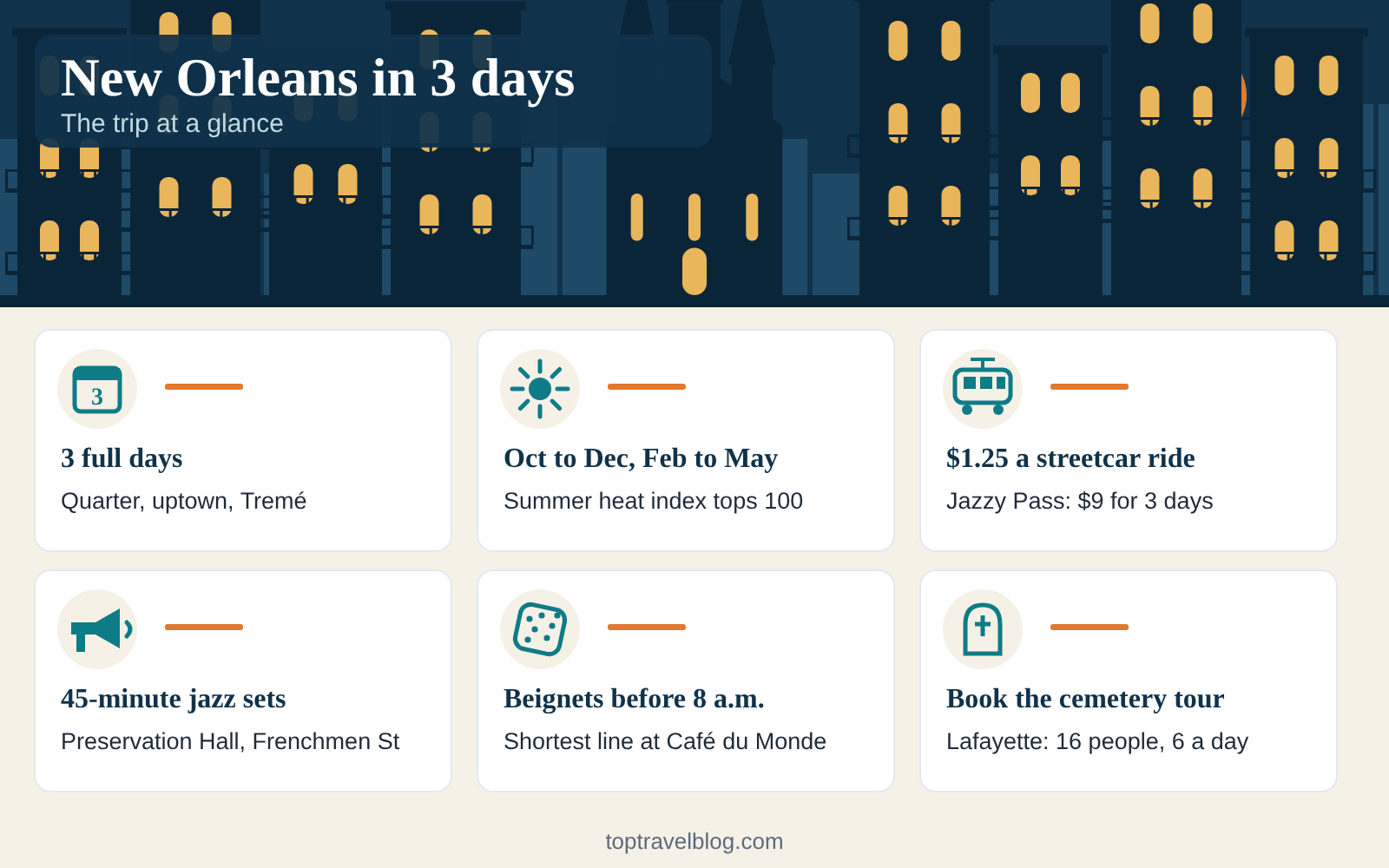
Quick facts: this New Orleans itinerary at a glance
- Best for: first-time visitors, couples, friends, music and food lovers, families with older kids.
- Ideal trip length: 3 full days, plus an arrival evening. Two days is tight, four lets you add a swamp or plantation trip.
- Getting around: on foot in the French Quarter, the St. Charles and Canal streetcars ($1.25 a ride, Jazzy Pass $3 a day or $9 for three days), rideshare late at night. No rental car.
- Booking priorities: a Lafayette Cemetery No. 1 or St. Louis No. 1 guided tour, Preservation Hall, dinner at Commander’s Palace or Arnaud’s, National WWII Museum film times, and hotels for festival weeks.
- Best months: late October to early December and February to mid-May. Mardi Gras Day is February 9, 2027; French Quarter Festival is April 8 to 11; Jazz Fest runs April 22 to 25 and April 29 to May 2.
- Key caveats: summer heat index above 100 degrees, hurricane season from June through November, late-night noise on Bourbon Street, and hotel fees on top of the nightly rate.
Best time to go: when this New Orleans itinerary works best
If you can choose, go between late October and early December, or between February and mid-May. Daytime highs in those windows run from the 60s to the low 80s, the air is dry enough to walk for hours, and there is live music in the street on most weekends.
The two festivals that fill the spring calendar are the French Quarter Festival, April 8 to 11, 2027, with more than 20 stages scattered through the Quarter, and Jazz Fest, April 22 to 25 and April 29 to May 2, 2027, at the Fair Grounds Race Course.
Summer is the hard season for any New Orleans itinerary. From June through September the heat index regularly passes 100 degrees, afternoon thunderstorms arrive on schedule, and hurricane season runs June through November, with the real risk concentrated in August through October. Hotels are cheaper then for a reason.
If summer is your only option, do the New Orleans itinerary below with outdoor stops before 11 a.m. and after 5 p.m., and put museums, long lunches and the cemetery-free hours in the middle of the day.
Mardi Gras and Carnival season
Carnival season starts on January 6 and ends on Mardi Gras Day, which falls on February 9, 2027. The two weekends before Fat Tuesday are the biggest parade days, and the city looks and sounds different: streets close, hotel prices can double, and many properties require three- or four-night minimums.
I love it, but it is a different trip. Parades start from Uptown and along Canal Street, you will spend hours standing, and this New Orleans itinerary would need to be rewritten around parade routes. If Mardi Gras is the reason you are going, book a year ahead and stay within walking distance of Canal Street.
January through mid-February: cool, cheaper, and king cake season
Before the parades peak, January is the quietest month for visitors. Highs sit in the 50s and low 60s, rooms cost the least all year outside summer, and king cakes appear in every bakery and grocery store. Rain is frequent, though, and the damp cold feels sharper than the number on the thermometer. Bring a real jacket and shoes that tolerate puddles.
March through May: the festival stretch
This is peak season for good reason. The azaleas are out, crawfish is in season, and the weather is good enough for a patio at every meal. It is also when hotel rates climb and the two big festivals can push a standard room to well over double its off-season price. If you want the festival feel without the festival bill, go the first or second week of March or the middle of May.
October through December: my favorite window
Humidity breaks in October, Halloween brings costume parades and cemetery events, and November is the month most locals say they like best. The city gets crowded around the Saints home games, Thanksgiving weekend and Bayou Classic weekend, but a normal Tuesday in November feels relaxed in a way spring never does.
In December, Celebration in the Oaks in City Park runs from November 27, 2026 through January 1, 2027, and the Quarter is decorated for Christmas. Plan on cooler evenings and a fleece for the late music hours.
Tip: Whatever month you choose, ask about the sunset time. In late October the sun sets around 6 p.m. and in late June after 8 p.m. Your Day 1 river walk and the timing of the Garden District stroll on Day 2 both depend on that one number.
Days of the week matter for your New Orleans itinerary
Plan around the Tuesday-to-Thursday sweet spot if you can. Weekends fill the Quarter with bachelor and bachelorette parties and tourist traffic on Bourbon Street, and the best restaurants book out on Friday and Saturday nights first. The Whitney Plantation is closed on Tuesdays, and the Cabildo on Chartres Street closes on Mondays during the summer season.
Sunday afternoons from fall through spring are the time for second-line parades in the neighborhoods, the brass-band processions run by social aid and pleasure clubs. They are not tourist events. If you find one, stand to the side and be respectful.
How many days you really need for a New Orleans itinerary
Three full days is where the trip stops feeling rushed. The city is compact, but the pace is slow by design: lunch is a two-hour event, and the best music starts late. Here is what each length buys you.
2 days in New Orleans: the Quarter plus one more neighborhood
With two days, trim the New Orleans itinerary so that Day 1 in the French Quarter exactly as written below, and use Day 2 for the Garden District by streetcar, then dinner and music on Frenchmen Street. You skip the WWII Museum, which takes a half day if you do it properly, and you skip Tremé and City Park. It works as a long weekend or as an add-on to a conference.
3 days in New Orleans: the version I would book
A three-day New Orleans itinerary adds the National WWII Museum, a cemetery visit, Magazine Street and a day for Tremé, City Park and the Bywater. You eat at three or four places people have written about for decades and still have an evening to wander. This is the version I follow in the rest of this guide.
4 days in New Orleans: add a day trip or a slower pace
A fourth day on a New Orleans itinerary is for leaving town or for doing less. The two day trips most travelers choose are a swamp tour in the bayous west of the city and the Whitney Plantation, about an hour upriver in Wallace, Louisiana. The other option is to repeat the day you liked most with fewer stops: another long lunch, another set of music, another walk along the levee.
5 days or more
Five days lets you add Lafitte and Barataria for a paddling tour, the Lower Ninth Ward, Oak Alley or a drive to Cajun country around Lafayette. I would rather spend the extra days in the city than in a car. If you are building a longer Southern trip, pair this with the Nashville itinerary for another music capital, or add the Savannah itinerary and Charleston itinerary for the coastal historic cities.
Arrival day and departure day
Treat the arrival evening as free. Walk the Quarter after dinner, hear one band, and go to bed. The Louis Armstrong airport sits about 15 miles from the Quarter, so a late-morning flight home needs a 7:30 a.m. departure from your hotel on a normal weekday. Build this New Orleans itinerary around full days only.
Where to stay in New Orleans for a first visit
Where you sleep matters here for two reasons: noise and walking distance. A room on the wrong block of the French Quarter will keep you up until 3 a.m., and a room two miles from the music will have you paying for rides every night. My general rule for a first New Orleans itinerary is to sleep in the Quarter’s quieter upper or lower edges, in the Warehouse District, or on the streetcar line in the Lower Garden District, and to avoid anything fronting Bourbon Street between Canal and St.
Ann.
On price, plain, well-reviewed hotels in the center usually run roughly $150 to $250 a night in the shoulder months, $250 to $450 in festival weeks, and more during Carnival. Guesthouses and small inns in the Marigny and Garden District often come in below the big hotels. Budget travelers can find hostel beds and motels from about $50 to $120 away from the center.
I never promise a specific rate in print because they move weekly. Compare the hotel’s own site with a booking engine, and read the total with taxes and resort or facility fees before you commit.
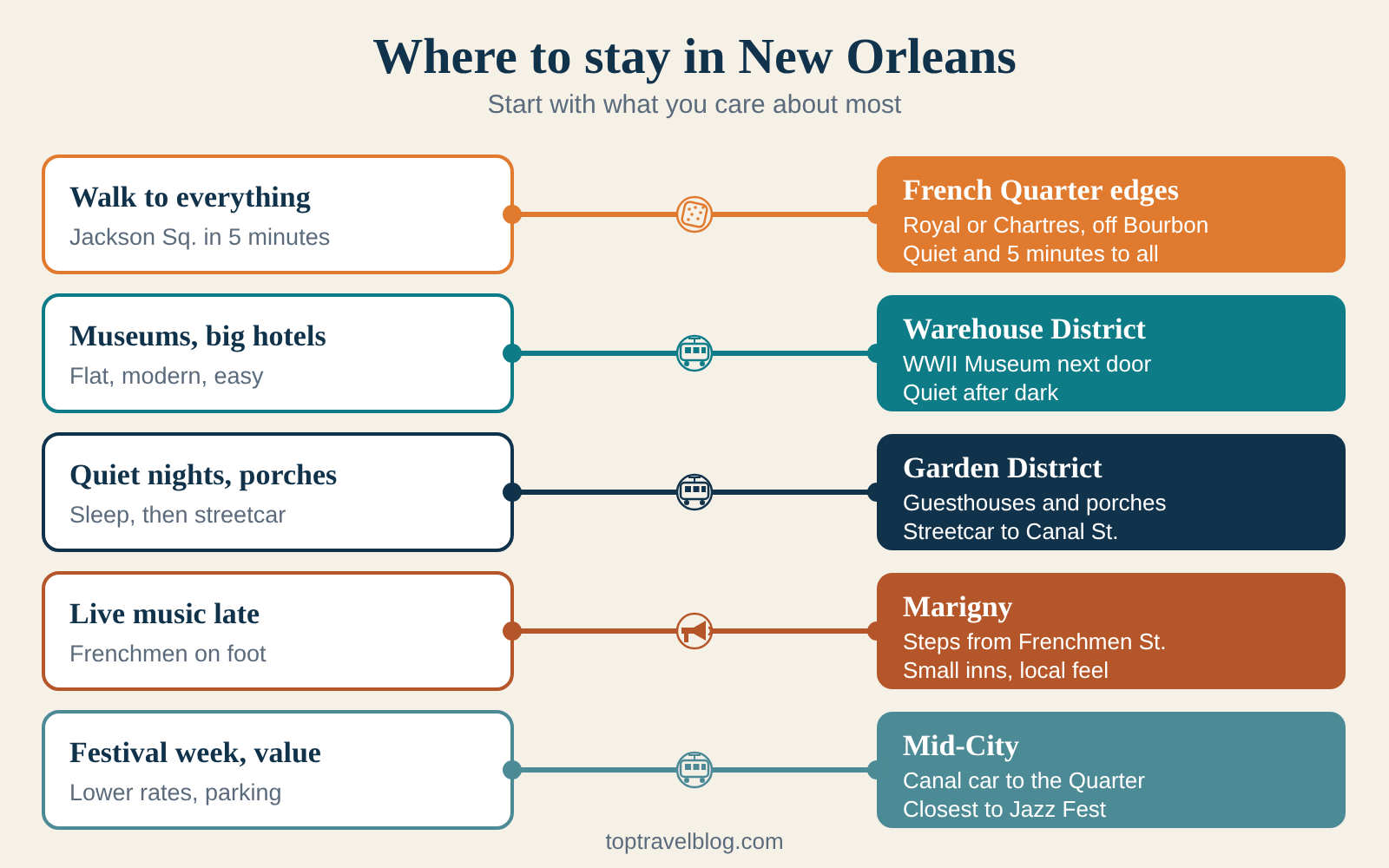
The five areas I recommend, and who each suits
French Quarter (the upper and lower edges)
Best for: first-timers, short stays, walkers
Put yourself on Royal, Chartres or Dauphine between St. Ann and Esplanade, away from Bourbon Street. You walk to Jackson Square, Preservation Hall and the river in minutes, and you step out of the hotel to the smell of coffee instead of the smell of Bourbon at 2 a.m. The trade-off is price and the odd sleepless night; ask for a courtyard room or an upper floor away from the street.
Central Business District and Warehouse District
Best for: museum people, business travelers, families
Larger modern hotels, a flat walk to the National WWII Museum, and the St. Charles and Loyola streetcar lines at your door. It is quiet after dark, which is the point. You are a 12 to 20 minute walk from the Quarter and the Superdome sits nearby on game days, when rates jump. Many properties here charge destination or parking fees that sit outside the quoted nightly price.
Lower Garden and Garden District
Best for: quiet nights, couples, return visitors
Guesthouses in old Victorian mansions along Prytania and St. Charles, with porches and breakfast included at some. The streetcar takes you to Canal Street in about 20 minutes. Dinner choices are excellent on Magazine Street. The downside is that you depend on the streetcar or rides to reach the live music, and the last streetcar home is not a reliable plan after midnight.
Faubourg Marigny and Bywater
Best for: music lovers, repeat visitors, anyone who skips Bourbon Street
Frenchmen Street is a short walk from the Marigny, and the Bywater is the city’s art-and-food neighborhood with a more local feel. Rooms are mostly small inns and rentals, so expect fewer hotel services. Walk home in groups late at night and choose a lit route; the edges of both neighborhoods change block by block.
Mid-City and City Park
Best for: festival visitors, budget stays
Lower prices, parking, and the Canal streetcar running straight to the Quarter in about 30 minutes. Mid-City suits Jazz Fest week because the Fair Grounds are a short ride away. I would only recommend it if you already know you will be out of the center most evenings.
If your budget is tight, skip the cheapest motels near the airport on Airline Drive. You will pay for rides to the Quarter, spend 40 minutes each way, and lose the late-night stroll that makes the city worth the trip.
Parking and the car question for a New Orleans itinerary
You do not need a rental car for this New Orleans itinerary. Quarter garages commonly cost $35 to $55 a night, street parking is a lottery of signs and tow zones, and break-ins are common enough that locals leave nothing visible in a parked car. Take the airport shuttle or a rideshare in, and use a car only for the day trips.
The 3-day New Orleans itinerary, day by day
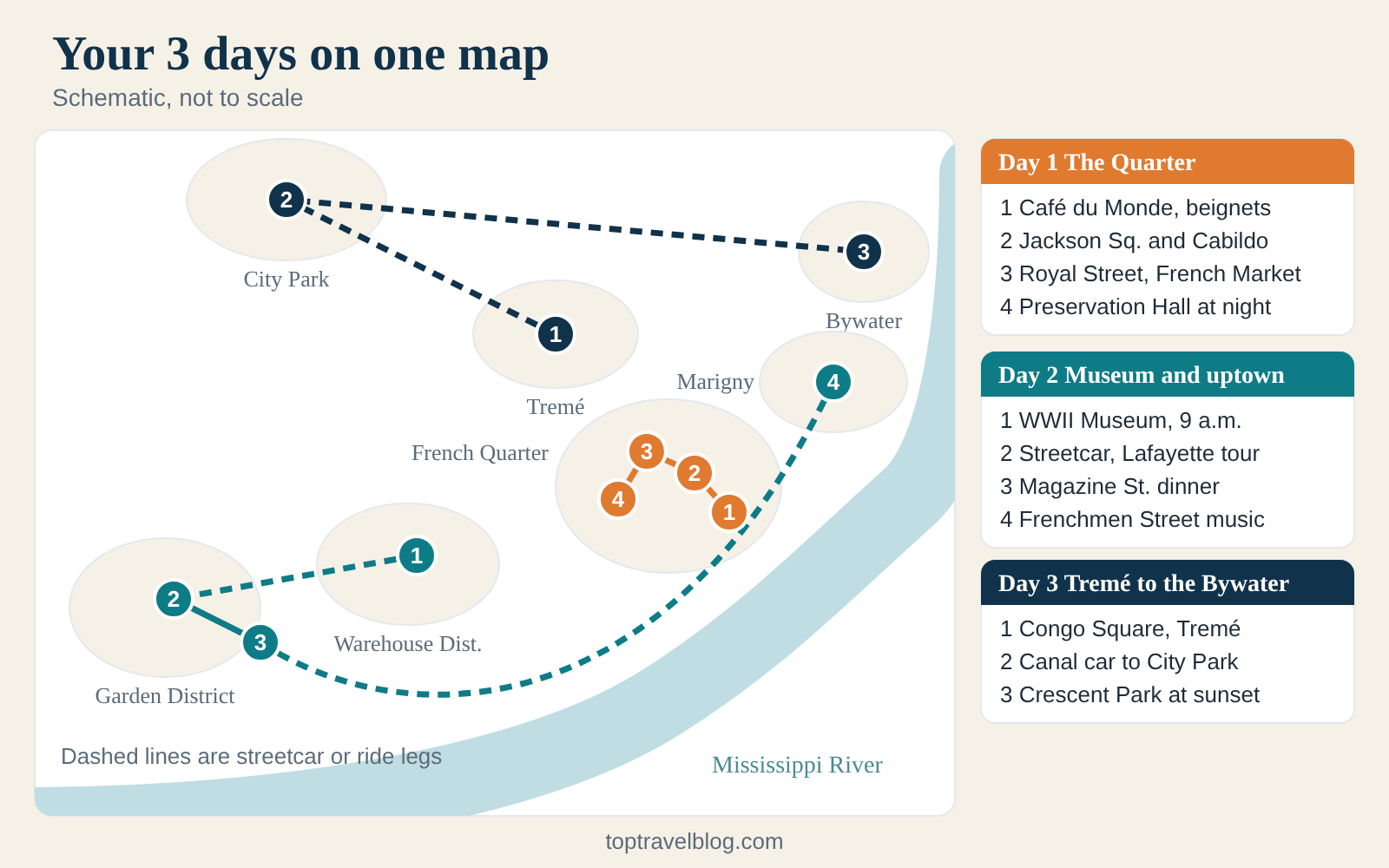
Each day of this New Orleans itinerary has one anchor area, so you are never riding back and forth across town. Morning starts are early because the Quarter is calm and cool at 8 a.m. and chaotic by noon. Walking times in this New Orleans itinerary are real-world times at a visitor’s pace with photo stops, not a map app’s. Evenings are menus, not schedules; drop whatever your feet refuse.
Day 1
The French Quarter, the river and Preservation Hall
Morning: beignets, Jackson Square and the Cabildo
Start your New Orleans itinerary at Café du Monde on Decatur Street before 8 a.m. The line is shortest early, the powdered sugar has not yet colonized the whole terrace, and the French Quarter is as quiet as it ever gets. Order an order of beignets and a café au lait, wear dark colors if you care about your shirt, and expect to leave looking like a snowman. Give it 35 minutes.
Walk across to Jackson Square, the old parade ground in front of St. Louis Cathedral. Artists set up along the iron fence, tarot readers and brass players claim the corners, and the equestrian statue of Andrew Jackson sits in the middle. Go into the cathedral if the doors are open; it is free and takes ten minutes.
Then buy a ticket for the Cabildo at 701 Chartres Street, the Spanish colonial government house where the Louisiana Purchase transfer ceremony took place in 1803. As listed by the Louisiana State Museum, admission is $15 for adults, children 6 and under are free, and it is open daily from 9 a.m. to 4 p.m. with last tickets at 3:30. The exhibits on Louisiana history, from the Native peoples to Reconstruction, make sense of the city in about 60 minutes.
Late morning: Royal Street and the Jazz park
Walk down Royal Street, the quieter, more elegant parallel to Bourbon, for six blocks. The galleries and antique shops, the iron balconies and a musician on nearly every corner make this the walk I recommend before noon. The Historic New Orleans Collection at 533 Royal runs free exhibition galleries in a set of restored buildings and is a good air-conditioned stop.
Then drop by the visitor center of the New Orleans Jazz National Historical Park at 916 North Peters Street, inside the French Market. The National Park Service runs this small park with exhibits and live performances, and rangers can tell you which of the day’s free programs fit your schedule. Give it 30 to 40 minutes.
Lunch: muffuletta or a courtyard
Lunch in the Quarter is one of the easiest decisions of any New Orleans itinerary. For a classic New Orleans sandwich, Central Grocery on Decatur Street is the muffuletta original: a round Sicilian loaf with olive salad, ham, salami and provolone, big enough to split. Napoleon House on Chartres serves a warm version and a Pimm’s Cup in a quiet courtyard, a better place to sit down.
For a proper restaurant lunch, Galatoire’s on Bourbon Street, famous for its long Friday lunch, is the old-school option, with jackets required at dinner and all day Sunday.
Afternoon: the river, the French Market and a rest
Climb the Moonwalk steps across from Jackson Square and watch the Mississippi churn past. The Woldenberg Riverfront Park next door is a good spot for a sit. Follow the riverfront promenade toward the French Market, a block-long covered arcade with produce, hot sauce, souvenirs and a few cheap lunch stands. The market is more tourist than local now, but it has good praline and café stands and the walk costs nothing.
Take a break. This is the moment to go back to the hotel for an hour, because the Quarter’s second wind begins around 5 p.m.
Tip: Do not drink and wander with glass. Open containers are legal in the Quarter in plastic cups, so you can take a drink from a bar to the street, but glass is not allowed. Ask for a go-cup when you leave.
Evening: dinner, Preservation Hall and a quick look at Bourbon
For dinner, I suggest Arnaud’s, Antoine’s or Galatoire’s for a white-tablecloth meal, or Gumbo Shop and Coop’s Place for a casual one. Antoine’s, opened in 1840, claims the title of the oldest family-run restaurant in the country, and a lot of tourists hold a long reservation there for oysters Rockefeller, which was invented in the building.
After dinner, go to Preservation Hall at 726 St. Peter Street. Per the venue, each ticket covers one 45-minute set, doors open about 20 minutes before the start, the room welcomes all ages, outside food and drink are not allowed, and you can walk in with a to-go drink from Le Spectacle next door. The band plays traditional New Orleans jazz without microphones, and the intimacy is the point.
Afterward, walk to Bourbon Street for twenty minutes and then leave. Walk it once, see the neon, hear three bands play three different songs, and understand why people either love it or flee it. If you want a nightcap, the Carousel Bar at the Hotel Monteleone on Royal turns slowly enough to make a drink feel like a ride.
Day 2
The WWII Museum, the St. Charles streetcar and the Garden District
Morning: the National WWII Museum
Day 2 of the New Orleans itinerary starts at the National WWII Museum in the Warehouse District, which opens at 9 a.m. Per the museum, general admission is $37 for adults, $34 for seniors, $27 for students, military and visitors with accessibility needs, and free for children under 5. Exhibits and the store are open daily from 9 a.m. to 5 p.m.
Two add-ons are worth it: the 4-D film Beyond All Boundaries (narrated by Tom Hanks) is $9, shows at the top of each hour from 10 a.m. to 4 p.m. and lasts 48 minutes; the USS Tang submarine experience, Final Mission, is included in general admission and runs from 11:15 a.m.
to 4:15 p.m. Plan on three to four hours. This is the museum I recommend to visitors who say they are not museum people, because the personal stories land. If it hooks you, the Washington, DC itinerary pairs it with the National WWII Memorial on the Mall.
Lunch in the Warehouse District
Eat nearby before heading uptown. Cochon Butcher on Tchoupitoulas does serious sandwiches and charcuterie, and the sit-down Cochon restaurant next door serves the Cajun pork cooking that put this block on the map. A cheaper option is any po-boy shop; order it dressed, which means lettuce, tomato, pickles and mayo. A roast beef po-boy with gravy is the messy order I defend.
Afternoon: the streetcar to the Garden District
Pick up the St. Charles streetcar on Carondelet Street, a block off Canal. This is the oldest continuously operating streetcar line in the world, with green cars and wooden seats. The fare is $1.25, and a Jazzy Pass costs $3 for a day or $9 for three days. The ride to Washington Avenue takes about 25 minutes; get off there and walk.
The Lafayette Cemetery No. 1, a Garden District landmark, reopened to visitors on October 1, 2026 after being closed for seven years. The Preservation Resource Center’s Save Our Cemeteries program runs the small-group tours: no more than 16 people per group and six tours a day, so book your time slot before you arrive. The cemetery sits on Washington Avenue across the street from Commander’s Palace.
From there, walk the Garden District streets. The mansions along First, Prytania, Third and Chestnut streets are private homes, so admire them from the sidewalk and keep your voice down. The walk through the area takes about 60 to 75 minutes.
Magazine Street and dinner
Magazine Street runs along the Garden District for about six miles, with antique stores, boutiques, coffee shops and restaurants. The stretch between Jackson Avenue and Louisiana Avenue is the densest and most walkable. For a break, try a sno-ball, a shaved-ice dessert with a syrup flavor and a cream topping. Hansen’s Sno-Bliz on Tchoupitoulas is the legendary stand, open seasonally.
For dinner, Commander’s Palace is the Garden District institution with its turquoise exterior and jacket-requested dining room. If you want it without the formality, order lunch or a Saturday or Sunday brunch instead. Otherwise Magazine Street has Mexican, Vietnamese and seafood places that cost less than half as much.
Evening: Frenchmen Street
Take a rideshare or the streetcar back, and then continue to Frenchmen Street in the Faubourg Marigny, a short walk or ride from the Quarter. Frenchmen is where locals go for live music: a three-block stretch of small clubs where bands play to a room that is often half-full of musicians. Many clubs have no cover and ask you to tip the band, and most want you to buy a drink.
Walk the block twice and pick a door by the sound. The Spotted Cat, d.b.a. and Snug Harbor are the names you will see most. Stay until the set you like ends, then go home.
Day 3
Tremé, City Park and the Bywater
Morning: Tremé and Congo Square
Day 3 of this New Orleans itinerary is about context. Tremé is one of the oldest African American neighborhoods in the country and the birthplace of much of the music you heard on Day 1. Start at Louis Armstrong Park, just across Rampart Street from the Quarter. Congo Square inside the park is where enslaved and free people gathered on Sundays to dance and drum in the 1800s, and many historians trace jazz rhythms to that tradition.
Walk a few blocks to St. Augustine Church, one of the oldest African American Catholic parishes in the country, and to the Backstreet Cultural Museum on Henriette Delille Street, which preserves the costumes of Mardi Gras Indians and the social aid and pleasure clubs. Keep the visit to about 90 minutes. Tremé is a residential neighborhood, so be respectful with your camera.
Lunch: Willie Mae’s or Dooky Chase’s
If you want fried chicken, Willie Mae’s Scotch House on St. Ann Street is the pilgrimage; the line forms before it opens, so go on a weekday. Dooky Chase’s on Orleans Avenue, the Creole restaurant of the late Leah Chase, is the other great Tremé lunch and a civil rights landmark. Both are worth a taxi ride from the Quarter if you do not want to walk.
Afternoon: City Park by streetcar
Take the Canal streetcar from the foot of Canal Street to the end of the line near City Park. The ride is about 40 minutes through Mid-City, past rows of cemeteries and shotgun houses, so it also serves as a neighborhood tour. City Park is larger than Central Park, with old live oaks, a botanical garden and a sculpture garden by the New Orleans Museum of Art.
The Besthoff Sculpture Garden next to the museum is free and a calm place to walk. If you have time for the museum itself, its collection runs from French and American art to Asian and African works. Another stop is Morning Call, the beignet shop inside the park, for a second helping of fried dough.
Evening: the Bywater and a last dinner
Take a rideshare to the Bywater, the neighborhood downriver from the Marigny. Walk through Crescent Park along the river for sunset, look at the murals and the pastel shotgun houses, and eat dinner at one of the neighborhood restaurants. Bacchanal Wine, a courtyard with a wine shop and live music, is the place I would close the trip.
If you have energy left, the New Orleans itinerary ends with whatever you missed. Go back to Frenchmen Street, hear a second brass band on the street, or take a final walk along Royal Street. The Quarter looks different with a day of context.
Rain, kids, heat
Swaps that keep the New Orleans itinerary working
If it rains
Showers are common and often brief, and they rarely cancel a New Orleans itinerary. Swap Day 1’s river walk for the Presbytère on Jackson Square, which houses a Mardi Gras exhibit, and keep the Historic New Orleans Collection. On Day 2 spend extra time inside the WWII Museum and push the Garden District to the following morning. On Day 3 move City Park’s museum inside and have a long lunch in Tremé.
With kids
The WWII Museum is a hit with older children, and the submarine experience is the highlight for most. Younger kids will prefer the Audubon Zoo and Aquarium, City Park’s Carousel Gardens, the Mississippi River steamboat cruise and beignets. Skip Bourbon Street after dark and save the music for Preservation Hall, which welcomes all ages.
In summer heat: making the itinerary work
Start at 7:30 a.m. and finish outdoor stops by 11. Duck into the Cabildo, the Historic New Orleans Collection, the WWII Museum and any air-conditioned café from noon to 4 p.m., and head back out for the river at sunset. Carry water, wear light cotton and sunscreen, and take a break at the hotel. Heat exhaustion is real here, and sidewalks can be hotter than the air.
Getting around New Orleans and airport transfers
Most of this New Orleans itinerary is on foot, with a streetcar ride on Day 2 and another on Day 3. The French Quarter is about 13 blocks by 6, flat, and you can cross it in 20 minutes. The rest of the city is reachable by streetcar, bus or rideshare.
From the airport to your hotel
The New Orleans & Company airport page lists the options from Louis Armstrong International. A taxi is a flat $36 each way for one or two passengers, and $14 each for three or more, plus $1 per bag, from the stand on level 1.
The airport shuttle costs $30 a person for downtown and Quarter hotels and runs about every 30 minutes from 5:55 a.m. to 10 p.m. Rideshares have a $36 minimum for trips starting or ending in Orleans Parish.
The cheapest route is the RTA Airport Express, bus 202, for $1.25, which runs to Poydras Street downtown. It works if you pack light and your hotel is in the Warehouse District; from there, the Quarter is a 15-minute walk or a short rideshare. For two travelers with bags, the flat-rate taxi is the best value.
Streetcars and buses
The Regional Transit Authority (norta.com) runs the streetcars and buses. As of late 2026, a single ride costs $1.25 in cash, and the Jazzy Pass costs $3 for one day, $9 for three days and $55 for 31 days. The pass is sold in the GoMobile app and at machines and retail locations; the app also lets you buy it for your phone. The three-day pass is the one I buy for a trip like this one.
Four lines matter to visitors. The St. Charles line runs from Canal Street to the Riverbend area past the Garden District and Audubon Park. The Canal line runs from the river to City Park and the cemeteries. The Riverfront line connects the French Market to the Convention Center. The Rampart–Loyola line links Union Passenger Terminal and the Quarter’s edge. Cars are slow, rarely air-conditioned in the older fleet, and charming enough that I do not mind.
Walking, rideshare and the ferry
Walk the Quarter, the Warehouse District and Frenchmen Street. Use a rideshare for Tremé at night, for the Bywater, and for anything late. Magazine Street is best covered in pieces, by bus or on foot. The Canal Street ferry to Algiers Point is a short river crossing with skyline views, if you have an extra hour.
At night, stay in lit areas and move in groups. Pickpockets work the crowds on Bourbon Street, and the blocks beyond the Quarter’s edges feel different after dark. Do not leave phones on bar tops or bags on chairs.
What a New Orleans itinerary costs
New Orleans is cheaper than New York or San Francisco and more expensive than people expect for a city that serves red beans and rice. These are rough numbers for one adult, excluding flights, for this three-day New Orleans itinerary. Hotel rates move weekly, so treat the numbers as ranges.
Budget: roughly $120 to $180 a day
A budget New Orleans itinerary means a hostel bed or a small guesthouse away from the center, po-boys and plate lunches, free music on Frenchmen, and the RTA three-day pass. Beignets and coffee cost less than a movie ticket, a po-boy runs about the same as a fast-food combo meal, and the WWII Museum at $27 for students and military or $37 for adults is the main splurge.
Mid-range: roughly $250 to $400 a day
This is the typical visitor’s New Orleans itinerary: a good hotel in the Quarter or Warehouse District for $200 to $300, one nice dinner, two casual meals, a couple of cocktails, a cemetery tour and a Preservation Hall set. Cocktails in the Quarter often cost $14 to $18, which is the main way the daily total creeps up.
Comfortable: roughly $500 and up
Stay at a historic hotel, book Commander’s Palace or Arnaud’s, add a swamp tour or a Whitney Plantation visit, and take cabs instead of streetcars. Dinner with wine can pass $150 per person.
Hidden costs
Hotel taxes add roughly 15 to 17 percent, and many hotels add resort or destination fees of $15 to $40 a night. Parking in the Quarter runs $35 to $55. Most bars expect a tip for the band, and a 20 percent tip for table service is standard. Some restaurants add an automatic gratuity for groups of six or more.
What to book ahead
New Orleans is a walk-up city, with a short list of things that sell out. Book these first when you lock in your New Orleans itinerary.
- Dinner at the famous places. Commander’s Palace, Arnaud’s, Brennan’s, Antoine’s and Galatoire’s fill on Friday and Saturday weeks ahead, and Galatoire’s Friday lunch is a local ritual that draws a line at the door.
- Preservation Hall. The 45-minute sets sell out in busy seasons, and tickets are sold through the venue’s calendar. Pick the early set if you have kids.
- The Lafayette Cemetery No. 1 tour. With six tours a day capped at 16 people, it is the tightest ticket in the city this season.
- St. Louis Cemetery No. 1. Only relatives of the people buried there can enter without a guide, so you must join a tour led by a guide registered with the Archdiocese of New Orleans. This rule has been in place since 2015, and unlicensed guides are not allowed to take you in.
- The WWII Museum. Walk-up tickets are usually available, but the film and submarine times fill on holidays and school break.
- Whitney Plantation. Closed on Tuesdays, open 9:30 a.m. to 4:30 p.m. with last entry at 3, in Wallace, about an hour from the city. Book the tour and your ride in advance.
- Festival tickets. Jazz Fest sells weekend and single-day passes through nojazzfest.com; the lineup typically comes out between December and mid-January. The French Quarter Festival runs April 8 to 11, 2027.
- Hotels in festival weeks. For Mardi Gras and Jazz Fest, book as early as your plans allow.
Food and drink worth planning around
You can build the whole New Orleans itinerary around meals, and plenty of people do. These are the dishes I plan each day around.
The dishes to order
Gumbo comes in two basic styles: dark and roux-based with sausage and chicken, or lighter with seafood and okra. Jambalaya is the rice dish, red beans and rice is the traditional Monday meal, and étouffée is shellfish in a roux gravy over rice. Crawfish is a spring crop, with the season usually running from about February or March into June. Oysters are good year round at Acme and Felix’s on Iberville, and shrimp po-boys are the sandwich I keep ordering.
For dessert, beignets are the obvious one, and bread pudding with whiskey sauce is the underrated one. Pralines are in every candy shop; the best ones are soft and a little grainy.
Cocktails and the culture of drinking
New Orleans claims to be the birthplace of the cocktail, and the Sazerac, the Vieux Carré, the Ramos Gin Fizz and the Hurricane are the local classics. The Sazerac House on Canal Street tells the story of the city’s official cocktail. Many bars stay open until the early hours, the drinking age is 21, and the open-container rule lets you walk with a plastic cup. Pace yourself; the drinks are strong and the heat adds up.
How I would spend the food budget
I would put the big money into one long dinner in the Quarter or at Commander’s Palace, and one lunch at Willie Mae’s or Dooky Chase’s. Everything else can be a po-boy, or a plate lunch. The cheaper meals are not the lesser ones; the neighborhood counters are where the best cooking lives.
Common mistakes on a first New Orleans itinerary
These are the ones I see every week, in rough order of how much they cost.
1. Treating Bourbon Street as the whole trip
Bourbon Street is loud, crowded and fine for twenty minutes. If you know the Strip from our Las Vegas itinerary, think of it as the same idea with beads and brass bands. The music that earned the city its reputation is on Frenchmen Street, in Preservation Hall, in Tremé and in neighborhood bars. Spend your evenings accordingly.
2. Booking a room on Bourbon Street
The noise runs until 3 or 4 a.m., including weekdays. A room two blocks away costs the same and lets you sleep.
3. Skipping the early morning
Café du Monde at 7:45 a.m. is a pleasure; at 11 a.m. on a Saturday it is a line around the corner. Do the Quarter early, take a break midday and go back out after 5 p.m.
4. Underestimating the heat
In summer, the heat index passes 100 degrees by lunchtime. Build in breaks, drink water between cocktails and wear light clothes. Do not plan the Garden District walk for 1 p.m. in July.
5. Wandering into the cemeteries alone
St. Louis No. 1 requires a licensed guide, and Lafayette No. 1 now operates by small-group tours. Unlicensed tours and people offering to show you the cemeteries are not a bargain.
6. Falling for street scams
The classic is a stranger who says “I bet you $5 I can tell you where you got your shoes” and then says “on your feet.” Others involve overpriced drinks or being steered into a bar. Politely say no and keep moving.
7. Trying to see everything in one day
A New Orleans itinerary that packs the Quarter, the WWII Museum and the Garden District into one day ends in a miserable afternoon. Keep each day to one anchor area.
8. Renting a car
Parking is expensive and break-ins are routine. You will not need a car except for a day trip.
9. Eating only on Bourbon Street
The tourist menus are the least interesting food in the city. Walk three blocks.
10. Forgetting the weather in hurricane season
From June through November, watch the forecast for the Gulf and consider travel protection. A named storm can close the airport and shut down the city for days.
Frequently asked questions about this New Orleans itinerary
Is 3 days enough for New Orleans?
Yes, and it is the length this New Orleans itinerary is built on. A three-day New Orleans itinerary covers the French Quarter, the Garden District, the WWII Museum, Tremé, City Park and a few nights of live music. Two days works if you skip the museum and Tremé. Four or five days let you add a swamp tour or plantation visit and slow down.
What is the best time of year to visit New Orleans?
October through early December and February through mid-May are the most comfortable windows. Summer is hot and humid, with a heat index above 100 degrees and hurricane risk, though rooms are cheaper. Mardi Gras Day is February 9, 2027, and the big festivals fall in April and May.
Where should I stay in New Orleans for the first time?
For a first New Orleans itinerary, the upper or lower French Quarter, away from Bourbon Street, is the easiest choice, because you can walk to Jackson Square and Preservation Hall. The Warehouse District is quieter and close to the WWII Museum. Choose the Garden District for quiet nights, and the Marigny for access to Frenchmen Street.
Do I need a car for a New Orleans itinerary?
No. The Quarter and nearby neighborhoods are walkable, the streetcars and buses cover the main sights, and rideshares fill in the rest. Parking in the Quarter commonly costs $35 to $55 a night. A car only makes sense for plantation or swamp trips, and many tours include pickup.
How much does the streetcar cost?
A single ride on the RTA is $1.25 in cash. The Jazzy Pass costs $3 for one day, $9 for three days and $55 for 31 days, and can be bought through the GoMobile app. For a three-day trip, the $9 pass pays for itself after about seven rides.
How do I get from the airport to the French Quarter?
A taxi is a flat $36 for one or two people, an airport shuttle is $30 per person, and rideshares carry a $36 minimum in Orleans Parish. The RTA Airport Express, bus 202, is $1.25 and goes to downtown. Allow 25 to 40 minutes in normal traffic.
Is Preservation Hall worth it?
Yes. The 45-minute set is short, intimate and unamplified, and the room welcomes all ages. It is one of the few ways to hear traditional New Orleans jazz played by working musicians in a historic room, and it is more comfortable than a crowded bar.
Can I visit the cemeteries on my own?
St. Louis Cemetery No. 1 can be entered only with a guide registered with the Archdiocese of New Orleans, unless you are visiting a relative’s grave. Lafayette Cemetery No. 1 reopened for guided tours on October 1, 2026. Other cemeteries, such as those near City Park, can be seen from the Canal streetcar.
What should I wear on a New Orleans itinerary?
Light, breathable clothing and comfortable shoes with grip for uneven pavement. Many upscale restaurants request jackets for dinner, so pack one dressier outfit. In winter, bring a real coat; the damp cold is sharper than the thermometer suggests.
Is New Orleans good for families?
Yes, with a few adjustments. If your family trip also includes theme parks, the Orlando vacation guide covers that side. The WWII Museum, Audubon Zoo, City Park and the streetcars are family-friendly, and Preservation Hall allows children. Skip Bourbon Street after dark. In summer, schedule outdoor activities before 11 a.m.
How safe is New Orleans for tourists?
I would not call any city safe, so here is what to be aware of. Pickpocketing and drink spiking are risks in crowded bars, car break-ins are common, and some blocks feel different after dark. Stay in lit, busy areas, use rideshares late at night, and keep your phone and wallet out of sight.
One last thing before you go
The thing I would do differently next time is leave one afternoon completely empty. Not a free-time slot or an optional museum, but nothing, with the intention of walking out of the hotel and turning whichever way the music sounds better.
The best hours I have spent on any New Orleans itinerary were unplanned ones: a brass band following a wedding down Royal Street, a front-porch conversation in the Marigny, a plate of red beans on a Monday because that is what the sign said. A New Orleans itinerary is scaffolding. The city fills it in.
Be kind to yourself about pace on a New Orleans itinerary. It is normal to hit a wall on Day 2, and the fix is a nap and a cold drink, not another stop. The plan works best when the evenings are a menu, not a schedule. Most people come back. Build the first trip so that you want to.
Related planning guides
- Nashville itinerary: 3 days of live music, food and neighborhoods — the other great American music city, with a very different sound.
- Savannah itinerary: 3 days of squares, history and Lowcountry food — historic squares and Southern cooking a day and a half up the coast.
- Charleston itinerary: 3 days of historic streets, food and beaches — the Lowcountry city that pairs well with New Orleans on a longer Southern trip.
- Washington, DC itinerary: 3 days of monuments, museums and neighborhoods — where the National WWII Memorial and the Smithsonian pick up the story.
- Las Vegas itinerary: the best 3 days on and off the Strip — the other American city that runs on late nights.
- Orlando vacation guide: theme parks, where to stay and how many days you need — the family-trip planner if the kids want parks after the museums.