

Five nights is my honest answer to how long Cancun needs, and four of those nights should be spent in the right place. That is the idea behind this Cancun travel guide: pick the correct stretch of sand, book the two or three things that fill up, and treat everything else as optional.
Cancun is a beach city first and a gateway second. The hotel zone gives you warm water, big resorts and easy logistics. Isla Mujeres, Chichen Itza, the cenotes and the Riviera Maya are all within a morning’s drive or a short boat ride.
I have flown into Cancun more times than I can count, in winter for the weather, in September when rooms were cheap and the sky was not, and once on a last-minute flight that turned into a week. I have stayed downtown, at the north end of the hotel zone, on Isla Mujeres and at an all-inclusive that I will describe honestly below. This Cancun travel guide is what I would tell a friend who asked me over coffee.
Quick facts: this Cancun travel guide at a glance
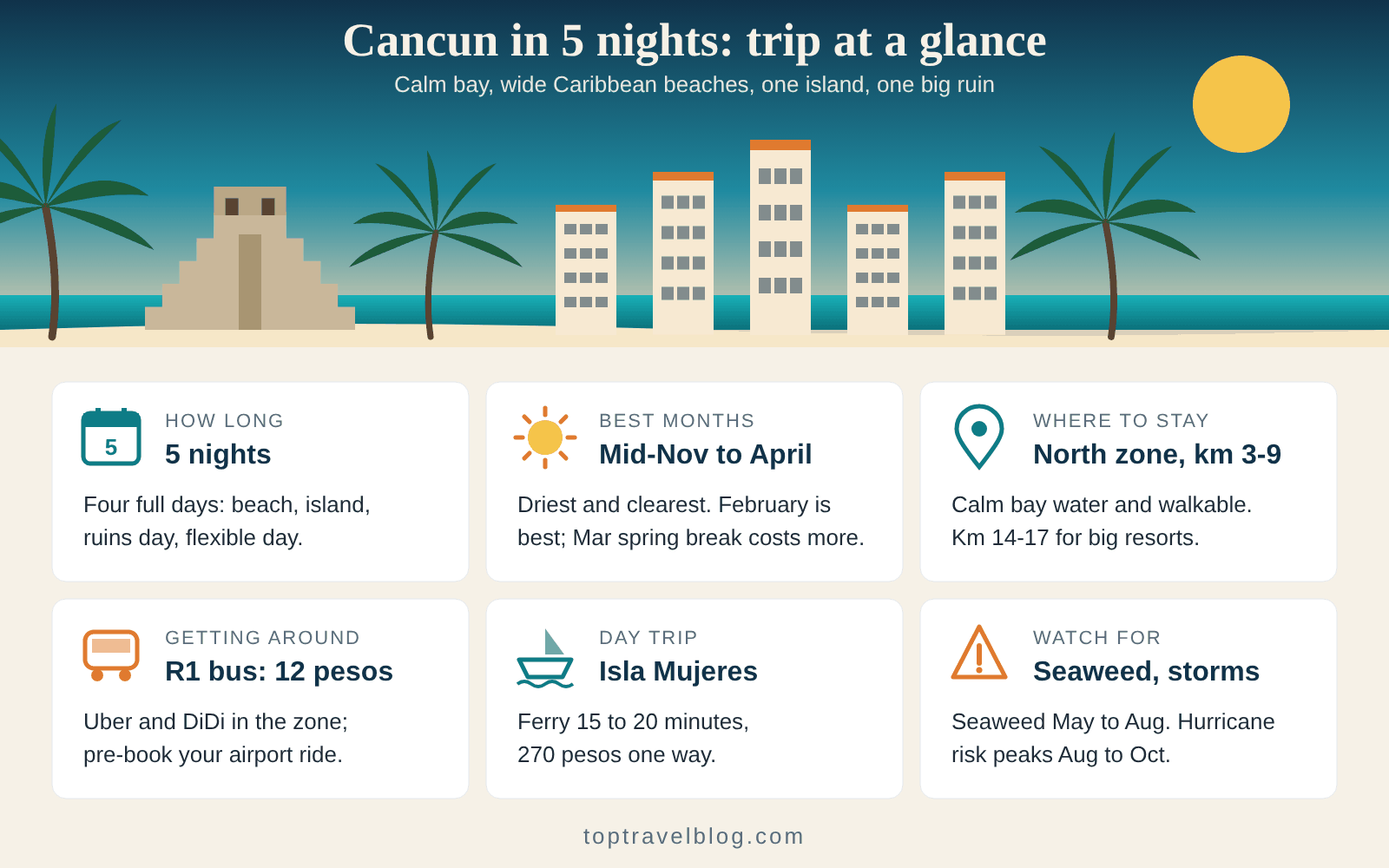
- Best for: beach vacations, couples, families, groups of friends, first-time Mexico visitors, and anyone who wants Maya ruins and cenotes within day-trip range.
- Ideal trip length: 5 nights for most people. 4 works if you skip the big ruins day; 7 lets you add Holbox, Cozumel or a night in Valladolid.
- Best months: December through April for dry weather and the lowest seaweed odds. November and early December are the sweet spot for value.
- Where to stay: North hotel zone (km 3 to 9) for calm water and walkability, km 9 to 16 for nightlife and shopping, km 17 to 25 for big all-inclusives and quiet, downtown for budgets and food.
- Getting around: R1 bus is 12 pesos in the hotel zone, Uber and DiDi work in the zone and downtown, ADO buses for long routes, prearranged transfer from the airport.
- Time zone: Quintana Roo stays on UTC-5 all year. That is Eastern time in winter and Central time in summer.
- Key caveats: seaweed arrives May through August, hurricane risk peaks August through October, the State Department tells visitors to exercise increased caution in Quintana Roo, and the hotel zone has one main road that jams in the evening.
Best time to visit Cancun: weather, seaweed and crowds
The best window for using this Cancun travel guide is the second week of November through mid-April. Days are in the low 80s Fahrenheit, nights drop into the 70s, the humidity eases, and rain is brief when it comes. January and February are the driest and the most reliably clear, which is why they are also the most expensive.
If I had to choose one stretch for a first visit, it would be the last week of January through the first week of March, before the spring break crush begins. My cheaper pick is November, after Day of the Dead and before the Christmas rate jump.
The calendar matters more here than in most beach destinations, because three things stack up: seaweed, storms and school holidays. Here is how I think about each part of the year when I plan any Cancun trip, and this Cancun travel guide follows the same logic.
December to April: dry season and peak prices
December is lovely and expensive from the 20th onward. Rooms at the big all-inclusives sell out for Christmas and New Year’s week months ahead, and the airport is at its busiest. Early December, before the holiday rush, is one of the best weeks of the whole year.
January and February give you the clearest water and the best odds of beaches with no seaweed at all. Highs sit in the low 80s, and an evening breeze makes a sweater useful on a hotel terrace. March and early April bring spring break, loud pool decks and the highest prices of the year. If you have a choice, go in February instead.
May to August: hot, humid and seaweed-prone
Highs reach the low-to-mid 90s with a heat index well above that. The Atlantic seaweed called sargassum arrives in these months, most heavily from June through August, and it piles up on east-facing beaches along the open Caribbean coast. The hotel zone’s south end and the Riviera Maya take the worst of it.
Water temperatures hit the mid-80s, whale sharks gather off Isla Holbox and Isla Mujeres from roughly June through September, and rooms are noticeably cheaper than in winter. If you can accept a green tinge on some beaches, summer is a fair bargain.
Tip: Seaweed is a beach-by-beach story, not a city-wide one. The north end of the hotel zone and the calm bay beaches facing Isla Mujeres usually stay much cleaner than the open-Caribbean beaches south of km 12. That one fact makes the where-to-stay decision more important than the month.
September and October: storms and cheap rooms
Hurricane season officially runs June 1 through November 30 and peaks from August through October. September and October are also the rainiest months, with hot mornings and heavy afternoon downpours. Cancun has had direct hits (Wilma in 2005 is the one locals still talk about), and in July 2024 Hurricane Beryl passed just south of the area and disrupted flights and tours.
Resorts are quiet, flights are cheap, and the water is as warm as a bath. I like this season for a flexible traveler who buys flexible fares and travel insurance that covers named storms. I would not book it for a once-a-year family week with fixed dates.
November: the shoulder month I like best
By the second week the storm threat fades and the rain stops being daily. The water is still warm, rooms are priced between summer and winter levels, and most seaweed is gone. The only crowd spike is Thanksgiving week, when American families fill the resorts. Early to mid November is the stretch where I have found the best mix of cost and weather.
Worth knowing: Quintana Roo stays on UTC-5 all year with no daylight saving shift. In winter, Cancun is on the same time as New York. From March to November it matches Chicago, so a 7 p.m. dinner reservation feels an hour earlier than you expect if you are coming from the East Coast.
How many days you need in Cancun: 3, 5 or 7 nights
The question I hear most while planning is whether three nights is enough. It is, for a beach weekend. It is not enough for the whole picture, which is why this Cancun travel guide is built around five nights.
3 nights in Cancun: a beach break with one outing
Three nights means two full days. Spend one on the sand and the pool and use the other for Isla Mujeres, which every Cancun travel guide recommends first and which I agree with, which is the easiest day trip from the hotel zone. You will not get to the big ruins at Chichen Itza, because that day trip takes ten hours on a bus and wrecks a short stay.
5 nights: the Cancun travel guide version I recommend
Five nights is the length this Cancun travel guide plans around. It gives you four full days: one for the beach, one for Isla Mujeres, one for a big ruins and cenote day, and one flexible day for snorkeling, a theme park, downtown or more beach. The first and last days are travel days with a morning or evening to spare. This is the sweet spot for first-timers and for couples who want a mix.
7 nights: add one overnight or one island
A week lets you do the Cancun travel guide plan comfortably and then add a night in Valladolid, a day on Cozumel, or a two-night stay on Holbox. It also lets you split the trip, with three nights in the hotel zone and three or four somewhere quieter. If you want the longer coastal itinerary, our Riviera Maya itinerary lays out seven days south of the airport.
10 nights or more: split the stay
Beyond a week I would not spend the whole stay in one hotel, and that is where a Cancun travel guide stops being enough on its own. Move bases once, perhaps from the hotel zone to Tulum or a Playa del Carmen apartment. Our Tulum travel guide covers that end of the coast and what it costs.
Worth knowing: Count your days honestly. Most US flights land between late morning and mid-afternoon and leave in the same window, which means five nights is really four full days and two half days. A flight home at 6 a.m. means you leave your resort at 3:30 a.m.
Where to stay in Cancun: hotel zone, downtown or Isla Mujeres
The question of where to stay decides more about your trip than any tour you book, which is why this part of the Cancun travel guide is the longest. Cancun is not one place. It is a long, thin hotel strip shaped like a number seven, a real working city a 20-minute drive inland, and an island across the bay. Each has a different beach, a different price and a different kind of evening.
The hotel zone (the Zona Hotelera) runs about 14 miles along Boulevard Kukulcan, numbered by kilometer markers from km 0 at downtown to km 25 at Punta Nizuc. Most addresses are given as a km number, and that number tells you more than the neighborhood name. Km 0 to 9 is the short top of the seven, facing the calm bay. Km 9 to 25 is the long stem, facing the open Caribbean.
How the hotel zone works in this Cancun travel guide
One fact shapes every decision in this Cancun travel guide: every beach in Mexico is federal property and open to the public, so you can walk onto any resort’s sand even if you cannot walk into its lobby. The practical limit is access: you need a public path, which are marked and sometimes a few blocks apart. The better question is not whether you can reach the beach, but whether the water in front of your hotel is calm and clean.
North of km 9 the bay is shallow and mild, with little surf, which suits small children and nervous swimmers. South of km 12 the sea is open, the sand is wider and softer, the water is a deeper blue, and waves and currents can be strong enough that flags matter.
Tip: Look at which way the beach faces before you book. A hotel on the bay side (km 3 to 9) has calm, shallow, sheltered water and a sunset view. A hotel on the open Caribbean side has the famous turquoise color, bigger waves, and more seaweed in summer. Neither is better; they suit different people.
The six areas in this Cancun travel guide, and who each suits
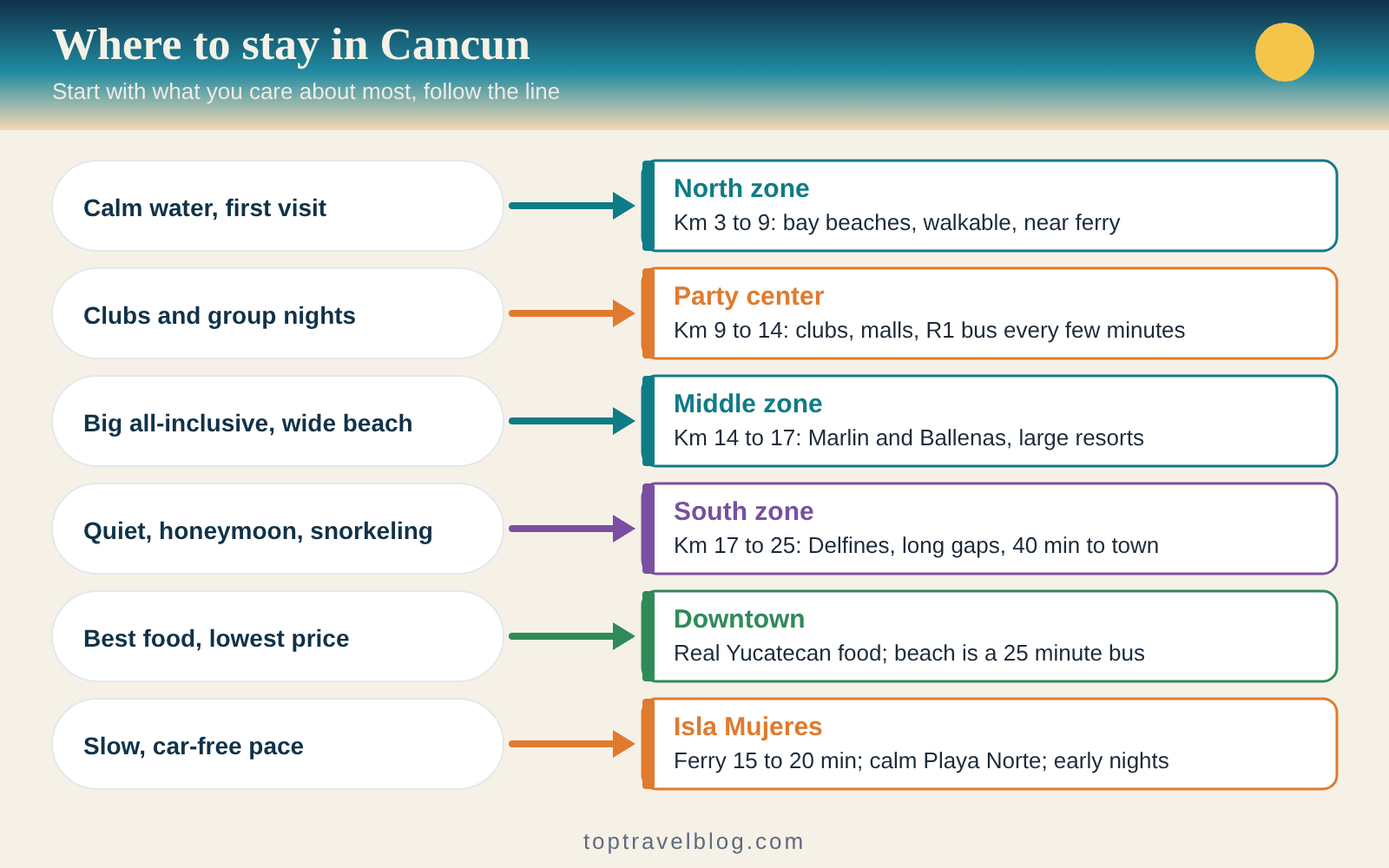
North hotel zone (km 3 to 9: Playa Gaviota Azul, Las Perlas, Langosta, Tortugas)
Best for: calm water, first-timers, walkability, families with small kids
This is where I send most first-time visitors. The beaches face the bay, the water is shallow and gentle, and a cluster of restaurants, shops and the Playa Tortugas ferry dock sit within an easy walk. You can reach downtown by bus or Uber in about 15 minutes, and the airport in roughly 25 to 30 minutes outside rush hour.
The trade-off is that the beaches here are narrower than farther south, and some stretches are crowded by day-trippers on weekends. Hotels range from small boutique places to aging all-inclusives, so read recent reviews with care.
Party center and Convention Center (km 9 to 14)
Best for: nightlife, shopping, groups, short stays
This is the busiest stretch, with the nightclubs on the lagoon side, the big malls, and an open-Caribbean beach in front. It is loud, fun and central, and the R1 bus passes every few minutes. I would pick it for a bachelor or bachelorette weekend, or a group that wants to walk to dinner and a club. Light sleepers should ask for a room facing the sea, and be ready to hear the music through the evening.
Central-south zone (km 14 to 17: Playa Marlin, Ballenas, Delfines approach)
Best for: wide beaches, big resorts, couples
Here the sand widens and the resorts become larger, often with several pools and many restaurants under one roof. Playa Ballenas and Playa Marlin are broad and attractive and are the best known open-water beaches in town. The sea can be rough on windy days, and seaweed matters more here from May through August. A room at this distance from downtown means you will mostly eat where you sleep, which is the point of an all-inclusive.
South zone (km 17 to 25: Delfines, El Rey, Punta Nizuc)
Best for: quiet, large resorts, honeymoons, snorkeling
The hotel zone gets calmer and greener as you head south, with big luxury and all-inclusive properties on wide beaches and long gaps between buildings. Playa Delfines, with its giant colorful CANCUN sign, is the public beach everyone photographs. You are 35 to 45 minutes from the airport at the south end in light traffic, closer to Playa del Carmen, and far from any independent restaurant. Go here for rest, not for variety.
Downtown Cancun (El Centro)
Best for: budgets, food, local color, long stays
Downtown is where Cancun’s residents live. Hotels are plain but much cheaper, restaurants serve actual Yucatecan food, and taxis and buses are cheap. The catch is that the beach is a 20 to 30 minute bus ride away, so you give up the sand outside your door. I recommend downtown for a night or two at either end of a trip, or for visitors who care more about eating well than swimming.
Isla Mujeres (across the bay)
Best for: slow days, couples, calm water, a car-free pace
An island 15 to 20 minutes from Puerto Juarez with golf carts instead of cars, a calm northern beach (Playa Norte), and small hotels. It is quieter after the last ferry and more expensive per room than downtown. It suits travelers who want beach and village in one place and are happy with fewer big-resort amenities. I would add one or two nights here to a longer trip rather than build a whole week around it.
Costa Mujeres, north of the city, and Puerto Morelos to the south are two more bases that deserve a mention. Costa Mujeres is a growing zone of large, adults-oriented and family resorts on a quiet coast, 30 to 40 minutes from the airport and farther from anything else. Puerto Morelos is a small fishing town about 20 minutes south of the airport, with a reef offshore and a slower feel.
All-inclusive or not: the Cancun travel guide math
A large share of the hotel zone is all-inclusive, and the model fits Cancun better than it fits most places. The resorts are far from independent restaurants, the best beaches are in front of them, and the evening road is slow. If you want to swim, eat, drink and sleep without making a decision, it is a good deal, and it is the format most Cancun travel guide readers end up choosing.
It is a poor deal if you plan to be out every day. A full day at Chichen Itza or on Isla Mujeres means you pay for a buffet you did not eat. In that case a room with breakfast, and dinners in the north zone or downtown, costs less and tastes better.
My rule for any Cancun travel guide: if you will spend more than two meals a day on the property, buy the all-inclusive. If you will be out for lunch and dinner most days, buy a room with breakfast and spend the savings on tours and good restaurants.
What to look for in an all-inclusive
Three things separate a good one from a mediocre one, and none are on the star rating. First, how many restaurants need reservations; at big resorts the a la carte spots book up by lunchtime, and a guest who arrives at 6 p.m. gets the buffet. Second, the beach itself: some resorts sit on a calm, wide stretch and some on a narrow, rocky one with a seawall.
Third, what the all-inclusive covers. Premium and top-shelf liquor, room service, and some activities and spa visits may cost extra at lower tiers. Read the inclusions list line by line. Our guide on how to choose a hotel covers reviews, fees and cancellation terms in more depth.
Fees, taxes and what a Cancun room really costs
Prices in the hotel zone move constantly, so I will give ranges rather than promises. A decent mid-range all-inclusive for two runs roughly $250 to $500 a night in winter and noticeably less in September. A boutique or downtown room can come in under $100 a night, and a top-end luxury resort can run well above $700. Compare total price with taxes and resort fees across two booking sites and the hotel’s own site.
Mexican VAT of 16 percent and a lodging tax usually sit on top of the rate shown at the first screen of a booking site, and some hotels add a resort fee. Look at the total at the last screen, not the first. Our how to find cheap flights guide explains how to compare flights and package prices without getting trapped by a low headline number.
Adults-only, family and group resorts
Cancun has many adults-only resorts, which have no kids’ clubs, quieter pools and a heavier focus on couples and spa time. They are fine for honeymoons and anniversaries, and I would pick them for a quiet week. They are not fine for a family trip, obviously, and not for a group that wants a pool party.
For families, the good family resorts have splash parks, a kids’ club and a calm beach. I would pick the north bay side for toddlers and the open-sea side for school-age kids who like waves. Group trips tend to work best at the party center, where a short walk puts everything within reach.
Timeshare pitches in Cancun: a warning
Many Cancun visitors are offered discounted tours, free breakfast or a resort credit in exchange for sitting through a presentation. It is a timeshare sale. The presentation runs two to four hours, not the 90 minutes promised, and sales agents are persistent. If you want the benefit, go knowing it will take your morning. If you do not, say no politely and keep walking. Never sign anything on the day.
Areas I would skip on a first trip
Be wary of any hotel advertising “steps from the beach” unless you can see the sand on a map. In the hotel zone, a hotel on the lagoon side of Boulevard Kukulcan has no beach in front of it, and you may need to cross a busy road and walk to a public access point. Lagoon-side rooms are cheaper for exactly that reason.
The Puerto Juarez area is fine for catching the ferry and not for a beach holiday, and I would not book a hotel near the airport except for a 6 a.m. flight.
How I decide: the Cancun travel guide short list
If it is your first visit and you want to swim without drama, pick the north hotel zone. If you want a big all-inclusive and a wide beach, pick km 14 to 17. If the trip is mostly about eating and ruins, split the stay between downtown and the zone. If you want a slower, smaller, more local week, spend it on Isla Mujeres. If you have only three nights, stay close to the airport and the bay.
Cancun travel guide: which area fits which traveler
People ask me to boil the area decision down to who they are, so here is the short version, written the way I would say it across a table.
Couples on a honeymoon or anniversary should look at the south zone (km 17 to 25) or an adults-only resort in the middle zone. You get wide beaches, quiet evenings and a resort that handles dinner reservations for you. If you want a more local, lower-key week, Isla Mujeres or Puerto Morelos fits better than any big resort.
Families with small children should pick the bay side of the north zone, where the water is shallow and the waves are small. Families with school-age kids can happily choose a large resort with a splash park at km 14 to 17, because kids like waves and a kids’ club, and parents like having everything within one walk.
Groups of friends, bachelorette parties and anyone planning late nights belong at km 9 to 14, close to the clubs and the malls. Solo travelers and budget travelers do best downtown with beach days by bus, or at a hostel on Isla Mujeres. First-timers who are not sure should default to the north zone, because it is easy to move around from there.
Cancun, Playa del Carmen, Tulum or Isla Mujeres as a base
Some readers ask whether they should skip Cancun and stay farther south. My answer depends on the trip. Cancun has the largest choice of all-inclusives, the most direct flights and the shortest transfer. Playa del Carmen has walkable streets and restaurants but a narrower beach, and Tulum is lovely, more expensive and less convenient for the airport.
If your trip is mostly beach and resort, the Cancun hotel zone is the best base in the region. If it is mostly ruins and cenotes, a night or two in Valladolid or Tulum saves hours on the road. Our Riviera Maya itinerary compares the coastal towns in more detail.
Best Cancun beaches: a Cancun travel guide ranked by what you want
Every beach in this Cancun travel guide is free and public by Mexican law. What differs is the water. Some beaches have the calm, warm shallows you picture, some have surf and a current, and some turn green in July. I rank them below by what you want from the day, not by an arbitrary score.
Best for calm water: Playa Tortugas, Langosta and Gaviota Azul
These sit on the bay side, in the north hotel zone, and the sea is as flat as a lake. Playa Langosta (around km 5) is small and often quiet. Playa Tortugas (around km 6.5) is the busiest of the bay beaches because it has a ferry pier, a row of restaurants and rental umbrellas, and it fills up with day-trippers. Playa Gaviota Azul (around km 3) is wider and tends to hold less seaweed.
I take small children here, and it is the first stop in my own Cancun travel guide notes. The bottom drops gently, there is almost no surf, and the nearby restaurants make a lazy lunch easy. The downsides are narrow sand and weekend crowds.
Best for classic turquoise: Playa Marlin and Playa Ballenas
On the open Caribbean side, around km 13 to 15, these are the wide white-sand beaches that appear on postcards. The water is a vivid blue, the sand is soft and the resorts behind them are big. Waves can be real, and a red or black flag means stay out of the water.
They are also the beaches that collect seaweed in summer. In winter and spring, they are the ones I would choose for a long, easy day with a book.
Best for photos and space: Playa Delfines
At km 18 the road bends toward the sea and the large CANCUN letters stand on the sand. This is the longest public beach in the hotel zone, with wide sand, parking, a few snack stands, and no resort wall behind it. The open water here has strong waves and currents, and I would only swim when the flag is green and a lifeguard is on the sand.
Go in the morning, before the sun gets harsh and before tour buses arrive. There is very little shade, and the sign draws a line of people waiting for photos by 11 a.m.
Best for a swim and a village: Playa Norte on Isla Mujeres
Playa Norte is the beach most people mean when they say Cancun’s water looks unreal. It is shallow for a long way out, the water is calm and clear, and a short walk puts you at a row of beach restaurants and the island’s town center. It is the beach I would pick for a day when I want the water to be a pool.
Go early or after 4 p.m., when the day-trip boats have left. It is often cleaner of seaweed than the hotel zone through the summer months, because it faces away from the open sea.
Best for snorkeling and reef: Punta Nizuc and the Isla Mujeres reefs
The Mesoamerican Reef runs along this coast, and the best snorkeling near Cancun is on its edge: Punta Nizuc at the south end of the hotel zone, the shallow reef at Garrafon on Isla Mujeres, and the area off Puerto Morelos. Go with a guide, because currents and boat traffic are real. Use reef-safe sunscreen without oxybenzone or octinoxate, since the reef is a protected area and many operators will not let you board with other types.
For something different, the Underwater Museum of Art (MUSA) has hundreds of sculptures on the sea floor off Punta Nizuc and Isla Mujeres, and it is open to snorkelers and divers through tour boats. It is a good choice for a family with older kids.
Reading flags and currents
Most Cancun beaches use a flag system: green for normal conditions, yellow for caution, and red or black for no swimming. Lifeguards are present on some beaches and absent from many, so a green flag does not mean a guard is on duty. Drowning accidents on the open-sea beaches, especially during red-flag days, are the most common serious problem visitors face.
If you are in doubt, ask the hotel’s beach staff how the water is that day. They know. Rip currents tend to form where waves look darker and calmer between breaking lines; swim parallel to the shore if one grabs you.
Seaweed in Cancun: what to expect and how to avoid it
Seaweed is the thing travelers worry about most, and the honest answer is that it varies from year to year and week to week. The heaviest period is roughly May through August, and the heaviest beaches are on the open Caribbean side. Resorts rake and haul it away every morning, so a managed hotel beach can look fine when a public beach nearby looks brown.
Three tactics work. Choose the north bay-side beaches or Isla Mujeres in summer. Choose a hotel with a pool you would be happy to use all day. And ask the hotel what the beach looked like in the last week, not what it usually looks like. The Mexican Caribbean tourism board lists destination updates and beach information at its official Quintana Roo tourism site.
The 5-day Cancun travel guide itinerary, day by day
This five-day Cancun travel guide plan assumes a base in the north or middle hotel zone, arrival around midday on Day 1 and a departure on the morning or afternoon of Day 6. Each day has one anchor, so you never spend a morning in traffic going the wrong way. Times are real-world estimates in light traffic, including waiting for a bus or a driver, not the numbers on a map app.

Day 1
Arrival, bay beach and a first sunset
Arrival and check-in on your first Cancun day
Most US flights land between 10 a.m. and 3 p.m., and immigration lines at peak hours can take 30 to 60 minutes. Plan on reaching your hotel two hours after landing. Many hotels will not give you a room until 3 p.m., so wear a swimsuit under your travel clothes and ask to leave bags at the front desk.
If you arrive by midday, go straight to the nearest beach. A swim and a cold drink are the best fix for a flight. Resist the urge to schedule a tour on day one of your Cancun travel guide plan; nothing about this trip needs to start before breakfast tomorrow.
Afternoon: the bay-side beaches
From the north zone, walk or take a taxi to Playa Tortugas or Playa Langosta. A walk along the bay side from km 3 to km 7 takes about 45 minutes and passes small plazas, restaurants and the ferry dock. Look at the water across the bay, where Isla Mujeres sits on the horizon. It is a good sight to see on arrival, because you will be on that island tomorrow.
The sea is shallow and calm here, which makes it the best first swim. Stay under an umbrella from noon to 3 p.m., as the sun is strong even in winter.
Evening: sunset and dinner
The bay faces west and north, so sunsets are easy to catch from the sand or a restaurant terrace on Boulevard Kukulcan. Eat in the zone if you are tired, or ride the R1 bus or an Uber 15 minutes to Parque de las Palapas downtown, where families gather and street stalls sell marquesitas, tacos al pastor and elote until late.
Order the cochinita pibil taco if you only get one: slow-roasted pork marinated in achiote and sour orange, the signature dish of the Yucatan. Be back at your hotel by 10 p.m. if you are leaving early for Day 2.
Day 2
Isla Mujeres by ferry and golf cart
Morning: the ferry from Puerto Juarez
On Day 2 of this Cancun travel guide, take an Uber or taxi to the Puerto Juarez ferry terminal, about 20 minutes from the middle of the hotel zone, and be there for a 9 a.m. departure. Ultramar runs the ferries from 5:30 a.m. to 11 p.m., with sailings roughly every 30 minutes through the late morning and early afternoon and about hourly otherwise. An adult fare is 270 pesos one way and 540 round trip, and the crossing is 15 to 20 minutes.
The Playa Tortugas ferry in the hotel zone is closer to some hotels and costs about 170 to 190 pesos one way, but it runs less often and stops earlier in the evening. I prefer Puerto Juarez for its later last boat, and every version of this Cancun travel guide plan that I have sent friends uses it.
Late morning: golf carts and Punta Sur
Golf carts are the standard way to see the island, since tourists rarely have cars there. Rent from a shop a block or two into town rather than from touts on the pier, expect roughly 600 to 1,000 pesos for a day, and agree on the price before you drive away. Drive on the right, take care at the many speed bumps, and note that parts of the loop road run one way.
Head south first, along the coast to Punta Sur, the cliff at the island’s southern tip with sculptures, a lighthouse and a view over the open Caribbean. It takes 20 to 25 minutes by cart. Then turn back along the eastern road for roadside viewpoints.
Afternoon: Playa Norte and lunch
Return to town by 1 p.m. and walk to Playa Norte, a 10-minute stroll from the ferry pier. Lunch on the sand with grilled fish, ceviche or tikin xic, the Yucatan’s achiote-rubbed fish. Swim in the shallow water for as long as you like.
Stay until the day-trip boats head home around 4 or 5 p.m., when the beach empties and the light turns soft. Take the 5:30 or 6 p.m. ferry back, which is calmer than the midday crowds.
Tip: Isla Mujeres ferries and shops are largely cash-based, and the island ATMs charge high fees. Bring pesos from your hotel or from a bank ATM on the mainland before you board. If you want a quieter day, go on a weekday and take the first boats.
Day 3
Chichen Itza, a cenote and Valladolid
The Chichen Itza decision: tour or drive yourself
In the Cancun travel guide plan, Chichen Itza is about 125 miles from the hotel zone, a 2.5 to 3 hour drive each way, and the best way to see it is to arrive when it opens at 8 a.m. A guided day tour from Cancun is easy and handles the logistics, but it leaves at 6 or 7 a.m., stops at a souvenir and buffet stop, and gets you to the ruins in the late morning, when the site is full and hot.
Driving yourself or hiring a private driver costs more but lets you arrive early and leave before the tour buses are at their peak. A rental car is workable on the toll road (cuota), which is well paved. A private driver is the more relaxed choice if you do not want to deal with a tollbooth and a fuel stop.
Morning: Chichen Itza
Entry for foreign visitors in 2026 is 676 pesos, made up of a 105-peso federal fee and a 571-peso Yucatan state fee. Arrive when the gates open, walk straight to El Castillo, the 79-foot pyramid, and take photographs before the groups arrive. Climbing the pyramid has been prohibited for years, so you walk around it, not up it.
The Great Ball Court, the Temple of the Warriors and the Observatory are all within a 10-minute walk. Hire an official guide at the gate for the first hour if you want context, because the site has few signs. Plan on two to three hours in total, and bring water, a hat and sunscreen because shade is limited.
Midday: a cenote swim
Cenotes are freshwater sinkholes that the Maya considered sacred, and a swim in one is the best way to cool off after the ruins. Ik Kil, about five minutes from the Chichen Itza gate, is the best known: an open cenote with hanging vines and a roughly 85-foot drop to the water. It is crowded and touristy and also very beautiful.
For somewhere quieter, continue 30 minutes east to Valladolid, where Cenote Zaci sits at the edge of town and Suytun is a few minutes outside, famous for a stone platform lit by a beam of light at midday. Bring a swimsuit, a towel and cash for entry, since most cenotes charge a small fee and do not accept cards.
Afternoon: Valladolid
Valladolid is a colonial town with a yellow convent, a shaded plaza, and the best Yucatecan lunch of the trip. Walk the Calzada de los Frailes, a pedestrian street lined with cafes, and sit in the main square near the cathedral for a drink. It is an easy place to spend two hours.
If you are driving, head back by 4 p.m. so you are on the highway before dark. The ride from Valladolid to the hotel zone is about two hours. If this long day sounds exhausting, spend a night in Valladolid instead and split the trip over two days.
Day 4
Reef, ruins and downtown
Morning: snorkeling or MUSA
Day 4 of this Cancun travel guide starts with a boat. Book a morning tour for snorkeling at the Cancun and Isla Mujeres reefs, with or without a stop at the MUSA underwater sculptures. Boats leave from marinas along the hotel zone, most trips are two to three hours, and the water is calmest before 10 a.m. Pick a small-group operator, choose one that supplies life jackets, and wear reef-safe sunscreen or a rash guard.
If snorkeling is not for you, spend the morning on a sunrise walk along Playa Delfines, then relax at the pool until lunch.
Afternoon: El Rey ruins and Delfines
Near km 18 sit the small Maya ruins of El Rey, with a few temples, a lot of iguanas and an entry fee of a few dollars. It takes 45 minutes and is the only archaeological site in the hotel zone. Drive or take a taxi from there to Playa Delfines for a late-afternoon walk and swim.
Evening: downtown for dinner
Take an Uber to downtown and eat dinner at a traditional restaurant. La Parrilla, on Avenida Yaxchilan, is a long-standing Mexican restaurant with a lively evening, and Mercado 28, a few blocks away, is the place for souvenirs, snacks and a bargain on hammocks and leather goods. Bargain with a smile and start at about half of the first price.
Skip the nightclubs on this night unless you actually enjoy them. If you do, the big clubs near km 9 stay open until the early morning and charge a cover that is often bundled with an open bar.
Day 5
Choose your own finish
Option A for the Cancun travel guide: a theme park day
Xcaret, near Playa del Carmen, and Xel-Ha, a bit farther, are the large eco-parks of the region, with underground rivers, shows and animal exhibits. A day at either costs well over $100 per adult, and Xcaret’s official site lists the ticket tiers and the evening show. They suit families with children and people who want one big, structured day.
Option B: Puerto Morelos and a cenote route
Puerto Morelos, 30 minutes south of the airport, is a quiet fishing town with a leaning lighthouse, a plaza, a reef offshore and a handful of good seafood restaurants. From there, the Ruta de los Cenotes runs inland through jungle, with several swimming caves and ziplines. It is a good alternative to the busy parks.
Option C: nothing at all
Honestly, the best last day in any Cancun travel guide is often a long breakfast, a final swim and no alarm. If your flight is in the afternoon, pack the night before, check out by 11 a.m., and leave bags with the front desk so you can swim one more time.
Rain, kids and adults-only swaps for this Cancun travel guide plan
Rain in Cancun usually comes as a short, heavy burst, and the swap in this Cancun travel guide plan is easy: move the beach to a pool, or do the downtown market and a museum visit first. For kids, replace Day 3 with a shorter day at Isla Mujeres’ turtle farm, or Xcaret. For an adults-only trip, the nightclub evening at km 9 and an extra beach day fit better than the ruins.
Adapting this Cancun travel guide for couples, families and groups
The five-day plan above is a template, not a rule. Here is how I bend this Cancun travel guide for the three kinds of trip I get asked about most.
The couples version of this Cancun travel guide
Swap the hotel for a quiet south-zone resort or an adults-only place, keep Isla Mujeres on Day 2 and shorten Day 3. Instead of the full Chichen Itza day, go for a private driver, an early start and a long lunch in Valladolid. Add one dinner at a good restaurant on the bay and a sunset boat trip.
I would also build in two empty afternoons. Couples who over-schedule their Cancun travel guide plan tend to come home needing a vacation from the vacation.
The family version of this Cancun travel guide
Pick the bay side or a family resort with a splash park, and choose beaches with gentle water. Keep Isla Mujeres, because the ferry itself is an event for kids, and add the turtle farm on the island. Replace the Chichen Itza day with Xcaret, or split the ruins into a short morning at a closer site such as El Rey.
For kids under eight, the long drive is the problem, not the ruins. If you do go to Chichen Itza with children, leave at dawn, bring snacks and plan for a nap in the car. Our Orlando vacation guide shows how I think about long theme-park days with children.
The group version of this Cancun travel guide
For friends and bachelorette trips, base yourselves in the party center and book a catamaran day to Isla Mujeres instead of the public ferry. Pre-book one nightclub night, one dinner for the group and one recovery day by the pool.
Split costs with a shared spreadsheet before you fly and decide how you will handle a late night, because the real friction in groups is the morning after. A Cancun travel guide can give you the places, but only the group can agree on the pace.
Pairing Cancun with another trip
Cancun pairs well with a longer Mexico or Caribbean trip. Our Belize itinerary is a natural next step by road and air, and the Puerto Rico itinerary and Jamaica travel guide cover two other Caribbean options. For a different side of Mexico, see the Mexico City itinerary.
Best day trips in this Cancun travel guide: what is worth the time
The big advantage of a Cancun base, and the reason a Cancun travel guide can cover so much ground, is how many places sit within a morning’s reach. The trick is to pick two or three, not eight. Here is how I would rank them, with the real travel time and my honest opinion of each.
Isla Mujeres: the easy one
Covered in the day plan above: 15 to 20 minutes by ferry, a golf cart, Playa Norte and Punta Sur. If you only take one day trip from this Cancun travel guide, take this one. Do it on your own on the public ferry rather than on a party catamaran unless you want the open bar.
Isla Contoy and snorkeling boats
Contoy is a protected national park island north of Isla Mujeres, reached by a full-day boat tour with snorkeling and a bird-watching stop. Access is limited each day to protect the island, so the tours sell out in high season. Book with an operator licensed for the park, and expect a long, sun-heavy day with a simple lunch.
Chichen Itza: the long day
Already covered on Day 3. For any Cancun travel guide reader it is the single biggest ruins site in the region and the one with the most cultural weight, and it is worth doing once. Go early, go with water, and combine it with Valladolid.
Tulum and Coba: ruins on the coast and in the jungle
Tulum sits on a cliff above the Caribbean about 80 miles south of Cancun, roughly two hours by road. The ruins are smaller than Chichen Itza and set on a spectacular coastline. Coba, an hour inland from Tulum, is a jungle site where you can rent a bike to ride between pyramids. If these two interest you, spend a night near Tulum and read our Tulum travel guide first.
Cozumel: diving and a quieter island
Cozumel is a larger island that you reach by ferry from Playa del Carmen, about 40 minutes across. It has some of the best scuba and snorkeling in the Caribbean, a calm town, and a few beach clubs on its western coast. It is a long day from Cancun, roughly an hour each way to the ferry plus the crossing. I would only do it with an overnight stay or with divers in your group.
Holbox: far, car-free and worth it for some
Holbox is a sand-street island reached from the village of Chiquila, a drive of about two and a half hours from Cancun plus a short ferry. It has white-sand beaches, bioluminescence on some summer nights, and whale shark tours from roughly June through September. It deserves two nights, not a day trip, and it suits couples and slow travelers more than families.
Playa del Carmen and the Riviera Maya
Playa del Carmen is a lively beach town with a pedestrian main street, Fifth Avenue, about an hour south. It is a useful stop on the way to Tulum, the Cozumel ferry and the large eco-parks. The colectivo vans from the downtown Cancun terminal cost roughly 55 pesos and take about an hour. For the full coastal route, see our Riviera Maya itinerary.
Tours or on your own: how I use this Cancun travel guide
Tours make sense for Chichen Itza, Contoy and snorkeling boats, where the logistics are the product. Going on your own makes sense for Isla Mujeres, Playa del Carmen, Tulum and Valladolid, where public transport or a driver works well and you pay far less. Read recent reviews, pick the small group over the 50-seat bus, and be skeptical of any operator promising “free” extras.
Getting around Cancun and the airport transfer
Getting around is the part of this Cancun travel guide that surprises people most. Cancun is easier than it looks, as long as you know which tool fits which trip. The hotel zone has one main road with buses, taxis and ride-hailing, downtown has a good bus network, and longer trips go by ADO coach or a rental car.
From the Cancun airport to your hotel
Cancun International Airport has four terminals, with most US airlines in Terminals 3 and 4 and a few in Terminal 2. After immigration and baggage claim, you walk out through a gauntlet of people offering rides, timeshares and “official” desks. Walk past them without engaging.
The simplest option, and the one I recommend in this Cancun travel guide, is a prearranged transfer, where a driver holds a sign with your name and the price is fixed. A shared van or private car to the hotel zone typically costs roughly $25 to $70 depending on the vehicle and group size. Taxis at the airport are unmetered and pricey, so agree on a price before you get in.
The cheap option is the ADO bus. ADO runs a 140-peso bus from Terminals 2, 3 and 4 to the hotel zone, about 40 minutes, and the airport-to-downtown ADO coach costs about the same. Schedules are sparse, so a late arrival does not suit the bus. The airport’s official site lists terminals and services.
Buses in the hotel zone and downtown
The R1 and R2 buses run through the hotel zone and cost 12 pesos for a trip inside the zone, or 10 pesos on city-only routes. You pay the driver in coins or small bills, and buses run all day with reduced service after midnight. They are crowded and hot at rush hour but cheap and quick, and I use them on short hops between hotel zone points.
Uber, DiDi and taxis
Uber and DiDi work in the hotel zone and downtown, and prices are usually lower than a taxi. Taxis are unmetered, so agree on a fare in pesos before the door closes, or look up the same trip on Uber and use that figure as a guide. Airport pickups by ride-hailing apps have been a long-running dispute with taxi unions, so a prearranged transfer is safer on arrival.
Rental cars
A car makes sense for the Chichen Itza and Valladolid day, and for exploring south of the airport. It does not make sense for beach days in the hotel zone, where parking is a headache. Rental cars in Mexico require Mexican liability insurance, which is not covered by a US credit card or your home policy, and a rental advertised at a few dollars a day often becomes much more at the counter. Read the total on the final contract, and take photos of the car before you drive away.
Coaches and colectivos
ADO coaches are comfortable, air-conditioned and run to Playa del Carmen, Tulum, Valladolid and Merida from the downtown terminal on Avenida Tulum. Colectivos, shared vans, are cheaper on the coastal route to Playa del Carmen, at roughly 55 pesos, but queues can run 20 to 30 minutes. ADO’s site sells tickets.
Cancun nightlife and evenings beyond the resort
Cancun’s nightlife is concentrated in the party center around km 9, where the big clubs, a few beach bars and the lagoon-front restaurants sit within a short walk of each other. Coco Bongo is the best known, a show-club with acrobats, impersonators and confetti, and tickets often bundle an open bar. It is loud, crowded and fun for the right group.
If clubs are not your thing, plenty of quieter options exist. Many resorts run evening shows, the north zone has bay-side bars with live music, and downtown’s Parque de las Palapas fills with families and street music on weekends. Isla Mujeres goes quiet after the last ferry, which some travelers consider its best feature.
Whatever you choose from this Cancun travel guide, plan how you will get back. Use Uber or a registered taxi after dark, avoid walking along Boulevard Kukulcan at night, and keep your drink in your hand. A Cancun travel guide that skipped this would be doing you a disservice, since most visitor problems happen late at night.
What to pack for a Cancun trip
For a Cancun travel guide trip, pack for sun, water and one evening that is slightly dressy. Pack light clothes in breathable fabrics, two swimsuits so one can dry, a hat, sunglasses and a rash guard for snorkeling days. Reef-safe sunscreen is not optional on a reef coast, and buying it in Mexico costs more than bringing it.
Bring water shoes for rocky cenote entrances, a small dry bag for boats, a light layer for air-conditioned buses and restaurants, and insect repellent for jungle days. Bring some pesos in small bills, a card without foreign transaction fees, and a photocopy or photo of your passport.
Leave expensive jewelry at home. For flights, a carry-on and a personal item are usually enough for five nights, and a small packable day bag is worth the space. Whatever else you bring, bring comfortable walking shoes for the ruins, where the paths are uneven and the sun is hot.
A short Cancun travel guide for people in a hurry
If you read nothing else in this Cancun travel guide, read this. Go between mid-November and April. Stay in the north hotel zone for calm water and walkability, or at km 14 to 17 for a big all-inclusive. Take the ferry to Isla Mujeres for one day, go to Chichen Itza early for another, and leave one day empty.
Pay in pesos, book hotels and Contoy tours ahead, skip the timeshare breakfast, and decline dollar conversion at card terminals. Use ride-hailing at night, respect the red flags on the beach, and buy travel insurance if you are going in hurricane season. That is the whole plan, and the rest of this page is detail.
What a Cancun trip costs: budget, mid-range and comfortable tiers
Prices in this Cancun travel guide are rough ranges for 2027 trips, built from current published fares and my own receipts. Flights are separate, and the biggest swing is the hotel, as always.
The budget traveler, staying downtown or in a hostel or simple hotel, can manage on roughly $90 to $140 a day per person: a modest room share, street tacos and market lunches, buses and the occasional ferry. It is a genuinely workable way to see Cancun, though you give up beach time in front of your room.
The mid-range traveler, the one this Cancun travel guide mostly assumes, in a decent north-zone hotel or a mid-priced all-inclusive, should plan roughly $200 to $350 a day per person including food, a couple of tours and local transport. Most people fall here, and this Cancun travel guide assumes it.
The comfortable traveler, in a large luxury resort with premium all-inclusive tiers and private transfers, spends roughly $450 a day per person and up, and the ceiling is high.
The costs a Cancun travel guide often forgets
The extras add up. A day tour to Chichen Itza usually runs about $80 to $130 per person, depending on the group size and what is included, and entry fees are often extra. Snorkeling boats cost roughly $50 to $100. Resort and cover charges at nightclubs, tips, and a Visitax add to the bill, and so do airport transfers.
The Visitax and tipping
Quintana Roo charges foreign visitors a tourism fee called the Visitax. It equals 2.5 UMA, which works out to roughly 290 pesos, or about $15 per person. In practice it is often added to flight tickets or collected at the airport, and some visitors pay it at a kiosk. Keep the receipt and ignore anyone who asks for payment in an unofficial place.
Tip 10 to 15 percent in restaurants if service is not already included, and a dollar or two for hotel staff and bartenders. Tour guides and drivers expect more, roughly 10 percent for a good day. Pay in pesos when you can: card terminals sometimes offer to charge in dollars at a worse rate, so decline the conversion and choose pesos.
Cancun travel guide to entry rules, safety and common scams
What you need to enter
US citizens need a valid passport to fly into Mexico. You complete an immigration form (the FMM) that airlines and the airport handle, and keep the stub of the tourist permit until you leave. Our guide on how to plan a trip has a documents checklist that covers passport validity and travel insurance.
The State Department advisory
The State Department’s Mexico advisory ranks Quintana Roo at “exercise increased caution” because of crime, and states that criminal activity and violence may occur in any location, at any time, including popular tourist destinations. It adds that there are no travel restrictions for US government employees in the state, and that visitors should exercise increased caution after dark in Cancun, Playa del Carmen and Tulum. You can read the full text on the State Department’s Mexico advisory page.
In practice, most visitors spend a week in resort areas without trouble. The things I do: stay on lit, busy streets at night, use ride-hailing or a registered taxi after dark, keep valuables in the room safe, and drink only at licensed places that serve from sealed bottles.
Scams and nuisances
The common ones are annoying rather than dangerous. Timeshare pitches, as described above. Taxi drivers who quote in dollars at a high price. ATMs with poor exchange rates or skimming risk, so use ATMs inside banks. Beach vendors who put things in your hand, and “free” tours that need a long presentation. Rental car agencies that raise the price at the counter.
The best protection is to ask the price before accepting anything, pay in pesos, and use hotel-recommended operators. If something feels off, walk away.
Water, sun and health
Drink bottled or purified water, and ask restaurants whether ice is made from purified water; most places in the hotel zone use it. The sun is strong all year, and heat exhaustion is common on the ruins days, so carry water, a hat and electrolytes. Travel health insurance with evacuation coverage is a sensible buy for a trip with boats and cenotes.
What to book ahead for your Cancun travel guide plan
Cancun is not a city where everything sells out, but a handful of things do. Here is the list in priority order.
- Your hotel, first. Christmas, New Year, spring break and Thanksgiving week sell out first, and the best all-inclusives book four to six months out.
- Flights. Prices rise sharply for peak weeks. See our guide to how to find cheap flights for a search plan that avoids the common traps.
- Contoy and whale-shark tours. Both are capped or seasonal, and the best operators fill up.
- Xcaret or another large park. Online tickets are easier and sometimes cheaper than at the gate.
- Chichen Itza transport. A private driver or a small-group tour is worth booking a week ahead in high season.
- Dinner at a destination restaurant on a Friday or Saturday.
Almost everything else, including the Isla Mujeres ferry, snorkeling and most cenotes, you can arrange the day before or the same morning.
What to eat in Cancun beyond the resort buffet
The resort buffet is fine. It is also not why you came to Mexico. Cancun’s real food is Yucatecan, a regional cuisine that differs from the tacos you know at home, and downtown is where to find it.
Order cochinita pibil, the achiote-marinated slow-roasted pork. Try panuchos and salbutes, fried tortillas topped with turkey or chicken, pickled onion and avocado. Sopa de lima is a bright chicken-and-lime soup. Poc chuc is grilled pork in sour orange, and tikin xic is the fish version. On Isla Mujeres, fresh ceviche and grilled catch of the day are the thing.
For street food, Parque de las Palapas downtown has stalls most evenings, and Mercado 28 has small lunch counters inside. For something with a view, the bay-side restaurants in the north zone serve fish and cocktails at sunset. Marquesitas, crisp rolled crepes with cheese and sweet fillings, make a good late snack.
Eating without stomach trouble
The usual rules apply: busy places with high turnover, food cooked in front of you, bottled water, and fruit you peel yourself. Most visitors in the hotel zone eat normally for a week without issue. If you are prone to stomach trouble, start with cooked foods for the first day.
10 common mistakes on a Cancun trip and how to avoid them
- Booking by the beach photo, not the beach location. Hotels advertise the best day of the best week. Look at the map, see which way the beach faces, and read recent reviews for seaweed.
- Choosing the wrong stretch of the hotel zone. A hotel at km 20 is a quiet, beautiful base and also a 40-minute ride from downtown. Decide whether you want walkability or quiet.
- Doing Chichen Itza as an 11 a.m. visit. Go early or go with a driver. The site is hot and crowded after 10 a.m.
- Taking the free timeshare breakfast. It is not free; it costs you half a morning.
- Paying for dollars at a bad rate. Pay in pesos and decline dynamic currency conversion.
- Swimming on a red-flag day. Currents on the open-sea beaches are the biggest everyday danger.
- Skipping travel insurance in hurricane season. September and October are cheap for a reason.
- Renting a car without understanding the insurance. Mexican liability insurance is mandatory, and the real price shows up at the counter.
- Planning too much. Every extra tour is a morning of lost beach time. Pick three outings, not seven.
- Ignoring downtown. Many visitors never leave the hotel zone and miss the food.
Frequently asked questions about Cancun
How many days do I need in Cancun?
Five nights is the best fit for most Cancun travel guide readers. It gives you four full days: the beach, Isla Mujeres, Chichen Itza and a flexible day. Three nights works for a beach break with one outing. Seven nights lets you add Holbox, Cozumel or a night in Valladolid.
What is the best area to stay in Cancun for first-timers?
For a first Cancun travel guide stay, the north hotel zone, roughly km 3 to 9, on the bay side. The water is calm and shallow, restaurants and the Playa Tortugas ferry dock are within walking distance, and the airport is about 25 to 30 minutes away outside rush hour. If you want bigger resorts and wider beaches, move south to km 14 to 17.
Is Cancun safe for tourists, according to this Cancun travel guide?
I never call a place safe, so here is what I can say. The State Department asks visitors to exercise increased caution in Quintana Roo, and warns of crime in tourist areas, especially after dark. Most visitors spend a week in resort areas without incident. Use ride-hailing at night, stay in busy places and keep valuables locked.
When is the best time to visit Cancun?
For planning with this Cancun travel guide, mid-November through April is the dry, warm, low-seaweed window, and February is the driest and most reliable. November and early December are cheaper. Hurricane season peaks from August through October, and seaweed is heaviest from June through August.
Is the seaweed bad in Cancun?
The Cancun travel guide answer is that it depends on the year, the month and the beach. May through August is the worst stretch, and the open-sea beaches south of km 12 are the most affected. The bay-side beaches in the north zone and Playa Norte on Isla Mujeres usually stay clearer. Resorts rake daily, so their beaches often look better than public ones.
Do I need to speak Spanish in Cancun?
Not in the hotel zone, where English is widely spoken, though a Cancun travel guide for downtown should say more. Downtown and on day trips, a few phrases help: por favor, gracias, cuanto cuesta, la cuenta. Learning to say them politely goes a long way, and it makes bargaining at the market friendlier.
Can I use US dollars in Cancun?
Many hotel-zone businesses accept dollars, but the exchange rate they give is usually poor. Pesos are better, especially for buses, markets, cenotes and the ferry. Use a card with no foreign transaction fee, and withdraw pesos from a bank ATM instead of changing money at the airport.
Is Cancun or Punta Cana better for a beach vacation?
For a beach vacation, Cancun travel guide logic says Cancun gives you more to do outside the resort: ruins, cenotes, islands and restaurants, plus a shorter flight from many US cities. Punta Cana is quieter, more resort-centered and has longer white-sand beaches. I pick Cancun for variety, and our Punta Cana travel guide covers the other side.
Should I rent a car in Cancun?
In this Cancun travel guide, only for the Chichen Itza and Valladolid day, or if you want to explore the coast south of the airport. In the hotel zone, buses, Uber and taxis are enough, and parking is a nuisance. If you rent, buy the Mexican liability insurance and photograph the car before you leave the lot.
Is Isla Mujeres worth a day trip from Cancun?
Yes, it is the easiest and best-value outing in the Cancun travel guide plan. The ferry takes 15 to 20 minutes, a golf cart covers the island in a few hours, and Playa Norte is one of the calmest beaches in the region. Stay overnight if you want the island to yourself after the day boats leave.
One last thing before you go
The best advice I can give after writing this Cancun travel guide is to resist the urge to do everything. Cancun rewards a loose plan: one outing a day, one long afternoon at the beach, and one evening in town where you eat something you cannot pronounce.
Pick the right stretch of sand, pick two or three excursions, and leave the rest of the trip alone. This Cancun travel guide is a framework. The sea, the food and the slow afternoons do the rest, and most people go home planning the next trip.
If you decide to compare other warm-weather destinations after this Cancun travel guide, our guides to Los Cabos, Puerto Vallarta, Aruba and the Bahamas will help you weigh the options.
Related planning guides
- Riviera Maya itinerary: 7 days of beaches, cenotes, ruins and resorts — the coastal route south of the airport, with the stops this guide only touches.
- Tulum travel guide: beaches, ruins, cenotes, where to stay and costs — the cliff-top ruins and beach town two hours south.
- Punta Cana travel guide: resorts, beaches, excursions and what to know — the Caribbean beach rival, with a more resort-centered feel.
- How to choose a hotel: location, reviews, room type, fees and cancellation terms — the framework behind the area advice above.
- How to find cheap flights: a practical search strategy — for the airfare half of the budget.
- Belize itinerary: 7 days of islands, reefs, ruins and jungle — the next stop if the reef and the ruins are what you came for.