

Booking a week at a beach resort with food and drinks “included” sounds simple until you start comparing, and that is exactly why I wrote this all inclusive resort guide. The rate covers a lot, but what it covers changes from one property to the next, and the gap between the brochure and the bill is where people get annoyed.
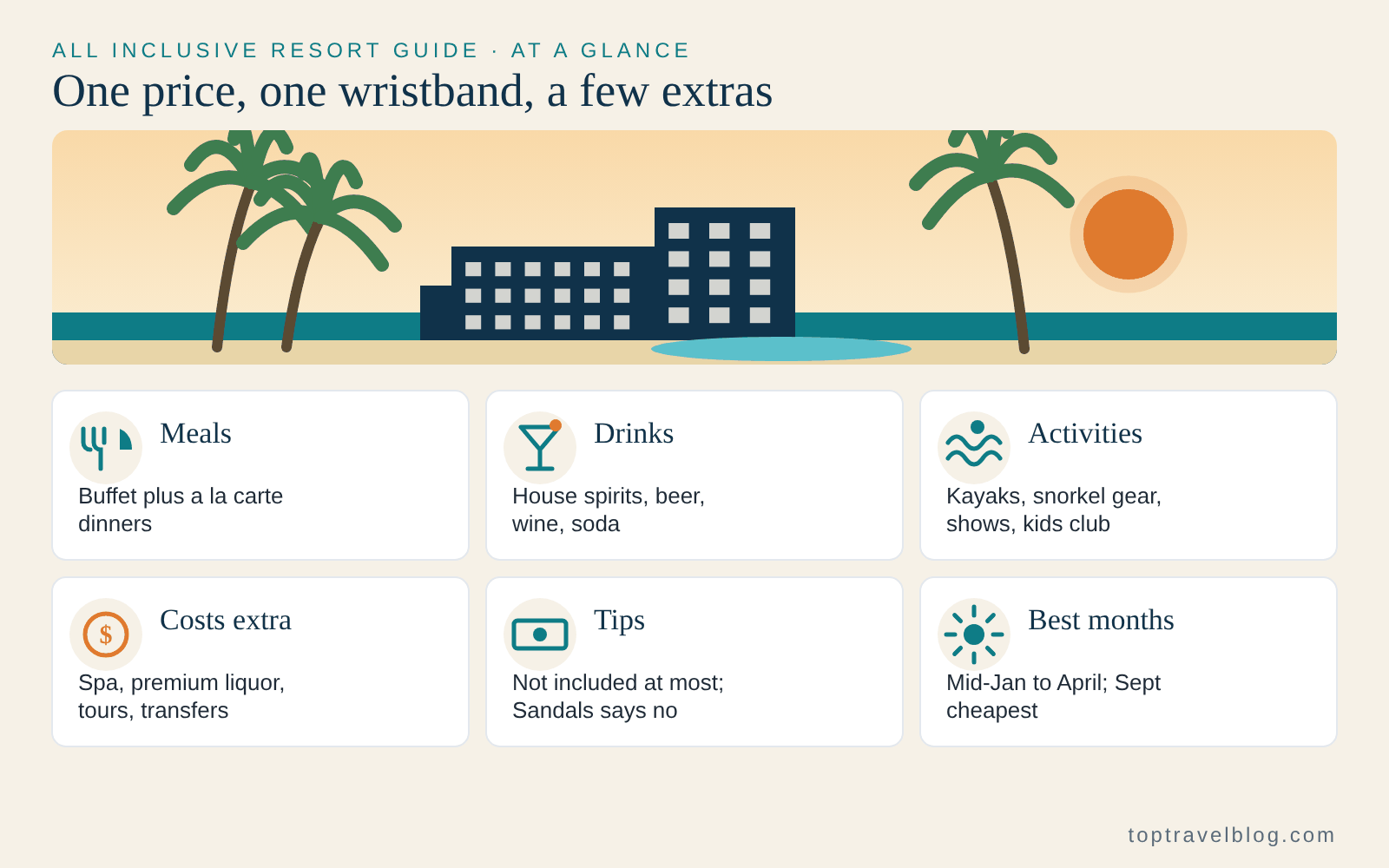
The short answer: an all-inclusive resort charges one nightly price that normally covers your room, all meals, most drinks, snacks, and a set of activities. Tips, spa treatments, premium liquor, off-site tours, Wi-Fi at a few properties, and the airport transfer are the usual exceptions.
It suits couples, families with kids under 12, friend groups, and anyone who wants to stop doing arithmetic on vacation. It suits you less if you want to eat your way through a city, if you drink very little, or if you plan to spend most days away from the property.
This guide walks through what is included, what costs extra, how to tell the types apart, how the money works out in real examples, and an eight-step method for choosing one.
Quick facts: this Paris itinerary at a glance
- Best for: couples, families with young kids, groups of friends, and travelers who want a fixed budget and no daily decisions.
- What the rate covers: room, buffet and most restaurant meals, snacks, house-brand drinks, pool and beach gear, a daily activity program, and usually evening shows.
- What usually costs extra: spa, premium spirits and wine lists, specialty dining at some resorts, golf, scuba, off-site excursions, airport transfers, and tips.
- Typical cost: roughly $250 to $500 a night for two at a solid four-star in Mexico or the Dominican Republic, and $600 to $1,200 or more for two at the luxury tier.
- Best months: mid-January to April for dry weather and calm seas; September and October for the lowest prices if you accept hurricane-season risk.
- Key caveats: the quoted rate may be per person or per room, taxes and service charges can add 15 percent or more, and the all-inclusive label has no legal definition, so read the resort’s own inclusions page.
What an all-inclusive resort actually means
Nobody regulates the phrase. A hotel can call itself all-inclusive and mean “breakfast and two drinks a day,” while the resort next door means unlimited food, top-shelf liquor, and a kids club that runs from 9 a.m. to 9 p.m. Treat the label as an invitation to read the inclusions list, not as a promise; that habit is the backbone of this all inclusive resort guide.
The model started with Club Med in the 1950s, when the French company sold a village-style vacation with food, activities and lodging paid in advance. The idea crossed the Atlantic and settled into Jamaica, Mexico and the Dominican Republic in the 1970s and 80s, where it grew into the large beachfront resorts we know today.
The wristband and what it really does
Most resorts put a plastic or paper wristband on you at check-in. It is your ID for the property: staff at the bars, the restaurants and the beach club glance at it and you are in. It also keeps outsiders from eating at the buffet, and it lets the resort count you. Any all inclusive resort guide should say so plainly: lose the band and you lose your access until the desk replaces it.
In practice you will take it off for one reason only: a day trip. Some people forget it is there and sleep in it for a week. That is fine. If it falls off, go to the front desk, and they will replace it, sometimes with a mild lecture.
Three pricing models you will run into
First, the classic all-inclusive: one price, nearly everything covered. Second, the “all-inclusive with a la carte tiers,” where a base rate covers the main buffet and some restaurants, and a higher “premium” or “club” tier opens the better restaurants, top-shelf drinks and a private lounge. Third, the “optional all-inclusive,” where the hotel rate is sold with an add-on meal plan, common at big resorts in Florida, Hawaii and the Bahamas.
When a friend tells you they found a great all-inclusive deal, ask which of those three they mean. The first and second are what this all inclusive resort guide is about; the third is a regular hotel with a meal plan, and the math for it looks different.
How all-inclusive differs from a regular resort stay
The difference in how you spend the day is bigger than the price difference, and it is the part of this all inclusive resort guide I would underline. At a regular resort, every meal and drink is a small decision with a price attached. At an all-inclusive, the decision is only “where do I want to be,” and the answer is usually “the pool.” If you want a deeper comparison of the property types, I wrote about resort versus hotel stays and the trade-offs between them.
The other difference is the layout. All-inclusive properties tend to be large and self-contained, with several restaurants, a handful of pools and a long beach frontage. You can go days without leaving the grounds, and plenty of guests do exactly that.
What is included at an all-inclusive resort
Here is the list I hand to friends who ask what they are paying for, and it is the core of this all inclusive resort guide. These are the things I would expect at a decent four-star in Mexico, the Dominican Republic or Jamaica. A budget property will cut some of them, and a luxury one will add more.
Room and daily housekeeping
The nightly rate buys the room, daily cleaning, towels, beach towels (usually through a card system at the pool) and in-room basics like a safe. Some resorts include a mini-fridge restocked daily with water, soda and beer. At others the fridge is stocked once and you pay to refill it, so look at the inclusions page rather than assuming.
Room category matters more than people think, and it is one of the few upgrades my all inclusive resort guide checklist says to pay for. A garden-view room is often a 10-minute walk from the beach, and a swim-up room puts your balcony right at a pool. My guide to hotel room types covers the vocabulary, and the same terms (ocean view, ocean front, swim-up, junior suite) mean slightly different things in each resort.
Food: buffets, restaurants, snacks and room service
Every all-inclusive has a main buffet, serving breakfast, lunch and dinner. It is the workhorse of any all inclusive resort guide, because it is where most of your meals will happen. At a good one you will find made-to-order omelets, a carving station, a salad bar and local dishes; at a poor one you will find lukewarm trays and the same pasta every night.
Most also have two to five a la carte restaurants, and this is where an all inclusive resort guide earns its keep, since the rules differ so much. These are sit-down, with waiters, and cover things like Italian, steakhouse, Japanese teppanyaki, Mexican or Caribbean cuisine. Entry is usually included but may require a reservation, and the bigger resorts limit you to one specialty dinner per stay or per two nights.
Add a snack bar or grill by the pool serving burgers, tacos, nachos and pizza from late morning, and often a 24-hour option, either room service or a late-night cafe. Room service is included at a large majority of mid-range and luxury properties and costs extra at the cheapest ones.
Drinks: the part people overestimate
Most all-inclusive packages include unlimited water, soda, juice, coffee, domestic beer, house wine and “well” spirits (basic rum, vodka, tequila, gin) from the bars and lobby, typically from around 10 a.m. until midnight or 1 a.m. Cocktails are made with those house spirits.
What “premium” means is the question that causes the most confusion. A resort that advertises top-shelf liquor may include only a few labels, with the genuinely expensive bottles reserved for a higher tier. If you care about a particular tequila or a good wine list, ask for the actual brand list in writing before you book. Imported spirits are the first thing a resort quietly drops when costs rise.
Activities, kids programs and entertainment
Included almost everywhere: pool and beach loungers, water aerobics, beach volleyball, kayaks, paddle boards and snorkel gear at the beach, a fitness center, tennis courts at some, daily activity schedules with trivia and dance classes, and an evening show.
Kids programs are a major selling point. Many mid-range and family resorts run a supervised kids club for ages 4 to 12, with teen lounges for older children and sometimes a splash park. Babysitting in the evening typically costs extra. If kids are the main reason for your trip, ask for the club’s hours and age cutoffs in writing, because they are the detail brochures blur.
The extras that are often included but surprise people
For the small print, my all inclusive resort guide notes: Wi-Fi is included at almost all modern resorts, though speed drops in the late evening. Safes, in-room coffee makers and hair dryers are included. Some resorts also include one or two off-property perks: a discounted day at a nearby sister property, a shuttle to town on certain days, or a free beach club visit. These are worth asking about because they vary and are rarely advertised well.

What costs extra at an all-inclusive resort
This is the section the marketing pages skip. Nothing here is a scam; it is how resorts make their margin, and a fair all inclusive resort guide should show you the line. You just want to know where the line is before you arrive, because finding it at the spa counter feels worse than reading it at home.
Tips
At most mid-range Mexican, Dominican and Jamaican resorts, tips are not included, and staff earn a large part of their income from them. A few brands, Sandals and Beaches being the best known, run a no-tipping policy and say so on their sites; at those, handing over cash is discouraged. I cover amounts in the tipping section below.
Spa, golf, diving and other activities that carry a fee
The spa is almost never in the rate, which is the first surprise in any all inclusive resort guide. A 50-minute massage at a resort spa often runs roughly $100 to $180 before tip. Golf, if the resort has a course, is usually discounted for guests but not free. Scuba is a separate charge at most places, though a “discover scuba” session in the pool is sometimes included. Motorized water sports like jet skis and parasailing are almost always a paid add-on.
Specialty restaurants, wine lists and premium bottles
Some resorts include every restaurant. Others charge a supplement at the steakhouse or sushi bar. Bottles of wine above the house pour, vintage champagne and top-shelf tequila are commonly extra even at generous properties. If a resort has a “Preferred Club” or “Prestige” tier, the thing you are paying for is mostly access to the good restaurants and the better liquor.
Airport transfers, taxes and local fees
Many packages sold through airlines or tour operators include shuttle transfers; a straight hotel booking often does not. Shared shuttles from the airport commonly cost roughly $20 to $50 per person each way, and a private transfer for a family is more. Distance matters: Cancún’s hotel zone is about 20 to 30 minutes from the airport, while resorts south of Playa del Carmen can be 60 to 90 minutes away.
Taxes and service charges are the other line. Depending on the country, they can add somewhere around 15 to 30 percent when added after the quoted rate. Quintana Roo, which covers Cancún and the Riviera Maya, also collects a visitor tax called Visitax from foreign tourists; some resorts and airlines bundle it, and some bill it separately. My article on hotel resort fees and destination fees explains how to find the true total before you commit.
Off-site tours, taxis and shopping
Excursions are the biggest unplanned expense I see, and I give them their own budget line in my all inclusive resort guide math.
A day at an eco-park, a boat trip to an island, a visit to Chichén Itzá or Tulum, a zipline run: each is booked through the resort’s tour desk or an outside operator.
Most land between $60 and $150 a person depending on the destination and what is included. Taxis and ride shares add up too, and in some resort areas taxi fares are fixed by zone and higher than visitors expect.
Laundry, minibar, premium Wi-Fi and the small stuff
Laundry is billed by the piece, often $2 to $5 an item. Cigars, imported snacks and some bottled drinks in the minibar are extra. A few resorts charge for in-room coffee pods or for beach cabana rentals, which can run $50 to $150 a day at the nicer ones.
Tip: Before you pay, ask the resort or your agent for the “not included” list. A good property will send it. If the answer is vague, the sales pitch is doing more work than the inclusions.
Who an all-inclusive resort suits, and who should skip it
This all inclusive resort guide comes from watching people fall in love with all-inclusive resorts and watched others leave on day three grumpy about the buffet. The difference is almost always fit. Here is how I break it down for each kind of traveler.
Couples
Best for: Relaxing, anniversaries, honeymoons
Adults-only resorts with swim-up suites, couples spas and romantic dinners are what the category does best. You eat well, nobody asks you to do anything, and you can book one excursion in the middle of the week without overpaying for the others.
Families with young children
Best for: Kids 3 to 12, grandparents along
This is the strongest case for the model. Meals are predictable, kids clubs give parents a few hours, and nobody has to hunt for a restaurant that handles a toddler at 6 p.m. Look for resorts with shallow splash areas and a children’s menu at the buffet.
Groups of friends and weddings
Best for: Reunions, bachelorettes, destination weddings
A single rate that covers meals and drinks removes the awkward splitting of the tab. Large resorts also handle group dinners and welcome events well. Agree on a nightly noise limit before you go.
Solo travelers
Best for: Meeting people without effort
Solo guests pay a single supplement at most resorts, but the social setup (group activities, shared tables at the a la carte restaurants) makes it easy to meet people. Adults-only and activity-heavy resorts work best.
Active travelers
Best for: Sports and classes
Resorts like Club Med bundle lessons for sailing, tennis, archery and the flying trapeze into the rate, which is real value if you will use them. A quiet beach-and-book resort will not scratch that itch.
Budget-minded planners
Best for: One fixed number
The money logic is simple: if you eat three meals and drink a few cocktails a day, the all-inclusive rate often beats paying separately at a resort town restaurant. For a light eater who skips alcohol, it rarely does.
Who I would steer away from all-inclusive
In plain terms, an all inclusive resort guide should also tell you when to skip the format. Food travelers who want to try the regional specialty from the stall in the market should book a regular hotel and eat out. So should anyone planning a road trip with a different bed every night, light drinkers who will not use the bar, and people who dislike structured resort atmospheres with schedules and wristbands.
I would also pause if you are traveling to see a place, not to rest in it. In Cancún or Punta Cana you can easily do both, but a resort day-rate of $200 or more a person is hard to justify when you spend every day away from it. For those trips, look at vacation rentals versus hotels instead.
Types of all-inclusive resorts: the part of this all inclusive resort guide people skip
“All-inclusive” covers properties that have almost nothing in common, which is why this all inclusive resort guide separates them by type. Picking the wrong type is more costly than picking the wrong destination, because it decides who you share the pool with.
Mega resort (large, family and group friendly)
Best for: Families, groups, first-timers
Hundreds to thousands of rooms, multiple pools, 6 to 10 restaurants, a kids club and nightly shows. The upside is choice; the downside is the walk to the beach, buffet lines at 8 a.m., and a feeling of being one of many. Riu, Iberostar and Barceló run many of these across Mexico and the Dominican Republic.
Adults-only (18 and over)
Best for: Couples, honeymoons, friends without kids
No children on the property, quieter pools, more romantic restaurants, often a bigger spa. Some are boutique and some are huge party-style resorts, so read the reviews for noise. The age floor is usually 18, but a few set it at 16.
Luxury couples (a la carte plus)
Best for: Anniversaries, honeymoons
Smaller, higher-priced resorts with premium liquor, private butler or concierge, swim-out rooms and individual dining. Sandals, Excellence, Secrets and the Zilara brand are examples of the type.
Family-focused
Best for: Children under 12
Splash parks, kids clubs from toddler age, family suites, and often a connecting-room option. Beaches Resorts and Hyatt Ziva are widely used examples. The all-day noise level is higher.
Activity or village style
Best for: Active couples and families
Club Med is the prototype, bundling lessons and sports into the rate. Check what is truly unlimited; a few classes may require a signup.
Boutique and eco all-inclusive
Best for: Quiet beach holidays
Small properties with 20 to 80 rooms, often with a single restaurant and a more local menu. Fewer amenities, more personality, and usually a higher cost per head.
Dude ranches and mountain lodges
Not every all-inclusive sits on a beach. Many dude ranches in Montana, Wyoming and Colorado sell a weekly rate that covers lodging, meals, horseback riding and guided activities, and some ski lodges in Utah and Colorado sell packages with lift tickets and meals. It is the same logic with a different backdrop, and these are worth considering if you are planning a domestic trip.
What changes between types
This part of the all inclusive resort guide saves the most regret.
Pool crowds and noise vary the most. Mega resorts generate steady background music and volleyball games. Adults-only resorts get a different kind of noise: late-night parties at the beach club. Luxury resorts get quiet, and you pay for it. The kids club is the other swing factor. At a family resort, it is the best part of the property. At an adults-only property, it does not exist, and the property is set up so that you do not miss it.
For step-by-step help on how to choose a hotel of any kind, the same reading habits apply: sort reviews by recent date, search for the words you care about, and trust the photos from guests more than the ones from the resort.
Where to go: an all inclusive resort guide to the main regions
You can find all-inclusive resorts on almost every warm coast. The ones that matter for a US traveler cluster in a few places, mostly within a 2- to 5-hour flight from major airports. Here is how I think about each; the regional notes are the most practical pages of this all inclusive resort guide.
Cancún, the Riviera Maya and Tulum, Mexico
This is the biggest market for good reason, and most readers of this all inclusive resort guide will end up looking here first. Cancún has direct flights from dozens of US cities, the airport is close to the hotel zone, and the Caribbean-side beaches are wide and white. South of Cancún, the Riviera Maya (Playa del Carmen, Puerto Morelos, Akumal) trades some convenience for quieter resorts and day trips to cenotes and Maya ruins. Tulum is trendier and less all-inclusive.
Downsides are sargassum seaweed on some beaches, mostly between spring and late summer, and a hurricane window from June through November. Resorts in Isla Mujeres and Costa Mujeres, north of the hotel zone, tend to see calmer beaches and fewer crowds.
Punta Cana and the Dominican Republic
Punta Cana has the highest concentration of large all-inclusives anywhere, so it is the market where an all inclusive resort guide matters most. Prices run lower than Mexico for a comparable star level, flights come from most large US hubs, and the east coast has long beaches. The airport is close to most resorts, often 15 to 45 minutes. Expect big properties and a lot of families.
The trade-off: resort quality swings widely at the lower end, so read recent reviews. Sargassum affects parts of the east coast in some years, and on the big, cheaper properties the drinks are mostly house brands, so do not expect much from the liquor shelf.
Jamaica: Montego Bay, Negril and Ocho Rios
Jamaica is the home of Sandals and Beaches, and the island has some of the best-run luxury all-inclusives around. Montego Bay’s airport serves most visitors, and the drive to Negril is typically 90 minutes to two hours while Ocho Rios is similar. Roads can be slow and rough.
Because many resorts are walled and the surrounding areas vary a lot, I book excursions through the resort or a licensed operator, and I read the State Department’s country page at travel.state.gov before choosing a region. The scenery and the food are the reward, and the local music scene is a real draw.
Los Cabos, Puerto Vallarta and the Mexican Pacific
The Pacific coast is drier and has no sargassum, but many open-ocean beaches have strong currents and big waves, so swimming is limited at some of them. Los Cabos is desert-meets-ocean with dramatic scenery and a lot of luxury. Puerto Vallarta and Nuevo Vallarta are warmer, greener and cheaper. If you want a swimmable beach, look for a resort on a protected cove.
The Bahamas, Turks and Caicos, Aruba and the Eastern Caribbean
These destinations have fewer all-inclusives and higher prices. Turks and Caicos has Beaches and several adults-only resorts on Grace Bay, which is arguably the best beach in the region. Aruba has a good beach and steady weather, since it sits south of the hurricane belt, with Riu and several others on Palm Beach. The Bahamas and Saint Lucia, Antigua and Barbados have Sandals and a handful of independents.
Costa Rica and the Pacific coast of Central America
Costa Rica’s Papagayo Peninsula, near Liberia airport, has a small group of all-inclusives, popular with families who want wildlife and zip lines alongside a beach. Weather has a clear dry season from December to April and a green season with afternoon rain. It is a lighter, more nature-oriented kind of all-inclusive.
Hawaii and the continental US
Hawaii has almost no true all-inclusives; resorts there sell room-only rates with resort fees. Florida has a few, including Club Med Sandpiper Bay. If your reason for going all-inclusive is cost control, a domestic resort with a meal plan rarely matches the value of Mexico or the Dominican Republic.
Is an all-inclusive resort worth the price? Three worked examples
The honest answer is that it depends on how much you eat, drink and do, and no all inclusive resort guide can skip the arithmetic. I’ll show three examples. The numbers are round, illustrative and drawn from the ranges I see most often; they are not quotes for a specific resort.
Example one: a couple who drinks and eats a lot
Two adults, five nights, a four-star in Cancún. The all-inclusive rate is $400 a night for two before taxes, so $2,000. Taxes and fees push it to around $2,400.
At a regular beachfront hotel at $240 a night ($1,200 plus around $200 in taxes), add three meals a day. Breakfast around $25 for two, lunch $45, dinner with a drink each $110, plus four drinks a day at $10 each: about $220 a day or $1,100 for five days. Total $2,500. So the all-inclusive wins narrowly on paper, and removes the choice fatigue.
Example two: a family of four with two kids
Two adults and two kids, six nights, a family resort in the Dominican Republic at roughly $650 a night for the family before taxes: $3,900 and about $4,600 after taxes. Eating out for four in a resort area runs $140 to $200 a day for modest meals and soft drinks, about $840 to $1,200 over six days, and the adults’ drinks add roughly $300.
A room at a regular hotel might be $320 a night, so $1,920, plus about $1,300 for food and drinks, plus taxes: around $3,800. Here the hotel approach comes out roughly $800 cheaper if you eat simply. What the all-inclusive buys you is that the kids’ meals and snacks are never a negotiation and the kids club buys the parents an afternoon.
Example three: two light drinkers who sightsee
Two adults who want to see ruins and old towns, three days away from the resort. They eat one meal at the resort a day and rarely drink. At $400 a night they are paying for food they do not eat, and the all-inclusive loses by $500 or more. A standard hotel with breakfast and dinner out is the better call.
The rule I use
If I had to reduce this all inclusive resort guide to one test, it would be this one.
If you will eat at least two meals a day on the property and have at least three drinks per adult, the all-inclusive usually pays for itself. If you will spend more than half your daylight hours away, it usually does not. A guide to choosing a hotel will help weigh the rest.
Tip: Ask whether the quoted price is per person or per room. Luxury brands often quote per person, double occupancy, and a number that looks low can double at checkout.
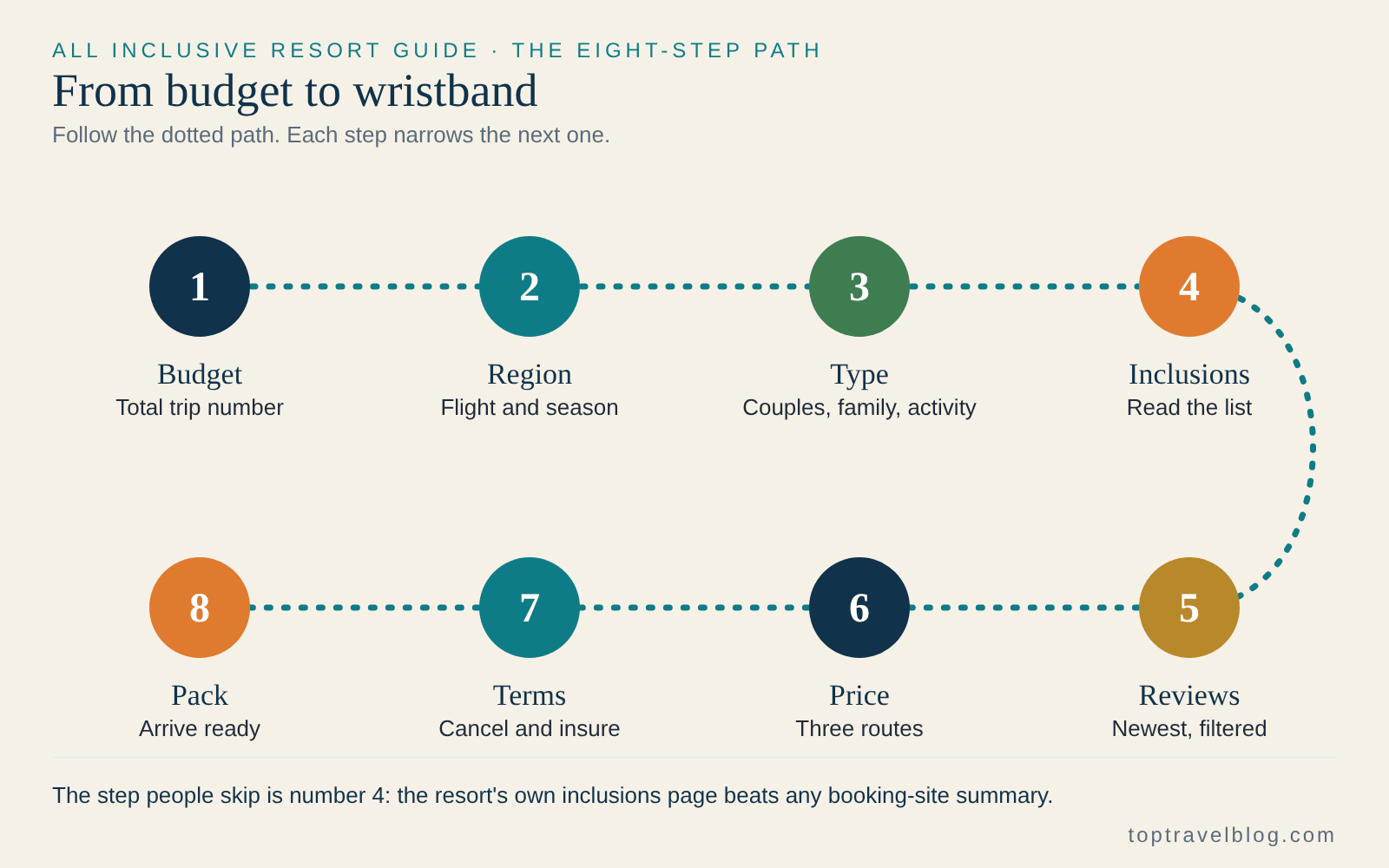
Choosing a resort: the eight-step all inclusive resort guide method
This is the process I walk friends through, and it is the working part of this all inclusive resort guide. Do the steps in order; each one narrows the next.
Step 1
Set a total budget, not a nightly rate
Start your all inclusive resort guide notes with one number: the amount you are willing to spend on the whole trip, including flights, transfers, taxes, tips and a cushion for excursions. A $350-a-night resort with a $60 round-trip transfer and $250 in tips is a very different thing from the headline rate.
Work backward: take your total, subtract flights (see how to find cheap flights for a search method that avoids the usual traps), subtract $400 to $800 for excursions and extras for two people, and what remains is your lodging budget.
Step 2
Pick a region by flight time and season
Choose where you are going based on the flight from your home airport, the time of year and what you want from the beach. Direct flights matter more than they appear to: a connection at Miami or Houston can eat half a day each way. Match the region to the month. Mexico’s Caribbean coast and the Dominican Republic are good from late December to April; Aruba works in September when the others are risky.
Step 3
Decide the resort type
Go back to the types above and pick one; every all inclusive resort guide should push you to this decision early. Couples-only, adults-only, family or active. Cross out every property that does not match. The most common error is booking a mega resort with a famous name for a quiet anniversary, then being surprised by a kids pool next door.
Step 4
Read the inclusions page line by line
The most useful step in this all inclusive resort guide is the dullest. Open the resort’s own “what’s included” page and the booking site’s version side by side. Look for these specific points: premium liquor brand list, a la carte reservation rules, room service hours, kids club ages and hours, motorized sports, Wi-Fi, minibar contents, and any fees collected at the property.
Where the two pages disagree, believe the resort’s. Write down the three items that matter most to you and email the resort or your agent about them. A written answer is more reliable than a phone call.
Step 5
Read recent reviews with a filter
Reviews are the second pillar of an all inclusive resort guide like this. Sort by newest, then search for the words that matter to you: “buffet,” “reservation,” “sargassum,” “noise,” “wait time,” “kids club,” “air conditioning,” “maintenance.” Ignore the best and worst reviews and read the middle. Look at the dates; a resort renovated last year deserves more weight than one renovated eight years ago.
Photos from guests tell you more than the resort’s own pictures, especially the beach at low tide and the pool at 11 a.m.
Step 6
Compare the total price across three booking routes
Price the same room, the way this all inclusive resort guide recommends, on the resort’s own site, one large booking engine and one package seller. Compare the total with taxes and fees, whether it is per person or per room, and the cancellation terms. My comparison of booking direct versus third-party sites explains who handles problems best, and the best hotel booking sites article shows how to compare rates without missing fees.
Packages that bundle flights and hotel can beat separate bookings, particularly from large hubs, but they bundle in rules you may not want, like non-changeable names.
Step 7
Understand the cancellation terms and buy insurance deliberately
This step of the all inclusive resort guide protects your money. Many all-inclusive rates are partially or fully prepaid and tighter than regular hotel rates, especially around Christmas and spring break. Find the date after which a change costs you money. My piece on hotel cancellation policies explains the common structures.
Travel insurance is the backstop. A “cancel for any reason” upgrade must usually be bought within 14 to 21 days of the first trip payment, and it generally reimburses 50 to 75 percent. The plain version covers listed reasons like illness. Read what it excludes, including hurricanes named before you bought it.
Step 8
Prepare for arrival and settle in
The last step of this all inclusive resort guide is packing. Pack the practical things: a refillable bottle, reef-safe sunscreen, water shoes, a light layer for over-air-conditioned restaurants, small bills for tips, and a passport copy. Photograph your passport and card and email the pictures to yourself. Arrive with a meal plan: eat lunch before the check-in line if you land at noon.
For the overall planning picture, how to plan a trip walks through the order of operations for any vacation.
Five trips, five choices: how this all inclusive resort guide works in practice
Frameworks are useful, but most people decide by picturing their own trip, so I tested this all inclusive resort guide against five of them. Here are five common situations and what I would book in each. The resort types come from the section above; I name no specific property because availability and quality shift from year to year.
The first anniversary trip, seven nights
For a trip like this, the all inclusive resort guide advice is simple. You want a beach, a spa day, three or four good dinners and nothing to organize. I would choose an adults-only luxury resort on a calm stretch of coast, in the dry season, with a swim-up or ocean-view room. Spend the extra on the room category, not the club tier, unless the lounge is truly the better restaurant.
Book one excursion only, a half-day boat trip or a cenote swim, and spend the rest of the week doing what you came for. This is the type of trip where an all inclusive resort guide earns its keep, because the price gap between a good adults-only property and a mediocre one is small and the experience gap is huge.
A family with a 4-year-old and a 9-year-old, six nights
In a family version of this all inclusive resort guide, I would look for a resort with a toddler-friendly splash area, a kids club that starts at age 3 or 4 and runs through dinner, a buffet with simple food at every meal, and a beach with gentle surf. Ask whether a connecting room or a family suite is available, because two adjoining rooms often cost less than one large suite.
I would avoid very large properties unless there is a tram, because a 15-minute walk to the pool with a tired four-year-old is no fun. If you are still weighing resorts against other places to stay, the comparison in vacation rental versus hotel helps when kids need a kitchen and separate bedrooms.
Six friends turning 40, four nights
Group trips are the hardest test of any all inclusive resort guide. They are won or lost on the room layout and the noise rules. Choose a resort with a lively but not rowdy reputation, book rooms in the same wing, and set one rule up front: dinner together on the first night, free the rest of the time. A single price that covers drinks removes the main source of group friction, the unequal bar tab.
Pick a resort with a strong beach club or a swim-up bar, and one with activities you can do together such as a catamaran sail or a cooking class. Avoid adults-only properties known for loud late-night parties if half the group wants to sleep.
A budget trip for two, five nights
On a budget, the all inclusive resort guide advice is that shoulder season is your friend: late April to early June or late September to early November, when rates sit well below peak. A solid mid-range property in the Dominican Republic or on Mexico’s Pacific coast usually delivers the lowest price per night for a decent room. Book a refundable rate, skip the club upgrade, and skip the resort tour desk.
Be realistic about food and drink. A budget resort has a good buffet and a decent grill, and the a la carte restaurants are often average. If that is acceptable, you will have a very good time at a modest price.
A traveler who wants some culture, eight nights
Split the stay; it is the single idea in this all inclusive resort guide that surprises people most. Spend four nights at a resort for rest, then four in a colonial city or a small town on a regular hotel rate, eating out. This is how I like to do Mexico: a few nights at a resort near Cancún or Playa del Carmen, then a few nights in Mérida or Valladolid, where the food is the main event. You pay the resort premium for only half the trip.
The same idea works in the Dominican Republic with Santo Domingo’s Colonial Zone, and in Costa Rica with a volcano or cloud-forest lodge. It costs more in transport but it spreads the spending, and it avoids the sameness that makes some people tire of a week-long resort stay.
How to read an inclusions page: the phrases that change the deal
Every resort writes its inclusions list in careful language, and reading between the lines is a skill this all inclusive resort guide can teach in a few minutes. After years of reading them, I look for the same handful of phrases. Here is what each one tends to mean in practice, which is not always what it says.
“Premium brands” and “top-shelf liquor”
This almost always refers to a limited list of mid-range labels. The real top shelf, the aged tequila or single malt, is typically reserved for a paid tier. Ask for the list in writing and look at the brands, not the adjective.
“Subject to availability” and “reservations required”
These phrases appear next to a la carte restaurants. They mean that a table is not guaranteed, particularly in high season. Some resorts open reservations at check-in, others the day before, and a few give priority to a higher room category. Learn the system on arrival day.
“Non-motorized water sports”
Kayaks, paddle boards, snorkeling, sailing dinghies, windsurfing: included. Jet skis, banana boats, parasailing and fishing trips: extra. If the page says “water sports” without qualification, ask which ones.
“Snacks available 24 hours” and “room service”
Sometimes this means a full menu at 3 a.m. and sometimes a counter with sandwiches and fruit. Room service might be free only for a limited menu or only during certain hours. If late meals matter, ask what is served after midnight.
“Kids club” versus “children’s activities”
A kids club implies a staffed room with trained supervisors and set hours. Children’s activities can be a scheduled game by the pool. Ask for the age range, the hours, the staff-to-child ratio and whether children must be potty trained. These details separate a real kids program from a marketing line.
“Resort credit,” “welcome gift” and “free night”
These promotions look generous and often come with conditions: minimum stays, blackout dates, credit that applies only to the spa. A resort credit of $200 is only useful if you were planning to spend $200 on spa services anyway. Count it at half its value.
“Taxes and fees not included”
This one is plain, but the amount is not. Depending on the country, add 15 to 30 percent to the rate. Include the Visitax if you are going to Quintana Roo. Add the transfer, tips and any resort-level service charge.
“Per person, based on double occupancy”
The rate is per person, and a couple pays double. A third person in the room often pays a reduced rate, and a child under a certain age often stays free. The age limits differ widely, so find the exact cutoff for your kids. If you are traveling alone, expect a supplement.
Tip: Screenshot the inclusions page on the day you book. Resorts rewrite these pages, and a dated image is useful if what you were promised at booking differs from what you receive on site.
Getting there: flights and transfers
The flight is the largest single cost outside the resort. Fly midweek, book in the window recommended in my guide to how to find cheap flights, and pick a morning departure so that you reach the resort before dark. Land early enough that you can transfer and arrive by mid-afternoon check-in.
Decide on the transfer in advance. A private driver takes the guesswork out of arrival at a cost of roughly $60 to $150 each way for a car or van, depending on distance. A shared shuttle is cheaper but makes stops at other hotels first, which can add an hour. A ride from the official taxi desk is the middle path. Avoid anyone who approaches you inside the terminal.
What to pack, and what to leave at home
Pack light and loose: swimsuits, a cover-up, linen or cotton shorts, a pair of flat sandals, water shoes for rocky entries, a sun hat, polarized sunglasses and one outfit for dinner. A small dry bag is useful for boat trips. A power strip helps in rooms with few outlets, and a universal adapter is rarely needed in Mexico, the Dominican Republic or Jamaica, which use the same plug type as the US.
Leave at home: expensive jewelry, anything you would hate to lose in the sea, and a plan to work. Wi-Fi is available, but the point of an all inclusive resort guide like this one is that you hand the logistics to someone else for a week. Bring a book, and bring a spare phone charger.
Dietary needs, accessibility, weddings and honeymoons
A good all inclusive resort guide has to cover the situations where the standard advice runs out. These are the ones I get asked about most; the all inclusive resort guide advice here is to ask early and in writing.
Food allergies and dietary restrictions
Buffets are the hardest place to manage a serious allergy, because serving spoons move between dishes and labels are inconsistent. If allergies are severe, email the resort before you book and ask for the executive chef or the guest relations manager by name. Many resorts will arrange safe meals at the a la carte restaurants if told in advance, and some assign a host at check-in.
Vegetarian and vegan eating is usually easy at the buffet but dull at the grill. Gluten-free and halal or kosher options are more variable; very few mid-range resorts are set up for strict kosher food. Carry any medication you rely on, including injectors, in your hand luggage along with a doctor’s note.
Mobility and accessibility
Resorts are large and spread out, with paths that mix stone, sand and steps. Accessible rooms exist at most mid-range and luxury properties, but they are limited in number and often sold out in peak weeks. Ask for the specifics: roll-in shower or tub with bench, door widths, distance to the main restaurant, whether the beach has a mat or a beach wheelchair, and whether the pool has a lift.
Do not rely on a general statement that a resort is “accessible.” Ask for photographs of the room. The hotel room types guide lists the vocabulary so you can ask precisely.
Destination weddings and group events
In the group-event part of this all inclusive resort guide: a wedding at an all-inclusive resort can be cheaper per head than at home, because food, drinks and venue are bundled. Most resorts offer free wedding packages for guests who book a minimum number of room-nights. Ask what the minimum is, what the cancellation terms are for each guest, and whether each guest books independently, because someone who drops out can leave the couple covering a shortfall.
Check the local marriage paperwork rules for the country. Many couples have a legal ceremony at home and a symbolic one at the resort, which avoids the paperwork in a foreign language.
Honeymoons and milestone trips
Resorts sell honeymoon perks aggressively: room decoration, a bottle of sparkling wine, a dinner for two, a late checkout, sometimes a free spa credit. The perks are real, and worth requesting when you book. Tell the resort when you arrive and again at the front desk, because the note does not always travel. Upgrades are possible if the resort has space and the desk likes you, and asking for a room upgrade politely at check-in costs nothing.
All-inclusive resort, cruise, or a regular hotel: how I decide
People sometimes use these three options interchangeably, which this all inclusive resort guide tries to untangle. They are not the same. Here is the thinking I use to separate them.
A cruise also bundles lodging, meals and entertainment, and it moves you to a new place almost daily. The cost is the schedule: you have a few hours ashore, and the port stops can be crowded. An all-inclusive resort is the opposite: one place, a slow rhythm and no luggage. I prefer a resort when the goal is rest, and a cruise when the goal is to sample several islands.
A regular hotel with a good location gives you freedom to eat locally, and costs more per meal. It fits city trips and road trips. I would also choose it in places with famous food, such as Mexico City or Oaxaca, where the point is the street stall and the market.
For a Florida week, the same family might compare an all-inclusive in the Caribbean against a theme-park trip. The money often favors the resort, but the expectations differ. My Orlando vacation guide shows what a park week costs once tickets and meals are counted, so you can compare real totals.
Resort etiquette and the unwritten rules
A few habits make the week smoother. Do not reserve loungers with a towel at 6 a.m. and disappear; many resorts remove towels after a set time. Tip early. Dress for the restaurant’s code. Keep the volume down in rooms with thin walls, and respect quiet hours. If you have a complaint, state it calmly, early and in person, and ask what the staff can do. The guest who says “I would like to move to a quieter room” gets further than the guest who demands a refund.
A sample five-night rhythm
Night one: arrive, walk the property, book the week’s dinners, eat at the buffet. Day two: beach and pool, the included lesson or activity, an a la carte dinner. Day three: the half-day excursion, back by 4 p.m., a spa treatment if you want one. Day four: the quiet day, a book, a long lunch, the show. Day five: a last swim, a late checkout request, and the transfer.
Leave a day without any plan at all. The rhythm of a resort week is that you slow down on day two and are properly rested by day four.
The best time to book an all-inclusive resort
Season decides your price and your weather more than any other single choice in this all inclusive resort guide. The calendar below is for the Caribbean and Mexico, where nearly all US travelers go.
December to April: dry, calm and expensive
Mid-December through April is the dry season: low humidity, steady sun, and the highest prices. Christmas through New Year’s week and spring break (March into early April) are the peaks. If you want to book then, do it early; the good rooms at the better resorts go first. Presidents’ Day week is another busy stretch.
My favorite window for any all inclusive resort guide plan is the middle of January through February, after the holiday rush and before spring break, when the weather is as good as it gets and prices are a step below the peak.
May to August: heat, humidity and sargassum
Summer is hot, humid and afternoon-thunderstorm territory. The sargassum seaweed that hits the Caribbean coast of Mexico and the Dominican Republic is typically heaviest in the spring and summer months, though it varies by year and by beach. Families like summer because school is out, and the rates reflect it in July.
September to November: cheapest, with hurricane risk
The Atlantic hurricane season runs June 1 through November 30, with the peak from mid-August through mid-October. The National Hurricane Center at nhc.noaa.gov tracks active storms. Resort rates drop sharply in September and October, which is why some people book then anyway.
If you do, buy insurance that covers named storms bought before the storm forms, book a refundable rate, and choose a destination outside the usual track. Aruba, Bonaire and Curaçao sit south of the hurricane belt. Costa Rica’s Pacific side and the Mexican Pacific have their own storm seasons.
Late November, right after the hurricane season ends and before Christmas prices begin, is a sweet spot if the weather cooperates.
How to book an all-inclusive resort without overpaying
You have several ways to book, and the all inclusive resort guide verdict is that each has real trade-offs.
Direct with the resort
Direct bookings give you the clearest view of inclusions and the best chance of upgrades or perks. Many brands offer member rates and promotions that are not on third-party sites. If something goes wrong, you deal with the resort, not a middleman.
Online travel agencies and package sites
Big booking engines show many resorts at once and bundle flights. They are useful for comparison. Their rates sometimes beat the resort’s, but changes and refunds can be complicated, and the room you get is the base category unless you pay more. If you book flight and hotel together, understand that changes to either can trigger fees on both.
Travel advisors
A good travel advisor, particularly one who specializes in a brand like Sandals or Club Med, can add real value: they know which rooms are noisy, which resorts have been renovated, and they often get small perks. Their service is usually paid by the supplier and not by you, but ask. Avoid anyone who cannot name the last resort they visited.
Upgrades, tiers and clubs
Tiers are where the all inclusive resort guide math gets personal.
Many resorts sell an upgraded tier: a premium room category plus lounge access, priority reservations, and better liquor. If you plan to spend most of your time at the pool and the specialty restaurants, it can be worth it. If you are a light user, it is not. My notes on how to get a hotel room upgrade cover what actually works at a front desk.
Arrival and departure timing
Check-in is usually mid-afternoon and checkout late morning, with the transfer to the airport earlier than you want. Many all-inclusives hold wristbands and give day-of access to the pool, buffet and a day room after checkout, but policies differ. Read my pieces on check-in times and check-out times for the questions to ask. If your flight leaves in the evening, ask about late checkout, luggage storage and a shower room.
Tipping at an all-inclusive resort
Tipping is the question I get asked most when I share this all inclusive resort guide with friends. The answer depends on the brand.
Sandals and Beaches resorts say tipping is not required and discourage it. Many other brands, including most Mexican and Dominican resorts, say tips are not included and are appreciated. In practice, staff at those resorts depend on them.
What I carry and who gets it
Bring small bills in US dollars; they are accepted nearly everywhere in tourist zones. These are the amounts I use, and they sit in the normal range:
- Bartenders and pool servers: $1 to $2 a drink, or $5 to $10 on the first round for good service for the week.
- Restaurant servers at the a la carte dinners: $5 to $10 per meal for two, more for a long dinner.
- Housekeeping: $2 to $5 a day, left each morning with a note.
- Bellhops and shuttle drivers: $1 to $2 per bag, and a few dollars for a driver.
- Concierge or a person who gets you a good table: $10 to $20 on day one and the final day.
Tips given early often change the whole week. A $5 tip on the first night to your bartender and server gets you remembered. Cash is better than a card. If a resort is explicitly no-tipping, do not tip, and tell staff that you appreciate them instead.
Your first 24 hours at the resort
The first day sets your pattern, and it is where the all inclusive resort guide plan becomes real. Land, transfer, check in, and use these steps.
Go straight to the pool or beach bar and ask the bartender for the list of included brands. Walk the property for 30 minutes to find the nearest restaurant, the spa, the activities desk and the route to the beach. Book your a la carte dinners right away at the reservation desk or by app, since the best slots go within hours.
Take a photo of the daily schedule posted at the lobby. Ask the front desk whether your room is ready, and if not, whether they can hold your bags and give you a day pass. If your room is not what you booked, ask for a different one on the first day, politely and in person. Complaints made on day one get more help than those on day five.
How a good day at the resort looks
I wake early, get a lounger near the water before 9 a.m. (the staff usually do not allow reserving with towels, but guests do it anyway), eat breakfast at the buffet, spend the late morning on the beach, lunch at the grill, a nap or a swim in the afternoon, a shower, and an a la carte dinner at 7 p.m. Then a show or a walk on the beach. It is lazy by design.
Eating and drinking well on an all-inclusive
Buffets reward strategy, and so does the rest of this all inclusive resort guide. Arrive at the start of service for the freshest food, look for stations where things are cooked in front of you, and use the a la carte restaurants for the better meals. Try the local station; it is often the best thing in the room.
Reservations and dress codes
Dress codes are a small thing the all inclusive resort guide checklist covers.
The a la carte restaurants often have dress codes for dinner: no swimwear, closed shoes or long pants for men at some. Pack one nice outfit. Reservations go quickly at the best-reviewed restaurant; book it at once.
Drinking
The bartenders are generous. Pace yourself: heat, sun and unlimited cocktails are a quick path to a bad day. Alternate with water, eat before you drink, and stay out of the sun after a few. Be careful with drinks left unattended, and stay alert in the evening around the bars. Don’t swim after drinking.
Legal drinking age is 18 in Mexico, the Dominican Republic and Jamaica, though some resorts set their own age at 21.
Health, safety and common scams to be aware of
In a responsible all inclusive resort guide, I never say a destination is “safe.” What I can tell you is what to be aware of and what to do about it.
Water, food and stomach trouble
Health comes up in every all inclusive resort guide, and for good reason.
Resorts in Mexico and the Caribbean generally treat their water and make ice from purified water, and the buffet is clean at well-run places. Even so, travelers’ diarrhea is the most common ailment. The CDC’s travelers’ health pages list vaccines and food and water precautions by country. Drink bottled or purified water, be careful with salads and raw foods from the street, and carry basic medications.
Sun, heat and the sea
Sunburn is the most common problem. Use a mineral or reef-safe sunscreen; some Mexican eco-parks require biodegradable sunscreen at the gate. Watch the beach flag system. Red means do not swim, and strong currents are common on Pacific and some Atlantic beaches.
Tour touts, timeshare pitches and “free” offers
The scams in this all inclusive resort guide are mostly small and avoidable.
On arrival at many airports, people inside the terminal in matching shirts will offer help with transport. Walk past and go to your pre-booked shuttle or the official taxi desk. The same applies to people who invite you to a “welcome orientation” or breakfast: this is often a timeshare presentation that takes two to four hours of your vacation, in exchange for a free tour or a discounted spa treatment. You are free to say no.
Advisories and insurance
Official sources matter most in this part of the all inclusive resort guide.
The U.S. State Department rates every country from Level 1 (exercise normal precautions) to Level 4 (do not travel), and its pages for Mexico, Jamaica and the Dominican Republic discuss crime, health and other risks in more detail at travel.state.gov. Enrolling in the free Smart Traveler Enrollment Program there gets you alerts. Most travelers I know stay on the resort grounds and organized tours, and keep their phone and valuables out of sight when away.
Your regular health insurance usually does not cover care abroad, and Medicare does not cover it at all. A travel policy with medical coverage and evacuation is cheap compared with a hospital bill.
Passports and bringing things home
A US passport book is needed to fly to Mexico and the Caribbean; the passport card is not valid for air travel. Make sure it is valid for the full stay. Returning US residents can bring home up to $800 of goods duty-free, including one liter of alcohol for adults 21 and over, under the rules at cbp.gov.
Common mistakes with all-inclusive resorts
These are the ones I see most often, roughly in order of cost, and they are the reason this all inclusive resort guide exists.
1. Booking on the headline rate
A $199 rate that turns into $420 after fees, per-person charges and transfer is not a deal. Always compare the final total. Read about resort fees and destination fees before comparing a Mexican resort with, say, a Las Vegas stay, where the fee is charged by night, not folded in.
2. Not reading which restaurants are included
A resort with seven restaurants where only three are included is a three-restaurant resort. Ask.
3. Booking the wrong type of resort
The types in this all inclusive resort guide exist for a reason.
A quiet couple booked into a family mega resort is the standard unhappy story. Reading reviews for “kids,” “noise” and “party” takes ten minutes.
4. Skipping reservations on day one
Specialty restaurants fill in the first hours. Book the whole week early.
5. Staying too long at a resort you do not like
If the buffet is bad and the staff does not help by day two, ask for a different room or restaurant package. If the situation does not improve, talk to the manager. Do it early.
6. Buying all excursions from the resort desk
Resort tours are convenient and priced at a premium. Compare with licensed operators, but avoid unvetted street offers. For the typical sights, the difference can reach 30 to 50 percent.
7. Booking a nonrefundable rate for a hurricane month
If your travel dates fall in September or October, book a flexible rate or buy proper insurance.
8. Assuming the “all” means all
Premium liquor, spa, motorized sports, laundry, the minibar and tips are often extra. See the list above.
Frequently asked questions about this all inclusive resort guide
What is the difference between all-inclusive and a regular hotel?
An all-inclusive resort charges one rate that includes your room, meals, most drinks, snacks and activities, while a regular hotel charges for the room and you pay separately for food and drinks. The all-inclusive rate looks higher but can be lower overall if you eat and drink on the property. Check what is excluded.
Do you tip at an all-inclusive resort?
It depends on the brand. Sandals and Beaches discourage tipping. Most others say tips are not included and are appreciated. A few dollars per drink, $5 to $10 per dinner and a couple of dollars a day for housekeeping is the normal range. Carry small US bills.
Is alcohol really unlimited?
Usually yes, for the brands the resort includes, during the hours the bars are open. The limit is on premium brands and bottle service, which may cost extra. Resorts can refuse service to a guest who has had too much.
Are all-inclusive resorts worth it for families?
Often, yes. Meals are predictable, kids clubs give parents free time and costs are known in advance. The math works best with kids who eat the buffet and parents who use the bars. For a family that mostly eats light and sightsees, a regular hotel can be cheaper.
What is not included at an all-inclusive resort?
Typically tips, spa treatments, premium liquor, off-site tours, motorized water sports, laundry and sometimes airport transfers. Some resorts charge for specialty restaurants, room service or Wi-Fi in the cheaper tiers. Ask for the not-included list before you book.
What is the best month to go?
For weather, mid-January through April. For the best value with some storm risk, September and October. For a balance, the first half of December or late November, depending on the destination.
Can you leave the resort and come back?
Yes. The wristband is for access, not confinement. Many guests leave for tours and return for dinner. If you leave for the day, tell the resort desk if you want a packed lunch.
What should I pack for an all-inclusive resort?
Swimwear, reef-safe sunscreen, a hat, water shoes, a light jacket for air-conditioned dining rooms, one dressy outfit for specialty restaurants, small US bills for tips, a refillable bottle and a waterproof phone pouch. Bring your own medications.
Are all-inclusive resorts good for solo travelers?
They can be. The social setup makes meeting people easy and the all-in price removes the cost of dining alone. Expect a single supplement on the room rate. Pick an adults-only or activity-focused resort.
How far in advance should I book?
For peak weeks, six to nine months ahead gives the best choice. For off-peak dates, three to four months is usually fine, and last-minute deals appear within 30 days for September and October.
One last thing before you book
The best all-inclusive trip I have taken was not the fanciest one. It was the one where I picked a resort that matched how I actually travel, wrote down the three things that mattered, and asked about them before paying. That is all a good all inclusive resort guide can really do for you.
If you only remember one line of this all inclusive resort guide, remember this: the label tells you nothing and the inclusions page tells you everything. Read it, price the real total, and choose the type of resort that fits the people in your group.
Then go and do very little. That is the point of every all inclusive resort guide worth reading.
Related planning guides
- How to choose a hotel: location, reviews, room type, fees and cancellation terms — the same reading habits, applied to any property.
- Resort vs hotel: which type of stay fits your trip? — when a resort pays off and when a standard hotel is the better call.
- Hotel resort fees and destination fees: how to spot the real total price — the add-ons that turn a headline rate into a bigger bill.
- Best hotel booking sites: how to compare rates without missing fees — a method for pricing the same room across booking routes.
- How to plan a trip step by step: from idea to booked itinerary — the order of operations around your resort week.
- Miami itinerary: 3 days in South Beach, Little Havana and beyond — a city-and-beach trip if you want a few days away from the resort.

