
There is no single winner among the best hotel booking sites, and anyone who names one is selling you something. What works is a pairing: use a search engine like Google Hotels to see the whole market in one place, then buy from either the hotel’s own website or one large booking platform, whichever shows the lower total once every fee is counted.
That is the short answer. The rest of this guide explains why, which platform fits which kind of traveler, and how to line up three prices so the resort fee, the tax and the cancellation terms are all in front of you before you enter a card number.
I have booked a few hundred hotel nights over the years, for family trips, solo weekends and one very stressful wedding block. The pattern is consistent. The nightly rate you see first is rarely the number you pay, and the site with the lowest headline rate loses to its competitors about as often as it wins once taxes and fees are added.
The best hotel booking sites for you depend on three things: whether you hold loyalty status with a hotel brand, how firm your dates are, and how much hassle you are willing to absorb if something goes wrong at the front desk at 11 p.m.
Quick facts: the best hotel booking sites at a glance
- Best for searching: Google Hotels, because it pulls the hotel’s own price and several platforms into one screen, with filters for free cancellation and guest rating.
- Best for buying with the fewest surprises: the hotel’s own website or app, especially if you have a free loyalty account with the brand.
- Best for variety and flexible terms: Booking.com, which lists hotels, apartments and guesthouses in almost every country, with a free-cancellation filter.
- Best for bundling and points: Expedia, Hotels.com and Vrbo share the One Key rewards program, though the earning rates dropped for most members in July 2026.
- The number that matters: the total price with resort fees and taxes, not the nightly rate. In the US, a federal rule in effect since May 12, 2025 requires mandatory fees to be shown up front for short-term lodging.
- Time to compare properly: about 20 minutes for a stay that will cost $1,000 or more, enough to line up three sellers on the same room and terms.
- Biggest mistakes: comparing nightly rates instead of totals, booking a nonrefundable rate by habit, and pressing “book” on a lookalike website.

How I judge the best hotel booking sites
Most lists of the best hotel booking sites rank them by features: how many hotels, how many filters, how slick the app is. Those things matter a little. What matters more is what happens when the booking is real money and something is off. So I judge each site on six questions, and you can reuse them on any platform I do not mention.
1. Does it show the real total?
The most useful screen on any platform is the final price step, the one that lists the room rate, the taxes and any property fee in separate lines. The best hotel booking sites get you there in two taps and show the total in a larger font than the nightly rate. The weaker ones show a low rate on the list, add fees on page three, and let you find out at the card form.
Since May 2025 the Federal Trade Commission’s fee rule has required hotels and booking platforms to show the total price including mandatory fees at the start of the process, with the total more prominent than any partial figure. Government taxes are the exception; they can be added later but must still be clearly disclosed. The rule text sits in 16 CFR Part 464 at the eCFR, and it has made the best hotel booking sites noticeably cleaner. It has not made every list screen honest, so I still compare at the last step.
2. Are the cancellation terms readable?
I want to see the deadline as a date and time, in the hotel’s local time zone, before I pick the room. “Free cancellation” with no date is not a term, it is a headline. If you want to understand the difference between a flexible rate, a nonrefundable rate and one that takes a deposit, my guide to the hotel cancellation policy walks through each type and the usual traps.
3. What does the loyalty program really pay?
Loyalty is where the best hotel booking sites split into two camps. Platform programs like Booking.com’s Genius and Expedia’s One Key give you discounts or credit across thousands of hotels. Brand programs like Hilton Honors and Marriott Bonvoy give you points, status, and usually better treatment at the desk, but only for one family of hotels. I value the second kind more whenever I stay in the same brand twice a year, and the first kind when I do not.
4. How good is the help when something breaks?
This is the criterion that almost nobody ranks and the one I would weigh heaviest. If you book through a platform and the hotel says it cannot find you, you now have two companies who can each blame the other. Some platforms answer fast and fix the problem. Some route you through a chatbot for forty minutes. I treat support quality as part of the price.
5. How wide is the inventory?
A site that lists only chain hotels is fine for a Marriott in Denver and useless in a Greek village. For small guesthouses, family-run hotels in Europe and Asia, and apartments, a large platform like Booking.com or Agoda usually has properties the chains’ sites never will. For a business trip to a downtown tower, the brand site will have the whole inventory anyway.
6. Is the booking tied to something else?
Package deals, member-only rates, card-portal rates and nonrefundable “secret hotel” deals can all be cheaper. They also tend to come with strings: no changes, points that do not count toward status, or a rate that disappears if you cancel and rebook. Cheap is a fine reason to choose these. Only make the choice knowingly.
Rule of thumb: A rate is only comparable when the hotel, room type, bed configuration, dates, number of guests, cancellation terms, breakfast and fees all match. Two prices that differ in any of those are two different products, not two prices for the same thing.
The four kinds of hotel booking sites, and what each is for
People talk about the best hotel booking sites as if they were one thing. They are four different kinds of tool, and picking the right kind for the job is half the skill.
Metasearch engines (Google Hotels, Kayak, trivago)
Best for: Searching and comparing, not buying
Metasearch sites do not sell you the room; they show you what other sites charge and send you there to book. They are where I start every trip because a single search shows the hotel’s own price, two or three platforms, and often a guest-rating filter and a map. The catch is that listed prices come from feeds, and a price on the list can be out of date or may exclude a fee that appears when you click through.
Online travel agencies (Booking.com, Expedia, Hotels.com, Agoda, Priceline)
Best for: Wide choice, flexible filters, a second set of loyalty perks
These are the sellers. They hold a block of rooms or a feed from the hotel, take a commission, and give you a single place to search many properties, pay in one checkout and keep one account. They shine for independent hotels, last-minute searches and international trips. They are weaker when you need to change something, because the hotel and the platform each have a say.
The hotel’s own website or app
Best for: Loyalty points, room requests and fewest middlemen
Booking direct means the hotel sees you as its own guest. You earn points, you usually get your elite benefits, and any request for a quiet floor or an early check-in is attached to the reservation the hotel itself holds. Direct rates are often equal to platform rates; sometimes they are lower because of a member discount. My comparison of booking hotel direct vs third party goes through the trade-offs in detail.
Membership and portal rates (Costco Travel, card travel portals, AAA)
Best for: Extra perks if you already hold the membership
Some bookings come with a benefit that only exists in a certain place: a shop card with a package, a free breakfast on a premium card’s hotel program, or a rate tied to a membership. These can beat public prices, but only in specific cases, and a nonrefundable or change-restricted rate is common. They are worth checking whenever you are about to spend several hundred dollars on a stay.
Getting the most from the best hotel booking sites means using all four kinds, usually in a single planning session. I search with metasearch, check the hotel’s site for the same dates, open one platform for a comparison, and glance at a membership rate if I happen to have the card in my wallet. That whole process takes about 20 minutes, and I have a walk-through of it further down.
If you are still choosing the hotel itself rather than the site, my guide on how to choose a hotel covers location, reviews and room type first. It is much easier to compare prices once you know exactly which room you want.
My ranking of the best hotel booking sites for 2027 trips
This is a ranking of the best hotel booking sites by usefulness, not by how many ads each company runs. The first two are the pair I would use on nearly every trip. Everything after that is a tool for a specific situation.
1. Google Hotels: the place to start every search
Google Hotels is a metasearch tool, so it never takes your payment. What it does is show a map, a guest-rating filter, a free-cancellation filter and, for most hotels, a row of prices from the hotel itself and several platforms. It is the fastest way to see whether the hotel’s own site is cheaper than a big platform, which is the question that decides most bookings.
It has limits. Vacation rentals from Airbnb do not appear, a few small hotels are missing, and the prices are pulled from feeds that can lag a few hours behind the live site. I treat every price as a pointer, then click through and read the actual checkout page. You will also see a “typical price” signal for your dates; useful for deciding whether to book now or wait, but not a promise.
My verdict: always the first tab. Of all the best hotel booking sites, it is the strongest for comparing and the weakest place to stop.
2. The hotel’s own website or app: where I buy when prices tie
Among the best hotel booking sites, the hotel’s own is the one I use when its price matches or comes within a few dollars of a platform’s. The reason is not savings; it is leverage. A direct reservation sits in the hotel’s own system, earns loyalty points, and is attached to your name for the front desk. Hilton says booking on Hilton.com or in the Hilton Honors app is the only way members earn points toward free nights, and gold and diamond members keep their perks on those bookings.
Marriott goes a step further. Bonvoy members get a member rate of at least 2 percent off weekdays and up to 5 percent on weekends, according to Marriott’s booking terms, and the chain’s Best Rate Guarantee pays 25 percent off the room or 5,000 points if you find a lower qualifying public rate elsewhere. More on that in a later section.
Downsides are real, though. Independent hotels sometimes charge more on their own site than on a platform because the platform runs a promotion. And a chain’s site only shows its own hotels, so you lose the comparison unless you bring it from somewhere else, which is why Google Hotels comes first.
3. Booking.com: the widest inventory and the clearest filters
Booking.com is where I look when I want an apartment in Lisbon, a family-run hotel in Oaxaca, or anything outside the big chains. It has a free-cancellation filter that works, a “pay at the property” option on many rates, and a loyalty program called Genius that is easy to qualify for.
Genius has three levels. Level 1 comes with a free account and gives roughly 10 percent off at participating properties. Level 2 requires five completed bookings in two years and moves some discounts to 10 to 15 percent. Level 3 requires 15 and goes up to 20 percent, with free breakfast or room upgrades at some properties and priority support. The discount applies to the base price before taxes and fees, so a Genius badge on a hotel with a hefty resort fee is less of a bargain than it looks.
My honest take on Booking.com as one of the best hotel booking sites: it is excellent for independent and international stays, and middling for chain hotels where the brand site is equal or better. The support experience varies with the property. When the hotel is helpful, the booking flows smoothly. When it is not, you may be talking to both sides for a day.
4. Expedia, Hotels.com and Vrbo: One Key rewards, bundles and the July 2026 change
The three brands share one rewards program called One Key. It is worth knowing about because it changed in July 2026. Under the new rules, as AwardWallet reported, members earn OneKeyCash on eligible Expedia bookings at a rate that depends on their tier: 1 percent at Blue, 2 percent at Silver and Gold, and 3 percent at Platinum, where all members used to earn 2 percent. Silver needs five trip elements and Platinum 30 or more. Expedia’s flight earning stopped, and the Hotel Price Guarantee on Expedia and Hotels.com ended.
What does that mean in practice? If you book a hotel a couple of times a year, the rewards are small enough that I would not choose a platform because of them. Where Expedia still earns its place is bundles. Adding a flight or a rental car to a hotel can unlock a lower combined price, and the app tracks a whole trip in one place. For a family flying to Orlando with a rental car, that is the case where a bundle price can win.
My verdict: a good second opinion and a good bundler. Among the best hotel booking sites for trip packages it still ranks well, but the earning rates alone are no longer a reason to pick it.
5. Kayak and trivago: metasearch with a different mix
Kayak and trivago belong on any list of the best hotel booking sites for comparison; they work like Google Hotels with different layouts and different partners. I open one of them when Google Hotels shows a thin set of sellers for a small hotel. Sometimes they surface a platform I had not considered, and sometimes a lower price at a regional seller.
6. Priceline: for Express Deals, and only for those
Priceline has the usual search and a loyalty program, but its reason to exist is the discounted “Express Deal.” You see the star rating and the neighborhood, not the hotel name, and you learn which hotel you booked after you pay. The rate is typically nonrefundable.
I use these in one situation: a short stay in a big city where I do not care which of several comparable hotels I get and my dates are fixed. A downtown stay in a large hub like Chicago is a fair example. I do not use them for anything involving a family, a mobility need, or a place where location matters block by block.
7. Agoda: strongest in Asia
Agoda is where I look for hotels in Thailand, Japan, Vietnam and much of the rest of Asia, where it often lists more local hotels and sometimes lower rates than the American-based platforms. Use it as one of the best hotel booking sites for Asia, not as a default everywhere. For Western Europe and North America I rarely find it ahead.
8. Costco Travel: for the right package
Costco Travel is a niche tool with a great niche. Executive members earn a 2 percent reward on Costco Travel purchases, capped at $1,250 over 12 months, but the reward does not apply to taxes, fees, surcharges, or resort fees. Many hotel packages add a digital Costco Shop Card, resort credits or waived resort fees, according to Costco Travel’s Executive Member page.
I would look here for a resort package or an all-inclusive trip. The waived resort fee on a Hawaii or Caribbean package can be worth more than the headline discount. Before you do, my all inclusive resort guide explains what is covered and what is not, so you know what you are comparing.
9. Card travel portals: when the points do the work
American Express, Chase and Capital One all run hotel portals for cardholders. Amex’s Fine Hotels + Resorts program adds perks such as breakfast for two and late checkout at a list of upscale hotels, which can be worth a lot on a single night in a luxury hotel and almost nothing at a mid-range one. Chase and Capital One portals let you redeem points directly.
These deserve a look when you hold the card and have points that are worth more in travel than as cash. They are not search tools; I use them last, after I know what the market price is.
Which of the best hotel booking sites fits which traveler
The ranking of the best hotel booking sites above is general. Your own situation changes it, so here is how I would choose for eight common kinds of trip.
Families on a theme-park or beach week
Best for: Bundles, free cancellation and room layout
Of the best hotel booking sites, start with Google Hotels to filter by rooms and bed types, then compare the hotel’s site with Expedia for a bundle. Pick a rate you can cancel while prices shift. Read the fee line carefully, because resort fees on family-focused resorts get multiplied by a week of nights.
Business travelers
Best for: Brand sites, points and status
The best hotel booking sites for this crowd are the brands themselves, so book direct with the one you hold status with. Corporate rates, flexible changes and consistent room service matter more than a platform’s discount. A cancelled meeting costs more than a $15 saving.
Points and miles collectors
Best for: Direct booking and credit-card portals
Book direct to earn points and keep your elite benefits. Compare against the Best Rate Guarantee if the brand offers one. Use a card portal only when its value beats what you would get from the direct booking and points.
Budget travelers and backpackers
Best for: Wide inventory and filters
The best hotel booking sites for guesthouses and hostels are Booking.com and Agoda, with free cancellation until a week or two before. Always read the fee line for city taxes charged at the property, which show up in cash at check-in.
Honeymooners and special occasions
Best for: Perks and a human to call
Look at a premium card portal for added breakfast and a late checkout, then ask the hotel directly whether it can add a room note. A direct booking makes that request easy.
Last-minute travelers
Best for: Mobile apps and flexible terms
The apps for the large platforms and hotel brands show same-night rates, and the Express Deal route can be cheap. If your plans might change again, pick a rate with free cancellation even if it costs a bit more.
International and multi-country trips
Best for: Local strength by region
The best hotel booking sites vary by region: Booking.com for Europe and Latin America, Agoda for Asia, and brand sites for chain hotels anywhere. Compare the currency each platform charges in, because a conversion at checkout can add a hidden cost.
Big-city weekend trips
Best for: Location and total price
Use Google Hotels and the other best hotel booking sites to find the neighborhood, then compare totals with local hotel taxes. A strong example is planning around a New York City itinerary, where the neighborhood you sleep in changes your daily transit time more than the nightly rate does.
If you are still working out the shape of the whole journey, my guide on how to plan a trip puts lodging in its proper place in the order of bookings, and the flights half of the equation is covered in how to find cheap flights.
A 20-minute routine for comparing the best hotel booking sites
This is the sequence I run with the best hotel booking sites for any stay that costs more than a few hundred dollars. It sounds fussy on paper and takes about 20 minutes with practice. Seven stations, in order, and each one has a reason for being where it is.

Step 1
Fix your dates, budget and deal-breakers
Before opening a single site, write down three things: the dates (and whether they can slide by a day), the highest total you will pay for the whole stay, and the two things you will not compromise on. For me that is usually a quiet room and a walkable location. For a family it may be two beds and a pool.
This step stops the most expensive habit in hotel shopping, which is comparing a cheap room that does not meet your needs with a good room that does. If you are still choosing between areas, read how to choose a hotel first.
Step 2
Search Google Hotels with the right filters
Enter the dates and the number of guests exactly as they will be, including children. Then set the guest rating filter, turn on free cancellation if your plans are not locked, and sort by what you actually care about rather than by lowest price. A $90 room with a 3.4 rating and a recent run of complaints about noise is a more expensive stay than the $125 room with a 4.5.
Pick three to five hotels, not twenty. Open each one’s detail page and note the rate from the hotel itself and from the two cheapest sellers. You are not buying yet. You are building a short list.
Step 3
Open the hotel’s own website
For each hotel on the list, search the hotel’s own site or its chain’s app for the same dates and room. Many people skip this because they assume the platform is cheaper. It is often a tie, and a tie goes to the hotel’s site for the loyalty points and the front-desk record.
Log in to the brand’s free loyalty account first. Member rates only show when you are signed in, and the Marriott member rate and the Hilton member price both work that way. Take a screenshot of the total or write it down.
Step 4
Compare the total, not the nightly rate
Now get all three prices to the last page before payment. Write down the room rate, the taxes, any resort or destination fee, and the total. If one seller charges a fee at the property instead of at checkout, add it by hand so you are comparing like with like.
Two traps live here. The first is the city tax that some platforms show in the total and others do not. The second is a property fee collected at check-in that never appears on the platform’s screen. My guide to hotel resort fees explains how to spot them before you pay.
Step 5
Read the cancellation terms
Look at the deadline, the penalty and whether a deposit is taken now. A rate that costs $12 a night more but can be cancelled until 48 hours before check-in is often the smarter purchase, because it lets you rebook if the price drops. The hotel cancellation policy guide covers what each label means and where deposits hide.
If the hotel says “pay at the property” you still have to guarantee the room with a card. That card can be charged a no-show fee, so the label on the rate matters more than the fact you have not paid yet.
Step 6
Book where the total is lowest, with a tie going direct
Choose the cheapest comparable total. If two totals are within a few dollars, book with the hotel, because you will get points, a direct line and a record that you made the reservation yourself. If a platform is clearly cheaper by a meaningful amount for the same room and same terms, take it, and accept that the platform is now your first call if something changes.
Screenshot the confirmation page, save the confirmation email, and note the cancellation deadline in your phone’s calendar for the evening before it expires.
Step 7
Run the search again once or twice before arrival
If you booked a free-cancellation rate, run the same search again a month out and a week out. Prices do drop, especially in shoulder seasons. If the rate is lower for the identical room, book the new one first, then cancel the old one, in that order. Cancelling first leaves you with nothing if the new price disappears.
Some platforms and hotels do not allow this on special rates, which is why you check the cancellation terms at step 5. Reasonable people can disagree about how much effort a $30 saving deserves; I do it when the stay is long or expensive and skip it for a single night.
What is inside the price: why the best hotel booking sites can show different totals
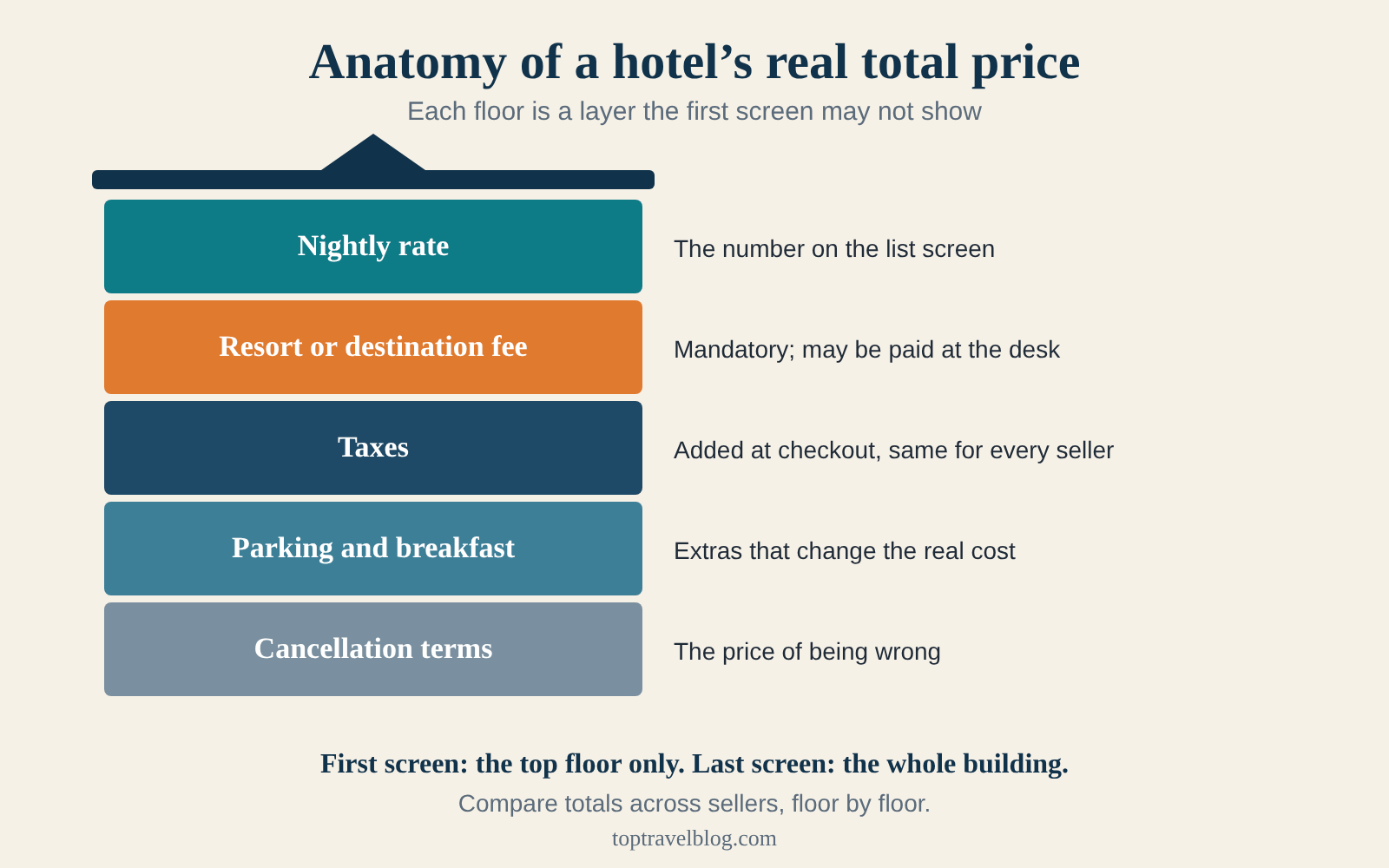
Two of the best hotel booking sites can show you the same hotel on the same night with a $25 gap in the total, and neither is lying. The reason is that a hotel total is a stack of layers, and each seller decides how many layers to show you on the first page.
The base rate
This is the nightly room charge. Different sellers may quote different base rates for the same room because of member discounts, packages and rate types. A Genius or member discount applies here, before anything else is added on top.
Resort, destination and facility fees
These are mandatory daily charges for things like pool access, Wi-Fi, fitness rooms or “amenities” you may never use. Las Vegas, Orlando, Hawaii, Miami and New York have many hotels that charge them, and the amount is often in the tens of dollars a night. They are not taxes; they are part of the hotel’s price, which is why the federal total-price rule treats them as mandatory fees that must be included up front.
A fee collected at the property that appears on the hotel’s own site but not on the platform’s can make the platform look cheaper than it is. That is the first thing I look for when two prices are close.
Taxes
Hotel occupancy taxes vary by city and state. They are the one layer that the federal rule allows to be added later, and some platforms show them as an estimate and some do not. Add them to every comparison. A 15 percent city and state tax on a five-night stay is a big number, and it is the same for all sellers, so it should not decide the winner, but you need it to know your real budget.
Parking, breakfast and other daily extras
An urban hotel with a $50-a-night valet charge is a more expensive hotel than the one next door with free parking. Breakfast is similar: a rate that includes it for two may beat a cheaper rate by the time you have paid for two hotel breakfasts. This is not part of the “mandatory fee” system, so you have to look for it yourself.
The cancellation layer
The last layer is the cost of being wrong. A nonrefundable rate is cheaper because you carry the risk. If your plans are firm, it is a fair trade. If they are not, you are paying for a discount with a chance of losing the whole thing.
A worked example: three sellers, one hotel, five nights
Numbers here are an illustration I made up to show the method, not a quote from any real hotel. Say you want five nights in a mid-range downtown hotel in a US city, two adults, one room with two queen beds.
- Seller A (a large platform): $189 a night, free cancellation until 3 days before arrival. Checkout shows $945 plus an estimated $140 in taxes and a note that a $35 nightly destination fee is paid at the hotel.
- Seller B (the hotel’s website, signed in to the loyalty account): $195 a night, free cancellation until 2 days before. Checkout shows $975 plus $145 in taxes, and the $35 nightly fee is included in the total.
- Seller C (a less familiar reseller on a metasearch list): $182 a night, nonrefundable. Checkout shows $910 plus taxes of $135, with the destination fee not mentioned.
Comparing the best hotel booking sites properly means doing the math the way a careful guest would. Seller A’s real total is $945 + $140 + $175 = $1,260. Seller B’s is $975 + $145 + $175 = $1,295. Seller C, if the same fee applies, is $910 + $135 + $175 = $1,220, but it cannot be cancelled and carries a reseller’s chain of custody.
On the first screen, C looked $35 cheaper than A and $65 cheaper than B. Once the fee is added to every row, the gap between A and B is $35 and C is only $40 below A. Then B earns loyalty points and gives you the hotel directly. Many travelers would pick B for $35, and many would pick A. Fewer would pick C. The point is that the decision is now an informed one.
Practical: Keep a note on your phone with three lines per hotel: seller, total including fees, and cancellation deadline. It takes a minute and stops the second guessing that happens at 11 p.m. the night before you leave.
Payment timing and cancellation: the hidden difference between rates
Price is the loud variable on the best hotel booking sites. Terms are the quiet one, and they decide how stressful your trip is if anything changes.
Pay now or pay later
“Pay now” rates are usually cheaper and often nonrefundable. “Pay later” or “pay at the property” rates cost more and are usually cancellable until a deadline. On many platforms, the pay-later label means the platform did not take your money; it does not mean the hotel did not take a card guarantee. If you fail to arrive, a no-show charge of one night is common.
How to read a free-cancellation claim
The full phrase to look for is “free cancellation until [date, time, time zone].” Check whether the date is in the hotel’s local time. A deadline of 11:59 p.m. on a Tuesday in Hawaii is a very different moment from the same sentence on the East Coast. Also see whether a deposit is taken now and when it is refunded, because some cancellable rates still hold a night’s charge for a few days.
Why I pay a little extra for flexibility
I buy flexibility when the trip depends on something I do not control, like a flight not yet booked. I take the nonrefundable rate when everything is fixed. The mistake I see most is the reverse: locking in a cheap nonrefundable hotel first, then finding that flight prices make the dates impossible.
What check-in time means for your first day
One more term that rarely shows up on the comparison page is the check-in time itself. Most hotels offer standard afternoon check-in, and early arrival depends on availability. If your flight lands at 9 a.m., ask the hotel about holding your bags or a guaranteed early room, because a platform cannot promise that for you. My notes on hotel check in time cover what to request and when to ask.
Price matches, loyalty and who helps you when something goes wrong
Best-rate guarantees: real, narrow and worth knowing
Some hotel brands promise to beat a lower price you find elsewhere. Marriott’s Best Rate Guarantee is the clearest example I can describe from its published terms. If you find a lower qualifying rate on a non-Marriott website for the same hotel, room, dates and inclusions, Marriott matches it and gives you either 25 percent off the room or 5,000 Bonvoy points. You must be a Bonvoy member, file within 24 hours of booking, and file at least 24 hours before check-in. The competing rate must be public and more than 1 percent lower.
Excluded: auction sites, packages, negotiated or corporate rates, rates that require a specific card or residency, and certain properties such as all-inclusive resorts. Hilton runs a Price Match Guarantee for bookings made on its own channels. In both cases the guarantee applies only if you booked direct, which is one more reason the hotel’s site belongs in every comparison.
I have never made a claim, because most of the time the direct price already matches. The existence of the guarantee is still useful: it tells you the hotel considers a lower platform price a mistake it will pay to fix.
Loyalty: where the real value is
If you stay in one brand more than a couple of times a year, brand points and status are worth more than a platform’s discount. Gold-level perks like a room upgrade when available or free breakfast depend on the hotel, but they are tied to direct bookings, and many chains treat third-party reservations as lower priority when the hotel is full.
If you do not stay in one brand, the loyalty programs of the best hotel booking sites are fine. Genius and One Key do not need much effort, and Genius Level 2 and 3 require repeat bookings that you may make anyway. I would not rearrange a trip to chase either.
Who fixes a problem?
Here is a scenario I have lived. You arrive at 10 p.m., and the hotel says it has no record of your platform booking. If you booked direct, the desk can see your reservation or call its central line. If you booked through a platform, you call the platform while standing at the desk, and the hotel waits.
Some platforms are quick, and some are not. Before you rely on one of the best hotel booking sites for an important stay, read recent reviews of its customer service rather than its hotel inventory. If a stay is truly critical, a wedding weekend or a flight-connected overnight, I book direct.
Scams and lookalikes to avoid when you book online
Even the best hotel booking sites attract imitators, because the amounts are large and the details are routine. These are the patterns I would watch for.
- Lookalike websites. A page that looks like a hotel or a major platform but sits on a slightly different web address, often surfacing as a sponsored search result. Type the address of the big sites yourself or use a saved bookmark.
- Messages asking you to pay outside the platform. If a message arrives through the booking app or an email, claiming a card problem and asking you to re-enter payment on a link, stop. Use the app itself, or call the hotel using the phone number from its own website.
- “Only 1 room left” and countdown timers. These are marketing devices. Sometimes accurate, often not. Check availability on a second site rather than reacting.
- Third-party “official” phone numbers. Search results sometimes show customer-service numbers that belong to resellers. Use the number printed on your confirmation email or the hotel’s own page.
- Prices that look too good on unfamiliar sites. A room 40 percent under every other seller is either a limited rate with severe conditions or not a real room.
Be aware: Never send card details by chat, text or email, and be wary of any request to move a conversation off the booking platform’s own messaging. Legitimate hotels and platforms rarely ask for payment this way.
When to book, and when to wait
Hotel pricing follows how full the hotel is expected to be, which varies by city, season and local events more than by calendar distance, so I do not trust any “book exactly 60 days out” rule. For peak weeks and events I book a cancellable room early. For ordinary weeks in a big city I wait, because inventory is deep. For tiny hotels, I book early.
The rebooking habit in step 7 turns timing into a free option. If you are building the whole schedule, how to plan a trip gives the order that I follow: flights and hotel dates first, details second.
Common mistakes when using the best hotel booking sites
These are the ones I see among friends, in comment threads and in my own history with the best hotel booking sites, in rough order of cost.
1. Comparing nightly rates instead of totals
A $20 gap on the list screen can vanish or reverse at checkout once a destination fee and taxes are added. Always compare the last-page total for the whole stay.
2. Booking nonrefundable because it was cheaper
The discount is real. So is the risk. Take it only when your flights are booked, your dates cannot move, and you could absorb the loss. Otherwise the flexible rate is cheap insurance.
3. Assuming a platform is always cheaper than the hotel
It used to be, on the best hotel booking sites and off them. Today the hotel’s own price often matches, and the direct booking has extra value in points and in who can fix a problem. Check it every time.
4. Treating a loyalty badge as a discount on the total
Discounts on the best hotel booking sites, Genius included, apply to the base price before taxes and fees. On a hotel with a large mandatory fee, the effective saving is smaller than the badge implies.
5. Ignoring fees collected at the property
A fee that is not charged at checkout still has to be paid. It just moves to the front desk. Add it to the total yourself, and if a seller does not mention one, look at the hotel’s own page to see whether it exists.
6. Booking from a sponsored search result without reading the web address
Typing the name of a hotel or platform into a search engine and clicking the first ad is a classic route to a lookalike page. Use bookmarks or the official app.
7. Forgetting the cancellation deadline
A free-cancellation rate becomes a nonrefundable one at a precise minute, often in a time zone you are not in. Put the deadline in your calendar the day you book.
8. Not telling the hotel about a platform booking
If you booked through a third party and you need something, such as an early check-in or an accessible room, contact the hotel with your confirmation number as well. The platform alone cannot guarantee requests.
9. Never running the search a second time
A cancellable booking can be swapped for a cheaper one. The mistake is assuming the price you booked is final.
Frequently asked questions about the best hotel booking sites
What are the best hotel booking sites overall?
There is no single best, but there is a best combination. Start with Google Hotels to compare many sellers at once, check the hotel’s own website for the same room, and add one large platform such as Booking.com or Expedia. Buy from whichever shows the lowest total with fees and acceptable cancellation terms. If prices tie, book direct.
Is it cheaper to book directly or through the best hotel booking sites?
Neither is cheaper every time. The hotel’s own rate often equals the platform’s, and a signed-in loyalty member may see a lower member rate. A platform sometimes wins on independent hotels or bundles. The only reliable method is to compare the final total, including fees, from at least two sellers for the same room and cancellation terms.
Which of the best hotel booking sites has the best cancellation policy?
The policy belongs to the rate, not the site. Every one of the best hotel booking sites lists both flexible and nonrefundable rates. Booking.com and Google Hotels have free-cancellation filters that save time. Read the deadline, which should be shown as a date and time, and look for a deposit that is taken now. My guide on the hotel cancellation policy explains the labels.
Do the best hotel booking sites include resort fees in the price?
They are supposed to. A federal rule that took effect on May 12, 2025 requires mandatory fees for short-term lodging to be included in the total price shown at the start of the booking process, with government taxes as the exception. Still compare at the final checkout screen, and see the guide to hotel resort fees for how to read them.
Is Booking.com Genius worth it?
It costs nothing, so it is worth having. Level 1 comes with a free account and gives about 10 percent off at participating properties. Levels 2 and 3 need five and 15 completed bookings within two years. The discount applies to the base price before taxes and fees, and only at properties carrying the Genius label, so compare totals instead of trusting the badge.
Did Expedia and Hotels.com change their rewards?
Yes. In July 2026 the One Key program began paying OneKeyCash on Expedia hotel bookings by tier: 1 percent for Blue, 2 percent for Silver and Gold, and 3 percent for Platinum. Flight earning on Expedia ended, and the Hotel Price Guarantee on Expedia and Hotels.com was discontinued. For most casual travelers, the earning rate is now too small to drive the choice of site.
Can I get a refund if I find a lower price after booking?
Sometimes. If your rate is cancellable, you can book the lower price and then cancel the first one. Some brands also run price-match programs: Marriott’s Best Rate Guarantee gives 25 percent off or 5,000 points when a member files within 24 hours of booking and meets the conditions. Platforms generally do not refund the difference.
Are Google Hotels prices accurate enough to rely on?
They are good guides, not guarantees. Prices come from the sellers, update frequently and can differ from the checkout page, particularly where a fee or tax is shown separately. Treat Google Hotels as the comparison step. Click through to the seller, get to the final screen and use that number for the decision.
Should I use a third-party site for an all-inclusive resort?
It can work, especially through a package, but all-inclusive stays have more variables: meal plans, resort credits, transfers and swim-up room categories. Compare what is included, not just the price. Costco Travel and similar packages may add credits or waive resort fees, and my all inclusive resort guide explains what to ask.
Are the best hotel booking sites safe, and what about unfamiliar ones?
The established ones, reached by typing the address yourself, are what I use. I would not use an unfamiliar one for an expensive stay. Unknown resellers may add layers between you and the hotel, and lookalike sites exist to take payment details. Stick with the hotel’s own domain, large platforms you reach by typing the address, and membership channels. If a price is far below every other seller, treat it as a warning rather than a bargain.
When should I book a hotel for the best price?
It depends on the city and dates more than on a fixed number of days. For peak seasons and events, book a free-cancellation room early and search again later. For quiet weeks in big cities, there is usually time to wait. Whatever you pick, a rate you can cancel lets you rebook if it drops.
One last thing before you book
If I could change one habit in the way people use the best hotel booking sites, it would be to stop treating the first screen as the price. The first screen is an advertisement for the price. The last screen is the price. Everything about the best hotel booking sites in this guide is a way to get to the last screen faster, on three sellers instead of one, with the cancellation date written down.
The second habit is humility about the process. You do not need to find the absolute lowest rate on earth. You need a fair total, terms you understand, and a reservation that will be honored when you walk up to the desk. A $20 gain that costs you a lost booking or a missing loyalty credit is not a gain.
Plan the stay around the trip rather than the other way round. Pick the neighborhood first, then the hotel, then the site. The best hotel booking sites are the ones that get you to the right room at a price you understand, and after that they should get out of the way.
Related planning guides
- How to choose a hotel: location, reviews, room type, fees and cancellation terms — start here if you have not picked the hotel itself yet.
- Booking hotel direct vs third party: price, flexibility and problem solving — the full trade-off between the hotel’s site and a platform.
- Hotel resort fees and destination fees: how to spot the real total price — how to find the fee that the first screen hides.
- Hotel cancellation policies explained — what flexible, nonrefundable and deposit rates really mean.
- Hotel check-in time: early arrival, late check-in and what to ask for — what to ask for once the room is booked.
- How to plan a trip step by step — where the hotel booking fits in the order of everything else.


