The short answer: apply at least three months before you fly. That is the single sentence I would tattoo on every first-time traveler, and it is the thread running through this us passport guide.
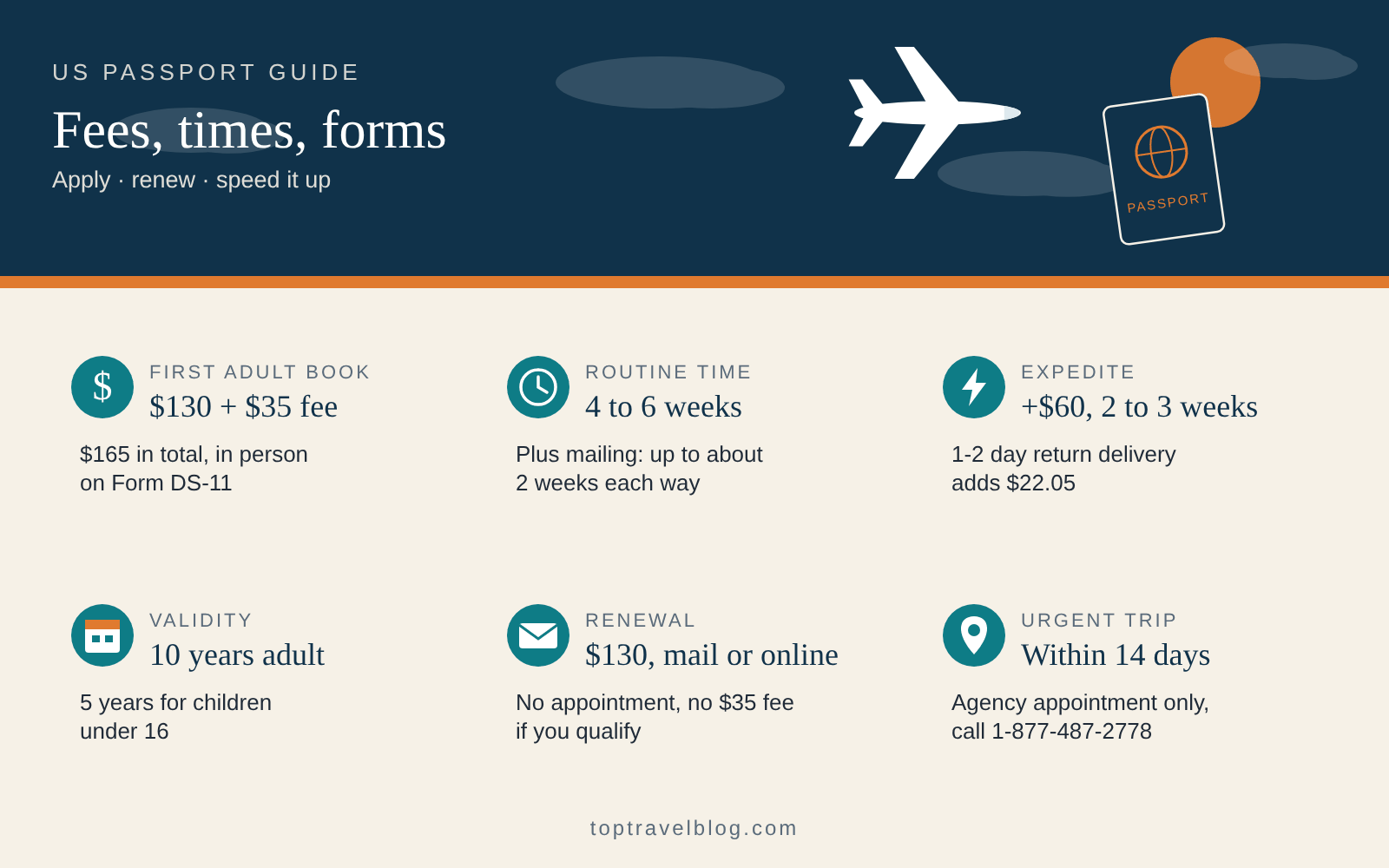
A first adult passport goes through an in-person application on Form DS-11 at an acceptance facility, usually a post office, and costs $130 to the State Department plus a $35 acceptance fee. A renewal costs $130 and can be done by mail or, if you qualify, online, with no appointment at all.
As of November 2026 the State Department publishes routine processing of 4 to 6 weeks and expedited processing of 2 to 3 weeks, and both exclude mailing time that can add up to about two weeks at each end. If you are inside two weeks of a flight, the only door left is an appointment at a passport agency. Most of this us passport guide exists to keep you out of that situation.
I have renewed my own passport twice, helped my parents through a first-time application at 68, and watched a friend rebook a Lisbon trip because her expired passport surfaced at the airport counter. What follows is the us passport guide I wish all of us had: which form you need, what every option costs, how long each step really takes, and what to do when the trip is closer than the paperwork.
Everything here comes from the State Department’s own pages, and I link to the relevant one wherever the rule is theirs and not mine. Where I have an opinion, I say so.
Quick facts: this US passport guide at a glance
- Apply when: at least three months before departure. Routine processing is 4 to 6 weeks, plus mailing that can add up to about two weeks each way.
- First adult passport: in person on Form DS-11. $130 to the State Department plus a $35 acceptance fee, $165 in total, for a ten-year book.
- Renewal: $130 by mail on DS-82 or online if you qualify. No appointment, no acceptance fee, and your old passport may be up to 15 years old.
- Children under 16: always in person with both parents or documented consent. $100 plus $35, valid five years.
- Faster options: expedited service adds $60 (2 to 3 weeks), one- or two-day return delivery adds $22.05, and trips within 14 days need an agency appointment.
- Key caveats: the passport card cannot be used for international flights, many countries want six months of validity left, and look-alike websites charge extra for free forms.
Which application you need: the four situations in this US passport guide
Before fees or photos, one question decides almost everything: which kind of application are you? There are four, and picking the wrong one is the most common reason an application gets sent back.
Think of this section as a sorting hat. Find the sentence that describes you, note the form number, and then jump to the matching section of the us passport guide below.
Situation one: you have never had a passport, or your last one was issued before you turned 16
You apply in person on Form DS-11, at an acceptance facility such as a post office, county clerk’s office or public library. You bring proof of citizenship (usually a certified birth certificate), a photo ID, photocopies of both, and a passport photo. You pay two separate fees, one to the State Department and one to the facility. The fees section of this us passport guide breaks both payments down.
Anyone under 16 also falls here, with extra rules about parents. This is the longest road, and the section on first-time applications below walks every step of it.
Situation two: you have a passport and it is simply running out
You renew. If your most recent passport is undamaged, was issued when you were 16 or older, was issued within the last 15 years, and carries your current name (or you can prove the change), you can renew on Form DS-82 by mail. Many people can also renew online through the State Department’s portal.
This is the easy road: no appointment, no acceptance fee, and you do not have to prove citizenship again. It is the path most readers of this us passport guide will take.
Situation three: your passport was lost, stolen, damaged or is too old to renew
You are back to the in-person route. A lost or stolen passport requires Form DS-64 to report it and a fresh DS-11 to replace it. A badly damaged passport, or one issued more than 15 years ago, also needs a new in-person application. The fees match a first-time application. The lost-and-stolen section later in this us passport guide covers the forms in order.
The good news is that the second time is faster, because you know what the acceptance agent will ask for and you probably still have the old book to hand in.
Situation four: your passport is fine, but something about you changed
A new legal name, a printing error, or a data correction is handled with Form DS-5504 if your passport is less than a year old, or with a renewal form if it is older. A name change within a year of issue carries no application fee. Past a year, the standard renewal fee applies. The name-change rules get their own section of the us passport guide, with a worked example.
Because the State Department’s fee calculator on its passport fees page covers these edge cases, I send people there when their situation is unusual.

The quick sorting rules I use
- Never had one, or last one issued under 16: DS-11, in person.
- Have a recent adult passport in hand: DS-82 by mail, or online if eligible.
- Lost or stolen: DS-64 plus DS-11, in person.
- Name or data changed: DS-5504 within a year, DS-82 after.
- Child under 16: always DS-11, in person, with both parents or documented consent.
If you fall between two categories, pick the more cautious one. An in-person application that did not need to be in person costs you an afternoon. A renewal application that should have been in person costs you weeks.
Quick check: Pull your current passport out right now and read two dates: the issue date and the expiration date. If it was issued more than 15 years ago, or expires within a year of your trip, this us passport guide is about you today, not next month.
Passport book or passport card: what each one actually does
The State Department issues two different documents, and the card is a trap for first-timers. It looks like a driver’s license, it is cheaper, and it will not get you on an international flight.
The passport book
The book is the real thing. It works for air, land and sea travel to every country that admits U.S. citizens. An adult book is valid for 10 years. A book issued to someone under 16 is valid for five. If you are going to cross an ocean even once in the next decade, this is the document. For nearly every reader of a us passport guide, the book is the answer.
The passport card
The card costs $30 for adults and $15 for children (plus the acceptance fee on a first application) and is valid only for land and sea crossings between the U.S. and Canada, Mexico, Bermuda and the Caribbean. You cannot fly internationally with it. Not to Cancun, not to Toronto, not to Nassau.
I recommend the card in exactly one situation: you live near a border, you cross by car often, and you already own a book. The two together cost $160 on a renewal, and the card fits in a wallet, which is the whole point.
Why the card is a poor first purchase
Imagine you buy the card for a Bahamas trip and the airline gate agent asks for your passport book. The airline answers to the destination country’s rules, not to your plans. A family of four holding four cards on a flight to Cancun is a family that is not flying to Cancun. Nobody should learn this at a gate, which is why a us passport guide has to say it plainly.
Cruises can be more forgiving. Some closed-loop cruises that start and end at the same U.S. port accept a birth certificate and photo ID, but a flight home from a missed port on a medical emergency requires a book. Buy the book.
What about a REAL ID?
A REAL ID driver’s license lets you board domestic flights and is not a travel document abroad. A passport book or card also satisfies the TSA’s identification requirement at domestic checkpoints. So a passport quietly does double duty, which is one more reason this us passport guide treats the book as the default.
What a US passport costs in 2027, in plain numbers
The State Department’s fee page, last updated in October 2025, lists every price below. The structure confuses people because a first application involves two separate payments, to two different payees, in two different forms.
Adult first-time application (DS-11)
- Passport book: $130 to the U.S. Department of State, plus a $35 acceptance fee to the facility. Total $165.
- Passport card: $30 plus $35. Total $65.
- Book and card together: $160 plus $35. Total $195.
The $130 goes by check or money order payable to “U.S. Department of State.” The $35 is paid separately to the facility, and you should ask what forms of payment it takes. Many post offices accept cards for their own fee but not for the State Department’s. Bring both payment types, and treat the us passport guide checklist later on as a reminder.
Adult renewal (DS-82 or online)
- Book: $130.
- Card: $30.
- Book and card: $160.
There is no acceptance fee, because you are not appearing in person. By mail, the payment is a personal check or money order. Online renewal takes credit, debit or contactless payment and nothing else.
Children under 16
- Book: $100 plus $35. Total $135.
- Card: $15 plus $35.
- Book and card: $115 plus $35.
The book for a child lasts five years, not ten, so the per-year cost is about double an adult’s. I know that stings. It exists because a child’s face changes too fast for a ten-year photo to mean anything. That is also why the children’s section of this us passport guide is stricter than the adult one.
The add-ons that move the total
- Expedited service: $60 per application, for a published processing time of 2 to 3 weeks.
- 1-2 day return delivery: $22.05, for the passport book only, not available for a passport card by itself.
- Name change or correction: priced by situation, and free for a printing error on DS-5504.
- File search: $150, and only if your record was issued before 1994.
Expedited and delivery add-ons stack. The fastest routine-travel option I recommend is $60 plus $22.05, which comes to $82.05 on top of the base fee.
Where people overpay
Photos are the first leak. A drugstore photo runs roughly $15 to $17, and your own phone, a white wall and a patient friend can produce a perfectly valid one for nothing, as the State Department’s photo page explains. Do not pay a “passport photo studio” a premium just because the sign looks official.
The second leak is expediter fees. A private service that submits your paperwork on your behalf charges its own price on top of the government fees. Sometimes it is worth it, as I cover in the urgent-travel section, but it is never a government charge.
The third leak is a “passport application service” website, which charges for filling in forms that the State Department’s form filler fills in for free. I come back to those in the scams section. Skip ahead to that part of the us passport guide if you already searched online and landed on a .com.
What a family actually pays
A family of four applying for the first time, two adults and two kids under 16, pays $165 for each adult and $135 for each child, so $600 before photos and travel to the facility. Routine service adds nothing. Expedited service for all four adds $240.
Compare that figure with the cost of a rebooked flight or a lost deposit. On a four-person family trip to Europe, the $600 is a small slice of the budget, and I keep telling friends that this is the cheapest insurance in the whole trip.
How long a passport takes: the real timeline in this US passport guide
This is where the timeline matters most, because the number that matters is not the one on the State Department’s page. It is the number plus the mail. That gap is the most useful thing a us passport guide can tell you.
What the published times mean
As of November 2026 the State Department lists routine service at 4 to 6 weeks and expedited service at 2 to 3 weeks. The processing times page specifies that these figures cover only the time your application sits at a passport agency or center, not mailing.
Mailing can add up to about two weeks for your application to reach the agency and up to about two weeks for the finished passport to reach you. Do the arithmetic honestly and a routine passport can take 8 to 10 weeks from the day you hand it to the clerk.
My planning rule: three months, no exceptions
I plan on 12 weeks for a first passport. That sounds paranoid until you remember that spring is the slowest season, because the whole country books summer vacations in the same six weeks. A processing time published in February is not the processing time you will meet in April. Seasonality is the quiet variable in any us passport guide timeline.
Twelve weeks also covers the day your appointment slot is a week out at the nearest post office, and the day your photo gets rejected and you start over.
The timeline, week by week
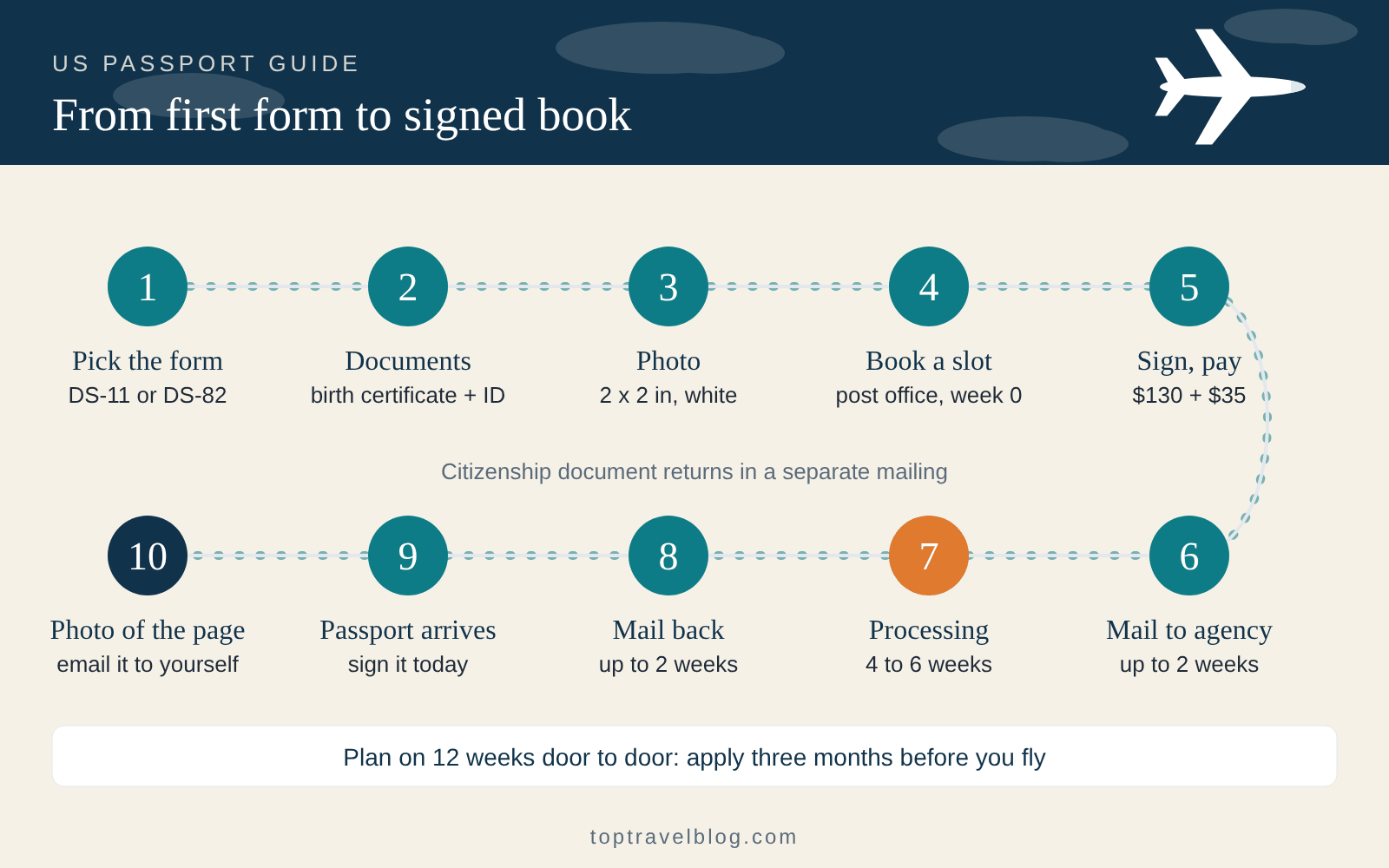
- Week 0: Gather documents, take the photo, book the acceptance appointment.
- Week 1: Appear in person, sign and pay. The facility mails your package.
- Weeks 1 to 3: The application travels to the processing center. Status may show as “Not Available” for about two weeks before it flips to “In Process.”
- Weeks 3 to 9: Processing at the center, 4 to 6 weeks routine.
- Weeks 9 to 11: Printing and mailing back. Your citizenship document arrives in a separate mailing, sometimes up to eight weeks after the passport.
That is the realistic shape of it, and it is why I tell people to start the passport before they book the flight. The details of ordering a whole trip live in the guide on how to plan a trip step by step, where the passport is step one for exactly this reason.
Online and mail-in renewal are the same speed
There is no secret fast lane for online renewal. It uses routine processing. What it saves is the mailing at the front, the post office trip, and the worry about whether the envelope arrived. If you qualify, I would use it every time. Online renewal is the part of this us passport guide that has changed most in recent years.
Tracking your application
The State Department runs an online passport status system, and you can enroll for email updates about a week after applying. If your status shows “Not Available” for about two weeks, that is normal and not a lost application. If your passport was mailed and has not arrived two weeks later, call the National Passport Information Center.
Spring is the slow season: Applications spike from January through June as summer plans get booked. If your trip falls between May and September, apply in the autumn or winter if you can. A November application has a cushion that a March application does not.
Applying for your first adult passport: step by step
Here is the route from nothing to a passport in your hand. The image below shows the whole path, with the realistic waiting points marked, and the steps after it are the detail. Keep the picture open while you read this part of the us passport guide.
Step 1
Check that you can use this route
You apply in person on Form DS-11 if you have never had a passport, if your last one was issued when you were under 16, or if your last one is lost, stolen, damaged or more than 15 years old. If you are unsure, the sorting rules near the top of this us passport guide settle it in under a minute.
Step 2
Gather proof of citizenship
You need an original or certified document, not a photocopy or a digital copy. The usual choice is a certified U.S. birth certificate with the registrar’s seal, issued by the city, county or state. A previous U.S. passport, a Certificate of Naturalization, a Certificate of Citizenship or a Consular Report of Birth Abroad also works.
Hospital “souvenir” certificates with footprints do not count. If you cannot find your birth certificate, order a certified copy from the vital records office of your birth state before anything else. It is the slowest piece of the puzzle.
You also bring a single-sided black-and-white photocopy of the document on plain 8.5 by 11 inch white paper. The facility keeps the copy, and the original comes back to you in a separate mailing. Every first-timer reading a us passport guide should expect that second envelope.
Step 3
Bring photo ID and a copy
A valid driver’s license, a military ID, or a previously issued passport works. Bring the original plus a single-sided photocopy of the front and back, again on white paper. A mobile ID on your phone is not accepted.
If your ID is from a different state than the one where you apply, the facility may ask for a second form of ID. Bring a debit card or a student ID as a backup.
Step 4
Fill out Form DS-11, but do not sign it
Use the State Department’s online form filler, which produces a printable PDF with a barcode, and print it single-sided. Fill in everything but the signature. The acceptance agent watches you sign, because the signature must be witnessed. It is a detail a us passport guide has to spell out, because the form looks finished without it.
Be careful with names. The name on the DS-11 must be your legal name, and it should match your proof of citizenship. A middle name that appears in one document and not the other is the sort of thing that turns a routine application into a two-month letter exchange.
Step 5
Get a photo that passes
This is the step that fails most often, so I give it its own section below. The short version is one 2 by 2 inch photo, taken in the last six months, plain white background, no glasses, neutral expression.
Step 6
Book an appointment and appear in person
Find an acceptance facility through the State Department’s search tool and book the earliest slot. Post offices are the most common choice, and many fill up weeks ahead. Library and county clerk’s office locations can be easier to get into, and some accept walk-ins. Appointment availability is the hidden variable in the us passport guide timeline.
At the window, the agent checks your documents, watches you sign, takes your payment and mails the package. Bring two forms of payment: a check or money order for the State Department’s $130, and whatever the facility accepts for its $35.
Step 7
Wait, then sign your passport
You will get your passport book by mail, typically in a plain envelope, and your citizenship document in a separate mailing. Sign the book in blue or black ink the day it arrives, then photograph the information page and email the photo to yourself. A copy makes a replacement abroad much faster if the original disappears.
First-timer shortcut: Start by ordering your birth certificate if you cannot find it. It is the one document you cannot replace on the spot, and a state’s vital records office may take weeks, which is longer than the passport’s own routine processing.
Renewing a US passport by mail or online
Renewal is the section most readers of this us passport guide need, and it is the one with the best news: it is easier than people fear.
Who qualifies for mail renewal
Using Form DS-82, you can renew by mail if you can answer yes to every one of these about your most recent passport:
- You can send it in with your application.
- It is not damaged beyond normal wear and tear.
- It has never been reported lost or stolen.
- It was issued within the last 15 years.
- You were 16 or older when it was issued.
- It carries your current name, or you can send proof of the change.
- It was not issued with a shortened validity because of an earlier loss or damage.
It does not need to be expired. An expired passport can still be renewed as long as it was issued less than 15 years ago, which is the detail that surprises most people. If yours expired two years ago, you are probably still on the easy road. That surprises more readers of this us passport guide than any other fact.
What goes in the envelope
You send your old passport, a completed and signed DS-82 printed single-sided, one photo stapled with four staples at the corners, a personal check or money order for the fee, and a certified name-change document if you have one. The State Department does not accept cash or online payment for mail renewals.
Mail it with the U.S. Postal Service, not UPS, FedEx or DHL, to the post office box listed for your state. Your old passport comes back in a separate mailing, canceled with holes punched in it, and some people keep it as a souvenir. The old book is canceled, not destroyed, and the us passport guide advice is to keep it somewhere safe.
Renewing online
The State Department also runs an online renewal portal for people who meet a stricter set of conditions. You sign in through a Login.gov account, upload a digital photo, and pay by credit, debit or contactless payment. You keep your old passport in hand and never mail it in, which is the part I like best.
The conditions are narrower than for mail. Online renewal is for routine service only, not for expedited requests or changes to your information. You need to be in the United States, hold a ten-year adult passport, and be renewing without changes. The portal tells you straight away whether you qualify, so you lose nothing by trying.
Mail or online: my pick
If I qualify online, I use it. There is no envelope, no post office line, and no week of wondering whether the envelope arrived. Processing time is the same routine 4 to 6 weeks. That equality is why the us passport guide recommends online renewal whenever it is available.
I mail it only when the portal says no, or when I need to add the $60 expedite fee, because expedited service is a mail-in or phone-in feature. The detail of what the State Department asks for is on its renewal page.
When to renew
There is no formal “too early.” Your passport does not need to be expired, and renewing early costs the same as renewing late. The sensible window is nine months to a year before expiration, for two reasons.
First, many countries require at least six months of validity left on arrival, and some require more, so a passport with eight months remaining is already limited. Second, the remaining months on an old passport are not credited to the new one. Renew at six months left and you lose six months of a ten-year book. That is cheap, and it is the price of avoiding a bad week. I treat it as standard advice in any us passport guide.
Our guide on the 6-month passport validity rule explains which countries apply which rule.
Do not travel while your renewal is in the mail: If you mail your passport for renewal, you do not have it. Plan any international trip within the next 10 weeks accordingly, or renew online, where you keep the old passport until the new one is approved.
Passport photos that pass the first time
A rejected photo is the most common avoidable delay, so spend ten minutes on it. The State Department’s rules, which I summarize here and which you can read in full on its photo page, are specific.
- Size: 2 by 2 inches, with your head measuring 1 to 1 3/8 inches from chin to top of head.
- Background: plain white or off-white, with no shadows, texture or lines.
- Age: taken within the last six months.
- Expression: neutral, both eyes open, mouth closed, facing the camera with your head level.
- Glasses: off. If a medical reason prevents it, include a signed note from your doctor.
- Paper: a sharp print on matte or glossy photo paper. Photocopies, scans and creased prints are rejected.
- Retouching: none. No filters, apps or AI.
Taking it at home
A phone and a white wall can work. Stand about arm’s length from a plain light wall with soft light on your face from a window, not overhead light that casts shadows under your eyes. Ask someone to take the photo at eye level, then print it on photo paper at a pharmacy. A home printer on plain paper is the classic mistake.
Online renewal needs a digital image instead, uploaded in the portal. Selfies do not pass there either.
Head coverings and other details
Religious head coverings are allowed with a signed statement that you wear them daily in public. Medical head coverings need a signed doctor’s statement. Your full face must stay visible and no shadows can fall across it. Jewelry and facial piercings are fine as long as they do not hide your face, and uniforms, camouflage, headphones and hands-free devices are not. The photo rules in this us passport guide come straight from the State Department’s page.
Babies get one exception: their eyes may be partly closed. Every other child’s eyes must be open. For an infant, lay the baby on a plain white sheet and shoot from above, which is exactly what the pharmacy photographer would do.
My honest advice
Pay the $15 or so at a pharmacy that guarantees acceptance. A rejected photo costs you a week or more. A home photo is fine if you are patient and the lighting is gentle, but I save the cheerful DIY for people with time to spare.
Passports for children and teens: what changes
A child’s passport is where the rules get stricter, because the State Department wants to prevent international parental abduction. If you are applying for a child, add this to your us passport guide reading list.
The core rule
A child under 16 applies in person on Form DS-11, with both parents or guardians, every time. There is no mail renewal for this age. The passport lasts five years. The State Department’s page for children under 16 lists the exact requirements, and I paraphrase the parts families ask me about most. The children’s rules are the part of a us passport guide that families read most closely.
What you bring
- Proof of citizenship: an original or certified document, such as a U.S. birth certificate, with a single-sided black-and-white photocopy.
- Proof of the parent-child relationship: the birth certificate often does both jobs if it lists the parents. Otherwise an adoption decree or court order.
- Photo ID for each parent: an accepted ID plus a photocopy of the front and back. A mobile ID is not accepted.
- The child’s photo: one photo that meets the rules, stapled by the acceptance agent.
- A Social Security number if one was issued, or a signed statement that none was.
Do not sign the DS-11 until the acceptance agent tells you to. Put your own name or the other parent’s name in the “in care of” line, and list an emergency contact who is not traveling with the child.
When one parent cannot come
This is the situation I hear about most. If one parent cannot appear, the parent who attends brings Form DS-3053, signed in front of a notary by the absent parent, plus a photocopy of that parent’s ID. Some countries require the notarization to happen at a U.S. embassy or consulate. That one surprise is worth a line in any us passport guide for parents.
If the other parent cannot be located, Form DS-5525 with supporting evidence such as a custody order applies. If you have sole legal authority, bring the court order, or a certified birth certificate or adoption decree that lists you as the only parent. If neither parent can appear, a third party needs a DS-3053 or notarized consent from both parents signed within 90 days of the application.
Ages 16 and 17
Teenagers sit in a middle category. The child prices and the five-year validity in this section apply to under-16s, so a 16- or 17-year-old is priced and issued like an adult, with a ten-year book. They still apply in person on DS-11, and a parent’s identification or consent is part of the file. The State Department’s page for your teen’s situation lists the exact documents.
Timing with kids
Add a week to every estimate. Two parents need to attend, schedules clash, and a child’s photo session can take three attempts. If the trip is during school break, apply during the autumn before. Family timelines are the hardest part of a us passport guide to get right.
For the whole family’s paperwork in one view, our international travel documents checklist lays out passports, authorizations, consent letters and copies for each traveler.
Urgent travel: how to get a passport fast
Nothing in this us passport guide matters more on the day it applies than this section. The ladder below goes from the cheapest, slowest fix to the narrow door that opens when you are days from a flight.
Rung one: pay for expedited service
Add $60 to the application. The published time drops to 2 to 3 weeks of processing, plus mailing. For a mail application, write “EXPEDITE” on the envelope. The State Department says this is the route for travel within about six weeks, and also warns that you should not rely on mail or an acceptance facility if you are traveling in under two to three weeks.
My rule: if your departure is closer than 8 weeks, buy the expedite. $60 is less than most airline change fees.
Rung two: add one- or two-day delivery
For $22.05 your finished passport book comes back by one- or two-day delivery. It does not speed up the processing, but it removes the up-to-two-week mailing at the end. Put it on a form of payment payable to the U.S. Department of State, include it with the application, and do not enclose your own prepaid return envelope.
If you already applied, you can add it by calling the National Passport Information Center. Online renewals can upgrade through your account.
Rung three: the passport agency appointment
If your international trip is within 14 calendar days, or within 28 days if you need a foreign visa, you can book an urgent appointment at a regional passport agency. You schedule it online if you have not applied yet, or by calling 1-877-487-2778 if you have. There are no walk-ins, appointments are free, they cannot be transferred, and they are not guaranteed. Those facts are the core of the urgent section of this us passport guide.
Bring the proof the appointment asks for: documents, photo, payment, and evidence of your trip such as a flight itinerary. Agencies sit in major cities, so a traveler in a small town may need a day trip, which is a much better problem than a missed flight.
The line is open Monday to Friday from 8 a.m. to 10 p.m. Eastern and on weekends from 10 a.m. to 3 p.m., closed on federal holidays. Call the day your trip enters the 14-day window, since open slots shrink fast near holidays.
Rung four: life-or-death emergencies
If an immediate family member abroad has died, is in hospice care or has a life-threatening illness or injury, the State Department offers a separate emergency appointment path, also by appointment, with documentation of the situation. This one is for genuine emergencies and nothing else. It is the narrowest door in the us passport guide, and it should stay narrow.
What about private expediting services?
Companies advertise “passport in 24 hours.” Their real service is to prepare and carry your application to an agency or deliver it quickly, charging a fee on top of the government’s. They cannot create appointments the State Department does not have. Some are legitimate and some prey on panicked people, and the State Department does not endorse any.
My view: if you have fewer than 14 days, an agency appointment is cheaper and more direct. If you cannot get an appointment and the trip is critical, a reputable expediting company with real reviews and a physical address may be your last option. Compare the quote with the government fees and walk away from anything that asks for a payment before documents.
If you are outside the United States
If your passport is lost or stolen abroad, the nearest U.S. embassy or consulate handles it. They can issue an emergency passport, usually a limited-validity one, which gets you home or to your next stop. Bring your police report if you have one, the photocopy you emailed yourself, and a photo. That emailed photocopy is the cheapest habit in the us passport guide.
This is the best argument I know for the habit of photographing your passport page. Our Smart Traveler Enrollment Program guide explains how to register your trip so the embassy can reach you, and it takes five minutes.
A decision rule for urgent travel
- More than 8 weeks out: routine service, mail or online.
- Between 3 and 8 weeks: expedite at $60, with 1-2 day return delivery at $22.05.
- Within 14 days (28 with a visa): the agency appointment, with proof of travel.
- Family emergency abroad: the life-or-death emergency line.
- Abroad and lost: the embassy or consulate.
The cheap insurance: If you have even a vague chance of an international trip this year, renew a passport that has under a year left today. It costs the same as an urgent renewal but nothing is on fire.
Lost, stolen, damaged or changed: the replacement rules
Passports fail in four ways: they disappear, they are damaged, your name changes, or the printing is wrong. Each has a different form.
Lost or stolen in the United States
Report it right away. You can report online, by mail or in person when you apply for the new one. A reported passport is canceled and cannot be used for international travel, even if it turns up in the couch the next day. That is intentional.
Reporting does not replace it. To get a new one you apply in person with Form DS-64 (the report) and Form DS-11 (the application). The State Department’s online form filler can generate both. The lost and stolen passport page walks through it. The steps in this us passport guide follow the State Department’s sequence.
The State Department adds one deadline: a lost passport that goes unreported for 90 days after it was issued means a full reapplication with all fees. A replacement runs through DS-11, so the fees match a first-time application.
Damaged passports
Normal wear is expected. Water damage, torn pages, a chewed corner or a cover that is detached will get the book refused at the border. If you cannot renew by mail because of damage, apply in person on DS-11 and bring the damaged passport. Damage is the case where a us passport guide’s renewal advice stops applying.
Do not laminate, tape or alter the pages. Never remove a page. If a few pages are stuck from moisture, a smudged stamp is not a problem, but a data page that is unreadable is.
Name changes
It depends on the age of your passport:
- Less than a year old: Form DS-5504 by mail, with your certified name-change document. A name change within that first year carries no application fee.
- More than a year old: you renew on DS-82 with the certified marriage certificate, divorce decree or court order, at the normal renewal fee.
Your certified document is returned in a separate mailing. For a wedding in the next year, I tell couples to apply for the new name only after the marriage certificate arrives, and to book honeymoon flights in the name that matches the passport they will actually be holding. If the passport will not arrive before departure, fly under the old name.
Corrections for State Department errors
If the State Department printed your name, date of birth or place of birth wrong, a correction costs nothing on DS-5504. Mail it with the incorrect passport. This is also the form to use if your data was recorded correctly but the printing came out garbled. Corrections are the cheapest fix in this us passport guide, since the form carries no fee.
Gender marker and other updates
The rules on sex markers and similar updates have changed more than once in recent years, so I leave the details to the source. Start at the passport home page for the form that applies to your situation.
Passport validity and entry rules: why a valid passport is not always enough
A passport can be perfectly legal in the United States and still be useless at a foreign check-in desk. This section of the us passport guide is about the gap between “valid” and “accepted.”
The six-month and three-month rules
Many countries require your passport to be valid for a set period after you arrive or leave, commonly three or six months. The rule is the destination’s, the airline enforces it at check-in, and it applies to the passport’s expiration date, not to the length of your stay. A week in a country that wants six months means your passport needs to last at least six months past the day you arrive or leave, depending on the country’s wording.
The Schengen area asks for a passport valid three months beyond your planned departure, and issued within the previous ten years. For adults that second condition rarely bites, because a ten-year passport is ten years old at the end. A teenager’s five-year book never trips it. Our dedicated guide to the 6-month passport validity rule covers which countries use which version.
My working rule
Treat any passport with under nine months left as an expired passport for planning purposes. That margin covers the six-month countries with room to spare, and it prevents the specific disaster of an airline agent reading a date and shaking their head. That scene is why validity gets its own section in the us passport guide.
Visas and electronic authorizations
A passport is the base document. On top of it, some destinations now want an electronic authorization that is not a visa but works like a pre-approved entry permission.
The United Kingdom charges £20 for its Electronic Travel Authorisation, valid two years or until the passport expires, and you apply on the government’s own gov.uk ETA page. Our UK ETA guide for U.S. citizens walks through the application and the transit rules.
Europe’s Entry/Exit System is already collecting fingerprints and a photo of first-time arrivals at Schengen borders, which means a new traveler should expect longer queues. Read our explanation of how Europe’s EES works for U.S. travelers before a tight connection. The us passport guide cannot predict border queues, but it can tell you to leave a long layover.
ETIAS, the EU’s €20 authorization, has been scheduled but not launched. The details, including what we know of the timing, are in our guide to ETIAS for U.S. citizens. The UK ETA and ETIAS both attach to a specific passport number, so a new passport means a new authorization. Apply for the authorization after your passport arrives, not before.
Check the destination’s own page
The State Department publishes a country information page for each destination, with entry and exit requirements, passport validity rules and local laws. I read the “Entry, Exit and Visa Requirements” section for every trip, since it is the authority on what a U.S. citizen must show. Start at the country information index.
Right next to it sits the travel advisory, a four-level scale. Our explainer on what travel advisory levels 1 to 4 actually mean helps you read it without panic or complacency. It belongs in every us passport guide, because the advisory shapes insurance and packing choices.
Worked examples: eight real situations and what I would do
Rules are fine, but people arrive with messy situations. Here are the ones I hear most often, with my pick for each.
Scenario 1: “I have never had a passport and I want to go to Italy in June”
You are applying in January or February at the latest. Order your birth certificate now if you do not have it, book a post office appointment, and apply on DS-11 for a book. Total: $165. Routine processing is fine if you start this early. If it is already April, pay the $60 and add the 1-2 day delivery for $22.05.
Scenario 2: “My passport expires in five months and I’m flying to Spain in two”
You are inside the problem window. Spain, as part of Schengen, wants three months of validity beyond departure, so a trip in two months technically works, but an airline can be strict, and many other countries want six. Renew now, and if you qualify, renew online so you keep the old book in hand. A mail renewal means your passport is in transit for weeks, which is no help to someone traveling in two months.
Scenario 3: “I’m leaving in 10 days and my passport expired last year”
Expedite will not help. Book an urgent appointment at a passport agency now, since you are inside the 14-day window. Gather the old passport, a photo, payment and your flight itinerary. This is the situation where I would also consider calling the airline about a short date change, because an appointment is not guaranteed. Scenario three is the one in this us passport guide that I would least like to live through.
Scenario 4: “My passport was stolen in Lisbon”
File a police report if you can, then contact the U.S. Embassy in Lisbon or the nearest consulate. Bring the emailed copy of your passport page, a photo, and your flight details. They can issue an emergency passport that gets you home. After you return, the full replacement uses DS-64 and DS-11.
Scenario 5: “Our family of four wants to go to Mexico by air next summer”
Everyone needs a passport book for the flight. The two adults apply on DS-11 or renew on DS-82. The children apply together, in person, with both parents present. A family of four with two renewals and two new children pays $130 each for the adults and $135 each for the kids, so $530. Book the appointment for a school-day morning and plan on three months.
Scenario 6: “I got married and want my honeymoon on my new name”
Do not mismatch names. If your passport still shows your maiden name, book the honeymoon flights in that name. Afterwards, apply to change your name with DS-5504 if the passport is under a year old, or DS-82 with the marriage certificate if not. If the new passport arrives before departure, you can rebook the ticket name with the airline, but that is the airline’s decision and not the State Department’s. The honeymoon case is the most common name question a us passport guide gets.
Scenario 7: “I’m a retiree who last renewed 12 years ago”
Excellent: you are almost certainly still eligible to renew by mail on DS-82, because the cutoff is 15 years. Even if the passport has expired, you can send it. Follow the mail renewal steps and include your current photo. No acceptance facility, no proof of citizenship.
Scenario 8: “I’m a college student whose passport was issued when I was 15”
That passport was issued before 16, so it is a child’s passport and does not qualify for mail renewal. Apply in person on DS-11 and pay $130 plus $35. It is one more reason to treat your passport date of issue as the most important number on the page.
Using your passport: REAL ID, security and keeping it safe
Passports as domestic ID
Your passport book and card are accepted for identification at TSA checkpoints for domestic flights. If your driver’s license is not REAL ID compliant, a passport solves that problem entirely. For many people that is a secondary reason to carry one, and it is why I store mine in the same folder as my boarding documents. Many readers of a us passport guide never realize the book is also a domestic ID.
Where to keep it at home
Keep it in a fireproof pouch or a drawer with other documents, not in a car or a bag you carry daily. Photograph the data page and email it to yourself. When you travel, keep the passport in a zipped inside pocket, not a back pocket. Do not leave it in a hotel room unless the room has a safe you can lock.
Pages and stamps
The U.S. no longer lets you add pages to a passport, so a heavy traveler who runs out of pages must renew. Many countries want one or two blank pages for stamps, though the Entry/Exit System in Europe and similar digital systems stamp less. If you have fewer than four blank pages, renew early.
Do not
- Do not laminate, glue or write in the book. That can void it.
- Do not pose for photos with the passport open and the data page visible online.
- Do not hand it to anyone who is not a border officer, an airline desk agent or a hotel clerk who gives it back in minutes. Anyone who wants to hold it overnight as a deposit gets a copy instead.
Passport scams and look-alike websites
Search results for “renew passport” or “passport photos” are packed with private sites that look official. They sell form-filling services that the State Department’s own site does for free, and they charge on top of the government fee. The scams section of this us passport guide is short because the rule is short.
The rule is simple. Government forms and applications live on a travel.state.gov address, and payment goes to the U.S. Department of State. If a URL ends in .com and asks for your Social Security number alongside a “service fee,” close it.
Phone scams exist too. The State Department does not call you and demand payment to release a passport. If someone does, hang up and call the National Passport Information Center at 1-877-487-2778 yourself.
When to apply: a month-by-month planner for your trip
The best use of any us passport guide is a calendar, because the paperwork is never hard, it is just slow. Work backward from the day you want to be abroad and the answer falls out.
Trips in June, July and August
Apply by the preceding November or December. January through June is the busy season, since the whole country books summer travel at once, and a processing estimate that looked fine in the autumn can stretch by spring. If you are a family with kids, school schedules make appointments scarce in May, so a winter application also gets you a calmer post office. A us passport guide that ignores the calendar is only half useful.
Trips in March and April
Apply in November. Spring break travelers are the ones who walk into the post office in February and find the next opening is three weeks out, which eats half the routine window before they even file. A winter holiday application can feel early, but the cushion is the entire point.
Trips in September and October
These are the forgiving months. Apply in May or June, and the processing season is behind you. This is the schedule I use myself when I can choose, because the fall shoulder season is the best time to travel to much of Europe and the passport lane is relatively empty. Those are the easiest dates in the whole us passport guide planner.
Trips in December
Apply by August or September. Holiday trips are the second-largest rush after summer, and a December departure with an October application leaves little room for a rejected photo or a missing document.
The year-end renewal habit
Every January I check my passport’s expiration date against the next twelve months of plans. If anything falls inside a nine-month window, I renew that month. It takes twenty minutes online or a single envelope in the mail. I would add it to any us passport guide’s checklist. A short habit beats an emergency, and the habit is the one thing in this us passport guide I would copy straight into your calendar.
Why the calendar beats the fee
Most people spend their attention on the wrong variable. They compare $60 for expedited service, or shop for a cheaper photo, when the variable that decides the outcome is the month they applied. A routine application in a quiet month is cheaper and calmer than an expedited one in a busy month.
Special situations: military, dual citizens, living abroad and travelers with complicated records
U.S. citizens living abroad
Apply or renew through the nearest U.S. embassy or consulate, not through the domestic mail process. The State Department’s passport pages explain that applicants outside the United States contact their local post. Online renewal is limited to people in the United States or at a military post office address, so overseas travelers use the consular route. Readers living abroad can treat this part of the us passport guide as their starting point.
Active-duty military and families
Military families have a few special routes, including service-specific passport offices and the options for APO and FPO addresses. A passport application from a military address uses the standard forms, and some processing differs. This us passport guide cannot replace your base’s passport office, which will know the local rules.
Dual citizens
If you hold another citizenship, you enter and leave the United States on your U.S. passport, and you generally use the other country’s passport for that country. Many countries require their own citizens to present their own passport. The rule for U.S. citizens is that you must use a U.S. passport to enter and exit the United States.
For a trip to a second country of citizenship, read that country’s entry rules first, and carry both passports. Treat the second passport’s expiration as a separate planning item.
Name differences across documents
If your birth certificate, driver’s license and old passport show three versions of your name, the application is where they must reconcile. Bring the certified documents that link them: marriage certificate, divorce decree, court order. The acceptance agent will tell you what is missing. It is better to hear that at the window than to hear it in a letter six weeks later. Name mismatches are the quiet villain of any us passport guide.
Child support and other holds
Federal law can block a passport for certain debts. The State Department’s renewal page notes that anyone behind on child support payments of $2,500 or more cannot get a passport. If that applies to you, resolve it with the state agency before applying.
Adoptions, surrogacy and complicated births
Children born abroad to U.S. parents, adopted children and children born through surrogacy have their own documentation, usually a Consular Report of Birth Abroad or a Certificate of Citizenship. If a child’s citizenship document is not an ordinary U.S. birth certificate, start at the State Department’s page for children and give yourself an extra month.
What the whole process costs: a worked budget for four travelers
Fees are only part of the cost of getting a passport. Here is a realistic budget, in prose, for the situations I see most.
One adult renewing by mail
The State Department charges $130 for a book. Add a stamp or postal fee for the envelope, a photo that costs roughly $15 at a pharmacy, and a few minutes of your time. About $150 in all. Renewing online removes the postage and takes the same $130. The budget section of this us passport guide treats that as the cheapest upgrade.
One adult applying for the first time
$165 in government and facility fees, a photo, a certified birth certificate if you need a new copy (state fees vary), and the cost of getting to your appointment. Most people land between $190 and $230. Expedited service takes it to roughly $250 to $290 once you add the $60 and delivery.
A couple, one renewing and one new
The renewer pays $130 and the new applicant pays $165. With two photos the total is about $325 before extras. Done during a quiet season, with a free document and a DIY photo, it can come in under $300.
A family of four, two adults and two children
Two adult renewals at $130 and two child applications at $135 come to $530 before photos. Add four photos and you are near $590. If both adults were first-timers, the figure becomes $600 for fees and about $660 once photos and a birth certificate or two are included. Families reading this us passport guide should add one more line for travel to the appointment.
The cost of getting it wrong
This is why a us passport guide starts with timing and not with price. A rebooked international flight can cost several hundred dollars per person, and a lost hotel deposit or tour fee adds to it. The cheapest outcome is a routine application, filed three months out, with the right documents.
The cheapest trick: Renew online whenever you are eligible. You save postage, you keep your passport in hand until the new one is approved, and you skip the risk of a lost envelope. It is the only option that makes the process both cheaper and safer.
Fitting the passport into your trip plan
A passport is the first domino. Everything else, flights, hotels, insurance, is easier once you hold it, and a few of those bookings depend on it directly.
The order I follow
- Passport first: apply or renew, before you buy anything non-refundable.
- Flights second: airlines require the name on your ticket to match your passport exactly, so buy tickets with the passport book in hand or the exact spelling confirmed from your application. Our guide on how to find cheap flights covers the search side.
- Hotels third: free-cancellation rooms hold your plans loosely while the passport clears. See how to choose a hotel for what to compare.
- Insurance fourth: buy it soon after your first non-refundable deposit. The travel insurance guide explains what covers a delayed document and what does not. Most policies will not pay for a passport you forgot to renew.
The whole sequence, from idea to booked itinerary, is mapped in our guide to how to plan a trip.
If the passport is late
Book refundable, not cheap. A fare that costs $80 less and carries no change option is a bad bet when your document is the one thing you do not control. I have seen people save $90 on a nonrefundable fare and lose $900.
What you can do while you wait
You do not need a passport for a domestic trip, and a few months of waiting is a fine excuse for one. Our itineraries for New York City, Las Vegas, Los Angeles and Miami, plus the Orlando vacation guide, are all trips that work with a driver’s license. Use the waiting period from this us passport guide to take one of them.
That’s also the practical case for the passport as ID: a REAL ID-compliant license gets you on those flights, and the passport covers you if yours isn’t.
Packing the documents
Put the passport in your carry-on, never your checked bag. Make two paper copies and email yourself a scan. Our international travel packing list puts the document pouch at the top, and the carry-on packing list and Europe packing list both build around it. For the longer paperwork view, see the international travel documents checklist.
Common mistakes this US passport guide can save you from
These are the ones I see most. The first five cost people trips.
1. Waiting until the trip is booked
Booking first and applying second means the passport timeline controls your vacation instead of the other way around. Apply first.
2. Assuming expedited service is a miracle
Expedited means 2 to 3 weeks of processing plus mailing. It is not 48 hours. If you are within two weeks of your flight, only an agency appointment is the faster door, and appointments are scarce.
3. Forgetting the 15-year and age-16 rules
Your 2009 passport is fine for mail renewal until it is 15 years old. A passport issued at 15 is not eligible, and people only find out after mailing the application and losing a month. That is why mistake three in this us passport guide leads with the dates.
4. A rejected photo
Glasses, shadows, a smile too wide, a home printer on plain paper. The photo section of this us passport guide exists because this is the number one avoidable delay.
5. Taking the wrong document to the appointment
A hospital souvenir birth certificate, a photocopy where an original belongs, or a mobile ID on your phone, none accepted. Bring originals and single-sided photocopies.
6. Signing DS-11 before the appointment
The acceptance agent witnesses your signature. A form signed at the kitchen table gets rejected on the spot, and the new form means another trip.
7. Mailing an application from a foreign-trip panic
If you are traveling in under two or three weeks, mail will not save you, and the State Department says so. Book the agency appointment instead.
8. Buying the passport card instead of the book
The card does not work for flights. For most people it is the wrong purchase.
9. Letting the passport run to the last minute
Six months of validity is the common requirement, and an airline agent will not argue. Renew at nine months.
10. Using a look-alike website
Official applications are on travel.state.gov. Any site that charges a “service fee” on top of the government fee is a middleman.
11. Booking a nonrefundable fare before the passport arrives
I know the fare is tempting. The risk is lopsided, and refundable or flexible fares are cheap insurance for a document that is in the mail.
12. Putting the passport in checked luggage
If the bag is delayed, the passport is delayed. Keep it on your person.
Frequently asked questions: US passport guide
How much does a US passport cost?
As of November 2026 an adult first-time passport book costs $130 to the State Department plus a $35 acceptance fee, so $165. A renewal is $130 with no acceptance fee. A child’s book is $100 plus $35. Expedited service adds $60, and one- or two-day return delivery adds $22.05. The passport card is $30 for adults. The fee page lists everything.
How long does it take to get a passport?
The State Department publishes 4 to 6 weeks for routine processing and 2 to 3 weeks for expedited, excluding mailing. Mailing can add up to about two weeks at each end. I plan on roughly 12 weeks from appointment to passport in hand, and I apply three months before departure so a slow spring does not catch me.
Can I renew my passport online?
Yes, if you qualify. Online renewal is for routine service, is aimed at adults renewing a ten-year passport with no changes, and requires you to be in the United States. You sign in through a Login.gov account, upload a photo, and pay by card. You keep your old passport until the new one is issued. The portal tells you at once if you are not eligible. That is the shortest answer in this us passport guide.
Do I need an appointment to apply for a passport?
For a first-time adult application, yes in practice. You apply in person at an acceptance facility, and many require an appointment, often weeks out. Renewals by mail or online need no appointment. Urgent travel within 14 days requires an appointment at a regional passport agency, and walk-ins are not accepted.
What do I need for a first-time passport application?
Form DS-11 unsigned, an original or certified proof of citizenship with a photocopy, a valid photo ID with a photocopy of the front and back, one 2 by 2 inch passport photo, and two payments: $130 to the State Department and $35 to the facility. Bring originals plus single-sided black-and-white copies on plain white paper.
Can I get a passport in a week?
Only through an urgent appointment at a passport agency, and only if your trip is within 14 calendar days (28 with a visa). Expedited service is a few weeks, not days. An appointment is free, not guaranteed, and requires proof of travel. Some people succeed, many do not, which is why I would start well before it comes to this. An appointment is a backup plan, not the plan, in any us passport guide worth reading.
What is the difference between a passport book and a passport card?
The book works for all international travel by air, land and sea. The card is cheaper, at $30 for adults, but is valid only for land and sea crossings to Canada, Mexico, Bermuda and the Caribbean. You cannot fly with it internationally. Buy the book unless you already have one and cross borders by car.
How long is a US passport valid?
Ten years for adults and five years for applicants under 16. A passport issued to someone who was 16 or older is valid for ten years. The remaining validity on an old passport is not credited when you renew, so there is little reason to wait until the last month.
Can I travel with a passport that expires in six months?
Often not. Many countries require six months of validity remaining on arrival, and airlines refuse boarding when the rule is not met. The Schengen area asks for three months beyond departure. Treat anything under nine months as too short and renew first. Our passport validity guide goes country by country. It extends the validity section of this us passport guide with a destination list.
What if my passport is lost or stolen abroad?
Report it to the nearest U.S. embassy or consulate, with a police report if you can get one. They can issue an emergency passport so you can get home. A photocopy of your passport page makes this much faster. Back home, replacing the full ten-year passport uses Form DS-64 and Form DS-11. Our STEP guide helps the embassy reach you.
Do children need their own passport?
Yes. Every traveler, including infants, needs their own passport to fly internationally. Children under 16 apply in person on DS-11, with both parents or documented consent. The book lasts five years and costs $100 plus $35. If one parent cannot attend, Form DS-3053 with a notarized signature solves it. That is the one-parent answer in the us passport guide.
What happens to my passport if I change my name?
Yes. If your passport is under a year old, use Form DS-5504 with your certified document, with no application fee for a name change. If it is older, renew on Form DS-82 with the marriage certificate or court order at the standard fee. Your original document is mailed back separately.
One last thing before you go
Passports are the least romantic part of travel, and also the part that most often ends a trip before it starts. Nobody writes a postcard about a post office line. Everyone remembers the story about the person turned away at a gate.
So the advice I keep coming back to is boring on purpose. Look at the date on your passport tonight. If it is under nine months from now, or it has never existed, start the paperwork this week. Everything fun about the trip you are imagining is waiting behind that one piece of paper. That is the real point of a us passport guide.
Treat the three-month rule as a gift to your future self. The calm version of this process is uneventful: a form, a photo, a small fee, a few weeks, and an envelope in the mailbox. I hope yours is that dull. When you have it, sign it, photograph it, and go book the flight.
Related planning guides
- International travel documents checklist for U.S. citizens — every document, copy and authorization to gather for each traveler.
- Passport validity rules: why some countries require 3 or 6 months — the date math that decides whether you board.
- UK ETA for U.S. travelers — the £20 authorization tied to your passport.
- How to plan a trip step by step — where the passport fits in the full sequence.
- Travel insurance explained — what covers delays, cancellations and medical care abroad.