

Four nights is the number I give friends, and it is the number this Tulum travel guide is built around. That is enough for the ruins at opening time, two or three cenotes, a beach day that does not depend on the weather gods, one slow lunch, and a day trip into the Sian Ka’an reserve or inland to Cobá.
Three nights of this Tulum travel guide works if you only want sand and cenotes. Five or six is better if you plan to dive, work remotely, or simply stop moving for a day.
Here is the honest verdict. Tulum is a small town on a beautiful stretch of Caribbean coast, and it has become expensive, crowded and a little chaotic because of that. It rewards travelers who pick the right base, go to the ruins and the big cenotes early, and treat the beach road as a place to eat and swim rather than a place to commute along three times a day.
This Tulum travel guide will not pretend otherwise: it is a poor fit for anyone who wants a polished all-inclusive with a buffet, for travelers who need smooth sidewalks and street lighting, or for anyone who hates cash.
I have written this Tulum travel guide the way I would plan it for a friend: when to go (the seaweed question matters more than the weather), which of the five or six areas to sleep in, a four-day plan with real distances, current entry fees, what the airport and the new Maya Train actually change, what it costs, and the mistakes that cost people the most.
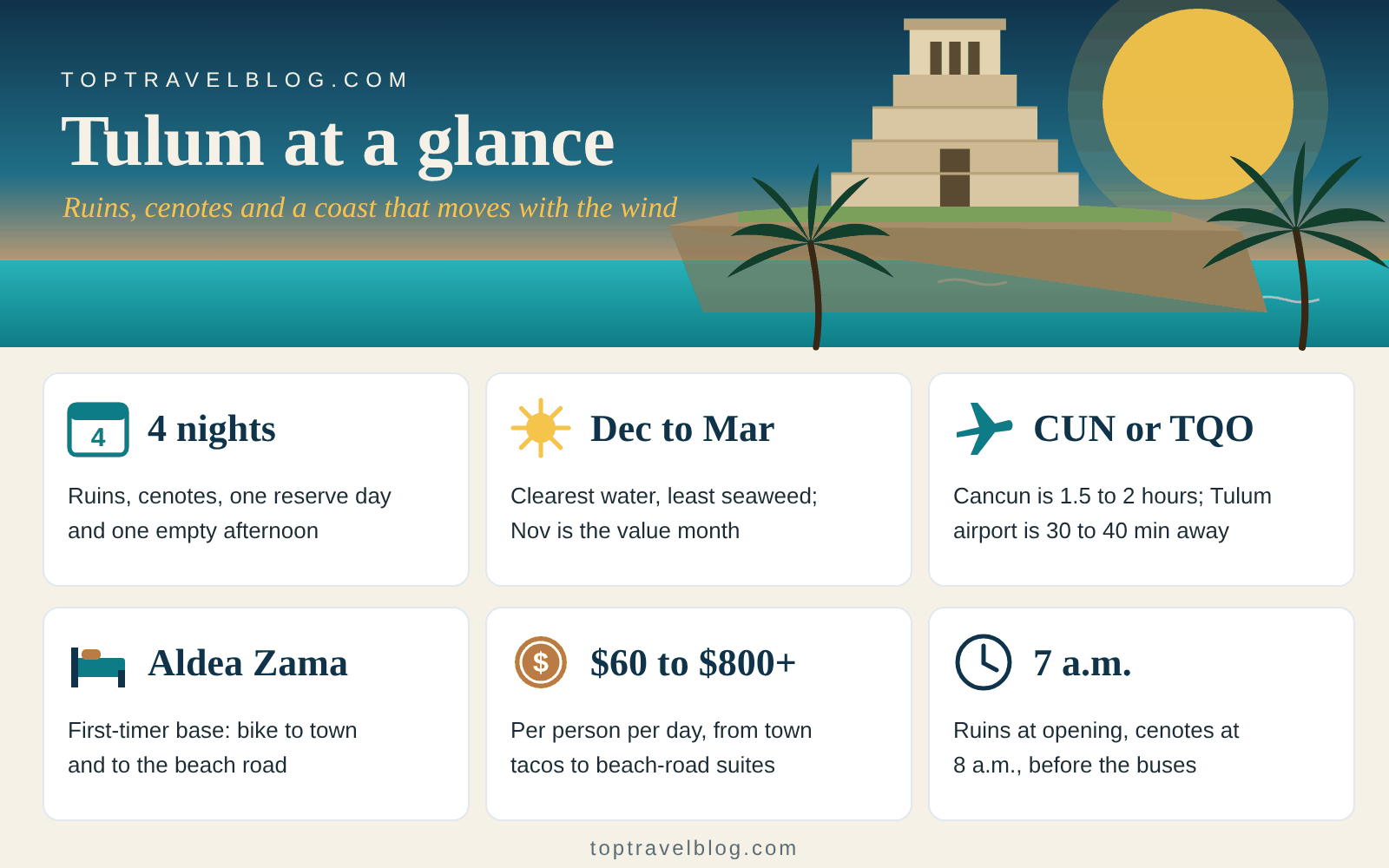
Quick facts: this Tulum travel guide at a glance
- Best for: couples, friends, active travelers who like swimming holes and ruins, remote workers, and families with older kids who can handle heat and uneven paths.
- Ideal trip length: 4 nights; 3 if you stay near the beach, 5 to 6 if you add diving, Sian Ka’an and Cobá at an easy pace.
- Best months: December through March for the clearest water and lowest seaweed; November for value; avoid June to October if beach time is the point.
- Getting in: Cancun (CUN) is the big airport, roughly 90 minutes to 2 hours away; Tulum’s own airport (TQO) is about 30 to 40 minutes from town but has far fewer flights.
- Getting around: bicycle in town and along the beach road, a taxi with a fare agreed in advance for longer hops, a rental car for cenotes, Cobá and Akumal. Rideshare is unreliable.
- Key caveats: sargassum from roughly April to October, mostly cash pesos, no lighting on parts of the beach road, rising entry fees at the ruins, and beach-club minimum spends that can match a hotel dinner elsewhere.
Best time to go: when this Tulum travel guide works best
Weather in Tulum is easy. Seaweed is the variable that decides whether your beach days are good. If I could pick one window for a Tulum travel guide trip, it would be mid-December through March: dry, highs in the mid-80s Fahrenheit, cooler evenings, and the clearest Caribbean water of the year.
February is the month this Tulum travel guide would book first. It has the settled weather of high season without the spring-break crowds that arrive in March and the holiday prices that peak between Christmas and New Year’s.
The sargassum season generally runs from April through October and peaks around June to September. Tulum’s southeast-facing beaches catch more of it than most of the coast, and 2026 started unusually early, with crews hauling away hundreds of tons in February and March alone. The cleanup has improved, but no barrier or rake gets it all.
Everything else in a Tulum travel guide works year-round, which is why the season you choose matters mostly for the sand.
December to March: clearest water, highest prices
Rooms on the beach road cost the most between mid-December and early January, and many boutique hotels set a four- or five-night minimum for those dates. From mid-January to early March you still pay high-season rates, but you can book without the holiday rules.
Days run warm and dry, ocean swimming is at its most reliable, and cenotes feel refreshing rather than chilly. This is the stretch I would choose for a first Tulum travel guide trip, and it is the one with the most competition for a table at dinner.
April to May: hot, getting greener
In a Tulum travel guide for April, spring break crowds fade after the first week of April and prices ease. Heat builds, with humid afternoons in the 90s, and the first heavy sargassum can show up. This is a good window for ruins and cenotes, since you will be in the shade or in the water most of the day anyway.
Pick a hotel that rakes its beach every morning and treat the sand as a bonus.
June to October: rain, seaweed and hurricane risk
Summer brings heavy humidity, short violent thunderstorms most afternoons, and the peak of the seaweed season. Hurricane season officially runs June through November, with the real risk concentrated in late August through October. Prices drop sharply, restaurants thin out, and some beach-road hotels close for maintenance in September.
If you come now, build your Tulum travel guide itinerary around cenotes, Sian Ka’an, Cobá and long lunches, and book flexible rates.
November: the value month
Early November is my quiet favorite in the Tulum travel guide calendar. The rains taper, the seaweed usually eases, the holiday crush has not started and rooms are noticeably cheaper than they will be in four weeks. Late October storms occasionally linger, so look at the forecast a week out. This is also when seasonal flights into Tulum’s airport begin to return.
How many days you need for a Tulum trip
The question I get most while writing a Tulum travel guide like this is whether Tulum is worth more than a long weekend. It is, but not by much. The town is small, the ruins take half a day, and the best cenotes are within 25 minutes of each other. What stretches a visit is how many separate zones you try to cover.
Three nights covers the ruins, one cenote day and one beach day, with a morning for the airport. It works if you already know you want to be horizontal for half of it.
Four nights is the sweet spot for any Tulum travel guide, and the length of the plan below: it adds a day for Sian Ka’an or Cobá and one unscheduled afternoon.
Five to seven nights of Tulum travel guide time make sense if you are also diving, taking Spanish classes or working from a laptop, or if you want to split your stay between town and the coast.
If you are combining Tulum with other places, the cleanest pairing is two nights in Tulum and a few days elsewhere along the coast; my Riviera Maya itinerary shows how to string cenotes, ruins and resort time together over seven days.
If you are choosing between Tulum and the big resort strip, the Cancun travel guide lays out that trade-off honestly.
Worth knowing: Count full days only. A flight that lands at Cancun at 3 p.m. and a transfer that takes two hours gives you a dinner on arrival day, not a day of sightseeing. Departure works the same way in reverse: leave the coast by 8 a.m. for a midday flight home.
How Tulum is laid out, and why it matters for your plan
Tulum is really three places along one highway. Tulum town (Tulum Pueblo) sits on Highway 307 and holds the bus station, supermarkets, banks and the cheapest food. The beach road runs south from the ruins along the coast, lined with hotels, beach clubs and restaurants. Between them lie Aldea Zama and La Veleta, newer residential districts that have filled with apartments, small hotels and cafes.
In this Tulum travel guide the ruins sit on the cliff at the north end of the beach road, about 3 kilometers from the center of town. The big cenotes are inland on the Cobá road, or north along the highway toward Akumal. South of the beach road, the paved track continues into the Sian Ka’an biosphere reserve.
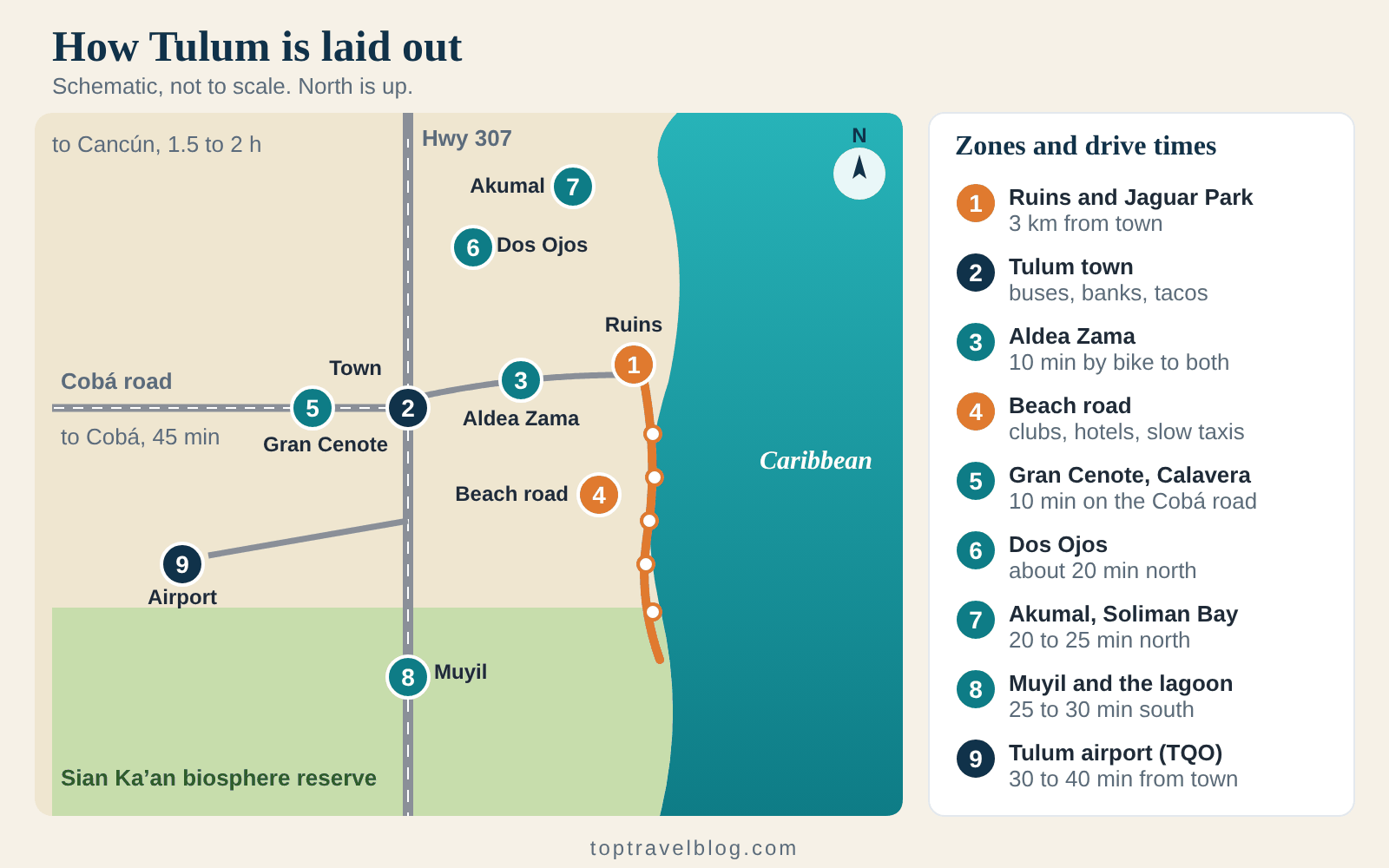
Why a Tulum travel guide has to start with geography: a hotel on the beach road feels close to everything on a map and turns out to be a 25-minute taxi ride from town at dinner time, when the single lane clogs. A hotel in Aldea Zama puts you a 10-minute bike ride from both. Drive times in this Tulum travel guide include that real-world traffic, not the best case.
Where to stay in Tulum for a first visit
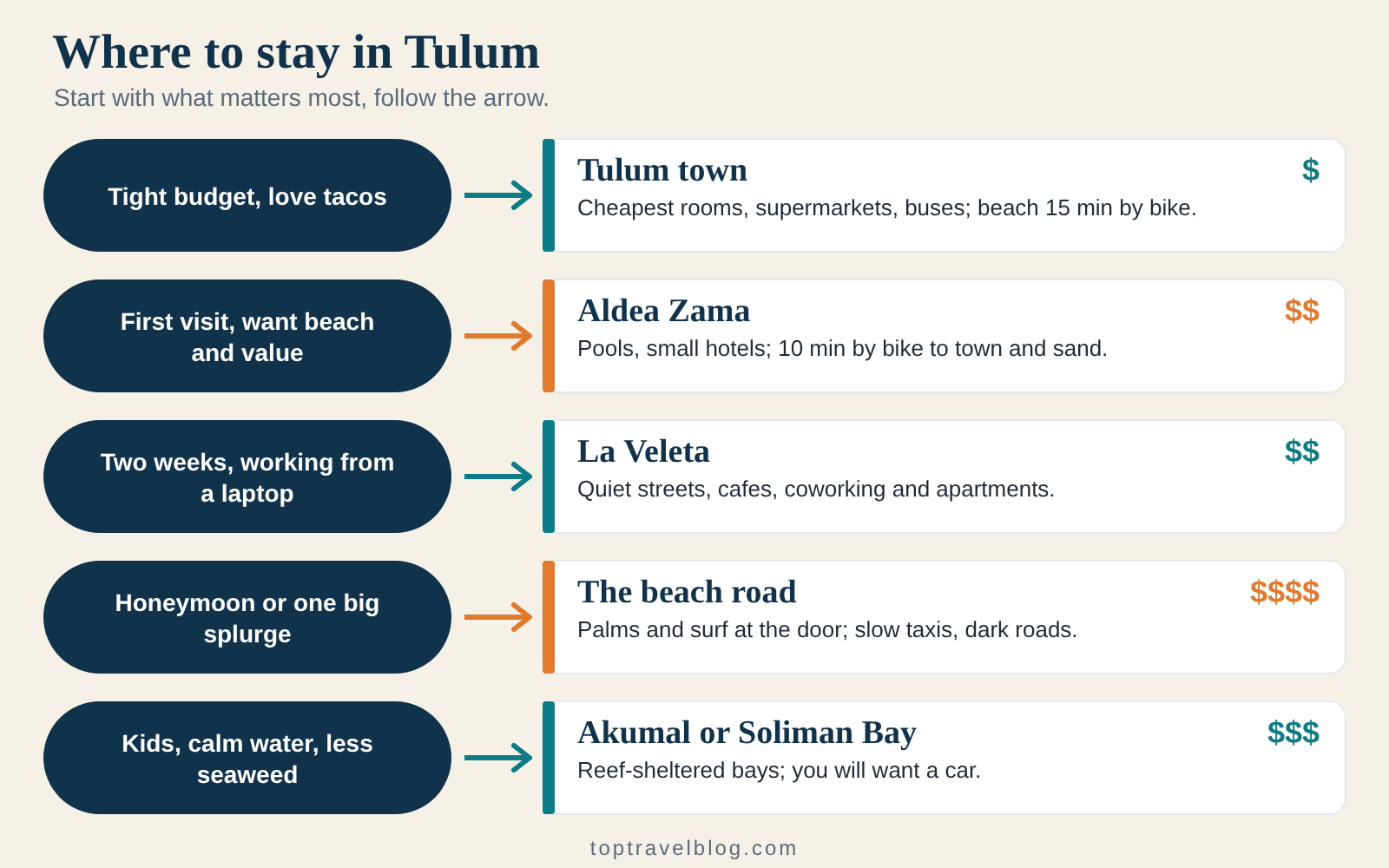
In any Tulum travel guide, the choice of area shapes your trip more than the choice of hotel. Tulum town is cheap, walkable and practical. The beach road is beautiful, expensive and slow to move around. Aldea Zama is the compromise most first-timers should take, and the northern bays are for people who prefer calm to scene.
On price, my Tulum travel guide advice is to use ranges. Simple rooms in town run from roughly $40 to $120 a night, apartments and small hotels in Aldea Zama and La Veleta from roughly $90 to $250, and beach-road hotels from roughly $200 to well over $600 in high season. Taxes and a resort or environmental fee can add noticeably to the total, so compare the final price at checkout.
Five areas I recommend, and who each one suits
Tulum town (Pueblo, along Avenida Tulum)
Best for: budget, food, buses, a real town
Stay on or near Avenida Tulum and you can walk to supermarkets, taquerías, banks and the colectivo stops. Rooms are the best value in the area, and the late-night taco stands are why I like it.
Downsides: the beach is a 15-minute bike ride away, the main road is loud, and quality varies hugely, so read recent reviews for noise and water pressure.
Aldea Zama
Best for: first-timers who want both
A newer district between town and the coast, with gated buildings, pools, rooftop bars and small hotels. A bike gets you to the beach road in 10 minutes and to town in five, and prices sit between the two.
It lacks old-Tulum character and some streets are still dust and construction, so choose buildings that have finished work and sit on a paved block.
La Veleta
Best for: remote workers, longer stays
Just southwest of Aldea Zama, with a growing set of cafes, coworking spaces and apartment buildings. Quiet at night and easy on the budget, it is the neighborhood where people who stay for two weeks end up.
It is farther from the coast, so rely on a bike or a short taxi ride.
The beach road (Zona Hotelera)
Best for: couples, honeymooners, a splurge
Small hotels set among palms on the sand, many with no air-conditioning but ocean breezes, plus the beach clubs and the most photographed restaurants. Waking up to the sound of waves is real.
It is also where you pay the most, where electricity and Wi-Fi can drop, where the road floods in heavy rain, and where dinner means a taxi or a long ride in the dark. Choose a hotel that rakes its sand.
Akumal and Soliman Bay
Best for: families, snorkelers, quiet beaches
About 20 to 25 minutes north of Tulum, these bays sit behind a reef that catches much of the seaweed, and the water is often calmer and clearer than at Tulum itself. Akumal is known for sea turtles on the seagrass.
You will want a car or a taxi for dinner out and for the ruins, and there is far less nightlife.
Areas I would skip on a first visit
A hotel far down the beach road toward Sian Ka’an, unless remoteness is exactly what you are buying. It is magical, but in a practical Tulum travel guide I have to add that every meal, taxi and ATM visit becomes a 30-minute decision. I would also skip any listing that advertises being “steps from Tulum” while sitting on Highway 307 toward the airport. And I would skip party-heavy hostels if you need sleep, since the beach-road clubs run music late on weekends.
What to check before you book a Tulum hotel
Three things. First, the distance to the beach and how you will cover it. A “beachfront” place with a rocky shoreline is very different from one with sand, and some beach-road hotels have no direct water access at all. Second, whether the room has air-conditioning and a backup power source, because outages are routine. Third, the total price after fees, which can run 20 percent or more over the headline rate.
If you want a quick comparison with another Mexican beach town, my Puerto Vallarta itinerary covers a city-and-beach base that is easier on logistics, and the Los Cabos travel guide covers the resort-heavy end of the scale.
The 4-day Tulum travel guide plan, day by day
Each day of this Tulum travel guide has one anchor zone so you are never doubling back on the highway. Mornings are for the places that fill up, afternoons are for water and shade, and evenings are loose. Travel times assume a rental car or a prebooked taxi, and an easy bike pace within town.
Day 1
The ruins at opening, then a beach and a slow dinner
Morning: be at the gate when it opens
In every Tulum travel guide the ruins come first, and they are small, compact and set on a limestone cliff above the sea, which is the entire appeal. The park opens at 7 a.m., with last entry around 5 p.m., and the difference between arriving at 7:30 and arriving at 11 is huge: the first hour is cool, the light on El Castillo is gold, and the tour buses from Cancun have not yet arrived.
From the entrance, it is a walk of roughly 10 minutes to the ruins themselves. Plan 90 minutes inside.
Foreign adults pay a combined park, conservation and INAH fee that works out to roughly 500 pesos (about $27 to $30), and the ruins portion roughly doubled at the start of 2026. Pay attention to the rules: no climbing the structures, no drones, no smoking, and plastic bottles and bags are taken away at the entrance. The National Institute of Anthropology and History (INAH) lists the archaeological zones at inah.gob.mx.
Late morning: the small beach below the cliff
A staircase leads down to Playa Ruinas, a short curve of sand tucked under El Castillo. It is photogenic and small, rocky in places, and packed from 10 a.m., so treat it as a 30-minute dip. If it is overrun, the next beaches south along the Jaguar Park trail are quieter. Rinse off and dry out before you head back, since the afternoon is for something shadier.
Afternoon: lunch in town and a bike ride
Head back to town for lunch. Tacos at the stands along Avenida Tulum run about 30 to 50 pesos each, and a sit-down comida corrida (set lunch) costs a couple of hundred pesos. Then pick up a bike if you do not have one. The cycle path along the beach road runs for kilometers and is the best way to see the strip without fighting taxis at 5 p.m.
Evening: sunset at a beach-road restaurant
Go to the beach road around 5:30 and watch the sun go down from a place with a drink. Most of the coast faces east, so the sunset color is on the sky behind you rather than on the water. Dinner on the beach road is the priciest meal of the week, usually $25 to $50 a plate, so have one dinner here and eat in town the other nights.
Day 2
Cenote day on the Cobá road
Morning: Gran Cenote when it opens
For this Tulum travel guide, Gran Cenote is about 4 kilometers from town on the road to Cobá, and it is the best-known swimming hole in the area for a reason: clear water, small turtles, a bat cave and a snorkeling route through the cavern. It is also the first place tour groups reach. Be there at the 8 a.m. opening, pay roughly 500 pesos, and plan on about 90 minutes. Rent a snorkel if you do not have one.
Showers are mandatory, and sunscreen and repellent are not allowed in most cenotes because they harm the water. Bring a biodegradable lotion or a long-sleeved rash guard.
Late morning: Calavera or a quieter pick
Cenote Calavera, known as the Temple of Doom, is five minutes away. Its small round openings are fun for jumps, and it is crowded by 11 a.m. If you want a quieter swim, Zacil-Ha (shallow, family-friendly, around 200 pesos) or Carwash (Aktun Ha, lily pads and turtles, around 280 pesos) are further along the same road.
Pick one, not all three, for your Tulum travel guide day, because you will pay a fresh entrance fee each time.
Afternoon: lunch inland and a lazy hour
Eat along the Cobá road or back in town; cenote-side snack bars charge tourist prices. After lunch, go back to your hotel pool for an hour. Swimming in cool water from 8 a.m. is tiring in a way that surprises people, and the mid-afternoon sun makes everything outdoors harder.
Evening: a quiet dinner in Aldea Zama or town
A table for dinner in town costs a fraction of the beach road. This is the right night for a long, unhurried meal, with no taxi ride afterward. If you want mezcal, ask for it neat, in a small glass, from a bar with a long list rather than a cocktail menu.
Day 3
Sian Ka’an and Muyil, or Cobá
Option A: Sian Ka’an biosphere reserve
Sian Ka’an is the Tulum travel guide day trip I recommend most. The reserve begins at the south end of the beach road and covers more than a million acres of lagoons, mangroves, marsh and reef. UNESCO listed Sian Ka’an as a World Heritage site in 1987, and its details are at whc.unesco.org. Most visitors see it in one of two ways: a guided boat trip through the lagoons, or a visit to the Muyil ruins plus a float down a narrow canal.
Muyil is about 25 to 30 minutes south on Highway 307. The ruins are quiet and mostly in the trees, and a short path leads to the lagoon, where a guide-led boat ride takes you across the water and into a Mayan-built canal where you can float with the current. Book a half-day tour from town or arrange a local guide at the entrance.
Option B: Cobá by bike
Cobá is a much larger site deep in the jungle, about 45 minutes inland, with a temple pyramid, ball courts and long paths between structures. Rent a bike or a pedicab at the entrance to cover the distances; on foot it takes hours. Arrive early because it gets hot, and combine it with the Cobá cenotes (Choo-Ha, Tamcach-Ha and Multum-Ha), which are quieter and cheaper than the ones near town.
Evening: tacos and an early night
You will be tired. Eat early in town, drink water, and treat the evening as optional.
Day 4
Akumal turtles, a beach morning and the trip home
Morning: Akumal or Soliman Bay
Akumal Bay is 20 to 25 minutes north of Tulum, a protected bay where sea turtles feed on the seagrass. You can snorkel there with certified local guides, and I strongly recommend going before 9 a.m., since tour groups arrive from about 10 a.m. to 2 p.m. Be careful not to touch or chase the turtles, and use reef-safe sunscreen or none at all.
If you would rather have a calm lagoon with nobody in it, drive another 10 minutes to Soliman Bay. The reef keeps the water shallow and the seaweed down, and you can swim in an almost still bay with a kid or a book.
Afternoon: Dos Ojos or a final beach club
Dos Ojos, 20 minutes north of town, is two connected sinkholes with some of the best cavern snorkeling in the region; expect to pay somewhere between 450 and 550 pesos. Alternatively, spend a lazy afternoon at a beach club. Day-bed minimums, which are credited toward food and drink, run from roughly 800 pesos at the more relaxed clubs to 2,500 pesos or more at the scene-driven ones.
Evening: slow dinner, early pack
The last stretch of the Tulum travel guide plan is logistics. Leave a cushion for transfers. If you fly out of Cancun, the road takes 90 minutes to two hours, and you should be there three hours before departure. If you fly out of Tulum’s airport, allow about 40 minutes plus a normal check-in window.
If it rains, or you have kids, or you stay longer
Rain on a Tulum travel guide trip: cenotes are still fine, since you are getting wet anyway, but skip the beach road and the ruins on the day of a thunderstorm. With young children: pick Zacil-Ha, Soliman Bay and Akumal, and skip the beach-road clubs.
A fifth day can go to a cenote dive, the Muyil boat trip or a long lunch in Playa del Carmen. If you want the colonial-city alternative to all this sand and this Tulum travel guide has you curious about Mexico beyond the coast, my Mexico City itinerary is a very different trip.
Tulum beaches and the seaweed question
The beaches in this Tulum travel guide are wide white sand and clear water, and they are also the part of the trip most at the mercy of sargassum. Wind and current decide each morning whether the shoreline is clean or lined with brown mats. That can change within a day, which is why a good Tulum travel guide never rests on a single beach day.
The main beaches, and what to expect
Playa Paraíso at the north end of the beach road is the one in the photos. The public stretch is shrinking as businesses expand, has little shade, and fills by mid-morning, so go before 9 a.m. Playa Ruinas beneath the temple is small, rocky in parts and crowded from 10. Playa Pescadores and the beaches reached through Jaguar Park are quieter and less polished.
Farther away, Chemuyil (about 15 km south) sits in a protected bay with no clubs, and Akumal and Soliman Bay to the north sit behind a reef. For a quiet swim during seaweed season, these are your best options. Most beaches have no lifeguards, so swim parallel to shore if a current pulls you and keep out of the water for a day or two after heavy rain.
Beach clubs: what the minimum spend means
Most beach clubs charge a per-person minimum that is credited toward food and drink, then add 16 percent tax and a service charge on top. Roughly, relaxed clubs such as Ziggy’s sit around 800 to 1,000 pesos per person, calmer wellness-style clubs around 800 to 1,200, and the social, photogenic ones from about 1,500 to 2,500 pesos, higher on event nights.
Order a proper lunch and the minimum disappears. Treat it as a pool pass with a sandwich attached, which is how I handle it in my own Tulum travel guide notes.
Checking the seaweed
Look at same-day reports from hotels and local news before you commit to a beach day, and check which way the wind is blowing: an onshore east wind brings it in. If your hotel has a good rake crew, the sand in front of it can stay clear while the neighbor’s is brown. The Mexican Caribbean tourism board lists current regional updates at caribemexicano.travel.
Cenotes worth your time near Tulum
Cenotes are the heart of any Tulum travel guide: freshwater sinkholes in the limestone, and the Tulum area has dozens. Prices range from about 100 to 550 pesos for the common swimming ones, paid in cash at the gate. Most open around 8 or 9 a.m. and close by 5 p.m. The pattern is simple: go early, go to one or two, and choose by type.
Gran Cenote
Best for: first-time snorkelers
Roughly 4 kilometers toward Cobá. Clear water, turtles, a cavern route and a bat roof. Busy by 10 a.m. Entry around 500 pesos.
Cenote Calavera
Best for: jumping and short stops
Five minutes from Gran Cenote, compact and atmospheric, with small openings to leap through. Entry around 300 pesos. Fun for 45 minutes.
Dos Ojos
Best for: cavern snorkeling and diving
Two linked sinkholes north of town with guided cavern routes. Higher price (roughly 450 to 550 pesos) but excellent clarity. Often paired with Akumal.
Casa Cenote
Best for: an open mangrove lagoon
Near Tankah, where the cenote meets a mangrove channel almost at the sea. Calm and good for floating. Entry around 280 pesos.
Cenote Cristal and Escondido
Best for: calm, open swimming
Across Highway 307 from each other, a few kilometers south of town. Usually quieter, around 250 pesos together.
Cobá cenotes (Choo-Ha, Tamcach-Ha, Multum-Ha)
Best for: dramatic caves, fewer people
About 45 minutes inland and cheapest of all, often under 200 pesos. Worth it only if you are already going to Cobá.
Sac Actun, one of the longest mapped underwater cave systems on Earth, is the place for guided cavern snorkel and certified cave dives. Remember a few rules: rinse off before you get in, skip regular sunscreen, and do not leave jewelry or anything on the ledges.
Health authorities have raised bacteria concerns at a few cenotes near town, including Calavera and Cristal, so pick well-managed sites and avoid swimming with open cuts.
Getting to Tulum and getting around
Flying in: Cancun or Tulum
The first decision in a Tulum travel guide is the airport. Cancun (CUN) is the main gateway, with the widest choice of nonstop flights from US cities and the best prices. From the airport to Tulum is roughly 130 kilometers, and the trip takes about 90 minutes to two hours. Tulum’s airport (TQO), Felipe Carrillo Puerto International, opened in December 2023 and is about 30 to 40 minutes from town.
American, Delta and United have flown there from hubs including New York, Chicago, Dallas, Houston, Miami and Los Angeles, but several routes are seasonal and capacity has dropped.
My rule: check fares into both airports and pick Tulum only if the difference is small, because a $90 saving on a flight can vanish in a taxi to the wrong side of the coast. For flight searching, my guide on how to find cheap flights walks through the tactics, and how to plan a trip covers the order to book things in.
Cancun airport to Tulum: your options
The ADO coach from Cancun airport takes roughly 2.5 hours and costs about $15 to $25 per person; ADO sells tickets at ado.com.mx. A shared shuttle runs about $30 to $55 per person. A private transfer runs roughly $90 to $160 per vehicle and goes straight to your hotel, which I recommend after dark. Airport taxis often ask $120 to $180, unmetered, so agree on the price first.
The Maya Train (Tren Maya) also serves Tulum, with a station in town and one at the airport; the official operator at trenmaya.gob.mx sells tickets. In 2026 the separate foreigner fare was dropped in favor of a single tourist rate, and fares are dynamic, so the online price is usually lower than the window price.
Moving around town
A bicycle is the best tool in Tulum town, Aldea Zama and along the beach road, which has a bike path. Many hotels lend them or rent them for a few hundred pesos a day. Taxis have no meters, so agree on the price before getting in: a ride from town to the beach road is a few hundred pesos at most, and from the ruins to the south end of the strip costs more.
Rideshare apps exist but are not dependable in Tulum, thanks to the local taxi union.
Colectivos (shared vans) run along Highway 307 to Playa del Carmen and Cancun for the price of a coffee, though they are not great with luggage. A rental car costs roughly $30 to $55 a day for the headline rate, but mandatory Mexican liability insurance often doubles that. For the cenotes, Cobá and Akumal, a car is worth it for one or two days.
What a Tulum trip costs
The money section of this Tulum travel guide starts with a warning: Tulum is the priciest town on this coast per square meter, and the gap between town and the beach road is wide. These Tulum travel guide ranges are daily per-person figures excluding flights, based on two people sharing a room.
Budget: roughly $60 to $130 a day. A simple room in town, tacos and comida corrida, a bike, one cenote and the occasional colectivo.
Mid-range: roughly $170 to $320 a day. A boutique hotel or apartment in Aldea Zama, a few cenotes, one beach-club day, a mix of town and beach-road dinners, a rental car for two days.
Comfortable: roughly $360 to $800 and up. A beach-road hotel in high season, private transfers, guided cenote or boat trips, most meals on the sand.
Add a few smaller items. Quintana Roo charges visitors a state tourism fee, roughly 2.5 UMA or about $15 per foreign visitor. Pesos run roughly 17 to 19 to the dollar, and many beach-road menus are priced in dollars. Dinner on the beach road costs $25 to $50 a plate, while a good meal in town costs a third of that.
Worth knowing: The beach road is the single biggest line on your budget. Sleeping in Aldea Zama and spending one evening and one afternoon on the sand typically saves $100 to $200 a night compared with sleeping on the coast, and you still get the beach.
What to book ahead
A Tulum travel guide does not need heavy planning, but a few things go. In high season, beach-road hotels sell out weeks ahead, and holiday dates need months. Dinner on the beach road on Friday and Saturday needs a reservation at the well-known restaurants. A private transfer from the airport is worth reserving so a driver is waiting. And Muyil boat trips and cave dives need a day or two of notice.
Cenotes, the ruins and Akumal are all pay-at-the-gate, so the only booking is your own time: arrive early. If you are comparing Caribbean beach destinations, the Punta Cana travel guide covers the all-inclusive alternative, and if you want wildlife and volcanoes instead, see the 7 days in Costa Rica itinerary.
Food and drink in Tulum
The food advice in this Tulum travel guide is short: eat in town for at least half your meals. Taquerias around Avenida Tulum serve al pastor, cochinita pibil and fish tacos for 30 to 50 pesos each, and the set lunches (comida corrida) are the best value. Yucatán dishes show up on most menus: cochinita pibil (slow-roasted pork in achiote), sopa de lima, panuchos and salbutes.
On the beach road, the food is more international, with wood-fired pizza, ceviche, mezcal bars and plant-forward menus, and the setting is part of what you pay for. Order the local seafood, ask for the price of fish by weight, and look at the bill, since a service charge is often already added.
Drink bottled or filtered water, and do not worry about ice in restaurants, which is made from purified water in tourist areas. Stay hydrated, since the heat here is deceptive.
Safety, health and money in Tulum
For safety, a Tulum travel guide should be plain: the US State Department lists Quintana Roo at Level 2, exercise increased caution because of crime, and posts its latest guidance at travel.state.gov. In practice, the common problems for visitors are petty theft from beach bags, overcharging by taxis and other vendors, and traffic on Highway 307. Keep valuables with you, use hotel safes, and avoid walking the unlit parts of the beach road late at night.
For money in Tulum, carry pesos. Cenote gates, taquerias and taxis often want cash, and some beach-road places add a card surcharge. Use bank ATMs rather than standalone machines, and when a machine or terminal offers to bill you in dollars, choose pesos. Mexico requires a valid passport for US citizens.
For health, wear a hat and drink more water than seems necessary. Use reef-safe sunscreen on the beach and a rash guard in the cenotes. Mosquito repellent is useful at dusk, away from the water. If you hire a scooter, remember that Tulum’s road accidents are a real source of tourist injuries; a bicycle is safer.
Common mistakes on a Tulum trip
These are the Tulum travel guide mistakes I see most often, roughly in order of how much they cost in money, time or mood.
1. Booking a far-down beach-road hotel for the photo
The jungle cabana with no air-conditioning looks perfect online. In July it means 90 percent humidity, mosquitoes and a generator at night, plus a 30-minute taxi to any real dinner. If you want that experience, choose it for two nights, not seven.
2. Arriving at the ruins at 11 a.m.
By late morning the heat is serious and the buses have come in. The ruins are a 90-minute visit; do them at 7 or 8 a.m. and be done before you are tired.
3. Planning every day around the beach
Seaweed can show up with no notice, so build your Tulum travel guide plan around options. Spread cenotes, ruins and day trips across the days so the plan survives a brown beach.
4. Visiting four cenotes in one day
Each one has its own fee and its own queue, and after the second they blur together. Two cenotes, one early and one late, plus a long lunch is a better day than four.
5. Taking unmarked taxis without a price
Taxi meters do not exist here. Settle the fare before the car moves, ask the hotel for the usual price, and carry small pesos so you do not overpay for lack of change.
6. Treating the beach road as walkable
It looks like a few blocks on a map and it is a 10-kilometer strip with no sidewalks in places. Rent a bike or plan to take cars.
7. Forgetting that the ruins and cenotes have rules
Plastic bottles are removed at the Tulum entrance, regular sunscreen is not allowed in cenotes and you cannot climb the temples. Pack a refillable bottle and a biodegradable lotion.
8. Skipping the rest of the coast
Every Tulum travel guide should say it: Tulum is a base, not a bubble. Akumal, Soliman Bay, Muyil and Cobá are all within 45 minutes, and they often give you better water, quieter sand and cheaper meals than the strip.
Frequently asked questions about this Tulum travel guide
How many days do you need in Tulum?
This Tulum travel guide is built on four nights: the ruins at opening, a cenote day, a Sian Ka’an or Cobá day and a bay day at Akumal or Soliman. Three nights is enough if you only want beaches and one or two cenotes, and five or six nights are worth it if you dive, work remotely or want an unhurried pace.
When is the best time to visit Tulum?
December through March gives the clearest water, the lowest seaweed risk and dry, warm weather, with February the best balance of crowds and price. November is the value month. June through October brings heat, rain, hurricane risk and the peak sargassum season, so plan for cenotes, ruins and day trips rather than beach days.
Where should I stay in Tulum for the first time?
Aldea Zama is my default: it is a 10-minute bike ride from both the town and the beach road, with pools and small hotels at mid-range prices. Choose Tulum town for budget and food, the beach road for a splurge and sunrise, and Akumal or Soliman Bay for calm water and families.
Is Tulum safe for tourists?
The US State Department lists Quintana Roo at Level 2, exercise increased caution because of crime. Most visitor problems are petty theft from beach bags, taxi overcharging and traffic on Highway 307. Keep valuables locked up, take a taxi after dark on the unlit parts of the beach road and avoid moped rentals if you are not experienced.
How much does it cost to enter the Tulum ruins?
Foreign adults pay roughly 500 pesos, about $27 to $30, in combined park, conservation and INAH fees, and the INAH portion roughly doubled in January 2026. The park opens at 7 a.m. with last entry around 5 p.m. Children under 12 are free, and the entrance asks you to leave single-use plastic outside.
What is the easiest way to get from Cancun airport to Tulum?
A prebooked private transfer is the simplest, at roughly $90 to $160 per vehicle for the 90-minute to two-hour ride. The ADO coach is the cheapest at about $15 to $25 per person and takes around 2.5 hours. A shared shuttle sits between at $30 to $55 per person, and you can rent a car if you want to see the cenotes.
Do I need a car in Tulum?
Not for a stay in town and on the beach road, where bikes and taxis cover everything. A car helps for one or two days if you want the cenotes, Cobá, Akumal and Soliman Bay without paying for a driver. Mandatory liability insurance often doubles the advertised rate, so budget for that, and park in lots rather than on the street.
Is Tulum worth it compared with Cancun or Playa del Carmen?
If you want ruins, cenotes and a boutique, outdoorsy feel, yes. If you want big resorts, nightlife, direct flights and easy logistics, the Cancun travel guide will serve you better. Tulum is pricier, harder to move around and more exposed to seaweed, which is why I suggest a short stay and a good base.
Does Tulum have sargassum all year?
No, and a Tulum travel guide should say so. The season generally runs April through October and peaks from June through September, and 2026 started early. December through March is usually the clearest stretch. Even in season, some beaches stay cleaner, particularly Soliman Bay, Akumal and Chemuyil behind the reef, and hotels that rake their sand each morning.
Can I use US dollars in Tulum?
Many beach-road restaurants and hotels quote prices in dollars and will take them, but the exchange rate they use is poor. Carry pesos for taxis, cenotes, taquerias and tips, use a bank ATM and pay in pesos when a card terminal offers a choice. Rates run roughly 17 to 19 pesos to the dollar.
One last thing before you go
The best day I have had in Tulum was not on the list. It was a morning at a cenote with nobody in it, a plate of tacos in town that cost less than a coffee at home, and an afternoon doing nothing under a palapa while the wind changed direction and the water turned clear again.
Nothing in this Tulum travel guide is rigid. It is a frame for your first visit, and the town is small enough that you can rearrange it on the way.
If I could change one thing about most trips here, it would be to leave one afternoon completely empty. Rent a bike, ride the beach road in the late light, stop wherever the music sounds right, and let the place fill in the rest.
Related planning guides
- Cancun travel guide: where to stay, beaches, day trips and how many days you need — the other side of the coast, with the big-resort and airport logistics worth knowing.
- Riviera Maya itinerary: 7 days of beaches, cenotes, ruins and resorts — a seven-day route through the same cenotes, ruins and beaches.
- Puerto Vallarta itinerary: 5 days of beaches, food and day trips — a Pacific-coast city and beach combination with easier logistics.
- Punta Cana travel guide: resorts, beaches and excursions — the all-inclusive Caribbean option to compare against.
- How to plan a trip step by step — the order to book flights, hotels and tours.