
Five days is the number I give everyone who asks, and it is the length this Seoul itinerary is built around. It is enough to see two royal palaces properly, eat your way through a traditional market, spend an afternoon on Namsan, take a half-day outside the city, and still have an evening in Hongdae and a morning in Seongsu without sprinting.
A three-day Seoul itinerary works if you cut the day trip and one palace. Seven is better if you want to add Busan or Suwon at a walking pace.
Seoul is a big, fast, extremely well-organized city of about nine million people that sits inside a metro area of more than twenty-five million. The subway runs on time, the food is cheap and excellent, and almost everything you want to see is within thirty minutes of everything else. The catch is that the city is spread across mountains and a wide river, so the order of your days matters far more than it does in a compact place like Kyoto.
This plan suits first-time visitors, couples, friends and families with kids old enough to walk six miles a day. It is less suited to anyone who needs a beach, a car, or a single neighborhood to unpack into and never leave.
I have done Seoul in cherry blossom season, in a January cold snap that froze my phone battery, and in the humid weeks after monsoon. What follows is the Seoul itinerary I would hand a friend: the order of days that avoids criss-crossing the Han River, the fares and ticket prices as of late 2026, the new entry rule for 2027 that catches Americans off guard, and the mistakes I watch visitors repeat around Gyeongbokgung every week.
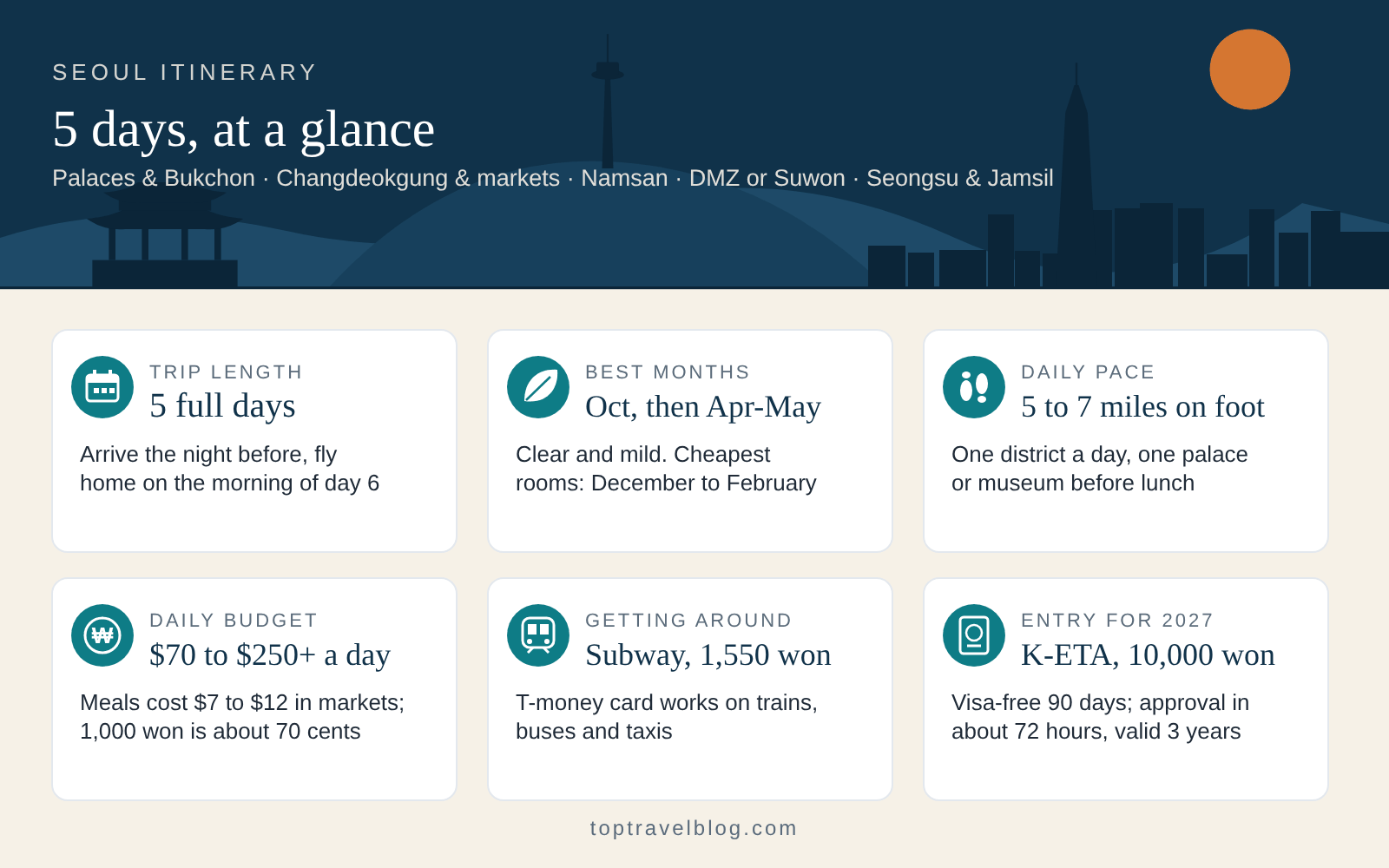
Quick facts: this Seoul itinerary at a glance
- Best for: first-time visitors, couples, friends, families with kids 8 and up, anyone who likes food more than shopping.
- Ideal trip length: 5 full days (arrive the evening before, or sleep off the flight and start fresh on day 1).
- How to get around: subway and bus with a T-money card (base subway fare 1,550 won, roughly a dollar and ten cents), plus 5 to 7 miles of walking a day. No rental car.
- Entry rule for 2027: Americans can enter without a visa for up to 90 days, and K-ETA approval is required from January 1, 2027 unless the exemption is extended again (details below).
- Booking priorities: Changdeokgung Secret Garden tour, a DMZ or Suwon day trip, a Korean barbecue dinner on a Friday or Saturday, Seoul Sky at sunset, a hanbok rental if you want free palace entry.
- Pacing: one anchor district per day, one palace or museum before lunch, a market or neighborhood after, and an evening you can drop.
- Key caveats: palaces close on different weekdays (Gyeongbokgung on Tuesday, Changdeokgung on Monday), July brings heavy monsoon rain, and winter is dry but properly cold.
Best time to go: when this Seoul itinerary works best
If I could choose one window, it would be the first three weeks of October. Daytime highs sit in the mid-60s to low 70s Fahrenheit, the sky is usually clear, the humidity of summer is gone, and the ginkgo and maple trees inside the palace walls start to turn at the end of the month. The second-best window is the first half of April, when cherry blossoms line Yeouido and the stone-wall road at Deoksugung.
Both windows are also the busiest, so the palaces, Bukchon and the observation decks fill up on weekends. The rest of the year has its own case, and the right Seoul itinerary changes with the thermometer.
December to February: cold, dry and cheap
Winter in Seoul is a real winter. Highs hover around freezing and nights drop well below it, with a wind off the north that makes a ten-minute walk to the subway feel long. The upside is clear skies, the lowest hotel rates of the year outside the Lunar New Year holiday, and a city that heats everything: ondol floors in guesthouses, heated seats in the subway, and hot soup on every corner.
Palaces in snow are the best version of Gyeongbokgung. A winter Seoul itinerary needs a real coat, thermal layers, and gloves you can use a phone in.
March to May: blossoms, then comfortable weather
March can still freeze, but by the first week of April the cherry trees open and the city turns pink for roughly ten days. Yeouido Hangang Park and the Seokchon Lake loop near Lotte World Tower are the crowded places to see them; Naksan Park and the Seoul City Wall are quieter.
May is my favorite month after October, with warm days in the 70s and long evenings. Spring also brings fine dust, a haze that settles over the city for a few days at a time. Look at an air-quality app such as AirVisual each morning and swap an outdoor stretch of your Seoul itinerary for a museum day when the reading climbs.
June to August: monsoon and heat
The rainy season, called jangma, arrives in the last week of June and runs through much of July. When it rains in Seoul it rains hard, sometimes all day, and the Han River parks and the DMZ lookouts become miserable. August swaps rain for humidity, with highs in the upper 80s and the occasional typhoon remnant.
Hotels are cheaper than in spring or autumn, and the subway and every mall are aggressively air-conditioned. If you come in summer, shape the Seoul itinerary so your walking happens before 11 a.m. and after 5 p.m., and put museums, the COEX Starfield Library and the covered markets in the middle of the day.
September to November: the sweet spot
September is hot for the first two weeks and then perfect. The Chuseok harvest holiday falls in mid-September in 2027, and for about four days the city empties as locals travel to their hometowns. Palaces and museums stay open, but many small restaurants close and trains to Busan sell out weeks ahead.
October and early November are the best of the year: dry, bright and mild. Late-October foliage at Changdeokgung’s Secret Garden is the single hardest ticket in this guide.
Tip: Whatever month you pick for your Seoul itinerary, look at the sunset time before you book Seoul Sky or the Namsan cable car. In late June the sun sets after 7:45 p.m., and in late December it is down by 5:20 p.m. The observation decks price sunset slots highest and sell them out first, so day 3 and day 5 depend on that one number.
The Lunar New Year and other crowd dates
Seollal, the Lunar New Year, falls in early February in 2027 and brings a three- to four-day holiday when many restaurants and shops close, though the palaces open with free admission and folk games. Buddha’s Birthday in spring brings a lantern parade near Jogyesa Temple. Hotels in Myeongdong and Hongdae are pricier on K-pop concert weekends, which you can spot by the lines of fans outside the Olympic Park stadiums.
Weekdays are quieter than weekends at every palace. The largest calendar trap in any Seoul itinerary is closing days: Gyeongbokgung and Jongmyo close on Tuesday, Changdeokgung, Changgyeonggung and Deoksugung close on Monday, and many museums close on Mondays too.
How many days you really need for a Seoul itinerary
Five days is where Seoul stops feeling like a checklist. Here is what changes at each length, based on the plan I would give someone with that many days.
2 days: a layover-sized taste
With two days, pick the palace core and one night view. Spend day 1 on Gyeongbokgung, Bukchon and Insadong, with dinner in Jongno. Spend day 2 on Gwangjang Market, Myeongdong and Namsan Tower at sunset. You skip Changdeokgung’s garden, the day trip, Seongsu and the Han River. It is a rushed Seoul itinerary, but it works if you are stopping over on the way to Japan or Southeast Asia.
3 days: the quick first visit
A three-day Seoul itinerary adds a Hongdae evening and either Changdeokgung or the National Museum of Korea. You still cannot do a DMZ tour comfortably, because it eats a full morning, so I would trade it for a long lunch in Gwangjang Market and an unhurried walk along Cheonggyecheon. Most weekend city-break travelers from Tokyo or Osaka do exactly this.
5 days: the plan in this guide
Five days gives each district its own half-day, builds in a half-day outside Seoul, and absorbs one rain day without wrecking the trip. It also covers the jet lag problem, because flights from the US East Coast land in the late afternoon after a fourteen-hour flight and your body will tell you it is 3 a.m. at lunchtime on day 1. Light day-one scheduling is built into this plan for exactly that reason.
7 days or more: add Suwon, Busan or Jeju
With seven days the Seoul itinerary can stretch to Busan by KTX (roughly two and a half hours each way, so give it two nights) or a night in a hanok in Jeonju. With ten days, fly to Jeju. If Japan is your other stop, the hop from Gimpo to Tokyo’s Haneda airport is about two hours, and it makes a clean pairing with our Tokyo itinerary for first-time visitors.
Pairing Seoul with another country
Plenty of readers combine this trip with Japan. Seoul to Osaka is under two hours in the air, so the Osaka itinerary fits as a 3-day second half, and the 10 days in Japan itinerary is the longer version if Seoul becomes the first stop. For a Southeast Asia pairing, the Singapore itinerary and the Bangkok itinerary both connect on direct flights of five to six hours.
If you are still deciding between destinations, the framework in our guide on how to plan a trip helps you decide where to spend each night.
Worth knowing: Count your days honestly. Landing at Incheon at 4 p.m. and flying out at 8 a.m. five days later gives you four full days, not five. Day one is for a bath, dinner and an early night, and nothing more ambitious. Build the plan below around full days only.
Where to stay in Seoul for a first visit
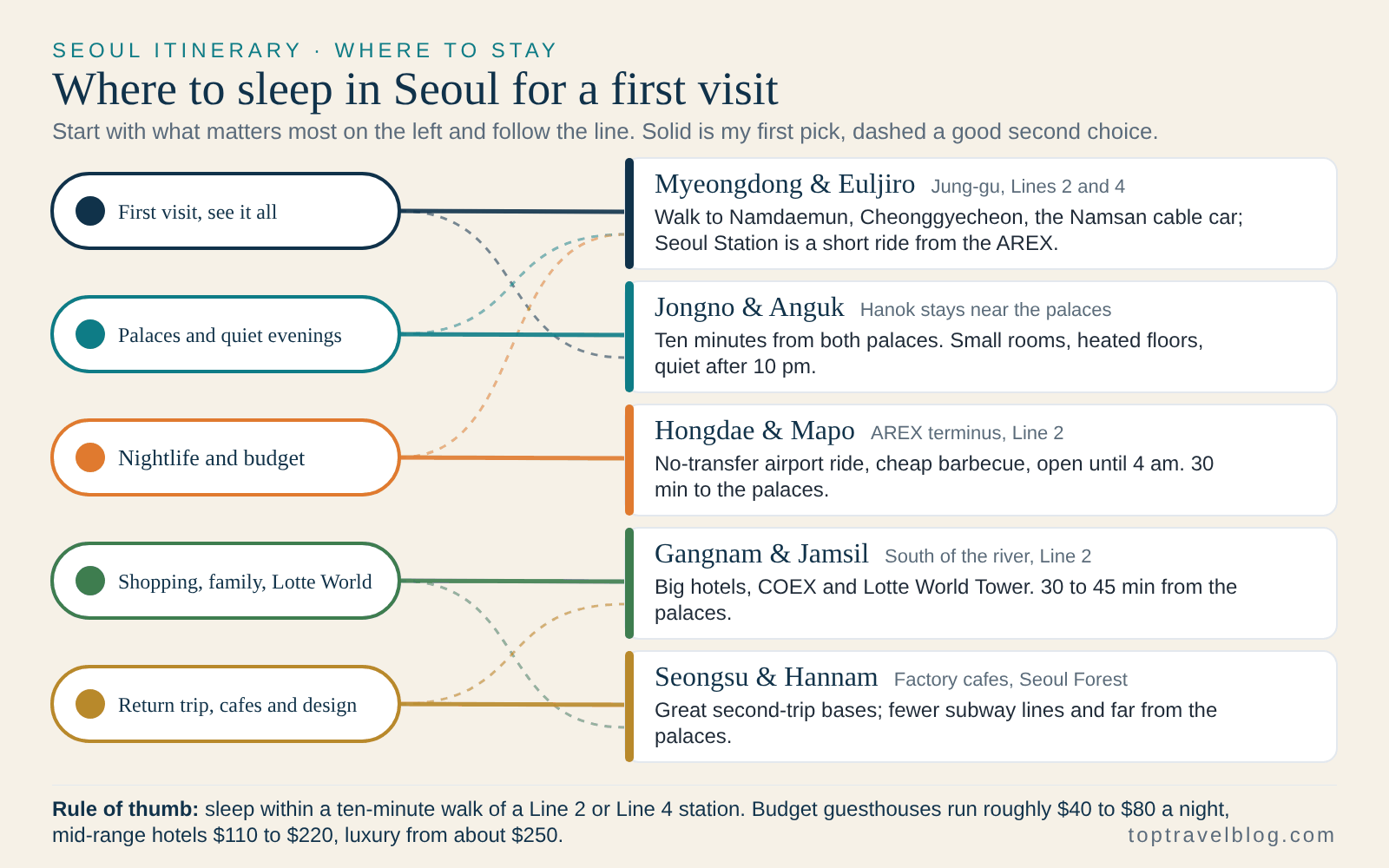
Seoul has no single center. The old city inside the four mountains (Jongno, Jung-gu and the palaces) sits north of the Han River, the money and malls of Gangnam sit south of it, and the youth districts of Hongdae and Seongsu fill in the west and east. Pick your base by which subway lines reach it, because the lines are what shrink the city.
For a first Seoul itinerary I put most people within a ten-minute walk of a Line 2 or Line 4 station, since those two lines connect nearly every stop in this plan.
The five areas I recommend for a Seoul itinerary
Myeongdong and Euljiro (Jung-gu)
Best for: first-timers, short airport transfers, night walks
My default recommendation. Myeongdong station sits on Line 4, Euljiro 1-ga and 3-ga on Line 2, and Seoul Station, a short ride away, is where the airport express arrives. You can walk to Namdaemun Market, Cheonggyecheon and the Namsan cable car, and to Gyeongbokgung in about 25 minutes.
The trade-off is crowds and noise on Myeongdong’s main streets from late morning until 10 p.m. Choose a hotel on a side street, and walk five minutes toward Euljiro for restaurants that locals use.
Jongno, Insadong and Anguk
Best for: palace lovers, hanok stays, quieter evenings
Waking up ten minutes from Gyeongbokgung and Changdeokgung is the best way to beat the tour buses, and Anguk station on Line 3 drops you at the Bukchon end of everything. Several traditional hanok guesthouses here include a Korean breakfast and ondol floors.
Hotel supply is small, rooms are smaller, and restaurants thin out after 10 p.m. outside Jongno 3-ga. It is the area I choose when I travel in cold months or with a parent.
Hongdae and Mapo
Best for: nightlife, budget, first-night arrivals
The AREX airport line ends at Hongik University station, so you can leave the airport and be at your hotel in about an hour without a transfer. The area is full of cafes, vintage stores, live music and cheap barbecue, and it is lively until 4 a.m.
It is also loud, a 25- to 35-minute ride from the palaces, and there are few quiet side streets on a weekend. Pick a hotel away from the main Hongdae playground and toward Yeonnam-dong or Mangwon.
Gangnam, COEX and Jamsil
Best for: business travelers, shoppers, families with teenagers
Newer, cleaner and more international, with big chain hotels, COEX Mall, Lotte World Tower and a very large number of restaurants. Line 2 links the area to Hongdae and Seongsu in one ride.
You are 30 to 45 minutes from the palaces, and the district is less interesting on foot. I only recommend it for people who plan to spend a lot of time in malls, business meetings or Lotte World.
Seongsu and Itaewon/Hannam
Best for: second-time visitors, design and cafe fans
Seongsu has converted factory cafes, pop-up shops and the Seoul Forest park. Itaewon and Hannam have the most international restaurants in the city and a steep, walkable hillside.
Both are far from the palaces and neither has the dense subway coverage of Jung-gu. I would stay here on a return trip, not the first one.
Areas and options I’d skip on a first visit
Anything advertised as “near Gimpo” or in Incheon outside the airport: the numbers assume empty roads and a perfect connection. Sinchon and Daehakro are fun but offer little to a first-time visitor over Hongdae. Business hotels in Yeouido are quiet in the evenings and weekends, which is the opposite of what you want.
Airport hotels in Incheon are worth it only for a 6 a.m. flight out, and capsule hotels are a good story and a poor night’s sleep for anyone over six feet tall.
Hotel, guesthouse or hanok
Korean hotels are small by American standards, with doubles often around 160 to 250 square feet, but they are spotless and almost always include a kettle, slippers, a good shower and a bidet toilet. Budget guesthouses run around $40 to $80 a night, mid-range hotels roughly $110 to $220, and international luxury hotels start near $250 and climb quickly. Rates are not guaranteed, but those ranges hold for most of the year outside the Lunar New Year and Chuseok weeks.
A hanok night is a one-off worth having: you sleep on a heated floor mattress, eat a Korean breakfast and listen to the neighbors. I would book it for one night of the trip, not all five, because the floor bedding is hard on the back and rooms are tiny.
The 5-day Seoul itinerary, day by day
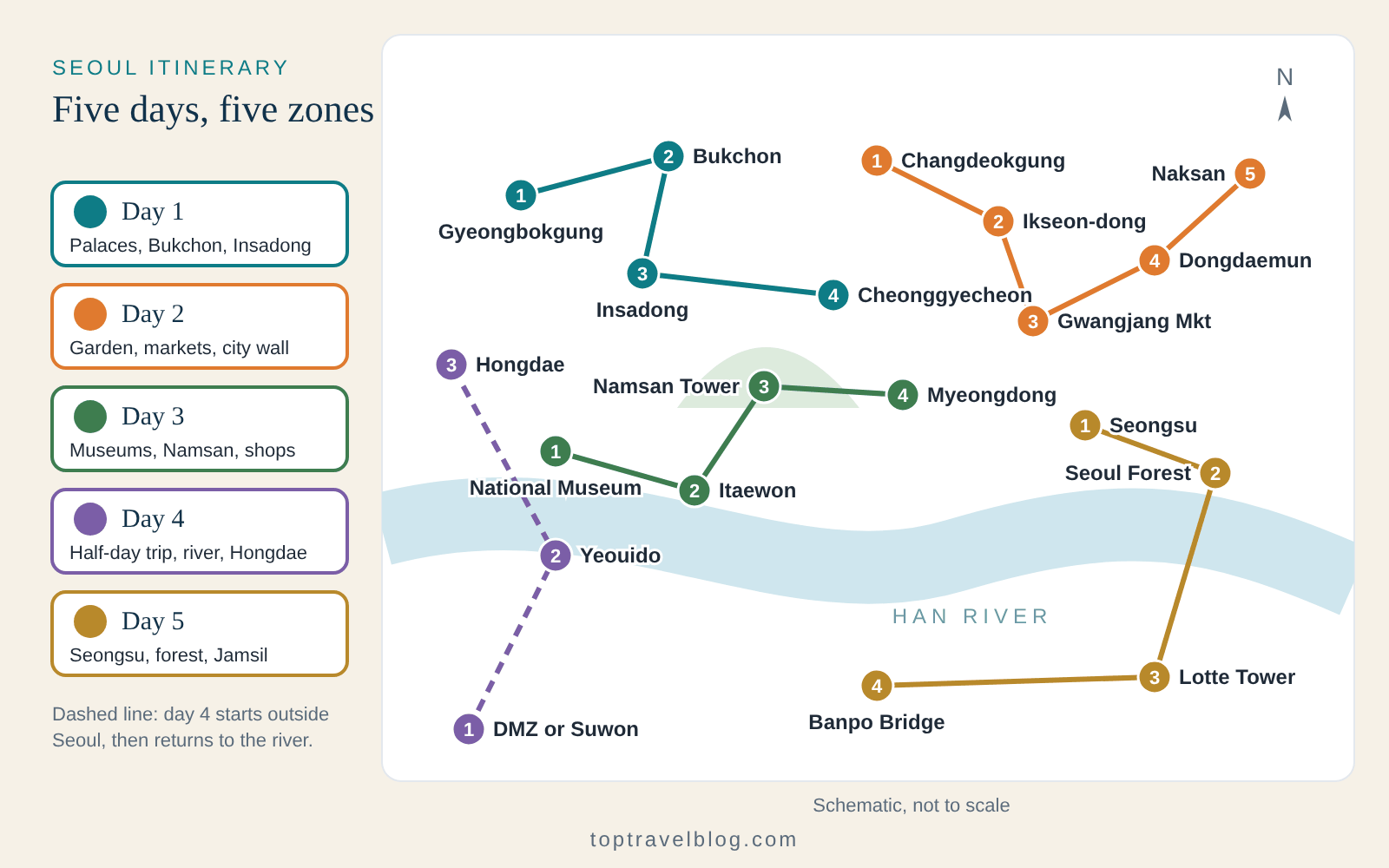
Every day of this Seoul itinerary has a morning, afternoon and evening block, rough walking times and a rain, kids or winter swap. Distances are by subway and on foot, because that is how you will move. Skim the map first to see how the days sit across the city.
Day 1
Gyeongbokgung, Bukchon and Insadong
Morning: Gyeongbokgung at opening time
Take Line 3 to Gyeongbokgung station (exit 5), which opens directly at the palace gate. The palace is the largest and the grandest of Seoul’s five royal palaces, built in 1395, burned in the 1590s, and rebuilt in the 1860s. Admission is 3,000 won, roughly two dollars, and it is free if you wear a hanbok that qualifies, and free for everyone on Culture Day, the last Wednesday of each month. The palace closes on Tuesdays.
Be at the gate when it opens, around 9 a.m. in most months. By 11 a.m. the courtyard is full of tour groups and hanok-clad selfie-takers, and the best photos of Geunjeongjeon throne hall with Bugaksan mountain behind it are gone.
The Soumunjang guard-changing ceremony runs in front of Gwanghwamun Gate at 10 a.m. and 2 p.m., and it is a good reason to be early in the square. Allow about two hours inside: the throne hall, Gyeonghoeru pavilion on its lotus pond, and the Hyangwonjeong pavilion at the back. The Royal Palaces and Tombs Center lists current hours and closing days for every palace.
Midday: Tongin Market and a hanok walk
Leave by the west exit and walk 12 minutes to Tongin Market in Seochon, a covered alley where you buy a string of brass coins and use them at stalls for rice, tteokbokki and side dishes, which you assemble into a lunch tray. A basic lunch comes to about 6,000 to 9,000 won. The coin system is a fun gimmick that actually works.
Then walk east to Bukchon Hanok Village, about 25 minutes. This is the line of tiled-roof houses climbing a hillside, and it is a residential neighborhood where people live. Tourists are allowed in the most-visited lanes only between 10 a.m. and 5 p.m., with a fine of 100,000 won for visiting outside those hours. Keep your voice down, and skip the lane marked “restricted” on weekends.
Afternoon: Samcheong-dong and Insadong
From Bukchon, walk downhill to Samcheong-dong’s cafe street, then to Insadong, the old antiques and tea street, about 15 minutes away. Insadong is touristy and the souvenirs are the same as everywhere, but the tea houses are real and the side alleys of Ikseon-dong, which you will see on day 2, are more interesting. The fish-shaped waffle with red bean is a good snack.
Jogyesa Temple, the head temple of Korean Zen Buddhism, sits two minutes north of Insadong’s main street. Entry is free, and the prayer hall with its lanterns is worth ten minutes.
Evening: Cheonggyecheon and Jongno dinner
Walk to Cheonggyecheon, the stream that was buried under a raised highway until 2005, and follow it east for 20 minutes. It is lit up at night, and the stepping stones are fun for kids. Then eat in Jongno: grilled mackerel, kimchi jjigae or a pork barbecue place. Expect roughly 10,000 to 15,000 won for a stew and 20,000 to 35,000 won a person for barbecue.
The official Visit Seoul site is the best English-language map of palace hours and festivals.
Logistics: Day 1 of the Seoul itinerary covers about 5 miles. Gyeongbokgung station to the palace gate, 5 minutes. Palace to Tongin Market, 12 minutes on foot. Tongin to Bukchon, 25 minutes. Bukchon to Insadong, 15 minutes. Insadong to Cheonggyecheon, 10 minutes.
If it rains: Gyeongbokgung stays open in rain and looks better wet, but its courtyards have little shelter. Swap Bukchon for the National Palace Museum of Korea and the National Folk Museum, both on the palace grounds, then spend the afternoon in the covered shops of Insadong. Keep the evening plan.
With kids: Skip Bukchon’s slope and walk the Cheonggyecheon stream. The National Folk Museum has a children’s wing, and hanbok rentals for kids are cheap. In winter: The palace closes earlier in winter, around 5 p.m., and the afternoon cold is sharp. Do the palace at opening, then warm up with a cup of yuja tea in Insadong.
Day 2
Changdeokgung, Ikseon-dong, Gwangjang Market and Dongdaemun
Morning: Changdeokgung and the Secret Garden
Changdeokgung is the palace UNESCO listed, and it is the one I would see if I could only see one. Built in 1405 as a secondary palace, it follows the shape of the land instead of a rigid grid, and the rear garden, Huwon, is the one section you can enter only on a timed, guided walk. The palace is closed on Mondays. Take Line 3 to Anguk station (exit 3) and walk five minutes.
General admission is 3,000 won. The Huwon tour costs an additional 5,000 won. For this Seoul itinerary it is the one hard booking. English-language Huwon tours run several times a day and reservations are made online through the palace’s booking system, with half of the tickets held for on-site sale. In October and early November they sell out days ahead, so book as soon as your dates are fixed.
The garden walk takes about 90 minutes, on foot, mostly flat, with a guide who explains pavilions, a lotus pond and a 300-year-old juniper. I think it is the best hour and a half in Seoul. The shaded paths also make it a good summer choice.
Midday: Ikseon-dong and Gwangjang Market
Walk 10 minutes to Ikseon-dong, a tangle of tiny hanok-era alleys turned into cafes, boutiques and bakeries. It is pretty, crowded after 1 p.m. and not cheap. Go before noon, take one photo, have one coffee, and keep walking.
Then take Line 1 or Line 5 to Jongno 5-ga and walk to Gwangjang Market. This is the lunch. Order bindaetteok (mung bean pancakes, about 6,000 to 10,000 won a plate), mayak gimbap (small rolls, roughly 4,000 to 5,000 won), tteokbokki, and a bowl of knife-cut noodles. The tables fill at 12:30, so arrive by noon, and sit where the ahjumma tells you to.
Afternoon: Dongdaemun Design Plaza and Naksan
Walk or ride three stops to Dongdaemun, where Zaha Hadid’s silver Design Plaza is free to see from outside and often worth a look inside for an exhibition. Behind it, the Seoul City Wall climbs to Naksan Park, a 20-minute climb that gives the best free view of the old city at sunset, with the wall lit up as the sun goes.
The Ihwa Mural Village below Naksan is a residential hillside. People live there and complain about the noise, so I would walk the wall and skip the village.
Evening: Dongdaemun at night
Dongdaemun’s wholesale fashion malls open from about 8 p.m. to 5 a.m., and the neighborhood’s late-night street food, cutlery alley and spicy fish-stew restaurants are an experience. If you still have energy, the LED rose garden outside Design Plaza is lit after dark. If you do not, go back to the hotel; day 3 starts early.
Logistics: Day 2 of the Seoul itinerary covers about 5 miles. Anguk to Changdeokgung, 5 minutes. Garden tour, 90 minutes. Palace to Ikseon-dong, 10 minutes. Ikseon-dong to Jongno 5-ga, 12 minutes on foot. Gwangjang Market to Dongdaemun, 15 minutes by subway. Dongdaemun to Naksan, 20 minutes on foot uphill.
If it rains: Changdeokgung’s garden tour runs in light rain, and the wet stone is beautiful, but not in a downpour. Swap in the National Museum of Korea (free, huge, indoors) and push Gwangjang Market to the evening.
With kids: Skip Naksan and spend the afternoon at the Design Plaza, whose outdoor lawn and exhibitions suit children. In winter: The Secret Garden tour still runs in winter, but the trees are bare. Book it for the late morning slot and enjoy the quiet.
Day 3
The National Museum, Namsan and Myeongdong
Morning: the National Museum of Korea
Day 3 starts south of the river bend in Yongsan. The National Museum of Korea is free, enormous and quiet on weekday mornings, and it is the best way to understand what you saw in the palaces. Take Line 4 or the Jungang line to Ichon station (exit 2), which connects through an underground passage. It opens at 10 a.m. and is closed on New Year’s Day only, and it stays open until 9 p.m. on Wednesdays and Saturdays.
Give it 90 minutes. Do the Silla gold crowns, the Goryeo celadon, and the Buddhist sculpture room with the Pensive Bodhisattva, which sits in a dim, quiet room made for it. The museum’s grounds and the reflecting pond out front are good for a break.
Midday: Itaewon or Hannam lunch
Two stops by subway, or 25 minutes on foot, takes you to Itaewon. This is the international food district: Turkish, Indian, Mexican, Thai and good Korean in the same street. For a Korean lunch, a bowl of naengmyeon (cold buckwheat noodles) or galbitang soup is about 12,000 to 16,000 won. I would walk the back lanes of Hannam instead of the main Itaewon strip for the independent bookshops and galleries.
If you want history first, the War Memorial of Korea, one stop away at Samgakji, is a serious, free museum on the Korean War and one of the most moving hours in the city. It closes on Mondays.
Afternoon: up Namsan
Take Line 4 to Myeongdong (exit 3) and walk to the Namsan cable car, which departs from a station about ten minutes uphill. A round-trip ticket costs roughly 15,000 won. You can also walk the hillside stairs in 30 to 40 minutes, a fine option in autumn.
At the top, N Seoul Tower’s observatory costs roughly 26,000 won for adults and is open into the late evening. The free alternative is the tower’s plaza terrace, where the love-lock fences are covered in padlocks and the view over the basin of the city is the same. I think the tower interior is optional. Go for the sunset from the terrace.
Evening: Myeongdong and Namdaemun
Walk down through Namsan Park to Myeongdong. After 5 p.m. the main street fills with street food stalls: tornado potato, grilled cheese lobster, egg bread, dumplings and hotteok. Prices are higher than in a market, and a snack runs 4,000 to 8,000 won. It is crowded, which is the point.
For dinner, ignore the main street and walk to Namdaemun Market and its side alleys, where kalguksu (knife-cut noodle soup) and galchi (hairtail fish) alleys feed office workers. A bowl is around 8,000 to 10,000 won.
Logistics: Day 3 of the Seoul itinerary covers about 6 miles. Ichon to the museum, 10 minutes. Museum to Itaewon, 25 minutes. Hannam to Myeongdong by subway, 20 minutes. Myeongdong to the cable car, 10 minutes uphill. Namsan to Namdaemun, 25 minutes on foot.
If it rains: Skip the cable car, because the tower is in cloud. Spend the afternoon in the Leeum Museum of Art in Hannam, then shop underground in Myeongdong and Hoehyeon. The National Museum plus the War Memorial can fill the whole day.
With kids: The National Museum has a Children’s Museum on the grounds, and the Namsan cable car is a ride in itself. In winter: Walk the hillside in the afternoon, when it is warmest. Hot tteokbokki and fish cakes in Myeongdong taste better at 3 degrees.
Day 4
A half-day trip, then Hongdae and the Han River
Option A: the DMZ (best for history)
A DMZ tour is the choice if you want to see where the Korean War ended. Tours leave central Seoul around 7 or 8 a.m. and return by mid-afternoon. They typically stop at Imjingak Park, the Third Tunnel, the Dora Observatory with its view into North Korea, and a checkpoint. A standard tour with a licensed operator runs roughly $50 to $90 a person.
Bring your passport on the day, because soldiers check it. Tours that include the Joint Security Area at Panmunjom are separate, more expensive, and need several weeks of lead time. You will not see the border at close range on a standard tour, but the sense of the place comes through. It is somber and absorbing, and it gives the rest of the trip context.
Option B: Suwon Hwaseong Fortress (best for walking)
If a day at the border does not appeal, take the Line 1 train 50 minutes south to Suwon. Hwaseong is a UNESCO World Heritage fortress built in the 1790s, with a wall that runs for about three and a half miles. You can walk the wall in two to three hours, shoot a traditional bow at Hwaseong Haenggung palace, and finish with Suwon’s famous fried chicken or galbi. Admission is a few thousand won, and it is a much calmer day than Seoul.
I recommend Suwon for repeat visitors and families with younger kids, and the DMZ for first-timers who want the story. Both are back in Seoul by 3 or 4 p.m.
Afternoon: the Han River at Yeouido
Back in the city, take Line 5 to Yeouinaru station and walk to the riverfront. Hangang Park has grass, bike rentals, a floating bridge and convenience-store ramyeon machines. This is where Seoul sits on the grass: buy ramyeon from a GS25 or CU, cook it in the self-service machine, and eat it on the lawn. Rent a mat, order fried chicken for delivery or pick up a convenience-store beer, and watch the sun set over the river.
The Korea Tourism Organization lists the Han River cruise schedules if you prefer a boat.
Evening: Hongdae
Line 2 takes you to Hongik University station in about 15 minutes. On day 4 of the Seoul itinerary, Hongdae is the youth district: street buskers outside the playground, boutique stores, vintage shops, board-game cafes and a lot of bars that stay open until the sun comes up. Dinner can be dakgalbi (spicy stir-fried chicken), or Korean barbecue.
Join the line for a pork barbecue place, order two servings (most places require at least two), and use the tongs and scissors to cut the meat. Allow about 25,000 to 35,000 won per person, plus soju at 5,000 to 6,000 won a bottle.
Logistics: Day 4 of the Seoul itinerary covers about 4 miles on foot. DMZ tours run 7 to 8 hours door to door. Suwon is 50 minutes each way. Yeouinaru to the river, 5 minutes. Yeouido to Hongdae, 20 minutes by subway.
If it rains: Skip Yeouido and move the DMZ or Suwon to a clear day. In the afternoon spend time in the Seodaemun Prison History Hall, or in the Seoul Museum of History, then go straight to Hongdae’s covered cafes and arcades.
With kids: Suwon is easier than the DMZ, and the Hangang playgrounds are free. In winter: The Han River in January is too cold for a picnic. Replace it with a jjimjilbang, the Korean bathhouse: Dragon Hill Spa near Yongsan is open 24 hours and runs about 20,000 won, a very Seoul way to end a cold day.
Day 5
Seongsu, Seoul Forest and Jamsil
Morning: Seongsu-dong
Line 2 to Seongsu station (exit 3) is where Seoul does its design cafes. This former shoe-factory district now hosts brand pop-ups that last a week or a month, so what you see depends on the date. Wander Yeonmujang-gil for the converted warehouses, queue for a bakery or have a coffee at one of the large factory-style cafes. Cafes are pricey here: a coffee is 6,000 to 8,000 won.
Skip the pop-up lines. The buildings are the draw, and you will see them faster than you expect.
Midday: Seoul Forest
A ten-minute walk takes you to Seoul Forest, a 400-acre park with a deer enclosure, a butterfly garden and long wooded paths. On a clear day it is the pleasant alternative to another market. Pick up a gimbap or sandwich on the way for a picnic.
Afternoon: Jamsil and Lotte World Tower
Line 2 runs from Seongsu to Jamsil in 10 minutes. Here, the 1,820-foot Lotte World Tower rises over Seokchon Lake. Seoul Sky, the observation deck on floors 117 to 123, costs roughly 31,000 won for adults, with a faster pass at about double. The glass floor on the 118th level makes people hold the railing.
Book a slot about 60 to 90 minutes before sunset so you see the city change from day to night. The mall below has a large aquarium and a food court that is cheap and easy for a last meal.
If you have children, Lotte World next door is one of the biggest indoor theme parks in the world, with a folk museum and a lakeside amusement park.
Evening: Banpo and a last dinner
Take the subway to Banpo and watch the Moonlight Rainbow Fountain on Banpo Bridge, which runs in the evenings from spring through early autumn. Then end where you started: a pork barbecue, a hot pot or a long, slow dinner in Gangnam, where restaurants book out on weekends. Order the thing you liked best earlier in the week.
Logistics: Day 5 of the Seoul itinerary covers about 5 miles. Seongsu station to Yeonmujang-gil, 8 minutes. Seoul Forest, 10 minutes’ walk. Seongsu to Jamsil on Line 2, 10 minutes. Jamsil to Banpo, 25 minutes by subway.
If it rains: Spend the morning in the Starfield Library at COEX, a two-story book hall free to walk through, then move to Seoul Sky early. Jamsil’s malls and the aquarium are fully indoors.
With kids: Replace Seongsu with Lotte World and the Seoul Forest deer enclosure. In winter: Seoul Sky at sunset is the best winter plan, with clear air and city lights visible by 5:30 p.m.
Getting around on a Seoul itinerary: subway, buses, taxis and the airport
Seoul’s subway has more than twenty lines in the metro area and is clean, air-conditioned and cheap. Signs, announcements and station names are in English, Korean, Chinese and Japanese, and every station has a number you can search. A single ride in the city costs 1,550 won with a transit card, and a bus is 1,500 won.
Transfers between subway and bus within 30 minutes are discounted.
The simplest approach for tourists is the T-money card, sold at convenience stores and subway kiosks for 3,000 won, then topped up with cash. It also works on buses and taxis in the capital area.
A Climate Card, the unlimited pass, runs from 5,000 won for one day to 20,000 won for seven days, plus the card fee. The one-day pass pays for itself at about four rides, but on most days of this plan you will ride three or four times, so a plain T-money card is usually the cheaper choice on a Seoul itinerary like this one.
Foreign credit cards work in most stores, but a T-money card is still the easier way to ride, and you can reload it at any convenience store.
From Incheon Airport to the city
The AREX airport railroad is the best option. The all-stop train costs about 4,150 won to Hongik University, takes under an hour, and the nonstop express to Seoul Station costs 11,000 won and takes about 43 minutes from Terminal 1. The last train leaves at about 11 p.m. The Incheon International Airport website lists the limousine bus routes (roughly 17,000 won) and the taxi stand. A taxi to central Seoul runs 70,000 to 90,000 won depending on traffic.
If you land after the last train, take a limousine bus or the N6000 night bus. Skip taxis from unlicensed drivers who approach you in the arrivals hall.
Taxis and maps
Regular taxis start at 4,800 won, and a night surcharge of 20 to 40 percent applies from 10 p.m. to 4 a.m. Use the Kakao T app for hailing, which accepts foreign credit cards in many cases. For maps, download Naver Map or KakaoMap, because their walking and transit directions are more reliable than most other apps in Korea. The subway closes around midnight, and the first trains leave at about 5:30 a.m.
What this Seoul itinerary costs per day
Seoul is cheaper than Tokyo and much cheaper than New York, but rates have risen. The won is weak against the dollar, which helps. As a rule of thumb, 1,000 won is about 70 cents.
On a budget, a Seoul itinerary like this one runs roughly $70 to $100 a person a day covers a guesthouse bed in a dorm or a small private room, subway rides, market meals at 8,000 to 12,000 won, and palace tickets. Mid-range travelers should plan $150 to $250 a person a day, based on a double room in a good hotel, a mix of casual and sit-down meals, a couple of paid attractions, and taxis at night.
Comfortable travel at $300 and up covers a luxury hotel, a good dinner, private guides and a day of shopping. Flights are the bigger variable: the nonstop from the West Coast is often cheaper than from the East Coast, and the cheapest months are January, February and early December.
Tipping is not expected anywhere, including taxis and restaurants. Tap water is drinkable and the restaurants give you cold water for free. Bring a plug adapter, because Korea uses 220 volts and Type C or F plugs. Many shops offer tax-free shopping with a passport; ask at the till, and bring the receipt to the airport kiosk.
What to book before you fly
The list is shorter than in most cities, which is part of Seoul’s charm. A few things are worth locking in.
Six to eight weeks out
K-ETA, if the exemption ends (see below). Seoul Sky for a clear weekend if your trip includes a Saturday. A hanok stay for the night you want. A Korean barbecue dinner at a restaurant you actually care about, via CatchTable or Naver.
Two to three weeks out
Changdeokgung’s Huwon tour in October and November, in cherry blossom week, and on weekends. A DMZ tour, and especially a Panmunjom one, because small groups fill first. A hanbok rental, if you want a specific shop.
The week of the trip
Everything else in the Seoul itinerary is optional. Palace tickets are bought at the gate, and museums, markets and parks are walk-in. If you want to see a traditional performance, the Jeongdong Theater and Namsan Hanok Village have schedules online.
Entry rules for a 2027 Seoul itinerary
Americans enter South Korea without a visa for up to 90 days. Since 2023, K-ETA, the Korea Electronic Travel Authorization, has been waived for citizens of the United States and 21 other countries, and that waiver currently runs through December 31, 2026. No extension had been announced as of November 2026, so plan as though K-ETA applies to a 2027 trip: apply on the official K-ETA website or its mobile app. The fee is 10,000 won, approval usually arrives within 72 hours, and it is valid for three years.
Apply only through the official site. Look-alike sites charge far more.
Separately, every foreign visitor without a K-ETA fills out the e-Arrival Card online within three days before landing. Your passport needs to be valid for the length of your stay; the State Department lists the full rules on its Korea country page.
Food worth planning your Seoul itinerary around
Food is half the reason people come, and nearly every meal in this Seoul itinerary works without a reservation. A few categories earn a place on the plan.
Korean barbecue, done correctly
Pork belly (samgyeopsal) and beef short rib (galbi) are grilled at your table. Order at least two portions, because that is the minimum at most places, and wrap each piece in a lettuce or perilla leaf with garlic, ssamjang paste and a pickled onion. Expect 20,000 to 35,000 won a person for pork, double for beef. Solo travelers should look for gimbap shops and stew restaurants, because barbecue is a group meal.
Market food
Gwangjang Market on day 2, Namdaemun on day 3 and Tongin Market on day 1 give you three styles. Eat at the stall that has a line of locals, not the one with photos taped to the front. Cash and cards both work at most stalls.
Stews, noodles and one-dish meals
Kimchi jjigae, sundubu (soft tofu stew), bibimbap, naengmyeon and kalguksu each cost 9,000 to 14,000 won and feed one person. This is the cheapest and most reliable way to eat well in Seoul. Many menus show photos, and servers bring side dishes, called banchan, that are free and refillable.
Convenience stores, cafes and fried chicken
A Korean convenience store sells triangle gimbap for about 1,500 won, hot instant noodles, boiled eggs and cold coffee, and it is genuinely good. Cafes are a cultural institution, and a coffee runs 4,500 to 6,500 won. Fried chicken with beer, called chimaek, is eaten at a pub or at the river, and a whole bird feeds two.
Things I’d skip
Chain restaurants in Myeongdong aimed at tour groups, the cheese-and-hot-dog street stalls that charge triple, and any restaurant with a Korean-English menu in six languages and a man at the door pulling you in. Spend your won on a barbecue night and a market lunch.
Common mistakes on a first Seoul itinerary
These are the ones I see most often, in rough order of how much they cost in time, money or mood.
1. Planning a palace on its closing day
Gyeongbokgung closes on Tuesday. Changdeokgung closes on Monday. Plan your Seoul itinerary around those two days before you book flights, and swap day 1 and day 2 if you land on a Monday or Tuesday morning.
2. Booking the Secret Garden late
The Huwon tour is capped, and weekends in autumn disappear. People arrive at the gate hoping for a ticket and leave with only the general palace entry. Book the day your dates are fixed.
3. Sleeping in the wrong district
Staying in Gangnam to see palaces, or in Incheon to save $40, costs you 90 minutes a day. Choose a base near Line 2 or Line 4 and your Seoul itinerary works.
4. Ignoring the Bukchon rules
The hours for tourists in the most-visited lanes are 10 a.m. to 5 p.m., and the fine is real. Residents film visitors who shout or block doors.
5. Skipping T-money and paying cash
Buses in Seoul often don’t take cash. A T-money card in your hand on day 1 saves frustration, especially at 10 p.m. when you need the last bus.
6. Over-scheduling jet lag
Day 1 of a Seoul itinerary after a 14-hour flight is a day for one palace, not three. People who push through fall asleep on a subway seat at 3 p.m. Build in a slow afternoon.
7. Assuming every restaurant has English
Most do not. Learn “hana, dul” (one, two) for portions, “mul” (water) and “juseyo” (please give me), and use the call button on the table. It is normal to press it.
8. Using Google Maps for walking directions
Google’s transit mapping works, but walking routes are often incomplete. Use Naver Map or KakaoMap for walking, and keep Google for translating signs.
Frequently asked questions about this Seoul itinerary
How many days do you need in Seoul?
Five full days is ideal for a first Seoul itinerary, and three is the minimum for a rushed one. Five days lets you see two palaces, a market, Namsan, a half-day trip, Hongdae and Seongsu without sprinting. If you plan to add Busan or Jeju, add two to three days. Count only full days, not arrival and departure days.
Is Seoul expensive?
It sits in the middle of major Asian cities. It is cheaper than Tokyo and Singapore for food and transit, and hotels cost less than comparable ones in Europe. A mid-range traveler on this Seoul itinerary should plan on $150 to $250 a person a day. Food is the great bargain, with hearty meals for $7 to $12 in markets.
Do Americans need a visa for Seoul?
No visa is needed for stays up to 90 days. K-ETA approval has been waived for US citizens through December 31, 2026, and no extension had been announced as of November 2026, so for a 2027 trip you should apply for K-ETA at k-eta.go.kr. It costs 10,000 won and lasts three years.
What is the best month to visit Seoul?
October is my first choice, followed by April and May. October gives you clear skies and autumn color. April brings cherry blossoms. July and August are humid and rainy, and January and February are cold, dry and cheap. The Lunar New Year and Chuseok holidays close many small restaurants for a few days.
Is Seoul safe for tourists?
Violent crime is low and the streets are busy late at night, but pickpocketing and scams exist in crowded areas. Watch for overpriced taxis from the airport, drink spiking in some Itaewon and Hongdae clubs, and fake tour sellers. Keep your phone in a front pocket. The State Department lists South Korea with a Level 1 advisory.
Is Seoul good for first-time visitors to Asia?
Yes. The subway is clear, signs are bilingual, tap-water is drinkable, and card payment is common. English is limited outside tourist areas, so a translator app and Naver Map matter. Many first-time Asia travelers begin here before moving to Japan or Southeast Asia.
How do I get from Incheon Airport to Seoul?
The AREX train is the cheapest and most reliable, at 4,150 won for the all-stop line, or 11,000 won for the nonstop to Seoul Station. Limousine buses stop at major hotels for about 17,000 won. A taxi is 70,000 to 90,000 won. The last AREX train leaves around 11 p.m.
Do I need cash in Seoul?
A little. Credit cards are accepted nearly everywhere, but some market stalls, small cafes and older buses prefer cash or T-money. ATMs in convenience stores accept foreign cards, and withdrawals of 50,000 to 100,000 won at a time are normal. Currency exchange booths in Myeongdong offer good rates.
Can I do a DMZ tour and still see the city?
Yes, on a half-day schedule. Tours leave around 7 or 8 a.m. and return by 3 p.m., which leaves the evening for Hongdae. Build the Seoul itinerary around a standard tour, not a Panmunjom one, unless you can commit a full day. Bring your passport.
Should I rent a hanbok?
If you want free palace admission and photos, yes. Rentals run about 15,000 to 25,000 won for two to four hours near Gyeongbokgung. Wear it only to palaces, and choose a traditional design, because fusion styles may not qualify for free entry.
One last thing before you go
Seoul rewards people who go slowly, and a good Seoul itinerary leaves room for that. The palaces are quiet in the first hour, the markets best at noon, and the city best seen from a hillside at dusk. If you take only one piece of advice from this Seoul itinerary, book Changdeokgung’s garden early and spend the rest of the time following your appetite.
On any Seoul itinerary, treat each evening as a menu rather than a schedule. Five days at this pace is about 25 miles of walking, three early mornings and four late dinners, and the right response to a flagging afternoon is a coffee and a bench, not a fourth stop.
Related planning guides
- Tokyo itinerary: the best 5 days for first-time visitors
- Osaka itinerary: 3 days of food, nightlife, castles and day trips
- Kyoto itinerary: 3 days of temples, food, gardens and historic streets
- 10 days in Japan: Tokyo, Kyoto and Osaka
- Bangkok itinerary: 4 days of temples, markets, food and river views
- How to plan a trip step by step

