

Four days. That is my honest answer to the question I get asked most about this city, and it is the number this rome itinerary is built around.
Four days gives you one full day of ancient Rome (the Colosseum, the Forum and the Palatine Hill), one day at the Vatican, one day in the Baroque center around the Pantheon, Trevi Fountain and Piazza Navona, and one day for Trastevere, the Aventine Hill and Testaccio, where the food is. Three days works if you trim. Five lets you add a day trip or simply sit down more often.
The verdict in one sentence: Rome rewards people who book the three tickets that sell out, start every day before the tour buses arrive, and leave the afternoons loose enough to follow a side street. This Rome itinerary suits first-time visitors, couples, friends and families with kids who can walk for a few hours at a time.
It suits you less if you want a resort holiday with a city attached, or if you cannot manage cobblestones and uneven ground, which cover most of the center.
I have made this trip in July heat, in a February drizzle, with my parents and with a stroller. What follows is the Rome itinerary I would hand a friend: the order of days that stops you crossing the city three times, the current ticket prices and fares as of November 2026, where to sleep, what to eat, and the mistakes I watch visitors make in the Colosseum queue every week.
Quick facts: this Rome itinerary at a glance
- Best for: first-time visitors, couples, friends, families with kids 8 and up, anyone who enjoys walking and eating well.
- Ideal trip length: 4 full days, with an arrival the evening before and a flight home on the morning of day 5.
- How to get around: mostly on foot, plus the metro and buses on a €1.50 BIT ticket (valid 100 minutes). A 48-hour pass is €15. No rental car.
- Booking priorities: Colosseum, Forum and Palatine ticket (weeks ahead), Vatican Museums timed entry (weeks ahead), Galleria Borghese (the 30-day window opens daily, so book on day one), and one dinner reservation per evening.
- Pacing: one anchor area per day, one major site before 11 a.m., a long lunch, and an evening you can drop.
- Key caveats: the Vatican Museums close on Sundays, Rome’s summer heat reaches the low 90s °F, and a €2 fee now applies to the Trevi Fountain basin on most days.

Best time to go: when this Rome itinerary works best
If I could pick one window, it would be mid-April to early June, followed closely by mid-September to late October. Daytime highs sit in the 60s and 70s °F, the light is soft until about 7 p.m., and you can walk from the Colosseum to the Pantheon without feeling like you are being slow-roasted.
Those two windows are also the busiest after the summer peak, so the trade is crowds against comfort, and I take comfort every time.
Here is how I think about each stretch of the year, because the right Rome itinerary changes with the thermometer.
December to February: cold, damp, cheapest
Winter in Rome is not Alpine. Highs are usually in the low 50s °F, nights drop toward freezing now and then, and the real enemy is rain. It rains more in November and December than in any other months, and a wet cobblestone street with a hundred umbrellas on it is a slow place to be.
The payoff is shorter queues, lower hotel rates outside Christmas and New Year, and a city that feels like it belongs to Romans again. Sunsets arrive around 5 p.m., so the Day 1 and Day 3 stops in this Rome itinerary shift indoors earlier. Pack a real coat and shoes that tolerate puddles.
March to May: the best stretch
March is cool and changeable, April brings the first warm afternoons and the wisteria, and May is close to ideal. Easter week is the exception: hotels fill, the Vatican is packed, and the Colosseum sells out far in advance. If your dates are flexible, avoid it.
In May the days stretch past 8 p.m., outdoor tables are open everywhere, and the Roman Forum is still tolerable at noon. This is the season when every day of this Rome itinerary works exactly as written, including the long lunches.
June to August: heat, crowds, and an early alarm
July and August are hot, with highs often in the upper 80s to low 90s °F, occasionally higher, and almost no shade in the Forum or on the Palatine. The strategy is simple: do the outdoor ancient sites at opening time, eat lunch somewhere air-conditioned or leafy, rest from 2 to 5 p.m., and come out again for the evening, when the stone gives back its heat and the city fills with people.
Around August 15 (Ferragosto) many neighborhood restaurants and shops close for a week or two, so the best small places may be dark. The big sites stay open.
Free drinking fountains, called nasoni (the cast-iron taps with a small hole on top), are everywhere. Bring a refillable bottle and use them.
September and October: second best, and my favorite
September stays warm, often into the low 80s °F in the first half, and the crowds ease after the first week. October is when I like to bring friends. Highs are in the 70s °F, the evening light on the travertine is gold, and restaurants have reopened after the summer break.
Rain becomes likelier from late October, so carry a packable jacket. The Colosseum’s closing time moves earlier in late October, which matters for Day 1: from the last week of October the site closes at 4:30 p.m., so you want your entry in the morning.
November: quiet, gray, good value
Early November is a reasonable gamble. Crowds are light, hotels drop, and the days are short but often mild. Rain is the trade-off. If you travel then, put museums on the wet days and the Forum, Aventine and Trastevere on the dry ones.
Tip: Whatever month you choose for your Rome itinerary, look up the sunset time before you book your Borghese slot and your evening plans. In late December the sun sets near 4:50 p.m.; in late June it is after 8:45 p.m. The Day 3 and Day 4 evenings are built around golden hour, so a one-hour shift matters.
How many days you really need for a Rome itinerary
Three full days is the minimum I would defend. Two days means choosing between the ancient sites and the Vatican and skipping the neighborhoods entirely, which is how people come home saying Rome was tiring and crowded rather than wonderful.
For a first Rome itinerary, four days is the sweet spot because each of the city’s big categories gets a day, and because Rome punishes over-scheduling. A tight day of three monuments leaves you frazzled; a day of one monument and two long meals leaves you in love with the place.
With three days, trim the Rome itinerary by merging Day 3 and Day 4: do the Baroque center in the morning and Trastevere in the afternoon, and drop the Borghese and the Aventine. With five days, add a day trip or a slower rhythm. Ostia Antica, the ancient port town, is a 30-minute train ride and has far fewer visitors than the Forum. Tivoli and Orvieto are good full-day alternatives.
The more important question is how Rome fits into a longer trip. If you are building a first big Italy loop, these days slot directly into the 10 days in Italy itinerary covering Rome, Florence and Venice, where Rome takes the first four nights. If you are comparing capitals, the Paris itinerary is built on the same four-day logic.
Worth knowing: Count your days honestly. A 4 p.m. arrival at Fiumicino and a 7 a.m. departure four days later is three days, not four. Arrival evening in Rome is for a walk to the Pantheon after dark and a plate of pasta. Build the 4 days in Rome below around full days and treat anything else as a bonus.
If you are still working out flights and dates, my guide to how to plan a trip step by step covers the order of decisions, and how to find cheap flights explains how to search for the Atlantic crossing without falling for the usual traps. Open-jaw tickets (into Rome, out of Venice or Milan) often cost no more than a round trip, and they save you a day of backtracking.
Where to stay in Rome for a first visit
Where you sleep shapes this trip more than any ticket you buy. Rome’s center is compact but hilly and cobbled, so every extra 15 minutes of walking at the end of a long day feels like 30. The right base lets you go back to the room at 3 p.m. for an hour, which in summer is the difference between a good trip and a miserable one.
My general rule: sleep within a 15-minute walk of either the Pantheon area or the Colosseum area, or in Trastevere or Monti if you prefer residential streets. Avoid the blocks immediately around Termini station unless you need an early train, because the area is grimy at night and noisy, even though the metro hub is convenient.
On price, I never promise a specific nightly rate because it moves weekly. As a rough guide in shoulder season, plain, clean, well-reviewed three-star hotels in the center run about €130 to €220 a night, boutique and four-star places about €220 to €400, and budget guesthouses and hostels well under that. July, August, Easter and December run higher.
Budget for it, because a Rome itinerary also carries a city tourist tax per person per night, paid at the hotel, which ranges from a few euros up to €10 for five-star properties and is usually capped at ten consecutive nights. It is not in the nightly rate on many booking sites. Read the total at checkout, and see how to choose a hotel for how I compare fees and cancellation terms.
The five areas I recommend for a Rome itinerary
Centro Storico (Pantheon, Piazza Navona, Campo de’ Fiori)
Best for: first-timers, short stays, walking everywhere
This is where I put most people on a first Rome itinerary, and it is the base I would choose again. From a hotel between the Pantheon and Campo de’ Fiori you can walk to the Trevi Fountain in 10 minutes, to the Forum in 20 and to the Vatican in 30. The streets are lovely at night and noisy on weekends. Rooms are small, prices are highest, and some places have no elevator, so ask before booking.
Monti (between the Colosseum and Termini)
Best for: couples, ancient-site mornings, a neighborhood feel
A hilltop-feeling district of small streets, wine bars and independent shops, about 10 minutes on foot from the Colosseum. It is calmer than the Centro and a little cheaper. The Cavour metro stop is at the bottom of the hill, and the walk back from dinner is easy. The trade-off is slopes and steps with luggage.
Prati (north of the Vatican)
Best for: Vatican day, families, quieter evenings, value
Wide, orderly streets with good bakeries and a real local lunch scene. You are 10 to 15 minutes on foot from the Vatican Museums and St. Peter’s, and the metro stops at Ottaviano and Lepanto are close. It lacks the cobblestone romance of the Centro and the walk to the Pantheon takes about 25 minutes.
Trastevere
Best for: food lovers, evenings out, returning visitors
The ivy-covered, cobbled district across the Tiber is the most atmospheric place to eat in Rome. It is also loud until late and thick with tourists on weekend nights. Getting to the Colosseum means tram 8 plus a metro or a 35-minute walk. I recommend it if dinner is the center of your trip.
Testaccio and the Aventine
Best for: food obsessives, budget-minded, repeat visitors
Residential, local and home to the old slaughterhouse neighborhood’s classic Roman cooking. The Piramide metro stop (line B) puts you two stops from the Colosseum. It is the least touristy base on the list, with the fewest hotels and a quieter night life. The trade is distance from the Vatican and Trastevere’s tourist energy.

What to check before you click book
Three things. First, the walk from the hotel to the nearest metro stop or tram line, measured in minutes with luggage rather than on a map. A hotel that is 15 minutes from the station and up a hill is a different hotel from one that is five minutes away.
Second, whether the building has a working elevator and whether the room has air conditioning. In July and August the second matters more than the star rating. Third, the real room size in square feet or square meters. Under about 150 square feet is tight for two people with roller bags, and plenty of historic-building rooms are exactly that.
For two people on a first trip, I would book Centro Storico if the budget allows and Monti if you want to save money and sleep better. For a family with children under 10, Prati is the calm choice, and it puts the Vatican, the one place where a long queue with a child is a real risk, ten minutes from the bed.
The 4-day Rome itinerary, day by day
Each day of this Rome itinerary has one anchor area, so you never zigzag across the Tiber and back. Mornings start early, because the big sites are measurably better at 9 a.m. than at 11, and evenings are designed to be dropped if your feet are done. Walking times in this Rome itinerary are real-world times at a visitor’s pace with photo stops, not the optimistic ones from a map app.
Transit times include the walk to the platform and a reasonable wait. Bring comfortable shoes with grip. The cobblestones, called sampietrini, are slick after rain and unkind to thin soles.
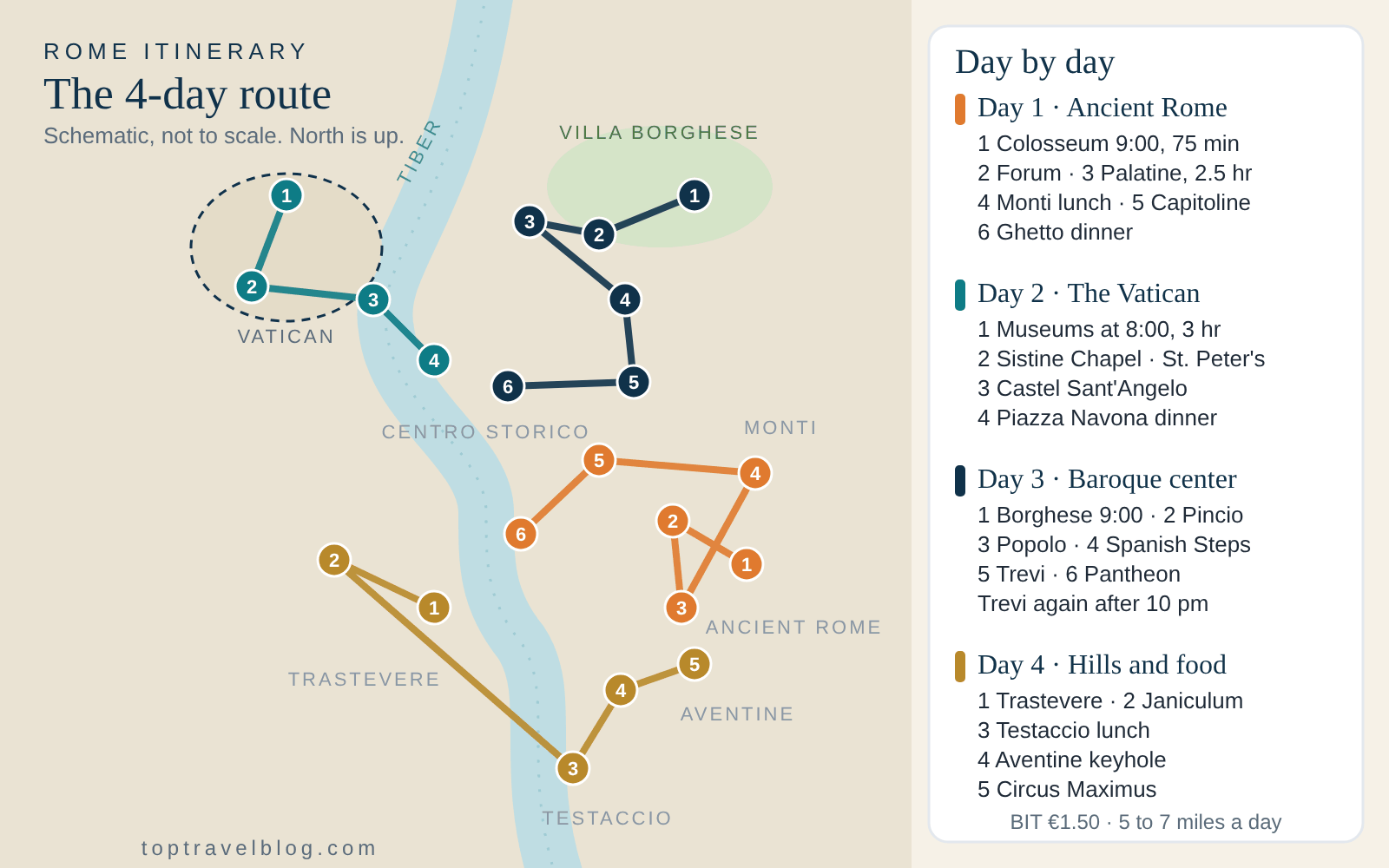
Day 1
Ancient Rome: the Colosseum, the Forum and the Palatine
Morning: the Colosseum at opening time
Book the combined ticket for the Colosseum, Roman Forum and Palatine Hill in advance on the official ticketing site, and choose the first entry slot of the morning. As of November 2026 the standard combined ticket is €18 and it is valid for 24 hours from your Colosseum entry. Under-18s enter free, and EU citizens aged 18 to 25 pay €2.
Take the metro to Colosseo (line B) and arrive 20 minutes before your slot. The security line is the only queue you should face. The tickets are named, so keep your passport or a photo of it handy in case you are asked.
Inside, go up to the second level if your ticket includes it, since the view across the arena floor is the best one. Give the Colosseum about 75 minutes. For a deeper look, the underground and arena-floor tickets cost €24 and sell out within minutes of release, and I would only chase one if the hypogeum is the reason you came to Rome.
Worth knowing: People in costumes outside the Colosseum will offer photos with a fake gladiator or a Roman soldier and then demand a payment that is several times what they implied. Guides who approach you in the queue and promise to skip the line are selling a tour at a markup. Your pre-booked ticket already skips the sales queue.
Late morning: the Forum and the Palatine
Leave the Colosseum and walk along the path past the Arch of Constantine toward the Arch of Titus, about five minutes. There is a Forum entrance next to the Arch of Titus, and your combined ticket works there with a short wait. Walk down the Via Sacra, the ancient processional road, with the Basilica of Maxentius on your left and the ruins of the Temple of Antoninus and Faustina ahead.
The Roman Forum is a field of broken columns, and it comes alive only if you know what you are looking at. Download a free audio walk or read the plaques, and look for three things: the Curia, where the Senate met; the Rostra, the speakers’ platform; and the Temple of Vesta, home of the sacred flame. Budget 90 minutes.
Then climb the Palatine Hill, the hill on which Romans placed the legendary birthplace of the city. The shaded gardens, the ruins of the imperial palaces and a rare view down over the Circus Maximus are the reward. Give it 60 minutes and drink at the fountains, since there are almost no cafés inside the site.
Most of the route is uneven, and there are some staircases. Mobility-limited visitors can ask at the entrances about the accessible routes, which cover the Colosseum’s lift and parts of the Forum.
Lunch: Monti
Exit the Forum on the Via dei Fori Imperiali side and walk 10 minutes uphill to Monti. The best lunch spots are on the small streets around Piazza della Madonna dei Monti, along Via Urbana and Via Leonina. Look for places with a short menu in Italian and a table of locals, order the pasta of the day, and expect to pay roughly €14 to €20 for a pasta main and a glass of house wine.
Sit down. Give lunch an hour and a half, because the time between 1 and 3 p.m. is when the sun is strongest and the Forum is least pleasant.
Afternoon: Capitoline Hill and Piazza Venezia
Walk down to Piazza Venezia (15 minutes from Monti) and climb the broad ramp to Michelangelo’s Piazza del Campidoglio on the Capitoline Hill. This is the one square in Rome I would call perfectly composed, with the paving pattern he designed and the equestrian statue of Marcus Aurelius (a copy; the original is inside) at its center.
The Capitoline Museums on either side of the square are a good wet-weather choice and hold the she-wolf bronze and the colossal head of Constantine. Allow 90 minutes if you go in. Otherwise walk around to the terrace behind the Palazzo Senatorio for a frame-filling view over the Forum, which costs nothing.
Next to the square is the white marble Vittoriano, the monument to Italy’s first king. Locals call it the wedding cake, and not kindly. You do not need to go in. The view from its terrace is good, though the free viewpoints on the Capitoline and the Janiculum Hill (Day 4) are better value.
Evening: the Jewish Ghetto and dinner
Walk 10 minutes from the Capitoline to the Jewish Ghetto, home to one of the oldest Jewish communities in Europe and to Rome’s best fried artichokes. Walk the Via del Portico d’Ottavia, past the ruins of the portico, and choose one of the restaurants along it for carciofi alla giudia, a crisp, whole fried artichoke that tastes like nothing else in Italy.
Booking is wise for a dinner table, especially Thursday through Saturday. For a lighter option, buy a slice of the dense ricotta and sour cherry tart from the old bakery on Via del Portico d’Ottavia and eat it on the steps.
After dinner, the walk to the Colosseum lit up at night is about 20 minutes, and the area around it is nearly empty by 10 p.m. It is one of the best free things you can do on this trip.
Logistics: Day 1 of the Rome itinerary covers about 5 to 6 miles on foot, much of it on uneven ground. Metro to Colosseo, five minutes to the Colosseum entrance, ten to the Forum gate, ten uphill to Monti, fifteen to Piazza Venezia and ten to the Ghetto. If it rains, move the Capitoline Museums to the afternoon and keep the Forum for a drier day. With kids, skip the Palatine and spend the saved hour on gelato.
Day 2
The Vatican: museums, the Sistine Chapel and St. Peter’s
Morning: the Vatican Museums
The Vatican Museums hold roughly seven kilometers of galleries, and the Sistine Chapel is at the very end. Book a timed entry on the official Vatican Museums site for the first slot of the morning; the museums open around 8 a.m. Monday through Saturday. As of November 2026 tickets bought online cost €25, which is the €20 admission plus a €5 booking fee.
The museums are closed on Sundays, except the last Sunday of each month, when entry is free from 9 a.m. to 2 p.m. and the lines are enormous. I would never choose that day. Reduced tickets for ages 7 to 18 and students are about half price, and children under 7 are free.
The Vatican leg of the Rome itinerary has a dress code, and it is enforced: shoulders and knees must be covered. A light scarf or overshirt in your bag solves it.
Take the metro on line A to Ottaviano and walk about 10 minutes, or walk from a Prati hotel. Look for the entrance on Viale Vaticano, not the one at St. Peter’s Square, which is a different entrance with a different line.
Late morning: how to pace the museums
The route through the museums is long and mostly one way, and it funnels toward the Sistine Chapel. Do not try to see everything. My order is the Pinecone Courtyard, the Gallery of Maps (a 120-meter corridor with painted ceilings that most people shuffle through), Raphael’s Rooms, then the Sistine Chapel.
Give the museums two and a half to three hours. Talking is not allowed in the chapel and photography is banned. Guards will say “silenzio” more than once, and they mean it.
If you are tempted to pay for a guided tour, I think it is worth it for the Vatican more than for any other Rome site. The collection is vast and poorly signed, and a good guide can get you to the highlights in 90 minutes. Book with the museums themselves or a licensed operator, and be skeptical of anyone offering a skip-the-line promise on the street.
Lunch and St. Peter’s Basilica
Individual visitors cannot walk from the Sistine Chapel straight into St. Peter’s; that shortcut is for guided groups. Everyone else exits the museums and walks around the Vatican wall to St. Peter’s Square, about 15 minutes. Eat before you go.
Prati has the best lunch near the Vatican. Skip the restaurants along the wall and go five or six blocks to the Via Cola di Rienzo area, where there are Roman pizzerias, bakeries and sandwich counters. Pizza al taglio, rectangular slices sold by weight, costs about €3 to €6 a piece and is the fastest great lunch in Rome.
St. Peter’s Basilica is free to enter. The only wait is the security screening, which can reach an hour at midday and a lot less at 7:30 a.m. or after 4 p.m. The dress code matches the museums. Give the church 45 minutes and look for Michelangelo’s Pieta in the first chapel on your right.
Afternoon: the dome and Castel Sant’Angelo
The climb to the dome of St. Peter’s is the best view in Rome and the one optional extra I would keep in any Rome itinerary, and it is hard work. It is 551 steps if you use the stairs the whole way, and the cost runs from roughly €10 to €22 depending on whether you take the lift for the first part. The last stretch is a narrow, curving, leaning staircase, not for anyone claustrophobic. Allow 90 minutes including the queue.
If you skip the dome, walk down the broad Via della Conciliazione toward the Tiber and into Castel Sant’Angelo, the hilltop fortress that began life as the emperor Hadrian’s tomb. Admission is €15, with no booking needed on ordinary days. The terrace has a wide view of the city, and the cross-river walk over the angel-lined Ponte Sant’Angelo that follows is one of the loveliest short walks in Rome.
Evening: Piazza Navona and dinner nearby
From Ponte Sant’Angelo, walk 10 minutes through the lanes to Piazza Navona, the oval square built over a Roman stadium. At 6 p.m. in spring or fall the light is soft and the square is full of people but not yet full of artists pressing prints on you. Bernini’s Fountain of the Four Rivers is at its center.
Do not eat in the square itself, a rule that holds across the whole Rome itinerary, because the prices are high and the quality is not. Walk five minutes in any direction, to Via del Governo Vecchio or toward Campo de’ Fiori, and sit where the menu is short. Reserve a table for 8 p.m. or later, since Romans rarely eat before then.
Logistics: Day 2 of the Rome itinerary covers about 6 miles on foot, with a lot of standing in galleries rather than walking. Metro to Ottaviano and 10 minutes to the entrance, a 15-minute walk from the exit to St. Peter’s Square, 20 minutes down the Via della Conciliazione to the castle, and 10 more to Piazza Navona. On Wednesdays, the papal general audience takes over St. Peter’s Square in the morning and tightens the security screening, so arrive early or go in the afternoon.
Tip: In summer, climb the dome first thing in the morning and save the museums for after lunch, because the museums are air-conditioned and the dome is exposed to the sun. In winter, flip it back. Shoulder seasons suit the dome best, since the stairs are cooler and the view is clear.
Day 3
The Baroque center: Borghese, Spanish Steps, Trevi and the Pantheon
Morning: Galleria Borghese and the park
The Borghese Gallery is the best small museum in Rome, the one that sells out first, and the one I would never drop from a Rome itinerary. Bernini’s Apollo and Daphne and Caravaggio’s paintings sit in a villa that admits visitors in two-hour sessions only, five times a day, and there is no ticket counter for walk-ups. As of November 2026 admission is €16 plus a €2 booking fee.
Slots open on a rolling window of about 30 days on the gallery’s official site, so book the 9 a.m. session the moment your date appears. If you miss it, try again in the days before you travel, since cancellations reappear.
Take a taxi or walk from the Spagna metro stop through the Pincio gardens, about 25 minutes, and plan to arrive 15 minutes early, because you must collect your ticket and leave bags in the cloakroom. Give the visit its full two hours. It is smaller than the Vatican and denser per square foot than anything else in the city.
After the gallery, spend an hour in Villa Borghese park. Walk to the Pincio terrace at the west edge, which looks down over Piazza del Popolo and across the rooftops to the dome of St. Peter’s. It is the best free view at this end of the city, and it is a good place for a coffee from a cart.
Late morning: Piazza del Popolo to the Spanish Steps
Walk down the ramps from the Pincio into Piazza del Popolo (five minutes), then along Via del Babuino, a quiet street of antique shops and galleries, to the Spanish Steps (15 minutes). The steps are a crowd magnet rather than a monument, and sitting on them is not allowed. Take a photo from the bottom, climb to the top for the view, then leave.
The shops on the Via dei Condotti are a short detour if you want luxury brands. If you do not, skip it and save the time for lunch.
Lunch: near the Pantheon
Walk 15 minutes from the Spanish Steps to the Pantheon district through Via del Corso, or take a bus. This is the heart of the Centro Storico and the area where the best Roman cooking meets the highest tourist density, so be choosy. Look for places a block or two away from the main squares, and make a reservation for dinner at the better-known ones days ahead.
For a quick lunch, a supplì (a fried rice ball with melted mozzarella inside) or a slice of pizza bianca with mortadella from a bakery counter costs under €5 and tastes like the real Rome.
Afternoon: the Trevi Fountain and the Pantheon
Walk 10 minutes to the Trevi Fountain. In 2026 the city began charging tourists a €2 fee to enter the basin, the stone steps directly in front of the water. The piazza itself is still free, and the fountain is visible from everywhere in it. The charge applies on most days from 9 a.m. to 10 p.m., with later starts on Mondays and Fridays. Rome residents, children under 6 and people with disabilities are exempt.
You can pay online through the official Trevi Fountain site or at the entrance, and payment is electronic only. I think the fee has made the experience better. The basin is calmer, and you can actually see the fountain. Go in the late afternoon when the light turns it golden, or return after 10 p.m., when entry is free and the crowd is thinner.
Walk eight minutes to the Pantheon, the best-preserved building of ancient Rome and the largest unreinforced concrete dome in the world. The oculus, the nine-meter hole in the roof, lets in a column of light and, in rain, a column of water.
Entry costs €7 as of mid-2026 and the building is open from 9 a.m. to 7 p.m. daily, with the last entry at 6:30 p.m. It is free on the first Sunday of the month. Tickets are sold through the museum ticketing site rather than the church’s own page.
Give the Pantheon 30 minutes. Mass is held on Sunday mornings and Saturday evenings, and entering for worship does not require a ticket.
Evening: coffee, gelato and the squares
Five minutes from the Pantheon is Sant’Eustachio, a coffee bar famous for its sweet, foamy espresso, and nearby is Piazza Navona, which you saw at the end of Day 2. Walk the other way instead, toward Campo de’ Fiori and the lanes to the south, where the evening crowd is local.
Dinner is the main event of Day 3 of the Rome itinerary. Reserve at one of the classic Roman trattorias in the Centro or Monti and order the Roman four: carbonara, cacio e pepe, amatriciana and gricia. Share two and add a plate of cicoria or puntarelle on the side. A full meal with wine runs roughly €35 to €60 a person at a good place.
After dinner, walk back to the Trevi Fountain. After 10 p.m. the basin is free again, and by 11 the square has thinned enough to hear the water.
Logistics: Day 3 of the Rome itinerary covers about 6 to 7 miles on foot. Taxi or 25-minute walk to the Borghese, 15 minutes down to Piazza del Popolo, 15 to the Spanish Steps, 12 to the Trevi, 8 to the Pantheon. If it rains, the Borghese stays and the Pincio becomes a coffee stop under an umbrella. With kids, skip the Spanish Steps and add the Capitoline Museums if you did not go on Day 1.
Day 4
Trastevere, the Aventine, Testaccio and the best of Roman food
Morning: Trastevere before the crowds
Take tram 8 from Largo Argentina to Trastevere (about 10 minutes) or walk across the Ponte Sisto from Campo de’ Fiori (15 minutes). Trastevere is best before 10 a.m., when the lanes are quiet, the shutters are going up and the cobbles are being hosed down.
Walk to the Basilica of Santa Maria in Trastevere, one of the oldest churches in Rome with 12th-century gold mosaics in the apse. It is free to enter and rarely crowded in the morning. Give it 20 minutes. Then wander the lanes behind it, with their ivy, laundry and small workshops, for as long as you like.
Late morning: the Janiculum Hill
Climb the Janiculum Hill (Gianicolo) from Trastevere on foot, a steep 15 to 20 minute walk up the Via Garibaldi stairs. The terrace at the top has one of the widest views of Rome, from the dome of St. Peter’s to the Pantheon, the Vittoriano and beyond. A cannon is fired at noon every day, a tradition that goes back to the 1800s, and children love it.
If the climb sounds like too much after three days, take a taxi up and walk down. There is a puppet theater and a small cafe at the top.
Lunch: Testaccio
Walk down the hill and across the river to Testaccio via Tiber Island and the Ponte Palatino or Ponte Sublicio, about 35 minutes, or take a taxi for 10. Testaccio is where Rome’s working-class cooking was invented, built from the cheaper cuts of the old slaughterhouse. You will find tripe, oxtail, and a rare place to eat very well for a fair price.
The covered food market at Testaccio is the casual choice: sandwiches, supplì, fruit and a supplì-and-wine lunch for less than €15. For a sit-down meal, book a table at a traditional trattoria on Via Marmorata or Via Luca della Robbia a few days ahead.
Afternoon: the Aventine Hill and the keyhole
Climb the Aventine Hill from Testaccio, about 15 minutes uphill, to the Orange Garden (Giardino degli Aranci), a free terrace with orange trees and a long, calm view across the Tiber to St. Peter’s. It closes at sunset.
A few minutes along the street is the Knights of Malta keyhole, a green door on Piazza dei Cavalieri di Malta. Look through it and you see a perfectly framed view of St. Peter’s dome at the end of a hedge-lined garden path. There is usually a queue of 5 to 10 people, but it moves fast, and it is one of those small Rome moments that people remember.
Then go down to the Circus Maximus, the ancient chariot racing ground, now a long, grassy oval with a view of the Palatine, and walk toward the Bocca della Verita (the Mouth of Truth) on the way back across the river. The line there is long for a 10-second photo, so go only if you have children.
Evening: Trastevere at night
Take a taxi or tram back to Trastevere for your final dinner. Book ahead, because the best places fill up days before. Cacio e pepe, supplì and a carafe of house wine at a small place off the main squares is the right way to end four days in Rome and the right last page of this Rome itinerary.
After dinner, walk along the Tiber or climb to the Janiculum again for the night view, which is worth it for the lights alone. If you have energy left, walk back to the Pantheon area, which is lit up at night and almost empty after midnight.
Logistics: Day 4 of the Rome itinerary covers about 6 to 7 miles on foot, with a steep uphill section on the Janiculum and a second one on the Aventine. Tram 8 to Trastevere in 10 minutes, a 15-minute climb up the Janiculum, a 35-minute walk down to Testaccio, 15 minutes up the Aventine, and a 25-minute walk or short taxi back.
In rain, replace the hills with the Capitoline Museums or the Ara Pacis and spend longer at lunch. In summer, skip the Janiculum climb at midday.
If you have a fifth day: extending the Rome itinerary
To stretch the Rome itinerary by a day, my first choice is Ostia Antica, the ancient port of Rome, 30 minutes from the city by train from Porta San Paolo (next to the Piramide metro stop) on the regional line, and covered by an ordinary city ticket. Its streets, mosaics, theater and bakeries are better preserved than the Forum, with a fraction of the crowd. Take water and a hat, and plan on three hours.
My second choice is Tivoli, with the Renaissance fountains of the Villa d’Este and the ruins of Hadrian’s Villa, which needs a full day. For a food and wine day, the Castelli Romani hills south of the city are an easy escape by regional train.
Rain, heat, kids and mobility: how to adjust this Rome itinerary
No plan survives contact with the weather, so here is how I bend the Rome itinerary above without throwing it out. The rule is to keep your booked, timed tickets where they are and move the flexible outdoor pieces around them.
When it rains
Rome in the rain is moodier and more crowded indoors. Keep the Colosseum, Vatican and Borghese bookings, since they are timed and mostly roofed. Swap the Palatine and the Janiculum for the Capitoline Museums, the Ara Pacis, the Crypta Balbi or the National Roman Museum at Palazzo Massimo, which holds some of the best ancient frescoes and mosaics in the city.
Churches are free, dry and full of art. Sant’Ignazio, San Luigi dei Francesi (with three Caravaggios in a side chapel) and Santa Maria sopra Minerva are all within a five-minute walk of the Pantheon. A wet afternoon in those is a perfectly good version of the Rome itinerary.
When it is very hot
In July and August, treat the Rome itinerary as two shifts. Go out at 8 a.m., finish the outdoor sites by 12:30, eat lunch inside, and rest until 5. The evening shift, from 6 p.m. to 11 p.m., is when the city is at its best. Wear a hat, carry water and use the nasoni.
On the hottest days, move the Forum and Palatine to the first slot of the morning and make the Vatican Museums your afternoon, because the galleries are air-conditioned. Churches stay cool too, even at midday.
Traveling with children
Children under 18 enter the Colosseum free and children under 7 are free at the Vatican Museums, so a family Rome itinerary is cheaper than it looks. Pace is the difficulty. Plan one major site a day, with an hour of free play in a park or piazza afterward. Villa Borghese has bike and pedal-cart rentals, and the Janiculum cannon fires at noon.
The Vatican Museums are the hardest sell for kids under 10. Give them a scavenger task, such as finding the ceiling painted with stars or the golden pinecone, and cut the visit to two hours. Gelato is a legitimate bribe at every stage.
Limited mobility
Rome is hard on wheelchairs and walkers because of cobblestones, curbs and steep streets. The Colosseum, the Vatican Museums, St. Peter’s and the Borghese Gallery all have accessible routes, and the museums publish details on their official sites. Taxis are the practical answer between sights, and metro stations vary a lot in whether they have working lifts.
On a mobility-friendly version of this Rome itinerary, I would drop the Palatine, the Janiculum climb and the Aventine, and replace them with a taxi ride to the viewpoints and a long lunch in the Centro. Choose a hotel with a lift, on a flat street, in the Centro Storico or Prati.
Traveling solo or as a couple
This Rome itinerary works well alone. Rome is easy to enjoy solo because eating at the bar, walking and visiting churches are all normal single-person activities, and the small trattorias are friendly to one-person tables if you arrive at opening time. Couples tend to prefer the evening shifts and a base in Monti or Trastevere.
For solo travelers, the main adjustment is dinner. Choose a counter seat or a wine bar with a small menu, and consider a guided food walk on Day 4 to meet other travelers.
Getting around: Rome public transport, taxis and airport transfers
Most of this Rome itinerary is done on foot, which is why your shoes matter more than any other item you pack. The center is smaller than it looks on a map. The Colosseum to the Pantheon is about 35 minutes, the Pantheon to the Trevi Fountain 10, and the Trevi to the Spanish Steps 12.
Public transport fills the gaps in the Rome itinerary, mainly for the long hops to the Vatican, the Borghese and Trastevere. Rome has three metro lines (A, B and C), a large bus network and a handful of trams, all run by ATAC, and the ATAC website lists current tickets and routes.
Tickets and passes
The basic ticket is the BIT, at €1.50 and valid for 100 minutes from the first validation, on buses, trams and the metro, with a single metro ride in that window. For visitors, ATAC also sells the Roma 24H at €8.50, the Roma 48H at €15 and the Roma 72H at €22, each valid from first use, and a weekly CIS card at €29.
In a four-day Rome itinerary I use the metro or bus perhaps six or eight times, so a stack of BIT tickets (about €9 to €12 in total) often costs less than a 48-hour pass. If you plan a day trip on regional rail inside the city zone, such as Ostia Antica, the BIT still works for it. Validate paper tickets at the machines on buses and at the gates in the metro, or you risk a fine.
The Roma Pass costs €38 for 48 hours or €58 for 72 hours and includes transport and entry to a set of sites, including the Colosseum. It does not cover the Vatican Museums. Do the math before buying: if you book the Colosseum, Borghese and Castel Sant’Angelo anyway, the pass rarely saves money, and it does not let you skip the timed-entry requirement at the busiest sites.
The metro, buses and trams
The metro is fast but limited. Line A links Termini, Barberini (for the Trevi), Spagna (for the Spanish Steps) and Ottaviano (for the Vatican). Line B serves Termini and the Colosseo stop. Line C runs through the east and south and is of little use to visitors. It runs from about 5:30 a.m. to 11:30 p.m., later on Friday and Saturday nights.
Buses reach the places the metro does not, but they are slow in traffic. Tram 8 from Largo Argentina to Trastevere is the one I use most. Bus 40 and 64 run from Termini to the Vatican area, and 64 has a reputation for pickpockets, so keep your bag in front of you. Google Maps and Citymapper both work well for live routing.
Italian transport strikes are announced in advance and usually last 24 hours, often on a Friday. Core service bands are guaranteed in the morning and evening, but expect delays. If a strike falls on the day you booked the Vatican, walk, which is entirely possible from Prati.
Taxis and ride apps
Use only licensed white taxis with a meter, from a taxi stand or by phone or the official app. Do not accept offers from people in the arrivals hall. From Fiumicino airport to anywhere inside the Aurelian Walls, the fare is a fixed €50, and from Ciampino it is a fixed €31. Inside the center, a short ride usually costs €10 to €15, with surcharges at night, on Sundays and for luggage.
Uber exists in Rome but only dispatches licensed taxis and black cars, so it is not much cheaper. For late nights and hills, a taxi is cheap by US standards and worth it.
From the airport
From Fiumicino (FCO), the Leonardo Express train takes about 32 minutes to Termini, leaves every 15 minutes from roughly 6:23 a.m. to 11:23 p.m., and costs €14. The regional FL1 train costs a few euros less but goes to Trastevere, Ostiense and Tiburtina rather than Termini, which can be more convenient if you are staying in Trastevere or Testaccio. A taxi is the best choice for two or more people with luggage, at €50.
From Ciampino, the budget-airline airport, buses to Termini take 40 to 50 minutes. The city’s BIT ticket works on the ATAC buses 520 and 720 that link the airport to the metro network. For late arrivals, a taxi at the fixed rate beats a long wait.
Worth knowing: If you land at Fiumicino after about 11:30 p.m. the Leonardo Express has stopped running, so book a taxi at the fixed rate or arrange a hotel pickup in advance. Some nights, you will arrive to a taxi line of 40 minutes, and an unlicensed driver will offer you a ride at a higher price. Walk to the official rank.
What this Rome itinerary costs per day
A Rome itinerary costs less than a London or Paris one, and noticeably cheaper than most major US cities for food. Exact costs depend on your hotel more than anything, so I split the budget into tiers. The numbers below are per person per day, for two people sharing a room, with hotel costs excluded. Figures are in euros because that is what you will pay; the euro has been trading a little above a dollar.
Lean: about €70 to €100 a day
Breakfast is a standing cappuccino and cornetto at a bar for about €2.50 to €4 in total. Lunch is pizza al taglio or a sandwich for €5 to €9. Dinner is pasta and a drink at a neighborhood trattoria for €18 to €28. Entry fees average €15 to €20 a day if you pick one paid site and rely on free churches, piazzas and viewpoints.
Comfortable: about €130 to €190 a day
Breakfast at a nicer cafe, a sit-down lunch with a glass of wine for €20 to €30, and a three-course dinner for €40 to €60 with wine. Entry fees run €25 to €40 a day because you add the Vatican Museums, the Borghese and the dome. A taxi or two a day fits this budget.
Generous: about €250 and up a day
A guided small-group tour for the Vatican or the Colosseum underground, a long dinner with a good bottle, and taxis door to door. Private guides can cost several hundred euros for a half day, so decide whether you want one for a single day only.
Add the hotel on top, plus the Rome tourist tax at the front desk and any resort or cleaning fees. Many restaurants add a coperto, a cover charge of roughly €1.50 to €3 per person, and a few add a service charge on the bill. Both are legal, both are printed on the menu, and tipping beyond that is not expected. Rounding up or leaving a euro or two for good service is plenty.
For the rest of the budget, think about the flight first, since the Atlantic crossing is often the largest line item. My guide on how to find cheap flights covers that, and the 10 days in Italy itinerary adds train costs between cities.
Tickets you must book ahead for a Rome itinerary
Every Rome itinerary has a short list of things that sell out, and it is the same list every year. Book these before your flights if you can, and the rest of the trip falls into place.
The Colosseum, Forum and Palatine
The combined ticket is sold on the official Colosseum ticketing site at €18 and covers the Colosseum, Forum and Palatine for 24 hours. The first slots of the morning sell out first. The archaeological park’s official site also lists the underground and arena tickets, which are €24 and sell out within minutes, and the attic at €26.
Buy from the official site only. Resellers charge €30 to €50 for the same entry with an audio guide, which can be fine if you want one, but compare before you click. Name your tickets correctly, because they are tied to a visitor name.
The Vatican Museums
Book the timed ticket on the official Vatican Museums site as early as your plan is firm. Online tickets are €25 with the booking fee. The free last-Sunday entry is not a bargain, because the queue can be several hours. Sundays otherwise, the museums are closed.
Tours from licensed operators cost more than the basic ticket but are often sold out last, and for some dates they are the only way in. Choose one that lists a maximum group size and an exact start time.
Galleria Borghese
Entry is by reservation only, in 2-hour sessions at 9, 11, 1, 3 and 5. Tickets are €16 plus a €2 booking fee. The booking window on the gallery’s official site is about 30 days, and slots in spring and fall can vanish within hours of release. If you want the Borghese on your trip, set a calendar reminder for 30 days before your date.
The Pantheon, the Trevi Fountain and others
The Pantheon now has a paid entry (€7 from mid-2026), sold through the museum ticketing site and also at the door, though a pre-booked ticket saves time in the summer. The Trevi Fountain basin fee is €2 and can be paid online or on site. Castel Sant’Angelo is €15 and rarely needs advance booking outside holiday weekends.
Dinner reservations are the last category. The best Roman trattorias book out several days to a week ahead, especially for Friday and Saturday. Book your four dinners when you book your hotel, because a Rome itinerary without reservations turns into a hunt for tables, and you will not spend the trip wandering hungry.
A note on skip-the-line tours
Rome has more third-party ticket resellers than any city I know. Some are legitimate and charge extra for a guide or audio, and some are simply the same ticket at twice the price. If a site does not say clearly that it is an authorized reseller and what is included, do not buy. When in doubt, the official sites for the Colosseum, the Vatican and the Borghese are the safest.
Food and experiences worth planning your Rome itinerary around
Eating is half of any good Rome itinerary, and it is the half most visitors waste on the tourist menus around the monuments. Roman cooking, the best argument for any Rome itinerary, is simple, salty and cheap when done properly, and it follows a few rules you can learn in a day.
The four pastas
Carbonara (guanciale, egg yolk, pecorino and black pepper, never cream), cacio e pepe (pecorino and black pepper), amatriciana (guanciale and tomato) and gricia (guanciale and pecorino, the white version of amatriciana). Order one in the first meal, another in the second, and by Day 4 you have a favorite. A plate costs roughly €12 to €18 at a good local place and €18 to €24 near the monuments.
Other things to order
Supplì (fried rice croquettes with a mozzarella center), carciofi alla giudia in the Ghetto in spring and winter, pizza al taglio with a thin, crisp base, maritozzo (a sweet cream-filled bun, a Sunday-morning tradition) and, if you are adventurous, coda alla vaccinara (oxtail stew) or trippa in Testaccio. A good Roman pizza, thin and charred, is not the same as the Neapolitan style, and a good one costs around €8 to €14.
Coffee is a standing ritual. Order at the bar, drink it standing, pay a euro or so and leave. Cappuccino after 11 a.m. marks you as a tourist, although no one will say so. Ask for a caffe if you want espresso.
Gelato
The rule is to avoid heaped, brightly colored mounds in the windows. Real gelato sits in covered metal tubs, in muted colors, with banana looking gray and pistachio looking brownish green. A small cup costs €2.50 to €4. Eat one each afternoon.
Eating schedule and etiquette
Restaurants open for dinner at 7:30 or 8 p.m., and the kitchen closes between 3 and 7. If you are hungry at 4, a bar with panini or a pizza al taglio counter is your answer. Tap water from the nasoni fountains is drinkable and free. A bottle of house wine in a carafe at a trattoria costs about €10 to €18, and it is usually the right choice.
If you want a guided food walk, the Testaccio and Trastevere tours are the best ones, and a good guide opens doors you would not otherwise knock on. If you enjoy planning around meals, the Barcelona itinerary is built the same way, with tapas and late dinners at the center.
Common mistakes on a first Rome itinerary
These are the errors I watch visitors make, in rough order of how much they cost.
1. Overloading each day of your Rome itinerary
The Forum, the Colosseum and the Vatican are each a half-day or more. Two big sites in a day is a good pace, and three is a forced march. Cut something before you leave rather than during.
2. Booking tickets too late
The Colosseum, the Vatican Museums and the Borghese all sell their best slots weeks ahead. Waiting until you arrive means the afternoon slot in the heat, or nothing at all.
3. Visiting the Vatican on a Sunday or Wednesday morning
The museums are closed on Sundays except the last of the month, when they are free and packed. Wednesday mornings bring the general audience and tighter security around St. Peter’s. Pick a Tuesday or Thursday for the Vatican leg of your Rome itinerary if you can.
4. Wearing the wrong clothes
The dress code at St. Peter’s and the Vatican Museums requires covered shoulders and knees, and it is enforced at the door. Carry a scarf. Sandals with thin soles are a bad idea on the cobblestones.
5. Eating on the tourist squares
Restaurants right on Piazza Navona, the Trevi Fountain and the Colosseum charge more for worse food. Walk two blocks, read the menu, and look for a place with a handwritten daily special.
6. Skipping the afternoon break in summer
From 2 to 5 p.m. in July, the sun and the crowds win. Eat a long lunch, go back to the hotel, and come out in the evening. The ancient sites reward a morning start.
7. Ignoring pickpockets
The Termini area, the metro line A, bus 64 and the crowds at the Trevi, the Colosseum and the Spanish Steps are where pickpockets work. Keep your phone and wallet in a front pocket or a zipped bag, and be alert when someone bumps you or distracts you. Rome is easy to enjoy with those habits, and the Rome itinerary above keeps you out of the worst spots at the worst hours.
8. Taking unlicensed taxis
Drivers who approach you at the airport or the station offer a ride at a high price. Use the official white taxis and the fixed airport fare, or a pre-booked transfer.
9. Paying for the wrong thing
A Roma Pass that you do not use enough, a skip-the-line voucher from a reseller, a photo with a costumed gladiator and the coperto on a menu you did not read are small leaks that add up. Read before you pay.
10. Planning no empty time
The best hours I have spent in Rome were unplanned ones: a church I walked into to escape the rain, a bench in a quiet piazza watching a dog chase pigeons. A good Rome itinerary leaves at least one afternoon open.
Frequently asked questions about this Rome itinerary
Is 4 days in Rome enough for a first visit?
Yes, and it is the length this Rome itinerary is built on. Four full days cover ancient Rome, the Vatican, the Baroque center and Trastevere with the Aventine and Testaccio, each with some slack.
Three days works if you merge the last two days. Five days lets you add Ostia Antica or Tivoli. Count only full days, because a late-afternoon arrival does not count.
What is the best order for the Colosseum, Forum and Palatine?
Start at the Colosseum at your first timed slot, then walk to the Forum through the entrance by the Arch of Titus, and finish on the Palatine. The combined ticket is valid for 24 hours from the Colosseum entry, so you can also split the Forum and Palatine into the next morning if it is hot.
How far in advance should I book the Colosseum and Vatican?
I book both at least three to four weeks ahead, and for Easter, summer and December I book as soon as flights are set. The Galleria Borghese is the exception: its slots open about 30 days in advance and the best ones go within hours.
Can I visit the Vatican and the Colosseum on the same day?
You can, but I would not. The two sites are on opposite sides of the center, each needs a long morning and each has strict timed entry. Spread across two days, the trip feels like a holiday; squeezed into one, it feels like an exam.
Is the Roma Pass worth it?
Rarely for four days, in my experience. It costs €38 for 48 hours or €58 for 72, includes transport and a set of sites, and does not cover the Vatican Museums. If your plan has only two or three paid sites, buying tickets and BIT fares separately costs less. It makes sense only with a packed museum schedule.
Do I need to pay to see the Trevi Fountain?
Not to see it. The piazza is free. Since February 2026 tourists pay €2 to enter the basin steps, from 9 a.m. to 10 p.m. most days (11:30 a.m. start on Mondays and Fridays). Rome residents and children under 6 are exempt, and the basin is free to enter outside those hours.
What should I wear in Rome?
Comfortable, closed, grippy shoes first. For churches, the Vatican and St. Peter’s, shoulders and knees must be covered, so carry a scarf or light overshirt in warm weather. In summer, choose breathable fabrics, a hat and sunscreen. In winter, add a waterproof coat and an umbrella.
Is Rome walkable, and do I need a car?
Rome’s center is very walkable, and a car is a liability because most of the center is a limited traffic zone (ZTL) with automatic fines for entering, plus parking is scarce. Use your feet with the Rome itinerary above, the metro, trams and the occasional taxi. A car only makes sense for day trips outside the city, and a train is easier for most.
What is the best time of year to follow this Rome itinerary?
April to early June and mid-September to October. The temperatures are comfortable, the days are long, and the sites are open on full schedules. Summer is workable with early starts and midday breaks, and winter is quieter, cheaper and wetter.
Can I do this Rome itinerary with kids?
Yes, with edits to the Rome itinerary. Skip the Palatine climb on hot days, take a long lunch, and let them see the Colosseum from the second level rather than doing a full tour. Children under 18 enter the Colosseum free and kids under 6 skip the Trevi fee. Gelato, the Janiculum cannon and the Mouth of Truth help.
What are the biggest scams and annoyances to watch for?
Fake gladiators who demand photo fees, bracelet sellers who tie a bracelet on your wrist and ask for money, unlicensed taxi drivers, restaurants that add large undisclosed charges and pickpockets on buses and the metro. Say a firm no, keep walking and keep your bag in front.
One last thing before you go
The thing I would do differently next time, every time, is leave one afternoon completely empty. Not free time to shop, not an optional museum, but nothing, with the intention of walking out of the hotel and turning wherever the light looks better.
My best hours in Rome were never the ones I planned. An afternoon organ rehearsal in a church near Piazza Navona, a table in Trastevere that a stranger gave up for us, a wrong turn on the Aventine that ended at a garden gate with a view of the dome. A Rome itinerary is scaffolding. The city fills it in.
The other thing I would say is to be kind to yourself about pace. Four days of this Rome itinerary adds up to roughly 24 miles of walking, three early mornings and four late dinners. It is normal to hit a wall on the afternoon of Day 2, and the fix is an hour in a dark hotel room, not a fourth church.
Treat the evenings as a menu rather than a schedule. The fountains, the hills and the long lunches will still be here when you come back, and most people do. Build the first trip so that you want to.
If Rome is one stop on a bigger European trip, the London itinerary and the 10 days in Spain itinerary use the same planning style, and the hub guides for Vienna, Prague, Budapest and Amsterdam cover the capitals people often pair with Italy.
Related planning guides
- 10 days in Italy: Rome, Florence and Venice itinerary — where these four Rome days fit inside a first big Italy trip.
- How to plan a trip step by step — the framework behind every itinerary on this site, from idea to booked.
- How to find cheap flights — a search strategy for the transatlantic leg that costs more than the hotel.
- How to choose a hotel — location, fees and cancellation terms, the things that matter in a tight old center.
- Paris itinerary: the best 4 days for first-time visitors — another four-day European capital, planned the same way.
- Barcelona itinerary: 3 days of Gaudí, tapas, beaches and old town — a warmer, looser city if Rome leaves you wanting a beach.